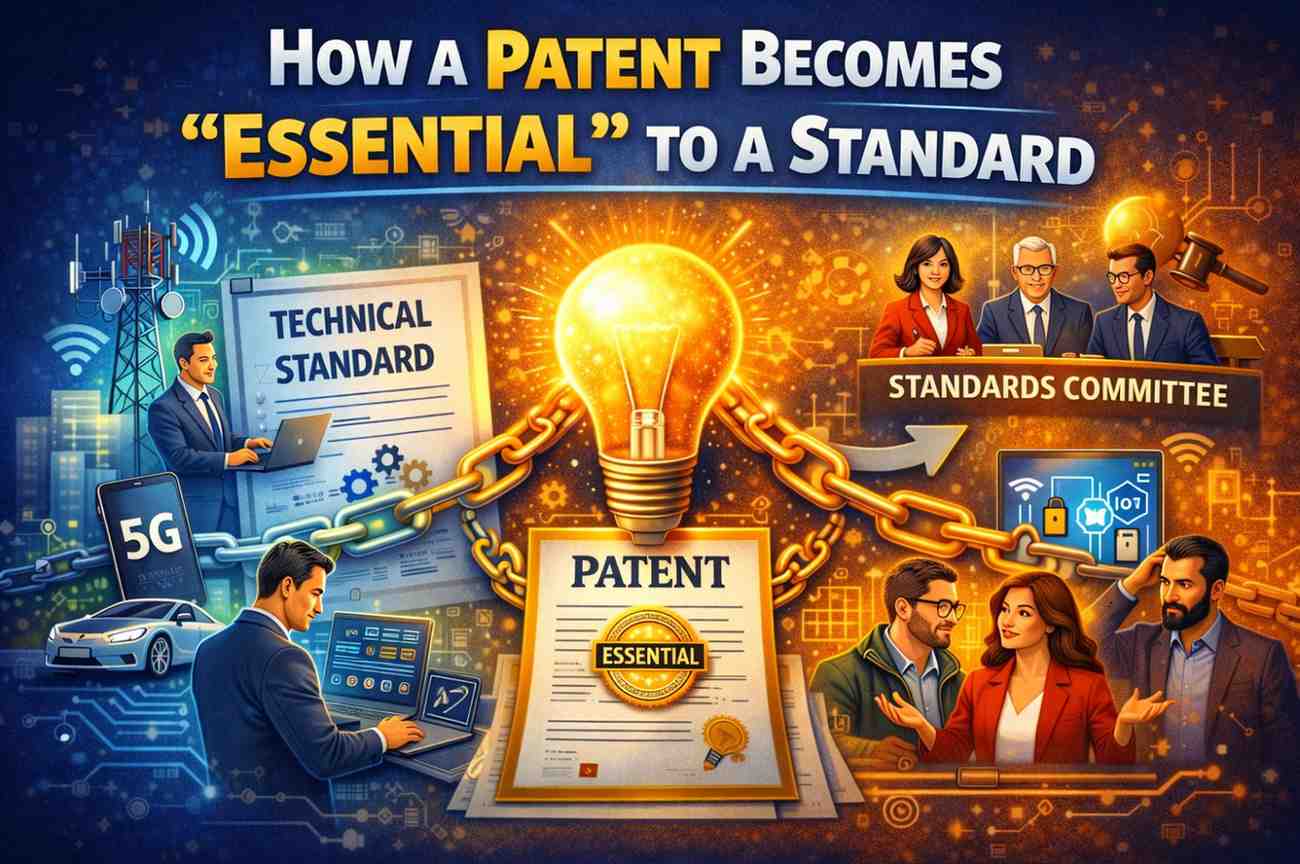
A patent does not become powerful by accident. It becomes powerful when the world starts using it without even knowing it. That is what happens when a patent becomes “essential” to a standard. This article explains, in plain and simple words, how that happens, why it matters so much, and what founders and engineers can do today to put themselves in that position. If you are building real tech that others will copy, depend on, or build on top of, this is one of the most important things you will ever understand. And if you want help turning your work into patents that actually matter, not dusty PDFs, PowerPatent is built for exactly this moment. You can see how it works here: https://powerpatent.com/how-it-works
What a “Standard” Really Is and Who Decides It
A standard is not a law. No one forces companies to follow it. And yet, once a standard exists, almost everyone does. That is what makes standards so powerful.
They are shared rules that the market agrees to use because life is easier that way. For businesses, standards quietly decide who wins, who follows, and who gets paid for decades.
To understand how a patent becomes essential, you must first understand how standards are born, shaped, and locked in.
This section explains that process in very clear terms and shows where businesses can step in early, even if they are small.
A standard is a promise between strangers
At its core, a standard is a promise. It is a promise that if you build something in a certain way, it will work with what others build. Phones connect to networks.
Devices talk to routers. Files open on different machines. None of that happens by magic.
Businesses agree on standards because customers demand things that work everywhere. No one wants a phone that only works with one tower or a charger that fits only one brand. Standards solve that pain.

For a company, agreeing to a standard means giving up some freedom in exchange for scale. You cannot do everything your own way, but you gain access to a much bigger market.
That trade is why standards spread fast once they take hold.
Standards are written before the market explodes
One mistake founders make is thinking standards appear after a market is mature. In reality, most standards are shaped early, when things are still messy and unclear. This is when choices matter most.
At this stage, many technical paths are possible. Different designs compete. Different methods exist.
Over time, the group chooses what feels best, cheapest, fastest, or safest. Once those choices are written into a standard, they become very hard to change.
For businesses, this early phase is where influence is highest. If your invention solves a real problem during this window, it has a chance to become baked into the rules everyone follows later.
Standards bodies are not mysterious clubs
Standards are usually decided by groups called standards bodies. These are not secret rooms filled with lawyers. They are working groups made up of engineers from many companies.
These people meet to solve real technical problems. They argue over details. They test ideas. They care deeply about performance and reliability. Business politics exist, but technical merit matters a lot.
For startups, this is important. You do not need to be a giant company to be heard.

You need to bring something useful, clear, and well thought out. Many key ideas in major standards came from small teams with strong technical insight.
Big companies do not control everything
It is easy to assume that large corporations decide standards behind closed doors. That is not how it usually works. Big companies influence standards, but they cannot force broken ideas through if they do not work.
Engineers in standards groups care about real-world use. They care about edge cases. They care about things not breaking at scale. If your solution clearly handles a hard problem better than others, it will be discussed seriously.
This is where strategy matters. A business that understands the technical pain points of a standard can position its invention as the clean answer everyone needs.
Standards are built from tiny technical choices
Most people imagine standards as high-level documents. In reality, they are collections of small technical decisions. How often a signal repeats. How errors are handled. How timing works. How conflicts are resolved.
Each small choice can hide deep value. If your invention covers one of these choices, and the standard relies on it, that invention becomes unavoidable.
For businesses, this means the most valuable patents often do not describe full products. They describe methods, flows, or rules that seem small but sit at the heart of how things work.
The difference between optional and required
Not every part of a standard is mandatory. Some features are optional. Others are required. This difference matters more than anything else when it comes to essential patents.
If a feature is optional, companies can avoid it. If it is required, they cannot. A patent only becomes essential when the standard requires that behavior.
Smart businesses watch for this distinction. They focus on inventions that solve problems the standard must address, not nice-to-have extras.
Standards reward clarity, not complexity
Another common mistake is thinking that complex inventions win in standards. In practice, the opposite is often true. Simple, clear solutions are easier to agree on and easier to implement.
Standards groups favor ideas that reduce risk and confusion. If your invention can be explained simply and implemented cleanly, it has a much better chance of being adopted.

From a patent angle, this means writing claims that match how engineers think, not how lawyers talk. Clear descriptions of steps, flows, and outcomes matter more than fancy words.
Timing decides who matters
Joining a standards discussion too late is like showing up after the rules are written. You can complain, but change is unlikely. Early involvement gives you a seat when decisions are still flexible.
Businesses that track emerging standards early gain a huge edge. They can align their product roadmaps and patent filings with where the standard is heading, not where it has already landed.
This does not mean guessing wildly. It means watching technical drafts, open problems, and working group discussions. Patterns appear quickly if you pay attention.
Why patents must be filed before consensus
Once a group agrees on a technical solution, it is too late to claim you invented it. Patent systems care about who filed first, not who spoke loudest.
If your idea is likely to become part of a standard, filing early is critical. Waiting until the standard is published often kills your chance to protect the core idea.
This is where many businesses fail. They contribute ideas openly without protection, hoping goodwill will carry them. It rarely does.
PowerPatent exists to solve this exact problem. It helps teams capture their inventions quickly, in language that matches how standards actually work, with real attorneys guiding the process.
You can see how that works here: https://powerpatent.com/how-it-works
Standards lock in behavior for decades
Once a standard is adopted, it moves slowly. Products ship. Infrastructure is built. Backward compatibility becomes sacred. Even better solutions struggle to replace what is already in place.
For a business, this means one good decision can create value for decades. A single essential patent tied to a long-lived standard can generate steady leverage long after the original product changes.
This is why standards strategy should not be an afterthought. It should be part of how you think about building and protecting your technology from day one.
Seeing standards as a roadmap, not a threat
Many founders see standards as constraints. In reality, they are maps showing where the industry is going. They reveal what problems matter most and what solutions will be used at scale.
If you align your invention with these needs, you increase both adoption and defensibility. Your work becomes part of the foundation others must build on.

Understanding who decides standards and how they decide them is the first step. The next step is seeing how patents slide into these decisions and become impossible to avoid.
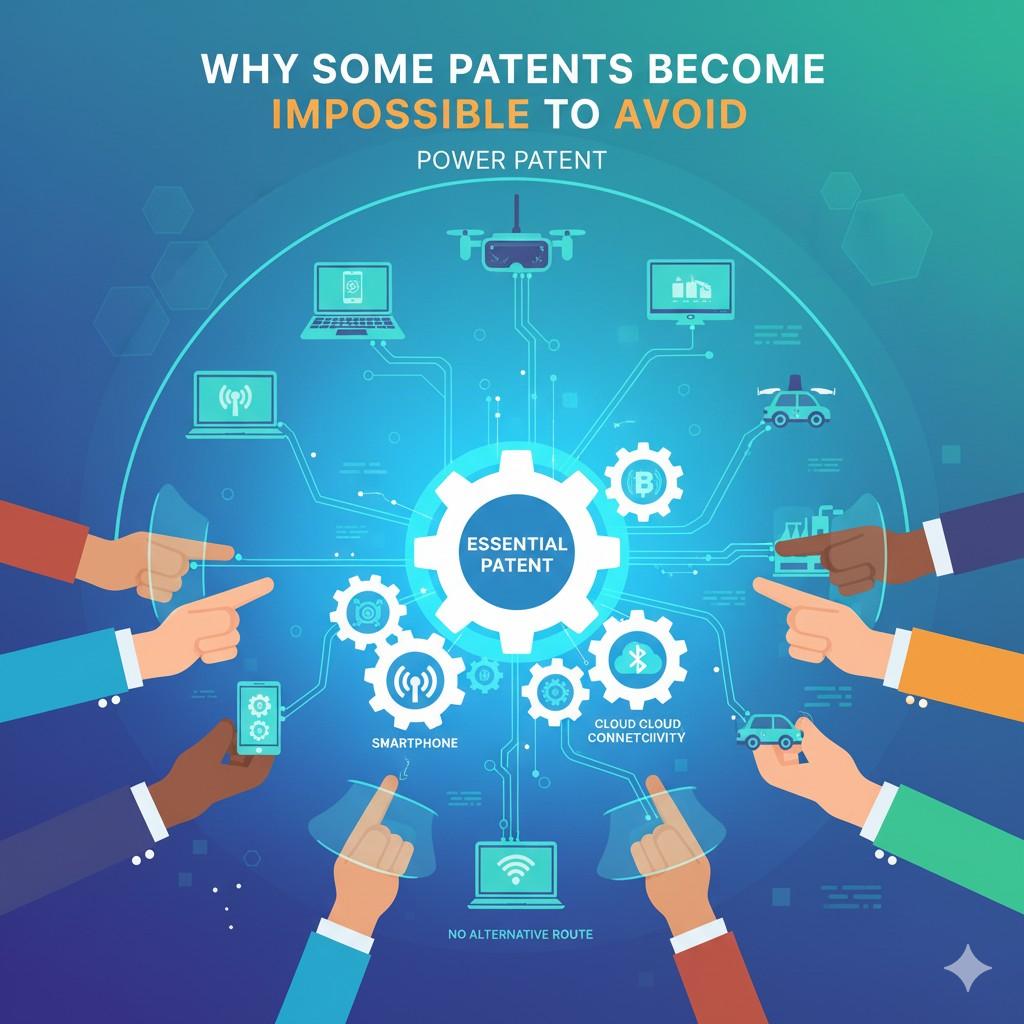
Why Some Patents Become Impossible to Avoid
Not all patents carry weight. Many exist on paper but never touch the real world. Others quietly sit at the center of how an industry works.
These are the patents no one can avoid, not because of threats, but because the market itself pulls everyone toward them.
This section explains how that happens and how businesses can position their inventions so avoidance is not an option.
Avoidability is the real test of patent strength
A patent only matters if someone cannot easily go around it. If a competitor can change a small detail and move on, the patent has little power. Truly strong patents leave no clean exit.
In standards-driven markets, avoidability disappears when the standard itself depends on a specific behavior. If following the rules requires using a certain method, that method becomes unavoidable.

For businesses, this means the goal is not to patent everything. The goal is to patent the part no one can skip.
Standards force convergence on one path
Markets are full of choices at the start. Different designs compete. Different approaches exist. Over time, standards collapse this diversity into one shared path.
When that happens, alternatives stop mattering. Even if another way exists in theory, it no longer matters in practice. Products must follow the agreed path to work with everything else.
Patents that sit on this path gain natural power. No enforcement effort is needed to make them relevant. Use of the standard triggers use of the patent.
Essential patents solve required problems
Standards are created to solve problems that must be solved for a system to work. Timing issues. Interference. Errors. Security. Coordination.
If a patent covers a solution to one of these required problems, and the standard adopts that solution, the patent becomes essential. There is no optional checkbox to turn it off.
Businesses should study standards drafts and discussions to spot these required problems early. That is where essential inventions live.
The quiet power of default behavior
Many standards rely on default behavior. These are actions that happen automatically unless someone goes out of their way to change them.
Patents covering default behavior are especially hard to avoid. Even if alternatives exist, most implementations will follow the default for simplicity and compatibility.
For a business, designing inventions that naturally fit default flows increases the chance of becoming unavoidable.
Why implementation details matter more than headlines
Standards documents often look dry and technical. Buried inside are small implementation details that shape everything.
A few lines describing how retries work or how conflicts are resolved can define how millions of devices behave. If your patent covers that detail, it sits at the center of massive scale.

This is why businesses should not only read summaries of standards. They should study the details where real behavior is defined.
Avoidance costs drive adoption
Even when alternatives exist, avoiding a core part of a standard often costs more than using it. Extra complexity. More testing. Higher failure risk.
Companies choose the simplest path that works everywhere. If a patented solution is the simplest path, it becomes the default choice.
From a strategy view, inventions that reduce complexity have higher odds of being adopted widely and becoming unavoidable.
Backward compatibility locks things in
Once products ship, backward compatibility becomes critical. New versions must work with old ones. This freezes many design choices in place.
If a patented method is part of this frozen layer, it becomes nearly impossible to remove later. Even better ideas struggle to replace it.
Businesses that file early and align with initial versions of a standard gain this long-term lock-in effect.
Consensus creates permanence
Standards are built on consensus. Once consensus is reached, changing course is slow and painful. Many stakeholders must agree.
This inertia protects early technical decisions. A patent tied to one of these decisions gains durability that few other assets have.
Understanding this dynamic helps businesses focus on early influence rather than late reactions.
Essential does not mean obvious
Many essential patents do not look impressive at first glance. They may cover a small step or rule.
What makes them essential is not size, but position. They sit at a junction everything passes through.
Businesses should train themselves to see systems, not features. Value lives in the flow, not the surface.
Why broad patents are not always better
Chasing broad claims can backfire. Standards groups resist vague or overly broad ideas. They want precision.
Patents that mirror specific technical behaviors often fit standards better than abstract ones. Precision aligns with how standards are written.
This is where careful drafting matters. The patent should read like an engineer explaining how something works, not a lawyer stretching words.
PowerPatent is designed to help teams do exactly that. It translates real technical work into clear, defensible patents that match how standards actually operate.
You can explore how that process works here: https://powerpatent.com/how-it-works
The role of early disclosure
Standards groups encourage open discussion. Ideas are shared early. This creates risk for businesses that do not protect their inventions first.
Once an idea is public without protection, it may be impossible to patent later. Timing matters more than perfection.

Smart teams file early, then participate openly. This protects value while still contributing to the ecosystem.
Why small teams can still win
Large companies have resources, but small teams have focus. They often solve specific hard problems faster.
Standards reward useful solutions, not company size. If your invention clearly solves a required issue, it will be taken seriously.
Patents allow small teams to hold their ground once their ideas are adopted. Without protection, influence fades quickly.
Turning technical insight into leverage
The moment a patent becomes essential, it turns technical insight into business leverage. Licensing. Partnerships. Negotiation power.
This leverage does not come from aggression. It comes from being part of the foundation others rely on.
Businesses that understand this aim their R&D toward foundational problems, not surface features.
Seeing avoidance before it happens
A useful exercise is to ask one question early. If someone tried to avoid this idea, what would break?
If the answer is compatibility, performance, or compliance, you may be close to something essential.
This mindset helps teams design inventions that sit deeper in the stack, where avoidance is costly.
Preparing for the next section
Understanding why some patents become impossible to avoid sets the stage for the most important question. When exactly does this window open, and how do you know you are in it?
That hidden moment is where most value is created or lost.
The Hidden Moment When Essential Patents Are Born
Most people think essential patents are created when a standard is finalized. That belief costs companies millions. The truth is quieter and far more uncomfortable.
Essential patents are usually born much earlier, before anyone is sure what the standard will become, when the problem is clear but the answer is not.
This section explains that hidden moment. It shows where it lives, why it is easy to miss, and how businesses can spot it while others are still debating surface details.
The moment happens before anyone says “standard”
The most important phase happens when people are still saying things like “best practice,” “proposed approach,” or “working assumption.” No one is calling it a standard yet. There is no final document. Just drafts, talks, and experiments.
This is when engineers are trying to make things work at all. They are not polishing language. They are fixing failures.

Patents filed during this phase have a unique advantage. They describe solutions before consensus hardens. Once consensus forms, the door starts to close.
Pain comes before agreement
Every standard begins with pain. Systems fail to connect. Performance breaks at scale. Security holes appear. Latency grows. Costs explode.
These pains force people into a room. The room may be a working group, a forum, or a shared repository. The reason does not matter. The pain does.
The hidden moment appears when everyone agrees on the pain but not yet on the fix. That gap is where essential inventions are born.
Businesses that chase shiny features miss this. Businesses that chase pain find leverage.
Early solutions shape later rules
The first workable solution often sets the direction. Even if it is not perfect, it frames how people think about the problem.
Later proposals tend to adjust around it rather than replace it completely. This creates momentum. Momentum becomes preference. Preference becomes requirement.
If your invention is part of that first workable solution, it can quietly shape the standard without loud promotion.
Engineers decide before committees vote
Formal votes come late. Real decisions happen earlier, when engineers test ideas and say, “this one actually works.”
Once engineers start building against a method, it gains credibility. Removing it later means rework, risk, and delay.

Patents tied to ideas that engineers already rely on are much harder to dislodge. The decision is emotional as much as technical.
Drafts reveal more than final documents
Final standards hide the struggle that created them. Drafts reveal it. They show which ideas were debated, which failed, and which survived.
Businesses that read drafts carefully can see where the center of gravity is moving. Repeated language. Reused diagrams. Familiar flows.
These signals show where the standard is settling. Filing during this drift phase can capture what will soon become fixed.
The danger of waiting for clarity
Founders often wait for clarity before filing. They want certainty. That instinct feels safe but is often fatal.
By the time things are clear, novelty is gone. The idea feels obvious because everyone has accepted it.
The hidden moment rewards speed, not certainty. Filing early, even with some ambiguity, preserves options.
PowerPatent is designed for this reality. It lets teams capture inventions as they evolve, without slowing down development, and with real attorneys ensuring quality.
You can see how that works here: https://powerpatent.com/how-it-works
The role of prototypes and pilots
Many essential ideas appear first in prototypes. Quick hacks. Temporary fixes. Proofs of concept.
These are often dismissed internally as “not final.” But standards do not care about polish. They care about what works.
If a prototype solves a core problem and others start copying the approach, the hidden moment has arrived.
Businesses should treat working prototypes as potential IP assets, not disposable code.
Language locks ideas in place
Once a certain way of describing a solution spreads, it becomes hard to change. Words shape thinking.
If your invention introduces a new term or framing that others adopt, it can anchor the solution in the standard.
Patents that align with this shared language feel natural and inevitable. Those that fight it feel forced.
Informal adoption precedes formal rules
Before something is required, it is often recommended. Before it is recommended, it is often used “because it works.”
This informal adoption phase is where avoidance disappears quietly. By the time rules catch up, behavior is already set.
Watching what people implement, not just what they discuss, reveals when the hidden moment is happening.
Why contributions without protection are risky
Many teams share ideas freely, hoping to influence direction. Influence without protection is fragile.
Once an idea spreads, it no longer belongs to you in practice unless it is protected. Others can implement it freely.

Filing before sharing does not block collaboration. It ensures recognition and leverage later.
The emotional bias toward shipping
Startups are wired to ship. Patents feel like a distraction. This bias causes teams to skip the hidden moment entirely.
The irony is that filing early often takes less time than dealing with IP issues later. A short pause now prevents long pain later.
Businesses that build filing into their development rhythm catch the moment without slowing down.
Recognizing the “everyone is stuck” signal
A strong signal of the hidden moment is when discussions loop. People agree something is broken, but no proposal satisfies all needs.
When someone finally offers a solution that breaks the loop, attention spikes. Questions shift from “why” to “how.”
That shift marks the birth of something essential.
The cost of missing the moment
Once the standard is stable, patents filed later sit outside the core. They may still have value, but not leverage.
Licensing becomes harder. Negotiations weaken. Enforcement costs rise.
Missing the hidden moment does not mean failure, but it means playing a much harder game.
Turning awareness into habit
The most successful teams do not rely on luck. They build habits. Regular IP check-ins. Monitoring standards activity. Early filings tied to real work.
This turns the hidden moment from a surprise into an expected step.
PowerPatent helps teams build this habit without turning them into patent experts. It fits into how engineers already work, while ensuring nothing critical slips through. Learn more here: https://powerpatent.com/how-it-works
Setting up the next step
Now that you know when essential patents are born, the next question is practical. How do you intentionally design inventions so they land in this moment instead of missing it?

That is where tactics matter.
Wrapping It Up
Standards decide how the world works long after individual products change. They shape behavior quietly, at massive scale, and for a very long time. Patents that become essential to those standards do not win by being loud. They win by being early, precise, and deeply tied to real technical problems. What matters most is not company size, budget, or legal muscle. What matters is where your invention sits. If it lives in the path everyone must walk, it becomes unavoidable. That position is earned by solving required problems at the exact moment the industry is searching for answers.
Leave a Reply