If you ship software, you are already carrying legal risk, whether you know it or not. Every library you pull in, every package you install, every snippet you copy adds rules. Some of those rules are light. Some are strict. All of them expect one thing from you: credit. That credit lives in one place. It is called the NOTICE file. Most founders do not think about it until it becomes a problem. An investor asks about open source risk. A customer’s legal team runs a scan. A deal slows down. Suddenly, a missing file turns into weeks of cleanup. This article exists so that never happens to you.
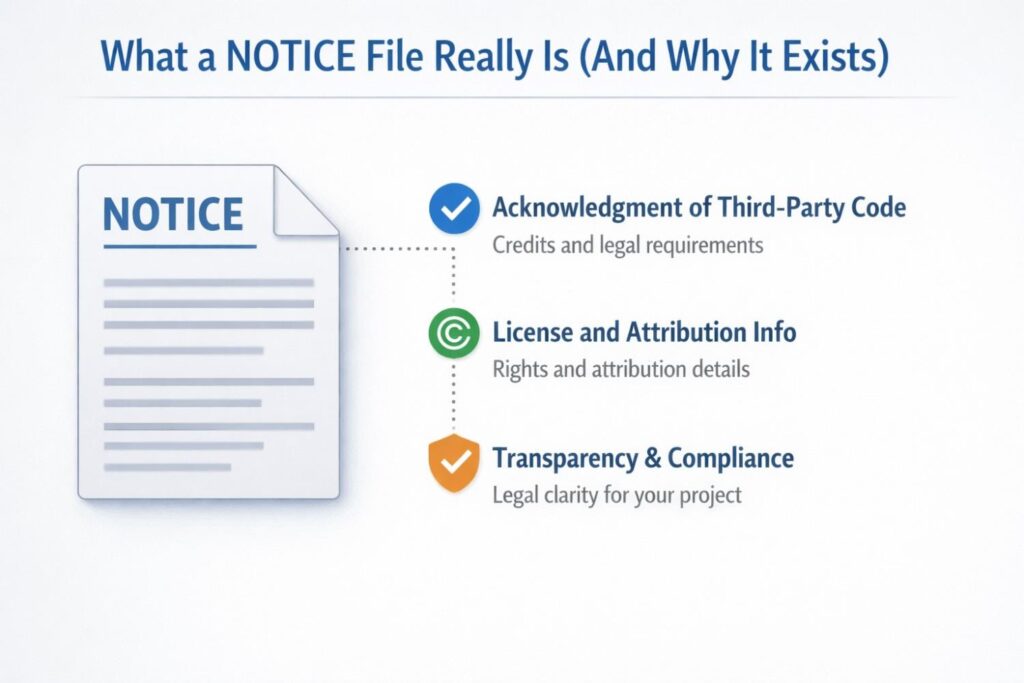
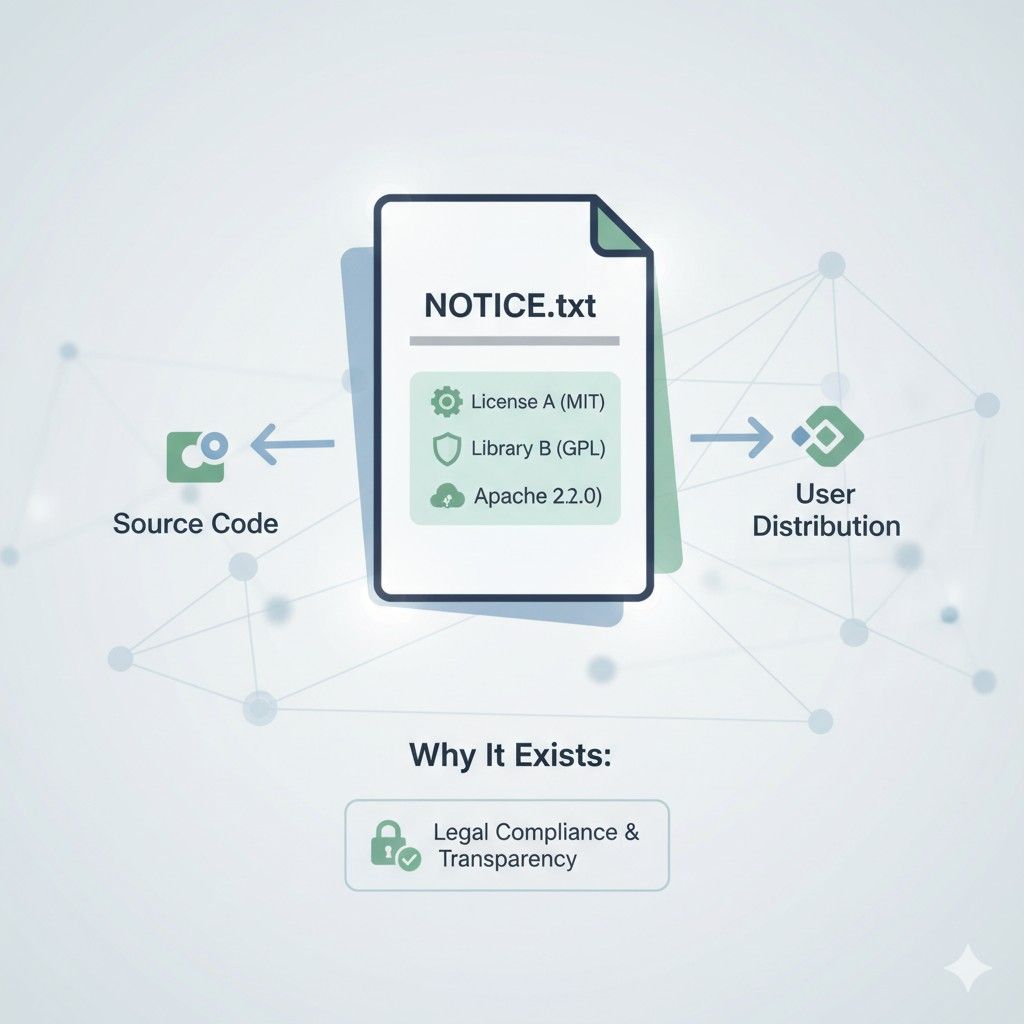
What a NOTICE File Really Is (And Why It Exists)
A NOTICE file is not a legal trap. It is not paperwork for paperwork’s sake. It is a simple record that tells the world which outside code you used and how you respected the rules that came with it.
Most teams hear “NOTICE file” and think it belongs to lawyers. That mindset is what creates problems later. In reality, this file is closer to documentation than compliance. It is proof that your company builds with care.
When done right, it becomes a quiet signal of maturity. It tells customers, partners, and buyers that you understand what you ship and that nothing is hidden under the hood.
The NOTICE File Is a Story of Your Product
Every product has a story. The NOTICE file tells the part most teams forget to write down.
It explains which building blocks came from outside your company. It shows that you did not take shortcuts or ignore licenses. It also shows that you know the difference between code you own and code you borrowed.
For a business, this matters because trust is built on clarity. When someone reviews your software, they want to see clean lines.
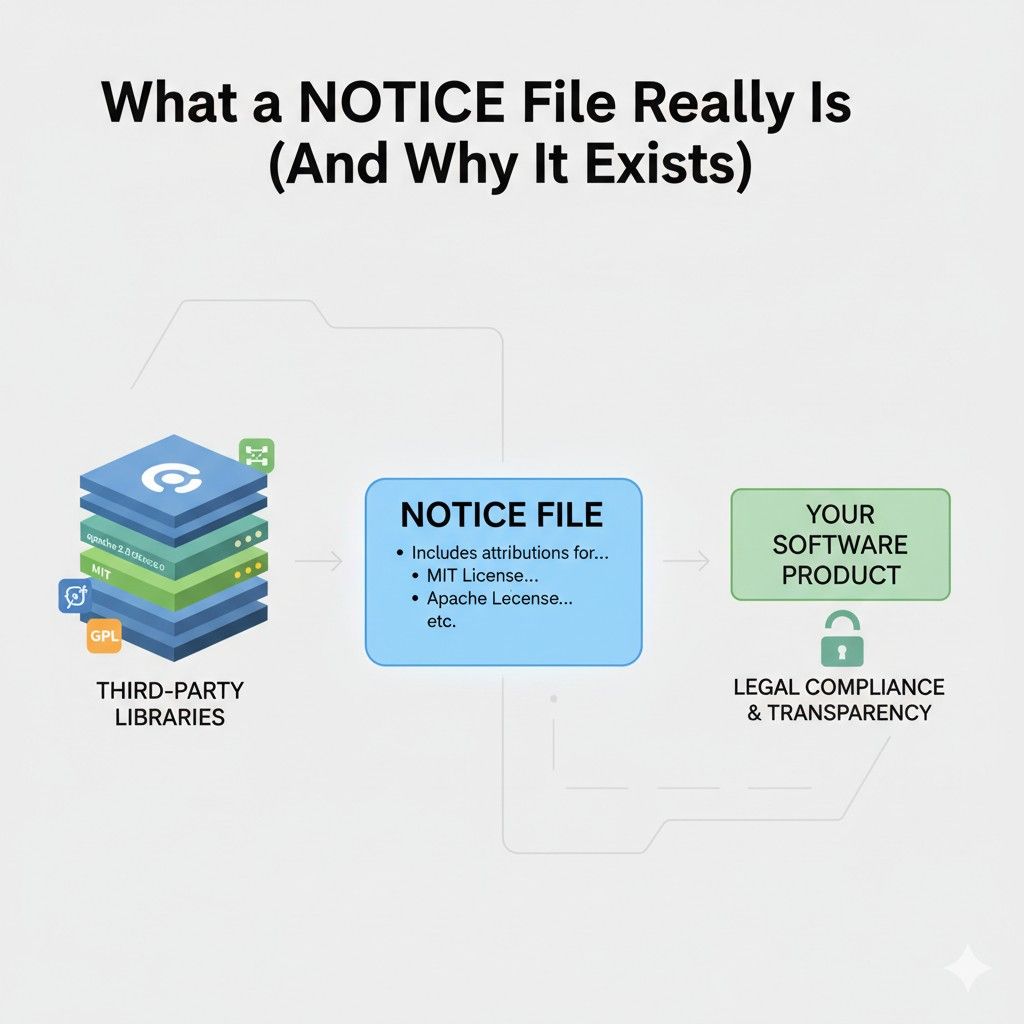
They want to know where things came from. The NOTICE file gives them that answer without emails, meetings, or audits.
Why Open Source Licenses Demand a NOTICE File
Open source is generous, but it is not free of rules. Many licenses allow you to use code with almost no limits, but they ask for one thing in return. They want credit.
The NOTICE file is where that credit lives. It is how you say thank you in a way that is clear and permanent.
From a business view, this is a trade you should gladly make. You get years of work from others. In return, you keep their name and license text visible.
That is a fair deal, and one that courts, customers, and acquirers expect you to honor.
Why This File Exists Outside Your Code
A common mistake is thinking that comments inside source files are enough. They are not.
The NOTICE file exists because products move. Code gets bundled, compiled, shipped, and deployed in many forms. The NOTICE file travels with the product no matter how it is packaged.
This is especially important if you sell software, ship devices, or provide hosted services to large customers. They often look for this file first. If it is missing, they assume risk, even if the code itself is clean.
The Business Risk of Ignoring the NOTICE File
Ignoring the NOTICE file does not break your product. It breaks deals.
Most problems show up during due diligence. A buyer runs a scan. A security team asks for your open source disclosures. You scramble to recreate months or years of dependency history.
At that point, the cost is not technical. It is time, stress, and lost leverage. Deals slow down. Questions pile up. Confidence drops.
The NOTICE file exists to prevent that exact moment. It is insurance you build once and benefit from forever.
Why Investors and Buyers Care So Much
Investors do not read code for fun. They read it to measure risk.
A clean NOTICE file tells them that your team understands ownership. It shows that you respect boundaries. It also signals that your IP story is not messy.
From an acquisition point of view, unclear third-party usage can reduce value. Buyers may ask for price cuts, escrow, or extra warranties. All of that can be avoided with clear notices prepared early.
How the NOTICE File Fits Into Your IP Strategy
Many founders think patents and open source live in separate worlds. They do not.
Your patents protect what you create. Your NOTICE file protects how you use what others created. Together, they form a clean IP posture.
When you file patents, especially on software-heavy inventions, clarity matters. You want to show that the core ideas are yours, not buried inside borrowed code. A strong NOTICE file supports that story quietly but effectively.
This is one reason teams using PowerPatent think about this early. Clean inputs lead to stronger outputs, both in patents and in products.
When the NOTICE File Should Be Created
The best time to create a NOTICE file is not before launch. It is not before fundraising. It is before things get complex.
Early in a product’s life, dependencies are few. Tracking them takes minutes, not weeks. Waiting turns a small task into a painful project.
From a strategy angle, this is about compounding. Every clean habit you build early saves you time later. The NOTICE file is one of the highest return habits a startup can adopt.
Who Should Own the NOTICE File Internally
This file should not bounce between teams. It needs a clear owner.
In many startups, this is an engineering lead or a platform owner. They are close enough to the code to know what enters the system, but senior enough to care about long-term risk.
Ownership does not mean doing everything by hand. It means making sure the process exists, stays updated, and is reviewed as part of shipping.
Why Manual Tracking Is a Trap
Some teams try to track notices in spreadsheets or docs. This works for about a month.
After that, people forget. Libraries change. Versions update. New tools sneak in. The document falls behind reality.
Strategically, this creates false confidence. You think you are covered, but you are not. A clean NOTICE file must reflect what is actually in production, not what you remember adding.
This is where smart tooling and automation matter. The goal is accuracy with low effort, not perfection through pain.
How a Clean NOTICE File Reduces Legal Noise
Lawyers get involved when things are unclear.
A well-built NOTICE file reduces questions before they are asked. It shortens reviews. It lowers back-and-forth. It keeps legal teams focused on real issues, not cleanup.
For a growing business, this is leverage. Less noise means faster decisions and fewer surprises.
Why Customers Notice Even When They Do Not Say It
Many customers never mention your NOTICE file. That does not mean they did not look.
Enterprise buyers often scan silently. They note what is present and what is missing. A clean file builds quiet trust. A missing one raises silent flags.
Trust like this compounds. It affects renewals, expansions, and referrals, even if no one ever sends you an email about it.
The NOTICE File as a Signal of Engineering Quality
Good engineering is not just about speed. It is about control.
A clean NOTICE file tells a story of discipline. It shows that your team understands its stack deeply. It signals that nothing is accidental.
This perception matters more as your company grows. Quality is judged not only by features, but by how responsibly those features are built.
Connecting Clean Notices to Faster Growth
When your NOTICE file is clean, everything downstream moves faster.
Fundraising goes smoother. Security reviews shrink. Legal checks become routine. Product teams ship without fear of hidden risk.
This is not about being perfect. It is about being prepared.
And preparation is what allows teams to move fast without breaking things that matter.
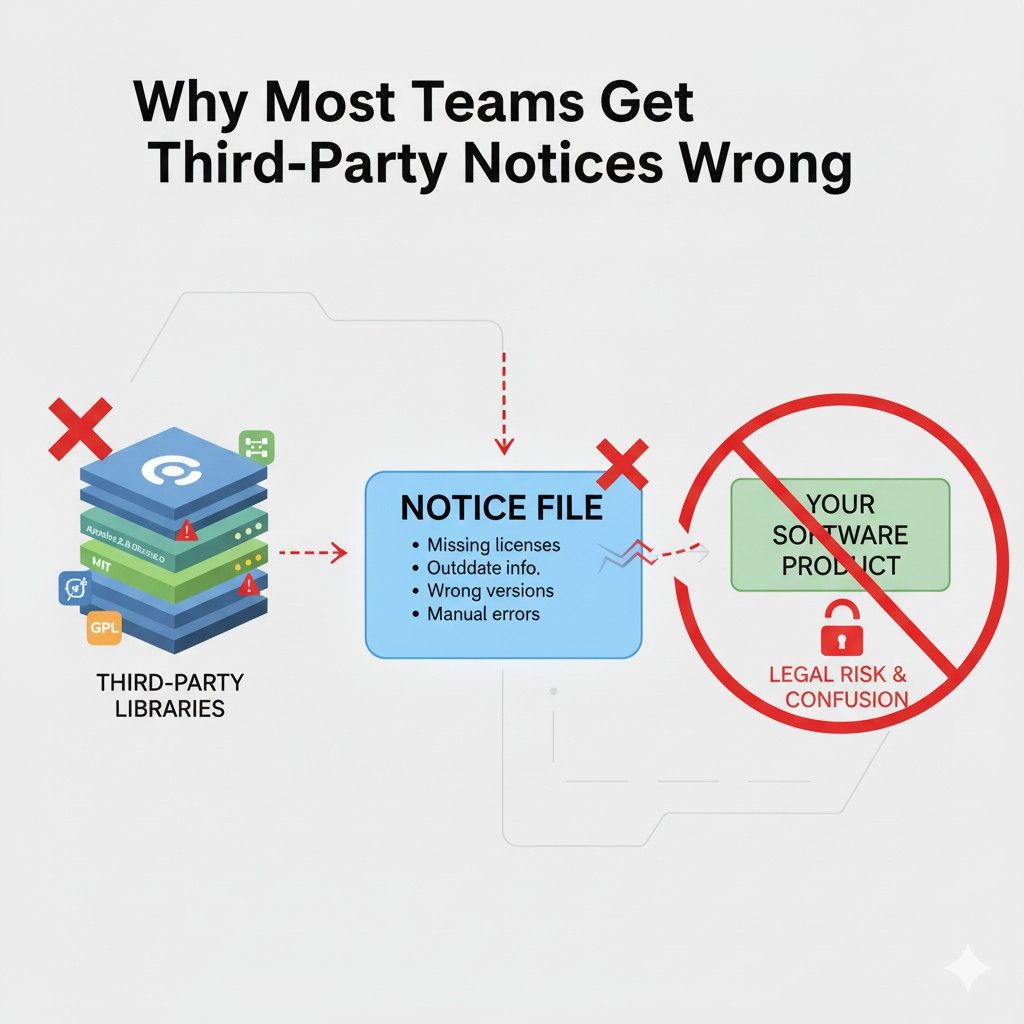
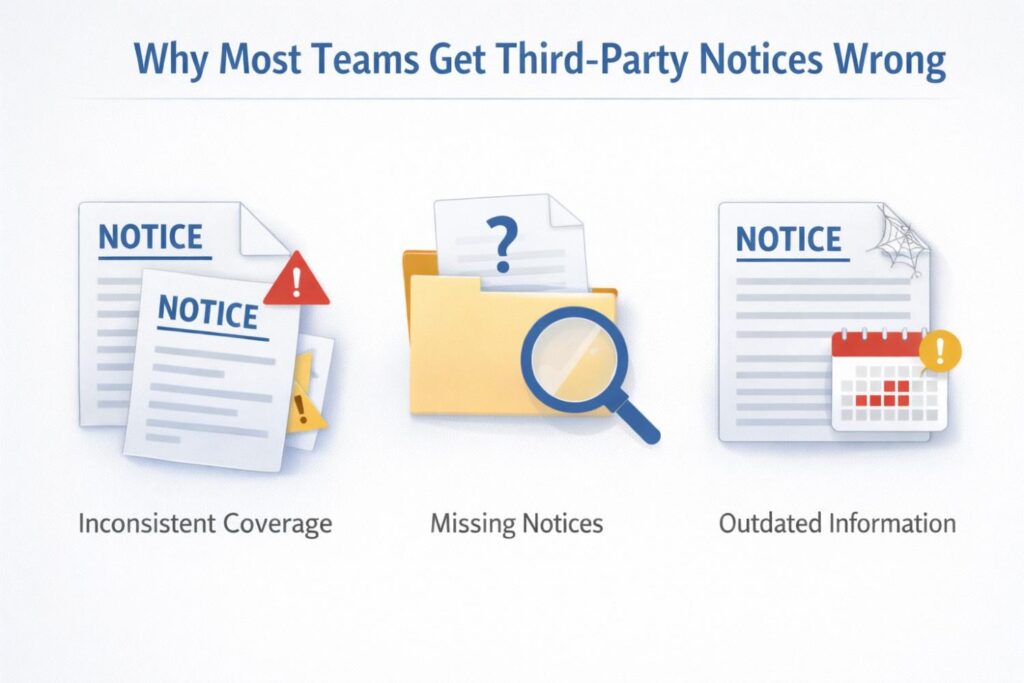
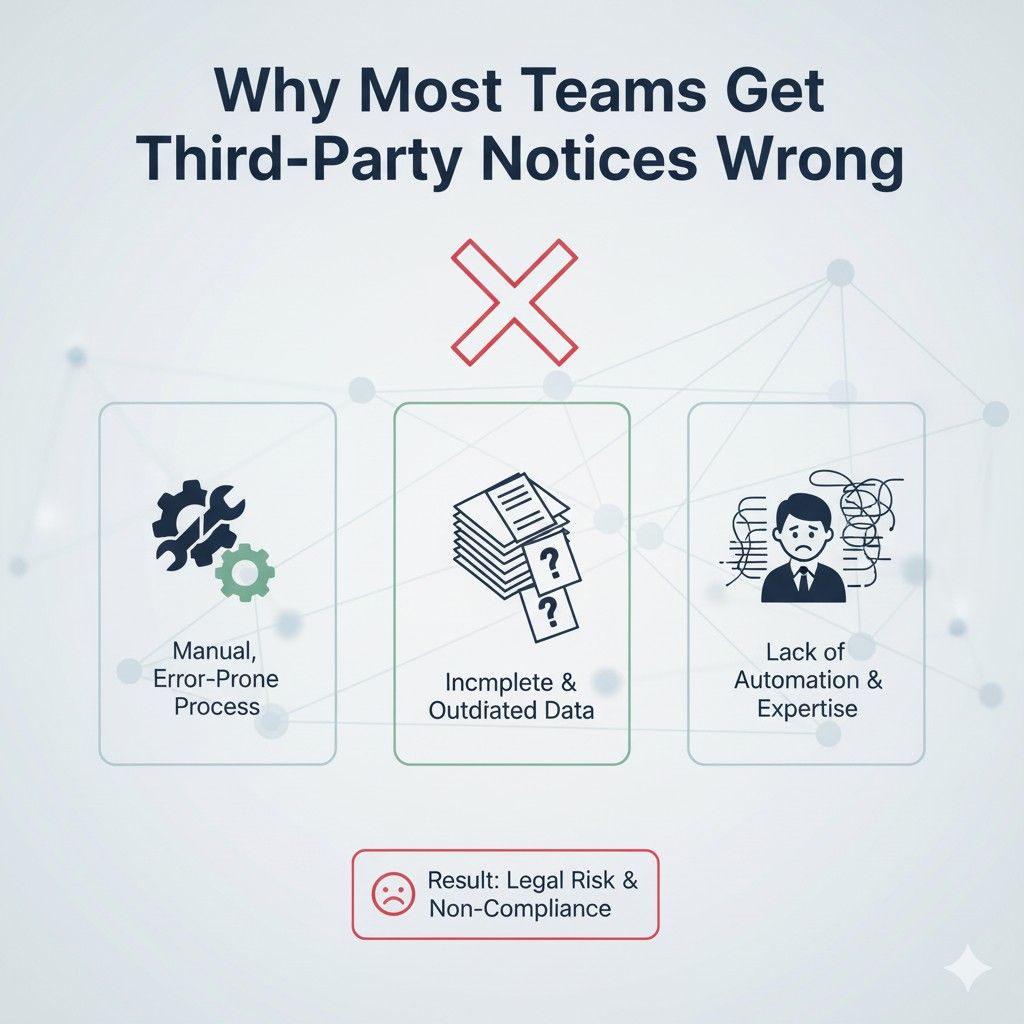
Why Most Teams Get Third-Party Notices Wrong
Most mistakes around third-party notices are not caused by bad intent. They are caused by speed, pressure, and unclear ownership.
Teams move fast. Features matter. Deadlines loom. Open source feels harmless because it works so well. In that environment, the NOTICE file quietly falls behind, then disappears from attention altogether.
This section explains how that happens, why it keeps happening across companies of all sizes, and what you can do to stop the pattern early without slowing your team down.
The Assumption That Someone Else Is Handling It
In many companies, everyone assumes someone else owns third-party notices.
Engineers assume legal will handle it later. Legal assumes engineering is tracking dependencies. Product assumes it is not their problem. By the time someone checks, the product has shipped, and history is blurry.
The fix is not more meetings. The fix is clarity. A single owner and a clear moment when notices are reviewed changes everything. This can be tied to releases, major merges, or version tags. What matters is that it happens predictably.
Treating the NOTICE File as a One-Time Task
A common mistake is creating a NOTICE file once and never touching it again.
Software does not stand still. Libraries update. New tools enter quietly. Old ones linger. A static file becomes inaccurate fast.
From a business view, this is dangerous because it creates a false sense of safety. You believe you are covered, but reality has moved on. The goal is not to finish a NOTICE file. The goal is to keep it true.
Teams that succeed treat it as living documentation that evolves with the product.
Confusing Licenses With Permissions
Another reason teams get this wrong is confusion around what licenses actually ask for.
Some licenses are permissive. Others require notices. Some require both notices and attribution in specific places. When teams lump all licenses together, they either overdo it or underdo it.
Overdoing it leads to clutter and fear. Underdoing it leads to risk.
The strategic move is not to memorize licenses, but to build a system that captures requirements automatically and surfaces what matters. This is where modern tools, combined with attorney review, save enormous time and stress.
This is also where platforms like PowerPatent fit naturally into a broader IP discipline. Clean inputs make strong protection easier later. You can see how this works at https://powerpatent.com/how-it-works.
Copying a NOTICE File From Another Project
This happens more often than teams admit.
Someone grabs a NOTICE file from a past project or an open source repo and tweaks it lightly. It feels efficient. It is also risky.
Every product has a unique dependency graph. Copying files creates mismatches that are hard to detect until someone audits deeply.
From a strategic lens, shortcuts here create downstream cost. What saved an hour today can cost weeks during diligence.
Relying Only on Dependency Scans
Automated scans are powerful, but they are not complete on their own.
They can miss bundled code, copied snippets, or internal forks. They also do not always understand context. A scan may flag a license but not explain how it applies to your use.
Teams that rely only on scans often end up with bloated notices or missing credits. The right approach combines scanning with human review at the right moments.
This balance keeps the NOTICE file clean instead of noisy.
Ignoring Transitive Dependencies
Many teams only track what they install directly.
The problem is that libraries depend on other libraries. Those dependencies come with their own licenses and notice rules.
Ignoring transitive dependencies is one of the fastest ways to create gaps. During reviews, these gaps stand out immediately.
Strategically, this is where early discipline pays off. Once your dependency tree grows, untangling it later becomes painful. Tracking it from the start keeps the tree visible and manageable.
Letting the File Drift Away From the Product
Sometimes the NOTICE file exists, but it lives in the wrong place.
It sits in a repo no one checks. It does not ship with the product. It does not get updated during releases.
When this happens, the file becomes theater. It exists to say it exists, not to serve its purpose.
A clean process ensures the NOTICE file travels with what you ship. Whether that is a binary, a container, or a hosted service, the connection must be real.
Waiting Until a Deal Forces the Issue
The worst time to fix third-party notices is during a deal.
At that stage, time pressure is extreme. Context is missing. Engineers are busy. Legal is asking urgent questions. Stress is high.
Many startups learn about NOTICE files only when an investor or buyer asks for one. That moment is avoidable.
The strategic move is to build this muscle early, when stakes are low. That choice keeps you in control later, when stakes are high.
Believing This Is Purely a Legal Problem
This belief creates friction.
When engineers think notices are legal noise, they disengage. When legal thinks notices are technical trivia, they disengage. The gap grows.
In reality, third-party notices sit at the intersection of product, engineering, and business risk. Treating them as shared responsibility, with clear ownership, removes tension.
This mindset shift alone fixes many failures.
How Small Gaps Turn Into Big Questions
Missing one notice rarely causes immediate harm.
The problem is pattern. Reviewers look for signals. One gap leads them to look harder. More questions follow. Trust erodes.
From a business perspective, this is about optics as much as rules. A clean NOTICE file reduces curiosity. A messy one invites it.
Building Habits Instead of Fire Drills
The teams that get this right do not work harder. They work earlier.
They build habits into their workflow. They review notices as part of shipping. They treat third-party code with respect, not fear.
This approach keeps the process boring. Boring is good. Boring means nothing breaks.
Why This Matters More as You Scale
As companies grow, their surface area expands.
More engineers means more tools. More products mean more dependencies. More customers mean more scrutiny.
A weak NOTICE process does not scale. A strong one does.
This is why mature startups treat third-party notices as infrastructure, not paperwork.
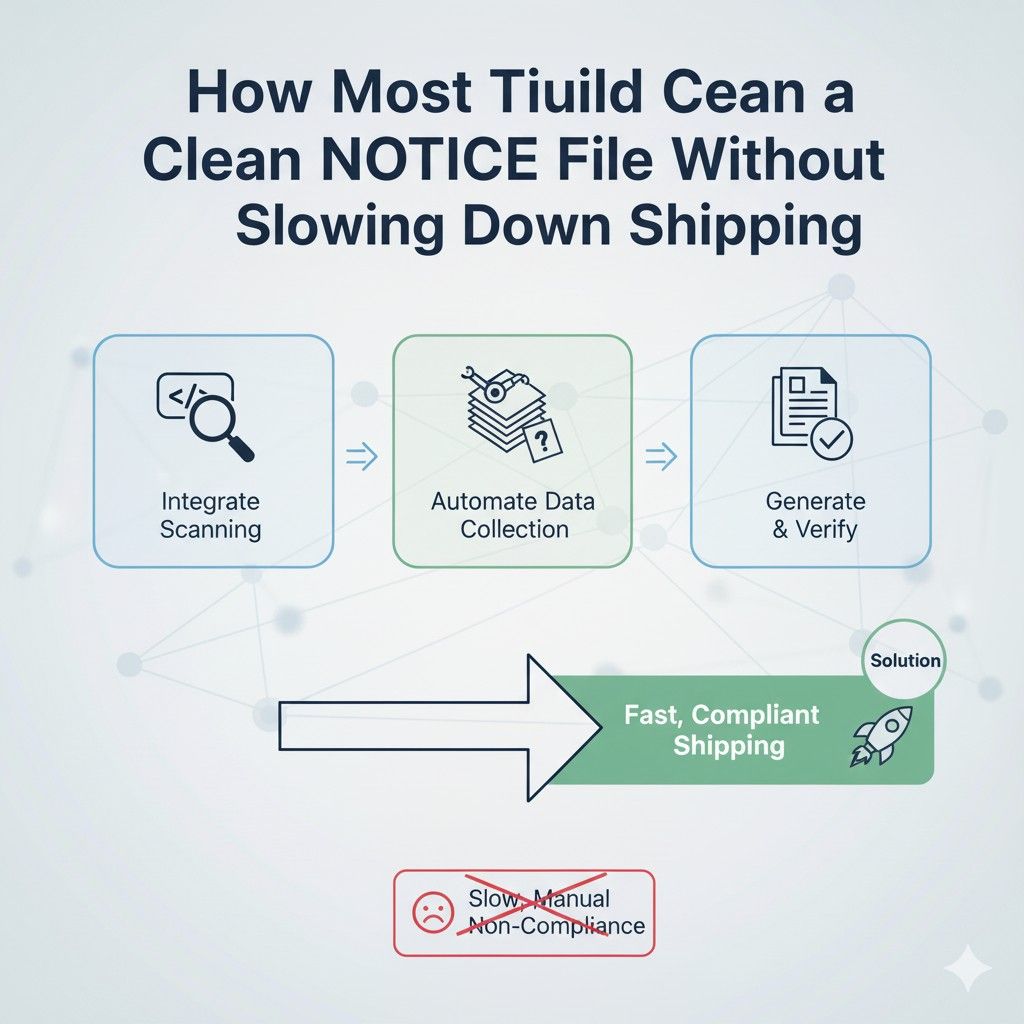
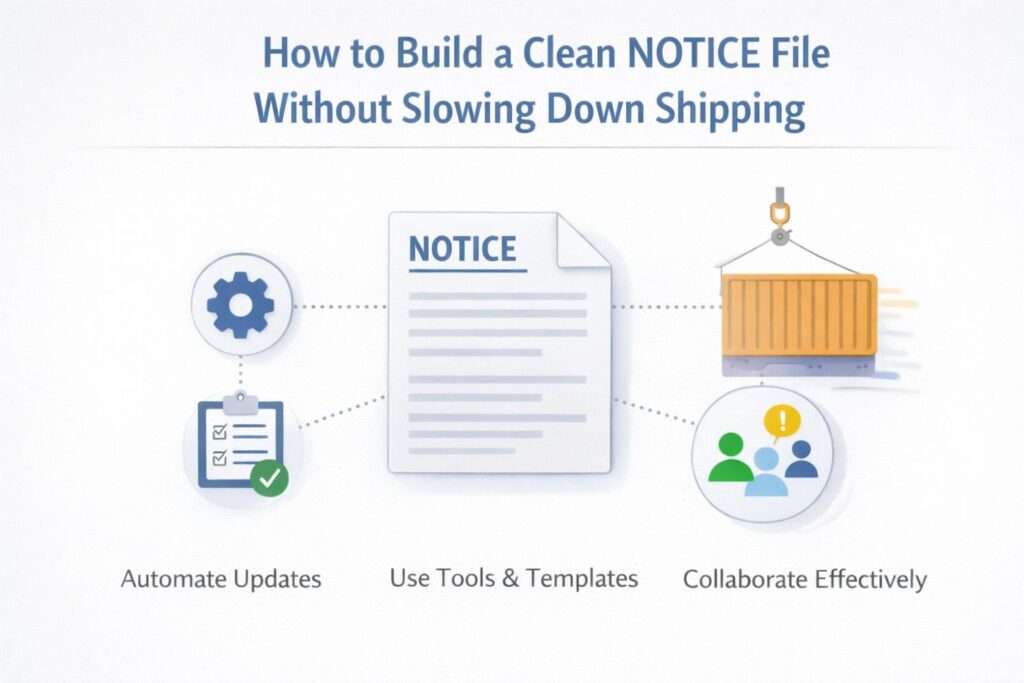
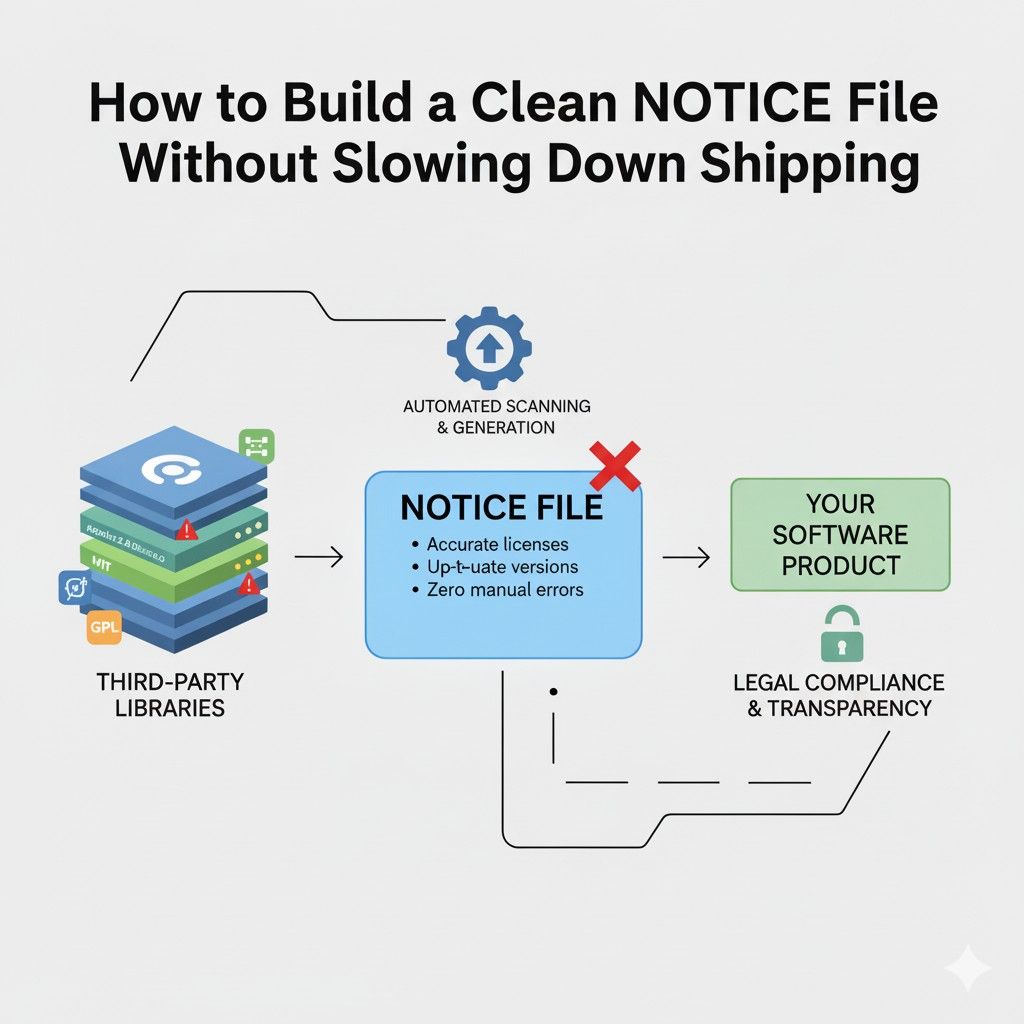
How to Build a Clean NOTICE File Without Slowing Down Shipping
Building a clean NOTICE file should feel boring. If it feels heavy, confusing, or slow, something is wrong with the process, not with your team.
The goal is not to turn engineers into lawyers. The goal is to create a system that runs quietly in the background while your product keeps moving. When done right, this work blends into your normal flow and never becomes a blocker.
This section focuses on how businesses actually do this in practice, under real constraints, with real teams.
Start by Accepting That This Is a Product Problem
The first mental shift is simple but powerful.
A NOTICE file is part of the product. It is not an extra document. It ships with what you build, just like documentation or release notes.
When teams treat it this way, it naturally finds a home in the workflow. It gets reviewed during releases. It gets updated when dependencies change. It stays close to reality.
This mindset removes friction before any tool or policy is added.
Anchor the NOTICE File to Your Build Process
The fastest way to keep a NOTICE file clean is to tie it to something that already happens.
Builds run. Releases go out. Versions get tagged. These moments are perfect anchors.
When the NOTICE file is generated or checked during these moments, it never feels like extra work. It becomes part of the rhythm of shipping.
From a business angle, this reduces risk without adding meetings or slowing decisions.
Keep the File Human-Readable
One mistake teams make is optimizing the NOTICE file for machines instead of people.
Yes, accuracy matters. But readability matters just as much. Reviewers want to scan, not decode.
A clean NOTICE file uses plain text, clear separation, and simple language. It does not bury important information under noise. It respects the reader’s time.
This matters during audits, diligence, and customer reviews, where clarity often matters more than volume.
Treat New Dependencies as a Trigger
Most NOTICE file issues begin the moment a new dependency enters the system.
That moment should trigger a simple question: what rules came with this code?
This does not need to be dramatic. It can be as simple as a quick check during review or merge. Over time, this habit becomes automatic.
Strategically, this is about catching risk at the smallest possible point. Small checks early prevent big fixes later.
Use Automation, But Do Not Blindly Trust It
Automation is your friend, but only when used with intent.
Good tools surface what is used, where it came from, and which licenses apply. They save time and reduce human error.
Bad outcomes happen when teams assume tools think for them. They do not. They report. Humans decide.
The strongest setups use automation to gather facts and humans to apply judgment. This balance keeps the NOTICE file both accurate and clean.
Decide Once Where the File Lives
Confusion grows when files move.
Pick a single, obvious place for the NOTICE file. Make sure everyone knows where it is. Keep it close to the product artifacts that ship.
This consistency reduces mistakes and speeds up reviews. It also makes onboarding new engineers easier, because expectations are clear.
Review the NOTICE File Like You Review Code
If the NOTICE file only changes in emergencies, it will always feel scary.
Teams that succeed review it like any other artifact. Calmly. Regularly. Without drama.
When changes are small and frequent, they are easy to understand. When changes pile up, they become risky.
This is the same logic that applies to technical debt. Notices are no different.
Build the Habit Before You Need It
The biggest advantage startups have is timing.
Early on, everything is smaller. Fewer dependencies. Fewer contributors. Fewer edge cases.
This is the best time to build the habit. Waiting until scale removes that advantage.
From a strategic view, this is about buying future speed. A clean NOTICE process today makes growth smoother tomorrow.
Align Legal Review With Reality
Legal review should confirm, not reconstruct.
When your NOTICE file reflects reality, legal teams can review quickly and confidently. When it does not, they have to dig, ask questions, and slow things down.
This is where modern approaches shine. Combining software that tracks usage with real attorney oversight ensures nothing critical is missed, without dragging engineers into legal loops.
This is the same philosophy behind PowerPatent. Strong outcomes come from clean inputs and smart review, not last-minute fixes. You can see how that approach works at https://powerpatent.com/how-it-works.
Make the File Boring on Purpose
A good NOTICE file does not impress anyone.
It does not try to be clever. It does not try to explain more than needed. It simply exists, quietly doing its job.
This boredom is a feature. It means there are no surprises.
From a business lens, boring infrastructure enables bold execution everywhere else.
Use the NOTICE File as a Teaching Tool
For new engineers, the NOTICE file can be educational.
It shows which tools the company relies on. It reveals patterns. It teaches respect for external work.
This builds culture. It reinforces that the company builds responsibly and intentionally.
Culture like this reduces risk without policies or pressure.
Protect Speed by Reducing Uncertainty
Most delays come from uncertainty, not rules.
When no one knows whether a dependency is safe, teams hesitate. When notices are unclear, releases pause.
A clean NOTICE file removes that uncertainty. It lets teams move forward with confidence.
This is the real speed advantage. Not cutting corners, but knowing where the corners are.
Turning Compliance Into Quiet Confidence
When everything works, no one talks about the NOTICE file.
That silence is success.
It means reviews pass. Deals move. Customers trust. Teams ship.
This is what building a clean NOTICE file is really about. Not compliance, but confidence.
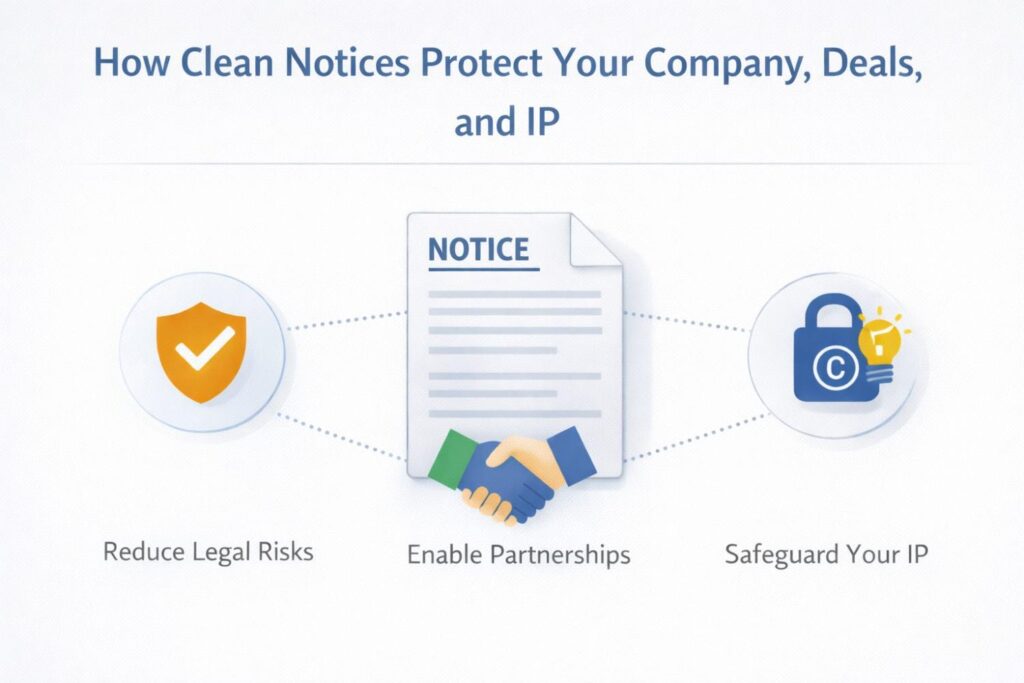
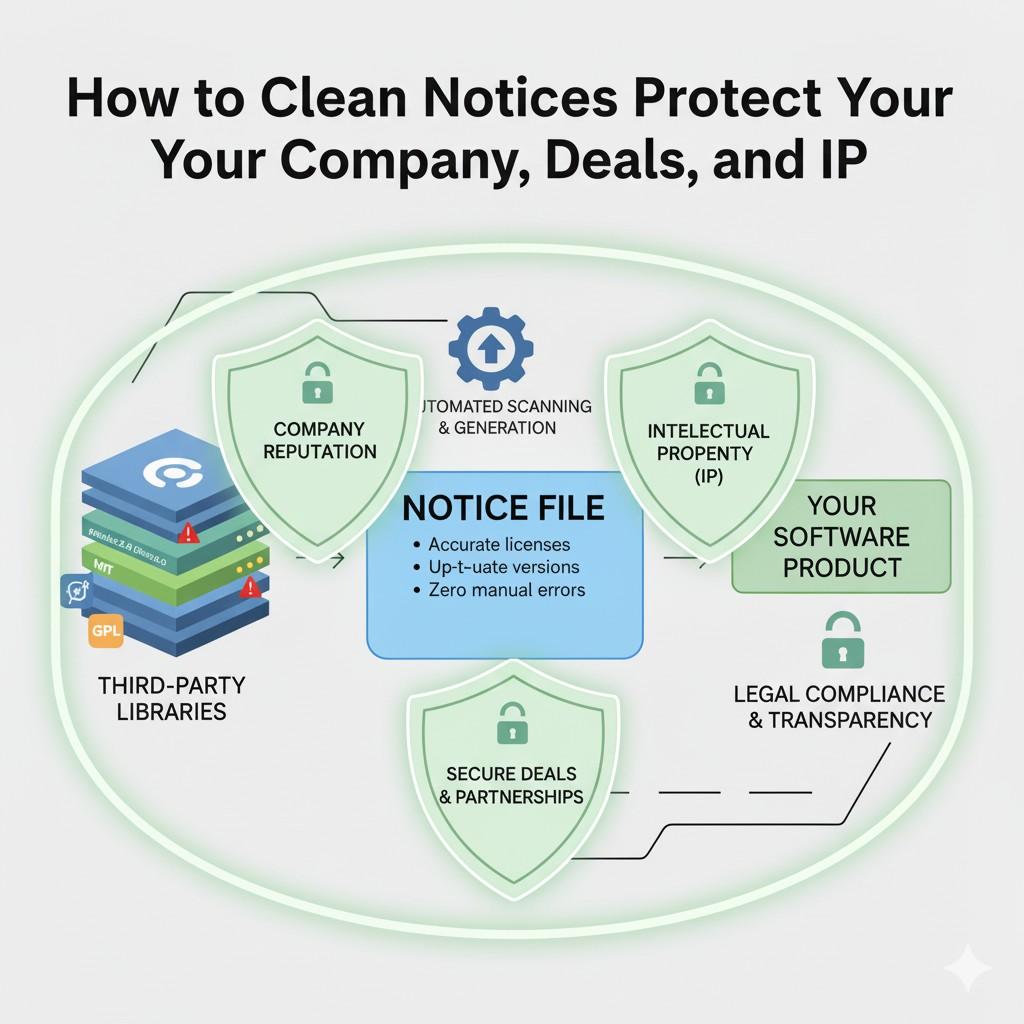
How Clean Notices Protect Your Company, Deals, and IP
Clean third-party notices do more than satisfy license rules. They shape how your company is judged when it matters most.
Most founders only see this file as a compliance artifact. In reality, it is a quiet defense layer. It protects your leverage, your valuation, and your ability to move fast when opportunities appear.
This final section connects the dots between clean notices and long-term business strength.
Clean Notices Reduce Fear During Due Diligence
Due diligence is not just a checklist. It is a trust exercise.
Buyers and investors look for signals. They want to see that your company understands what it owns and what it uses. A clean NOTICE file answers that question without friction.
When this file is present, accurate, and readable, reviewers relax. They move on faster. They assume fewer hidden issues exist elsewhere.
From a deal perspective, this is powerful. Less fear means fewer follow-ups, fewer concessions, and faster timelines.
Why Missing Notices Trigger Deeper Scrutiny
When a NOTICE file is missing or messy, it does not fail quietly.
Reviewers do not just flag the file. They start digging. They ask for scans, histories, and explanations. They assume other things might also be sloppy.
This extra scrutiny costs time and credibility. It can turn a smooth process into a stressful one.
Clean notices act as a shield. They reduce curiosity before it becomes investigation.
How Notices Protect Your Negotiation Position
Every unresolved risk weakens leverage.
If a buyer sees unclear third-party usage, they may ask for price reductions, special warranties, or escrow terms. These requests are hard to fight when documentation is weak.
A clean NOTICE file gives you facts. It allows you to answer questions confidently and push back when concerns are overstated.
This clarity keeps negotiations focused on value, not cleanup.
Clean Notices Support Strong Patent Strategy
Patents and notices work together more than most founders realize.
When you file patents, especially on software systems, you want to clearly separate your invention from external code. A clean NOTICE file helps tell that story.
It shows that your core ideas are original and not buried inside borrowed components. It also shows discipline, which matters when patents are reviewed, enforced, or evaluated later.
This alignment strengthens your overall IP posture.
Why Acquirers Care About Clean Boundaries
Acquirers think in terms of ownership.
They want to know which parts of the product they truly own and which parts come with ongoing obligations. A clear NOTICE file draws that line.
This reduces post-acquisition risk and simplifies integration. It also makes your company easier to absorb, which buyers value.
From a strategy view, this makes your company more attractive, not just compliant.
Clean Notices Enable Faster Enterprise Sales
Large customers care deeply about risk.
Enterprise security and legal teams often review open source usage before contracts are signed. They look for clear disclosures and responsible handling.
A clean NOTICE file speeds this process. It answers questions before they are asked. It shows maturity that younger companies often lack.
This can be the difference between a fast close and a stalled deal.
Reducing Legal Costs Over Time
Messy notices lead to expensive fixes.
When gaps appear late, lawyers have to reconstruct history. They review old commits, audit dependencies, and draft explanations. This work is slow and costly.
Clean notices prevent this. They keep legal involvement light and predictable.

Over years, this saves significant money and internal bandwidth.
Clean Notices Build Internal Confidence
Confidence is not just external. It matters inside the company too.
When teams know their foundations are clean, they ship with less anxiety. They do not fear audits or reviews. They focus on building.
This confidence improves velocity and morale. It also reduces defensive behavior that slows innovation.
Turning Compliance Into a Competitive Advantage
Most startups treat compliance as a burden.
A few treat it as infrastructure.
Those few move faster when others freeze. They close deals while others scramble. They scale without constant rewrites.
Clean third-party notices are part of that advantage. They remove friction in moments when speed matters most.
The Cost of Fixing This Late
Fixing notices late is painful for one reason: memory fades.
People leave. Context disappears. Decisions become guesses.
Early discipline avoids this trap. It preserves clarity while it is still easy.
From a business perspective, this is about protecting optionality. You keep doors open instead of scrambling to reopen them.
Clean Notices as a Signal of Leadership
Founders set the tone.
When leadership treats third-party usage with respect, teams follow. When leadership ignores it, gaps appear.
A clean NOTICE file reflects thoughtful leadership. It shows that the company plans beyond the next sprint.
This signal matters to employees, partners, and investors alike.
How PowerPatent Fits Into This Picture
Clean notices and strong patents share a core principle: clarity.
PowerPatent helps founders turn what they build into clear, defensible protection, without slowing down progress. The same mindset applies to third-party notices.
When inputs are clean, outputs are strong. When ownership is clear, confidence follows.
If you care about building real value, not just shipping fast, this discipline pays off. You can see how PowerPatent supports that approach at https://powerpatent.com/how-it-works.
The Quiet Win No One Talks About
When everything is done right, nothing happens.
No panic emails. No emergency audits. No deal delays.
This quiet outcome is the real win. It means your company is ready when opportunity knocks.
Clean third-party notices do not create headlines. They create freedom.
Freedom to grow. Freedom to sell. Freedom to build without fear.
Wrapping It Up
A clean NOTICE file is not about rules. It is about control. It is about knowing what your product is made of and being able to prove it at any moment, without stress or delay. It is about building with confidence instead of hope.
Most companies do not fail because of third-party code. They struggle because they lose track of it. That loss creates fear, slows deals, and weakens trust. All of that is avoidable.
When you treat third-party notices as part of your product, everything gets easier. Reviews go faster. Questions get simpler. Teams move with more certainty. Your company looks mature long before it is expected to.
Leave a Reply