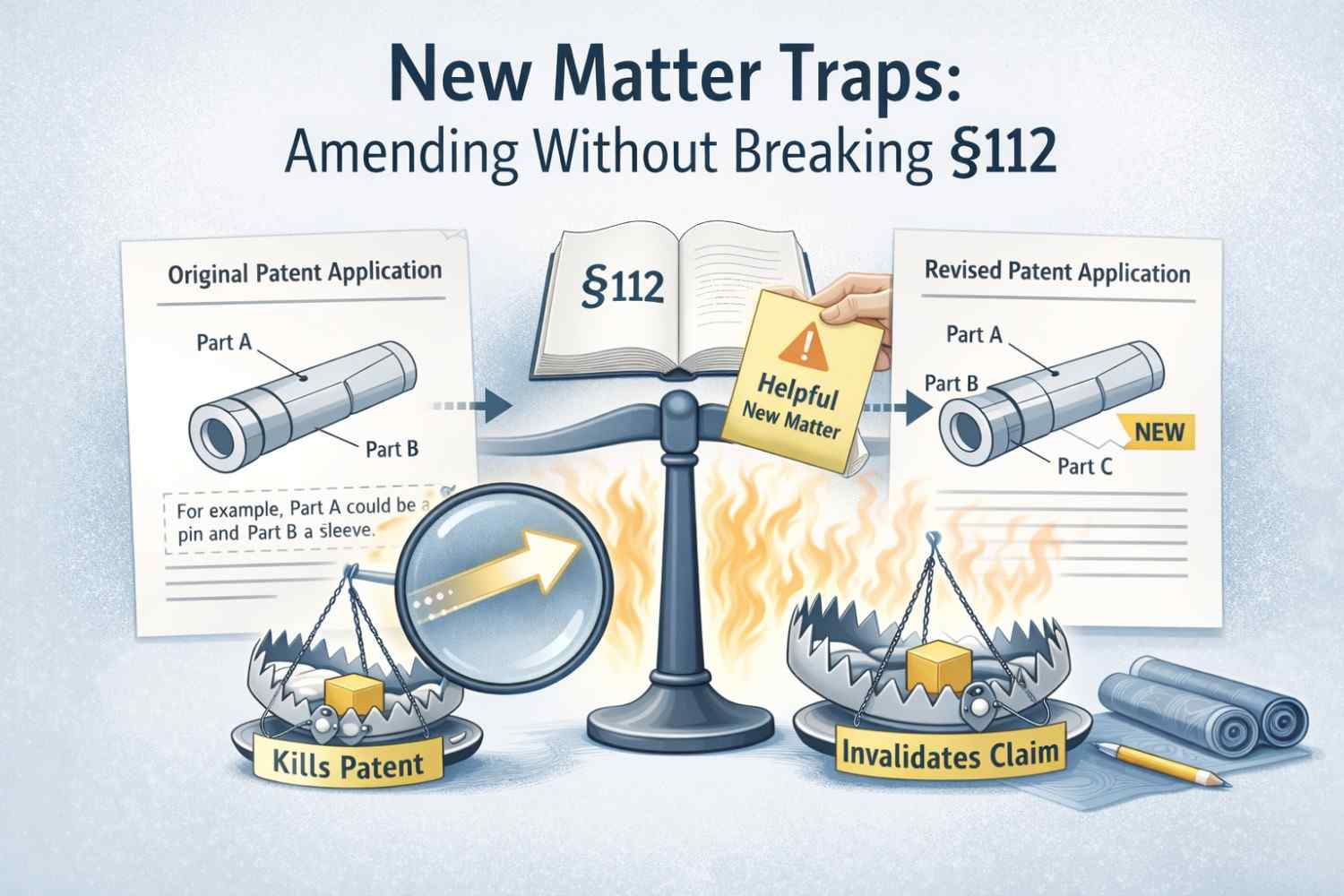
If you have ever changed a patent application after filing and felt a quiet fear in your stomach, you are not alone. Amendments look simple. They feel harmless. You just add a few words, clean up a sentence, or explain the invention better. But this is where many strong patents quietly fall apart. New matter is one of the fastest ways to weaken or kill a patent. It does not announce itself. It does not come with a warning sign. It usually shows up years later, during prosecution or enforcement, when it is too late to fix. And when it shows up, it hits hard.
Why New Matter Is So Easy to Add Without Noticing
New matter rarely comes from carelessness. It usually comes from good intentions. Teams are trying to explain their invention better, respond to an examiner, or clean up language so the patent reads more clearly.
The danger is that patents are not judged by what you meant to say. They are judged by what was actually written on the day you filed.
This section explains why new matter sneaks in so easily, especially for fast-moving startups, and how smart teams can avoid it without slowing down product development or patent progress.
The Human Instinct to Explain Things Better
Most founders and engineers are trained to clarify, not freeze ideas in time. When someone does not understand your product, you explain it again with better words.
When something changes, you update the description. That instinct is correct in business, but risky in patents.
Patent law treats the original filing like a snapshot. It does not care how obvious something feels later.
If a detail was not clearly present in that snapshot, adding it later can be seen as creating something new, even if it existed in your head all along.
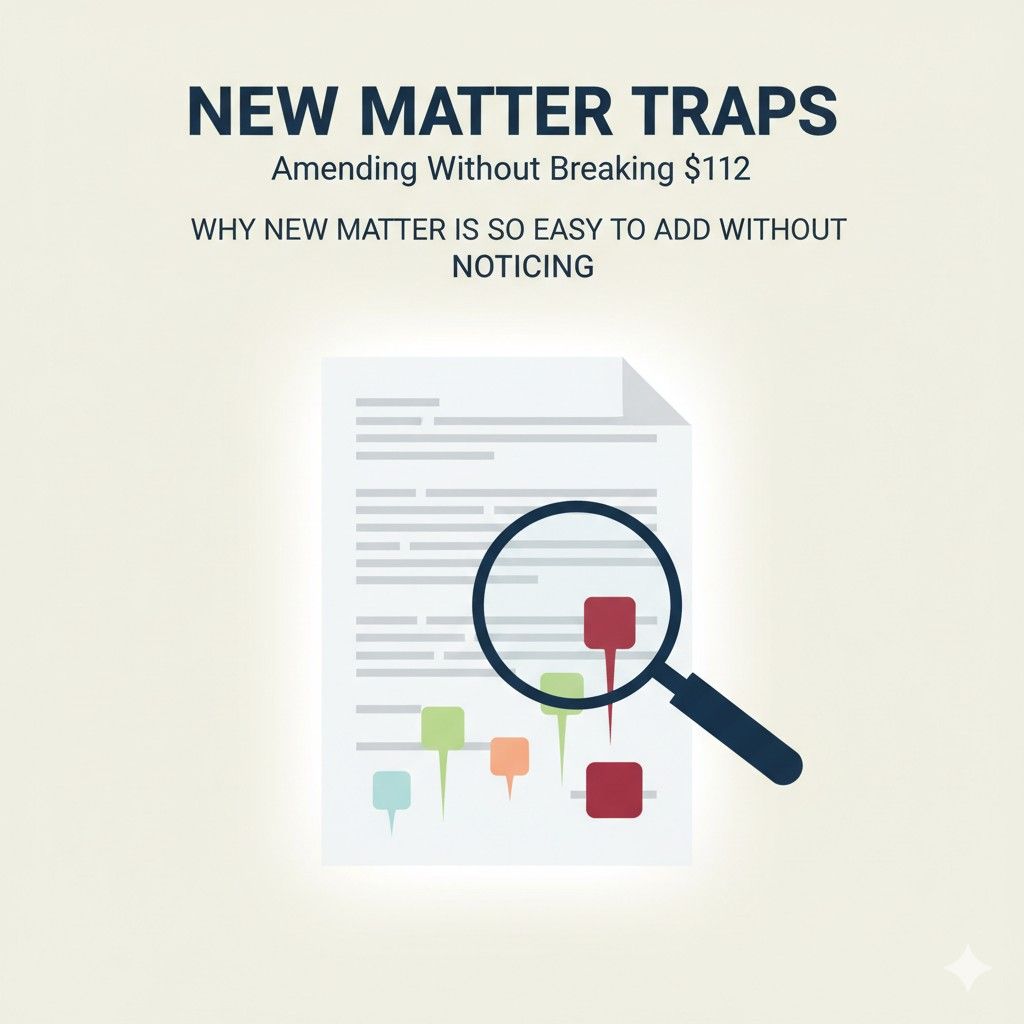
A practical way to reduce this risk is to slow down your wording changes. When you feel the urge to explain something better, first ask whether the original text already supports that explanation.
If you cannot point to a specific sentence or drawing that backs it up, you are likely crossing into new matter territory.
Product Knowledge Grows Faster Than the Patent
Startups learn fast. Features evolve. Edge cases appear. Performance improves. By the time you are responding to an office action, your understanding of the system is often much deeper than when you filed.
That growth creates a dangerous gap. You are now writing from today’s knowledge, but the patent is locked to yesterday’s disclosure.
Even small additions, like naming a specific algorithm type or calling out a data structure, can be treated as new matter if it was not clearly described before.
One way businesses protect themselves is by separating product truth from patent truth. Internally, you can acknowledge how the system really works today.
But when amending, force yourself to live inside the original document. Treat it as a closed world. Only use concepts that already exist there, even if they feel incomplete.
Familiar Words That Quietly Change Meaning
New matter is not always about adding new features. Sometimes it is about swapping words that feel similar but are legally very different.
Changing “can” to “does,” or “may include” to “includes,” can turn an optional idea into a required one. That shift can introduce structure or behavior that was never clearly supported.
These changes often happen when teams try to sound more confident or precise. Unfortunately, precision without support is exactly what creates new matter problems.
A strong habit is to track language intensity. When revising text, notice whether you are making the invention more specific or more absolute.
If the answer is yes, pause and confirm that level of specificity was already present in the original filing.
Drawings Create False Confidence
Founders often assume that if something is shown in a drawing, they are safe to describe it in detail later. This is only partly true. Patent drawings usually show relationships, not full technical depth.
Adding detailed behavior or logic based on a drawing can still be considered new matter.
This trap is common in software and system patents. A box in a diagram might represent a module, but later describing how that module processes data step by step may go beyond what the drawing actually supports.
A safer approach is to treat drawings as anchors, not permissions. They can support general descriptions, but they do not automatically justify adding deep operational detail unless that detail was also described in words.
Examiner Pressure Pushes Teams Too Far
Office actions often ask for clarity. Examiners want to understand how something works or why it is different. That pressure can push teams to overexplain, especially when deadlines are tight.
The risk is that in trying to satisfy the examiner, you end up teaching them something that was never disclosed. That explanation might help in the short term but hurt the patent long term.
Businesses that handle this well focus on reframing, not expanding. Instead of adding new explanations, they reuse existing language in smarter ways. They connect dots that were already there rather than drawing new ones.
Internal Assumptions Leak Into Amendments
Teams live with their product every day. Certain details feel so obvious that no one remembers whether they were ever written down. Those assumptions quietly slip into amendments as if they were always part of the invention.
This is one of the hardest traps to spot because it feels honest. You are not inventing anything new. You are just stating what everyone already knows.
The best defense is to pretend you are an outsider reading the application for the first time. If that outsider would not clearly understand the added detail from the original text alone, it should not be added.
Speed Makes the Problem Worse, Not Better
Fast companies move fast everywhere, including patents. Speed is usually a strength. But when it comes to amendments, speed increases the chance of crossing the line.
Quick edits, late-night responses, and rushed rewrites all reduce the careful comparison between old text and new language that new matter analysis requires.
High-performing teams build a simple pause into their process. Before submitting any amendment, they ask one focused question: where exactly is this supported in the original filing?
If that question cannot be answered cleanly, the language needs to change.
This is one of the reasons founders use platforms like PowerPatent. The combination of smart tools and real attorney review makes it much easier to move fast without breaking things that cannot be fixed later.
You can see how that works here: https://powerpatent.com/how-it-works
Why New Matter Is a Business Risk, Not Just a Legal One
New matter does not just create legal problems. It creates business problems. It weakens enforcement. It gives competitors arguments. It reduces the value of your IP in diligence and fundraising.
Many patents fail not because the invention was weak, but because amendments slowly pulled the claims away from the original foundation.
Understanding why new matter is so easy to add is the first step. The next step is learning how to amend with discipline, clarity, and control.
How §112 Quietly Punishes “Helpful” Changes
Section 112 does not raise its voice. It does not accuse you of wrongdoing. It simply waits. It waits until your patent matters, and then it asks one calm question: was this really disclosed from the start?
When the answer is unclear, the damage is already done.
This is why §112 is so dangerous for growing companies. It does not stop you while you are amending. It does not block the filing.
It allows the patent to move forward. Then later, when the patent is examined closely, enforced, or challenged, it quietly takes value away.
This section explains how §112 works in practice, why it punishes changes that feel helpful, and how businesses can protect themselves without freezing their patents in time.
§112 Cares About Support, Not Intent
One of the biggest misunderstandings is thinking that good intent matters. It does not. §112 does not ask whether you were trying to cheat or add something new.
It only asks whether a skilled reader could clearly see the amended idea in the original filing.
You may honestly believe the change was obvious. You may know your system inside and out. None of that matters if the original text does not clearly show it.
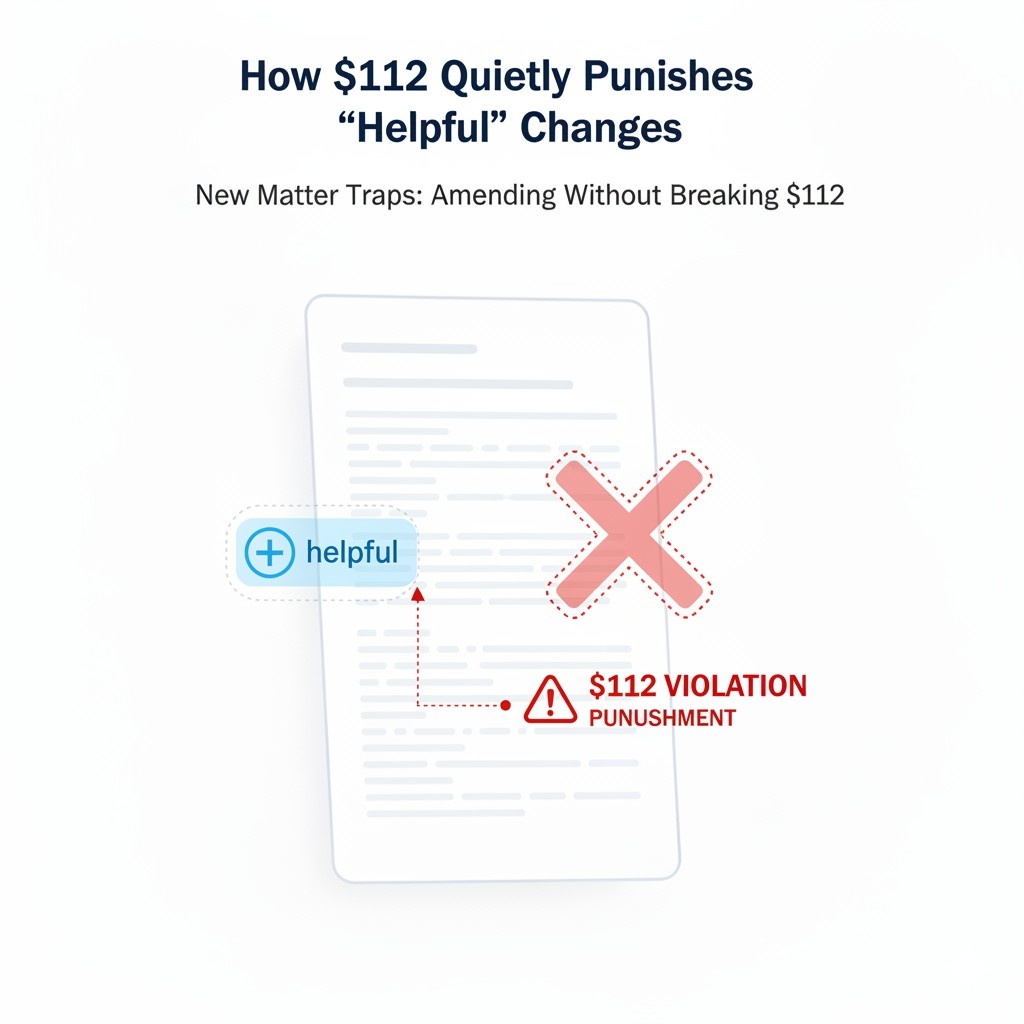
This is why amendments that feel like harmless clarifications are often the most dangerous. They feel safe because they match reality. But patents are not about reality. They are about disclosure.
A strong business practice is to separate what is true from what is provable on paper. When amending, only aim for what is provable using the original words and drawings.
Clarity Can Cross the Line Without Warning
Examiners often ask for clarity. Founders want clarity too, especially if they plan to show the patent to investors or partners. The problem is that clarity often requires specificity, and specificity requires support.
Adding a clear explanation of how data flows, how decisions are made, or how components interact can accidentally introduce structure that was never explicitly disclosed.
The safer move is to clarify using rearrangement, not addition. You can restate ideas using the same building blocks already present. You can tighten language by removing ambiguity, not by adding new detail.
If a sentence becomes clearer because it is shorter or better organized, that is usually safe. If it becomes clearer because it explains something new, that is where §112 starts paying attention.
The Written Description Trap
Written description issues are one of the most common ways §112 punishes amendments. This happens when the claims suggest the inventor had possession of something that the original application does not clearly show.
For example, narrowing a claim to a specific approach may feel like a smart move to get around prior art. But if the original filing only described the idea at a high level, that narrowing can backfire later.
From a business standpoint, this is painful. You think you strengthened your patent, but you actually made it easier to attack.
The disciplined approach is to only narrow claims in ways that clearly mirror language already present. If the original text did not walk that narrow path, the claims should not either.
Enablement Problems Hide Until Enforcement
Enablement issues often stay invisible during prosecution. The patent may even issue. The real problem shows up when someone challenges whether the patent actually teaches how to make and use the invention across its full scope.
Amendments that add complexity can widen the gap between what is claimed and what is enabled. You may claim a more advanced version of the invention without adding enough teaching to support it.
For companies, this is a serious risk. A patent that looks broad and impressive on paper may crumble when tested.
A practical rule is this: if an amendment makes the invention sound more powerful, more flexible, or more advanced, double-check whether the original filing actually teaches that power in a usable way.
The Examiner Is Not Your Safety Net
Many teams assume that if an examiner allows an amendment, it must be safe. That assumption is costly. Examiners are not validating your patent for future enforcement. They are focused on novelty and clarity in the moment.
§112 challenges often come from competitors, not examiners. They come during litigation, licensing talks, or due diligence. By then, the examiner’s approval offers no protection.
This is why businesses that care about long-term value do not rely on examiner silence. They rely on internal discipline and careful amendment strategy.
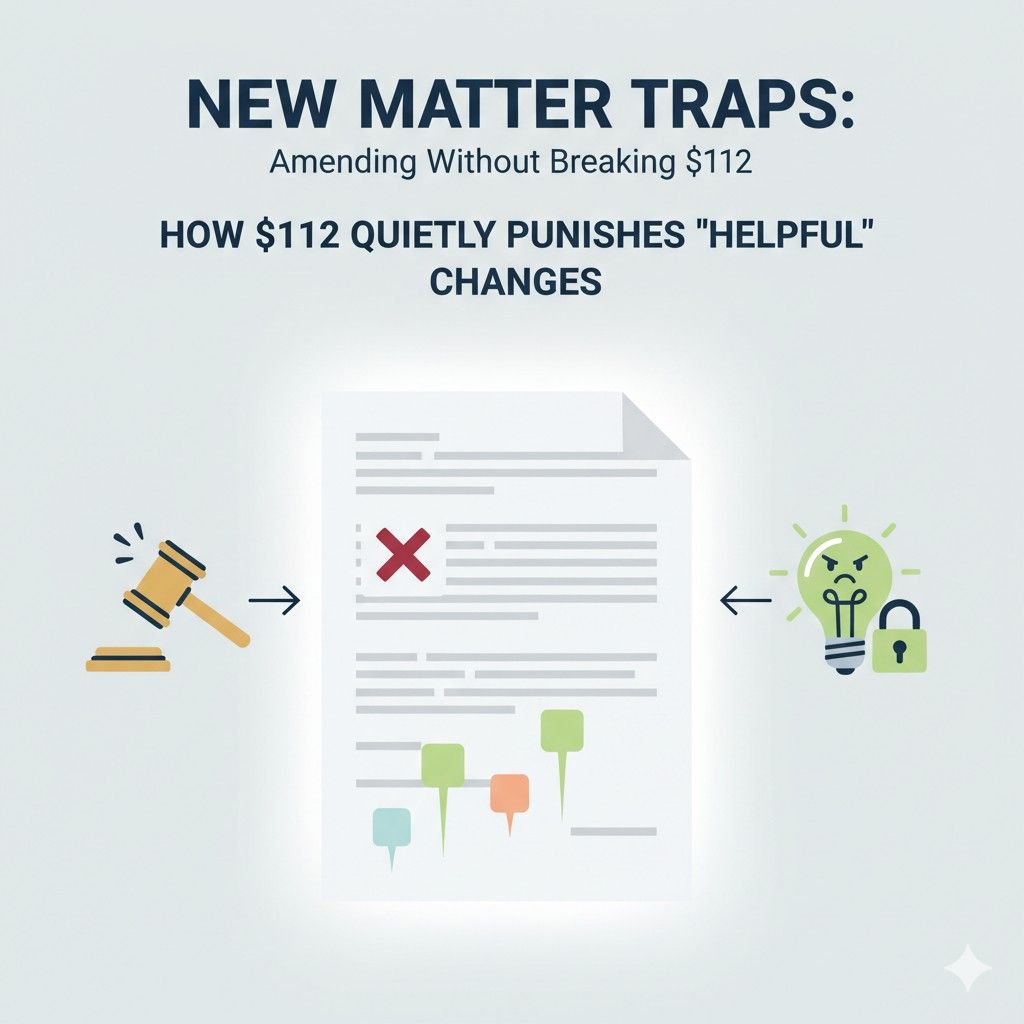
Platforms like PowerPatent help here by keeping amendments grounded in the original disclosure while still moving prosecution forward efficiently. You can see how that approach works in practice here: https://powerpatent.com/how-it-works
How Small Changes Add Up to Big §112 Problems
Rarely does one amendment destroy a patent. More often, it is a series of small changes over time. Each one feels reasonable. Each one feels minor. Together, they slowly pull the claims away from the original foundation.
By the time the patent is challenged, the gap is obvious. But at the moment of amendment, it is hard to see.
A strong habit for businesses is to treat every amendment as cumulative. Ask not only whether this change is supported, but whether it moves the patent further away from its original center of gravity.
Why §112 Is a Valuation Issue
Investors and acquirers look closely at patents. They care about enforceability, not just issuance. §112 weaknesses reduce confidence, even if they are not explicitly discussed.
A patent that is vulnerable to new matter arguments is harder to rely on. That affects licensing leverage, defensive strength, and overall company value.
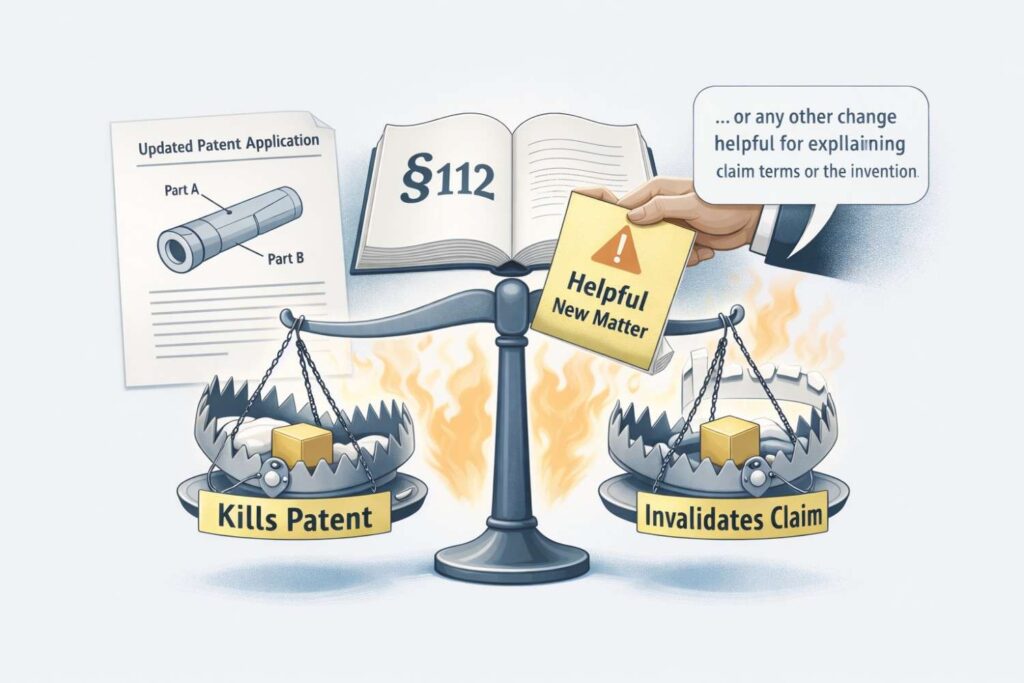
Understanding how §112 quietly punishes helpful changes allows founders to make smarter tradeoffs. Sometimes the right move is to leave language broader and less polished if that keeps it firmly supported.
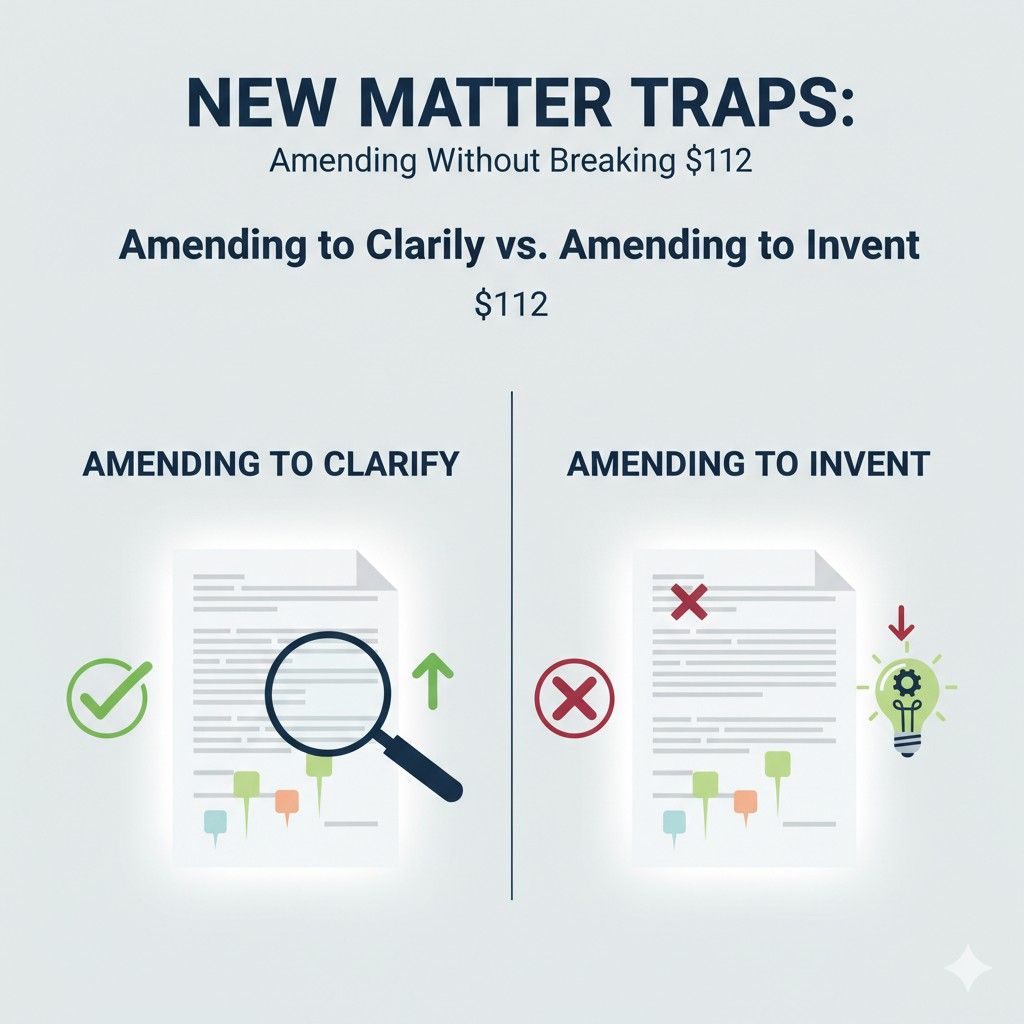
Amending to Clarify vs. Amending to Invent
Most patent damage does not come from bold moves. It comes from subtle ones. The line between clarifying what you already disclosed and inventing something new is thin, quiet, and easy to cross without realizing it.
Strong teams learn to see that line early and respect it every time they amend.
This section focuses on how businesses can improve patents without changing what they legally own, and how to build habits that keep amendments safe long after the original filing.
Clarification Is About Structure, Not Substance
True clarification does not add substance. It changes how existing ideas are presented. This means reordering sentences, tightening phrasing, and connecting concepts that already exist in the text.
When an amendment introduces a new capability, a new step, or a new result, it is no longer clarification. It is invention. Even if that invention feels small or obvious, it carries real risk.
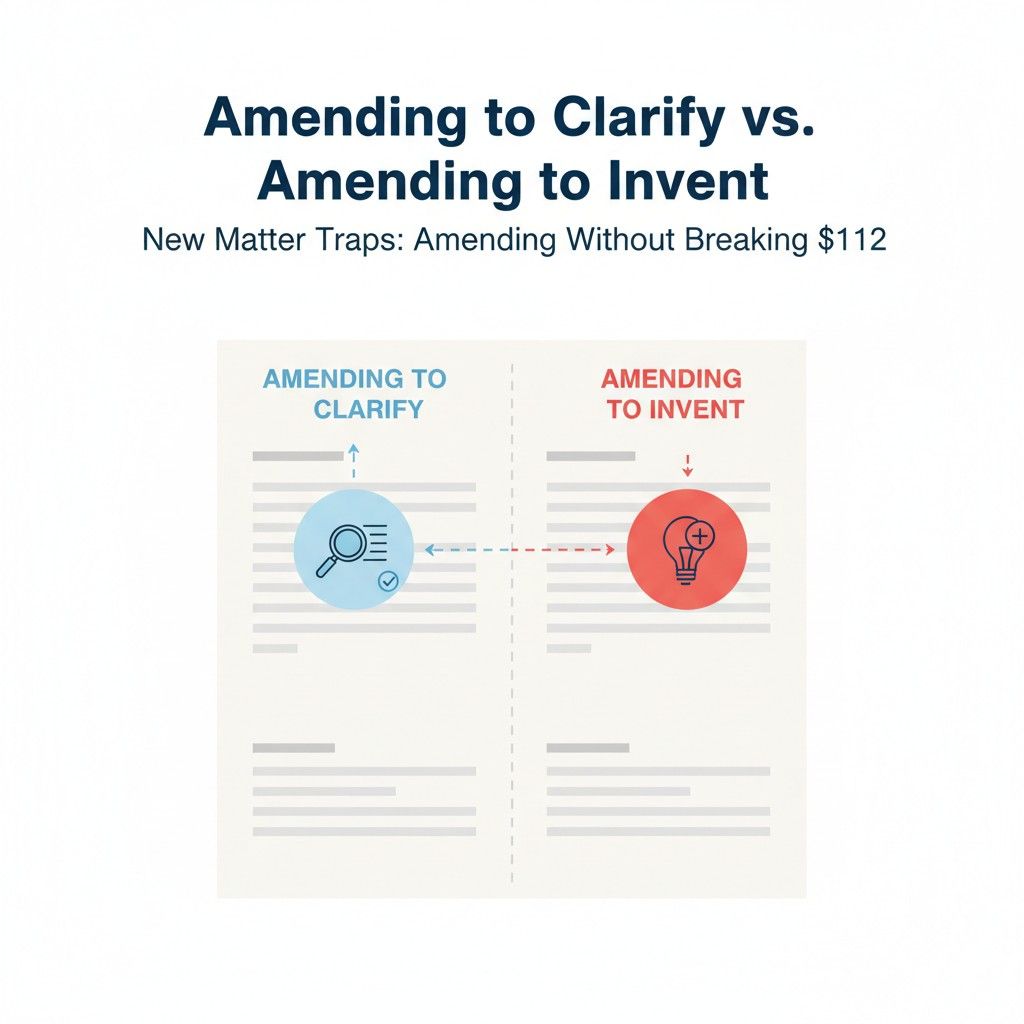
A useful mental shift is to treat clarification like editing for readability, not for completeness. You are making the same story easier to follow, not adding new chapters.
Using the Original Language as Raw Material
One of the safest ways to amend is to reuse the exact words from the original filing. This may feel limiting, but it is powerful. When you build claims or explanations from existing language, you reduce the chance of adding unsupported ideas.
For businesses, this also creates consistency. The patent reads like a single, coherent document rather than something that evolved in disconnected pieces over time.
When new language is needed, it should mirror the tone and generality of the original text. Sudden jumps in detail or specificity are often signs that the amendment is drifting into new matter.
When Narrowing Claims Becomes a Hidden Invention
Narrowing claims is common during prosecution. It is often necessary to get around prior art. The danger is that narrowing can create the appearance of possession that the original filing does not support.
For example, limiting a claim to a specific technique may imply that the inventor knew that technique from the start. If the application only described the invention at a high level, that implication can be challenged later.
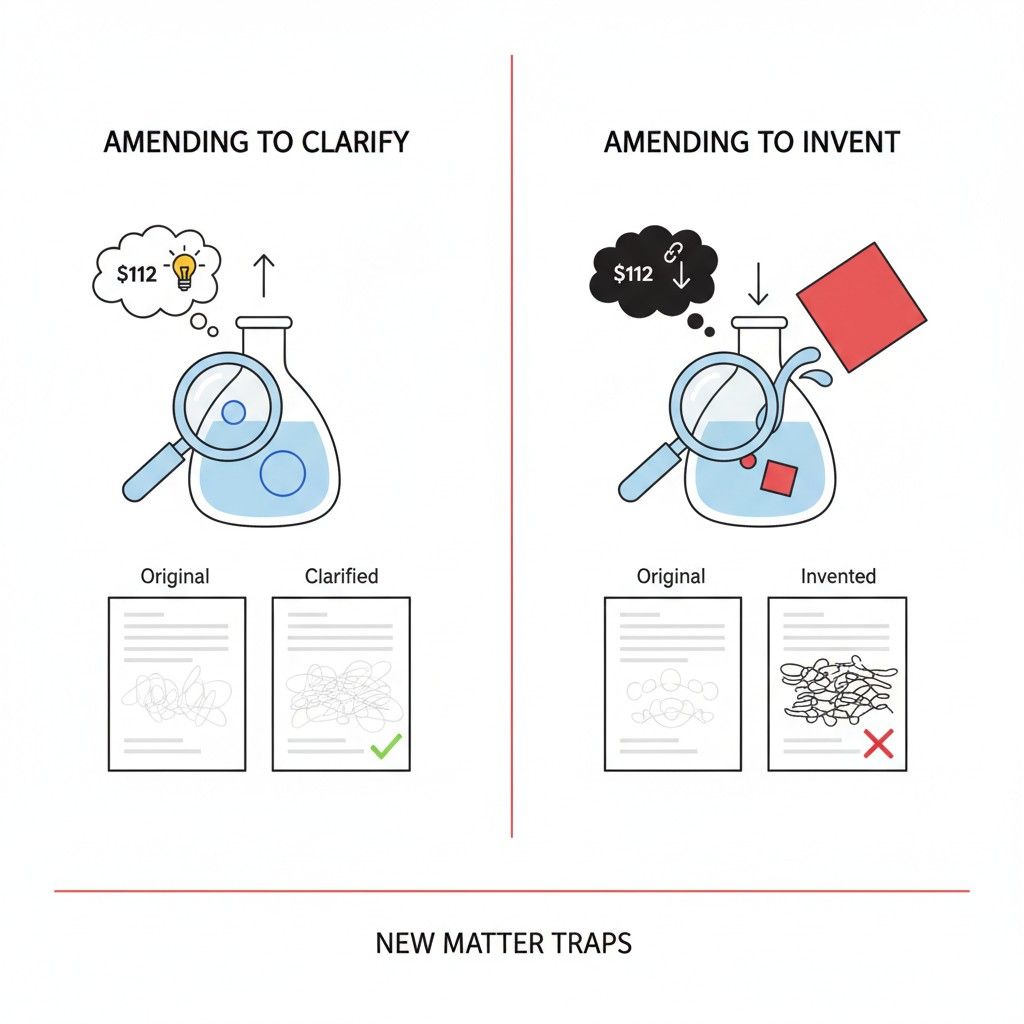
A safer approach is to narrow using functional language that already exists in the description. This keeps the claim aligned with what was actually disclosed, even if it sacrifices some precision.
The Problem With Adding Examples Late
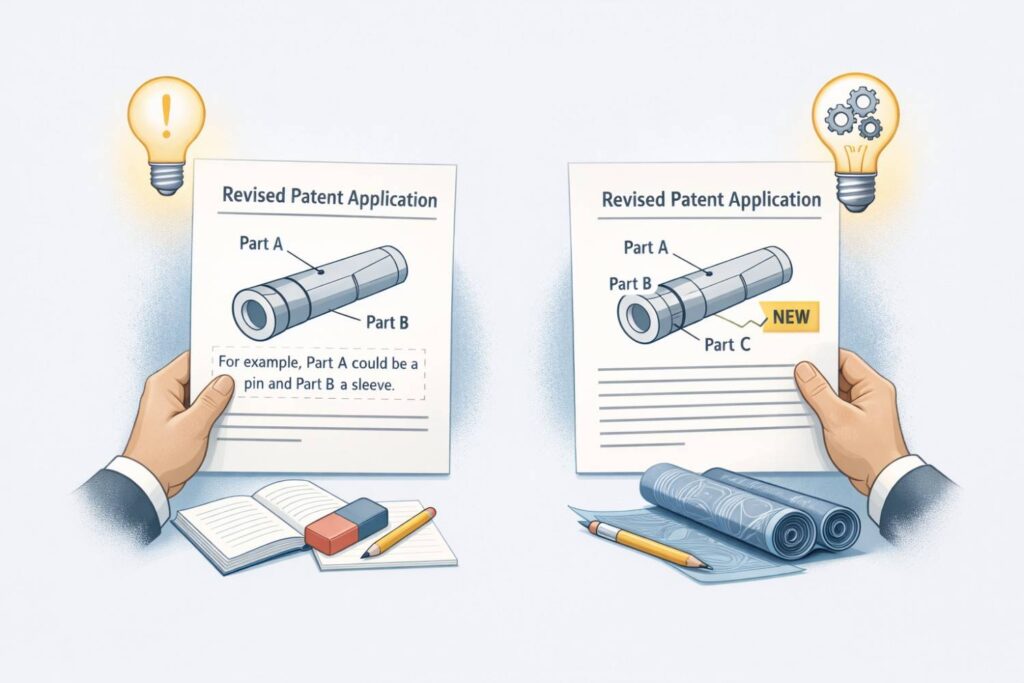
Examples feel helpful. They make inventions concrete. But adding new examples after filing is one of the most common ways teams invent without realizing it.
Even if the example matches your real product, it may introduce details that were never disclosed. Those details can later be used to argue that the claims rely on new matter.
If examples are needed, they should be framed as illustrations of concepts already described, not as new embodiments with unique features.
Teaching the Reader vs. Teaching the Patent
There is a difference between helping a human reader understand and strengthening a legal document. Amendments often aim to teach the reader. But patents are not judged on teaching style. They are judged on disclosure support.
Sometimes the best amendment feels unsatisfying from a communication standpoint. It may leave out details you would normally explain. That restraint is often what keeps the patent safe.
For businesses, this is a mindset shift. The goal is not to tell the full story. The goal is to protect what you disclosed as early as possible.
Building an Amendment Discipline Inside the Company
Companies that handle amendments well treat them as strategic decisions, not routine edits. They slow down just enough to ask whether a change adds meaning or just clarity.
Over time, this discipline becomes cultural. Engineers learn what details matter. Product teams understand what belongs in a patent and what does not. The risk of accidental invention drops.
This is where having the right tools and guidance matters. PowerPatent helps teams stay anchored to their original disclosure while still moving quickly through prosecution.
You can explore how that balance works here: https://powerpatent.com/how-it-works
Why Safe Amendments Create Stronger Patents
A patent that survives scrutiny is more valuable than one that reads perfectly. Safe amendments keep the patent close to its original core, which makes it harder to attack later.
For businesses, this means more confidence in enforcement, licensing, and fundraising conversations. The patent becomes a stable asset instead of a fragile document.
Understanding the difference between clarifying and inventing is not just a legal skill. It is a business advantage.
If you want, I can continue by diving deeper into real-world amendment scenarios where teams often slip, and how to handle them without breaking §112.
Wrapping It Up
Amendments are not the enemy. Careless amendments are. The real risk is not changing your patent. The risk is changing it without knowing what you are giving up. New matter traps exist because patents freeze time, while companies move forward. That tension never goes away. The goal is not to eliminate it, but to manage it with discipline. When teams understand that every amendment is judged against the original filing, they start making calmer, smarter choices. The strongest patents are not the most detailed or polished ones. They are the ones that stay true to their foundation. They clarify without drifting. They respond without overexplaining. They evolve in form, not in substance.
Leave a Reply