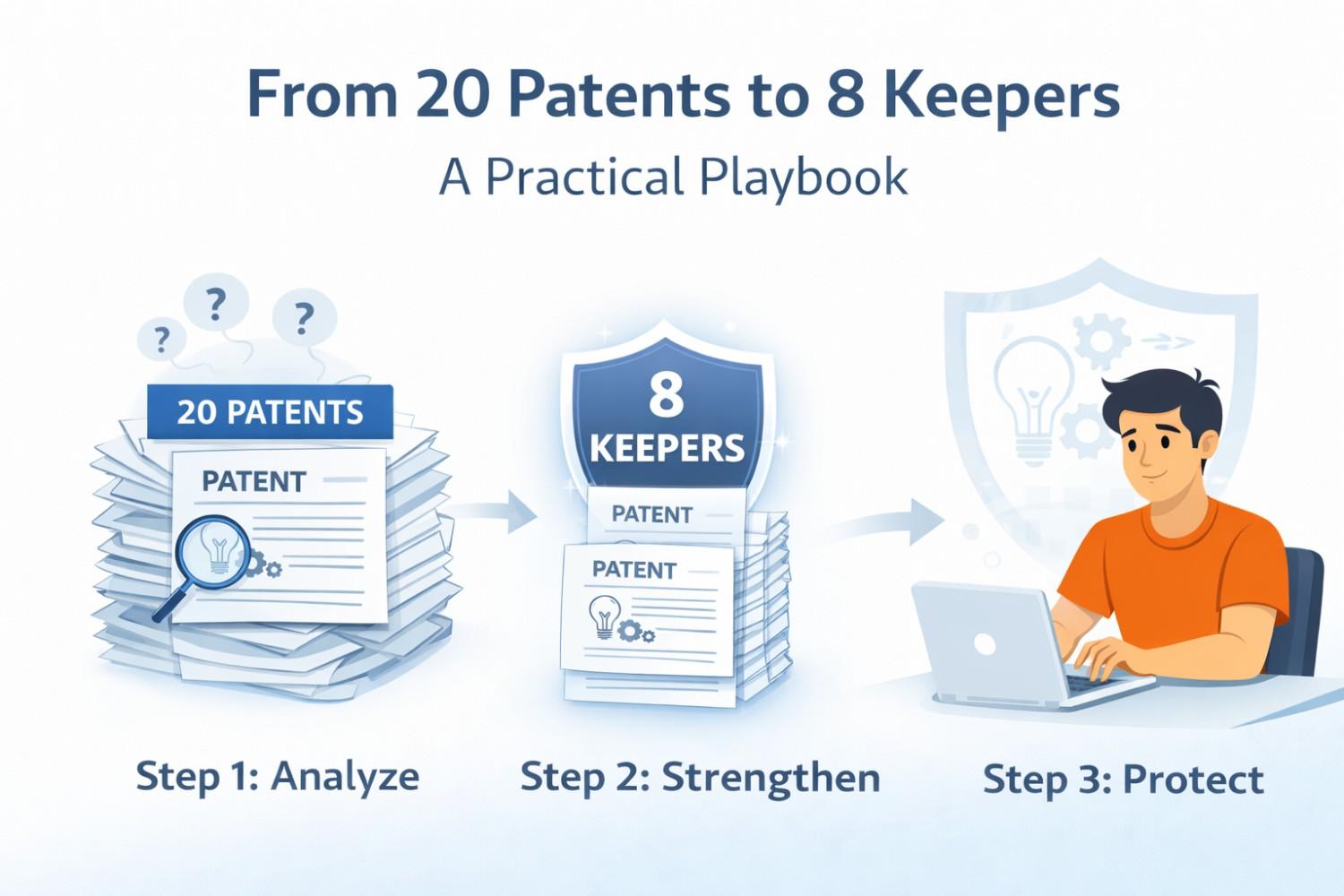
Most startups file too many patents—or none at all. Both are costly mistakes. I have seen teams spend years and huge budgets building a wall of 20 filings, only to realize that only 8 truly matter. The rest add noise, cost, and stress. This playbook shows you how to go from a messy pile of filings to a tight set of powerful, focused patents that protect what actually drives your company’s value. If you are building real tech and want strong protection without slowing down, this guide is for you.
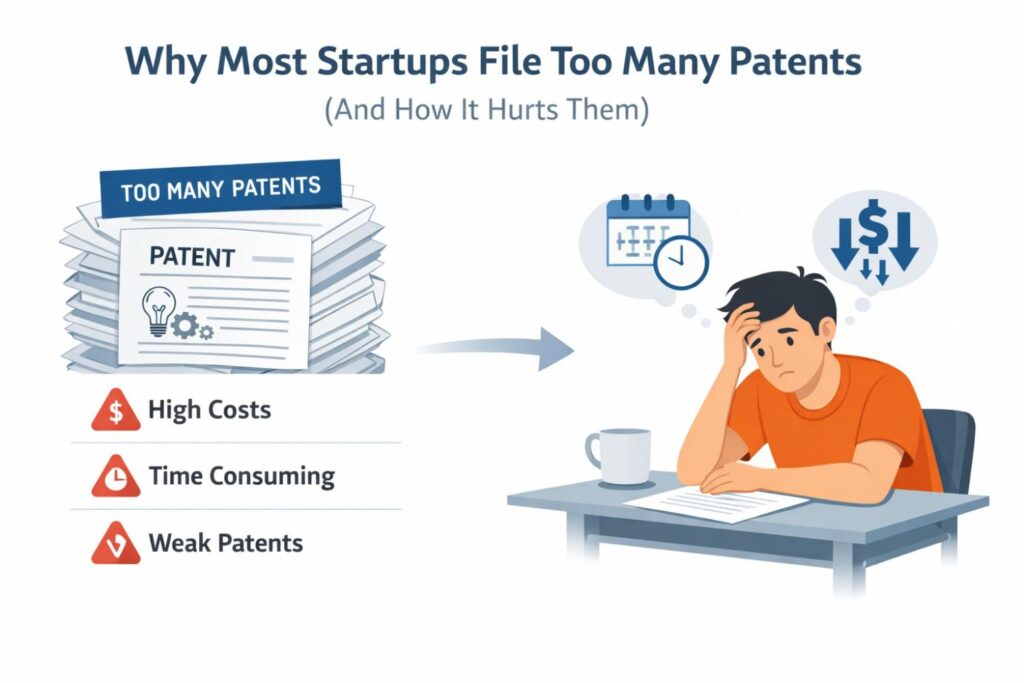
Why Most Startups File Too Many Patents (And How It Hurts Them)
Many founders believe more patents mean more safety. It feels logical. If one patent is good, then twenty must be better.
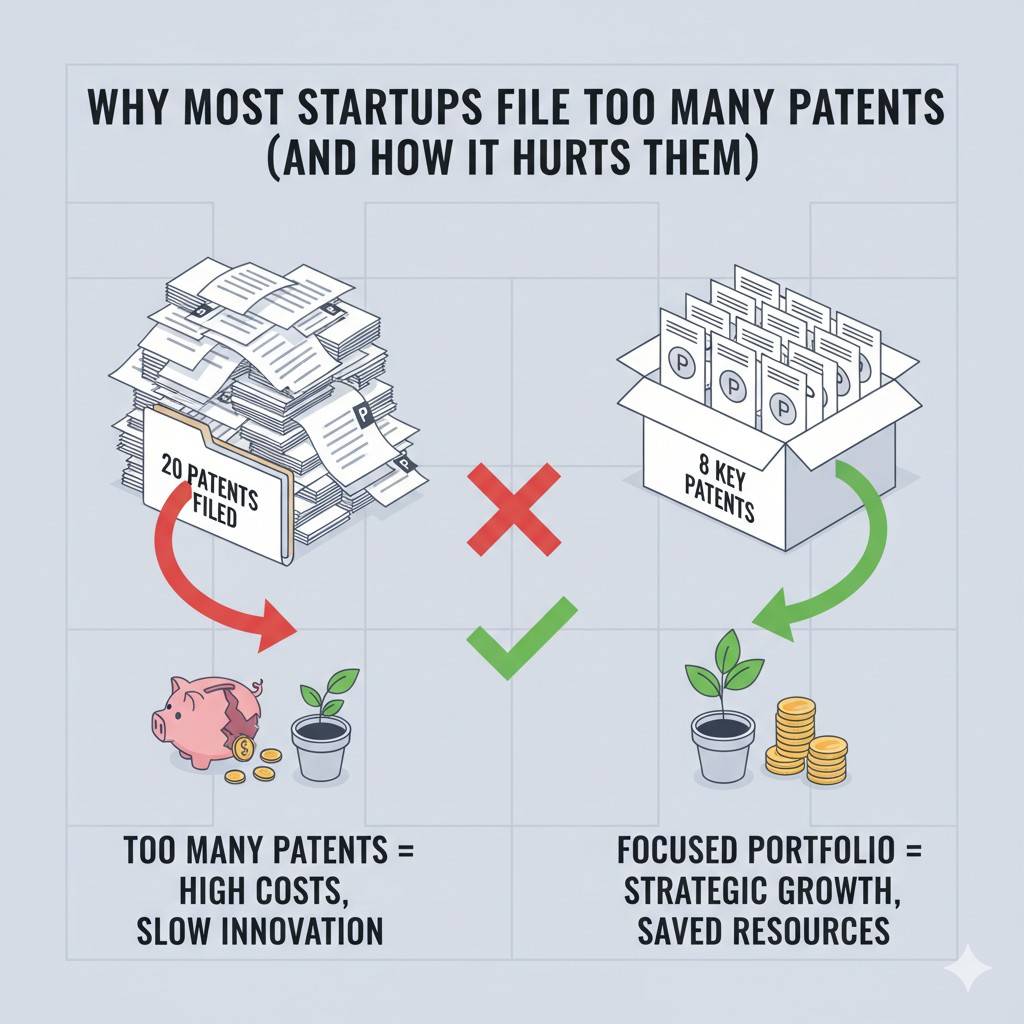
But that thinking can quietly drain your money, focus, and speed. In reality, a large stack of filings often hides weak strategy. It creates comfort, not protection.
This section breaks down why startups fall into the “more is better” trap and how that decision can slow growth at the worst possible time.
The Fear-Driven Filing Trap
Startups move fast, but fear moves faster. Fear of competitors. Fear of investors asking hard questions. Fear of missing a filing deadline.
When fear leads, teams file quickly and often without stepping back to ask what truly needs protection.
Many early patents are filed when the product is still shifting. Features change. Architecture evolves. What felt core six months ago becomes irrelevant. Yet the filing remains.
Fees continue. Legal time adds up. You end up protecting yesterday’s idea instead of tomorrow’s moat.
A smarter move is to pause before filing and ask one simple question: if this exact feature vanished tomorrow, would our company still win? If the answer is yes, it may not deserve a full patent filing.
This single question filters noise better than complex legal reviews.
Instead of reacting to fear, build a quarterly review rhythm. Every three months, gather your product lead, engineering lead, and someone thinking about market position.
Look at what truly drives user adoption or revenue. Only those pieces should move forward into filings. Everything else stays in the lab until it proves itself.
If you want a system that helps you file with clarity instead of panic, see how PowerPatent guides founders step-by-step at https://powerpatent.com/how-it-works.
The Investor Pressure Problem
Investors like numbers. Ten patents sounds stronger than two. So founders file more to look serious. But seasoned investors care less about the count and more about coverage.
They want to know if your patents block real competitors from copying your edge.
When a startup shows a long list of filings but cannot explain how each one protects the main product engine, it signals confusion. It looks like activity instead of strategy.
A better approach is to map each patent directly to a business risk. If a competitor copied this piece, would it hurt growth? Would it lower your margins? Would it reduce switching costs?
If the answer is weak, the patent may not be pulling its weight.
Before raising your next round, run a protection audit. Take every patent and write one clear sentence explaining what business outcome it defends. If you struggle to do that, the filing may not belong in your core portfolio.
PowerPatent was built for founders who want patents that stand up in investor meetings because they connect clearly to product and market. Learn more here: https://powerpatent.com/how-it-works.
The “Feature Patent” Mistake
Startups often patent features instead of systems. Features change. Systems endure. A narrow patent around a single interface tweak may look precise, but it rarely creates a barrier competitors cannot step around.
The deeper protection lives in architecture, workflows, data handling, or model training methods.
These are harder to copy without rebuilding from scratch. Yet many teams overlook them because they are not as visible as user-facing features.
When reviewing your portfolio, ask whether each patent protects surface-level behavior or the engine underneath.
If it focuses only on how something looks or a minor step in a process, consider whether that filing truly blocks imitation.
Engineers should be heavily involved in identifying core system breakthroughs. Too often patents are drafted from product descriptions without diving into the underlying logic. That gap creates shallow protection.
At PowerPatent, founders start with their real technical depth—code, models, architecture diagrams—and turn that into defensible filings reviewed by real patent attorneys.
That is how you move from feature patents to true system coverage. Explore the process at https://powerpatent.com/how-it-works.
The Budget Drain You Do Not See
Each patent has hidden costs beyond the initial filing. Office actions, responses, maintenance fees, foreign filings, attorney time. Multiply that by twenty and the burn adds up fast.
Early-stage companies operate on tight cash. Every dollar tied up in low-impact patents is a dollar not spent on product, hiring, or growth. Yet because patent costs are spread over time, the total drain often goes unnoticed.
One practical exercise is to project five years of cost for each patent family. Include prosecution, potential international filings, and maintenance. Then compare that total against the value that patent brings to your moat.
This exercise alone can reveal which filings deserve to continue and which should quietly sunset.
Being selective does not mean being weak. It means being sharp. Eight strong patents that guard your core engine will do more than twenty scattered filings.
PowerPatent helps founders see the full picture before committing long-term spend, combining smart software and attorney oversight so you avoid costly missteps from day one.

If you want clarity before you spend, visit https://powerpatent.com/how-it-works.
The Complexity Spiral
More patents mean more complexity. Tracking deadlines. Managing responses. Coordinating inventors. Reviewing drafts. As the portfolio grows, mental load grows with it.
Founders already juggle hiring, sales, fundraising, and product strategy. Adding a tangled patent portfolio can create distraction at critical moments.
Complexity slows decision-making because you are unsure how changes to the product affect existing claims.
A tight portfolio simplifies life. When you know exactly which eight patents matter, product decisions become cleaner. Engineers understand which areas are sacred. Leadership can align around protected territory.
To reduce complexity, consolidate overlapping filings where possible. If two patents cover similar ideas, explore whether one broader continuation could replace both.
Work with counsel who understands your long-term roadmap, not just isolated filings.
Modern tools make this easier. PowerPatent was designed to give founders control and visibility over their portfolio, without drowning in paperwork. Real attorneys guide the strategy, but the process stays simple and fast.
You can see how it works at https://powerpatent.com/how-it-works.
The False Sense of Security
Perhaps the most dangerous harm of over-filing is emotional. A thick stack of patents creates a feeling of safety. But if those filings do not cover your true edge, that safety is an illusion.
Competitors do not fear numbers. They fear claims that block revenue paths. They fear patents that would force them to redesign core systems. If your filings do not do that, they will move forward without hesitation.
To test your portfolio, imagine a well-funded competitor studying your patents. Would they need to change their product roadmap? Or could they work around your claims with minor tweaks? Honest answers matter.
Bring in outside perspective when possible. Someone who did not draft the patents can spot gaps more easily. The goal is not to criticize past decisions but to sharpen future ones.
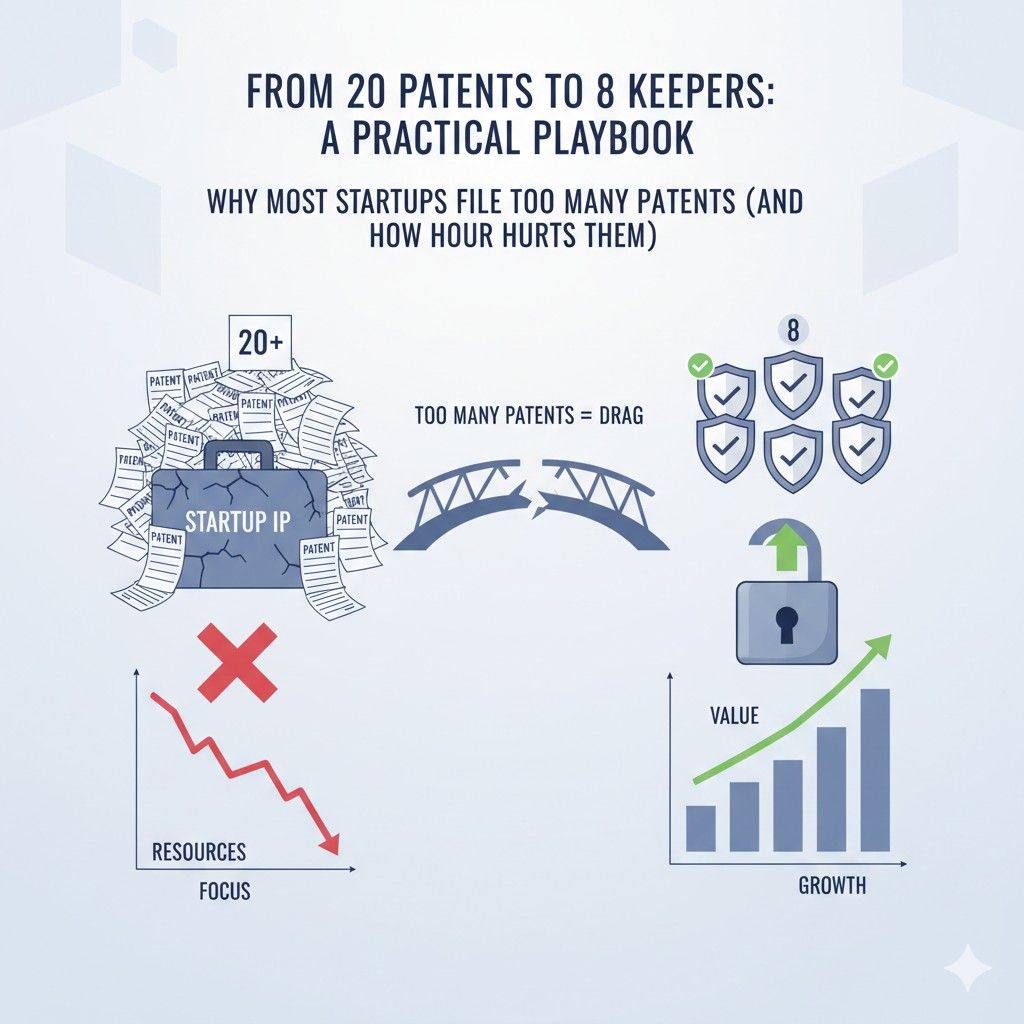
Strong protection builds confidence rooted in reality, not in volume. That is how you shift from twenty uncertain filings to eight keepers that truly defend your position.
How to Identify the 8 Patents That Actually Protect Your Core Technology
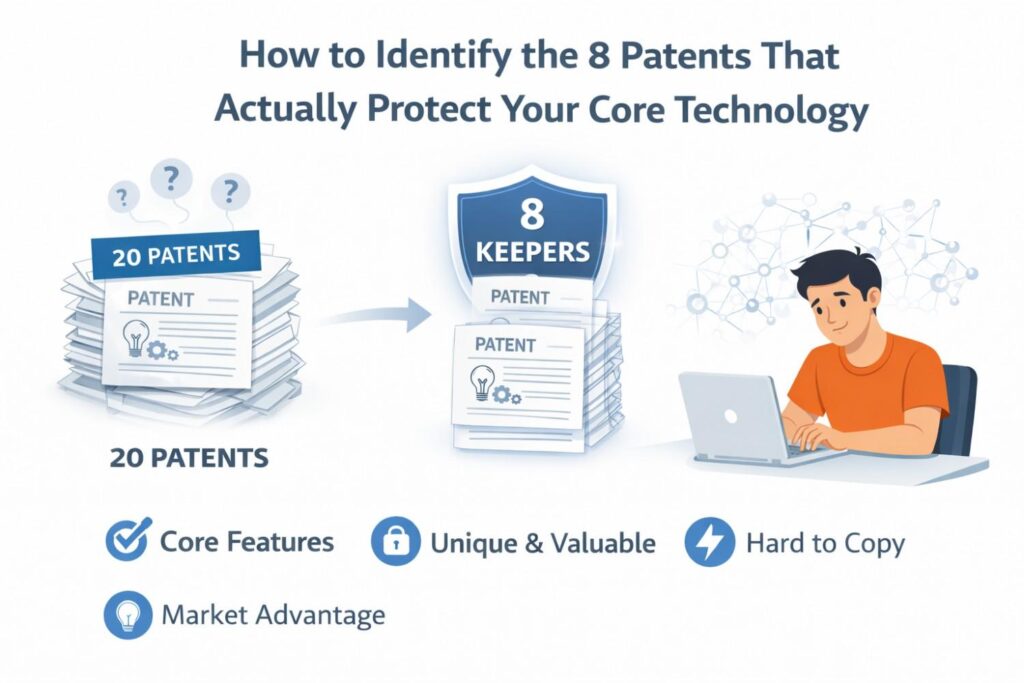
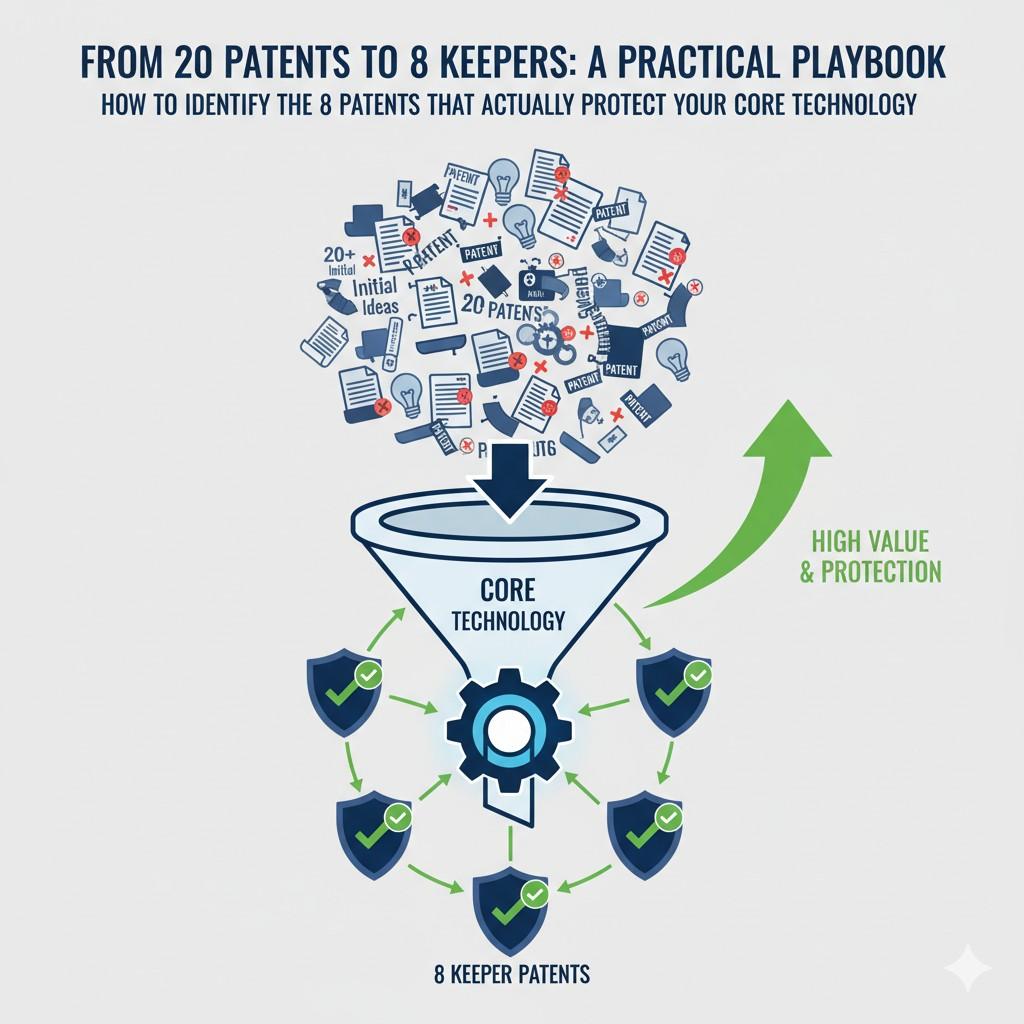
Most companies do not need more patents. They need better ones. The shift from twenty scattered filings to eight true keepers starts with clarity. You are not trimming for the sake of saving money.
You are sharpening your edge. The goal is simple: protect the parts of your technology that, if copied, would seriously damage your growth. Everything else is optional.
This section walks you through how to spot those eight keepers with focus and discipline.
Start With Your Revenue Engine
Your product may have many parts, but only a few drive revenue. Some features attract attention. Others quietly power retention, performance, or scale.
The first step is to identify what truly makes customers stay, pay, and expand.
Sit down with your product and growth leads. Look at usage data. Look at churn. Look at what customers mention during demos. Somewhere in that data is your engine.
It may be a matching algorithm, a compression method, a training pipeline, a hardware design, or a workflow that saves users hours each week.
Now ask a blunt question: if a competitor copied this exact engine, how much would it hurt us?
If the answer is “a lot,” that area deserves serious patent protection. If the answer is “not much,” it should not sit at the center of your portfolio.
This revenue-first lens changes everything. You stop filing around what is interesting and start protecting what pays the bills.
At PowerPatent, this alignment between product and protection is built into the process.
The system helps you translate your real technical edge into claims that map directly to business value. You can see how founders do this here: https://powerpatent.com/how-it-works.
Trace the Deep Technical Advantage
Not all important tech is visible to users. Often the most valuable pieces are buried in architecture, infrastructure, or data flow. These are harder to explain, but they are also harder to copy.
Go one layer deeper than your surface features. Look at what makes your system faster, cheaper, more accurate, or more scalable. Maybe your AI model trains with less labeled data.
Maybe your chip design reduces power use in a way others cannot match. Maybe your backend handles real-time updates with unusual efficiency.
These are not marketing bullet points. They are structural advantages.
Pull your senior engineers into a working session. Ask them what parts of the system would be painful for a competitor to rebuild. Where did you spend months debugging?
What breakthroughs unlocked the next level of performance? Those pain points often signal patent-worthy material.
Your eight keepers should include protection around these deep layers. They are the foundation. If they crumble, everything above becomes easier to copy.
Look for Bottlenecks You Control
In every industry, there are bottlenecks. A bottleneck is a point in the workflow where value must pass through a specific process. If you control that process, you control leverage.
For example, in a marketplace, the matching logic may be the bottleneck. In a hardware startup, a manufacturing step could be the gatekeeper. In software infrastructure, it might be how data is normalized before analysis.
Map your product flow from start to finish. Where does value get created in a way that is hard to bypass? Those points deserve protection.
When reviewing your patent stack, check whether your filings surround these bottlenecks. If they do not, you may have patents that look impressive but fail to guard your true leverage points.
Strong portfolios protect choke points, not random features.
Align With Your 3-Year Roadmap
Your patents should not only protect what you built yesterday. They must also defend where you are going. A common mistake is filing based only on the current version of the product.
Then, two years later, the company pivots slightly, and the early filings no longer match the main strategy.
Pull out your three-year vision. Where will your company make most of its money? What markets will you enter? What capabilities will you expand?
Now compare that vision with your current patents. Do they align?
If your roadmap centers on automation at scale, but your patents focus on early manual workflows, something is off. The eight keepers should clearly support your future direction.
This may require filing continuations or adjusting claim scope. It may mean letting go of older filings that no longer fit the mission. That is not failure. It is discipline.
PowerPatent helps founders keep filings aligned with evolving roadmaps by combining smart drafting tools with attorney review. This avoids the trap of outdated protection.
If your roadmap has shifted, it may be time to recalibrate: https://powerpatent.com/how-it-works.
Evaluate Claim Strength, Not Just Titles
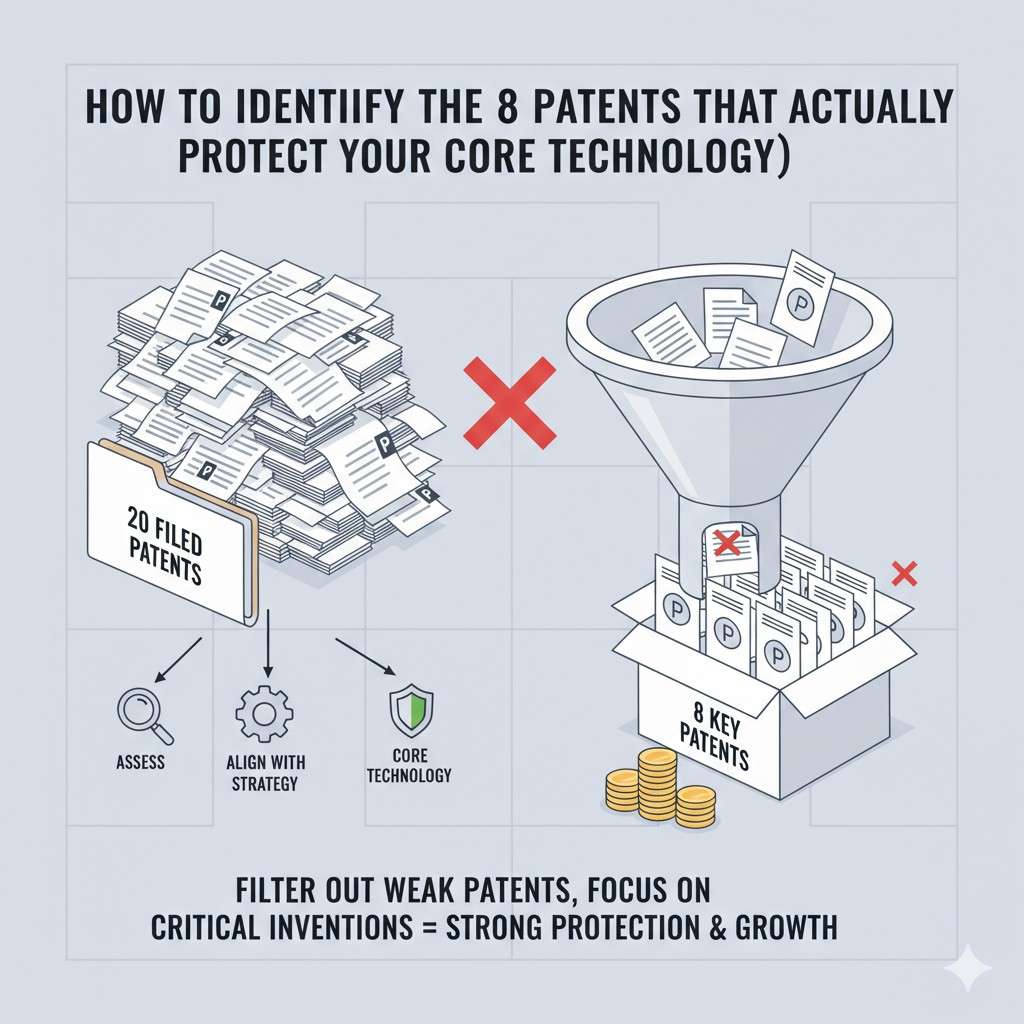
A patent title can sound powerful. The real power lives in the claims. Claims define what others cannot do. If the claims are narrow or easy to work around, the patent may not be a keeper.
Review your issued patents and pending applications carefully. Look at how broad the independent claims are. Do they cover only one specific version of your implementation?
Or do they capture the broader concept in a way that blocks alternatives?
If a competitor could avoid infringement by changing a minor detail, that patent may not deserve top-tier status.
This review is technical. It requires thoughtful reading. It may require outside counsel. But it is worth the effort. Eight patents with strong, well-crafted claims beat twenty weak ones every time.
When patents are drafted with clarity from the start, this process becomes easier. That is why combining AI-driven drafting with real attorney oversight, as PowerPatent does, can make such a difference.
It increases the odds that what you file today will still matter years from now. Learn more here: https://powerpatent.com/how-it-works.
Stress-Test Against Real Competitors
The final filter is practical. Pull up your top three competitors. Study their products, technical blogs, and public filings. Then imagine they are trying to replicate your core advantage.
Would your eight chosen patents stop them? Would they need to redesign key components? Would they hesitate before entering your space?
If the answer is uncertain, dig deeper. You may need to strengthen claims or file new applications that close gaps.
This is not about being aggressive. It is about being realistic. Patents exist in a competitive world. They must hold up under pressure.
When you complete this exercise, you will likely see that only a subset of your original filings truly pass the test. Those are your keepers.
Everything else becomes optional. And optional patents should never consume core resources.

You now have a framework to identify the eight that matter. The next step is learning how to cut, strengthen, and reposition the rest without losing strategic ground.
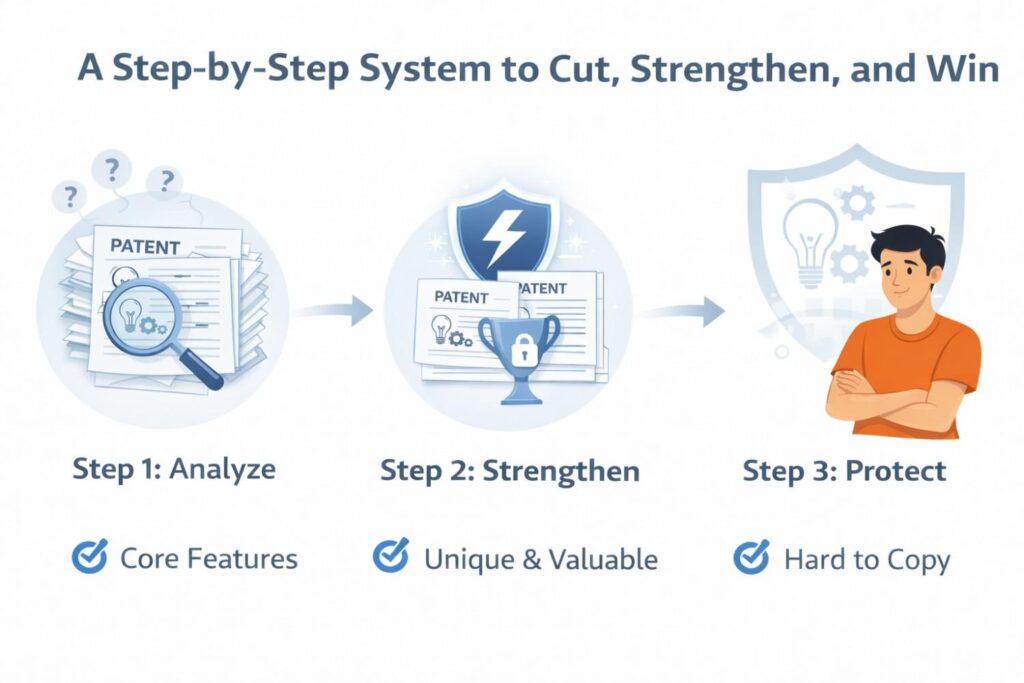
A Step-by-Step System to Cut, Strengthen, and Win
Once you know which eight patents truly matter, the hard part begins. You now have to make real decisions. Some filings will need to be tightened. Some will need to be expanded.
Others may need to be dropped. This process can feel uncomfortable, especially if time and money were already invested.
But this is where strong companies separate themselves. They treat patents like product strategy. They refine. They focus. They remove what no longer serves the mission.
This section shows you how to move from clutter to clarity without losing protection or momentum.
Step Into CEO Mode, Not Attachment Mode
Patents often carry emotional weight. Engineers remember late nights spent inventing. Founders remember early breakthroughs. Letting go of a filing can feel like letting go of a chapter in the company’s story.
But this is not about memory. It is about leverage.
Approach your portfolio like a CEO reviewing product lines. If a product does not drive growth or strengthen the brand, it gets sunset. The same logic applies here.
A patent that does not protect your current or future engine should not command ongoing resources.
Have one focused session where you review every filing and force a decision. Keep and strengthen. Maintain but deprioritize. Or exit over time. Avoid vague middle ground. Clarity reduces drag.
When founders work with PowerPatent, they often say the biggest relief comes from finally seeing their portfolio clearly.
With software that organizes filings and real attorneys guiding decisions, the fog lifts. If you want that same clarity, see how it works here: https://powerpatent.com/how-it-works.
Tighten the Claims Around the Core
For the eight keepers, your job is not done. Now you make them stronger.
Read the independent claims carefully. Ask whether they capture the broad idea behind your advantage or just one implementation.
If they are too narrow, explore continuation filings that expand protection while staying grounded in your original disclosure.
This is a powerful move that many startups miss. A continuation allows you to adjust claim focus as your product evolves, without losing the early filing date. It is a way to adapt protection as your strategy sharpens.
Work closely with counsel who understands both your codebase and your roadmap. The goal is to shape claims that are hard to design around. You want competitors to face real friction if they try to copy your approach.
Strong claims are simple in language but wide in coverage. They focus on the underlying method or system, not cosmetic details.
PowerPatent blends AI tools that extract the deep logic from your tech with attorney review that sharpens the claims for real-world defense. That combination helps you avoid weak language that limits future leverage.
If you want patents that grow with you, explore the process here: https://powerpatent.com/how-it-works.
Close the Gaps You Discover
As you narrow to eight keepers, gaps often appear. You may realize that one crucial workflow step is not protected. Or that your data pipeline improvements were never fully captured.
Do not ignore these gaps. Address them directly.
Gather fresh technical detail from your team. Document how the system works today, not just how it worked two years ago. If new inventive concepts have emerged, file targeted applications that fill the holes.
This is not about returning to a pile of twenty. It is about making sure your core ring of protection is complete.
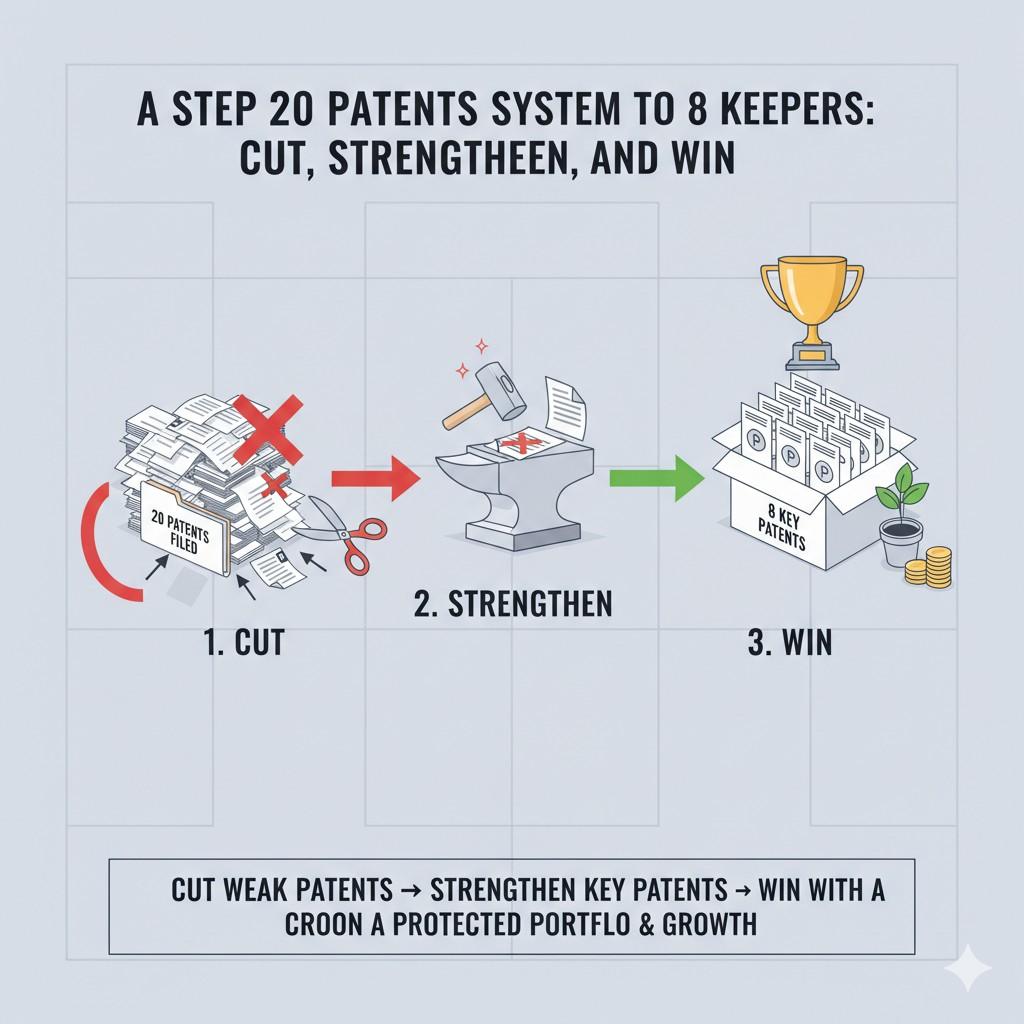
Think of it like reinforcing a fortress wall. You are not building a larger wall. You are sealing cracks so nothing slips through.
Timing matters here. File before major product launches or public disclosures. Once something becomes public, your options narrow. Staying proactive keeps you in control.
Reduce Ongoing Drag
For patents that are not keepers, create a clean wind-down strategy. Some may be allowed to lapse at the right time. Some may not be pursued internationally. Others may simply remain as low-priority filings without additional investment.
This step frees budget and mental energy.
Redirect those resources into strengthening the core eight. Fund deeper claim work. Consider strategic foreign filings in markets that truly matter. Invest in enforcement readiness if your space is competitive.
The point is not to spend less. The point is to spend smarter.
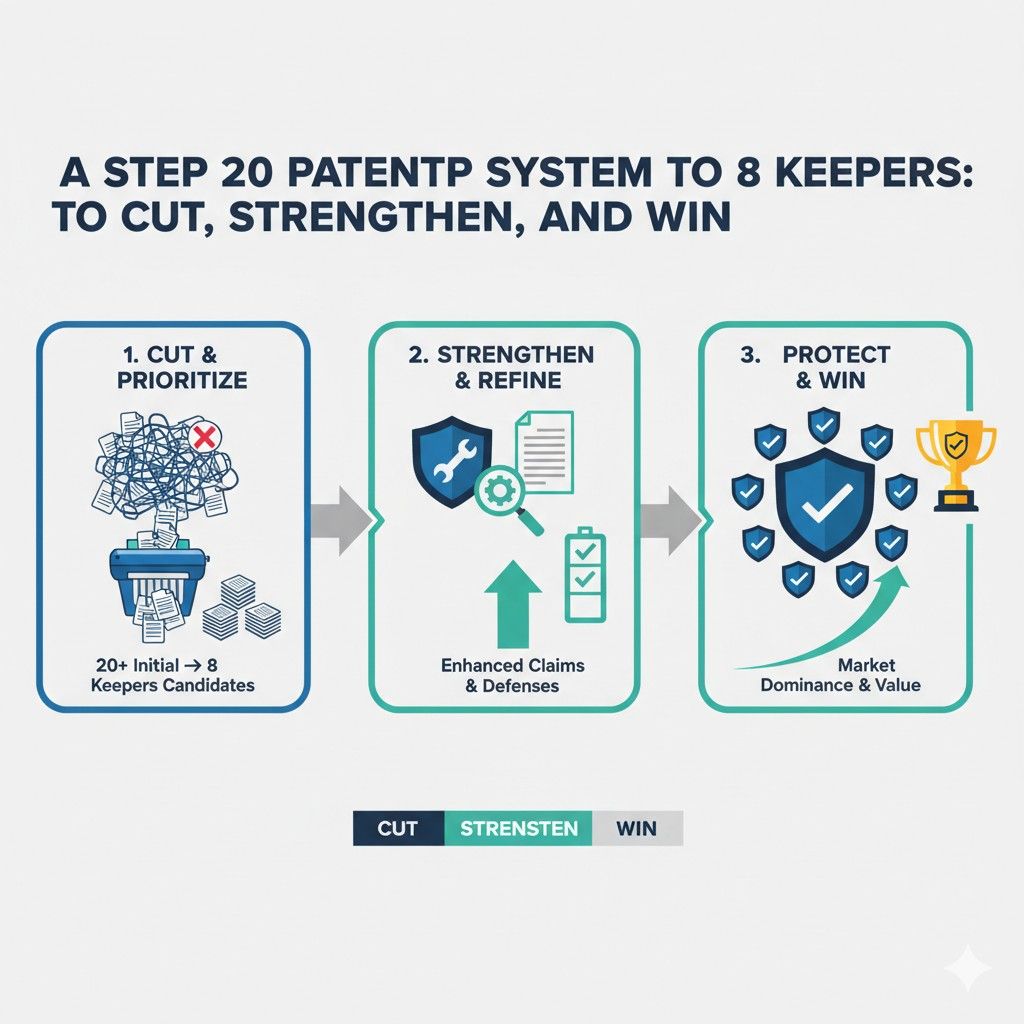
A focused portfolio also simplifies internal communication. Your team knows which inventions are mission-critical.
Engineers can align future innovation around protected areas. Leadership can speak confidently to investors about real barriers to entry.
Build an Ongoing Review Rhythm
Winning is not a one-time cleanup. It is a habit.
Set a calendar reminder twice a year for a portfolio review. Align it with major product milestones. Ask whether your eight keepers still reflect your engine. If your strategy shifts, your protection should shift with it.
Keep documentation clean. Update technical summaries as systems evolve. This makes future filings faster and more accurate.
Modern startups move quickly. Your patent strategy must move with you. Static portfolios become outdated. Living portfolios create long-term leverage.
PowerPatent was built for this rhythm. It allows founders to iterate on filings with speed while keeping real attorney oversight in the loop. That balance of software efficiency and human expertise prevents drift and costly mistakes.
If you want a system that grows with your startup instead of slowing it down, learn more here: https://powerpatent.com/how-it-works.
Win With Focus
At the end of this process, you will likely have fewer patents than before. But you will have more strength.
Eight well-positioned patents tied directly to your revenue engine, deep technology, and future roadmap can create real defensive power. They send a clear signal to investors. They deter competitors. They give your team confidence.
Most startups chase volume because it feels safe. The smartest ones chase precision.
If you are serious about building durable advantage, do not measure your portfolio by count. Measure it by impact.
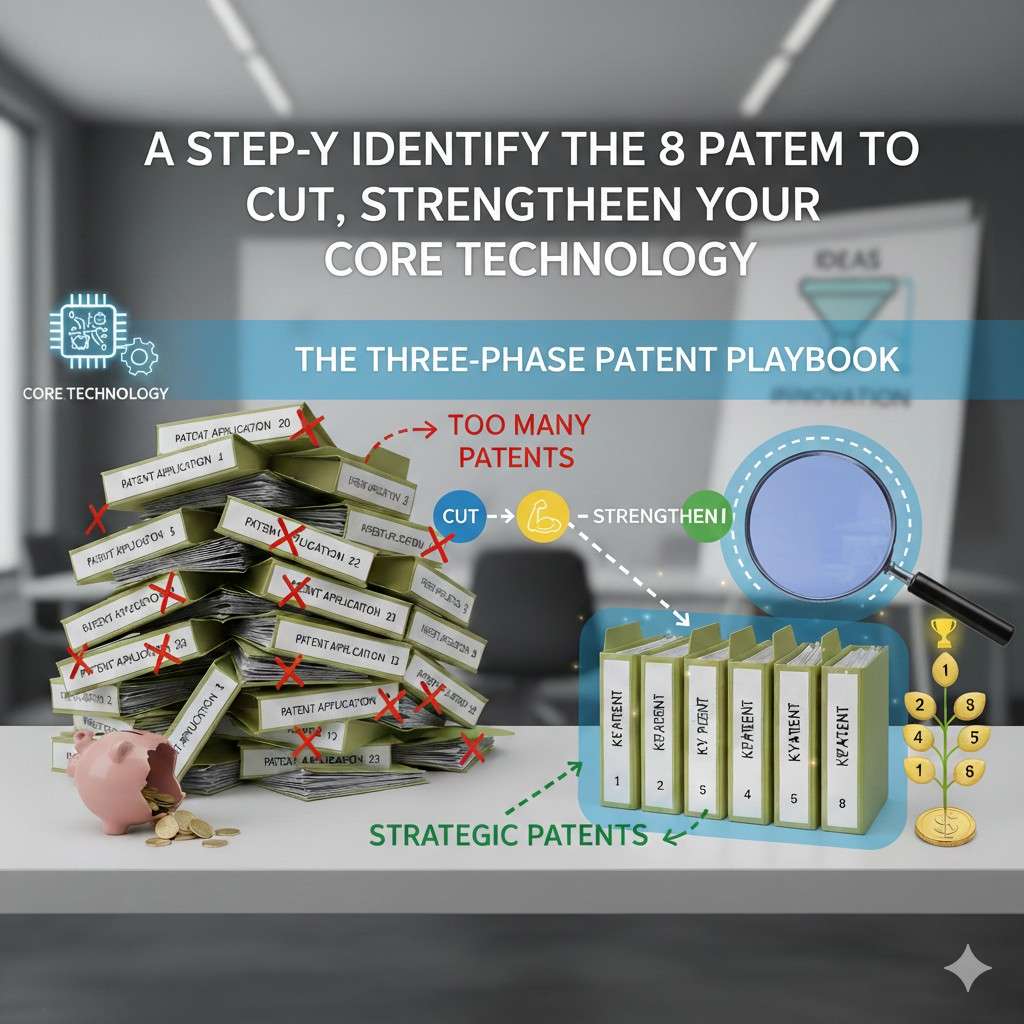
And if you want help turning your real technical depth into focused, defensible protection without the delays and confusion of traditional firms, take a close look at how PowerPatent works: https://powerpatent.com/how-it-works.
This is how you move from twenty scattered filings to eight true keepers. This is how you protect what matters and win with intention.
Wrapping It Up
If you remember one thing from this playbook, let it be this: patents are not trophies. They are tools. Twenty filings do not make you safe. Eight sharp, well-placed patents that protect your real edge do. Most startups overfile because they are reacting. They react to fear. They react to investor pressure. They react to early excitement about features that later change. Over time, they wake up with a stack of paperwork that looks impressive but does not truly guard the engine of the business.
Leave a Reply