Software patent claims can feel confusing at first, especially when you see three versions of what looks like the same invention: system claims, method claims, and medium claims. But this split is not random, and it is not just legal formality. Each claim type protects your software from a different angle, and that matters a lot when you want real coverage, not a weak patent that looks good on paper but falls apart when it counts. If you are building software, AI tools, backend systems, developer platforms, or product features that do real work in the real world, you need to understand why these claim types exist, how they work together, and how to use them in a way that actually protects what your startup is building.
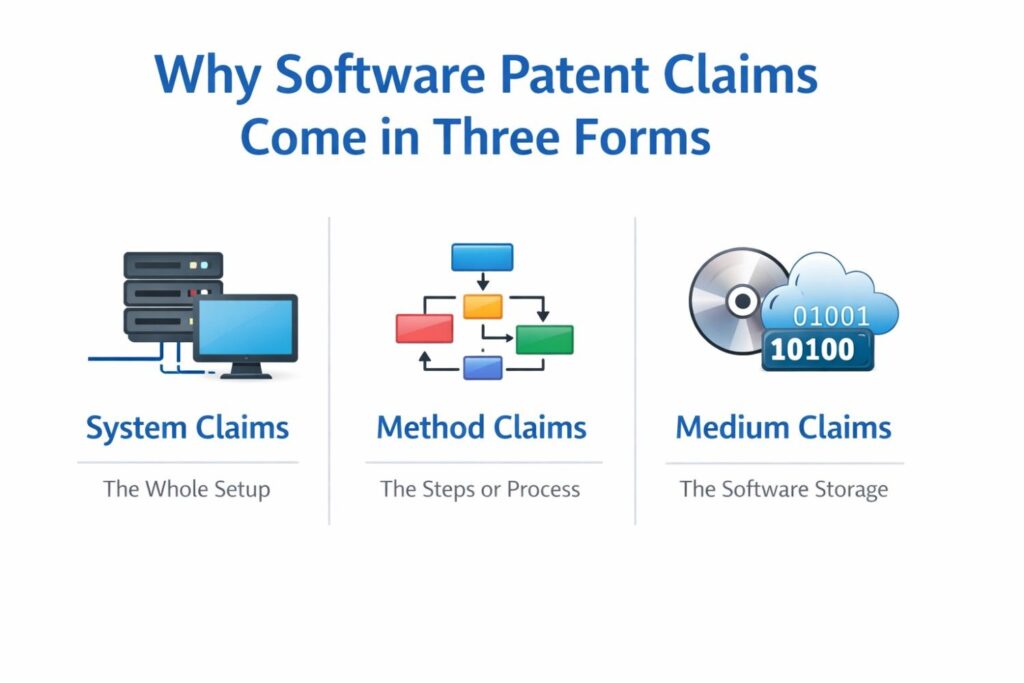
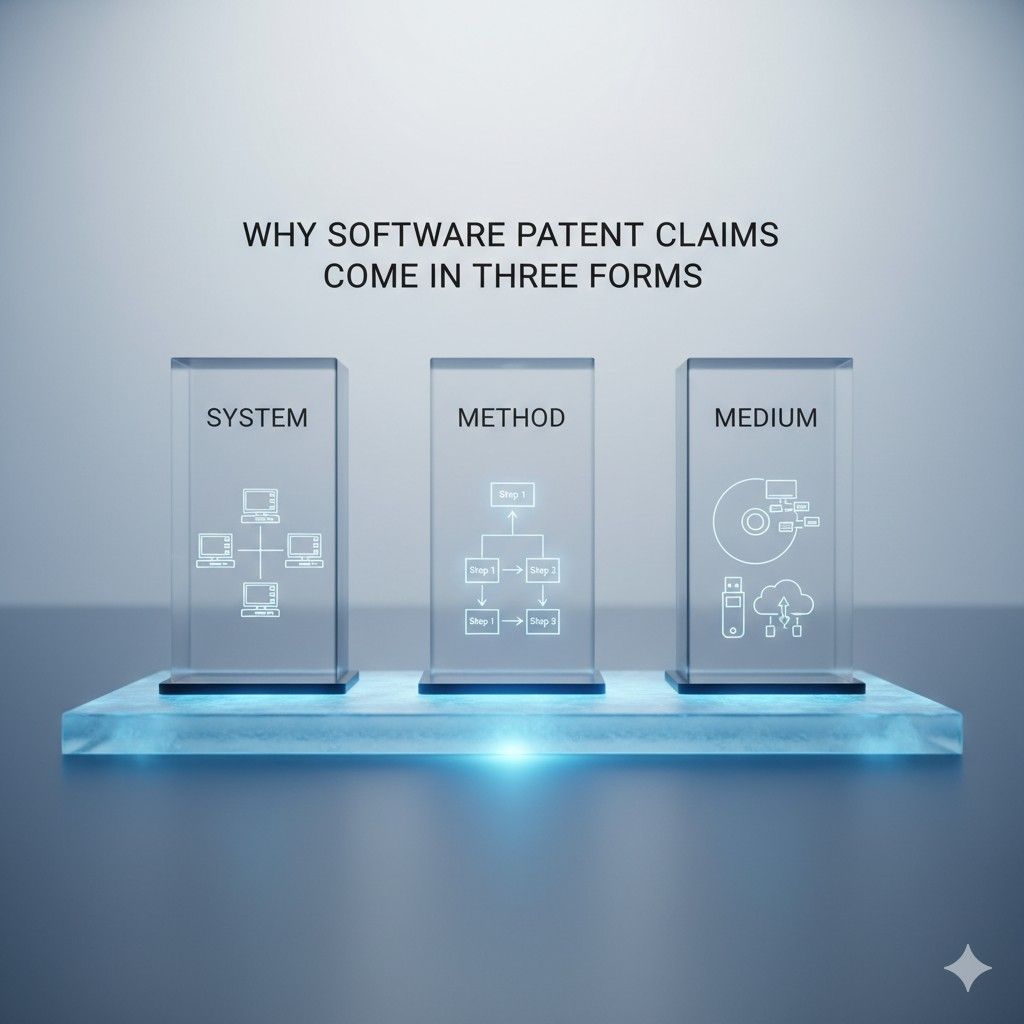
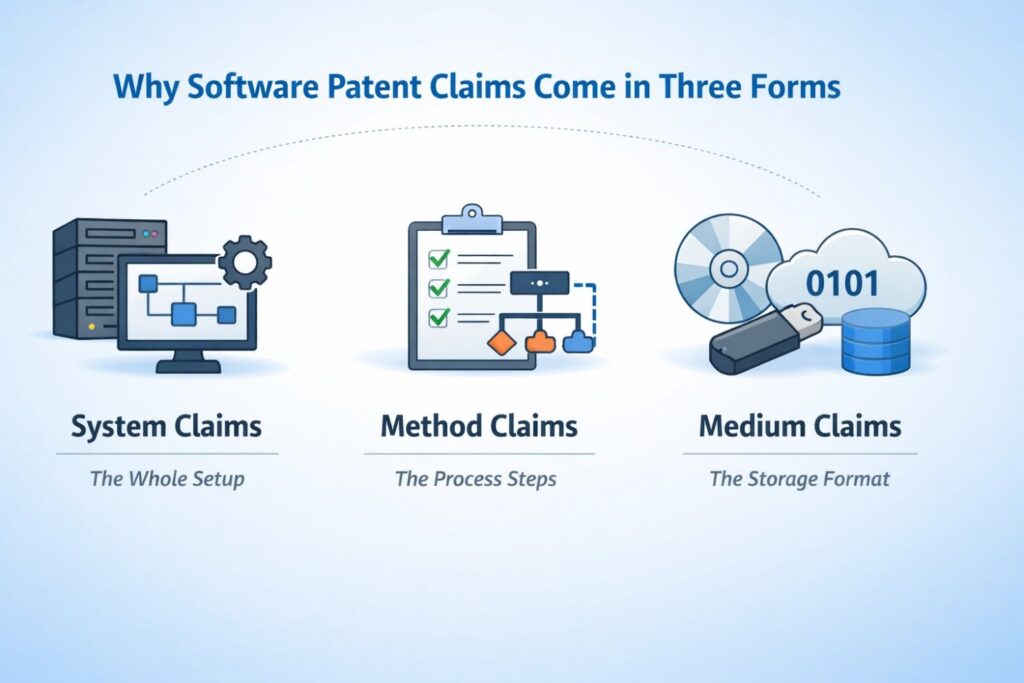
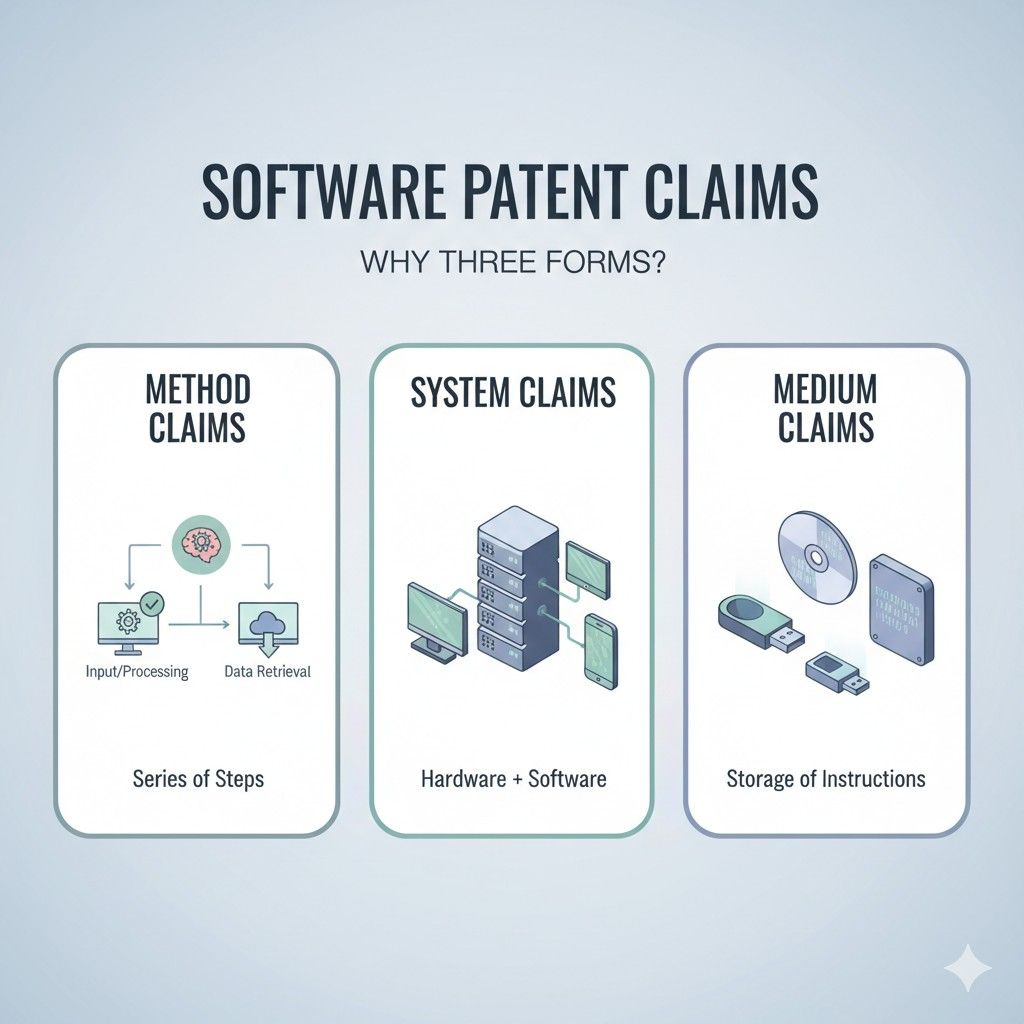
Why Software Patent Claims Come in Three Forms
Software businesses move fast. Products change, code ships every week, and features that look small on the surface often hide the real value underneath.
That is one reason software patent claims come in three forms. A software invention does not live in only one place. It can live in the way a platform is built, in the way a process runs, and in the way instructions are stored so the process can happen again and again.
Strong patent drafting reflects that reality. For a business, this is not a technical detail. It is part of building protection that matches how software is created, delivered, and monetized.
The Same Invention Can Show Up in Different Business Forms
A software invention rarely stays in one neat box. The same core idea might appear inside a cloud platform, a mobile app, an edge device, an API workflow, or a developer tool.
If a business tries to protect that invention in just one format, it may leave open space for a competitor to copy the value while changing the wrapper.
That is why software patent claims often come in three forms. The law is trying to capture the same invention through different lenses, but from a business angle, the goal is even more practical.
You are not just protecting code. You are protecting how the market experiences that code. A founder who understands this early can file with more precision and less regret later.
Patent Claims Need To Follow How Revenue Actually Happens
A software company does not earn money from source code sitting alone in a repository. It earns money from how that code is turned into a working product, a repeatable service, or a usable capability customers depend on. Patent claims need to match that commercial reality.
If your company sells a software platform, system claims may matter because they can line up with how the product is architected. If your advantage lives in the sequence of actions the software performs, method claims may better reflect what creates the business result.
If the value sits in software instructions stored and shipped through a technical environment, medium claims help protect that embodiment.
The three forms exist because business value in software can be expressed through structure, operation, and stored implementation all at once.
Software Is Easy To Repackage and Hard To Pin Down
Software is flexible in a way machines, chemicals, and hardware parts often are not.
A competitor can change labels, move processing to a server, split one module into three services, or shift steps between devices and still deliver nearly the same outcome. That flexibility is great for product teams, but it creates risk for weak patent drafting.
Using three claim forms helps reduce the chance that small packaging changes let a copycat slip away. This is one of the most important strategic reasons these forms exist.
They help the patent reach the invention even when someone changes how it appears on the surface. That does not mean every claim will catch every version, but it gives the business more ways to frame the same core innovation.
A Smart Patent Is Written for Future Conflict, Not Just Filing Day
Many startups think about patent filing as a milestone. They want to get the application on file, show investors they are serious, and move on.
But the real value of a patent appears later, when the company grows, raises money, gets copied, or enters a partnership discussion where ownership matters.
Claims written in three forms help because future conflict is unpredictable. You do not know in advance whether a competitor will sell a full product, run a similar process behind the scenes, or distribute software in a way that makes one claim type more useful than another.
Businesses that think ahead do not draft patents only for approval. They draft for leverage. The three forms are part of that leverage.
The Goal Is Coverage, Not Repetition
At first glance, system, method, and medium claims can look repetitive. Founders sometimes assume they say the same thing three times with small wording changes.
That is not the right way to see them. Good claim drafting is not about repeating ideas. It is about covering the same innovation from positions that may matter at different times.
This is especially important for business strategy. A patent should not just describe what your product is today. It should cover how the invention can be recognized if the market shifts.
That means each claim form should have a reason to exist. The best filings do not multiply words for the sake of volume. They create useful variation that gives the company options later.
Investors Often Care More Than Founders Expect
Investors may not read every line of a patent application, but they care a great deal about whether the company is protecting something real.
A weak software filing can look fine from a distance, yet offer very little practical coverage. A stronger filing shows that the company understands not just the invention, but the ways that invention can be owned and defended.
Using multiple claim forms signals maturity. It shows the company is not treating patent work like a box-checking exercise. It shows it is thinking about defensibility, product shape, and future enforcement paths.
That can matter in diligence, especially for startups whose value depends heavily on technical differentiation.
Customers May Never See the Most Valuable Part
In many software companies, the most valuable innovation is invisible to the customer. It sits in backend logic, data handling, orchestration, timing, routing, optimization, or control.
What the customer sees may be simple, while the real secret sits behind the scenes.
This is another reason three claim forms matter. A business should not assume that visible features are the only thing worth protecting. System claims can help capture the architecture that supports the feature.
Method claims can focus on the steps that create the hidden advantage. Medium claims can cover the stored instructions that let the advantage be delivered through software. When used well, the three forms help pull hidden value into the patent strategy.
Strong Claims Help a Business Tell a Clearer Story
A strong patent is not only a legal tool. It is also a business story. It explains why the invention matters, where the value sits, and how the company is different from generic software that merely automates a common task.
The structure of the claims helps tell that story.
When a company uses three claim forms thoughtfully, it often ends up clarifying its own product advantage. It sees which parts are structural, which parts are operational, and which parts are embodied in code that can be deployed at scale.
That clarity can improve internal alignment too. Product, engineering, leadership, and counsel can get on the same page about what really needs protection.
Businesses Need Flexibility Because Products Change Fast
Software products evolve quickly. Teams rename features, change flows, shift infrastructure, and rewrite major parts of the stack. A patent drafted too tightly around one product version can age badly.
That creates frustration because the core inventive idea may still be valuable even when the product presentation has changed.
Three claim forms can support more flexible coverage if they are grounded in the right technical core. They let the business avoid overcommitting to one expression of the invention.
This does not remove the need for careful drafting, but it does improve the chances that the filing still makes sense as the company grows. That is a major practical benefit for startups that expect rapid iteration.
A Narrow Filing Can Create Expensive Gaps
Many businesses do not realize how easy it is to file something that sounds strong but leaves real gaps. A filing may describe the product well and still fail to protect it in a meaningful way.
This happens when the claims focus too heavily on one angle and ignore how a competitor might recreate the value through another path.
That is why it helps to think about claims as coverage planning rather than paperwork. The reason software patent claims come in three forms is that businesses need a broader shield.
A founder should ask not only, what did we build, but also, how would someone try to copy this without copying it word for word? That question often reveals why multiple forms matter.
The Three Forms Create Strategic Pressure on Competitors
A patent becomes more useful when it increases the effort required for others to design around it.
No business can stop all competition, and no patent blocks every similar approach. But good patents can make copying harder, riskier, and more expensive.
When claims are written in three forms, competitors may have to work harder to avoid all of them at once.
They may need to redesign architecture, change process flow, and alter how software is packaged or implemented.
That pressure has business value. It can slow down imitators, support licensing conversations, and improve the startup’s position in a crowded market.
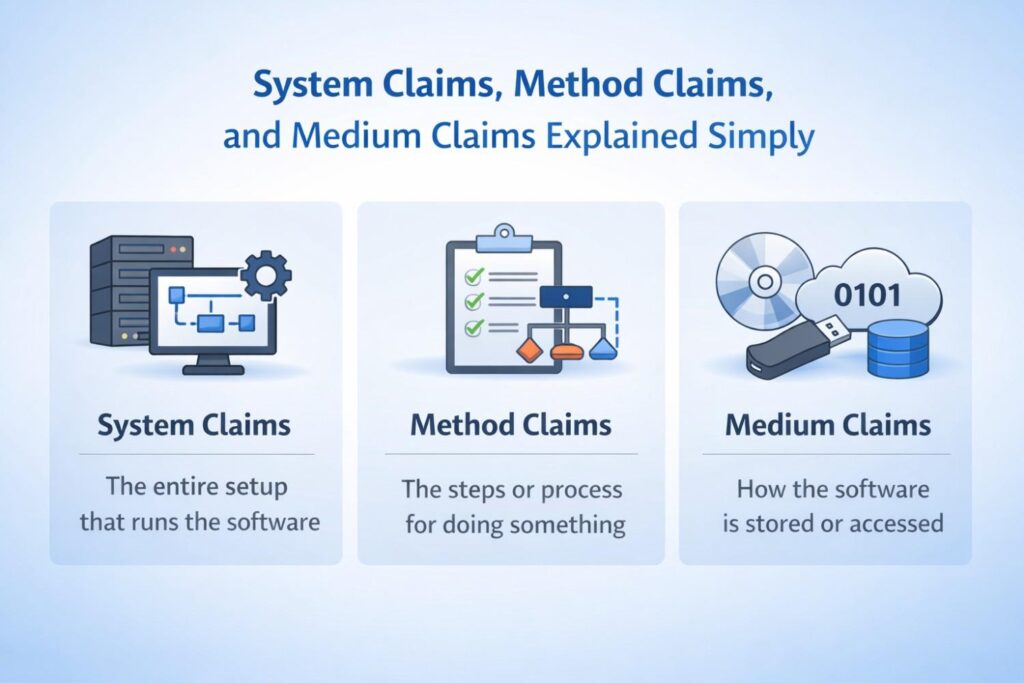
System Claims, Method Claims, and Medium Claims Explained Simply
Software patent claims often sound more complex than they really are. At the core, these three claim types are just three ways to describe the same invention.
They are used because software can be understood in three practical ways. You can look at it as a setup of parts working together. You can look at it as a series of steps being carried out.
Or you can look at it as code stored in a form a machine can use. Once you see that, the idea becomes much easier to understand.
Why these three claim types matter
These claim types matter because software is not like a simple physical object. A software product can be built into a platform, run through a workflow, and stored as instructions at the same time.
If a patent only covers one of those views, the protection may be thinner than the business expects. A stronger filing tries to match how software really exists in the world.
The easiest way to think about them
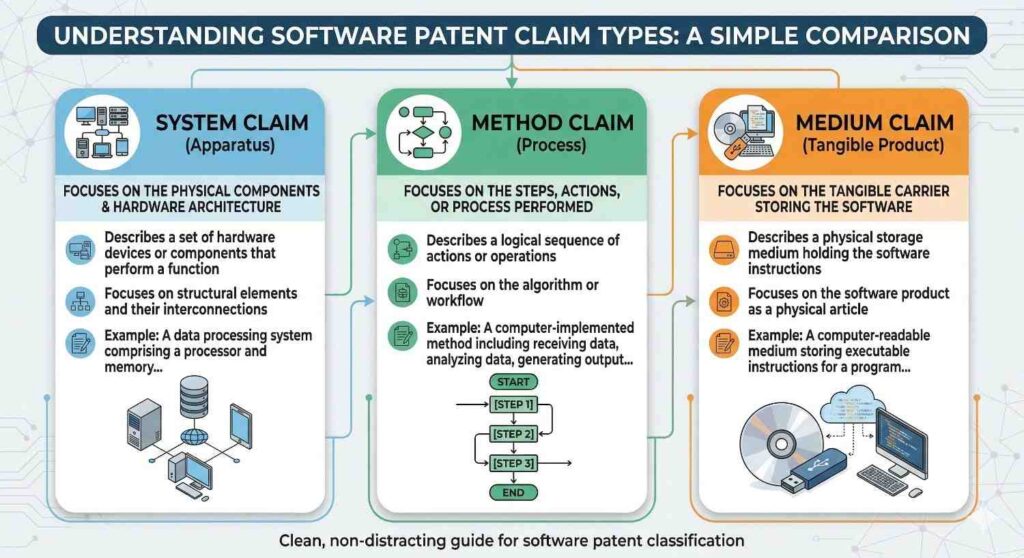
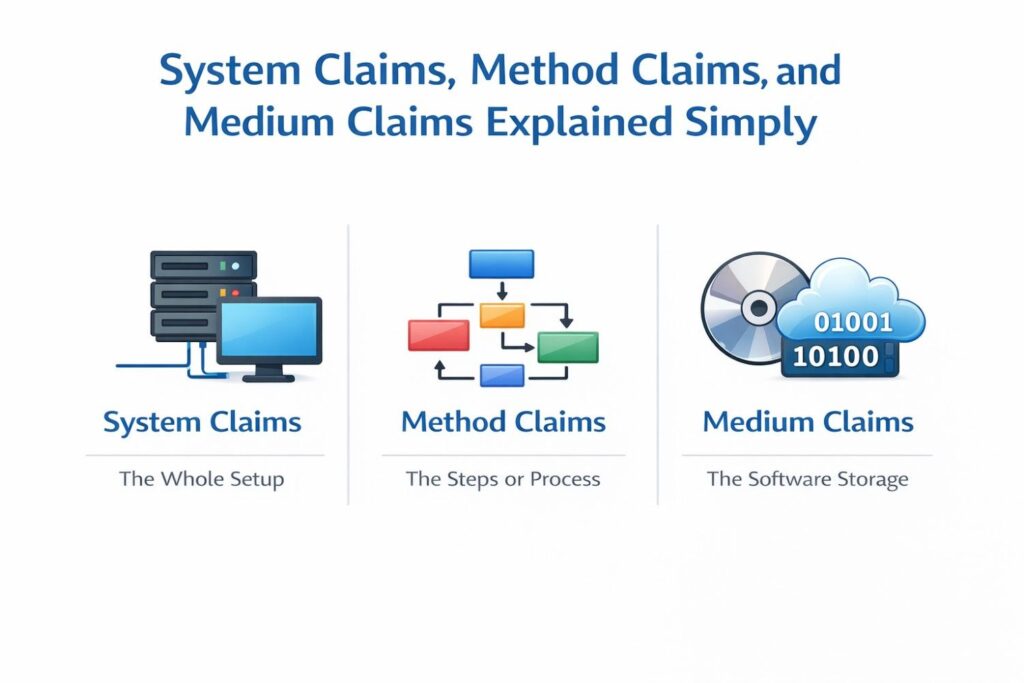
The simplest way to understand the difference is this. System claims focus on what is there. Method claims focus on what happens. Medium claims focus on where the software instructions live.
That is the basic split. The invention may be the same, but each claim type frames it in a different way.
Why simple framing helps founders
Founders often get lost in patent language because the wording feels distant from the product they actually built. But when these claim types are translated into plain English, they become much more useful.
Instead of feeling like abstract legal language, they start to feel like business tools. They help you describe your software in ways that can better match real market risk.
System Claims
System claims describe the invention as a working setup. They focus on the parts of the software environment and how those parts interact.
This could include servers, processors, databases, interfaces, models, modules, engines, or other technical pieces that work together to produce the result.
What system claims are really doing
System claims are answering one main question. What is the technical arrangement that makes this invention work.
They describe the software as a system with connected parts rather than as a sequence of actions. This is useful when the value of the invention comes from how components are organized and coordinated.
A simple way to picture a system claim
Imagine a fraud detection platform. A system claim might describe a data intake module, a scoring engine, a rules engine, and a notification component that work together to flag risky activity.
The focus is not first on the step-by-step flow. The focus is on the structure of the solution and the parts that create the capability.
Why businesses should care about system claims
System claims can be very useful when your competitive edge is tied to architecture. If your startup has built a smarter way for different technical pieces to interact, that setup may be part of the moat.
For many software businesses, the hidden value is not just the output. It is the way the product is built behind the scenes.
When system claims can be especially helpful
System claims can be helpful when your invention depends on multiple components working together in a special way.
This often shows up in cloud systems, AI infrastructure, developer tools, security platforms, and products with layered backend services. In those cases, the arrangement itself can be part of what makes the invention hard to copy.
What founders should watch out for
A common mistake is describing the system too broadly. If the claim says little more than generic parts doing generic things, it may not do much for the business.
The key is to tie the system language to the real technical design choices that make the invention different.
Method Claims
Method claims describe the invention as a process. They focus on actions, steps, and decisions that happen over time.
This type of claim is often the easiest for non-lawyers to understand because it follows the logic of how the software works from start to finish.
What method claims are really doing
Method claims are answering a different question. What does the software do, and in what order does it do it.
Instead of focusing on components, they focus on operations. They describe the flow that turns inputs into useful outputs.
A simple way to picture a method claim
Using the same fraud detection example, a method claim might describe receiving transaction data, extracting behavior signals, generating a risk score, comparing that score to a threshold, and triggering an alert.
Here, the invention is framed as a set of actions rather than as a collection of parts.
Why businesses should care about method claims
Method claims can be very powerful when the value of the software lives in the workflow or decision logic.
If your product wins because it processes information in a smarter order, applies a better decision rule, or adapts based on changing inputs, method claims may capture that advantage more directly.
When method claims can be especially helpful
Method claims are often helpful for products built around automation, optimization, ranking, detection, personalization, orchestration, and control logic.
In those cases, the order of operations may be the heart of the invention. If a competitor copies the process, it may not matter much that their interface looks different.
What founders should watch out for
The biggest mistake here is being too vague about the steps. If the claim just says the software receives data, analyzes it, and shows a result, that may be too thin.
Stronger method claims usually explain what kind of processing makes the method different in a real technical way.
Medium Claims
Medium claims describe the invention as software instructions stored in a machine-readable form. This can sound odd at first, but the idea is simple.
Software is often embodied as code stored in a form that a machine can access and execute. Medium claims are meant to cover that expression of the invention.
What medium claims are really doing
Medium claims answer another practical question. Where does the software live as an implemented thing. They describe code that, when executed, causes a machine to perform the inventive steps.
So even though the invention may be the same as the one described in a method claim, the legal framing shifts to stored instructions.
A simple way to picture a medium claim
Again using the same example, a medium claim might describe a non-transitory computer-readable medium storing instructions that cause one or more processors to receive transaction data, calculate a risk score, and trigger an alert.
It is still the same core idea. It is just framed as stored software instructions.
Why businesses should care about medium claims
Medium claims matter because software is not only a process in motion. It is also something implemented, stored, and deployed.
For companies that distribute software, embed it in products, or run it across technical environments, this framing can help round out protection.
When medium claims can be especially helpful
Medium claims are often useful in software-driven businesses where code deployment is central to product delivery.
That includes SaaS products, edge software, embedded software, enterprise tools, developer platforms, and AI systems deployed across infrastructure. They help capture the invention in a form closer to how software exists operationally.
What founders should watch out for
A common problem is treating medium claims like automatic filler. They should not just echo weak method language.
If the underlying method is too generic, changing the format will not fix it. Medium claims are most helpful when they are built on a strong technical core.
How the three claim types work together
These claim types are not meant to compete with each other. They work best when they support one another.
Together, they describe the same invention from different angles. That gives the patent a more complete shape and can make it more useful in real business situations.
Why one invention needs multiple frames
Software is flexible. A competitor may copy your architecture, your process flow, or your implemented logic while changing surface details.
Looking at the invention from more than one angle can reduce the risk that your patent only covers a narrow version of what matters. This is one reason good software patent drafting usually includes all three forms when it makes sense.
Why this is a business strategy issue
This is not just about drafting style. It is about how your company protects value. If your edge comes from backend structure, system claims matter. If your edge comes from workflow logic, method claims matter.
If your edge is tied to deployable software implementation, medium claims matter. A smart filing strategy thinks about all three before the application is written.
How founders can tell which part of the invention matters most
Not every software product has the same center of gravity. Some inventions are more architectural. Some are more procedural.
Some are best understood as implemented software logic. The real work is figuring out where your advantage truly lives.
Start with the technical advantage, not the feature name
A good way to think about this is to ignore your product name and marketing message for a moment. Ask what the software actually does that is different.
Ask what another engineering team would have to rebuild to get the same result. The answer often points to whether the strongest story starts with the system, the method, or both.
Use customer value as a clue
Another helpful test is to ask why customers care. If customers care because your platform setup makes performance possible at scale, system framing may matter a lot. If they care because your software follows a smarter decision flow, method framing may be key.
If your value depends on the software being packaged and deployed in a technical environment, medium framing may deserve more attention.
What this means for patent strategy
The takeaway is simple. System claims, method claims, and medium claims are not three random patent categories.
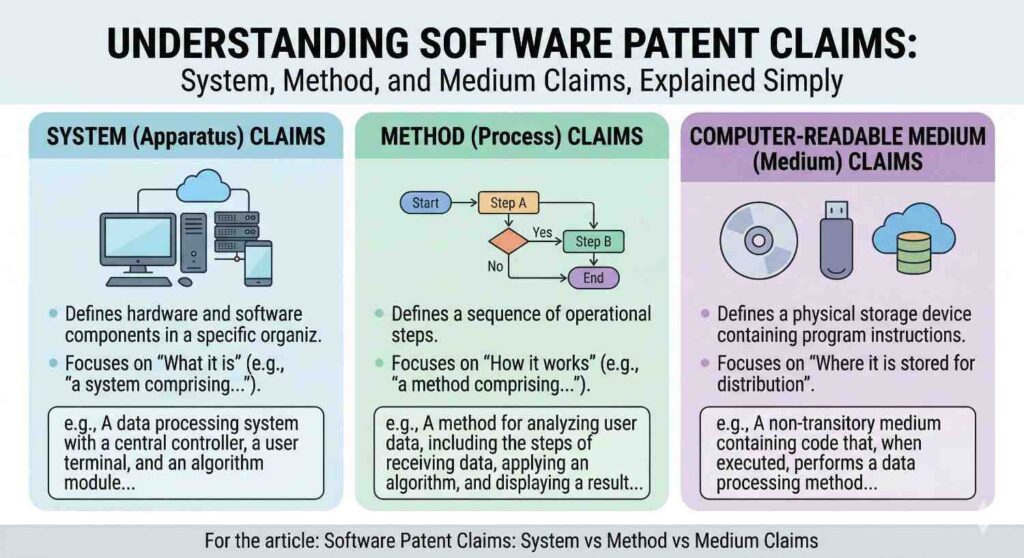
They are three practical ways to protect software that creates value in more than one form. When used well, they help a business protect the same inventive core from multiple angles.
How to Protect Software from More Than One Angle
Protecting software well means thinking beyond the feature your users see on the screen. Most valuable software is not just a button, a dashboard, or a simple output. The real value often sits deeper.
It may live in the way your system is set up, the way your logic runs, the way your software makes decisions, or the way the code is deployed across your product.
That is why strong software patent strategy is about protecting the same invention from more than one angle. When a business understands this, it stops treating patents like paperwork and starts using them like a real growth asset.
Why one view of the invention is rarely enough
A software product can look simple from the outside and still contain a very strong technical advantage inside. A user may only notice a faster result, a cleaner workflow, or a smarter recommendation.
But behind that simple result may be a unique system design, a special sequence of steps, and software instructions that make the whole thing work at scale.
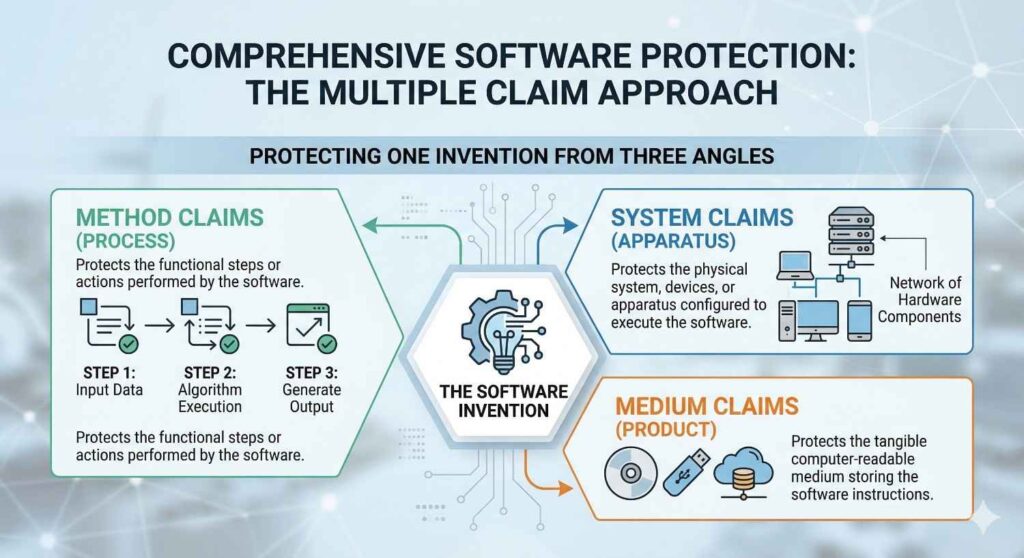
If your patent protection looks at only one of those layers, you may leave room for competitors to recreate the value while avoiding the narrow version you described.
The business risk of protecting only the visible feature
Many founders talk about their invention by pointing to the product feature customers use. That makes sense in sales and product marketing, but it can create problems in patent strategy. The customer-facing feature is often only the tip of the iceberg.
A competitor can keep the same underlying technical advantage while changing the layout, changing the interface, or moving the logic to another part of the stack.
If your protection is tied too tightly to the visible feature, you may miss where the real business value lives.
Protection should match how software actually works
Software does not live in a single form. It operates as a technical setup, as a process, and as stored instructions executed by machines. That is why protecting software from more than one angle is not overkill.
It is simply a more accurate reflection of reality. A strong patent strategy follows the actual shape of the invention instead of forcing it into a narrow frame.
Looking Beyond the User Interface
The user interface is often the least defensible part of a software business. It matters for adoption, and it matters for user experience, but it is usually not the deepest moat.
Strong software companies win because of what happens behind the interface. They win because they process data better, orchestrate systems better, reduce latency, improve accuracy, lower waste, or automate decisions in a way others cannot easily match.
The interface is often easy to change
A competitor can redesign a screen in a week. They can move buttons, rename features, and change layouts without changing the core technical engine.
That is why software protection should not stop at what people click. It should reach into what the software is really doing.
The deeper moat usually sits in hidden logic
In many startups, the true advantage is not what the customer sees. It is the rule engine, the ranking flow, the training logic, the monitoring process, the routing method, or the way multiple services work together.
That hidden logic is often what deserves the most care in a patent filing.
Founders should ask where the hard part really is
One useful internal test is simple. Ask your team what part would be hardest for a competitor to rebuild if they had screenshots but not your code or architecture.
That answer often reveals where the real inventive value sits. That is the part that should shape your protection strategy.
Protect the Architecture, Not Just the Outcome
A lot of software value comes from structure. The way parts are connected can matter just as much as the final output.
Two products may both produce the same result, yet one may do it through an architecture that is more reliable, more scalable, or more efficient. That architectural difference can be worth protecting.
Architecture can be part of the competitive edge
Founders sometimes think the only thing that matters is what the software does. But how it does that work can matter just as much.
A product that routes data in a smarter way, distributes workload more efficiently, or coordinates services in a special pattern may have built a strong moat even before users notice it.
A strong setup can be hard to copy cleanly
When your edge comes from how the system is arranged, a competitor may struggle to match performance without recreating the same setup. That is why architectural protection matters.
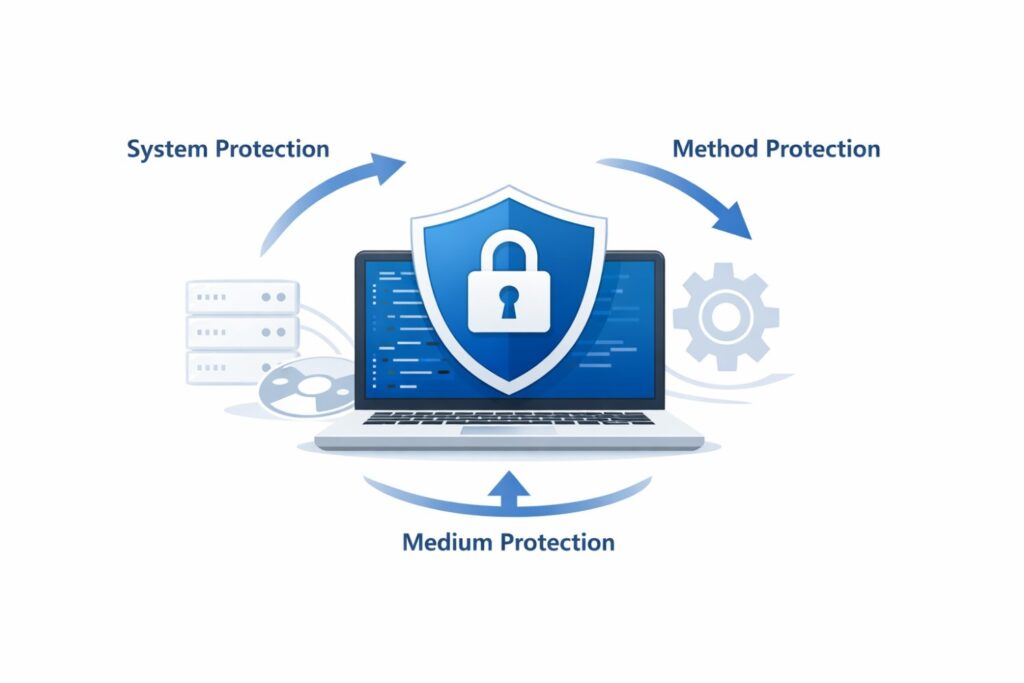
It gives the business a way to claim value that lives in the technical design itself.
This is especially important for infrastructure-heavy software
Products built around AI systems, cloud services, developer tooling, cybersecurity, industrial software, and backend platforms often create value through architecture more than appearance.
In those businesses, the system design may be a major part of the company’s advantage.
Protect the Process, Not Just the Platform
Some software inventions are not mainly about structure. They are about flow. The real value may come from what happens first, what happens next, what conditions trigger actions, and how the software reaches a result.
In those cases, the process deserves its own protection focus.
Process is often where the intelligence lives
A software product can look ordinary on the surface while using a very smart internal process.
It may rank inputs in a better order, filter noise more effectively, adapt based on context, or trigger decisions using a refined sequence. That process may be the core of the invention.
Competitors may copy the logic while changing the shell
A company trying to imitate your product may not copy your exact interface or technical stack.
But they may copy your process logic if that is what produces the customer value. That is why protecting the process matters. It reaches closer to the engine of the result.
Good protection follows the chain of actions
Founders should be able to explain, in plain language, how their software moves from input to output. That flow often reveals where the inventive process sits. If the team cannot explain the flow clearly, the patent strategy may end up fuzzy too.
Protect the Code-Based Embodiment
Software is also real in the form of stored instructions. It is not only a system on paper or a process in motion.
It is code that lives in deployable form and causes machines to perform work. That angle matters because it reflects how software is actually built and delivered.
Software exists as implemented instructions
For many businesses, the invention is not just an abstract flow. It is a coded implementation that runs across infrastructure, devices, platforms, or customer environments. Protecting that embodiment helps complete the picture.
Modern deployment makes this even more important
Software today may be delivered through cloud instances, containers, edge deployments, embedded environments, or enterprise installations. The invention often reaches the market as machine-executable instructions. A sound strategy should reflect that reality.
This helps round out protection
When businesses protect the implemented software angle as well, they are less likely to rely on only one narrow description of the invention. That broader framing can make the patent more useful as the company grows.
Think Like a Competitor Before You File
One of the smartest ways to protect software from more than one angle is to stop thinking like the inventor for a moment and start thinking like the imitator.
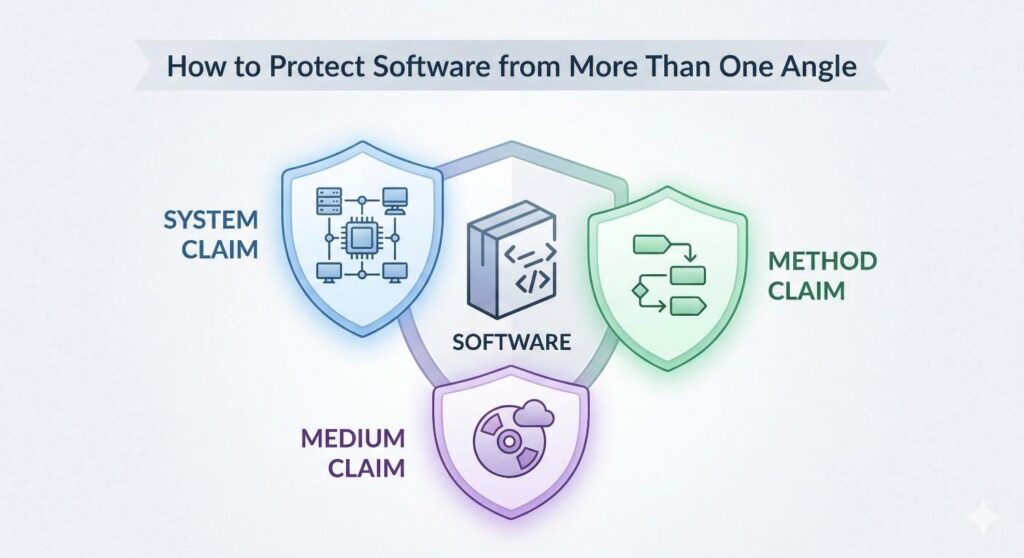
Competitors do not care how proud you are of the product. They care about how to get similar value without stepping too obviously on your work.
Copycats look for weak spots in how inventions are framed
A weak patent often gives away its limits. It may focus too much on the interface, too much on one deployment style, or too much on a narrow product version.
A competitor looking at that patent will search for the edges and build around them.
Founders should run a design-around exercise early
Before filing, it helps to ask a hard question. If another team wanted the same customer result, how would they try to avoid our approach while still copying the value?
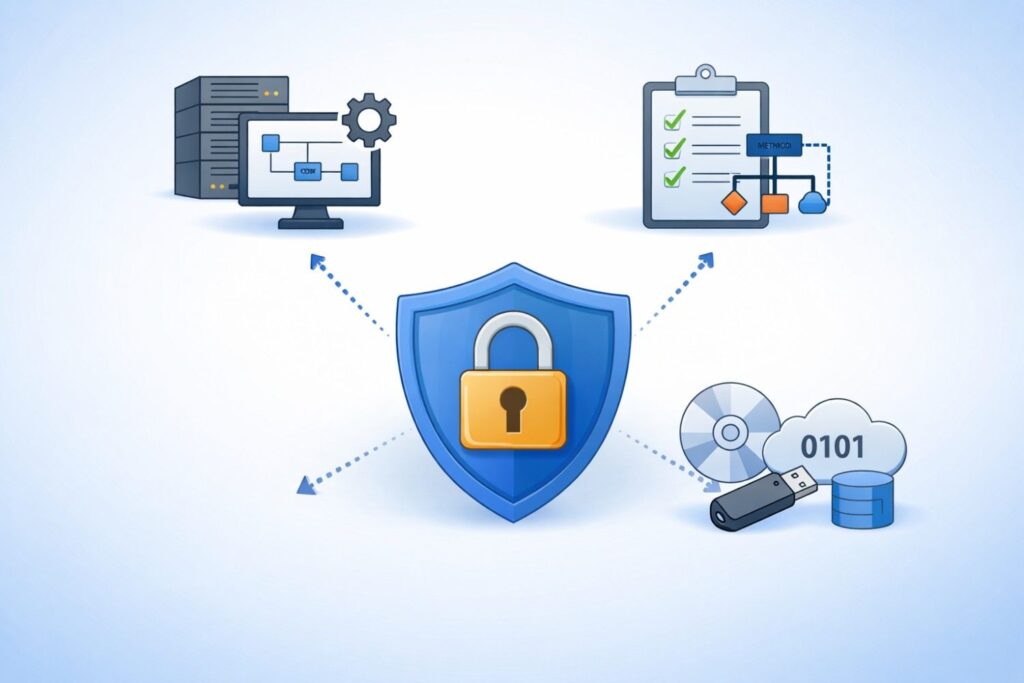
The answers are extremely useful. They show where your protection may need more reach.
Wrapping It Up
Software patents are easier to understand when you stop looking at claim types as legal labels and start looking at them as business tools. System claims protect the setup. Method claims protect the flow. Medium claims protect the software instructions in a usable form. Together, they help protect one invention from more than one angle, which is exactly what strong software businesses need in fast-moving markets.
Leave a Reply