Most founders think the hard part is building the tool. It is not. The hard part is protecting what makes the tool matter. If you are building monitoring or observability software, you are not just making dashboards, alerts, logs, traces, or charts. You are building systems that help companies see problems early, move faster, and trust what is happening inside complex software. That is real technical value. It is also the kind of value that gets copied fast when your product starts to work.
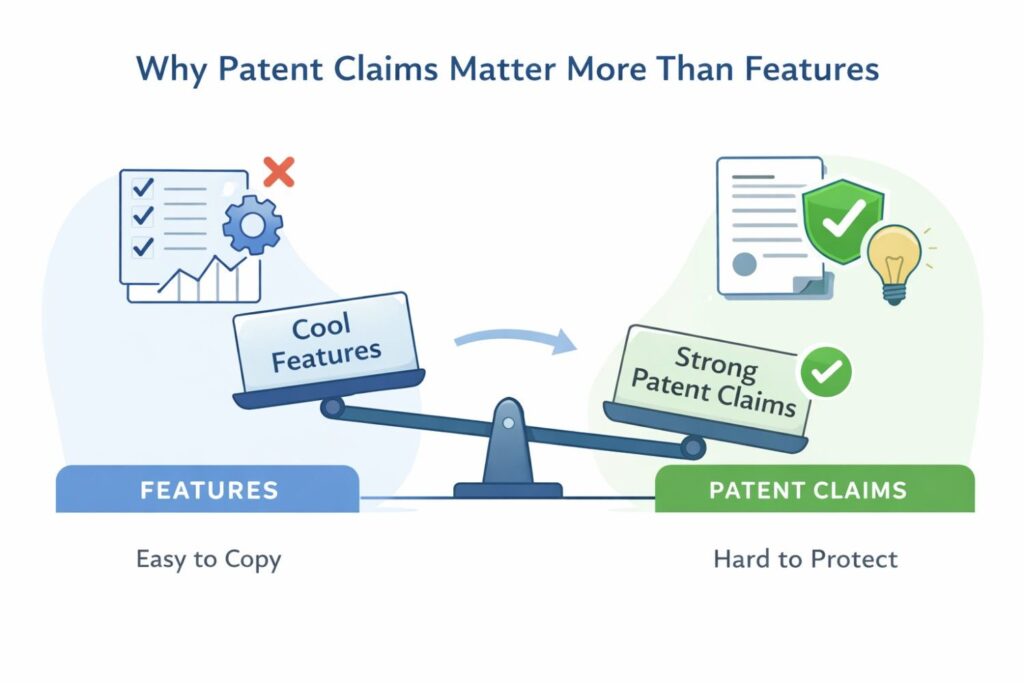
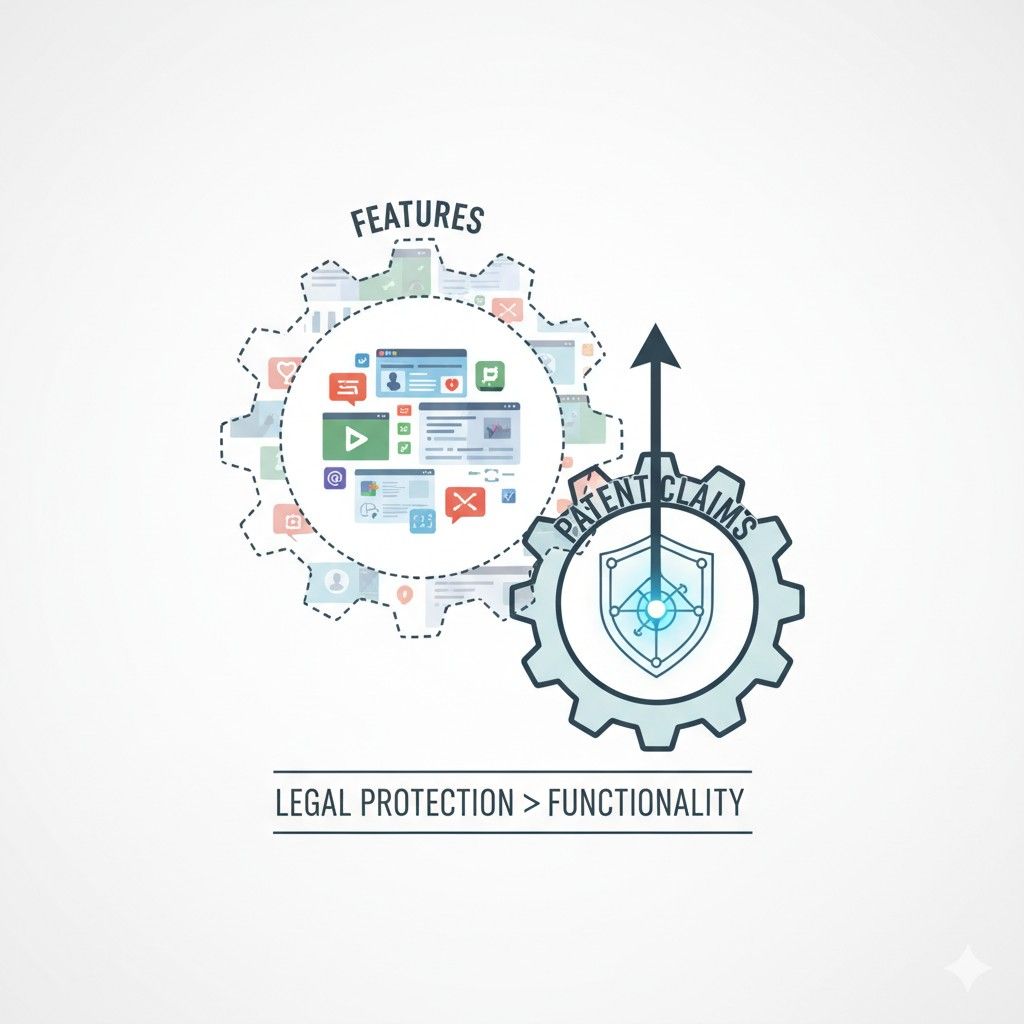
Why Patent Claims Matter More Than Features
Features get attention. Claims create protection.
That difference is easy to miss when you are building fast. A team launches a new dashboard, a cleaner alert flow, a smarter way to connect traces to logs, or a better method for spotting incidents before users complain.
Customers notice the feature. Buyers talk about the feature. Competitors copy the feature. But a patent does not protect attention. It protects the real technical boundary around what you built. That boundary lives in the claims.
For businesses building monitoring and observability tools, this matters more than it does in many other software categories. The surface of the product is often easy to imitate.
A rival can make a similar screen, use similar words, and tell a similar story. The real edge usually sits deeper in the system.
It may be the way telemetry is collected with less overhead, the way signal quality is improved before analysis, the way related failures are grouped, or the way system behavior is translated into a form humans can act on fast.
If the claims are weak, the deeper advantage stays exposed. If the claims are built the right way, the business has a much stronger way to defend its lead.
Features can be copied faster than founders expect
A product feature often looks like an asset. In many cases, it is really a temporary lead unless there is something stronger behind it.
In observability, a feature can spread across the market very quickly because the category is full of smart teams watching each other. One company adds guided root-cause hints.
Another adds event grouping. Another adds low-noise alert ranking. From the outside, these launches can look different, but the market moves fast, and good ideas rarely stay exclusive for long.
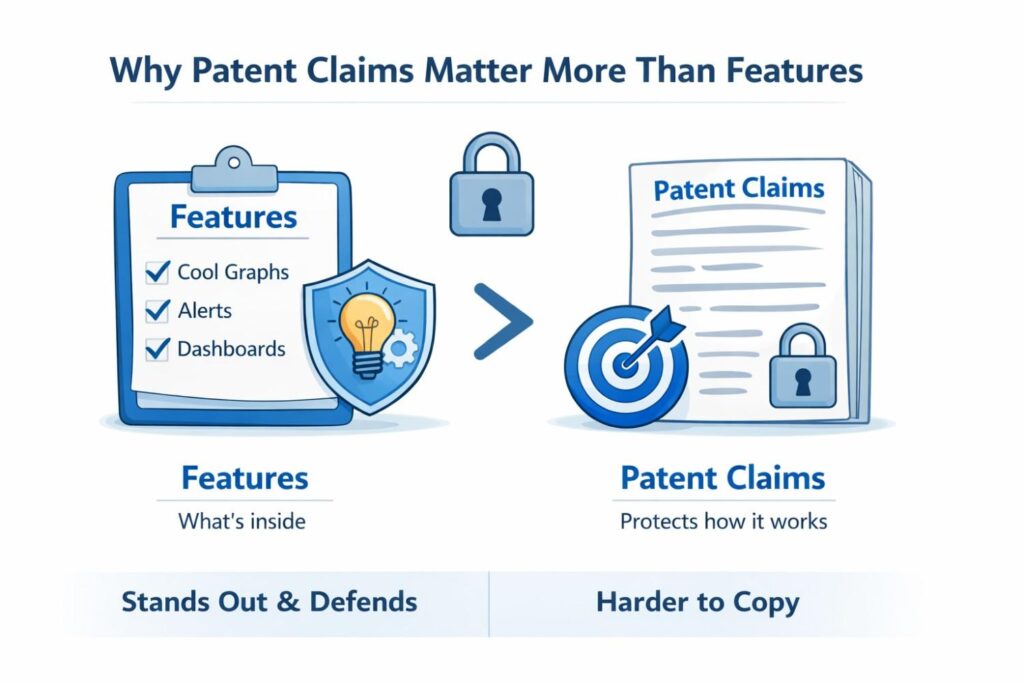
That is why founders should avoid treating the visible product layer as the main thing worth protecting. The visible layer is often just the packaging for the true invention.
The market rewards outcomes, not originality alone
Customers pay for fewer outages, faster debugging, and less wasted engineering time. They do not pay extra just because your team had the idea first.
That means the business risk is not just that someone copies the wording of your feature. The risk is that another company reaches the same customer outcome through a close version of your method.
If your patent claims focus only on the public-facing feature, they may miss the internal mechanics that actually drive the value. A business that wants durable protection has to think beyond what users click and into what the system is really doing.
A copied user interface is not always the biggest threat
Many founders worry when a rival releases something that looks similar on the screen. That can matter, but it is often not the most serious issue.
The larger danger is when a competitor copies the engine while changing the outer shell. They may rename the workflow, change the layout, or present the output in a different view.
If your claims were tied too closely to how the product looks instead of how it works, that competitor may move around your patent with little effort. Stronger claims usually anchor protection in the technical process, not in the design wrapper around it.
Claims define what your company can actually stop
A patent is only as useful as the claims inside it. This is where many teams get the wrong idea.
They believe a patent protects the whole product because the patent talks about the whole product. In real life, the claims are what matter most. They define the legal reach.
They tell the world what falls inside the protected zone and what stays outside.
If the claims are too narrow, a rival can step around them. If they are too vague, they may not hold up. If they are too focused on broad marketing language, they may never protect the real invention at all.
A patent without strong claims can become a paper trophy
A business can spend real money and still end up with weak protection if it does not focus on claim quality from the start.
This happens often when founders hand over a deck, a landing page, and a few screenshots and hope the rest will sort itself out. The result may sound polished, but it may not capture the true technical edge.
That kind of patent can feel useful during fundraising because it looks official. But when the company needs actual leverage, the weakness shows. Strategic teams do not aim for a patent that sounds impressive.
They aim for claims that map tightly to the hard thing the system does.
The best claims usually protect the method, not the slogan
Marketing language is helpful for sales. It is not enough for protection.
Words like smart alerts, unified visibility, instant root cause, or automated monitoring may explain the product to buyers, but they rarely explain the invention.
Strong claims usually describe the system steps that lead to the result.
They show how data enters, how it is processed, how relationships are found, how a decision is made, and what technical output follows. That is the level where a business can build real defensive value.
In observability, the real invention is often hidden below the product surface
This space creates a special problem for founders because the most important innovation is often invisible to users.
A buyer may love your product because it cuts incident response time in half. But the reason it does that may live in a specific internal method for correlating changes across metrics, traces, deployment data, and service dependencies.
The customer sees speed and clarity. The invention may actually be a highly specific technical pipeline. If you do not capture that pipeline, you may protect the wrong thing.
Surface simplicity can hide deep technical work
The cleaner the user experience, the easier it is for outsiders to underestimate the engineering behind it.
That can create a dangerous blind spot inside the business. Teams start talking about the product in simplified terms because that is how they sell it. Over time, even internal conversations shift away from the detailed mechanics.
Then, when patent work starts, the first draft reflects the simplified story rather than the true technical design.
A strategic business resists that drift. It keeps a separate record of the hard technical choices that made the product work.
Internal system choices often create the biggest moat
Not every engineering decision deserves patent attention. Some do. The challenge is knowing which ones shape a lasting moat.
A good signal to watch for is this: when your team solved a repeated technical problem in a way that changed system performance, reliability, speed, scale, or accuracy, there may be something worth protecting.
In monitoring and observability, that could mean a new way to reduce ingestion load, a cleaner method for ranking anomaly importance, or a system that uses runtime context to improve event grouping.
These are not cosmetic upgrades. They can become business assets when translated into strong claims.
Businesses lose value when they describe inventions as product features
The way a company talks about its work affects what it can protect later.
Many teams naturally speak in feature language because that is how product planning, sales, and customer education work. The problem is that feature language compresses the story too early.
It skips over the mechanism and jumps to the result. That is efficient for messaging, but it can weaken patent strategy.
If the company keeps describing everything at the result level, it may miss the chance to protect the process that produces that result.
Business teams and engineering teams often mean different things
This gap shows up often in growing startups.
The go-to-market team may say the product delivers instant root-cause analysis.
The engineering team may know that what really happens is a staged process that ranks event clusters, filters likely noise, maps the event set to recent service graph changes, and compares the pattern against prior incident signatures.
Those are very different levels of description. A strategic patent effort bridges both views. It starts with the customer promise, but then drills down until the technical engine is clearly described.
Actionable advice: capture the translation layer early
One of the most useful habits a business can build is a simple internal record that connects each important feature to the deeper technical mechanism behind it.
For each major capability, ask a product lead and an engineer to answer the same question in different ways.
First, what outcome does the user get? Second, what does the system actually do to create that outcome? Third, what makes that process different from older approaches or common tools?
This simple exercise can uncover patentable material long before formal filing work begins. It also helps leadership see which parts of the product are true technical assets rather than just good packaging.
Strong claims support pricing power and market position
Patent claims are not only about litigation. They also shape how strong your business looks to the market.
A startup with well-targeted claims around its core technical advantage often has a stronger story with investors, partners, acquirers, and enterprise buyers.
The value is not just in the existence of a filing. It is in the quality of what the filing covers.
If the claims align with the product’s most valuable technical engine, they signal that the company understands its own moat and has taken real steps to secure it.
Protection changes negotiation dynamics
When a company can clearly point to protected technical methods tied to its product advantage, conversations change.
This is true in partnership talks, enterprise procurement, and strategic diligence.
A sophisticated buyer or investor may not expect a startup to own every inch of its market, but they do look for proof that the company knows what is uniquely theirs.
Clear claims can help answer that question in a concrete way. They show that the team did more than build fast. They identified the part that matters and locked onto it.
Better protection can support premium positioning
In crowded observability markets, pricing pressure is real. Many products start to sound the same.
A company that has claims tied to a distinct technical benefit may have a stronger basis for premium pricing because it can back its value story with defensible differentiation.
That does not mean the patent alone justifies a higher price. It means the patent can reinforce a stronger market position when paired with real product performance.
It tells customers and competitors that the company is not just another dashboard vendor with fresh branding.
Claims help protect the economics of your product, not just the technology
Every important technical improvement in this category tends to connect to money, even if the link is indirect at first.
When a monitoring tool uses fewer resources to collect and process data, that affects margins.
When an alerting system reduces false positives, that affects customer retention because teams trust it more.
When an observability engine finds issues faster, it can justify larger contracts because buyers see operational savings.
The technical design and the business model are often closely linked. Claims help protect the technical design that supports those business outcomes.
A better system architecture can be a business asset
Founders often notice customer-facing differentiation first, but internal architecture can matter just as much.
Suppose your system delivers useful observability with lower storage cost, faster query speed, or less agent overhead.
That can give the business room to price more aggressively, close larger accounts, or improve gross margin.
If that architecture includes a novel method worth protecting, the patent strategy is not just defending engineering work. It is helping defend the economics of the company.
Actionable advice: map inventions to revenue levers
A useful exercise for leadership is to take each likely invention area and ask which business lever it affects most.
Does it improve win rate? Does it increase retention? Does it lower infrastructure cost? Does it shorten deployment time for enterprise customers?
Does it reduce support burden? When the answer is clear, patent priorities become clearer too. The most valuable claims are often the ones tied to the parts of the system that drive company growth or efficiency in a lasting way.
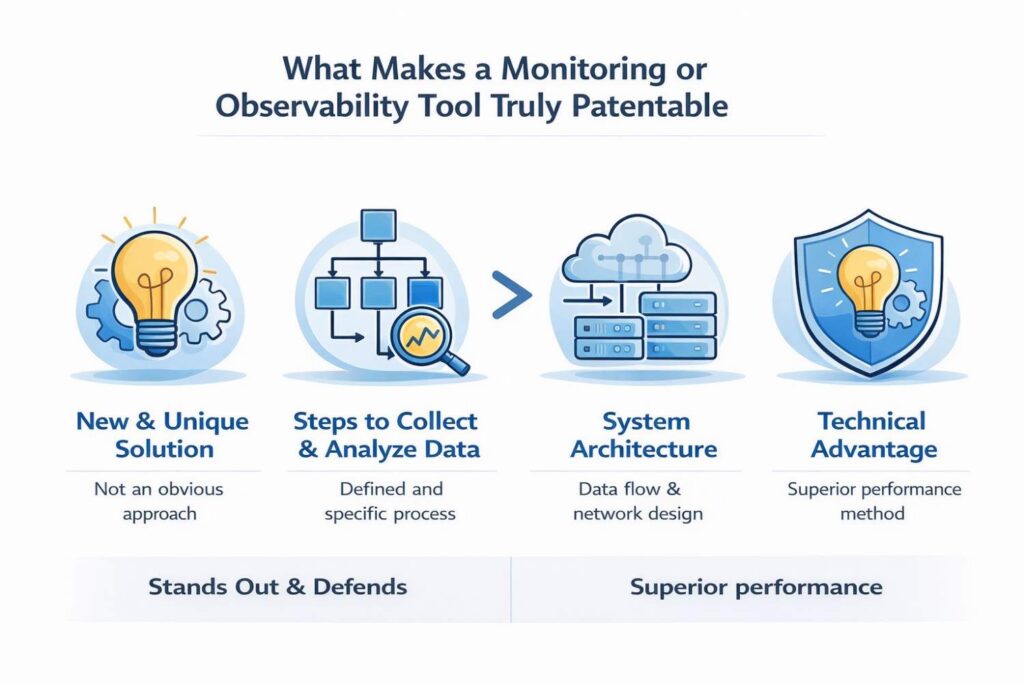
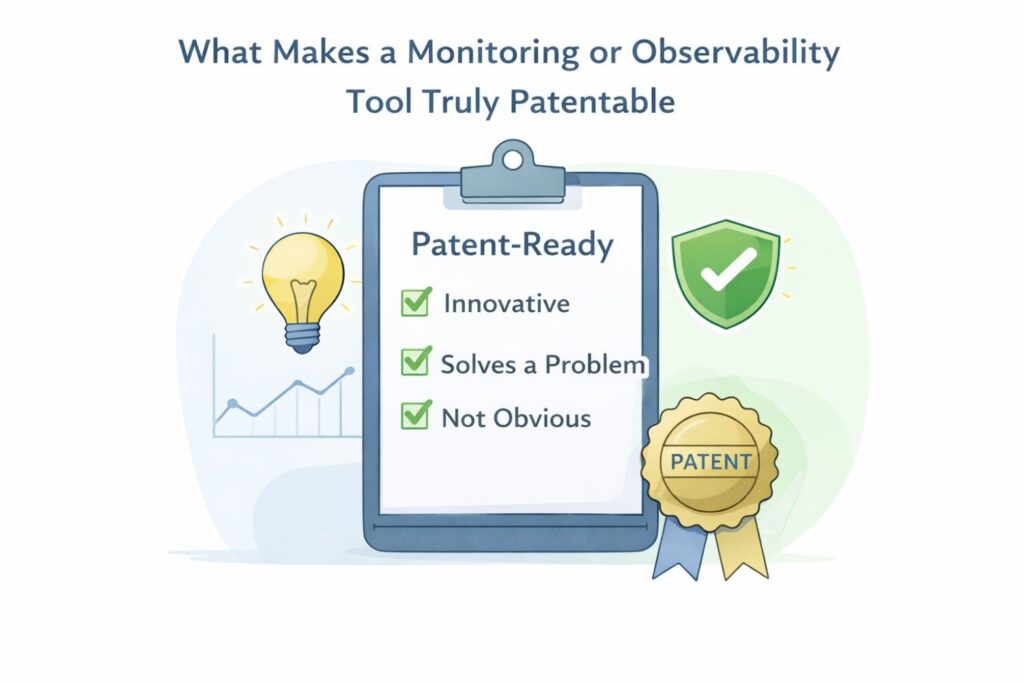
What Makes a Monitoring or Observability Tool Truly Patentable
A lot of founders build something useful and assume that usefulness alone makes it patentable.
That is not how it works. A monitoring or observability tool becomes a real patent candidate when it does more than present data in a nicer way.
It needs to solve a technical problem in a concrete technical way. That is the key difference.
In this space, many products can sound similar at a high level. They collect telemetry. They surface alerts. They help teams find root cause. They reduce noise.
Those outcomes matter, but patentability usually depends on what is happening under the hood. The deeper question is simple: what did your team make that changes how the system actually works?
Patentable does not mean “valuable” in a general sense
A strong business can have a great product and still not have a patentable feature in every part of that product. That is normal.
Patentability is not about whether customers love the product, whether investors like the market, or whether the company is growing fast.
It is about whether there is a specific technical method, system design, or machine process that is new and meaningfully different from what came before.
For observability companies, this means the bar is usually met by technical mechanics, not by broad product messaging.
A great feature is not always a patentable invention
Some product improvements are smart but still not patent-worthy on their own.
A cleaner dashboard, a simpler setup flow, or a nicer chart may improve adoption, but that does not always mean there is a protectable invention underneath.
The question to ask is whether the improvement comes from a real technical method. If the answer is yes, that is where patent potential starts to appear.
If the answer is no, the feature may still matter a lot to the business, but it may be better protected through speed, brand, product execution, or internal know-how.
The standard is deeper than “we built this first”
Being first can help a startup win market attention, but being first does not by itself make something patentable.
Your team needs to show what was technically new about the way the problem was solved. In practice, that means going beyond the launch story and explaining the system behavior in detail.
What changed in data handling, event processing, correlation logic, infrastructure efficiency, query interpretation, or machine-assisted decision-making? That level of detail is where patentable substance usually lives.
A patentable observability tool solves a real technical problem
This is one of the most important ideas for founders to understand. Patent-worthy software usually solves a technology problem, not just a business workflow problem.
For monitoring and observability tools, that technical problem might involve data scale, signal quality, system complexity, latency, overhead, service mapping, anomaly ranking, or cross-source correlation.
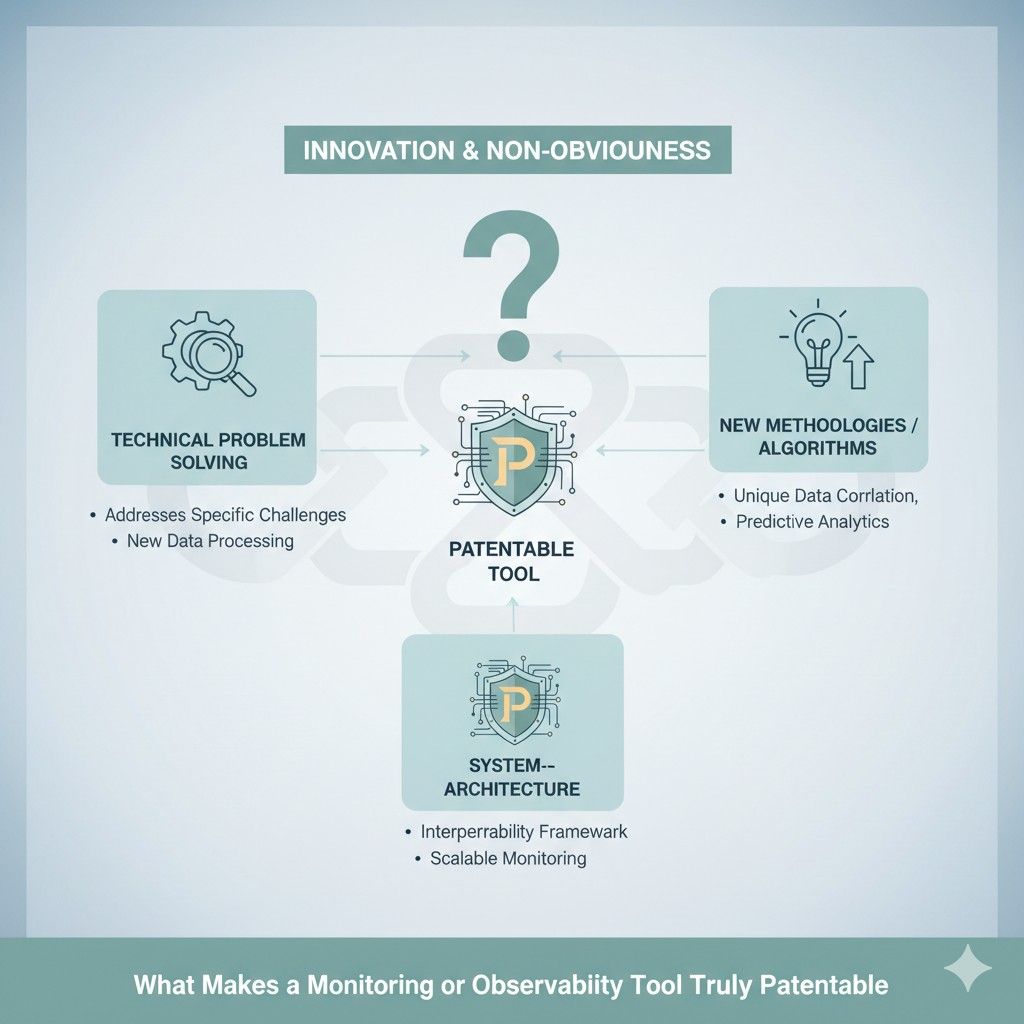
The invention becomes stronger when it addresses one of those problems in a way that changes system performance or capability.
The problem should exist inside the system, not only around the business
A business pain point alone is usually not enough. “Teams struggle to understand outages” is real, but it is still broad. The patentable angle usually comes from the technical challenge hidden inside that pain.
For example, perhaps the true problem is that traces, logs, and metrics arrive in different forms and at different times, making it hard to identify causally related failures.
Or maybe the issue is that agent-based telemetry collection creates too much resource load in short-lived cloud workloads.
These are technical problems. When your invention addresses one of them with a concrete system method, patentability becomes much more plausible.
Strong inventions often reduce friction in machine behavior
A useful sign is this: if your system materially changes how machines collect, process, compare, compress, prioritize, or explain technical data, there may be something patentable there.
That is different from simply helping a person make a decision. Patentable observability inventions often improve the machine-side process itself.
They make the system faster, lighter, more accurate, more adaptive, or better able to handle scale and complexity.
The invention has to be specific
Founders often describe their product at a level that is too broad. That is good for sales. It is weak for patent work.
The more general the wording, the harder it is to show that there is a true invention. Saying “our platform detects incidents automatically” is not enough. The real value comes from explaining how that happens.
A patentable system is usually one with identifiable steps, inputs, decisions, and outputs that are tied together in a defined way.
Specificity is what turns a concept into an invention
A concept says what the system aims to do. An invention says how it does it.
That difference matters a lot. For example, “intelligent alert reduction” is a concept.
But a system that clusters incoming telemetry events based on temporal overlap, service dependency proximity, and deployment-change context, then suppresses duplicate alerts when the cluster confidence crosses a threshold, starts to sound like an actual invention.
The second version gives the technical path, not just the goal.
The system should have a repeatable technical flow
Patentability gets stronger when the invention can be described as a process that a system performs in a repeatable way.
That does not mean the method has to be simple. It just means it should be clear enough to explain. What enters the system first? What gets transformed? What is compared?
What rules or models are used? What condition changes the next step? What output is produced? If your team can walk through that flow clearly, you are much closer to identifying patentable subject matter.
Observability tools become more patentable when they improve computer performance or system operation
This is where many software founders find their strongest ground. If the invention improves how computing systems operate, that can be a major advantage.
In observability, a lot of product value comes from making complex environments more measurable without creating too much cost or overhead. That is a deeply technical space.
A new method that makes telemetry collection more efficient, reduces storage burden, improves query execution, or lowers false-positive rates can be far more patentable than a purely presentational feature.
Better performance is not only about speed
Many founders think performance means faster response time. It can, but that is only one part of the picture.
A tool may also improve computer performance by reducing memory use, cutting network load, lowering compute cost, shrinking storage needs, or improving the efficiency of event processing.
In monitoring systems, these improvements can be central to product value because observability data is often large, messy, and expensive to manage. If your invention changes that technical reality, it may support patentability.
Improvements to distributed systems matter a lot in this category
Modern observability products often work across containerized services, serverless functions, edge workloads, and fast-changing cloud environments. That complexity creates room for real invention.
A method that automatically maps service relationships from partial runtime evidence, or one that reconstructs execution paths from fragmented telemetry across distributed components, may be much more than a feature.
It may be a technical system improvement that solves a hard machine-level problem. These are the kinds of areas where patentable material often appears.
Combining data sources is not enough by itself
Many observability tools combine logs, traces, metrics, events, and infrastructure signals. That is useful, but the fact of combining them is rarely the most important point.
The patentable part usually comes from what your system does with that combination. It is not enough to say that data is unified.
The better question is how the system interprets, ranks, cleans, aligns, or transforms the combined data to produce a better technical result.
Correlation logic is often where the invention lives
If your product ties together multiple signal types, the patentable value may sit in the correlation engine rather than in the mere presence of multiple inputs.
For example, perhaps your system aligns events across different data streams using time-window weighting, service topology context, and code deployment markers.
Or perhaps it scores likely causal chains between abnormal metrics and downstream trace anomalies. That is much more meaningful than simply stating that the tool uses more than one source of telemetry.
Founders should look for the rule or model behind the result
A helpful way to inspect your product is to ask what hidden rule set or internal model produces the benefit.
If the user sees “probable root cause,” what led the system there? If the platform suppresses duplicate alerts, what logic decides duplication?
If the system surfaces service health risk before failure becomes visible, what pattern is it detecting?
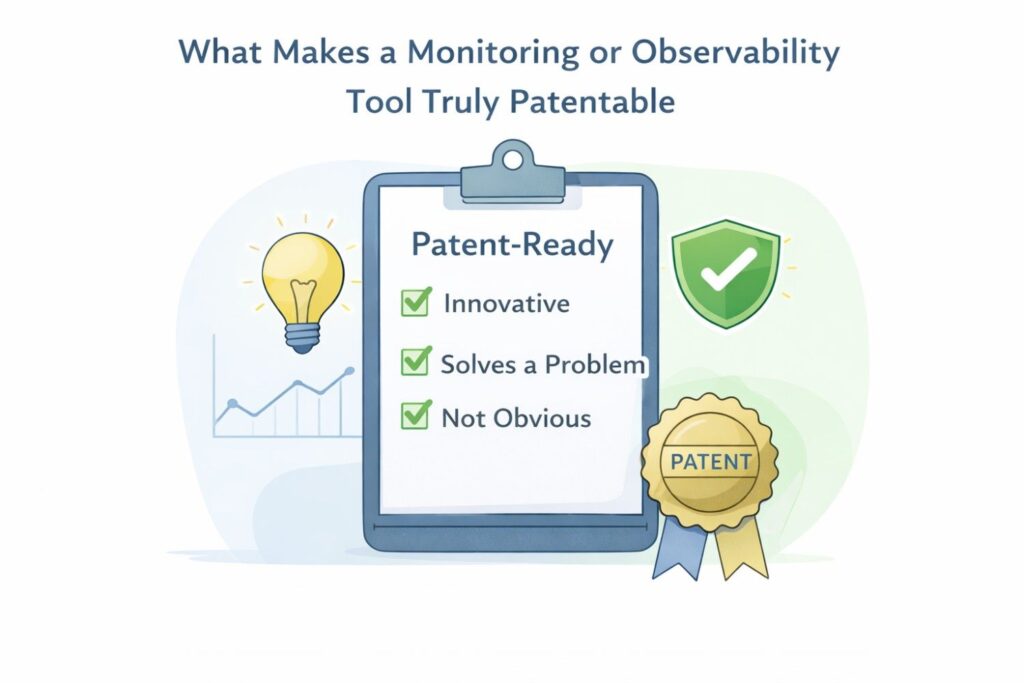
The business value may appear in the final output, but the patentable value often sits in the internal engine that creates it.
How to Write Claims Around the Real Technical Advantage
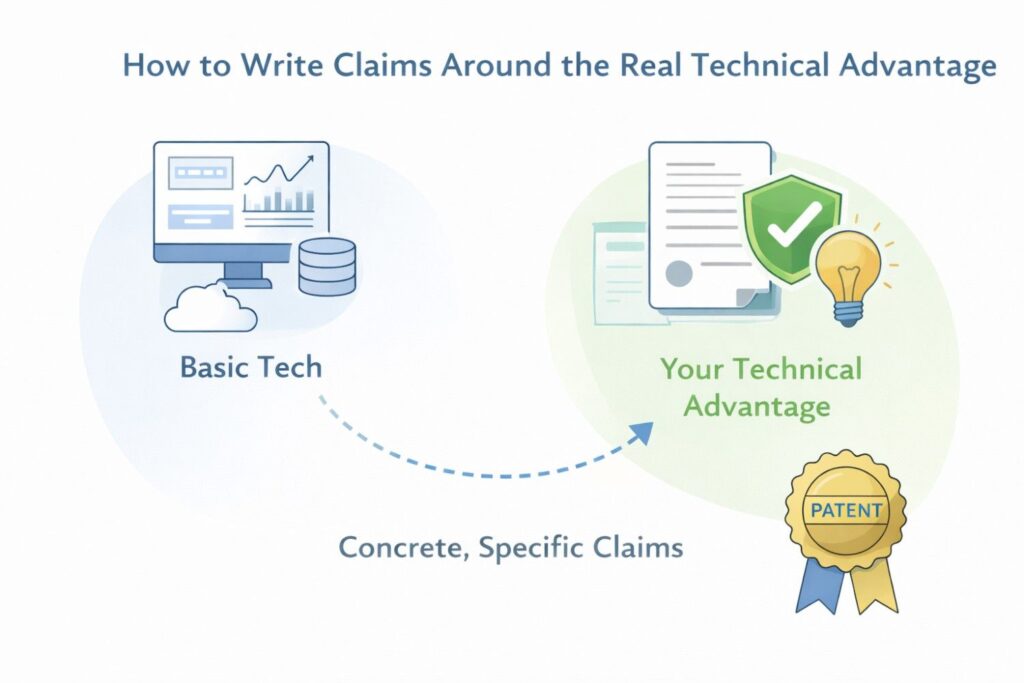
Writing strong patent claims starts with one simple rule: do not chase the feature headline. Chase the technical advantage that makes the feature possible.
That sounds obvious, but it is where many software teams go wrong.
They write around what the product appears to do instead of what the system actually does better. In monitoring and observability, that mistake is even more common because many products look similar on the surface.
They all promise better visibility, faster debugging, cleaner alerts, and stronger reliability. Those are useful outcomes, but they are not the claim strategy.
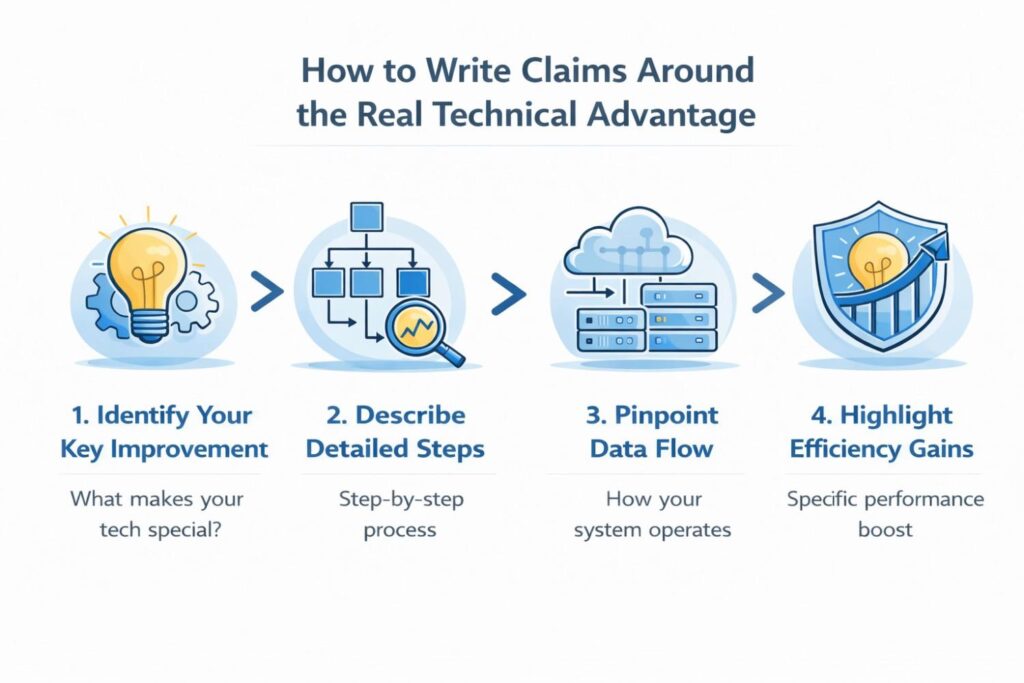
The claim strategy has to sit underneath that layer and lock onto the method, structure, or machine process that gives your product its edge.
Start with the hard part your system solves
The best claims usually begin with a real technical problem, not a market slogan.
That matters because claims built around broad product language tend to become weak very fast. If you say your system “improves root cause analysis,” you are describing a goal.
You are not yet protecting the technical path to that goal. A stronger approach starts by asking what made the problem hard in the first place and what your system changed to solve it.
Find the technical friction, not the customer promise
The customer promise matters for sales. The technical friction matters for claims.
For example, a founder may say the product helps engineers find incidents faster.
That is useful, but it is still too high-level.
The claim work begins when the team explains that the real challenge was that logs, traces, and metrics arrived with inconsistent timing and incomplete service context, which made traditional correlation inaccurate or slow.
Once that friction is clear, the claim can begin to form around the actual technical solution rather than the business-facing benefit.
The harder the system problem, the stronger the claim opportunity
One useful internal test is to ask what your team had to invent because standard methods kept failing.
In observability, that may mean old approaches created too much telemetry overhead, missed fault relationships across distributed services, produced too many false alerts, or could not handle dynamic cloud topologies.
When your team had to design a new machine-level process to address one of those gaps, that is often where the strongest claim material lives.
Write claims around how the system works, not how the interface looks
A clean interface can be part of a good product, but it is rarely the center of strong claim coverage.
Founders often describe inventions by walking through the screen because that is the easiest way to explain the product. The problem is that screens change. Product flows evolve.
A competitor can change the layout and still copy the engine. Stronger claims usually focus on the technical method operating beneath the visible layer.
The interface is often the wrapper, not the invention
What the user sees is often just the final expression of a deeper process.
A screen that shows likely root cause may look impressive, but the protectable advantage is usually not the display itself.
It may be the way the system ranks event clusters, maps them to recent dependency changes, filters noise, and generates a ranked explanation set.
That is where the actual technical advantage sits. If the claim is built around the display instead of the engine, the protection may miss the most important part.
Durable claims survive product redesigns
This is a strategic point that businesses should take seriously.
A startup product will change. The user flow that looks central today may disappear in a year. If your claims are tied too tightly to a specific interface layout or user interaction, they may age badly.
If they are anchored in the deeper technical logic of the system, they can remain useful across multiple product versions. That makes them more valuable to the business over time.
Translate each feature into a system method
One of the most useful habits in claim drafting is to force every major feature through a technical translation step.
That means taking a product statement and rewriting it as a machine process. The goal is not to sound more complex. The goal is to expose the actual moving parts.
This is where vague product language starts to turn into defensible claim language.
Turn outcomes into steps
Every strong claim needs a technical sequence, even if that sequence is not written in a rigid way at first.
Suppose the feature is “noise-free alerting.” That is not yet a claim idea. The useful next step is to ask how the system creates that result.
Maybe the system receives telemetry from multiple sources, groups signals by temporal overlap, scores each group against service dependency information, suppresses groups below a dynamic confidence threshold, and triggers alerts only for event sets that exceed a weighted incident score.
Now the product outcome has become a system method. That is much closer to claim material.
Turn marketing words into machine actions
This translation step is often where the biggest improvement happens.
Words like intelligent, automatic, smart, unified, and instant can be useful in messaging, but they do very little in a patent claim unless they are grounded in real machine behavior.
A good internal drafting habit is to challenge every such word with one question: what does the system actually do when we say that? The answer usually reveals the real invention.
Focus on the smallest technical distinction that creates the biggest product value
Many founders assume claims should cover the whole product in one sweep. In practice, the most valuable claims often come from a smaller technical distinction with outsized business impact.
That distinction might look minor from the outside. It may be one rule set, one architecture choice, one correlation step, one data reduction method, or one ranking process.
But if that piece is the reason the product performs better, scales better, or produces cleaner results, it may be the part worth protecting most.
The moat is often narrower and deeper than teams expect
This is especially true in monitoring and observability tools.
A founder may think the moat is the entire incident investigation flow. In reality, the strongest moat may be a very specific internal process that reconstructs likely failure chains from fragmented telemetry using dependency-weighted timing analysis.
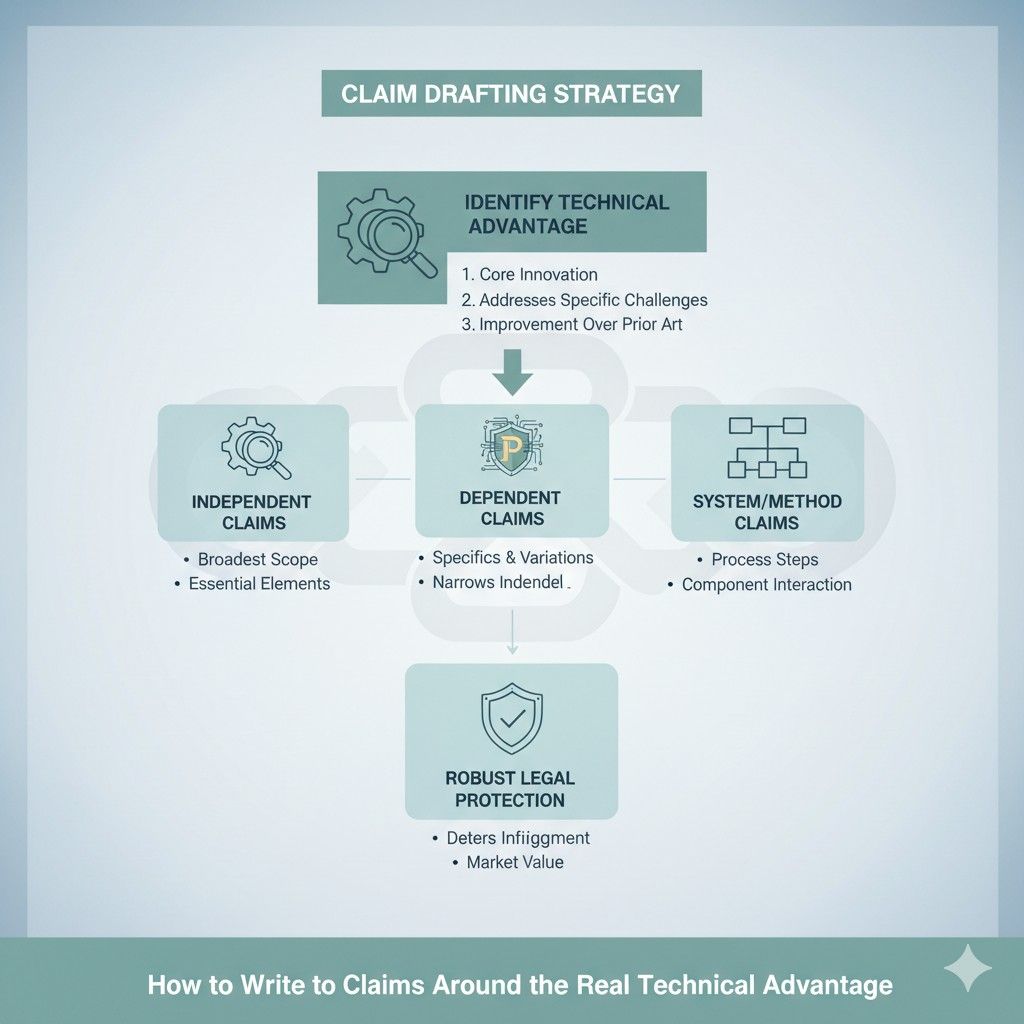
That kind of technical distinction may not be obvious to outsiders, but it may be the real source of customer value. Good claims go after that layer.
Claim the engine that moves the business
A strategic business should not ask only what is patentable. It should ask what is worth patenting.
The best place to focus is where technical novelty and business value overlap. If one method drives faster detection, lower overhead, better retention, or more credible product differentiation, that method should be studied carefully for claim coverage.
The point is not to file on every idea. The point is to secure the part of the system that matters most.
Use the product architecture to find claim structure
Product architecture can be one of the best guides for claim drafting because it reveals what the system actually does in a way marketing language usually cannot.
When you look at the architecture, you can often see the real flow of data, the transformation points, the decision points, and the output logic. That makes it easier to identify where claims should begin and end.
In observability tools, this is particularly useful because the technical advantage often sits in how different system components work together rather than in a single isolated feature.
Look for input, transformation, decision, output
This simple frame can help teams uncover claim structure without overcomplicating the process.
A useful claim draft often starts with what enters the system, then moves to what is transformed, then explains how the system makes a determination, and then shows what technical result follows.
In monitoring tools, that may mean telemetry ingestion, event normalization, correlation scoring, and alert generation.
In another product, it may mean query intake, service graph mapping, runtime pattern comparison, and issue ranking. This structure helps turn system design into legal coverage.
Architecture diagrams often expose hidden invention points
Many founders already have internal diagrams that are more useful than they realize.
Those diagrams may show a data path or service flow that reveals exactly where novelty lives. A smart claim process uses those materials to identify non-obvious technical steps.
This is one reason fast-moving technical teams should capture architecture while it is fresh. The clearer the internal system story, the easier it is to write claims around the real advantage instead of the visible feature layer.
Avoid claims that sound broad but protect very little
A common drafting mistake is to use big, sweeping language that feels strong but ends up being fragile.
This usually happens when teams want broad coverage too early. They write claims around abstract outcomes instead of grounding them in a concrete technical method.
The claim may sound impressive, but if it is not tied to a clear process, it may not hold much practical value. Broad words do not automatically create broad protection.
Empty breadth is not real coverage
A claim that says a system detects anomalies and presents an incident cause may look wide on paper, but it may not protect much if it does not explain how the system gets there.
Real strength usually comes from pairing reach with technical specificity.
That means identifying the core machine process that makes the result happen and claiming it in a way that preserves room for equivalents and variations. The goal is not to be vague. The goal is to be strategically precise.
Good breadth comes from abstracting the right layer
This is where strong claim thinking becomes valuable.
You do not want to claim only a single narrow implementation if the real invention is broader. But you also do not want to float so high that the claim becomes generic.
The better move is to identify the true technical pattern beneath current versions of the feature.
If several product variants all depend on the same correlation logic, dependency model, or adaptive thresholding framework, that deeper pattern may support broader and more useful coverage.
Write for competitors who will try to work around you
A claim is not just a description of your product. It is also a boundary competitors may try to step around.
That means the drafting mindset should be more strategic than descriptive. You are not only asking what your system does.
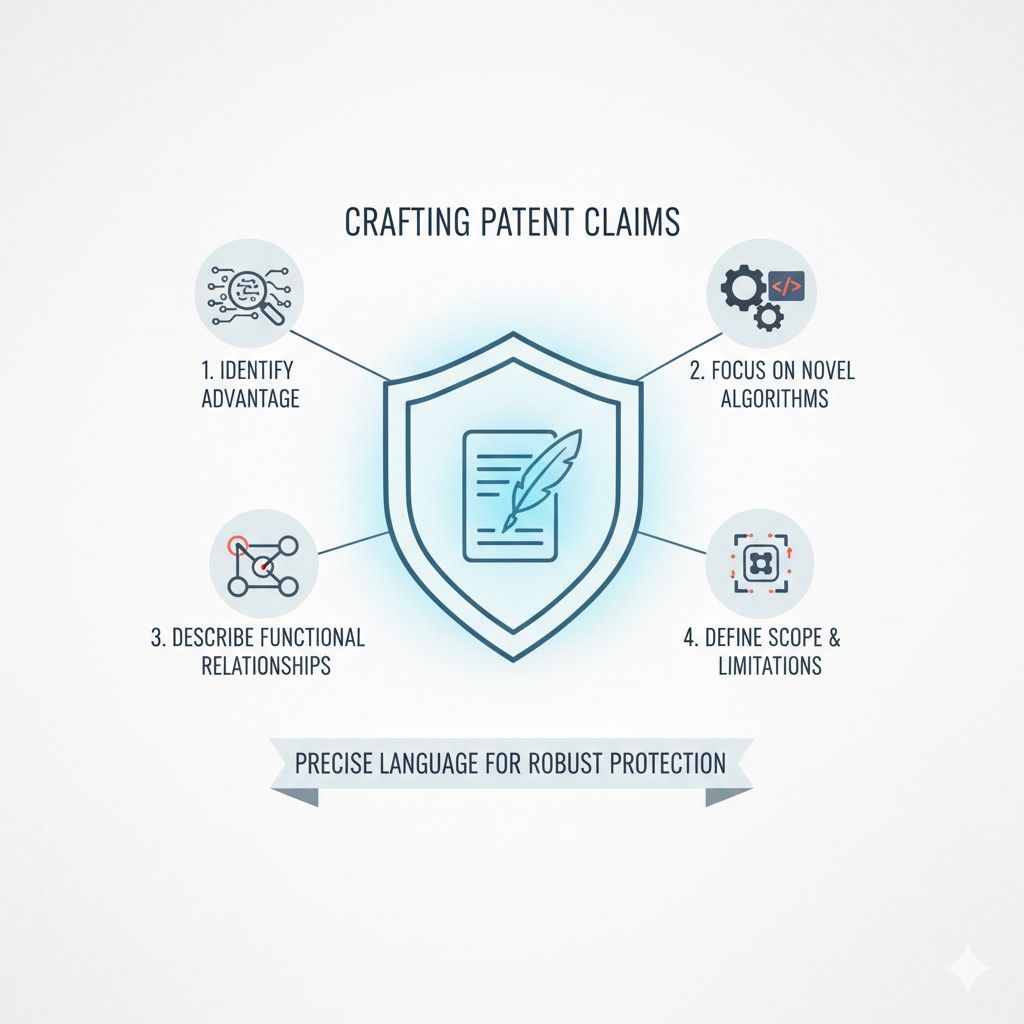
You are asking how another company might copy the advantage while changing names, screens, or implementation details. Strong claims make that path harder.
Think one move ahead of the copycat
In a crowded software market, competitors rarely copy your wording exactly.
They usually keep the core benefit, change the framing, alter the workflow, and rebuild enough of the surface to make it look different.
That is why claims should be anchored in the technical method that produces the value. If a rival changes the user flow but still uses the same underlying approach to correlate telemetry and rank incident likelihood, a strong claim is more likely to stay relevant.
Claim around the principle, not just the exact release
Founders often make the mistake of drafting too close to the product snapshot of the moment.
A better approach is to ask what principle sits underneath the current implementation. Is the invention really about one specific interface action, or is it about context-aware event prioritization based on changing service relationships?
Is it really about one dashboard output, or is it about automated fault-chain reconstruction from fragmented runtime signals? When claims are built around the principle, they are harder to work around and more useful over time.
Build a layered claim strategy, not a single claim idea
A single claim angle is rarely enough for a serious software business.
The strongest patent positions often come from layering. One layer may cover the broader system method. Another may cover a narrower technical refinement.
Another may cover a supporting architecture, data structure, or operating variation. This creates more resilience because the invention is protected from more than one direction.
Different claim layers protect different business risks
That is why layered drafting is a strategic move, not just a legal one.
A broader claim may help protect the core technical concept. A narrower claim may capture the specific implementation competitors are most likely to copy first.
Another claim may focus on a valuable fallback version that maps directly to how the product ships today. Together, those layers can create a more durable position for the business.
Actionable advice: draft from the inside out
A practical way to think about this is to start with the deepest technical mechanism, then move outward.
First, identify the core engine that drives the advantage. Then identify the specific version that your product uses today. Then identify the variations you expect to add as the roadmap evolves.
This helps create claims that are both commercially relevant and strategically flexible. It also prevents the business from treating the first draft as the whole strategy.
Wrapping It Up
Patent claims are not the side story for monitoring and observability tools. They are the part that decides whether your real technical edge stays yours when the market gets crowded. If you are building in this space, the biggest risk is not that people fail to notice your product. The bigger risk is that they notice it, understand the value, and then build around you while your patent only covers the surface. That is why smart founders do not stop at features. They go deeper. They identify the true technical method that makes the product faster, cleaner, lighter, more accurate, or more useful in real-world systems.
Leave a Reply