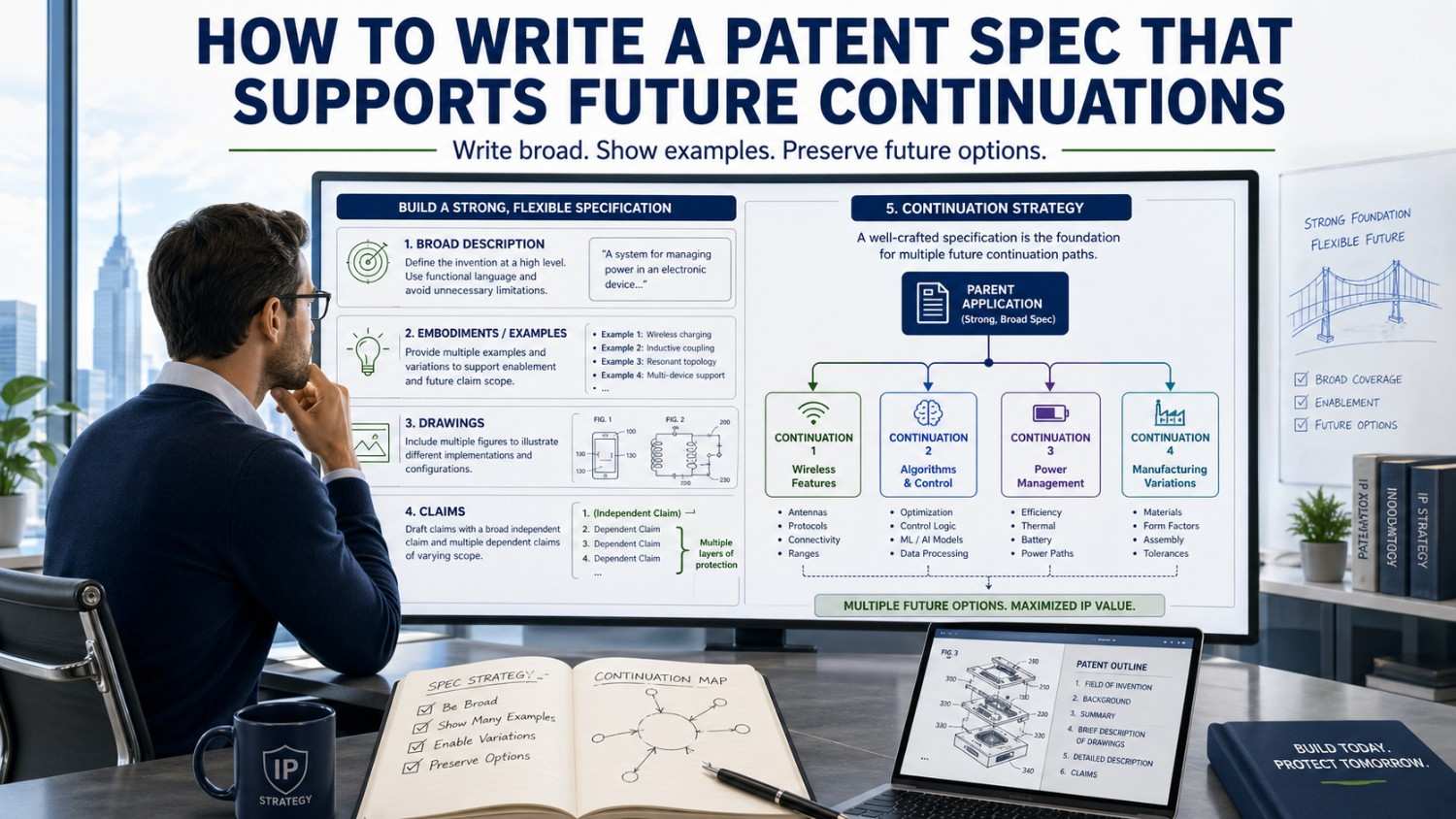
A strong patent application should protect what you built today. But for a startup, that is not enough.
Your product will change. Your roadmap will grow. Your market will teach you new things. A good patent spec should give you room to file future continuations as your company learns, ships, and expands.
That starts with the first patent spec.
PowerPatent helps founders, engineers, and inventors turn technical ideas into stronger patent filings with smart software and real attorney oversight. You can see how it works here: https://powerpatent.com/how-it-works
What a continuation really means for founders
A continuation is a later patent application that grows out of an earlier one.
You can think of it as a second shot, third shot, or next layer based on the same original filing. It can let you pursue different claim angles while keeping the benefit of the first filing date, as long as the later claims are supported by what you already disclosed in the first spec.
That last part is the key.
A future continuation can only work with the material you put in the original application.
If the original spec does not describe a feature, version, workflow, data path, device setup, model behavior, fallback mode, or use case, it may be hard or impossible to claim it later through a continuation.
This is why the first spec matters so much.
Many founders think the goal of the first patent filing is only to get one patent allowed. That is too small. The better goal is to build a patent base that can support a family of patents over time.
That family can cover the core invention, product updates, competitor design-arounds, customer-specific versions, new workflows, and deeper technical improvements.
But the family can only grow from what the first spec teaches.
A thin first spec gives you a thin future.
A rich first spec gives you options.
The patent spec is the soil for future claims
A continuation does not create support from nothing.
It grows from the first spec.
That means your original spec should not only describe your current product. It should describe the invention family.
Think of the spec like soil. The claims are plants. You may plant one set of claims now. Later, you may plant another set. But they all need soil to grow.
If the soil is shallow, the future claims may not take root.
For example, say your startup builds an AI tool that reviews engineering drawings and flags design risks. Your first patent claim may focus on detecting risk based on drawing data. But later, you may want continuation claims around ranking risks, grouping similar risks, routing high-risk items to review, updating a model based on engineer feedback, or generating a design change suggestion.
Those future claims need support in the first spec.
If the first spec only says, “The system detects risks in engineering drawings,” that may not be enough.
A better spec would explain input types, preprocessing, model steps, rule checks, risk scoring, confidence values, review flows, feedback use, output types, user actions, and deployment options.
That does not mean the spec should be bloated. It means the spec should be strategic.
It should teach the core idea and the natural ways the idea can grow.
The biggest mistake: writing only for the first claim set
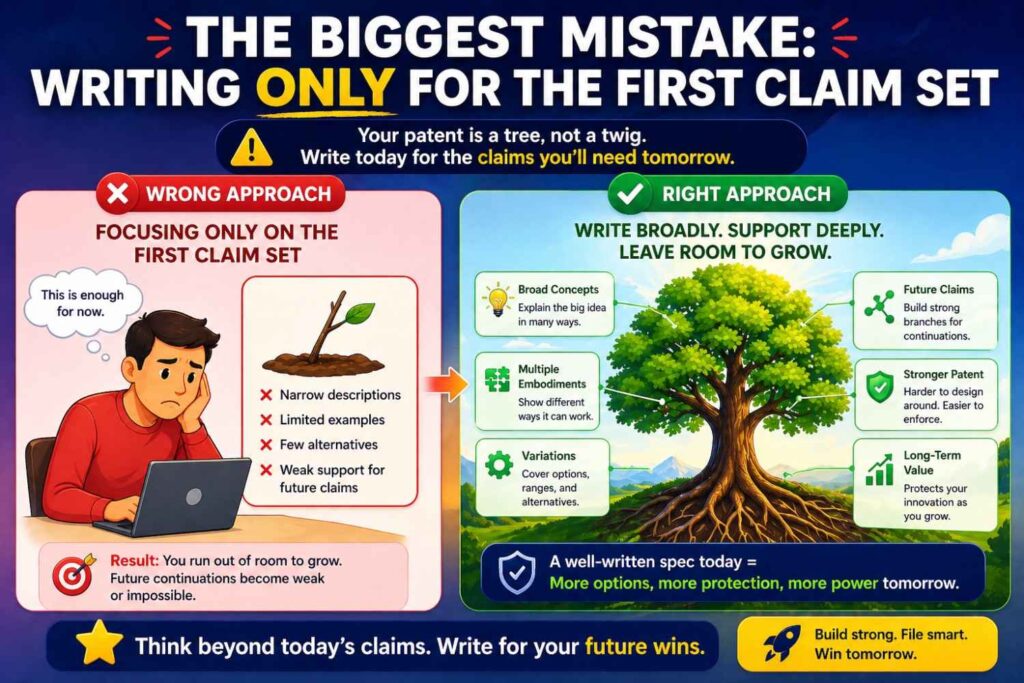
A common mistake is writing the spec around the claims you plan to file today.
That may seem efficient. But it can hurt you later.
The first claim set is only one view of the invention. It may be the broadest view. It may be the fastest path. It may be the version your attorney thinks has the best chance. But it should not be the only view your spec supports.
Startups often learn after filing.
You may learn that customers care more about one workflow than another.
You may learn that competitors are copying a narrow feature you thought was minor.
You may learn that the market is moving toward a different deployment model.
You may learn that your first claims face pushback, but another claim angle is stronger.
You may learn that your product becomes more valuable after adding a feedback loop, safety check, or integration.
If your spec was written only for the first claims, you may not have enough support to go after those later angles.
A continuation-friendly spec is broader than the first claim set. It gives you more paths.
PowerPatent is built to help founders capture those paths early, before they are lost in product changes or rushed filings. See how the process works here: https://powerpatent.com/how-it-works
Start with the invention family, not the product screen
Your current product is important, but it is not the whole invention.
A product screen may show one way the invention appears to a user. A patent spec needs to go deeper.
It should explain what happens behind the screen.
What data comes in?
How is the data changed?
What decisions are made?
What models, rules, scores, thresholds, or checks are used?
What outputs are produced?
What actions happen because of those outputs?
What can vary?
What can be optional?
What can be done in a different order?
What happens if the system fails?
What happens when the system learns?
Those details create support for future continuations.
If you only describe the user interface, you may only support claims around the user interface. If the real value is in the back-end process, that is a problem.
For example, a product may look like a simple dashboard that ranks supplier risk. But the invention may involve a new way to combine shipment delay data, supplier messages, weather signals, contract terms, and inventory levels into a changing risk score.
The spec should not stop at “dashboard shows supplier risk.”
It should explain the data pipeline, scoring logic, update triggers, ranking process, alert paths, fallback data sources, and actions that may follow.
That gives you room for future continuations around many parts of the system.
Write the broad idea first, then the working examples
A good continuation-friendly spec has both breadth and detail.
Breadth protects the big idea.
Detail supports future claims.
The trick is to start broad, then move into examples.
For example, instead of starting with:
“In one embodiment, a mobile app receives camera images of a warehouse shelf and sends the images to a cloud server that uses a convolutional neural network to detect missing inventory.”
You may start with:
“This disclosure describes systems and methods for detecting an inventory condition based on sensor data from a storage area.”
That is broader.
Then you can explain examples:
“In some examples, the sensor data may include image data, depth data, weight data, RFID data, barcode data, motion data, or other data related to items in the storage area.”
Then you can give the actual product example:
“In one example, a mobile device captures image data of a warehouse shelf and sends the image data to a remote server for analysis.”
This structure gives future continuations more room.
You may later claim camera-based detection. Or RFID-based detection. Or weight-based detection. Or sensor fusion. Or edge processing. Or a shelf-specific alert. Or a restocking workflow.
The spec supports more than one path because it did not treat the first implementation as the whole invention.
Avoid narrow labels too early
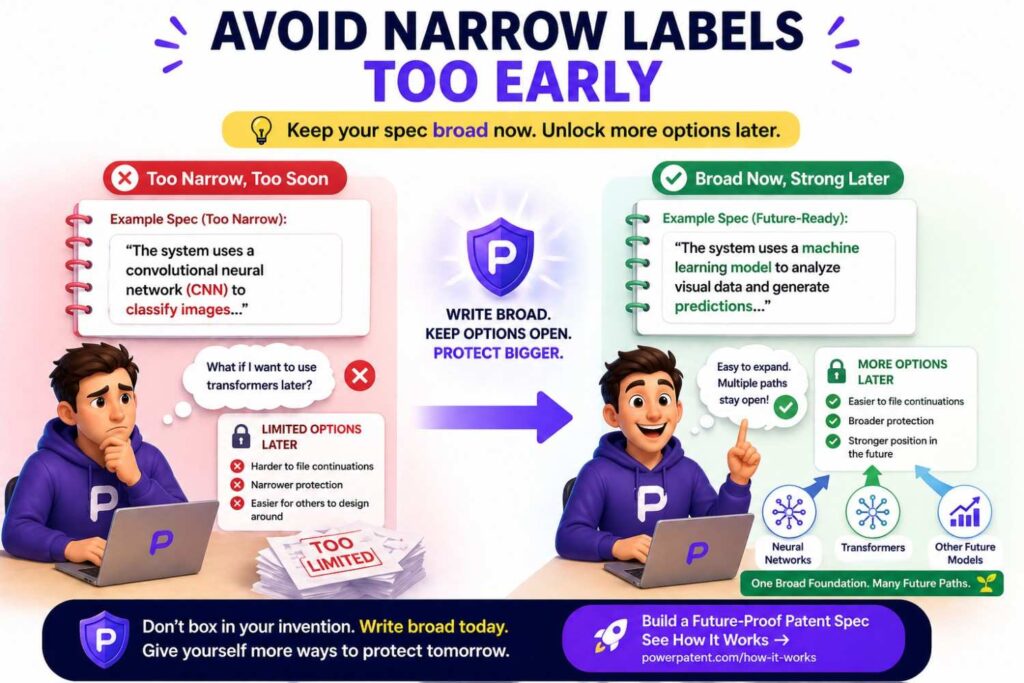
The names you use can shape the spec.
If you call the invention “a mobile app,” you may make it sound mobile-only.
If you call it “a dashboard,” you may make it sound interface-only.
If you call it “a neural network system,” you may make it sound limited to one model type.
If you call it “a camera-based device,” you may make it sound limited to cameras.
Those names may be fine if they are truly central. But if they are only current choices, use broader names.
A “mobile app” may be a “client device” or “user interface.”
A “dashboard” may be an “output interface” or “review interface.”
A “neural network” may be a “trained model” or “classification process.”
A “camera” may be a “sensor.”
A “Slack alert” may be a “message through a communication platform.”
A “Jira ticket” may be a “task in a workflow system.”
Broad names do not mean vague names. They mean names based on function, not one current tool.
This matters for continuations because later claims may need to reach beyond today’s labels.
Describe the problem in a way that supports growth
The background and problem statement should not be too narrow.
If you describe the problem only as a mobile app problem, you may make the invention feel tied to mobile.
If you describe the problem only as a dashboard problem, you may make the invention feel tied to dashboards.
If you describe the problem only as a specific customer’s pain, you may miss larger uses.
A better problem statement reaches the technical pain under the product.
For example, weak:
“Warehouse workers need a mobile app to find missing boxes.”
Better:
“Inventory systems may fail to detect item state changes quickly when item data is incomplete, delayed, or spread across different sources.”
That broader problem can support many future continuations.
Another weak version:
“Doctors need a better dashboard for lab results.”
Better:
“Clinical systems may generate large amounts of patient data without ranking which changes require prompt review.”
Now future claims may cover ranking, filtering, alerting, grouping, confidence scoring, review routing, or clinical workflow updates.
The problem statement should set up the invention family, not just the first product.
Teach the reader how the invention works
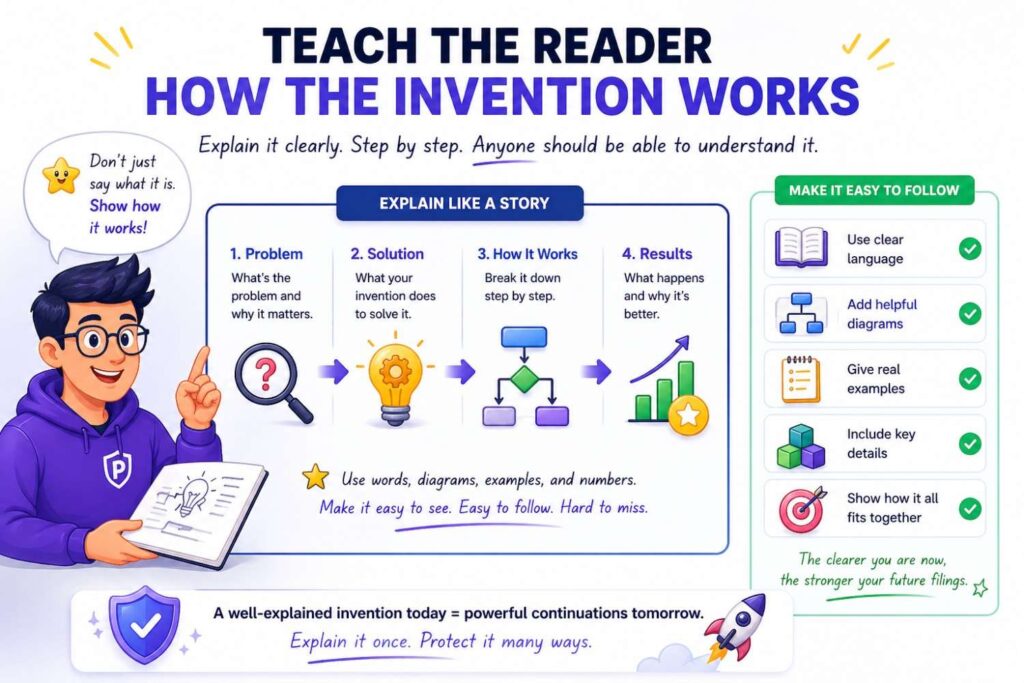
A continuation-friendly spec should teach.
It should not only state results.
Saying “the system improves accuracy” is not enough. How?
Saying “the system reduces latency” is not enough. How?
Saying “the system ranks risk” is not enough. Based on what?
Saying “the model is updated” is not enough. Using what data? When? How? What changes?
Future claims need support. Support comes from clear teaching.
For example, if your system ranks outputs, describe ranking factors.
If your system uses a threshold, describe how the threshold may be set, adjusted, or selected.
If your system routes items for review, describe review conditions and review results.
If your system uses feedback, describe feedback sources and how feedback changes future operation.
If your system has fallback modes, describe what triggers fallback and what the system does next.
These details give later continuation claims a stronger base.
Include the “why” behind each feature
A spec should explain not only what a feature is, but why it matters.
This makes the application clearer. It also helps show that optional features are tied to real technical value.
For example:
“In some examples, the system may group related alerts into a single incident. This may reduce repeated alerts and help a user review a root cause instead of many separate symptoms.”
That sentence does more than list grouping. It explains value.
Another example:
“In some examples, at least part of the processing may be performed on an edge device. This may reduce delay, reduce network use, or allow operation when a remote server is unavailable.”
Now edge processing has a purpose.
Another:
“In some examples, the system may create an audit record that stores the input, output, model version, confidence value, and review result. This may help a later user understand how an output was generated.”
That supports future claims around audit logs, explainability, and review.
The “why” gives the feature life.
Do not rely on one embodiment
A spec that only has one embodiment can be weak for continuations.
One embodiment may describe the current product. But a continuation strategy needs variants.
A good spec should include multiple examples, alternatives, and combinations.
For example, if your system processes data in the cloud, also describe local, edge, on-prem, and hybrid processing where appropriate.
If your product sends alerts by email, also describe text, push, dashboard, API, workflow task, control signal, and stored output.
If your model is a neural network, also describe other trained models, rules, hybrid systems, and model selection where appropriate.
If your hardware uses a certain material, describe other materials that perform the same function.
If your sensor is a camera, describe other sensors that detect the same condition.
This does not mean adding fantasy. The variants should make technical sense. But you should not write as if the first build is the only build.
Future continuations often depend on those variants.
Give future continuations more claim angles
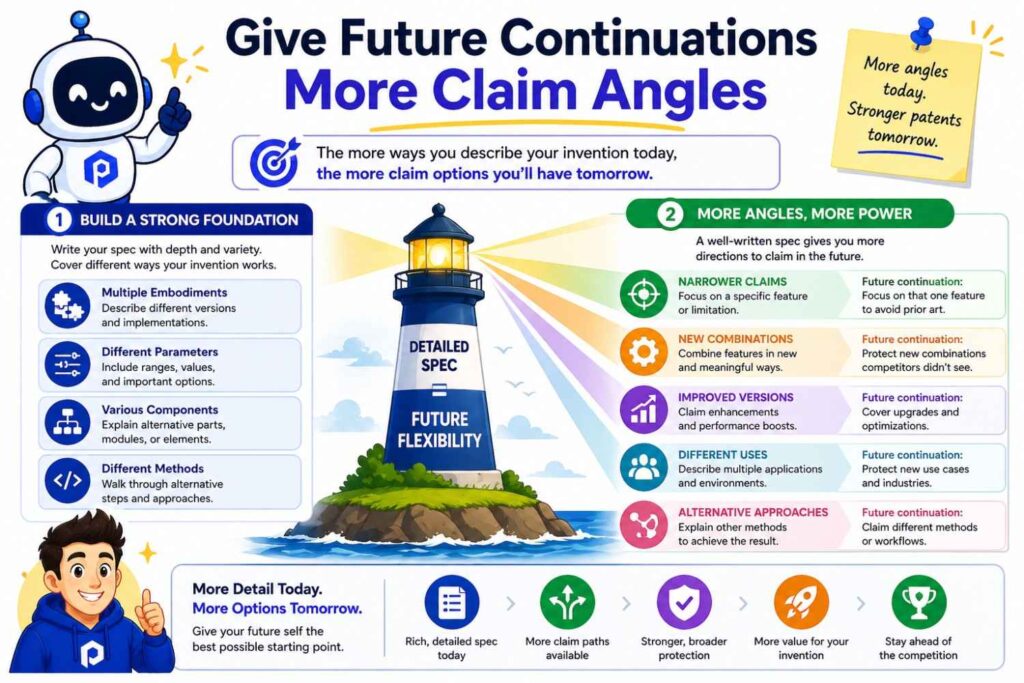
A claim angle is a way to claim the invention.
One spec may support many angles.
For a software invention, possible angles may include data intake, preprocessing, model use, scoring, routing, feedback, user review, output generation, deployment, and system update.
For a hardware invention, angles may include structure, material, assembly, sensor layout, control process, manufacturing method, and use method.
For an AI invention, angles may include training data, model input construction, retrieval, ranking, grounding, confidence scoring, guardrails, feedback, evaluation, and human review.
A continuation-friendly spec gives support for several of these angles.
That way, if one angle becomes important later, you have a path.
For example, your first patent may claim a method of generating a risk score. Later, a competitor may copy your feedback loop. If your spec described the feedback loop well, you may file a continuation with claims focused on feedback-based updating.
If your spec did not explain the feedback loop, you may not have that option.
This is the heart of continuation strategy.
Write for competitors you have not met yet
When you file the first spec, you may not know who will copy you.
You may not know how they will design around you.
But you can guess common paths.
They may use a different sensor.
They may use a different model.
They may change the output channel.
They may move processing from cloud to edge.
They may skip the user interface.
They may automate a step you perform manually.
They may change the order of operations.
They may use a different threshold.
They may replace a human review step with a rule.
They may use a different data source.
Your spec should describe reasonable alternatives so future continuations can target those paths.
This does not mean writing a patent that claims everything. It means giving your future self options.
A strong first spec says, in effect: “Here is the core invention, and here are the natural ways it can be built, used, modified, deployed, and extended.”
That is what makes continuations powerful.
Capture the roadmap before it becomes urgent
Many startups file a first patent application under pressure.
A demo is coming.
A fundraise is starting.
A public launch is near.
A customer pilot is about to begin.
In that rush, the team may only capture the current product. But the roadmap may contain important continuation support.
Before filing, ask what the product may become in the next 12 to 36 months.
Will it add more data sources?
Will it move from human review to automation?
Will it support enterprise integrations?
Will it run on edge devices?
Will it update models based on feedback?
Will it add audit logs?
Will it support customer-specific rules?
Will it control devices, not just report results?
Will it support new industries?
Will it include simulation, testing, ranking, or design suggestions?
Those future paths may belong in the first spec if they are part of the invention family.
PowerPatent helps teams capture these details in a structured way so the filing is not just a snapshot of today. You can explore the workflow here: https://powerpatent.com/how-it-works
Describe inputs broadly and clearly
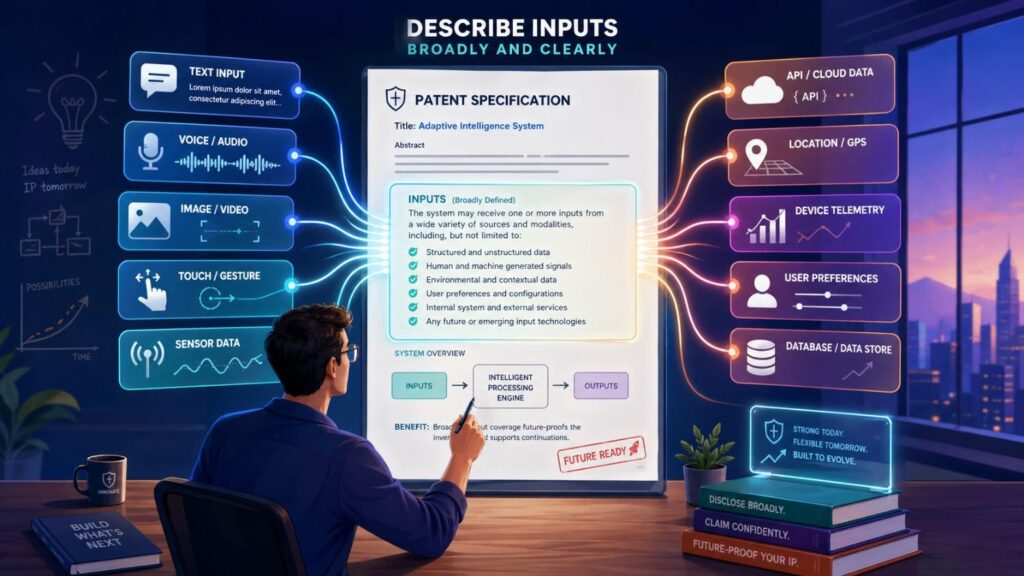
Future continuations often depend on input data.
A strong spec should explain what kinds of input can be used.
Do not only say “the system receives data.” That may be too thin.
Also do not only say “the system receives camera images” unless images are truly required.
Use a broad base, then examples.
For example:
“The system may receive input data from one or more data sources. The input data may include sensor data, image data, audio data, text data, event data, transaction data, device data, location data, time data, user data, historical data, simulation data, test data, or other data.”
Then make it concrete for your invention:
“In some examples, the input data may include time-series data that represents changes in a machine state.”
Or:
“In some examples, the input data may include engineering design data and test results for a component.”
Or:
“In some examples, the input data may include user activity events that occur before a target event.”
This style supports future claims around different inputs while still teaching the invention.
Describe data sources, not just data types
Data type is one thing. Data source is another.
A risk system may receive data from sensors, databases, third-party services, user devices, logs, files, APIs, enterprise systems, or manual input.
If you describe sources, future continuations may have more room.
For example:
“The input data may be received from one or more devices, databases, sensors, user interfaces, software services, logs, repositories, external systems, or application programming interfaces.”
This can support later claims around integrations or distributed data collection.
If your invention works better because it combines sources, say that.
For example:
“In some examples, the system may combine live sensor data with historical maintenance records to detect a condition that is not shown by either source alone.”
That is strong.
It may support future continuation claims around source fusion.
Describe preprocessing steps
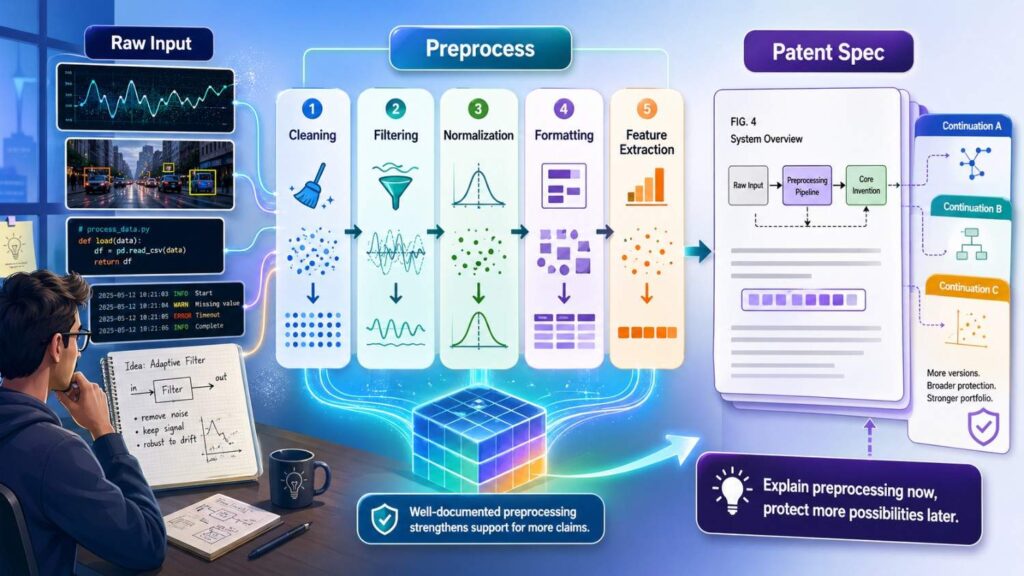
Preprocessing is often where valuable invention details live.
Data is rarely clean. Systems may filter, normalize, align, crop, segment, label, remove noise, fill gaps, extract features, convert formats, or mask sensitive fields.
If the spec does not describe preprocessing, future claims around those steps may be harder.
For example:
“In some examples, the system may preprocess the input data before generating an output. The preprocessing may include filtering noise, removing duplicate records, aligning time stamps, normalizing values, converting a file format, selecting a time window, extracting features, masking sensitive data, or combining data from multiple sources.”
Then tie it to your invention:
“In one example, the system may align sensor readings from different devices based on time stamps before detecting a machine condition.”
Now you have support for a specific useful step.
Preprocessing can support continuations because it is often copied by competitors. It may also become the main point of difference during patent review.
Describe processing in more than one way
If your system performs a key operation, describe possible ways to do it.
For example, if it classifies input data, do not only say “classify.” Explain possible classification processes.
“The classification process may include applying a trained model, applying a rule set, comparing the input data to one or more templates, calculating a score, matching a pattern, using a lookup table, or using a combination of these.”
If your system ranks items:
“The ranking may be based on risk, confidence, time, cost, severity, user role, available resources, expected impact, or another ranking factor.”
If your system selects an action:
“The action may be selected based on a score, rule, threshold, model output, user setting, system state, or feedback history.”
This gives future continuations more claim material.
It also helps show that the invention is not tied to one implementation.
Describe outputs with care
Outputs are often under-described.
A spec may say “the system generates an output.” That is not enough if future claims may focus on what the output contains or does.
Describe output forms.
“The output may include a score, label, alert, warning, prediction, recommendation, ranked list, classification, control signal, report, message, task, ticket, explanation, confidence value, or other result.”
Describe output destinations.
“The output may be provided to a user, device, software service, database, workflow system, control system, API endpoint, or another destination.”
Describe output actions.
“In some examples, the output may cause an alert to be sent, a task to be created, a device setting to change, a transaction to be blocked, a file to be routed, a model to be updated, or a review process to begin.”
This matters because future continuations may target actions, not just results.
For many startups, the value is not only that the system knows something. The value is what the system does next.
Describe feedback loops
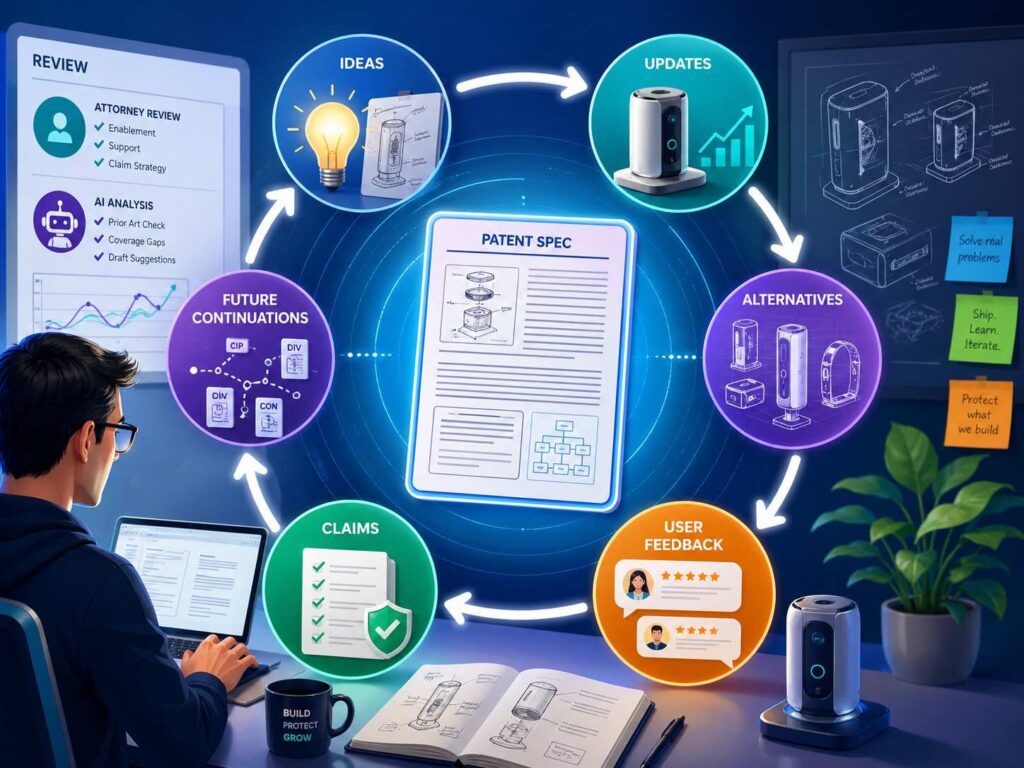
Feedback loops are powerful for future continuations.
They can turn a static system into a system that improves.
If your invention can use feedback, describe it early.
For example:
“In some examples, the system may receive feedback related to an output. The feedback may indicate whether the output was accepted, rejected, edited, ignored, confirmed, corrected, or followed by a target result.”
Then explain use:
“The feedback may be used to update a model, adjust a threshold, change a rule, revise a ranking, select a different data source, update a user setting, or create a training record.”
Then give a real example:
“In one example, when a user rejects a recommended action, the system may store the rejection as feedback and reduce the ranking of similar actions in future cases.”
This kind of detail can support many continuation paths.
It is especially important for AI, automation, workflow, cybersecurity, health, finance, robotics, and developer tools.
Describe confidence and uncertainty
Many systems make decisions under uncertainty.
A spec that supports continuations should explain how confidence, certainty, error, risk, or quality may be handled.
For example:
“In some examples, the system may generate a confidence value for an output. The confidence value may include a score, probability, label, range, flag, error estimate, or another measure of certainty.”
Then:
“The confidence value may be used to select an action, route an output for review, request more data, suppress an output, adjust an alert level, trigger a fallback mode, or update a ranking.”
This gives future claims room around confidence-based workflows.
It also supports safety and trust features.
If confidence values are important to your product, do not leave them as a passing phrase. Explain how they are generated, used, displayed, stored, or updated.
Describe thresholds as flexible
Thresholds are common and often valuable.
But fixed thresholds can narrow the spec.
A continuation-friendly spec should explain that thresholds may vary unless the exact number is core.
For example:
“The system may compare a score to a threshold. The threshold may be fixed, user-defined, learned, adjusted over time, selected based on context, selected based on a risk level, or selected based on a system state.”
Then:
“In some examples, different thresholds may be used for different users, devices, sites, data types, time periods, models, or output classes.”
This supports future continuations around adaptive thresholds, customer-specific thresholds, model-based thresholds, or risk-based thresholds.
If your current product uses a number like 80, include it as an example, not the only rule.
Describe human review and automated review
Many products begin with human review and later move toward automation.
A good spec should support both when both are part of the invention family.
For example:
“In some examples, the system may route selected outputs for human review. In other examples, the system may perform an automated review step before providing or acting on the output.”
Then explain triggers:
“Review may be triggered by a confidence value, risk level, user request, rule, missing data, detected conflict, random sampling, or another review condition.”
Then explain results:
“A review result may approve, reject, edit, label, rank, comment on, or otherwise change an output. The review result may be stored, displayed, or used to update later system behavior.”
This can support continuations around review workflows, safety checks, quality control, and model improvement.
Do not assume review is a minor detail. In many AI and deep tech products, review is where trust is built.
Describe fallback modes
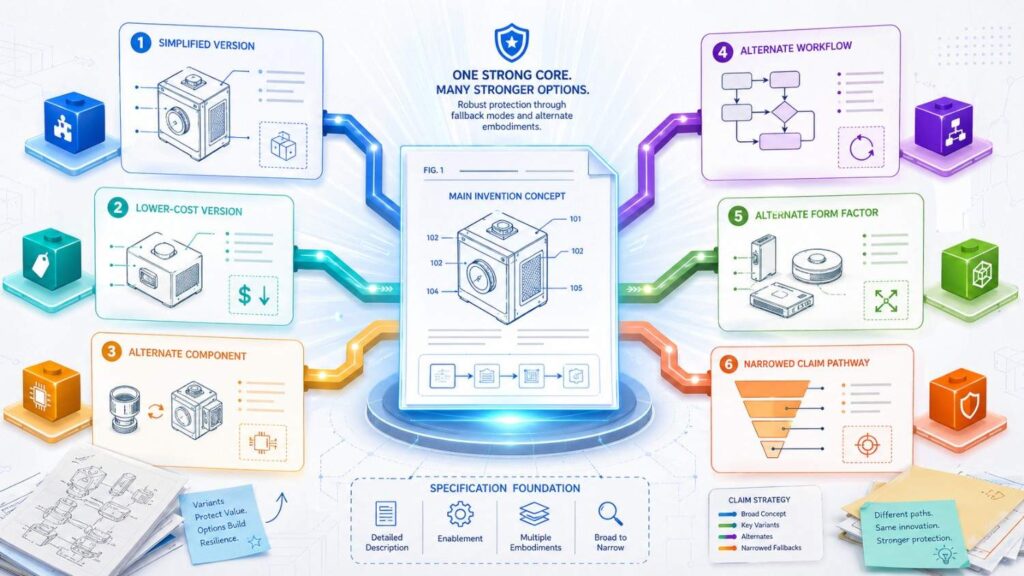
Fallback modes are often overlooked.
They can be very valuable in future continuations because they show how the invention works when things go wrong.
For example:
“In some examples, when a remote service is unavailable, the system may use a local model, cached result, rule-based process, default setting, or delayed processing mode.”
Another:
“In some examples, when input data is missing or incomplete, the system may request more data, use a reduced feature set, lower a confidence value, route the output for review, or delay the output.”
Another:
“In some examples, when a sensor is unavailable, the system may use data from another sensor or estimate a missing value based on historical data.”
These details matter.
Real products need fallback modes. Competitors may copy them. Patent reviewers may see them as meaningful technical depth. Future claims may focus on them.
Describe deployment options
Deployment changes are common.
A startup may begin in the cloud. Later, enterprise customers may want on-prem. Hardware customers may need edge. Regulated customers may need local processing. Cost pressures may push work to devices.
If the first spec only describes one deployment, future continuation options may shrink.
A better spec says:
“The system may be implemented on one or more computing devices, including a server, cloud system, local computer, mobile device, embedded device, edge device, on-premises system, vehicle computer, robot controller, wearable device, or another device.”
Then:
“Operations may be performed locally, remotely, or using a combination of local and remote processing.”
Then:
“In some examples, a first operation may be performed on a local device, and a second operation may be performed by a remote server.”
Then add why:
“The distribution of operations may be selected based on latency, privacy, power use, compute cost, data size, model size, network state, or another factor.”
This gives future continuations a strong base for deployment claims.
Describe system architecture without locking it down
Architecture matters, but it changes.
A diagram may show separate modules. In real life, those modules may be combined, split, moved, or replaced.
The spec should say that.
For example:
“The components shown separately may be combined in some examples. A component shown as one component may be divided into multiple components. Functions described as being performed by one component may be performed by another component or by multiple components.”
This is useful.
It can support future continuations around different architecture forms.
For software, a module may be a service today, a library tomorrow, a container later, and an embedded process after that.
For hardware, parts may be separate in a prototype and integrated in production.
Do not let one diagram freeze the invention.
Describe drawings as examples
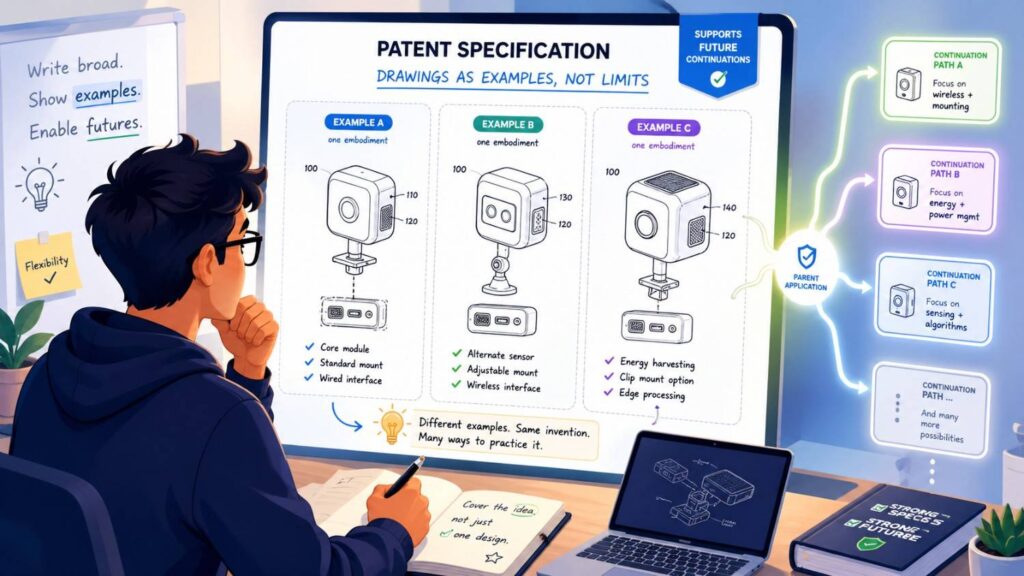
Drawings are not supposed to be cages.
Every figure should be described as an example unless it truly shows the only form.
For example:
“Figure 1 illustrates an example system.”
“Figure 2 illustrates an example process.”
“Figure 3 illustrates an example user interface.”
“Figure 4 illustrates an example device.”
Then add flexibility:
“Other examples may include more, fewer, or different components.”
“The operations may be performed in a different order or at least partly in parallel.”
“The illustrated interface may be omitted or replaced with another output channel.”
This kind of language helps future continuations because it keeps the spec from being tied too tightly to the figures.
Describe step order carefully
Flowcharts can accidentally limit a patent.
A continuation-friendly spec should explain when order can vary.
For example:
“Although the operations are shown in a particular order, the operations may be performed in another order, repeated, omitted, or performed at least partly in parallel unless a specific order is required by context.”
Then, for important steps, explain variations.
“In some examples, the system may store the output before sending an alert. In other examples, the system may send the alert before storing the output.”
This supports future claims with different step orders.
It also makes design-arounds harder.
A competitor should not be able to avoid your patent simply by switching the order of two steps when the order was not central.
Describe optional features without making them required
Future continuations often depend on optional features.
But optional features must be written carefully.
A spec may say:
“The system includes a dashboard, mobile app, repair ticket system, audit log, and feedback engine.”
That may sound like all are required.
Better:
“In some examples, the system may include a user interface, such as a dashboard or mobile app. In some examples, the system may create a task in a workflow system. In some examples, the system may store an audit record. In some examples, feedback may be used to update later system behavior.”
Now each feature is optional.
It can still support future continuations. But it does not weaken the broad invention by turning every extra part into a limit.
The best spec makes clear what is core and what is optional.
Do not say “the invention requires” unless it truly does
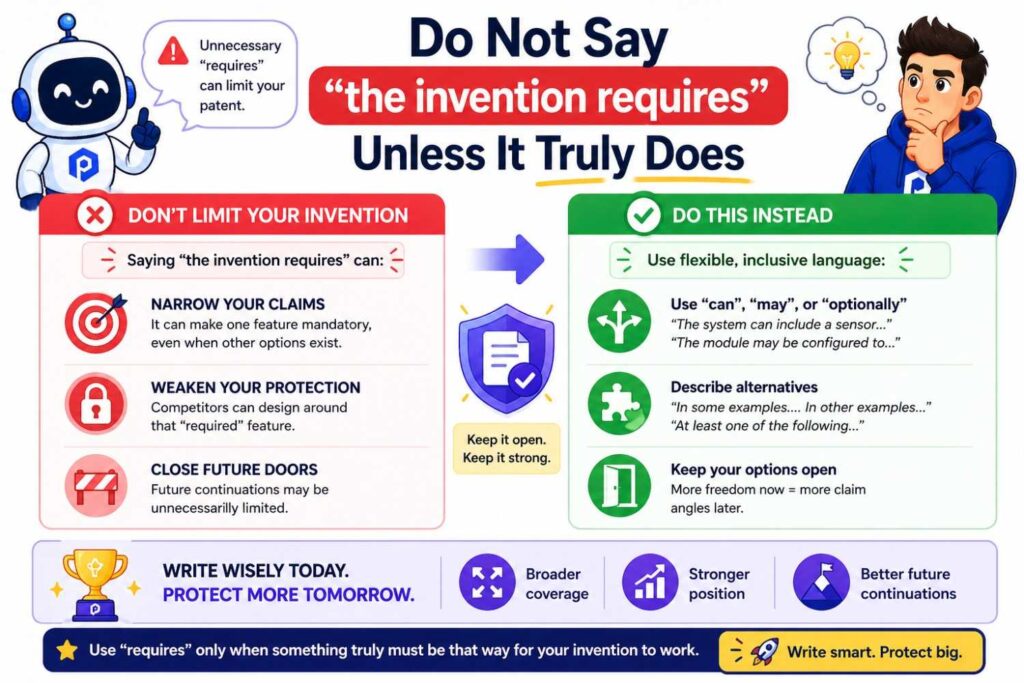
Words like “requires,” “must,” “always,” “necessary,” and “essential” should be used with care.
If a feature is truly required, fine. Say so.
But if it is only part of one example, use softer wording.
Use “may,” “can,” “in some examples,” “in one implementation,” or “optionally.”
For example:
Weak:
“The system must send every output to a reviewer.”
Better:
“In some examples, the system may send selected outputs to a reviewer.”
Weak:
“The invention always uses a neural network.”
Better:
“In some examples, the system may use a trained model, such as a neural network.”
Weak:
“The device requires a camera.”
Better:
“In some examples, the device may include a camera or another sensor.”
Future continuations need flexibility. Absolute words reduce flexibility.
Include alternatives for key parts
For each key part of the invention, ask what else could perform the same role.
If there is a reasonable substitute, describe it.
A camera may be replaced by lidar, radar, depth sensing, thermal imaging, or pressure sensing.
A cloud server may be replaced by an edge device, local server, mobile device, or on-prem system.
A neural network may be replaced by another model or rules engine.
A dashboard may be replaced by an API, report, message, or control signal.
A human reviewer may be replaced by an automated validation step.
A fixed threshold may be replaced by a learned or context-based threshold.
These alternatives are not filler. They are continuation support.
They help you file later claims that respond to the market and to competitors.
Describe combinations of features
A continuation may focus on a combination that was not claimed first.
For example, your first claims may cover risk scoring. Later, you may want claims around risk scoring plus confidence-based review plus feedback-based model updates.
The spec should support that chain.
Do not only list features separately. Explain how they can work together.
For example:
“In some examples, the system may generate a score and a confidence value for an output. When the confidence value satisfies a review condition, the system may route the output for review. A review result may be stored as feedback and used to update a model or threshold for later outputs.”
That single paragraph supports several future claim paths.
Another example:
“In some examples, the system may detect a condition, group related outputs, rank the grouped outputs, and create a task for a highest-ranked output.”
That supports grouping, ranking, and workflow claims.
Combinations are often where commercial value lives. Include them.
Describe ranges and examples carefully
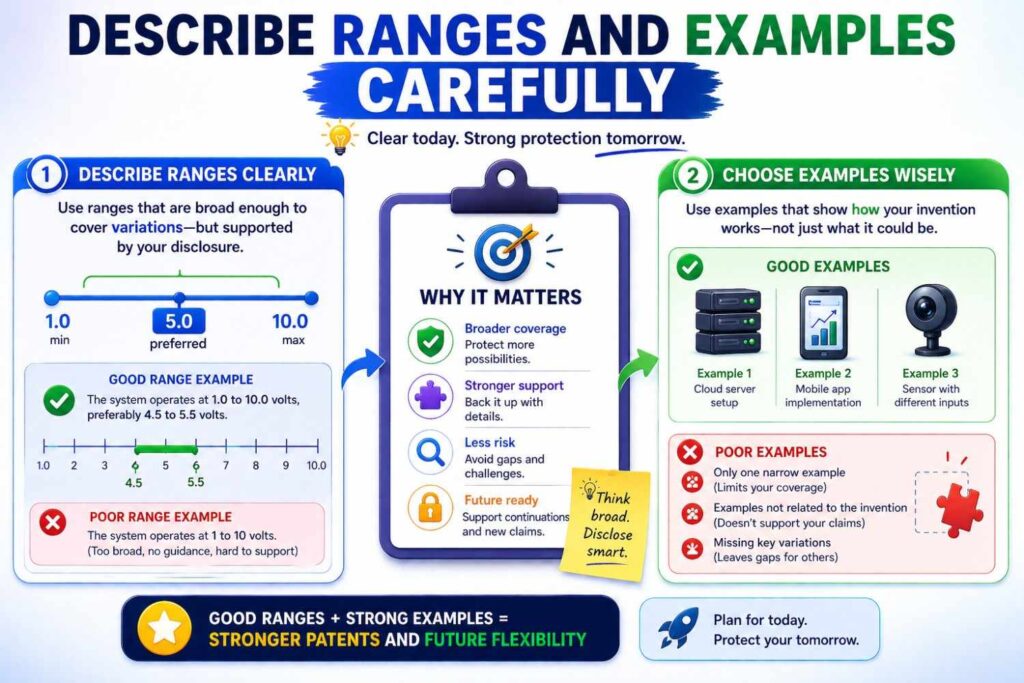
Numbers can help. But they can also narrow the spec.
If a number is only an example, make that clear.
For example:
“In one example, the threshold may be 0.8.”
But also say:
“The threshold may have another value and may be fixed, user-defined, learned, or adjusted over time.”
For hardware:
“In some examples, the layer may have a thickness between X and Y.”
But also explain:
“The thickness may be selected based on strength, heat transfer, flexibility, cost, or another design factor.”
For timing:
“In one example, the system may update the model every 24 hours.”
But also say:
“The update may occur after a time period, after a number of events, in response to user feedback, in response to a performance change, or on request.”
This keeps examples from becoming traps.
Describe materials by function
For physical inventions, material support can matter in future continuations.
Do not only name the prototype material unless it is central.
For example:
“The housing may include a material selected based on strength, weight, heat transfer, chemical resistance, flexibility, cost, or another factor.”
Then give examples:
“In some examples, the material may include metal, polymer, composite, ceramic, glass, rubber, silicone, or another material.”
If a material has a specific function, say it.
“The layer may include a conductive material.”
“The seal may include a flexible material that reduces fluid leakage.”
“The coating may include a material that reduces friction or repels liquid.”
This style supports future claims around function and material classes.
Describe sensors by what they detect
If your invention uses sensors, write beyond the first sensor type.
A continuation may later need to claim another sensor version.
For example:
“The system may receive sensor data representing motion, temperature, pressure, force, sound, light, position, chemical state, biological state, electrical state, or another condition.”
Then:
“The sensor data may be generated by a camera, microphone, accelerometer, gyroscope, temperature sensor, pressure sensor, force sensor, current sensor, voltage sensor, lidar sensor, radar sensor, chemical sensor, biosensor, or another sensor.”
Then connect it to the invention:
“In one example, the system may detect a machine condition based on vibration data and temperature data.”
This supports future sensor variations and sensor fusion claims.
Describe model options in AI specs
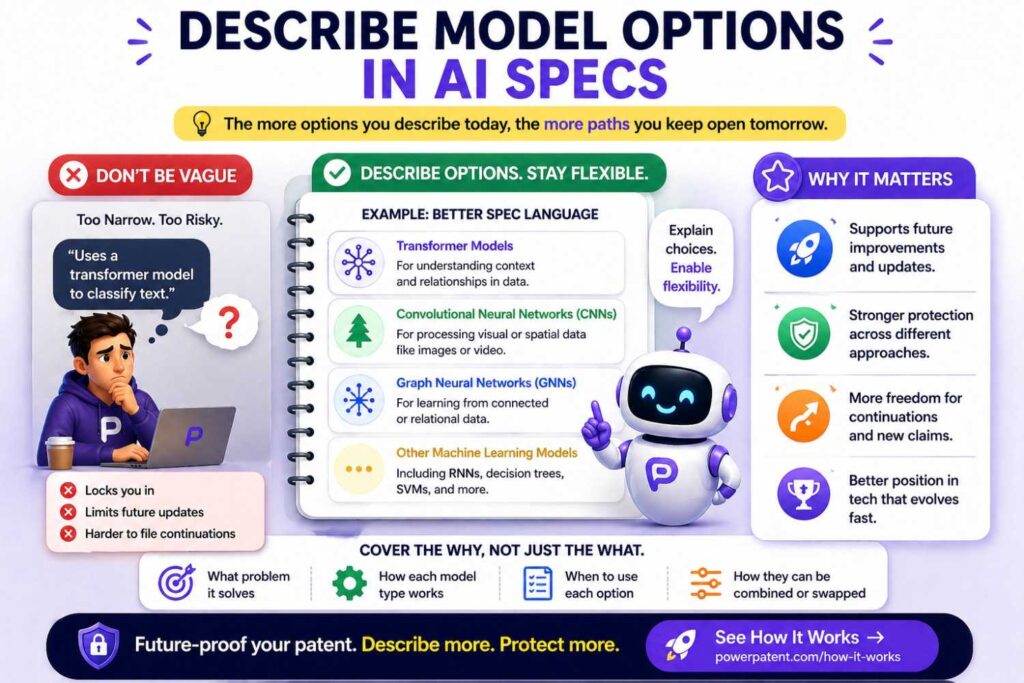
AI specs should be written with extra care because models change fast.
Do not lock the invention to one model unless the model type is the point.
A continuation-friendly AI spec may say:
“The system may use one or more models to generate, classify, rank, score, summarize, transform, retrieve, filter, or validate data.”
Then:
“The model may include a neural network, transformer model, language model, vision model, regression model, tree-based model, clustering model, rules-based model, statistical model, or another model.”
Then explain model inputs:
“The model input may include a task instruction, selected context, user data, sensor data, historical data, retrieved data, system rules, output format instructions, or other information.”
Then explain model outputs:
“The model output may include a prediction, classification, score, generated text, extracted value, ranked list, recommended action, explanation, or other result.”
This gives future AI continuation claims much more room.
Describe retrieval and context selection
For AI tools, the way a system selects context can be a core invention.
If relevant, describe it.
For example:
“In some examples, the system may select context data based on a query, user role, document type, time period, source reliability, similarity score, access permission, or prior user action.”
Then:
“The selected context data may be included in a model input, used to check a model output, used to generate an explanation, or used to rank candidate outputs.”
This can support future continuations around retrieval, grounding, prompt building, and output checking.
Do not reduce an AI invention to “send prompt to model.” Explain how the input is built and how the output is used.
Describe guardrails and validation
AI and automation tools often need guardrails.
These can support valuable future claims.
For example:
“In some examples, the system may validate an output before providing the output to a user or another system.”
Then:
“The validation may include checking the output against source data, comparing the output to a rule, detecting a conflict, checking a confidence value, verifying a required field, identifying unsafe content, or requesting review.”
Then:
“If the output fails validation, the system may revise the output, suppress the output, request more data, route the output for review, or generate a warning.”
That is rich continuation support.
Guardrails may become more important as your product enters regulated or enterprise markets.
Describe personalization and customer-specific settings
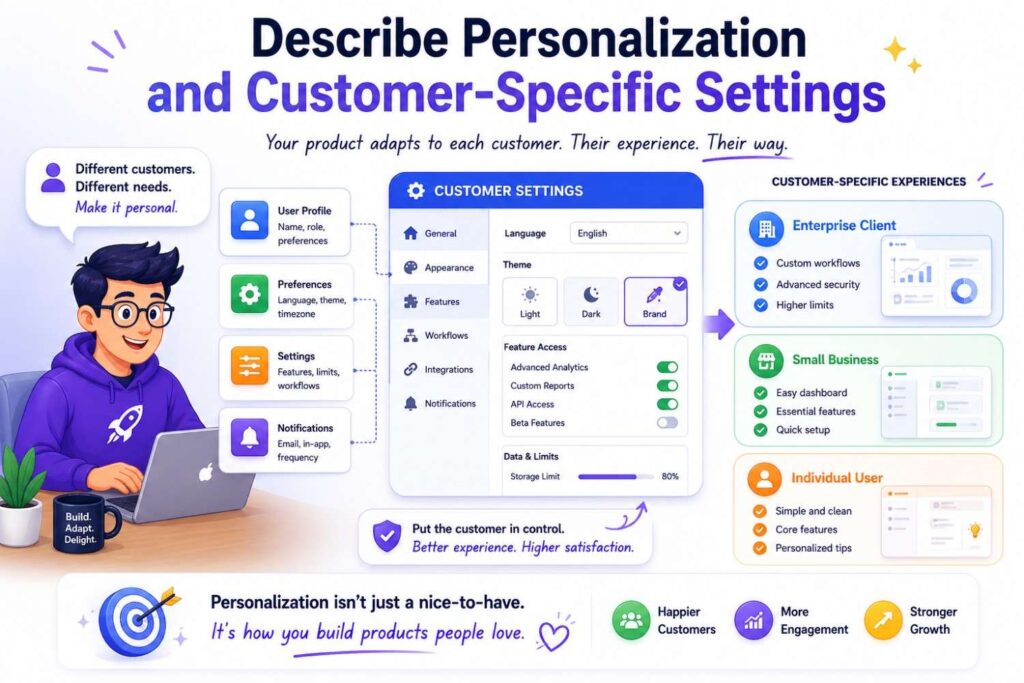
Many startups begin with one general product and later add customer-specific versions.
A spec can support this if it describes personalization.
For example:
“In some examples, the system may adjust a threshold, model, ranking rule, output format, alert channel, review rule, data source, or user interface based on user-specific, device-specific, site-specific, or organization-specific data.”
Then:
“The adjustment may be based on past behavior, user settings, operating conditions, risk level, data quality, or feedback history.”
This supports future continuations around customization.
It also reflects how enterprise products grow.
Describe permissions and roles
User roles can matter, especially in enterprise, health, finance, defense, developer tools, and industrial systems.
If relevant, include role-based behavior.
For example:
“In some examples, access to an output, input, explanation, review control, or system setting may be based on a user role or permission.”
Then:
“Different users may receive different outputs, different alert levels, different explanations, or different actions based on role.”
This may support future claims around controlled review, secure workflows, or role-based output.
Do not make a specific role required unless it is central.
Use broad terms like “user,” “operator,” “reviewer,” “administrator,” “technician,” “clinician,” or “system” as examples.
Describe audit records
Audit records can support future continuations and product trust.
A good spec may say:
“In some examples, the system may create an audit record. The audit record may include input data, processed data, output data, a confidence value, a model version, a rule version, a threshold, a user action, a review result, a time, a device identifier, or a destination.”
Then:
“The audit record may be used to review a decision, explain an output, train a model, detect an error, compare model versions, or support compliance with a recordkeeping process.”
This gives many future claim paths.
Audit features are often important after enterprise customers begin asking hard questions.
Capture them early if they fit the invention.
Describe explainability
Explainability is another area that may become valuable later.
For example:
“In some examples, the system may generate an explanation for an output.”
Then:
“The explanation may include a text summary, highlighted input data, ranked factors, a score breakdown, a rule trace, a source link, an example case, or another explanation form.”
Then:
“The explanation may be generated for all outputs, selected outputs, high-risk outputs, low-confidence outputs, or outputs requested by a user.”
This supports future continuations around explainable AI, decision support, and review workflows.
Even if explainability is not in the first product, it may become important as customers grow.
Describe data privacy options
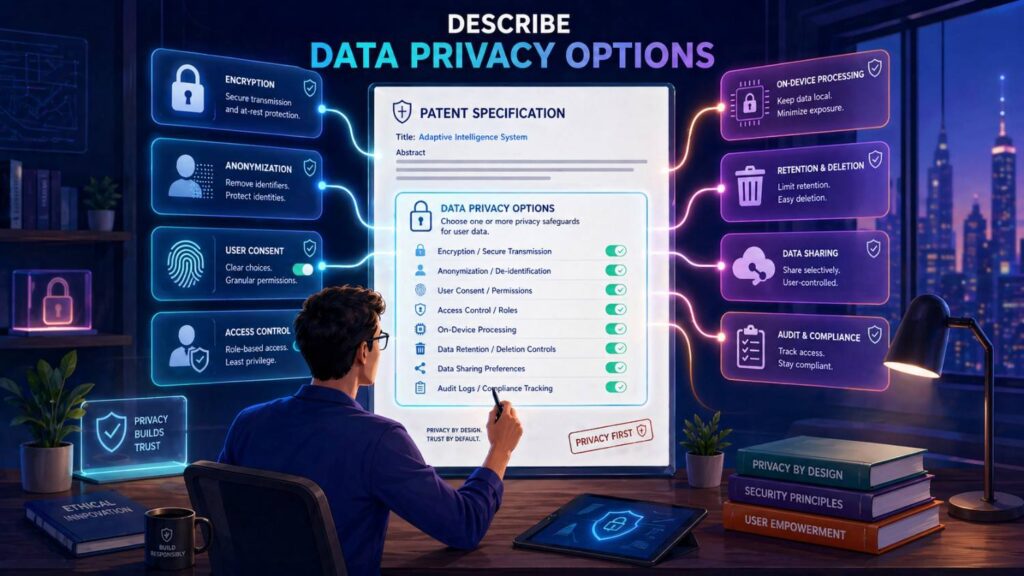
Privacy can become a major product feature later.
If your invention may process sensitive data, include privacy-supporting variants.
For example:
“In some examples, the system may mask, remove, encrypt, tokenize, summarize, or transform sensitive data before storing or sending the data.”
Another:
“In some examples, at least part of the processing may be performed locally to reduce transfer of sensitive data.”
Another:
“In some examples, access to stored data or outputs may be controlled based on permission, role, policy, device, location, or data type.”
These details can support future claims and help show that the system can work in serious settings.
Describe security options
Security features may also support future continuations.
For example:
“In some examples, the system may verify a user, device, software service, or data source before accepting input data or providing an output.”
Another:
“In some examples, the system may detect tampering, unusual access, unexpected data changes, or other security events.”
Another:
“In some examples, the system may encrypt stored data, encrypt transmitted data, sign an output, or verify a signature.”
Tie security features to the invention when possible.
Do not just add generic security words. Explain how the security feature helps the system work safely or reliably.
Describe updates over time
Many systems improve, adapt, or change.
Future continuations may focus on updates.
Describe what can be updated.
A model can be updated.
A rule can be updated.
A threshold can be updated.
A ranking can be updated.
A user setting can be updated.
A data source can be updated.
A workflow can be updated.
A device setting can be updated.
Then describe update triggers.
Updates may happen after feedback, after a time period, after enough events, after performance drops, after a new data source is added, after user approval, or when an error is detected.
For example:
“In some examples, the system may update a model, threshold, rule, ranking, or output format based on feedback, performance data, observed outcomes, user settings, or system state.”
This can support many continuation paths.
Describe manufacturing or setup methods when relevant
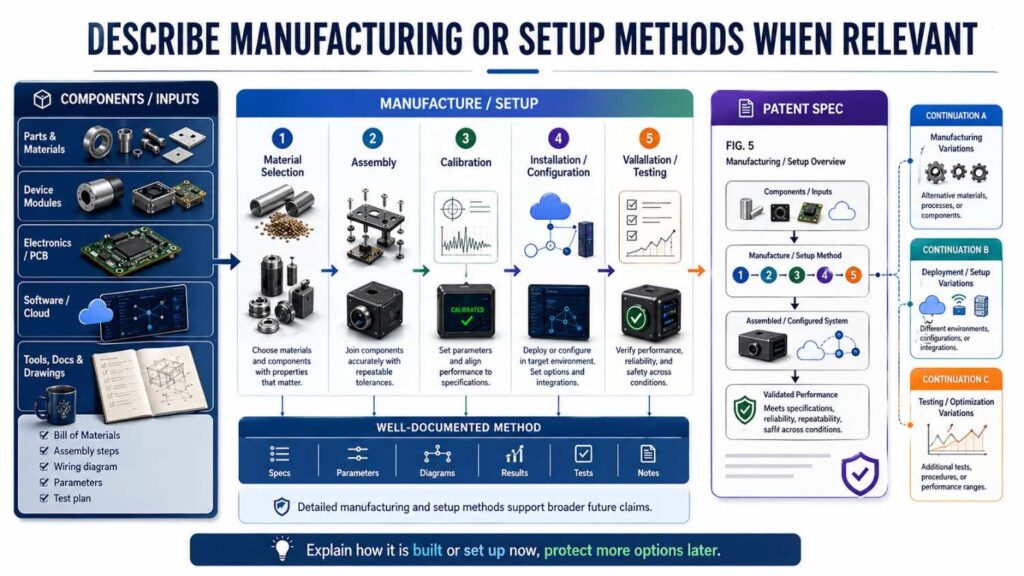
For hardware and deep tech inventions, future continuations may focus on how the device is made, configured, calibrated, or installed.
If relevant, include those methods.
For example:
“In some examples, the device may be calibrated by collecting reference data, comparing the reference data to a target value, and adjusting a sensor setting based on the comparison.”
Or:
“In some examples, the system may be configured for a site by receiving site data, selecting a model or threshold based on the site data, and storing the selected model or threshold for later use.”
Setup and calibration are often commercially important. They may also be copied by competitors.
Do not leave them out if they matter.
Describe use cases without limiting the invention
Use cases help show value. But do not make one use case the whole invention unless intended.
For example:
“In some examples, the system may be used in a warehouse environment.”
Then:
“In other examples, the system may be used in a factory, vehicle, store, hospital, lab, data center, farm, construction site, or another environment.”
Only include environments that make sense.
Use cases can support future continuations if your company expands into new markets.
But make clear they are examples.
Describe industry-specific versions carefully
Sometimes the invention is industry-specific. Sometimes it is not.
If your system can apply across industries, do not lock it to one.
For example, a risk ranking system may apply to cybersecurity, finance, health, manufacturing, logistics, or energy. If the core technique is general, the spec can include multiple industry examples.
But if the invention depends on a medical workflow, say so.
The key is honesty and strategy.
Do not pretend the invention works everywhere if it does not. But do not shrink it to one field if the technical idea is broader.
Include enough detail for each future path
It is not enough to mention a feature once if you may want to claim it later.
A future continuation needs support.
If you may later claim a feedback loop, give details.
If you may later claim edge processing, give details.
If you may later claim sensor fusion, give details.
If you may later claim a review workflow, give details.
If you may later claim a model update, give details.
A single passing phrase may not be enough.
For example, saying “the system may use feedback” is thin.
Better:
“The feedback may be received from a user action, device response, later measurement, transaction result, or review decision. The feedback may indicate whether an output was accepted, rejected, modified, or followed by a target result. The system may use the feedback to update a model, threshold, rule, ranking, or training record.”
That is far stronger.
Avoid buzzword stuffing
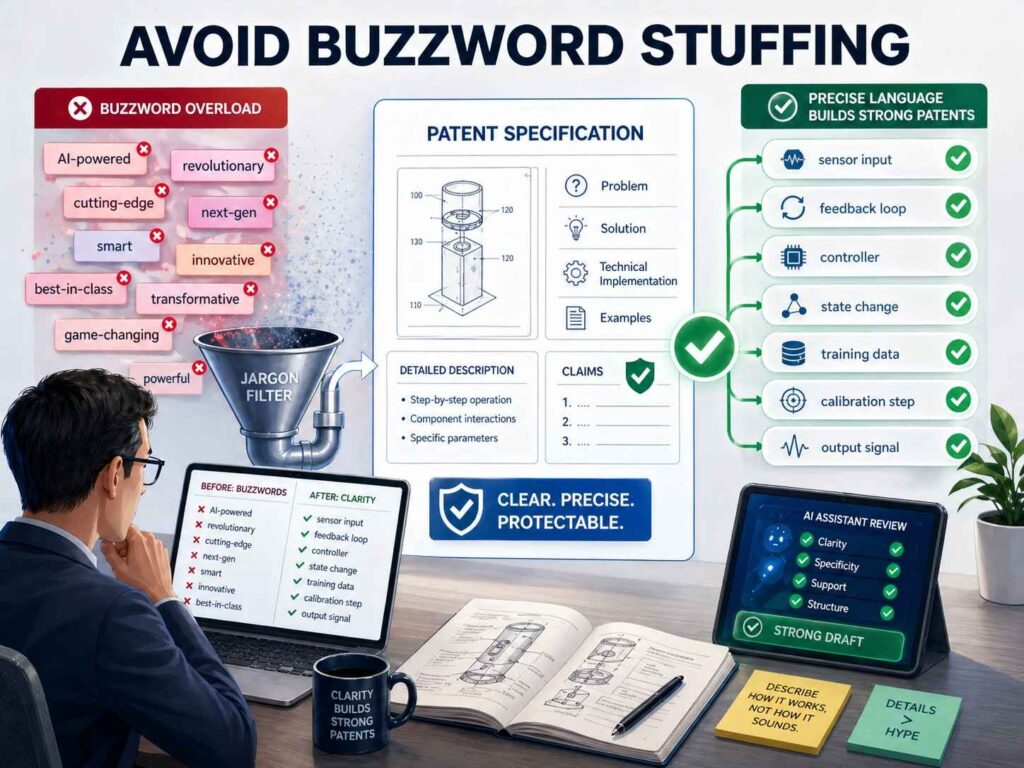
A spec that supports continuations is detailed, not bloated.
Adding buzzwords does not help.
Do not throw in AI, blockchain, cloud, IoT, metaverse, analytics, digital twin, and automation unless they are truly part of the invention.
A patent reviewer, investor, or future buyer will not be impressed by a word cloud.
They will look for clear technical support.
If a digital twin matters, explain what data forms the twin, how it is updated, and how it affects outputs.
If blockchain matters, explain what record is stored and why a ledger is useful.
If analytics matter, explain what is measured and how it changes system behavior.
If IoT matters, explain the devices, data, network, and control flow.
Useful detail beats buzzwords every time.
Keep the spec readable
A continuation-friendly spec may be long, but it should still be clear.
Use simple names. Use direct sentences. Use examples. Group related ideas. Do not make every sentence a maze.
A founder should be able to read the spec and recognize the invention.
An engineer should be able to catch errors.
A patent attorney should be able to build claim sets from it.
A future investor or acquirer should be able to see that the filing has depth.
Readable does not mean casual. It means clear.
Clear specs are easier to use later.
Build a “claim bank” inside the spec
You do not need to call it a claim bank, but the idea is useful.
A continuation-friendly spec should contain many claim-ready ideas.
For example, each of these may become a future claim path:
A special way of receiving data.
A special way of cleaning data.
A special way of selecting context.
A special way of scoring risk.
A special way of ranking actions.
A special way of routing outputs for review.
A special way of using feedback.
A special way of updating a model.
A special way of running locally and remotely.
A special way of handling missing data.
A special way of explaining an output.
A special way of creating an audit record.
These ideas should be described clearly enough that claims can be drafted later.
That is what makes the first spec valuable for continuations.
Write with prosecution in mind
Patent review can change the path.
The examiner may find prior art. You may need to amend claims. You may choose to file a continuation with different claims.
A good spec gives you options during that process.
If the spec includes only one version, your options may be limited.
If the spec includes rich variants, combinations, and fallback details, your attorney can respond with more flexibility.
For example, if a broad claim faces prior art, you may move to a narrower feature such as confidence-based review, sensor fusion, adaptive thresholds, or feedback-based updating.
But only if the spec supports those features.
This is why strong specs are not just about filing day. They are about the whole life of the patent family.
Write with product pivots in mind
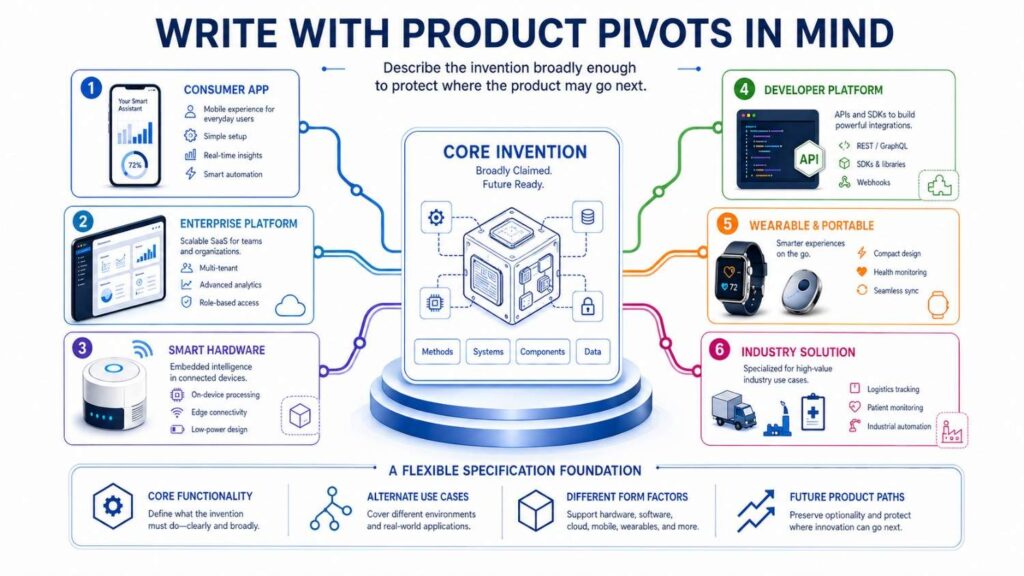
Startups pivot.
Sometimes the core technology stays the same while the customer changes.
A tool built for factories may move into logistics.
A health workflow may become a general compliance workflow.
A developer tool may become an enterprise security tool.
A robotics sensor method may move into vehicles.
A continuation-friendly spec can help if it describes the invention at the right level.
If the first spec is tied too tightly to one market, future claims may be harder.
If it describes the technical function and gives multiple use cases, the company may have more room.
This is not about hiding the real product. It is about not mistaking the first market for the full invention.
Write with acquisition diligence in mind
A future buyer may look at your patent family and ask:
Does this protect the core technology?
Can competitors design around it?
Does the spec support future claims?
Does it cover the product roadmap?
Does it cover the most valuable workflows?
Does it cover the technical moat?
A thin spec may not inspire confidence.
A rich spec can show that the company was thoughtful early.
It can show that the patent family has room to grow.
For startups, this can matter a lot.
Patents are not only defensive tools. They can be part of the story of why your technology is hard to copy.
Do not let speed destroy support
Fast filing can be important.
But rushed filing can create weak support.
The best approach is not to slow everything down. It is to capture better invention detail faster.
That is why PowerPatent exists. It helps founders and engineers organize the technical story, capture variants and future paths, and work with real patent attorneys without getting stuck in old-school delays.
You can see how PowerPatent works here: https://powerpatent.com/how-it-works
The founder’s role in a continuation-friendly spec
Founders should not try to do everything alone.
But founders can make the patent process much stronger by giving better input.
Tell your patent team what is core.
Tell them what is optional.
Tell them what may change.
Tell them what competitors may copy.
Tell them what customers are asking for.
Tell them what is on the roadmap.
Tell them what failed in prototypes.
Tell them what is hard to build.
Tell them what is not obvious from the product screen.
Those details help shape a spec that supports future continuations.
A patent team cannot include what they do not know.
The engineer’s role
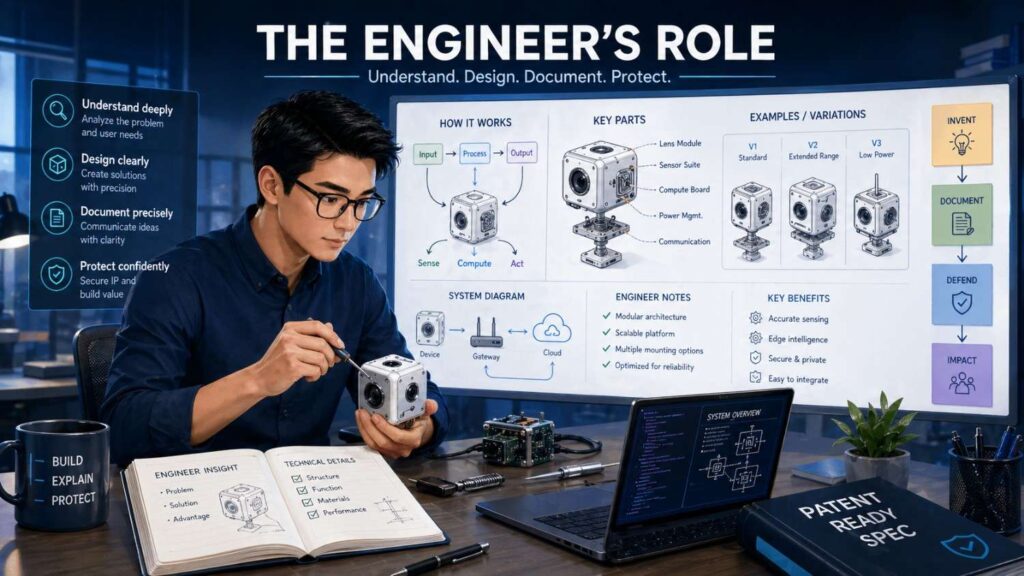
Engineers are often the best source of continuation support.
They know the alternate designs.
They know what can be swapped.
They know what is hard.
They know what was tested and rejected.
They know where the system may go next.
An engineer may say:
“The dashboard is not important. The real trick is how we select which data to send to the model.”
Or:
“The model can change. What matters is the feedback loop.”
Or:
“We use camera data now, but the same logic works with depth data.”
Or:
“This runs in the cloud now, but we already designed an edge version.”
Those comments can be patent gold.
A strong process makes it easy for engineers to share that knowledge without pulling them into endless legal meetings.
What to give your patent team
A pitch deck is not enough.
A good patent team should see system diagrams, product flows, model notes, architecture notes, data examples, screenshots, API notes, hardware drawings, prototype photos, test results, roadmap notes, and competitor concerns.
They should also know which parts are required and which are not.
For each feature, it helps to say:
This is core.
This is one example.
This may change.
This is planned.
This is optional.
This was tested but not used.
This is a customer-specific version.
This is a likely competitor workaround.
Those labels can lead to a much better spec.
Use examples from the real build
Future continuations need broad support, but real examples matter.
Do not write only in abstract terms.
Include real product examples.
If your system uses machine data, describe a machine data example.
If your AI tool reviews contracts, describe the document flow.
If your device senses pressure, describe how pressure data is captured and used.
If your system ranks alerts, describe what an alert may contain and how it may be ranked.
Concrete examples show possession of the invention. They also help readers understand it.
The best specs move between broad language and real examples.
That balance is what makes them strong.
Include negative and edge cases
Edge cases can support future continuations.
What happens when data is missing?
What happens when the model is uncertain?
What happens when two outputs conflict?
What happens when a user rejects a result?
What happens when a sensor fails?
What happens when the network is down?
What happens when an output is high-risk?
What happens when a rule changes?
These cases often lead to valuable claim ideas.
For example, a future continuation may claim a method for handling low-confidence model outputs. Or a method for using fallback data when a sensor fails. Or a method for resolving conflicting outputs.
If the spec ignores edge cases, those future claims may be harder.
Include system states
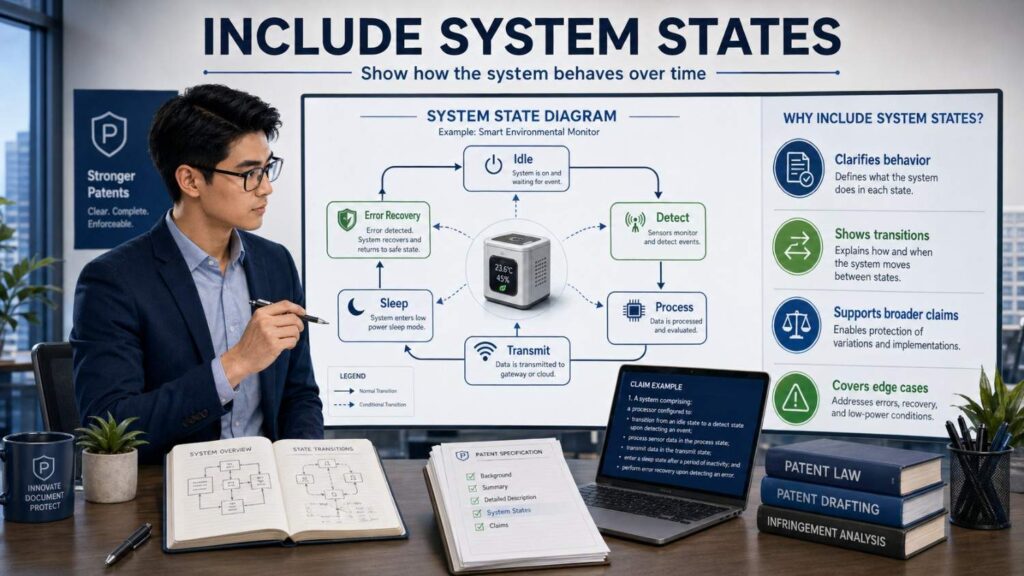
Systems often behave differently in different states.
A device may have a normal mode, low-power mode, calibration mode, fault mode, offline mode, update mode, or safety mode.
A software system may have training mode, inference mode, review mode, admin mode, batch mode, real-time mode, or fallback mode.
If states matter, describe them.
For example:
“In some examples, the system may operate in a normal mode and a fallback mode. In the normal mode, the system may use a remote model. In the fallback mode, the system may use a local rule set when the remote model is unavailable.”
This kind of detail can support future continuation claims around modes.
Include control loops where relevant
For robotics, hardware, industrial systems, energy systems, and many AI systems, control loops can matter.
A control loop may sense, decide, act, measure, and adjust.
If your invention includes control, describe the loop.
For example:
“The system may receive sensor data, generate a control output based on the sensor data, apply the control output to a device, receive updated sensor data after the control output, and adjust a later control output based on the updated sensor data.”
That supports future claims around closed-loop control.
Even if the first claims do not focus on control, later continuations might.
Include ranking and selection logic
Ranking and selection often become valuable later.
If your system chooses among options, describe how.
For example:
“The system may generate multiple candidate actions and rank the candidate actions based on one or more factors.”
Then:
“The factors may include risk, confidence, cost, time, expected benefit, resource availability, user preference, safety level, or system state.”
Then:
“The system may select a highest-ranked action, present multiple ranked actions to a user, or perform an action after approval.”
This supports claims around ranking, action selection, and decision support.
Include data structures if they matter
Sometimes a special data structure supports future claims.
For example, a graph, table, vector store, event log, state map, index, queue, feature set, or knowledge base may matter.
If so, describe it.
For example:
“In some examples, the system may store relationships between items in a graph. The graph may include nodes representing items and edges representing relationships between the items.”
Then explain use:
“The system may use the graph to select context data, rank outputs, detect conflicts, or generate an explanation.”
This can support future continuations around graph-based processing.
Do not add data structures just to sound technical. Include them when they are part of the invention.
Include user actions
User actions can matter, especially in tools with review, feedback, editing, or approval.
Describe possible user actions.
For example:
“A user may accept, reject, edit, approve, label, comment on, rank, assign, share, or ignore an output.”
Then explain how the system uses actions:
“The system may store the user action, update a status, change a future ranking, create feedback, update a model, or trigger a workflow based on the user action.”
This supports future continuation claims around human-in-the-loop systems.
Include machine actions
Do not only describe what users do.
Describe what machines do.
For example:
“The output may cause a device to change a setting, start an operation, stop an operation, enter a safety mode, request service, change a route, adjust power use, or send data to another device.”
Machine actions can be more valuable than user alerts.
If your invention can control systems, make that clear.
Future continuations may focus on automatic action, not just recommendation.
Include integration flows
If integrations are part of the invention family, describe them by type.
For example:
“The system may receive data from a monitoring system, source code repository, electronic record system, customer relationship system, inventory system, payment system, identity system, or another external system.”
Then:
“The system may send an output to a workflow system, messaging system, control system, ticketing system, reporting system, or another external system.”
This gives support for integration claims without limiting the spec to named vendors.
Integrations are often where products become sticky. They may also be where competitors copy workflows.
Include examples of what can be omitted
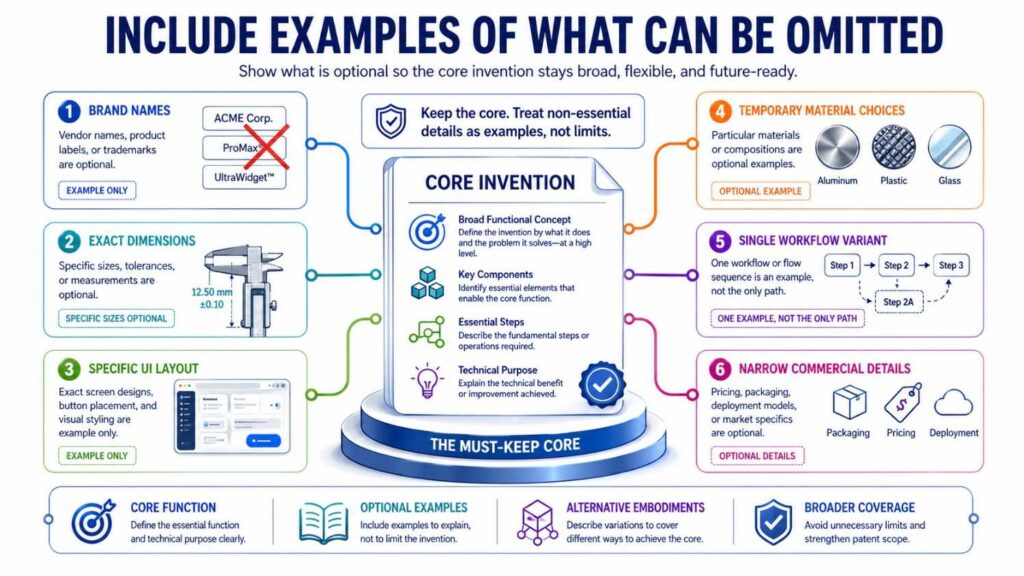
To support continuations and avoid narrow readings, say that some parts may be omitted.
For example:
“Although the example system includes a user interface, other examples may omit the user interface and provide outputs through an API.”
“Although the example process includes a human review step, the review step may be omitted or replaced with an automated check.”
“Although the example device includes a battery, other examples may receive power from an external source.”
This helps make clear that the figures and examples are not required in every version.
Include examples of combined and separated parts
A continuation-friendly spec should not freeze component boundaries.
For example:
“Although the data collector, scoring engine, and alert manager are shown as separate components, two or more of these components may be combined. A single component may also be divided into multiple components.”
This is especially useful in software.
In hardware, you may say:
“Although the sensor and processor are shown as separate parts, they may be integrated into a common package or placed in separate housings.”
This supports future product redesigns and continuation claims.
Include multiple levels of detail
A spec should include broad, middle, and narrow detail.
Broad:
“The system generates an output based on input data.”
Middle:
“The system generates a risk score based on sensor data and historical event data.”
Narrow:
“In one example, the system generates a machine failure risk score based on vibration data collected over a time window and maintenance records for similar machines.”
This layered style supports multiple continuation paths.
If you only write broad language, the spec may feel unsupported.
If you only write narrow examples, the spec may be too limited.
Use both.
Be honest about what is speculative
It is fine to include future variants that are part of the invention family. But do not add unsupported fantasy.
A good spec should be credible.
If a future version is planned and technically reasonable, include it.
If an alternative is known to work or likely to work, include it.
If a variant is pure buzzword guessing, leave it out.
Continuation support works best when the spec shows real technical understanding.
The goal is not to write the longest possible document. The goal is to write the most useful one.
Avoid contradictions
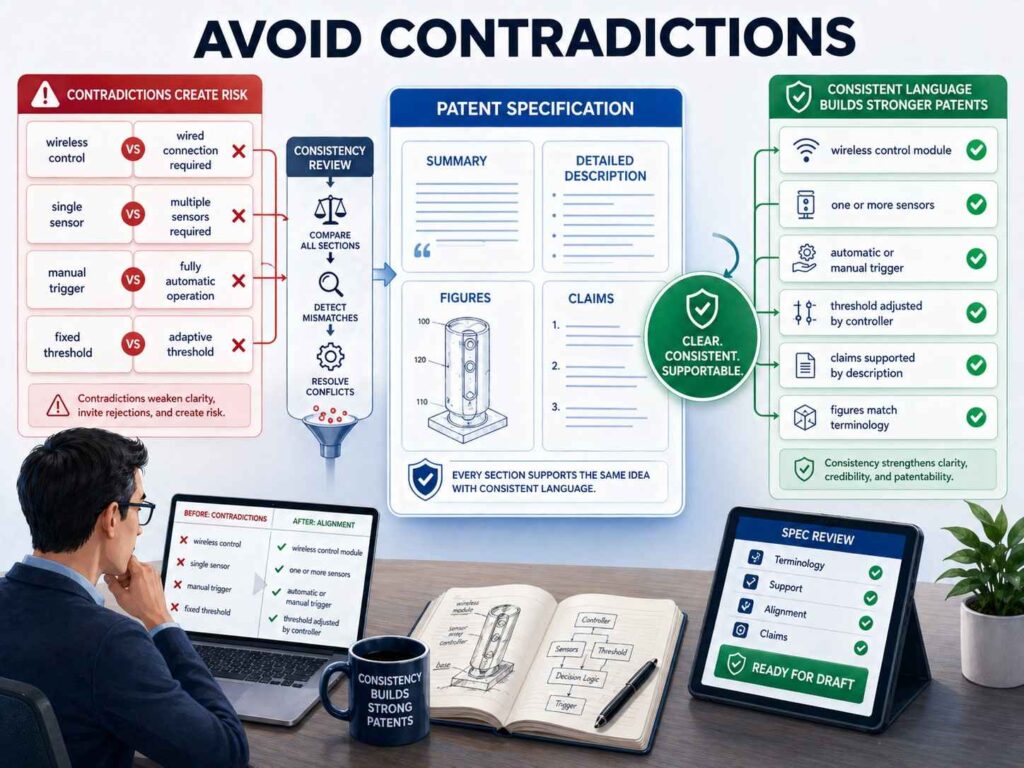
A rich spec may include many options. That is fine.
But it should not contradict itself in confusing ways.
If one section says all processing is cloud-based, another should not say processing may be local unless it is clear these are different examples.
Use clear phrasing:
“In some examples…”
“In other examples…”
“In one implementation…”
“Alternatively…”
“Although…”
This keeps variants organized.
A continuation-friendly spec can be flexible without being messy.
Use consistent terms
Consistent terms help future claims.
If you call something a “risk score” in one section, avoid calling the same thing a “threat number,” “danger value,” and “priority index” unless those are meant to be different.
Use one main term, then explain that it may take different forms.
For example:
“The risk score may include a number, label, class, range, probability, or other risk measure.”
This gives breadth while keeping language clean.
Inconsistent terms can make continuation drafting harder later.
Make sure the spec supports claim language
A future continuation claim may need words that are already supported in the spec.
If you may want to claim “routing selected outputs for review,” the spec should use and explain that idea.
If you may want to claim “adjusting a threshold based on feedback,” the spec should describe it.
If you may want to claim “processing locally when a network link is unavailable,” the spec should teach it.
This is why the spec should be written with possible future claims in mind.
Not all possible claims need to be filed on day one. But the support should be there.
Do not leave the best details in engineer notes only
Many valuable details stay hidden in internal docs.
A Slack thread explains why the model works.
A design doc explains the fallback mode.
A notebook shows the preprocessing trick.
A roadmap doc shows the edge version.
A test report shows why one threshold update works better.
A customer email reveals a key workflow.
If these details are not shared with the patent team, they may not make it into the spec.
And if they are not in the spec, they may not support future continuations.
Before filing, collect the key technical details from the team.
PowerPatent helps organize invention capture so these details do not get lost. See how it works here: https://powerpatent.com/how-it-works
A practical drafting map
A continuation-friendly spec can be built around a simple map.
First, explain the technical problem.
Then explain the broad solution.
Then explain the system parts.
Then explain the input data.
Then explain preprocessing.
Then explain the main processing.
Then explain outputs and actions.
Then explain optional review, feedback, updates, fallback, deployment, security, privacy, and integrations.
Then explain examples and variations.
Then explain drawings and workflows.
This structure keeps the spec clear.
It also creates support for many future claim sets.
Example: weak spec support
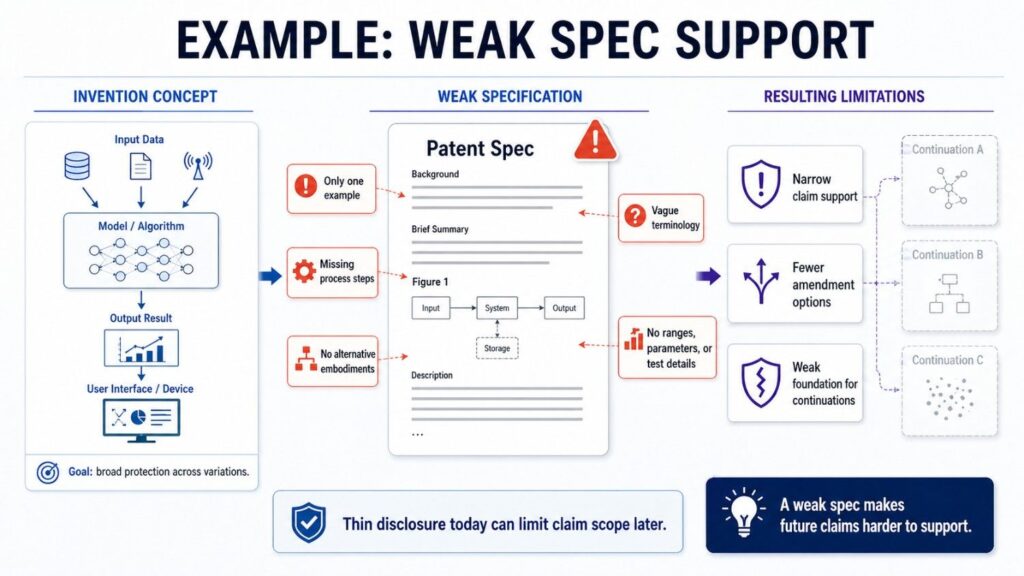
Here is a weak version:
“The system is a mobile app that uses AI to inspect photos of factory equipment and alerts a manager when maintenance is needed.”
This is too thin.
It may not support many continuations.
It is tied to a mobile app, photos, factory equipment, alerts, and a manager. It does not explain data handling, model use, scoring, confidence, review, feedback, fallback, deployment, or other outputs.
Now compare a stronger version.
“This disclosure describes systems and methods for detecting a maintenance condition based on equipment data. The equipment data may include image data, audio data, vibration data, temperature data, pressure data, electrical data, maintenance records, usage records, or other data related to equipment operation.
The system may process the equipment data to detect a pattern that indicates a maintenance condition, generate a maintenance output, and provide the output to a user or another system. In some examples, the output may include a score, alert, ranked list, suggested action, repair task, control signal, or report. In some examples, the system may generate a confidence value, route selected outputs for review, update a model or rule based on feedback, or use a fallback process when data is missing or a network is unavailable.”
This version supports many more future continuations.
You can still include the mobile photo example later. But the spec is not trapped by it.
Example: stronger continuation support for AI
Suppose the product is an AI tool that helps developers find risky code changes.
A thin spec may say:
“The system uses AI to review pull requests and warn developers about bugs.”
A continuation-friendly spec would go deeper.
It may explain that the system receives code change data, repository history, test results, build logs, issue data, ownership data, and user comments. It may explain that the system selects context from the repository, creates a model input, generates a risk output, ranks risky files, provides explanations, routes high-risk changes for review, receives developer feedback, and updates a rule or model based on the feedback.
It may explain that the output can be shown in a pull request, sent through an API, posted in a messaging tool, added to a ticket, or used to trigger a test.
It may explain that review can be human or automated.
It may explain that the model may be a language model, code model, rules engine, or hybrid process.
It may explain that confidence may control whether the output is shown, hidden, escalated, or checked.
That spec gives the startup many continuation options.
One continuation could claim context selection.
Another could claim risk ranking.
Another could claim feedback-based update.
Another could claim test triggering.
Another could claim explanation generation.
All from the same original support.
Example: stronger continuation support for hardware
Suppose the product is a smart sensor mount for drones.
A weak spec may say:
“The mount holds a camera on a drone and reduces vibration.”
A stronger spec may explain the structure, materials, connection points, damping elements, sensor types, orientation options, calibration, control signals, replacement process, and how vibration is measured.
It may say the sensor can be a camera, thermal sensor, lidar sensor, radar sensor, chemical sensor, or other sensor.
It may explain that the damping element may be rubber, silicone, spring, fluid, foam, magnetic coupling, or another vibration-reducing structure.
It may explain that the mount can attach to a drone, robot, vehicle, fixed pole, or other platform.
It may explain that the system may adjust sensor operation based on detected vibration.
Now future continuations can target the mount structure, damping method, sensor calibration, control loop, replaceable sensor module, or platform variants.
That is far stronger than one narrow product description.
Example: stronger continuation support for medical software
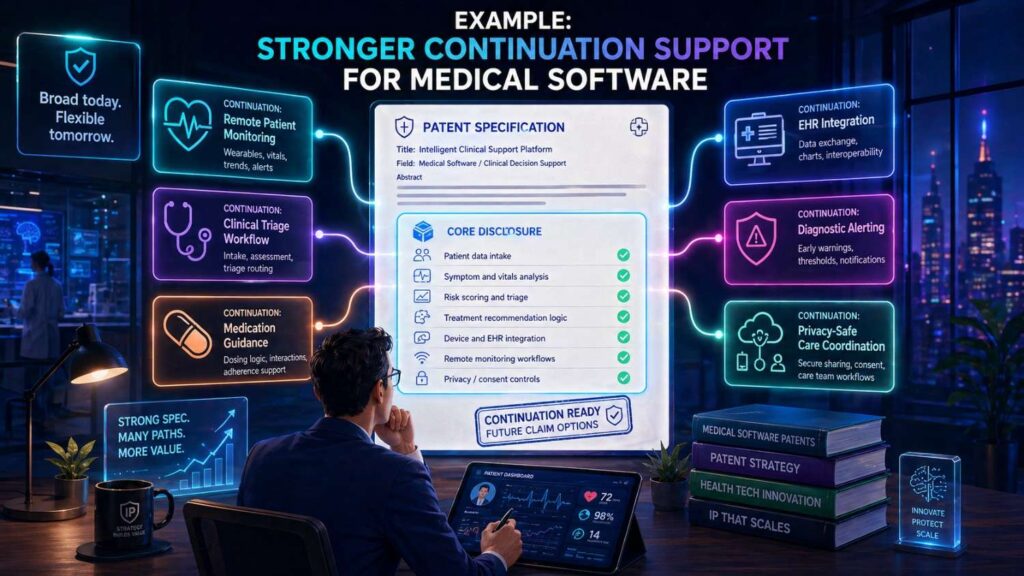
Suppose a startup builds software that flags patient risk.
A thin spec may say:
“The system shows patient risk on a doctor dashboard.”
A stronger spec may say the system receives patient data from one or more sources, detects changes over time, generates a risk score, generates a confidence value, ranks patients, routes selected patients for review, explains key factors, stores an audit record, and updates thresholds based on outcomes or clinician feedback.
It may explain that outputs can go to a dashboard, electronic record, message, API, care workflow, or report.
It may explain that different thresholds can apply by patient group, care setting, time period, or data quality.
It may explain that sensitive data can be masked or processed locally.
This supports future continuations around ranking, review, explainability, audit logs, threshold updates, and privacy-preserving processing.
Why attorney oversight matters
A continuation-friendly spec is not just a long technical write-up.
It needs legal judgment.
The spec must support future claims without creating unnecessary limits. It must describe enough detail without turning every example into a requirement. It must be broad but credible. It must match the figures. It must avoid harmful language. It must support the claim strategy.
This is why PowerPatent combines smart software with real patent attorney oversight.
The software helps founders and engineers capture invention details quickly.
The attorneys help shape those details into a patent filing that can support stronger protection.
That blend matters, especially for startups that need speed and quality at the same time.
Explore PowerPatent here: https://powerpatent.com/how-it-works
The “future claim” test
Before filing, ask this question:
What might we want to claim in two years?
Not every answer will go into the claims today. But the spec should support the important ones.
You may want claims around a new workflow.
A data source.
A model update.
An edge version.
A feedback loop.
A review step.
A safety check.
A control action.
A customer-specific setting.
A sensor combination.
A ranking process.
A fallback mode.
If those are likely and tied to the invention, describe them.
A future continuation is much easier when the first spec already planted the seeds.
The “competitor workaround” test
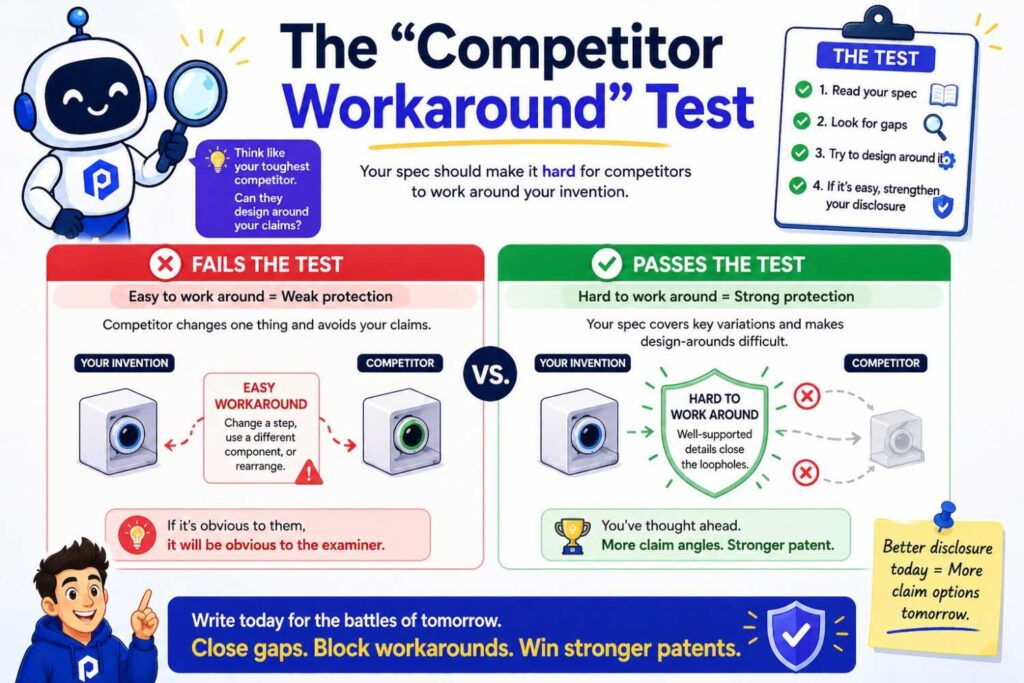
Ask how a competitor might copy your value while changing details.
Then check whether the spec covers those changes.
Could they avoid the patent by changing the interface?
Could they use a different model?
Could they run locally instead of in the cloud?
Could they use a different sensor?
Could they use a different threshold?
Could they output to a machine instead of a user?
Could they replace human review with an automated check?
Could they skip one optional feature?
If the answer is yes, the spec may need more variants.
This test helps you write for the real world.
The “roadmap” test
Compare the spec to the roadmap.
If the roadmap includes features that grow naturally from the invention, make sure the spec supports them.
A roadmap is not just a product plan. It can be a source of continuation support.
The first filing should not only protect what is live. It should also support where the invention is going.
This is especially true if you are about to raise money, launch publicly, publish papers, or speak with partners.
The “remove one part” test
Take a feature out of the product.
Does the invention still work?
If yes, that feature should probably be optional in the spec.
Remove the dashboard.
Remove the cloud server.
Remove the exact model.
Remove the specific sensor.
Remove the human review step.
Remove the fixed threshold.
Remove the named integration.
If the core still works, the spec should not make that feature required.
This helps keep future continuation options open.
The “swap one part” test
Now swap one part.
Replace camera with lidar.
Replace cloud with edge.
Replace email with API.
Replace neural network with rules.
Replace human review with automated validation.
Replace fixed threshold with learned threshold.
If the swapped version is realistic, describe it.
This supports future claims and makes design-arounds harder.
Common phrases that help
Certain phrases can help keep a spec flexible.
“in some examples”
“in one implementation”
“may include”
“may be”
“one or more”
“at least one”
“or another”
“or a combination thereof”
“locally, remotely, or both”
“before, after, or at least partly in parallel”
“more, fewer, or different components”
“may be omitted”
“may be combined or separated”
These phrases are not magic. They must be used with real substance. But they help show that examples are examples, not limits.
Common phrases to avoid
Some phrases can hurt flexibility.
“the invention is”
“must”
“always”
“required”
“necessary”
“essential”
“all”
“each”
“only”
“the present invention requires”
Use these only when they are true and intended.
A single careless word can make a future continuation harder.
Do not make the spec unreadable
Some people think a patent spec must sound complex to be strong.
That is wrong.
A strong spec can use simple words.
The key is detail, not fancy language.
A clear sentence that explains how data is received, processed, scored, reviewed, and used is better than a dense sentence full of abstract terms.
Founders should be able to understand their own patent filings.
Engineers should be able to check them.
Investors should be able to see the moat.
Clarity is a strength.
A continuation-friendly spec is an asset
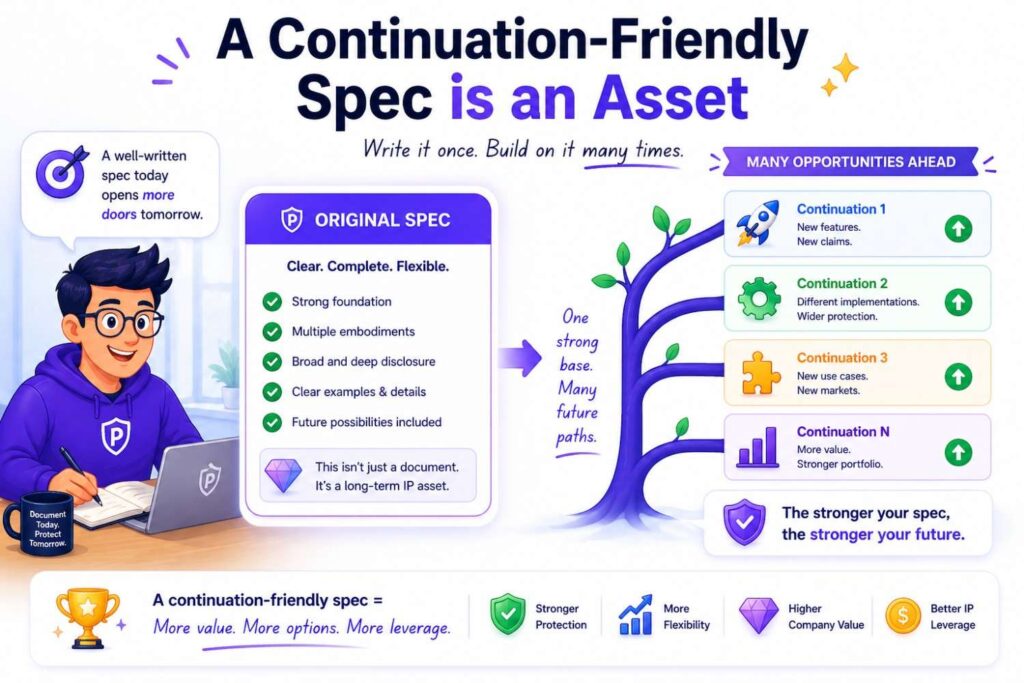
A patent family can become more valuable over time.
The first application may lead to one patent. Continuations may lead to more patents covering different parts of the platform.
This can help as the company grows.
You may file claims around the first product.
Then later claims around new customer workflows.
Then claims around automation.
Then claims around model updates.
Then claims around edge deployment.
Then claims around competitor design-arounds.
But this only works if the first spec supports those later claims.
That is why the original spec is so important.
PowerPatent’s view
For startups, patents should not be slow, confusing, or disconnected from the product.
They should protect the technical value the team is building.
They should give founders control.
They should move fast enough to match startup life.
They should be backed by real patent attorneys.
And they should be written with the future in mind.
PowerPatent helps founders turn code, models, diagrams, notes, and invention details into stronger patent filings. The platform is built to capture not just the first version, but the invention paths that may support future continuations.
See how PowerPatent works here: https://powerpatent.com/how-it-works
Final thoughts
A patent spec that supports future continuations is not just a description of today’s product.
It is a foundation.
It should explain the core invention, show real examples, describe useful variants, support future claim angles, and leave room for the product to grow.
The best specs are broad but not vague. Detailed but not cluttered. Formal but still clear. Technical but still readable.
They describe inputs, processing, outputs, feedback, review, deployment, fallback modes, security, privacy, integrations, and future versions where those details matter.
They avoid turning optional features into required limits.
They give your future patent family room to grow.
For a startup, that room can be very valuable.
Your product will change. Your market will change. Your competitors will react. Your patent strategy should be ready.
If you are building something technical and want a smarter way to protect it from the start, PowerPatent can help.
Learn how it works here: https://powerpatent.com/how-it-works
Leave a Reply