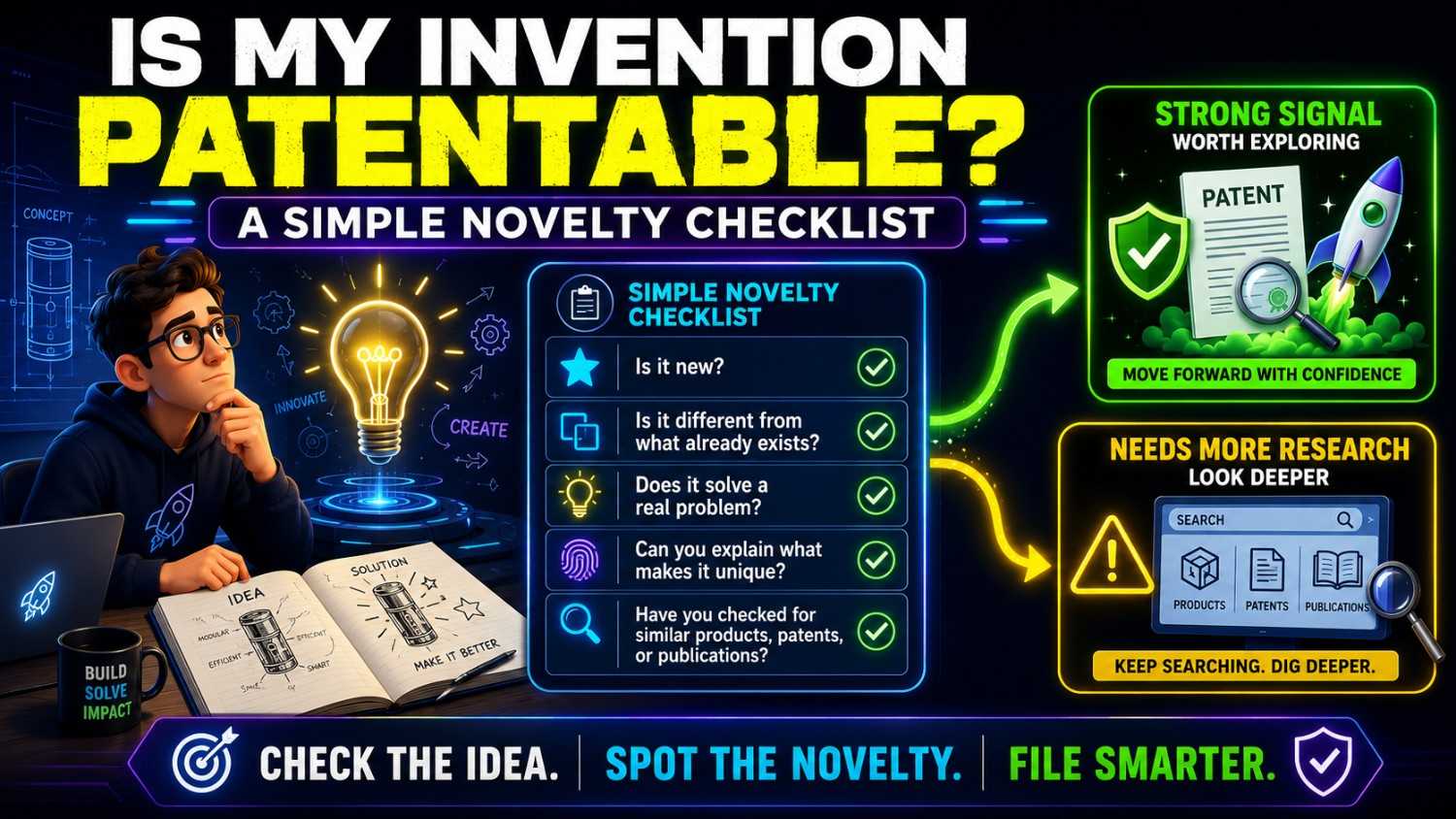
You built something that feels new.
Now you want to know if it can become a patent.
This guide gives you a simple way to check novelty before you file, so you can move forward with more confidence and fewer surprises.
PowerPatent helps founders turn inventions, code, models, and technical work into stronger patent filings with smart software and real patent attorney oversight. You can see how it works here: https://powerpatent.com/how-it-works
First, What Does “Patentable” Mean?
When founders ask, “Is my invention patentable?” they are usually asking a few things at once.
They want to know if the idea is new.
They want to know if it is different enough from what already exists.
They want to know if it is the kind of thing that can be protected.
They want to know if it is worth spending time and money on a patent.
Those are good questions.
But the first big question is simple:
Is your invention new?
That is called novelty.
Novelty means your invention has not already been publicly shown, described, sold, used, or filed by someone else before your filing date.
In plain words, novelty asks:
Did the world already know this before you filed?
If the answer is yes, you may have a problem.
If the answer is no, you may have a path.
But patents are not always that simple. Something can be partly old and partly new. A product can feel new in the market but still be described in an old patent. An idea can look similar to old work but include a new technical improvement that matters.
That is why a novelty checklist helps.
It gives you a clear way to look at your invention before you file.
Why Novelty Matters So Much
Novelty is one of the first gates your invention must pass.
If someone already publicly described the same invention before you filed, you usually cannot get a patent on that same thing.
This is true even if you never saw that old work.
This surprises many founders.
You may have built your invention from scratch. You may have spent months solving a hard problem. You may have never copied anyone. But if someone else publicly described the same invention first, that old public information can still count against you.
That does not mean your work has no value.
It may still be a great product.
It may still be a strong business.
It may still include improvements worth protecting.
But the broad invention may not be new.
This is why checking novelty early is so important.
It helps you avoid filing on the wrong thing. It helps you find the real new part. It helps you write a stronger patent. It helps you make better choices before you show too much to the world.
For a startup, that can save money, time, and stress.
A novelty check is not just a legal task. It is a founder task.
It helps you protect the work that gives your company an edge.
The Simple Novelty Checklist
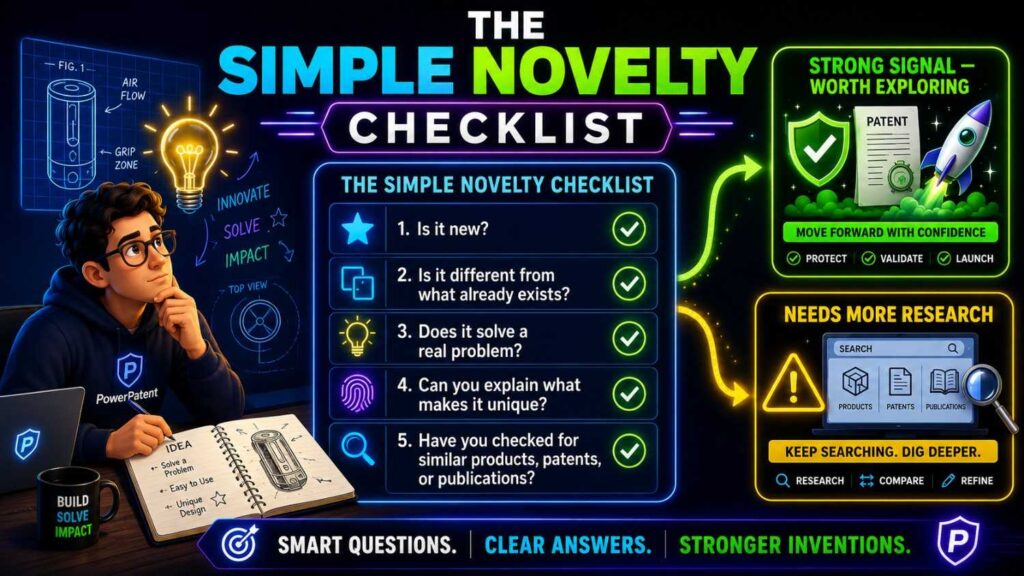
Here is the basic checklist in plain words.
Can you clearly describe what your invention is?
Can you point to the technical part that is new?
Has anyone already patented the same thing?
Has anyone already published a patent application about it?
Has anyone written a paper, blog post, manual, or public document that explains it?
Has any product already done it publicly?
Have you already shared it publicly yourself?
Is your difference more than a small design choice?
Does your difference create a real technical benefit?
Can you explain why your version is different from the closest old work?
That is the heart of the novelty check.
The rest of this guide will walk through each part in a clear, practical way.
Start by Writing the Invention in Plain Words
Before you search anything, write down your invention.
This sounds too simple, but it is one of the most important steps.
Many founders cannot search well because they cannot yet explain the invention clearly.
They explain the product. They explain the company. They explain the market. But they do not explain the actual invention.
A product is not always the same thing as an invention.
Your product may have a dashboard, a login screen, a workflow, a pricing model, customer reports, and integrations. But the invention may be one hidden technical method inside that product.
For example, do not write:
“Our platform uses AI to help support teams.”
That is too broad.
Write:
“Our system reads a support ticket, checks product usage changes, looks at past billing risk, and creates a risk score. If the score is high, it routes the ticket to a senior agent and suggests a custom action.”
That is much clearer.
Now you can check novelty.
You can search ticket routing, customer risk scoring, product usage signals, support escalation, churn prediction, and AI support workflows.
The better your invention summary, the better your novelty check.
If you cannot explain your invention in simple words, do not rush into filing yet. Spend time getting the invention clear.
PowerPatent helps founders do this. It helps turn raw notes, code, diagrams, and technical work into a clearer invention record, with real attorney oversight to help guide the filing path. You can learn more here: https://powerpatent.com/how-it-works
Separate the Invention From the Idea
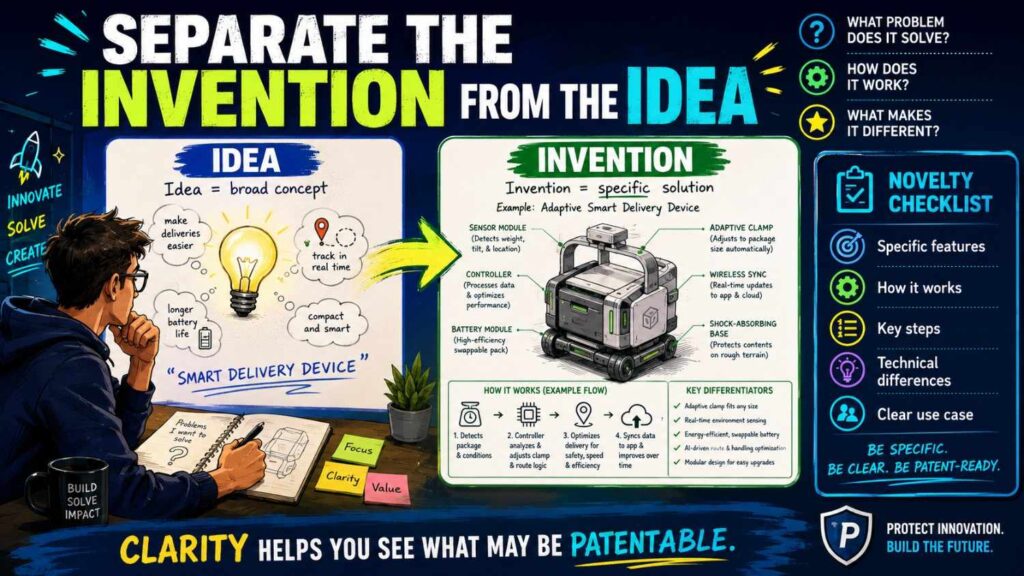
An idea is usually broad.
An invention is specific.
“I want to make hiring easier with AI” is an idea.
“A system that compares interview answers with role-specific skill signals, flags missing evidence, and updates a candidate score based on interviewer confidence” is closer to an invention.
“I want to make batteries last longer” is an idea.
“A charging method that predicts cell imbalance from early heat changes before voltage drift appears” is closer to an invention.
“I want to make robots safer” is an idea.
“A robot control method that slows a robot based on predicted human path and aisle width before a collision zone forms” is closer to an invention.
Patents protect inventions, not loose goals.
This is why novelty must be checked at the invention level.
If you search a broad idea, you will find too much and learn too little.
If you search the specific invention, you can see what is truly new.
Ask yourself:
What are the actual steps?
What parts are required?
What data is used?
What changes because of the invention?
What result improves?
What would a competitor need to copy to get the same advantage?
Those answers help you move from idea to invention.
Find the Core Technical Feature
Your invention may have many details.
Some are important. Some are not.
The novelty check should focus first on the core technical feature.
This is the part that makes the invention work.
For a software product, it may be a data flow, a ranking rule, a model training method, a privacy step, a routing method, a testing method, or a way to reduce compute cost.
For a hardware product, it may be a shape, sensor placement, moving part, material, cooling path, signal path, or control system.
For an AI product, it may be the way prompts are built, how tools are selected, how outputs are checked, how training data is chosen, how feedback is used, or how a model is deployed.
For a medical or biotech invention, it may be a composition, assay, target, dosage, delivery method, sensor setup, or treatment workflow.
The core technical feature is not always what users see.
In fact, it is often hidden.
A user may only see “faster results.”
But the invention may be a special way to split work between a phone and a server.
A user may only see “fewer false alarms.”
But the invention may be a new way to combine two sensor signals before sending an alert.
A user may only see “better AI answers.”
But the invention may be a method that checks model output against a trusted source graph before showing the answer.
The user benefit matters, but novelty lives in the technical feature.
Find that feature first.
Ask Whether the Whole Invention Was Already Public
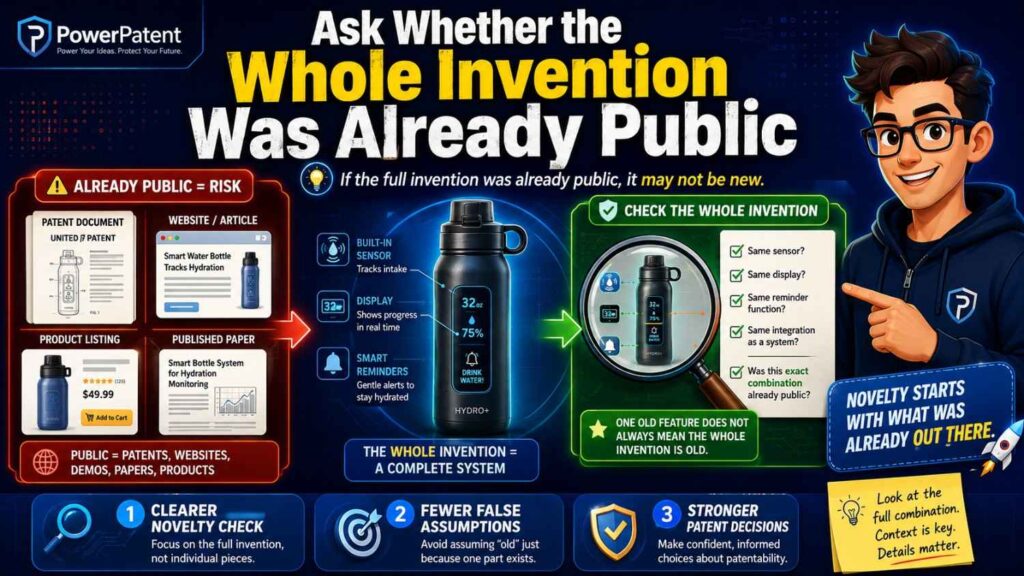
Once you know the core feature, ask the first big novelty question:
Has the whole invention already been made public?
This means someone publicly described all the key parts before your filing date.
Public can mean many things.
It can be a granted patent.
It can be a published patent application.
It can be a research paper.
It can be a product manual.
It can be a blog post.
It can be a public demo.
It can be a GitHub repo.
It can be a conference talk.
It can be a standards document.
It can be a video.
It can be a website.
It does not have to be famous. It does not have to be easy to find. It does not have to be sold by a big company.
If it was public and it teaches the key parts of your invention, it can matter.
This is why novelty checks should go beyond a quick Google search.
You need to search patents, papers, products, and public technical materials.
A quick search may miss the most important old work.
Search Patents First
A good novelty check often starts with patent search.
Use tools like Google Patents to search for old patents and published patent applications.
Start with simple words that describe your invention.
Then use different words.
If your team says “AI agent,” search “automated assistant,” “task execution system,” “workflow orchestration,” “natural language command execution,” and “tool selection.”
If your team says “edge AI camera,” search “embedded vision system,” “low power image processing,” “local inference device,” “motion-triggered camera,” and “selective model activation.”
If your team says “smart routing,” search “dynamic path planning,” “route optimization,” “task allocation,” “multi-agent navigation,” and “congestion prediction.”
Do not search only one phrase.
Patent documents often use dry, formal, or older words.
When you find a close patent, read the abstract, look at the drawings, scan the description, and review the claims.
You do not need to understand every line. You need to understand what it teaches.
Ask:
Does this show the same problem?
Does it use the same parts?
Does it follow the same steps?
Does it create the same result?
Does it include the part I think is new?
If yes, save it and study it.
If not, write down how it differs.
Search Published Patent Applications Too
Do not only search granted patents.
Published patent applications can also matter.
A published application may never become a granted patent, but it can still show that the idea was public.
Founders sometimes ignore applications because they think, “This was abandoned, so it does not matter.”
For novelty, that may be wrong.
If the application was published before your filing date and describes your invention, it may count as prior art.
That means it can make your invention look not new, even if no patent was ever granted.
This is one of the reasons patent searching can feel strange.
The question is not only, “Who owns an active patent?”
The question is also, “What did the public already know?”
An abandoned application may still teach the public.
So include published applications in your novelty check.
Look Beyond U.S. Patents
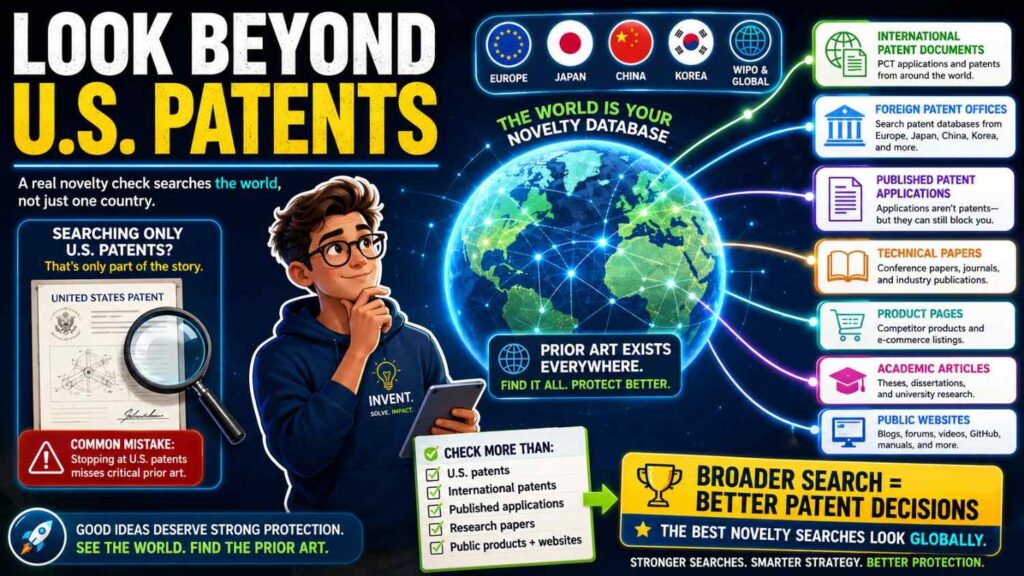
Your invention may be checked against public information from many countries.
A patent document from Europe, Japan, China, Korea, Canada, Australia, or another place may still matter if it was public before you filed.
Do not assume only U.S. patents count.
Global search is important in fields like AI, robotics, electronics, chips, batteries, medical devices, biotech, wireless systems, materials, and manufacturing.
Google Patents includes many global documents. You can also search Espacenet and WIPO PATENTSCOPE.
Foreign patent documents may use machine translation. The wording may feel awkward. Still, the drawings and summaries can be helpful.
If a foreign document looks close, save it.
You can ask a patent professional to review it later.
The goal at this stage is not perfect legal analysis. The goal is to find the closest old work you can.
Search Research Papers
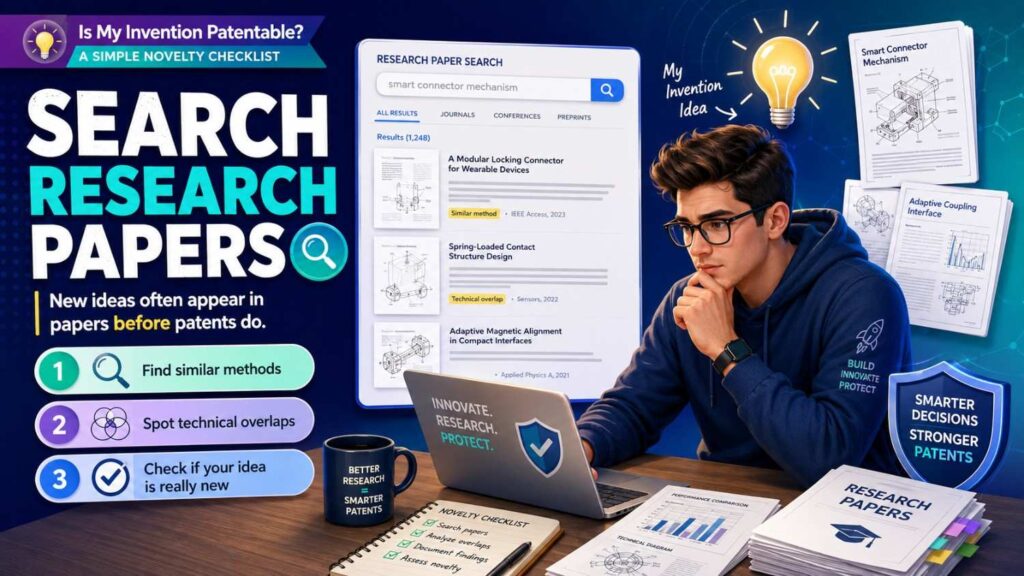
Many technical inventions are first described in papers.
This is especially true in AI, biotech, robotics, chips, medical devices, materials, climate tech, and advanced software.
Search Google Scholar, arXiv, PubMed, IEEE, ACM, conference sites, university pages, and other sources in your field.
For AI inventions, search papers very carefully. The AI world moves fast, and many ideas are published before they are patented.
For biotech and medical inventions, papers can be central.
For robotics, papers may explain algorithms and control methods years before products appear.
For hardware and chips, papers may show designs, tests, materials, and system layouts.
When reading a paper, focus on the abstract, figures, method section, and results.
Ask whether it teaches your key technical feature.
A paper does not need to mention your market. It may still matter if it teaches the same method.
For example, your invention may apply a signal process to factory sensors. A paper may use the same process in medical sensors. That could still be relevant.
Search by technical method, not just industry.
Search Products and Manuals
Sometimes a product has already done what you invented.
The product may not have a patent. It may not have a paper. But if it was publicly available and its technical details were public, it can matter.
Search competitor products.
Search product pages, manuals, support docs, datasheets, API docs, developer guides, setup guides, release notes, demo videos, and teardown articles.
Marketing pages may be too vague. Manuals and technical docs are often better.
A product page that says “uses smart AI routing” may not teach much.
But a developer guide that explains how the system ranks requests, checks device state, and routes work based on latency and battery level may be very relevant.
For software, search documentation.
For hardware, search manuals and datasheets.
For devices, search teardown videos and repair guides.
For developer tools, search API docs and GitHub examples.
Public product information can be prior art if it teaches the invention clearly enough.
Search Open-Source Code
If your invention involves software, AI, infrastructure, data tools, security, developer workflows, or automation, search open-source code.
GitHub can contain important prior art.
A repo may show a method. A README may explain the workflow. An issue thread may describe the problem and solution. A demo notebook may reveal the exact steps.
Search for your key terms.
Search related libraries.
Search older names for the method.
Search phrases from the problem and result.
If you find code that seems close, check dates. Look at commits, releases, tags, and README history if available.
Open-source materials are easy to miss because they may not look like formal publications. But they can still show what was public.
This matters a lot for software startups.
Your novelty check should include the places where builders share work.
Search Standards and Protocols
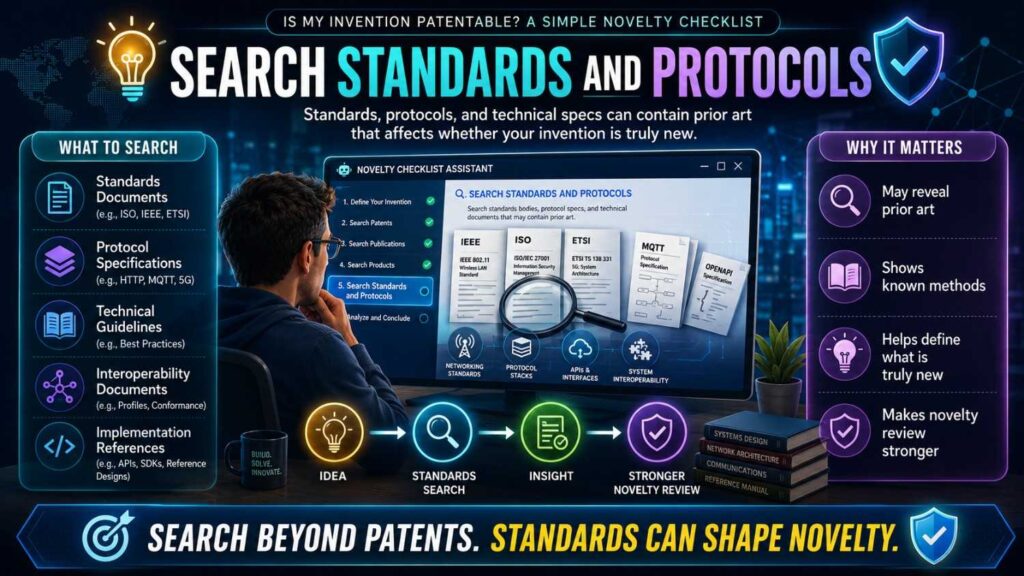
If your invention touches communication, wireless systems, networking, video, audio, encryption, chips, medical data, industrial systems, or connected devices, search standards.
Standards documents can be very detailed.
They may describe methods, formats, protocols, timing rules, control flows, safety rules, and data structures.
Search relevant standards bodies, technical working groups, protocol documents, RFCs, industry consortium materials, and draft specifications.
A standard does not need to be a patent to matter.
If it publicly describes your technical feature before you filed, it can affect novelty.
This is especially important if your invention improves or uses a known protocol.
You need to know what the protocol already teaches.
Check Your Own Public Sharing
This is one of the most important parts of the checklist.
Ask:
Have we already shared the invention publicly?
Did we post a blog about it?
Did we publish a paper?
Did we release code?
Did we demo it at a public event?
Did we put technical details in docs?
Did we show architecture diagrams in a pitch deck that was widely shared?
Did we talk about the method on a podcast, webinar, or conference stage?
Did we put the key workflow in a public video?
Your own public disclosure can create risk.
In some places, public disclosure before filing can hurt your ability to get a patent. In the United States, there may be grace period rules in some cases, but relying on them without legal advice is risky.
The safest habit is simple:
File before you publicly share the technical details.
You can still market your product. You can talk about benefits. You can say what the product does at a high level. But be careful with the exact method before filing.
If you already shared details, do not panic. Move quickly and get help.
PowerPatent helps founders act faster before public launch, investor talks, partner meetings, or technical releases. See how it works here: https://powerpatent.com/how-it-works
Ask Whether One Reference Shows Every Key Part
Novelty often turns on whether one old reference shows all the key parts of your invention.
In plain words:
Did one public document or product already describe the whole thing?
If one old patent, paper, manual, or public page shows every key part, novelty may be a problem.
If different references show different parts, that may raise another issue, but the novelty question is slightly different.
For novelty, focus first on one reference.
Take your invention’s key parts and compare them to the old reference.
For example, suppose your invention has these parts:
A wearable sensor collects motion data.
A low-power model checks whether the motion will harm signal quality.
The system changes the sampling rate before taking a blood flow reading.
The result is better signal quality with less battery use.
Now ask whether one old reference shows all of that.
If a patent shows a wearable sensor and motion data but does not change sampling before the reading, it may not show the whole invention.
If a paper shows sampling changes but not the specific motion-based model, it may be close but not identical.
If a manual shows all steps, it may be a serious novelty issue.
This comparison helps you avoid vague fear.
You are not asking, “Is this similar?”
You are asking, “Does this show each key part?”
Ask Whether Your Difference Is Real
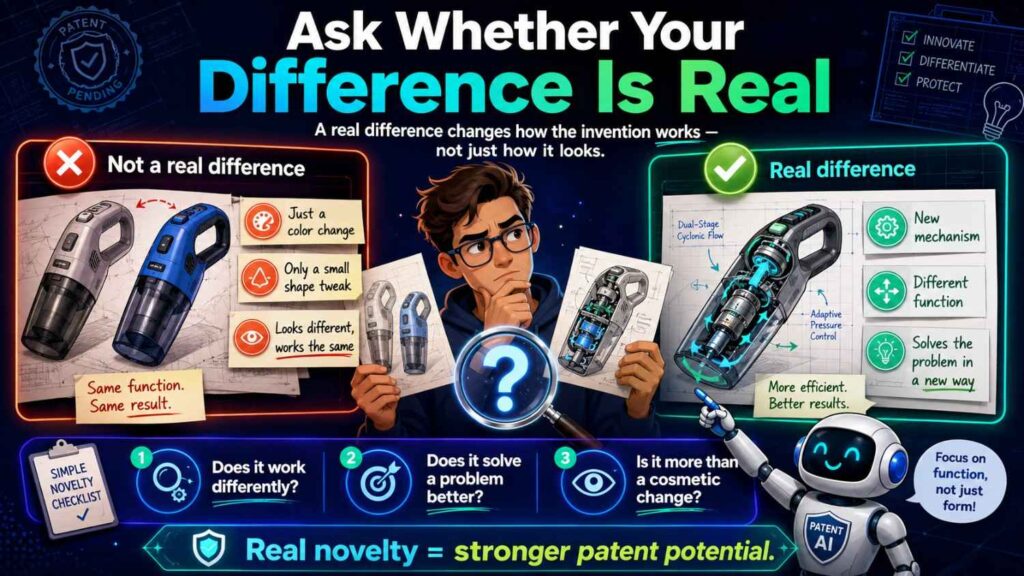
If old work is close, your invention may still be new if it has a real difference.
But the difference must matter.
A real difference changes the technical feature, step, structure, input, output, timing, or result.
Weak differences include names, colors, branding, general industry use, normal user interface choices, or small cosmetic changes.
Strong differences are more like:
A different sensor setup that improves signal quality.
A new data flow that reduces delay.
A model update method that protects private data.
A control rule that prevents unsafe device behavior.
A device structure that reduces heat.
A routing method that reduces congestion before it forms.
A testing method that finds code failures faster.
A training method that uses less labeled data.
Ask yourself:
What does our invention do that the old work does not?
Why does that matter?
What gets better because of it?
If you can answer those questions clearly, you may have a useful novelty angle.
Use the “So What?” Test
The “so what?” test is simple.
After you state your difference, ask:
So what?
If you cannot give a strong answer, the difference may not be useful.
Example:
“Our app shows the score in a different panel.”
So what?
That may not help much.
Now compare:
“Our system creates the score only after checking product usage drop, recent billing risk, and support ticket tone, then routes the ticket to a senior agent if the score crosses a dynamic threshold.”
So what?
That may help catch churn risk earlier and route work more accurately.
That sounds more technical and more meaningful.
Another example:
“Our camera has a different outer shell.”
So what?
Maybe not much.
“Our camera runs a low-power motion classifier before waking the main vision model.”
So what?
It saves battery and reduces false wake events.
That is stronger.
Novelty is not only about being different. It is about being different in a way that matters to the invention.
Ask Whether the Invention Solves a Technical Problem
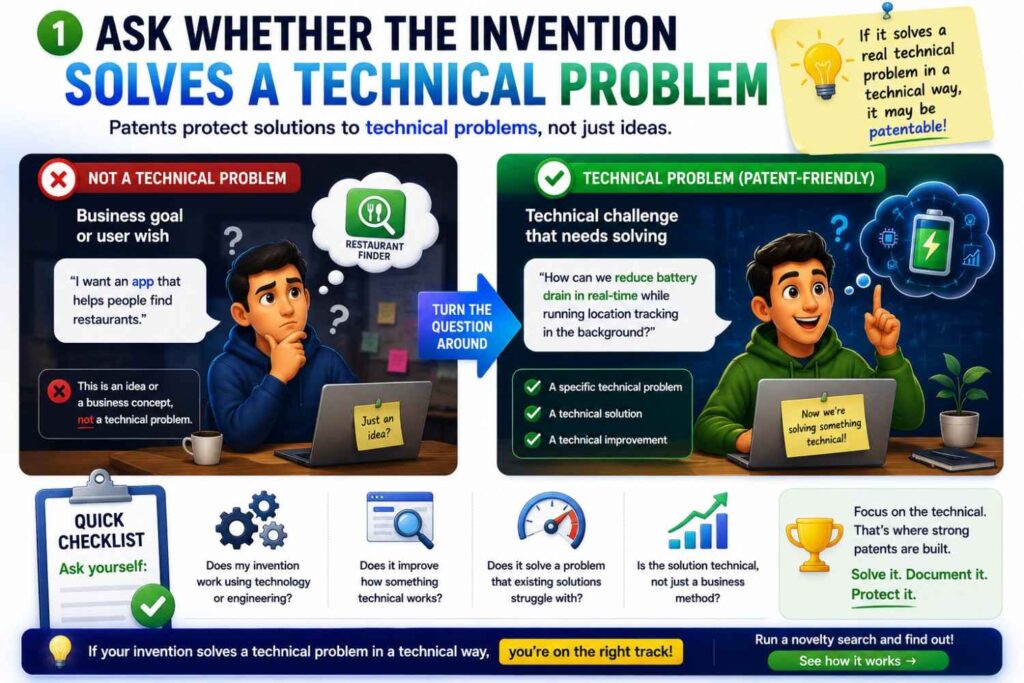
A strong patent story often starts with a technical problem.
The problem should not be only a business wish.
“Make more money” is not a technical problem.
“Help sales teams” is not specific enough.
“Improve user engagement” is usually too vague.
Technical problems sound more like:
Reduce latency in distributed inference.
Lower power use in a wearable sensor.
Improve signal quality in noisy motion conditions.
Prevent unsafe pressure spikes in a device.
Reduce memory use during model deployment.
Route robots before congestion forms.
Detect code failures with fewer tests.
Protect private data during model training.
If your invention solves a clear technical problem, your novelty check becomes sharper.
You can search that problem. You can compare old solutions. You can explain why your solution is different.
If your invention does not have a technical problem yet, keep digging.
The patentable part may be hidden under the business goal.
Ask Whether the Invention Has a Technical Result
A technical result is the thing that gets better because of your invention.
It can be speed, safety, accuracy, battery life, memory use, signal quality, privacy, device control, heat reduction, lower bandwidth, fewer failures, or better reliability.
A result helps show why your difference matters.
For example:
The system reduces model response time.
The device uses less power.
The sensor reading has less noise.
The robot stops less often.
The network sends less data.
The battery charges more safely.
The code tool runs fewer tests while catching the same failures.
The medical device detects a risky state sooner.
When checking novelty, write down the result.
Then search for old work that tries to get the same result.
If old work gets the same result in the same way, that may be a problem.
If old work gets the same result in a different way, your path may still be new.
If old work never gets that result, your invention story may be stronger.
Search the Problem, Not Just the Solution
Many founders search only their solution.
That can miss close prior art.
Search the problem too.
If your invention prevents AI hallucinations, search hallucination reduction, output verification, grounded generation, source checking, confidence scoring, and answer validation.
If your invention reduces battery use in a sensor, search low-power sensing, adaptive sampling, duty cycling, wake-up sensing, battery conservation, and power-aware monitoring.
If your invention routes robots better, search robot congestion, path planning, multi-agent routing, obstacle avoidance, local coordination, and warehouse traffic.
Problem-based search helps because other people may have solved the same issue using different terms.
It also helps you find old approaches.
Those old approaches can help you explain why your method is different.
Search the Result, Not Just the Parts
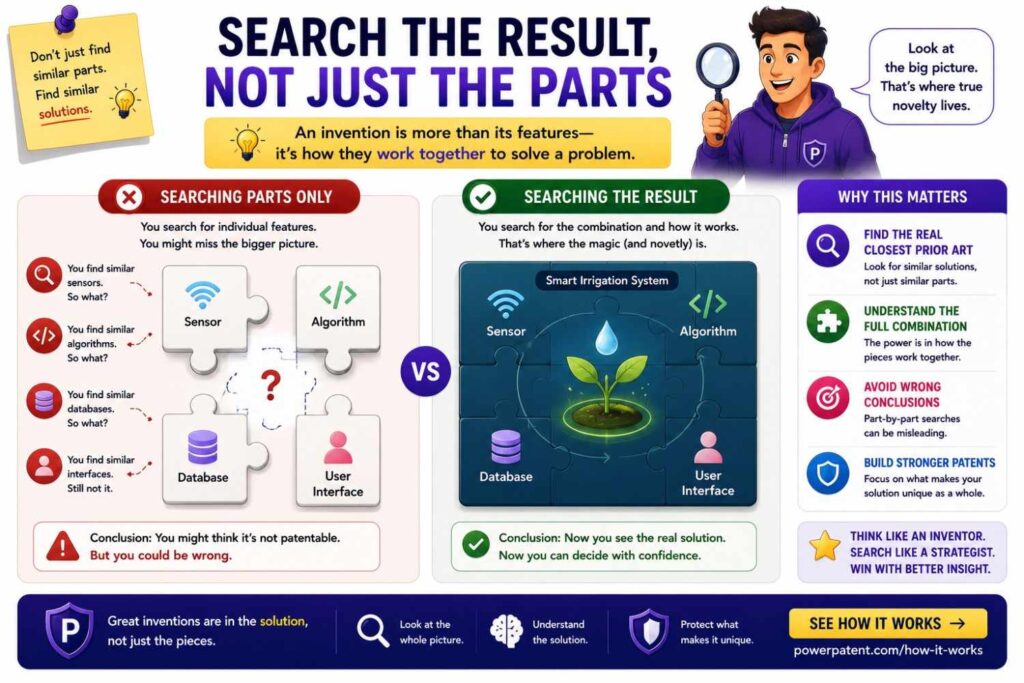
Search what your invention improves.
If the result is lower latency, search “latency reduction” with your field.
If the result is less memory, search “memory efficient” with your system.
If the result is fewer false alarms, search “false positive reduction” with your sensor or model type.
If the result is better privacy, search “privacy preserving” with the data flow or model process.
If the result is safer control, search “safety control” with the device or machine.
Result-based searching catches documents that use different mechanisms but aim at the same goal.
This is useful because your invention may be one path among several.
You need to know what those paths are.
Search Different Words for the Same Thing
The same invention can be described in many ways.
Your words may not match the words in patents or papers.
This is especially true in fast-moving fields.
Your “AI copilot” may be called a “natural language assistant,” “automated task system,” “workflow engine,” “dialog manager,” or “software agent.”
Your “vector memory” may be called “semantic index,” “embedding store,” “nearest neighbor retrieval,” or “information retrieval database.”
Your “smart factory camera” may be called “industrial vision system,” “event detection apparatus,” “image processing device,” or “remote monitoring unit.”
Your “battery health engine” may be called “state of health estimator,” “charge control system,” “cell balancing method,” or “thermal prediction model.”
Build a bank of alternate words.
Use old words, technical words, simple words, and industry words.
Search all of them.
A novelty check is often won or lost on language.
Search Competitors
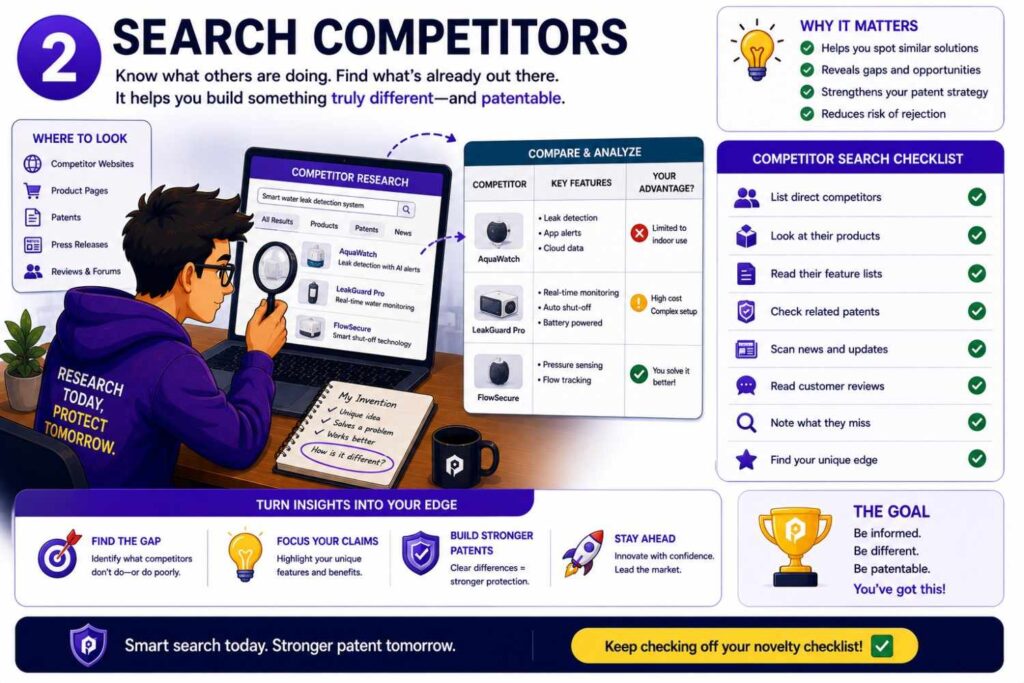
Competitor searching is very useful.
Search companies in your space.
Search their old names too.
Search their founders and key inventors.
Search the big companies that may care about your market.
Look at their patents, papers, product docs, and technical posts.
Competitors may have filed patents on features they never launched. Big companies often file patents around future directions. Startups may publish technical blogs that reveal how their systems work.
Do not assume that because you have not seen a product, the idea is new.
A competitor may have filed a patent application years ago.
Also, do not panic when you find competitor patents.
A competitor patent may be close but not identical. It may teach the old way. It may help you see your own difference more clearly.
Competitor search is not just about risk.
It is also strategy.
It helps you see where the field is crowded and where there may be room.
Search Inventor Names
If you find one close patent or paper, look at the inventors or authors.
Search their names.
People often work on the same technical problem for years.
An inventor may have filed patents at a university, then a startup, then a large company.
An academic author may have published several papers that build toward your area.
Following names can reveal prior art that keyword searches miss.
This is especially useful in deep tech fields where the same small group of people may publish and file often.
If one person appears again and again near your invention, study their work.
Use Classification Codes
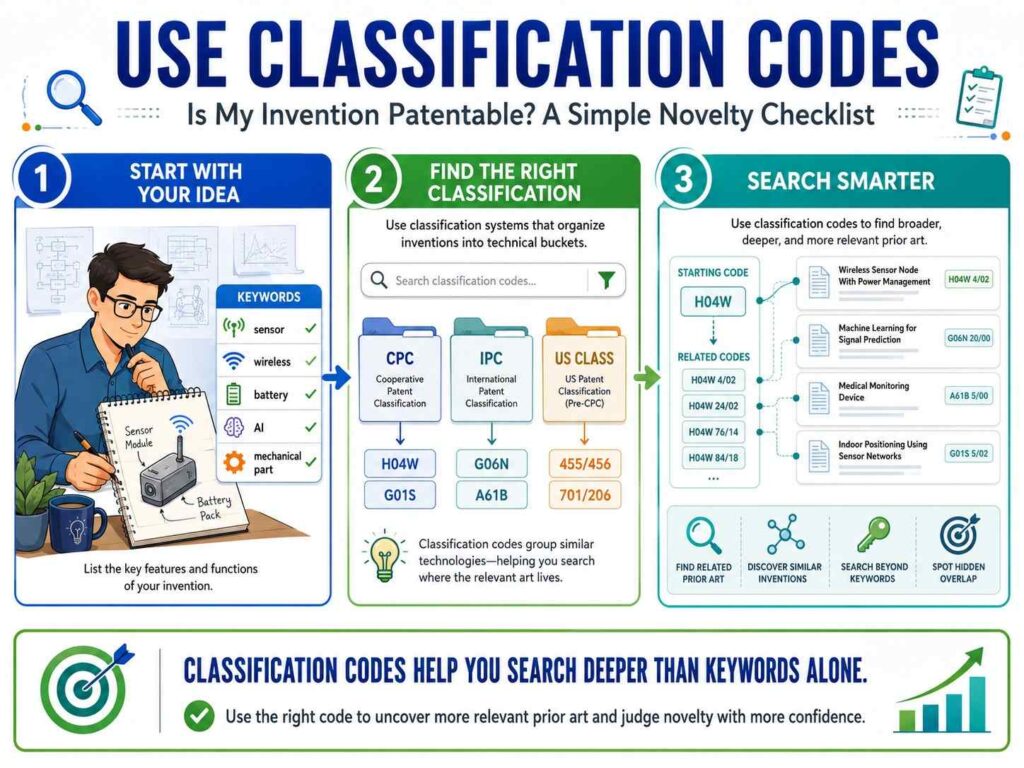
Patent documents are grouped by technical classification codes.
These codes can help you find related patents that use different words.
When you find a close patent, look for its CPC or IPC codes.
Then search those codes with your keywords.
You do not need to master the system. Use the codes like breadcrumbs.
One good patent can lead to a group of related patents. That group can show you how the field talks about your invention.
Classification searching is especially helpful when your invention uses words that are new, trendy, or different from patent language.
Compare Dates
Novelty depends on timing.
Ask whether the old reference was public before your filing date.
For patents, look at the filing date, publication date, and priority date.
For papers, look at the publication date or preprint date.
For websites, look at the post date if available.
For GitHub, look at commit dates and release dates.
For videos, look at upload dates.
For products, look at launch dates, manuals, and public docs.
If something was public after your filing date, it may not hurt novelty for that filing.
If it was public before, it may matter.
Dates can be tricky, so save the reference and ask for help if needed.
But do not ignore dates.
They are part of the novelty story.
Make a Simple Novelty Chart
A novelty chart helps you compare your invention to old work.
It does not need to be complex.
Write your key invention parts in one column.
Then compare each close reference.
Does the reference show this part?
Does it miss this part?
Does it do something different?
Add a short note.
For example, your invention may have five key parts. A close patent may show three of them but miss the low-power classifier and the local wake-up rule. A paper may show the classifier but not the device control flow. A product manual may show wake-up control but not the risk pattern model.
Now you can see the gap.
The gap may be your novelty.
This is much better than saying, “There are some similar patents.”
A chart makes the comparison clear.
Write the Difference in One Sentence
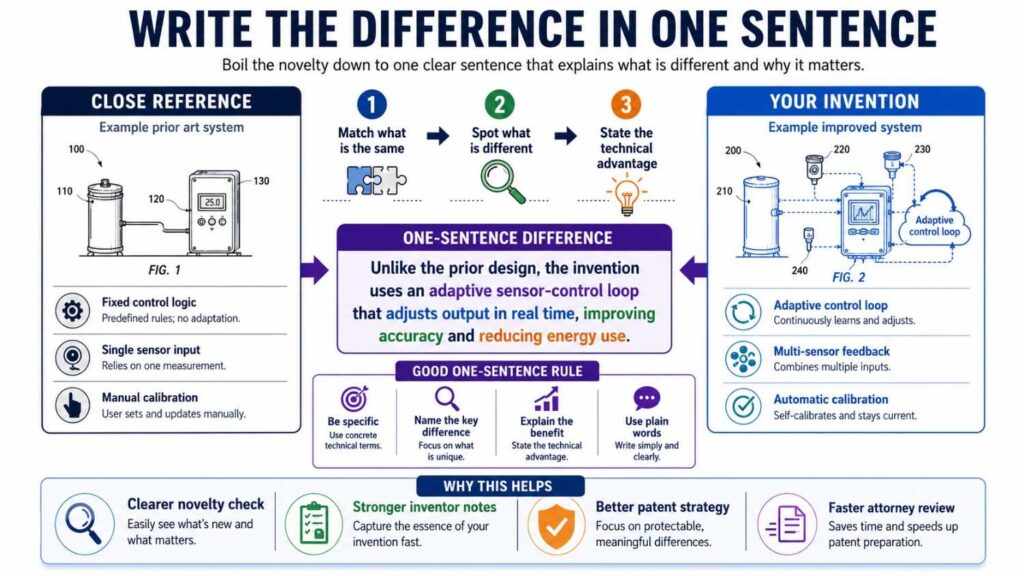
After your search, try to write the difference in one sentence.
Use this simple pattern:
“Our invention is different because it does X, which causes Y.”
For example:
“Our invention is different because it uses a low-power model to classify motion before waking a larger vision model, which saves battery and reduces false wake-ups.”
Or:
“Our invention is different because it updates a dependency graph using production logs before selecting tests, which reduces test time while still finding risky code changes.”
Or:
“Our invention is different because it predicts battery cell imbalance from early heat signals before voltage drift appears, which allows safer charging sooner.”
If you cannot write the difference clearly, you may not yet understand the novelty.
That does not mean there is no invention. It means you need more search or clearer thinking.
The best patent filings start with a clear difference.
Check Whether the Difference Is Already Suggested
Novelty asks whether one old reference shows the whole invention.
But patentability also involves whether your invention is too close to old work.
Even if no single reference shows everything, the patent office may look at whether old references make your invention seem like an easy next step.
You do not need to solve that whole legal question alone.
But during your novelty check, pay attention.
If one old reference shows part A and another shows part B, ask whether people in the field were already combining them.
If many documents point toward your exact solution, your path may be harder.
If old work tried different paths and missed yours, your story may be stronger.
This is another reason your difference should have a real technical benefit.
A meaningful improvement is easier to explain than a tiny tweak.
Check Whether Your Invention Is More Than Automation
Many software and AI ideas start as automation.
“We automate this manual task.”
That alone may not be enough.
Ask what is technically new about the automation.
Does the system process data in a new way?
Does it reduce compute?
Does it improve machine performance?
Does it change how a device operates?
Does it handle errors in a new way?
Does it protect privacy?
Does it improve accuracy through a specific technical method?
Does it solve a technical limit that old systems could not solve?
For example, “automating contract review” is broad.
But “a system that detects conflicting obligations by building a time-based dependency graph across contract clauses and external policy rules” is more specific.
“Automating customer support” is broad.
But “a system that routes support tickets based on a churn risk score created from product usage drops, billing state, and message tone” is more specific.
Automation may be part of an invention, but the patentable part often lies in how the automation works.
Check Whether the Invention Is Only a Business Method
Business ideas can be hard to patent if they are not tied to a real technical solution.
Ask whether your invention improves a technical system or only changes a business rule.
A pricing plan, sales method, hiring process, or marketplace rule by itself may not be strong.
But a technical system that solves a data, security, compute, device, or control problem may be stronger.
For example, “match buyers and sellers better” is a business idea.
“A system that reduces failed matches by updating a trust score based on verified device location, transaction timing, and behavior anomalies” is more technical.
“Offer dynamic insurance pricing” is broad.
“A system that calculates risk from vehicle sensor data using a privacy-preserving local model before sending only an encoded risk band to a server” is more technical.
The more your invention explains how a technical system works better, the stronger the patent story may be.
Check Whether the Invention Is Too Abstract
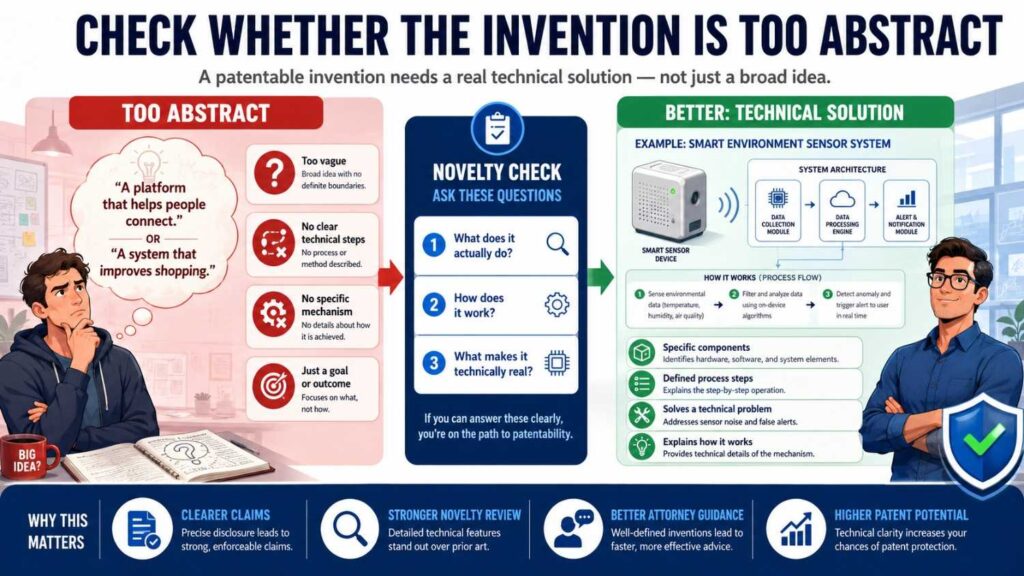
Some inventions are described at such a high level that they feel abstract.
“Use AI to make decisions.”
“Analyze data and show a result.”
“Connect users with resources.”
“Predict an outcome.”
“Recommend an action.”
These statements are too vague.
To check patentability, you need concrete steps.
What data?
What model?
What rule?
What device?
What signal?
What timing?
What output?
What changes in the system?
What technical result improves?
A strong invention is not just a desired outcome. It explains the method for reaching that outcome.
If your invention still sounds abstract, add detail.
Do not add fluff. Add real technical substance.
Check Whether Your Invention Is Enabled
A patent application needs enough detail to show how to make and use the invention.
For your novelty checklist, ask yourself:
Could a skilled person understand how this works from our notes?
Do we know the steps?
Do we know the parts?
Do we know the inputs and outputs?
Do we have examples?
Do we know useful variations?
Do we have test results or working data?
You do not always need a finished product to file. But you need enough detail to describe the invention clearly.
A vague dream is not ready.
A clear technical design may be ready even before full launch.
This is important for startups.
You can often file before the product is perfect. But the filing should still be rich in detail.
PowerPatent helps teams organize those details so the invention is not trapped in scattered notes, code comments, Slack threads, and diagrams. Learn more here: https://powerpatent.com/how-it-works
Check Whether You Have Proof of the Benefit
You do not always need perfect proof to file, but evidence helps.
If your invention improves speed, measure it.
If it reduces power use, capture test data.
If it improves accuracy, save benchmark results.
If it reduces false alarms, keep examples.
If it lowers memory use, record before-and-after numbers.
If it improves safety, document the safer behavior.
These details can help explain why your difference matters.
They can also help your patent team write a stronger application.
Founders often skip this because they are busy. But even simple notes can help.
Write down what changed and what improved.
Do not wait until everyone forgets.
Check Whether There Are Variations
A good patent application often describes more than one version.
Ask how else the invention could work.
Could it use a different sensor?
Could it use a different model?
Could it run on a phone, server, device, robot, or cloud system?
Could it apply to another industry?
Could the threshold be fixed or dynamic?
Could the signal come from a different source?
Could the output be an alert, command, score, route, model update, or device action?
Variations matter because competitors may design around a narrow patent.
If your filing only describes one exact product version, it may be easier to avoid.
But be careful. Do not invent fake variations that do not make sense. Describe real technical options.
A novelty search can help here too.
Some variations may already be old. Others may be open.
The goal is to protect the invention’s real range.
Check Whether the Invention Is Core to the Business
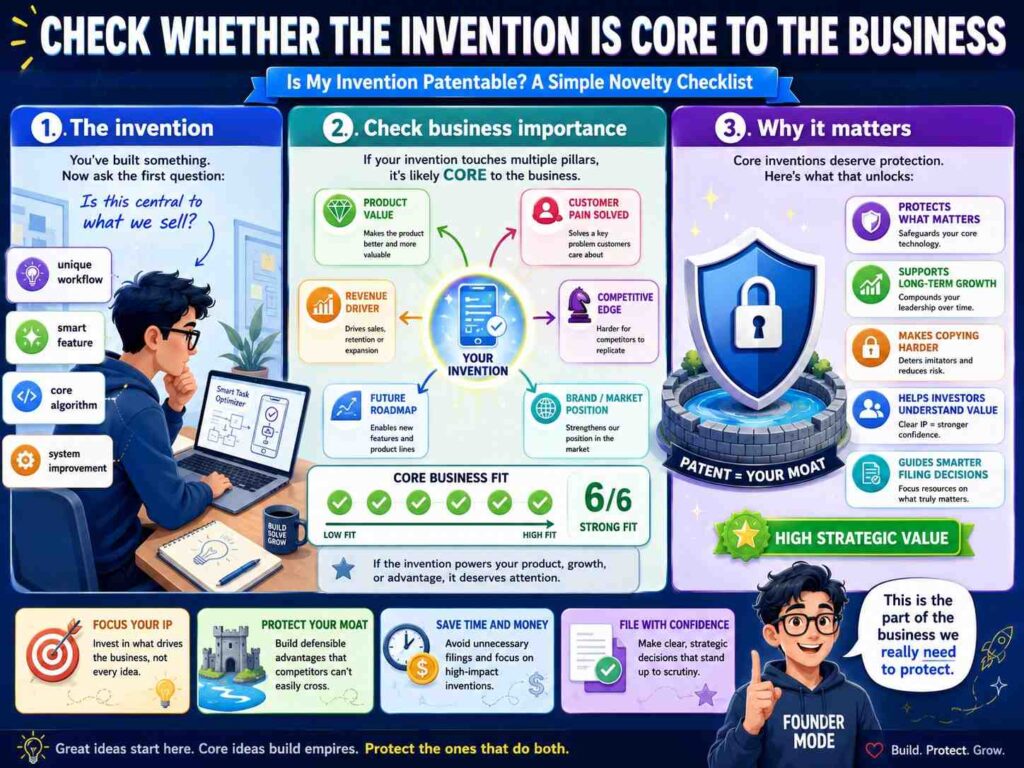
Novelty is not the only question.
An invention may be new but not worth filing.
Ask whether it matters.
Does it protect a core product feature?
Would competitors want to copy it?
Does it create a technical advantage?
Does it support your investor story?
Does it help with partnerships?
Could it matter in an acquisition?
Is it hard to keep secret?
Is it likely to be used for years?
If the answer is yes, a patent may be worth exploring.
If the invention is minor, easy to replace, or not tied to business value, it may not deserve your first filing budget.
Startups should file thoughtfully.
The goal is not to patent everything.
The goal is to protect what matters.
Check Whether Trade Secret Protection Is Better
Not every invention should be patented.
A patent becomes public. In exchange, it can give legal rights.
A trade secret stays private, but it only helps if you can keep it secret.
If your invention can be reverse engineered from the product, a patent may be better.
If your invention is hidden on the backend and can stay secret for a long time, trade secret protection may be worth considering.
For example, a manufacturing process that cannot be seen from the final product may be a trade secret candidate.
A device structure that is visible once sold may be better suited for patent protection.
A backend model training method may be secret for a while, but if employees, partners, or public papers reveal it, secrecy can fade.
This is a business and legal decision.
A novelty check helps you decide whether patent protection is available. Then you can decide whether it is the right path.
Check Whether Timing Is Urgent
Timing can change everything.
Ask whether you are about to publicly disclose the invention.
Are you launching soon?
Publishing a paper?
Posting a technical blog?
Releasing open-source code?
Giving a conference talk?
Showing a demo?
Sending detailed materials to customers?
Entering a pilot?
Talking to a large partner?
Raising money with technical decks?
If yes, filing may be urgent.
A novelty check should happen before that disclosure if possible.
But do not let a long search delay a needed filing.
If time is tight, do a focused search, capture the invention well, and move quickly with professional support.
PowerPatent is built for founders who need to move fast without treating patents like an afterthought. See the process here: https://powerpatent.com/how-it-works
Check Whether You Are Filing Too Early
Filing early is often good.
But filing too early with too little detail can be weak.
If you only have a rough idea and cannot explain how it works, you may need more development.
Ask whether you can describe the system in enough detail.
Can you draw it?
Can you explain the steps?
Can you give examples?
Can you describe alternatives?
Can you state the technical benefit?
If yes, you may be ready.
You do not need a finished product. You do need a clear invention.
A good rule is this:
File when the invention is clear enough to describe and important enough to protect.
Check Whether You Need More Than One Patent
Sometimes one product contains many inventions.
A robot may include new sensing, path planning, safety control, charging, fleet management, and maintenance prediction.
An AI platform may include data cleaning, model routing, output checking, memory handling, permission control, and feedback training.
A medical device may include sensor placement, signal processing, safety logic, patient fitting, and treatment flow.
Do not force everything into one invention if there are several.
A novelty check can reveal this.
You may find that one part is old, another is crowded, and a third is truly open.
That third part may be your best first patent.
Over time, you may build a portfolio around several inventions.
This is how strong startup IP often grows.
Check Whether the Old Work Comes From Another Field
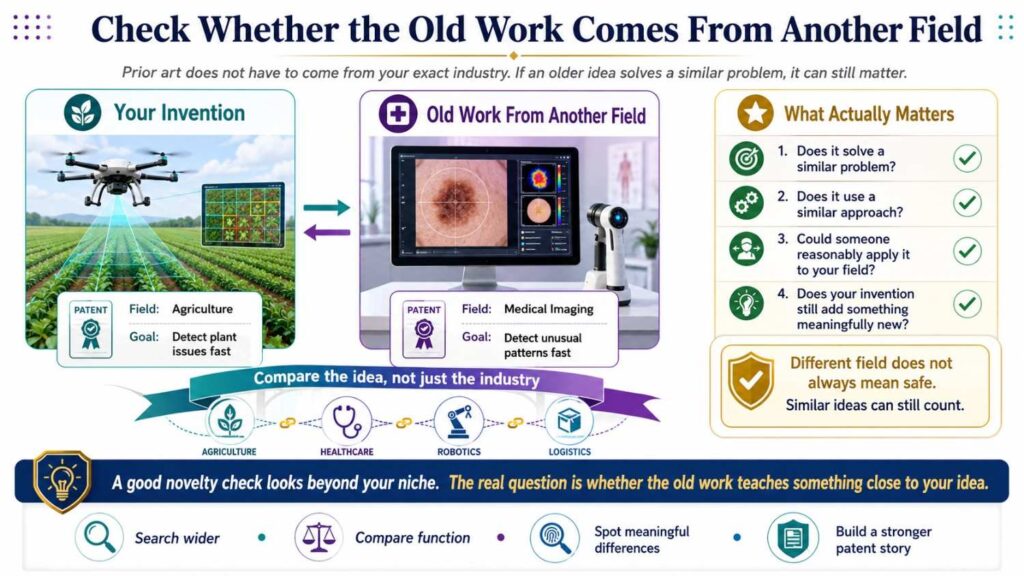
Prior art does not always come from your exact market.
A method used in drones may matter for warehouse robots.
A signal process used in medical sensors may matter for factory sensors.
A routing method used in telecom may matter for cloud compute.
A privacy method used in finance may matter for health data.
Search nearby fields.
Ask where else the same technical problem appears.
If another field solved the same problem in the same way, that may affect novelty or patentability.
But if your invention adapts a method to a new setting with new technical constraints, that may still be important.
Explain those constraints.
What made your setting hard?
What had to change?
What result did your version achieve?
This kind of detail can support a stronger patent story.
Check Whether the Old Work Only Shows the Goal
Sometimes old work shows the same goal but not your method.
That may be good for you.
For example, an old product may say it “reduces battery use,” but it does not explain how.
A patent may say it “improves routing,” but the steps are different.
A paper may say it “reduces false positives,” but it uses a different model.
A goal alone is not always the same as your invention.
You need to compare the method.
How does the old work reach the result?
How does your invention reach it?
If the goal is the same but the method is different, your invention may still be new.
This is why you should not panic over broad marketing claims.
Study the technical teaching.
Check Whether the Old Work Only Shows One Part
A close reference may show one part of your invention but not the full thing.
That does not always destroy novelty.
For example, old work may show a sensor.
Another reference may show a model.
Another may show a control action.
Your invention may combine these in a new way.
But you should still be careful.
If each part is old, you need to explain why the combination matters.
What does the combination do that the parts alone did not do?
Does it create a new result?
Does it solve a problem others did not solve?
Does it work in a hard setting?
Does it require a special timing, structure, or rule?
Many inventions are combinations.
A good novelty checklist helps you find whether the full combination was already shown.
Check Whether Your Improvement Is Measurable
Measurable improvements are helpful.
They make the invention easier to explain.
For example:
Response time drops from 800 ms to 300 ms.
Battery life improves by 35%.
False alarms drop by 50%.
Memory use falls by 40%.
Test time drops from 2 hours to 12 minutes.
Robot idle time is reduced.
Signal noise is lower during motion.
You do not always need perfect data, but numbers help.
Even if the numbers change later, early tests can show why the invention matters.
If you have no numbers, use clear qualitative results.
For example, “the system avoids sending raw patient data to the server” or “the device shuts off the high-power sensor until a risk pattern appears.”
The point is to connect the technical difference to a real outcome.
Check Whether a Competitor Could Design Around It
A patent is more useful when it is hard to avoid.
Ask whether a competitor could copy the benefit without using your invention.
If yes, your patent may still have value, but maybe it is not the strongest moat.
If no, the invention may be very important.
For example, if your advantage comes from a very specific backend flow that competitors need to match your performance, that may be worth protecting.
If your invention is only one small implementation choice among many equal choices, it may be less valuable.
This is a business question, not just a novelty question.
The best patents often protect a technical path that competitors will care about.
Check Whether the Invention Can Be Detected
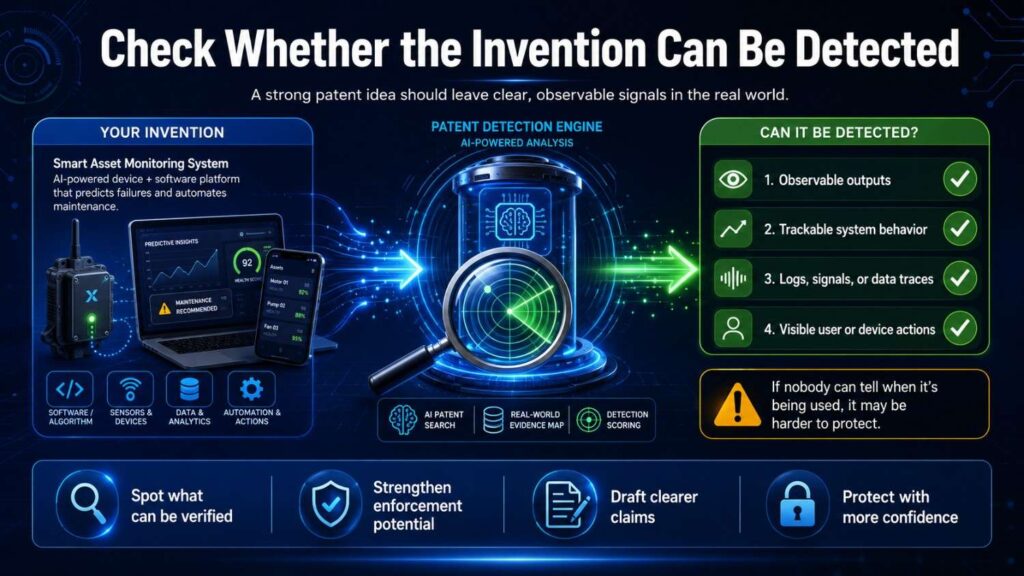
Some inventions are hard to see from the outside.
This matters.
If a competitor copies your patented backend method, will you be able to tell?
Sometimes yes. Product behavior, outputs, timing, network activity, documentation, or discovery in litigation may reveal it.
Sometimes no. A hidden internal method may be hard to detect.
This does not mean you should not patent hidden methods. But it is worth thinking about.
If the invention is hard to detect and easy to keep secret, trade secret protection may be worth considering.
If the invention will be visible in the product, patent protection may be more important.
A good IP strategy looks at both protectability and practical value.
Check Whether You Have Inventor Records
Keep records of who invented what and when.
For startups, this can matter.
Write down invention dates, contributors, design notes, prototypes, tests, and key decisions.
Keep diagrams and technical notes.
Make sure invention ownership is handled properly with employees, contractors, and founders.
This is not just paperwork.
Messy ownership can create trouble later.
If you are building company IP, make sure the company owns the work.
PowerPatent can help structure the patent process, but founders should also keep clean internal records and use proper agreements.
Check Whether Contractors or Partners Helped
If outside people helped build the invention, pay attention.
Contractors, consultants, university labs, development shops, advisors, or partners may have rights if agreements are not clear.
Before filing, ask who contributed to the inventive parts.
Did a contractor design the key method?
Did a university lab create part of the system?
Did a partner suggest a technical feature?
Did an advisor help solve the core problem?
Inventorship and ownership can be sensitive. Get legal help when needed.
The novelty checklist is about whether the invention is new, but filing also needs clean ownership.
Check Whether You Have Shared Under NDA
Sharing under a strong confidentiality agreement is different from public disclosure.
If you shared details privately under NDA, that may be less risky than public sharing.
But do not rely on casual assumptions.
Was there actually an NDA?
Who signed it?
What did it cover?
Was the information kept confidential?
Did the other party have the right to share it?
If you are unsure, talk to a patent professional.
For founders, the safest path is often to file before sharing deep technical details, even under NDA, when the invention is important.
Check Whether You Are Using Someone Else’s Confidential Information
Your invention should be based on your own work.
Do not use confidential information from a former employer, partner, customer, or contractor.
If your idea came from private information you were not allowed to use, that can create serious issues.
This is different from public prior art.
Public information can be searched and learned from. Confidential information is different.
Founders should be careful, especially when leaving big companies or university labs.
Keep clean records. Use your own work. Get legal advice if there is any doubt.
Check Whether the Invention Is Ready for a Provisional
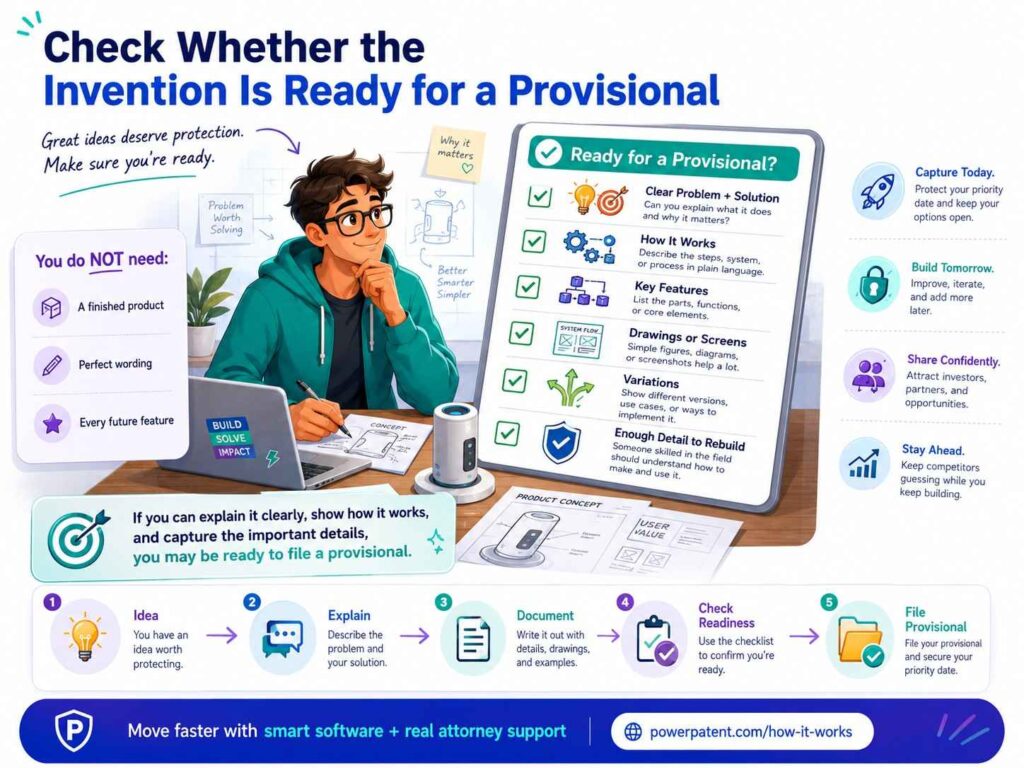
Many founders use a provisional patent application as a first step.
A provisional can help secure an early filing date.
But it must describe the invention well.
Do not file a thin provisional that barely says anything.
Your novelty checklist should help make the provisional stronger.
Include the core feature, variations, technical problem, technical result, examples, diagrams, and differences from known work where helpful.
A strong provisional can be valuable.
A weak one can create false comfort.
Fast is good. Empty is not.
PowerPatent helps founders move quickly while still capturing meaningful detail. See how it works here: https://powerpatent.com/how-it-works
Check Whether Your Patent Story Is Clear
A strong patent story is simple.
Here was the problem.
Old systems tried to solve it this way.
They missed this issue.
Our invention does this new thing.
That new thing creates this technical benefit.
If you can tell that story clearly, your filing is in better shape.
If the story is muddy, keep working.
Maybe the invention is not clear. Maybe the search is not complete. Maybe the real invention is somewhere else in the product.
Do not force a weak story.
Find the real one.
A Novelty Checklist for AI Inventions
AI inventions need a careful novelty check because many teams use similar words.
Do not stop at “we use AI.”
Ask what the AI system actually does.
Does it choose data in a new way?
Does it train a model in a new way?
Does it build prompts in a special way?
Does it select tools based on system state?
Does it check output against trusted sources?
Does it update memory with a new rule?
Does it run across edge and cloud devices?
Does it protect private data?
Does it recover from bad model output?
Does it reduce hallucinations?
Does it lower compute cost?
Search those details.
AI novelty is usually not in the word “AI.” It is in the workflow around the model.
For example, “an AI agent for finance” is broad.
But “a system that verifies model-generated financial answers against source documents and blocks output when source confidence is below a threshold” is more specific.
That is the level to search.
A Novelty Checklist for Software Inventions
For software, ask how the system works under the hood.
What data comes in?
How is it processed?
What decision is made?
What output is created?
What changes in the computer system?
What technical result improves?
Search patents, papers, docs, open-source code, and product manuals.
Avoid searching only business terms.
For example, “project management automation” is broad.
But “a system that predicts task delay by comparing code commit activity, dependency graph changes, and unresolved review comments” is more concrete.
The more technical your description, the better your novelty check.
A Novelty Checklist for Hardware Inventions
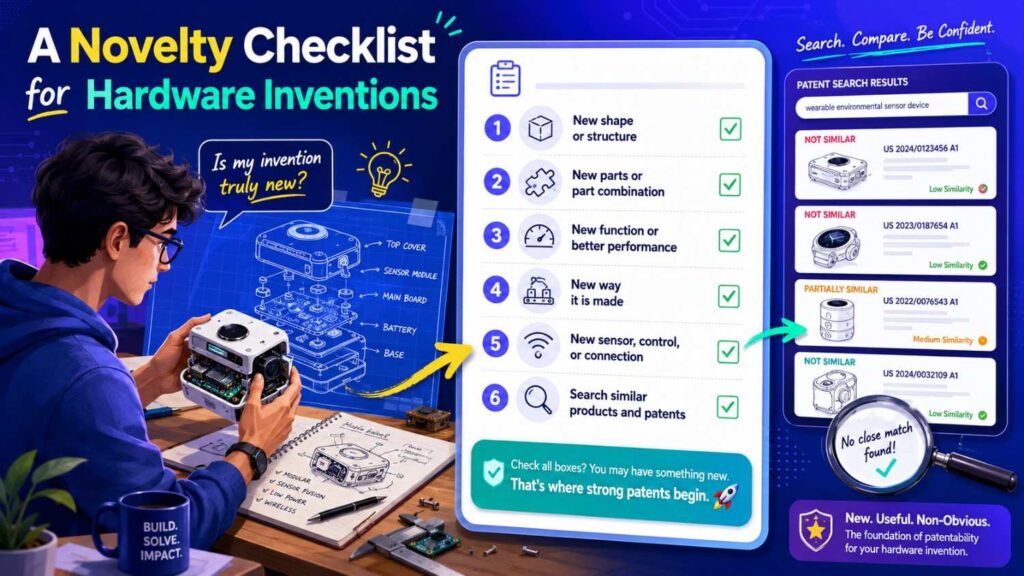
For hardware, focus on structure and function.
What parts are new?
How are they arranged?
How do they move?
How are they connected?
What material is used?
How does heat, force, fluid, light, sound, or electricity move?
What sensor is placed where?
What control signal changes the device?
Search drawings carefully.
Look at patents, manuals, datasheets, product photos, teardown videos, and technical papers.
Hardware novelty often lives in details that seem small but create a real result.
A new placement, shape, path, or mechanism can matter if it solves a real problem.
A Novelty Checklist for Medical Devices
For medical devices, search both the device and the clinical problem.
Look at structure, patient contact, sensor position, delivery method, control logic, safety feature, calibration, and treatment workflow.
Search patents, papers, manuals, clinical materials, product docs, and regulatory materials.
Small technical differences may be important.
But because medical devices are high-stakes, attorney and expert review is especially useful.
A founder-led novelty check can still help you prepare.
It can identify close devices and clarify what your invention does differently.
A Novelty Checklist for Biotech and Chemistry
For biotech and chemistry, details are everything.
Search targets, compounds, compositions, sequences, vectors, pathways, cell types, assays, biomarkers, delivery methods, formulations, ranges, and uses.
Use patent databases and scientific literature.
Search old names and synonyms.
Check papers, patents, clinical trial records, product labels, and conference abstracts.
These fields can be complex. A simple checklist is a starting point, not a final answer.
If the invention is core to your company, get expert patent help early.
A Novelty Checklist for Robotics
Robotics inventions often combine many systems.
Search sensors, navigation, mapping, control, motion planning, task assignment, safety stops, fleet coordination, charging, and failure recovery.
Use terms from robotics research.
Search patents, papers, product docs, and conference materials.
Look across related fields like drones, vehicles, warehouse systems, factory automation, and delivery robots.
Robotics fields can be crowded, but that does not mean your invention is not patentable.
The key is to find the specific technical improvement.
Example: AI Support Tool
Imagine your startup built an AI support tool.
At first, you might say, “It helps support teams answer tickets.”
That is not enough.
You dig deeper.
The invention is a system that reads a support ticket, checks product usage changes, checks billing risk, reviews past support history, and creates a churn risk score. If the score is high, it routes the ticket to a senior agent and suggests a retention action.
Now run the checklist.
Is the invention clear? Yes.
Is the technical feature clear? The scoring and routing flow.
Search patents for AI ticket routing, churn prediction, support escalation, account health scoring, and customer service workflow automation.
Search papers for churn prediction and support ticket classification.
Search products and docs for support tools with routing and health scores.
Search competitors.
Now compare.
Maybe old systems route tickets by sentiment. Maybe others predict churn at the account level. Maybe others show customer health scores. But none combine ticket text, usage drop, billing risk, and routing to a senior agent in this event-based way.
That may be the novelty angle.
The patent should not be “AI support.”
It should focus on the specific technical workflow.
Example: Edge AI Camera
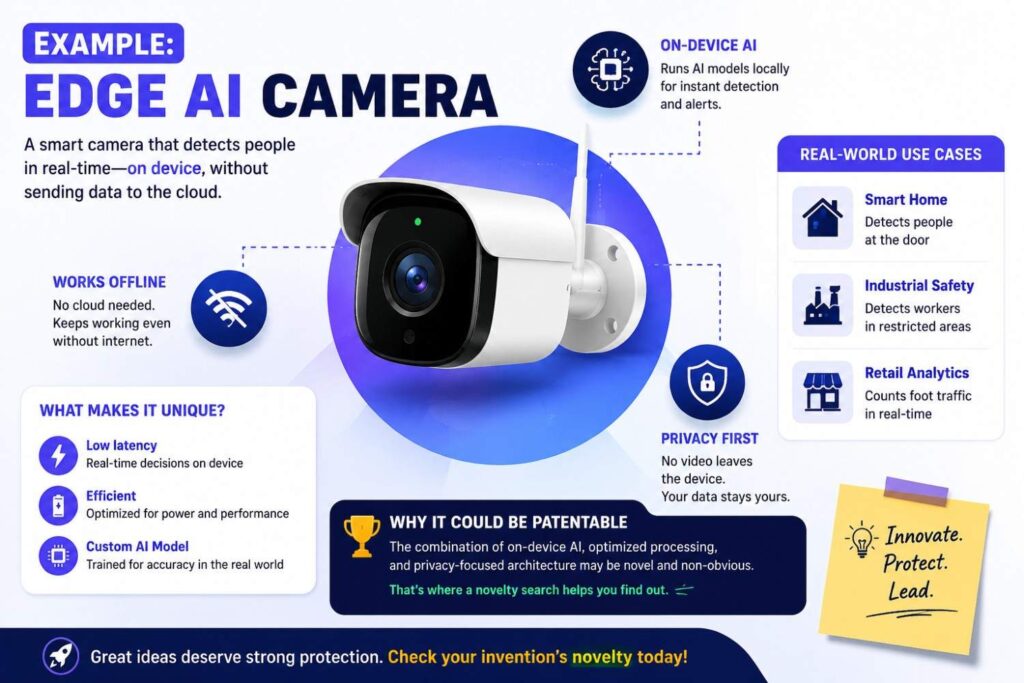
Imagine your startup built a factory safety camera.
The simple pitch is, “It detects safety risks with low power.”
The invention is more specific.
A low-power model checks motion patterns. If the pattern matches a risk profile, the device wakes a larger vision model. The larger model runs locally and sends only a compact event record to the cloud.
Now run the checklist.
Search low-power camera, motion-triggered vision, edge inference, selective model activation, event-based safety detection, local AI camera, and model cascade.
You find old motion cameras. You find edge AI systems. You find factory safety cameras.
Now compare.
Old motion cameras may wake on any motion. Your system wakes based on classified risk patterns.
Old edge AI systems may run models locally. Your system uses staged model activation to save power.
Old safety cameras may send full video to the cloud. Your system sends compact event records.
Your novelty may be in the combined wake-up and local event flow.
That is what you would bring into the patent process.
Example: Battery Management
Imagine your team built a battery management method.
The pitch is, “It makes batteries last longer.”
The invention is that the system predicts cell imbalance from early thermal signals before voltage drift appears, then changes the charging pattern.
Search battery cell balancing, thermal prediction, charge control, battery management, temperature-based charging, early imbalance detection, and adaptive charging.
You find old battery systems that use voltage drift. You find thermal monitoring. You find charge control methods.
Now compare.
If no single reference predicts imbalance from early heat patterns before voltage drift and changes charging based on that prediction, you may have novelty.
The technical benefit is earlier correction and safer charging.
That is a clear patent story.
Example: Developer Tool
Imagine your startup built an AI tool for code testing.
The pitch is, “It runs smarter tests.”
The invention is a method that builds a dependency graph from code changes, production logs, and test history, then selects only tests linked to risky changed areas.
Search test selection, code dependency graph, regression testing, production log analysis, change impact analysis, software failure prediction, and targeted testing.
You find old test selection systems. You find dependency graphs. You find log analysis.
Now compare.
Maybe old systems select tests based only on code dependencies. Your system updates risk based on production logs.
Maybe old systems use logs but do not map them to test selection.
Your novelty may be the way production behavior changes the test graph.
That is more useful than claiming “AI testing.”
What If the Checklist Looks Good?
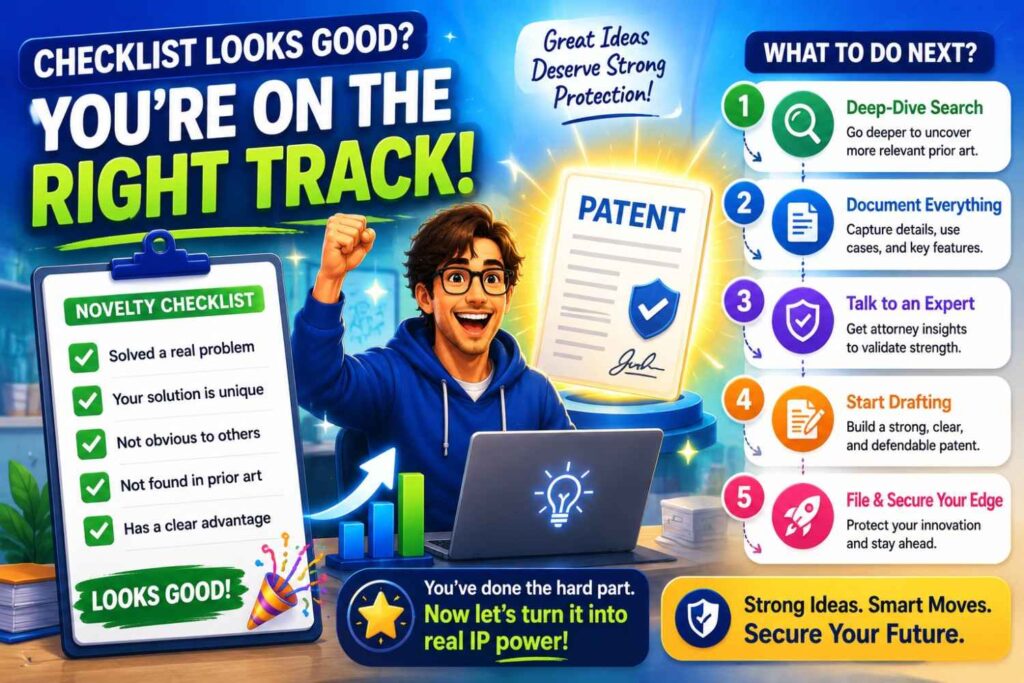
If your checklist looks good, take the next step.
Prepare a clean invention summary.
Gather diagrams.
Save search notes.
List the closest prior art.
Write your difference in plain words.
Collect test results if you have them.
Then start the patent filing process.
Do not wait until after launch if the invention is important.
PowerPatent can help you move from this checklist into an attorney-reviewed patent path with less friction. Start here: https://powerpatent.com/how-it-works
What If the Checklist Looks Bad?
If the checklist shows that your broad invention is already known, do not give up right away.
Look for improvements.
What did your team add?
What works better?
What setting is harder?
What technical limit did you solve?
What part of your product is not shown in the old work?
You may not be able to patent the broad concept, but you may be able to patent a better version.
If nothing seems new, it may be better not to file on that invention.
That is still a win.
You saved money and learned the field.
Now you can focus on a stronger invention.
What If You Are Not Sure?
Most founders are not sure.
That is normal.
Patentability is not always obvious.
A reference may look close but miss a key part. A paper may seem scary but use a different method. A competitor patent may sound broad but claim something narrower.
If you are unsure, gather your notes and get help.
Do not make major IP decisions based only on a quick search.
PowerPatent gives founders a way to bring technical details into a structured process with real patent attorney oversight. That helps you move beyond guessing. See how it works here: https://powerpatent.com/how-it-works
How PowerPatent Helps With the Novelty Question
PowerPatent helps founders get from “I think this is new” to a clearer patent path.
The platform helps capture what the invention is, how it works, and why it matters.
That structure is important.
A patent is only as strong as the invention story inside it.
If the story is vague, the filing may be weak.
If the story is clear, technical, and focused on the real difference, the filing has a better foundation.
PowerPatent also includes real patent attorney oversight. That matters because novelty and patent strategy can be subtle.
Smart software helps with speed and structure.
Attorney review helps with judgment.
That combination is built for modern founders who do not want slow, confusing patent work but also do not want risky DIY filings.
The Founder’s Final Novelty Check
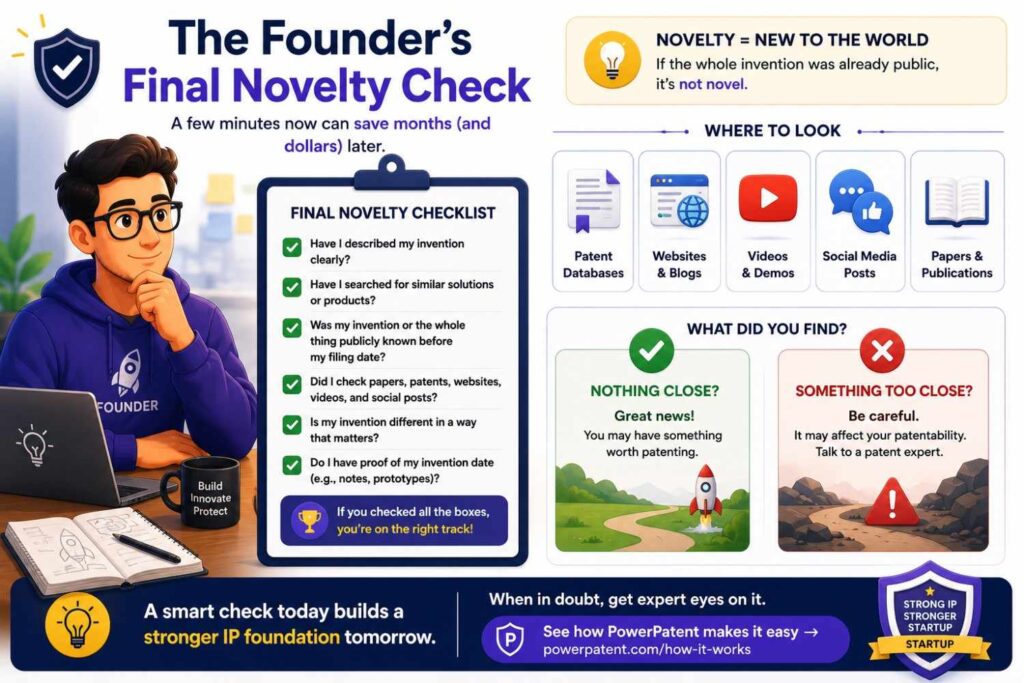
Before you file, do one last review that looks at the invention like a business asset, not just a clever idea.
This final check should help you answer three big questions:
Is this invention truly different?
Does this invention matter to the company?
Are we ready to protect it before the market sees too much?
A patent is not just a document. For a startup, it can support fundraising, partnerships, licensing, defense, and future exit value. So this last check should be clear, honest, and tied to business goals.
Check the Business Value, Not Just the Technical Difference
A technical difference is important, but it is not the whole story.
Before filing, ask whether this invention protects something your business truly needs.
Does it support your main product?
Does it make your product faster, safer, cheaper, more accurate, or harder to copy?
Would a competitor want this feature if they saw it working?
Would losing this advantage hurt your company?
Would this invention matter in an investor meeting, customer deal, partner review, or acquisition process?
Some inventions are new but not very useful to protect. Others may look small at first but sit at the center of your company’s edge.
For example, a small backend method that cuts cloud cost by 40% may be far more valuable than a flashy user-facing feature. A sensor placement that makes a device work in real-world noise may be more important than the app screen customers see. A model-checking step that prevents unsafe AI output may become the reason large customers trust your product.
Founders should look for the invention that protects the business engine.
That is often the best filing target.
Map the Invention to Your Moat
A moat is what makes your company hard to copy.
Your patent strategy should support that moat.
Before filing, write down how the invention fits into your larger defense plan.
Maybe your moat is speed. Maybe it is data. Maybe it is hardware performance. Maybe it is model quality. Maybe it is regulatory trust. Maybe it is deep system integration. Maybe it is a hard technical workflow that took your team months to solve.
Now ask:
Does this patent help protect that moat?
If the answer is yes, the invention may be worth serious attention.
If the answer is no, you may still file, but it should not distract from protecting more central work.
A strong patent portfolio is not built by filing random ideas. It is built by protecting the parts of the company that competitors will need to copy if they want to catch up.
That is the strategic lens.
Do not only ask, “Can we patent this?”
Ask, “Would this patent make our company harder to copy?”
Identify the Copycat Risk
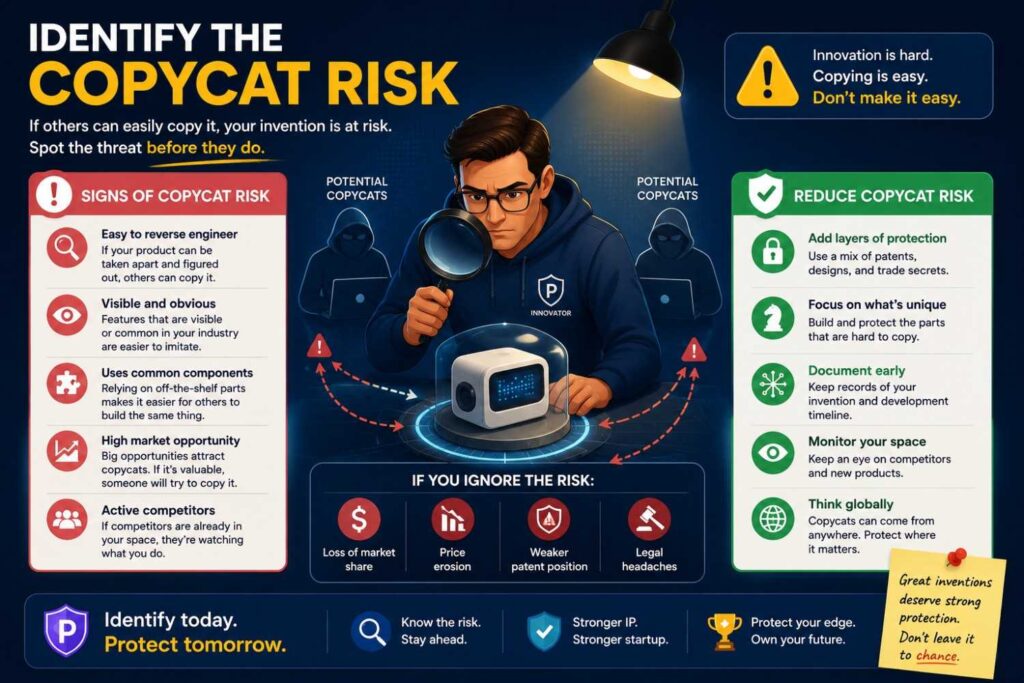
A very useful founder question is:
What would a smart competitor copy first?
Not what they would admire. Not what sounds cool in a pitch deck. What would they actually copy to close the gap?
If your answer points to this invention, that is a strong signal.
Think like a competitor for a moment.
If they saw your demo, what would they try to rebuild?
If they hired one of your customers, what feature would they hear about?
If they studied your product behavior, what hidden system would they try to guess?
If they wanted your performance numbers, what technical step would they need?
This exercise helps you sort inventions by real-world value.
A patent is often most useful when it protects a feature that competitors cannot avoid without giving up an important benefit.
If competitors can easily work around the invention and get the same result, the patent may be less strategic. If they need your approach to match your product, the invention may be worth filing quickly.
Check Whether the Invention Will Become Public Soon
Novelty can be damaged by public disclosure.
So before filing, review your next 90 days.
Are you launching a product?
Publishing technical docs?
Releasing an API?
Open-sourcing code?
Presenting at a conference?
Posting an engineering blog?
Sharing architecture in investor decks?
Starting customer pilots?
Sending detailed materials to partners?
If any of these will reveal how the invention works, you should treat filing as urgent.
This does not mean you must stop marketing. It means you should protect the core technical details before they become public.
A simple business rule helps:
If the market will soon learn how it works, file before that happens.
This is especially important for deep tech startups because the most valuable details are often shared during pilots, diligence, enterprise sales, or technical onboarding.
Founders may think, “We are only showing this to customers.”
But if there is no strong confidentiality setup, or if the information spreads, it can create risk.
File first when the invention is important.
Decide Whether This Should Be a Patent or a Trade Secret
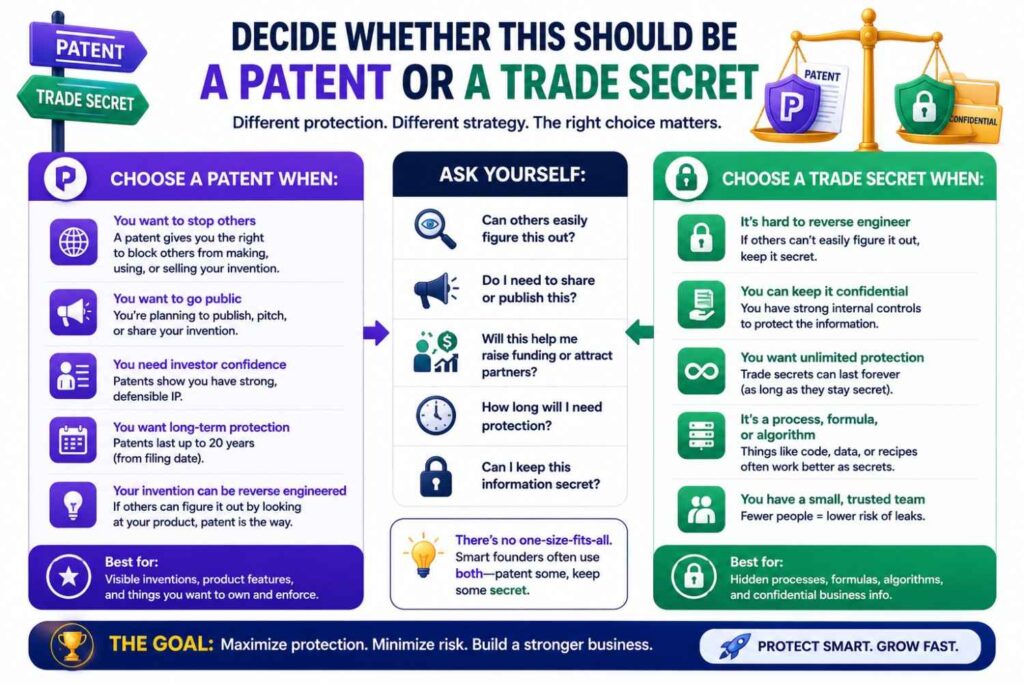
Not every new invention should become a patent.
A patent becomes public. A trade secret stays private.
So ask whether the invention can stay hidden.
If customers can see it, inspect it, reverse engineer it, or infer it from product behavior, patent protection may make more sense.
If the invention is a backend process that no one outside the company can see, and you can keep it secret for a long time, trade secret protection may be worth considering.
For example, a visible device structure is often hard to keep secret once the product is sold. A special factory process may be easier to keep secret. A model training method may stay private if it is fully internal, but it may leak through papers, employees, partners, or customer audits.
There is no one-size answer.
The strategic question is:
Will we gain more by publishing this invention in exchange for patent rights, or by keeping it secret?
This decision should be made before filing, not after.
Rank the Invention Against Other Filing Options
Most startups have more than one possible invention.
Your budget and time are limited.
So before filing, compare this invention against other candidates.
Ask which invention is closest to revenue. Which one protects the core product. Which one competitors are most likely to copy. Which one will be disclosed soon. Which one is hardest to design around. Which one supports the investor story. Which one may create the most long-term value.
This helps you avoid filing in the wrong order.
For example, your team may have a clever dashboard feature, a model training method, and a low-cost deployment system. The dashboard may be easy to see, but the deployment system may be what makes your margins work. The model training method may be what gives your product better accuracy. The right first filing may not be the most visible feature.
A simple ranking system can help.
Score each invention on business value, copycat risk, disclosure risk, technical strength, and connection to your core product.
The highest-scoring invention should usually move first.
Make Sure the Invention Has Enough Detail to Support a Strong Filing
A patent filing should not be thin.
Before moving forward, check whether you have enough detail to explain the invention well.
Can you describe the system step by step?
Can you draw the flow?
Can you name the inputs and outputs?
Can you explain the old problem?
Can you explain why old methods were not enough?
Can you show examples?
Can you describe different versions?
Can you explain what happens when the system fails?
Can you show test results or early performance data?
This matters because a weak filing can create false comfort.
A founder may think, “We filed, so we are protected.”
But if the filing does not clearly describe the invention, it may not protect the thing that matters.
Strong patents start with strong technical detail.
Before filing, gather diagrams, screenshots, architecture notes, code comments, lab data, test results, product specs, and engineering notes.
Do not wait for perfect polish. But do gather enough substance.
Write the One-Sentence Patent Thesis
Before you file, force yourself to write one clean sentence.
Use this format:
“We should protect this invention because it does [specific technical thing], which creates [specific business or technical advantage], and competitors would need it to [copy key benefit].”
For example:
“We should protect this invention because it uses a low-power model to decide when to wake a larger local vision model, which saves battery in factory safety cameras, and competitors would need a similar flow to match our power and detection performance.”
Or:
“We should protect this invention because it updates a software dependency graph using production log signals before selecting tests, which cuts test time for engineering teams, and competitors would need a similar method to match our speed without losing reliability.”
This sentence is powerful.
It connects the patent to the business.
If you cannot write this sentence clearly, pause and refine the invention story.
Pressure-Test the Invention With the “Board Meeting” Question
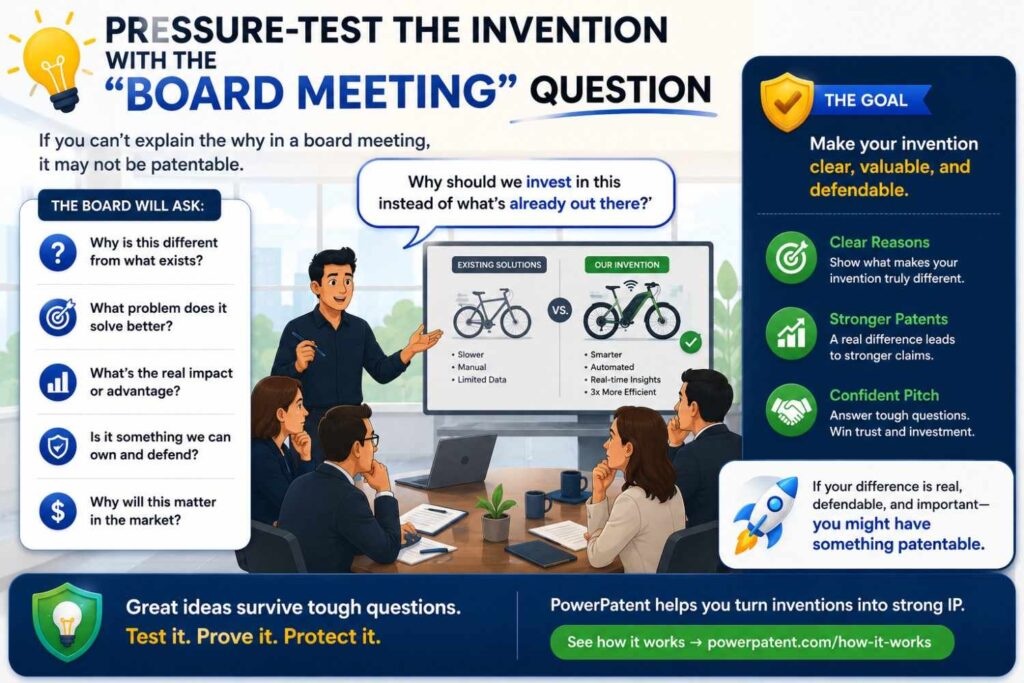
Imagine you are in a board meeting one year from now.
Someone asks, “Why did we spend money filing this patent?”
Would you have a strong answer?
A weak answer sounds like:
“Because it seemed new.”
A better answer sounds like:
“Because this is the method that lets our system run faster and cheaper than competitors, and it is likely to be copied once our product is public.”
That is the level of clarity you want.
Patents should support company strategy.
They should not be random legal trophies.
Before filing, make sure you can explain why this invention matters to the business in plain words.
Prepare a Clean Handoff for Patent Review
Once the final novelty check looks strong, prepare a clean package.
This should include the invention summary, closest prior art, key differences, diagrams, technical examples, known variations, public disclosure timeline, and business reason for filing.
This handoff saves time.
It also helps the patent team focus on the right thing.
Instead of saying, “Here is our product, please patent it,” you are saying, “Here is the invention, here is what we found, here is why it matters, and here is what we want to protect.”
That is much stronger.
It gives your patent attorney better raw material.
It also reduces the risk that the final application misses the real invention.
PowerPatent helps founders create this kind of structured path from invention details to attorney-reviewed patent filings. It is built for teams that want speed, clarity, and real oversight without the old-school back-and-forth. See how it works here: https://powerpatent.com/how-it-works
Decide the Next Action
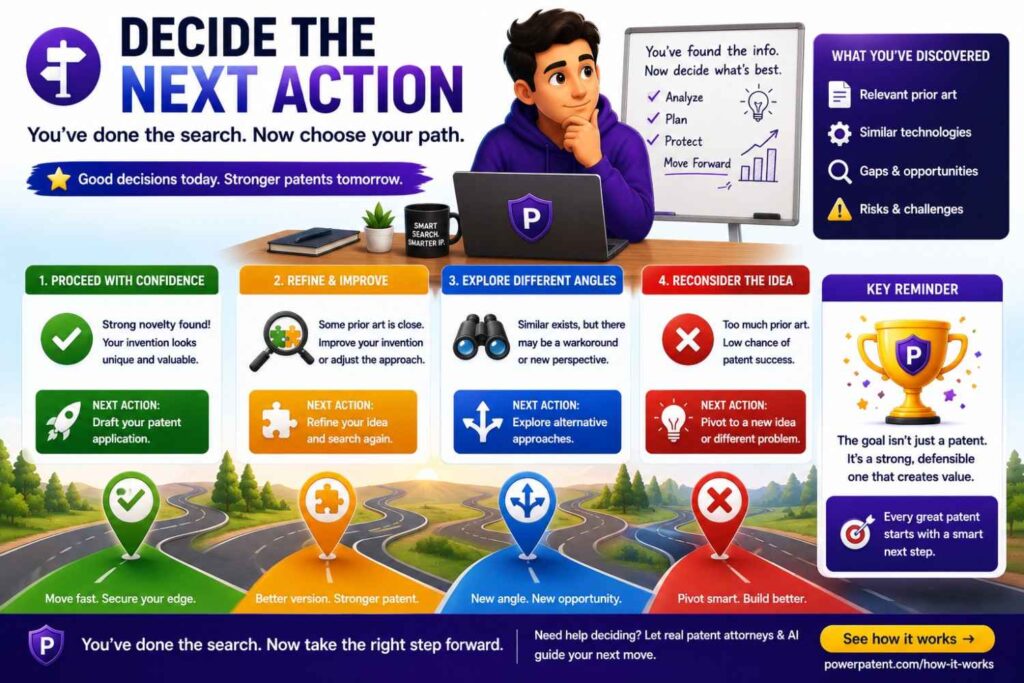
At the end of the final check, do not leave the invention in limbo.
Choose one next step.
File now if the invention is important, clear, and likely to be disclosed soon.
Do more search if the closest prior art is unclear.
Gather more technical detail if the invention is promising but still too thin.
Hold as a trade secret if it is valuable, hidden, and not easy to reverse engineer.
Deprioritize it if it is new but not central to the business.
This decision discipline matters.
Many startups lose time because every invention sits in a vague “maybe later” bucket.
A final novelty check should create action.
The best founders do not just ask whether something is patentable. They decide what to protect, when to protect it, and why it matters to the company..
Final Thoughts
Novelty does not need to feel mysterious.
At its core, the question is simple:
Did someone already publicly show your invention before you filed?
To answer that well, you need to describe your invention clearly, search carefully, compare old work, and find the real technical difference.
You do not need to become a patent expert.
You do need to be thoughtful.
For founders, this is worth doing. A strong novelty check can help you avoid weak filings, protect the right invention, and move faster with more confidence.
Your invention may be more than an idea.
It may be one of the most valuable assets your company has.
When you are ready to protect it, PowerPatent can help you turn your technical work into a real patent path with smart software and real attorney oversight.
Start here: https://powerpatent.com/how-it-works
Leave a Reply