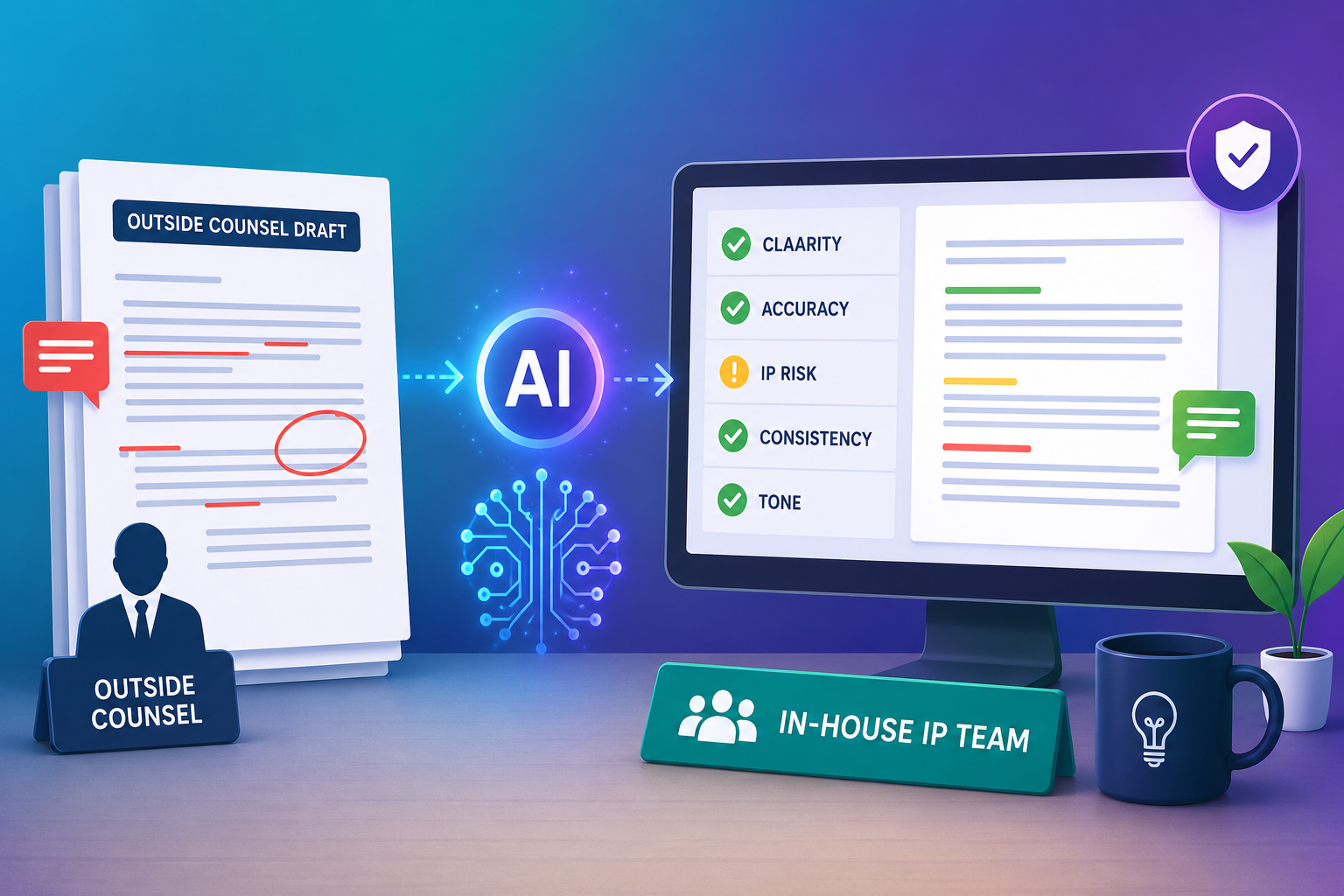
A patent draft from outside counsel can look “done” at first glance. The words are polished. The format looks right. The claims sound careful. But for an in-house IP team, the real question is not whether the draft looks professional. The real question is whether it protects the business.
In-house IP teams use AI to test whether the draft protects the real business asset.
A strong patent draft is not just a clean legal document. It is a business shield. It should protect the part of the product that makes the company hard to copy.
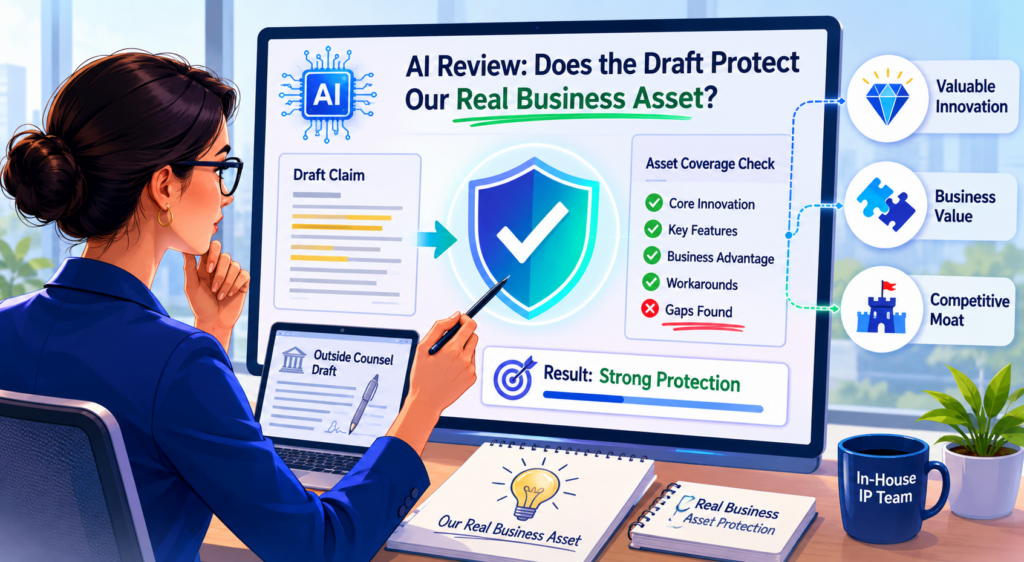
That may be a model pipeline, a training method, a chip design, a control system, a medical device workflow, a robotics stack, a data process, or a small technical trick that gives the product its edge.
The outside counsel draft may describe the invention, but the in-house team has to ask a deeper question. Does this draft protect what actually matters?
This is where AI becomes useful very fast. An in-house IP team can use AI to compare the draft against the invention notes, product specs, inventor comments, roadmap documents, code summaries, model cards, system diagrams, and prior internal disclosures.
The goal is not to let AI “approve” the patent. The goal is to make the review smarter. AI can help the team see where the draft lines up with the real product and where it starts to drift.
When a draft comes back from outside counsel, the first review often takes more time than expected. The claims need to be checked. The figures need to match the text. The examples need to support the broader idea.
The draft needs to avoid locking the invention into one narrow version. At the same time, the document must be clear enough that the inventors can say, “Yes, that is what we built.” AI helps make that first pass less painful and more complete.
The first job is to find the core invention before reviewing the wording.
Before an in-house team marks up claim language, it should confirm the core point of value. This sounds simple, but it is where many patent drafts lose strength.
A draft can be long and still miss the center of the invention. It can include many parts, many examples, and many technical words, while the most valuable idea is only mentioned once or hidden in a narrow example.
AI can help by reading the draft and giving a plain-language view of what the document appears to protect.
The team can ask AI to explain the invention in simple terms, name the main technical benefit, identify the parts that seem required, and point out which features appear optional.
This gives the in-house team a fast gut check. If the AI summary sounds like a side feature instead of the true business asset, the draft needs deeper review.
For example, suppose a company has built an AI system that reduces false positives in medical imaging by using a special feedback loop between a model and a human review step.
The outside counsel draft may focus heavily on image preprocessing because that was easy to describe. But the actual value may be the feedback loop.
AI can help flag this mismatch by comparing the draft against the invention disclosure and noting that the draft gives more weight to the preprocessing step than to the feedback mechanism.
That kind of insight matters. Patent drafts often become weak not because the attorney did poor work, but because the invention was not fully mapped to the company’s business goal.
The in-house team has context that outside counsel may not fully have. AI helps bring that context into the review.
A practical AI review starts by asking what the draft makes important.
A useful first prompt is not complex. The team can ask AI to read the draft and answer, in plain words, what the draft treats as the invention, what problem it solves, what technical result it claims, and what parts seem central.
Then the team can compare that answer with what the business believes is valuable.
This creates a simple but powerful test. If the draft says the key invention is one thing, while the product team says the key invention is another thing, the review should stop and reset.
There is no point polishing words around the wrong center. The claims, the summary, the detailed description, and the figures all need to point toward the real value.
PowerPatent is built around this same idea. The goal is not to make patents feel like mystery work.
The goal is to help teams turn what they are building into clearer, stronger patent assets with smart software and real attorney oversight.
For teams that want to move faster while still keeping quality high, it helps to see the process in action here: https://powerpatent.com/how-it-works
AI helps in-house teams find missing invention details before they become expensive problems.
One of the most common issues in outside counsel drafts is not bad writing. It is missing detail. The draft may describe the invention at a high level, but leave out the key choices that made it work.
This is risky because those details may be needed later. They may help support broader claims. They may help answer patent office questions. They may help show why the invention is different from older systems.
In-house teams can use AI to compare the draft against source materials and ask what is missing.
This may include missing inputs, outputs, model steps, system states, edge cases, fallback paths, hardware parts, data flows, timing rules, user actions, or training steps.
AI is good at spotting places where one document says more than another. It can say, in effect, “The disclosure mentions this feature, but the draft does not explain it,” or “The draft refers to a module, but never explains what the module does.”
That saves time. Instead of reading the draft from top to bottom and hoping to catch every gap, the in-house reviewer can start with a map of possible missing content. The reviewer still makes the final call. But the review becomes sharper.
For deep tech teams, this is especially helpful. Many inventions live in small technical choices. A robotics invention may depend on how sensor data is fused under noisy conditions.
A semiconductor invention may depend on a process window. An AI infrastructure invention may depend on how memory is used during inference.
A biotech platform may depend on how signals are filtered before a decision step. If those details are absent, the draft may look fine but protect too little.
The best review does not ask whether the draft is long enough, but whether it teaches the right things.
Length can trick people. A patent draft can be thirty pages and still feel thin where it matters. AI can help the team ask better questions. Does the draft explain how the invention works? Does it give enough examples?
Does it show other ways to build the same idea? Does it describe the main version and also the next likely versions? Does it support the claim language with real detail?
The in-house team should use AI to mark weak spots, then bring those points back to outside counsel with clear comments.
Instead of saying, “Please add more detail,” the team can say, “Please add support for the feedback loop in the model review process, including the confidence threshold, the human review trigger, and the model update path.”
That kind of comment is easier for counsel to act on, and it helps the final draft become stronger.
This also helps inventors. Inventors are busy. They do not want to read a full patent draft line by line if the first version is far from the actual invention.
When AI helps the IP team find the missing pieces first, the inventor review can be focused. The inventor can answer targeted questions instead of trying to fix the whole draft.
In-house IP teams use AI to review claims before the claims become the biggest risk.
The claims are the most important part of a patent draft. They define what the company is trying to protect. For many in-house teams, the claims are also the hardest part to review.
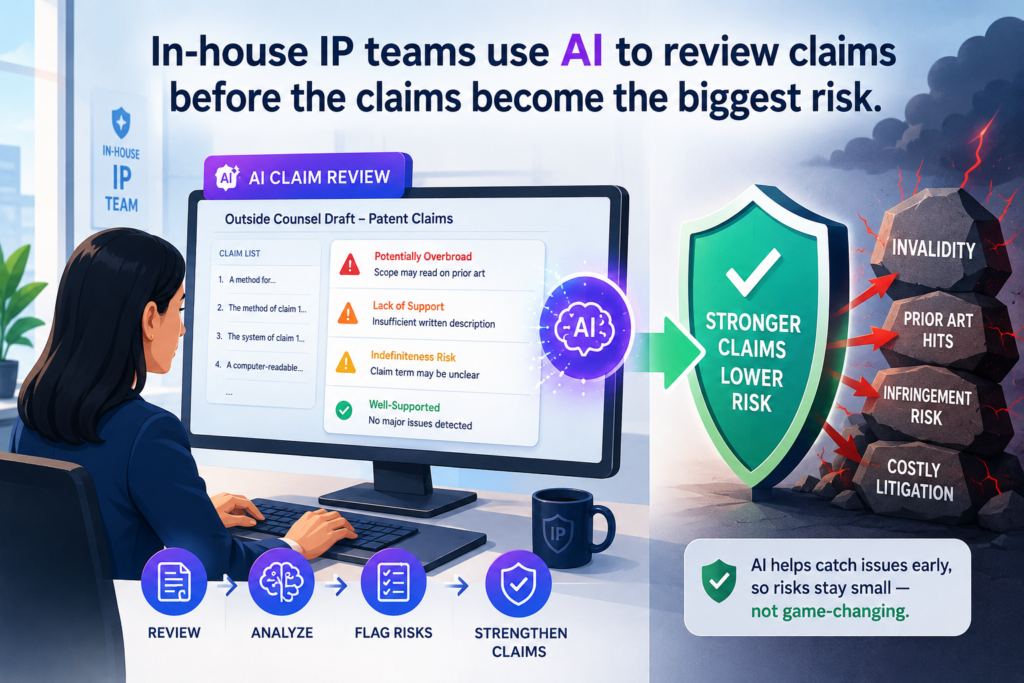
They are written in a very specific style. They can look broad, but hide narrow limits. They can look careful, but fail to cover the product. They can include words that seem harmless, but later become a problem.
AI helps by turning claim review into a more structured process. It can break claims into plain language. It can identify required parts. It can show what must be present for another product to fall inside the claim.
It can compare claim words against the product design. It can flag terms that appear unsupported or unclear.
Most of all, it helps the in-house team move from “these claims seem okay” to “these claims do or do not match our protection goal.”
This is a major shift. In-house teams do not need to become outside counsel. They do not need to rewrite every claim themselves. But they do need to understand what the claims are doing. AI gives them a faster way to see that.
AI can turn dense claim language into a plain-English coverage check.
A claim often reads like a long sentence with many parts. Each part matters. A small phrase can narrow the claim. A required order of steps can limit coverage. A specific data type can exclude future versions.
A hardware element can make a software invention harder to protect. A narrow model type can leave out the next model architecture the team plans to use.
AI can help by translating each claim into simple words. The in-house team can ask, “What would a competing product need to include to meet this claim?” That question is powerful because it forces the claim to be viewed from the market.
If a competitor could avoid the claim by changing a small non-core detail, the claim may need work.
For example, a claim may say that a system uses a neural network trained on labeled images from a first sensor. That may sound fine if the current product works that way.
But the company roadmap may include unlabeled data, multiple sensors, and synthetic training sets.
If the claim is limited to labeled images from one sensor, it may not protect where the product is going. AI can flag that mismatch if the roadmap materials are included in the review.
The in-house team can also ask AI to identify every required element in the claim. This helps reveal hidden limits.
A claim may require a server, a user device, a database, and a ranking module. If the real product can run locally without a server, or may move to an edge device later, the team should know that before filing.
A claim should be tested against the current product, the next product, and the likely copycat.
The current product is only the first test. A strong patent draft should also think about the next version and the likely copycat version. AI can help run these tests in plain words.
The current product test asks whether the claim covers what the company is building now. If not, the draft may have a serious gap.
The roadmap test asks whether the claim still makes sense as the product changes. If the claims only cover today’s build, the company may outgrow its own patent.
The copycat test asks whether a competitor could take the main idea while avoiding one narrow claim part. If that is easy, the claims may not be doing enough.
This is where AI can help the in-house IP team give better feedback to outside counsel. Instead of sending vague comments like “Can we make this broader?” the team can send a specific note.
The note may say that claim 1 requires a cloud server, but the company wants coverage for local, edge, and hybrid deployment.
Or it may say that the claim requires a transformer model, but the invention should cover any model that performs the same technical role. These comments are practical. They are clear. They save cycles.
PowerPatent helps teams work this way by connecting invention details, claim review, and attorney guidance in a cleaner workflow.
When teams can see what a draft actually covers, they can make better decisions before filing.
That means fewer surprises, less rework, and stronger protection. You can learn more about that process here: https://powerpatent.com/how-it-works
AI helps spot claim terms that sound safe but may create narrow protection.
Some claim words look harmless. Words like “single,” “fixed,” “central,” “manual,” “labeled,” “specific,” “predefined,” or “periodic” can quietly shrink coverage. Sometimes those words are needed.
Many times they are not. In-house teams can use AI to flag words that may limit the claim and ask whether each one is truly required by the invention.
This does not mean every narrow word is bad. A patent needs clear support. Sometimes a narrow claim is useful. Sometimes the team wants a focused claim that tracks the product closely.
But narrow words should be chosen on purpose. They should not appear by accident because an example was copied into the claim.
AI can help by creating a “limiting language” review. The team can ask AI to identify terms that may narrow the claim, explain how each term could limit coverage, and suggest questions for counsel.
The output should not be treated as legal advice. It should be treated as a review aid. The in-house team can then ask outside counsel to confirm whether the terms are needed and whether broader support exists in the draft.
For example, if a claim says the system updates a model “after each user session,” the team should ask whether the invention truly requires updates after every session.
Maybe the system can update after a batch of sessions, after a threshold is met, after a time delay, or after a review event. If those options are part of the invention, the draft should support them. AI can help find that issue early.
The most useful AI output is not a rewrite, but a better question for counsel.
In-house IP review works best when AI helps the team ask sharper questions. The team does not need AI to replace outside counsel. It needs AI to make counsel’s time more valuable.
A good AI-assisted review might lead to comments like, “Why does claim 1 require this step to happen before that step?” or “Can this module be described in functional terms instead of as one fixed component?” or “Do we have support for doing this with different model types?”
Those questions move the draft forward. They also help the in-house team stay in control of the business goal.
Outside counsel brings legal skill. Inventors bring technical truth. The in-house team brings product and company strategy. AI helps connect all three.
This is why AI review is becoming a normal part of modern IP work. It reduces blind spots. It speeds up the first pass. It helps teams catch avoidable issues before they become filing problems.
And when paired with real attorney oversight, it gives companies a more confident way to protect what they are building.
In-house IP teams use AI to compare the draft against the invention record before inventor review.
Inventor review is one of the most important steps in patent drafting, but it can also become one of the slowest. Inventors are busy. They are building, testing, shipping, fixing bugs, meeting customers, and making hard technical calls every day.
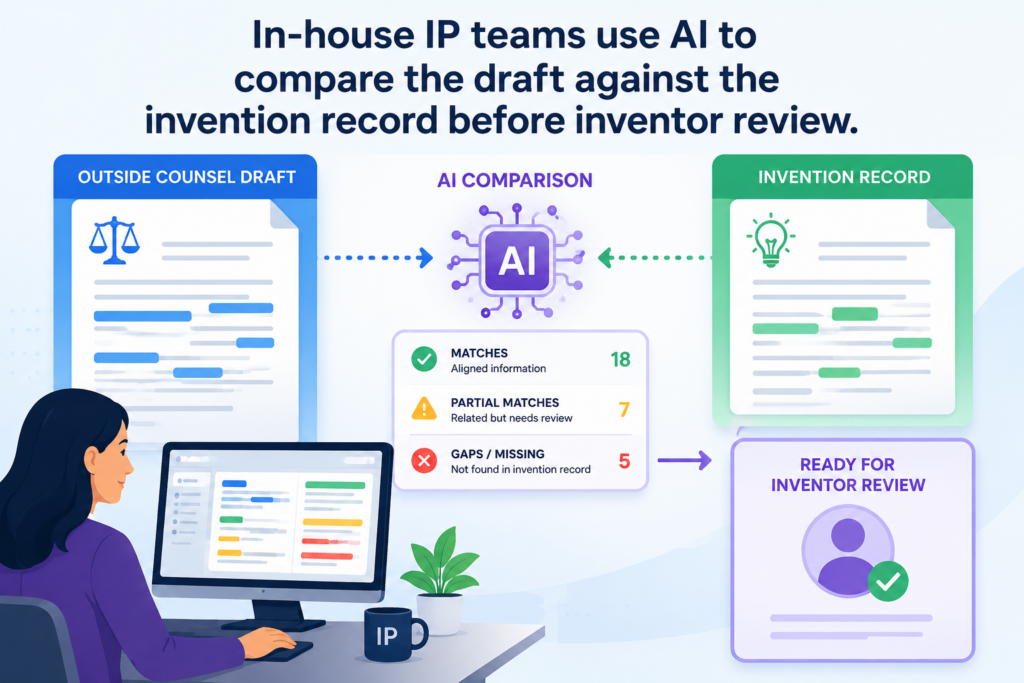
When a long patent draft lands in their inbox, they may scan it fast, leave a few comments, and move on. That is risky because inventors often hold the small details that make the invention strong.
This is why in-house IP teams use AI before the inventor ever sees the draft. The goal is to clean up the review path.
AI can compare the outside counsel draft against the invention disclosure, meeting notes, lab notes, design docs, code summaries, product specs, and earlier emails. Then it can show where the draft matches the record and where it does not.
This helps the in-house team avoid sending a weak or confusing draft to the inventors. Instead of asking inventors to review everything from scratch, the team can ask better questions. The inventor does not have to say, “This whole part feels wrong.”
The team can ask, “Is the model update step missing this trigger condition?” or “Should this sensor fusion step happen before or after the filtering step?” That kind of question gets better answers.
AI also helps reduce review fatigue. When inventors are asked to review drafts that are too broad, too narrow, or too hard to read, they may stop engaging.
But when the in-house team gives them a short set of focused issues, inventors are more likely to respond with useful technical input. That input can make the patent far stronger.
The invention record is the source of truth, not the draft.
A patent draft is only as strong as the facts behind it. The outside counsel draft is a written version of the invention, but it is not the invention itself.
The true source of value is the actual work done by the team. That work may live in system diagrams, model tests, code commits, design choices, customer use cases, and technical tradeoffs.
AI can help bring that full record into the review. It can find places where the draft leaves out important facts. It can also find places where the draft adds things that may not be true.
Both problems matter. A missing detail can weaken support. An added detail can cause confusion. A wrong detail can create bigger trouble later.
For example, a draft may say that a system ranks outputs based on a user score. But the real system may rank outputs based on a mix of model confidence, past user action, error type, and real-time system load. That difference matters.
If the patent only talks about user score, the draft may miss the technical reason the system works better. AI can help flag that gap before the inventor review.
The in-house IP team can also use AI to check whether the draft uses the same names as the engineering team. This may sound small, but it matters. Engineers may call something a “policy engine,” while the draft calls it a “rules module.”
That may be fine, but it may also hide a mismatch. AI can help build a map between draft terms and engineering terms, so reviewers can see whether they are talking about the same thing.
A strong AI pass turns inventor review into a guided check, not a guessing game.
The best inventor review is not a blank request that says, “Please review attached.” That creates too much work and too much room for missed issues.
A stronger approach is to send the draft with a short set of targeted questions. AI helps create those questions.
The in-house team can ask AI to find the top areas where inventor input is needed.
These may be places where the draft uses broad language, where the technical step is unclear, where the claim depends on a detail, or where the invention record says more than the draft. The team can then turn those findings into simple questions for inventors.
A good question might ask whether a step is required or just one example. Another question might ask whether the invention works with other input types.
Another might ask whether the model can be trained in a different way. These questions help the inventors give precise answers that outside counsel can use.
This is also where PowerPatent can help teams move faster. PowerPatent gives startups and IP teams a better way to turn technical work into stronger patent drafts, with smart software and real attorney oversight.
It helps keep the process clear, so inventors do not get buried in slow review loops. You can see how PowerPatent works here: https://powerpatent.com/how-it-works
AI helps in-house teams catch changes that happened after the first disclosure.
In fast-moving companies, the invention may change while the patent is being drafted. The first disclosure may describe version one. By the time outside counsel sends the draft back, the product may be on version three.
A model may have changed. A workflow may have been simplified. A hardware part may have been removed. A new customer use case may have become the main market.
This creates a real risk. The draft may be accurate to the first disclosure but not accurate to the current product. In-house IP teams use AI to compare the draft against newer records.
This may include later product specs, updated diagrams, release notes, internal demo notes, or engineering updates. AI can help ask, “What changed after the invention disclosure, and does the draft reflect it?”
This is not about chasing every small product change. A patent does not need to describe every build. But it should not miss a major change that affects the invention.
If the product no longer uses a required step in the claims, that is a problem. If the new version adds a much better technical path, the team may want to include it before filing.
The review should protect the invention as it is becoming, not only as it first appeared.
Startups move fast. Deep tech teams move even faster when they are close to a breakthrough. The first version of an invention is rarely the final version. In-house IP teams know this, so they use AI to make sure the draft has room for change.
AI can help identify whether the draft is too tied to the first prototype. It can flag language that depends on one test setup, one model type, one sensor, one user flow, or one deployment style. The team can then decide whether the draft should include more versions.
This matters because patents are not only about today. They are about creating room around the company’s future.
A good draft should protect the core idea while giving enough support for changes that are already likely. AI helps the team see whether the draft has that room.
In-house IP teams use AI to find support gaps before filing decisions are made.
A patent draft can have strong claims on the surface, but weak support underneath.

This is one of the biggest reasons in-house review matters. The claims may reach for broad protection, but the detailed description must back them up.
If the draft claims a system that works across many versions, the body should explain enough of those versions. If the draft claims a method that solves a technical problem, the body should show how the method works.
AI helps in-house IP teams spot these support gaps faster. It can compare each claim element with the detailed description and identify where the draft gives strong support, thin support, or no clear support. This makes review more tactical.
The team is not just reading for style. It is checking whether the document can carry the weight of the claims.
Support gaps often hide in plain sight. A claim may use a broad phrase like “generating a control signal based on sensor data.” The body may only describe one sensor, one signal type, and one control action.
If the business wants protection across many sensors and control outputs, the body may need more examples. AI can help flag that mismatch.
This is especially useful when outside counsel drafts quickly from a short disclosure.
A skilled attorney can write a clean draft, but if the source material is thin, the draft may still lack depth. AI helps the in-house team see where more inventor input is needed before filing.
AI can match claim language to the detailed description and show weak links.
One practical use of AI is claim-to-spec mapping. The in-house team can ask AI to take each claim phrase and find where the draft explains it.
The output can show which parts are well supported and which parts need more detail. This is not a final legal opinion, but it is a very useful review tool.
For example, if a claim says the system “updates a model based on a detected drift condition,” the team should check whether the body explains what drift means, how it is detected, what data is used, when the update happens, and what kind of update is made.
If the body only says that the system “may update the model,” that may be too thin. AI can flag that issue and help the team ask outside counsel to add support.
This process also helps in-house teams avoid overconfidence. A claim can sound strong because it uses broad language. But broad language without enough support can be fragile.
The review should ask whether the draft teaches real ways to practice the invention across the scope of the claims.
The same process can help with dependent claims. Dependent claims often include useful fallbacks. But they also need support.
AI can check whether those narrower features are explained in the body. If a dependent claim mentions a threshold, ranking rule, data structure, or device setting, the draft should explain it clearly.
A support gap is easier to fix before filing than after filing.
The best time to fix support gaps is before the application is filed. After filing, adding new technical matter can become much harder. That is why in-house teams should use AI early, while there is still time to improve the draft.
AI can help the team find missing support, but the fix often comes from the inventors.
The in-house IP team may need to ask inventors how a step works, what alternatives were considered, what other versions are possible, or what technical result was seen. Then outside counsel can add that material in a clean and proper way.
This is where a modern patent workflow makes a huge difference. Teams need a way to gather technical facts, structure them, review them, and turn them into strong drafts without endless back-and-forth.
PowerPatent is designed for this kind of work. It helps founders and technical teams move from invention details to attorney-reviewed patent filings with more control and less delay. See how the process works here: https://powerpatent.com/how-it-works
AI helps review whether examples are too narrow for the company’s goals.
Examples make a patent draft easier to understand. They show how the invention may work in practice. But examples can also create a hidden problem if the draft leans on them too much.
If every example describes one narrow version, the overall disclosure may feel narrow even if the claims are broad.
In-house teams use AI to review examples with the business goal in mind. AI can ask whether the examples cover enough different versions.
It can identify whether all examples use the same data source, same hardware setup, same model architecture, same user flow, same network structure, or same control path. If so, the team may want more variety.
This matters because competitors do not copy with perfect honesty. They look for ways around protection.
A good patent draft should not only describe the company’s exact product. It should also describe reasonable variations that still use the same core idea.
For example, if the invention is a way to reduce power use in an edge AI device, the examples should not only cover one device, one chip, and one model.
The draft may also need to describe other device types, other power states, other model sizes, and other trigger rules. AI can help surface those missing versions.
The draft should show the core idea from more than one angle.
A strong patent draft often teaches the invention in several ways. It may describe the system, the method, the data flow, the user action, the device setup, and the result.
This helps make the invention clearer. It also gives outside counsel more room to shape claims.
AI can help in-house teams check whether the draft shows the invention from enough angles. If the draft only explains the invention as a system, maybe it should also explain the process steps.
If it only explains one use case, maybe it should include others. If it only explains the front-end user action, maybe it should explain the back-end technical work.
This kind of review is very hard to do by hand when the draft is long. AI makes it easier to see patterns.
It can say, “Most examples are focused on user display, but the claims focus on model update.” That kind of mismatch gives the in-house team a clear action item.
In-house IP teams use AI to review figures, flowcharts, and system diagrams for real alignment.
Figures are easy to overlook during patent review. Many teams focus on the claims and the written description, then treat the figures as formal support. That is a mistake.
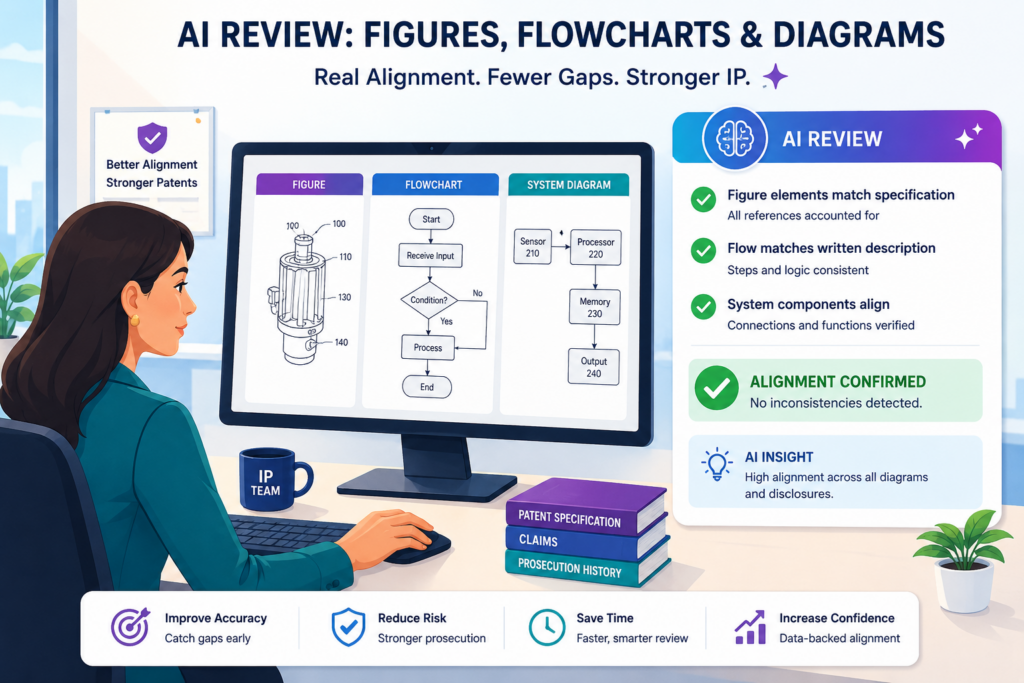
Figures often shape how the invention is understood. They show the system parts, the flow of data, the order of steps, and the relationship between components. If the figures are wrong or too narrow, they can weaken the whole draft.
AI helps in-house IP teams review figures more carefully. The team can compare figure descriptions with product diagrams, architecture charts, and engineering flowcharts.
AI can help find missing parts, strange names, mismatched labels, and steps that appear in the text but not in the drawings. It can also help identify whether a figure makes one part look required when it should be optional.
This matters because outside counsel often creates patent figures based on early notes or rough invention diagrams.
Those figures may not fully match the final product or the best version of the invention. If the in-house team does not catch this, the filed patent may carry an outdated view of the system.
A good figure review is not about making drawings pretty. It is about making sure the drawings support the story of the invention.
The figures should help explain what is new, how it works, and why the system is different.
AI can compare the figure labels with the words used in the draft.
One common issue in patent drafts is label drift. The figures may call something a “data processor,” while the text calls it a “ranking engine,” and the claims call it a “selection module.”
Sometimes that is fine. Sometimes it creates confusion. AI can help by building a term map across the claims, description, and figures.
This term map helps the in-house team see whether the same concept is being described with different names. It also helps find terms that appear only once.
If a figure includes a part that is never explained in the text, that may need attention. If the claims rely on a part that is not shown in any figure, that may also be worth reviewing.
For technical teams, this is very helpful. Engineers often notice naming problems quickly, but only if they have time to read the full draft.
AI can find those issues before inventor review. Then the in-house team can ask inventors or outside counsel to confirm the right terms.
AI can also check whether the figure descriptions match the figure content. If the text says data flows from A to B, but the figure shows B sending data to A, that mismatch should be fixed.
If a method step is described as optional in the text but shown as required in every flowchart, the team should decide whether more flexible figure language is needed.
The best figures leave room for the invention to grow.
A figure can make an invention look narrower than it is. For example, a system diagram may show one central server, one database, and one user device.
But the actual invention may work across cloud, edge, local, and hybrid systems. If every figure shows only a central server setup, the draft may feel tied to that version.
AI can help spot this by comparing figure structure to the broader product plan. The team can ask whether the figures show only one deployment style. It can ask whether the figures imply a fixed order of steps.
It can ask whether each shown component is truly needed. These questions help the team decide whether more figures or broader descriptions are needed.
This does not mean every patent needs many figures. It means the figures should serve the protection goal. If the company wants broad coverage, the figures should not quietly teach only one narrow build.
AI helps in-house teams review whether flowcharts match the real process.
Flowcharts are often used for method inventions, software workflows, AI pipelines, device control loops, and data processing systems. They can be powerful, but they can also create problems.
A flowchart may show steps in a strict order, even though the real process allows steps to happen in parallel, in a different order, or only when certain conditions are met.
AI can help review this. The in-house team can ask AI to extract every step from a flowchart description and compare it with the actual technical process.
Does the flowchart include all key steps? Does it show extra steps that are not required? Does it force a sequence that is not needed? Does it leave out feedback loops, fallback paths, or error handling?
For example, an AI model workflow may not be a straight line. It may include checks, confidence scores, review triggers, retraining steps, and rollback logic.
If the flowchart shows only a simple input-output path, the draft may miss the real technical value. AI can help flag that gap.
A flowchart should not turn an optional step into a required step by accident.
Optional steps are a major part of patent drafting strategy. Some steps may be useful but not required. Some may apply only in certain versions.
Some may be backup paths. If a flowchart makes every step look required, the draft may become too rigid.
AI can help identify this issue by comparing words like “may,” “can,” “optionally,” and “in some examples” against the flowchart language. If the text says a step is optional, but the flowchart description presents it as required, that should be reviewed.
If the claims do not require a step, but every figure does, the team should ask whether the disclosure needs more flexible wording.
PowerPatent helps teams avoid these kinds of avoidable mistakes by making the patent process easier to control from the start.
When software helps organize the invention and attorneys guide the final work, teams can file with more confidence. Learn how PowerPatent helps here: https://powerpatent.com/how-it-works
In-house IP teams use AI to check whether the draft matches the company’s product roadmap.
A patent is not just a record of what the company built last month. It should help protect where the company is going. This is why product roadmap review matters.
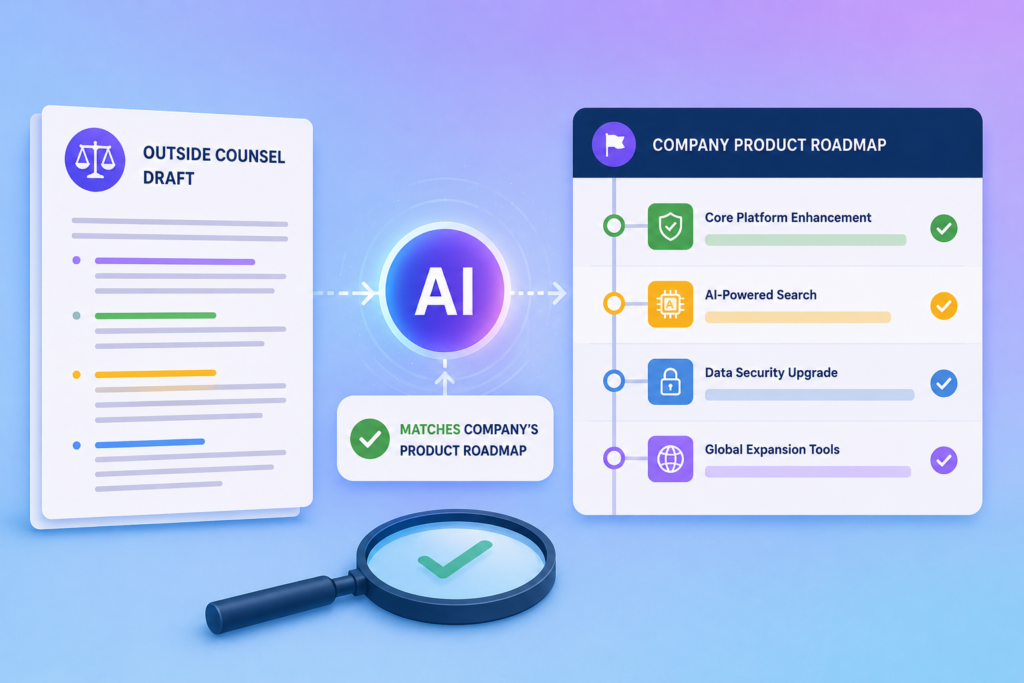
In-house IP teams are in the best position to connect patent work with future plans. Outside counsel may know the invention, but the in-house team knows the market push, product shifts, investor story, and planned technical path.
AI can help connect these pieces. It can compare the outside counsel draft with roadmap notes and identify where the draft may be too tied to the current product.
It can also find future product areas that are related to the invention but not yet reflected in the draft.
This does not mean the patent should claim things the team did not invent. It means the draft should capture the real invention in a way that supports natural growth.
If the same core method will be used in several products, the draft should not describe it as if it only belongs to one. If the same technical idea will later move from cloud to edge, the draft should not lock it to cloud only.
Roadmap review also helps with budget. In-house IP teams often have to decide which filings deserve more investment.
If AI shows that a draft maps to a major future platform, the team may give it more attention. If it only covers a small feature with limited life, the team may handle it differently.
AI can compare claim scope against planned product versions.
One of the most useful AI review steps is to test claims against future product versions.
The in-house team can feed AI a plain-language roadmap summary and ask whether the draft appears to cover each planned version. This can reveal gaps that are hard to see in normal review.
For example, suppose the current product uses a hosted AI service, but the next version will run on customer hardware. A claim that requires a remote server may cover the current product but not the future one.
Or suppose the current version uses image data, but the roadmap includes audio and sensor data. A claim that requires images may become too narrow.
AI can make these gaps visible. It can produce a plain-language comparison showing which product versions seem covered, which seem partly covered, and which may fall outside the draft.
The in-house team can then ask outside counsel whether the draft should be broadened, whether more support should be added, or whether a separate filing is needed.
This is not about letting AI make filing strategy decisions. The team and attorneys still do that. AI simply helps reveal the facts faster.
The roadmap review should focus on the core technical path, not every planned feature.
A roadmap can be huge. It may include user interface changes, integrations, pricing plans, customer segments, analytics tools, and support features.
Not all of that belongs in a patent review. The in-house IP team should use AI to focus on the technical path that relates to the invention.
The right question is not, “Does this patent cover every future feature?” The better question is, “Does this patent protect the core technical idea as it will likely be used in future products?” That keeps the review focused and useful.
AI can help by separating technical roadmap items from business or design items.
It can identify changes in architecture, data flow, model behavior, hardware setup, control logic, security design, or processing steps. Those are often the changes that matter most for patent review.
When this is done well, the in-house team can give outside counsel direct guidance. It can say, “Please make sure the draft supports local deployment because the roadmap includes an on-device version.”
Or it can say, “Please add examples for different input data types because the platform is moving beyond images.” These comments are specific, useful, and tied to business value.
AI helps teams avoid filing patents that protect yesterday’s product.
One of the quiet risks in patent work is delay. A draft can start with one product version, get reviewed weeks later, and be filed after the company has already moved on.
The result is a patent application that protects yesterday’s product better than tomorrow’s business.
AI helps reduce that risk by making review faster and more current. The in-house team can run a last roadmap check before approving the draft.
It can ask whether any major technical changes have happened since the draft started. It can compare new engineering notes against the draft. It can flag areas where the patent may need a quick update before filing.
This is very important for startups. A young company’s direction can change fast. A new customer may ask for a different deployment model.
A new model may replace an older one. A performance issue may lead to a new technical fix. These changes can be valuable, and they may deserve to be captured.
A patent draft should support the company’s next raise, next product, and next fight.
Patents are business tools. They can support fundraising, partnerships, licensing, defensive strength, and long-term company value.
That means they should line up with where the company is going. A patent that covers an abandoned feature may have less value than one that protects the platform’s core future.
AI helps in-house teams review this alignment with more discipline. It can summarize what the patent appears to protect and compare that to the company’s strategic story.
If the company tells investors that its advantage is a new training pipeline, but the patent draft focuses on a front-end workflow, something may be off.
If the company’s platform value is in the back-end engine, the patent should not read like a simple app feature.
PowerPatent helps founders and in-house teams build patents around the real invention, not just the paperwork.
The software helps move faster, while real patent attorneys help guide the work. For teams that want protection without slowing down the build, the process starts here: https://powerpatent.com/how-it-works
In-house IP teams use AI to turn outside counsel feedback into a faster review loop.
The patent review process can get slow because feedback moves in circles. Outside counsel sends a draft. The in-house team reviews it.
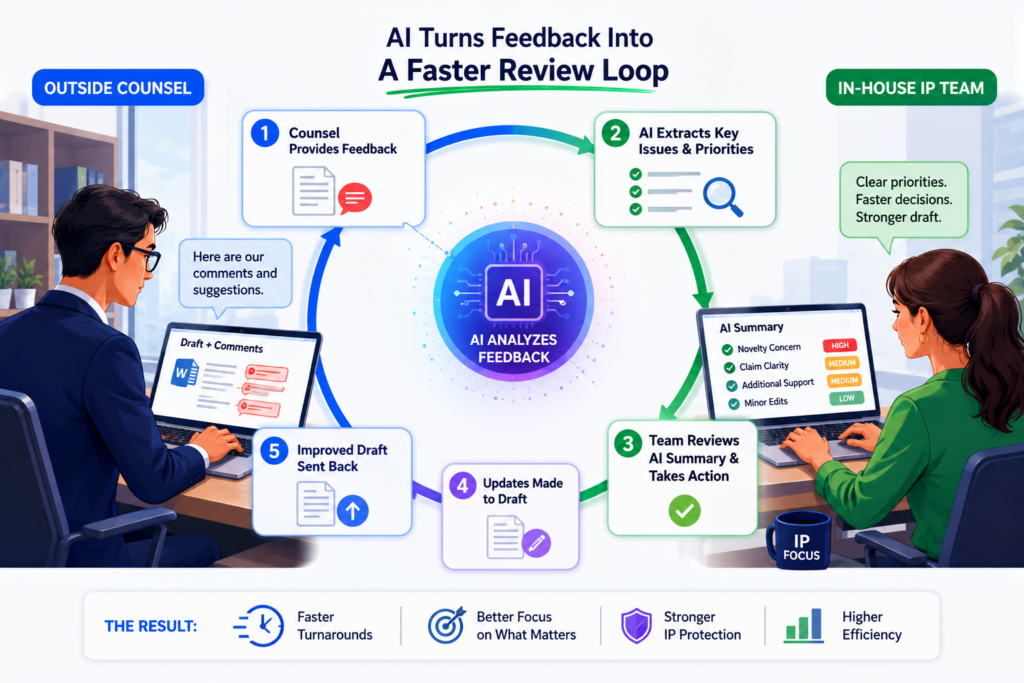
Inventors comment. Counsel revises. The in-house team checks again. More questions come up. The draft moves back and forth. Each turn takes time, and each delay adds risk.
AI helps in-house IP teams tighten that loop. It can organize comments, group similar issues, track open questions, and compare revised drafts against earlier versions.
This makes it easier to see whether counsel addressed the main points. It also helps prevent comments from getting lost.
The goal is not to rush the work. The goal is to remove wasted motion. When AI handles the messy review tasks, people can focus on judgment.
In-house counsel can focus on business fit and risk. Outside counsel can focus on legal strength. Inventors can focus on technical truth. That is a better use of everyone’s time.
AI also helps create a clearer record. The team can see why a change was requested, whether it was made, and whether the revised language solved the issue.
This matters when teams are managing many filings at once. Without a clear system, review quality can depend too much on memory and inbox searches.
AI can turn messy comments into clear instructions for outside counsel.
Draft review comments are often scattered. One inventor comments in the document. Another sends an email. A product lead leaves notes in a chat thread.
The in-house attorney adds claim comments. Someone else raises a business concern. The result can be hard for outside counsel to follow.
AI can help by collecting the comments and grouping them by issue. It can separate technical corrections from claim scope questions, figure issues, support gaps, roadmap concerns, and wording problems.
Then the in-house team can send outside counsel a clean set of instructions.
This makes the review more professional and more effective. Instead of sending a draft full of scattered edits, the team can say, “Here are the main issues we need fixed in the next version.”
That saves time for outside counsel and reduces the chance of missed comments.
AI can also help rewrite unclear feedback into useful feedback. For example, an inventor may write, “This is not how it works.”
That is true but not enough. AI can help the in-house team turn that into a better instruction by asking what part is wrong, what the correct step is, and whether the issue affects claims, figures, or examples.
Clear comments create better drafts and fewer review cycles.
Outside counsel can do better work when feedback is precise. A vague comment creates another round. A clear comment can be fixed in one pass. AI helps in-house teams move from vague concern to clear instruction.
For example, a weak comment might say, “Broaden this.” A better comment says, “The claims should not require a central server because the product may run on local devices or edge gateways.”
A weak comment might say, “Add more detail.” A better comment says, “Please add support for how the system detects drift, including threshold-based, time-based, and event-based triggers.”
That level of clarity helps everyone. It helps counsel revise faster. It helps inventors see their input reflected. It helps in-house teams keep control. And it helps the final filing become stronger.
This is one reason PowerPatent is useful for technical teams. It helps bring structure to the patent process, so important details do not get buried in long email threads.
With smart tools and real attorney oversight, teams can move from idea to filing with more confidence. See the workflow here: https://powerpatent.com/how-it-works
AI helps compare revised drafts against the team’s requested changes.
A revised patent draft can be hard to review because the team has to answer two questions at once. First, is the draft better? Second, did outside counsel address the actual comments? AI helps with both.
The in-house team can give AI the prior draft, the comment list, and the revised draft.
AI can then identify which comments appear addressed, which are partly addressed, and which may still be open. This saves a lot of time, especially when the draft is long or when many comments were made.
This kind of review is especially helpful for claims. If the team asked counsel to remove a narrow term from claim 1, AI can check whether that term is still there or whether it moved somewhere else.
If the team asked for support for multiple deployment types, AI can check whether the body now mentions them. If the team asked for figure updates, AI can check whether the figure descriptions changed.
Of course, the in-house attorney still reviews the final draft. AI does not replace that judgment.
But it gives the attorney a cleaner starting point. It reduces the chance that an old issue slips through because everyone assumed someone else checked it.
Version review should focus on whether the business problem was solved.
Not every edit matters equally. Some changes improve style. Some changes fix small wording issues.
Others affect the value of the patent. In-house teams should use AI to focus version review on the business problem behind each comment.
If the issue was that the claim did not cover edge deployment, the team should not only check whether the word “edge” was added. It should check whether the draft truly supports edge deployment in a useful way.
If the issue was that the invention’s feedback loop was underdescribed, the team should check whether the new text explains how the feedback loop works, when it runs, and why it matters.
AI can help keep that focus. It can summarize what changed and whether the change appears to solve the original concern. This is much better than simply reviewing redlines line by line.
AI helps in-house IP teams build a repeatable review standard.
One draft can be reviewed with care by a strong team. The bigger challenge is doing that again and again across many inventions.
In-house IP teams need a repeatable way to review outside counsel work. AI helps create that standard.
The team can build a review process that checks the same core areas every time. The draft should match the invention record. The claims should cover the product and likely design-arounds.
The body should support the claims. The figures should match the text. The roadmap should be considered. The inventor questions should be focused. The final version should address open comments.
When AI supports that process, the review becomes less dependent on who has time that day. It also makes quality easier to manage across different outside counsel firms.
The in-house team can compare drafts using the same basic checks, even when writing styles differ.
A repeatable process gives the team speed without losing judgment.
Speed is only useful if quality stays high. AI can make review faster, but the real win is controlled speed.
The in-house team can move quickly because the process is clear. It knows what to check. It knows what to ask. It knows when a draft is ready for deeper attorney review.
This is where AI, in-house judgment, and outside counsel skill work best together. AI helps find issues. The in-house team decides what matters for the business.
Outside counsel shapes the legal draft. Inventors confirm the technical truth. Each person does the work they are best at.
That is the future of patent review. It is not a world where AI replaces people. It is a world where smart tools remove slow, messy work so people can make better calls.
For in-house IP teams, that means stronger drafts, cleaner reviews, fewer missed issues, and more confidence before filing.
PowerPatent brings this kind of modern workflow to founders, engineers, and IP teams that want strong patents without the old slow process.
It combines smart software with real patent attorney oversight, so teams can protect what they are building while they keep building. Learn how PowerPatent works here: https://powerpatent.com/how-it-works
In-house IP teams use AI to find prior art pressure before the draft goes too far.
A patent draft may sound strong inside the company, but the real test is outside the company. Other papers, products, patents, open source projects, and public demos may already show parts of the idea.

In-house IP teams use AI to spot that pressure early, before too much time is spent polishing claims that may need a different shape.
AI can read the draft and help the team pull out the main technical ideas. Then the team can compare those ideas with known references, internal search notes, competitor materials, and earlier work.
This does not replace a real search or attorney review. It helps the team see where the draft may be standing on thin ground.
The goal is not to panic over similar work, but to sharpen the story.
Many inventions build on older systems. That is normal. The key is to explain what is different in a clean way.
AI can help the in-house team ask, “What does this draft say is new?” and “Does the draft explain that difference clearly enough?”
If the draft sounds too close to older work, the team can ask outside counsel to focus the claims on the true improvement. Maybe the value is not the whole AI system.
Maybe it is the way the system handles poor data, cuts compute cost, improves timing, or changes a control action.
A stronger draft makes the difference easy to see.
The best patent drafts do not hide the point. They make the improvement clear.
AI can flag vague parts where the draft says the invention is “better” without saying how it is better. That gives the team a chance to add facts, examples, and technical detail before filing.
This is where PowerPatent can help teams move with more control. Smart software helps organize the invention, while real patent attorneys help shape the final strategy. See how PowerPatent works here: https://powerpatent.com/how-it-works
In-house IP teams use AI to check whether the draft speaks to business value without sounding like marketing.
A patent draft should not read like a sales page. But it still needs to show why the invention matters.
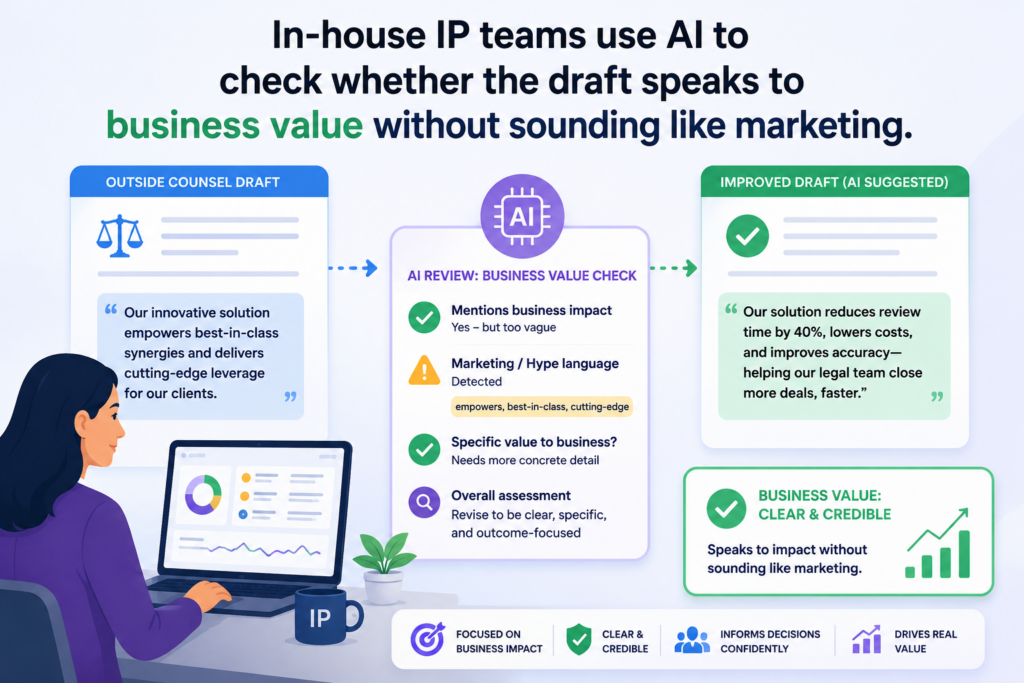
If the draft only lists parts and steps, it may miss the real reason the company cares. In-house IP teams use AI to check whether the draft explains the technical value in a clear and useful way.
This is not about adding hype. It is about showing the problem, the old pain, and the better result.
For example, the invention may reduce delay, save battery, improve accuracy, cut memory use, make a device safer, or help a system recover from errors.
Those facts can make the draft stronger when they are tied to the actual technology.
AI helps separate real technical value from broad claims of benefit.
A weak draft may say the system is faster or more accurate without explaining why.
AI can flag those empty statements and ask what part of the system creates the result. That pushes the team to add better support.
The in-house team can then go back to inventors and ask for test results, design notes, tradeoffs, or simple examples.
Even a plain explanation can help. The point is to connect the benefit to the invention, not to add fancy words.
The business value should support the patent story, not distract from it.
A good draft makes the reader understand why the invention matters without sounding like a pitch deck. AI can help keep that balance. It can point out where the draft is too thin, too broad, or too promotional.
PowerPatent helps teams turn real technical value into clear patent work without making founders feel buried in process.
The platform is built for builders who want strong protection and less friction. Learn more here: https://powerpatent.com/how-it-works
In-house IP teams use AI to make outside counsel drafts easier for inventors to review.
Inventors often avoid patent drafts because the writing feels slow, dense, and far from how they think. That creates a problem for in-house IP teams.
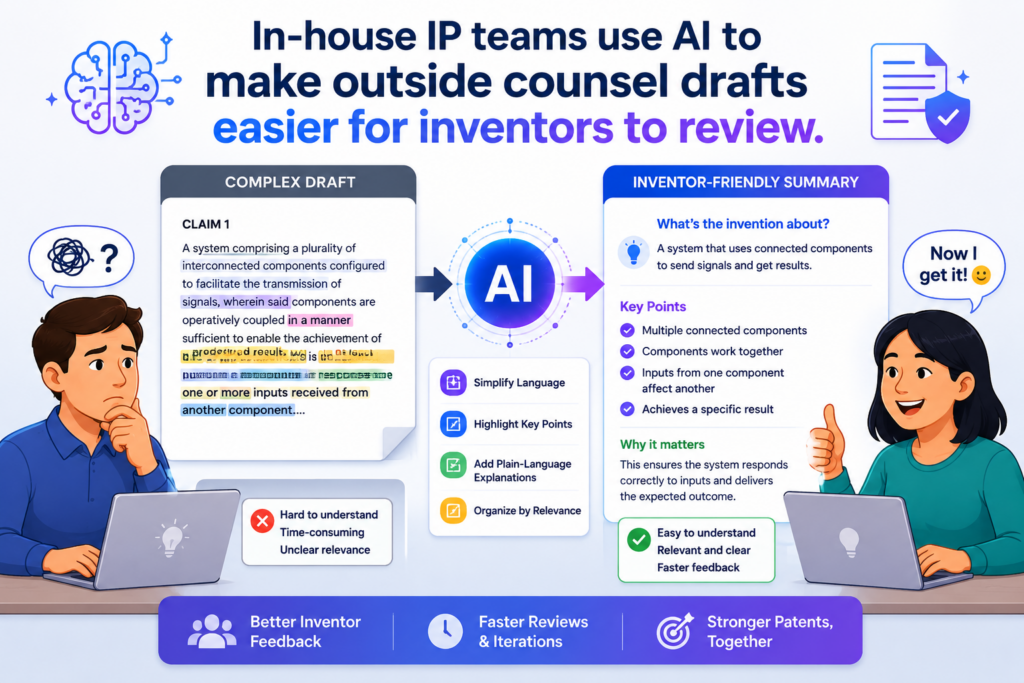
The people who know the invention best may not have the time or patience to review every page in detail.
AI helps by turning a long draft into a clear inventor review packet. It can explain the claims in plain words, summarize the figures, highlight key technical assumptions, and list the exact places where inventor input is needed.
This makes the review feel less like homework and more like a focused check.
A shorter inventor review path leads to better comments.
When inventors get clear questions, they give better answers. Instead of saying, “Please review the draft,” the in-house team can ask whether a step is required, whether the system works with other inputs, or whether a figure matches the actual architecture.
This approach also shows respect for the inventor’s time. The team is not asking them to become patent experts.
It is asking them to confirm the technical truth. AI makes that possible by doing the first sorting pass.
Inventors should review the invention, not decode the document.
The best inventor review happens when the draft is translated back into the language of the product. AI can help explain what the claims cover, what the draft assumes, and what details may be missing.
That makes the whole process smoother. Inventors engage more, counsel gets better facts, and the company files stronger work.
PowerPatent is designed with this builder-first mindset. See the workflow here: https://powerpatent.com/how-it-works
In-house IP teams use AI to check tone, clarity, and internal consistency before final approval.
A patent draft can be technically correct but still hard to follow. It may use three names for the same part. It may describe the same step in different ways.
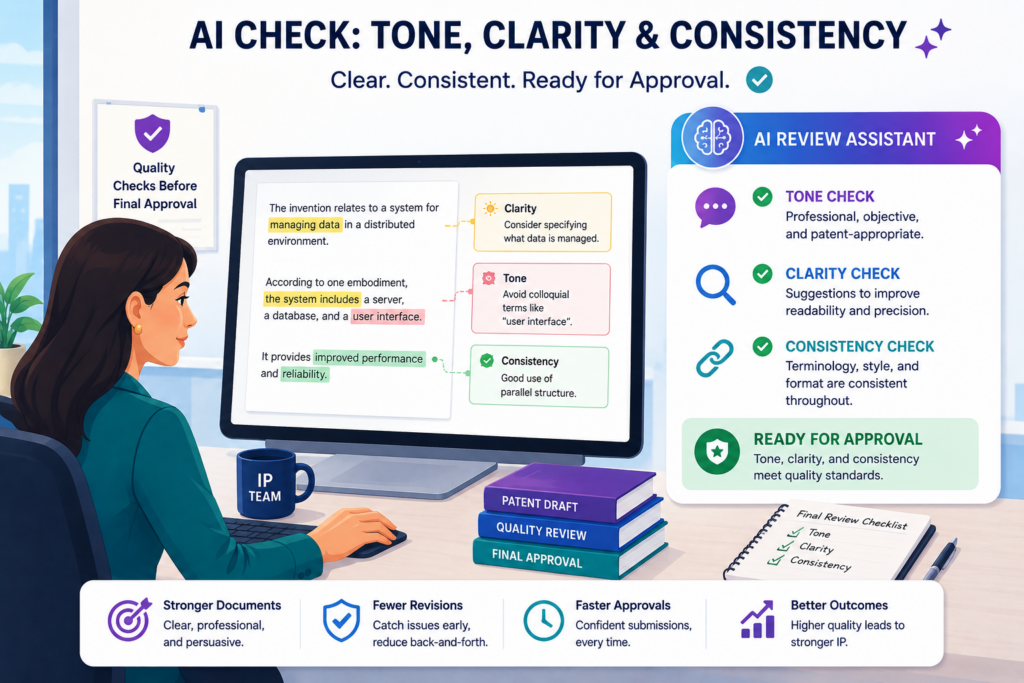
It may include long sentences that make review harder for everyone. In-house IP teams use AI to clean up these issues before final approval.
Clarity matters because confusion creates risk. If a term changes across the claims, figures, and description, people may read the draft in different ways.
If the draft explains a key step in a vague way, the team may not notice a missing detail until later. AI helps catch those small problems before they grow.
Consistent terms make the draft easier to defend and easier to manage.
AI can build a term map and show where the draft uses different words for the same idea.
It can also show where one word seems to mean different things in different places. This helps the in-house team decide what should be fixed.
The goal is not to make the draft sound simple at the cost of precision. The goal is to make the wording stable.
Stable wording helps inventors review faster and helps outside counsel revise with less confusion.
Clean language is not cosmetic when it protects a technical asset.
In-house teams should not ignore clarity as “style.” A clear draft can make the invention easier to understand, easier to review, and easier to improve before filing. AI can find places where the writing slows the reader down.
PowerPatent helps teams keep this process clear from the start. Smart tools help organize the work, and attorney oversight helps protect quality. See how PowerPatent helps here: https://powerpatent.com/how-it-works
In-house IP teams use AI to build a final filing checklist that is tied to the actual invention.
Final approval should never be a rushed click. Before filing, the in-house team needs to know that the draft matches the invention, supports the claims, reflects key product plans, and includes inventor feedback.
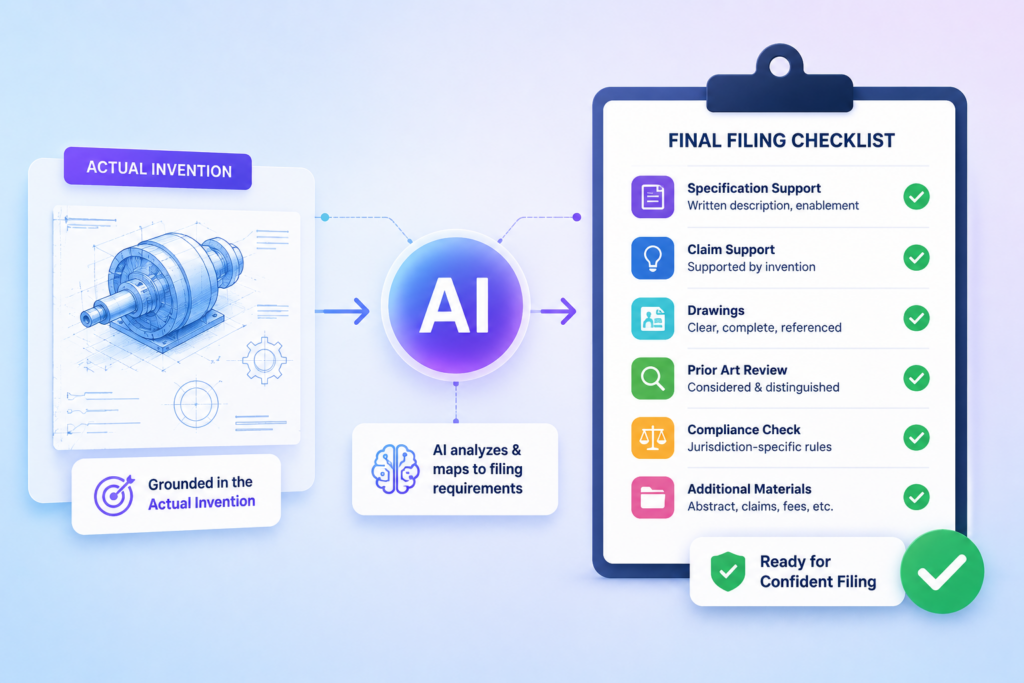
AI helps turn that final review into a clean checklist tied to the actual draft.
This checklist should not be generic. It should be based on the invention record, the claims, the figures, prior comments, and the company’s protection goal.
AI can show open issues, missing answers, unresolved comments, and places where the latest draft may still feel weak.
A final AI pass helps the team slow down only where it matters.
The last review should not mean reading every word with the same level of stress. AI can help point the team to the parts that deserve attention. Maybe a claim changed late.
Maybe a figure was added. Maybe a key term was revised. Maybe inventor feedback was only partly addressed.
This lets the in-house team focus energy where the risk is highest. It also helps avoid filing with known loose ends just because the deadline feels close.
The final decision still belongs to people with judgment.
AI can support the checklist, but it should not make the filing call. The in-house team, inventors, and attorneys still decide whether the draft is ready. AI simply makes that decision better informed.
That is the real value of a modern IP workflow. It gives teams speed, structure, and control without removing human judgment.
PowerPatent brings smart software and real patent attorney oversight into one process, so founders and IP teams can protect what they are building with more confidence. Start here: https://powerpatent.com/how-it-works
Conclusion
AI gives in-house IP teams a faster, clearer way to review outside counsel drafts, but the real win is control. It helps teams see what the claims cover, what the draft misses, where support is thin, and whether the filing matches the product and roadmap. The best teams use AI to ask better questions, not to replace human judgment.
With PowerPatent, founders and IP teams can pair smart software with real attorney oversight, so patents become stronger, reviews move faster, and protection feels less like a burden and more like a business advantage. Start here: https://powerpatent.com/how-it-works
Leave a Reply