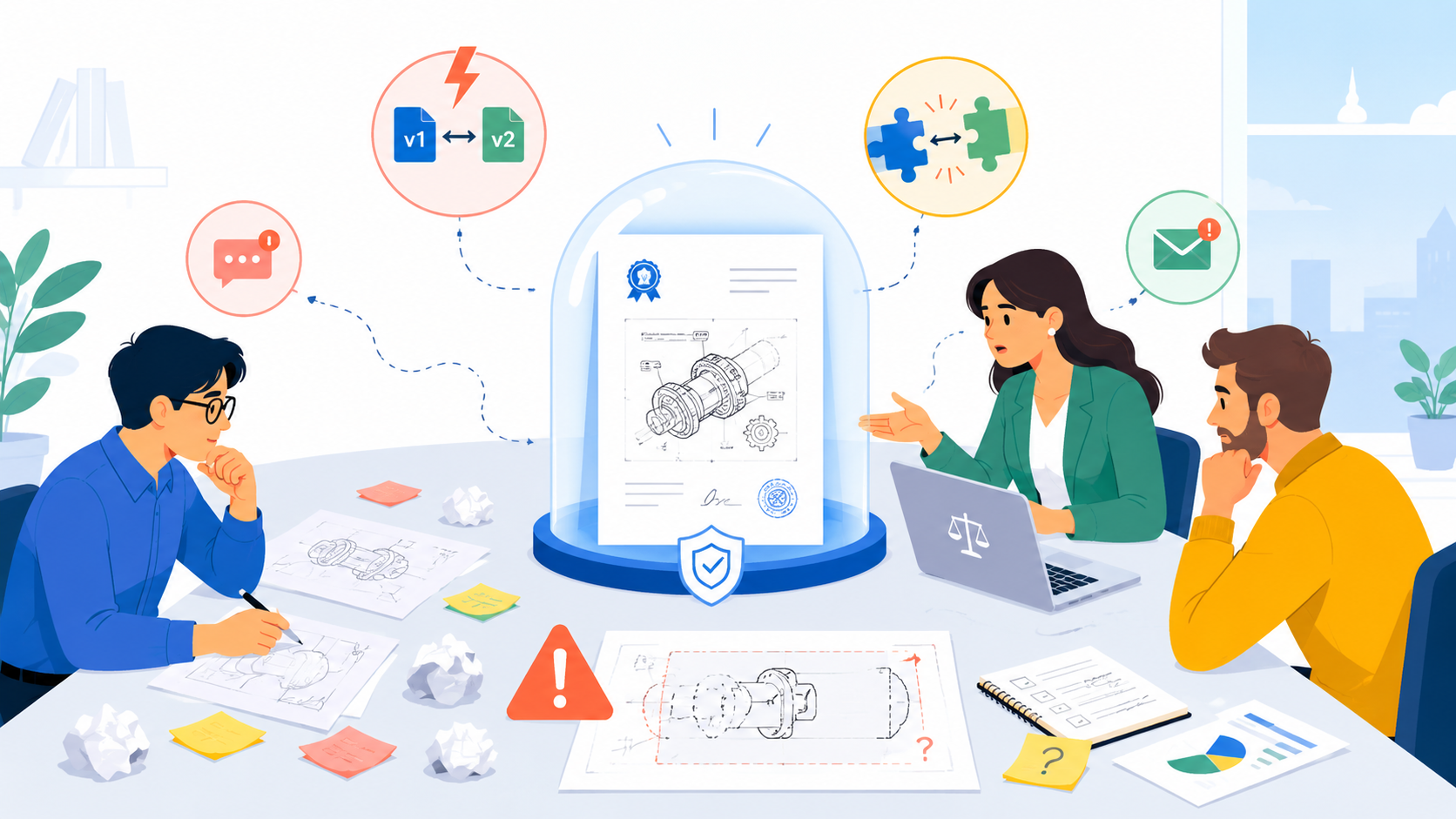
A strong patent does not start with paperwork. It starts with clear teamwork. PowerPatent helps teams turn messy invention work into stronger patent filings with smart software and real attorney oversight. You can see how it works here: https://powerpatent.com/how-it-works
Mistake One: Starting the Patent Process After the Team Has Already Moved On
Most weak patent applications are not weak because the invention is bad. They are weak because the filing process starts too late.
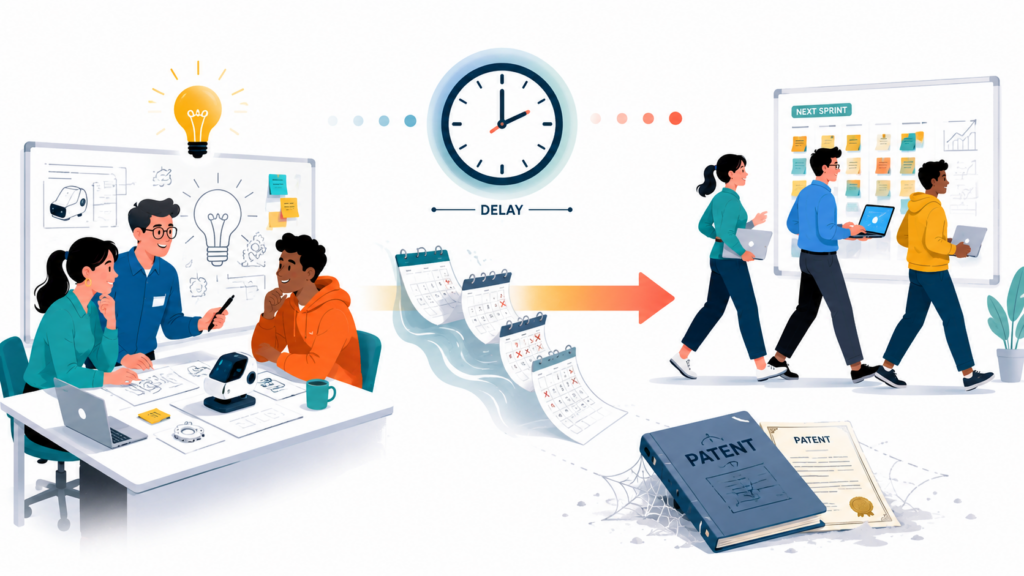
By the time many teams talk to a patent attorney, the product has already changed three times. The first prototype is gone. The early notes are buried in Slack.
The engineer who solved the hard problem is now working on a new sprint. The founder remembers the big picture, but not the small choices that made the invention work.
That delay creates a hidden gap.
A patent application needs more than the final product. It needs the story of the invention. It needs to show what was built, why it was hard, what choices were made, and what makes the solution different.
A nonprovisional patent application must include a written description and at least one claim, and drawings are needed when they help explain the invention.
That means the team must capture enough detail for someone else to understand the invention with care.
When the team waits too long, the best details often disappear.
The real invention is often hiding in the messy middle
The polished demo is rarely where the strongest patent value lives. The real value is often in the messy middle, where the team tried three bad paths before finding the one that worked.
That messy middle may include a better data flow, a faster model update step, a cleaner sensor layout, a safer control loop, a smarter way to rank results, or a small backend choice that made the whole system usable.
These details may feel normal to the team because they lived through them. But to a patent attorney, those details can be gold.
If those details are not shared, the patent application may describe the product in broad and flat terms.
It may say what the product does, but not how the invention makes it happen. That is a big problem because strong patent work often depends on the “how,” not only the “what.”
Why late memory creates weak protection
Human memory is not a clean database. It gets edited every time a team moves forward.
Once the product works, people forget how hard the old problem was. They forget the failed designs. They forget which tradeoff mattered.
They forget that the key step was not obvious at the time. They start to describe the invention as if the path was always clear.
That hurts the patent application.
A strong application should help show the technical path. It should make the invention feel real, not like a loose idea. It should capture the parts that competitors would want to copy.
When the team relies on late memory, the application can become thinner than the actual invention.
This is why founders should not treat patent work as a final admin task. It should run close to invention work. Not in a way that slows the team down, but in a way that captures the right details while they are fresh.
PowerPatent is built for this exact problem. It helps teams turn raw invention notes, product context, and technical work into a cleaner patent workflow with real attorney oversight. You can see how it works here: https://powerpatent.com/how-it-works
How to fix this before it becomes expensive
The best fix is simple: capture invention context as soon as a technical decision starts to look important.
That does not mean writing a long legal memo. It means saving the plain facts while they are still easy to explain.
What problem did the team face? What did not work? What changed? What made the final method better? What part would a competitor copy if they saw the product?
Those questions should be asked during the build, not months after launch.
A founder can make this part of the normal product rhythm. When a sprint creates a new technical advantage, the team should pause for a short invention capture.
When an engineer says, “This was harder than expected,” that is a signal. When a model performs better because of a new training path, that is a signal. When a customer gets a better result because of a hidden system change, that is a signal.
The goal is not to decide on the spot whether something is patentable. The goal is to avoid losing the facts that help a patent team make that call later.
What to capture in plain language
The best invention notes do not sound like legal writing. They sound like a smart engineer explaining the problem to another smart engineer.
Write down the old way, the new way, and why the new way matters. Save diagrams, screenshots, whiteboard photos, architecture notes, experiment results, model changes, API flows, and design docs. Keep the bad paths too, because they show why the final path was not just a routine choice.
If the invention relates to software, capture the data inputs, the decision steps, the output, and the system effect. If it relates to hardware, capture the structure, placement, timing, signal path, and operating conditions.
If it relates to AI, capture what the model receives, how it is trained or used, how the output changes the system, and why the result is better.
Do not wait until every part is perfect. Patent work can often start from the best current version, with room to refine as the team learns more. The key is to start while the insight is still alive.
The strategic lesson for founders
Late patent work creates weak collaboration because everyone is forced to rebuild the invention from memory.
That is slow. It is risky. It invites missing pieces. It also makes attorney review less useful because the attorney is not seeing the full invention story.
Early invention capture gives the patent team better raw material. It helps the founder see what may be worth protecting. It helps engineers explain the parts that matter.
It helps the attorney draft with more depth. It also helps the company avoid filing something that sounds broad but fails to protect the real business edge.
The smartest teams do not wait for a perfect product. They protect the learning curve that got them there.
Mistake Two: Letting Only One Person Explain a Team Invention
Many patent applications get weaker because one person becomes the “voice” of the invention.
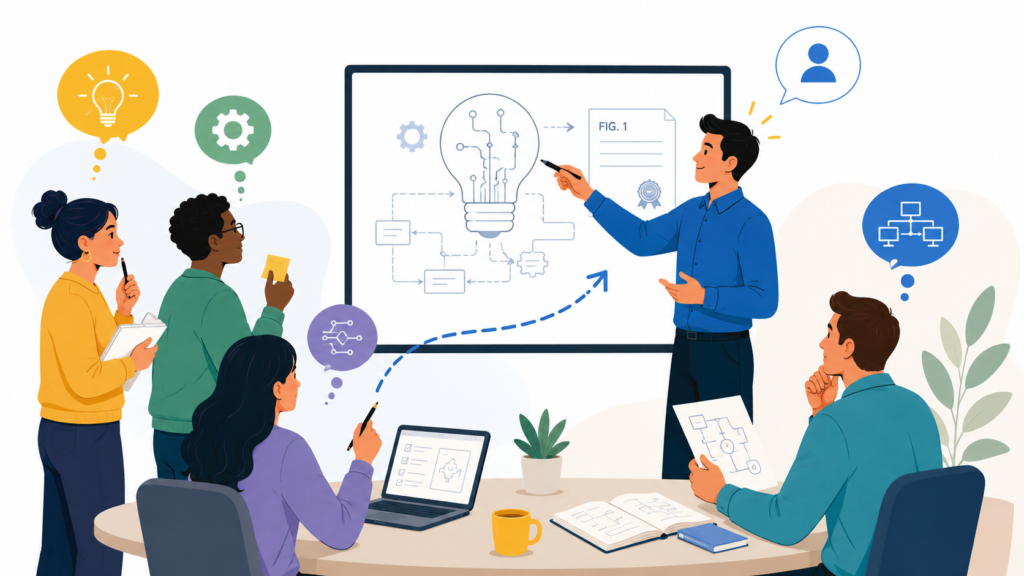
This usually happens for a good reason. The founder is busy and wants to move fast. The CTO knows the whole system. The product lead can explain the customer pain. So one person joins the patent call and tells the story.
That sounds efficient, but it can be dangerous.
Modern inventions are often built by many people. One person may understand the system goal. Another may understand the hard model change. Another may know why the hardware failed in testing.
Another may know the workflow that made the product useful. If only one person explains the invention, the patent application may reflect only one view.
That can leave out the most valuable parts.
The USPTO’s guidance on inventorship recognizes that more than one person may contribute to an invention, and inventorship connects to the subject matter being claimed in the application.
That is one reason it is so important to understand who contributed what before the application is shaped too tightly.
The loudest voice is not always the deepest source
In startup teams, the person who can explain the business value is not always the person who solved the technical problem.
A founder may say, “We built a tool that predicts equipment failure earlier.” That is a good product story, but it may not be enough for a strong patent story.
The engineer may say, “The important part is how we combine noisy sensor data with a rolling confidence score, then change the alert threshold based on machine state.” That is much closer to the invention.
The product lead may add, “The alert only matters because we route it differently based on who is on shift and what repair parts are nearby.” That may open another angle.
The data scientist may say, “The model works because we trained it using weak labels from maintenance logs and then filtered the labels in a special way.” That could be another important layer.
Each person sees a different part of the moat.
Why single-source invention intake creates blind spots
A single speaker often compresses the invention into the easiest story. That may help a sales call, but it can hurt a patent application.
Patent work needs detail. It needs fallback positions. It needs examples. It needs variations. It needs enough technical meat so the application is not trapped in one narrow version.
When one person explains everything, they may skip details they think are “too obvious.” They may leave out failed designs. They may understate another teammate’s contribution.
They may focus on the customer benefit and forget the system design. They may describe the current product but not the broader invention.
This creates a weaker filing because the patent attorney has fewer angles to work with.
The better path is not to put twenty people in every meeting. That would slow everyone down. The better path is to identify the few people who touched the inventive parts and get their input in a structured way.
How to run a better invention capture meeting
A good invention meeting should not feel like a legal exam. It should feel like a clean technical debrief.
The founder or patent lead should start with the product goal, but then the conversation should move quickly into the build choices.
What was hard? Who solved it? What changed after testing? Which part gave the biggest lift? What would a competitor need to copy to get the same result?
Each key contributor should explain their part in plain words. The attorney or patent team can then ask follow-up questions. The goal is not to make everyone agree right away. The goal is to map the invention from different angles.
A strong patent process often finds value in places the founder did not expect.
For example, the founder may think the invention is the dashboard. The engineer may reveal that the dashboard only works because of a new event grouping method.
The product lead may reveal that the grouping method was created because users ignored alerts when the system produced too much noise. That full chain is much stronger than saying, “We built a better dashboard.”
The best question to ask each contributor
The most useful question is simple: “What did you do that made this work better?”
That question cuts through job titles. It also avoids asking people to decide whether they are “inventors,” which can be confusing. The patent attorney can help assess inventorship later based on the claims and the real contributions.
A second strong question is: “What would someone else get wrong if they tried to copy this?”
That question often brings out the hidden know-how. It gets engineers to explain the traps. It gets designers to explain the workflow choices. It gets founders to explain the market reason behind the technical shape.
A third strong question is: “What did we try that failed?”
Failed paths are not wasted time. They show why the final path mattered. They can help the patent team describe the invention with more depth and care.
The strategic lesson for founders
A patent application should not be built from the memory of the most available person. It should be built from the knowledge of the people who made the invention real.
That does not mean the process needs to be slow. It means the process needs to be clear.
PowerPatent helps teams gather the right invention details without turning the whole company into a paperwork machine.
It combines smart software with real patent attorney review, so founders can move fast while still giving the patent team the details needed to build stronger filings. See how PowerPatent works here: https://powerpatent.com/how-it-works
When the right voices are included early, the application gets sharper. The claims can be aimed at what truly matters. The description can include stronger examples.
The drawings can show the real system. The company can avoid filing a watered-down version of its own breakthrough.
That is the point of good collaboration. Not more meetings. Better signal.
Mistake Three: Sharing the Result but Not the Path That Created It
Many teams explain their invention by talking about the end result.
They say the product is faster. They say the model is more accurate. They say the system gives better alerts. They say the device is smaller, safer, cheaper, or easier to use.
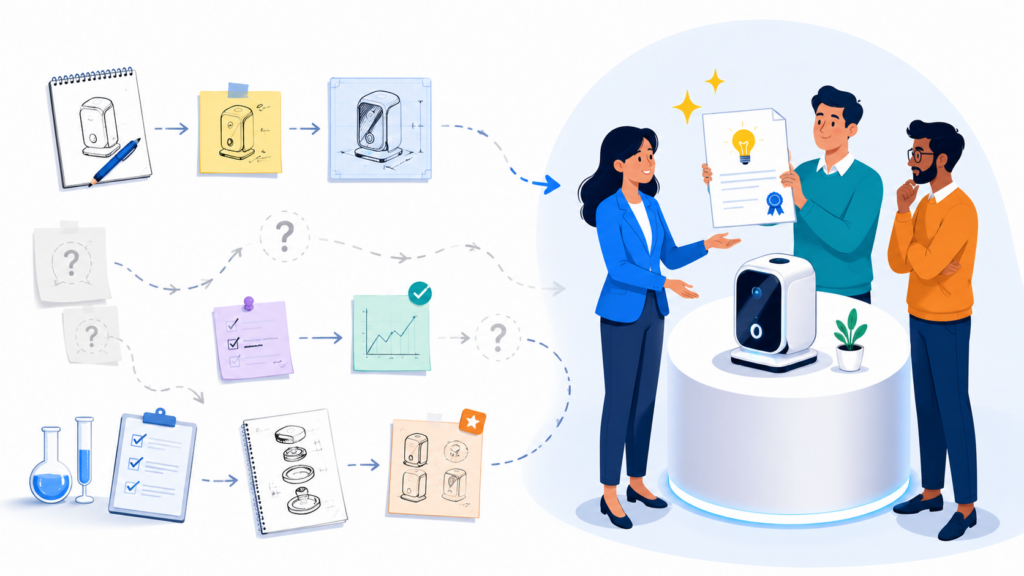
Those results matter. But they are not enough.
A patent application needs to show how the invention works. The team must explain the path that leads to the result. This is where many collaboration breakdowns begin. The founder talks about the value.
The engineer talks about the feature. The product lead talks about the customer pain. But no one clearly explains the steps that make the invention different.
That can make the patent application sound soft.
A strong patent application should not only say, “Our system improves speed.” It should explain what changed in the system to create that speed. Did the team remove a step? Did it change the order of steps? Did it process data closer to the source? Did it use a new rule before calling a model? Did it split one process into two parts? Did it use feedback from the user to tune the next action?
The path matters because that is often where the protectable idea lives.
The outcome is the promise, but the method is the moat
Founders are trained to sell outcomes. That is useful for customers and investors. But patent work needs a different kind of story.
A customer wants to know what the product does for them. A patent team needs to know what the team built so others cannot easily copy it. Those are not the same thing.
For example, “We reduce false alarms in a hospital monitor” is a strong business result.
But the patent value may live in how the system groups signals, how it checks patient state, how it changes the alert level, or how it sends different alerts to different roles.
The result tells people why the invention matters. The path tells people what the invention is.
When collaboration only focuses on the result, the patent attorney may have to guess at the path. That is not ideal.
The application may become too broad in a weak way or too narrow in a random way. It may miss the steps that make the invention hard to copy.
How teams accidentally hide the best details
The best technical details often get hidden because the team sees them as normal.
An engineer may not mention a key data filter because it feels like a small fix. A designer may not mention a flow change because it feels like a user experience detail.
A founder may not mention a pricing or routing rule because it feels like business logic. A machine learning lead may not mention how training data was cleaned because it feels like setup work.
But these “small” choices may be the reason the product works.
Patent applications get weaker when teams treat these details as background noise. The attorney cannot protect what the team does not share.
Even a great attorney cannot read the codebase, replay every product debate, and guess which part created the leap.
This is why collaboration must make room for the path, not only the result.
A better way to describe the invention
The best way to explain the invention is to slow down just enough to walk through the before, the change, and the after.
First, explain how the problem was handled before. Use plain words. Say what was slow, costly, risky, noisy, hard to scale, or hard to use.
Then explain what the team changed. This is the core. Describe the system steps. Describe the flow of data. Describe what gets checked, ranked, filtered, trained, routed, displayed, stored, adjusted, or triggered.
Then explain why the change worked. Not in marketing terms. In cause-and-effect terms. The system got faster because it avoided a full model call unless a simple rule was met first.
The device got safer because it used two sensor checks before making a control change. The workflow got easier because it grouped actions by role instead of by time.
That kind of explanation gives the patent team real material.
The “because” test
A simple test can improve almost every invention note.
Every time the team says the invention is better, add the word “because.”
The model is more accurate because it weighs recent signals differently from older signals.
The tool is faster because it runs a low-cost check before starting a larger process.
The dashboard is easier to use because it hides low-priority items until a risk score crosses a set point.
The device uses less power because it switches sensing modes based on motion state.
The robot is safer because it changes its path when two kinds of risk signals match.
This small habit forces the team to move from claims about value to facts about design. It gives the patent attorney the logic behind the invention. It also helps the team see which details are central and which are just surface features.
The strategic lesson for founders
A patent application should not read like a landing page. It should explain the invention deeply enough that the core idea is clear, supported, and hard to miss.
That does not mean the team must write legal text. It means the team must share the technical path in simple words.
Founders should ask engineers to explain the steps, not just the feature. Engineers should explain the reason behind each step, not just the code.
Product leads should explain the user problem that shaped the design, not just the screen. Patent teams should ask follow-up questions until the cause-and-effect story is clear.
This is where PowerPatent can help. The platform helps teams gather invention details in a cleaner way, then brings in real attorney oversight so those details can be turned into a stronger patent application.
It helps founders move fast without losing the technical story that makes the invention worth protecting. See how it works here: https://powerpatent.com/how-it-works
When teams share the path, the application gets stronger. The claims can better match the real invention. The description can show more useful examples. The filing can protect more than a shiny result. It can protect the engine behind that result.
Mistake Four: Treating Draft Review as a Quick Approval Task
Patent drafts are often reviewed too fast.
The attorney sends a draft. The founder is in the middle of fundraising, hiring, sales calls, and product fires.
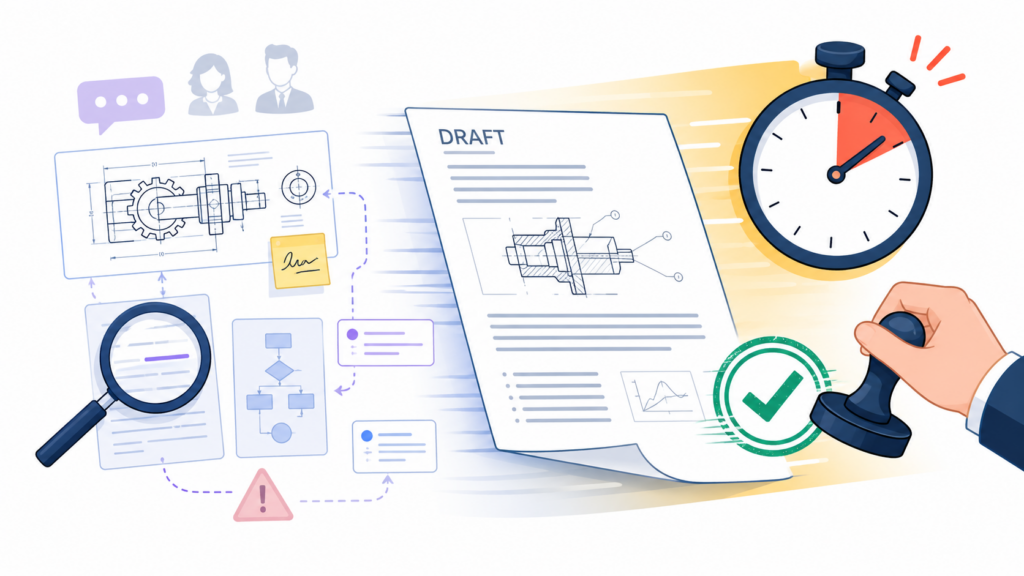
The engineer skims a few pages, sees some familiar terms, and says it looks fine. The team approves it because they trust the process and want to keep moving.
That may feel efficient, but it is risky.
Draft review is one of the last chances to catch missing details before filing. It is also one of the best chances to make sure the application matches the actual invention.
If the team treats review like a rubber stamp, mistakes can slip through. The draft may describe an old design.
It may use wording that does not match the current system. It may miss a key step. It may include examples that are too narrow. It may leave out another version the team already knows it may build later.
A patent draft should not be reviewed like a contract checkbox. It should be reviewed like a map of the invention.
The goal is not to admire the draft, but to stress-test it
A strong draft review is not about asking, “Does this look smart?”
It is about asking, “Does this protect what we actually built and what we are likely to build next?”
That question changes the whole review.
A founder should check whether the draft protects the business advantage. An engineer should check whether the draft correctly explains the system.
A product lead should check whether the draft covers the use cases that matter most. The patent attorney should guide the team through the parts that matter, especially the claims, the drawings, and the key examples.
This does not mean every person must read every word with the same depth. It means each person should review the parts where they have real knowledge.
Why teams approve drafts they do not fully understand
Patent drafts can look formal and hard to read. Many founders and engineers assume that if the writing sounds technical and legal, it must be right.
That is a mistake.
The team does not need to rewrite the draft. But the team does need to check the facts. Are the steps in the right order? Are the parts named correctly? Are the examples real? Are important options missing? Does the draft make the invention sound like only one narrow product screen? Does it leave out a backend process that matters more than the front end?
The best reviewers do not try to act like lawyers. They act like builders.
They mark anything that feels wrong, thin, outdated, or too narrow. They ask whether the draft covers the version being built now and the versions likely to come next.
They ask whether a competitor could copy the valuable part while avoiding the exact wording in the draft.
That is the kind of review that helps a patent attorney strengthen the filing.
How to review a patent draft without slowing the team
The best review process is focused.
The founder should first read the summary and claims with one question in mind: “Does this point at the business edge we care about?” If the product wins because of speed, accuracy, safety, cost, control, privacy, or ease of use, the founder should make sure the draft supports that edge.
The technical lead should review the drawings and detailed description with another question in mind: “Could another skilled person understand the real system from this?” If a key step is missing, or if the draft describes the system in a way that no longer fits, that should be fixed.
The product lead should look at user flows and examples. Sometimes a patent draft can focus too much on the technical engine and miss the setting where the engine creates value.
The product context can help show why the invention is useful and how it works in practice.
The attorney should then take that feedback and decide what changes belong in the application.
The review should include future versions, not only the current build
This is one of the most important draft review habits.
Startups change fast. A patent application that only covers today’s version may be too narrow by the time the product reaches the market. During review, the team should ask what may change over the next year.
Will the model use different inputs? Will the device move from one sensor type to another? Will the workflow be used by a different kind of customer? Will the system run on the edge instead of the cloud? Will the product move from one industry to another? Will the output be a score today, but an automated action later?
Those future paths may not all belong in the same filing, but the conversation is valuable. It helps the patent attorney understand the invention more broadly. It may also lead to better examples and stronger coverage.
This is where rushed review leaves money on the table. The team approves a draft based on the current demo, while the real business is about to move into a broader market.
The strategic lesson for founders
Draft review is not a delay. It is a power move.
A careful review can catch weak spots before they become fixed. It can help the application match the real invention. It can help the company avoid filing something that feels complete but misses the moat.
The key is to make review easy for the right people. Do not send the draft to the whole company. Send it to the people who know the invention, the product, and the business edge.
Ask them focused questions. Give the patent team clear feedback. Make sure the final filing reflects what the company actually wants to protect.
PowerPatent makes this easier by giving teams a more guided way to work with invention details and attorney review.
Instead of forcing founders to manage messy files, scattered notes, and unclear draft feedback, PowerPatent helps bring the work into a cleaner flow. Learn how PowerPatent helps teams file better patents faster here: https://powerpatent.com/how-it-works
A patent draft deserves real attention because it may shape the company’s protection for years. Skimming it is not speed. It is risk wearing a speed costume.
Mistake Five: Leaving Business Strategy Out of the Patent Conversation
A patent application can be technically correct and still be strategically weak.

This happens when the patent team understands the invention, but not the business plan.
The application may describe the system well. It may include useful drawings. It may name the right parts. But it may not focus on the feature that drives revenue.
It may not cover the use case investors care about. It may not map to the market the company is entering. It may protect a side detail while the main value remains easy to copy.
This is a collaboration mistake, not just a drafting problem.
Founders sometimes assume patent attorneys only need technical facts. Engineers sometimes assume market context is not relevant.
Product teams sometimes assume patent work is separate from go-to-market work. Those assumptions can weaken the application.
The best patent work sits at the meeting point of invention, product, and strategy.
Protection should follow the business edge
A patent application should not only ask, “What is new?”
It should also ask, “What part of this invention gives the company an edge?”
That edge may be speed. It may be lower cost. It may be higher trust. It may be better privacy. It may be a safer system. It may be a workflow that locks in users because it solves a painful job better than anything else.
The patent team needs to know that.
If the business edge is accuracy, the application should not only describe the user interface. If the business edge is a new deployment model, the application should not only describe the algorithm.
If the business edge is a faster setup flow, the application should not only describe the backend architecture.
The filing should support the part of the invention that matters most to the company’s future.
Why “cool technology” is not the same as “valuable protection”
Engineers love hard problems. That is a strength. But not every hard problem is the best thing to protect first.
A technical detail may be clever but not central to the business. Another detail may seem simple but may be what customers would pay for, what competitors would copy, and what investors would care about.
For example, a team may spend months improving a model. But the real defensible edge may be the way the system collects feedback from users and turns that feedback into better future actions.
Another team may build a complex device, but the real edge may be a small calibration method that makes the device work in the field without expert setup.
The patent conversation should make space for both views.
The technical team can explain what was hard. The business team can explain what matters. The attorney can help translate both into a filing strategy.
How to bring strategy into the invention meeting
The founder should explain where the company is going, not just what has been built.
That does not require a long business plan. It means sharing the market, the target user, the key customer pain, the main competitors, and the reason the product wins. It also means sharing which parts of the product are likely to become core to revenue.
This context helps the patent team ask better questions.
If the product is moving into health care, safety and trust may matter more. If it is moving into industrial automation, reliability and field setup may matter more.
If it is moving into developer tools, workflow and integration may matter more. If it is moving into AI infrastructure, speed, cost, privacy, and model control may matter more.
The same invention can be described in different ways depending on the strategic angle.
The competitor-copy test
One of the most useful strategy questions is this: “If a competitor saw our product tomorrow, what would they copy first?”
That question cuts through noise.
It helps the team focus on what matters. Maybe the competitor would copy the scoring method. Maybe they would copy the training loop. Maybe they would copy the device shape.
Maybe they would copy the way users approve changes. Maybe they would copy the data pipeline that makes the whole product work.
Once the team names what a competitor would copy, the patent team can look at whether the draft supports that area.
A second useful question is: “What would hurt us most if a bigger company built it?”
That question often reveals the true strategic asset. It may not be the flashiest feature. It may be the hidden system that makes the product hard to match.
The strategic lesson for founders
Patent work should support the company’s plan, not sit outside it.
This does not mean every patent must cover the whole business. It means each filing should be tied to a clear strategic reason. Protect the engine behind the product.
Protect the workflow that creates customer value. Protect the technical method that competitors would need. Protect the parts that support fundraising, partnerships, pricing power, or market trust.
When business strategy is missing, the patent application may drift. It may protect something real but not useful enough.
It may miss the market-facing edge. It may fail to create the confidence founders need when talking to investors or partners.
PowerPatent helps founders connect invention details with real filing strategy.
The platform combines smart software with attorney oversight, so teams can move from raw technical work to stronger patent applications without losing the business context. You can explore the process here: https://powerpatent.com/how-it-works
A patent is not just a document. It is a business tool. Collaboration should treat it that way from the start.
Mistake Six: Using Vague Words Instead of Concrete Details
Vague words make patent applications weaker.
They feel harmless in team conversations. People say the system is “smart,” “dynamic,” “optimized,” “automated,” “adaptive,” “seamless,” or “intelligent.” These words may sound good in a pitch deck. But they do not explain the invention.
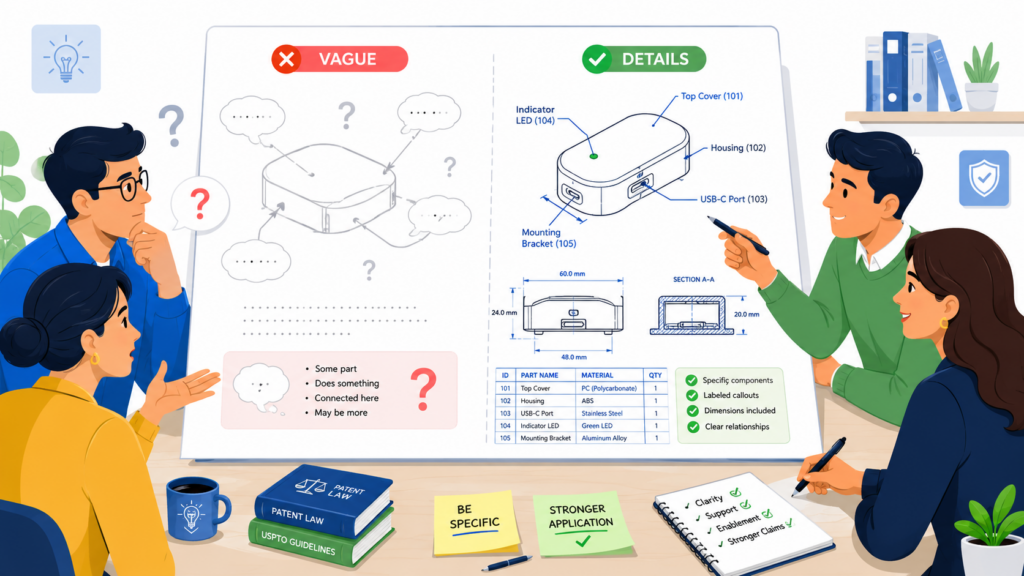
A patent application needs concrete detail. It needs to show what the system does, how it does it, and why that method matters.
When the team gives the patent attorney vague words, the final application may also become vague. That can make the invention harder to understand and easier to design around.
The problem is not that founders use simple language. Simple language is good. The problem is empty language. Simple words can be precise. Vague words can hide the real invention.
“Smart” is not a method
A system is not protectable because it is called smart. It becomes meaningful when the team explains what the smart part actually does.
Does it compare two signals? Does it adjust a threshold? Does it select one model from several models? Does it route a task to a user based on skill level? Does it update a score based on fresh data? Does it reject bad input before it reaches the main engine?
Those details matter.
A founder may say, “Our tool gives smart recommendations.” But the patent team needs to know how those recommendations are created.
Are they based on user history, real-time context, peer behavior, sensor data, location, risk level, cost, time, or some mix of those things? Does the system rank options? Does it explain the ranking? Does it change the ranking after feedback?
The more concrete the team gets, the more useful the patent conversation becomes.
The danger of words that sound good but say little
Vague words can trick the team into thinking the invention has been explained.
When someone says “automated workflow,” everyone may nod. But each person may picture something different. The engineer may picture backend triggers.
The product lead may picture a user flow. The founder may picture time savings. The attorney may not know which part matters most.
That gap can lead to a draft that sounds broad but lacks depth.
Concrete words reduce that risk. Instead of “automated workflow,” say the system detects a completed event, checks whether the next task meets a rule, assigns the task to a user group, sends a notice, and updates a status field when the task is done.
That is still simple. But now it has shape.
How to replace vague words with useful detail
The best fix is to ask what the word means in action.
If someone says the system is adaptive, ask what it adapts to. If someone says it is optimized, ask what is being improved and how the system chooses the better option.
If someone says it is automated, ask what starts the process, what steps happen without a person, and when a person is brought back in.
This habit turns fuzzy talk into useful invention detail.
It also helps teams find hidden patent value. Many inventions are not one big magic step. They are a chain of smart choices. A vague word hides the chain. A concrete explanation reveals it.
For AI teams, this is especially important. Saying “AI-powered” is not enough. The patent team needs to know what data goes in, what the model or logic does, what comes out, and how that output changes the system.
It also helps to explain how training data is built, how bad data is handled, how confidence is measured, and how the system responds when confidence is low.
Keep the simple words, but make them exact
Some founders think patent work requires complex words. It does not.
The best invention explanations are often plain and exact. They use words like check, compare, rank, send, store, train, update, reject, group, match, score, route, show, hide, trigger, and repeat.
Those words help because they describe actions.
A strong patent intake might say: “The system receives a user request, checks the request against a stored rule, selects a model based on the rule, creates an answer, checks the answer against a risk score, and sends the answer only if the risk score is below a set level.”
That sentence is simple. It is also useful.
The team does not need to sound fancy. It needs to sound clear.
The strategic lesson for founders
Vague language is one of the fastest ways to weaken a patent application before drafting even begins.
The fix is not more legal language. The fix is better plain language.
Founders should train teams to explain inventions with action words. Engineers should avoid assuming the attorney knows what “optimized” means in their system.
Product leads should explain what the user sees and what the system does behind the scenes. Attorneys should push for concrete steps, not buzzwords.
PowerPatent helps teams move from rough invention notes to clearer patent-ready material with smart tools and real attorney oversight. That means founders do not have to guess how to describe technical work in a useful way.
They can capture the details that matter and get support from people who know how to turn those details into stronger filings. See how it works here: https://powerpatent.com/how-it-works
Clear words create stronger collaboration. Stronger collaboration creates better patent applications.
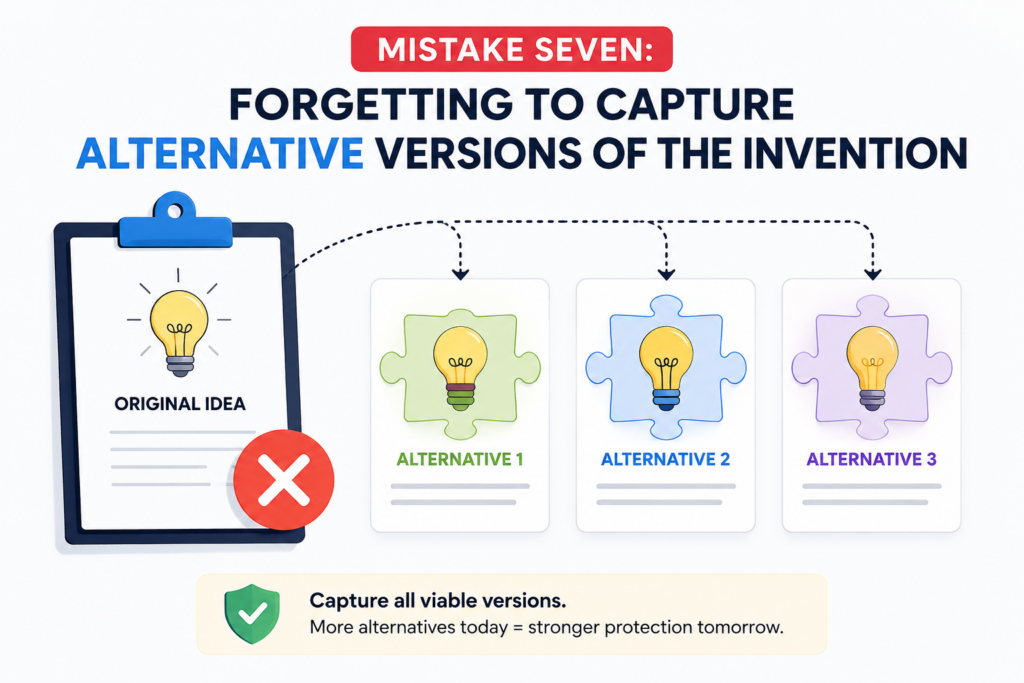
Mistake Seven: Forgetting to Capture Alternative Versions of the Invention
A patent application can become too narrow when the team only describes one version of the invention.
This often happens because startups are focused on shipping. The team talks about the current build, current stack, current model, current hardware, current workflow, and current customer. That makes sense for product work. But patent work needs a wider view.
A strong patent application often benefits from describing variations. These are other ways the invention could be built while using the same core idea.
They may include different inputs, different outputs, different devices, different steps, different users, different settings, or different deployment models.
When teams forget alternatives, they may hand competitors an easy path around the patent.
A competitor may copy the main idea but change a small detail. They may use a different sensor, a different database, a different model type, a different screen, or a different order of steps.
If the application only describes the current version, the filing may not support broader protection.
The first version is rarely the final version
Startups evolve. That is normal.
The first version of a product may run in the cloud. Later it may run on a local device. The first model may use text data. Later it may use image, audio, sensor, or behavior data.
The first workflow may serve one kind of user. Later it may serve a team, a manager, or an automated system.
If the patent application only captures the first version, it may age badly.
This does not mean the team should invent fake versions. It means the team should share real, reasonable paths the invention could take. The patent attorney can decide which ones should be included and how to describe them.
Alternatives help protect the idea behind the product
A product is one form of an invention. The invention may be bigger than the product.
For example, a startup may build a tool that uses a camera to detect defects in factory parts.
But the deeper invention may be a way to compare live data against a changing defect profile and adjust the inspection step based on machine state. That idea may work with cameras, thermal sensors, vibration sensors, or other data sources.
If the application only says “camera,” it may be too narrow.
A team may build a tool that sends alerts by email. But the deeper invention may be a risk-based routing method. That method could send alerts through email, mobile app, dashboard, API, or machine control system.
If the application only says “email,” it may miss the wider value.
This is why alternative versions matter. They help the patent team describe the invention in a way that is not trapped by the first build.
How to find useful alternatives without guessing wildly
The best alternatives come from real product thinking.
Ask what parts are required and what parts are just one choice. Is the input always a sensor, or could it be a user action? Is the output always a score, or could it be a command? Is the model always trained one way, or could another training path work? Is the process always done in this order, or could some steps be swapped? Is the system always used by one person, or could a team use it?
These questions help separate the core from the wrapper.
The core is what makes the invention work. The wrapper is the current way the team built it. A strong patent conversation should understand both.
Engineers are often the best source of alternatives
Engineers know which parts are flexible.
They know when a tool could use a different database. They know when a model could be replaced by rules. They know when a cloud process could run locally.
They know when one sensor could be swapped for another. They know when a step is required and when it is just the easiest current choice.
This is why engineers should be asked directly about variations.
A founder may focus on the product as sold today. An engineer may see three future versions that would still use the same inventive idea. Those versions could make the application stronger.
The product team can also help. Product leaders know where customers may pull the product next. They know which features may become must-haves. They know which use cases are close to the current market.
Together, these views help the attorney draft with more range.
The strategic lesson for founders
Do not let the first product version shrink the invention.
The team should explain what exists now, but also what could change while keeping the same core idea. This helps the patent application support a wider set of examples and may give the company more room as the product grows.
This is especially important for deep tech startups. Code changes. Models change. Chips change. Workflows change.
Customer needs change. The patent filing should not be so narrow that it only protects a version the company has already moved past.
PowerPatent helps founders capture not only the current invention, but also the surrounding context that can help attorneys understand where the invention may go.
With smart software and real attorney oversight, teams can avoid turning a fast-moving product into a narrow filing that misses the bigger opportunity. Explore the process here: https://powerpatent.com/how-it-works
A strong patent application should protect the invention’s center, not just its first outfit.
Mistake Eight: Failing to Decide Who Owns Each Piece of the Collaboration
Collaboration can create powerful inventions. It can also create messy ownership questions.
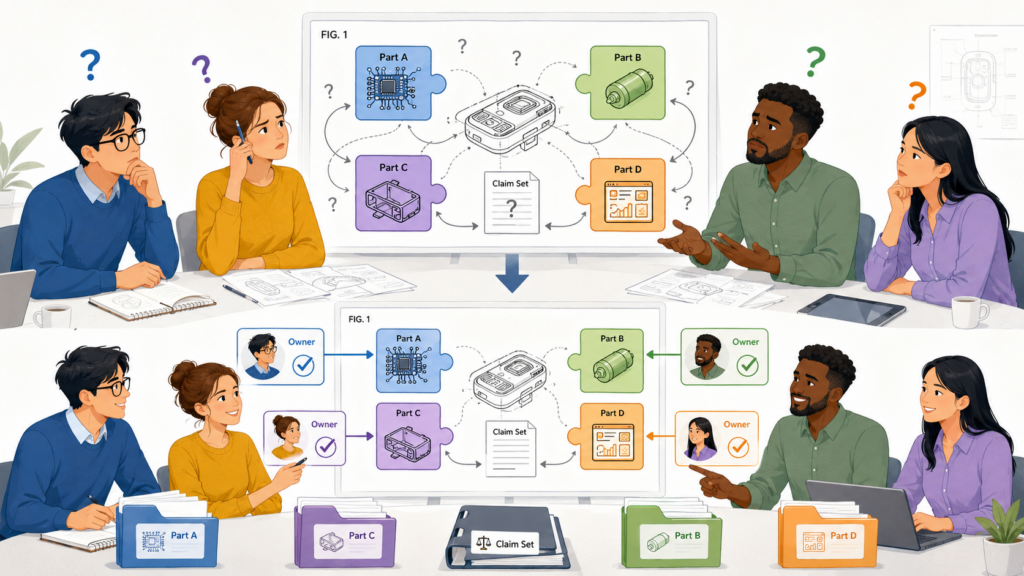
This is especially true when startups work with contractors, outside developers, labs, universities, design firms, data partners, or early customers. The team may be moving fast.
Everyone may be friendly. The work may feel informal. But when patent time comes, unclear ownership can cause stress, delay, and risk.
A patent application can be weakened when the company does not know who contributed what, who assigned rights, and whether outside parties need to be handled before filing.
This is not a place to rely on memory or good vibes.
If an outside engineer helped design a key method, that fact may matter. If a university lab contributed to the invention, that may matter. If a customer suggested a problem but did not help create the solution, that may matter too.
Each situation is different, and the company should get proper legal guidance. But the collaboration mistake is always the same: waiting too long to sort it out.
Ownership issues are easier to fix early
When ownership is clear from the start, patent work runs more smoothly.
When it is unclear, everything gets harder. The team may have to search old emails, contracts, invoices, lab notes, and chat threads. People may disagree about who created the key idea.
A contractor may be hard to reach. A partner may want credit or rights. A filing date may be delayed while the company cleans up paperwork.
That is painful because patents often matter most when timing matters.
Startups may need filings before fundraising, launch, demos, partnerships, or public talks. If ownership questions appear at the last minute, the company may be forced into a rushed process.
Contribution and ownership are not the same thing
Teams often confuse these two ideas.
Someone can contribute ideas, code, feedback, testing, data, or product insight. But whether that person should be named as an inventor, and whether the company owns the rights, depends on the facts and the agreements in place.
This is one reason collaboration records matter.
The team should capture who did what in plain terms. Who came up with the technical solution? Who only tested it? Who suggested the customer problem?
Who wrote code based on someone else’s design? Who changed the method in a way that made it work? Who helped shape the actual inventive concept?
The patent attorney can help sort out the legal side. But the company must provide the facts.
How to avoid ownership surprises in team-based invention work
Founders should build clean habits before the invention becomes valuable.
For employees, make sure invention assignment agreements are handled properly. For contractors, make sure contracts clearly address intellectual property before technical work starts.
For partners, make sure the collaboration scope is clear. For universities, labs, or research groups, make sure the company understands the rules before joint work begins.
This does not need to feel cold or distrustful. It is simply part of building a real company.
Clear agreements protect the relationship because they reduce confusion later. People know what is expected. The company knows what it can file. The patent team knows who needs to be involved.
Keep a simple contribution record
A simple contribution record can save a lot of pain.
It does not need to be fancy. For each major invention, capture who worked on it, what each person contributed, and when the key change happened.
Save links to design docs, commit history, lab notes, prototype records, meeting notes, and experiment results.
This helps the team answer important questions later. It also helps the attorney understand the invention story.
The record should be factual, not political. Avoid giving people credit just to be nice, and avoid leaving people out because the conversation feels awkward. Accuracy matters.
If there is uncertainty, flag it early. Do not hide it and hope it goes away.
The strategic lesson for founders
Collaboration is a strength only when the company can clearly explain the collaboration.
Unclear ownership can weaken patent work because it creates delay, doubt, and avoidable risk. It can also scare investors or partners if they ask about IP and the company cannot answer with confidence.
A strong patent process should include both invention capture and rights cleanup. The goal is not to make founders act like lawyers.
The goal is to make sure the company does not lose control of what it built.
PowerPatent helps teams bring more order to the patent process by combining smart software with real attorney oversight.
That support can help founders move faster while still paying attention to the details that make patent filings stronger and cleaner. See how PowerPatent works here: https://powerpatent.com/how-it-works
When the team knows who did what and has the right agreements in place, the patent process becomes less stressful.
The company can file with more confidence. The invention story becomes clearer. The business becomes easier to defend.
Collaboration should create leverage, not loose ends.
Mistake Nine: Mixing Public Sharing With Patent Planning Too Late
One of the most damaging collaboration mistakes is talking too openly before the patent plan is clear.
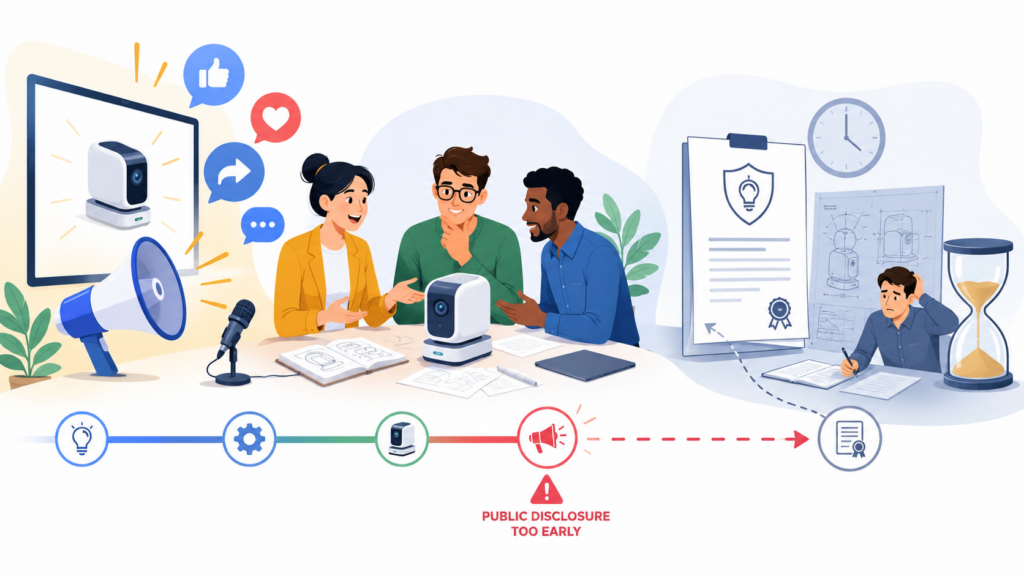
Startups live by sharing. They pitch investors. They demo to customers. They post updates. They join accelerators.
They talk to advisors. They recruit engineers. They test with design partners. This is all normal. It is how companies grow.
But public sharing can create risk when the invention has not been reviewed for patent filing.
The problem is not that founders should hide forever. The problem is that teams often do not know what has been shared, who saw it, when they saw it, and how much detail was revealed. By the time the patent team asks, the answer is often fuzzy.
Someone showed a demo in March. Someone sent a deck in April. Someone posted a product video in May.
Someone shared an architecture slide with a partner. No one is fully sure what was public, what was private, or what was under a signed agreement.
That uncertainty can make patent work harder.
Public talks can reveal more than the team realizes
Founders often think they are only sharing the big idea.
But a pitch deck, demo, webinar, blog post, GitHub repo, investor memo, product screenshot, white paper, or customer onboarding call can reveal much more. It can show the workflow.
It can show the inputs and outputs. It can show timing, scoring, ranking, routing, or system behavior. It can show enough for a smart competitor to understand the path.
Even when a founder avoids source code, the invention may still be exposed.
This matters because patent planning depends on timing and detail. A patent team needs to know what has already been shown so it can make the right filing choices. If the team hides or forgets public sharing, the application may be built on a bad timeline.
Why “we did not share the secret sauce” is not enough
The phrase “secret sauce” can be dangerous because it is vague.
One person may think the secret sauce is the model. Another may think it is the data pipeline. Another may think it is the user flow. Another may think it is the way the system responds when confidence is low.
A founder may say, “We did not share the secret sauce,” but the demo may have shown the key sequence of steps. An engineer may say, “We did not share the algorithm,” but a public API guide may have revealed the decision flow.
A product lead may say, “It was just a mockup,” but the mockup may have shown the exact workflow that makes the product different.
The safer question is not, “Did we share the secret sauce?”
The better question is, “What would a skilled person learn from what we shared?”
How to build a safer sharing habit
The team should treat invention-related sharing like product release planning.
Before a public talk, major demo, technical blog post, open-source release, conference slide, or customer handoff, someone should ask whether the material includes new technical details that have not been reviewed for patent filing. This does not need to slow down the company. It can be a simple checkpoint.
If the material only says what the product does at a high level, the risk may be lower.
If it explains how the product works, the team should pause and involve the patent team. The more technical the share, the more important the review.
This is especially true for AI, robotics, biotech, hardware, developer tools, security, chips, medical devices, climate tech, and industrial systems. In these fields, a single architecture diagram or process flow can reveal a lot.
Keep a disclosure log that a real person can understand
A disclosure log sounds formal, but it can be simple.
For each major outside share, capture the date, audience, material shown, whether it was public or private, whether any agreement was signed, and what technical details were included. Save the deck, video, post, email, or document as it existed at the time.
This record helps the patent team understand the facts fast. It also prevents panic later.
The key is to write it in plain language. Do not say, “Investor deck shared.” Say, “Investor deck shared with two slides showing the model input types, risk scoring flow, and alert routing screen.” That kind of detail is useful.
A good disclosure log is not about fear. It is about control.
The strategic lesson for founders
Startups should share with purpose, not by accident.
Patent planning does not mean the team must stop selling, pitching, recruiting, or testing. It means the team should know what it is revealing and when. The best founders protect the invention before the market sees the full shape of it.
PowerPatent helps teams move faster by giving founders a clearer path from invention details to attorney-reviewed patent filings.
That means you can keep building and sharing while reducing the chance that key invention details slip out before they are protected. You can see how PowerPatent works here: https://powerpatent.com/how-it-works
The mistake is not talking about your product. The mistake is letting public sharing happen without a patent plan.
Mistake Ten: Treating Engineers Like Note Takers Instead of Invention Partners
Some founders bring engineers into the patent process too late and in the wrong role.
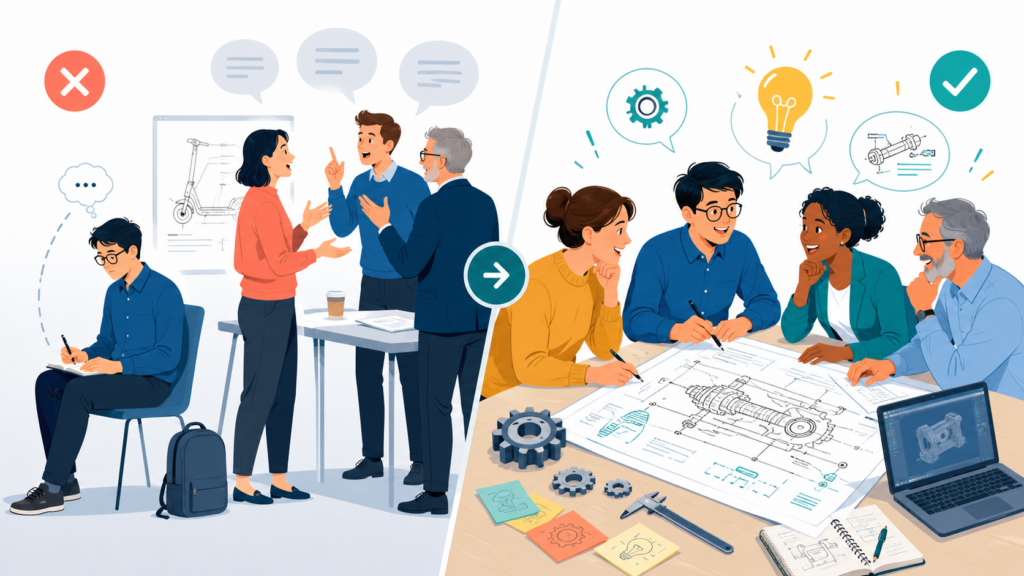
They ask engineers to “send over the technical details” after the strategy has already been decided. They ask for diagrams after the claims have already taken shape.
They ask for quick review when the draft is almost final. The engineer becomes a support person, not a true invention partner.
That weakens the process.
Engineers often know the deepest parts of the invention. They know where the system almost failed. They know why one method worked better than another.
They know which parts are hard to copy and which parts are easy. They know what the code does that the product screen does not show.
When that insight is treated as an afterthought, the patent application can miss the heart of the invention.
Engineers can explain the real tradeoffs
Great inventions often come from tradeoffs.
The team wanted speed but needed accuracy. It wanted safety but needed low delay. It wanted privacy but needed useful results. It wanted a small device but needed strong sensing. It wanted automation but needed user trust.
Engineers understand those tradeoffs because they had to solve them.
A patent application becomes stronger when it explains not only the final choice, but also why that choice mattered. For example, a system may use a smaller model first and a larger model only when needed.
That may reduce cost and delay. A device may sample at a low rate until motion is detected, then switch modes.
That may save power. A workflow may show a human only the uncertain cases. That may improve trust and reduce review time.
These are not just build details. They are invention details.
Why founder-only patent strategy can miss technical leverage
Founders are often great at seeing the market. But they may not see which technical details create real leverage.
A founder may believe the invention is a broad product idea. The engineer may know the real edge is a specific method used under the hood.
A founder may think the breakthrough is the output. The engineer may know the breakthrough is how the system cleans, ranks, or rejects inputs before creating the output.
This does not mean engineers should run the whole patent strategy. It means their input should shape it.
The best patent work happens when business vision and technical truth meet. The founder brings the market edge.
The engineer brings the build edge. The attorney helps turn both into a filing that supports the company’s goals.
How to involve engineers without draining their time
Engineers do not need long legal meetings. They need focused invention sessions.
The best format is a short technical walkthrough with clear questions. What problem did you solve? What did you try first? Why did that fail? What changed? What step is most important? What parts could be swapped out? What would a competitor copy? What details are not visible from the product demo?
That conversation can produce more useful material than a long, polished memo.
It also helps to ask engineers to mark drawings, not write legal language. A rough system diagram with notes can be extremely valuable.
A flow chart with inputs, checks, outputs, and decision points can help the attorney understand the invention faster. A short screen recording can show how the system behaves. A few comments on a draft can catch major errors.
Give engineers the reason behind the task
Engineers are more helpful when they know why the patent work matters.
Do not just say, “We need this for legal.” Say, “We are trying to protect the part of the system that makes our product hard to copy.” That makes the work feel connected to the mission.
When engineers understand that their details can shape the company’s protection, they are more likely to share the right context.
They may point out a hidden method. They may explain why a planned future version matters. They may warn that a draft describes the system in a way that is technically wrong.
That feedback can save the filing.
The strategic lesson for founders
Engineers should not be treated as document helpers. They should be treated as invention witnesses.
They do not need to become patent experts. They need to explain the work clearly, challenge weak descriptions, and help the patent team understand the real system. This makes the application sharper and more honest.
PowerPatent is built for technical teams that want to protect what they are building without drowning engineers in old-school legal process.
It helps capture invention details and routes them into a patent workflow with real attorney oversight. Learn more here: https://powerpatent.com/how-it-works
When engineers are included the right way, the patent application gains depth. It moves from a surface-level product story to a stronger record of the actual invention.
That is how teams protect more than the demo. They protect the work that made the demo possible.
Mistake Eleven: Ignoring Product Roadmap Changes During Patent Drafting
Startups change fast. Patent drafts often do not.
This creates a common problem. The patent process starts with one version of the product. Then the roadmap changes. The team adds a new customer segment. The architecture shifts.

A feature gets removed. A new workflow becomes the main focus. The patent draft keeps moving forward based on the old picture because no one tells the patent team what changed.
The result can be a filing that is already stale on the day it is filed.
This is not rare. It happens because patent work and product work often live in separate lanes. Product teams keep building.
Patent teams keep drafting. Founders assume everyone is aligned, but no one is actively connecting the two.
That gap can weaken the application.
The application should track the invention, not yesterday’s sprint
A patent application does not need to chase every small product change. But it should track major invention changes.
If the team changes the core method, changes the main data flow, adds a new technical step, removes a key part, or discovers a stronger use case, the patent team should know.
The same is true if customer testing reveals that a different feature is actually the most valuable part.
Roadmap changes can change what should be protected.
For example, the team may start with a tool that recommends actions to a user. During testing, they may discover that the valuable part is not the recommendation itself, but the way the system asks for human feedback and updates future decisions. If the patent draft stays focused only on recommendations, it may miss the stronger invention.
Why product changes get lost
Product changes get lost because they feel normal inside the company.
A team may say, “We just changed the workflow.” But that workflow change may be the invention.
Another team may say, “We switched how the model is triggered.” That trigger may be the key technical step. Another team may say, “We added a safety check.” That safety check may be critical to the patent story.
When teams move fast, these changes become part of daily work. No one thinks to flag them for patent review.
That is why founders need a simple rule: if a change makes the product work much better, safer, faster, cheaper, or more useful, it should be shared with the patent team.
How to keep the patent draft aligned with the roadmap
The best method is to create a small patent checkpoint during major product shifts.
This checkpoint should happen when the team changes the product direction, finishes a major technical milestone, learns something important from customers, or decides to move into a new market.
It does not need to be a big meeting. It can be a short update sent to the patent lead.
The update should explain what changed, why it changed, and whether the change affects the core invention.
If the change is minor, the patent team can ignore it. If it is important, the attorney can adjust the draft, add examples, change drawings, or suggest a later filing. The key is that the decision is made on purpose.
Product and patent calendars should talk to each other
The patent process should not be blind to the product calendar.
If the company is about to launch, publish, demo, or pitch a major feature, patent timing may matter. If the team is about to abandon a feature, the patent team should know.
If a new version is about to become the main customer-facing product, the draft should not be locked to the old one without review.
This does not mean the patent team controls product. It means patent work supports product.
A simple shared rhythm can help. When the product team has a major roadmap review, someone should ask whether any new technical advantage emerged.
When the patent team has a draft review, someone should ask whether the roadmap has changed since intake.
That small bridge prevents many weak filings.
The strategic lesson for founders
A patent application should not be frozen while the invention is still moving.
It should be stable enough to file, but informed enough to reflect the company’s real direction. The goal is not to include every possible feature.
The goal is to avoid filing an application that protects an old version while the business has moved to a better one.
PowerPatent helps fast-moving teams keep invention capture and patent drafting closer to real product work.
With smart software and real attorney oversight, founders can reduce the chance that key product changes get lost before filing. See how it works here: https://powerpatent.com/how-it-works
The patent process should move with the company, not trail behind it like an old slide deck.
Mistake Twelve: Sending Raw Documents Without a Clear Invention Story
Many teams think they have shared enough because they sent a pile of documents.
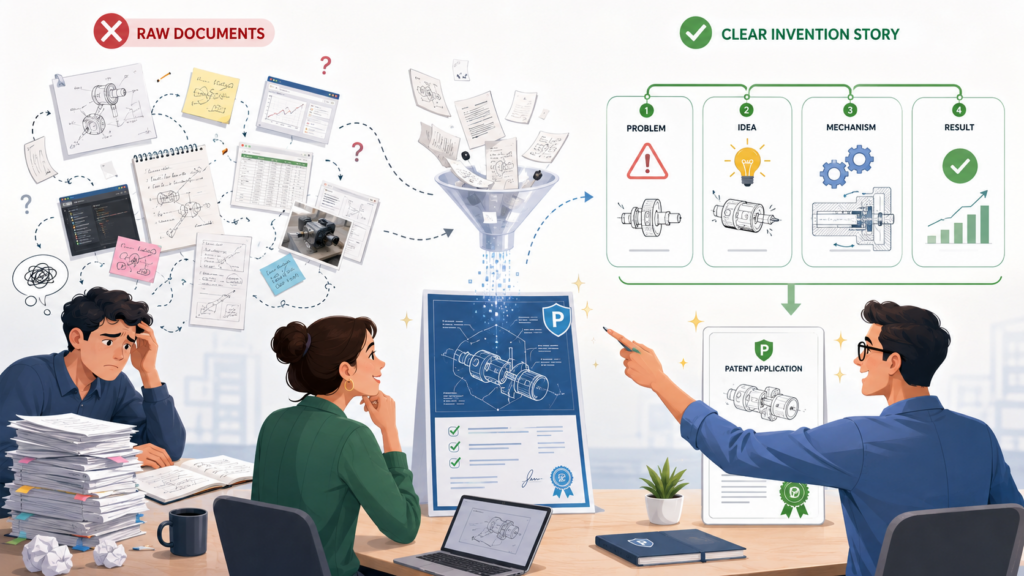
They send code snippets, design docs, slide decks, screenshots, lab notes, product specs, API docs, test results, and meeting notes. That material can be useful. But raw documents alone are not a clear invention story.
A patent team still needs to know what matters.
Without guidance, the most important detail may be buried on page forty of a design doc. A key tradeoff may be hidden in a comment thread.
The reason for a system change may be missing entirely. The documents may show what exists, but not why it was built that way.
This creates a false sense of completion. The founder thinks the attorney has everything. The attorney may have a lot of material, but not enough signal.
Documents are evidence, not strategy
A document dump can help support the patent process, but it should not replace explanation.
The team should first explain the invention in plain words. Then the documents should support that explanation. This lets the patent attorney read the material with the right frame.
For example, sending a model architecture diagram is useful. But it is more useful when paired with a note saying, “The key change is that we select one of three models based on input quality before generating the output.”
Sending test results is useful. But it is more useful when paired with a note saying, “The performance jump came after we added a confidence check before routing uncertain cases to review.”
That short context turns a document into a useful source.
Why raw files can create weak drafts
Raw files can create confusion when they contain old versions, side ideas, abandoned paths, or internal shorthand.
A patent attorney may see five versions of a system and not know which one matters. A diagram may show a feature that no longer exists. A product spec may describe the customer flow but not the backend change.
A deck may use marketing language that hides the technical steps. A test chart may show improvement but not explain what caused it.
If the team does not guide the review, the draft may focus on the wrong material.
This is not because the patent team is careless. It is because invention context is not always obvious from documents. The builders know which parts matter. They need to say it.
How to turn messy material into a clear invention packet
A strong invention packet starts with a short plain-language overview.
It should explain the problem, the old way, the new method, why the new method works better, and which documents support each part. This overview does not need to be polished. It needs to be clear.
Then the team can include documents with comments. Mark the pages, diagrams, charts, or sections that matter most.
Add short notes explaining why each item is relevant. Tell the patent team which files are current, which are old, and which show failed paths.
This saves time and improves quality.
The best invention packet tells the attorney where to look
Do not make the patent team hunt for the invention.
Point to it.
Say, “The key flow is shown in this diagram.” Say, “The important test result is the drop in false alerts after step three was added.”
Say, “This older design failed because it treated all sensor readings the same.” Say, “This document shows a future version using a different input source.”
These comments are simple, but powerful.
They help the attorney see the invention through the team’s eyes. They also reduce the risk that the draft will focus on less important details.
The strategic lesson for founders
More documents do not always mean more clarity.
The best patent collaboration combines raw material with a clear invention story. The documents provide support.
The story provides direction. Together, they give the patent team the context needed to draft with depth and focus.
PowerPatent helps teams move from scattered invention material to a more guided process, with smart software and real attorney oversight.
That means founders can avoid the chaos of document dumps and help their patent team focus on what truly matters. Learn how PowerPatent works here: https://powerpatent.com/how-it-works
A strong patent application starts when the team stops throwing files over the wall and starts explaining the invention with care.
Conclusion
Strong patent applications come from strong teamwork. When teams share the right details early, include the right people, explain the real path, review drafts with care, and connect the filing to business goals, the patent becomes much more than paperwork. It becomes protection for the work that makes the company special.
Most patent mistakes are not caused by bad ideas. They are caused by missed context, rushed talks, vague notes, and weak handoffs. PowerPatent helps founders fix that with smart software and real attorney oversight, so teams can file with more speed, control, and confidence: https://powerpatent.com/how-it-works
Leave a Reply