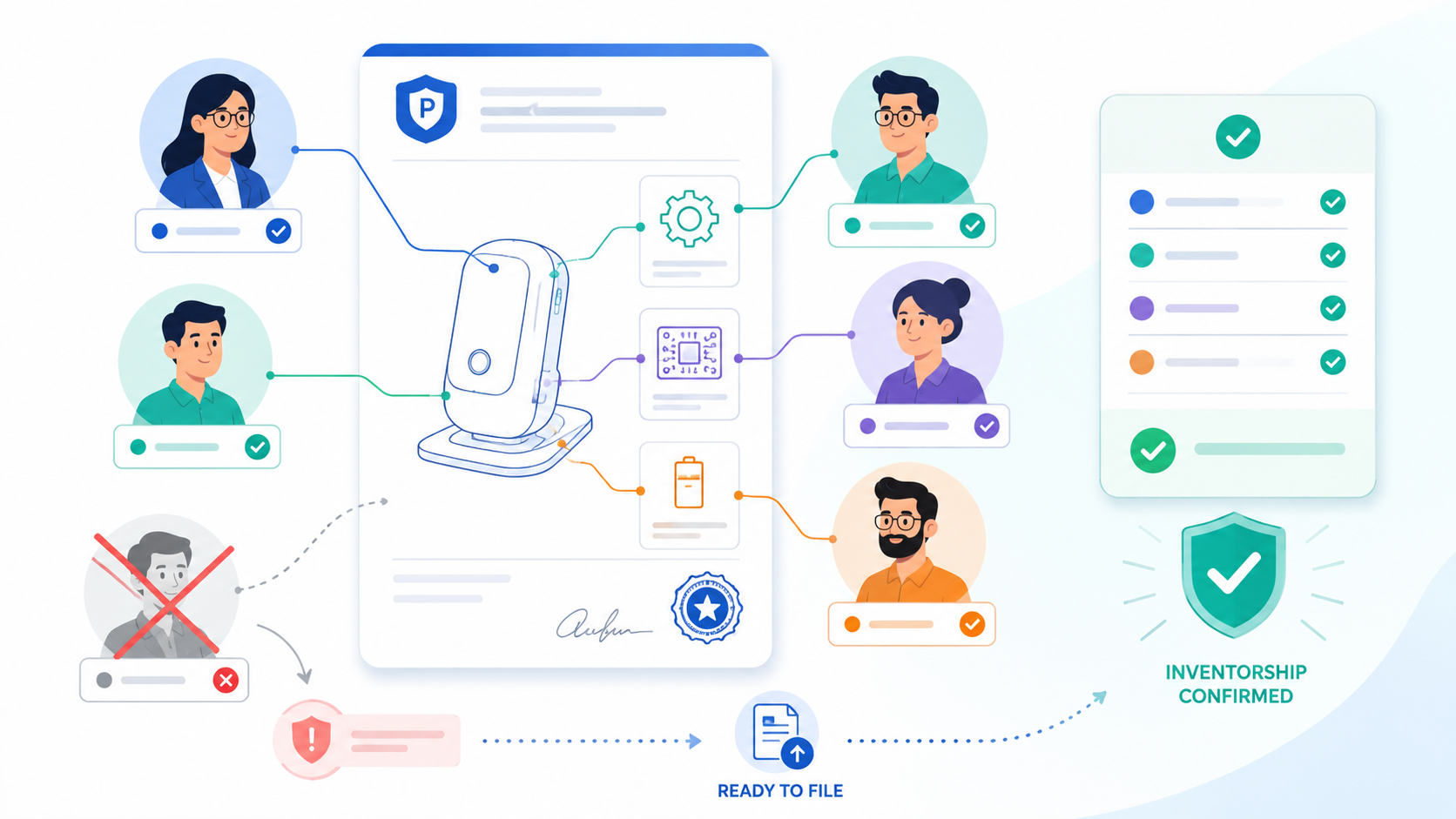
AI can draft a patent specification.
That fact is no longer very interesting.
The important question is what happens after everyone can do it.
If one lawyer can produce a first draft in hours instead of days, the competitive advantage does not remain “I can generate patent text.”
Every other modern patent practice eventually gets similar capability.
The advantage moves somewhere else.
It moves to better invention capture.
Better claims.
Better review.
Better consistency.
Better client communication.
Better decisions about what belongs in the application.
And, above all, better judgment.
This is why the current debate about whether artificial intelligence will replace patent lawyers often begins with the wrong unit of analysis.
AI does not need to replace a patent attorney to transform patent practice.
It only needs to replace enough of the old workflow.
The Lesson From Venture Capital’s Legal AI Experiment
A 2026 Data Driven VC discussion brought together Ben Sneider of NEA, Marty Gomez of Goodwin, and Jamie Tso of LegalQuants to discuss whether investors still need lawyers when AI can perform more legal work.
Their shared conclusion was that AI is already strong at surfacing information while human judgment remains harder to replace.
That idea may be even more important in patents.
Patent work contains a large amount of text production and information processing.
But the document is not the real product.
The legal position created by the document is the product.
A 40-page application produced beautifully in minutes can still be a bad patent.
A five-page set of carefully designed claims can contain more strategic thinking than dozens of pages of polished specification.
So the future of AI patent drafting should not be judged by how much text AI can produce.
It should be judged by whether the resulting workflow helps professionals create stronger, more consistent, better-supported patent applications.
AI Use in Law Has Already Passed the Experiment Stage
Thomson Reuters reports that 41% of law firms were using GenAI in 2026, compared with 28% in 2025. Corporate legal departments moved even faster, rising from 23% to 47%.
Among legal professionals already using AI, common uses include document review, research, summarization, and drafting.
This matters for patent professionals because it changes client expectations.
The client who knows software can speed up document-heavy work will increasingly ask why traditional legal processes still take as long as they once did.
At the same time, clients will not accept lower quality simply because AI was involved.
Thomson Reuters’ 2026 research found that 96% of surveyed professionals considered confidential-data safeguards necessary, 94% wanted outputs grounded in authoritative material, and 90% said AI reasoning should be explainable and defensible.
So the winning patent workflow has to solve two problems at once:
Make work faster.
And:
Keep professional control over the result.
PowerPatent Original Research: The Patent Workflow Pressure Analysis
To understand why patent workflows need to change, we combined public data from WIPO, the USPTO, and legal-industry research.
This is not an estimate of PowerPatent’s own productivity.
It is an independent workflow-pressure analysis designed to answer a different question:
Is the volume and speed of technical invention increasing fast enough that the old manual patent workflow becomes increasingly difficult to scale?
Step 1: Measure the growth of the technology frontier
WIPO counted 14,080 GenAI patent-family publications in 2023.
The number reached 18,862 in 2024 and then 37,808 in 2025.
From 2023 through 2025, that is an increase of approximately 168.5%.
In other words, the 2025 publication level was about 2.69 times the 2023 level.
The implied compound annual growth rate over the two-year period is approximately 64%.
The composition is changing too.
WIPO found that LLMs overtook GANs as the largest GenAI model category by patent volume. LLM patent families went from 881 in 2023 to more than 14,100 in 2025.
That is not normal incremental change.
Patent professionals working in these areas are trying to document inventions while the underlying technical landscape is changing extremely quickly.
Step 2: Look at the patent system’s existing workload
As of July 2026, the USPTO reported 759,413 unexamined utility, plant, and reissue patent applications awaiting a first Office Action.
That figure should not be interpreted as evidence that drafting software can “solve” the patent backlog. Examination workload and applicant drafting workload are different problems.
It does demonstrate scale.
The patent system already handles enormous quantities of highly technical information.
Step 3: Look at potential legal capacity created by AI
Thomson Reuters reported that legal professionals estimated AI could free roughly 240 hours per lawyer per year.
That is an industry-wide estimate, not a patent-specific PowerPatent benchmark.
But consider its implications.
For an eight-person patent team, 240 hours per professional would equal 1,920 hours per year of potential reclaimed capacity.
That is roughly the raw annual time represented by one person working 40 hours per week for 48 weeks.
Again, that does not mean AI literally eliminates one job.
It means that relatively small savings repeated across research, drafting, review, reporting, and administration can add up to a very large pool of professional time.
The result
Our three datasets point in the same direction.
The technical landscape is expanding quickly.
The patent information workload is already huge.
AI has the potential to release meaningful professional capacity.
The rational response is therefore not to use AI simply to “write faster.”
It is to redesign the workflow so professionals spend a larger share of their scarce time on the steps where judgment creates value.
The First Draft Is Becoming Infrastructure
For decades, producing the first complete patent draft required a great deal of mechanical effort.
A professional might receive an invention disclosure, schedule a call, reorganize inventor notes, create drawings or instruct someone else to create them, build claims, construct detailed descriptions, check numbering, connect figures to text, inspect antecedent basis, compare terminology, and circulate the result.
Some of those tasks require deep skill.
Others require skill mainly because the old tools were inefficient.
Generative AI changes that division.
PowerPatent’s workflow, for example, includes invention-disclosure capture, drawing and flowchart management, graphical claim drafting, computer-aided description drafting, diagnostics for §112 and claim issues, and inventor collaboration.
That is a better way to think about patent AI.
Not:
“Press a button and receive a patent.”
But:
“Build a structured environment in which the machine handles more of the repetitive transformation between invention information and patent documents.”
The professional remains responsible for deciding what the patent should actually say.
Stage One: Capture the Invention Before Generating Prose
The easiest way to create a bad AI patent draft is to begin drafting before the invention has been properly understood.
AI is very good at filling empty space.
That makes incomplete invention disclosures more dangerous, not less.
The system may turn three thin paragraphs into ten pages of smooth text.
The output looks complete.
The invention understanding may not be.
A better workflow begins by making the technical structure explicit.
What problem is being solved?
What existed before?
What did the inventors change?
Which part produced the unexpected or useful result?
What alternatives did the inventors consider?
What components are essential?
Which are optional?
What variations are already foreseeable?
Where is the commercial value?
What will competitors probably try to copy?
PowerPatent’s workflow begins with invention-disclosure capture rather than jumping immediately to final prose, which reflects this logic.
The quality of the AI output will depend heavily on the quality of the structured input.
Stage Two: Make the Claims the Center of the Workflow
A common failure mode in AI patent drafting is to generate an impressive specification first and treat the claims almost as another piece of generated text.
That reverses the strategic order.
Claims deserve concentrated human attention because they define the boundaries the applicant is trying to obtain.
AI can help enormously here.
It can suggest alternatives.
It can convert structural relationships into different claim forms.
It can expose inconsistent terminology.
It can compare independent and dependent claims.
It can identify elements that appear unsupported elsewhere.
It can help a practitioner explore variations much faster than manual copying and editing.
But the professional still needs to ask the harder questions.
What is the inventive concept?
How much breadth can reasonably be pursued?
Which limitations are commercially dangerous?
Which term might later be construed too narrowly?
What will the examiner probably search?
Which fallback positions should be preserved?
What competitor design should the claim make difficult?
That is not text generation.
That is claim architecture.
Stage Three: Let AI Expand the Description, but Do Not Let It Invent the Invention
Once the invention and claim strategy are clear, AI is especially useful for turning structured technical material into readable draft language.
This can include descriptions of embodiments, figure narratives, alternative configurations, system relationships, and implementation details.
But professionals need a strict boundary.
A generative system should not quietly add technical facts simply because they make the document sound more complete.
Patent drafting does not reward fiction.
An elegant hallucination is still a hallucination.
The reviewer should therefore distinguish between three kinds of generated text:
Transformative text restates information already supplied.
Inferential text draws a reasonable implication from supplied information.
New technical content adds something that did not come from the inventor.
The first category can often be automated aggressively.
The second deserves review.
The third should trigger a deliberate check with the inventor.
That simple classification can prevent a great deal of false confidence.
Stage Four: Automate Consistency Checking Much More Aggressively
Patent applications are unusually well suited to machine-assisted consistency review.
The documents contain repeated terms, reference numbers, figures, claims, antecedent relationships, cross-references, and dependencies.
Humans are capable of checking all of these.
Humans are also capable of missing one item after reading a long document for the sixth time.
Software does not become bored.
This is an area where patent teams should expect far more automation.
PowerPatent, for example, offers diagnostics designed to identify §112 and claim issues.
A diagnostic does not decide the legal issue.
It tells the professional where to look.
That distinction is extremely powerful.
The machine becomes the tireless checker.
The lawyer becomes the decision-maker.
Stage Five: Put the Inventor Back Into the Loop Earlier
AI can actually make inventor collaboration worse if teams use it badly.
A patent professional can generate such a polished draft that the inventor assumes everything must be correct and skims it.
That is dangerous.
The better use of AI is to shorten the time between the invention discussion and meaningful inventor review.
Instead of waiting for a nearly finished application, teams can share structured diagrams, claim concepts, summaries, and flagged questions earlier.
That encourages the inventor to correct misunderstandings while they are still cheap to fix.
PowerPatent explicitly includes inventor and client collaboration in its workflow.
The purpose should not merely be quicker approval.
It should be quicker discovery of missing facts.
Stage Six: Keep Inventorship a Human Question
AI-assisted invention creates another reason for good process.
In November 2025, the USPTO revised its inventorship guidance and confirmed that the same legal inventorship standard applies whether or not AI tools were used.
Only natural persons can properly be named as inventors. AI systems remain tools.
That makes invention records important.
If an engineer uses an AI system to explore hundreds of alternatives, the team should still be able to understand which human contributions resulted in the claimed invention.
Patent workflow software should help preserve that story rather than bury it under generated text.
Stage Seven: Human Review Must Become More Demanding, Not Less
There is a tempting idea that if AI creates the draft, the lawyer’s job becomes easier.
In one sense, yes.
Less blank-page work.
Less repetitive typing.
Less manual formatting.
But the review job can become harder.
A weak human draft often announces its weaknesses.
The author knows which paragraph was rushed.
Missing detail looks missing.
Generated prose can hide weakness under fluency.
A reviewer therefore needs to read AI-assisted work with an adversarial mindset.
Ask:
Where did this fact come from?
Does every important claim concept have clear support?
Are terms used consistently?
Does the description silently narrow the invention?
Does an example accidentally become a mandatory feature?
Do the drawings and text agree?
Are alternatives technically real, or merely linguistically plausible?
Would an inventor recognize this implementation?
Could opposing counsel later point to this sentence and use it against the patentee?
This is why AI does not eliminate professional review.
It changes what good review means.
The USPTO Is Sending the Same Message
In its guidance on AI tools, the USPTO has made clear that existing responsibilities continue to apply regardless of how a submission was produced. It specifically warns practitioners about the need to use AI responsibly rather than leave generated work unchecked.
The USPTO has also experimented with AI inside examination itself.
Its Artificial Intelligence Search Automated Pilot Program tested an automated pre-examination search that could identify up to ten potentially relevant documents. The pilot later closed to new petitions in June 2026.
The signal is important.
AI is moving into both sides of the patent process.
Applicants will have better search and drafting tools.
Patent offices will have better search and examination tools.
That means the advantage cannot simply come from producing more words faster.
The standard of strategic thinking has to rise too.
The Junior Patent Professional’s Job Is About to Change
The DDVC panel also raised the changing role of junior lawyers.
Patent practice provides a particularly clear example.
Historically, junior professionals could learn by performing large quantities of first-pass work.
Draft the background.
Write figure descriptions.
Summarize prior art.
Check references.
Prepare claim amendments.
Review formal details.
AI can now assist with many of those activities.
That creates a training problem.
If software performs the mechanical work, how does a junior professional develop the judgment normally acquired while doing it?
The answer cannot be to preserve inefficient work simply as a training exercise.
Instead, firms need to train judgment explicitly.
A junior professional should be taught to explain why a claim is structured a certain way.
Identify the strongest design-around.
Find the unsupported limitation.
Challenge an AI-generated embodiment.
Explain why one piece of prior art matters and another does not.
Trace each important claim term to support.
Predict an examiner’s objection.
Ask inventors the missing technical question.
AI fluency will matter.
But issue spotting may become even more valuable.
AI Also Changes Patent Economics
The traditional billable-hour structure contains a basic tension.
Efficiency reduces time.
Hourly billing rewards time.
Thomson Reuters found that 43% of legal professionals expect hourly billing models to decline over the next five years.
Patent drafting is well positioned for alternative pricing because much of the workflow is repeatable.
But firms should be careful about assuming that every matter fits a simple fixed price.
A straightforward mechanical invention with a strong disclosure may be predictable.
A cutting-edge AI architecture with unclear inventorship, several iterations of experimental results, a dense prior-art landscape, and aggressive international plans may not be.
The technology makes fixed pricing easier where workflow variability can be controlled.
It does not make uncertainty disappear.
What Patent Teams Should Measure Instead of AI Word Count
One of the worst AI metrics is “pages generated.”
Another weak metric is “minutes to first draft.”
Both can matter operationally.
Neither tells you whether the resulting patent is better.
A stronger patent AI scorecard would track things such as the time from disclosure to substantive first review, number of inventor clarification cycles, consistency issues found before filing, claim revisions caused by missing support, attorney time spent on mechanical drafting, attorney time spent on strategy, and portfolio throughput without a drop in review quality.
Thomson Reuters found an interesting industry-wide problem: organization-wide AI use reached 40% in 2026, but only 18% of surveyed organizations said they track AI ROI.
Patent teams should avoid making the same mistake.
Buying AI software is not an AI strategy.
A strategy identifies exactly which work should become faster and what will be done with the capacity that is released.
The Best AI Patent Workflow Is a Judgment Escalation System
This leads to a useful design principle.
Every patent task should be routed according to the level of judgment it requires.
Software handles the repetitive transformation.
Diagnostics handle systematic checks.
AI helps explore alternatives.
The professional reviews exceptions.
The attorney escalates the issues with legal consequences.
The inventor resolves missing technical facts.
The client decides business priorities.
That is much more powerful than a generic chatbot sitting beside a Word document.
It turns AI into workflow infrastructure.
Why This Matters More as GenAI Patenting Explodes
WIPO’s latest figures show how quickly the field is moving.
GenAI patent-family publications roughly doubled between 2024 and 2025. The United States remains the second-largest inventor location, while WIPO found that seven of the top ten GenAI-patenting locations produced more families in 2024 and 2025 combined than during the entire preceding decade.
For patent practitioners, the message is simple.
The amount of relevant technology is not waiting for the profession to catch up.
Clients are building faster.
AI systems are changing faster.
Competitors are filing faster.
Search is improving.
Examination is becoming more technology-assisted.
Patent teams need workflows that can absorb that speed without sacrificing thought.
PowerPatent Is Built Around That Division of Labor
PowerPatent describes itself as a platform created by patent lawyers for patent lawyers and enhanced by generative AI. Its workflow covers invention disclosure, drawings, graphical claim drafting, computer-aided description drafting, diagnostics, and inventor collaboration.
That model points toward the future of patent practice.
Not autonomous patents.
Not lawyers pretending AI does not exist.
Instead:
AI performs more of the mechanical work so patent professionals can spend more of their time building strategic patents.
That distinction will matter increasingly as the technology improves.
The first-draft race will eventually become less interesting.
Anyone may be able to generate text.
The winners will be the teams that can turn invention knowledge into strong patent strategy reliably, quickly, and repeatedly.
If your patent team is still assembling every application through a chain of manual documents, emails, copy-and-paste drafting, and disconnected review steps, explore PowerPatent and see what a structured AI-assisted patent workflow can look like.
Leave a Reply