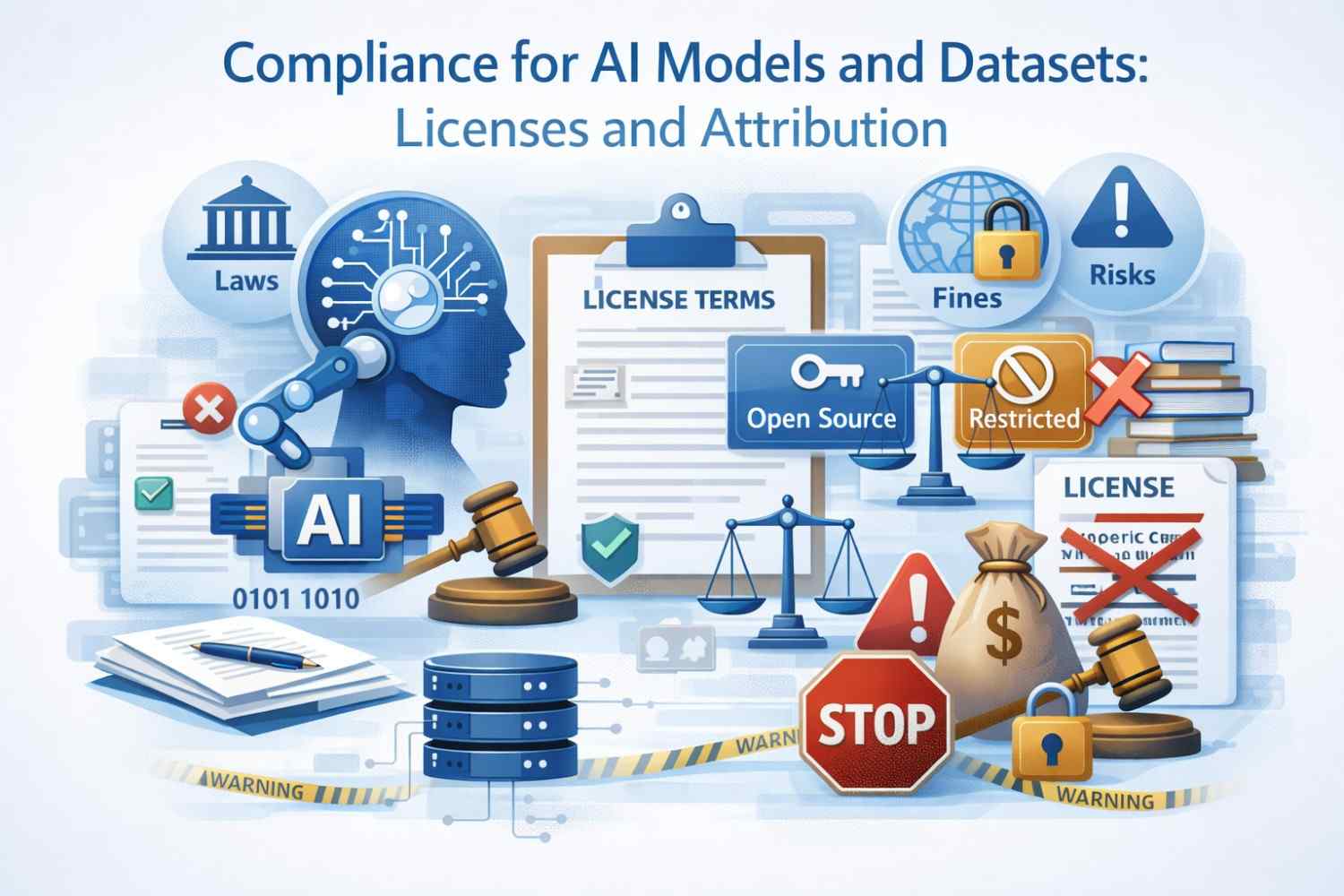
AI is moving fast. Faster than most founders expect. You can train a model in weeks, ship in months, and get users even faster. But there is one quiet risk that can undo all of that progress if you ignore it. That risk is compliance around the data and models you use.
This is not about slowing down. This is about staying in control.
Every AI product is built on top of something else. Data you did not create from scratch. Models you did not fully invent alone. Code, weights, datasets, and tools that came with rules. Those rules live inside licenses and attribution terms. If you miss them, you can lose deals, face shutdowns, or weaken your patent position before you even realize it.
Why AI Compliance Is Not Optional Anymore
AI compliance is no longer something you can push to the side and deal with later. It has moved from a legal detail to a core business issue.
Founders who understand this early build stronger companies, close deals faster, and avoid painful resets.
This section explains why compliance now sits at the center of AI strategy and how smart teams treat it as part of product design, not paperwork.
The Speed of AI Has Changed the Risk
AI products move fast, and that speed creates hidden exposure.
Ten years ago, software teams built most things from scratch. Today, AI teams stack layers of open models, scraped data, third-party tools, and shared research. Each layer adds rules.
The faster you move, the easier it is to forget where those rules came from. That is how teams end up shipping models that technically work but legally cannot be sold.
The risk is not theoretical anymore. Buyers now ask direct questions about training data sources, model licenses, and reuse rights. Investors run diligence earlier.
Enterprise customers want written proof. If you cannot answer clearly, deals slow down or disappear.
The action here is simple but powerful. Treat compliance like performance or security. It belongs in the build process, not as an afterthought.
When a dataset enters your system, someone should know where it came from and what rules came with it.
Compliance Is Now a Sales Requirement
Many founders still think compliance is about avoiding lawsuits. That view is outdated.
Compliance today is about closing revenue. Large customers will not buy AI products unless they trust the inputs. They want to know that your model will not expose them to risk.
Even startups selling to mid-market companies are getting these questions during procurement.
If you wait until a customer asks, you are already late. Scrambling to recreate data lineage under pressure often leads to bad answers or missed details. That damages trust even if nothing is technically wrong.
A smarter approach is to prepare short, clear explanations of your model and data sources early. You do not need a long legal memo. You need confidence and clarity.
When you can explain how your data was sourced and why you are allowed to use it, sales conversations change tone instantly.
PowerPatent helps founders document this early so it supports both patents and go-to-market strategy. You can see how that works here: https://powerpatent.com/how-it-works
Regulators Are Catching Up Faster Than Expected
For years, regulation lagged behind AI development. That gap is closing.
Governments around the world are introducing AI-specific rules, and many of them focus on transparency and data rights.
Even when laws do not directly ban your product, they often require you to explain how it works and what data it relies on.
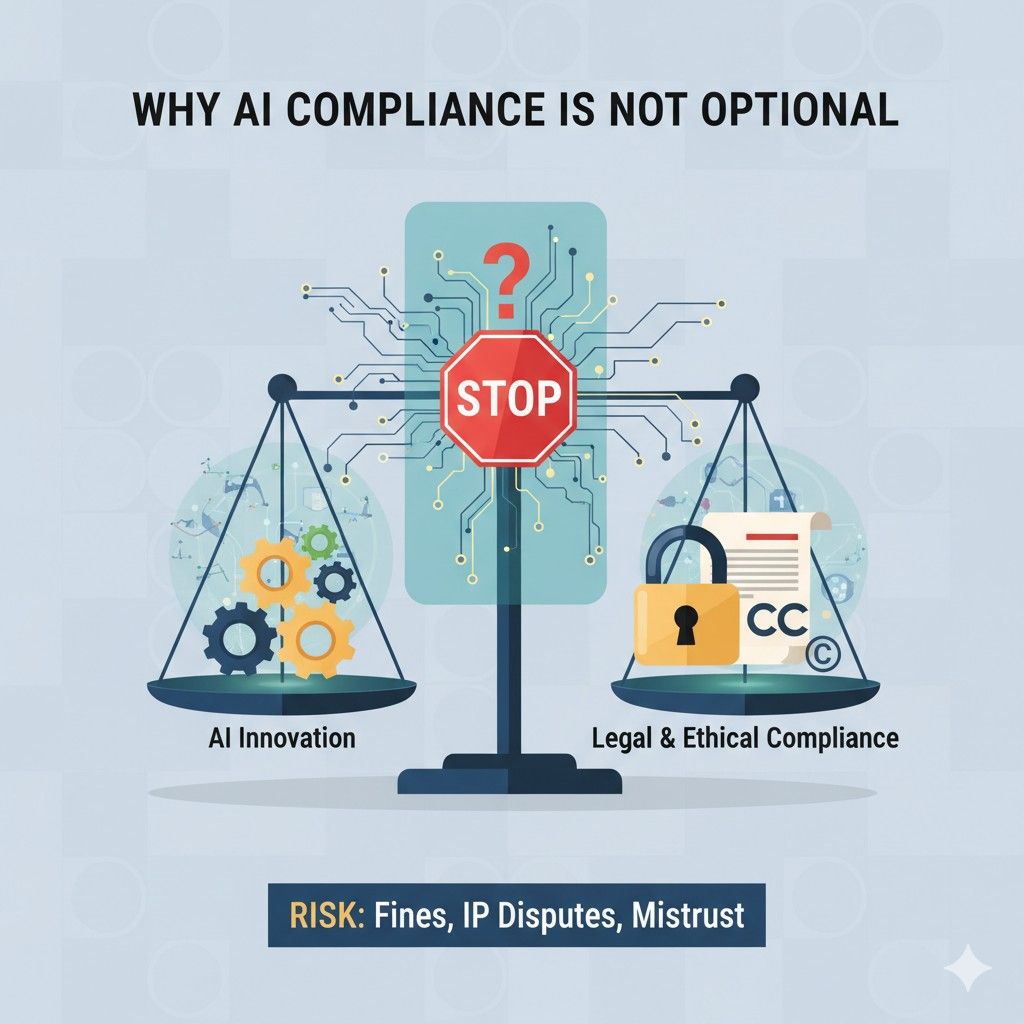
Founders who cannot answer those questions face delays, audits, or forced changes. Founders who can answer them move forward while others stall.
The key insight is that regulation rarely asks for perfection. It asks for process. Regulators want to see that you thought about compliance, made reasonable choices, and can explain them.
Building that process early costs far less than retrofitting it later.
Your IP Is Only as Strong as Your Compliance
This is where many AI teams get surprised.
You can build an amazing model and still fail to protect it if your inputs are not clean. If your training data or base model license restricts commercial use or derivative works, your patent claims may weaken.
Investors and acquirers notice this quickly.
Compliance is not separate from intellectual property. It is part of it. Clean inputs lead to clean ownership. That ownership becomes leverage when you file patents, raise money, or negotiate partnerships.
The practical move here is to align your compliance story with your IP story. When you describe what makes your AI unique, you should also know which parts you own outright and which parts you rely on under license.
PowerPatent is built around this exact alignment, combining software and real attorney review to help founders avoid blind spots.
Attribution Is Becoming a Public Signal
Attribution used to live in footnotes and documentation. Now it is visible.
Open models, public datasets, and shared benchmarks often require attribution. Failing to give it does not just break rules. It sends a signal that your team cuts corners. In the AI world, reputation spreads fast.
On the flip side, clear attribution shows professionalism. It tells users, partners, and contributors that you respect the ecosystem you build on. That matters more than many founders realize.
The action step here is to standardize attribution early. Decide where it lives in your product, your site, or your documentation. Make it part of release checklists. When attribution becomes routine, it stops feeling like a burden.
Compliance Debt Grows Faster Than Technical Debt
Founders understand technical debt. Compliance debt works the same way, but it grows faster and is harder to unwind.
Every dataset added without review compounds risk. Every model fine-tuned without license checks narrows future options.
When teams finally address compliance after months or years, they often face painful trade-offs. Retraining models, dropping features, or rewriting contracts.

Avoiding this starts with ownership. Someone on the team must be responsible for compliance decisions, even if they are not a lawyer.
That person tracks sources, flags unknowns, and asks questions early. This role saves time, not wastes it.
Customers and Partners Are Doing Their Homework
One quiet shift in AI is how informed buyers have become.
Customers read licenses. Partners ask about dataset rights. Platform providers enforce terms more strictly. This is not about being cautious. It is about protecting their own risk.
Founders who dismiss these questions lose credibility. Founders who welcome them stand out. Being prepared shows maturity beyond company size.
This is why many teams now treat compliance summaries as part of their pitch. Not long documents. Just clear answers. What data did you use. What model did you start from.
What rights do you have. When you can answer calmly, conversations move forward.
Compliance Enables Faster Growth, Not Slower
The biggest myth is that compliance slows you down.
In practice, it does the opposite. Teams that understand their constraints make faster decisions. They know which datasets are safe to use. They know which licenses fit their business model. They avoid rework.
Compliance becomes a guardrail, not a roadblock. It lets builders focus on innovation without fear that success will create legal problems later.
This is exactly why PowerPatent exists. To help founders move fast while building defensible AI and clean ownership from day one. If that sounds useful, explore how it works here: https://powerpatent.com/how-it-works
How Licenses Shape What You Can and Cannot Build
Licenses are the invisible architecture behind every AI product. They decide what is allowed, what is blocked, and what becomes risky later.
Many founders treat licenses as background noise, but in AI they quietly define the limits of your business. This section explains how licenses actually work in practice and how smart teams use them to stay flexible instead of boxed in.
Licenses Are Product Constraints, Not Legal Text
Every license is a set of rules about behavior.
When you use a model, a dataset, or even evaluation code, you are agreeing to conditions.
Some conditions are obvious. Others are buried in simple-looking terms. These conditions shape how your product can be used, sold, or extended.
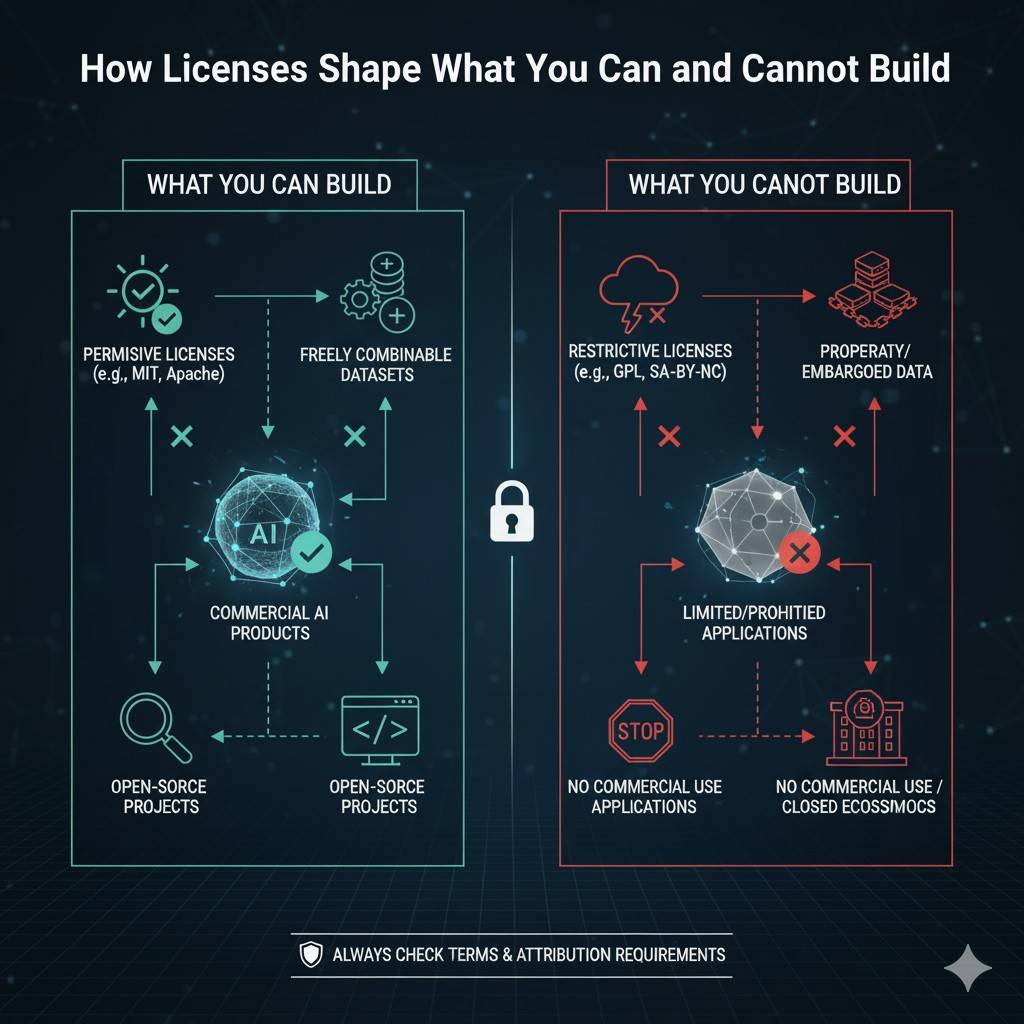
The mistake many teams make is assuming licenses only matter at launch. In reality, they matter most when your product evolves. A license that looks fine for a demo may block enterprise sales.
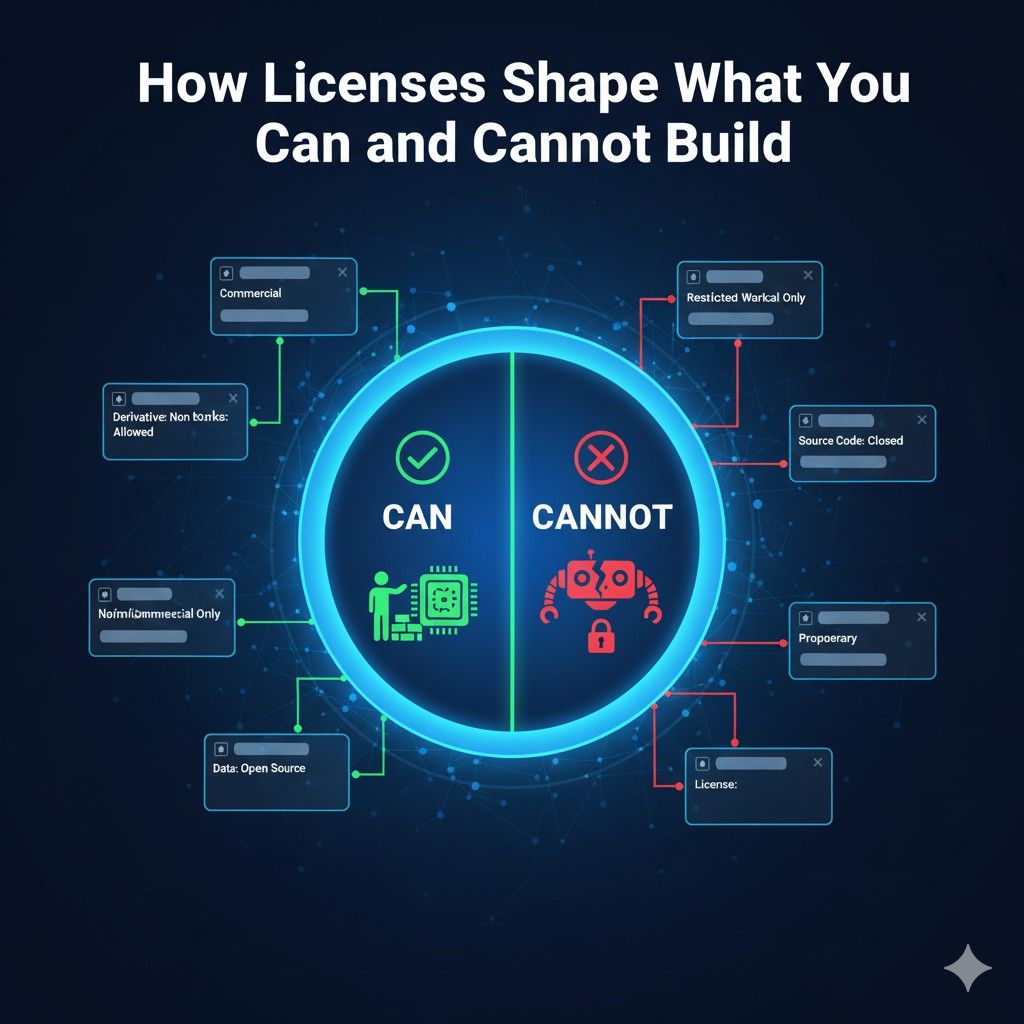
A research-only dataset may break commercial plans. These are not edge cases. They happen all the time.
The smart move is to treat licenses like product requirements. Just as you would not ship a feature that breaks your system, you should not adopt a license that breaks your future roadmap.
Open Does Not Mean Free to Use However You Want
Open-source and open-access resources power most AI systems today. That openness is powerful, but it comes with structure.
Many founders hear “open” and assume freedom. In reality, open licenses vary widely. Some allow commercial use. Some restrict it. Some require sharing changes. Some limit how outputs can be used.
The danger is not using open resources. The danger is using them without understanding the rules. Once a model is trained, you cannot easily remove the influence of restricted data.
A practical habit is to pause before training. Ask one simple question. If this model succeeds, will I be happy with the license terms in two years. If the answer is unclear, you need clarity before moving forward.
Dataset Licenses Often Carry More Risk Than Model Licenses
Most conversations focus on model licenses. In practice, datasets create more problems.
Datasets are often assembled from many sources. Each source may have its own terms. Even when datasets are labeled as public, that does not always mean unrestricted.
Some require attribution. Some forbid certain uses. Some rely on assumptions that no longer hold.
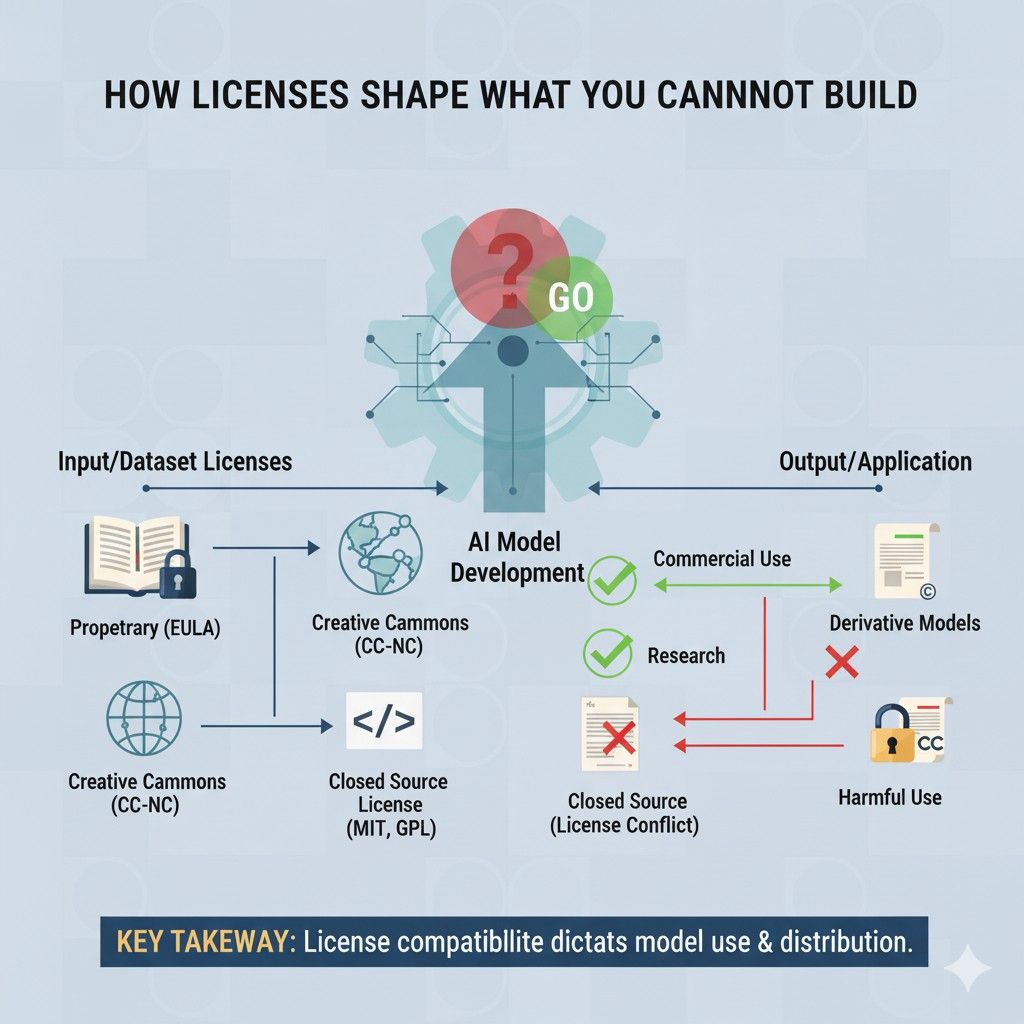
If your model learns patterns from restricted data, those restrictions may follow the model. This creates uncertainty during diligence and sales.
A strong habit is to keep dataset records simple and human-readable. Not legal documents. Just notes on where data came from and what rules apply. This small effort pays off massively later.
Fine-Tuning Changes the License Story
Fine-tuning is where many teams cross invisible lines.
You may start with a model that allows commercial use. Then you fine-tune it on a dataset with stricter rules.
The result is a hybrid model with blended obligations. If you do not track this, you may assume rights you no longer have.
This is especially risky for startups that iterate quickly. Each training run can change the compliance picture.
The solution is awareness. Before fine-tuning, consider the direction of change. Are you adding more freedom or more limits. If you are adding limits, ask whether that trade-off is worth it.
Licenses Affect How You Can Monetize
Licenses do not just affect legality. They affect business models.
Some licenses restrict offering models as a service. Others limit resale. Some require passing rights downstream to customers.
These rules can quietly block pricing strategies or partnerships.
Founders often discover this during contract negotiations, when it is hardest to change course. A deal slows down. Lawyers get involved. Momentum fades.
You can avoid this by mapping licenses to revenue early. If your plan includes enterprise contracts, APIs, or embedded use, your licenses must support that. Alignment here reduces friction everywhere else.
PowerPatent often helps founders spot these issues before they turn into blockers. You can learn more here: https://powerpatent.com/how-it-works
Licenses Influence Your Patent Strategy
This is a connection many teams miss.
If your invention relies heavily on licensed components, your patent claims must reflect what you actually own. You cannot claim exclusive rights over things you only have permission to use.
Clean licensing makes patent drafting easier and stronger. Messy licensing forces narrower claims and more caveats.
This is why licensing decisions should involve IP thinking, not just engineering. When licenses and patents align, you gain confidence. When they conflict, you lose leverage.
Changing Licenses Can Break Your Product Later
Licenses are not always fixed forever.
Some resources change terms. Some are deprecated. Some are reissued under new rules. If your product depends deeply on a resource that later tightens its license, you may face hard choices.
This risk is higher when you rely on single points of dependency. One dataset. One base model. One provider.

Resilient teams plan for this. They understand which parts of their stack are replaceable and which are not. They design flexibility where possible. This is not about paranoia. It is about durability.
Internal Use Versus External Use Matters
Many licenses treat internal use differently from external distribution.
Training a model for internal analysis may be allowed under terms that forbid shipping it to customers. The moment you cross that line, your obligations change.
Founders sometimes assume internal experimentation gives them a free pass. It does not if that experiment becomes a product.
A good rule is to assume success. If this experiment works and becomes core, will the license still work. Thinking this way avoids painful rewrites.
License Clarity Builds Confidence Across the Company
When licenses are unclear, teams hesitate.
Engineers wonder what they can use. Sales wonders what they can promise. Leadership wonders what risks exist. This uncertainty slows decisions.
When licenses are clear, everyone moves faster. Engineers build with confidence. Sales speaks clearly. Leadership plans boldly.
This clarity does not require heavy process. It requires attention and ownership. Small, consistent actions create trust internally and externally.
Turning Licenses Into an Advantage
The best founders do not just avoid license problems. They use license clarity as a signal.
They show customers they are thoughtful. They show investors they are disciplined. They show partners they are reliable.
In AI, trust is part of the product. Licenses are one of the easiest ways to earn it when handled well.
PowerPatent helps founders build this trust into their IP and compliance story from the start. If you want to see how, visit https://powerpatent.com/how-it-works
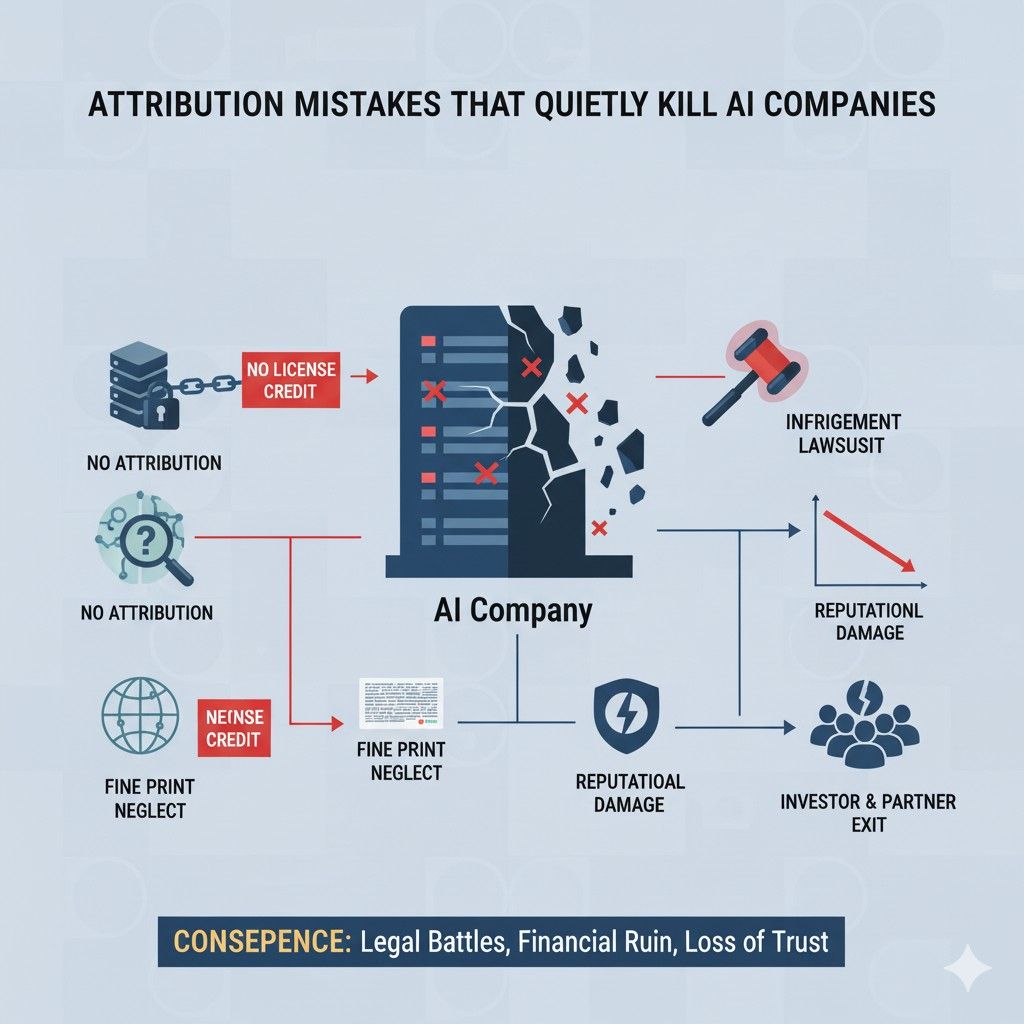
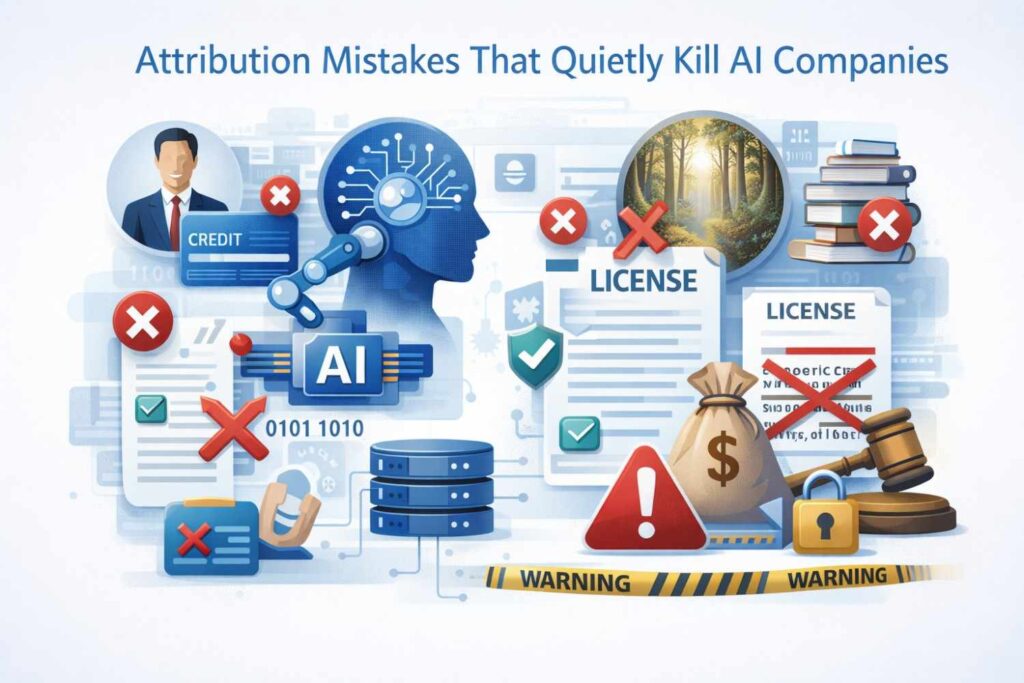
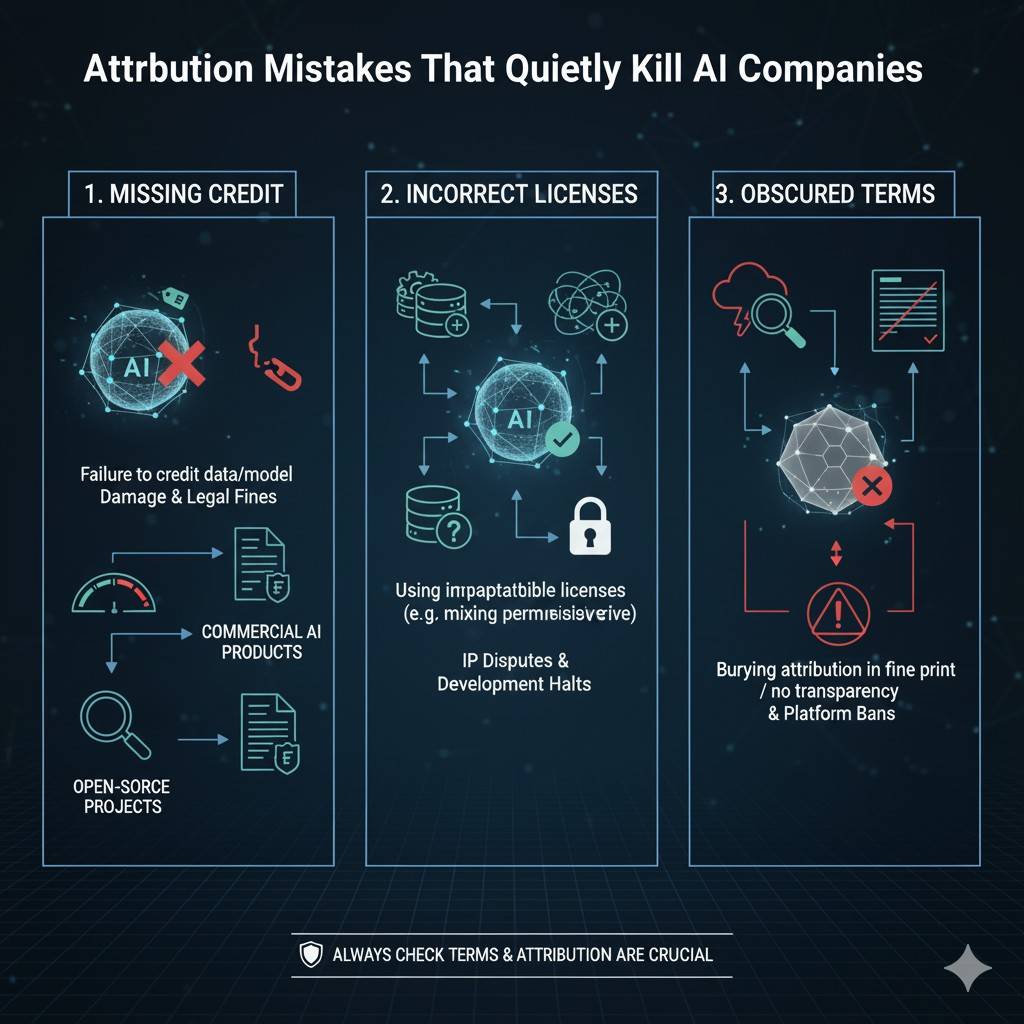
Attribution Mistakes That Quietly Kill AI Companies
Attribution sounds small. Many founders see it as a courtesy or a line in a document. In AI, attribution is much more than that. It is a signal of trust, discipline, and maturity.
Companies rarely fail because of attribution alone, but many lose deals, credibility, and leverage because they handled it poorly.
This section explains where attribution goes wrong and how to handle it in a way that protects your business instead of exposing it.
Attribution Is About Respect and Proof
Attribution is not just about saying thank you.
In AI, attribution is proof that you understand what you are building on.
It shows that you know where your data came from, which models influenced your system, and which rules apply. This proof matters to customers, partners, investors, and regulators.
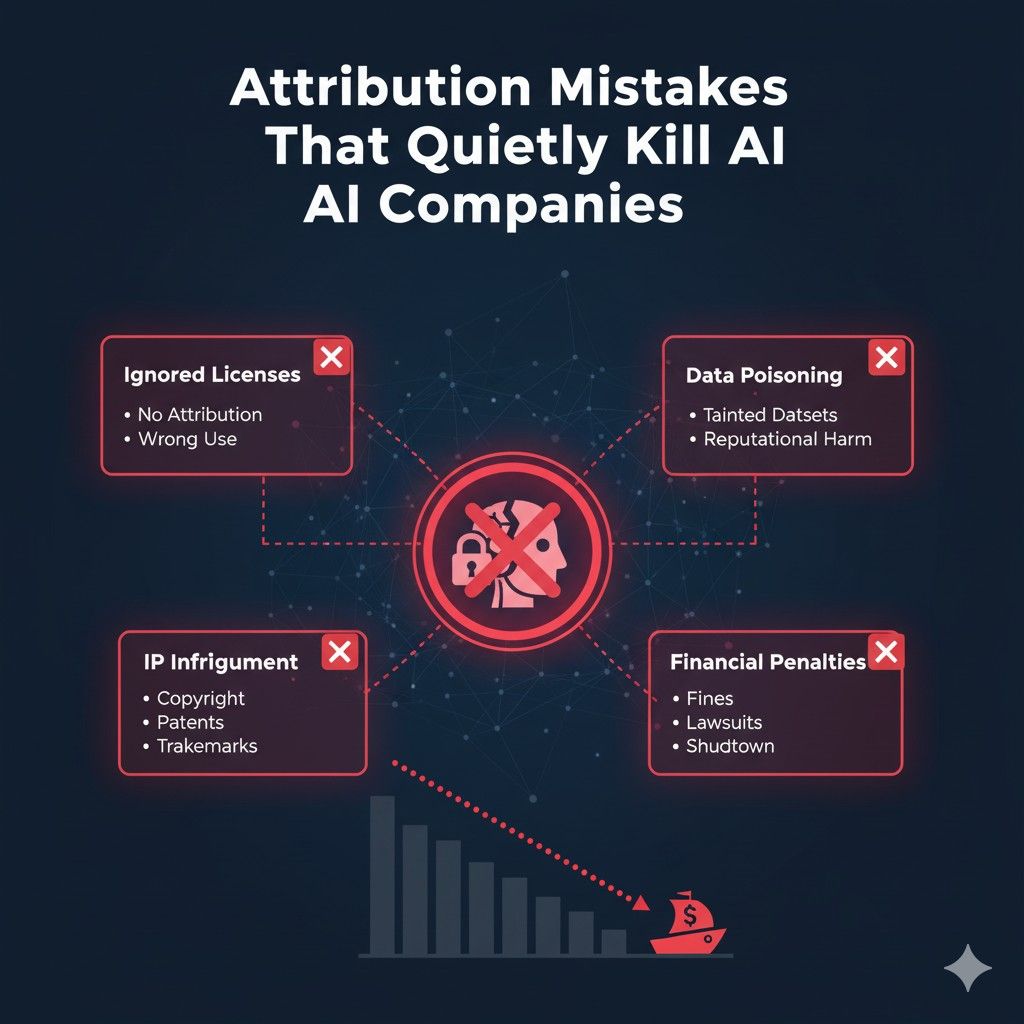
When attribution is missing or sloppy, people assume the rest of your compliance story is the same. Even if your technology is strong, trust weakens.
A good mindset shift is to treat attribution as part of your product story. It explains how your system came to be and why it can be trusted.
Ignoring Attribution Early Creates Visible Gaps Later
Early-stage teams often skip attribution because everything feels internal.
You are experimenting. You are iterating. You are not shipping yet. This feels harmless. The problem appears later when those early experiments become core systems.
At that point, tracing attribution back is hard. People forget sources. Links break. Decisions are lost. What could have been a simple note becomes a guessing game.
The practical move is to capture attribution when you first touch a dataset or model. Not perfectly. Just enough to remember. This habit costs minutes and saves weeks later.
Many Licenses Require Attribution in Specific Ways
Not all attribution is optional.
Some licenses require attribution in documentation. Others require it in user interfaces. Some require it in marketing materials. Missing these details can violate terms even if you intended to comply.
Founders often assume a single credits page is enough. Sometimes it is. Sometimes it is not.
The key is alignment. Attribution must match what the license expects. This does not require deep legal reading. It requires awareness and consistency.
When in doubt, clarity beats minimalism. It is better to over-attribute than to under-attribute.
Attribution Errors Surface During Diligence
Most attribution mistakes are not discovered by lawyers first.
They surface during diligence. A buyer asks where data came from. An investor reviews documentation. A partner checks terms. Gaps appear.
At that stage, fixing attribution feels reactive. You are explaining instead of demonstrating. That shifts power away from you.
Teams that prepare attribution early walk into diligence calmly. They answer questions directly. They provide references without scrambling.
This readiness shortens deals and strengthens negotiating positions.
Attribution and Branding Are Linked
Many founders worry attribution will dilute their brand.
In reality, clear attribution strengthens it. It shows confidence. It shows you are part of a serious ecosystem. It shows you did not cut corners.
Strong brands do not hide their foundations. They stand on them.
The trick is placement and tone. Attribution should be clear but not apologetic. Informative, not defensive. When done right, it fades into professionalism.
Failing to Attribute Can Break Platform Relationships
AI products often rely on platforms.
Cloud providers, model hosts, data sources, and research communities all care about attribution. It is part of how ecosystems stay healthy.
When teams ignore attribution, platforms notice. Access can be limited. Relationships strain. Support weakens.
Founders who respect attribution build goodwill. That goodwill matters when you need help, extensions, or exceptions later.
Attribution Becomes Harder as Products Grow
As AI products scale, attribution complexity increases.
You add more datasets. More models. More tools. More contributors. Without structure, attribution becomes messy fast.
The mistake is waiting for scale to solve this. Scale amplifies whatever habits you already have.
A simple internal standard early makes growth easier. Decide how attribution is recorded. Decide where it lives. Decide who updates it. This structure does not slow you down. It keeps things sane.
Attribution Ties Directly Into IP Ownership
Attribution is also an IP signal.
When you clearly attribute external components, you also clarify what is yours. This boundary matters for patents, licensing, and valuation.
Blurry attribution creates blurry ownership. Clear attribution sharpens claims.
This is why attribution and patent strategy should move together. At PowerPatent, we help founders think about both at the same time, so one supports the other instead of creating tension.
You can see how that works here: https://powerpatent.com/how-it-works
Attribution Is Easier Than Fixing a Reputation
Reputation damage is subtle.
No headline announces an attribution failure. Instead, trust erodes quietly. People hesitate. Questions increase. Confidence drops.
Fixing that takes time and effort. Often more than doing attribution right in the first place.
Founders who take attribution seriously early rarely think about it later. It becomes background hygiene. That is the goal.
Turning Attribution Into a Strength
The best teams treat attribution as a signal of quality.
They use it to show discipline. They use it to support transparency. They use it to reinforce trust.
Attribution does not slow AI companies down. It protects momentum. It keeps doors open.
When paired with clean licensing and strong IP strategy, attribution becomes part of a foundation you do not have to revisit under pressure.
If you want help building that foundation the right way from the start, explore how PowerPatent supports AI founders here: https://powerpatent.com/how-it-works
Wrapping It Up
AI compliance is not a side task. It is part of building a real company.
Licenses decide what you are allowed to build. Attribution shows how carefully you built it. Together, they shape trust, ownership, and long-term value. Ignoring them does not make them go away. It only makes the cost show up later, when it is harder to fix and more expensive to explain.
The strongest AI companies treat compliance as a design choice. They think about data sources before training. They understand model licenses before scaling. They document attribution as they go. Not because they love process, but because they value speed without surprises.
Leave a Reply