Most founders don’t think about data ownership until something breaks. A model leaks. A dataset gets shared. A partner claims rights you didn’t know you gave away. It never feels urgent—until it becomes the only thing that matters. That’s why protecting your data and model weights isn’t a “legal thing.” It’s a survival thing.
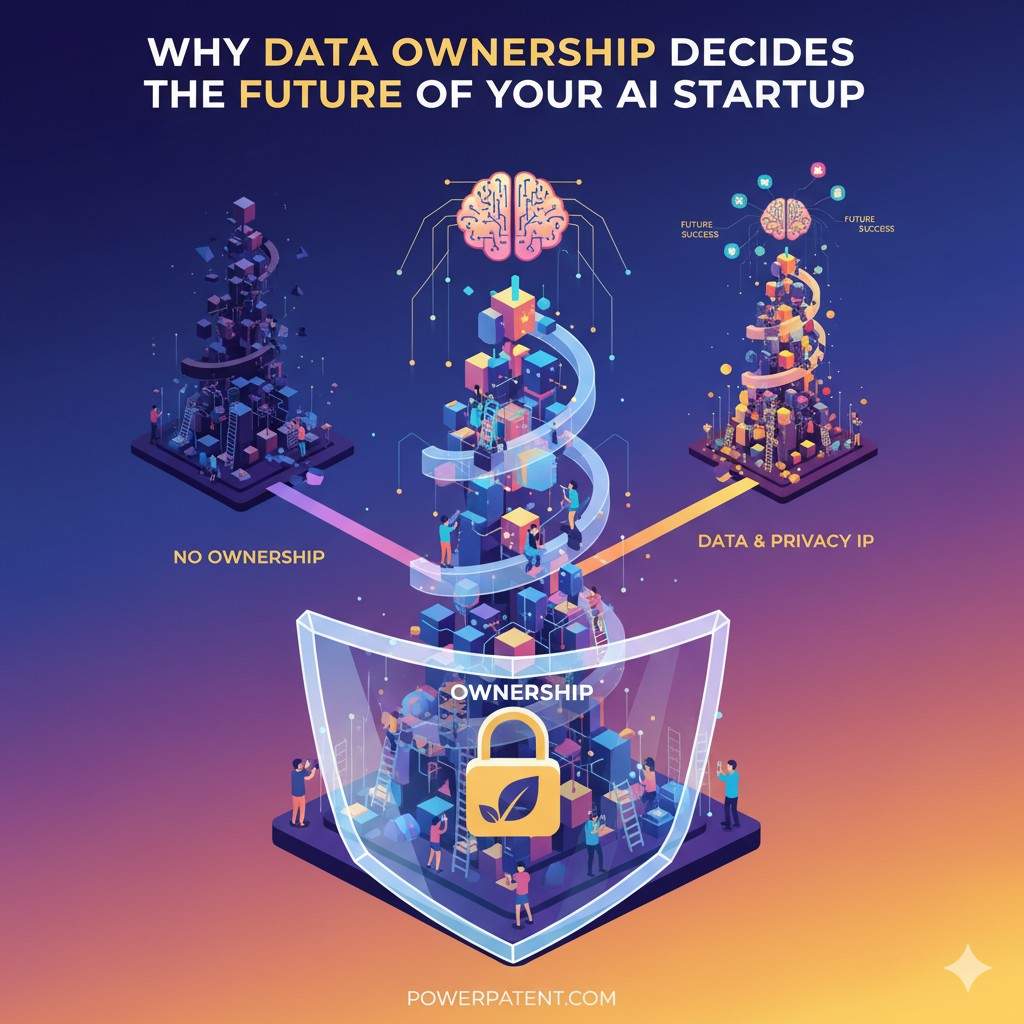
Why Data Ownership Decides the Future of Your AI Startup
Before anything else, it helps to see data ownership as a control system. It decides what you can build, how fast you can grow, and how confidently you can raise money.
Data is no longer a support resource. It is the foundation of your product and the core of your IP strategy.
When you understand what you own, what you merely access, and what you must protect, you unlock long-term stability that many teams overlook until it is too late.
How data ownership shapes your product roadmap
Every product decision in an AI startup eventually touches data. When you know exactly what you own, you can expand features without worrying about hidden limits or future disputes.

This clarity lets you move faster because you do not hesitate. You are not guessing. You are not waiting for legal cleanup. You can build with confidence because your rights are already established.
How unclear ownership creates silent technical debt
Lack of clarity does not break things on day one. Instead, it creates small cracks that grow over time.
A partner who gave you access today might restrict future use tomorrow. A dataset you licensed may not allow commercial deployment.
A research source may suddenly change its terms. These moments do not just delay progress. They force you to rethink your architecture, rebuild your models, or even pause your product.
When early ownership is sloppy, the cost shows up later when momentum matters most.
Why investors treat data ownership like core infrastructure
Investors know that model architectures can be copied, but datasets cannot. They see rights as a moat. They want proof that no one else can claim your training data, your labeling decisions, or your feature engineering.
When they ask where your data came from, they are not just checking a box. They are checking for durability.
Clear ownership becomes a signal of operational maturity, and it often becomes one of the reasons you win a competitive round.
How strong ownership boosts your pricing power
When you fully control your data, your model has unique behavior that no competitor can replicate. That difference gives you leverage in pricing, positioning, and partnership terms.
Companies with clean ownership can sell into regulated markets faster, command higher contract values, and negotiate from a stronger position because their product carries fewer risks.
Customers choose the team that makes their own compliance easier, and clean data rights make that possible.
How ownership protects you when you scale internationally
Every new market introduces new privacy rules. If your rights are shaky, global expansion becomes slow and expensive.
When your dataset is built with strong ownership principles, you do not have to rebuild or limit functionality for each region.
You can scale the same core product across borders with small adjustments instead of structural reworks. This makes international growth predictable rather than painful.
Why your dataset is more than the raw inputs you collect
Most founders focus on the raw data but overlook the value created by transformations. If you clean data, normalize signals, label examples, or remove sensitive fields, you are creating new intellectual property.
This transformed version often carries fewer restrictions and more protection than the original source.

When you treat this transformed dataset as its own asset, you gain a layer of protection that increases your control and reduces your dependence on any single source.
How to create a clean chain of custody for every piece of data
A simple but powerful practice is keeping a clear record of where data came from and what rights you secured. This chain of custody becomes a shield during audits, diligence, and negotiations.
It shows that you did not stumble into ownership but earned it through deliberate steps. Maintaining this habit early makes everything smoother when your user base grows and partners start asking questions.
How strong ownership lets you train, retrain, and fine-tune without hesitation
When rights are ambiguous, every model update becomes a legal question. When rights are clear, updates become engineering tasks.
This difference affects your ability to respond to bugs, customer needs, and competitive pressure.
You are free to experiment, fine-tune, and release improvements without worrying about crossing a boundary. Your team stays focused on building instead of waiting for approval.
How clarity with users builds long-term trust
Users are becoming more aware of how their data is used. When you can clearly explain your rights, your safeguards, and your privacy rules, you build trust that stays with you as you grow.
People feel safer choosing a product where the data boundaries are simple to understand. Clear ownership turns privacy into an advantage rather than a risk that sits in the background.
Why ownership determines your exit value
Acquirers do not just buy your product. They buy your defensibility. They want to know that what you built cannot be duplicated without great effort.
Clean data ownership makes your company more attractive because it removes uncertainty.
It shows that your core advantage is not fragile. Acquirers are willing to pay far more for assets that will not trigger disputes years after the deal closes.
How strong IP around data ownership strengthens your patent strategy
Data itself cannot always be patented, but the way you gather, filter, and refine it often can. When you take the time to understand what you own, you also uncover technical processes worth protecting.
Patents around data workflows give you long-term leverage even if parts of your dataset are replaceable. This blend of ownership and IP protection is one of the strongest positions an AI startup can achieve.
How PowerPatent makes these ownership steps easier
Many founders know data ownership matters but feel overwhelmed by the complexity.
PowerPatent removes the friction by helping you document your workflows, capture your technical innovations, and protect the parts of your system that give you real long-term advantage.
You move faster because you do not pause to decode legal language. You stay safer because real attorneys and smart tools help you avoid costly mistakes.
If you want to see how the process works in a simple, visual way, explore it here: https://powerpatent.com/how-it-works.
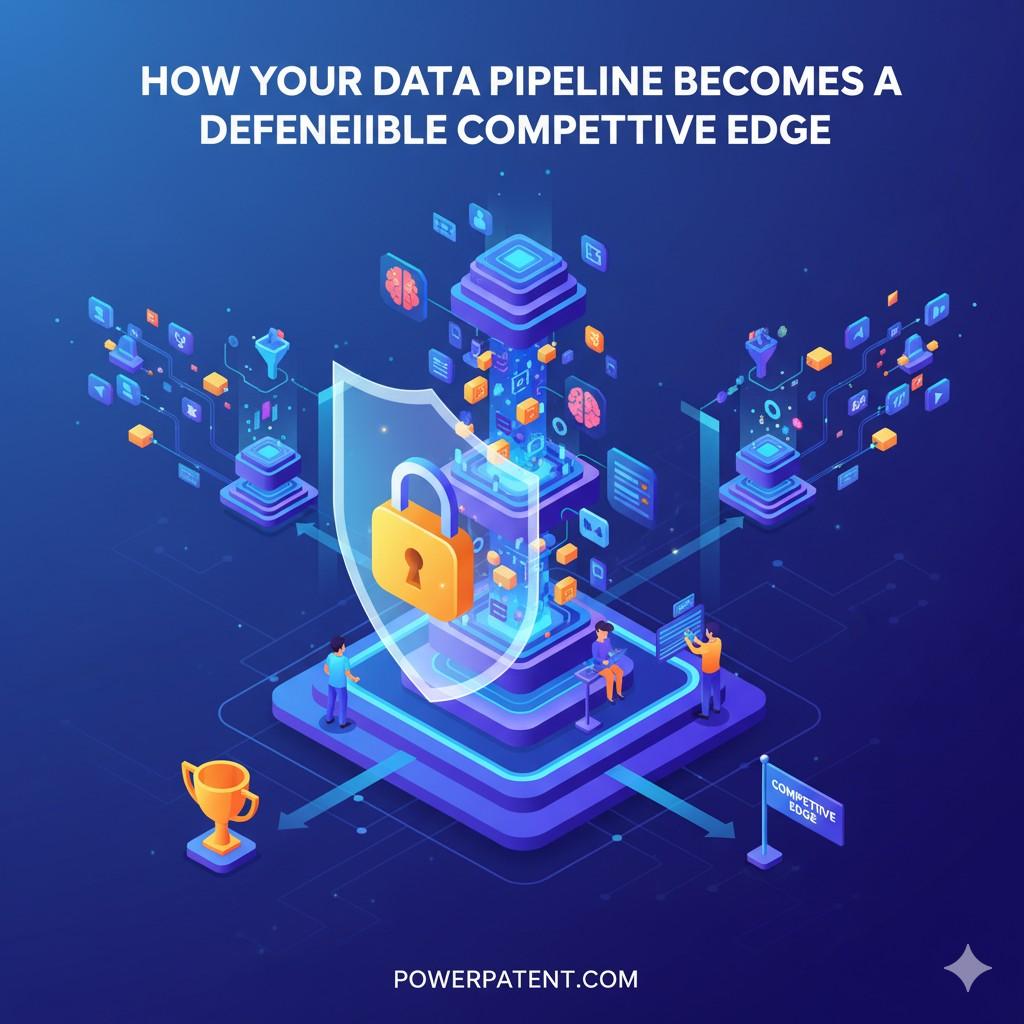
How Your Data Pipeline Becomes a Defensible Competitive Edge
Your data pipeline is not a background system. It is the core engine that shapes how your model learns, behaves, and improves.
Most people underestimate how much power sits in these internal steps because they focus only on the final dataset.
But the pipeline is where your real secret sauce lives.
This is where your team makes hundreds of small decisions that quietly set your AI apart. When you understand this, you start seeing your pipeline as something worth protecting, refining, and treating like high-value IP.
How the pipeline becomes the true source of model performance
Before any data reaches your model, it passes through filters your team created. These steps change how the model interprets the world.
The pipeline determines what signals matter, what noise gets removed, and what patterns the model will learn.
Even if someone copied your raw dataset, they would never reproduce the same behavior unless they understood every step your team crafted. This gives you natural defensibility without even trying.
How custom preprocessing becomes intellectual property
Every startup tweaks preprocessing in its own way. Some normalize text differently. Some engineer custom sensor features. Some rewrite the raw stream to reflect domain expertise.
These choices seem small, but they form a chain of technical steps that investors and acquirers treat as protectable IP.
When you write down how your pipeline works, you start seeing clear invention points. These points become anchors for patents and trade secrets that strengthen your position.
How consistent transformations create product reliability
A stable pipeline means stable results. When your transformations follow predictable rules, your model behaves consistently across updates.
This also makes debugging easier because you know where variation comes from. Clear ownership over your pipeline gives you control over reliability, and reliability builds trust with customers who depend on predictable outputs.
How clean labeling decisions become a competitive advantage
Labeling is where your model learns the meaning behind the data. Even small changes in labeling rules create huge differences in final accuracy.
Your team’s labeling strategy reflects your domain expertise. It becomes a repeatable method.
This method itself can form a defensible asset when described clearly and protected properly. Once protected, another team cannot simply replicate your labeling logic without stepping into your IP space.
Why metadata becomes one of your most valuable assets
Metadata is often ignored because it feels secondary. But metadata drives context. It drives structure. It drives grouping, routing, and fine-tuning decisions.
When you track metadata deliberately, you create a richer dataset than competitors with the same surface-level data.
As you expand your product, this metadata becomes even more powerful because it enables smarter models, simpler monitoring, and safer behavior.
How a pipeline lets you scale quality without scaling headcount
A strong pipeline reduces manual work. When your cleaning, validation, and labeling steps are automated, your quality grows without growing your costs. This expands your margins and helps you scale your product faster.
The pipeline becomes a long-term financial advantage, not just a technical one. And when you protect these automation methods as IP, you prevent competitors from copying your efficiency.
Why privacy rules must be built into the pipeline, not added later
Privacy only works when it is structural. If you bolt it on later, it becomes a limiting force that slows the product. When you embed privacy into the pipeline, you gain control while staying compliant.
This approach makes international expansion easier because the same privacy-preserving structure works across markets. Investors notice this. Customers trust it.
Regulators support it. And it creates a durable reputation that follows your company.
How the pipeline filters out long-term liability
A messy dataset is not just messy. It is dangerous. It carries legal risks, bias risks, and performance risks. Your pipeline is the filter that removes questionable data, sensitive fields, or unlicensed samples.
This protects your business from future disputes and saves you from costly retraining down the line. Each filtering step becomes a risk reduction mechanism that compounds as you grow.
Why internal documentation becomes an invisible moat
Most companies never document their pipelines properly. This becomes a painful problem when team members leave or when the business prepares for diligence.
But a startup that documents these systems gains something rare: continuity. Documentation becomes a map that new engineers can follow, partners can review, and acquirers can trust.
This hidden discipline also reveals areas worth patenting, which strengthens your IP strategy even more.
How to treat your pipeline like a product, not a tool
The moment you see your pipeline as a product inside your product, you start improving it with more intention. You redesign steps for speed. You refine workflows for quality.
You harden privacy rules. You observe failure modes and tune them away.
And because you built it with care, every improvement becomes leverage. Your competitors may build similar features, but they will struggle to match your consistency and your structure.
How PowerPatent helps founders capture pipeline innovations
Many teams do not realize their pipeline contains patentable inventions because the work feels like routine engineering.
But these small technical decisions often qualify as protectable methods when they improve speed, efficiency, privacy, or accuracy.
PowerPatent helps founders spot these innovations early and protect them before they become exposed. You do not have to slow down or write legal language.
The platform turns your engineering steps into patent-ready material, backed by real attorneys who make sure you are protected. If you want to understand how this works behind the scenes, you can explore it here: https://powerpatent.com/how-it-works.
The Real IP Power Hidden Inside Your Model Weights
Before diving deeper, it helps to rethink what model weights actually represent. They are not just numbers. They are a living memory of everything your system learned from your data.
They capture patterns your competitors do not have. They reflect your cleaning steps, your labeling decisions, your tuning strategies, your domain experience, and the thousands of little adjustments your team makes over time.
This is why model weights feel like a blend of code, research, and secret knowledge. And this is why protecting them is one of the most important IP steps for any AI startup.
How weights become the true expression of your training data
Weights are shaped directly by the examples you feed your model. If your dataset is unique, your weights become unique as well.
Even if another company uses a similar architecture, it will never produce the same weights unless it has the same data, the same preprocessing, and the same training rules.
This is what gives you natural defensibility. The uniqueness is baked into the math.

No one can extract your training data from your weights, but they can feel the influence of your insights. This makes weights a silent competitive advantage that compounds every time you fine-tune.
How weights reflect your team’s decision-making
Every step your engineers take shows up in the weights. This includes learning rate schedules, loss functions, data sampling patterns, augmentation choices, and optimization strategies.
These decisions create a fingerprint that becomes extremely difficult to reverse engineer.
When investors evaluate an AI company, many look for this fingerprint because it shows that the team has technical depth and operational discipline. Clean, well-trained weights signal maturity even before anyone sees the code.
Why weights should be treated like your most sensitive secrets
Weights often sit on servers with far less protection than source code. But weights reveal far more about your product direction, your market understanding, and your competitive strategy.
Once someone has your weights, they can observe your model’s behavior, replicate its strengths, and measure how it responds to edge cases.
This is why weights should be stored carefully, shared rarely, and protected with strict access controls. A single leak can collapse years of advantage.
How weights create long-term differentiation even in open-source ecosystems
Open-source models are becoming more common, but this does not weaken the value of proprietary weights. When everyone has access to the same architecture, the true gap comes from the training.
This means your weights become the core of your product differentiation. You can still use open-source components for speed, but the moment you train on your own dataset, the result becomes proprietary.
This blend of public structure and private refinement allows startups to build faster without giving away their edge.
How weight ownership affects your freedom to commercialize
If you train on data you do not fully control, your weights inherit that uncertainty.
This affects your ability to deploy your model, sell it, or license it. Some founders learn this too late and are forced to retrain with new data, a process that can be slow and expensive.
Clear rights around your training data restore full ownership of your weights. This means you can build products without worrying about future claims or product restrictions.
The freedom to commercialize without fear is one of the strongest advantages you can create early on.
How fine-tuning creates new IP layers
Fine-tuning is not just an upgrade. It is a form of invention. Each tuning run produces new parameters shaped by your own knowledge and your own examples.
Even if you start with a base model created by another team, your fine-tuned version becomes a hybrid asset.
The new layers of behavior belong to you, as long as your rights to the original model are clear.

Many founders do not realize how valuable this new IP becomes because it reflects your product insights in a form no one else can replicate.
How behavior-level innovations become patentable
You do not need to reveal your weights to protect invention. You only need to describe the technical methods that lead to better performance.
If you create a training trick, a reinforcement rule, a sampling strategy, or a privacy-preserving method that improves model behavior, that method can be patentable.
This allows you to protect your innovation without exposing your architecture or releasing your weights. You hold the secret, and the patent holds the shield.
How weights influence trust in regulated industries
In fields like healthcare, finance, automation, and security, trust matters. Teams must show how the model learns, how it avoids bias, how it protects privacy, and how it behaves under stress.
When you fully control your weights, you control the narrative. You can answer questions with confidence.
You can show audits when needed. You can demonstrate that your system behaves the way it should. This makes your product safer and more attractive for industries where reliability is essential.
How ownership of weights simplifies partnerships and integrations
When companies integrate AI into their workflow, they want assurance that the model is legally safe to use. If you cannot prove ownership of your weights, you introduce friction, delays, or worse, lost deals.
But when ownership is clear, partnerships move faster. Companies are willing to embed your model into their core systems because they know it will not create unforeseen liability.
This clarity increases your integration velocity and makes your startup easier to adopt.
Why your weight version history becomes part of your IP story
As your model grows, you produce many versions of weights. Each version captures a stage of learning that reflects your growth as a company. This version history creates a timeline of innovation.
It proves originality. It demonstrates how your team improved performance over time. If a dispute ever arises, this history becomes evidence of your independent development.
It is a quiet but powerful form of protection that strengthens your IP position.
How PowerPatent helps founders protect weight-related inventions
Founders often underestimate how many steps around weights qualify as patentable innovation.
They assume training is routine, but the truth is that any improvement to speed, accuracy, security, or privacy may count as an invention when described clearly.
PowerPatent helps teams uncover these innovations early and turn them into strong patents without slowing engineering. The platform captures your training logic, your data pipeline, and your model behavior in a way that is structured and attorney-reviewed.

This keeps your core insights safe while letting you move at startup speed. If you want to see how this process fits into real workflows, you can explore it here: https://powerpatent.com/how-it-works.
Building Clean, Confident Data Rights That Investors Trust
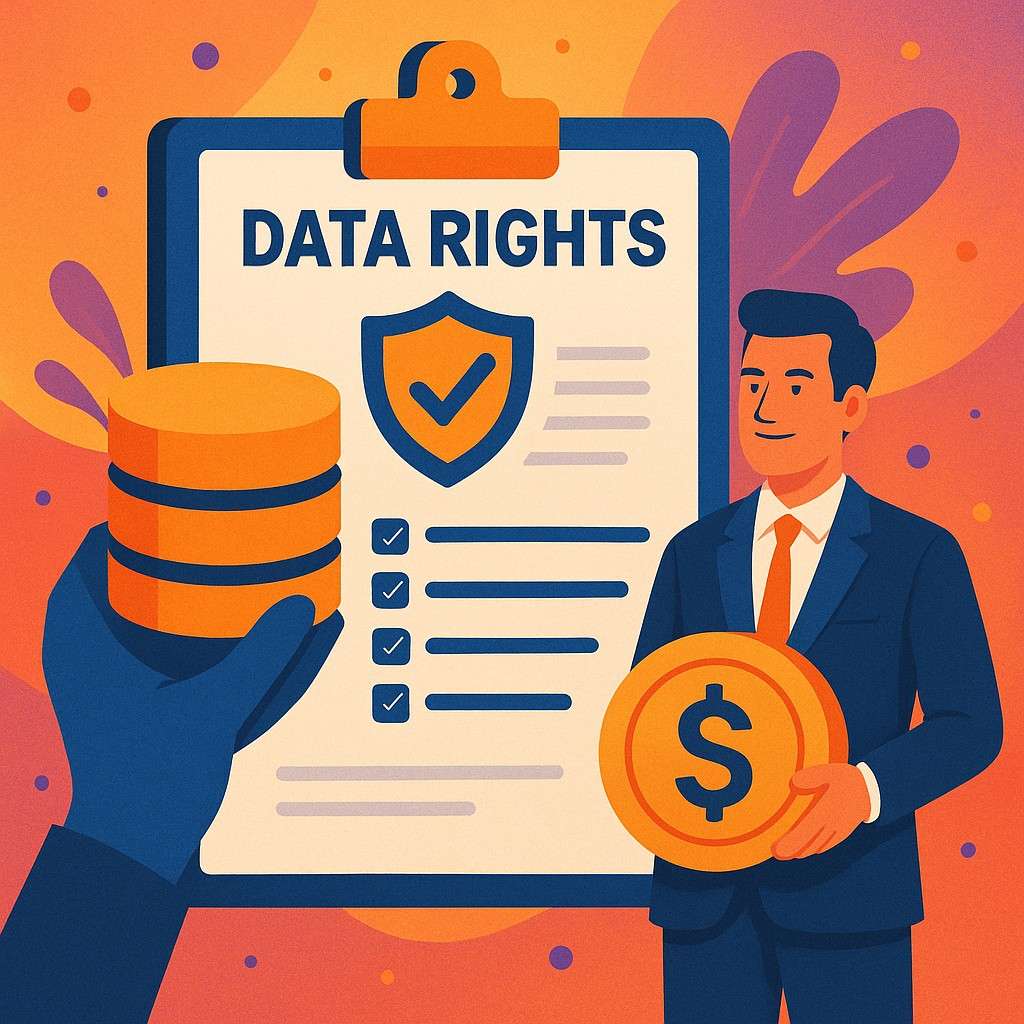
Before diving into the details, it helps to understand why clean data rights are not just legal hygiene. They are a trust signal. They tell investors, partners, and customers that your AI foundation is solid.
They show that your growth will not collapse because of unclear permissions or questionable sources.
Strong data rights give you the freedom to commercialize, the power to scale, and the confidence to raise capital without leaving unanswered questions on the table.
When you treat data rights as part of your product strategy, you build a safer and more valuable company.
Why clarity around permissions shapes long-term stability
Every piece of data you collect carries expectations. Some users expect their information to be used only in specific ways. Some agreements limit commercial deployment.
Some sources restrict machine learning use altogether. When you understand these boundaries early, your decisions become smarter. You avoid overreaching.
You prevent surprises. You design features with the right assumptions in mind. Over time, this clarity becomes a stabilizing force that protects your roadmap from unexpected obstacles.
How permission-based design becomes a growth advantage
Instead of guessing what you can or cannot do with data, you can design your product around clean permissions.
This creates a smoother user experience because people understand exactly what they are agreeing to.
It creates a smoother engineering process because you are not retrofitting privacy into a system that never planned for it.
It creates smoother regulatory reviews because you can show a clear match between consent and usage. Everything becomes easier when the rules are known from the start.
How proactive data rights reduce technical risk
When rights are unclear, every technical decision carries hidden risk. You might build a model only to discover later that you cannot launch it. You might develop a feature that depends on data you are not allowed to use.
This forces costly rewrites and delays that hurt momentum. Clean rights remove this risk.
They turn uncertainty into confidence. They let engineers focus on performance instead of legality. And they make your product lifecycle more predictable at every stage.
How clear ownership transforms due diligence
During fundraising, diligence happens fast. Investors ask about data sources, user permissions, contracts, privacy policies, and compliance steps. Teams that scramble to answer these questions lose confidence.
Teams with clean documentation move through diligence smoothly. Investors trust a company that can show where its data came from, how it was processed, what rights were granted, and how privacy was protected.
This clarity builds credibility and makes it easier to negotiate terms.
How clean rights open the door to enterprise customers
Large companies have strict rules. They cannot buy from vendors who use unlicensed data or ambiguous sources. When you can show that your data rights are clean, you remove a major friction point.
Enterprise sales cycles shorten. Security reviews become faster. Legal review becomes easier. This is one of the fastest ways to unlock revenue growth because enterprises want products that reduce their own risk, not add to it.
How transparency around data builds user loyalty
Users choose products they trust. When you explain clearly how you collect data, why you use it, and what boundaries you respect, people feel safer. Transparency turns privacy into a relationship rather than a transaction.

Confident users share more accurate information, which improves your product. This creates a feedback loop where trust increases data quality, and higher data quality increases product value.
Why strong data rights make compliance simple, not scary
A lot of founders think of privacy laws as barriers, but they can become strategic assets. When your rights are clean, compliance stops being a burden. It becomes a pattern you follow.
You design with minimal data collection. You store information carefully. You handle deletion requests smoothly.
You build systems that respect boundaries. This gives you protection in every market you enter and prepares you for stricter regulations in the future.
How internal data governance becomes part of your IP story
Many startups overlook internal governance because it feels operational rather than strategic. But internal rules shape how your team handles sensitive information, how you prevent misuse, and how you maintain quality.
These systems often contain technical workflows that can be protected as IP when they improve security, privacy, or reliability.
Strong governance becomes more than a safeguard. It becomes a differentiator that raises the value of your company.
How treating data as an asset improves decision making
When you view data as a real asset rather than a byproduct, you begin to protect it, measure it, and invest in it the same way you would design or engineering.
You start evaluating what new data is worth collecting. You decide which datasets increase the value of your model. You focus on quality instead of volume.
This mindset leads to better strategic choices because you understand how each piece of data contributes to your competitive edge.
Why long-term ownership matters more than short-term access
Access can disappear. Partners change terms. Platforms close their APIs. Public sources restrict training usage. When you rely on data you do not own, you become vulnerable to outside decisions.
Ownership removes this vulnerability. You control the asset. You decide how it is used. You decide how often you retrain. You decide how you expand. Ownership creates independence, and independence gives you resilience.
How strong ownership future-proofs your AI models
Models evolve. They get retrained, fine-tuned, distilled, expanded, or restructured.
Each new stage requires clean rights. When your data foundation is solid, you can evolve your model freely without reworking permissions or rebuilding datasets.
This freedom allows you to innovate faster and adapt to market changes without legal hesitation. It turns model improvement into a simple engineering task instead of a compliance challenge.
How PowerPatent helps founders protect data rights early
Clean rights are powerful, but many founders do not know where to start.
PowerPatent helps identify which parts of your data collection, transformation, or governance workflows count as technical inventions worth protecting. It lets you capture these ideas before they become exposed.

And because real attorneys review your filings, you stay safe while building fast. If you want to see how simple the process is, you can explore it here: https://powerpatent.com/how-it-works.
Wrapping It Up
As we reach the end, it helps to step back and see the full picture. Data ownership, model weights, and the pipelines that shape them are not scattered pieces. They are one connected system that defines the strength, safety, and long-term stability of your AI company. When this system is built with intention, you gain power over your direction instead of reacting to legal surprises or market pressures. You move with clarity. You grow with confidence. You protect the parts of your product that give you real leverage.
Leave a Reply