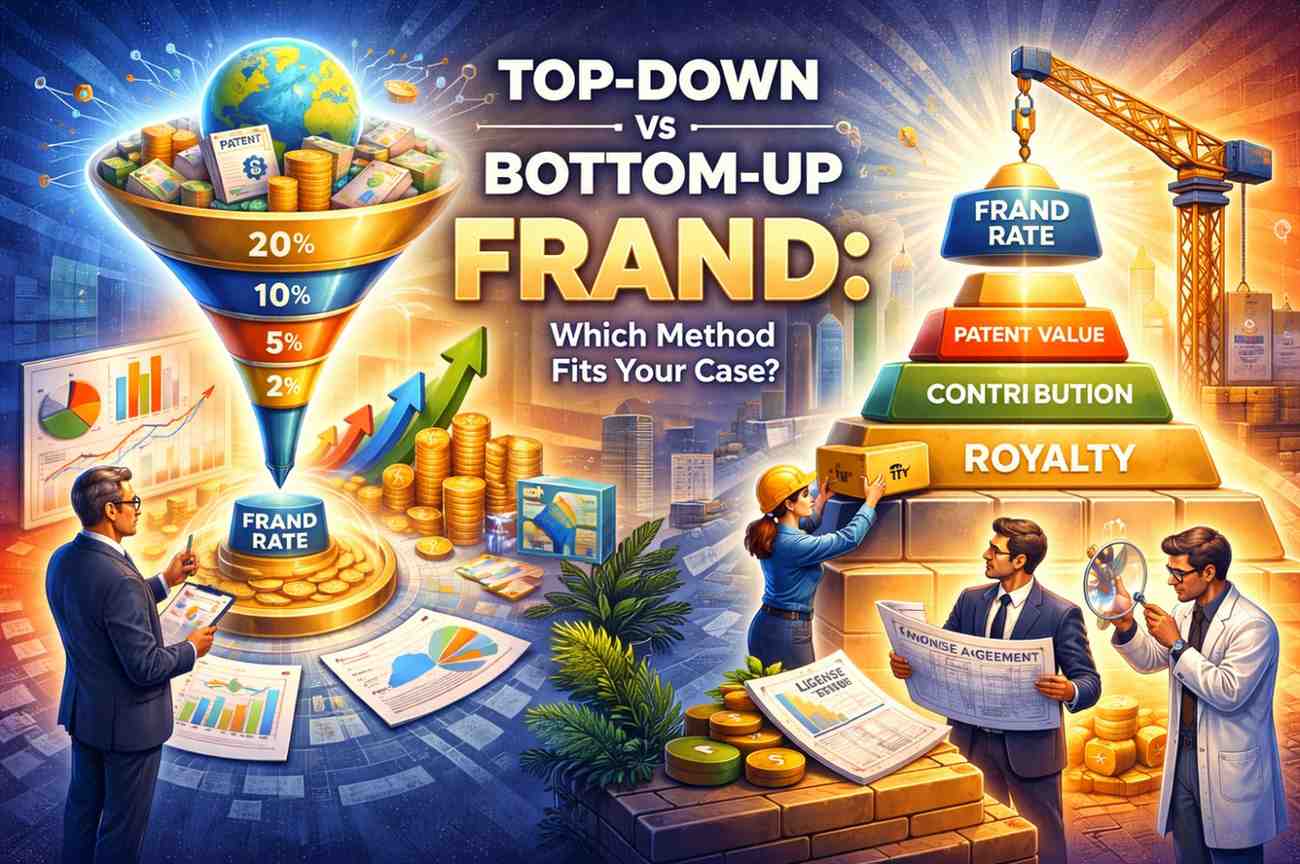
FRAND fights decide real money, real leverage, and real outcomes for companies building core tech. If you get the method wrong, you can lose value fast. This article breaks down the two main ways courts and negotiators set FRAND rates—top-down and bottom-up—in plain, simple words, so you can see which one fits your situation and why it matters.
Why FRAND Pricing Is So Hard to Get Right
FRAND pricing sounds simple on paper. Fair, reasonable, and non-discriminatory. Three friendly words. But in real life, FRAND pricing is one of the hardest business problems in modern tech.
It sits at the intersection of patents, standards, products, timing, and power. Small choices early on can change outcomes years later. That is why companies often walk into FRAND talks confident and walk out surprised.
This section explains why FRAND pricing breaks down so often, where businesses usually misstep, and what you can do early to stay in control.
FRAND Is a Business Problem Before It Is a Legal One
Most teams treat FRAND like a court issue. That mindset already puts them behind.
FRAND disputes usually start long before lawyers show up. They start when standards are written, when patents are filed, and when product roadmaps are set.
By the time a judge is involved, the real leverage has already been created or lost.
If you are building technology that may touch a standard, your FRAND outcome is shaped by how clearly your patents describe real technical value. Vague patents create weak anchors.
Clear patents tied to actual system behavior create pricing gravity. This is where many businesses go wrong without realizing it.
The most actionable step here is to audit how your patents explain value in plain technical terms.
If a smart engineer cannot see how your patent changes how the system works, FRAND pricing will be hard no matter which method you use.
Standards Hide Value in Plain Sight
Standards are massive documents. Thousands of pages. Hundreds of contributors. Layers of revisions over years. Inside that mess, real value can disappear.
FRAND pricing struggles because it is hard to say which part of a standard actually moves the needle. Not all standard features matter equally. Some are critical paths.
Others are nice-to-have options. Courts and negotiators often lack the technical depth to see the difference unless you show them clearly.
Businesses that win FRAND outcomes translate standard language into product behavior.
They explain what breaks if the patented part is removed. They show cost, performance, or reliability impacts in simple terms. That framing matters more than raw patent counts.
If you want to act now, start mapping your patents to specific system outcomes. Not claims.
Outcomes. Faster connection. Lower power use. Better handoff. Less data loss. These stories survive scrutiny far better than legal arguments alone.
Timing Warps What Feels Fair
FRAND is supposed to be fair. But fairness changes with time.
Early contributors to a standard often take more risk. They invest before adoption is guaranteed.
Late adopters benefit from market clarity. FRAND pricing struggles to reflect this imbalance because courts often look backward with today’s success bias.
This creates tension. Patent owners feel underpaid. Implementers feel overcharged. Both sides think the other is gaming the system.
From a business angle, the best defense is documentation. If you contribute early, record why the problem mattered at the time and what alternatives failed.
If you implement later, track which features were optional and which were unavoidable. These records shape how fairness is perceived later.
Aggregate Royalty Fear Distorts Reality
One of the biggest reasons FRAND pricing is hard is fear of stacking. Courts worry that if every patent owner charges full price, total royalties will crush the product.
This fear drives many top-down approaches, but it also causes underpricing of real innovation. Not all patents stack equally. Some overlap. Some are foundational. Others are marginal.
Businesses often fail by not distinguishing themselves from the noise. If you own truly core patents, you must explain why your value does not stack the same way. If you are an implementer, you must show where overlap already exists.
A practical move is to benchmark real-world alternatives. What would it cost to design around your patent? Not in theory, but in time, money, and risk. This grounds FRAND in reality instead of abstract math.
Courts Do Not Build Products
Judges are smart. But they do not ship software or hardware.
FRAND pricing is hard because courts must assign value without living inside the product. They rely on experts, models, and comparisons. These tools simplify reality, sometimes too much.
Businesses that expect courts to intuit value usually lose ground. Those that teach value win space.
You can prepare by pressure-testing your own story. If you had to explain your patent’s importance to a non-expert in five minutes, could you do it without buzzwords? If not, FRAND pricing will be uphill.
This is why early patent drafting matters. When patents are written clearly and concretely, later explanations become easier.
Platforms like PowerPatent focus on this exact problem by forcing clarity early, before disputes exist. You can see how that approach works here: https://powerpatent.com/how-it-works
FRAND Assumes Rational Actors, Reality Does Not
FRAND theory assumes both sides want a deal. In practice, strategy dominates.
Some companies delay to gain leverage. Others litigate to signal strength. Some settle quickly to avoid risk. These moves change what feels reasonable, even if the underlying tech stays the same.
This makes pricing unstable. The same patent can be valued very differently depending on market pressure, public perception, and business goals.

Actionable advice here is simple but hard. Decide your goal early. Are you maximizing long-term licensing income or protecting market access?
Your FRAND position should match that goal consistently. Mixed signals weaken credibility fast.
Data Is Scarce and Often Biased
FRAND pricing depends heavily on comparable licenses. But real license data is private, messy, and context-heavy.
Courts see fragments. Negotiators see partial pictures. Both sides cherry-pick.
This makes pricing feel arbitrary. One deal becomes the anchor for the next, even if it was made under unique pressure.
Businesses should build their own internal pricing logic that does not rely fully on external deals. What revenue does the feature enable? What cost does it avoid? What risk does it reduce?
These internal numbers provide stability when external data is thin.
The Method You Choose Signals Your Strategy
Even before numbers are discussed, choosing top-down or bottom-up sends a message.
Top-down often signals a system-level view and concern about stacking. Bottom-up signals confidence in individual patent strength. Each frames the debate differently.
FRAND pricing is hard because these frames shape outcomes before facts are weighed. If you pick the wrong frame for your situation, you fight uphill.
The most strategic move is to evaluate your position honestly. If your patents are few but foundational, bottom-up may fit. If you are part of a large portfolio landscape, top-down may feel safer. Align method with reality, not ego.
Why Early Patent Strategy Quietly Decides FRAND Outcomes
By the time FRAND pricing is argued, the game is mostly set.
Clear claim scope, strong technical explanations, and tight alignment with standards give flexibility. Weak drafting locks you into defensive positions.
This is why modern teams invest in patent quality early, not just quantity. Strong patents reduce dependence on abstract pricing models because value is obvious.

PowerPatent was built around this insight. By combining software that forces clarity with real attorney review, it helps teams create patents that stand up in real-world FRAND fights, not just on paper.
If FRAND matters to your future, this is where leverage starts: https://powerpatent.com/how-it-works
How the Top-Down Method Sets a FRAND Rate
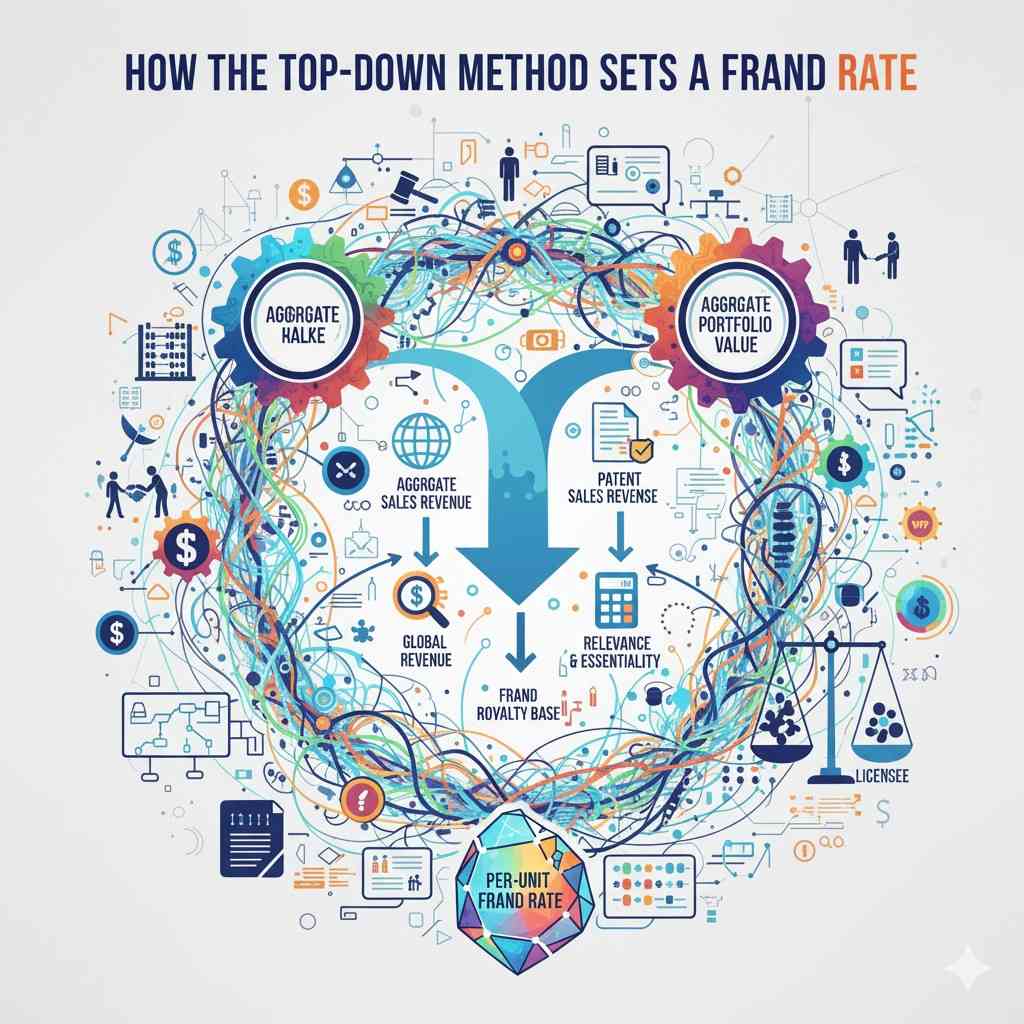
The top-down method starts from a simple idea. Instead of arguing about one patent at a time, it looks at the whole system first.
It asks how much money the entire standard should reasonably generate in royalties, and then works downward to assign a slice of that total to each patent holder.
On the surface, this feels clean and fair. In practice, it is powerful, risky, and often misunderstood by businesses using it.
This section explains how the top-down method really works, where it helps, where it hurts, and how companies can use it strategically instead of blindly.
The Core Logic Behind Top-Down Pricing
The top-down approach begins with the product, not the patent.
Courts or negotiators first decide the maximum royalty burden a product can handle without killing the market.
This is often called the total royalty stack. From there, they allocate portions of that stack to different patent holders based on their share of the standard-essential patents.
This logic appeals to judges because it limits runaway pricing. It also appeals to implementers because it caps exposure early.

For patent owners, this method can feel uncomfortable. It puts a ceiling on value before individual contribution is fully explored. That is why understanding when top-down helps you, and when it limits you, is critical.
Why Courts Often Prefer Top-Down
Courts like structure. The top-down method gives them guardrails.
By anchoring the discussion to a total number, courts reduce fear of stacking and overpayment. This is especially common in industries like telecom, where thousands of patents cover a single standard.
Another reason courts lean top-down is manageability. Evaluating every patent deeply is slow and expensive. A top-down framework allows courts to work with aggregates and ratios instead.
From a business view, this means one thing. If your case is likely to end up in court, you must assume top-down reasoning may appear even if you argue bottom-up. Preparing for it early is not optional.
The Hidden Power of Setting the Total Royalty Stack
The most important number in top-down is not your share. It is the total stack.
Once that number is set, everything else becomes math. A small shift in the total stack can double or cut your outcome dramatically.
Many companies focus too much on proving their patent count or technical share and ignore the fight over the total. That is a mistake.
Actionable advice here is to engage early in shaping what feels reasonable for the entire industry.
Use market data, product margins, adoption history, and consumer pricing to explain what the product can actually bear. If you miss this moment, later arguments have limited effect.
Patent Counting Can Be a Trap
Top-down often relies on counting patents. How many essential patents does each party hold? What percentage of the total is yours?
This seems objective. It is not.
Not all patents are equal. Some are broad and unavoidable. Others are narrow or optional. Counting treats them the same.
Businesses lose leverage when they accept raw counts without context. If you rely on top-down, you must work hard to explain why your patents punch above their numerical weight.
This means showing technical centrality, not just existence.
If you are an implementer, this same flaw can help you. Highlight overlap, redundancy, and optional features to dilute inflated counts from others.
Top-Down Rewards Portfolio Strategy, Not Lone Patents
The top-down method favors players with large, diversified portfolios.
If you own many patents spread across the standard, top-down smooths risk. Weak patents are averaged with strong ones. This can be comforting.
If you own a small number of highly important patents, top-down can undervalue you. Your unique contribution may be diluted into a pool.
This reality should guide long-term strategy. Companies betting on top-down should invest in breadth. Companies betting on bottom-up should invest in depth. Mixing these strategies without clarity weakens both.
This is why early patent planning matters so much. Tools like PowerPatent help founders think about portfolio shape early, not years later when standards are locked.
That foresight can decide whether top-down works for or against you. You can explore that approach here: https://powerpatent.com/how-it-works
The Risk of Industry Averages
Top-down often uses industry averages to justify numbers.
Average royalty rates. Average margins. Average adoption curves.
Averages hide extremes. If your product or patent sits at an extreme, averages can misprice you badly.
For patent owners, this means you must show why your contribution is not average. For implementers, it means questioning whether claimed averages reflect current reality or outdated markets.
A practical step is to gather real product data early. What margins exist today, not five years ago? What alternatives are actually used? This keeps top-down grounded.
Negotiation Leverage Shifts Early in Top-Down
Once a top-down framework is accepted, leverage shifts quickly.
The party that successfully frames the total stack and the counting method gains momentum. Late objections sound defensive.
Businesses often wait too long to engage. They argue numbers after the structure is set. By then, outcomes are constrained.

Strategic advice is to engage at the framing stage, not the pricing stage. Ask what assumptions are being made. Challenge them politely but firmly. This shapes the battlefield before numbers appear.
When Top-Down Works Best for Businesses
Top-down shines in crowded patent landscapes with many overlapping claims.
If no single patent clearly dominates, top-down provides predictability. It reduces litigation risk and speeds resolution.
It also works well when markets are mature and pricing expectations are stable. In these cases, the total royalty stack is easier to justify.
Businesses operating in these environments should prepare data that supports stability and industry norms. This reinforces the logic of top-down and keeps outcomes within expected bounds.
When Top-Down Quietly Fails
Top-down struggles in fast-moving or emerging tech.
When standards evolve quickly, patent counts lag reality. Early patents may be foundational but few in number. Top-down can underprice this early value.
It also fails when one innovation unlocks the entire standard. In these cases, averaging hides causation.
If you are in an emerging space, relying purely on top-down can leave money on the table. Hybrid approaches or strong bottom-up arguments may be needed to rebalance value.
Preparing for Top-Down Before You Need It
The biggest mistake businesses make is preparing for top-down too late.
Once a dispute starts, narratives harden. Data gaps become assumptions. Assumptions become facts.
Preparation means tracking contributions to standards, documenting technical necessity, and maintaining clean patent families. It also means understanding how your portfolio would look if reduced to ratios.
PowerPatent supports this kind of forward thinking by helping teams build patents that clearly map to real system behavior, not abstract language.

That clarity makes top-down outcomes less risky and more predictable. If FRAND is anywhere on your horizon, this preparation pays off: https://powerpatent.com/how-it-works
How the Bottom-Up Method Builds a FRAND Rate
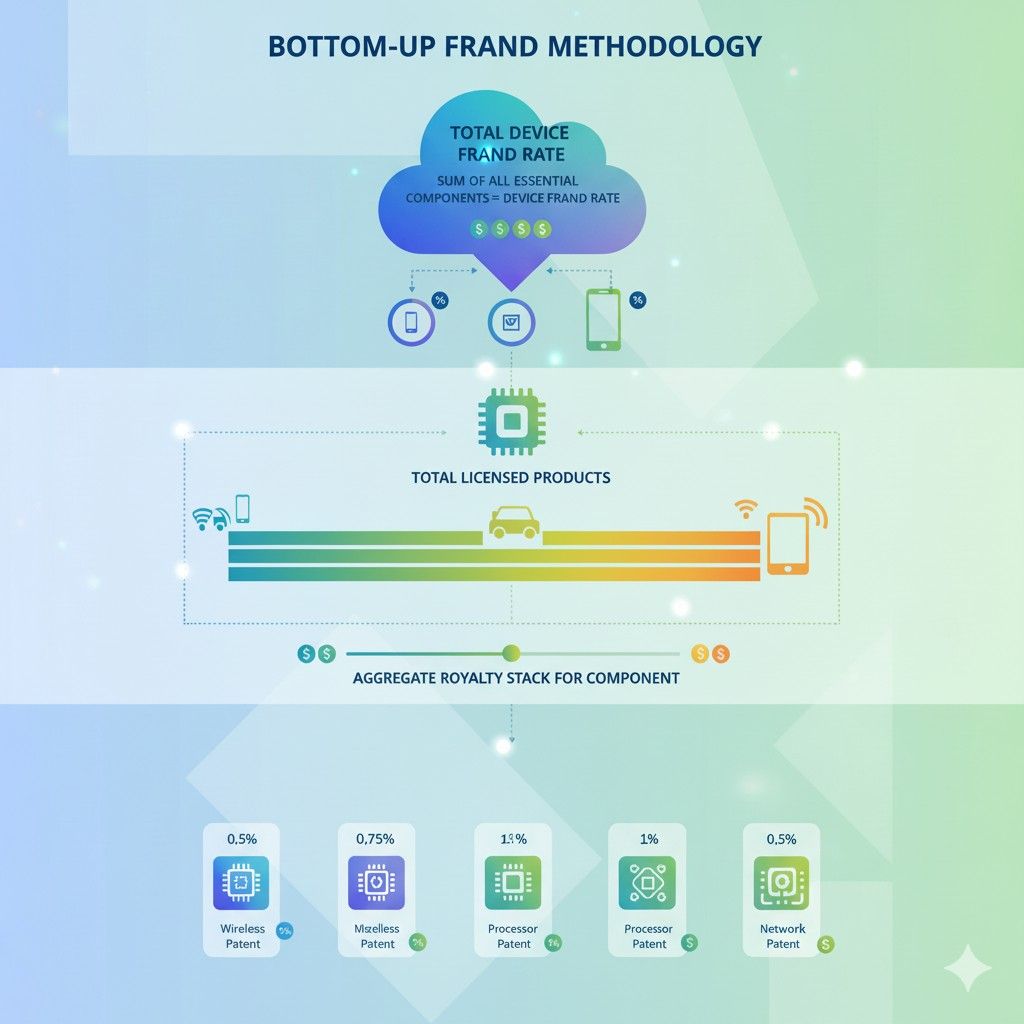
The bottom-up method flips the logic of top-down on its head. Instead of starting with the whole market and slicing it up, it starts with the individual patent and builds value upward.
It asks a very direct question: what is this specific invention worth to the product that uses it?
For businesses, bottom-up often feels more intuitive. It mirrors how engineers think. One feature. One problem solved. One measurable benefit. But that clarity comes with its own risks and responsibilities.
This section explains how bottom-up FRAND pricing actually works, why it can be powerful, and what companies must do to use it without overreaching.
Bottom-Up Starts With Technical Reality
At its core, bottom-up pricing is about cause and effect.
If a patented feature improves speed, stability, battery life, or cost, bottom-up tries to price that improvement directly. The focus stays tight on what changes because the invention exists.
Courts and negotiators using bottom-up want to understand what breaks if the patent is removed. Does performance drop? Does compliance fail? Does the product become unusable or just slightly worse?
Businesses that succeed here are very concrete. They avoid theory. They show real-world impact.

An immediate action you can take is to document how your invention changes system behavior. Not in legal terms, but in plain technical outcomes. This becomes the backbone of any bottom-up argument.
Why Bottom-Up Feels Fair to Patent Owners
Bottom-up pricing appeals strongly to patent holders because it rewards depth.
If you own a small number of patents that do heavy lifting, bottom-up gives you a chance to be paid for that importance. You are not diluted by unrelated or weaker patents in a large pool.
This method aligns with how innovators see their work. One breakthrough can matter more than dozens of incremental tweaks.
But this strength is also a vulnerability. Bottom-up only works if you can clearly prove that importance. If you cannot, the method collapses under scrutiny.
Courts Demand Clear Proof, Not Big Claims
Bottom-up arguments live or die on evidence.
Judges are cautious here. They worry about inflated claims of importance. As a result, they expect tight proof that ties the patent directly to product value.
Businesses often fail by overstating uniqueness. Saying your invention is critical is not enough. You must show why alternatives are worse, slower, more expensive, or riskier.
A smart move is to prepare comparison scenarios early. What would an implementer have to do without your patent? How long would it take? What would it cost? This grounds your pricing in reality instead of ambition.
Bottom-Up Forces You to Define the Smallest Saleable Unit
One of the hardest parts of bottom-up is defining the right base.
You cannot price a small feature as if it controls the entire product. Courts often look for the smallest part of the product that actually uses the patented invention.
This forces discipline. You must isolate where value truly enters the system.
For businesses, this is uncomfortable but healthy. It prevents overreach and strengthens credibility. If you start from a fair base, your rate feels more reasonable even if the percentage is higher.
An actionable step is to map your patent to specific components or software modules, not the full device. This clarity avoids painful corrections later.
Bottom-Up Shines When Alternatives Are Weak
Bottom-up works best when there are no good substitutes.
If your patent solves a problem in a way others cannot easily copy around, its value is easier to justify. The higher the design-around cost, the stronger your position.
Businesses should actively analyze design-around paths, even if they seem unlikely. Knowing how hard it would be to avoid your patent strengthens negotiation and deters lowball offers.
If design-arounds exist and are cheap, bottom-up pricing becomes harder. In those cases, pushing too hard can backfire and reduce credibility.
The Danger of Isolated Thinking
One weakness of bottom-up is tunnel vision.
By focusing tightly on one patent, it can ignore how standards actually work as systems. Even critical features may rely on other inventions to deliver full value.
Courts sometimes discount bottom-up claims when they feel the patent owner is ignoring shared contribution.
Strategically, this means acknowledging context. You can argue that your invention is critical while still recognizing the role of others. This balanced tone builds trust and keeps the court engaged.
Negotiation Dynamics Favor Prepared Parties
In negotiation, bottom-up can be a powerful opening.
It frames the discussion around value instead of caps. It invites detailed technical discussion, which favors parties who know their technology deeply.
However, it also invites pushback. Implementers will question assumptions, bases, and comparisons.

Businesses using bottom-up must prepare thoroughly. Half-prepared arguments invite aggressive discounting. Well-supported arguments command respect, even if they are challenged.
When Bottom-Up Works Best for Businesses
Bottom-up is strongest in cases with a few core patents, emerging technology, or early-stage standards.
It also works well when market data is thin. In these cases, building value from fundamentals is more reliable than guessing industry totals.
Companies with strong engineering teams often excel here because they can explain impact clearly and confidently.
If this sounds like your situation, bottom-up may give you leverage that top-down cannot.
When Bottom-Up Becomes Risky
Bottom-up struggles in crowded landscapes with heavy overlap.
When many patents claim similar ground, courts become skeptical of isolated value claims. In these environments, bottom-up can look inflated or unrealistic.
It also struggles when product value comes from integration rather than individual features.
Businesses in these spaces should be cautious. Hybrid strategies or fallback top-down arguments may be necessary to avoid being boxed in.
Bottom-Up Depends on Patent Quality More Than Quantity
More than any other method, bottom-up exposes weak patents.
Vague claims, broad language, and unclear technical linkage get punished. Clear, focused patents get rewarded.
This is why early patent drafting quality matters so much. Patents written with real system behavior in mind are far easier to value bottom-up later.

PowerPatent is built to support this exact need. By helping teams draft patents that explain how inventions actually work, it makes bottom-up arguments stronger and more defensible when FRAND matters most.
You can see how this approach works here: https://powerpatent.com/how-it-works
Wrapping It Up
By now, one thing should be clear. There is no universally “right” way to set a FRAND rate. Top-down and bottom-up are not opposing truths. They are tools. And like any tool, their value depends on when, why, and how you use them. Most businesses get into trouble because they pick a method emotionally, not strategically. Patent owners often lean bottom-up because it feels fair to their work. Implementers often push top-down because it feels safer for the market. Courts sit in the middle, trying to balance both without breaking the system.
Leave a Reply