Every founder carries a quiet fear that someone else might use their hard-won ideas before they can. Trade secrets exist to stop that from happening. They protect everything inside your company that gives you an edge—your data, your code, your models, your formulas, your internal methods, your customer insights, even the weird tricks you’ve learned by solving real problems the hard way. But a trade secret is only a trade secret if you treat it like one. The law gives no credit for hope, intention, or wishful thinking. It only cares about whether you took real steps to guard what matters.
Why Trade Secrets Only Matter When You Protect Them
Trade secrets sound powerful, but the truth is simple: they only work if you treat them like real assets. Many founders believe their secret advantage is naturally protected because it lives in their heads or inside their product.
But trade secret law does not protect ideas by default. It protects effort. It protects discipline. It protects the steps you take to show the world that this information is not meant to be shared.
When a company fails to show that effort, the law treats the information as if it belongs to anyone who finds it.
This is why secrecy has to be intentional, visible, and continuous. Without those habits, a secret is just an unguarded story waiting to slip out.
The Moment Your Information Leaves Its Safe Zone
Every company has a moment when its internal knowledge spreads just a little too far.
It may be a friendly demo, a shared screen, a rushed onboarding, a contractor who needed access for just one day, or a notebook left open on a table. These tiny slips rarely feel dangerous in the moment, but they often become the reason a secret loses protection.
Courts look closely at these details, because they reveal whether the company cared enough to build a barrier around its information.
When no barrier exists, it becomes almost impossible to claim that something was ever meant to stay private.
How Small Behaviors Decide the Fate of a Trade Secret
Many founders think trade secret protection comes from big policies or expensive legal work, but most of the protection comes from small daily habits.
Closing documents. Using controlled folders. Sharing only what someone needs, not what is easiest. Stating out loud that something is confidential.
These may look ordinary, but they are the clearest signals that a company is treating its knowledge as something worth guarding.
Over time, these habits become part of the company culture, and that culture becomes your greatest evidence of secrecy.
The Silent Risk of Building Fast Without Guardrails
High-growth teams often skip security steps because they want to move fast, but speed without guardrails usually creates more work later. When a dispute arises, you cannot go back and recreate evidence of secrecy.
You cannot retroactively label something. You cannot claim protection for information that was already shared without limits.
This is why early habits matter so much. A young team with good secrecy practices is far safer than a mature team trying to clean up years of loose behavior. Even simple steps taken today can prevent major loss tomorrow.
Why Secrecy Strengthens Your Patent Story
Even if you plan to file patents later, secrecy today still matters. Strong secrecy shows that you have been careful with your ideas from day one, which helps avoid complications when filing.
It reduces the risk of your own disclosures harming your patent rights. It protects early experiments that may turn into inventions worth filing later.
This is one reason many startups use PowerPatent to turn protected ideas into real patent filings. It feels simple and fast because the platform blends software with real attorney review, helping you move forward without slowing your team.
You can explore how this works anytime at https://powerpatent.com/how-it-works.
How Your Team Learns What to Guard
A trade secret is not always an obvious thing. Sometimes it is a formula or an algorithm. Sometimes it is a training technique, a data process, or a pattern you discovered by accident.
Your team must be able to recognize these moments. They need to understand which pieces of information create value and how those pieces should be handled.
Training does not need to be heavy or formal.
A short meeting, a short document, or a short explanation from a founder can be enough to build shared understanding. When people know what matters, they naturally become more careful.
The Clear Line Between Internal Knowledge and Public Knowledge
Many companies blur the line between what is internal and what is shareable. They talk freely about internal systems, investor decks, product decisions, or workflows in public spaces.
Even casual conversations at meetups or conferences can reveal more than intended. The safest approach is to assume that anything said outside the team might eventually spread.

This mindset helps you protect more without feeling paranoid. It helps your team draw boundaries without overthinking. The more consistent this boundary becomes, the easier it is to maintain secrecy without slowing down your work.
When You Choose Not to Protect Something
A surprising amount of trade secret loss does not come from theft. It happens because companies never chose to protect the information in the first place.
They believed the idea itself was not valuable enough, or they assumed no one would care. But simple insights often become powerful once a competitor sees them.
A small internal shortcut can become a breakthrough for someone else. Treating information lightly today gives someone else the chance to turn it into their advantage tomorrow.
Protection is not about paranoia. It is about respecting your own work.
Evidence Is Built Long Before You Need It
You never know when you will have to prove that something was a secret. Most companies discover this only after a problem arises. They start digging for old emails, training records, access logs, or agreements, hoping to piece together a story.
But real evidence of secrecy is built over time, in small steps, by simply doing things the right way.
Clear rules, consistent labeling, meaningful access controls, and routine communication all create a trail that shows you cared. This trail becomes your defense if anything ever goes wrong.
Why Strong Protection Attracts Investors and Partners
Investors care deeply about defensibility. If your knowledge walks out the door, your company’s value goes with it. When you can show that your trade secrets are well protected, it signals maturity and reduces risk.
It shows that you understand your moat and that you have taken real steps to preserve it.
Strong secrecy practices also make partnerships easier, because partners trust a team that treats information with respect. Without clear protection, even the best technology looks fragile.
How Secrecy Lets You Move Faster, Not Slower
Many founders assume that secrecy slows things down, but good secrecy often removes friction. When rules are clear, people do not have to guess what they can share.
When access is controlled, onboarding is simpler. When documents are labeled, confusion disappears. When the team knows what matters, communication becomes sharper.

Protection works best when it blends into your daily flow. It acts like a silent system that keeps your most valuable knowledge safe while you keep building.
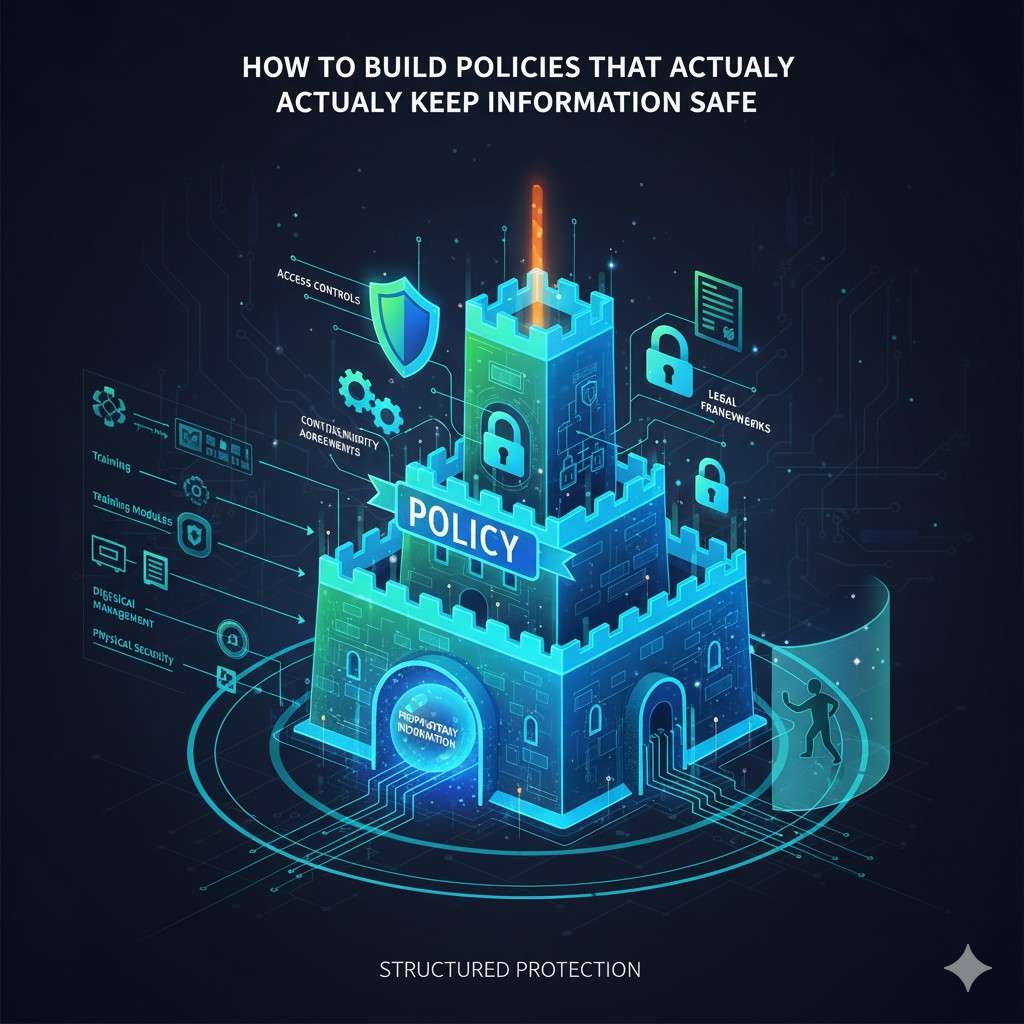
How to Build Policies That Actually Keep Information Safe
Every company needs policies that feel real, simple, and usable in daily work. Policies only matter when people follow them, and people only follow them when they are clear, easy, and make sense in the flow of fast execution.
The goal is not to create a heavy rulebook that no one reads. The goal is to build a living set of practices that guide how your team treats information.
The right policies make secrecy feel natural rather than forced, and they help everyone act with the same level of care. When these policies work well, they turn your internal knowledge into a real business asset.
The Role of Clear Language in Policy Design
Teams ignore policies when they sound like legal write-ups. Clear language keeps everyone aligned without confusion.
Your policies must explain what counts as a trade secret in simple terms that anyone on the team can identify without needing clarification.
When people understand the definition, they stop guessing. A short explanation of what should stay inside the company becomes the anchor for every later rule.
This clarity reduces mistakes, speeds up training, and gives new hires instant direction.
Why Short Policies Work Better Than Long Documents
A long document looks impressive but rarely influences behavior. A short policy forces you to focus on the essential rules that matter most. This clarity helps your team act without hesitation, especially in high-pressure moments.
A few strong guiding principles outperform a binder full of text.
When everything important fits into a brief document that people can remember, the entire team becomes more consistent, which strengthens your claim that you protected your knowledge with intention.
Policies That Match How Your Team Already Works
Policies are easier to follow when they match your team’s habits. If your team uses shared drives, the policy should describe how those drives should be organized.
If your team relies on messaging apps, the policy should explain how confidential information should be handled there. Policies become powerful when they map directly onto real workflows.

This reduces friction and avoids the pushback that often happens when rules feel disconnected from daily work.
How to Train Without Slowing Down Work
Training does not need long sessions or formal presentations. A short explanation during onboarding, a quick note in a meeting, or a brief written reminder can create the understanding needed to protect information.
Training works best when it is repeated in small, simple ways.
A few minutes each month can reinforce habits better than one long session that everyone forgets. When training feels natural, it becomes part of the rhythm of the company.
The Importance of Stating Ownership Clearly
Your team should always know that the company owns the knowledge, tools, and methods created during work.
This is not about control. It is about clarity. When ownership is clear, people handle information more responsibly because they know it does not belong to individuals.
This understanding also helps when someone leaves the company. If they know the information stays behind, they are less likely to treat it casually.
Clear ownership also strengthens your position if you ever need to enforce your rights.
How Policies Shape Behavior in Moments of Stress
During crunch periods, teams often take shortcuts. These are the moments when trade secrets are most vulnerable.
Clear policies support good decisions even when pressure is high. If someone must share information with a partner or contractor, the policy guides how to do it safely.

If someone joins a meeting who should not have access to certain details, the policy helps the team adjust quickly. Policies act as a guardrail when the pace of work creates risk.
Why Documentation Helps You Defend Your Secrets
Documentation proves that your policies were real, not just ideas. It shows that you shared rules with your team, reinforced them, and expected them to be followed. You do not need complex paperwork.
A simple record of when policies were shared, updated, or discussed is enough to show consistency.
Documentation is one of the strongest forms of evidence if you ever need to defend your trade secrets. It shows that your protection was intentional, steady, and supported by leadership.
How Policies Fit Into Your Larger IP Strategy
Policies are not only about preventing loss. They also help you decide what information should become a patent. When the team knows what is valuable and protected, they recognize invention sooner.
That means stronger disclosures and better invention records. A clear policy framework also makes it easier to work with IP tools like PowerPatent, because your ideas are already organized and your internal processes support quick capture of what matters most.
This leads to stronger filings and fewer delays. If you ever want to see how this works in practice, you can visit https://powerpatent.com/how-it-works.
How to Adjust Policies as the Company Grows
Policies that work for a five-person team may not work for a fifty-person team. Growth brings new roles, new systems, and new risks. Revisiting your policies at regular intervals keeps them relevant and prevents gaps.
This review does not need to be complicated. A short conversation about what has changed can reveal where policies need to adapt.
Strong companies treat policy updates as part of their growth, not as a separate legal task. This mindset keeps the whole team aligned as the structure of the company evolves.
Building Policies That Survive Turnover
People leave companies all the time, and trade secrets are most vulnerable during transitions. A smart policy anticipates this by setting clear expectations for departing team members.
It explains what must stay behind, what cannot be taken, and how to return company materials.
It creates a predictable process that protects the company while staying fair to the employee. When this process is consistent, it becomes a strong indicator that the company treats secrecy seriously.
How Policies Reinforce a Culture of Care
Policies alone cannot protect trade secrets. The team must believe in their purpose.
When everyone understands why secrecy matters, they take ownership of protection. They speak up when something feels risky. They remind each other when information should not be shared.
This internal culture is often the strongest proof of secrecy because it shows that protection is built into the identity of the company. A team that cares naturally creates evidence through its daily behavior.
The Quiet Power of Access Controls and Proof of Secrecy
Access controls are one of the most underrated tools in protecting trade secrets. Many founders picture access control as a technical feature or a security checkbox, but it is far more important than that.
It is the physical proof that your company treats its valuable knowledge with care. When courts look at trade secret disputes, one of the first questions they ask is simple: who had access, and why?
That single question can decide the entire outcome. Access controls are not just a safety measure. They are the visible structure behind your secrecy strategy, and without them, even your strongest ideas can lose legal protection.
How Access Controls Become a Story of Intent
Every access decision tells a story about how much you value your internal knowledge. When access is narrow, deliberate, and based on real need, it shows intention.
When anyone can open a sensitive folder or view a private system, the story changes.
Courts read these signals closely. Your access rules become proof that your company viewed certain information as important and took active steps to protect it.

Strong access controls turn your secrecy into something you can demonstrate with confidence, rather than something you have to explain after a problem arises.
Why Limiting Access Strengthens Team Focus
Small teams often give everyone access to everything because it feels easier. But wide access usually creates more confusion, not less. When only the right people can see sensitive information, the whole team becomes sharper about what matters.
It also reduces the risk of accidental sharing. When a team member is not exposed to something, they cannot leak it by mistake.
Controlled access is not about limiting trust. It is about reducing noise so people can do their work without carrying unnecessary risk.
The Role of Digital Boundaries in a Fast-Moving Startup
Digital boundaries create predictability in environments where speed often leads to shortcuts. When you build clean folder structures, clear permissions, and sensible access rules in your internal tools, you reduce the chance that information spreads into places where it should not be.
This structure becomes a quiet layer of protection that does not interrupt your workflow.
It simply keeps sensitive information in its proper home. Startups that set these boundaries early avoid the messy rebuild that usually happens when the team grows and the risk becomes harder to manage.
How Simple Tools Create Strong Secrecy Signals
Protecting trade secrets does not require the most advanced software.
Simple tools like permission-based drives, private channels, controlled onboarding steps, and restricted repositories send strong signals that your company is handling information responsibly.
What matters is consistency. If sensitive documents are always stored in a controlled space, labeled clearly, and accessed only by the people who need them, you are already doing more than many large companies.

These ordinary steps become powerful evidence of secrecy in any legal challenge.
Why Every Access Decision Must Be Defensible
A trade secret is lost the moment you cannot explain why someone had access to it.
If a contractor, intern, or temporary partner had visibility into your most valuable information without a defined need, the protection becomes fragile.
Defensibility comes from clarity. When every access grant has a simple reason and a clear boundary, you can show that your secrecy was thoughtful, not careless.
This is why many growing companies review access regularly. Not to police the team, but to ensure that every access path makes sense.
The Power of Removing Access at the Right Time
Granting access is only half the story. Removing access when roles shift or people leave is equally important. Many companies fail here because offboarding feels rushed or awkward.
But this moment matters deeply. When someone leaves with access still open, a court may view it as weak protection. A simple, predictable offboarding process fixes this. It does not need to be formal or complicated.

You just need a clear moment when access ends and company materials return. This consistency becomes a strong shield if you ever need to defend your trade secrets.
How Access Controls Support Cleaner Patent Filings
When you control access well, you also reduce the chance that early disclosures harm your future patent rights. Uncontrolled sharing can accidentally trigger public disclosure, which damages your ability to file later.
Access controls create a clean environment where your inventions stay protected until you are ready to file. This is one reason why teams that work with PowerPatent often see smoother filings.
When your information is already handled carefully, capturing it inside the platform becomes easier, faster, and safer. You can see how the workflow operates at https://powerpatent.com/how-it-works.
Building Access Rules That Match Your Company’s Pace
Your access system must grow with your team. A small startup may start with only one or two restricted folders, but as your structure evolves, your controls must evolve too.
This does not mean you need a formal security team. It simply means that once a quarter, someone looks at who can see what and decides whether the system still makes sense.
These small check-ins keep your protection aligned with your growth and prevent loose areas from forming over time.
Turning Access Controls Into Evidence
Evidence of secrecy does not come from what you intend. It comes from what you can show. Audit logs, timestamps, role-based permissions, and documented access decisions all act as living proof of how your company protected its knowledge.
You do not need advanced tracking. Even basic logs from everyday tools create the trail you need.
This trail is what saves companies when disputes arise. It gives you something concrete to point to, something that proves your secret was treated as a secret long before anyone tried to challenge it.
How Team Awareness Makes Access Controls Stronger
Access controls work best when everyone understands why they exist. When your team knows that certain folders or systems are restricted because they hold trade secrets, they become more careful with their own behavior. They check before sharing.
They notice when something looks out of place. They recognize when someone is asking for more access than they need.

This awareness turns your team into active participants in protection, which strengthens your evidence and reinforces your internal culture.
Wrapping It Up
Protecting trade secrets is not about fear, complexity, or heavy legal work. It is about showing, through your daily habits, that your most valuable knowledge matters. When your team follows clear policies, when your access controls match your company’s pace, and when your evidence of secrecy grows naturally through your workflow, you build real strength around the ideas that set you apart. This protection becomes part of how you operate. It becomes a signal to investors, partners, and future hires that your company takes its advantage seriously. And when challenges arise, you have the structure, the clarity, and the proof to defend what you’ve built.
Leave a Reply