Let’s get straight to it.
Negative limitations can either make your patent very strong or completely break it. There is no middle ground. When used the right way, they help you lock out competitors with clean, clear claims. When used the wrong way, they get rejected, delayed, or quietly weaken everything you’re trying to protect. This article will show you exactly when negative limitations are allowed, why examiners push back on them, and how to support them so they actually work for you. No legal talk. No filler. Just the real rules that matter if you are building something valuable and want it protected without slowing down your company.
Why Patent Examiners Push Back on Negative Limitations
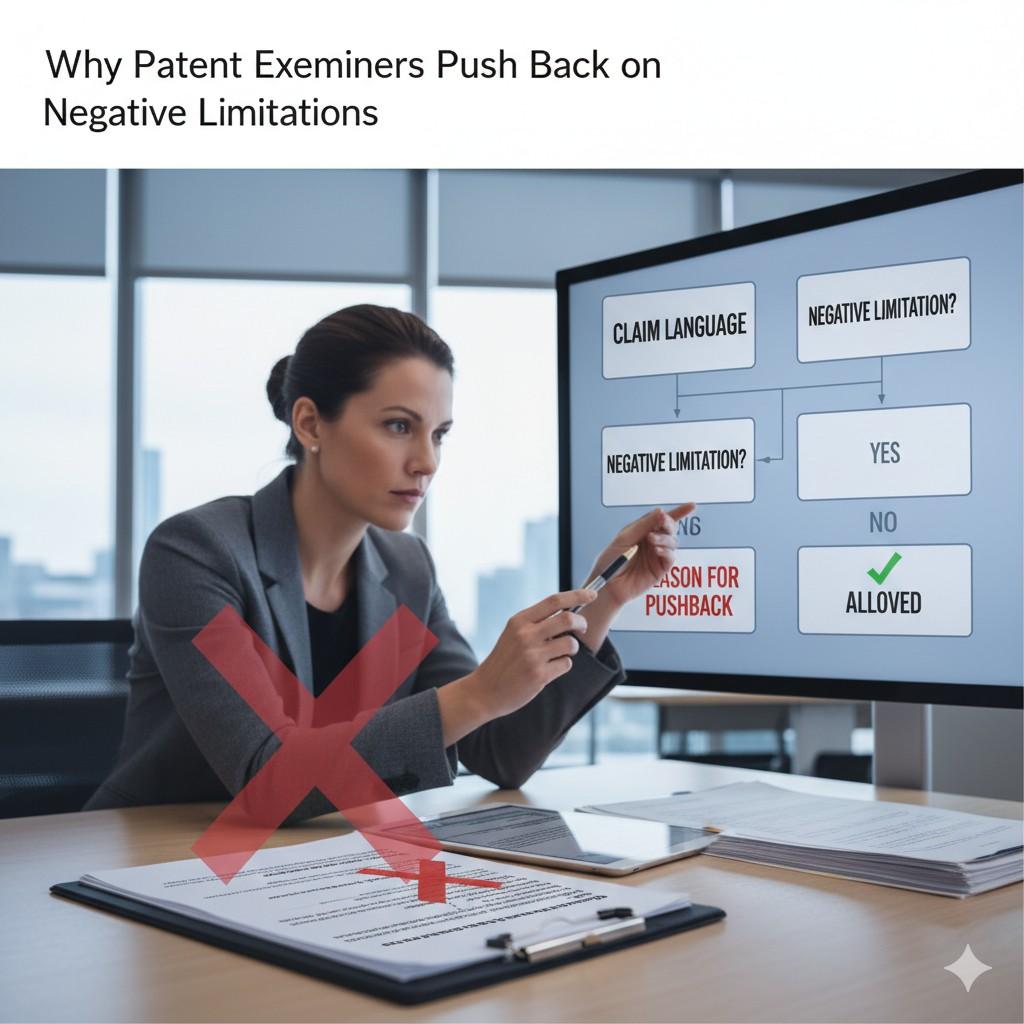
Patent examiners do not push back on negative limitations because they are trying to be difficult. They push back because negative limitations can quietly change the story of an invention.
From a business point of view, this matters because every pushback means delay, cost, and risk.
Understanding the real reason behind the resistance lets you plan ahead and avoid getting stuck defending a position that was never set up properly.
At a high level, examiners are trained to protect the integrity of the patent system.
Their job is to make sure that what you claim today is something you actually invented and explained earlier. Negative limitations sit right at the edge of that line, which is why they get extra attention.
Examiners Are Guarding Against After-the-Fact Changes
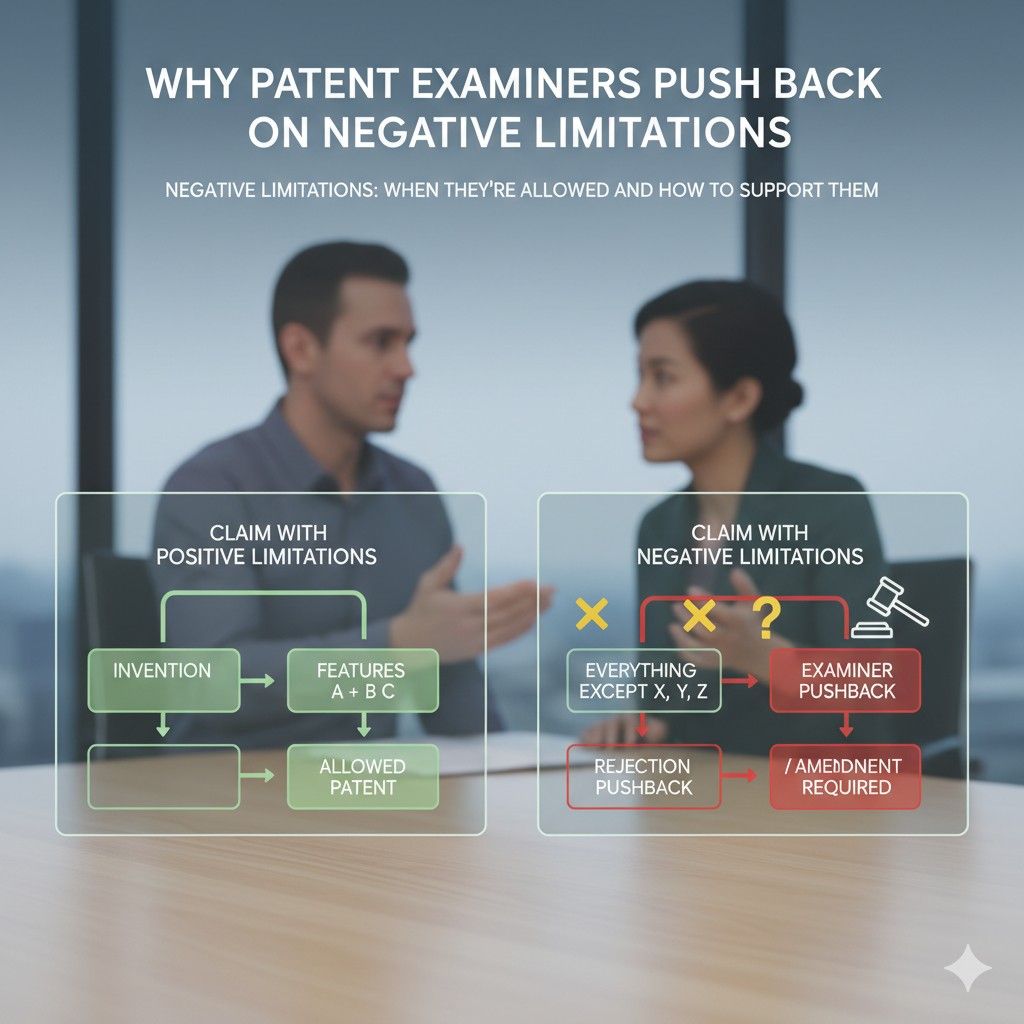
From the examiner’s view, a negative limitation often looks like a late-stage correction. It can feel like the inventor saw a rejection and tried to carve around it by saying something is missing.
That makes examiners nervous because patents are not supposed to evolve based on what competitors are doing later.
For businesses, the takeaway is simple. If a claim change looks reactive instead of planned, it is more likely to be rejected.
When you draft or revise claims, you should always be able to point back to the original story of the invention and show that the absence was part of the design, not a response to pressure.
A smart move here is to document your technical decisions early. Even internal design notes that explain why you avoided a feature can help guide how your patent is written.
While those notes are not part of the patent, they help your team explain the invention clearly from day one.
Silence in the Specification Creates Suspicion
One of the biggest reasons examiners reject negative limitations is simple silence. If the patent never mentions a feature, never contrasts it, and never hints at its absence, the examiner assumes the inventor did not think about it.
This matters because patents reward teaching, not guessing. An examiner cannot assume you intentionally left something out unless the application gives them a reason to believe that.
For a business, this means your patent should not just describe what your product does.
It should also show awareness of the landscape it lives in. If your system avoids a common part used by others, that should be visible in how the invention is explained.
A practical way to do this is by framing your invention as a solution to a known problem. When you explain the problem clearly, the absence of certain features often becomes obvious and justified, even without using negative words.
Negative Limitations Can Look Like Overreach
Examiners are trained to watch for claims that try to cover more than what was actually built. A negative limitation can sometimes look like a way to block competitors broadly without earning that scope.
For example, saying a system works without a certain component might suggest that it works in many unknown ways.
If the application only shows one narrow implementation, the examiner may push back because the claim feels larger than the teaching.
From a strategy standpoint, this is where businesses need to balance ambition with credibility. A strong patent does not just say what is missing. It shows how the invention still works and why it works without that thing.
When you want to use a negative limitation, make sure the surrounding description shows stability. The examiner should feel confident that the invention stands on its own, not that it collapses once a familiar part is removed.
Examiners Are Protecting Public Notice
Patents are public documents. One of the examiner’s roles is to make sure the public can understand what is protected and what is not. Negative limitations can sometimes muddy that clarity.
If a claim says something is excluded, but the application never talks about that thing, the public cannot easily tell what boundary is being drawn. That lack of clarity is another reason examiners hesitate.
Businesses should think of their patent as a map, not a mystery. When you draw a line by excluding something, the reader should already know what that something is and why it matters.
A useful tactic is to include short explanations of alternative approaches, even if you never plan to use them. This creates a reference point that later supports clearer boundaries in the claims.
Past Court Decisions Shape Examiner Behavior
Examiners do not operate in a vacuum. They are influenced by court cases where negative limitations were challenged and sometimes struck down. Those cases often focus on whether the original patent truly supported the exclusion.
Because of this history, examiners are cautious by default. They would rather reject and force clarification than allow something that could later be invalidated.
For a company, this means that winning an argument with an examiner is not just about logic. It is about aligning with how courts have treated similar issues.
The safest path is to make support so clear that the examiner does not feel exposed by allowing the claim.
This is why having attorney oversight during drafting is so valuable. Experienced attorneys know how examiners think because they see patterns across many cases.
Platforms like PowerPatent combine that insight with speed, so founders do not have to learn these lessons the hard way. You can see how that works here: https://powerpatent.com/how-it-works
Examiners Prefer Additions Over Subtractions
Another subtle reason for pushback is that examiners are more comfortable with positive statements. Saying what something includes feels concrete. Saying what it excludes feels abstract unless handled carefully.
Negative limitations force examiners to ask extra questions. What replaces the missing feature? How is the function achieved instead? Is that alternative actually described?
Businesses can work with this preference instead of against it. One effective approach is to describe what your system does do, in enough detail that the absence becomes a natural conclusion.
When the positive story is strong, the negative limitation feels less risky.
How Businesses Can Reduce Pushback Early
The most effective way to deal with examiner resistance is to prevent it. That starts before filing, not during prosecution.
When preparing a patent, take time to explain the edges of your invention. Talk about what it avoids, what it improves, and what it deliberately leaves behind.
This does not require long explanations. Even short contrasts can create powerful support later.
It also helps to think two steps ahead. Ask yourself how a competitor might design around your product. If that design-around relies on a feature you intentionally avoided, your patent should reflect that awareness.
This kind of forward thinking is hard to do alone while running a company. That is why modern tools that guide founders through these decisions, with real attorney review, can make a measurable difference.
If you want a faster, safer way to build patents that hold up under scrutiny, take a look at https://powerpatent.com/how-it-works
When a Negative Limitation Is Clearly Allowed
Negative limitations are not forbidden. In fact, when done right, they are fully acceptable and often very powerful. The problem is not the concept itself. The problem is that many patents try to use negative limitations without earning the right to use them.
This section explains when examiners are actually comfortable allowing them and how businesses can intentionally design their patents to fall into these safe zones.
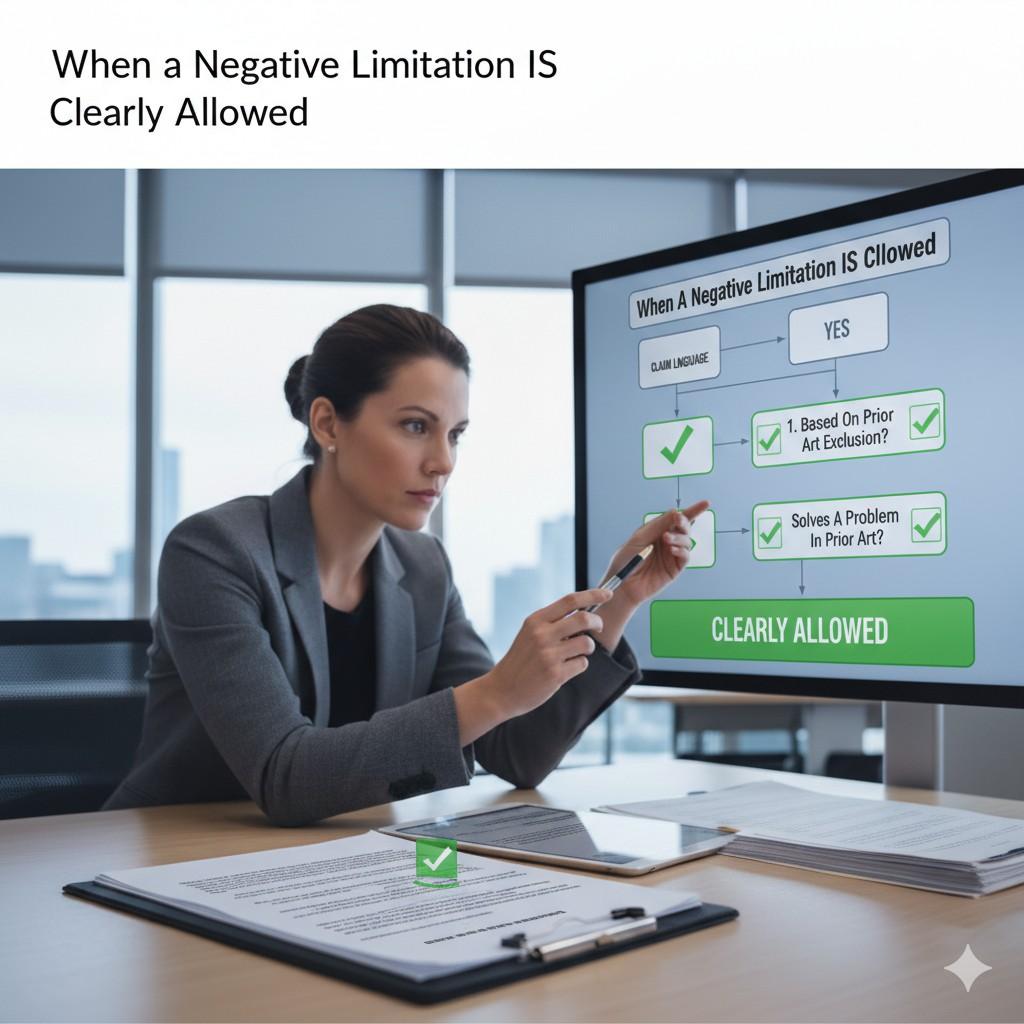
The Invention Clearly Solves a Known Problem by Leaving Something Out
One of the strongest situations for a negative limitation is when the invention exists because something was removed. In these cases, the absence is not accidental. It is the reason the invention works.
Examiners are much more receptive when the patent explains a real-world problem and shows that common solutions rely on a feature that causes pain.
When the invention avoids that feature and explains why, the absence becomes part of the core idea.
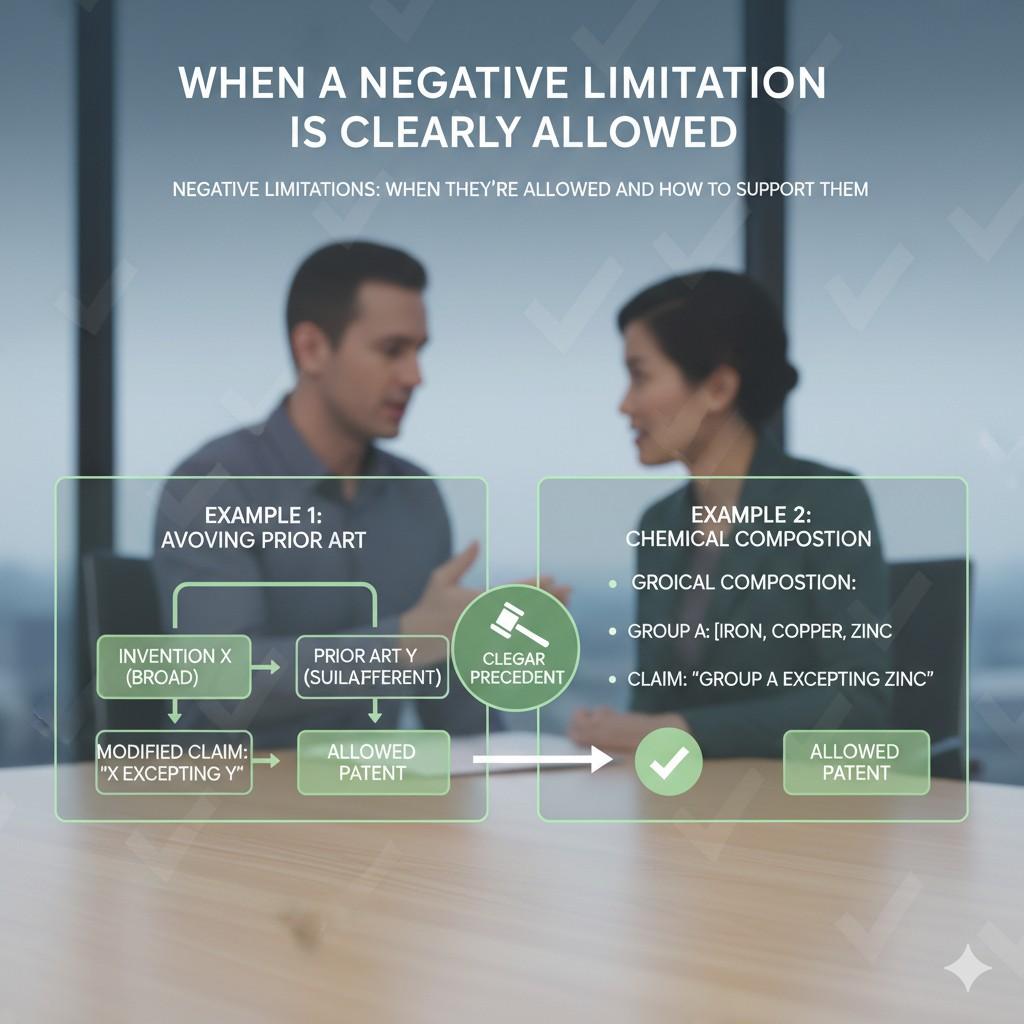
For a business, this means you should not just describe your product as new. You should describe it as different in a meaningful way. If removing a component improved speed, cost, reliability, or scale, that story should be visible in the application.
When the story is clear, adding a claim that says the system operates without that component feels honest and earned, not opportunistic.
The Specification Shows Multiple Paths, Including One Without the Feature
Another situation where negative limitations are allowed is when the patent describes more than one approach. If one approach includes a feature and another does not, the absence is already disclosed.
Examiners like this because it shows intentional design space. It tells them the inventor understood the options and chose between them.
From a strategy standpoint, businesses should think of their patent as a playground, not a single snapshot. Even if your product uses only one approach today, describing alternatives gives you flexibility later.
This does not mean overcomplicating the patent. It means acknowledging that different designs exist and showing at least one example where the feature in question is not present.
When you later claim that version, the examiner sees continuity instead of invention drift.
The Absence Is Implied by How the System Works
Sometimes a negative limitation is allowed even when the words “without” never appear in the original application. This happens when the described system could not function if the excluded feature were present.
Examiners accept this when the technical explanation is tight and logical. If adding the excluded feature would contradict how the invention operates, the absence is implied.
For businesses, this is where clarity matters more than volume. A clean explanation of how your system functions can do more work than pages of generic description.
This is also where rushed drafting causes harm. If the explanation is vague, the examiner cannot infer absence with confidence. Precision in describing how things work pays off later when you need flexibility in claims.
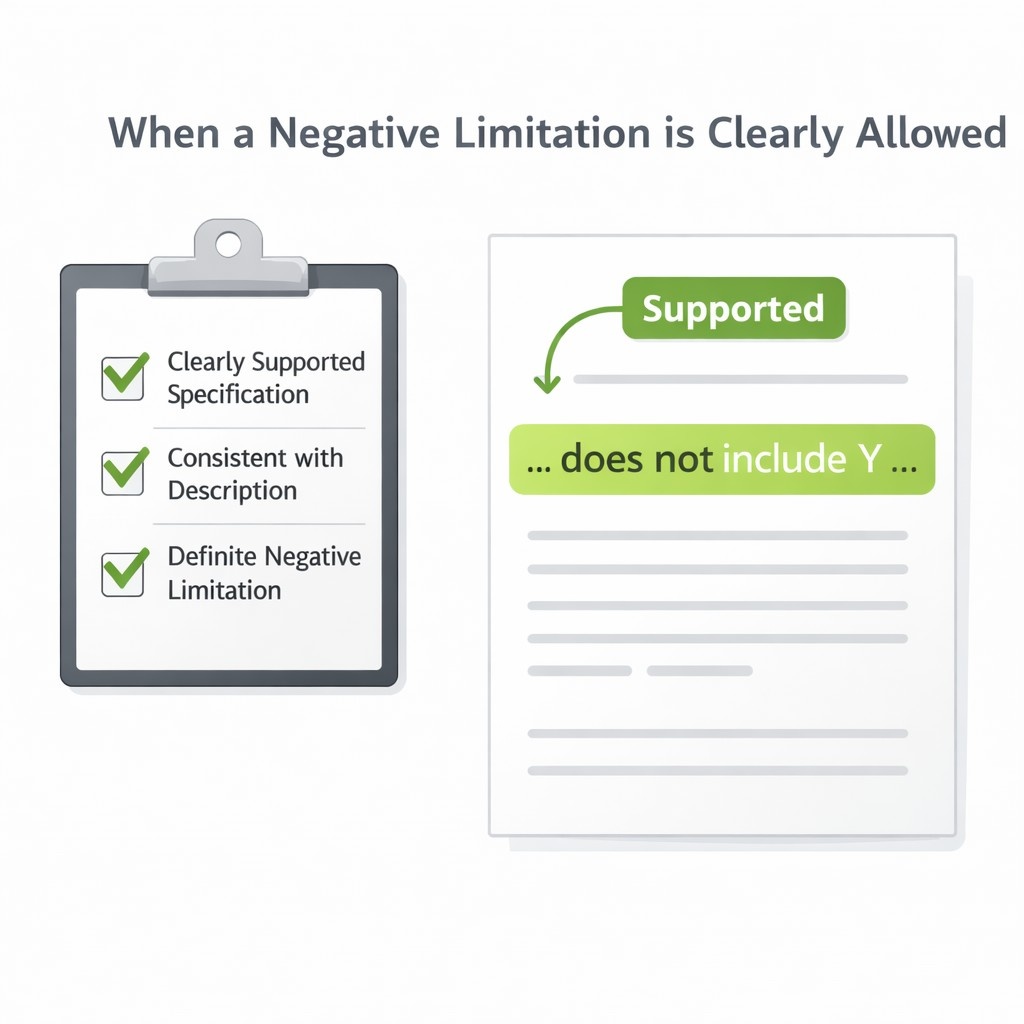
The Patent Explicitly Distinguishes Over Prior Art
Negative limitations are often allowed when the patent clearly distinguishes itself from known systems. If prior art uses a feature and your invention deliberately does not, that contrast creates strong support.
Examiners are comfortable here because the negative limitation aligns with novelty. It explains why the invention is new, not just how it avoids rejection.
From a business view, this is a powerful positioning tool. Your patent should not pretend competitors do not exist. It should acknowledge them and explain how your approach differs.
Doing this early also helps during fundraising and diligence. A patent that clearly explains how it avoids known approaches signals thoughtfulness and depth.
The Negative Limitation Narrows, Not Expands, the Claim
Examiners are more likely to allow negative limitations when they clearly narrow the claim. If removing a feature makes the claim more specific and less broad, it feels safer.
Problems arise when a negative limitation appears to open the door to many unknown implementations. That triggers concerns about overreach.
Businesses should frame negative limitations as precision tools. They are not about grabbing more ground. They are about fencing off exactly what you built and why it matters.
When your claim reads as tighter and more focused after adding the limitation, you are moving in the right direction.
The Original Filing Shows Intent, Not Accident
Intent is a recurring theme. Examiners allow negative limitations when they believe the inventor made a conscious choice.
This belief comes from tone, structure, and emphasis. If the application reads like a thoughtful explanation of design decisions, examiners trust it more.
For founders, this is a mindset shift. A patent is not just a technical dump. It is a narrative about why your solution exists.
This is why tools that guide you through explaining your invention, instead of just filling in templates, are so valuable. PowerPatent is built around capturing intent early, with real attorney review to make sure those signals are clear. You can see how that process works here: https://powerpatent.com/how-it-works
Business Advantage of Getting This Right Early
When negative limitations are clearly allowed, they become leverage. They let you respond to examiner feedback without rewriting your invention. They let you block design-arounds that rely on features you intentionally avoided. They also make your patent easier to defend later.
The key is that allowance is not luck. It is design.
If you plan for negative limitations at the drafting stage, you gain options. If you wait until rejection, you are negotiating from a weak position.
Strong patents feel inevitable when read backward. The claims align with the story. The story aligns with the design. And the design aligns with the business goal.
That alignment does not happen by accident. It comes from treating patent strategy as part of product strategy, not an afterthought.
If you want to continue, the next section will dive into what actually counts as real support for negative limitations and how to build that support into your patent without bloating it or slowing you down.
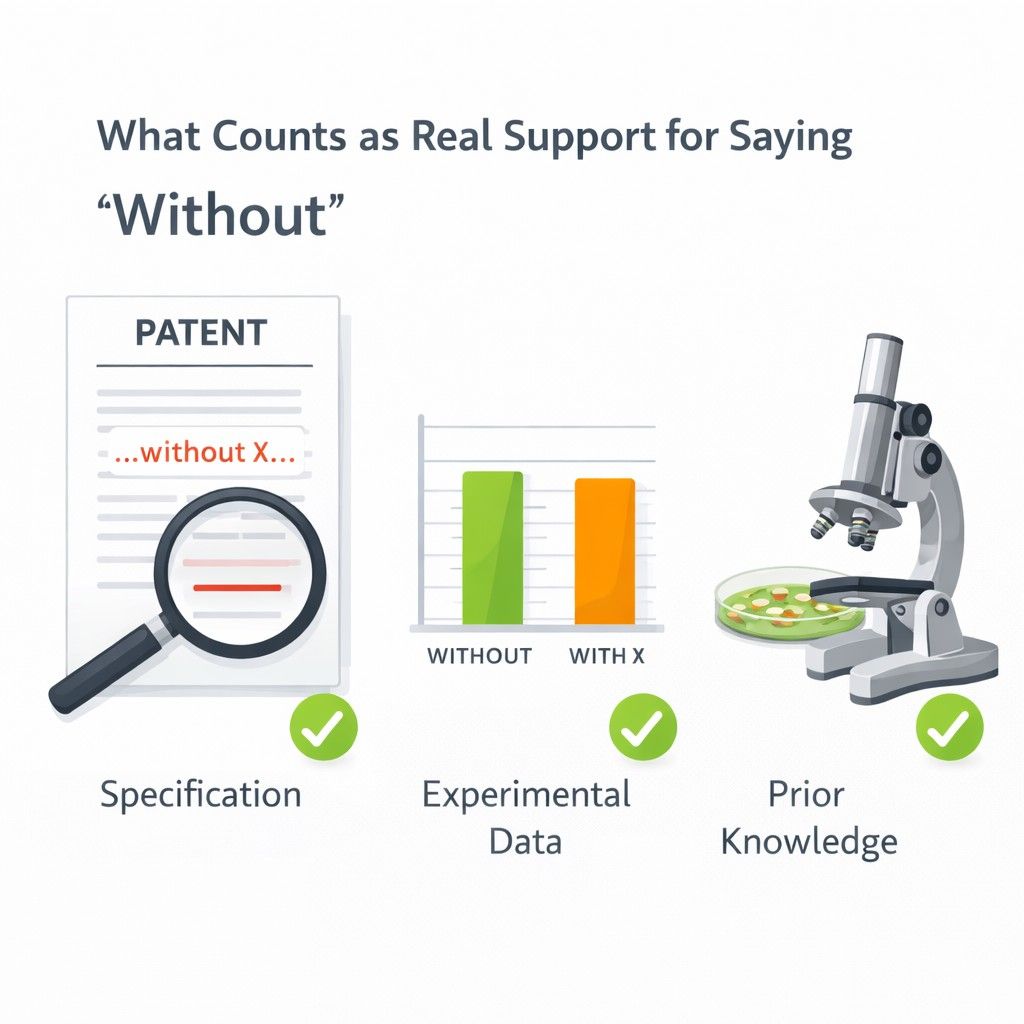
What Counts as Real Support for Saying “Without”
Support is the make-or-break factor for negative limitations. You can have the cleanest claim language in the world, but if the original patent does not support the exclusion, the examiner will not allow it.
This section explains what examiners actually view as real support, how businesses can create it intentionally, and how to avoid the false sense of safety that comes from vague descriptions.
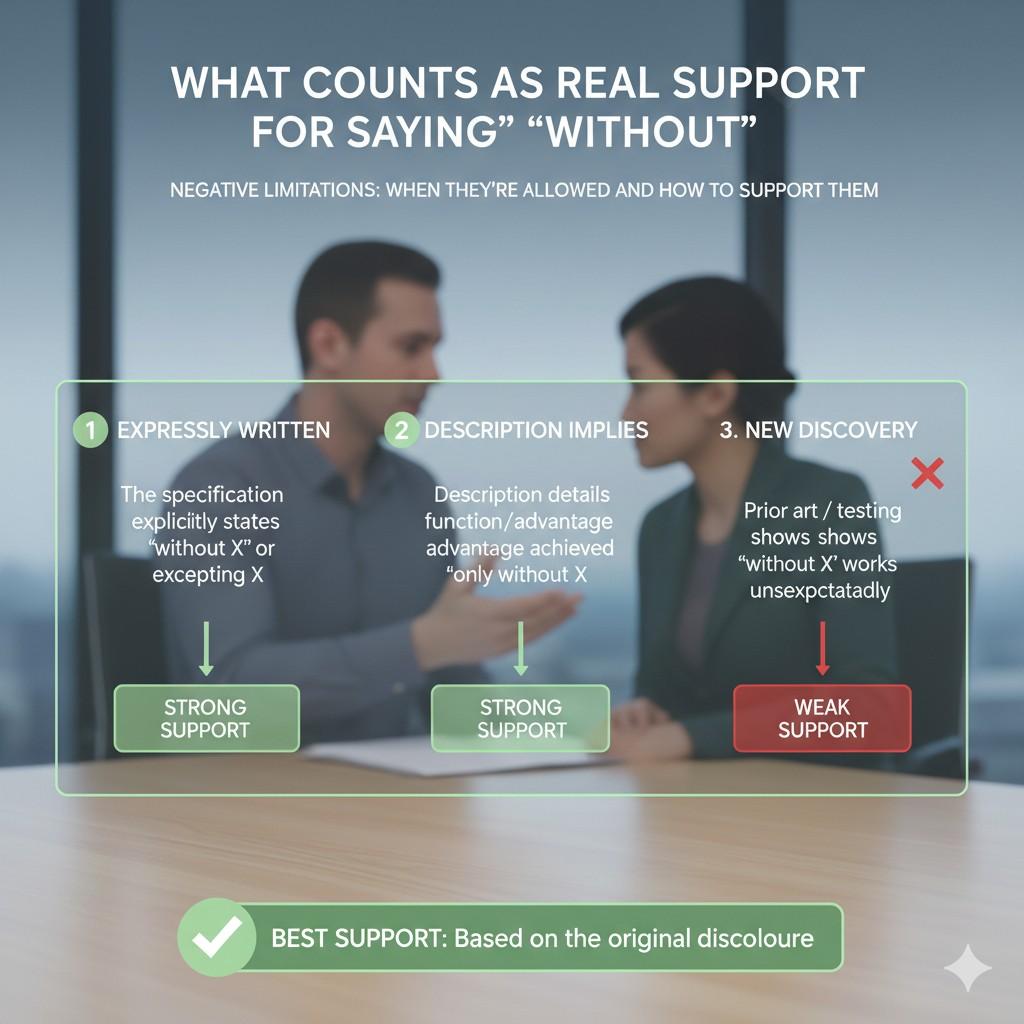
Support Is About Meaning, Not Keywords
A common mistake is thinking support requires specific words. Many founders assume that if the patent does not literally say “without X,” they are out of luck. That is not how examiners read patents.
Examiners look for meaning. They ask whether the application teaches that the invention works without the excluded feature. If the answer is clear from the explanation, support can exist even without explicit language.
For businesses, this means the quality of explanation matters more than volume. A well-written description that clearly shows how the system operates can quietly support many future claim options.
This is why explaining how your invention functions step by step is so valuable. When the logic is tight, absence becomes visible.
Functional Descriptions Create Strong Implied Support
One of the strongest forms of support comes from describing function instead of parts. When you explain what the system does and how it achieves results, you often show what it does not need.
If your invention performs a task using software logic, data flow, or timing control, and you explain that clearly, the absence of certain physical components becomes implied.
From a business standpoint, this approach scales well. Functional explanations tend to age better as products evolve. They also make it easier to adjust claims later without changing the core story.
The key is precision. Vague functional language weakens implied support. Clear cause-and-effect explanations strengthen it.
Comparative Explanations Strengthen Support
Another powerful way to support negative limitations is through comparison. When the patent explains how traditional systems work and then explains how your invention works differently, the differences carry weight.
Examiners trust comparisons because they show awareness. They suggest the inventor understood existing approaches and made conscious choices.
For businesses, this is an opportunity to position your invention strategically. A short explanation of what others do and why it causes friction can justify why your system avoids a certain feature.
This also helps in later enforcement. A patent that clearly contrasts itself with known approaches is easier to explain to investors, partners, and courts.
Explicit Alternatives Create Clear Support Paths
Describing alternatives, even briefly, is one of the most reliable ways to support future negative limitations. If the patent says a function can be performed using one approach or another, and one approach does not include a feature, that absence is disclosed.
Examiners see this as intentional design space. It tells them the inventor explored options.
For businesses, the lesson is to resist over-optimizing the patent around the current product version. A small amount of alternative description can dramatically increase long-term flexibility.
This does not mean inventing imaginary features. It means acknowledging real design choices you considered or could reasonably consider.
Problem-Solution Framing Builds Natural Support
Support often emerges naturally when the invention is framed as a solution to a problem. If the problem is caused by a specific feature used in existing systems, and your solution avoids that feature, the absence becomes justified.
Examiners respond well to this structure because it mirrors how innovation happens in the real world.
For companies, this is one of the most effective ways to align technical reality with patent strategy. When your patent explains why something was removed, later claiming that removal feels consistent, not convenient.
This approach also improves readability. A patent that explains problems and solutions is easier to understand and more persuasive.
Structural Explanations Can Support Absence
Sometimes support comes from structure. If the patent describes a system architecture that simply does not have room for a feature, that can support a negative limitation.
Examiners accept this when the architecture is explained clearly. They look at whether the excluded feature would conflict with the described structure.
For businesses building platforms or systems, this is especially relevant. Clear architectural descriptions can do a lot of heavy lifting without long explanations.
The risk here is being too high-level. If the structure is abstract, the examiner cannot confidently infer absence. Detail matters, but it should be purposeful.
What Does Not Count as Support
It is just as important to know what examiners do not accept. Silence alone is rarely enough. Simply failing to mention a feature does not show intent.
Generic language also fails. Statements like “the system may include various components” do not help support absence later.
From a business perspective, this is where many patents quietly lose value. They look broad, but they lack the grounding needed to adapt during prosecution.
Avoiding this requires intention. The patent should read like a thoughtful explanation, not a placeholder.
Building Support Without Slowing Down
Founders often worry that adding this kind of support will slow them down. It does not have to. With the right guidance, these explanations can be captured quickly as part of the drafting process.
This is where modern patent platforms make a real difference. PowerPatent is designed to prompt these insights early, while real attorneys make sure the support is legally meaningful. The result is speed without sacrificing strength. You can see how that works here: https://powerpatent.com/how-it-works
Support is not about predicting every future claim. It is about telling a complete and honest story about your invention.
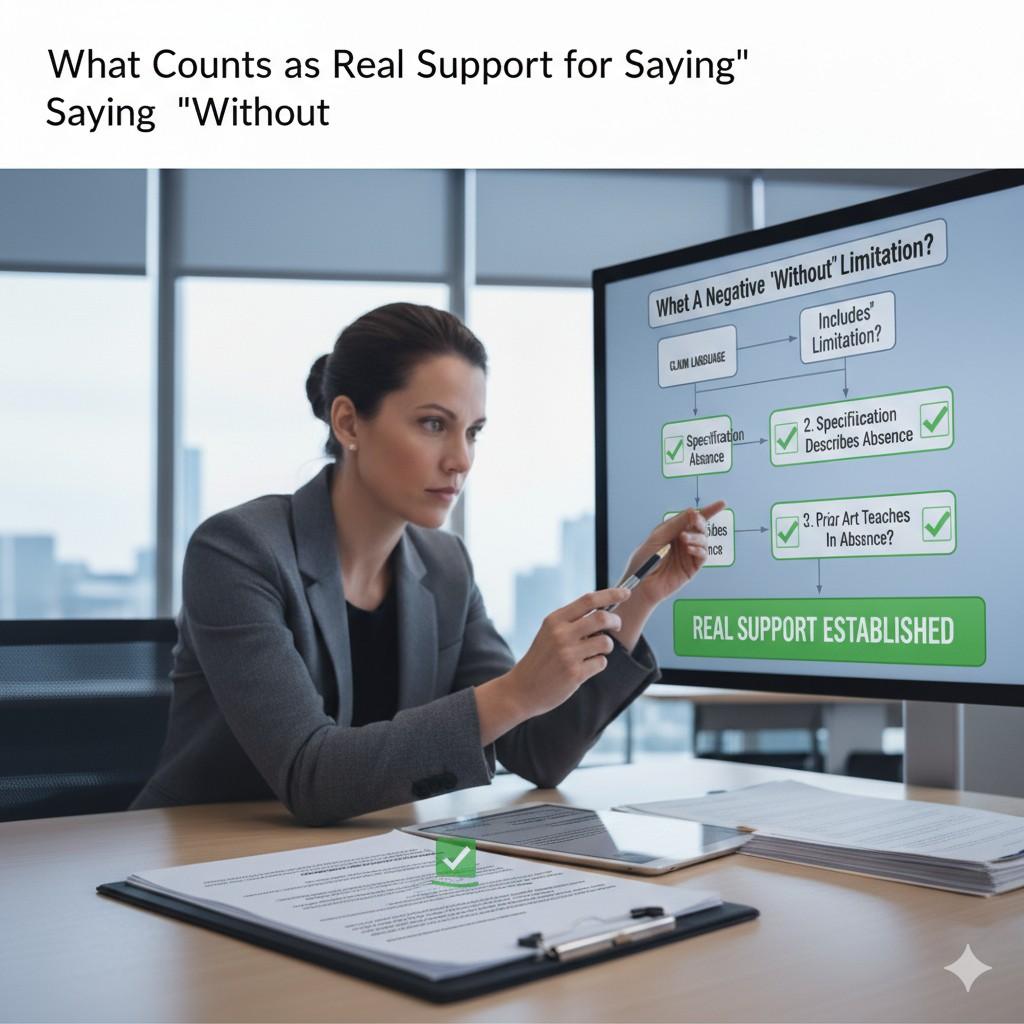
When that story is clear, negative limitations stop feeling risky. They become another tool you can use with confidence.
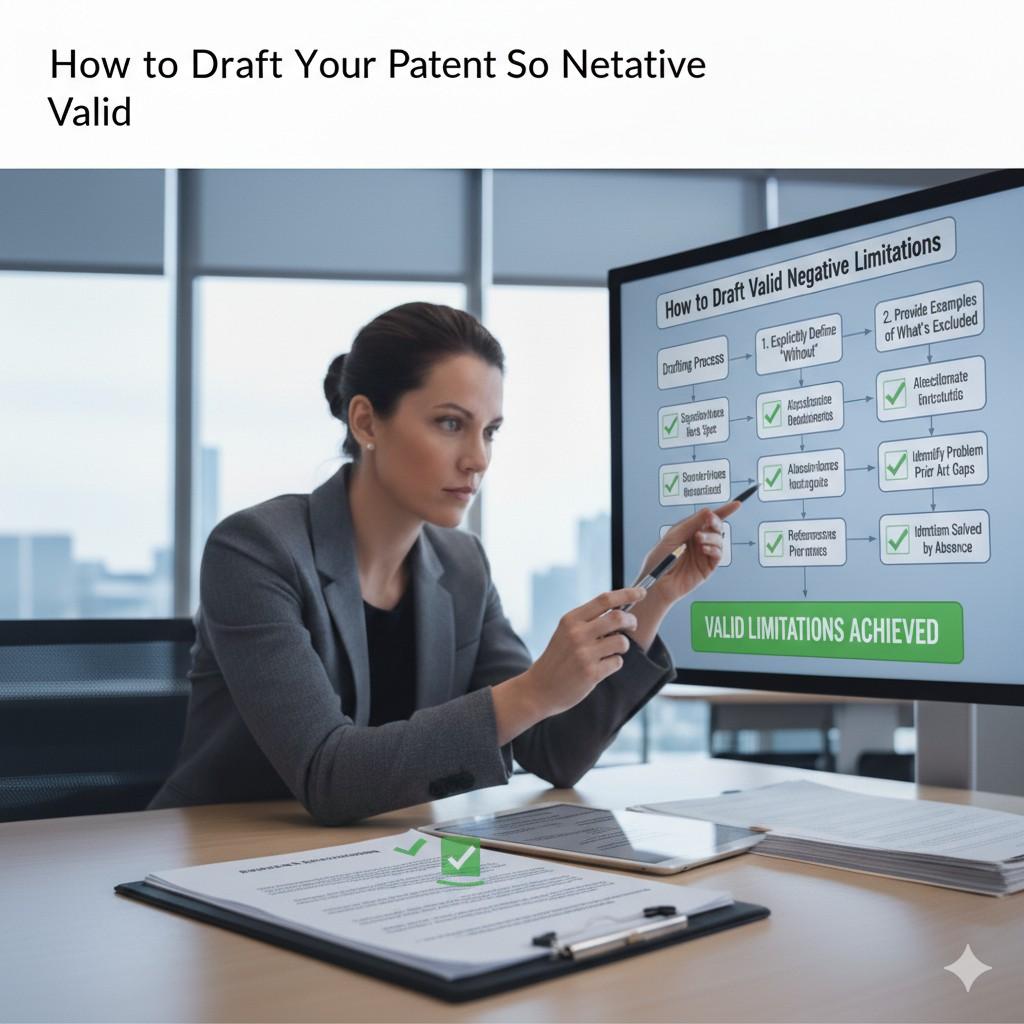
How to Draft Your Patent So Negative Limitations Stay Valid
Drafting for negative limitations is not about sprinkling in magic words. It is about building a patent that can grow with your business without breaking under pressure.
When done right, your patent stays flexible, credible, and enforceable, even years after filing. This section focuses on how businesses can draft with intention so negative limitations remain valid and useful over time.
Start With the Decisions, Not Just the Design
Most patents focus heavily on what was built and very little on why it was built that way. That is a missed opportunity.
Examiners care about decisions. They want to see that choices were made deliberately. When your patent explains why a feature was included or avoided, it creates a foundation that supports future exclusions.
For a business, this means capturing reasoning early. If your team decided not to use a certain approach because it was slow, fragile, or expensive, that reasoning belongs in the patent story.
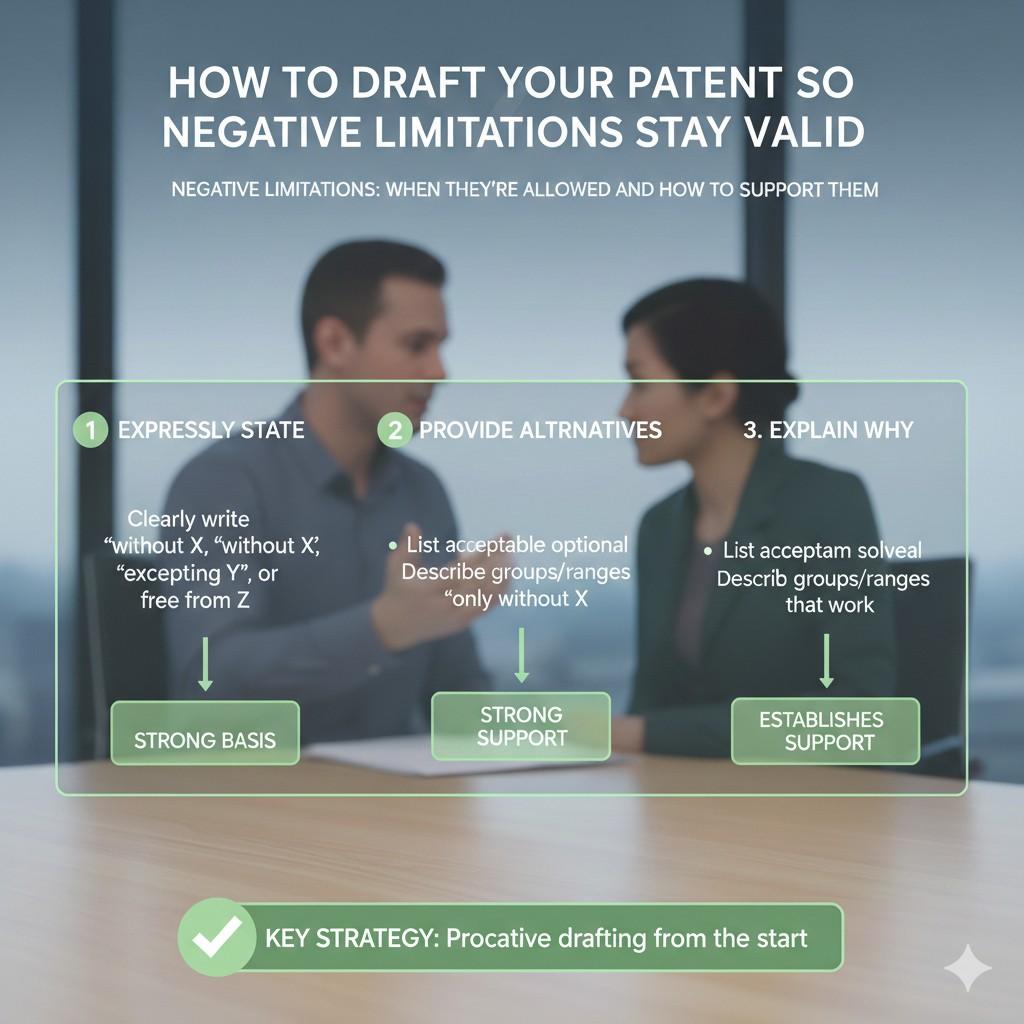
This does not require long explanations. Even short insights into design tradeoffs can carry long-term value.
Explain How the System Holds Together Without the Feature
A negative limitation is stronger when the patent shows stability. The examiner should feel confident that the invention works cleanly without the excluded element.
This means explaining how key functions are achieved. If something is missing, something else must be doing the work. That relationship should be visible.
For businesses, this is about showing resilience. A patent that explains how the system operates without common crutches looks more mature and defensible.
This also helps later when your product evolves. If the patent shows a solid foundation, small changes do not undermine its core claims.
Use Context to Make Absence Obvious
Context is one of the most underused drafting tools. When the environment around the invention is well explained, absence becomes easier to support.
If your patent clearly describes the problem space, existing solutions, and their drawbacks, the absence of certain features feels logical.
From a business angle, this is storytelling with purpose. You are not just describing a product. You are positioning it in a market.
This makes your patent easier to understand and harder to challenge.
Draft With Future Claim Changes in Mind
No patent survives first contact with an examiner unchanged. Amendments are normal. The goal is to make those amendments painless.
When drafting, assume you will need to narrow claims later. Ask yourself what you might want to exclude if pushed.
This mindset leads to better structure. You naturally explain alternatives, boundaries, and variations.
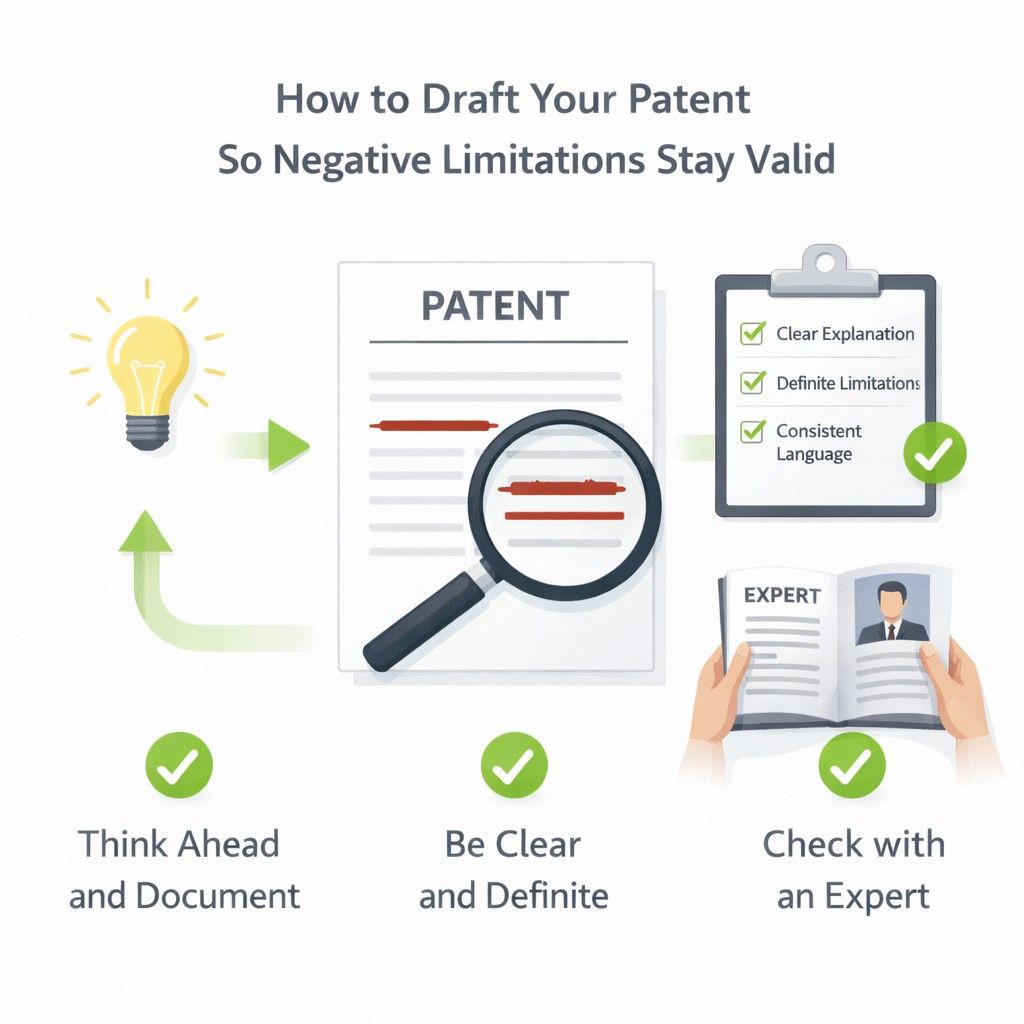
For businesses, this is risk management. A little foresight now prevents expensive rewrites later.
Avoid Overgeneralized Language That Weakens Support
Broad language can feel safe, but it often backfires. When everything is described as optional or interchangeable, nothing feels intentional.
Examiners struggle to find support in overly general descriptions. They cannot tell what matters and what does not.
For companies, clarity beats breadth. A patent that clearly explains a few strong ideas is more adaptable than one that vaguely gestures at many.
This does not mean narrowing your invention. It means anchoring it.
Tie Technical Choices to Business Outcomes
One way to strengthen support is to connect technical decisions to real outcomes. If excluding a feature improved speed, reliability, or cost, say so.
Examiners are human. They respond to logic that makes sense in the real world.
For businesses, this alignment is powerful. It turns the patent into a reflection of your strategy, not just your code.
It also helps during enforcement. Courts understand business motivations better than abstract descriptions.
Keep the Story Consistent Across the Document
Consistency matters more than most founders realize. If the description, drawings, and examples all align, examiners trust the document more.
Negative limitations feel safer when they match the overall tone and direction of the patent.
For a business, this means reviewing the patent as a whole, not just the claims. The story should feel cohesive.
This is one reason attorney review is critical. Experienced eyes catch inconsistencies that founders often miss.
Build a Patent That Ages Well
Your product will change. Your market will shift. Your patent should still hold.
Drafting with negative limitations in mind helps future-proof your IP. It gives you room to adjust claims without rewriting history.
This kind of drafting does not slow you down when supported by the right tools.
PowerPatent is designed to help founders capture these insights quickly, with real attorney oversight to ensure long-term strength. If you want to see how that works, you can explore it here: https://powerpatent.com/how-it-works
When your patent is drafted with intention, negative limitations stop being a risk. They become a quiet advantage.
Wrapping It Up
Negative limitations are not shortcuts. They are signals. When used correctly, they tell a clear story about what your invention is and just as importantly, what it is not. Examiners push back on them when that story feels incomplete, reactive, or unsupported. They allow them when the intent is visible, the reasoning makes sense, and the invention stands firmly on its own.
Leave a Reply