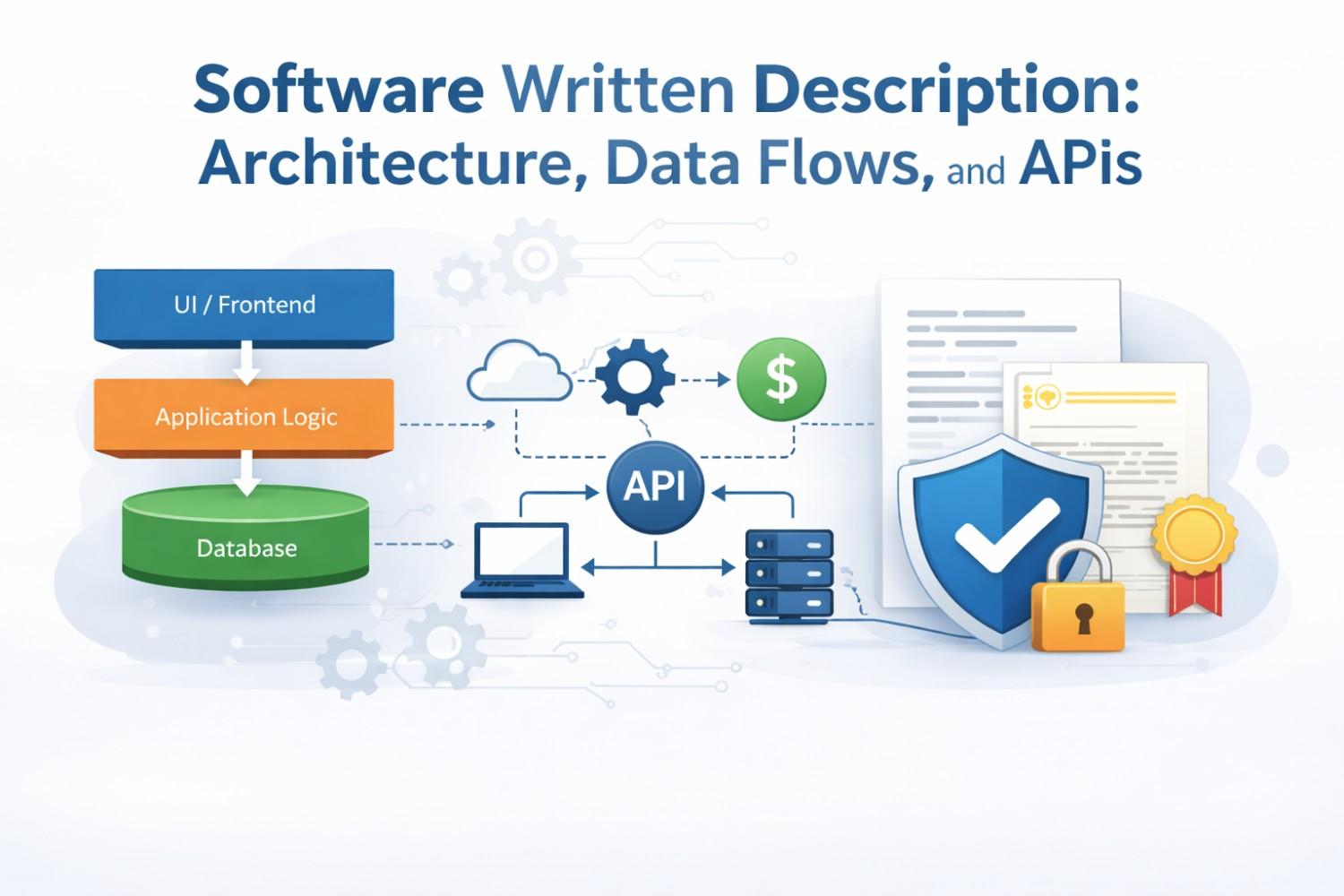
If you are building software, your product already has a story. It has a shape. It has moving parts. Data goes in, data moves around, and something valuable comes out. That story matters more than most founders realize, especially when it comes to patents. A software patent does not protect ideas. It protects how your system works. That means the way your architecture is set up, how data flows through the system, and how your APIs connect everything together. This is called the written description. And it is the backbone of a strong software patent.
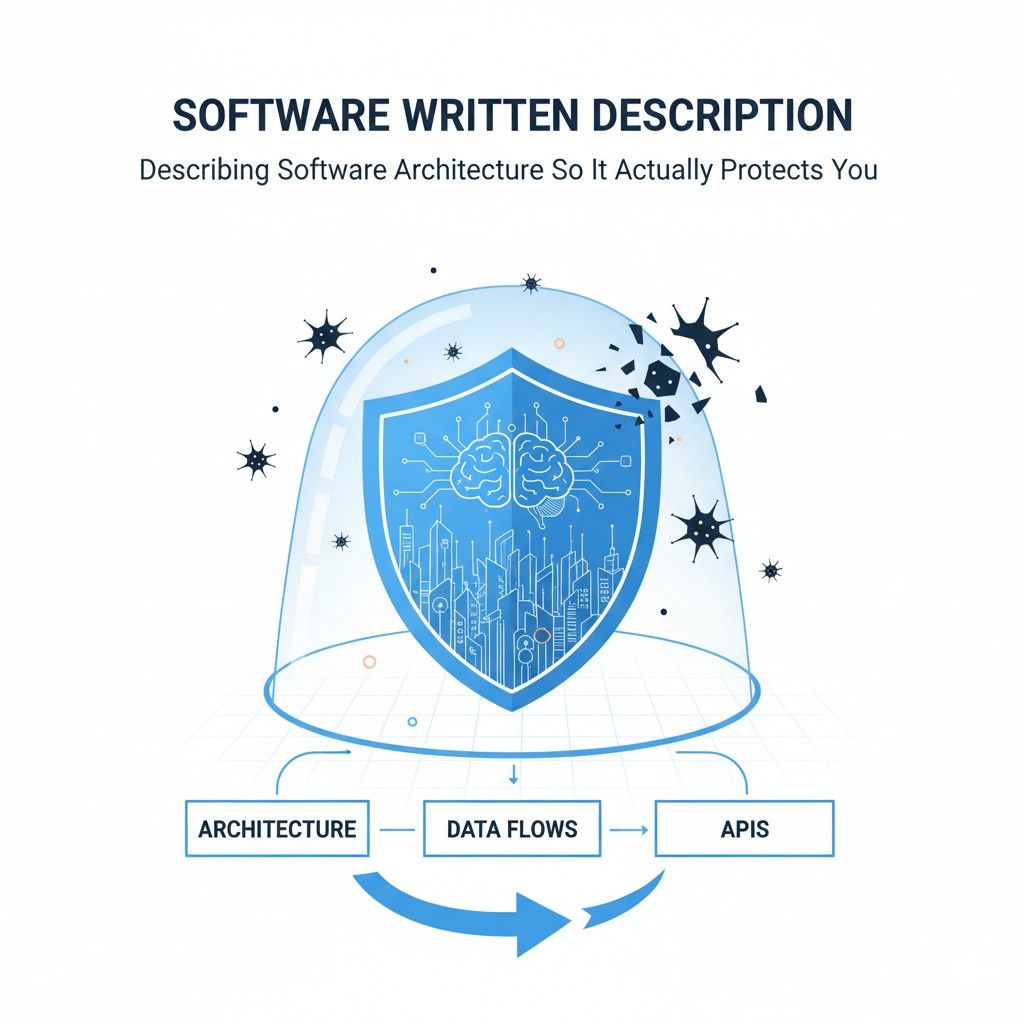
Describing Software Architecture So It Actually Protects You
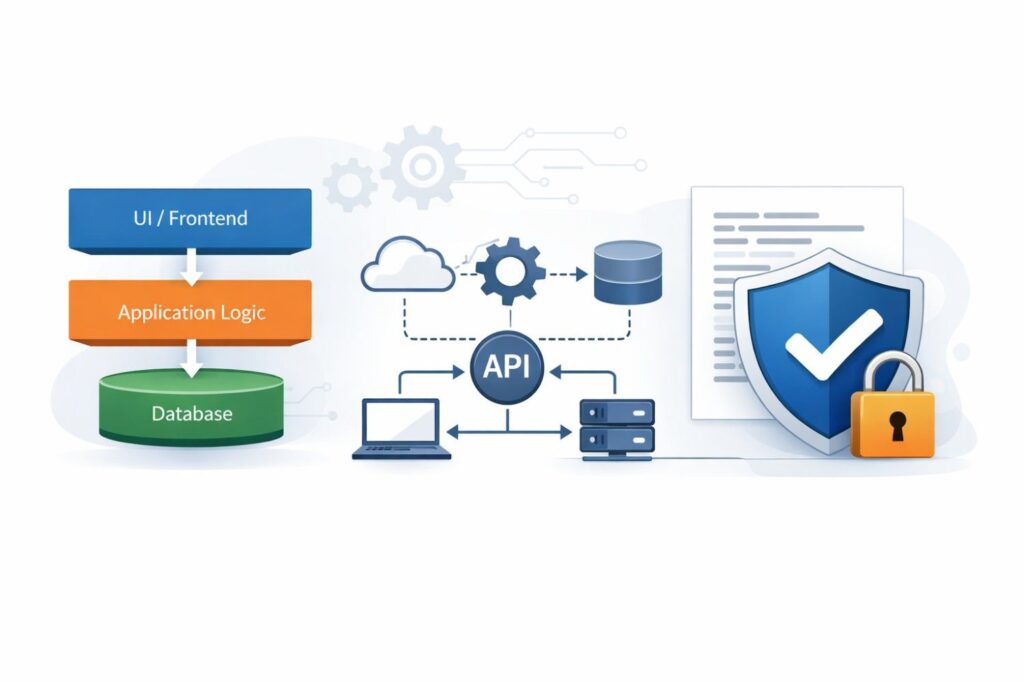
Software architecture is not about diagrams that look good in pitch decks. It is about how your system is shaped, how responsibility is divided, and how work moves through the product.
When architecture is described well in a patent, it becomes very hard for others to copy your system without leaving fingerprints. When it is described poorly, competitors can walk right around it.
This section is about writing architecture in a way that creates real protection. Not theoretical protection. Not language that sounds smart. Real protection that matches how your system actually works today and how it can evolve tomorrow.
Why Architecture Is the Core of Software Protection
Architecture is where intent meets execution. It shows how you chose to solve a problem, not just that you solved it.
Two teams can build products that look the same on the surface, but the internal structure can be very different. That internal structure is what matters in a patent.
A strong written description captures those choices. It explains why certain components exist, what each one is responsible for, and how they work together as a system.
This is what turns abstract ideas into something concrete and protectable.
When founders skip this or keep it too high level, the patent becomes weak. It might describe a result, but not the system that produces it. Courts and examiners care about systems, not outcomes.
Writing Architecture Like You Are Explaining It to a New Engineer
One of the most effective ways to describe architecture is to imagine onboarding a senior engineer who has never seen your code. You would not start with buzzwords.
You would start with the big picture, then walk through the major parts, and explain how they interact.
That same approach works for patents.
Start by describing the overall system as a whole. What kind of system is it. What problem does it exist to solve.
Then explain how the system is divided into parts that each have a clear role. Avoid naming technologies unless they matter. Focus on responsibility, not tools.
This approach keeps the description flexible. It protects the concept of the architecture, not just one implementation.
If you want to see how PowerPatent helps founders turn real systems into clear descriptions like this, you can see the process here: https://powerpatent.com/how-it-works.
Defining System Boundaries With Purpose
Every strong architecture has boundaries. These boundaries define what is inside the system and what is outside. In a patent, this is critical.
You need to explain where your system begins and ends. What does it control. What does it rely on. What does it ignore.
These boundaries help examiners understand what is new and help future enforcement by showing what others cannot copy without crossing into your protected space.
A practical way to do this is to describe inputs and outputs at the system level. What information comes in. What information goes out. Everything in between is your territory.
Separating Components by Responsibility, Not Code Files
Many founders make the mistake of mapping architecture directly to their code structure. That works for developers, but it is not ideal for patents.
Instead, describe components based on what they do, not where they live in the repo. A single component in a patent can cover multiple services, functions, or classes as long as they share a role.
This gives you broader protection and more room to change your implementation later without stepping outside your own patent.
For example, instead of describing a specific microservice, describe a processing component that performs a defined task. The key is to explain the task clearly and how it fits into the system.
Explaining Control Flow Without Getting Lost in Details
Architecture is not just about static parts. It is also about control. Who decides what happens next. Which component triggers which action. Where decisions are made.
A strong written description explains this flow of control at a conceptual level. It shows how the system responds to events, requests, or changes in data. It does not need to explain every edge case, but it should show the main path clearly.
This is especially important for systems that involve automation, optimization, or decision making. The location of control is often where the invention lives.
Showing How Architecture Solves a Real Problem
Architecture should always be tied back to a problem. Not in a sales way, but in a functional way.
Explain why the architecture is set up the way it is. What problem does this structure solve that simpler structures could not.
Maybe it improves speed. Maybe it allows scaling. Maybe it enables real-time responses. These explanations help show that the architecture is not arbitrary.
This also helps the patent survive scrutiny. When the structure is clearly linked to a technical benefit, it becomes much harder to dismiss as obvious.
Describing Variations Without Weakening the Core
One of the most strategic moves in a written description is explaining that the architecture can vary while still following the same core idea.
This is not about adding fluff. It is about acknowledging that components can be combined, separated, centralized, or distributed without changing the essence of the system.
By doing this, you protect not just what you built, but also reasonable future versions. This gives you room to grow without outgrowing your own patent.
PowerPatent focuses heavily on this concept. The goal is not to freeze your system in time, but to protect the direction you are going. You can learn more about how this is done here: https://powerpatent.com/how-it-works.
Avoiding Overly Abstract Architecture Language
There is a fine line between being flexible and being vague. Many software patents fail because the architecture is described in language that is too abstract to mean anything.
Words like module, engine, or platform are not enough on their own. Each component needs a clear function. What does it receive. What does it do. What does it produce.
This clarity does not limit you. It strengthens you. Clear descriptions are easier to enforce and harder to design around.
Mapping Architecture to Competitive Advantage
Your architecture is not just technical. It is strategic.
Some architectural choices give you speed. Others give you reliability. Others give you cost advantages. These advantages should be reflected in how you describe the system.
This does not mean adding marketing language. It means showing how the structure enables outcomes that others would struggle to achieve without copying you.
When done right, the patent becomes a mirror of your competitive moat.
Making Architecture Understandable to Non-Engineers
A patent examiner is smart, but they are not inside your product every day. Your architecture description needs to be readable by someone who understands software but does not know your domain.
This is why simple language matters. Short sentences. Clear cause and effect. No assumptions about prior knowledge.
If your architecture description feels easy to read, it is usually a good sign. Complexity should come from the system itself, not the words used to explain it.
Treating Architecture as a Living Asset
Finally, think of your architecture description as something that can evolve. The first version does not need to capture every future idea. It needs to capture the core structure that makes your system work.
As your product grows, you can file continuations that build on this foundation. This is only possible if the original description is solid.
That is why getting it right early matters so much.
PowerPatent is built to help founders do exactly this. You bring the real system.

We help turn it into a written description that actually protects you, without slowing you down or burying you in legal noise. If you are building something that matters, this is worth doing right. You can see how it works here: https://powerpatent.com/how-it-works.
Explaining Data Flow Without Diagrams or Legal Noise
Data flow is where software comes alive. Architecture shows the shape of the system, but data flow shows movement. It shows how information enters, changes, and exits.
In many software inventions, this movement is the invention. Yet most patents barely explain it, or they drown it in confusing language that hides the value.
This section explains how to describe data flow in a way that is clear, strong, and protective. The goal is not to document every variable. The goal is to explain how information behaves inside your system and why that behavior matters.
Why Data Flow Is Often the Most Valuable Part
In modern software, value rarely comes from storing data. It comes from transforming it. Reordering it. Filtering it. Enriching it. Combining it with other data. Making decisions based on it.
When you explain data flow well, you show exactly how your system creates value from raw input. This is often where competitors try to copy you, because results are easy to see but flows are harder to design.
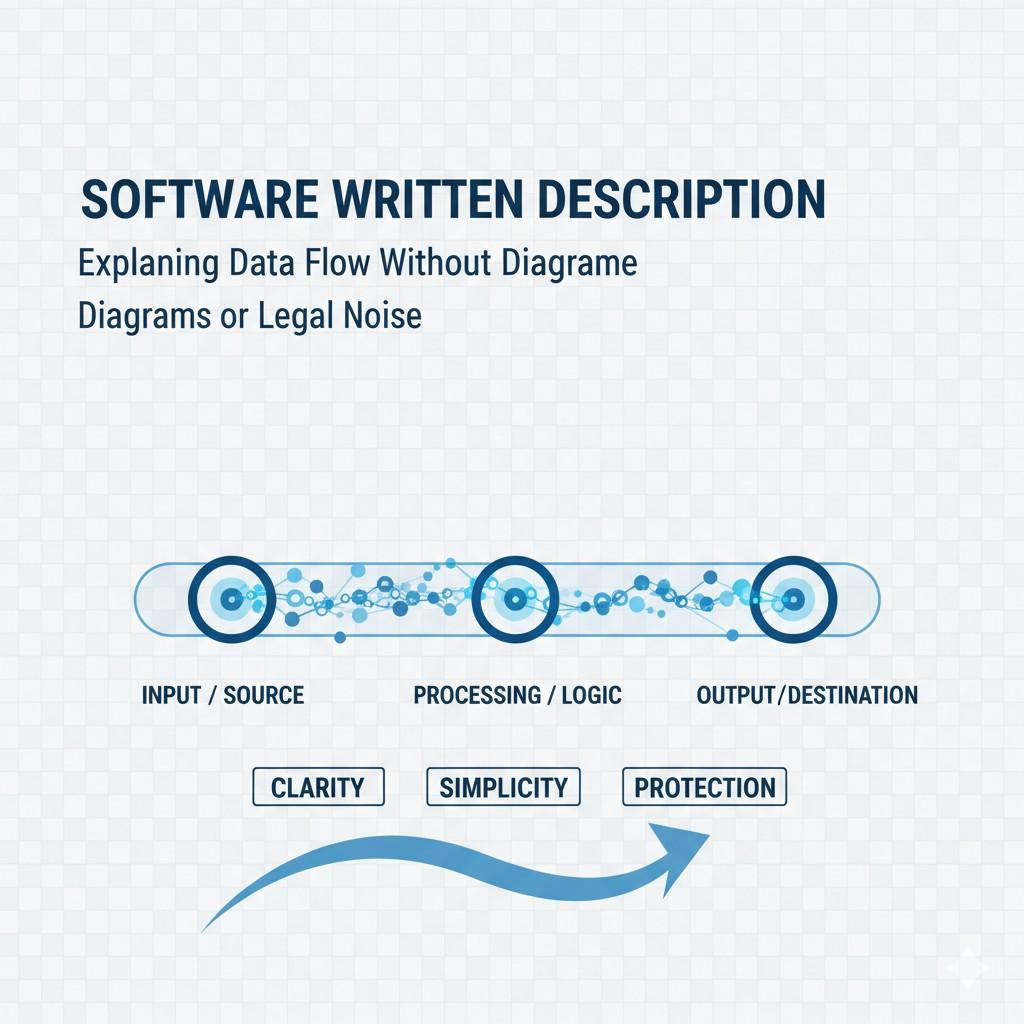
A good written description makes those flows visible and defensible.
Starting With the First Moment Data Touches the System
Every data flow has a beginning. That beginning matters.
You should explain how data first enters the system. Is it received from a user, another system, a sensor, or a stored source. Is it pushed in or pulled in. Is it raw or partially processed.
This starting point anchors the entire flow. It helps the reader understand context and sets the stage for what follows.
Avoid jumping straight into processing. Always ground the reader in where the data comes from and why it arrives in the first place.
Describing Transformation as a Sequence of Purposeful Steps
Data flow should feel like a story. One thing happens, then another, then another. Each step should have a reason.
You do not need to describe every internal operation. Focus on meaningful transformations. When data is validated, normalized, enriched, scored, ranked, or filtered, those moments matter.
Explain what changes and why. Not with math or code, but with plain words. This makes the flow understandable without making it shallow.
This approach also makes it easier to show novelty. If your system transforms data in a way others do not, that difference should be clear from the description alone.
Showing Where Decisions Are Made Using Data
Many software systems are valuable because they make decisions. These decisions might route data, trigger actions, or change system behavior.
It is important to explain where these decisions happen in the flow. Which component evaluates the data. What kind of criteria are applied. What happens as a result.
You do not need to reveal secret thresholds or exact rules. You do need to show that the system uses data in a structured way to control outcomes.
This is often a key point of protection, especially in systems involving automation or optimization.
Explaining Timing and Order Without Overcomplication
Order matters in data flow. So does timing.
Some systems process data in real time. Others batch it. Others mix both. These choices affect performance and behavior, and they should be explained.
Describe when processing occurs relative to data receipt. Describe whether steps happen sequentially or in parallel. Keep it simple, but be clear.
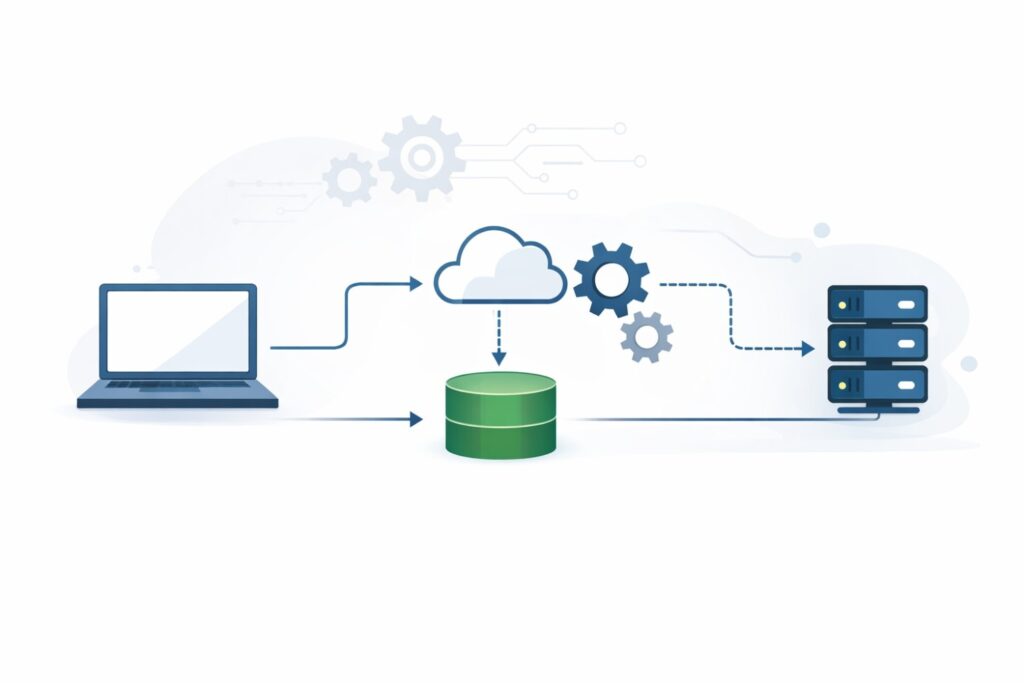
This helps distinguish your system from others that might use the same components but in a different order or timing.
Handling Feedback Loops in a Clear Way
Many advanced systems include feedback. Output becomes input. Results influence future processing.
These loops are often where the real invention lives, but they are also where descriptions get messy.
The key is to describe the loop at a high level. Explain that output data is fed back into the system, how it is used, and what effect it has on future behavior.
You do not need to trace infinite cycles. One clear explanation of the loop and its purpose is usually enough.
Explaining Data Flow Across Components
Data rarely stays in one place. It moves between components.
When describing this movement, focus on intent rather than transport. Explain why data is passed from one part of the system to another. What responsibility shifts when that happens.
This shows coordination. It shows that the system is more than isolated parts. It shows design.
Avoid turning this into a network diagram in words. Keep it human and logical.
Treating Data Types as Functional, Not Technical
Patents do not need schema definitions. They need understanding.
When you refer to data, describe it by what it represents and how it is used. User input. Context data. Configuration data. Result data.
This keeps the description flexible. It also helps non-specialists follow along.
If the nature of the data is critical to the invention, explain that nature in simple terms. What makes this data different. Why does it matter.
Showing How Data Flow Improves the System
Data flow should not feel neutral. It should feel purposeful.
Explain how the way data moves improves accuracy, speed, reliability, or adaptability. This does not require marketing language. It requires cause and effect.
For example, explain that processing data early reduces later load, or that delaying processing allows aggregation. These explanations help show technical benefit.
This strengthens the patent and makes the invention easier to understand.
Leaving Room for Change Without Losing Protection
Just like architecture, data flow can evolve. Your description should allow for that.
You can explain that steps may be added, removed, combined, or reordered while preserving the core behavior. This signals flexibility without vagueness.
This is especially important for startups. Your product today is not your product in two years. Your patent should grow with you.
PowerPatent is designed around this idea. The goal is to capture the real flow while leaving space for growth. If you want to see how this is done in practice, you can explore it here: https://powerpatent.com/how-it-works.
Making Data Flow Readable and Trustworthy
Finally, data flow descriptions should feel easy to read. If the reader feels lost, the protection weakens.
Use simple language. Short explanations. Clear transitions. Each paragraph should move the flow forward.
When done right, the reader should be able to explain your system back to someone else after reading it once. That is a strong signal that the description works.
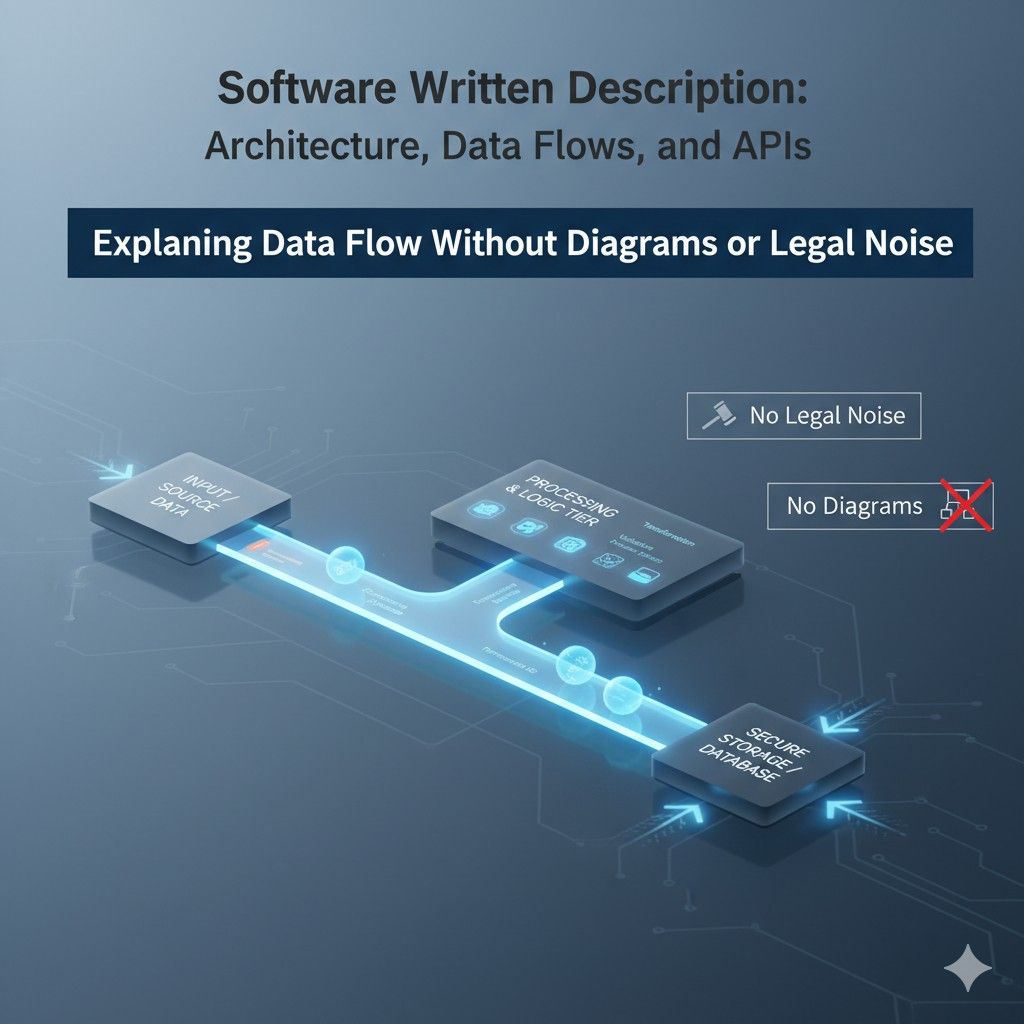
That clarity is not just for examiners. It is for future you, future investors, and future enforcement.
Writing APIs as Functional Connections, Not Endpoints
APIs are often treated as plumbing. Necessary, but uninteresting. In patents, they are either ignored or described in a way that adds no real protection. That is a missed opportunity.
An API is not just a door. It is a contract. It defines how parts of a system talk to each other and how outside systems are allowed to interact with yours.
When written well, APIs can anchor your patent to real system behavior and make it much harder for others to copy your approach without crossing your boundaries.
This section explains how to describe APIs in a way that strengthens protection without turning the patent into technical documentation.
Why APIs Matter More Than Most Founders Think
In modern software, APIs shape how systems are used. They decide what can be done, how easily it can be done, and in what order things happen.
Two systems can perform the same tasks, but if their APIs differ, they are fundamentally different products. That difference is valuable, and it should be protected.
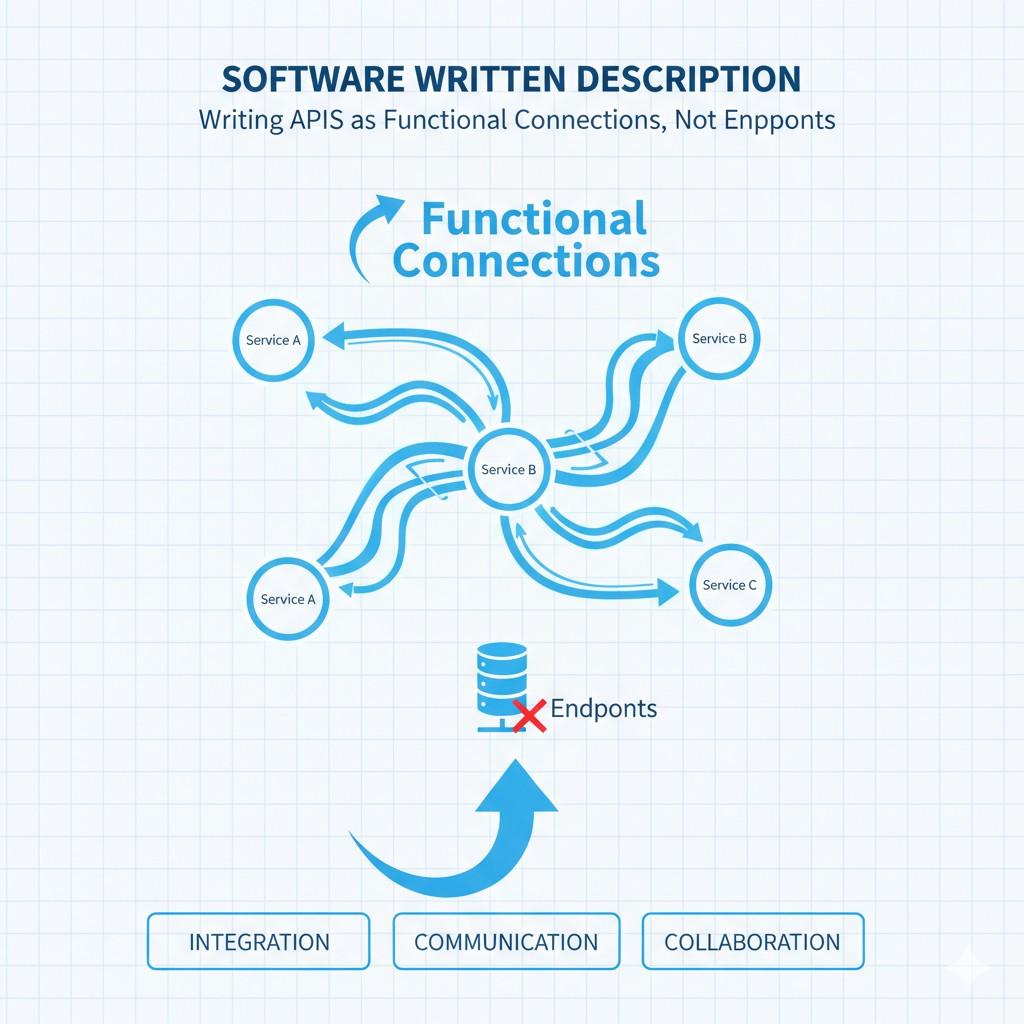
A strong written description treats APIs as part of the invention, not as an afterthought.
Describing the Purpose of an API Before Its Mechanics
The first mistake many patents make is jumping straight into mechanics. Requests. Responses. Formats.
Instead, start with purpose.
Explain why the API exists. What role it plays in the system. What kind of interaction it enables. This frames the rest of the description and helps the reader understand its importance.
When purpose is clear, the details that follow feel intentional, not arbitrary.
Framing APIs as Bridges Between Responsibilities
An API usually sits between two responsibilities. One part of the system provides a capability. Another part needs to use it.
Describe the API as that bridge. Explain what responsibility lives on each side and what is exchanged across the boundary.
This makes the API feel like a design choice, not just a technical necessity. Design choices are protectable.
Explaining Input and Output in Human Terms
You do not need to describe endpoints or payloads. You need to describe meaning.
Explain what kind of information is received through the API and what kind of result is produced. Describe it in terms of function, not format.
This keeps the description broad and future-proof. It also makes it easier to enforce, because it focuses on behavior rather than syntax.
Showing How APIs Control System Behavior
APIs do more than move data. They control when and how actions happen.
Explain how invoking an API triggers processing, changes system state, or causes downstream effects. This shows that the API is active, not passive.
In many systems, this control aspect is where the real invention lives.
Explaining Access and Constraints Without Legal Language
Some APIs are public. Some are internal. Some have limits.
You can describe these differences without using security jargon or legal terms. Explain who is allowed to use the API and under what conditions.
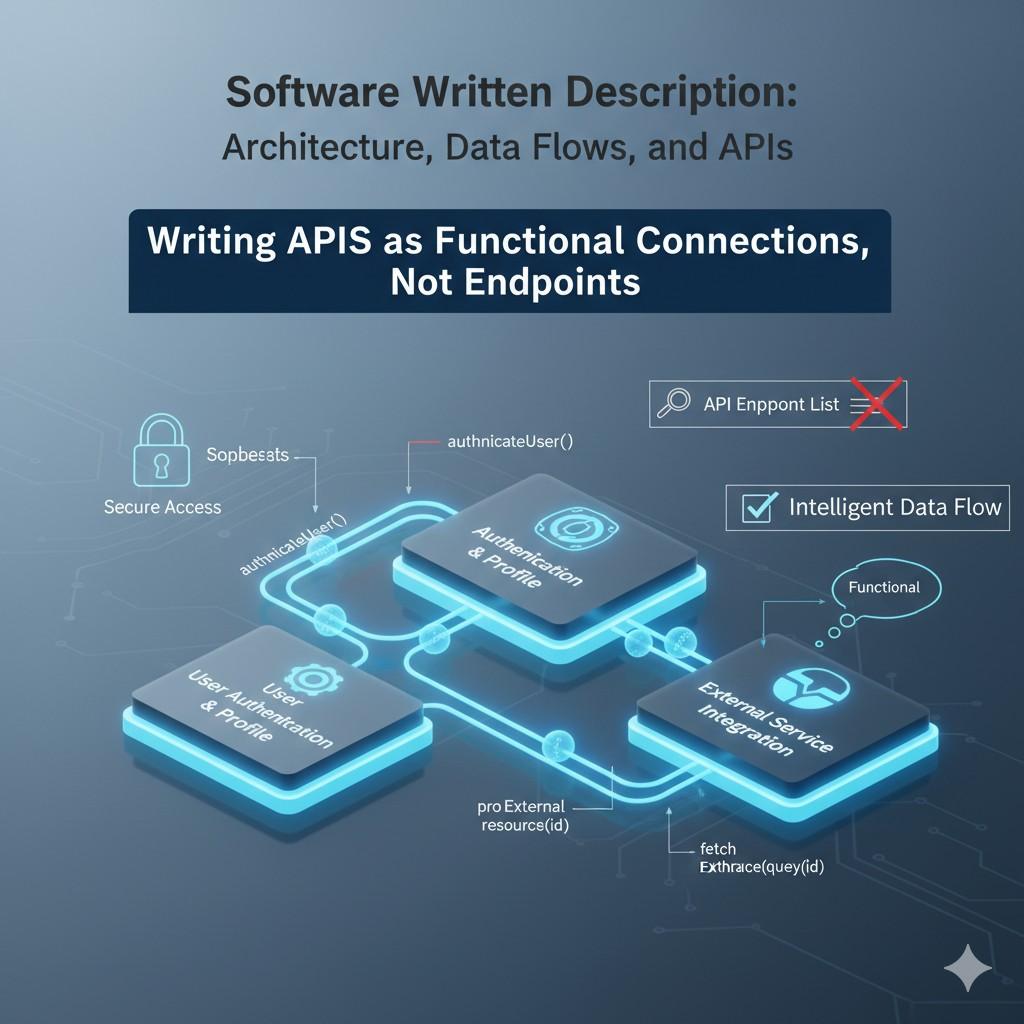
This helps define system boundaries and shows intentional design. It also supports protection against misuse or imitation.
Treating APIs as Stable Interfaces Over Changing Internals
One of the most important ideas to capture is that APIs often stay stable while internals change.
Describe the API as a consistent interface that hides complexity. This explains why the system is flexible and scalable.
It also protects the idea of separating interface from implementation, which is a powerful architectural choice.
Explaining Sequences of API Interactions
In many systems, value comes not from a single API call, but from a sequence.
Describe how multiple API interactions work together to achieve a result. Explain order and dependency in simple terms.
This helps protect workflows, not just individual actions.
Avoiding Over-Specification That Limits You Later
It is tempting to describe APIs in detail. Resist that urge.
Focus on what the API enables, not how it is coded. This keeps the patent aligned with the concept rather than a snapshot of the current implementation.
Overly specific descriptions can trap you. Broad, functional descriptions protect you.
Showing How APIs Enable Integration and Growth
Many businesses win because their system connects well with others.
Explain how APIs allow external systems to interact with yours in a controlled way. Show how this supports integration, automation, or expansion.
This ties technical design to business value without sounding like marketing.
PowerPatent helps founders capture this connection clearly and safely. If APIs are central to your product, this step is critical. You can see how we approach it here: https://powerpatent.com/how-it-works.
Making APIs Easy to Understand for Non-Builders
Just like architecture and data flow, API descriptions should be readable.
If a business person can understand what the API does after reading the description, you are on the right track. That clarity helps examiners and strengthens enforcement.
Complex systems do not require complex language.
Treating APIs as Part of the Invention, Not a Detail
Finally, treat APIs as first-class elements of your system.
They define how your system is used, extended, and protected. When you describe them as functional connections, you capture their real value.
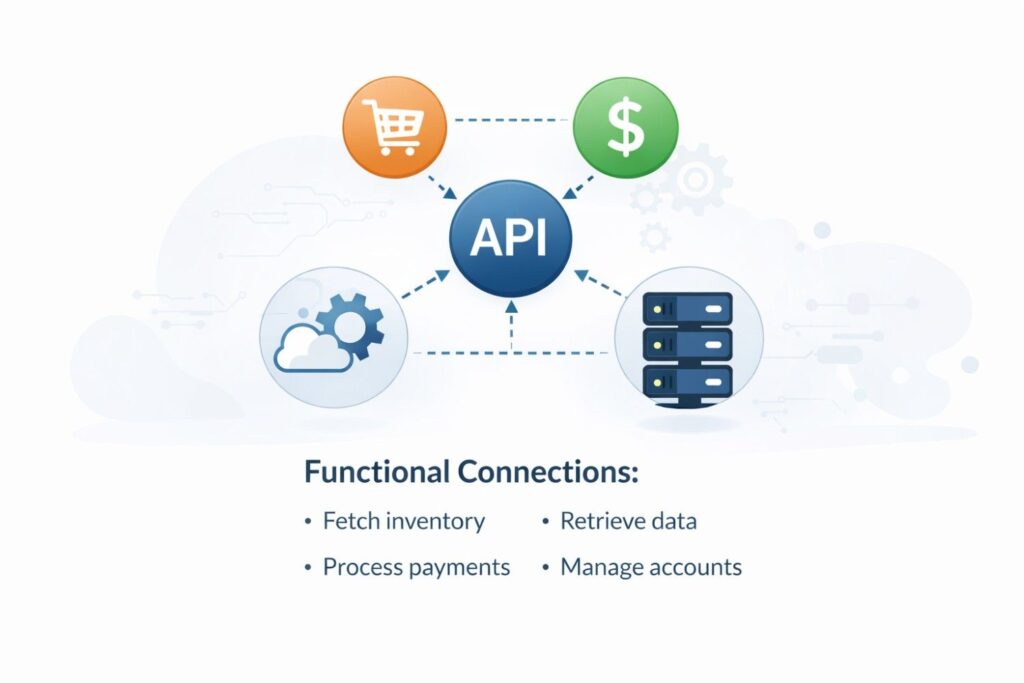
That is how APIs move from plumbing to protection.
Turning Real Systems Into Defensible Patent Descriptions
A patent should not feel like a translation of marketing copy. It should feel like a clear explanation of a real system.
When the written description matches how the product actually works, protection becomes natural. When it does not, everything becomes fragile.
This final section brings architecture, data flow, and APIs together. The goal is to show how to turn what you have already built into a description that holds up over time, even as the product changes.
Starting From the System You Actually Have
The strongest patents begin with honesty.
Instead of starting from what you wish the system did or what sounds impressive, start from what exists today. Real components. Real flows. Real interactions.
This does not limit you. It grounds you. Once the core is solid, you can expand around it safely.
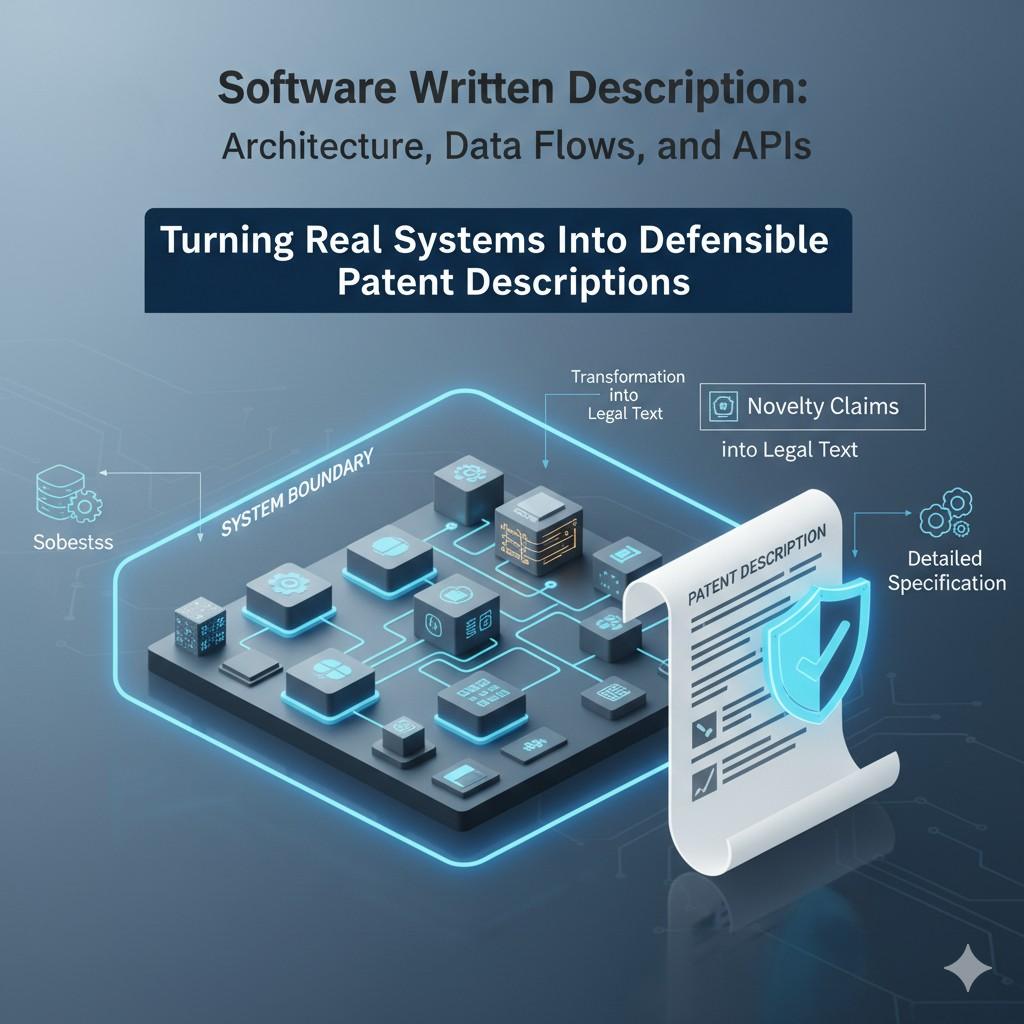
A written description based on reality is easier to defend because it reflects real engineering decisions.
Identifying the Non-Obvious Parts of Your System
Every system has boring parts and special parts.
The key is to identify what was hard to design. What took time to get right. What required tradeoffs. These areas often contain the invention.
Describe those parts clearly. Explain why they exist and how they interact with the rest of the system.
This shifts the focus from generic software behavior to your unique approach.
Explaining Tradeoffs as Intentional Design Choices
Many founders hide tradeoffs. In patents, that is a mistake.
Tradeoffs show intent. They show that the system was designed with purpose.
Explain why certain choices were made. Centralized versus distributed. Real time versus delayed. Automated versus manual triggers.
These explanations add depth and make the system harder to dismiss as obvious.
Connecting Technical Structure to Business Outcomes
A defensible patent links structure to effect.
Without selling, explain how the system’s design leads to specific outcomes. Faster responses. Better accuracy. Lower cost. Higher reliability.
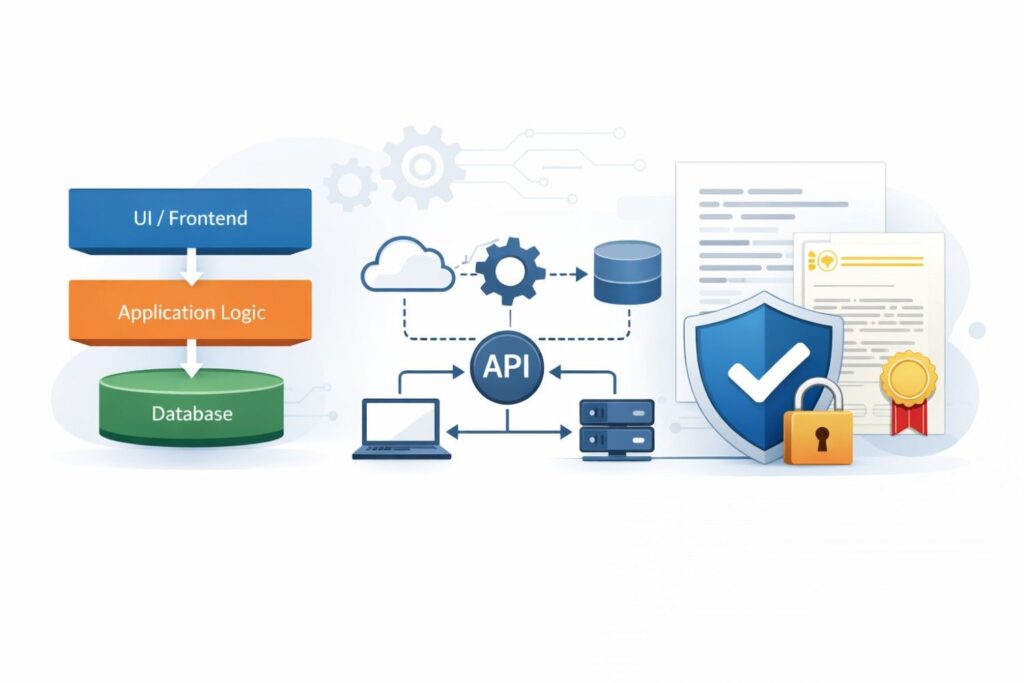
This helps the reader understand why the system matters. It also strengthens the technical story by showing cause and effect.
Avoiding the Trap of Over-Optimization
Some patents try to cover every possible variation. They end up covering nothing.
Focus on the core idea. Protect the heart of the system. Variations should support that core, not overwhelm it.
Clarity beats completeness every time.
Writing for the Future Without Guessing It
You do not need to predict the future to protect it.
Describe the system in a way that allows reasonable evolution. Use language that supports change without becoming vague.
This balance is what allows you to file continuations later without contradicting the original description.
Making the Description Internally Consistent
Consistency builds trust.
Terms should be used the same way throughout. Components should behave the same way each time they appear. Data should flow logically.
Inconsistencies weaken patents because they create confusion. Clear structure strengthens them.
Treating the Written Description as an Asset
A good written description is not just for filing. It becomes a reference point.
It helps onboard new engineers. It helps explain the system to investors. It helps guide future filings.
When written well, it saves time across the company.
Why Speed and Quality Do Not Have to Conflict
Many founders think strong patents take a long time. That is only true when the process is broken.
When you start from real systems and explain them clearly, speed increases. Decisions are easier. Rewrites are fewer.
This is where modern tools and real attorney oversight matter.
How PowerPatent Makes This Practical
PowerPatent is built around real systems, not theory.
We help founders capture architecture, data flow, and APIs in plain language that matches how they build. Our software keeps things organized. Our attorneys make sure nothing important is missed.
The result is a patent that feels like your product, not a legal document.
If you are building something worth protecting, this approach changes everything. You can learn exactly how it works here: https://powerpatent.com/how-it-works.
Closing Thought
Strong software patents are not about complexity. They are about clarity.
When your written description clearly explains how your system works, why it is structured that way, and how information moves through it, protection follows naturally.
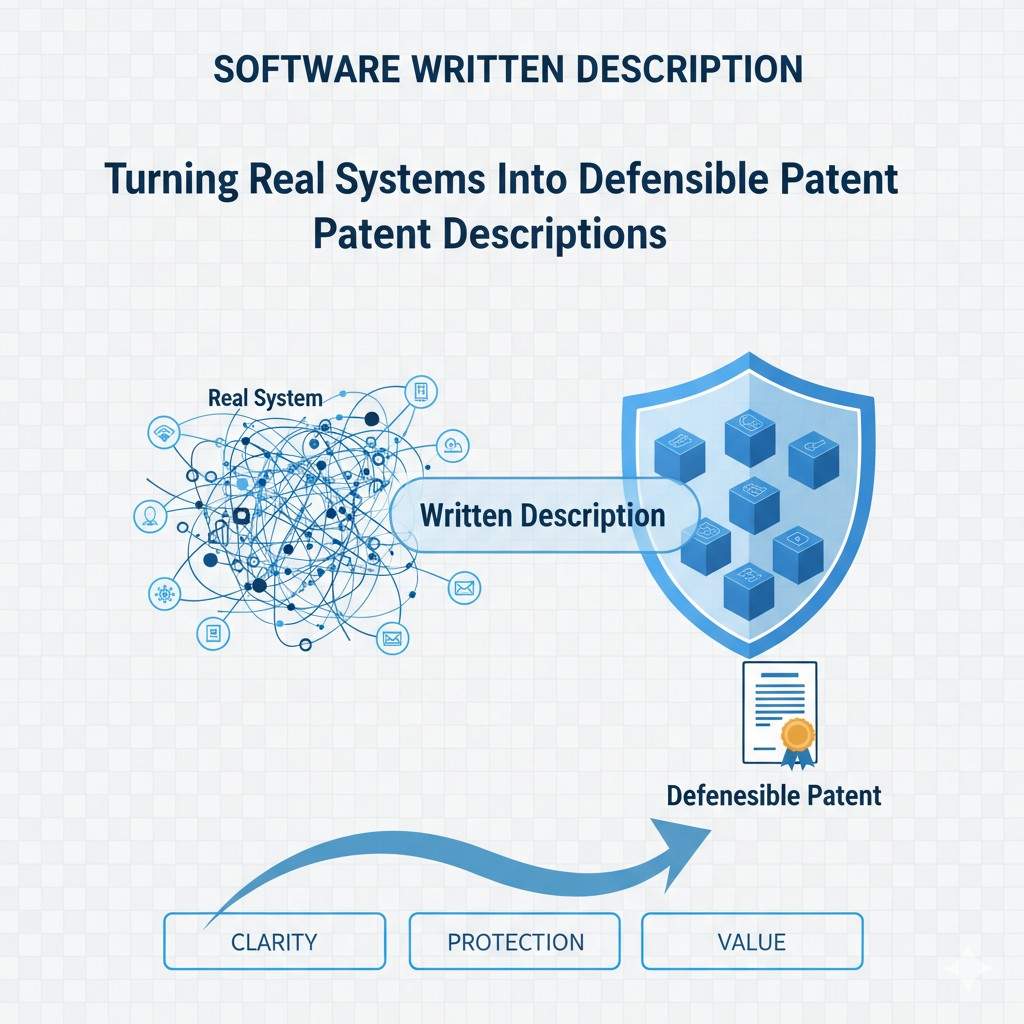
That clarity is achievable. It does not require slowing down. It requires explaining what you already know.
Wrapping It Up
Software patents do not fail because the technology is weak. They fail because the story is unclear. When architecture is described as a real structure, data flow is explained as purposeful movement, and APIs are written as functional connections, the patent stops feeling abstract. It starts to feel solid. It reflects how the system truly works, not how someone guessed it might work. The strongest written descriptions are simple, honest, and grounded in real engineering decisions. They do not rely on buzzwords. They do not hide behind vague language. They explain the system the same way a founder or engineer would explain it to someone they trust.
Leave a Reply