Great inventions do not fail because the tech is weak. They fail because the story is unclear. If an attorney cannot fully see what you built, how it works, and why it matters, your patent will be weak from day one. That is why your inventor questionnaire is not just a form. It is the foundation of your protection. In this guide, you will learn how to build an inventor questionnaire that attorneys actually use, respect, and rely on to write strong patents—without wasting your time or slowing down your startup.
If you want to see how modern founders turn their technical work into strong patents without the usual friction, you can explore how PowerPatent works here: https://powerpatent.com/how-it-works
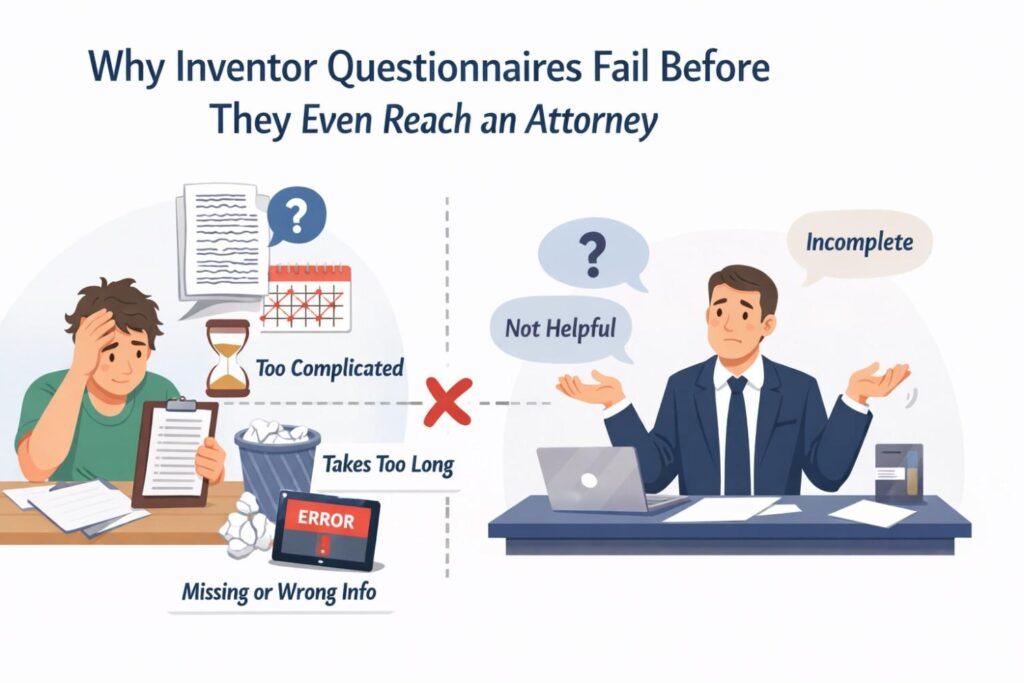
Why Most Inventor Questionnaires Fail Before They Even Reach an Attorney
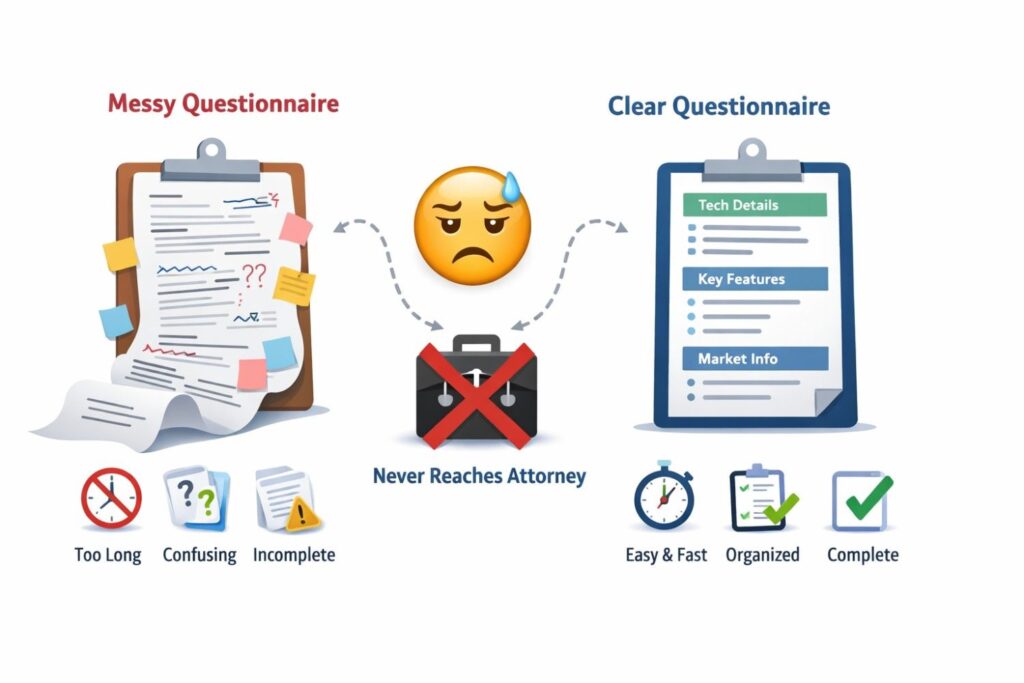
Most inventor questionnaires do not fail because founders are careless. They fail because they are built the wrong way from the start. They are either too shallow, too legal, too vague, or too long.
And when that happens, the attorney receives something that feels more like a school worksheet than a technical blueprint.
If your goal is strong protection, your questionnaire must act like a bridge between your mind and the attorney’s pen. If it does not translate your thinking clearly, your patent will be built on guesswork. And guesswork is expensive.
Let’s break down where most questionnaires go wrong and how to avoid those traps.
They Ask the Wrong First Questions
The first few questions shape everything that follows. If you start with generic prompts like “Describe your invention,” you will get a generic answer. That answer will usually be short, surface-level, and missing the details that matter most.
The opening section of your questionnaire should guide the inventor into a clear mindset. Instead of asking for a description, ask for the problem story. Ask what was broken before this invention existed.
Ask what people were doing that did not work well. Ask what pain or cost pushed the inventor to build something new.
When you frame the beginning around real-world problems, the inventor starts thinking in terms of value and difference. That is exactly how attorneys think when drafting claims.
If you do not capture this early, the rest of the document becomes flat.
A strong questionnaire feels like a guided interview, not a blank page.
They Focus on Features Instead of Function
Most founders love talking about features. They will say their system uses a neural network, a new sensor layout, or a faster data pipeline. That sounds impressive. But it does not tell the attorney what truly matters.
What matters is how the system works step by step.
If your questionnaire does not force the inventor to explain the flow of actions inside the system, you will miss the real protection points. Attorneys need to see the cause-and-effect chain.
They need to know what triggers what. They need to know how data moves, how decisions are made, and what changes in the physical or digital world as a result.
A smart questionnaire guides the inventor to walk through the invention as if they are explaining it to a junior engineer. Not in legal words. Not in marketing talk. Just clear steps.
If you want stronger patents, build sections that ask, “What happens first?” Then, “What happens next?” And keep going until the full picture appears.
They Do Not Separate the Core From the Extras
One of the biggest mistakes is mixing the main invention with optional improvements. When everything is blended together, it becomes hard for the attorney to see what the true core is.
Your questionnaire should gently force clarity here.
There should be a clear space where the inventor explains the simplest version that still works. The base version. The minimum structure that solves the problem.
Then there should be room to describe variations. Different ways to implement it. Different materials, algorithms, layouts, or settings.
When you separate these, you give the attorney room to draft broad protection around the core and add layers of coverage for the improvements. Without this structure, you risk shrinking your protection without even knowing it.
This small change in how you ask questions can dramatically change the strength of the final patent.
They Ignore Real-World Use
Many questionnaires stay inside the lab. They focus on theory and skip the real-world environment where the invention operates.
Attorneys need context. They need to understand how users interact with the invention. They need to see what devices, systems, or environments surround it. They need to know what happens when something goes wrong.
If your questionnaire does not ask about usage scenarios, edge cases, and failure conditions, you are leaving valuable protection on the table.
Encourage inventors to describe how a real person or system uses the invention from start to finish. Ask them to imagine a normal day of operation. Ask what happens when inputs are messy or conditions are not ideal.
These details often reveal hidden invention points that would otherwise never make it into the patent.
They Overuse Legal Language
Some companies try to sound “official” in their questionnaires. They use formal legal terms and stiff language. The result is that inventors feel unsure or restricted. They start answering cautiously. They write less.
Your questionnaire should feel like a technical workshop, not a courtroom.
Use plain language. Keep the tone calm and direct. Make it clear that rough answers are fine. Diagrams are welcome. Bullet sketches are allowed.
When inventors feel safe explaining things in their own words, they give you richer information. That raw material is far more valuable than polished but thin answers.
They Treat It Like a One-Time Form
A questionnaire should not be a one-time dump of information. It should be part of a process.
If founders think they must get everything perfect in one sitting, they rush. They skip parts. They avoid deeper thinking.
Instead, design your questionnaire in stages. The first pass gathers the story and high-level structure. The second pass digs into technical depth. The third pass explores variations and future versions.
Even if you do not label it this way, structure your questions so that thinking builds over time. This approach leads to better answers and fewer gaps.
At PowerPatent, this layered approach is built into the system.
Founders are guided step by step, and real patent attorneys review the output to make sure nothing critical is missing. If you want to see how that works in practice, you can explore it here: https://powerpatent.com/how-it-works
They Do Not Capture What Makes It Hard to Copy
A weak questionnaire gathers descriptions. A strong one uncovers barriers.
Ask inventors what makes their solution hard to replicate. Is it a specific data training method? A special calibration step? A sequence of operations that must happen in a precise order?
Often, founders assume certain technical steps are obvious. They skip them. But those “obvious” steps may be exactly what competitors would struggle to reverse engineer.
Your questionnaire should probe gently for these hidden advantages. Ask what took the longest to figure out. Ask what failed before it worked. Ask what design trade-offs were made.
These answers often lead to strong protective language in the final patent.
They Ignore Future Roadmaps
Another common failure is focusing only on the current version. Startups move fast. Today’s version will change in six months.
If your questionnaire does not ask about planned upgrades or future directions, you risk filing protection that becomes outdated quickly.
Encourage inventors to think forward. What features are planned but not yet built? What integrations are being explored? What performance goals are on the roadmap?
Even if some of these ideas are early, they can often be included in a way that expands protection.
This is not about filing fantasy ideas. It is about capturing realistic evolution before competitors move into that space.
They Fail to Connect the Tech to Business Strategy
A patent is not just a technical document. It is a business tool.
Most questionnaires never ask how the invention fits into the company’s larger plan. Is it the core product? A supporting system? A key part of a platform strategy?
When attorneys understand the business role, they can shape the claims to match real value.
Add questions that explore where revenue will come from. Ask which parts of the system drive customer adoption. Ask which features competitors care about most.
These insights guide smarter drafting decisions. Protection becomes aligned with growth, not just engineering.
They Do Not Create Alignment Before Attorney Review
If multiple inventors are involved, misalignment is common. Each person may describe the invention differently. If the questionnaire does not include a review step where inventors align on key concepts, the attorney receives mixed signals.
Build in a simple internal review before submission. Encourage inventors to read each other’s answers. Clarify terms. Agree on naming conventions for parts and steps.
This small effort prevents confusion later and reduces costly back-and-forth with legal counsel.
Strong patents begin with shared understanding.
When your questionnaire is structured to guide thinking, surface hidden value, and connect technical detail to business goals, attorneys will actually use it. They will rely on it. And they will draft with more confidence and clarity.
If you want a system that already solves many of these problems and pairs smart software with real attorney oversight, take a look at how PowerPatent helps founders build stronger patents without slowing down: https://powerpatent.com/how-it-works
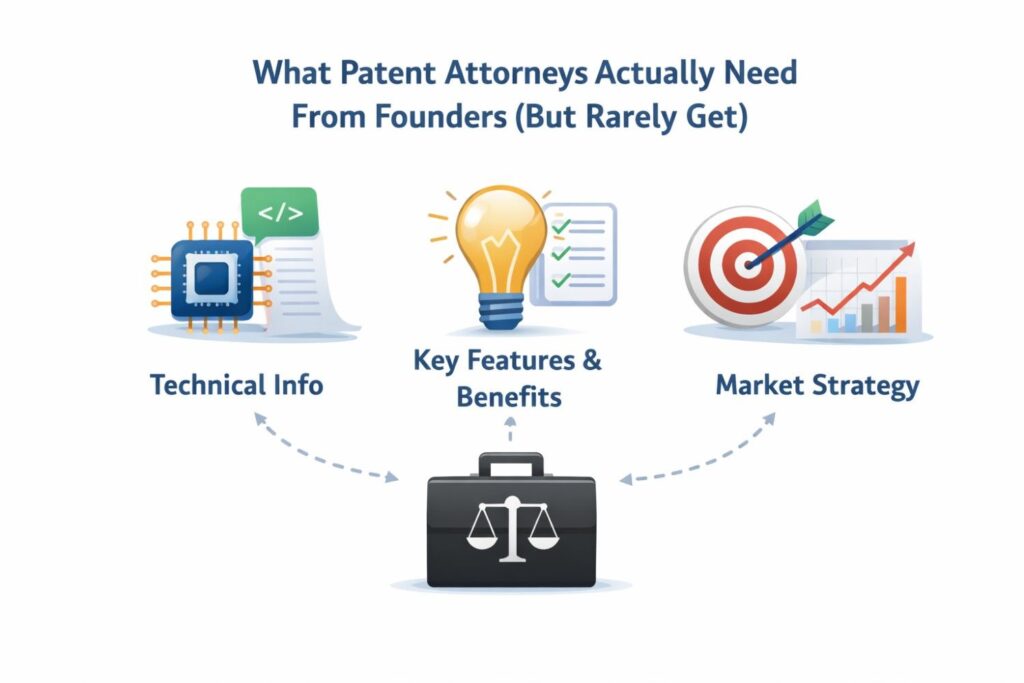
What Patent Attorneys Actually Need From Founders (But Rarely Get)
Most founders think attorneys want a polished summary. A clean pitch. A neat slide deck version of the invention. That is almost never what helps most.
What attorneys truly need is depth. They need clarity. They need to understand not just what you built, but how it works at a level where they could almost rebuild it themselves.
The problem is this: founders live inside their product every day. They see the moving parts clearly in their own heads. But when they explain it, they skip steps. They jump ahead.
They assume too much. And those gaps are where patents become weak.
If you want an attorney to write strong protection, you must give them the raw material that allows them to think strategically. Let’s walk through what that really means.
They Need the Engineering Logic, Not the Marketing Story
A pitch deck is built to impress investors. A patent is built to block competitors.
Those are two very different goals.
Attorneys do not need headlines about how your product is faster, smarter, or more scalable. They need to understand the exact mechanism that creates that advantage.
What design choice makes it faster? What system change makes it more reliable? What structure makes it possible at all?
When founders send high-level summaries, attorneys are forced to guess at the deeper logic. Guessing leads to narrow claims or missed opportunities.
If you want your questionnaire to be useful, it must guide founders to explain the internal reasoning behind design decisions. Why was this architecture chosen?
Why does the process follow this order? Why is this parameter set in a specific range?
That reasoning is often where true invention lives.
They Need Clear Definitions of Terms
One silent problem that weakens many patents is unclear language.
Engineers use shorthand all the time. They say things like “the controller processes the data” or “the model optimizes the output.” But what does that really mean in this specific invention?
Attorneys need terms that are stable and consistent. If a system component is called a “node” in one section and a “module” in another, confusion begins. If a step is described loosely without a clear boundary, it becomes harder to protect.
Your questionnaire should push inventors to define key terms in simple, concrete ways. Not in legal language. Just in clear descriptions.
What exactly is the “controller” in this invention? Is it software, hardware, or both? Where does it sit in the system? What inputs does it receive? What outputs does it produce?
These details make drafting stronger and reduce the risk of ambiguity later.
They Need to See the Full System, Not Just the New Part
Founders often focus only on what they believe is new. They describe the clever piece and skip the surrounding system.
But attorneys need context.
They need to see how the new part interacts with the old parts. They need to understand what existed before and how the new component changes the overall flow.
Without system-level context, it becomes harder to draft claims that capture real-world use. Protection must match how competitors would actually build a similar solution.
Your questionnaire should create space for a system map in words. How does data enter? Where is it stored? How is it processed? How does it leave? Who or what interacts with it along the way?
Even if some parts are standard, they must be described enough to create a full picture.
They Need Examples, Not Just Abstract Ideas
An abstract explanation may sound elegant, but it often lacks the detail needed for strong claims.
Attorneys benefit greatly from concrete examples. A real use case. A specific configuration. A sample workflow.
When founders provide at least one fully worked example, attorneys can draft with more confidence. They can anchor broader language around something solid.
Your questionnaire should encourage inventors to walk through a specific scenario. Not just “the system can handle data,” but “here is what happens when user A uploads file B under condition C.”
Examples reveal edge cases, hidden steps, and assumptions that might otherwise stay buried.
They Need to Understand What Is Truly New
This may sound obvious, but it is one of the biggest blind spots.
Founders sometimes struggle to separate what is standard from what is inventive. In fast-moving fields like AI or software, it is easy to assume everything feels new.
Or the opposite happens. Founders assume their approach is obvious because they have lived with it for months.
Attorneys need founders to clearly articulate what they believe is different from known methods. Even if that belief turns out to need refinement, it gives a starting point.
Your questionnaire should ask founders to compare their invention to what existed before. What methods were common? What limitations did they have? What trade-offs were unavoidable until now?

This contrast is critical. It shapes how the patent is positioned and how broad protection can be.
They Need Alternative Ways the Invention Could Be Built
A patent should not protect only one narrow implementation.
Attorneys need to see variations. Different ways the same core idea could be realized. Different hardware setups. Different software flows. Different data types.
Founders rarely volunteer this information unless prompted.
Your questionnaire should ask, in simple terms, how else this could be done. If the current version uses a specific algorithm, could a different class of algorithms work?
If a sensor is placed in one location, could it be placed elsewhere?
These variations expand the scope of protection. They make it harder for competitors to design around the patent.
They Need to Know What You Have Not Solved Yet
This might feel uncomfortable, but it is valuable.
If there are technical limits or known weaknesses, attorneys should understand them. Not to expose them, but to draft around them.
For example, if a system works best under certain conditions, that boundary may define where the strongest protection lies. If there are performance constraints, those may suggest additional claims focused on specific ranges or thresholds.
Your questionnaire should invite honesty about current limits. This is not about showing weakness. It is about building smarter coverage.
They Need Alignment Between Co-Inventors
When multiple founders contribute, differences in explanation can create subtle conflicts.
One person may describe the invention as a hardware innovation. Another may see it as primarily software-driven. These perspectives shape how the attorney drafts.
Before information reaches the attorney, your questionnaire process should encourage internal discussion. Founders should align on what the invention truly is at its core.
This alignment reduces revision cycles and improves clarity in the first draft.
They Need Business Context Without Hype
Attorneys are not marketers, but they are strategic thinkers.
They benefit from understanding how the invention fits into your company’s growth plan. Is this the heart of your product? A defensive feature? A long-term platform play?
This context helps shape claim strategy. It guides decisions about where to aim broad coverage and where to focus on specific embodiments.
Your questionnaire should gently connect technical answers to business goals. Not in a sales tone. Just clear intent.
If this invention is central to your valuation, the attorney should know that. If it is a supporting tool, that matters too.
They Need Time-Ordered Development Insight
One of the most overlooked sources of strength in patent drafting is the development journey.
What experiments were run? What failed before success? What key breakthrough changed the direction?
When founders explain the path they took, attorneys often spot additional invention points that were not obvious at first glance.
Your questionnaire can include a narrative section where inventors describe how the idea evolved. This story is not fluff. It often reveals technical turning points that deserve protection.
At PowerPatent, this depth is captured through guided prompts and reviewed by real patent attorneys who know how to extract strategic value from technical answers.
The goal is not to create paperwork. The goal is to create strong, defensible assets that support your startup’s growth. You can see how that process works here: https://powerpatent.com/how-it-works
When founders understand what attorneys truly need, the quality of patent drafting improves dramatically. Fewer revisions. Fewer gaps. Stronger claims. More confidence.
How to Design a Questionnaire That Pulls Out the Right Technical Detail
If you ask shallow questions, you get shallow patents.
That is the hard truth.
The quality of a patent does not begin with the attorney. It begins with the structure of the questions you ask the inventor. A well-designed questionnaire acts like a quiet engineer in the room.
It knows where to dig. It knows when to slow down. It knows how to turn scattered thoughts into a clean technical map.
If your goal is strong protection, your questionnaire must do more than collect information. It must guide thinking.
Let’s walk through how to design one that actually pulls out the right technical detail instead of surface-level answers.
Start With a Guided Story, Not a Blank Box
When you place a large empty text field under the words “Describe your invention,” you create pressure. Most inventors respond with short summaries because they do not know where to begin.
A better design approach is to lead them through the story in stages.
Begin with the problem in real-world terms. Then move into how existing solutions behave. Then ask what changed with this invention. This sequence warms up the inventor’s thinking and brings clarity to the technical shift.
The goal is to move from pain to mechanism, not from hype to abstraction.
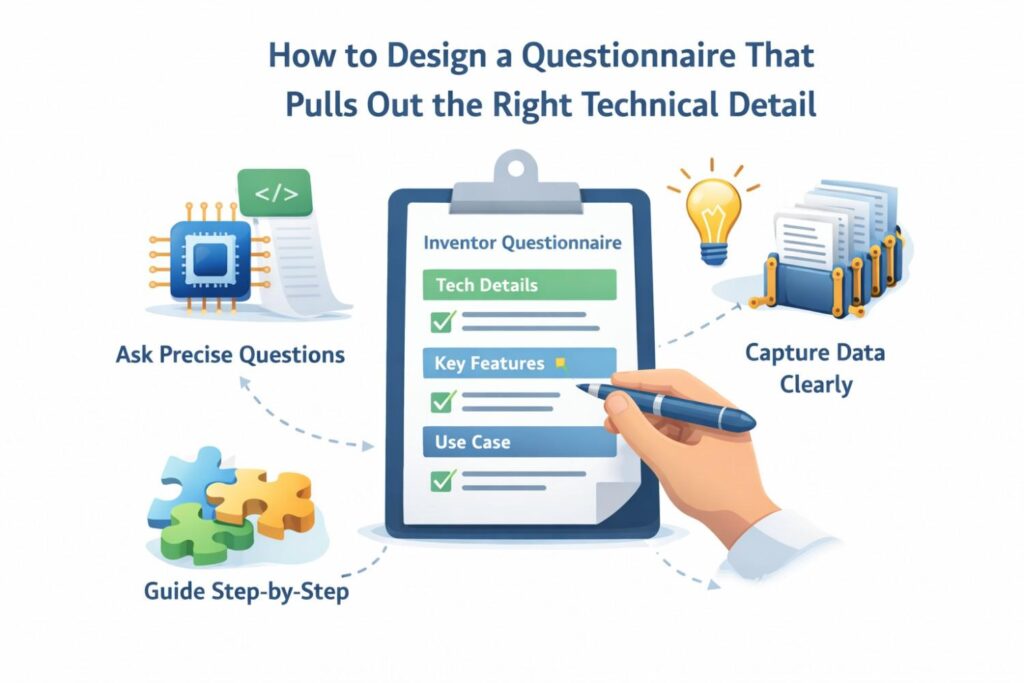
When the inventor feels guided instead of tested, they give richer answers.
Break the System Into Clear Zones
Strong patents depend on structure. Your questionnaire should mirror that.
Instead of asking about the invention as one block, divide it into functional zones. For example, input, processing, storage, output, and control logic. Even if the invention is mechanical, you can break it into stages of operation or physical components.
Then ask the inventor to describe each zone separately.
What enters this zone?
What happens inside it?
What leaves it?
What conditions affect it?
This structure forces clarity. It prevents vague explanations like “the system optimizes data.” Instead, it pulls out the exact operations that occur inside each part.
Attorneys can draft much stronger claims when the invention is explained in modular form.
Force Step-by-Step Thinking
Many technical founders think in patterns, not sequences. They see the system as a whole. But patents often need step-by-step clarity.
Your questionnaire should include a section that walks through the invention in order of operation.
Ask the inventor to imagine the system turning on for the first time. What is the very first action that occurs? What triggers it? What happens immediately after? What signals or changes move the process forward?
Encourage them to slow down and avoid skipping.
This is where hidden invention often lives. Small ordering decisions. Conditional steps. Feedback loops. These details rarely appear in high-level summaries but can become key claim elements.
Ask “Why” More Than Once
Most questionnaires ask what the invention does. Few ask why it is structured that way.
That is a missed opportunity.
After each major technical explanation, include a follow-up prompt that asks why that choice was made. Why this architecture? Why this material? Why this algorithm instead of another?
The answer often reveals constraints, trade-offs, or performance gains. Those are powerful anchors for patent claims.
When inventors reflect on design reasoning, they expose deeper logic. Attorneys can use that logic to draft broader protection.
Separate Core Mechanics From Performance Metrics
Inventors often mix how something works with how well it works.
Your questionnaire should separate these.
First, capture the mechanism. The structural steps. The relationships between parts. The technical flow.
Then, in a different section, capture performance metrics. Speed, accuracy, power savings, bandwidth reduction, or other measurable gains.
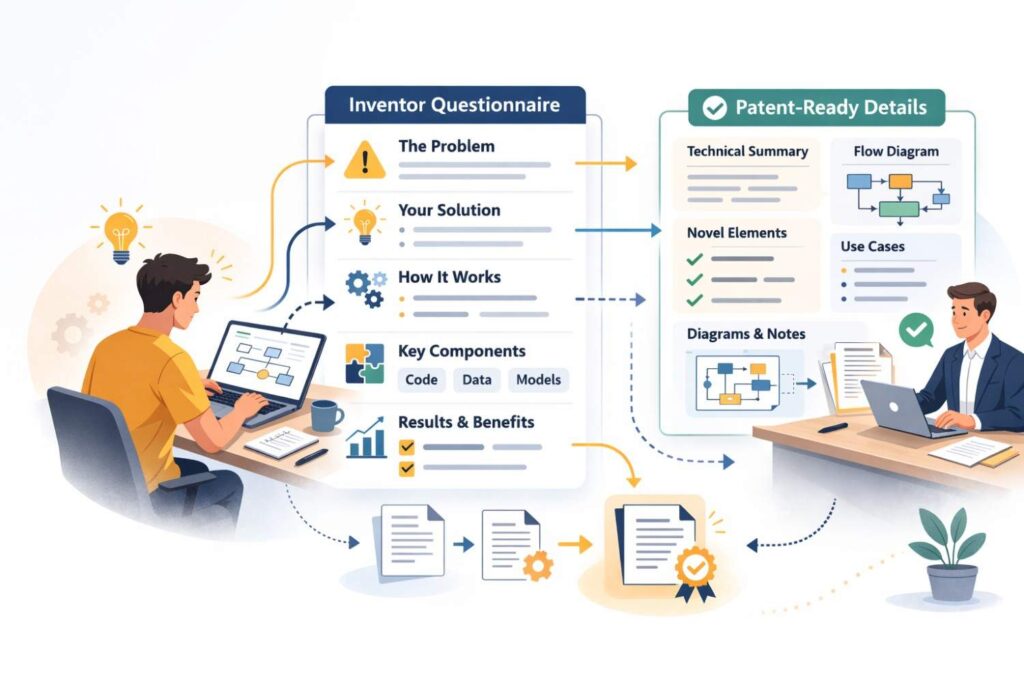
This separation prevents the core invention from being buried under numbers. It also gives attorneys flexibility. They can write claims that focus on structure and use performance data to support arguments if needed.
Clear structure leads to stronger drafting.
Pull Out Edge Cases and Failure Modes
Most questionnaires only explore ideal conditions. That creates risk.
Competitors often attack patents by pointing to edge scenarios that were not described. If the patent does not show that the inventor understood and accounted for these cases, the protection may feel narrow.
Design your questionnaire to include real-world friction.
Ask what happens if inputs are incomplete. Ask what happens if network latency spikes. Ask what happens if a sensor misreads. Ask how the system recovers or adapts.
These answers show depth. They demonstrate that the invention is not fragile. They also reveal additional inventive features that might deserve independent protection.
Create Space for Variations
If your questionnaire only captures the current implementation, you limit future protection.
After the main technical explanation, include a section that invites alternatives.
Could this process be done in a different order?
Could a hardware component be replaced with software?
Could different data structures achieve the same result?
Encourage open thinking here. Make it clear that these do not need to be fully built versions. They just need to be realistic alternatives.
Attorneys use these variations to draft broader language. This makes it harder for competitors to copy the core idea while making small tweaks.
Capture the Development Journey
One powerful way to pull out detail is to ask how the invention evolved.
What was the first rough version? What failed? What unexpected issue forced a redesign? What breakthrough unlocked the final structure?
When inventors revisit the journey, they often uncover technical decisions that felt small at the time but were critical.
These insights can shape dependent claims or even additional filings.
A questionnaire that ignores the development path misses this hidden gold.
Design for Diagrams and Visual Thinking
Some inventors think best visually. If your questionnaire is text-only, you may lose clarity.
Encourage simple diagrams. Block sketches. Flow charts. Even hand-drawn images. Provide prompts that say, “If helpful, attach a diagram showing component relationships.”
Attorneys do not need polished graphics. They need clarity.
When combined with written explanations, visuals reduce misunderstanding and speed up drafting.
At PowerPatent, founders are guided through structured prompts that capture both written and visual insight, and real patent attorneys review the material to ensure technical strength before filing.
The system is built to draw out depth without slowing down your build cycle. You can see how that works here: https://powerpatent.com/how-it-works
Build in Internal Review Before Submission
Before the questionnaire reaches an attorney, it should pass through one internal check.
Encourage inventors to re-read their answers a day later. Fresh eyes often catch vague phrases or skipped steps.
If multiple team members are involved, let them challenge each other’s explanations. Ask simple questions like, “Could someone outside this team understand this?” or “Did we explain why this step exists?”
This light review process increases clarity without adding friction.
Design for Clarity, Not Volume
A longer questionnaire does not mean a stronger patent.
Your goal is precision.
Every section should have a purpose. Every prompt should unlock specific technical detail. Remove questions that only produce filler language.
When inventors feel that each question is thoughtful and necessary, they respond with care.
A strong questionnaire is focused. It feels intentional. It respects the inventor’s time while pulling out exactly what attorneys need to draft high-quality protection.
If you are building this process from scratch, take your time. Review past patents in your field. Notice what details are consistently described. Reverse engineer your questionnaire around those patterns.
Or, if you prefer a system that already combines smart prompts with real attorney oversight, explore how PowerPatent helps founders capture the right technical detail without guesswork: https://powerpatent.com/how-it-works
Turning Raw Answers Into a Patent Strategy That Protects Your Startup
Collecting strong technical answers is only half the job. The real leverage appears when those answers are shaped into a smart protection plan.
This is where many startups lose power.
They gather detailed responses. They send them to an attorney. A patent gets drafted. It gets filed. And everyone moves on.
But filing is not the same as building a strategy.
A patent is not just a document. It is a shield around the parts of your company that matter most. If raw answers are not shaped with intent, you may protect the wrong layer of your technology while leaving the true engine exposed.
Let’s talk about how to turn technical detail into real protection that supports growth, funding, and long-term control.
Move From Description to Positioning
Raw answers describe what your system does. Strategy decides what angle to protect.
There are often multiple ways to frame the same invention. You could protect it as a system. As a method. As a device. As a process carried out by software. Each angle creates a different wall around your work.
The first strategic step is identifying which framing gives you the strongest advantage in the real market.
Ask yourself where competitors are most likely to copy you. Are they likely to rebuild your full system?
Or just mimic your workflow inside their own product? Are they likely to copy your hardware layout? Or re-create your algorithm in a different stack?
Your raw answers should be reviewed with this in mind.
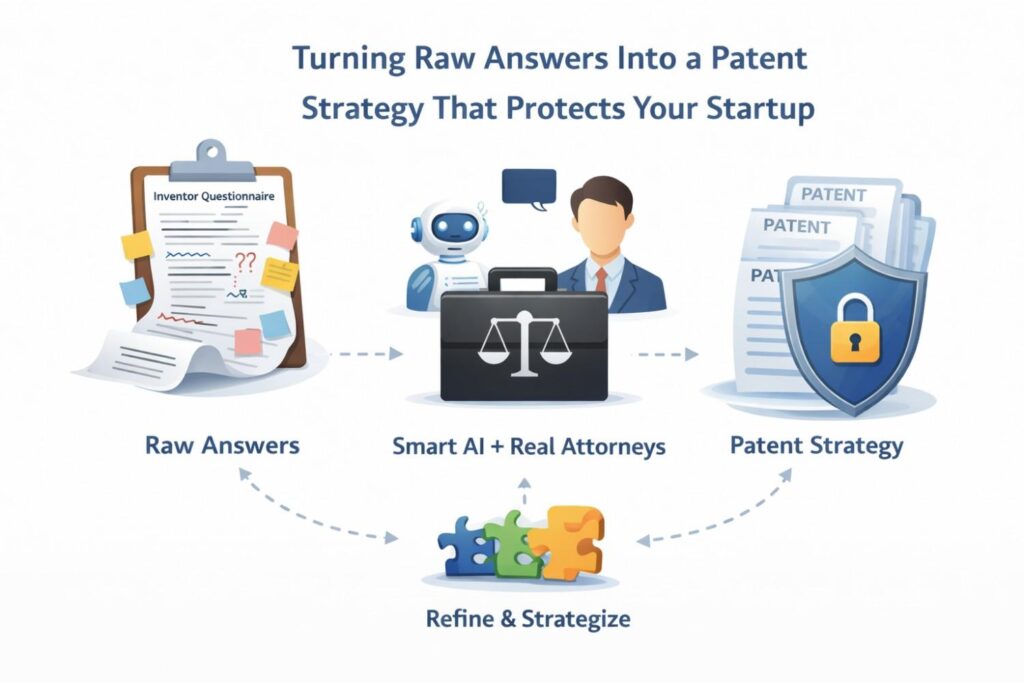
The goal is not just to capture what you built. The goal is to claim the space competitors must enter if they want to compete.
That shift in thinking changes everything.
Identify the Control Points in Your Technology
Every strong startup has control points. These are the technical choke points that drive performance or value.
It may be a specific data transformation. A unique training pipeline. A calibration sequence. A sensor placement. A feedback loop. A system architecture decision that unlocks speed or cost savings.
Raw questionnaires often bury these inside long explanations.
Strategy pulls them to the surface.
Once you identify these control points, you can build claims around them. You can layer protection so that even if a competitor tries to adjust small details, they still cross into your territory.
This is where attorney oversight becomes critical. You need someone who understands how to translate a control point into broad but defensible language.
At PowerPatent, this translation is part of the process. Smart software organizes your answers, and real patent attorneys review them to identify exactly where the strongest leverage sits.
You can see how that works here: https://powerpatent.com/how-it-works
Align Patent Scope With Business Direction
Your startup is not static. It is moving.
If your patent only protects the current version of your product, you risk falling behind your own roadmap.
Raw answers should be reviewed alongside your growth plan.
If you plan to expand into new markets, integrate with new platforms, or license your technology, your patent strategy should anticipate that.
For example, if your invention today operates in one industry but could easily adapt to another, the patent should not be locked into narrow language that limits its reach.
This does not mean claiming unrealistic territory. It means protecting logical extensions that are already within your vision.
Strong strategy looks forward, not just backward.
Create Layers of Protection, Not a Single Wall
Many founders think in terms of one patent per invention. That mindset can leave gaps.
Raw answers often contain multiple invention points. A system-level innovation. A specific improvement within that system. A new interface. A new data handling method.
Instead of packing everything into a single narrow structure, strategy may involve layering protection.
One layer may protect the broad system concept. Another may focus on a key technical improvement. A third may capture performance optimization.
Layered protection makes it harder for competitors to design around you. Even if they find a way around one claim set, they may still collide with another.
When reviewing questionnaire responses, look for distinct technical ideas that could stand on their own.
That is how you move from a document to a defensive moat.
Shape Claims Around Real-World Enforcement
It is easy to draft claims that sound impressive but are hard to enforce.
When turning raw answers into strategy, ask a practical question: if a competitor copied this, would we be able to tell?
For software-based inventions, this is especially important. If your protection relies on internal steps that cannot be observed or inferred, enforcement becomes complex.
Strategic review focuses on elements that create observable impact. Outputs, interactions, data flows, structural relationships.
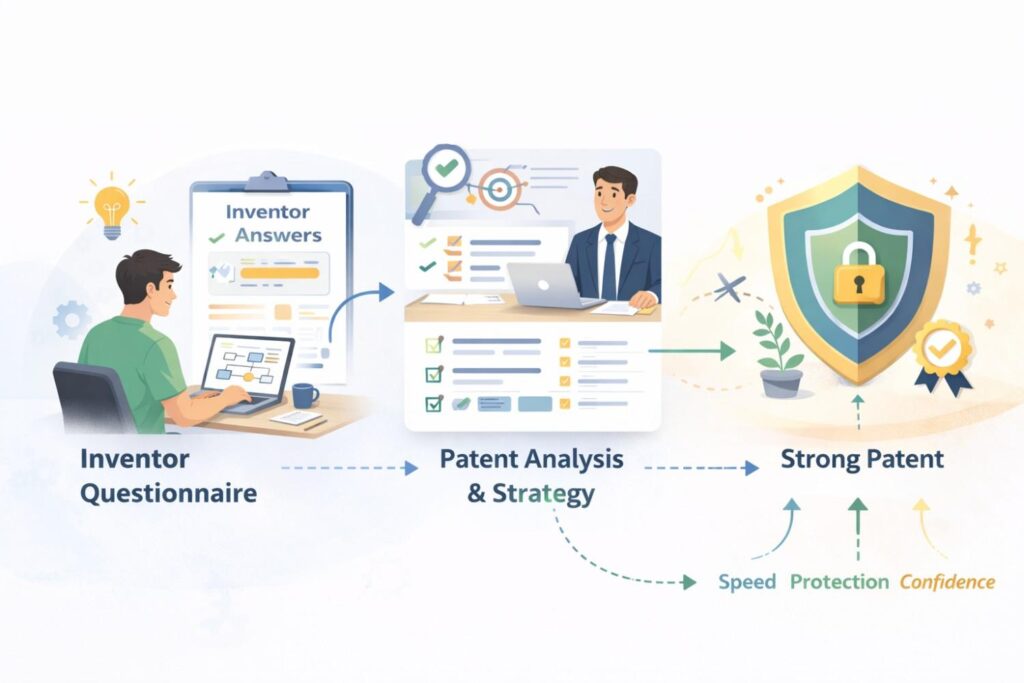
This does not mean ignoring deep technical detail. It means connecting that detail to something measurable in the real world.
Raw answers provide the technical foundation. Strategy shapes that into enforceable coverage.
Balance Breadth With Strength
Founders often want the broadest possible protection. That instinct is understandable.
But overly broad claims that are not supported by detailed explanations can be challenged.
Your questionnaire answers must support whatever scope you aim to claim.
During strategy review, look at where your explanations are deep and concrete. Those areas can often support broader language. Areas with thinner explanation may require narrower claims or further detail gathering.
This is another reason why a strong questionnaire matters. The deeper the technical explanation, the more room you have to claim broadly without overreaching.
Breadth without support is fragile. Breadth built on clear detail is powerful.
Connect Patents to Fundraising Narrative
Investors look for defensibility.
When turning raw answers into strategy, consider how the patent story will appear in a data room. Does it clearly protect the core technology that drives valuation? Or does it feel peripheral?
A well-shaped patent strategy allows you to say, with confidence, that the heart of your product is protected.
This does not require hype. It requires alignment.
If the technical core described in your questionnaire matches the claims in your patent filing, your story becomes clean and credible.
Investors respect clarity.
Plan for Iteration, Not Perfection
Your first filing does not need to capture every future idea. But it should create a strong foundation.
Raw answers should be archived carefully. As your product evolves, revisit them. Identify new improvements. New workflows. New system interactions.
Patent strategy is not a one-time event. It is an ongoing process that tracks innovation as it happens.
When you build a habit of capturing technical depth through structured questionnaires, you make this process smoother.
You reduce stress. You reduce legal back-and-forth. You stay ahead of competitors instead of reacting to them.
Turn Documentation Into Leverage
At the end of the day, the purpose of your questionnaire is not paperwork. It is leverage.
Leverage in negotiations.
Leverage in partnerships.
Leverage in fundraising.
Leverage against competitors.
Raw answers are just the beginning. When shaped into thoughtful claims, aligned with business direction, and layered strategically, they become real assets.
This is why the combination of smart structure and real attorney review matters so much. Software alone cannot make strategic judgment calls. Attorneys alone cannot extract detail efficiently without guidance.
PowerPatent combines both. Structured inventor prompts pull out the right technical depth, and experienced patent attorneys shape that into a protection plan that fits your startup’s goals.
If you are building something valuable and want to protect it without slowing down your team, explore how it works here: https://powerpatent.com/how-it-works
Strong patents do not happen by accident. They are built from clear answers and shaped by clear strategy.
Wrapping It Up
If you take one thing away from this guide, let it be this: a great patent starts long before an attorney writes a single sentence. It starts with how you ask questions. Most inventor questionnaires fail because they are treated like paperwork. They are rushed. They are vague. They are built without strategy. And when that happens, even a skilled attorney is forced to work with thin material.
Leave a Reply