Software patents do not protect vague ideas. They protect the exact way your software solves a real problem. That is why patent claims matter so much. Claims are the part that draw the line around what is yours, what others cannot copy, and what gives your patent real value later. If you write them too wide, they may break. If you write them too narrow, they may be easy to work around. In this simple guide, you will learn how to write software patent claims in a clear, practical way, so your invention is described with enough detail to be strong, useful, and hard to dodge.
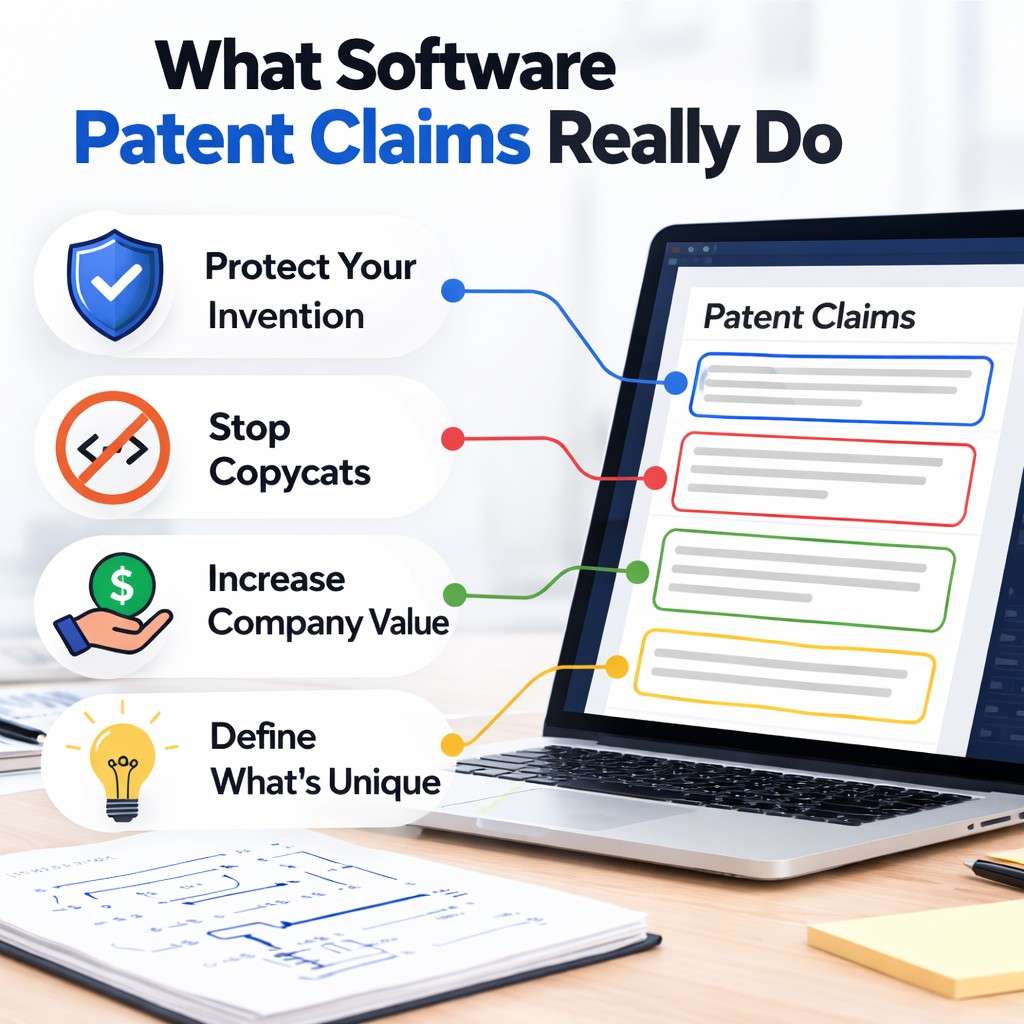
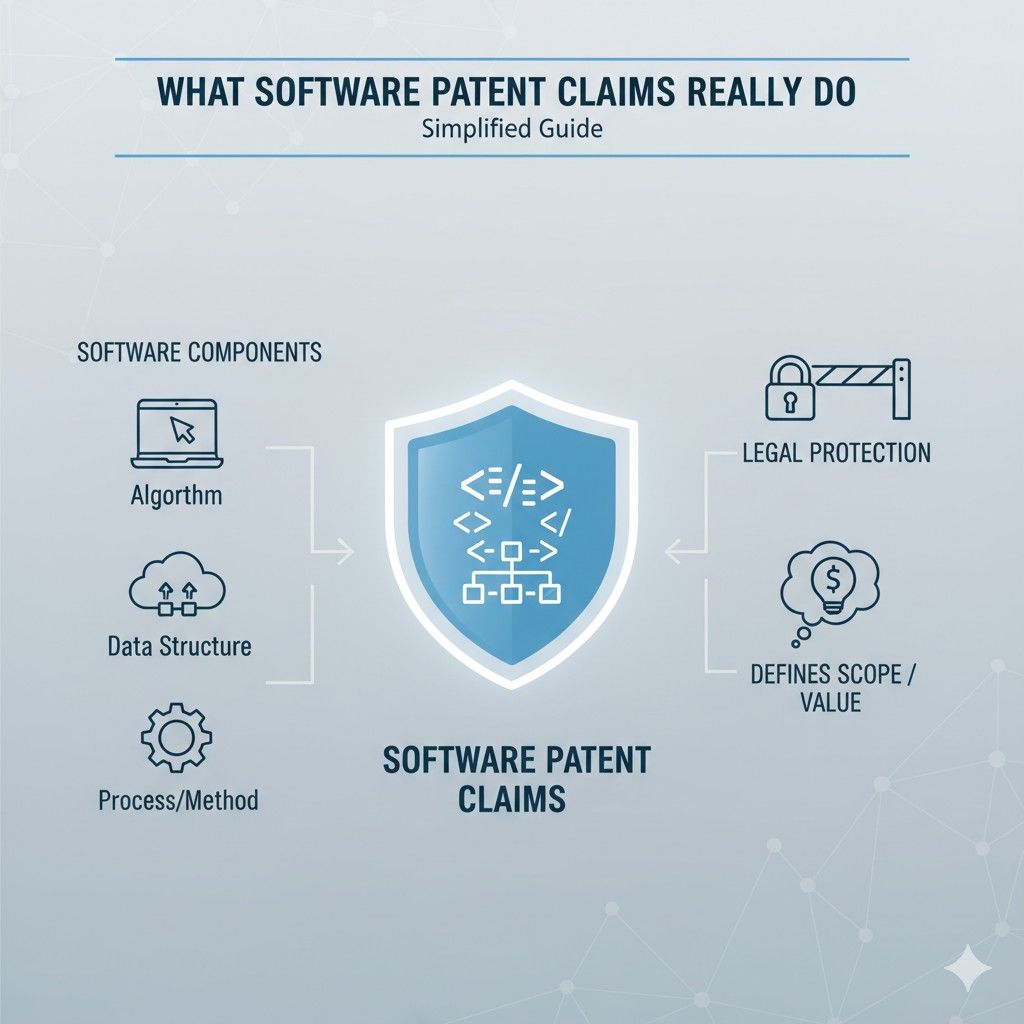
What Software Patent Claims Really Do
Software patent claims do a very specific job. They define the legal edge of your invention in plain business terms: what your product does in a new way, how it does it, and what part of that solution you want to protect.
For a company, this is not just a writing exercise. It is a strategy choice. Strong claims can help you defend product value, support fundraising, reduce copycat risk, and create leverage in deals.
Weak claims can leave the door open for others to build around your work with only small changes.
Claims turn your software from an idea into a business asset
A software product may look impressive in a demo, but a patent does not protect the excitement around the demo. It protects the real working solution under it. That is what claims are for.
They take the moving parts of your product and define them in a way that can be owned, enforced, licensed, or used to increase the value of your company.
For a business, this matters because raw effort is not the same as protected advantage. You may have spent years building a system, but if your claims do not clearly cover the engine that makes it special, then the market may not care how hard it was to create.
What matters is whether the patent covers the part competitors would want to copy. This is why software claims should always be written with business value in mind, not just technical pride.
The real goal is not to describe everything
Many founders think a good patent claim should describe the whole product from top to bottom. That feels safe, but it often creates a trap.
When a claim tries to cover every screen, every workflow, and every side feature, it becomes too narrow. A narrow claim may match your current product, but it may not stop a competitor from changing a small detail and escaping the claim.
A better approach is to focus on the core mechanism that creates the value. That might be the way data is processed, the way model outputs are ranked, the way system resources are allocated, or the way security is improved without hurting speed.
The claim should center on the engine, not the paint on the car. That is where the real protection sits.
Strong claims follow the money
When you decide what to claim, ask a simple business question: if a competitor copied one thing from us to win customers faster, what would they copy first?
The answer is often the best place to begin. It may not be the most complex part of the product. It may be the one feature that saves users time, lowers cost, improves accuracy, or makes the product much easier to adopt.
This is where many teams miss the mark. They protect the part that feels clever to engineers, not the part that creates the business edge. Those two things can overlap, but they are not always the same.
Claims become more useful when they are tied to a clear value story. That value story is what helps the patent matter in the real world.
Claims set the boundary that others cannot cross
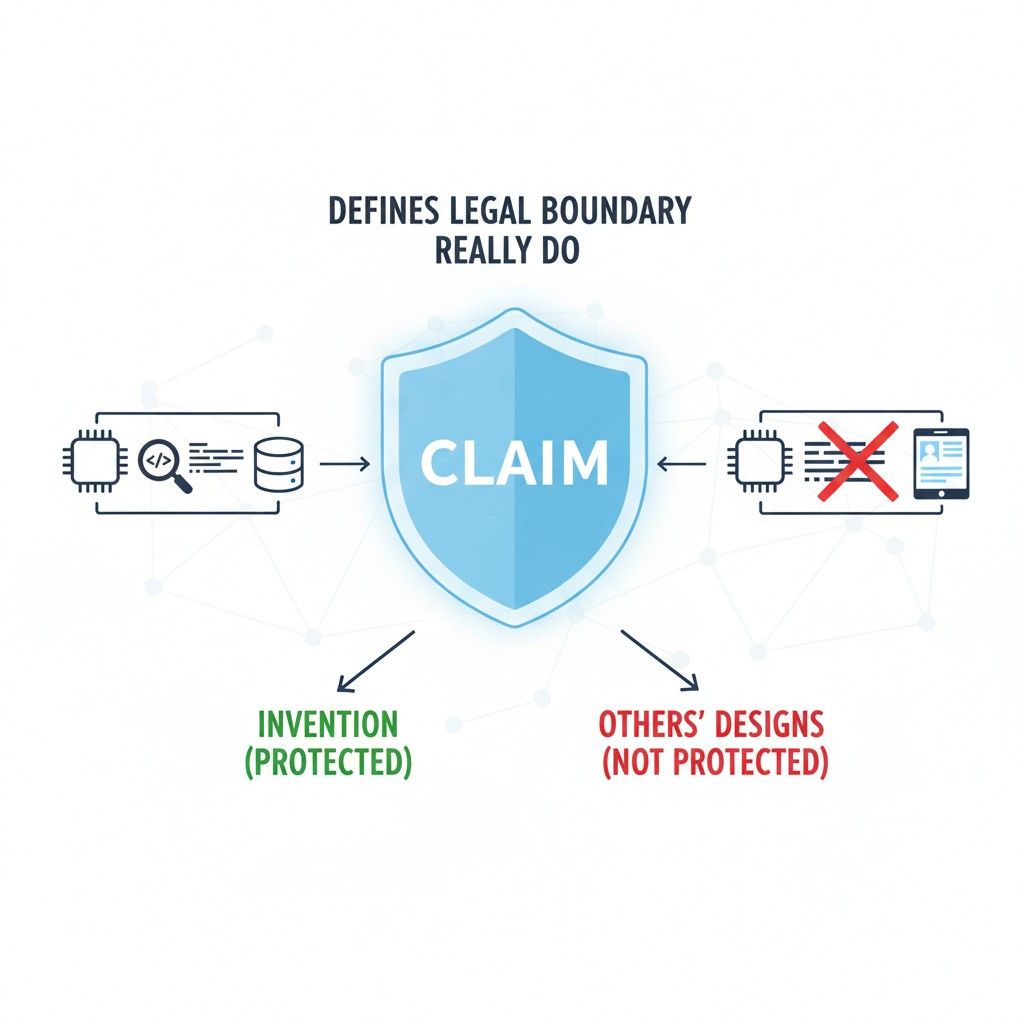
A software patent claim works like a line on a map. Inside the line is your protected space. Outside the line is open ground. The quality of the claim depends on where that line is drawn.
If it is too tight, competitors can step around it. If it is too loose, the claim may not survive review because it covers more than you truly invented.
For a business, this boundary is one of the most important parts of the patent. A patent with weak boundaries may still look good on paper, but it may not do much when pressure arrives.
A patent with smart boundaries can create real friction for competitors. It can force them to redesign, delay launch, or think twice before entering your lane.
The best boundary covers the method, not just the interface
Software companies often want to protect what users see. That is natural because screens, steps, and product flows are easy to point to. But interfaces change fast. Design shifts. Menus move. Buttons disappear. If your claims depend too much on a visible layout, your protection may age badly.
The stronger move is usually to claim the way the software achieves the result behind the scenes. That includes the sequence of operations, the rules used to make decisions, the structure of inputs and outputs, and the way system parts work together to solve the problem.
Interfaces can support the story, but the claim should usually hold onto the underlying method. That is much harder to replace without losing the product benefit.
Why this matters in competitive markets
In crowded markets, companies rarely copy a product exactly. They copy the winning outcome and change the wrapper. That is why claims must be written to catch near-copies, not just exact copies.
If your software saves teams ten hours a week because of a certain workflow logic, a competitor may build the same logic under a different screen design. If your claims only cover the original screen design, you may miss the copy.
The better strategy is to claim the logic that produces the advantage. When that happens, even if the visual layer changes, the protected core may still be in use. That is how claims become more durable and more useful as markets evolve.
Claims help show investors that your moat is real
Investors hear many founders say they have defensible technology. Fewer founders can prove it. Strong software claims help turn that promise into something more concrete.
They show that the company has identified what is unique, captured it in a clear structure, and started protecting it in a serious way.
This matters because investors do not just back products. They back position. They want to know why your company can keep winning once others notice the opportunity.
Claims are not the whole answer, but they can make the answer much stronger. They show that your edge is not only speed or branding. It is also ownership of a core technical solution.
A claim can support the story you tell in the room
When you pitch, you may say your platform makes decisions faster, reduces false alerts, improves routing, or lowers compute waste. A strong patent claim can reinforce that same story.
It shows that the company understands the exact process that creates those results and has taken steps to secure it.
That is why the best claims often sound surprisingly close to the strongest business story. They do not read like marketing, but they support the same central point.
They answer the question, what exactly is the special thing this company does? If the claim cannot help answer that, it may not be focused on the right invention.
Action founders can take before drafting
Before you write a claim, gather your product lead, technical lead, and founder in one short session. Do not ask them to explain the whole platform. Ask them one thing: what part of the system creates the result that customers care about most?
Then push one step deeper and ask how it works in a way that is different from normal tools. That conversation often reveals the claim path faster than a long feature review.
This kind of meeting is useful because it pulls the team away from broad product talk and into the heart of the invention.
It also forces alignment. If different people give different answers about what makes the product special, that is a sign the claim strategy needs work before drafting begins.
Claims are also a tool for future licensing and deal value
Many businesses think about patents only as shields. They can also be useful as deal tools. If your software claims covers a method others need or want, it may support licensing talks, partnership leverage, or stronger acquisition interest.
That does not happen just because a patent exists. It happens when the claim maps onto something commercially important.
A weak claim that covers a minor internal detail may not help much in a deal. A stronger claim that covers a valuable system process used across an industry can matter far more.
This is why claim writing should not be cut off from business development thinking. Good claims are often built around what others in the market may someday need access to.
The wider business lens changes what you choose to protect
If you only think like a builder, you may protect the exact version you launched. If you think like a business, you protect the reusable concept underneath it.
That concept may apply across customer segments, deployment settings, or future product lines. This creates more room for growth.
For example, a company may start with software for one type of workflow, but the real invention may be a way to classify and route event data under changing conditions. If the claim is written around the narrow first use case, the company may lose protection as it expands.
If the claim is written around the broader technical method, the patent can grow with the business. This is one of the most practical ways to make patent work more useful over time.
A claim should match the company you are becoming
Founders often draft patents based on the product they have today because that is what feels real.
But the better question is often this: what part of this system will still matter when the company is five times bigger? That is usually the part worth claiming with the most care.
This does not mean you guess wildly or claim things you did not build. It means you identify the technical pattern that has room to matter across more than one release.
That makes the patent more aligned with the future of the business, not just the past sprint.
Claims force clarity inside the company
There is another benefit that many teams do not expect. Writing claims forces the company to become clearer about its own invention. A vague sense of uniqueness is not enough when you need to claim the actual mechanism.
You must decide what the inputs are, what the system does to them, what output is produced, and why that flow is different from what came before.
That clarity is valuable on its own. It can sharpen product messaging, improve technical storytelling, and help teams explain the product more clearly to investors, partners, and even new hires.
In that way, claim writing is not just legal work. It is a discipline that can make the company think better.
This is why fuzzy language hurts more than people think
When founders describe their software with phrases like smart engine, adaptive system, intelligent routing, or automated insights, they may feel like they are being clear.
In reality, those phrases say very little unless they are tied to actual operations. Claims must explain what the system does in a concrete way.
For business teams, this means one practical thing. During claim prep, stop leaning on brand language. Replace each soft phrase with a real action. What data is received? What is compared?
What threshold is applied? What model output is adjusted? What next step is triggered? That shift from slogan to mechanism is where useful claims begin.
A simple drafting habit that improves claim quality
A strong internal habit is to take every broad product phrase and ask, “What does the software actually do next?” Keep asking that until you reach a concrete operation.
Then ask, “Why does that step matter?” The answer often reveals whether the step belongs in the claim or whether it is just background detail.
This habit helps businesses avoid a common mistake, which is drafting around surface language instead of actual invention.
It also helps uncover which parts of the software are truly essential and which parts are just one implementation choice.
Claims are not there to impress examiners with complexity
Some teams think strong claims need to sound dense or highly technical. That is not the goal.
A strong claim is not valuable because it feels hard to read. It is valuable because it is precise, well scoped, and tied to a real technical solution. In fact, extra complexity often hides weak thinking.
For businesses, simple and exact is usually better than complex and cloudy. You want claims that clearly cover the invention and are hard to misunderstand.
That clarity helps not only during patent review, but later when the patent is evaluated by investors, acquirers, or potential infringers. A claim that takes too much interpretation may create uncertainty where you want strength.
Clear claims make stronger business conversations
A clear claim lets you explain, in one direct statement, what your protected method does. That can be powerful. It makes your patent story easier to use in due diligence, sales strategy, and board discussions.
It also gives your attorney a better base to build on when shaping broader and narrower versions of the claim set.
This is where many companies get extra value. The patent process becomes more than filing paperwork. It becomes a way to sharpen how the company presents its technical edge.
When claims are clean and strategic, they can support that story across many parts of the business.
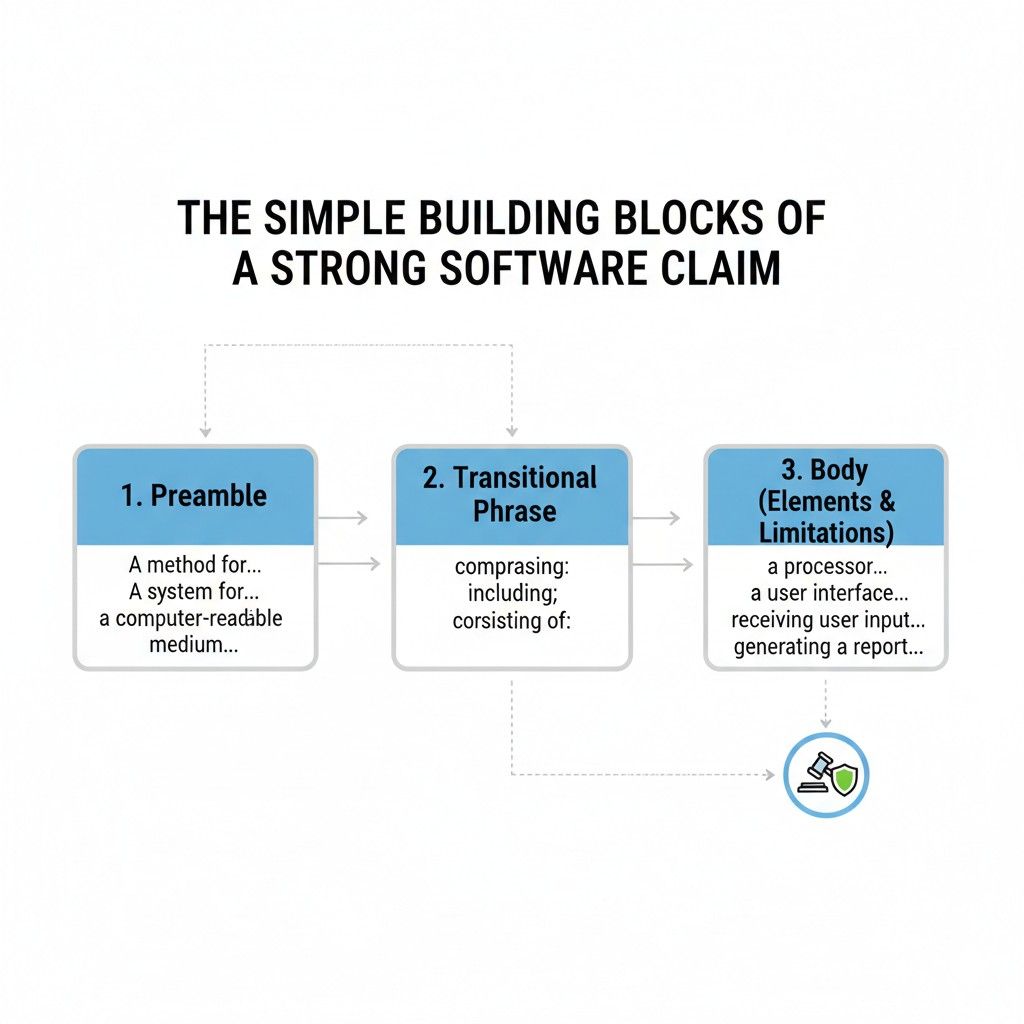
The Simple Building Blocks of a Strong Software Claim
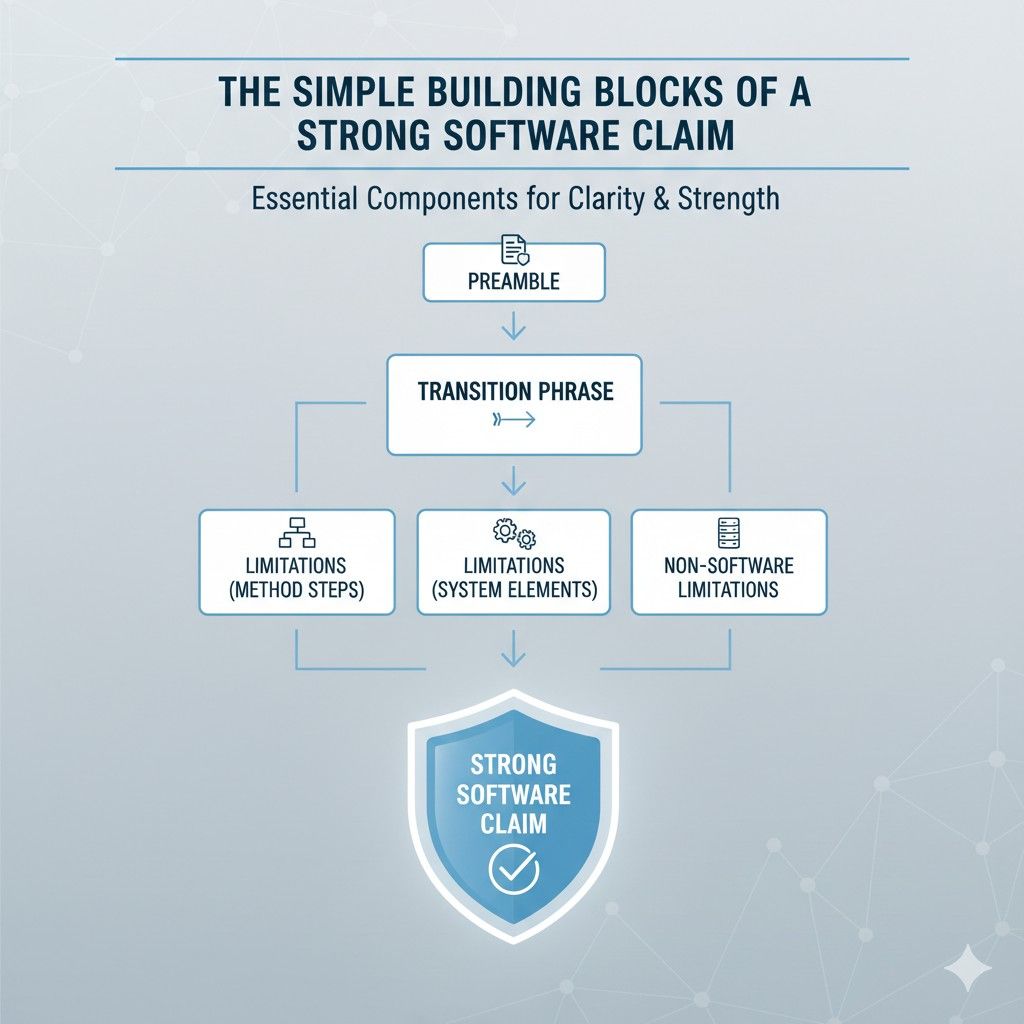
A strong software claim is not built by trying to sound complex. It is built by choosing the right parts of the invention and putting them in the right order. That is what gives the claim strength.
If the parts are too vague, the claim becomes weak. If the parts are too narrow, the claim becomes easy to avoid.
The goal is to create a claim that clearly covers the real technical value of the software in a way that holds up and helps the business.
A software claim is really a structured explanation
At its core, a software claim is a structured way of saying what the system receives, what it does, and what result it creates.
That structure matters because patent claims are not meant to read like product pages or pitch decks. They are meant to define a method with enough shape and detail that the invention can be recognized and protected.
Many teams get into trouble because they start with labels instead of actions. They say things like smart engine, automation layer, or optimization module. Those labels may sound useful inside the company, but they do not do much inside a claim unless they are tied to actual steps.
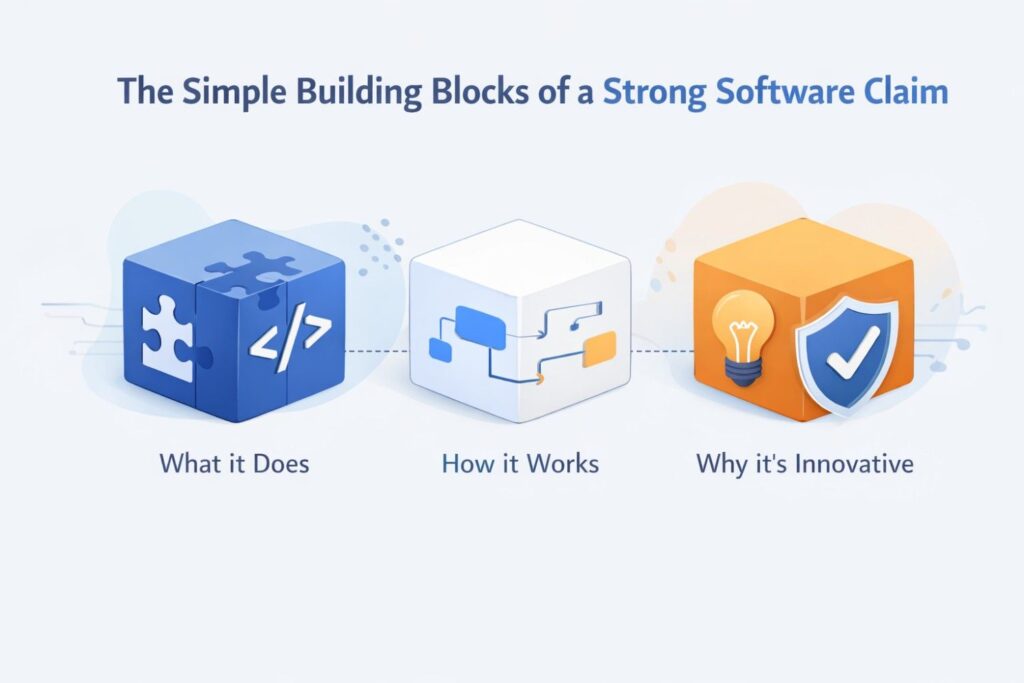
A stronger approach is to focus on the movement inside the software. What comes in. What happens to it. What changes. What comes out. That is the backbone of the claim.
Every strong claim starts with a clear problem-solution match
Before drafting any claim language, the business should be able to state one thing with confidence: what problem does this software solve in a new way. That sounds simple, but it is where much of the real work begins.
If the problem is described too loosely, the claim may drift. If the solution is described too broadly, the claim may lose force.
A good claim is anchored in a real match between problem and solution. Not a general market pain point, but the specific technical issue the software handles.
That might be slow processing, weak routing, unstable output quality, too many false alerts, wasted compute, or broken coordination between systems. The claim should then focus on the exact method the software uses to improve that condition.
The problem should be technical, not just commercial
A common mistake is to write the claim around a business outcome instead of a technical solution. Saying the software helps teams work better or makes decisions faster is not enough by itself.
Those are outcomes. The claim needs to capture the technical path that produces the outcome.
This matters because software patents gain strength when they are tied to how the system actually works.
The stronger move is to explain what technical barrier existed and what the software now does differently to overcome it. That gives the claim more substance and makes it easier to defend why the invention matters.
The input is one of the first key building blocks
Most software claims begin to take shape when you identify the input. The input is what the system receives before it performs the inventive work.
This could be a user request, a sensor signal, a set of training examples, a stream of event data, a file, a state change, or a message from another system.
The reason input matters so much is that it grounds the claim in a real process. It shows what starts the method. It also helps separate your invention from general ideas.
When the claim clearly states the type of data or signal being received, it becomes easier to understand how the invention operates in context.
Input should be specific enough to matter
There is a balance here. If the input is too broad, the claim may feel detached from the actual invention. If it is too specific, the claim may get trapped inside one use case.
That is why the input should usually be described at the level that reflects the technical function, not a narrow product label.
For example, a claim may work better when it refers to a set of event records, a model output, or a request containing structured parameters rather than naming a single customer workflow.
This gives the claim room to stay relevant across different implementations while still showing real structure.
Ask what the system must know before it can act
A useful drafting question is this: what information must the system have before it can do the special thing it does? The answer often points to the right input language. This is a simple but powerful way to avoid fuzzy openings in a claim.
When businesses use this question early, they often discover that their true invention starts earlier than they thought.
What seemed like a decision engine may really begin with a special form of data preparation or signal handling. That shift can lead to a much stronger claim.
The processing step is usually where the invention lives
In most software claims, the heart of the invention sits in the processing step. This is the part where the system does more than just receive and display data.
It transforms, compares, filters, ranks, predicts, routes, groups, validates, adjusts, or generates something in a way that solves the technical problem.
This is also where many claims rise or fall. If the processing is described in broad words, the claim may feel hollow. If it is written with too much low-level detail, it may lose flexibility.
The right move is to capture the meaningful operation that makes the software different without locking the claim to one small implementation choice.
Processing should show a real technical move
A useful way to think about processing is to ask what the software is actually doing that a normal or older system did not do. That difference is often the engine of the claim.
Maybe the system applies a rule only after scoring context. Maybe it allocates resources based on a predicted workload state. Maybe it changes how records are grouped before evaluation. Maybe it adjusts model output using feedback from a second source.
What matters is that the processing step is not just busy work. It should reflect the special move that creates the advantage.
This is where strategy matters. Not every internal step belongs in the claim. Only the ones that help define the inventive path should lead.
Focus on the step that changes the outcome
One of the best ways to find the core processing step is to ask what internal action most changes the final result. If that action were removed, would the software still deliver the same value?
If the answer is no, that step may belong close to the center of the claim.
This way of thinking helps businesses avoid overclaiming routine parts of the system. It also helps them see which processing stage is actually worth protecting because it drives the difference customers care about.
The output gives the claim a practical end point
A strong software claim usually ends with an output or result. The output is what the software produces after performing the core operation.
It may be a ranked result, a generated instruction, a selected route, a modified data object, a control signal, a classification, a detection result, or some other machine-usable outcome.
This matters because output shows that the method leads somewhere concrete. It turns the claim from an abstract statement into a full process. It also helps tie the invention to measurable value.
In many cases, the output is where the business benefit becomes easiest to see, even though the invention itself may sit in the middle processing step.
Output should connect back to the technical problem
The best output language does more than end the sentence. It closes the loop. It shows how the claimed method addresses the original issue. If the problem was delayed handling, the output may trigger faster routing.
If the problem was noisy predictions, the output may be a refined score. If the problem was wasted compute, the output may be a selected subset for further processing.
This is important because it makes the claim feel coherent. The input starts the process, the processing step performs the inventive work, and the output shows the practical effect.
When those three parts align well, the claim becomes more persuasive and more useful.
Make sure the output is not just a display
Many software products end in a screen or report, but that does not mean the claim should always end there. In many cases, the stronger move is to claim the generated result before it appears on a display.
That often keeps the focus on the method rather than the user interface.
This can be especially helpful for businesses building systems that may later appear in different product forms.
The same engine may power dashboards, alerts, APIs, and embedded workflows. A claim tied too tightly to the visible display may not age as well as one tied to the system result.
Sequence matters more than many teams expect
The order of steps inside a software claim is not just a writing choice. It can shape the meaning of the invention. In many cases, the sequence of operations is part of what makes the method work.
A system that filters before ranking may behave very differently from one that ranks before filtering. A system that adjusts a result using real-time context may differ sharply from one that applies context only at the end.
That is why strong claims pay attention to sequence. They do not simply pile up functions.
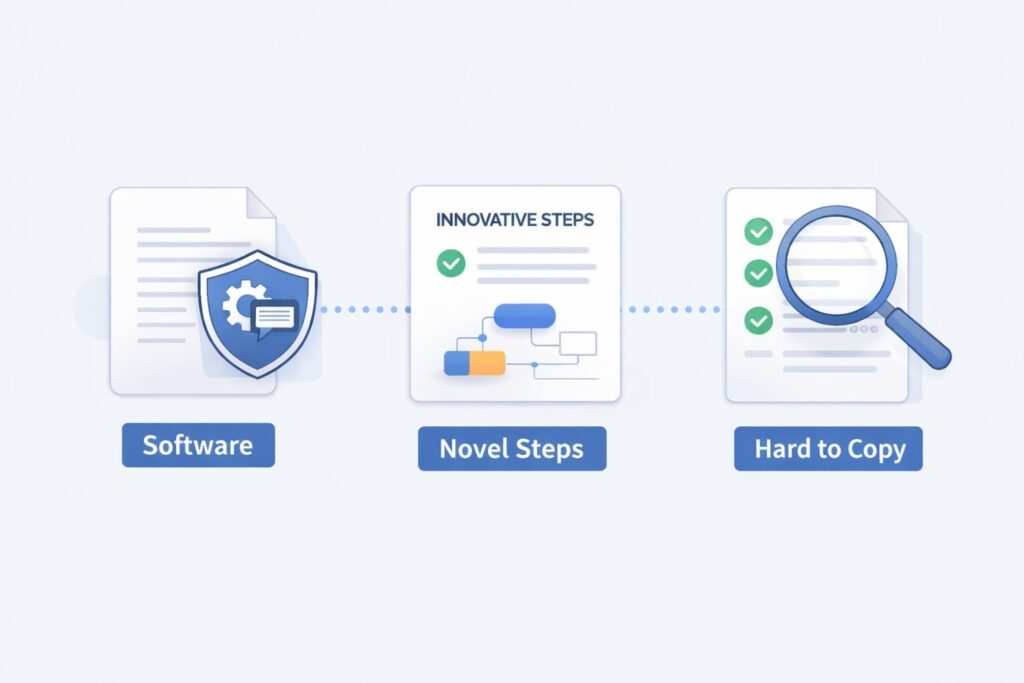
They reflect the actual order that creates the result. This can make the claim clearer and can also help show why the invention is not just a collection of common steps.
Sequence can be a hidden source of strength
Some software inventions do not depend on a brand-new component. Instead, they create value by arranging known operations in a better way. When that happens, the sequence itself may carry much of the inventive force. Businesses should not overlook this.
A claim can become much stronger when it captures how one operation sets up the next. Maybe an early classification determines which model runs later.
Maybe a confidence score controls whether a second analysis step occurs. Maybe a normalization stage makes later comparison reliable. These relationships often matter more than any one step on its own.
Look for dependencies between steps
One practical way to improve claims is to ask whether each step changes how the next step behaves. If it does, that relationship may be worth showing clearly in the claim.
It signals that the method is not just a loose workflow. It is a coordinated process.
This is useful for businesses because coordinated processes are often harder for competitors to replace with small edits. When the steps depend on each other in a meaningful way, the claim can cover more of the real engine.
Conditions and rules can be powerful building blocks
Many software systems make decisions based on conditions. A threshold is met. A state is detected. A confidence score crosses a range. A match level qualifies for another action.
These rules can become important building blocks in a claim when they shape how the software solves the technical problem.
Rules matter because they show that the method is not random. It follows a defined logic.
That logic can often be where the value sits. A smart claim may include a rule that changes what the system does next, especially when that rule improves speed, quality, stability, or resource use.
Do not include every rule, only the ones that matter
It is easy to drown a claim in business logic. Most modern software contains many conditions, checks, and branch paths. Not all of them belong in the main claim.
The goal is to include the rule or condition that helps define the inventive move, not every operational detail in the product.
This is where discipline matters. A claim should not read like raw system documentation. It should reflect the rules that shape the special method. Extra conditions can be saved for dependent claims or deeper support in the specification.
The main claim should stay focused on the rules that help define the core protection.
Ask which rule changes cost, speed, or accuracy
A simple way to find a valuable rule is to ask which condition most affects performance in a business-relevant way. Which one cuts waste. Which one reduces wrong results.
Which one improves system stability. Rules tied to real technical gains often deserve more attention in claim drafting.
This helps businesses move beyond abstract descriptions and toward the parts of the decision logic that truly create advantage.
Data relationships often matter more than raw data points
Software inventions often shine not because of one isolated data value, but because of how different data points are connected, compared, or weighted.
That is why claims can become much stronger when they reflect meaningful data relationships.
A system may compare current events against prior patterns. It may combine user state with system load.
It may adjust weights using feedback history. It may map one input set to another before choosing an action. These kinds of relationships can reveal the deeper method inside the software.
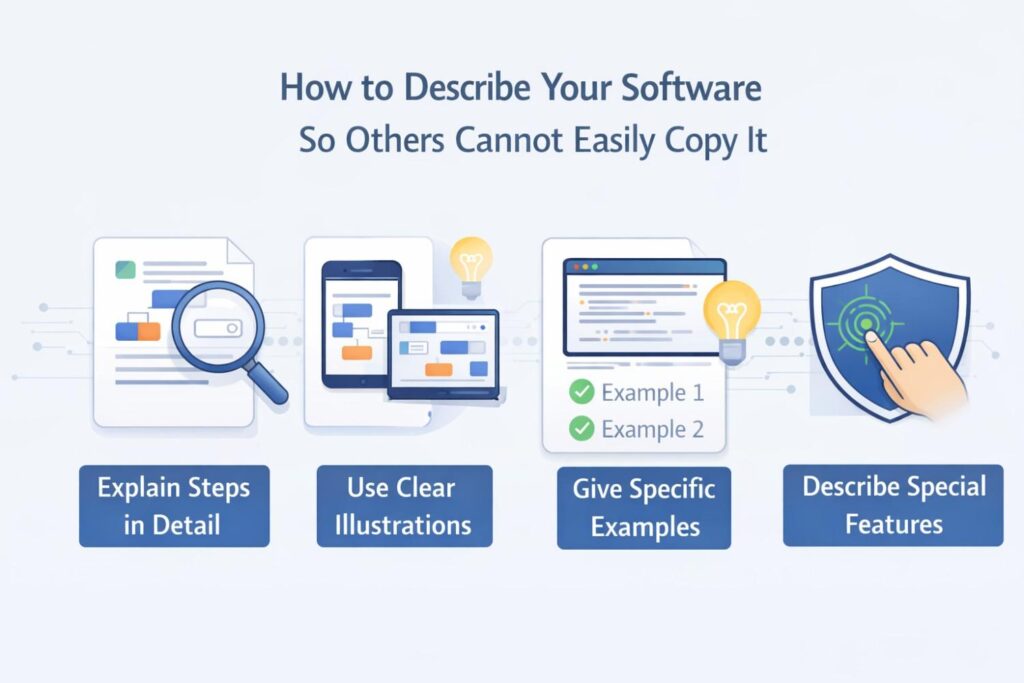
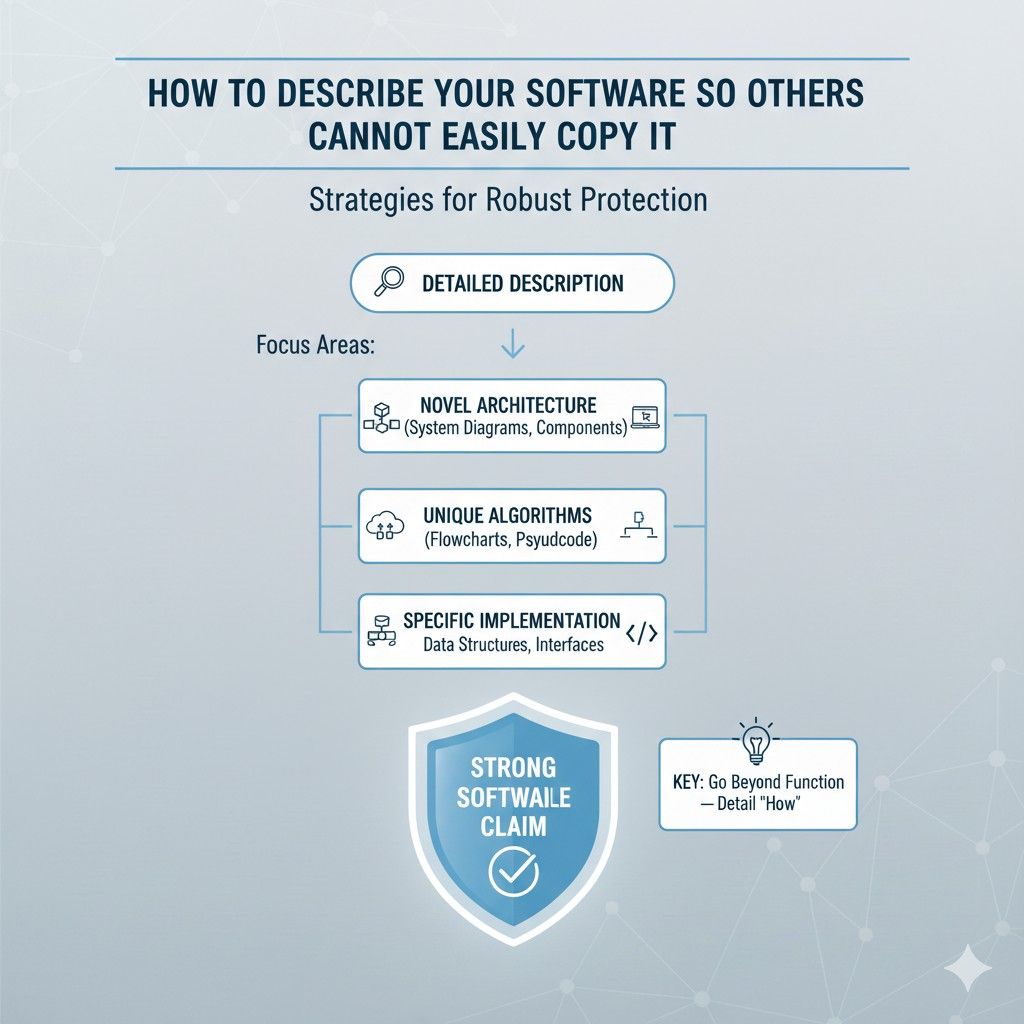
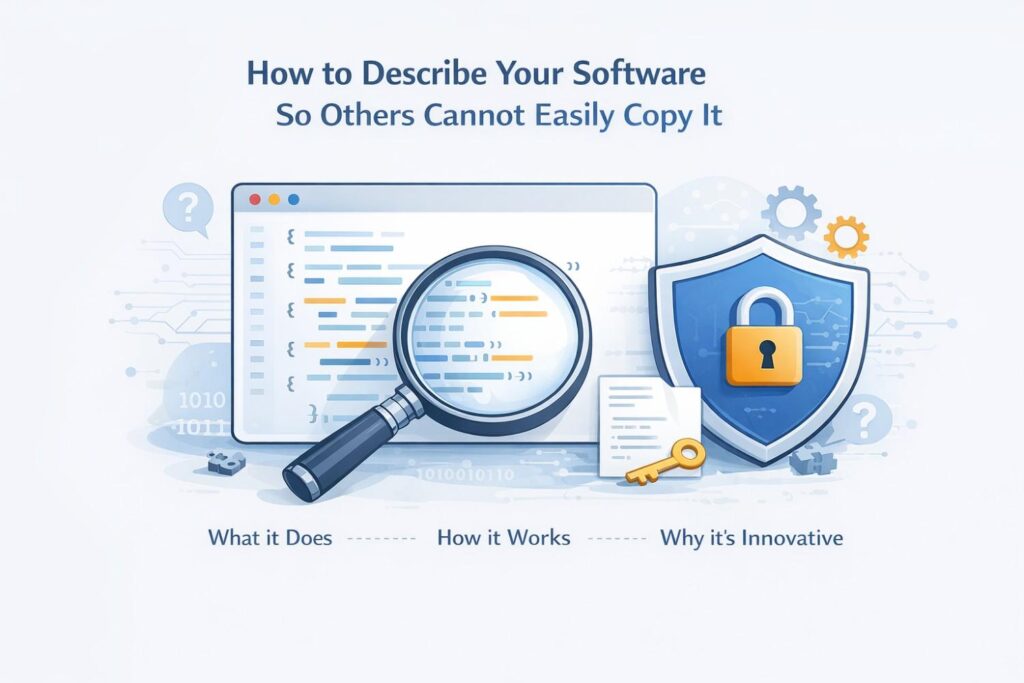
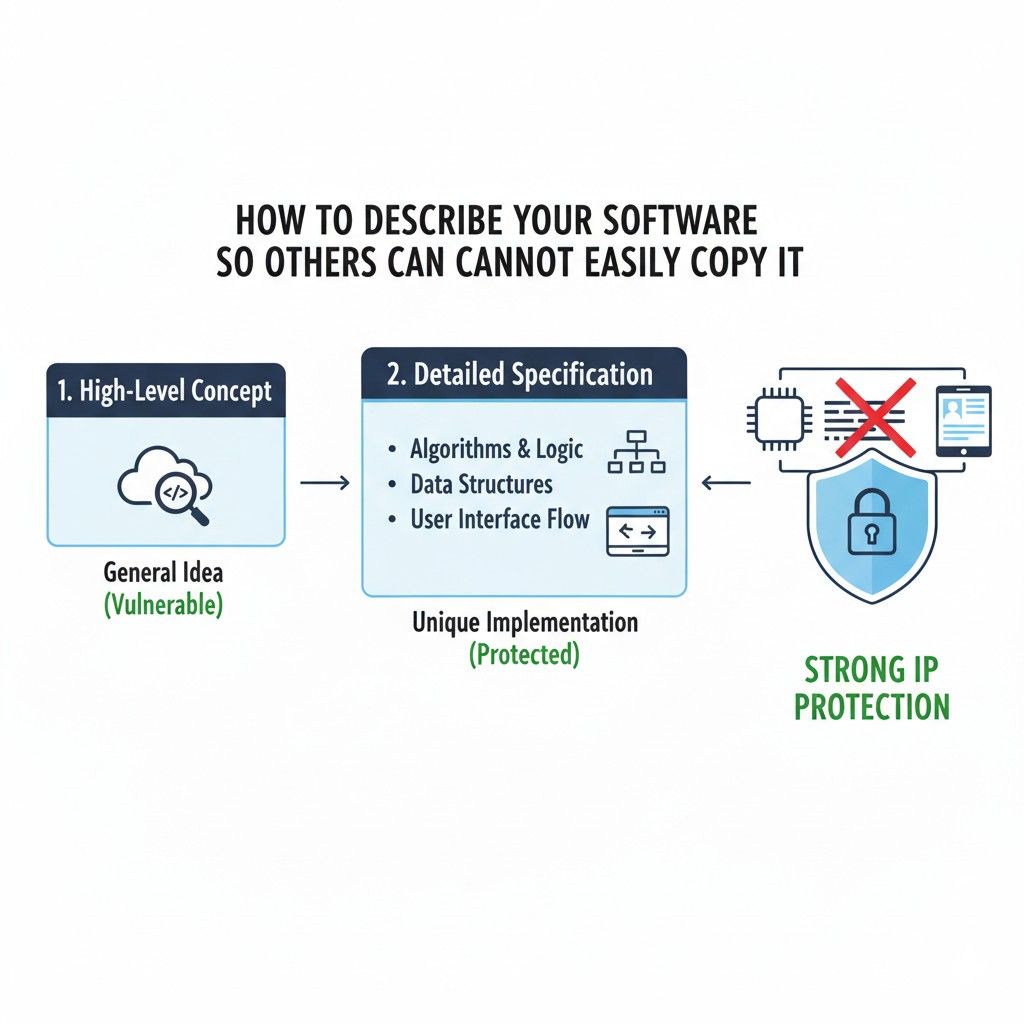
How to Describe Your Software So Others Cannot Easily Copy It
When you describe software for a patent, the goal is not to explain it like a sales page or a product demo. The goal is to show what the software actually does in a way that is clear, specific, and hard for others to work around.
That means you need to describe the real moving parts of the invention, not just the end result.
A weak description talks about outcomes in broad terms. A strong description shows how the system gets there and why that path matters.
Start with the problem your software solves in a real way
A good description begins with the real problem, not a vague promise. This matters because software patents become much stronger when the invention is tied to a practical issue the system fixes.
The problem should be framed in a way that matches real product use, real system limits, or real user pain.
If you say your software “improves efficiency,” that is too soft. Almost every software company says that.
But if you explain that your system reduces failed job scheduling across unstable compute environments by dynamically reassigning workloads based on current node health, now the invention has shape.
It feels real. It sounds like something built, tested, and used. That is what makes it harder for others to dismiss or copy lightly.
Describe the software like a system, not like a slogan
Founders often describe software in brand language because that is how they pitch it. But patent writing needs a different mode. You are no longer trying to sound exciting.
You are trying to show the machine under the hood. That shift is what makes your description useful.
If your product uses phrases like smart automation, intelligent ranking, adaptive workflows, or predictive insights, pause and replace those words with what the software actually does.
What data comes in. What rule, model, or process gets applied. What output is created. What action follows. That simple change makes the invention far harder to copy because it exposes the real technical path, not just the polished label.
Strip away the marketing layer
The fastest way to improve a software description is to remove every phrase that could appear on a homepage and replace it with an operation. That does not make the writing cold. It makes it precise.
Precision is what gives the patent value later.
A good test is simple. If a competitor read your description, would they see the actual mechanism or just the business promise? If they only see the promise, your description is still too thin.
Focus on the sequence that creates the result
Most software value comes from a sequence. Data enters, something happens to it, a decision is made, and an output changes what happens next. That chain is often where the invention lives.
When you describe software, spend real time on that sequence because it is usually the part others would need to copy to get the same result.
This is important for businesses because competitors rarely care about copying every detail. They care about copying the part that creates the advantage.
If your software predicts demand, flags fraud, routes network traffic, or personalizes responses, the key is not only the final answer. The key is how the software reaches that answer better than normal tools.
Show the flow from input to action
A strong description often becomes clearer when you track the path from input to action. Start with what the system receives. Then explain what the software evaluates, transforms, compares, or classifies.
Then show what the system outputs or triggers. That path is often the heart of the invention.
For example, it is much stronger to say the system receives event logs from distributed services, groups the logs by dependency path, assigns severity values based on cross-service timing patterns, and triggers a remediation workflow when a threshold is met than to say the platform detects incidents automatically.
The second version sounds nice. The first version shows substance.
Make the middle steps visible
Many teams describe the beginning and end of a process but skip the middle. That is a mistake because the middle is often where the inventive work sits.
The hidden step may be the ranking logic, the correction process, the model adjustment, or the way conflicting inputs are reconciled.
If the middle is missing, a competitor can read your description, keep the same value story, and invent their own middle.
That weakens the usefulness of your patent. The more clearly you capture the essential middle steps, the harder it becomes for others to create a close substitute.
Write around the method, not only the feature
Features are easy to name, but methods are what make protection stronger. A feature might be real-time alerting, one-click summarization, dynamic resource allocation, or automated code review.
But those are product labels. They are not enough by themselves. The method is the actual way the system makes that feature possible.
This difference matters because competitors can rename or redesign features. They can move buttons, adjust flows, and change the user interface.
But if your description captures the core method, it becomes harder for them to keep the same performance or business value without stepping into your space.
Ask what must stay true for the feature to work
A useful drafting habit is to ask what must stay true for this feature to keep delivering its value. The answer often points to the deeper method. Maybe the system must correlate signals from multiple sources before acting.
Maybe it must re-rank outputs based on feedback loops. Maybe it must partition workloads in a very specific way to keep latency low.
Those underlying truths are often better to describe than the feature label itself. They are harder to swap out without changing the real product benefit. That is exactly what you want in a patent description.
Be specific without locking yourself into one version
This is one of the hardest parts of describing software well. You need enough detail to make the invention concrete, but not so much detail that your patent only fits one narrow implementation.
The answer is not to be vague. The answer is to describe the essential logic and keep optional details from taking over the whole story.
That means you should identify which steps are necessary to the invention and which are simply examples.
If your software can use different data sources, interfaces, deployment models, or tuning methods, the description should not act as if one of those versions is the only possible form unless that detail is truly central to what makes the invention work.
Protect the engine, not the paint color
A useful way to think about this is to separate the engine from the paint color. The engine is the part that makes the invention deliver the result. The paint color is the implementation choice that may change later.
Good software descriptions stay close to the engine.
For a business, this matters because products evolve quickly. If your patent description is chained to a current UI flow or one exact architecture choice, it may lose value as your own product changes.
But if it captures the core processing method, decision logic, or system interaction that drives the advantage, it can remain useful across future versions.
Use examples without making them the whole invention
Examples help a lot. They make abstract software easier to understand. But examples should support the invention, not shrink it.
If you include one sample workflow, one sample model, or one sample type of input data, make sure the surrounding explanation shows that the core concept can apply more broadly where appropriate.
That gives your patent room to grow with the company while still staying grounded in a real build.
Describe why the steps matter, not just what they are
A common weakness in software drafting is describing steps with no explanation of why they exist.
That creates flat writing. It may sound technical, but it does not show the purpose behind the design. Better descriptions make the function of each important step clear.
When you explain why a step is there, you reveal the logic of the invention. Maybe a weighting step reduces false positives. Maybe a fallback routine keeps services running during partial failure.
Maybe a timing window filters noisy inputs. These reasons matter because they show that the system is not a random collection of actions. It is a deliberate solution to a real technical problem.
Reason creates stronger protection
When a description includes purpose, it becomes more defensible. It is easier to show why the claimed design is not just ordinary software activity.
It also helps shape stronger claims later because the business value and technical value begin to line up.
This is especially useful for startups. Your patent should not only show that something happens. It should show why your way of doing it is worth protecting. That connection between step and benefit helps with that.
Wrapping It Up
Writing software patent claims is not about using fancy language. It is about clearly protecting the part of your software that gives your business an edge. The strongest claims do not chase every feature. They focus on the real method, the real flow, and the real technical move that makes your product valuable. That is what makes a patent useful in the real world.
Leave a Reply