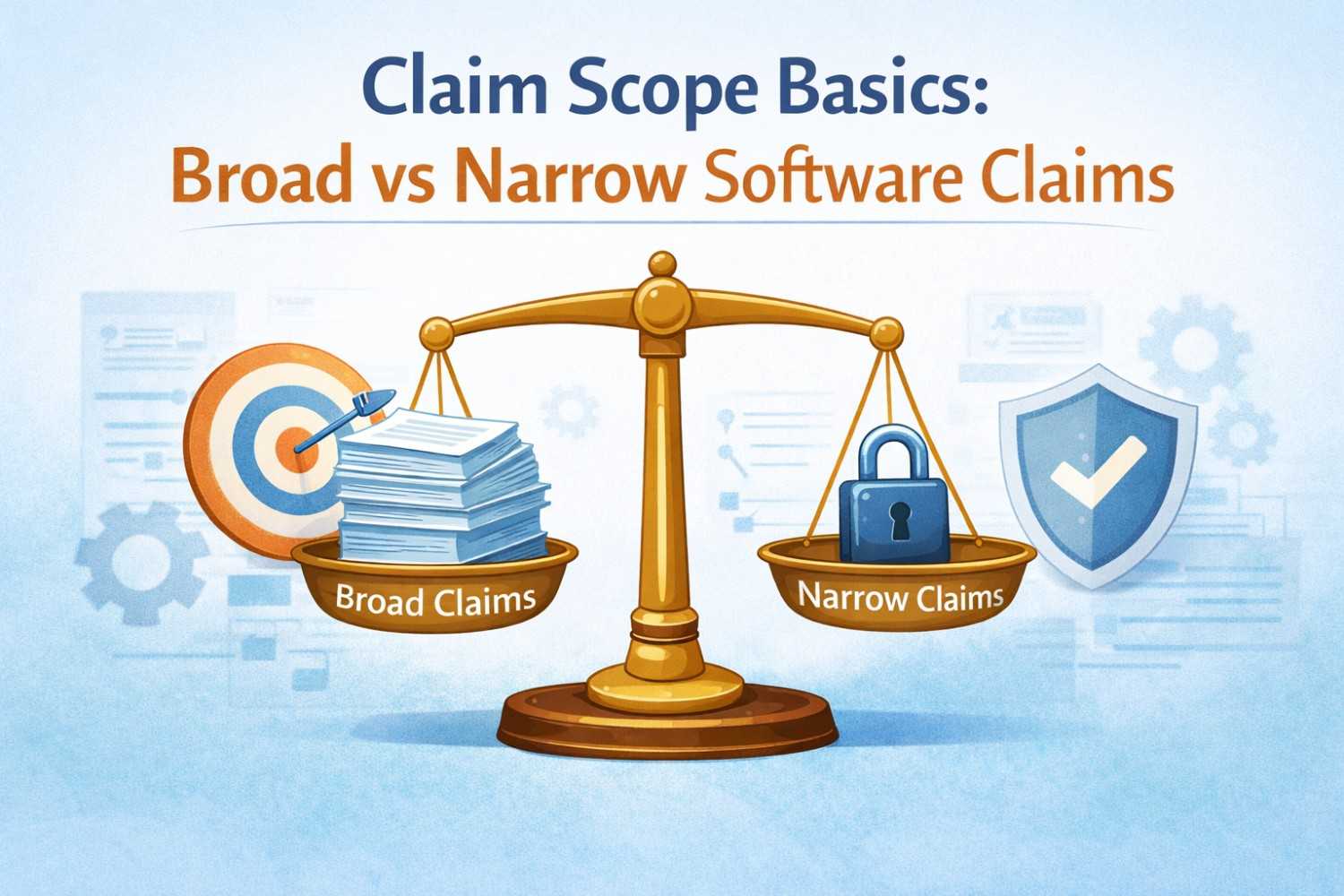
Software patents live or die on claim scope. That sounds technical, but the idea is simple: your claims decide how much ground you protect. Write them too wide, and they may break under review. Write them too tight, and competitors can step around them with small changes. That is the real tension behind broad vs narrow software claims. Founders and engineers often build something truly new, then lose protection because the claims were shaped the wrong way from the start. This is why claim scope is not a small drafting detail. It is the heart of the patent. In this article, we will break down what broad and narrow software claims really mean, when each one helps, where each one can hurt, and how smart teams can create claims that are strong, useful, and built for real business value.
What Claim Scope Really Means in Software Patents
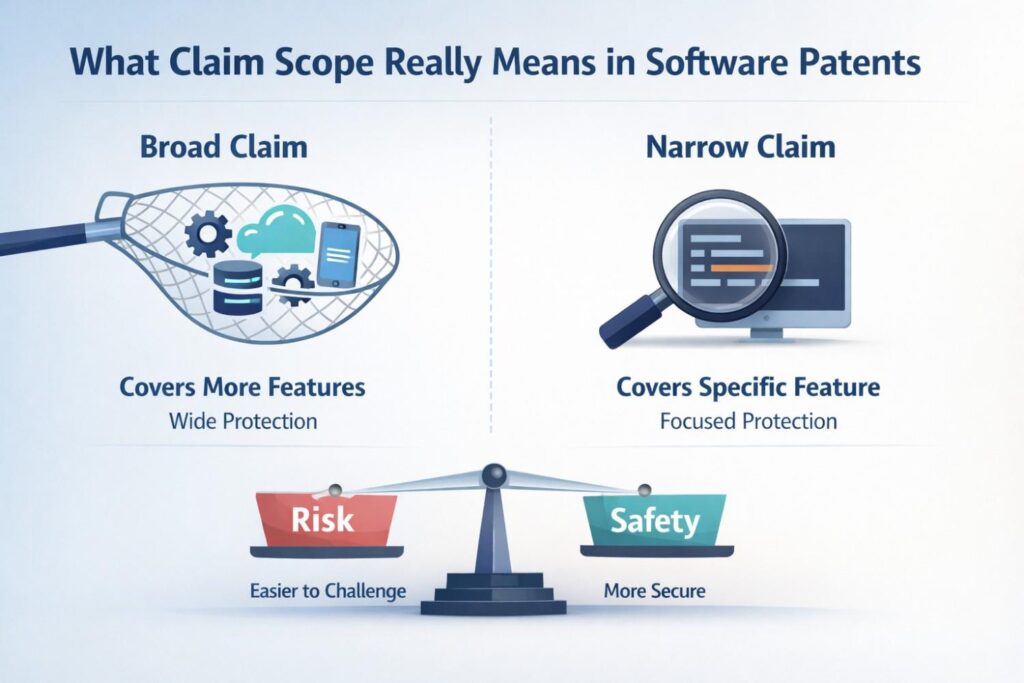
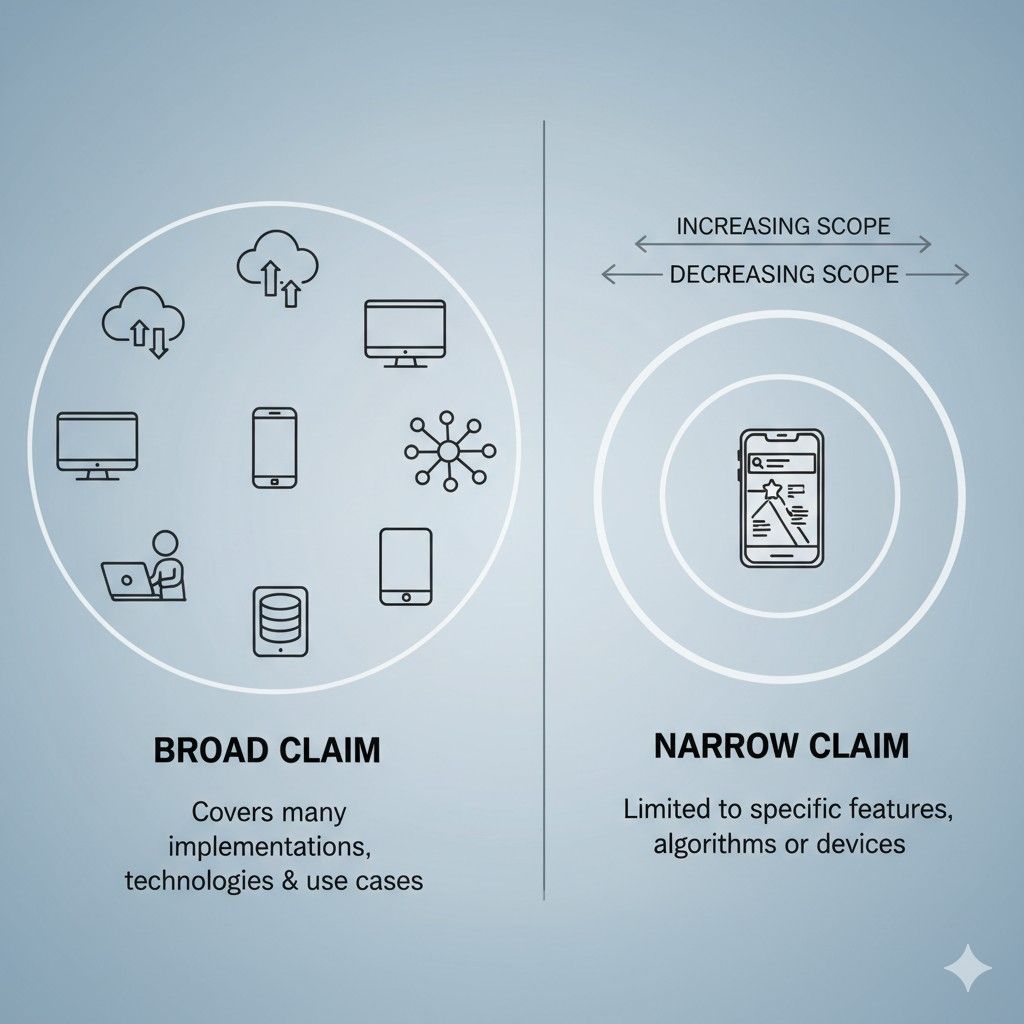
Claim scope is the size of the legal space your patent tries to cover. In software, that space can be hard to define because code can be written in many ways while doing almost the same job.
That is why this topic matters so much for businesses.
If your claim scope is shaped well, you do not just protect a feature. You protect the business value behind that feature. You protect the real advantage that makes your product hard to copy, hard to replace, and hard to ignore.
Claim Scope Is About Boundaries, Not Buzzwords
Many founders think a patent claim is just a formal way to describe what the product does. It is not. A claim is a boundary line. It tells the world where your protection starts and where it ends. That is a very different job.
In software patents, the danger is that teams often describe their invention with product language instead of protection language. They talk about dashboards, workflows, alerts, models, and APIs.
Those things matter, but they are not always the real point. The real point is the unique technical move underneath. Claim scope should be built around that move, not around the marketing language wrapped around it.
A Business Should Ask What It Really Needs to Stop
This is where strategy starts. A business should not begin with the question, “What did we build?” It should begin with the question, “What do we need to stop others from doing?” That shift changes everything.
A software company may have ten features, but only two of them may drive sales, lock in users, or create a moat. If the claims focus on side details instead of those core moves, the patent may look complete while missing the part that matters most.
Strong claim scope is not about covering everything. It is about covering the part of the system that gives the company leverage.
Software Changes Fast, but Core Logic Lasts Longer
Products change every month. Interfaces get updated. Names change. Steps move around.
But the core engine often stays more stable. That is why claim scope should usually track the deeper logic of the invention rather than the exact product design of one release.
For a business, this matters because patents take time. By the time a patent is examined, the product may already look different.
If the claim scope is tied too closely to one version of the software, the patent may protect a version the company no longer sells. Good scope planning helps a business protect the idea in a way that stays useful as the product grows.
A Claim Is Not the Product Description
This point is often missed by smart teams. The product description can be rich, detailed, and full of examples.
A claim has a different role. It is meant to define the invention in a way that draws a legal fence. That fence must be clear enough to stand up, but wide enough to matter.
For software companies, this means the claims should not simply mirror the user flow. A user flow tells a story about what the user sees. A claim often needs to capture what the system is really doing behind the scenes.
That can include how data is processed, how decisions are made, how system parts interact, or how performance is improved in a real technical way.
A Useful Test for Founders
A simple test can help. Ask this question: if a competitor removed the screen design, renamed the feature, and rebuilt it with different code, would they still be using the same core method?
If the answer is yes, your claims should probably focus more on that core method than on the visible version of the feature.
This is highly useful for businesses because competitors almost never copy software in an obvious way. They do not usually clone the exact button layout. They copy the value. They copy the engine. Your claim scope should aim at the engine.
Why Surface-Level Claiming Creates Weak Protection
Surface-level claims often sound fine at first. They may describe receiving input, showing output, updating a display, or sending a notification. But if that is all the claim does, it may not reach the real invention. It may also be easy for others to avoid.
A business that wants meaningful protection should look deeper. What special rule made the software better? What technical choice made the system faster, more accurate, more secure, or easier to use in a way that was not obvious? That is where scope starts to gain real value.
Scope Should Match the Commercial Goal
Not every patent should aim for the same type of protection. The right claim scope depends on what the business is trying to achieve. Some patents are meant to support fundraising.
Some are meant to strengthen acquisition value. Some are meant to block direct competitors. Some are meant to protect a platform layer that many future products will use.
This means claim scope is not just a legal issue. It is a business design issue. If the company does not know what commercial result it wants, the claims can become unfocused.
Protect Revenue Paths, Not Just Product Features
A smart software business should map claim scope to revenue. Which technical function supports the paid plan? Which backend system keeps churn low?
Which workflow makes the product sticky for enterprise teams? Those are often better targets for thoughtful claims than flashy but shallow features.
When patents are connected to revenue paths, they become more than papers for the shelf. They become assets tied to business value. That is what investors, buyers, and serious competitors care about.
Think About Where the Market Is Going
Good claim scope is not only about where the product is today. It should also reflect where the market may go next.
If the company sees the industry moving toward automation, orchestration, model optimization, or secure data exchange, claims should be shaped with that future in mind when the invention supports it.
That does not mean making vague claims. It means spotting the broader technical pattern that your invention fits into.
Businesses that do this well often end up with patents that stay relevant longer because they match the future shape of the market, not just the current version of the product.
Claim Scope in Software Is Often About Abstraction Level
Software claims live or die by abstraction level. That means how high-level or how specific the claim language is. This is one of the hardest parts to get right because software inventions can be described at many layers.
At one level, you can describe exact implementation details. At another, you can describe the system behavior. At another, you can describe the technical rule that drives the behavior.
The scope becomes stronger when the claim sits at the level that captures the true invention without getting trapped in unnecessary detail.
Too Low and You Protect Only One Build
If the claim is drafted too close to the implementation, it may only cover one way of doing the task. That may be fine for one narrow claim, but it is not enough by itself for most businesses.
A competitor can often swap one module, reorder steps, or change a data structure and argue that they are outside the claim.
This is why businesses should be careful about overloading claims with details that are not central to the advantage. Every extra limit shrinks the protected space.
That may make approval easier in some cases, but it can also make the patent less useful in the real market.
Too High and You Risk Saying Almost Nothing
The opposite problem is also common. Some claims try to cover the result without showing the real technical path.
That can create weakness during examination and make enforcement harder later. A claim that only says “analyze data and provide a result” usually will not do much for a software company.
A strong business-focused approach is to ask what technical mechanism creates the result. That mechanism is often the best anchor for claim scope. It gives the claim real structure while still leaving room for variation in implementation.
Strong Scope Usually Starts in the Specification
A company cannot fix weak support later with clever claim edits. The claims depend on the underlying disclosure. That means the quality of the patent application itself shapes what scope is possible down the road.
For software businesses, this is a major strategic point. If the application only explains one example in a shallow way, later options may be limited.
But if the application explains the invention at several levels, with variations, alternatives, system views, and technical benefits, the company has more room to shape claims over time.
Describe Variations Before You Need Them
One of the best practical moves is to describe alternate ways the invention can work from the start.
Explain different inputs, outputs, logic paths, architectures, and deployment settings. Explain what parts can change and what parts should stay the same.
This matters because claim scope often gets refined during examination. If the original filing includes strong support for variations, the business has more flexibility.
It can narrow where needed without giving up the entire strategic position.
Write for Future Arguments, Not Just Today’s Filing
A patent application should help the company later, not just get submitted today. That means the writing should support future claim choices, future responses to objections, and future business use.
A rushed filing may feel fast, but it can close off valuable options.
For a growing software company, this is especially important because the product roadmap may shift. Good early drafting gives the business room to adapt while keeping the core invention protected.
Claim Scope Should Be Measured Against Real Competitor Behavior
A patent is only valuable if it covers conduct that matters in the market. That is why claim scope should be checked against how competitors actually build, not just against how your own engineers think.
This requires a practical mindset. Teams should ask how a rival would likely recreate the advantage without copying the code line by line.
Would they use a different model type, a different storage design, a different message flow, or a different sequence of steps? That analysis helps reveal which claim elements are too narrow and which are truly essential.
Reverse-Engineer the Workaround Before It Happens
One of the best ways to improve claim scope is to imagine the easiest workaround a smart competitor would try. Once you see that path, you can ask whether the claim still reaches it.
If not, the business may need broader framing in the disclosure or additional claim angles.
This exercise is highly actionable because it turns patent planning into market defense planning. It helps the company move from passive filing to active protection thinking.
Patents Should Support Negotiation Power
Businesses often think about patents only in court terms, but that is too limited. Strong claim scope can help with partnerships, licensing, M&A, and competitor conversations long before any lawsuit exists.
A patent that clearly covers an important technical approach can create leverage simply because others know it is there.
That is why scope should be shaped with practical business pressure in mind. It is not just about whether a claim can exist. It is about whether it can matter.
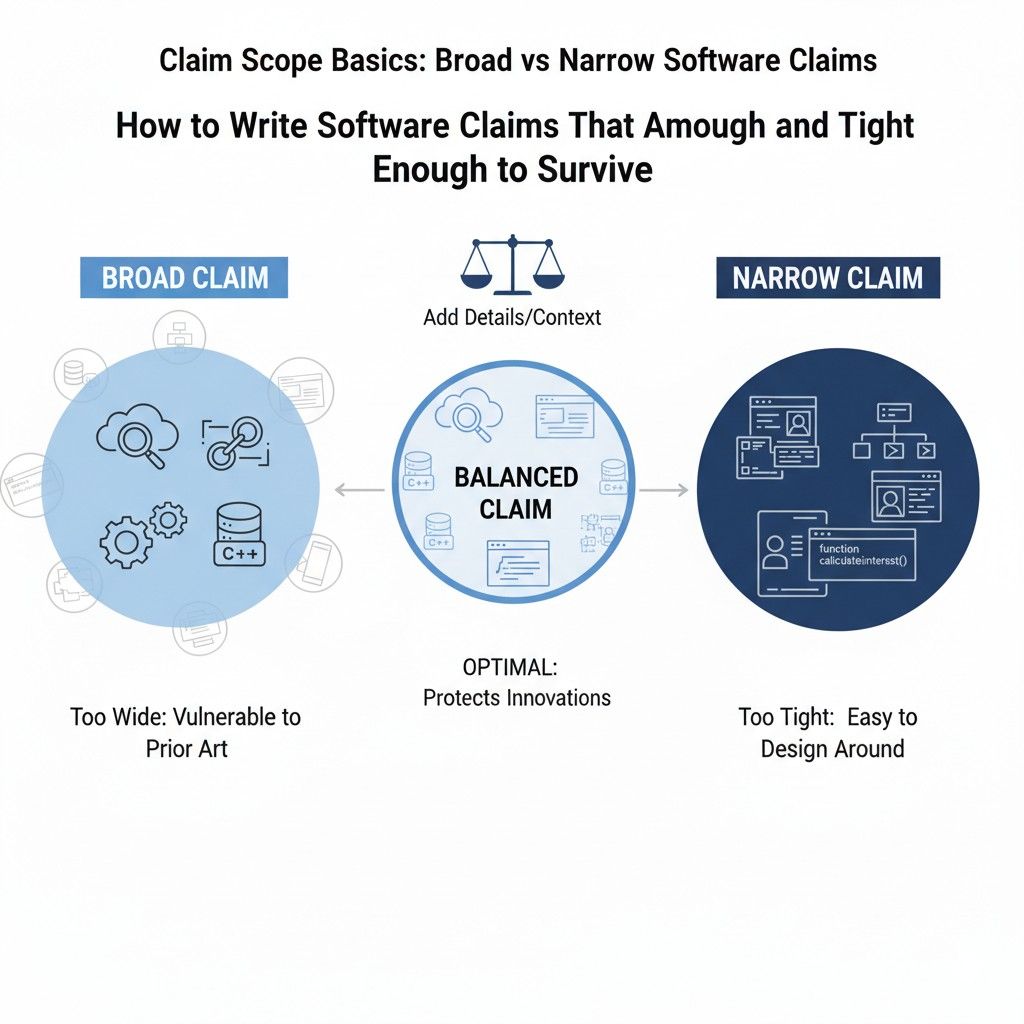
Broad Claims vs Narrow Claims: What Each One Protects
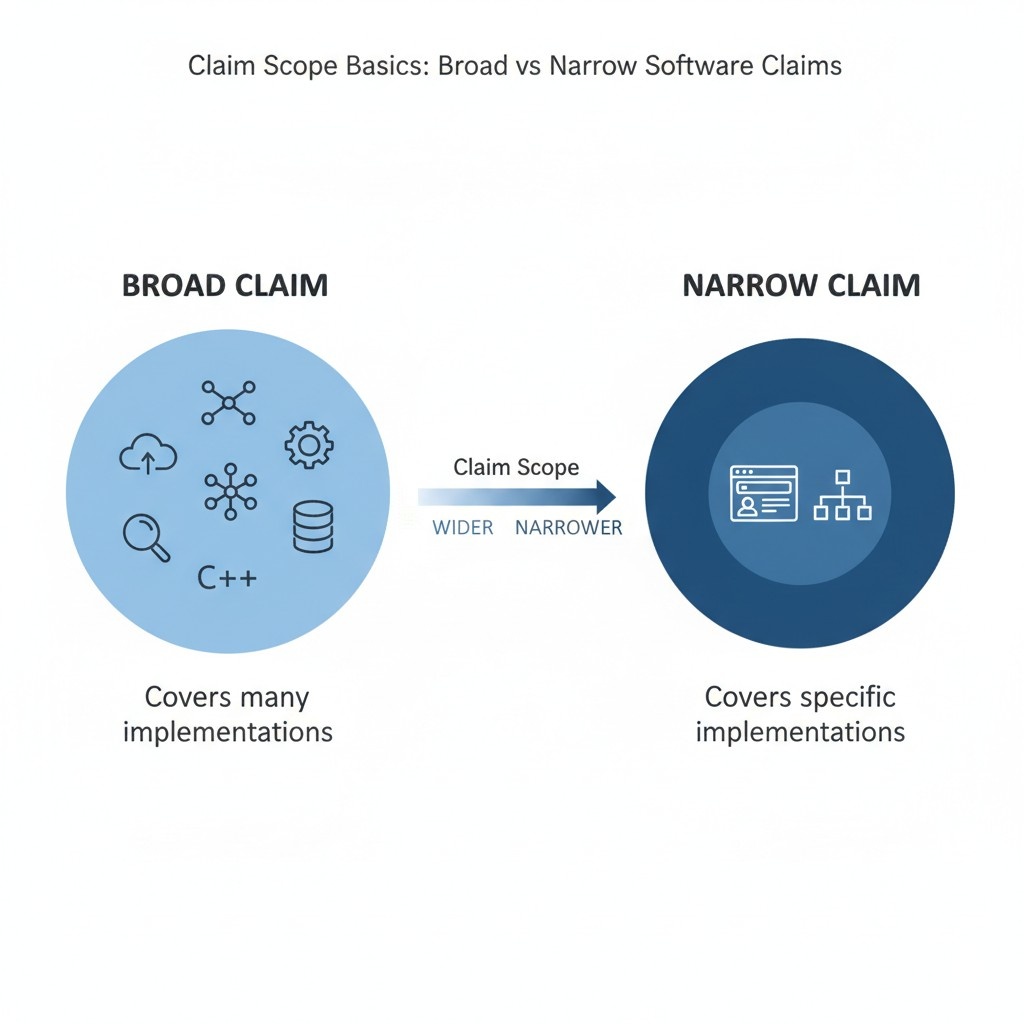
Broad claims and narrow claims do very different jobs in a software patent. One tries to protect more ground. The other tries to protect a more exact version of the invention.
Neither one is automatically better. The real question is what kind of protection the business needs, what the invention can honestly support, and how the claims will hold up when tested.
For software companies, this is not a theory issue. It shapes how much room competitors have to move around your patent.
Broad Claims Protect the Core Idea at a Higher Level
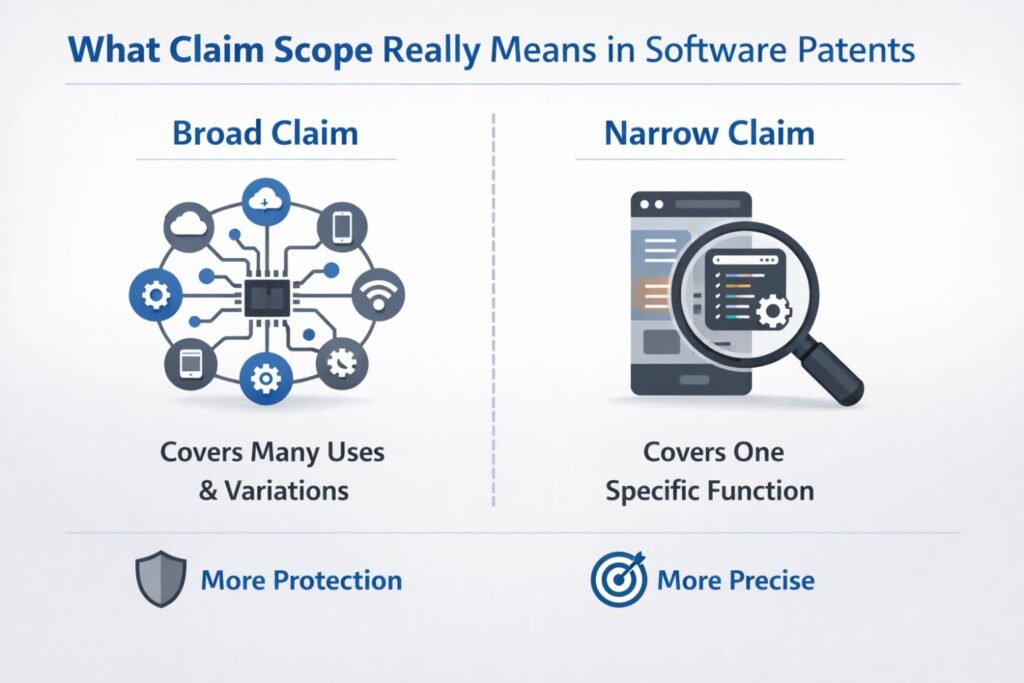
Broad claims usually try to cover the invention at a higher level of generality. They do not lock the patent into one exact code structure, one user flow, or one system layout unless those details are truly necessary.
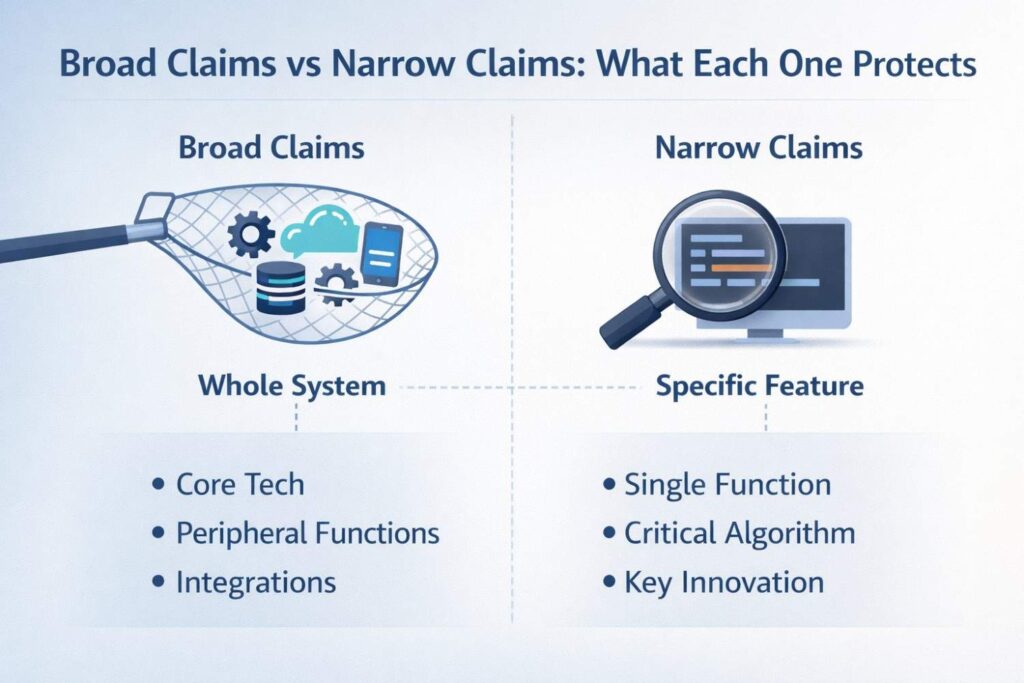
Instead, they aim to protect the central technical approach in a way that can reach multiple implementations.
Broad Claims Aim at the Business Threat, Not Just the Product Version
A broad software claim is often built to stop a competitor from taking the same core concept and dressing it up in a different technical outfit. That matters because software companies rarely face exact copying. They face close imitation.
A rival may change interfaces, rename modules, or swap internal components while still using the same basic inventive move. Broad claims try to reach that behavior.
For a business, this means broad claims are often the claims with the highest upside.
If they are written well and supported well, they can cover more than one release, more than one product variation, and sometimes more than one competitor approach. They can help protect the engine of the business rather than a snapshot of one build.
Broad Claims Can Make a Patent More Valuable Commercially
A claim that reaches many versions of the same technical idea can create stronger business leverage. It may support licensing conversations more effectively.
It may matter more during diligence. It may also signal to competitors that simple design changes will not easily avoid the patent.
That does not mean broad claims should be vague. They still need real structure. They still need a real technical basis.
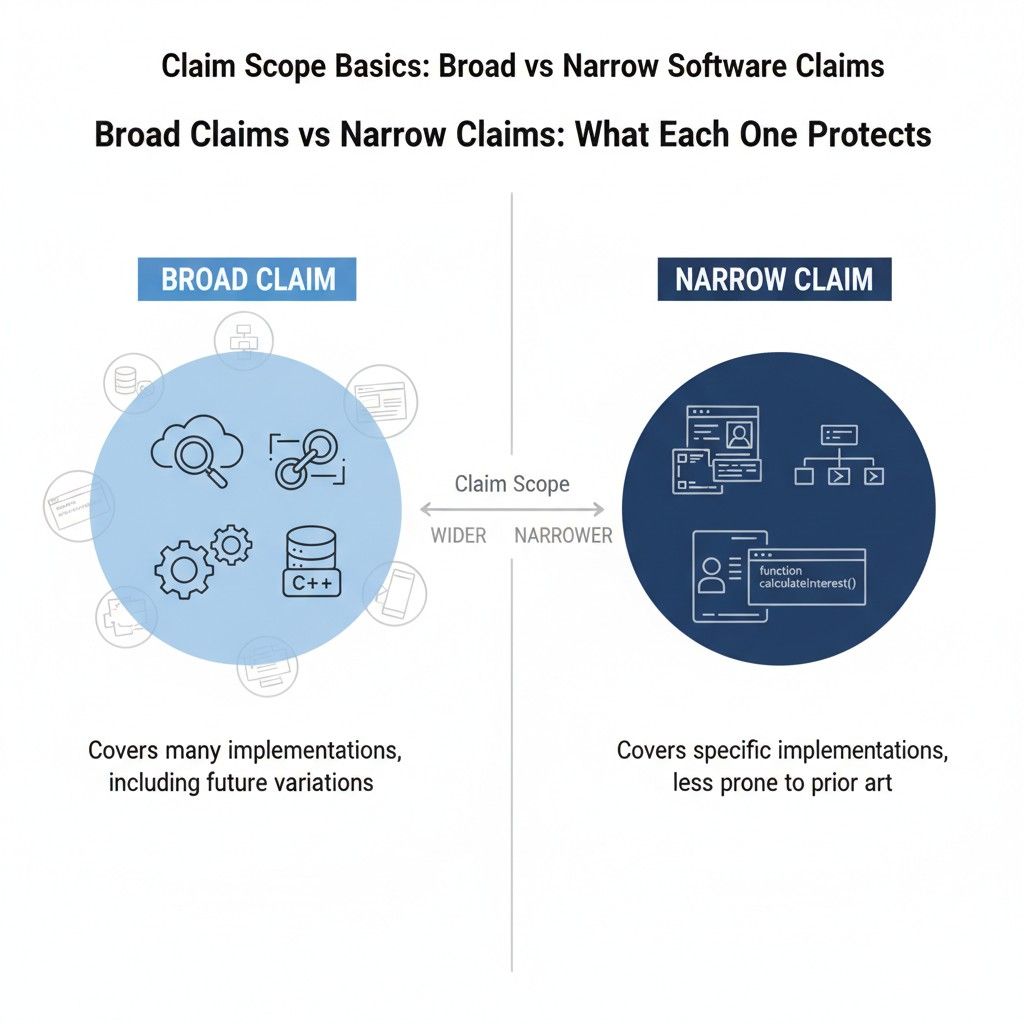
But when they are done right, they tend to connect more directly to long-term business value because they protect what the market is likely to copy, not just what your engineers happened to ship first.
What Broad Claims Usually Cover in Practice
Broad claims often protect the core functional logic of a software invention rather than its surface expression.
In practical terms, they may focus on how a system classifies data, routes tasks, optimizes performance, applies rules, coordinates components, or transforms inputs into outputs in a technically meaningful way.
They Often Reach Multiple Technical Implementations
This is one of the biggest reasons broad claims matter. A single business problem can be solved through different architectures. A scheduling engine may use different queue structures.
A fraud system may rely on different feature sets. A collaboration tool may sync data using different transport choices. If the inventive idea sits above those implementation choices, a broad claim may try to protect the shared logic across them.
That is especially useful for a software company with an evolving roadmap. Products change.
Teams refactor. Platforms expand. If the patent only covers version one, the company may outgrow its own protection. Broad claims help reduce that risk by tying the patent to the deeper inventive concept.
They Can Protect Future Product Expansion
A broad claim can also help when the company expects to reuse the same technical approach across new products or markets.
Maybe the current product handles workflow automation for finance teams, but the underlying invention could also apply to legal, HR, or healthcare operations.
A narrow claim tied too tightly to one context may miss that future value. A broader claim may preserve room for that growth.
This is one reason claim planning should not be separated from product strategy. A smart business does not only ask what the software does now. It asks where the same technical edge may create value next.
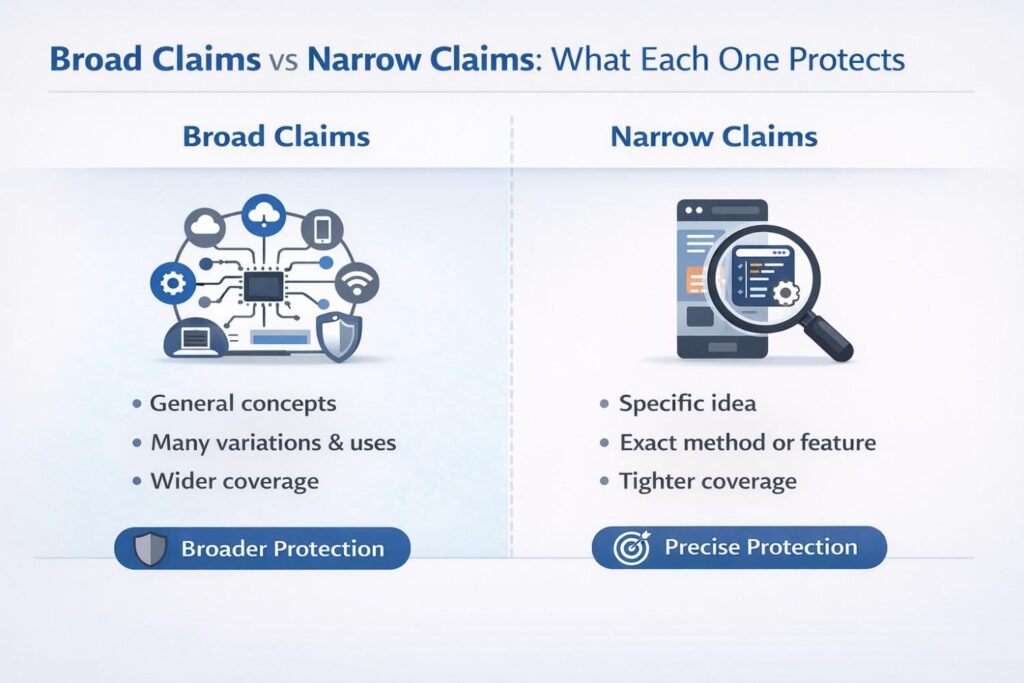
Narrow Claims Protect a Specific Implementation More Directly
Narrow claims are more limited. They include more details, more conditions, more defined parts, or a more exact series of technical steps. That makes the protected space smaller, but it also makes the claim more concrete.
Narrow Claims Often Match the Real Build More Closely
In software patents, narrow claims often track a specific architecture, a defined processing flow, or a more exact combination of components. They may describe a particular way of storing data, triggering actions, scoring inputs, or coordinating subsystems.
That can be useful because software inventions are often challenged on whether they are concrete enough or different enough.
A narrower claim can answer that by showing a more exact technical structure. It says, in effect, this is not just a broad idea. This is a defined way of doing it.
Narrow Claims Can Be Easier to Defend During Examination
From a business point of view, narrow claims often play an important supporting role.
They may not cover as much ground, but they can sometimes move more smoothly through review because they are tied to more specific features. When broader claims face objections, narrower claims may survive by drawing cleaner distinctions.
That is why narrow claims should not be viewed as weak by default.
A narrow claim may end up being the claim that gets allowed first, the claim that protects the product as sold, or the claim that provides a fallback position when broader language is challenged.
What Narrow Claims Usually Cover in Practice
Narrow claims often protect one version of the technical solution rather than the full family of related solutions.
They may cover a specific order of operations, a specific way of generating a score, a specific interaction between modules, or a specific handling of system constraints.
They Protect Precision More Than Range
That precision can matter a lot when the invention’s strength comes from a very particular technical move. Some software advances are not broad conceptual shifts.
They are exact engineering solutions to difficult problems. In those cases, a narrow claim may map closely to the real source of novelty.
For businesses, this can be highly useful when the product’s edge depends on details that competitors cannot easily change without losing performance or reliability.
If the narrow claim captures a detail that rivals need to copy to match the result, the smaller scope may still have strong commercial force.
They Can Protect High-Value Features That Matter Today
Many founders think only in terms of broad protection, but narrow claims can be very practical when tied to current revenue.
If a company has one exact workflow or backend method that drives adoption or retention, a narrower claim aimed at that feature can be worth a great deal.
Even if competitors can design around the patent in theory, they may not want to do so in practice if the protected implementation is the one users actually want.
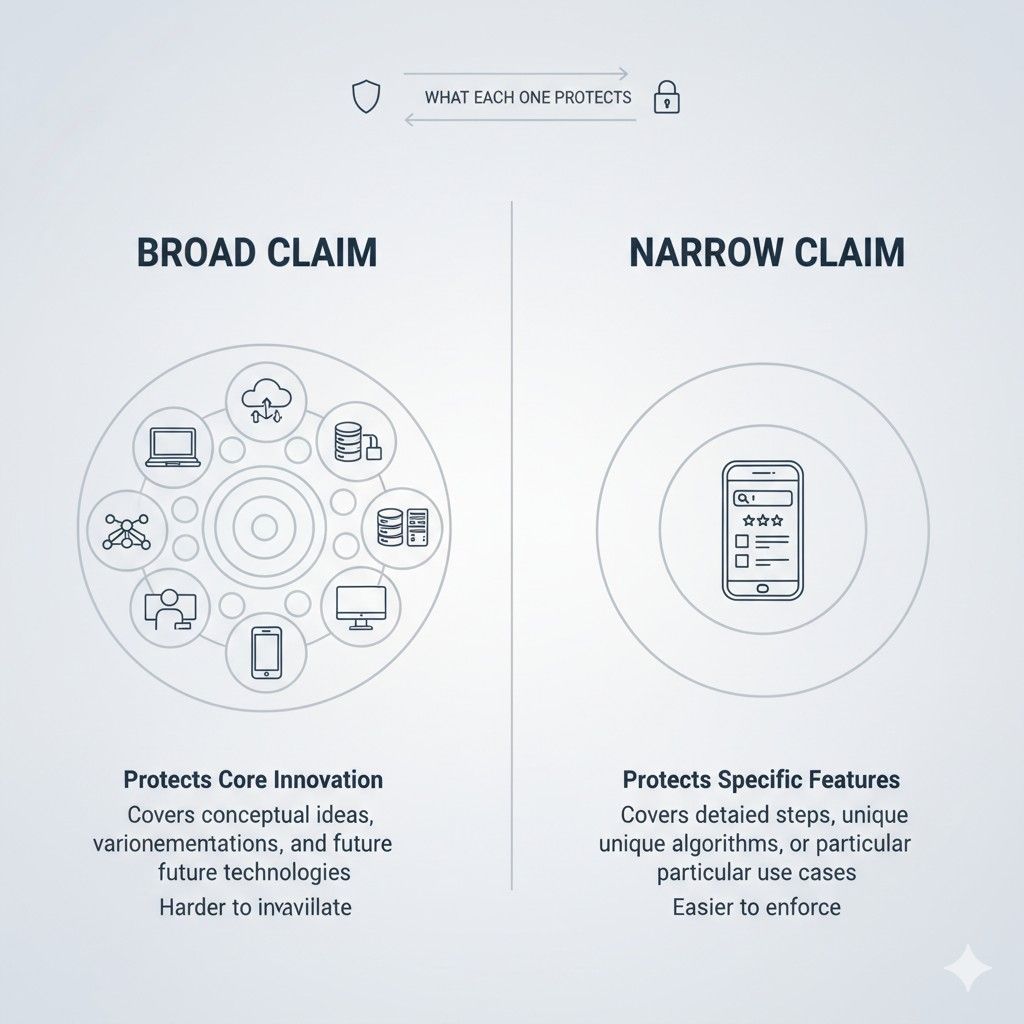
That is why businesses should measure narrow claims against market behavior, not just against abstract legal range. A narrow claim that covers the feature customers care about can still be highly valuable.
How to Write Software Claims That Are Wide Enough to Matter and Tight Enough to Survive
Writing strong software claims is not about sounding technical. It is not about stuffing the claim with fancy system words. It is about making smart choices. You want claims that cover enough ground to protect real business value, but not so much that they fall apart when tested.
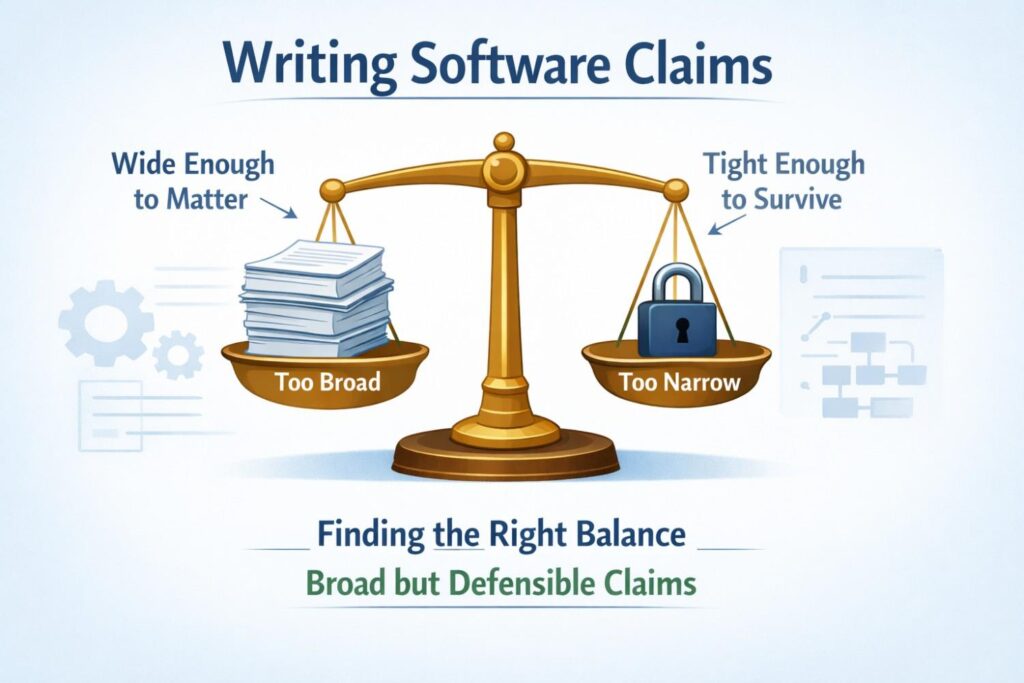
That balance is where good patent strategy lives. For software companies, this matters because the wrong claim shape can turn a real invention into weak protection.
The goal is to claim the true technical edge in a way that can hold up, stay useful, and create leverage.
Start With the Technical Move, Not the Product Pitch
The best claims usually begin with one simple question: what is the actual technical move that makes this software different? This is the place where many teams slip.
They begin with the product story, the feature name, or the user benefit. Those things help explain the business, but they do not always reveal the invention in a way that makes a claim strong.
A software claim should start closer to the engine than the interface. It should focus on the system behavior, the data handling, the decision rule, the control logic, or the interaction that creates the improvement. That is usually the part worth protecting.
Find the Real Point of Difference
Before drafting, a team should try to state the invention in one plain sentence with no product branding and no marketing terms.
If that sentence only says something like “helps users work faster” or “uses AI to improve results,” it is not ready yet. The team needs to keep digging until it can name the actual mechanism.
That mechanism is often the heart of the claim. It might be a new way to rank inputs, trigger actions, manage resources, coordinate models, or reduce system load.
Once that point is clear, the claim can start to take shape around something real instead of something vague.
Separate Business Value From Claim Language
The business value still matters, but it should guide the drafting rather than replace it.
A founder may care most about reducing churn, speeding onboarding, or improving enterprise security. Those goals are important. The claim, though, should say how the system produces that result in technical terms.
This separation helps businesses avoid a common mistake. They try to write toward the outcome they sell instead of the method they invented. A claim that only chases the outcome often ends up thin.
A claim that captures the method has a better chance of surviving and still protecting the outcome indirectly.
Claim the Core Rule Before You Claim the Extra Detail
A strong claim often works best when it first captures the key rule of the invention and only adds details that truly matter. This is where breadth and durability come together.
If the core rule is protected, the claim has a chance to matter in the real market. If the added details are chosen carefully, the claim has a better chance to survive review.
The drafting process should not begin by loading every implementation detail into the claim. That often makes the claim smaller than it needs to be.
Ask Which Details Are Essential
Every software system has many parts. Some are central to the invention. Some are just engineering choices. The hard part is telling the difference.
A good drafting exercise is to look at each detail and ask whether the invention still works without it. If the answer is yes, that detail may belong in the description or in a narrower fallback claim, not in the main claim.
This is highly actionable for businesses because each extra detail narrows the fence. If the business wants broad protection around a revenue-driving technical approach, it should be careful not to give away scope by adding unnecessary limits too early.
Keep the Main Claim Focused on the Minimum Winning Structure
The main claim should often reflect the minimum structure needed to define the invention as a real technical solution. Not less than that, because then it becomes too abstract.
Not more than that, because then it becomes too easy to avoid.
This idea of minimum winning structure is useful. It forces the team to identify the few elements that must be present for the invention to do its special work.
Those elements usually form the backbone of a claim that is broad enough to matter but concrete enough to survive.
Draft at the Right Level of Abstraction
Software can be described at many levels. That is one reason software claims are so tricky.
You can write about exact code behavior, system modules, data flows, or high-level functional logic. The challenge is choosing the level that matches the invention.
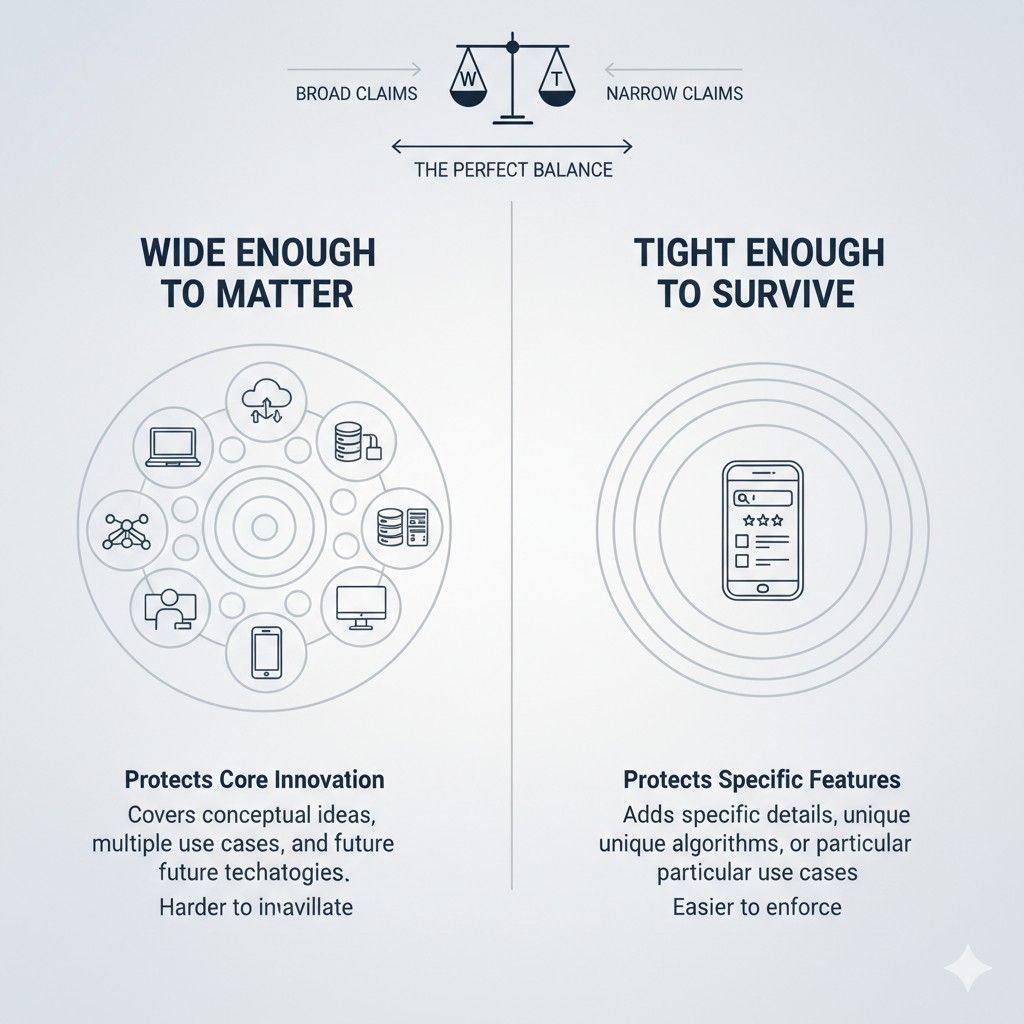
A claim drafted too low becomes trapped in one implementation. A claim drafted too high may look like a result without a real technical path. The sweet spot is the level where the inventive concept is still clear, but the claim is not tied to choices that could easily change.
Describe What the System Does in a Technical Way
One helpful move is to describe system behavior through technical action rather than through product labels.
Instead of naming a branded feature, describe how the system processes, selects, updates, routes, transforms, or controls something. That makes the claim less dependent on presentation and more grounded in technical function.
For a business, this matters because competitors usually change naming and packaging first. They are less likely to escape a well-framed claim that reaches the same technical behavior under different labels.
Avoid Claiming Only the End Result
A claim that only says the software achieves a useful result is usually not enough. It needs a technical route. It needs to show how the system gets there in a meaningful way.
The route does not have to include every implementation detail, but it should include enough structure to show that the claim is about a real solution.
This is a strong pressure test during drafting. If the claim could describe almost any system that gets a similar outcome, it is probably too broad in the wrong way. If it clearly points to the unique technical move, it is on better ground.
Write One Broad Story, Then Support It With Narrower Angles
Good claim strategy is rarely about choosing broad or narrow once. It is usually about building layers. The broader framing protects the larger concept.
The narrower framing protects exact versions, fallback positions, and valuable implementation choices.
This layered approach is useful because software businesses need both range and stability. They need claims that can reach future variations, but they also need claims that are likely to hold when challenged.
Use the Broad Claim to Cover the Core Competitive Threat
The broadest useful claim should usually aim at what a competitor would most want to copy. That is often the key system method, not the decorative product details.
The claim should cover the core technical move in a way that still has real structure.
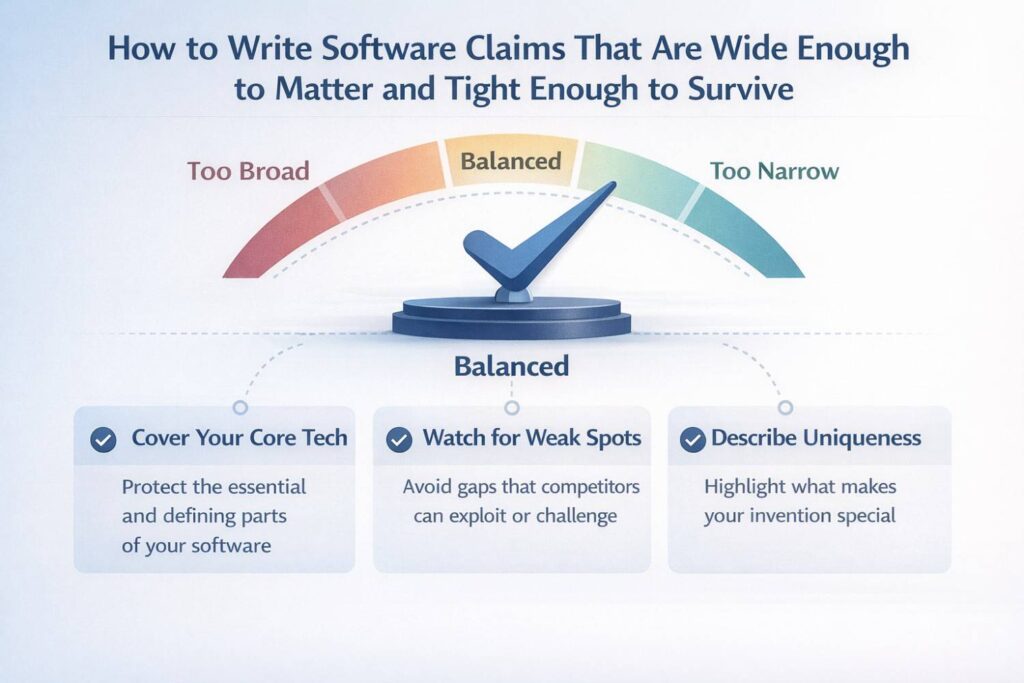
When businesses do this well, they create protection that maps to the real market threat. The patent is no longer just a technical document. It becomes part of competitive planning.
Use Narrower Claims to Protect Important Variants
Once the broad framing is in place, narrower claims can capture specific architectures, processing steps, data treatments, or interaction patterns that matter to the actual product.
These narrower claims are not filler. They are strategic support. They help preserve value if the broadest claim is challenged or reduced.
A business should think of narrower claims as reinforcement. They can protect the exact implementation that customers use today, while the broader claim protects the larger concept the company wants to own.
Build the Claim Around What Competitors Cannot Easily Change
One of the smartest ways to draft software claims is to focus on parts of the invention that a competitor would struggle to remove without losing the value of the solution. That is where claims tend to become more useful in the real world.
This is a business-first lens on claim writing. It asks not just what is new, but what is hard to work around.
Pressure-Test the Easy Workaround
Before finalizing claim language, the team should imagine the fastest path a smart competitor would take to avoid the patent.
Would they reorder steps, swap a model, split a service, rename a component, or move a function to a different layer? If a small technical change would avoid the claim while keeping the same advantage, the claim may be too narrow in the wrong place.
This is one of the most practical exercises in software patent work. It forces the claim to face market reality. It also helps reveal which elements are essential and which ones are limiting the scope for no good reason.
Anchor the Claim to the Sticky Part of the System
Some parts of a software system are easy to change. Others are sticky because they affect performance, reliability, customer experience, or deployment cost. Claims are often stronger when they anchor to the sticky part.
For example, if the invention’s advantage comes from a specific way of coordinating data updates across distributed components, that coordination logic may be a better claim target than the exact interface where users trigger the update.
The coordination logic is often harder for a rival to replace without changing the product in a meaningful way.
Wrapping It Up
Software patent claims should not be written to sound impressive. They should be written to do a job. That job is to protect the part of your software that creates real business value. Broad claims matter because they can reach the core idea across different versions and competitor workarounds. Narrow claims matter because they can lock onto the exact technical moves that make your product work in the real world. The strongest patent strategy does not pick one and ignore the other. It uses both with purpose.
Leave a Reply