Most patent claims fail not because the invention is weak, but because the improvement is described in a vague way that sounds like a goal instead of a real technical change. If you want stronger claims, you need to show exactly what changed in the system, how that change works, and why it makes the technology itself work better. That is the heart of a technical improvement. It is not “faster results” or “better user experience” by itself. It is a concrete change to how the software, model, device, or process operates under the hood. When you describe that clearly, your claims become sharper, easier to defend, and much harder to brush aside.
What Counts as a Real Technical Improvement
A lot of founders think a technical improvement is anything that makes their product better. That sounds right at first, but it is not enough for claim drafting.
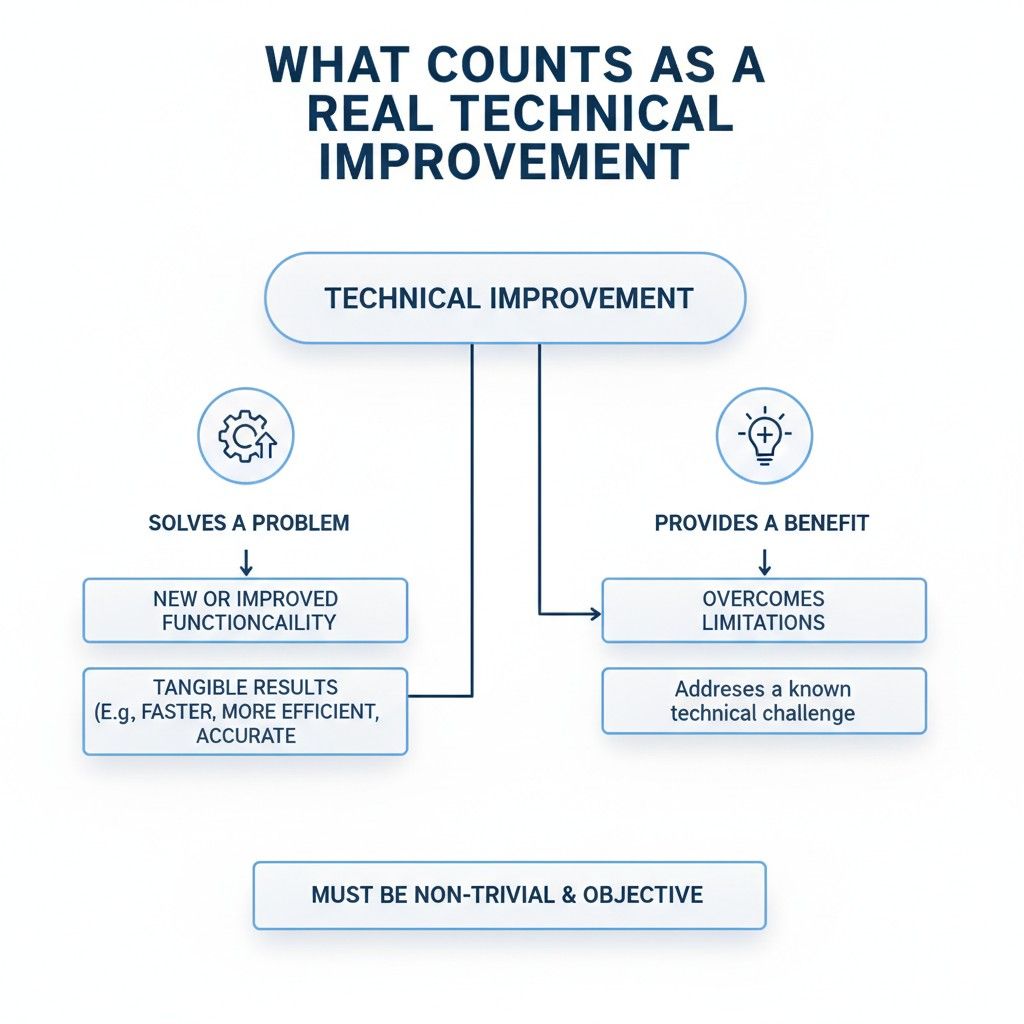
In patent claims, the key question is much tighter: what changed in the technology itself, and how does that change make the system work in a better way? That is the standard you want to meet.
A real technical improvement is not just a business win, a cleaner workflow, or a nicer user screen. It is a concrete change to how a machine, model, network, device, or software process actually runs.
A Technical Improvement Must Live Inside the Technology
When you describe the improvement, you want to place it inside the system, not outside it. That means the improvement should show up in the engine, not just in the outcome.
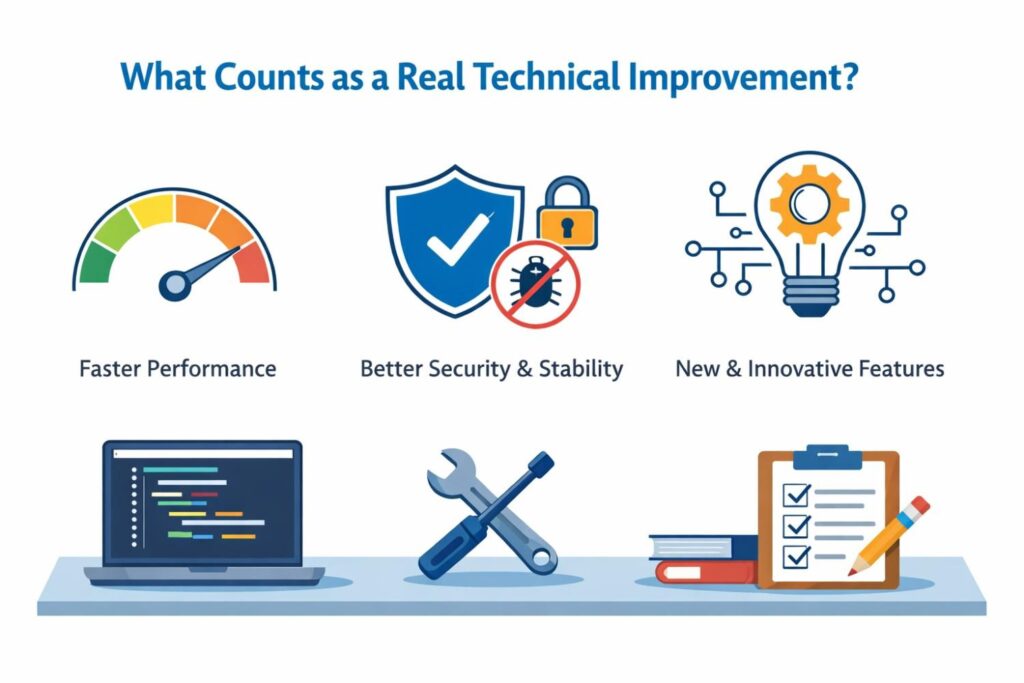
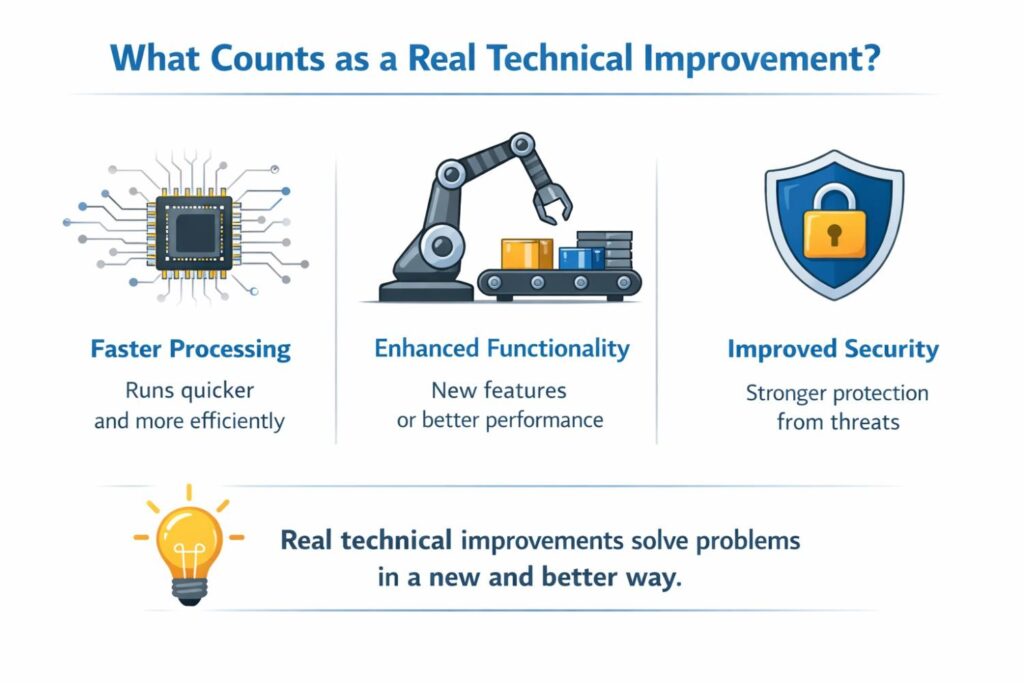
If your invention reduces memory use, cuts network traffic, lowers compute load, improves signal quality, makes training more stable, or speeds up execution in a specific way, you may have a technical improvement.
But if you only say it helps users make better choices, helps teams work faster, or helps a company save money, that is not enough on its own.
This is where many businesses lose strength in their patent story.
They describe the commercial value before they explain the engineering value. Investors may love the business result, but claims become stronger when the technical result comes first.
The safer move is to tie every claimed benefit to a system-level change.
Instead of saying the invention “improves decisions,” say that it uses a specific scoring pipeline that reduces repeated processing by removing duplicate feature extraction across related inputs. The second version gives the claim something real to stand on.
Better Results Alone Are Not the Same as Technical Improvement
It is easy to confuse a good result with a technical improvement. A product may be more accurate, more useful, or more appealing in the market without changing the underlying technology in a meaningful way. Claims need more than “our platform performs better.” They need the reason why, at the technical level.
A smart way to test your own invention is to ask this: if you removed the business context, would an engineer still see a system improvement? That question helps strip away the marketing layer.
If the answer is yes, you are probably getting close. If the answer is no, then the write-up may still be describing a business method dressed up as engineering.
The Improvement Should Change How the System Operates
A true technical improvement usually changes operation, not just output.
It alters the way the system handles data, schedules tasks, stores information, routes signals, trains a model, secures communication, or allocates resources. In other words, the invention should affect how the machine gets the work done.
This matters for businesses because strong claims often come from operational detail. Competitors can copy high-level results while changing surface wording.
But when your patent is tied to a distinct operational change, it becomes harder to design around. That gives your company a better protection edge and a clearer moat.
Ask What the System Does Differently Step by Step
One of the best ways to find the technical improvement is to walk through the old approach and your new approach side by side. Look at each step and ask where the flow changed.
Did you move a task to the edge instead of the server? Did you compress data before transmission using a special rule tied to sensor state? Did you replace repeated polling with event-based triggers?
Did you narrow search space before running a heavier model? The exact step where the process changed is often where the improvement lives.
This exercise is practical for business teams because it turns a vague invention story into claim-ready material. It also helps product, engineering, and legal teams speak the same language.
Once you can point to the changed step, you can start building claims around it with much more confidence.
A Technical Improvement Usually Solves a Technical Problem
The strongest claim language often starts with a technical pain point. The problem might be too much latency, high battery drain, unstable model output, poor fault tolerance, network congestion, storage overhead, weak synchronization, or inaccurate detection under real-world noise.
When you define that problem in plain terms, your improvement becomes easier to explain and easier to claim.
This is useful for companies because it keeps patent drafting grounded in the real work your team already did.
Most good products were built to fix something annoying, costly, or limiting in the stack. That pain point is not just product history. It is often the opening line to your patent strategy.
The Best Improvements Are Specific, Not Generic
Generic language weakens claims. Words like optimize, enhance, streamline, and improve are fine in everyday writing, but they do not carry enough weight by themselves in a patent claim story.
The stronger move is to say what was improved, by what mechanism, and under what conditions.
A business should train its teams to explain inventions with measurable and structural detail. Instead of saying a system “improves performance,” say it “reduces repeated database reads by generating and storing a compact state object that can be reused across related session requests.”
Instead of saying a model “works better,” say it “updates only a selected subset of parameters based on drift scores, reducing retraining load while preserving output quality.” The more exact the language, the more real the improvement feels.
Tie the Improvement to Architecture, Not Just Features
Features are what users see. Architecture is what makes the feature possible. Claims are often stronger when the invention is tied to architecture.
That could mean a new arrangement of modules, a new data path, a new control loop, a new memory structure, a new training sequence, or a new coordination rule between system parts.
For businesses, this is a major strategic point. Features change fast. Product teams rename them, redesign them, or merge them into larger flows. Architecture tends to be more stable.
If your patent is anchored only to a front-end feature, your protection may age badly. If it is anchored to the technical architecture that drives the feature, it often stays useful longer.
Look Under the User Interface
Many companies first explain inventions through screens and workflows because that is what product teams know best. But the claim-worthy material is often one layer below.
The real value may come from how requests are queued, how state is tracked, how conflicting inputs are resolved, how training jobs are split, or how sensor data is filtered before downstream use.
This is why the best patent drafting process pulls from engineering notes, system diagrams, code comments, and design docs, not just product decks.
PowerPatent is built around this exact idea: helping founders pull the real technical substance out of what they already built, then shaping it into stronger patent language with real attorney oversight. You can see how that process works here: https://powerpatent.com/how-it-works
A Technical Improvement Should Be Hard to Fake With Empty Language
A useful test is this: could a competitor copy your wording without copying your system? If yes, the description may still be too soft.
Strong technical improvement language forces the reader to picture a real implementation. It does not leave the invention floating at a high level.
That is important for businesses because vague claim language often looks broad but acts weak. It feels impressive in a pitch deck but does not hold up well when challenged.
A narrower but more concrete technical description often creates better long-term value than a broad sentence with no real mechanics behind it.
Use the “Because” Test to Make the Improvement Real
A very effective drafting habit is to make sure every improvement statement can survive a “because” test. If you say your system is faster, you should be able to finish the sentence with because it does something specific.
If you say it is more reliable, you should be able to explain because it changes some technical behavior in a concrete way.
This simple move helps businesses avoid empty claim language. It forces the team to connect benefit to mechanism. That connection is where patent strength usually grows. It also makes invention reviews much easier, because weak ideas tend to fall apart when asked to explain the “because.”
Example of Weak Framing
A weak version would say that the invention improves processing speed for analytics workloads. That sounds nice, but it does not say what changed. It tells the result but hides the reason.
Example of Stronger Framing
A stronger version would say that the invention groups incoming events into context-linked batches and runs shared preprocessing once for the batch rather than once per event, reducing repeated compute operations and shortening processing time.
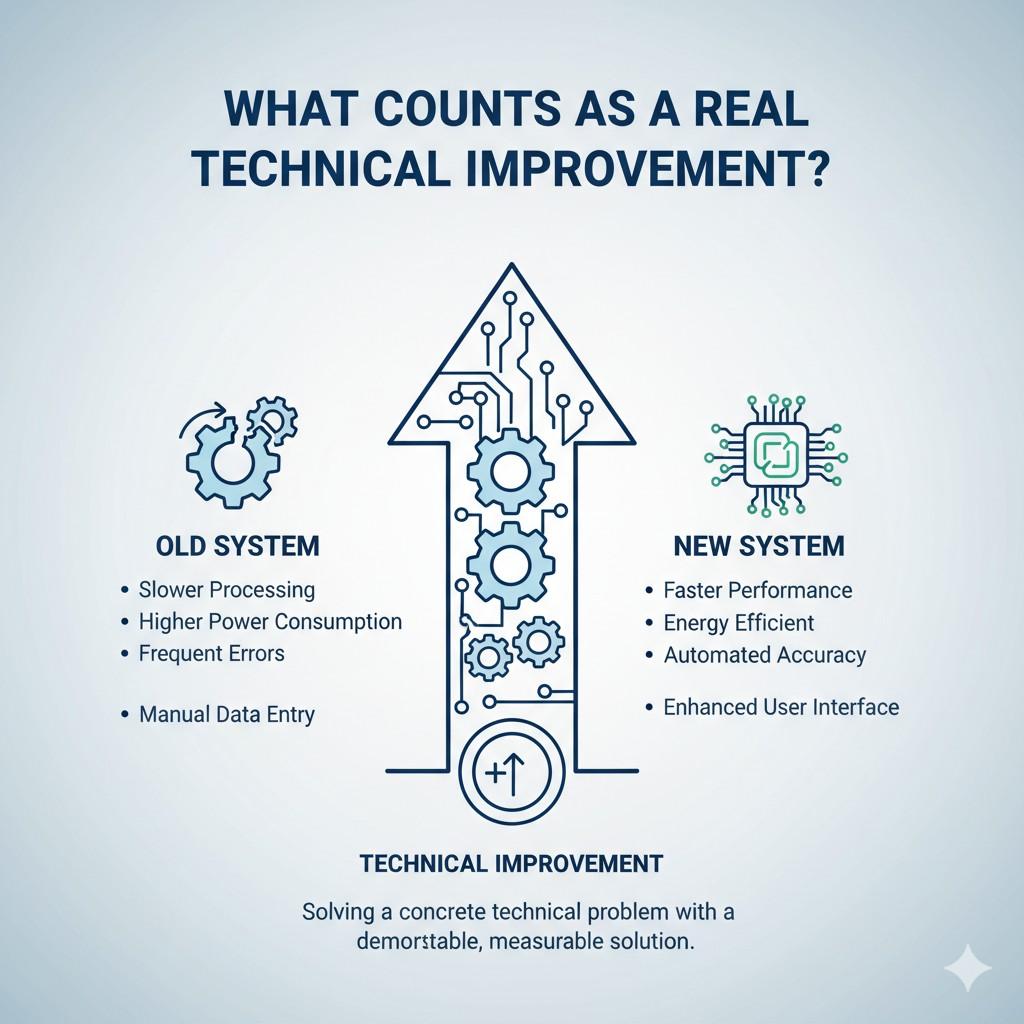
Now the technical change is visible. The benefit is attached to an actual mechanism.
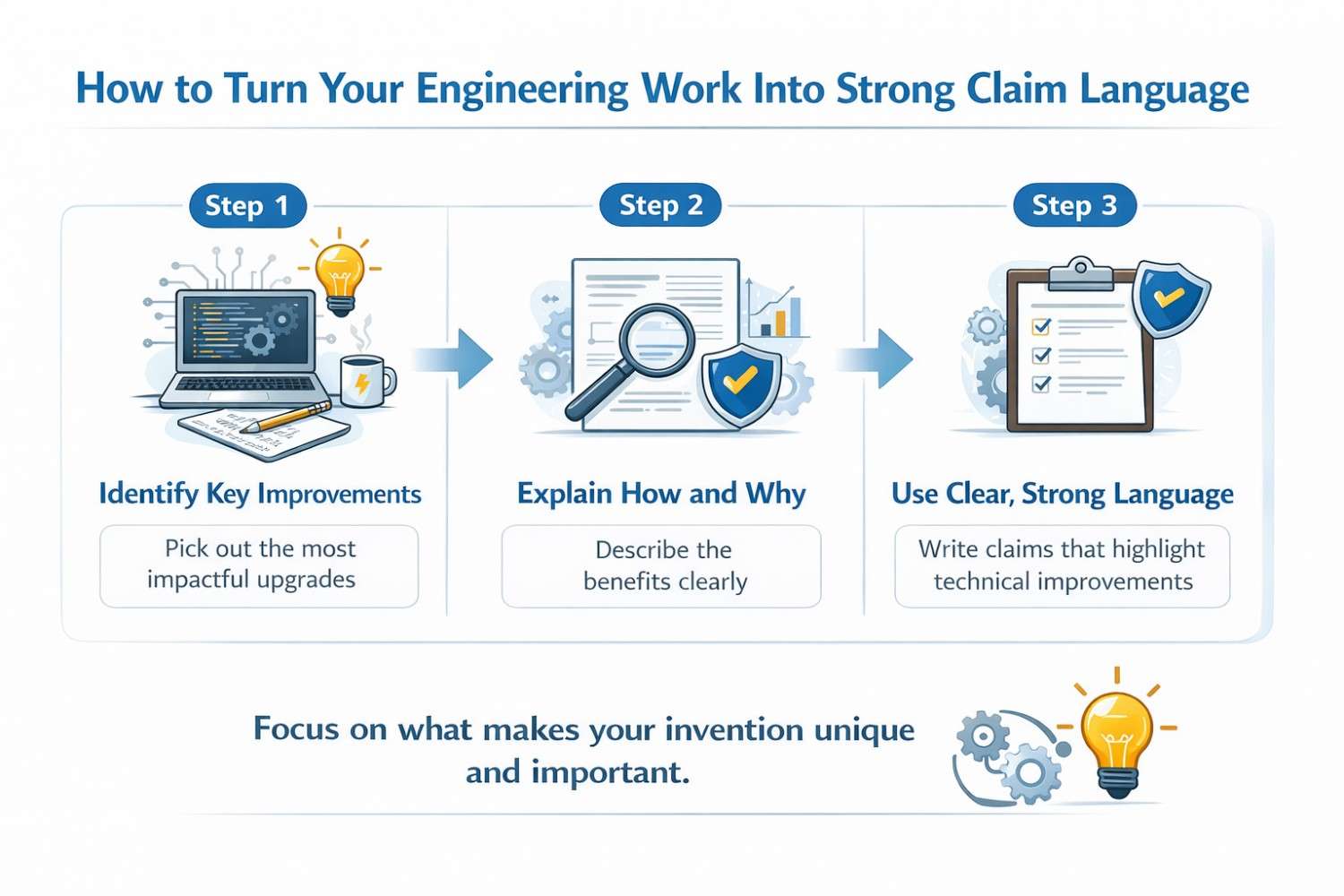
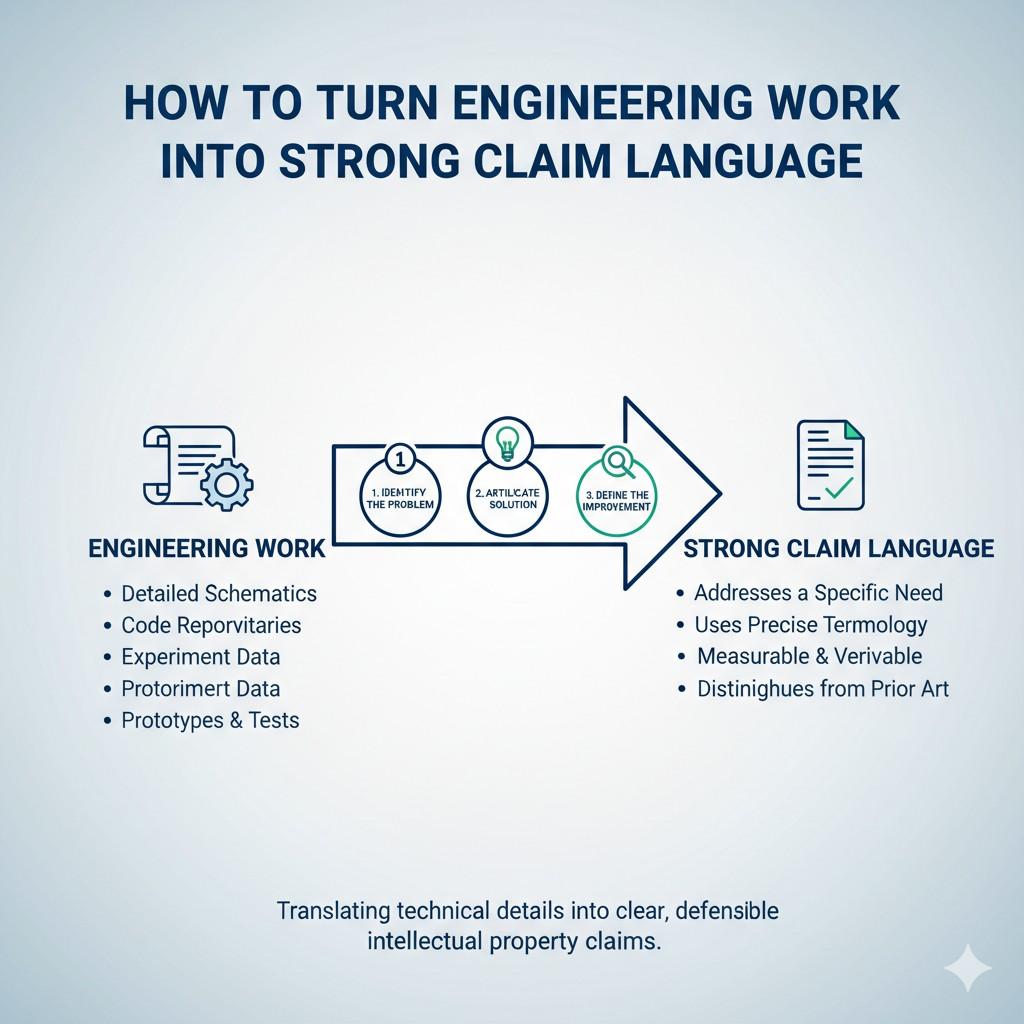
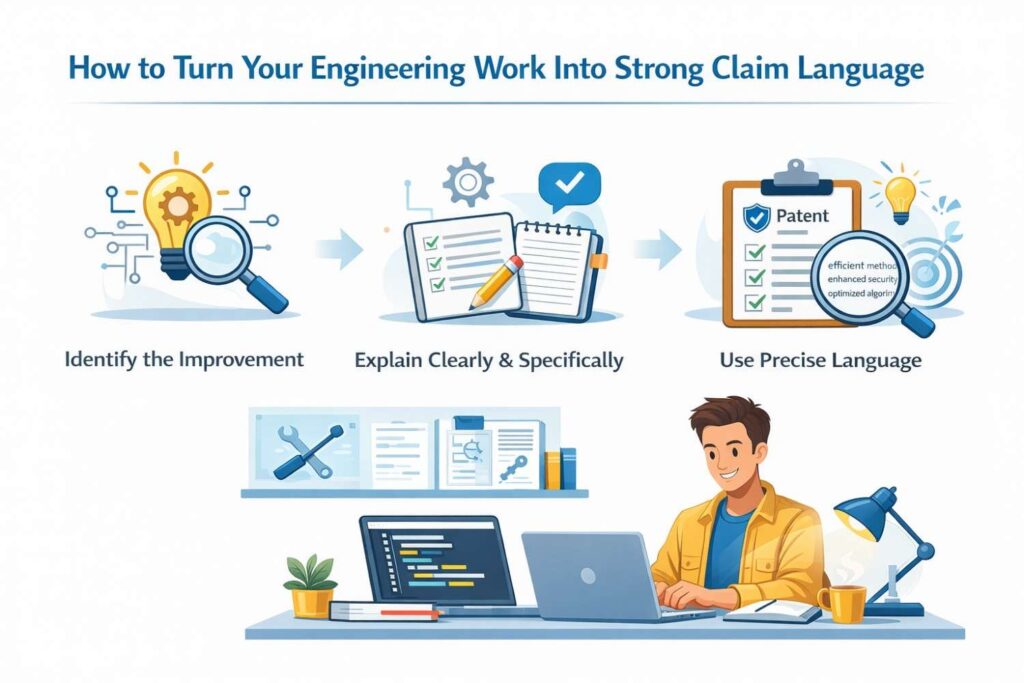
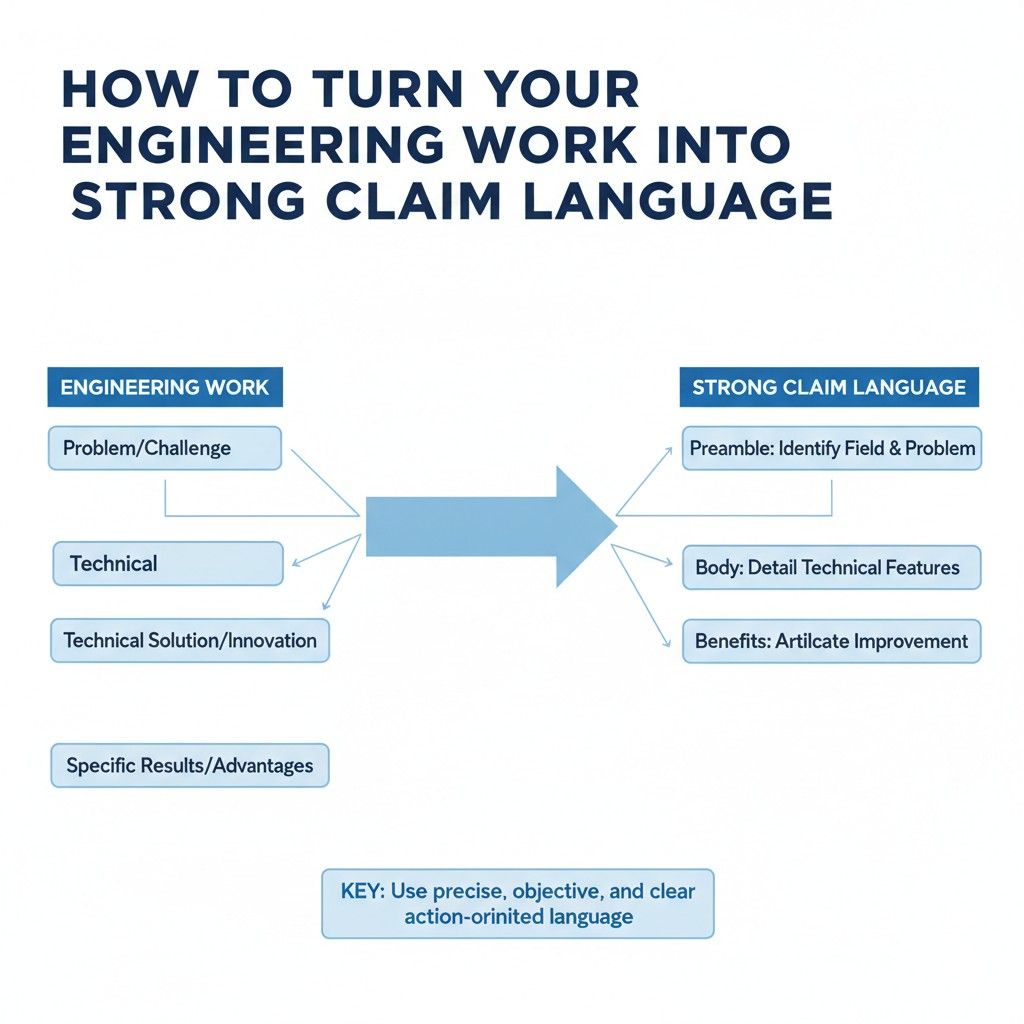
How to Turn Your Engineering Work Into Strong Claim Language
A lot of smart patent work starts long before anyone writes a claim. It starts in the build process. Your team solves a hard system problem, tests a better approach, and ships something that works in a cleaner, faster, or more reliable way.
The problem is that most engineering work is not written down in claim-ready form. It lives in code, diagrams, pull requests, sprint notes, and team memory.
To get strong patent claims, you have to translate that work into language that clearly shows what the invention does, how it does it, and why that technical change matters.
Start With the System Change, Not the Product Pitch
The easiest way to weaken a claim is to begin with the sales version of the invention. A product pitch is made to create excitement. A claim is made to define the actual technical boundary of what was built.
Those are not the same thing. When you begin with broad product language, you usually end up with claims that sound polished but say very little.
The better move is to ask what changed inside the system. Maybe your platform now routes requests based on load state instead of sending them through a fixed path.
Maybe your model updates only selected layers after drift detection instead of retraining the whole stack.
Maybe your device stores a compact intermediate state so it does not need to rerun a heavy process step. Those are technical changes. That is where claim language should begin.
Claims Need Engineering Truth, Not Marketing Words
Engineers often explain a new system in honest, concrete terms. Marketing teams often explain the same thing in outcome terms. Patent claims need the first kind of truth.
They need the build truth. If your draft says the invention “delivers better insights” or “improves the user journey,” it may sound attractive, but it does not tell the reader what the machine is doing differently.
Strong claim language comes from replacing soft words with operational detail. Instead of “smart routing,” say how routing is decided.
Instead of “adaptive processing,” explain what input is measured, what threshold is checked, and what behavior changes when that threshold is met. This does not make the claim weaker. It makes it more real.
Pull From the Build Artifacts Your Team Already Has
Most companies do not have a shortage of invention material. They have a shortage of organized invention language. The good news is that the raw material is usually already there.
Engineers leave clues everywhere. The system design doc may explain the old bottleneck.
The code comments may show the reason for the new logic. The benchmark notes may reveal the exact technical gain. The architecture diagram may show the changed path that matters most.
This is highly useful for businesses because it means strong patent work does not require starting from a blank page. It requires pulling the right signals from the work your team has already done.
When companies build a habit of capturing invention details from normal engineering records, claim drafting gets faster and far more accurate. That is one reason startups use PowerPatent.
It helps turn real technical work into clear patent content with software support and real attorney review. You can see how that works here: https://powerpatent.com/how-it-works
Translate Code Decisions Into Functional Claim Language
Code itself rarely becomes a claim word for word, but the choices inside the code often map directly to claim structure. A claim usually does not need every implementation detail.
It needs the core technical behavior. That means you should look at the code and ask what functional steps the system is performing.
For example, a block of code may check device state, classify the request type, select one of two processing paths, and store a reduced state object for later reuse. In code, that may appear across several files and helper functions.
In claim language, it may become a cleaner sequence: receiving device state data, selecting a processing mode based on the state data, generating a reduced state representation, and reusing that representation for a later request.
The code is the proof. The claim is the structured expression of the invention.
The Goal Is Not to Copy the Code
Many technical founders worry that claims will either become too abstract or too tied to one code version. The answer is to capture the logic of the code without locking the claim to unnecessary syntax or narrow implementation choices.
You do not need to claim variable names, file names, or every branch. You need to claim the technical behavior that gives the system its advantage.
This is where discipline matters. If you claim too high, the invention can sound empty. If you claim too low, you may trap yourself inside one version of the implementation.
Strong drafting finds the middle layer where the technical idea is both concrete and durable.
Name the Technical Inputs and Outputs Clearly
Claims get stronger when they describe the right inputs and outputs of the system.
This sounds simple, but it is often where weak drafting begins. Teams talk about “data” and “results” when they should be talking about specific technical inputs and outputs. Broad words blur the mechanism.
A more effective approach is to identify what the system receives, what it creates, and what it uses next. It may receive sensor readings, network state data, model confidence scores, timing data, hardware status, or user interaction events.
It may generate a ranked subset, a compressed state object, a control signal, an updated parameter set, or a filtered stream. Once those are named properly, the claim begins to sound like a technical system instead of a business process.
Show the Decision Logic That Makes the System Smarter
A large share of modern engineering value lives in decision logic. The invention is not always a new piece of hardware or a brand-new model.
Often it is the rule that decides when to switch modes, when to cache, when to compress, when to escalate, when to retrain, or when to avoid unnecessary work. That logic can be highly valuable in claims if it is described clearly.
Businesses should pay close attention here because this type of invention is easy to overlook. Teams often treat it as mere tuning. But if the tuning changes system behavior in a meaningful and repeatable way, it may be central to the invention.
Claim language should capture that rule in a way that ties condition to action. The stronger the link between the trigger and the system response, the stronger the technical story becomes.
Use Cause and Effect in Every Draft
A claim becomes much easier to defend when each step has a clear reason for being there.
One of the best habits in patent drafting is to ask what each claimed action causes the system to do next. If one step does not support the next, or if a result appears without a visible mechanism, the language may still be too loose.
This matters for companies because cause and effect exposes the real invention.
If your system identifies a congestion state, then shifts traffic to a lower-cost path, then reduces failed requests during peak load, that chain tells a strong technical story. It shows not only what happens, but why it happens. That is far more useful than saying the platform “improves reliability.”
Weak Language Hides the Engine
When a draft skips cause and effect, it often reads like a summary slide. It tells the end result without showing the engine. That is dangerous because weak language can look broad while providing very little real protection.
A better draft shows the sequence. It helps the reader see the technical flow. Once that flow is visible, it becomes easier to build claims around it and harder for others to dismiss it as vague.
Separate the Main Idea From the Optional Details
Engineering work often includes many good ideas layered together. There may be a main system change, several support features, fallback paths, performance tweaks, and deployment choices.
That is normal in real product development. But claim language gets stronger when the core inventive idea is separated from the optional details around it.
For businesses, this is a strategic step. The core claim should usually focus on the smallest set of technical features that create the actual improvement.
Extra features can support dependent claims or future filings. If you force every detail into the main claim, you may make it harder to enforce and easier to avoid.
But if you isolate the real engine of the invention, you give yourself a stronger center of gravity.
Find the Narrowest Technical Step That Creates the Biggest Change
Some of the best patent claims are built around one key move. It may be small in code size but large in system effect. Maybe your team added a pre-filter before a costly analysis step.
Maybe you store a shared intermediate output so later requests reuse it. Maybe you trigger retraining only when a drift score crosses a calculated threshold. That single move may be where most of the invention value sits.
Businesses should train themselves to look for that step. It helps avoid bloated claim sets and it sharpens portfolio strategy.
A company with a clear view of its key technical moves is in a much better position to file strong patents around them before competitors catch up.
Write Claims Around What Must Happen, Not What Usually Happens
Engineering teams often explain systems with language like “in some cases” or “the service may” or “typically.” That is fine in internal discussion, but claim drafting needs a firmer center.
The claim should identify the steps or relationships that define the invention when it is being practiced.
This does not mean every claim must be narrow. It means the claim must be anchored in actions that matter.
If your invention works because the system compares a live input to a stored profile and then selects a different execution path based on the comparison, that relationship should be clear. It should not be buried under language that makes the core idea feel optional.
Use Real Failure Points to Sharpen the Language
One of the most useful places to find strong claim language is in the old failure mode your team had to fix. Maybe the previous system created too many duplicate calls.
Maybe edge devices ran out of memory. Maybe inference time rose too fast during traffic spikes. Maybe model output became unstable when one sensor degraded. These are not just engineering headaches. They are clues to the invention.
When you write from the failure point, the claim language becomes more precise. You stop speaking in broad outcomes and start speaking in targeted technical action.
That is good for businesses because it produces claims tied to real pain, and real pain is often what competitors face too.
Your Best Patent Material May Be in the Bug History
Many companies overlook bug reports, performance regressions, and emergency fixes as patent sources.
That is a mistake. Some of the strongest patent ideas come from the moment a team had to solve a failure that ordinary approaches could not handle well.
The key is to ask whether the fix was more than routine cleanup. If it required a new technical approach, new control logic, a new data structure, or a new way to divide work across the system, it may be patent-worthy.
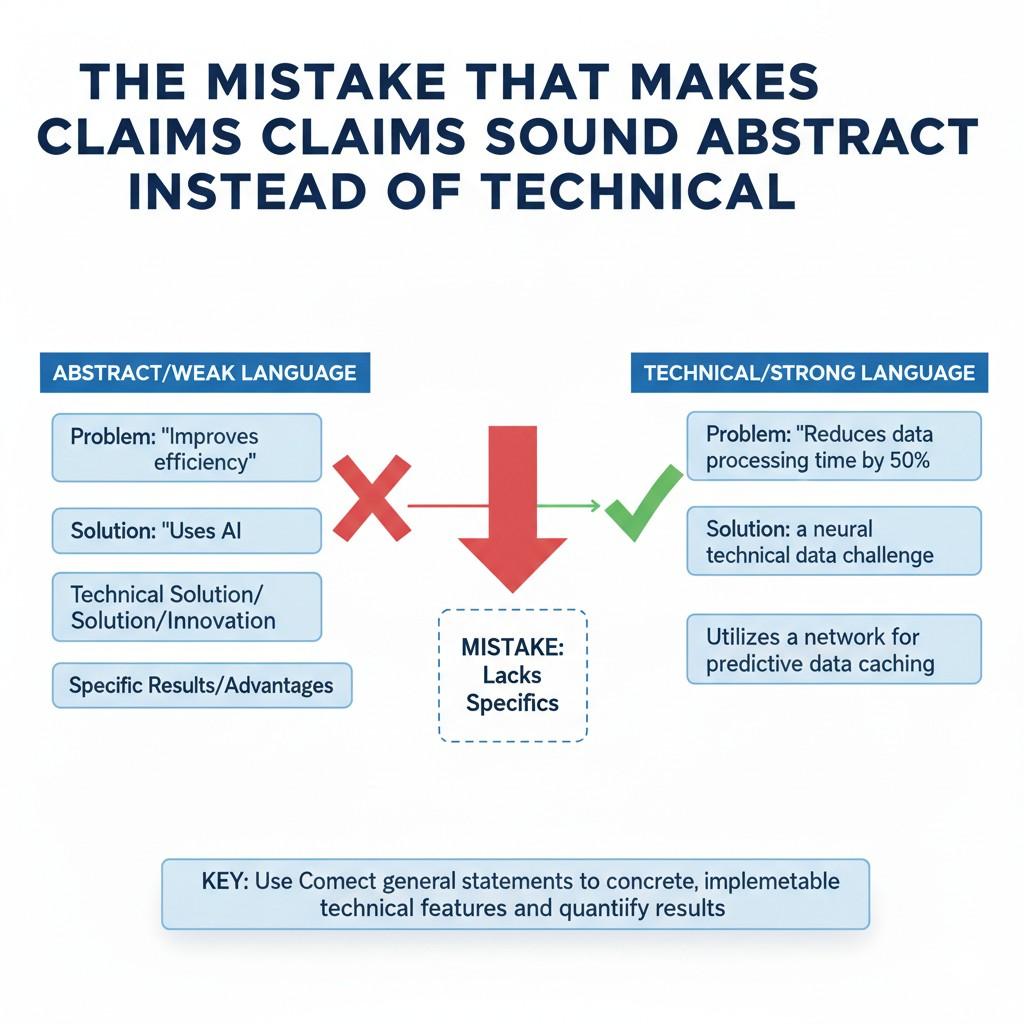
The Mistake That Makes Claims Sound Abstract Instead of Technical
The most common mistake in patent drafting is simple: the claim talks about what the invention achieves, but not what the invention actually changes inside the technology.
That is when a claim starts to sound abstract. It may describe a nice outcome, a useful business result, or a smart-sounding idea, yet still fail to show the technical move that makes the system different.
For startups and engineering teams, this is a costly mistake because it can make a real invention sound thin on paper. The fix is not to add more buzzwords. The fix is to describe the actual technical behavior with clarity.
The Problem Starts When the Claim Sounds Like a Goal
A claim often becomes abstract when it is written like a mission statement. It says the system improves efficiency, increases accuracy, enhances security, or supports better decision-making.
Those phrases are not useless, but standing alone, they do not explain the invention. They tell the reader where the system ends up, not how it gets there.
This is a major issue for businesses because many internal invention summaries are written in exactly this way. They are made to be easy to share in meetings, so they focus on benefits.
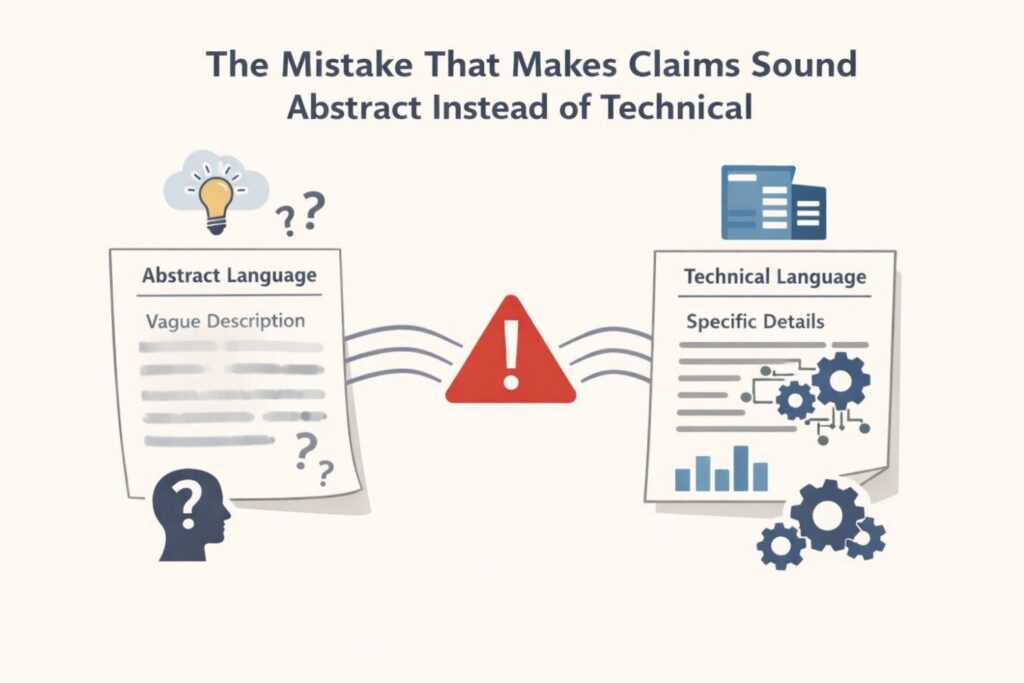
That works for slides. It does not work well for claims. A patent claim needs to do more than point to a result. It must show the mechanism that creates that result.
Abstract Language Hides the Real Engineering Value
When claim language stays too high-level, it often covers up the very part of the invention that makes the company valuable.
The engineering team may have solved a hard systems problem, but the claim ends up sounding like a broad idea anyone could say. That disconnect is dangerous because it reduces the sharpness of the patent right where it matters most.
For businesses, this usually happens when the invention is filtered through too many layers before it gets drafted. Engineering explains the build. Product explains the feature.
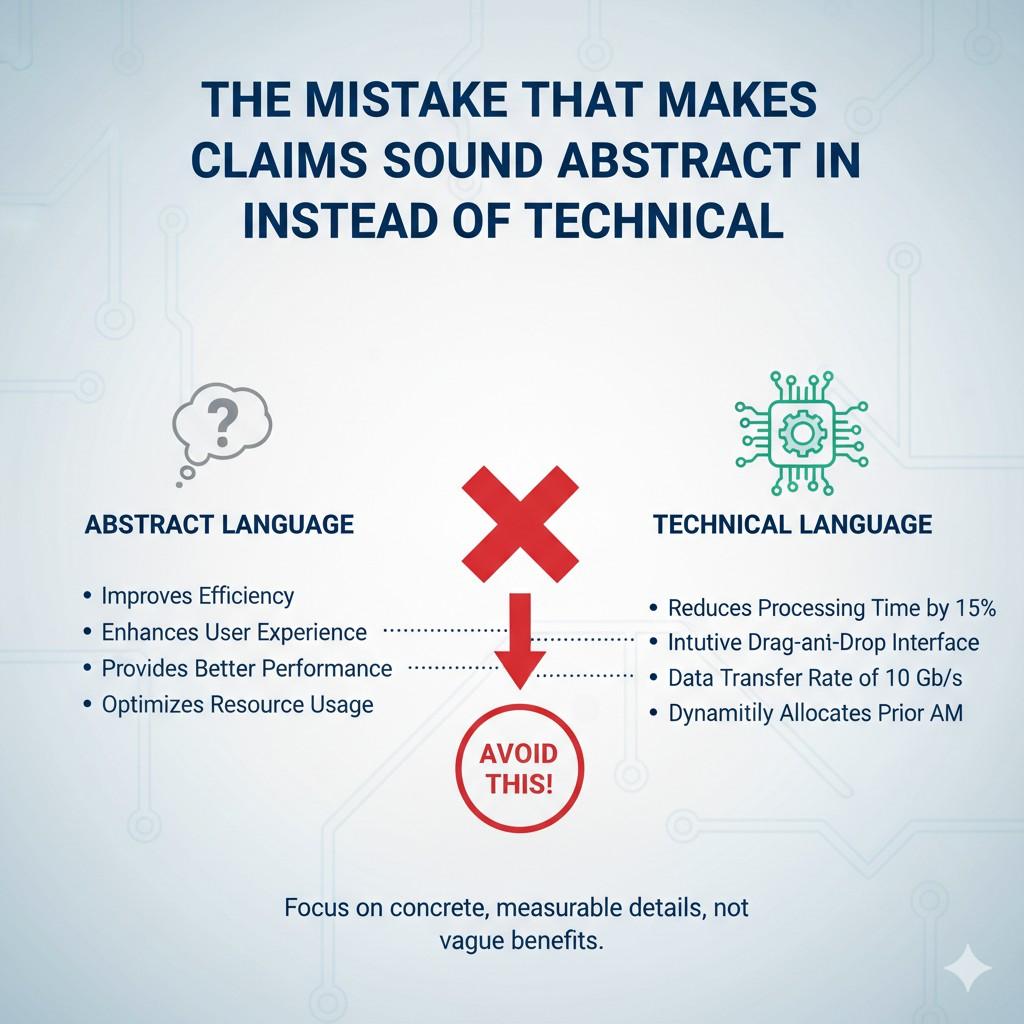
Leadership explains the market benefit. By the time the claim is written, the technical substance may be gone. That is why the best drafting process keeps a direct line back to the original system change.
The Claim Describes an Outcome Instead of an Operation
A technical claim should normally describe something the system does, not just something the system delivers. That difference matters more than most teams realize. If the claim says the invention provides more reliable service, that is still an outcome.
If the claim says the system detects a failure state, shifts processing to a secondary execution path, and preserves a stored intermediate state to avoid restarting a prior step, that begins to sound technical because it describes operations.
This shift from outcome language to operation language is one of the most valuable habits a company can build. It improves patent quality, but it also improves invention review.
Teams can see faster whether there is a real technical contribution or only a broad product concept.
The Reader Should Be Able to Picture the System Working
A good test is whether a technical reader can imagine the system behavior after reading the claim. If the claim leaves the reader with only a business idea or a broad result, it is probably still abstract.
If the reader can picture inputs, system actions, transitions, and outputs, the claim is moving in the right direction.
That test is highly practical for businesses because it does not require deep patent expertise.
It simply asks whether the language points to a working technical flow. If it does not, the team likely needs to go back and add more substance.
The Mistake Gets Worse When Teams Use Familiar Buzzwords
Some words create the appearance of technical detail without giving any real detail at all.
Terms like intelligent, dynamic, adaptive, optimized, automated, and scalable can sound advanced, but they often hide the missing mechanics. They are not bad words by themselves. The problem comes when they replace the actual explanation.
This matters for businesses because modern product language is full of these terms. In crowded markets, everyone claims to be using smart automation, intelligent systems, and adaptive processing.
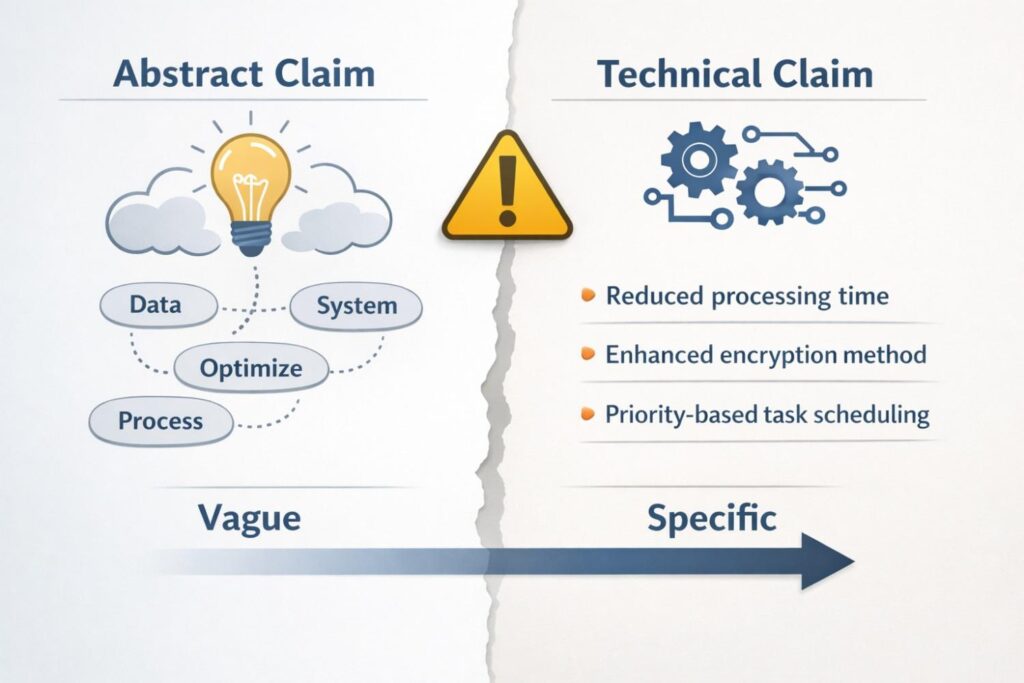
That kind of language does little to separate your invention unless you explain what makes it technically different. A claim should not depend on labels. It should depend on the system behavior behind the label.
Broad Business Framing Can Make a Strong Invention Look Weak
Founders often explain inventions in terms of time savings, revenue gains, lower support cost, or better customer decisions. Those are real benefits, and they matter.
But they are not the center of the claim. When business framing takes over the draft, the technical improvement can become invisible.
For companies, this is not just a writing problem. It is a strategy problem. If your patent story focuses too much on business value, competitors may be able to reframe your invention as a generic business method instead of a technical contribution.
The safer path is to keep the business result in the background and put the technical mechanism in the foreground.
Claims Sound Abstract When They Skip the System Constraint
Technical inventions usually exist because something in the system was hard. There was too much latency. Memory was limited. The device battery was weak.
Data quality was noisy. Network conditions changed too often. A model became unstable. A server path created repeated work. Those constraints are often where the invention begins.
When a claim ignores that constraint, it can lose its technical grounding. The invention then sounds like a floating idea that exists apart from the machine, the network, or the computing environment.
For businesses, that is a missed chance. The system constraint often makes the invention more believable, more specific, and harder to dismiss.
Put the Technical Friction Back Into the Story
One of the best ways to make a claim sound less abstract is to explain the friction that the system faced before the invention. That friction gives shape to the technical change.
It tells the reader why the claimed steps exist and why they are not random.
This is also useful from a business view because it helps internal teams decide what is actually worth filing.
If the invention solves a real technical bottleneck, there is often strong claim material there. If the invention only rephrases a business workflow, the patent case may be weaker.
The Draft Often Fails to Name the Changed Technical Component
Another reason claims sound abstract is that they refer to a generic system without identifying what part of the system changed.
The draft may mention a platform, engine, module, or processor, but never explain what that part does differently. That leaves the invention vague.
A stronger claim points to the changed technical role. It may be a scheduling component that changes how tasks are assigned. It may be a filtering component that removes low-value signals before a heavier step runs.
It may be a local agent that decides whether to process on-device or send work upstream. Once the changed component is visible, the claim begins to look much more technical.
Wrapping It Up
A strong claim does not win because it sounds broad. It wins because it clearly shows the technical change your team made and why that change matters inside the system. That is the real job here. When you describe a technical improvement well, you make it easier to show that your invention is not just a business idea, not just a result, and not just a polished product story. You show that your team changed how the technology works.
Leave a Reply