Most software patents do not fail because the idea is weak. They fail because the claims are weak. That is the part many founders miss. You can build something truly new. You can solve a hard problem. You can have clean code, strong user growth, and a real edge in the market. But if the claims are drafted in a vague, narrow, sloppy, or easy-to-design-around way, the patent may not do the job you hoped it would do. It may look fine on paper and still give you very little real protection.
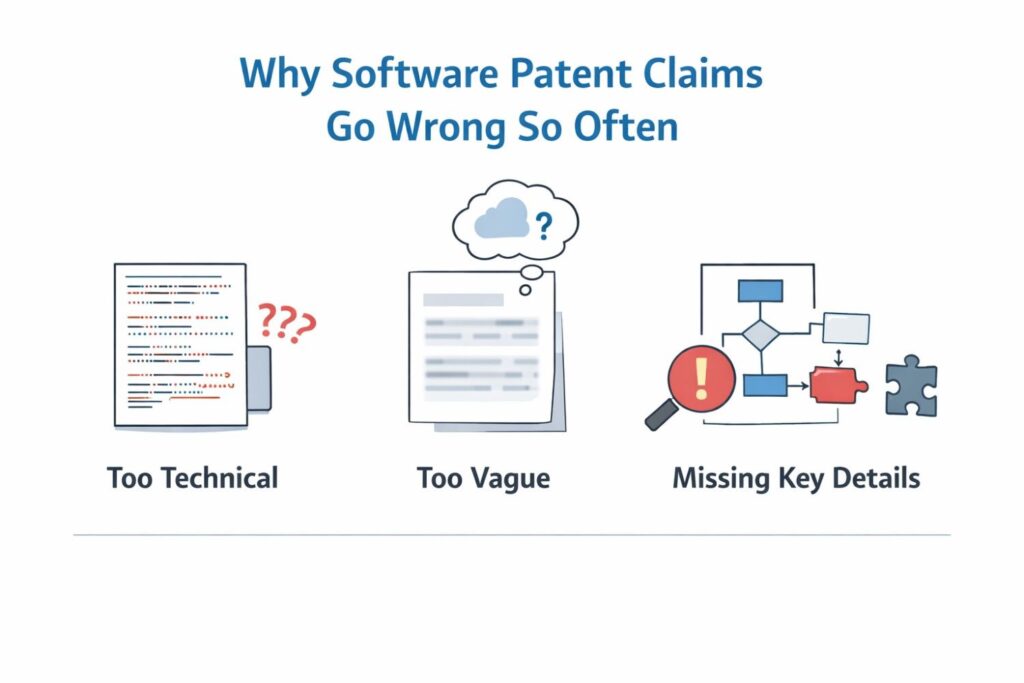
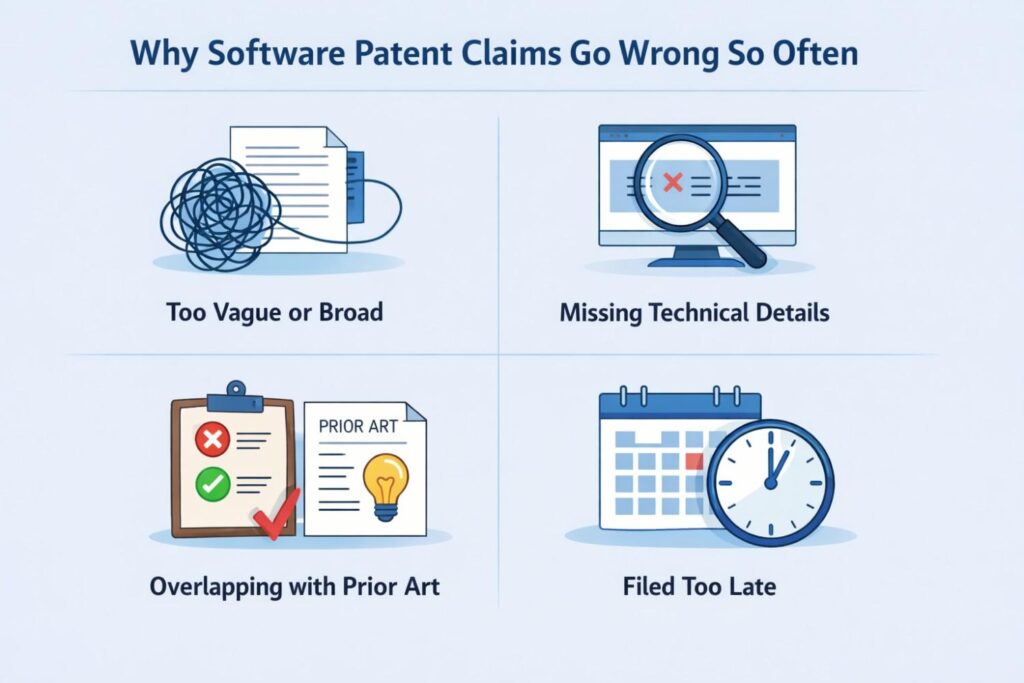
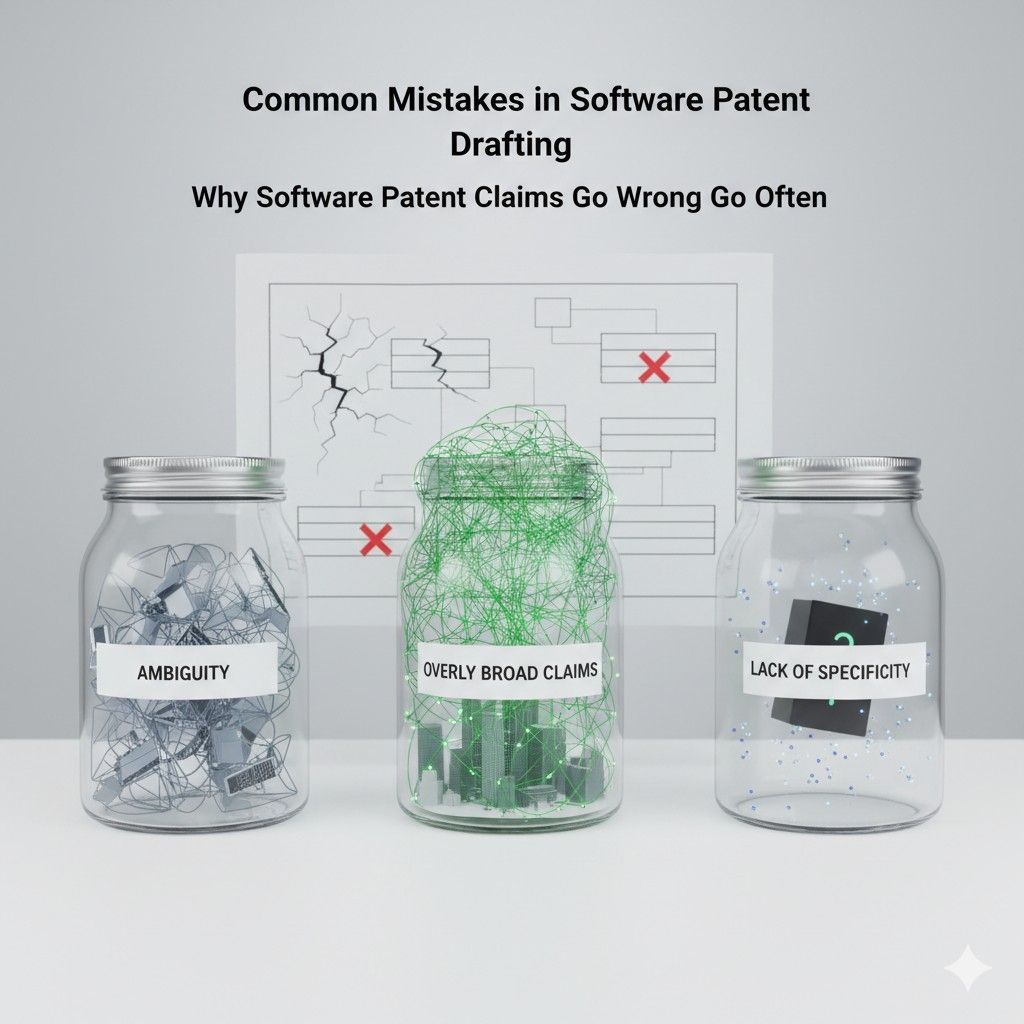
Why Software Patent Claims Go Wrong So Often
Software patent claims go wrong for a simple reason. Most teams try to protect their product before they slow down enough to understand what the real invention is.
They rush from building to filing. They describe features, screens, and outputs, but they do not fully capture the engine under the hood. That gap creates weak claims.
For a business, this is not a small drafting issue. It is a strategy issue.
A patent is supposed to protect the edge that helps you win. If the claims miss that edge, the filing can eat time and money without giving you strong business value back.
That is why founders need to see claim drafting as part of product strategy, not just a legal step.
Most teams describe what users see, not what the system actually does
A common problem starts at the surface. Teams explain the dashboard, the alerts, the workflow, or the user experience because those things are easy to talk about.
But the patent office does not care much about a polished screen if the claim does not clearly capture the technical way the system achieves the result.
This matters because user-facing language is easy for others to avoid. A competitor can change the layout, rename the feature, or adjust the sequence of screens and still use the same core method.
If the claim sits too close to the visible product layer, it may leave the real value open for someone else to copy.
What the business should do instead
The better move is to ask one hard question early: what is happening behind the screen that makes this work better than the old way?
That answer often lives in data handling, timing, model behavior, system coordination, resource allocation, or decision logic. Once that core is clear, the claim can be built around the technical move that creates the advantage.
A practical way to uncover the real invention
Have your engineering lead explain the product without mentioning the interface once. Ask them to describe the flow from input to processing to output.
Ask where the system makes a choice, saves time, reduces cost, improves accuracy, or handles scale in a new way. That is often where the claim should begin.
Founders confuse a product feature with a patentable concept
A feature is not always an invention. A feature may be useful, popular, and valuable to customers, but still not be the right thing to claim.
Many software filings go wrong because the team tries to patent the feature name or the business result instead of the technical method that makes the feature possible.
For businesses, this mistake creates a false sense of safety. The company feels protected because the filing mentions the thing customers love.
But when you look closely, the claim may not lock down the technical path that competitors will actually copy.
The pressure to file fast can blur the thinking
Speed matters for startups. Teams move fast because markets move fast. Investors move fast.
Competitors move fast. That pressure can push founders to file before they have mapped the invention clearly enough. The result is often a claim set that looks complete but was built on shallow thinking.
Filing fast is not the real problem. Filing without a sharp theory of protection is the problem.
A fast filing can still be strong if the team knows what it is trying to protect, which versions matter most, and what future product path needs coverage.
Speed should not replace depth
The smartest businesses do not wait forever, but they also do not treat drafting like form filling.
They capture the technical story while the details are fresh. Then they shape claims around the broad concept, the key system flow, and important fallback positions. That gives speed and depth at the same time.
A simple business rule to follow
Before filing, write one sentence that begins with: our competitive edge comes from the way our system does this specific technical step.
If your team cannot finish that sentence in a clear way, the claim strategy probably is not ready yet.
Software is often explained in abstract words that sound clear but protect very little
Software teams naturally use broad terms. They say the system analyzes data, optimizes performance, matches users, predicts outcomes, or automates decisions.
Those phrases sound good in a pitch deck. They are not enough on their own in a claim.
Abstract language creates two business risks. First, it can make the filing easier to challenge because it sounds like a high-level idea instead of a real technical implementation.
Second, it can leave room for competitors to say they do something different, even when they copy the core idea in practice.
The claim gets shaped around today’s version of the product
Another reason claims go wrong is that teams draft too close to the current release.
They lock the language to the exact workflow, model type, database structure, or deployment setup used at filing time. That feels precise, but it can become a trap.
Products change. Startups pivot. Models improve. Infrastructure shifts. If the claim is too tied to the current build, the company may outgrow its own protection.
Months later, the team may realize the patent covers the version they used to have, not the stronger version they use now.
Protect the concept, not just the snapshot
The better approach is to claim the core technical idea in a way that can stretch across reasonable product changes.
Then support that with narrower claims that map to current implementations. This gives the business a wider shield and also creates backup positions.
A good internal test
Ask whether your claim would still matter if your engineering team changed the model, changed the cloud stack, or changed the user flow next quarter. If the answer is no, the claim may be too brittle.
Internal teams often skip the hard comparison against the old way
Claims become weak when the team never studies what makes the invention different from existing methods. Without that contrast, the filing ends up sounding generic.
It reads like a system that does normal software things in normal software ways.
From a business view, this is a missed chance. The patent should not just describe your product.
It should frame your product against the old world. That is how you sharpen the story, strengthen the claim angle, and improve your odds of getting meaningful protection.
Engineers know the details, but they do not always know what details matter most
This is one of the biggest hidden reasons claims go wrong. Engineers often share too much of the wrong detail and too little of the right detail.
They may focus on stack choices, code structure, or implementation preferences when the stronger patent angle lies in system behavior, timing logic, data transformation, or coordination between components.
That does not mean the engineering input is wrong. It means it needs translation. The business needs a bridge between technical depth and claim strategy. That is where good drafting changes everything.
The most useful details are the ones tied to advantage
A helpful way to sort details is to ask which technical choices create measurable value. Does the method cut compute cost. Does it reduce false positives.
Does it improve response time. Does it make a model usable in a real-time setting. Does it let the product scale across messy data sources. Those are the details worth pushing to the front.
Teams rarely draft with enforcement in mind
Many claims are written as though approval is the finish line. It is not. The real question is whether the claim would be useful later against a competitor, during diligence, in a deal, or in a funding process.
A claim can be approved and still be weak for business purposes.
This is why software claims often go wrong. The team asks, can we get this filed. They do not ask, can we point to another company’s product and say with confidence that this claim reads on what they are doing.
A business-first way to think about claims
Picture a rival product in the market two years from now. Ask what they would likely copy because it works.
Then ask whether your claim would still catch that move even if they changed names, screens, or some implementation details. That exercise can reveal gaps early, before filing locks them in.
The drafting process is often split across people who see only part of the picture
Founders see the business goal. Engineers see the build. Lawyers see the filing rules.
When these views stay separate, the claim can become disconnected from what matters most. It may be technically correct but strategically weak. Or it may sound broad but miss the actual architecture.
Businesses do better when claim drafting is treated as a joint strategy session. The best outcome happens when the product story, system logic, competitive threat, and long-term roadmap are all in the room at the same time.
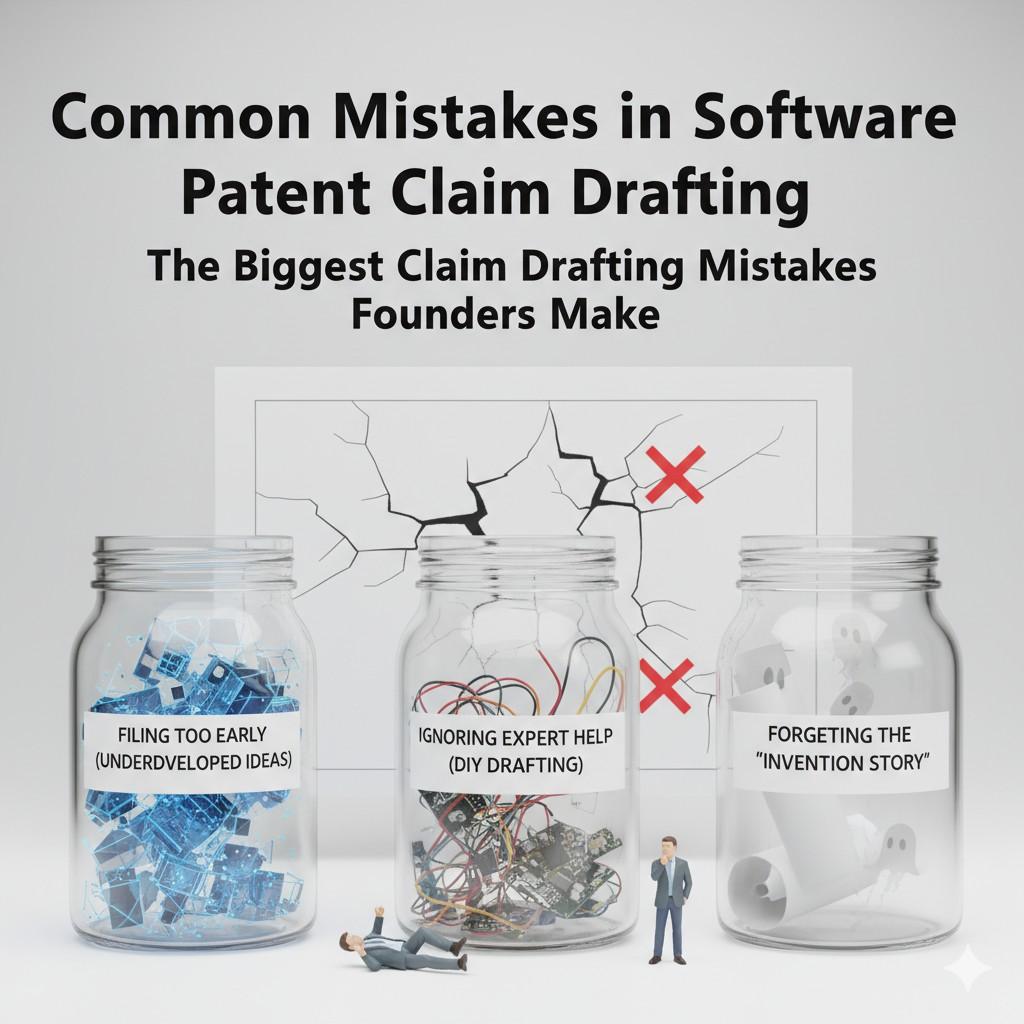
The Biggest Claim Drafting Mistakes Founders Make
Founders often think claim drafting breaks down because patents are too technical or too legal. That is not usually the real issue. The real issue is that founders are close to the product, close to the market, and close to the pressure of moving fast.
That makes it easy to focus on what feels important in the moment and miss what actually creates lasting protection. In software, that gap can be expensive.
A weak claim does not just create filing risk. It can leave the company exposed right where it thought it was safe.
Claiming the idea at the highest level and stopping there
This is one of the most common mistakes founders make. They describe the invention in a broad way because they want broad protection. On the surface, that sounds smart.
In practice, it often creates a claim that sounds impressive but does not say enough about how the system actually works.
A broad claim without enough technical substance can become fragile. It may be easier to challenge, easier to reject, and easier for a competitor to sidestep.
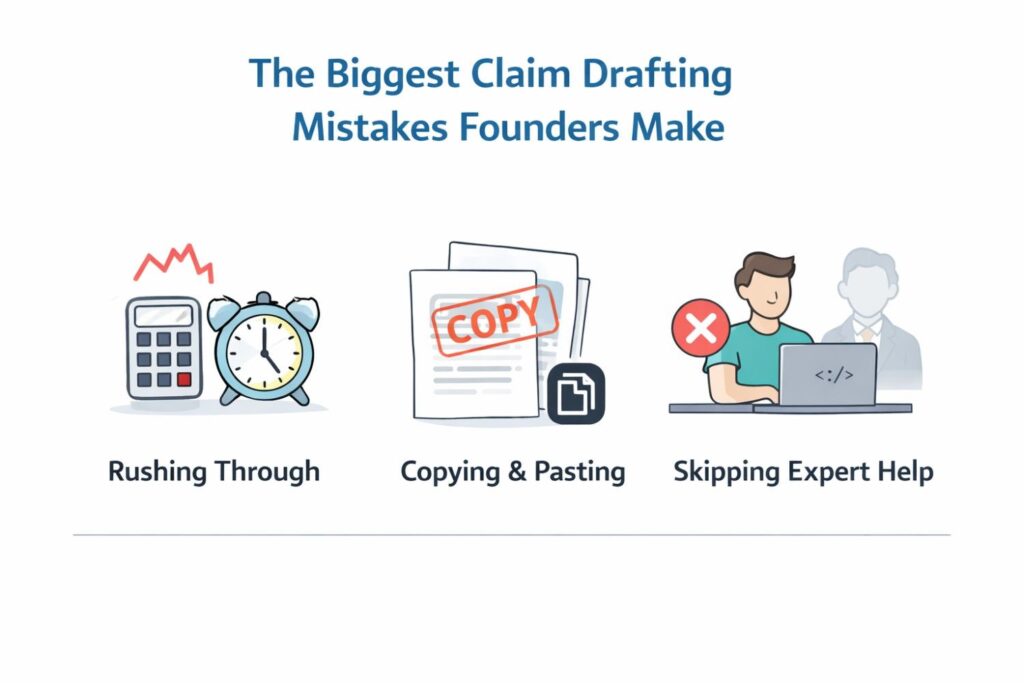
For a business, this means the patent may look valuable in a deck or a data room but offer less real-world protection than expected. The better move is to claim the broad concept while grounding it in a real technical path. The broad layer matters, but it cannot stand alone.
What founders should do instead
A strong starting point is to explain the invention at two levels at the same time. First, describe the business-level change the software creates. Then explain the system-level move that makes that change happen.
When those two pieces connect, the claim has a much better chance of being both useful and durable.
Drafting claims around the current feature name
Founders often fall in love with the product language. That is normal. The team has spent months shaping the feature, naming it, and teaching customers why it matters.
But a feature name is marketing language, not claim strategy. If the claim leans too hard on product wording, it can become too narrow or too tied to one version of the product story.
This matters because the market does not copy names. It copies value.
A rival company will not likely reuse your feature label. It will copy the mechanism that helps users save time, improve output, cut cost, or get better results. The claim should track that deeper mechanism, not the label wrapped around it.
A simple way to test this mistake
Take the feature name out of the discussion completely. If the invention becomes hard to explain once the name is gone, the team may be protecting branding language more than technical substance.
That is a sign to go deeper before the filing is locked.
Mixing up the product with the invention
Not every important part of the product is the invention. This is where many founders lose precision. They try to claim the whole product because they know the product creates value.
But claims work better when they target the real technical step that makes the product different.
The whole product may include onboarding, billing, analytics, support tools, integrations, and many useful workflows. None of that automatically points to the strongest patent angle.
The invention is often smaller, sharper, and more focused. It may sit in one decision engine, one synchronization method, one model update process, or one way of handling data under pressure.
When founders try to patent the whole machine instead of the critical move inside it, the result is often vague and weak.
Writing claims that only cover one implementation path
Founders usually know their own build very well. That is both a strength and a trap. Because they know the current architecture so deeply, they often describe the invention through one exact implementation path.
The filing ends up tied to one model type, one sequence, one deployment pattern, or one technical setup.
That may feel accurate, but it can create a small box around the patent. A competitor can then change one layer of the implementation and argue it is outside the claim.
For a business, that is painful because the core value may still be copied while the legal coverage turns out to be too narrow.
How to avoid locking the patent to one build
Founders should ask what parts of the implementation are essential and what parts are just current choices. That is a very useful distinction. The claim should center on the essential logic.
The specification can still describe multiple versions, examples, and system paths so the protection has room to grow as the product evolves.
Forgetting to think like a competitor
A surprising number of founders draft from the inside out. They explain what they built, why they built it, and how proud they are of the result.
That is all useful. But one key question is often missing: how would a smart competitor copy this without copying it word for word?
That question changes everything. It forces the team to stop admiring the product and start stress-testing the protection. A claim that only covers the exact internal version of your solution may fail the moment another team reaches the same result through a slightly different wrapper.
Businesses that think ahead about copy paths usually draft better claims because they see the problem from the outside, not just from their own roadmap.
A better framing for founders
Instead of asking only, what did we build, ask this: what would another company borrow first if they wanted our advantage fast.
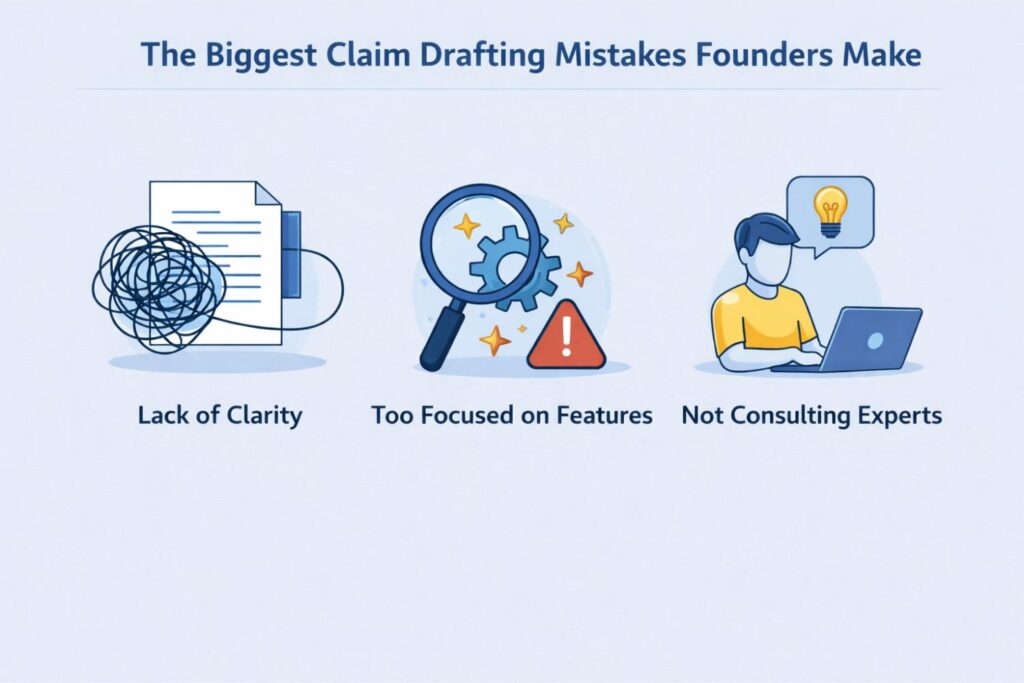
That answer often reveals the true center of value and helps shape claims that are harder to design around.
Using language that sounds smart but says very little
Founders in software are used to compressed language. They talk in product shorthand every day. They say things like intelligent routing, adaptive scoring, dynamic optimization, automated decisioning, and contextual analysis.
Those phrases may work well in sales and fundraising. In claim drafting, they often create fog.
Fog is dangerous because it gives everyone room to interpret the claim in different ways. That includes the patent office, future investors, future acquirers, and future competitors.
A strong claim does not try to sound advanced. It tries to be clear about what happens, when it happens, what inputs matter, and what change the system makes as a result.
Waiting too long to capture the invention clearly
Many founders do not document the invention when it is fresh. They wait until the product is further along, until a launch is near, or until someone says the company should file quickly.
By then, the early technical choices may be blurry. The team remembers the finished feature better than the insight that made the feature possible.
This creates weak claim inputs. The filing gets built from memory, surface-level notes, and current product behavior instead of from the original technical breakthrough.
For businesses, this means the most valuable thinking may never make it into the claim set in a useful way.
A better habit for fast teams
When a technical breakthrough happens, capture it right away in plain language. Record what problem existed before, what the team changed, why that change worked, and what measurable benefit followed.
That single practice can dramatically improve claim quality later because the drafting starts from truth, not reconstruction.
Letting the patent become a legal exercise instead of a business one
This mistake hurts strong companies more than weak ones. Founders hand the invention off, assume the patent process is separate from product strategy, and only re-engage near the end.
The filing may still get done, but the business context is often missing. That context matters because claims should protect what drives leverage in the market.
A business-first claim strategy asks different questions. What part of this system helps defend pricing. What part is likely to matter in diligence. What part would a buyer care about.
What part blocks fast followers. Those are not side questions. They are central questions. The claims should serve those answers.
Why founders who fix these mistakes build stronger protection
The best founders do not treat claim drafting like a side task. They treat it like a decision about future control. That shift changes the quality of the whole process.
It leads to better invention framing, better drafting inputs, and better protection around what the company is actually betting on.
This is exactly why many startups use a smarter process instead of trying to force patents through old workflows.
PowerPatent helps founders turn technical work into stronger patent filings with software built for speed and real attorney oversight built for quality. You can see how that works here: https://powerpatent.com/how-it-works
What Weak Software Claims Look Like in Real Life
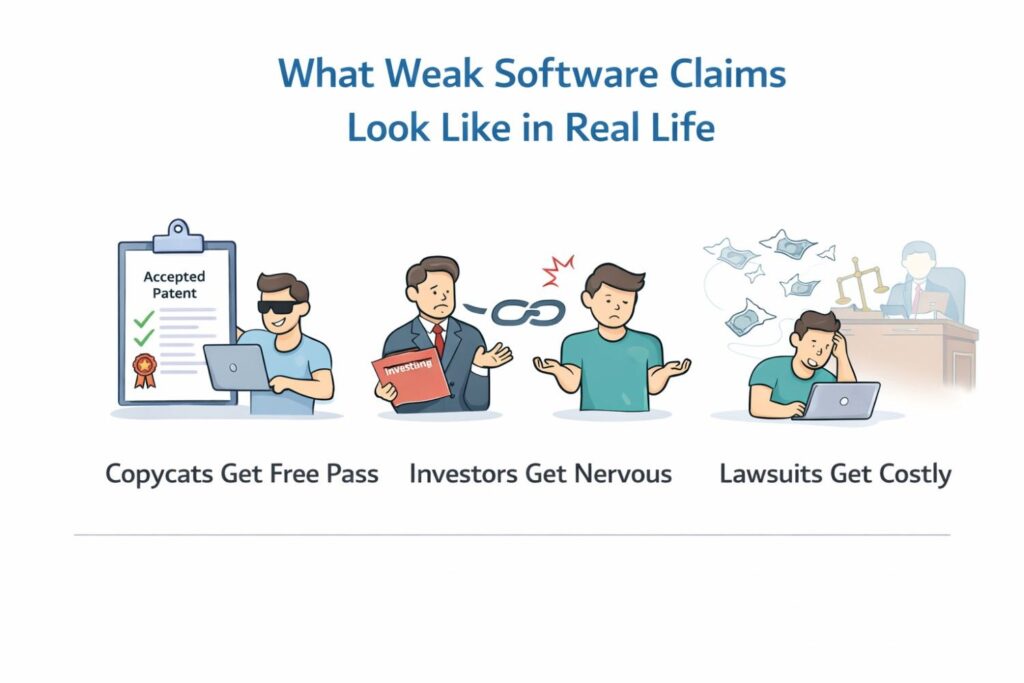
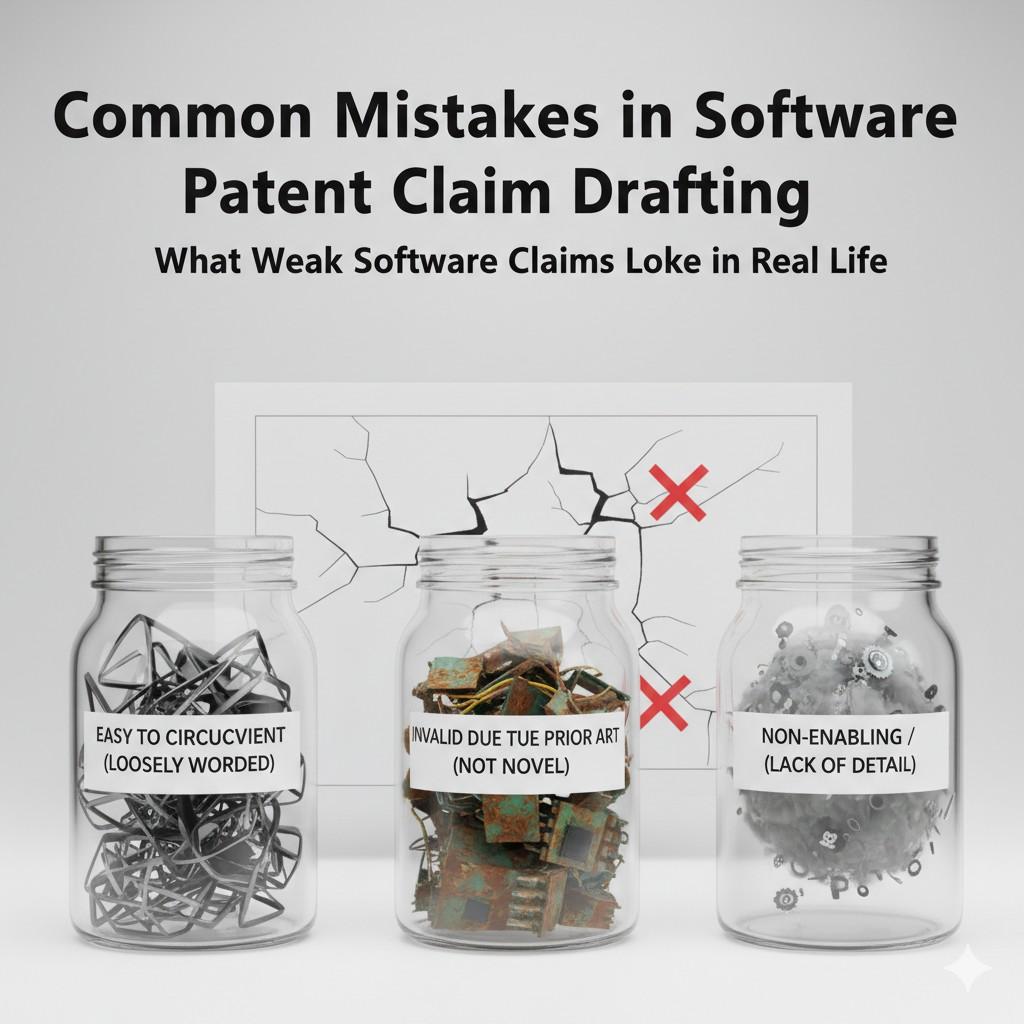
Weak software claims do not always look weak at first glance. In fact, many of them sound polished, broad, and technical enough to impress a founder in a quick review. The problem shows up later. It shows up when a competitor copies the value but avoids the wording.
It shows up when an examiner says the claim is too abstract. It shows up when investors ask what the patent really covers and the answer feels fuzzy.
In real life, weak claims usually fail not because they are badly written in a simple grammar sense, but because they do not track the true business value of the invention in a way that holds up under pressure.
A weak claim often sounds bigger than it really is
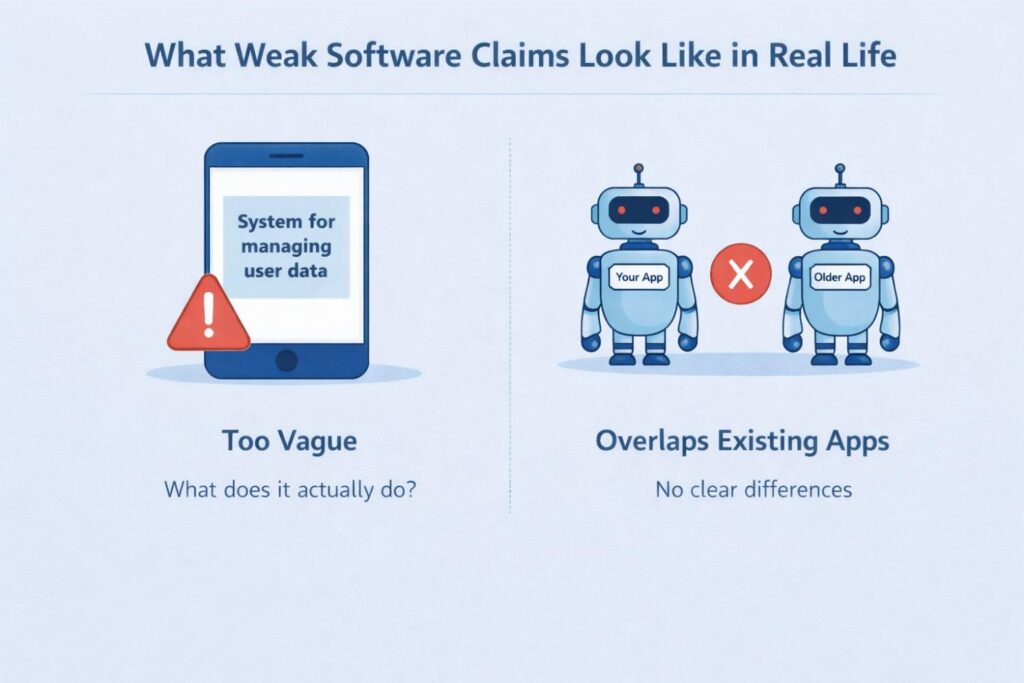
At first, a weak software claim can feel strong because it uses wide language. It may talk about a system that receives data, processes that data, and produces an output.
On paper, that sounds broad. In practice, it often means very little because almost every software system does some version of that.
The issue is not that broad language is always wrong. The issue is that broad language without a clear technical center creates empty coverage.
It may read as if it covers a large category, but when you look closely, it does not tell a clear story about what specific technical move makes the invention different. That makes the claim easier to challenge and easier to avoid.
It reads like a business goal instead of a technical solution
This is one of the clearest signs of weakness in real life. The claim focuses on the result the business wants rather than the system behavior that gets there.
It may frame the invention as improving engagement, reducing fraud, matching users better, increasing efficiency, or automating a process. Those outcomes matter to the business, but they are not enough by themselves.
A strong claim needs to show the technical path that leads to the business result. Without that path, the claim can look like it is trying to own the goal rather than protect the actual innovation.
That creates serious risk because goals are easy to describe but hard to defend unless the claim anchors them to a concrete system method.
What this looks like inside a startup
A founder says the invention is a better way to route support tickets, approve transactions, or personalize recommendations. That may be true from a product angle.
But if the claim only repeats that framing, it may miss the data logic, timing sequence, signal weighting, or system coordination that actually creates the improvement. In real life, that means the patent may not stop a rival from reaching the same end through a similar technical path.
It is tied too closely to one product flow
Another common weakness shows up when a claim mirrors the current user journey too closely. It follows the exact sequence used in the live product, with the same inputs, same order, and same visible steps.
That can feel safe because it matches what the team has already built. But it can also create narrow protection.
Real products change fast. Startups update flows, remove friction, change interfaces, and rebuild infrastructure all the time. A claim that hugs one version of the flow too tightly may lose value as the product evolves.
Even worse, a competitor may simply rearrange a few steps or shift the interaction point and move outside the claim while still using the same core idea.
Why this hurts the business later
When the company grows, the patent should still map to the real engine of the business. If it only maps to an early workflow, the protection starts aging much faster than the product itself.
That disconnect is one of the most common reasons founders later feel disappointed by a patent they once felt good about.
It uses polished language that hides weak structure
Some claims sound smooth because they borrow language from product decks, sales copy, or technical marketing.
Terms like intelligent engine, adaptive framework, dynamic orchestration, contextual processing, or automated optimization can make a claim sound advanced. But in real life, polished labels do not create real protection.
The weakness here is structural. If the claim depends on vague labels instead of clear system behavior, it becomes harder to tell what is actually covered. That uncertainty can work against the patent owner.
It can confuse the review process, reduce confidence in diligence, and give competitors room to argue that their approach is different.
It claims a feature that users love but misses the mechanism that matters
In the real world, users often love the visible outcome, not the technical method. They love faster results, cleaner recommendations, fewer manual steps, or more accurate outputs.
Founders naturally want to protect the thing customers notice. The problem is that the thing customers notice is often not the best claim target.
Weak claims stop at the feature level. Strong claims go one layer deeper. They protect the method that makes the feature hard to copy.
That difference matters because markets reward results, but patents work best when they cover the technical path that creates those results.
A better way to think about this
The right question is not only what customers use. The right question is what hidden system choice makes that experience possible in a way others would want to copy.
That hidden choice is often where the strongest claim value lives.
It covers only the founder’s preferred implementation
Founders and engineers often have good reasons for choosing one architecture or one model design.
But a patent claim becomes weak when it assumes that the chosen implementation is the only valuable version of the invention. In real life, competitors do not copy your preferences.
They copy your advantage and rebuild it in their own stack.
A claim that only fits one exact implementation can leave large gaps.
It may protect your current code path while missing functionally similar versions that use different components, different ordering, or different system arrangements. That is why narrow implementation language often creates false comfort.
How strong drafting changes the picture
A stronger claim usually protects the core technical logic in a way that reaches across reasonable implementation changes.
Then the narrower details can appear in supporting claims or in the broader written description. That gives the business more flexibility without losing precision.
Wrapping It Up
Software patent claims do not become strong by accident. They become strong when the team takes the time to protect the real technical edge instead of the easiest story to tell. That is the thread running through every mistake in this article. Weak claims usually come from weak framing. They come from rushing, from staying too close to feature language, from claiming outcomes instead of methods, and from forgetting that a patent is supposed to help the business in the real world, not just get filed.
Leave a Reply