Most patent claims look fine on the surface. Then they get tested. That is where weak dependent claims show their true value, or show that they never had any value at all. A lot of founders and inventors treat dependent claims like filler. They add a few narrow versions of the main claim, change a few words, stack on a few features, and move on. It feels done. It looks complete. But in real life, that kind of drafting often does very little. It does not give you meaningful backup positions. It does not make enforcement easier. It does not help much during examination. And it does not give your patent attorney much to work with if the broad claim gets pushed back.
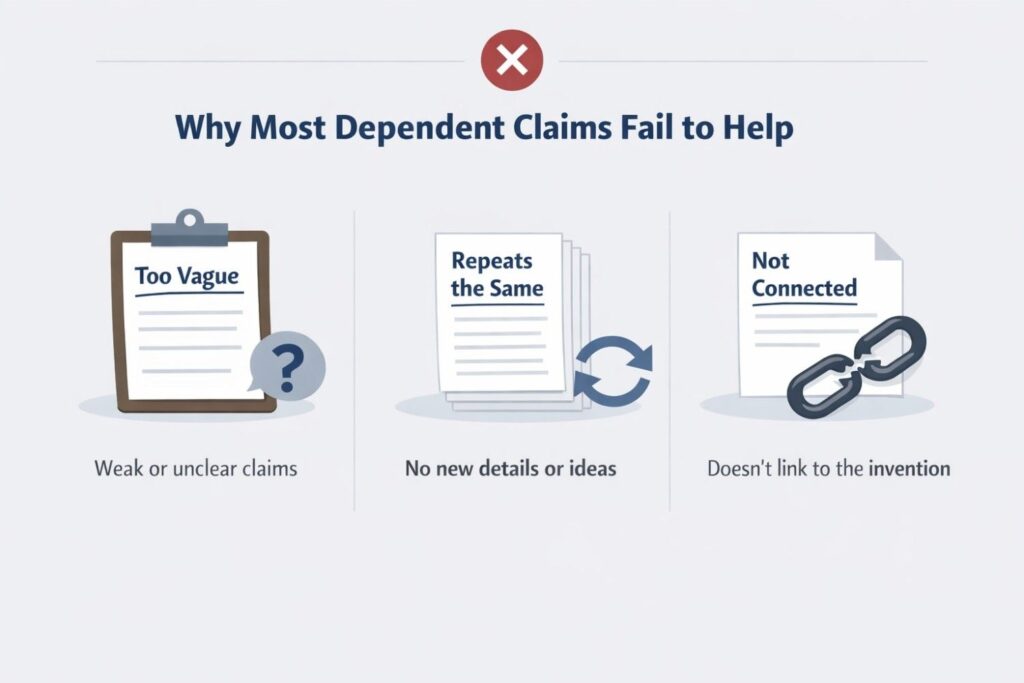
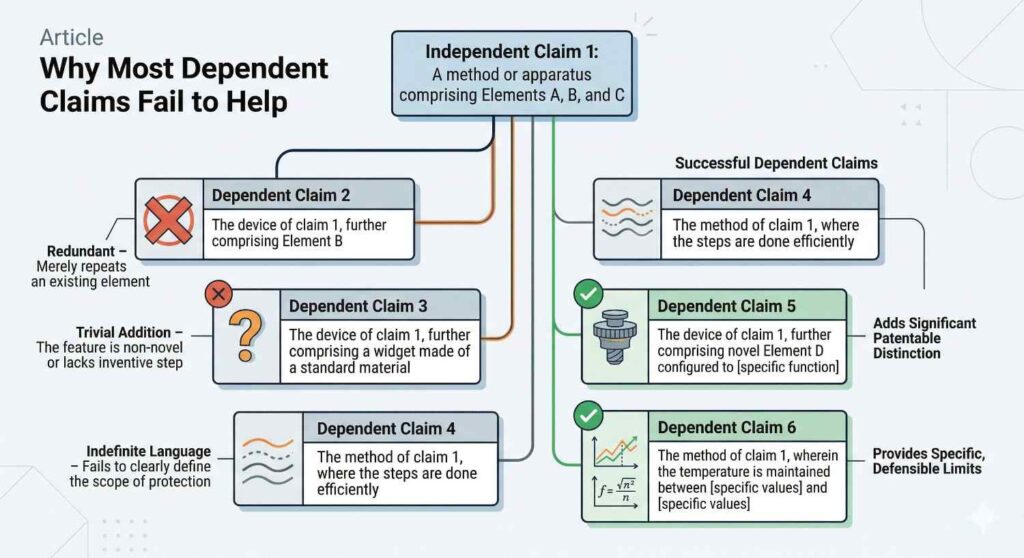
Why Most Dependent Claims Fail to Help
A lot of dependent claims look useful at first glance. They seem more specific. They seem safer.
They seem like they give the patent more depth. But when the patent faces real pressure, many of those claims do very little for the business behind the invention.
That is the hard truth. A dependent claim is not valuable just because it is narrower than the independent claim.
It only adds real value when it protects an important version of the invention, supports a business goal, or gives the company a strong fallback position when the broader claim gets challenged. If it does none of those things, it is just extra text.
For founders, product teams, and companies building real technology, this matters a lot.
A weak dependent claim strategy can leave the business exposed even when the patent looks long and detailed. A strong one can create options, improve coverage, and make the whole patent more useful in the real world.
The problem starts when claims are written to fill space
Many dependent claims fail because they are not drafted with a real purpose. They are often added near the end of the process, almost like an afterthought.
Someone feels the application needs more claims, so they pull a few details from the spec and drop them into dependent form. The result is narrow language without strategic value.
That kind of drafting creates the appearance of strength, but not the substance of it.
A claim that adds a random sensor type, a routine data format, or an obvious implementation detail may technically narrow the claim, but that does not mean it helps the business.
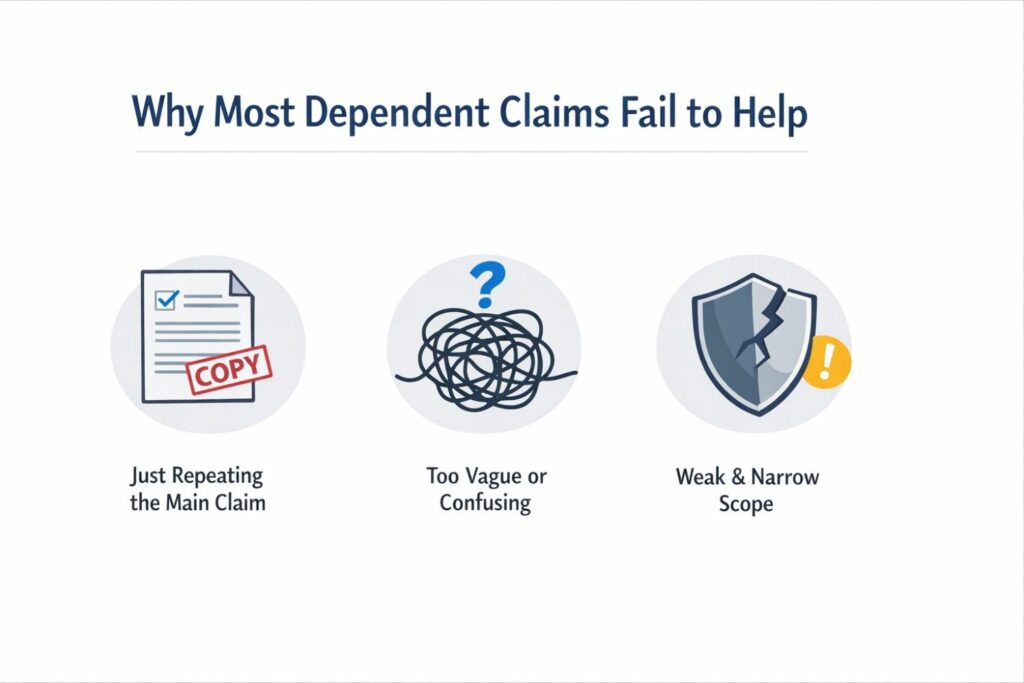
If that feature is easy for a competitor to remove or swap out, the claim does not create much pressure. If the feature is not central to the product, it does not protect what matters. If the feature is already standard in the field, it may not help much during examination either.
Narrow is not the same as useful
A common mistake is to assume that every narrower claim is automatically a good fallback. That is not true. A fallback claim is only strong if it still covers a commercially meaningful version of the product or method.
This is where many patents quietly break down. The broad claim may cover the full concept, but the dependent claims may narrow into corners that the business does not even care about.
If the broad claim falls away, the remaining claims may cover edge cases instead of the core offer. That leaves the company with protection on paper, but not in practice.
A useful dependent claim keeps one foot in the real market. It narrows in a way that is still tied to how the product is built, sold, or copied. That connection is what makes the claim matter.
Too many claims describe trivia instead of leverage
Some dependent claims focus on details that feel technical but do not create business leverage. They might name a material, state a timing value, add a routine communication step, or specify a common software action.
These things can sound precise, but precision alone is not enough.
A smart question to ask is simple: if a competitor copied our product and changed only this one detail, would we still care?
If the answer is yes, the claim might not be doing enough. If the answer is no, then the detail may have real value.
This is one of the best filters a business can use during drafting. Do not ask only whether a feature exists. Ask whether that feature creates lock-in, product advantage, cost advantage, speed, accuracy, user trust, or a barrier to substitution.
A dependent claim should ideally protect a detail that matters to product performance or market position, not just a detail that happens to be in the design.
Many claims are drafted without thinking about how competitors design around patents
A dependent claim often fails because it does not reflect how a real competitor would react.
In the real world, a competitor usually does not copy every part of a product exactly. They copy the value and change the edges. They look for the simplest path around the claim.
That means the best dependent claims are not random technical add-ons. They are chosen with design-around behavior in mind. They cover the versions a competitor is most likely to use once they learn what your broad claim says.
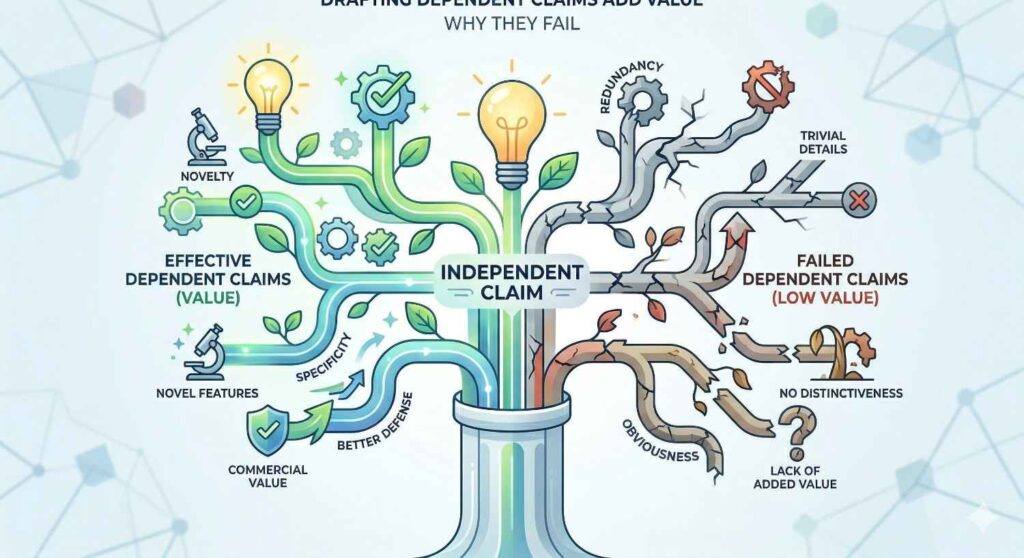
If your dependent claim narrows to something no smart competitor would keep, it adds little value.
If it narrows to the feature they would want to preserve because it drives performance, lowers cost, or improves adoption, then the claim can become very powerful.
Claims often mirror the invention story, but not the business story
Inventors usually explain technology in the order they built it. They talk about what came first, what was hard, what they tested, and what finally worked. That story is useful, but patent value often depends on a different story.
It depends on what makes the product hard to copy and easy to sell.
A dependent claim strategy should reflect that second story.
This is where businesses can gain an edge. Instead of asking only, “What else can we claim?” ask, “What part of this system gives us market power?” Sometimes that is a technical shortcut that improves performance.
Sometimes it is a setup that reduces hardware costs. Sometimes it is a workflow that makes customer adoption easier. Sometimes it is a specific architecture that enables scale.
When dependent claims are tied to those kinds of choices, they start working like business tools rather than legal filler.
The drafting process is often too disconnected from product strategy
Another reason dependent claims fail is that the people drafting them are not always close enough to the product roadmap.
They may understand the invention in a technical sense, but not which features matter most to the company over the next two or three years.
That gap can be expensive. A claim may narrow to an implementation that is already being phased out. Another may focus on a version that was only used in an early prototype.
Meanwhile, the company’s most valuable product path may have little meaningful backup coverage.
This is where timing matters
Dependent claims should not be chosen in a vacuum. They should be drafted with an eye on where the product is going, what customers care about, and what parts of the system the company expects to keep.
Even if the exact roadmap changes, a strong claim set usually tracks the durable logic of the product.
For business teams, this means the drafting process should include more than invention capture. It should include a real conversation about what makes the product commercially sticky.
The more closely claims follow that thinking, the more useful they become later.
Many dependent claims fail during examination because they add predictable details
A dependent claim can also fail in a very practical way: it does not help overcome prior art.
This happens when the added limitation is too routine, too standard, or too expected in the field. The claim narrows, but not in a way that meaningfully separates the invention from what already exists.
That creates a missed opportunity. Good dependent claims should not only cover narrower versions of the invention.
They should also create paths for allowance. In other words, they should include details that help show why the invention is different and worth protecting.
A better way to think about fallback positions
A true fallback claim is not a weak backup. It is a second line of protection that still matters if the first line gets hit. That means it should be both narrower and still important.
The best fallback positions often sit around technical choices that create the core advantage of the invention. Maybe the broad claim covers a full system, while a dependent claim captures the way data is ranked, filtered, compressed, or verified.
Maybe the broad claim covers an end-to-end platform, while a dependent claim focuses on the step that makes the result faster, safer, or cheaper.
That is a much better use of claim space than narrowing to side details. It gives the company a real place to stand if broader language gets challenged.
Think in terms of business survival, not just claim structure
A useful drafting exercise is to imagine the broadest claim is gone. Then ask what remaining dependent claim you would want to own if your company had to enforce this patent against a serious competitor.
The answer to that question is often much more strategic than the standard drafting approach.
It pushes the team to identify what truly matters. It also helps expose weak claims early, before they get filed.
Weak dependent claims make enforcement harder than it needs to be
If a dependent claim captures a detail that is hard to detect from the outside, it may be less useful than it appears. The claim might technically cover an infringing product, but proving that coverage could become expensive or uncertain.
That is another reason many dependent claims fail to help. They are drafted around hidden internal settings, buried configurations, or implementation details that cannot be easily seen from product behavior, public materials, or reverse engineering.
The company ends up with a claim that is hard to use in practice.
Visibility matters more than many teams realize
A more strategic dependent claim often tracks something that leaves footprints. It may show up in system outputs, product documentation, integration behavior, hardware structure, network patterns, user flow, or performance characteristics.
That does not guarantee easy enforcement, but it improves the odds that the claim will be usable.
For businesses, this is a very practical drafting point. During claim review, ask whether the limitation would be observable if a competitor launched a similar product.
If not, consider whether there is a better way to claim the same value in a more visible form.
The safest-looking claims can be the least valuable
Sometimes teams feel better when they see many very narrow claims because those claims seem easier to defend.
But a very narrow claim can become so specific that it protects only one exact implementation and nothing else. That may feel safe, yet still be commercially weak.
The goal is not to draft the narrowest claim possible. The goal is to draft the narrowest claim that still catches a meaningful target.
What Makes a Dependent Claim Truly Valuable
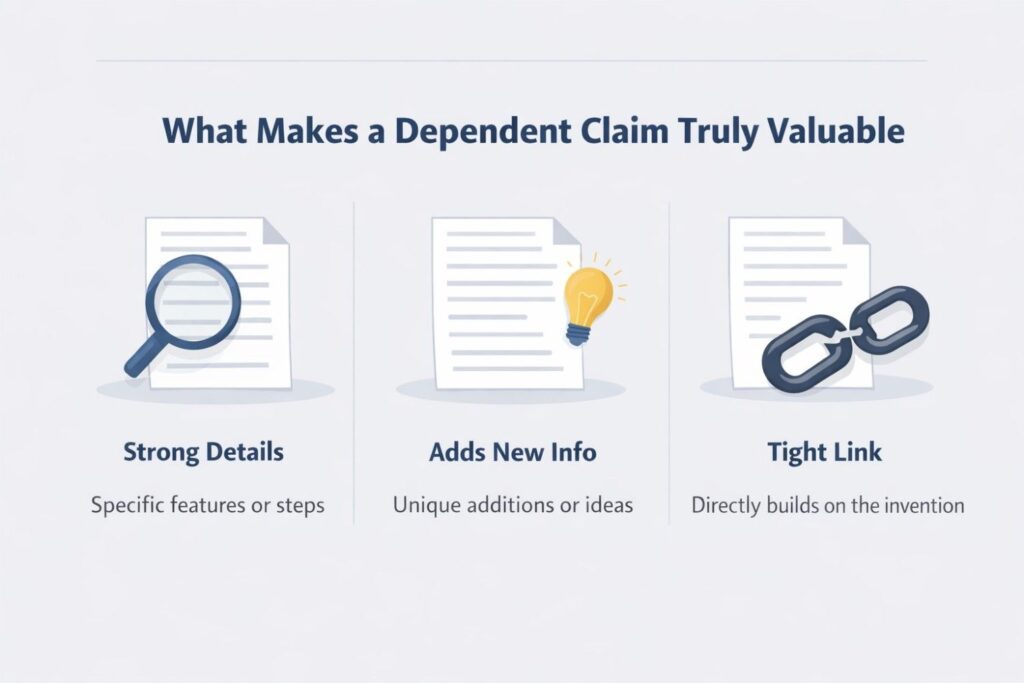
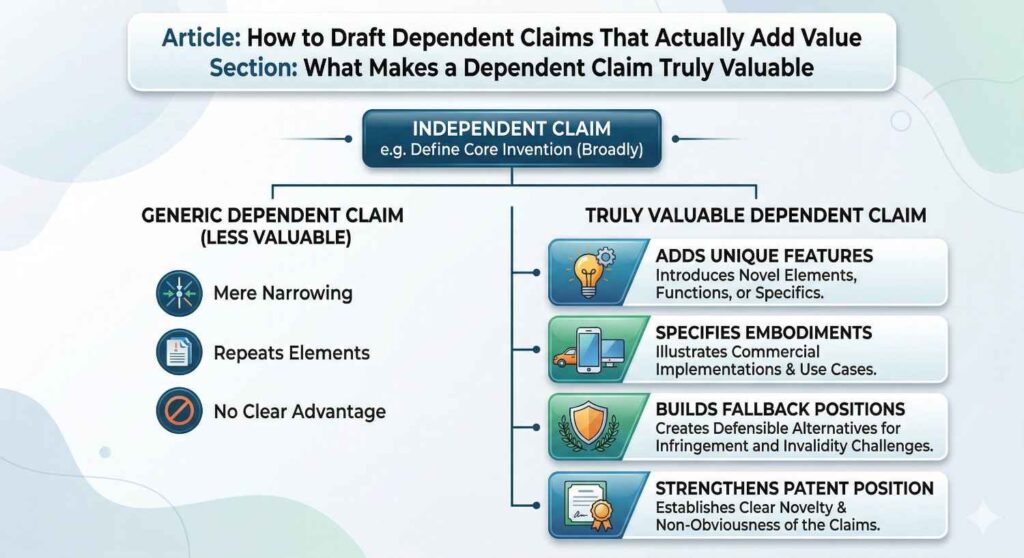
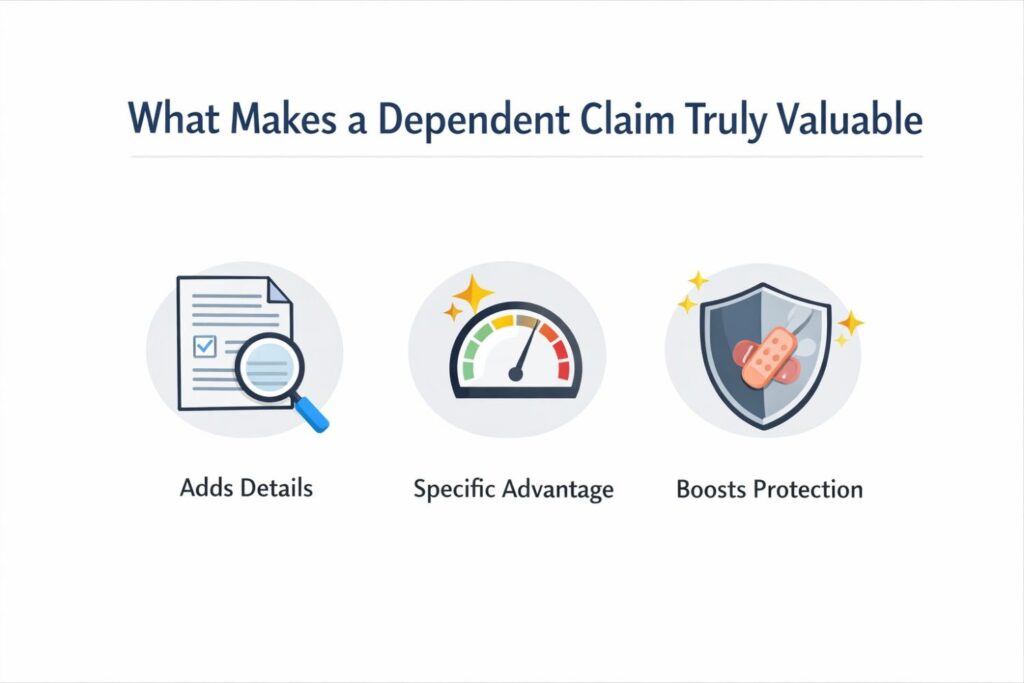
A dependent claim becomes valuable when it does real work for the business behind the patent. It should not exist just to make the application look fuller or more complete.
It should protect an important version of the invention, give the company room to respond if the broader claim gets rejected, and make it harder for a competitor to copy the product without stepping into protected ground.
This is where many teams need a mindset shift. A useful dependent claim is not just a narrower sentence. It is a strategic position. It protects a technical choice that matters in the market. It preserves leverage. It gives the patent more ways to stay alive and more ways to matter.
A valuable dependent claim protects something a business would actually care about
The first test is very simple. If this claim were the main claim you had left at the end of prosecution or during a dispute, would it still protect something your company truly values? If the answer is yes, that claim is starting from the right place.
That question forces the team to think beyond formal drafting. It pushes attention toward what really drives product strength.
A claim is more valuable when it covers a feature tied to customer adoption, technical performance, lower cost, easier deployment, stronger security, better speed, or a better user result.
Those are the kinds of details that tend to matter in the real world.
Value starts with commercial relevance
A dependent claim should narrow toward a version of the invention that is still close to how the company creates value.
It should not drift into a side path that happens to be disclosed but is not central to the product. When claims track the commercial center of the invention, they become much more useful later.
This is especially important for startups. Early patents often need to do several jobs at once.
They may help with fundraising, strengthen a future acquisition story, support a licensing position, or give the company confidence as it grows.
A dependent claim that protects a real business asset is much more powerful in all of those settings than one that protects a minor implementation detail.
A strong dependent claim captures a technical choice that drives the result
The best dependent claims often focus on the part of the invention that makes the difference. Not just what the system includes, but what makes it work better, faster, cheaper, cleaner, or more reliably than other approaches.
That is where real patent value often lives. In many inventions, there is one technical move that changes the outcome. It might be how data is filtered before processing.
It might be how a model selects a next action. It might be how a device calibrates itself.
It might be how the system reduces latency, handles errors, or avoids waste. When a dependent claim captures that move, it becomes much more than a formal narrowing step. It becomes a way to protect the engine inside the invention.
Useful claims often lock onto the reason the invention matters
A good way to find valuable dependent claims is to ask why the invention is better than what came before. The answer often points to the most worthwhile claim limitations.
If the invention matters because it cuts processing load, reduces human effort, improves precision, shortens setup time, or makes deployment easier, then the dependent claims should often reflect those same sources of value.
This does not mean every claim must mention a result word like faster or better. It means the claim should point to the design choice that causes that result.
That is a much stronger move than adding details that simply happen to be present.
A valuable dependent claim creates a fallback that still has weight
Not every fallback is worth having. A true fallback should still leave the business with something meaningful if the broader claim gets narrowed or rejected. That is one of the clearest signs of value.
When you think about dependent claims this way, quality rises fast. Instead of asking what extra detail can be added, you start asking what narrower version would still be worth owning.
That changes the drafting process from passive to strategic.
The best fallback claims still cover real-world products
A strong fallback claim should still map onto a version of the product that customers would use and competitors would want to offer.
If the fallback only covers an odd edge case or an outdated prototype, it may have little practical use.
But if it still covers the core implementation or a version that keeps the product advantage alive, it can become one of the most important claims in the whole application.
That is why good claim drafting often feels a lot like product thinking. You are not only narrowing language. You are deciding which narrower product realities deserve legal protection.
Valuable dependent claims make design-arounds harder
One of the most important jobs of a dependent claim is to make it harder for a competitor to escape the patent by changing just one or two features.
A claim adds value when it closes off likely workaround paths without becoming so narrow that it protects only one exact build.
This is a delicate balance. If the limitation is too broad, it may not help much. If it is too narrow, it may be easy to avoid.
The sweet spot is a limitation that captures a feature competitors would want to keep because removing it would hurt their product.
The best claims follow likely market behavior
Competitors usually do not redesign products for fun. They make changes where the cost is low and keep the features that make the offering attractive. A valuable dependent claim often tracks that reality.
It narrows into the part of the invention they would be reluctant to remove because it drives performance, lowers operating cost, improves reliability, or supports customer expectations.
This is one reason dependent claim drafting should never be isolated from business thinking. The more clearly the team understands what parts of the invention are sticky in the market, the more useful the claims become.
A strong dependent claim helps during patent examination
Value is not only about future enforcement. A dependent claim is also valuable when it gives the patent examiner a clear path to allowance.
That can save time, reduce back-and-forth, and improve the odds of getting meaningful claims allowed without losing the core invention.
This is a very practical point. Many broad claims face prior art. That is normal. The question is whether the application includes narrower claims that carve out real distinctions.
A dependent claim that introduces a non-routine technical feature can become the bridge between an initial rejection and a granted patent.
Examination value comes from purposeful narrowing
A useful dependent claim should not just be narrower. It should be narrower in a direction that matters.
The added limitation should help separate the invention from older systems in a real way. It should show that the claimed solution is not simply a generic version of what others already did.
When a dependent claim does that, it creates leverage during prosecution. It gives the attorney a meaningful place to move without giving up too much. That flexibility can be very important, especially when the broad claim meets crowded prior art.
Valuable claims are tied to evidence the company can actually point to
A dependent claim becomes more useful when the company can show that a competing product or process likely includes the claimed feature. In other words, value is not just about what is written.
It is also about whether the claim can be used in the real world.
Claims tied to visible behavior, public product materials, measurable outputs, documented integrations, hardware structure, or user-facing workflows can be more practical than claims tied only to hidden internal logic.
A claim that is impossible to prove may still be legally valid, but it can be much harder to use.
Usability matters as much as theory
This is a helpful business filter. Ask whether the limitation leaves signs in the world. Could a company spot it from a demo, benchmark, API behavior, technical paper, setup flow, or reverse-engineered system output?
If yes, the claim may be more valuable than one tied to a buried internal setting that never shows up outside the product.
That does not mean every claim must be externally visible. But a smart claim set often includes limitations that can be supported by real evidence if needed.
Valuable dependent claims are rooted in durable parts of the product
A dependent claim becomes stronger when it is tied to features the company is likely to keep, not temporary details that may disappear in six months. This is one of the most overlooked parts of claim value.
Startups move fast. Products change. Early builds often contain choices made for speed, not permanence. If dependent claims focus too heavily on temporary implementation choices, they can age badly.
But when they track the durable logic of the system, they are much more likely to stay relevant as the company grows.
Draft around the product’s long-term spine
Every product has a few structural choices that tend to last longer than the rest.
It may be the data flow, the control method, the trust model, the model update loop, the hardware interaction pattern, or the way different parts of the system coordinate. These deeper choices often survive even when surface features change.
Dependent claims tied to those deeper structures often bring more lasting value than claims tied to cosmetic details. That is because they follow the spine of the product rather than its temporary clothing.
A valuable dependent claim does not just narrow scope, it sharpens meaning
Another sign of value is clarity. Some dependent claims do more than reduce the size of the claim.
They make the invention easier to understand. They show what is really special about the system. They help define the core idea in a more concrete way.
This can help in several ways at once. It can make examination cleaner. It can support future argument. It can improve the story told by the patent. It can also make internal teams more aligned on what the company is really trying to protect.
Clarity creates strategic strength
When a dependent claim names an important mechanism or decision point, it often sharpens the whole application. It makes the invention feel more grounded and less abstract.
That can matter when explaining the patent to investors, buyers, partners, or internal leaders. A patent is not just a legal file. It is also a business asset, and business assets are stronger when people can understand why they matter.
A strong dependent claim matches the way customers experience value
Sometimes the best dependent claims are found by looking at what customers notice, rely on, or pay for. That does not mean claims should be written like marketing copy. It means customer value often points toward technical choices worth protecting.
If customers care that a system sets up in minutes instead of hours, there may be a specific architecture behind that speed. If customers trust the product because results are more consistent, there may be a technical mechanism causing that consistency.
If adoption grows because the system fits into existing workflows, there may be a specific integration approach behind that ease.
Customer value can guide technical claiming
This is where business and drafting can work together. Product teams often know exactly what customers love.
Engineering teams often know exactly what design decisions make that possible. A valuable dependent claim often sits at the point where those two views meet.
That kind of claim is powerful because it protects not just a feature, but a reason the market cares.
Valuable dependent claims support future deal value
A patent is often reviewed by people beyond the patent office. Investors, acquirers, partners, and even potential licensees may look at the claim set and ask a basic question: does this protect something meaningful?
Dependent claims that track real business value can help answer that question much more clearly.
This matters because a long application can still feel weak if the fallback claims are thin or random. On the other hand, even a narrower claim can feel powerful if it clearly protects a commercially important implementation.
Sophisticated readers look for substance
People evaluating a patent asset often want to see that the company did more than file broad ideas. They want to see layered protection. They want to see that the narrower claims are not throwaway lines.
They want to see that the company understood where the real advantage lived and made sure that advantage was covered at more than one level.
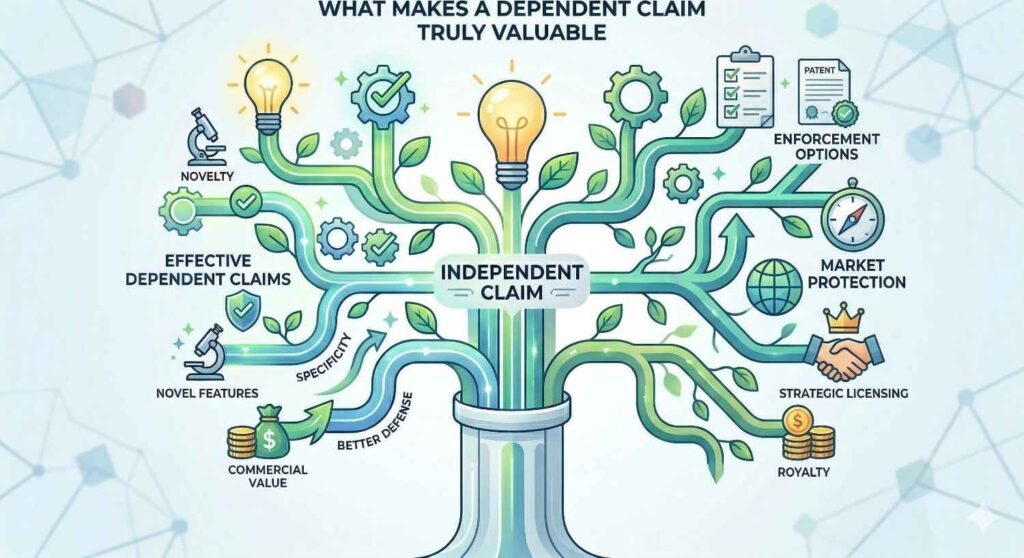
That is one reason drafting discipline matters so much. Valuable dependent claims make the whole patent feel stronger.
How to Choose Narrow Claims That Protect the Right Thing
Choosing narrow claims is where patent drafting turns from theory into judgment. This is the moment where many teams either build real protection or quietly lose it.
A narrow claim is not helpful just because it adds detail. It is helpful when it narrows toward something the business truly needs to keep protected.
That is the key idea for this whole section. The goal is not to make claims smaller for the sake of it.
The goal is to choose the right smaller target. A claim should narrow in a way that still matters if the broad claim is challenged, changed, or never allowed.
When that happens, the narrow claim becomes the real line of defense. That is why choosing the right one is such a serious business decision.
Start with the part of the invention that creates the advantage
The best narrow claims usually begin with the part of the invention that makes the product worth having in the first place. That means the feature, step, interaction, or structure that drives the outcome customers care about or gives the company an edge over other options.
A lot of teams begin in the wrong place. They look at the product and ask what extra details can be added to the broad claim. That sounds logical, but it often leads to weak results.
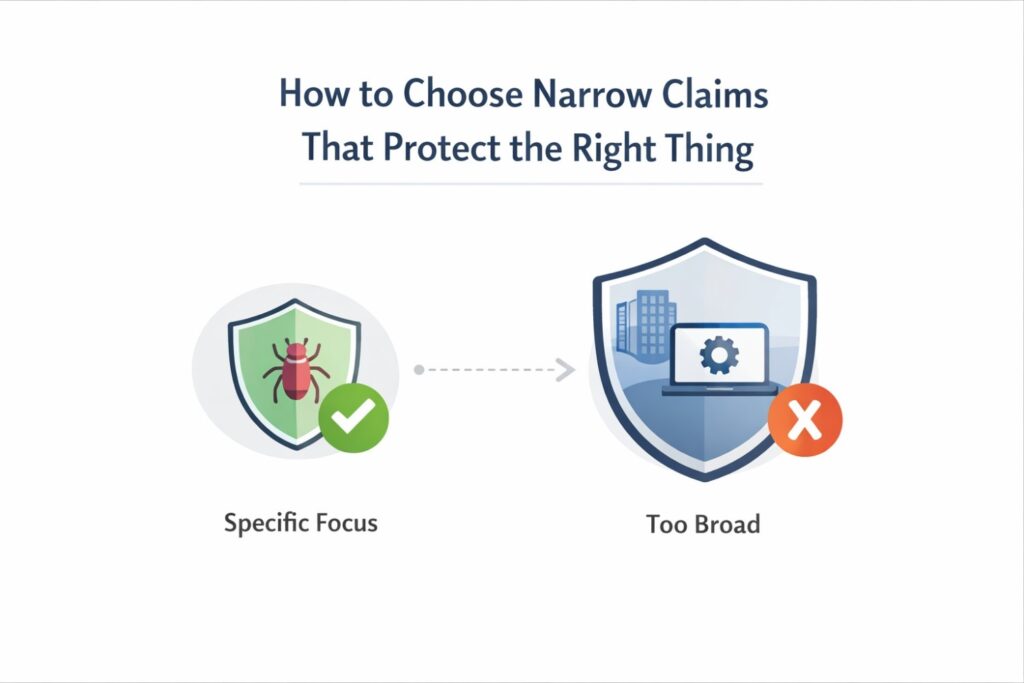
It leads to claims around side details, implementation leftovers, or routine design choices. A better starting point is to ask what exactly makes this invention better than what came before. That answer usually points toward the narrow claims that matter most.
Find the technical move that changes the result
Every strong invention has a point where things become meaningfully different. Sometimes that point is easy to see. Sometimes it is buried inside the system.
It may be a special way of processing data, a control step that improves output, a hardware arrangement that lowers cost, or a workflow that makes adoption easier. Whatever it is, that is often where valuable narrow claims begin.
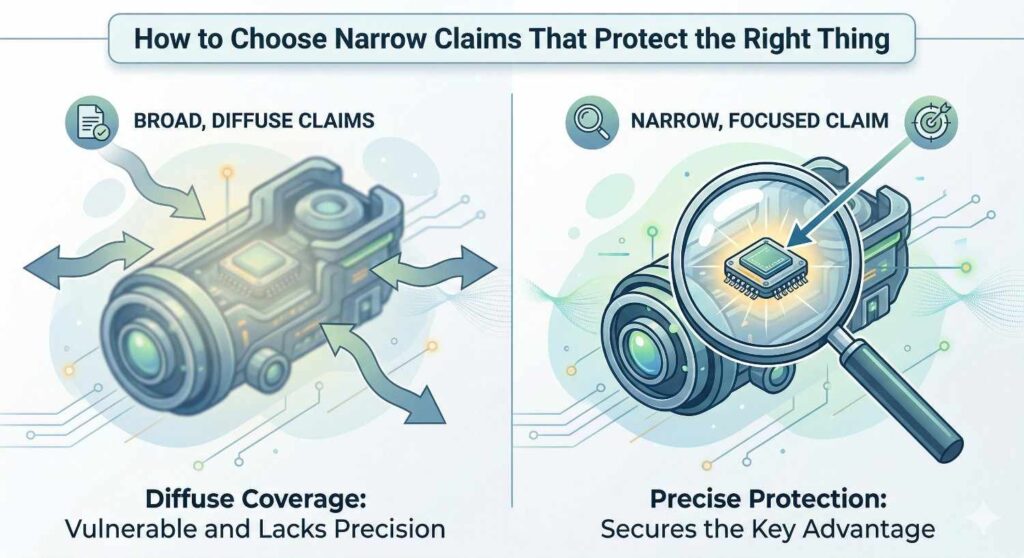
When you draft around that technical move, you are not just shrinking the claim. You are protecting the source of the benefit. That creates much stronger fallback coverage than narrowing toward random details that happen to exist in the same product.
Do not narrow toward noise
One of the biggest mistakes in patent drafting is narrowing toward details that are present but not important.
Many products contain dozens of little choices that helped the team get something working. Some of those choices matter. Many do not. Narrow claims should not be built around noise.
Noise can look very technical. It can sound precise. It can feel patent-like. But if removing or changing the detail would not hurt the product in a serious way, then it may not be the right thing to protect.
Businesses should be careful not to confuse detail with value. The fact that a feature exists does not mean it deserves a claim.
Ask what the company would miss if a competitor copied it
A very practical way to choose the right narrow claims is to imagine a competitor launches something very close to your product.
Then ask what exact feature would bother you most if they copied it. That question often cuts through a lot of clutter.
It shifts the drafting process away from invention description and toward business reality. The right narrow claim usually protects the feature that would make a copied product dangerous in the market.
That might be the speed advantage, the lower compute cost, the smoother setup, the trust signal, the better accuracy, or the simpler integration.
Once you identify that source of danger, you are usually much closer to choosing the right claim limitation.
Narrow toward the feature competitors will want to keep
A claim has more strategic value when it covers a feature a competitor would not want to remove. That is because strong competitors do not copy products word for word. They copy value. They remove what they can and keep what they need.
This means the best narrow claims are often aimed at sticky features. A sticky feature is one that gives enough performance, cost, usability, or adoption benefit that a competitor would hesitate to give it up.
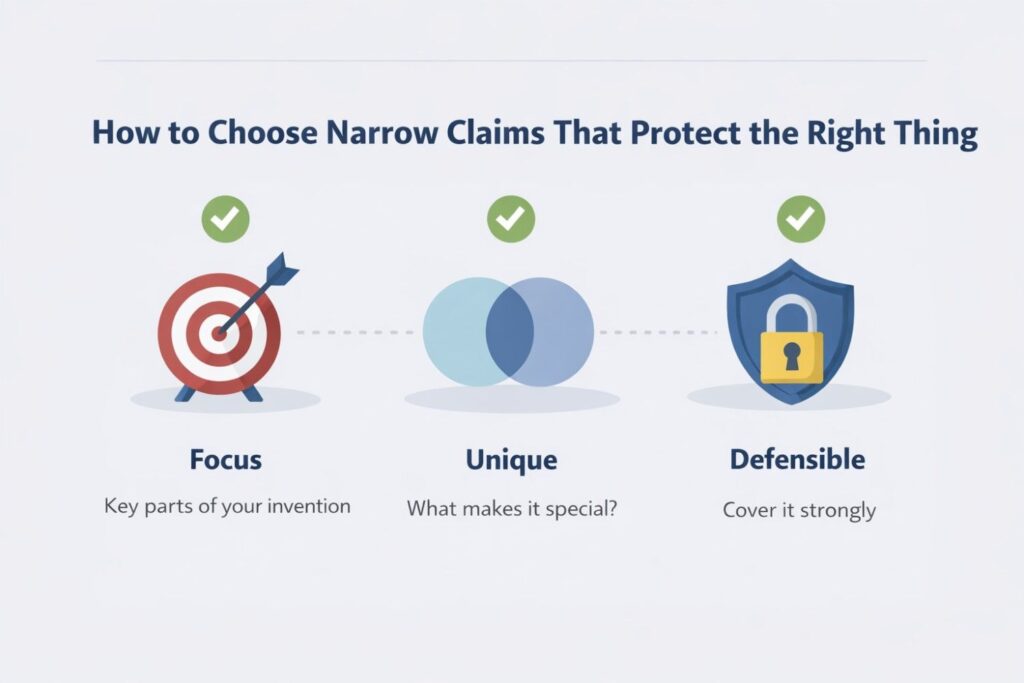
If your claim covers that type of feature, it becomes much harder to design around without making tradeoffs.
The right claim often protects what feels expensive to replace
This is a useful mindset for business teams. Look for parts of the invention that would be painful for a competitor to replace with something equally good.
Painful does not always mean technically impossible. It can mean slower, more costly, less reliable, less scalable, or harder to sell. Those are exactly the kinds of places where narrow claims can create real pressure.
Choose claims that still map to the product roadmap
Many claims fail not because they were drafted badly in a formal sense, but because they were drafted around details that did not last. Startups change fast.
Features evolve. Workarounds become permanent. Temporary systems get rebuilt. That is why narrow claims should track the durable direction of the product, not just the current prototype.
A smart claim should still feel relevant if the product gets cleaned up, scaled up, or simplified.
That does not mean guessing the future perfectly. It means drafting around the deeper structure of the invention rather than surface choices that may disappear soon.
Protect the long-term spine of the system
Most products have a few core design decisions that stay stable even when many other details change. It may be how the system routes decisions, how it verifies outputs, how it manages resources, how it coordinates components, or how it interacts with external systems.
These deeper choices often deserve narrow claim coverage because they survive roadmap changes better than temporary settings or interface details.
When a company identifies those durable structures early, claim quality improves. The narrow claims start protecting what the business is actually building toward instead of what it happened to build first.
Narrow claims should still cover a commercially meaningful version
A common drafting failure happens when the claim becomes so specific that it no longer covers a version of the invention anyone would care about.
At that point the claim may still be valid, but it is weak in a business sense. It protects a sliver of behavior instead of a meaningful product position.
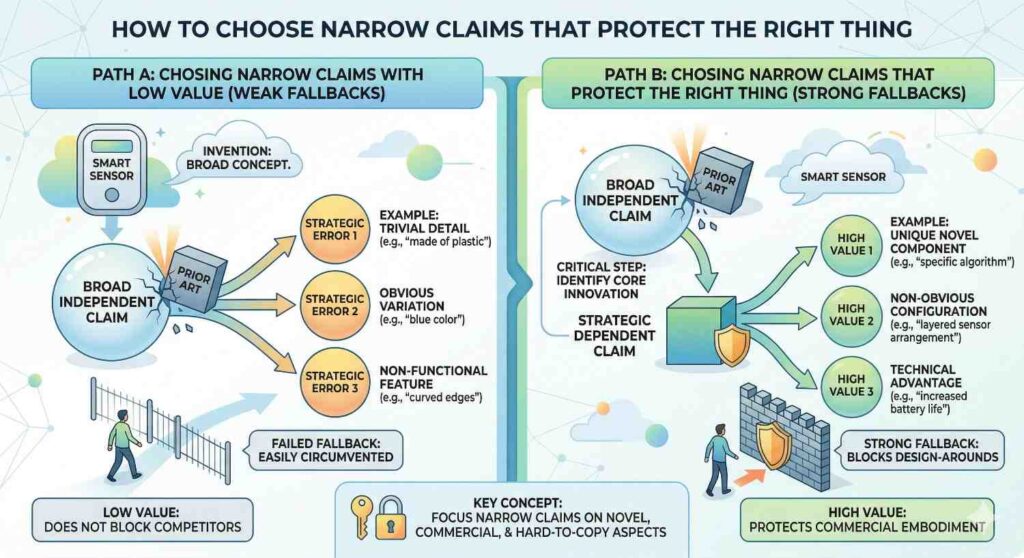
That is why every narrow claim should be tested against a simple business standard. If this were the claim that survived, would it still cover something worth protecting? If the answer is unclear, the narrowing may be aimed at the wrong thing.
Wrapping It Up
Dependent claims are often treated like small add-ons. In strong patent strategy, they are nothing like that. They are where real depth gets built. They are where a company protects the parts of the invention that still matter when broad language gets challenged. They are where smart drafting turns one idea into multiple layers of protection.
Leave a Reply