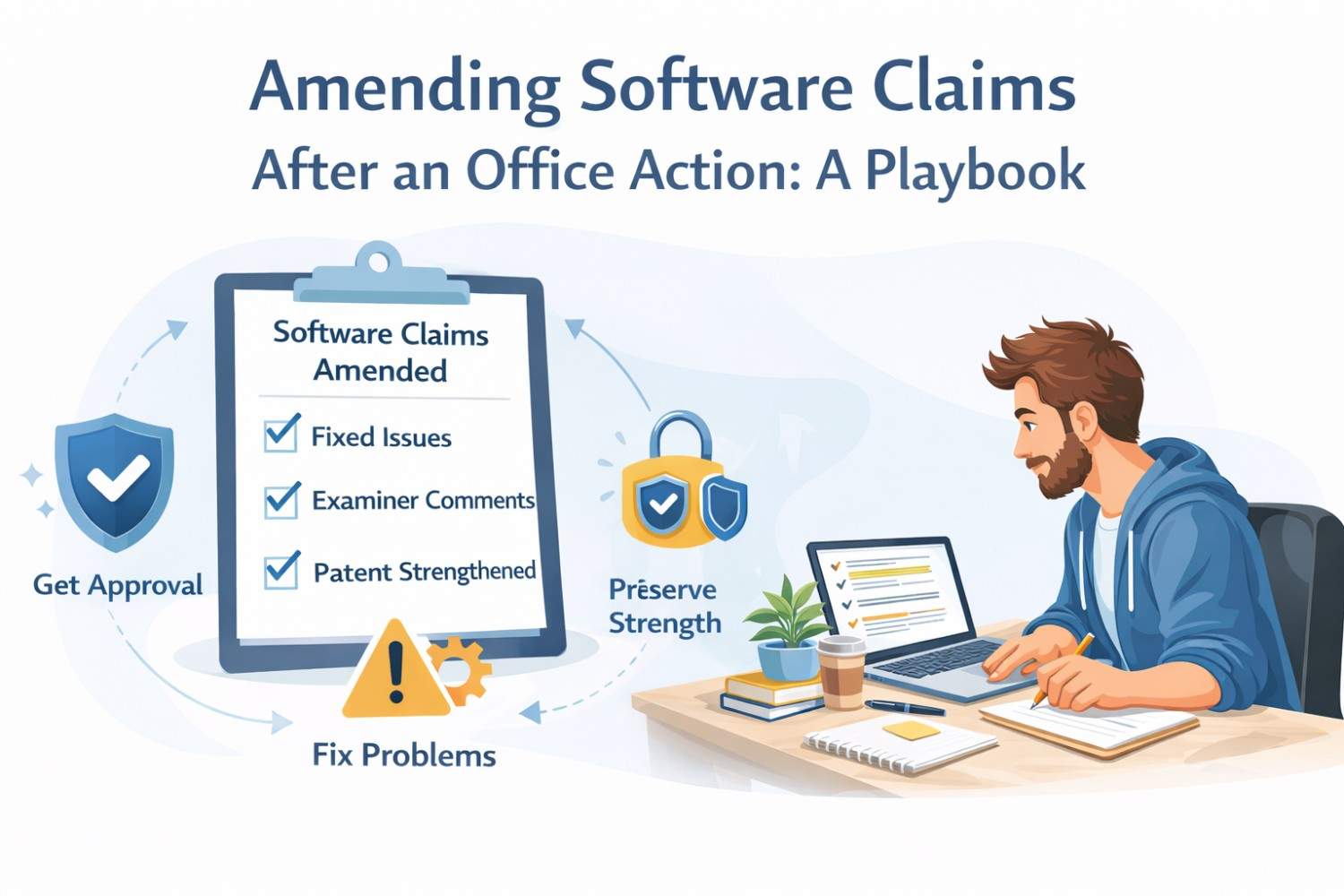
You got an Office Action. That moment can feel rough. You open the document, read a few lines, and it sounds like the patent office is telling you your software invention is not new enough, not clear enough, or not the right kind of thing to patent. For many founders and builders, this is the point where excitement turns into doubt. It should not.
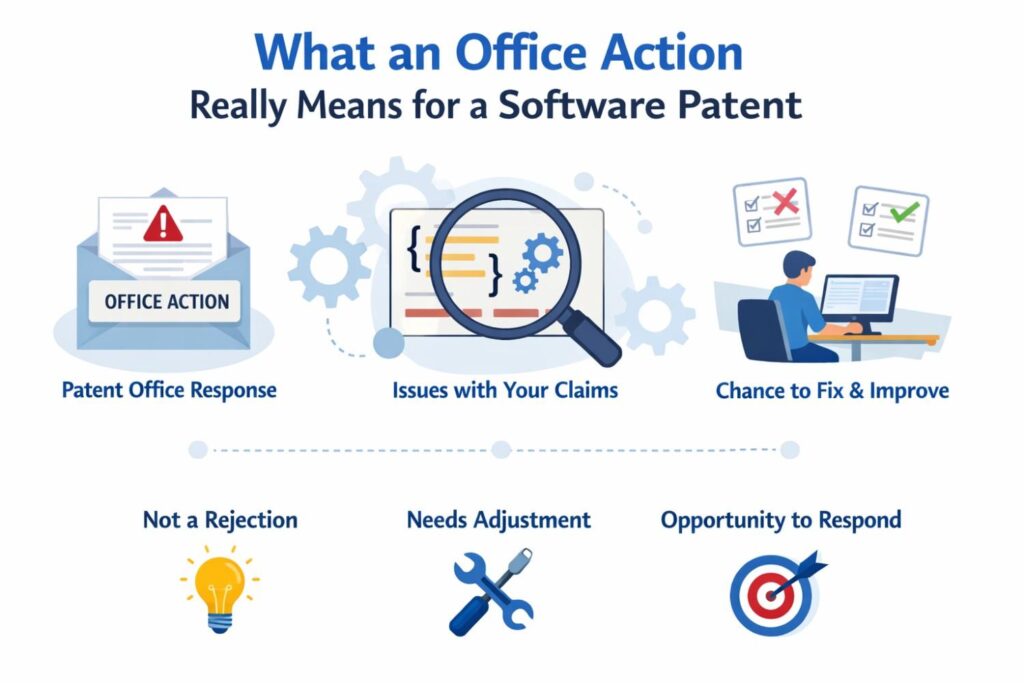
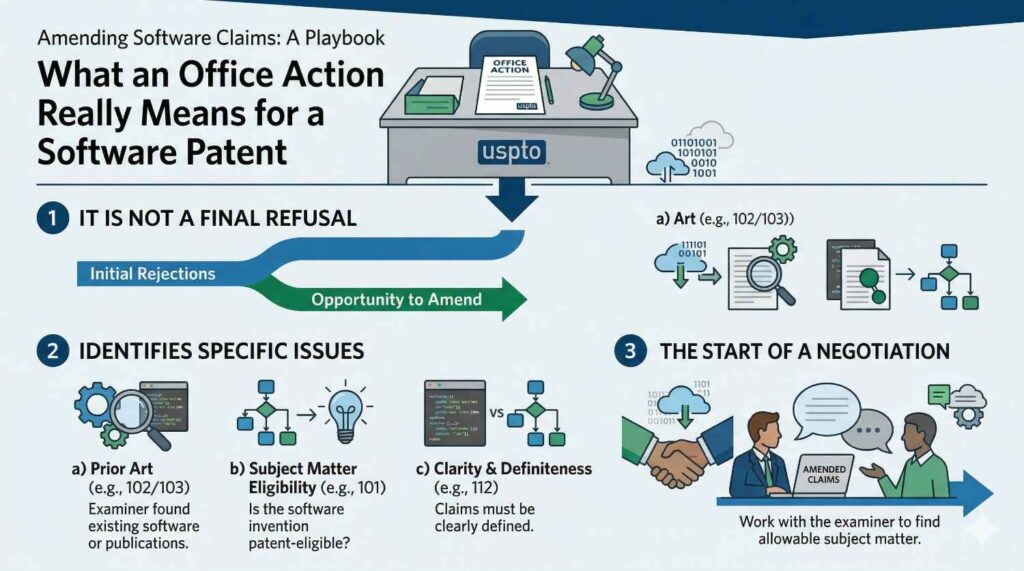
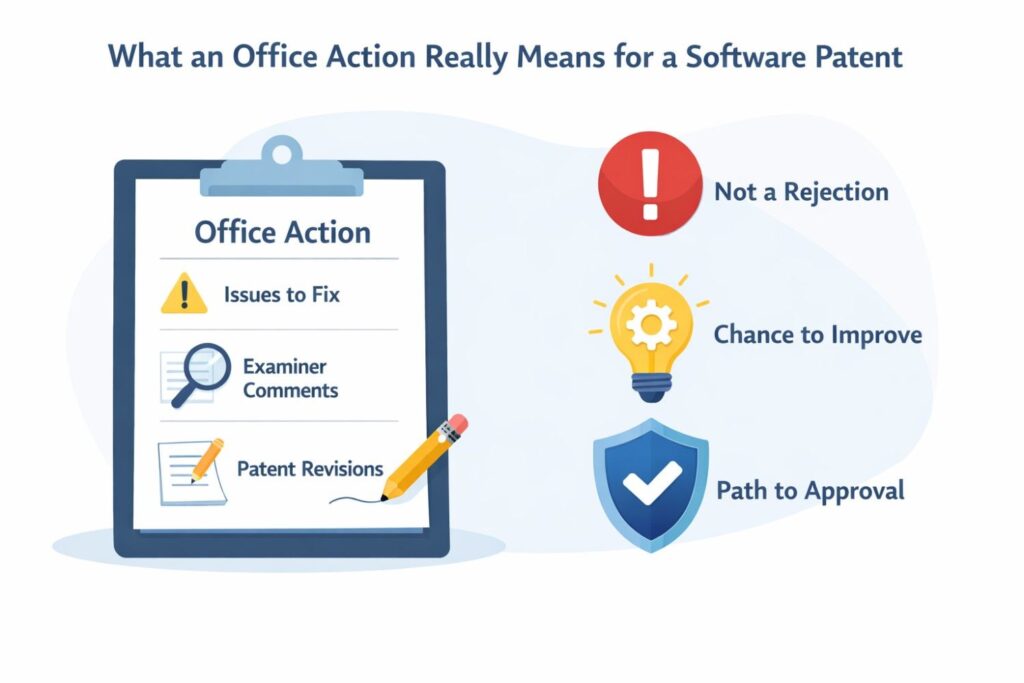
What an Office Action Really Means for a Software Patent
An Office Action can feel like a wall. For many founders and product teams, it looks like the patent office is saying your software idea does not matter or does not deserve protection.
That is not what is happening. In most cases, an Office Action is the examiner telling you where the gap is between how you described your invention and what the patent office needs to see before allowing it.
That gap can often be closed. The key is to understand what the examiner is really reacting to and how your business should respond in a way that protects long-term value.
It Is Not a Final Verdict
The first thing to understand is that an Office Action is usually part of the process, not the end of it. Many good software patents face rejection at first. That does not mean the invention is weak.
It often means the claims are too broad, too abstract, too result-focused, or not tied closely enough to the technical way the software gets the job done.
For a business, this matters because panic leads to bad moves. Some teams treat the first rejection like a disaster and rush into narrow changes that cut away the real commercial value of the patent.
Others dig in and argue too much without fixing the actual problem. Both paths can waste time and reduce the strength of the patent. A better response starts with calm.
You are not losing. You are being shown where the draft needs work.
The Patent Office Is Testing Precision, Not Just Novelty
A lot of founders assume the examiner is only asking one question: is this new? In software cases, that is only part of the picture.
The examiner is also looking at whether your claims are precise, whether they clearly define a technical solution, and whether they avoid claiming a broad idea in a vague way.
This is why a software patent application can get rejected even when the product feels fresh in the market. Your product may truly be different, but if the claim language sounds like a business outcome instead of a technical method, the examiner may push back.
That means your response should not only focus on defending novelty. It should also focus on showing the specific way your system works.
A Rejection Often Means the Claim Is Too Far From the Build
One of the most common problems in software patent drafting is distance between the claim and the real implementation. The claim may describe a high-level function, but not the actual engine that makes it happen.
The farther the claim is from the real build, the easier it is for the examiner to cite prior art or say the claim is too abstract.
That creates a useful lesson for companies. The best amendment strategy often starts with your actual product, not with generic patent phrases. Go back to the architecture.
Look at the sequence of operations. Look at how data moves, how models are triggered, how decisions are made, how outputs are generated, and how system parts interact under the hood.
The more your amended claims track a real technical flow, the better your chance of moving forward without giving up core business value.
An Office Action Shows You Where Your Patent Risk Really Is
An Office Action is not just a legal event. It is also a business signal. It shows you which parts of your invention look soft, which parts look crowded, and which parts may need clearer support.
That is useful because it helps you see where your patent strategy may be exposed before the patent is granted.
A smart business does not treat the rejection as a paperwork problem. It treats it like feedback on how the company is defining its edge. The examiner is, in effect, showing you where your current patent story is weak.
That can help you improve not only the application in front of you, but also how you write future applications around the product roadmap.
It Reveals Whether You Claimed the Product or Just the Pitch
Many software patent applications are written too close to how a startup talks in meetings, decks, and fundraising materials. They focus on what the product achieves.
They talk about speed, automation, personalization, better matching, stronger security, lower cost, or better decisions. Those are business wins. But they are not enough by themselves in a claim.
The patent office wants to know how the software reaches those outcomes. If your claim reads more like a product promise than a technical method, that is often what the Office Action is reacting to.
For business leaders, this is a critical shift. Investors buy into outcomes. Customers buy into outcomes. Patent examiners do not. They need the machinery behind the promise.
When you amend claims, your goal is to move from pitch language to system language without losing sight of the business moat you are trying to protect.
Strategic Advice for Founders and Product Teams
When you review an Office Action, ask one direct question: did we claim the part that makes us hard to copy, or did we claim the result we market to customers? That question can change the whole response strategy.
If the claim only covers the result, your amendment should move toward the mechanism.
That may mean defining a specific sequence, a rule set, a model interaction, a data transformation, a filtering step, a training flow, a distributed coordination method, or a way of allocating resources in the system.
The best amendment often locks onto the part that competitors would actually need to recreate if they wanted to copy the product.
It Tells You What the Examiner Thinks Your Invention Is
Every Office Action contains a hidden message: this is how the examiner is reading your invention. That message matters because prosecution is not just about what you meant to say.
It is about what your claims actually communicate to the person reviewing them.
If the examiner cites references that seem off target, that usually tells you something important. It may mean your claims are written at such a high level that they sweep in old and unrelated systems.
It may mean the examiner sees your invention as generic computing instead of a real technical improvement. It may mean the novelty is buried too deep in the spec and never made it into the claim.
Read the References as a Mirror
Founders often look at cited prior art and think, this is nothing like what we built. Sometimes that is true.
But instead of stopping there, ask why the examiner thought the reference was close enough to use. The answer is often the key to a strong amendment.
A cited reference acts like a mirror. It shows which words in your claim are carrying too much weight and which words are missing.
If the prior art covers broad data processing and your invention is really about a new way of structuring event-driven model updates, then the issue may be that your claim never clearly said that.
The problem may not be the art alone. The problem may be the distance between your innovation and your current claim wording.
Action You Can Take Right Away
Have your product lead or engineer sit with the Office Action and mark up the cited references against the claim. Not as a legal exercise, but as a technical one. Ask them where the examiner’s view diverges from the real system.
Ask them which system behavior is missing from the claim.
Ask them what one design choice in your product would be hardest for a competitor to replace with something simple. Those answers often point to the strongest amendment path.
It Is a Chance to Build a Better Barrier Around the Business
A well-handled amendment can do more than overcome rejection. It can produce a cleaner, tougher patent.
In some cases, the amended claim is more valuable than the original claim because it draws the line around the invention in a more realistic and enforceable way.
That matters for businesses because a patent is not just a certificate. It is a tool. It should support fundraising, licensing, M&A diligence, market positioning, and competitive defense.
A claim that is broad but unstable may look impressive at first, but it can fail when tested. A claim that is narrower in the right way can be much more powerful if it maps closely to the product and to how competitors would build around it.
Broad on Paper Can Be Weak in Practice
Many teams chase broad claims because broad sounds better. In theory, that makes sense. In practice, software claims that are too broad often become fragile.
They are easier to reject, easier to challenge, and harder to defend. They may also create confusion about what exactly the patent protects.
A strong amendment strategy does not ask, how do we keep this as broad as possible at any cost?
It asks, where can we be specific in a way that still captures the real commercial core of the invention? That is a much better business question.
Your Goal Is Not to Save Every Word
When companies respond to an Office Action, they sometimes become attached to the original claim text. That can be a mistake. The goal is not to rescue every line of the first draft.
The goal is to secure protection that matters.
That may mean removing vague phrases that add little value. It may mean replacing generic words with structural detail from the specification.
It may mean shifting focus from the user-facing outcome to the back-end process that creates it. Each of those moves can feel like narrowing, but when done well, they actually sharpen the patent around the company’s real advantage.
It Forces the Business to Decide What Is Core
An Office Action creates a useful pressure test. It forces the company to decide what part of the invention matters most. That sounds obvious, but many applications try to cover too many ideas at once.
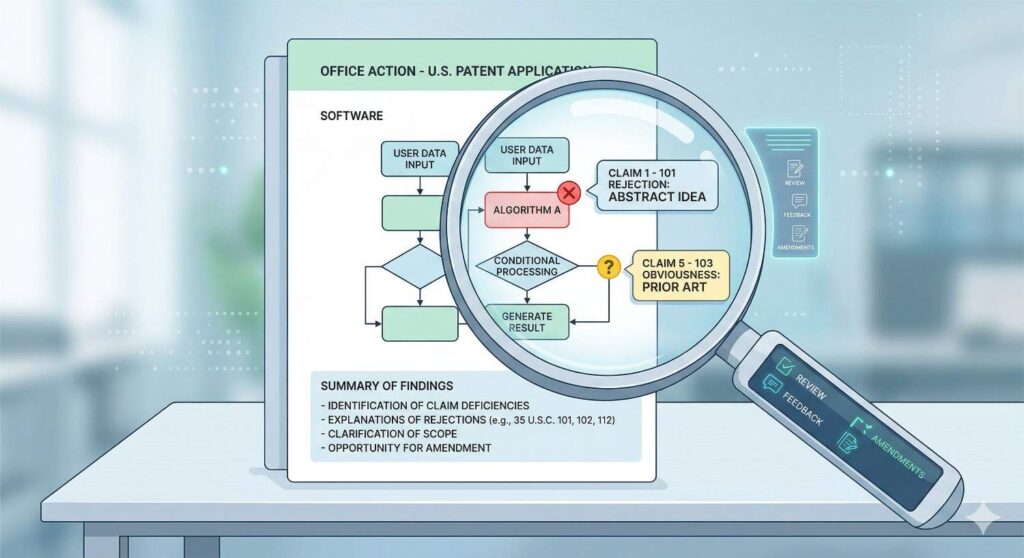
They mix infrastructure, workflow, analytics, interface behavior, and business logic into a single claim set. When the examiner pushes back, the company has to choose what is worth fighting for first.
That is not bad news. It is strategy.
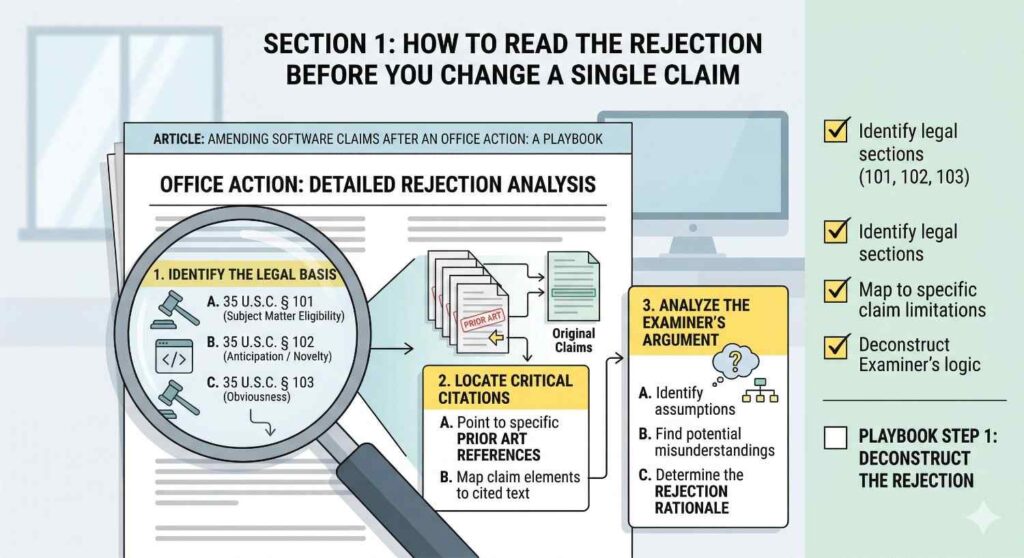
How to Read the Rejection Before You Change a Single Claim
The worst way to handle an Office Action is to start editing claims too fast. That is how founders lose strong coverage without even knowing it. A rejection is not just a problem to fix.
It is a message to decode. If you read it the right way, you can see what the examiner thinks your invention is, what part of your claim language is causing trouble, and where your best path forward may be.
If you read it the wrong way, you may cut out the very thing that made the patent worth pursuing in the first place.
Slow Down Before You Start “Fixing” Things
The first job is not drafting. The first job is reading. Most bad amendments happen because the team reacts to a few harsh lines and jumps straight into revision mode.
That creates a real risk. You end up changing claim language before you understand whether the examiner is attacking novelty, clarity, eligibility, support, or some mix of all four.
A software patent response should begin with patience. Read the rejection as a business asset review, not just as a legal document. The words matter. The references matter.
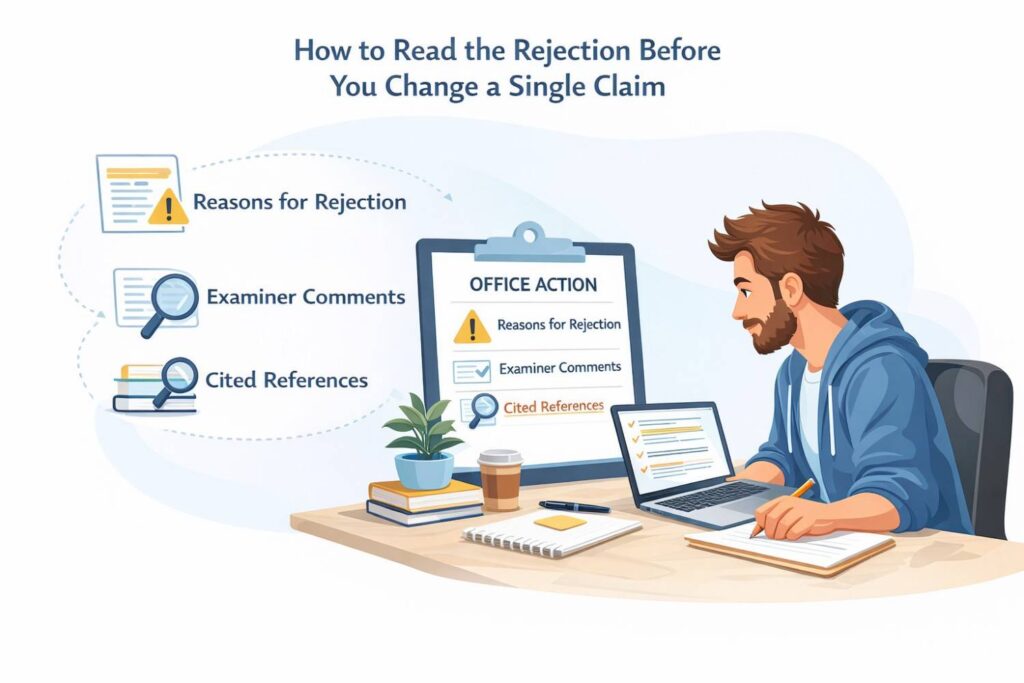
The exact ground of rejection matters. And the order in which the examiner presents the issues matters too. Often, the first reading tells you what feels wrong. The second reading tells you what is actually wrong.
Start With the Examiner’s Framing, Not Your Own
Founders naturally read an Office Action through the lens of the product they built. That is normal, but it can be dangerous. The examiner is not inside your codebase, your roadmap, or your customer calls.
The examiner sees only what is in the application and what is in the claims. So the first thing to understand is not what you meant. It is what the examiner believes you claimed.
That shift is powerful. It changes the question from “Why do they not get it?” to “What in our claim language led them to read it this way?” Once you ask that question, the Office Action becomes much more useful.
Look for the Examiner’s Summary of the Invention
In many rejections, the examiner gives a short description of what they think the claim covers. That summary may not be stated in one clean sentence, but it is there in the way they discuss the claim and the prior art. Read that carefully.
If the examiner describes your invention as generic data processing, a basic matching system, routine automation, or standard computer implementation, that is a sign the claim may not be carrying your actual technical edge.
This is one of the most important moments in the whole response process. If the examiner’s framing is too broad or too shallow, your next move should focus on correcting that framing through better claim language and stronger argument.
But you cannot do that well until you first see the mismatch.
Separate the Type of Rejection Before You React
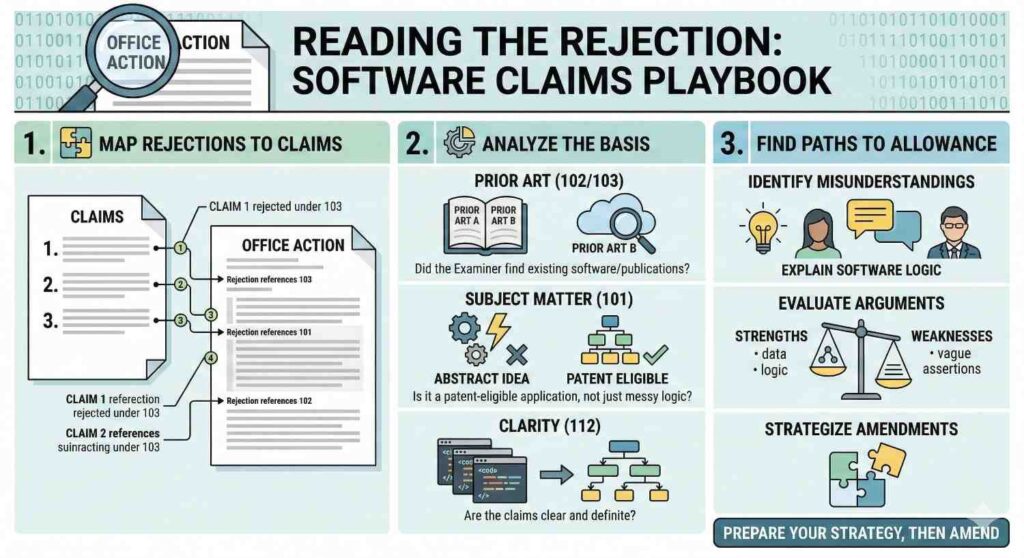
Not all rejections mean the same thing. A novelty rejection is different from an obviousness rejection.
A subject matter rejection is different from an enablement or written description problem. If you blur them together, your response will likely miss the target.
This sounds basic, but many teams read an Office Action emotionally and treat every rejection as one big “no.” That makes it harder to respond with precision.
A strategic business response starts with clean separation. What exactly is being challenged, and why?
A Prior Art Rejection Is Usually About Claim Mapping
When the examiner cites earlier references and says your claim is anticipated or obvious, the issue is often not that your product is worthless.
The issue is that your current claim language maps too easily onto what already exists in the record. That means the rejection is often about overlap at the wording level.
This is why software founders should not stop at saying, “Our product does more than that old system.” The product may do more. But the claim may not say enough about that extra part.
The examiner is comparing claim language to prior art disclosures, not product demos to product demos.
Read the Mapping Like a Competitor Would
A strong way to read a prior art rejection is to imagine a competitor reading it with bad intentions. Ask yourself what parts of your claim look generic enough that a rival could say, “Yes, we do that too.”
Those are often the weak points. The examiner has already exposed where your language may be too broad or too functional.
This is useful for business strategy because it tells you where your current patent position may be vulnerable in the market, not just in prosecution.
If the rejection makes your invention sound easy to overlap with older systems, that is a sign your claims may need more technical shape.
A Subject Matter Rejection Is Usually About Abstraction
Software patents often face eligibility pushback because the claims read like a result instead of a concrete technical method. When that happens, many founders think the patent office is hostile to software in general.
That is not the most useful way to read it. The more useful reading is this: the examiner does not yet see a clear technical improvement in the claim language.
That is a very different problem from pure novelty.
It means the response must show how the claimed steps improve a technical process, system behavior, computer operation, data handling flow, or another concrete implementation detail. Reading that correctly up front can save a lot of wasted motion.
Find the Words That Sound Like Business Goals
If the rejection says your claims are directed to organizing activity, processing information, evaluating data, or presenting results, look for language in the claims that sounds more like a goal than a method.
Terms that describe outcomes without giving operational detail often trigger this kind of response.
For businesses, this is a warning sign worth taking seriously. Claim language that sounds great in a pitch deck may sound abstract in a patent file.
When reading the rejection, notice where your claims drift away from engineering detail and toward business benefit language. That is often where the problem begins.
Read the Office Action With the Specification Open
A common mistake is to read the rejection in isolation. That is too narrow. You should read it side by side with the claims and the specification. The real question is not just what the examiner rejected.
The real question is whether the application already contains technical support for a better response.
That is why smart amendment strategy begins with alignment. Look at the rejected language.
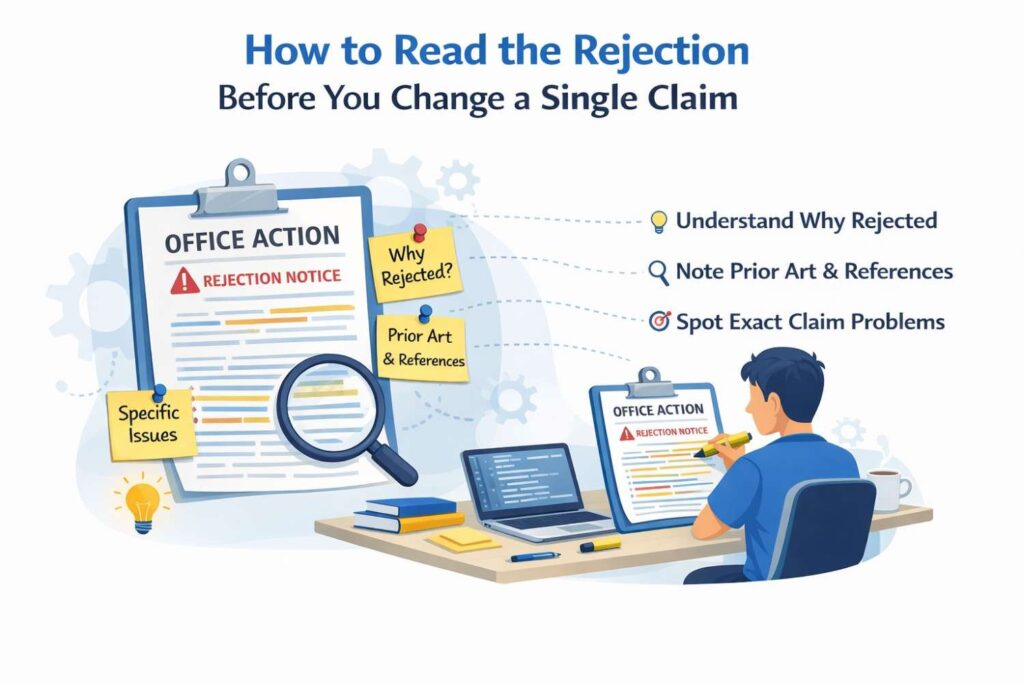
Then look at the portions of the specification that explain the actual implementation. Often the strongest path forward is already sitting there in the filing, waiting to be pulled into the claims.
Do Not Guess What You Can Add Later
Founders sometimes assume they can simply add clarifying technical detail during response. That is not always true. You can only amend safely within the support of the original filing.
So while reading the rejection, you should also be asking a second question: what does our specification clearly teach that we have not yet claimed?
This is where many software teams either gain leverage or lose it. A well-written application gives you room to respond without inventing new language.
A thin application limits your options. Reading the rejection against the specification helps you see that early.
Mark the Support Before Drafting Anything
Before changing a claim, identify exact places in the specification that support each possible amendment idea.
That discipline matters. It keeps the response grounded and reduces the risk of narrowing in the wrong direction. It also forces the team to focus on supported technical detail rather than improvised wording.
For business teams, this step has another benefit. It shows whether the company’s patent process is capturing enough engineering detail in the first place.
If support is hard to find, that is not just a prosecution issue. It is a filing process issue worth fixing for future cases.
Pay Attention to What the Examiner Did Not Cite
The Office Action is valuable not only for what it says, but also for what it leaves untouched.
Sometimes the examiner attacks broad claim language but ignores a narrow technical point buried in a dependent claim or in the specification. That silence can be a clue.
It may point to the feature that actually distinguishes your system. It may show where there is still room to build a stronger independent claim.
It may also suggest that the real fight is not over every feature in the application, but over which feature should become the center of the claim set.
Silence Can Reveal Opportunity
When a claim element gets little attention in the rejection, do not assume it is unimportant. In many cases, it may be the most promising amendment anchor.
The examiner may have focused on the broad parts of the claim because those parts were easiest to read onto prior art. That leaves the more specific system behavior underused.
This can be a major business opportunity. A claim built around a less obvious but commercially important implementation detail may be easier to allow and harder for competitors to copy cleanly.
Reading the rejection closely helps you find that opening.
Ask What the Examiner Considered Routine
Software patent rejections often rely on the idea that certain steps are standard, conventional, or routine. Read that language carefully. It tells you what the examiner thinks is ordinary.
Your job is not to argue with labels in the abstract. Your job is to see whether your application actually discloses a step, sequence, or architecture choice that is not routine and has not been brought into focus yet.
That is where strong responses come from. Not from louder disagreement, but from clearer contrast.
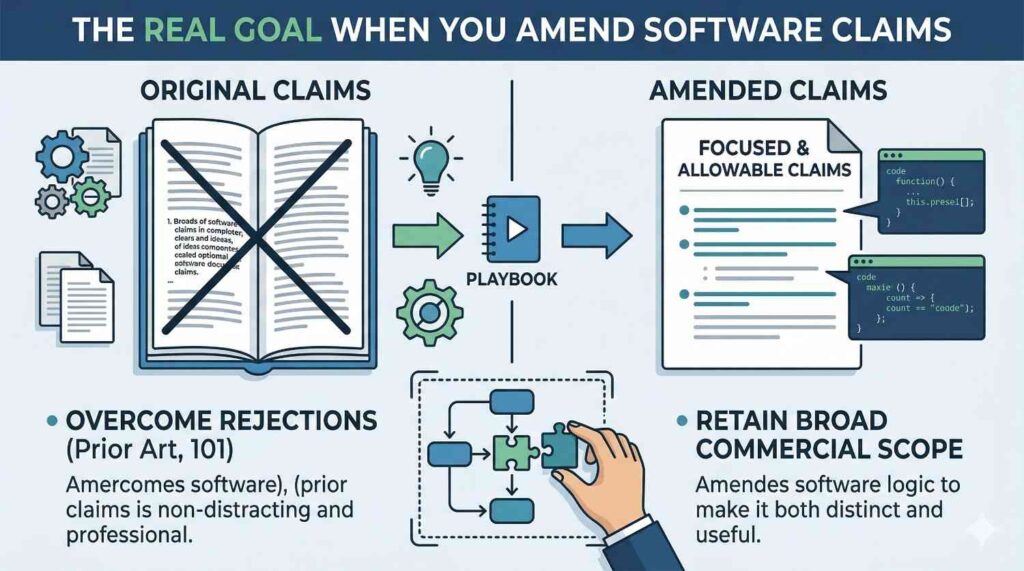
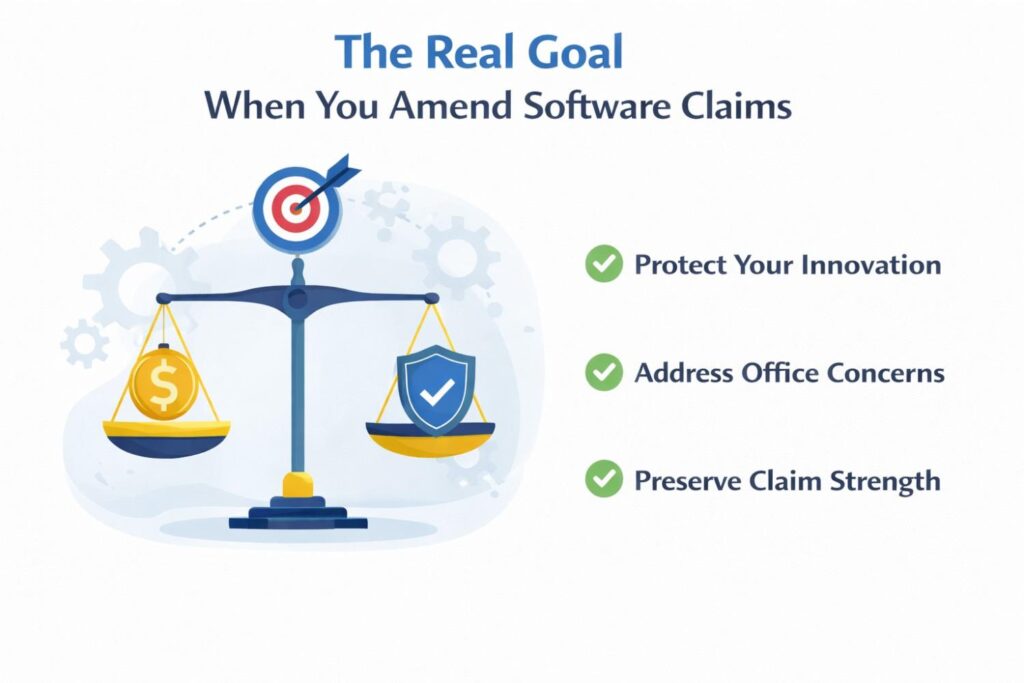
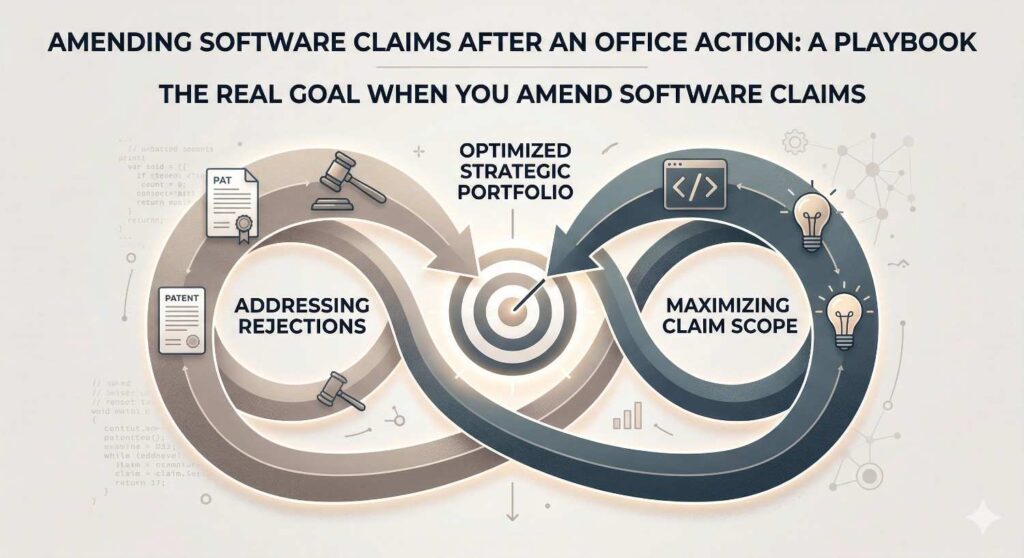
The Real Goal When You Amend Software Claims
Amending software claims is not about making the examiner happy at any cost. It is not about trimming words until the rejection goes away.
And it is not about giving up broad protection just to get a patent issued faster. The real goal is much more important than that.
You are trying to reshape the claim so it clearly covers the part of the invention that gives your business real value, while still giving the patent office a clean path to allowance.
The Goal Is Not Just to Get a Yes
A granted patent matters, but a weak granted patent does not help much. Many companies make the mistake of treating amendment as a race to approval.
They cut the claim too fast, tie it to a tiny product detail, and end up with a patent that looks nice on paper but does little in the real world. That is not a win.
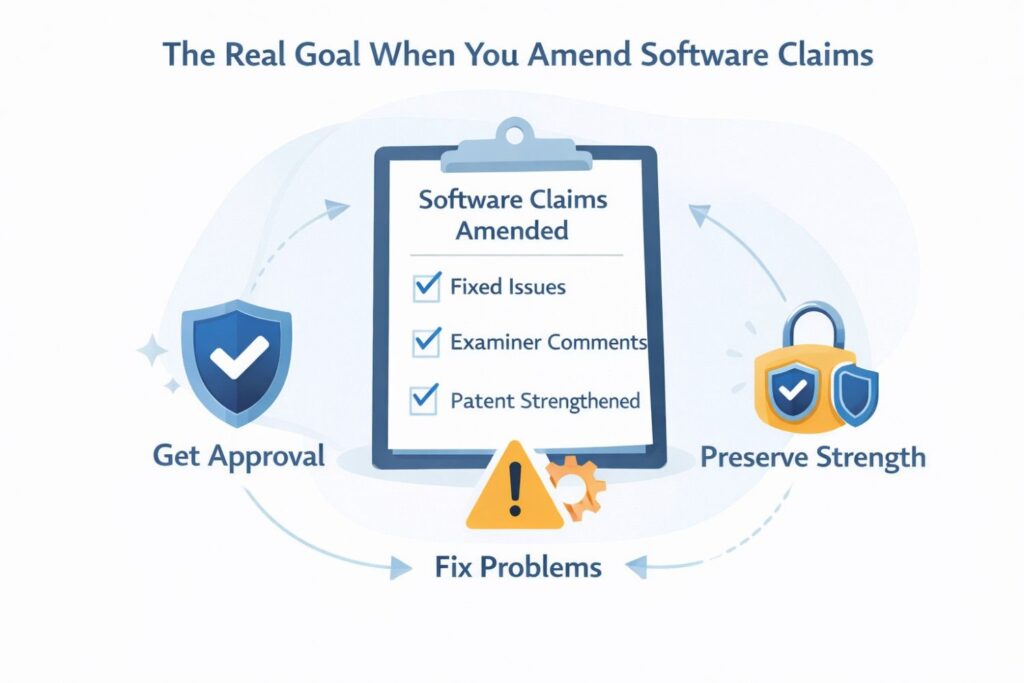
A true win is a claim that gets allowed and still matters when your company grows, raises money, sells into the market, or faces a copycat.
A Fast Allowance Can Sometimes Cost You Later
Speed feels good, especially for startups that want momentum. But every claim change shapes the business value of the patent.
If you narrow the claim around a minor feature that customers do not care about and competitors can avoid with one small tweak, the patent may become easy to work around.
The real goal is to avoid that trap. You want to move toward allowance without shrinking the invention down to something no longer worth protecting.
The Real Goal Is to Protect the Technical Edge That Drives Business Value
The best amended claim is not the one with the most words or the one with the fewest words. It is the one that tracks the actual technical edge behind the product.
In software, that usually means the system behavior, processing flow, architecture choice, training logic, data handling method, coordination method, or control logic that makes the product harder to copy.
You Want to Cover What a Competitor Would Need to Rebuild
A useful way to think about claim amendment is this: if a well-funded rival wanted to copy your advantage, what part of your software would they really need to recreate?
That is usually the zone your amended claims should move toward. Not the marketing promise. Not the broad idea. The concrete method that creates the result.
This Is How Patent Strategy Connects to Company Strategy
A patent should protect more than an invention in the abstract. It should protect the thing that supports your pricing power, market edge, or product lead.
When you amend claims, you are deciding what part of the business deserves a stronger legal fence. That is why claim amendment should not happen in a vacuum. It should reflect what the company actually needs to defend.
The Goal Is to Shift From Outcome Language to Mechanism Language
Many software claims get rejected because they describe what the software achieves, not how it achieves it. That is a common drafting problem. During amendment, the real job is often to move away from broad result language and toward the technical mechanism that creates the result.
This does not mean you make the claim unreadable or stuffed with unnecessary detail. It means you choose the right details.
Results Alone Rarely Carry a Strong Software Claim
Words like optimize, analyze, match, rank, personalize, detect, automate, and improve can sound impressive. But standing alone, they often leave too much open.
They describe what the system does at a high level, but not the technical way it gets there. That is where the examiner pushes back, and that is also where competitors get room to argue around the claim.
The Better Question Is “How, Exactly?”
Each time you look at a rejected claim phrase, ask a simple question: how, exactly?
If the claim says the system selects content, how does it select it? If it says the system generates a recommendation, based on what steps? If it says the system detects an event, through what process? That question helps expose the real amendment target.
The Goal Is to Narrow in the Right Way, Not in the Easy Way
Every amendment narrows something. The issue is not whether narrowing happens. The issue is whether the narrowing increases or decreases the real value of the patent.
Good narrowing makes the claim more grounded, more defensible, and more clearly tied to the product’s core advantage. Bad narrowing gives away useful scope while solving only the temporary prosecution problem.
Smart Narrowing Adds Shape Without Giving Away the Store
A strong amendment often adds structure, sequence, or technical conditions that were already in the specification but missing from the claim. That kind of narrowing can actually improve the patent because it makes the line around the invention clearer.
It can also make infringement easier to analyze later, because the claim maps more directly to real system behavior.
Weak Narrowing Usually Targets a Side Detail
The wrong kind of narrowing often happens when a team grabs the first small feature that distinguishes the art and plugs it into the independent claim. That may work for prosecution, but it may also leave the core invention untouched.
If the added detail is easy to omit, easy to replace, or not central to product value, the amendment may weaken the patent even if it wins allowance.
The Goal Is to Preserve Commercial Scope
Patent scope is not just a legal concept. It is a business concept. When you amend a software claim, you should be asking whether the revised claim still covers the commercial heart of the product.
A claim can be technically valid and still miss the business target. That happens when amendments focus too much on a narrow implementation detail that matters little in the market.
A Useful Patent Should Still Matter If the Product Evolves
Software changes fast. Features move. User flows change. Back-end infrastructure gets rebuilt. If your amended claim is tied too tightly to one temporary design choice, the patent can become stale even while the business grows.
The real goal is to capture the durable technical idea inside the product, not just the exact snapshot of one release version.
Think Beyond the Current Build
This does not mean you claim in vague terms. It means you claim with foresight. Look for technical features that are likely to stay important even as the product matures.
Those are better amendment anchors than temporary implementation choices made only for speed or resource limits.
The Goal Is to Create a Claim You Can Actually Explain
A software patent becomes more useful when it can be explained clearly to investors, buyers, partners, and even internal teams. Overly abstract claims are weak.
But overly tangled claims can also create problems. The best amended claim is usually one that has real technical detail and still tells a clear story about what the invention does differently.
Clarity Helps in More Places Than Prosecution
A clear claim can help during fundraising because it is easier to connect to the company’s value.
It can help in diligence because it is easier to map to the product. It can help in enforcement because it is easier to compare against competitor behavior. Clarity is not just nice writing. It is part of the asset.
A Good Test Is Whether the Product Team Can Recognize It
After an amendment, someone close to the product should still be able to read the claim and say, yes, that is our real technical advantage.
If the team no longer sees the product in the claim, the amendment may have drifted off course, even if it looks legally neat.
The Goal Is to Reduce Ambiguity Without Losing Flexibility
Ambiguity is dangerous in software claims. It opens the door to broad prior art mappings and weakens the line around what is protected. But being too rigid can also hurt.
The real goal is to remove the ambiguity that caused the rejection while keeping enough flexibility to cover the real business implementation and close variants of it.
Wrapping It Up
An Office Action can feel like bad news when it lands in your inbox. In truth, it is often the moment when your software patent starts becoming more real, more focused, and more useful. The first draft of a claim is rarely the final version that creates the most value for the business. What matters is how you respond when the examiner pushes back.
Leave a Reply