You built the software. You know how it works. You know why it matters. But before you file a patent, there is one hard truth worth facing: A weak claim can quietly ruin a strong invention. That is the part many founders miss. They spend months building something real. They solve a painful problem. They create a system that does more than what came before. Then, when it is time to protect it, the patent draft says too little, says the wrong thing, or stays so vague that it fails when it matters most. That is why pre-filing QA matters.
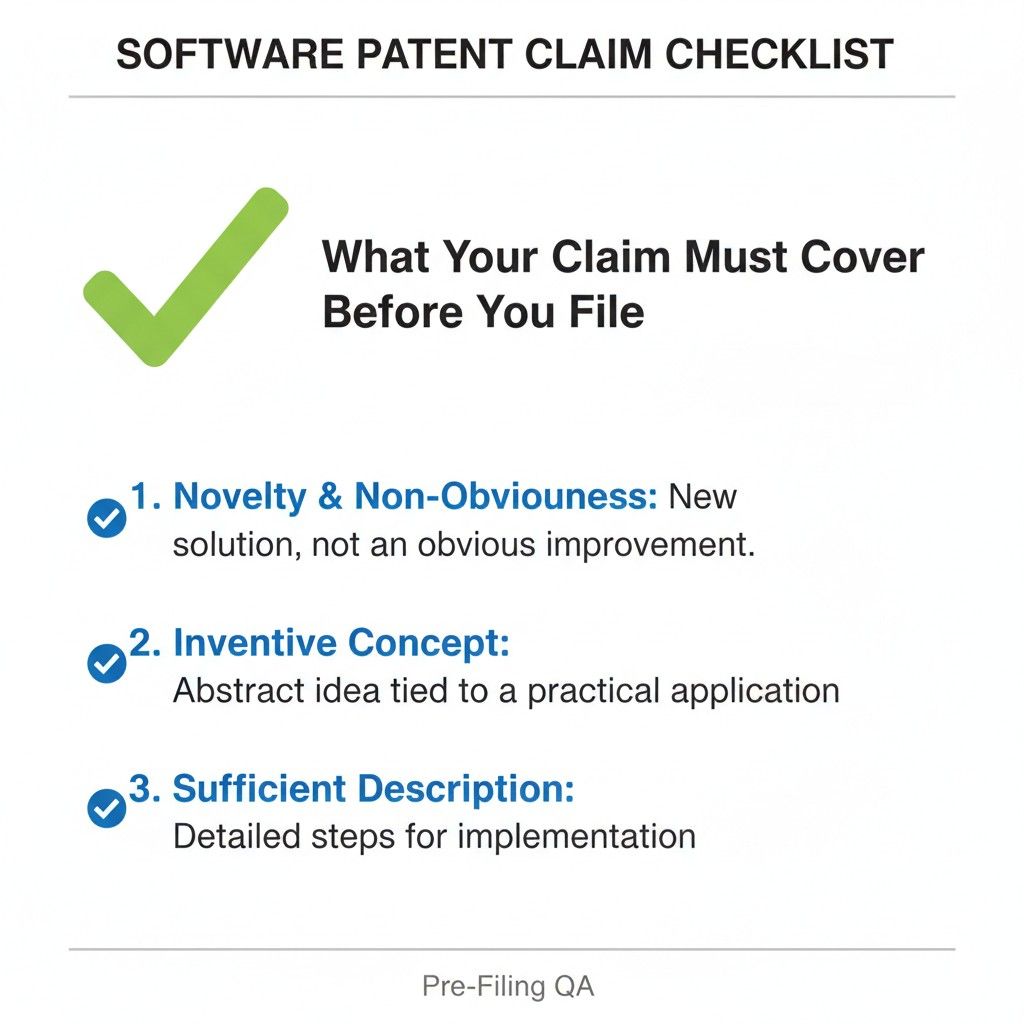
What Your Claim Must Cover Before You File
A software patent claim is not just a short summary of your product. It is the part that does the hard work of defining what you are trying to protect. That is why this section deserves real care before filing.
If the claim misses the heart of the invention, your patent may look fine on paper but fail to protect the business value you worked so hard to build.
Start With the Real Business Value
Before you look at claim wording, step back and ask a simple question: what part of this software gives your company an edge? That is where the claim work should begin.
Many teams make the mistake of claiming what the product does on the surface instead of claiming the deeper technical move that creates the result.
A business may think its value is “faster payments,” “better search,” or “smarter fraud detection,” but those are outcomes. The claim needs to reach the engine under the hood.
For a business, this matters because investors, buyers, and even competitors care less about your marketing line and more about what is actually protectable.
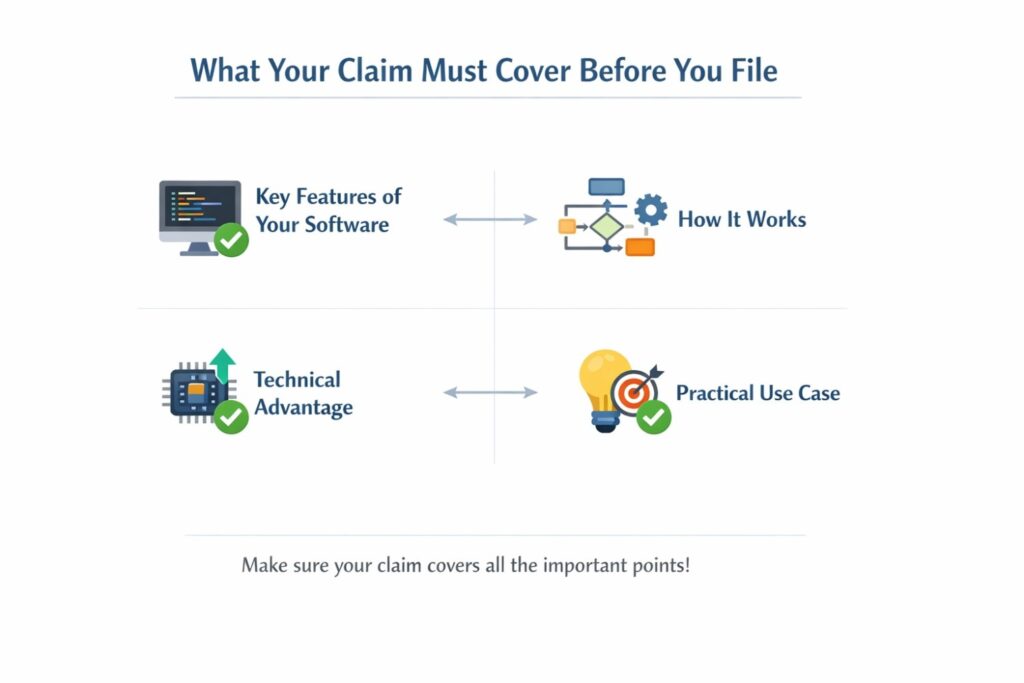
A useful pre-filing review starts by matching the claim to the thing that would hurt most if copied.
If a rival built a close version of your system tomorrow, what part would you want the patent to reach? That answer should guide the whole draft.
Tie the Claim to What Makes Switching Hard
The strongest business assets are often the ones that make customers stay. That might be the way your system sets up data, routes tasks, makes predictions, or reduces manual work.
Claims should aim at the feature or process that creates that stickiness. If your claim focuses only on a visible feature while leaving out the real technical process, it may protect less than you think.
A practical way to test this is to imagine a buyer looking at your company during diligence. Would the claim point to the part of the product that drives retention, cost savings, or speed? If not, the draft may be protecting the wrong thing.
Look Past the User Interface
Many software teams naturally speak in screens, flows, and user actions. That makes sense for product design, but patent claims need more than front-end language.
A user interface can be helpful context, yet the stronger protection often sits in the system behavior behind it.
That may include how data is transformed, how signals are ranked, how workflows are triggered, or how system steps happen in a useful order.
This is where companies can gain an edge. When the claim is tied only to the surface layer, a competitor may copy the same business logic with a different screen and reduce your leverage.
A better draft reaches the mechanism, not just the display.
Cover the Technical Change, Not Just the Result
A good claim should not stop at saying what happened. It should show enough of how the system gets there.
That does not mean the claim must read like source code. It means the claim should capture the technical path that turns the idea into a real solution.
For business leaders, this point is easy to miss because outcomes are easier to explain than architecture. But in patent work, the technical change is often the protectable part.
Saving time, cutting errors, or improving recommendations are helpful results, yet the claim needs to show the system steps that produce them in a concrete way.
Show the Movement of Data
One powerful way to pressure-test a software claim is to track the movement of data through the system. Where does it start? What is done to it? How does it change? What decision follows?
What output is produced? A claim that follows this path tends to feel more grounded and more useful than a claim that simply states a business goal.
This is also highly actionable for a company preparing to file. Sit with the product lead or engineer and walk one real example from input to output. Then compare that flow to the claim draft.
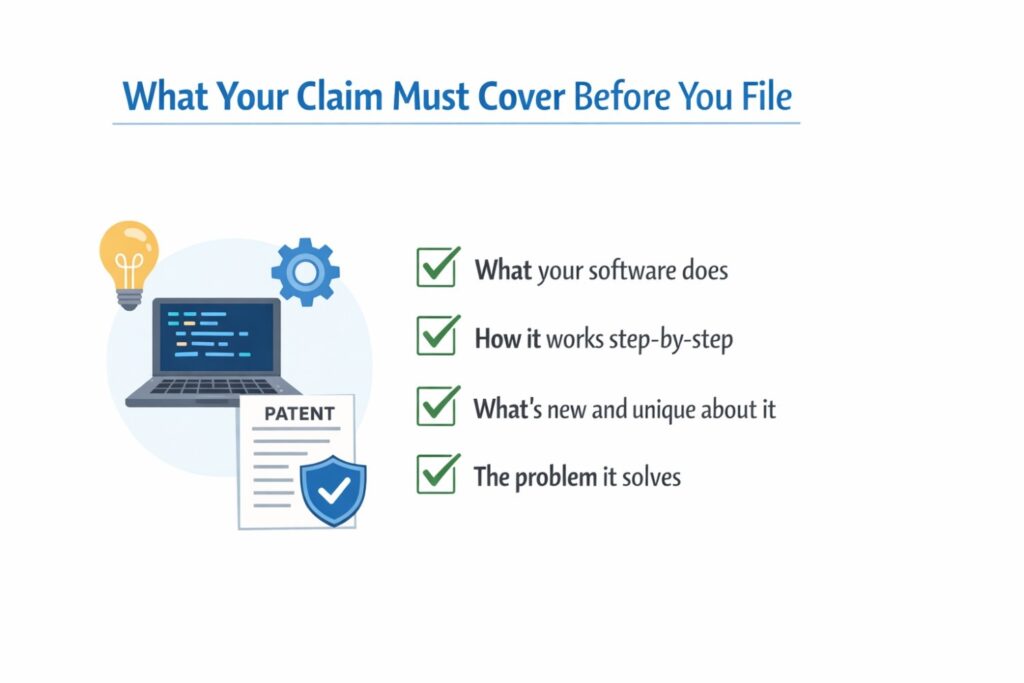
If the draft skips the key transformation step, the claim may not be covering the technical gain that matters.
Make Sure the Claim Includes the Decision Logic
Software often becomes valuable at the point of decision. The system classifies something, ranks options, detects a state, selects a rule, or triggers an action.
If that decision logic is central to your product advantage, it should not be buried or left implied. It should be reflected clearly enough that the claim covers the reason the system behaves differently from ordinary software.
From a business view, this helps build stronger protection around what makes your software harder to reproduce.
A rival can copy a simple workflow. It is much harder to safely design around a claim that captures the real decision logic at the heart of the platform.
Make the Claim Match the Product You Actually Have
One of the easiest ways to weaken a patent filing is to let the claim drift away from the product reality. Sometimes this happens because the draft tries too hard to sound broad.
Sometimes it happens because the product changed after the invention notes were first written. Either way, a claim that does not match the actual system creates risk.
A strategic business team should treat claim review as a product alignment exercise.
The filing should not describe the product you hoped to build six months ago if the actual release now works in a better and different way. Your current technical edge is what deserves protection.
Review the Claim Against the Current Build
A very useful habit before filing is to review the draft with the current product, not an old deck.
Open the spec, the design notes, or even the live workflow. Read each claim part and ask whether the product truly does that step. If the answer is no, the draft needs work. If the answer is yes, ask whether the step is still the right one to focus on.
This process gives businesses a major advantage because it reduces the gap between legal language and engineering truth.
That gap becomes painful later during diligence, licensing talks, or disputes. Closing it before filing saves time, money, and trust.
Include the Version That Matters Most Commercially
Your product may have several versions, modes, or deployment paths. The claim does not need to cover every small variation in one sentence. But it should cover the version that matters most to the company’s future.
That may be the enterprise workflow, the API layer, the automation engine, or the model-serving process that customers actually pay for.
Too many startups let the claim center on a simple demo version because that version is easy to explain.
A more strategic move is to focus on the form of the invention that connects to revenue, scaling, or defensibility. That is the version a business should be most serious about protecting.
Cover the Problem in a Way That Sets Up the Solution
A strong claim often becomes much clearer when the underlying problem is framed well. The problem tells you what the invention had to solve, and that helps define what the claim must include.
If the problem is vague, the claim tends to become vague too. If the problem is sharp and technical, the claim often becomes more focused and useful.
For a business, the right problem statement also helps explain why the patent matters. It gives context for investors, partners, and internal teams. It turns the claim from random wording into a direct answer to a real pain point in the system or market.
Define the Pain With Precision
Instead of saying the software improves efficiency, identify the specific bottleneck. Was the old process too slow because it required repeated queries?
Did it fail because signals were handled in isolation? Did it create waste because tasks were routed without current context? The more clearly you define the technical pain, the easier it becomes to see what the claim must cover.
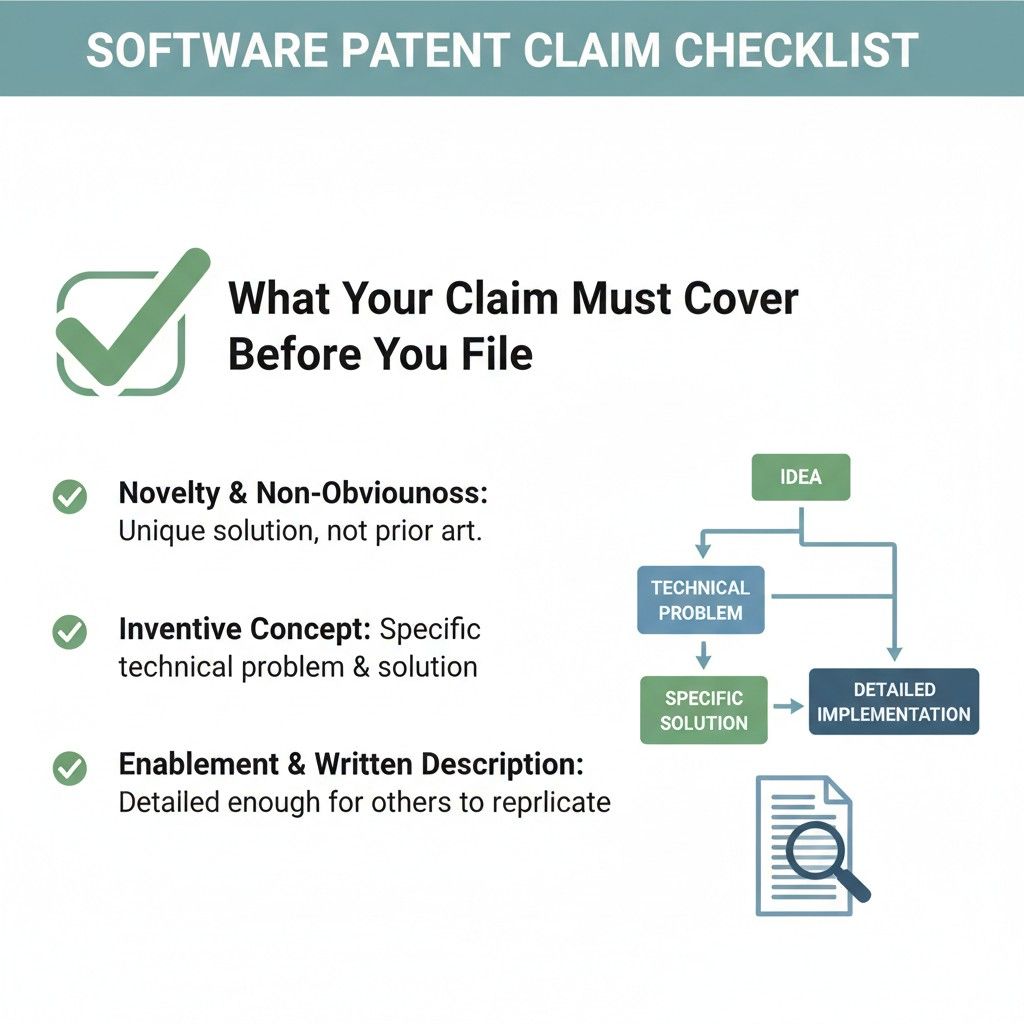
This is a helpful checkpoint for management teams. If your internal leaders cannot explain the exact pain the invention solves, the claim may drift toward generic language. Precision here creates better focus later.
Connect Every Claimed Step to That Pain
Once the problem is clear, each step in the claim should earn its place. A good internal QA question is this: why is this step here?
If a step does not connect back to solving the identified problem, it may be filler. And filler weakens clarity.
That does not mean claims must be long. In fact, cleaner claims are often stronger. The point is that every part should map to the solution in a meaningful way.
Businesses benefit from this because focused claims are easier to defend, easier to explain, and often harder to design around.
Protect the Core Workflow, Not Just One Snapshot
Software does not create value in one frozen moment. It usually creates value across a chain of actions.
Data comes in, rules are applied, system state changes, outputs are generated, and next steps follow. A claim should reflect the workflow that matters, not just one isolated stage.
This is especially important for businesses in fast-moving markets. A narrow claim tied to a single snapshot may miss the broader process competitors would actually copy. A more thoughtful draft protects the flow that creates the advantage.
Think in Terms of System Behavior Over Time
Many important software inventions depend on sequence. The order of operations can matter. The timing can matter. The use of prior state can matter.
The update of a model, queue, or rule set can matter. If the value comes from how the system behaves across time, the claim should not flatten that into a static description.
This is a strong place for actionable review. Ask your team whether changing the order of steps would break the benefit. If yes, the claim should likely reflect that order. If the order does not matter, the wording may be kept more flexible.
Include the Trigger That Starts the Valuable Action
In many systems, the real advantage begins when something triggers the process.
That trigger may be a user event, a threshold crossing, a pattern match, a model output, or a new data condition. If that trigger is important, leaving it out can make the claim less tied to the real invention.
From a business angle, triggers are often where automation becomes monetizable. They show how the product moves from passive software to active system value. That is a commercially important detail, and often a patent-worthy one too.
Make Room for Commercially Important Variations
A startup rarely has only one path forward. The product evolves. The use cases expand.
The deployment model changes. A claim should protect the core invention now without boxing the company into a tiny corner later. This is where good pre-filing QA becomes highly strategic.
The goal is not to make the claim so broad that it loses support. The goal is to make sure the claim covers the center of the invention while leaving space for business growth. That takes thought before filing, not after.
Ask How a Competitor Would Copy You Cheaply
One of the smartest business tests is to think like a fast follower. If a competitor wanted to copy your product while making small changes, what would they change first?
They might swap the input source, alter the output format, move processing to a different
How to Spot Gaps, Weak Words, and Risky Claim Drafting
A software patent claim can look polished and still have serious problems hiding inside it. That is what makes this stage so important. Before filing, you need to slow down and read the claim like someone trying to break it, copy it, or reject it.
That is where the real value of pre-filing QA shows up. You are not just checking grammar. You are testing whether the claim is strong enough to protect a business asset.
Read the Claim Like a Competitor Would
The fastest way to spot weakness is to stop reading the claim like its owner and start reading it like a rival. A competitor is not trying to admire your wording.
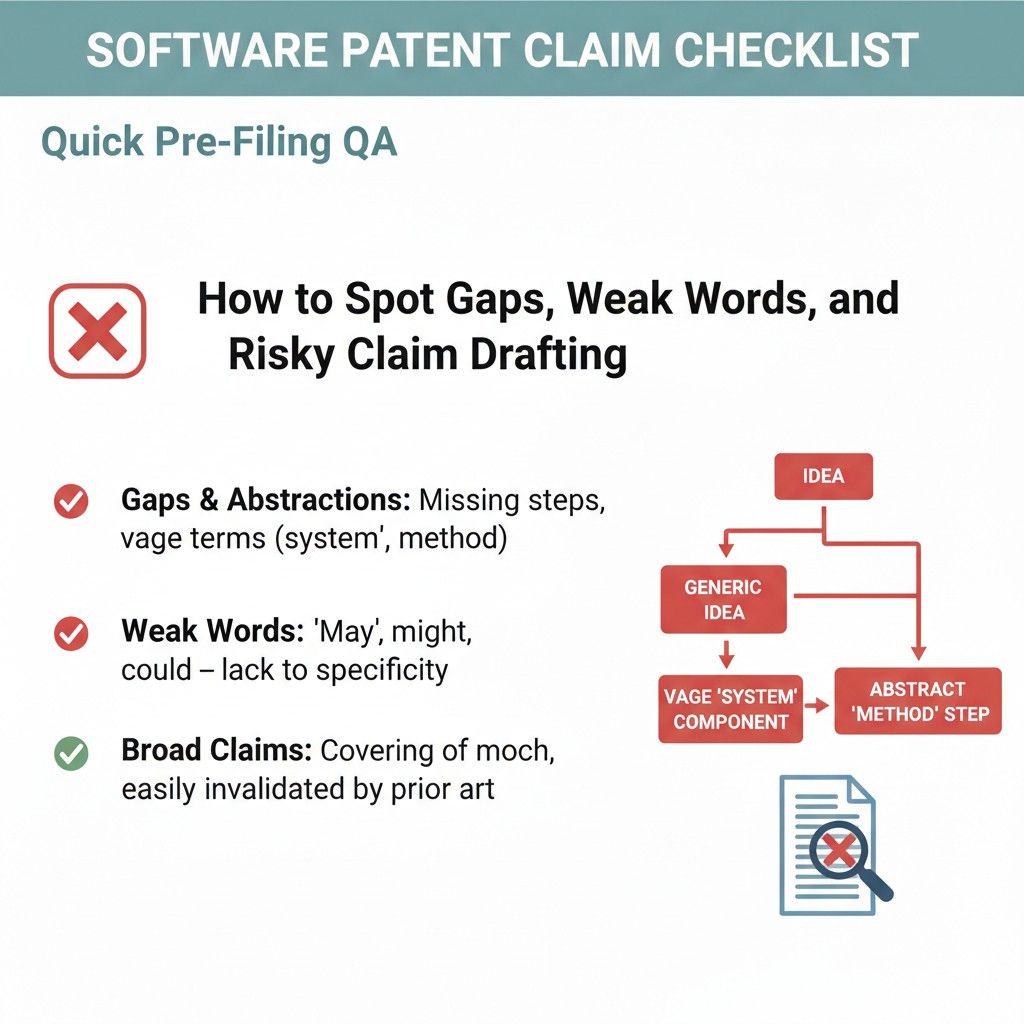
They are trying to find room around it. They are looking for missing parts, soft phrases, and easy workarounds. That mindset helps expose weak spots very quickly.
Ask What a Fast Follower Could Change
A good pressure test is to imagine a competitor building a close version of your product while changing as little as possible.
If they can swap one step, rename one part, or move one action to a different place and likely avoid the claim, that is a warning sign.
A strong claim does not need to trap every possible design, but it should not leave the main door wide open.
This is highly useful for businesses because most real threats do not come from perfect copying.
They come from partial copying with small changes. If a claim only covers one exact version of your workflow, it may not give the company much real leverage later.
Look for the Simplest Workaround
Claims often fail in practice because they are too tied to one narrow form of the invention. Maybe the claim says the system stores data in a certain place, but a competitor could do the same work in memory.
Maybe it says the output is shown in one way, but a competitor could send it through an API instead. These are not just technical details. They are possible escape paths.
When reviewing a claim, it helps to ask what the cheapest workaround would be for a smart engineering team. If the answer comes too fast, the wording likely needs work before filing.
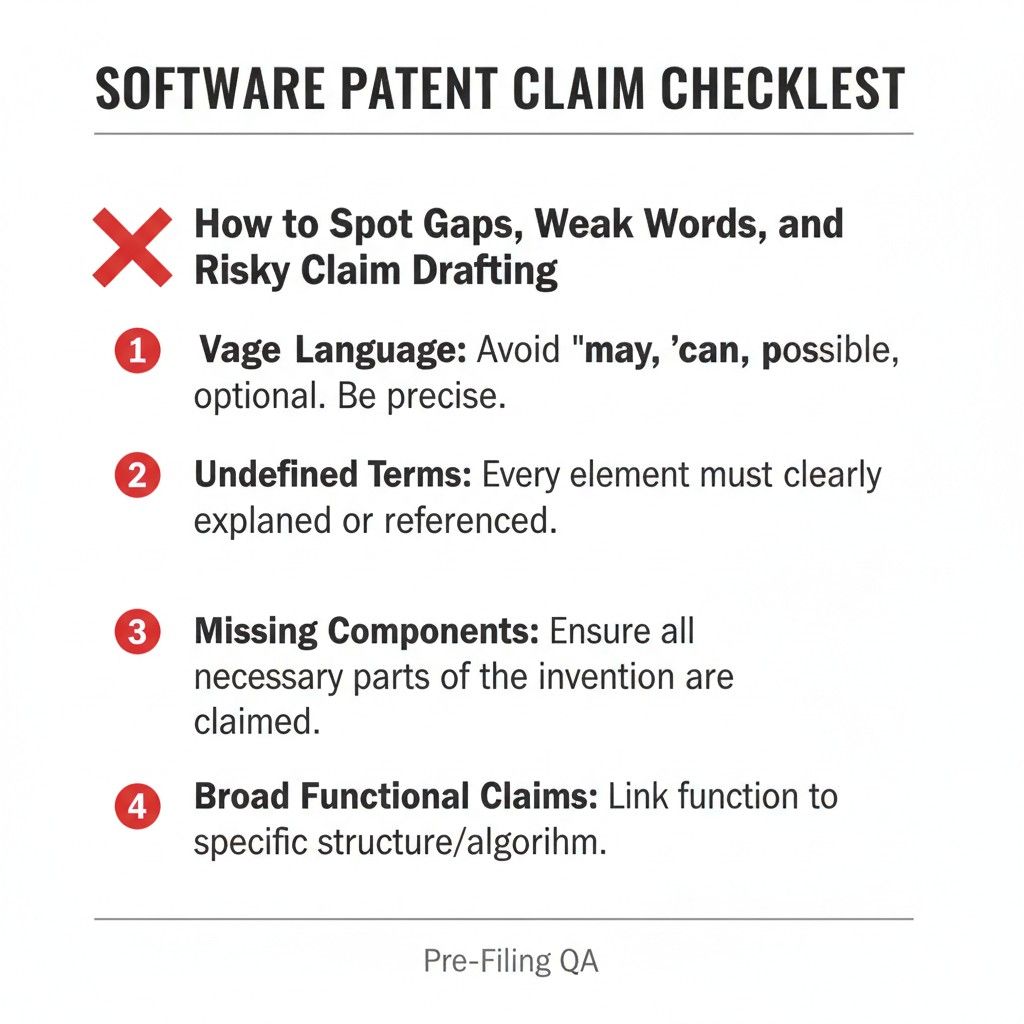
Watch for Words That Sound Strong but Say Very Little
Some claim language feels impressive at first glance. It sounds broad. It sounds formal.
It sounds important. But when you slow down, it may not say much at all. These weak words create a false sense of safety. They make the claim look bigger than it really is.
Generic Verbs Can Hide Thin Protection
Words like processing, analyzing, determining, handling, and managing can be useful in the right place.
But when those words carry too much weight by themselves, the claim starts to drift into fog. A reader may understand that something happens, but not what really changes in the system or why the step matters.
That is risky for a business because the claim may fail to show the actual technical move that makes the product valuable.
When a generic verb appears, pause and ask what the system is really doing at that step. If the answer is much more specific than the claim, the draft may be leaving value unclaimed.
Vague Labels Can Make a Core Feature Disappear
Another common issue is the use of soft labels for important parts of the system. Phrases like module, engine, logic, component, or mechanism can be fine as placeholders, but they can also hide the real work.
If the claim says a scoring engine produces a result, that may sound useful. But what makes the engine different? What inputs matter? What transformation occurs? What rule or model drives the output?
For startups, this is more than a wording issue. A vague label can cause the invention to lose shape on the page. When the important part becomes a black box, the claim may become easier to attack and harder to enforce.
Find the Missing Step That Makes the Invention Work
One of the most common claim problems is omission. The draft may include several correct steps but skip the one step that makes the whole invention actually useful.
This often happens because the missing step feels obvious to the internal team. Engineers know it is there, so they assume the draft already captures it. Many times, it does not.
Trace the Workflow From Input to Output
A practical way to catch this is to follow one real example from start to finish. Start with the input.
Follow each system action. Watch where the data changes. Notice where a rule is applied. See where a decision is made. Then compare that real flow to the claim line by line.
When a step is missing, the gap becomes easier to see. The claim may jump from receiving data to generating an output without covering the technical step that creates the benefit.
That missing middle is often where the true invention lives. Businesses should care deeply about this because the unclaimed middle is often exactly what a competitor would copy.
Check Whether the Claim Explains the Advantage
If the claim ends with a result but does not reflect the step that creates that result, there is a serious weakness.
A useful test is simple: can you see from the claim why the system performs better than ordinary software? The answer does not need to read like a white paper, but it should be clear enough that the advantage feels tied to real system behavior.
This is one of the best pre-filing questions a company can ask. If the benefit is present in the business story but absent from the claim path, the filing may not protect the thing that matters most.
Be Careful With Overly Narrow Details
Specificity can strengthen a claim, but too much specificity in the wrong place can shrink protection fast.
This is where many founders get caught. They try to make the claim feel concrete, but they lock it into one version of the product.
Do Not Let the Example Become the Entire Claim
A claim should not accidentally become a frozen snapshot of one demo, one test case, or one customer setup unless that exact form is the true invention.
If your software can work across different data sources, environments, or output paths, but the claim only reflects one of them, you may be giving away room for others to work around you.
This matters for growing businesses because the product you file today may not be the product you sell one year from now.
Strong claims protect the center of the invention without chaining the company to one narrow implementation.
Notice When Optional Details Take Over
Sometimes a claim becomes crowded with details that are helpful in a technical description but not necessary in the main protection layer.
An exact threshold, a narrow file type, a fixed sequence that does not need to be fixed, or a specific deployment setting can all limit the claim more than intended.
That does not mean these details have no value. They may belong elsewhere in the filing. But the main claim should be reviewed carefully to make sure it is not carrying limits that the business does not truly need.
Watch for Overly Broad Language Too
Narrow claims are not the only problem. Claims can also become so broad that they stop feeling real.
This usually happens when the draft tries too hard to cover everything. The result is a claim that sounds large but loses technical shape.
Broad Enough to Matter, Specific Enough to Hold
A useful claim lives in the middle. It should be wide enough to matter in the market and concrete enough to show a real technical solution.
If the claim could describe almost any software system that takes data and returns a result, that is a danger sign. It may not be saying enough about what is different.
Businesses should pay attention here because overbroad claims often create false confidence.
They look powerful in a pitch deck, but they may not survive serious review. A better approach is to anchor the claim in the technical path that makes your software distinct.
Ask Whether the Claim Could Fit a Hundred Other Products
This is a simple but strong test. Read the claim and ask whether it could plausibly describe many unrelated products. If yes, it may be too abstract.
The right claim should reflect your invention, not just software in general. It should be possible to see what kind of system it is and where the real novelty may sit.
Check the Words That Tie the Steps Together
Sometimes the problem is not the individual step. It is the way the steps connect. Weak linking language can make a claim feel like a pile of actions instead of one coherent method.
When that happens, the invention can lose force.
Make Sure Each Step Builds on the Last
A strong claim has flow. One step should feed the next. The output of one stage should matter to the next stage. If the steps feel disconnected, ask whether the draft is missing the relationship that makes the process valuable.
This is especially important in software because system value often comes from sequence and dependency. If the claim does not show how one operation affects another, it may fail to capture the actual design of the invention.
Look for Breaks in Logic
Sometimes a claim says a system receives data, evaluates it, and then performs an action, but it never explains how the evaluation leads to that action.
That logical break may seem small, but it can weaken the claim badly. The link between assessment and action is often where the technical advantage sits.
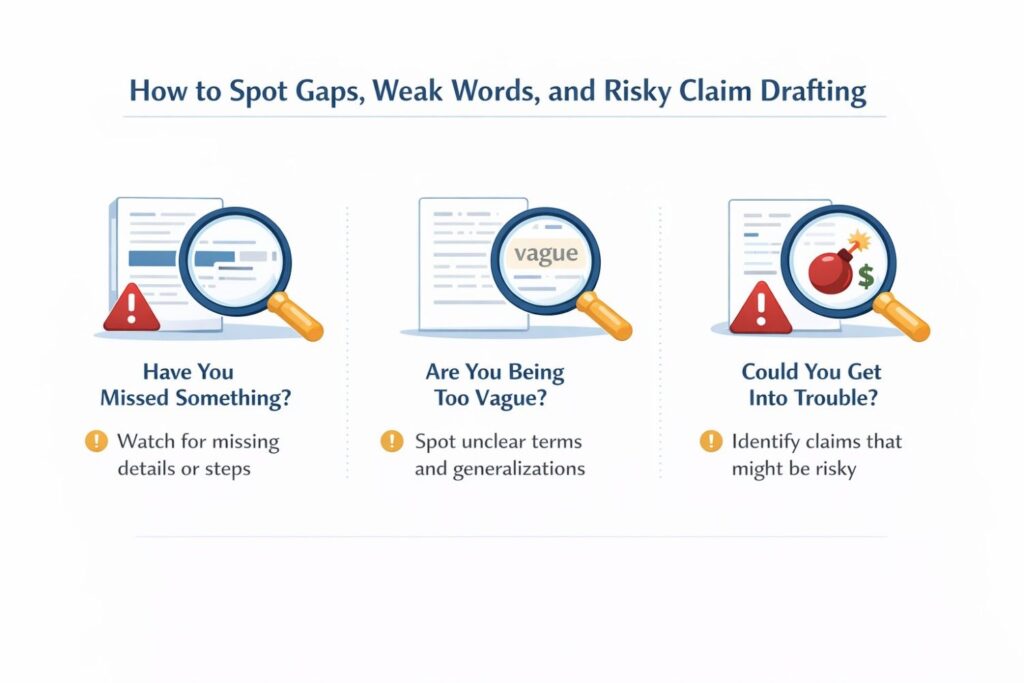
For business teams, this is a great place to focus review meetings. Do not only ask whether each step is present. Ask whether the chain makes sense as a whole.
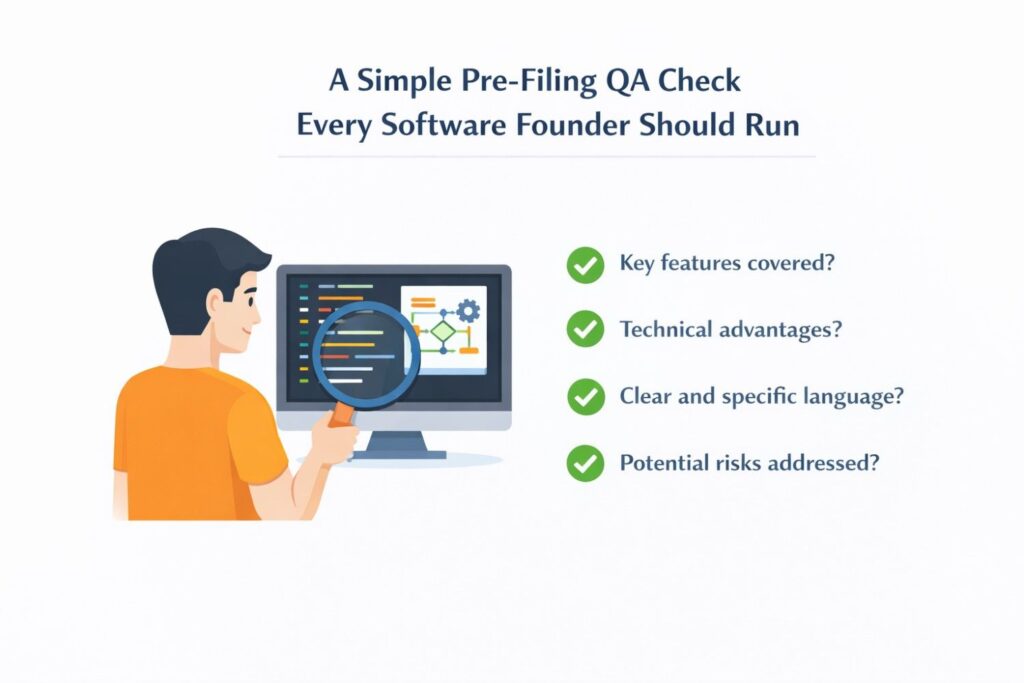
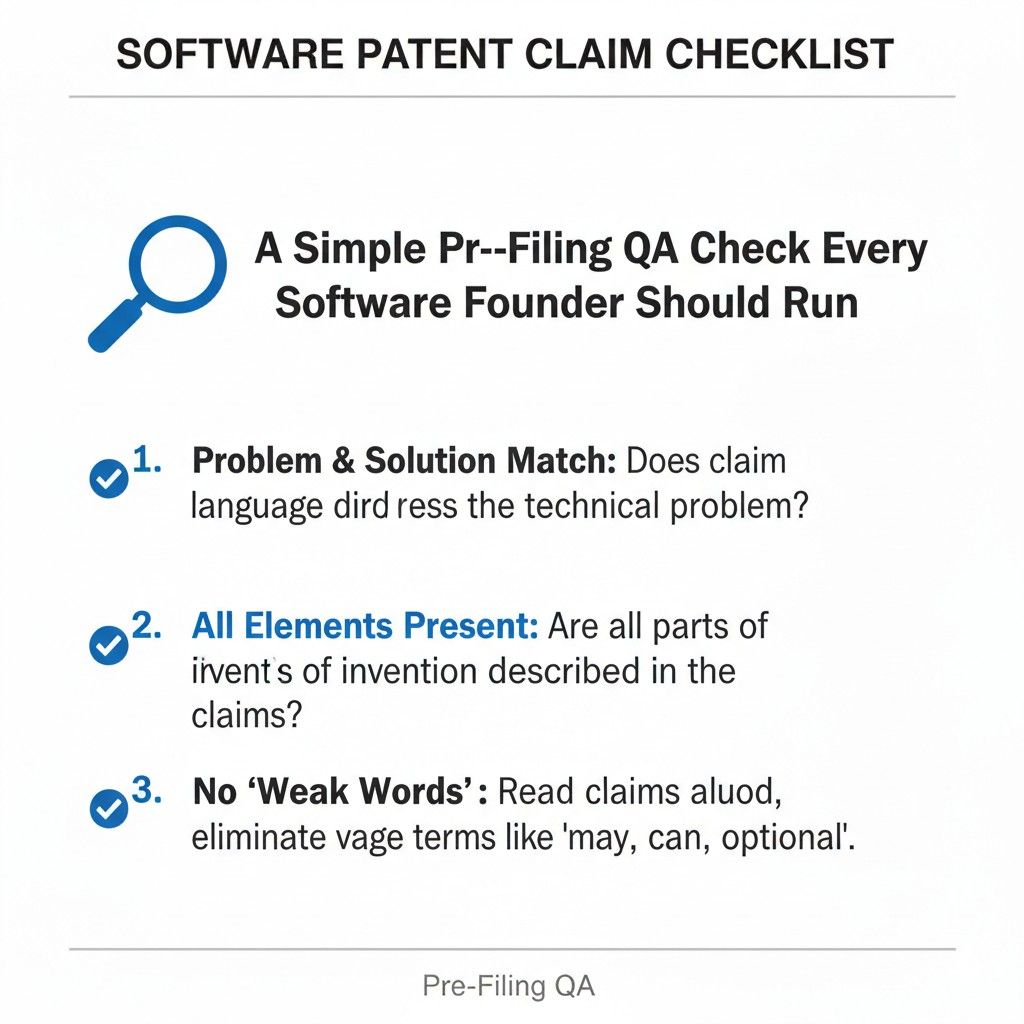
A Simple Pre-Filing QA Check Every Software Founder Should Run
Before a software patent gets filed, there should be one calm, serious review that happens without rush. Not a quick skim.
Not a loose gut check. A real pass through the claims to make sure the filing matches the invention, supports the business, and avoids obvious weakness. That is what this section is about.
A founder does not need to become a patent expert to do this well. What matters is asking the right questions before the filing becomes final. A strong pre-filing QA check helps you catch gaps while they are still fixable.
It helps you protect what the company actually built. It also helps you avoid the painful moment when you realize too late that the patent says something different from the product, the roadmap, or the technical win that gives you an edge.
Start With the One Sentence Test
A good pre-filing review begins with one simple sentence. What exactly is this claim trying to protect? That question sounds basic, but it reveals more than most teams expect. If the answer is fuzzy, the draft may be fuzzy too.
This first test matters because a claim that cannot be explained clearly is often not focused clearly. The goal here is not to reduce the invention into a slogan.
The goal is to see whether the claim has a clean center. When the core protection is clear, the rest of the review becomes much easier and much more useful for the business.
Say It Without Patent Words
The best way to run this first test is to remove all formal language for a moment. Explain the claim in normal product language. Describe what the system does, what changes in the system, and why that change matters.
If that explanation starts drifting into vague talk about improving efficiency or making things smarter, there is a good chance the claim itself is not yet anchored tightly enough.
This is highly actionable for founders because it creates an easy review step with no special tools. If your team cannot say in plain words what the claim covers, you should pause before filing. That pause can save a lot of regret later.
Make the Sentence Match the Business Bet
The sentence should also line up with what the business is actually betting on. If the company is winning because of a routing method, a model-serving method, a system for ranking signals, or a process for reducing false actions, the one sentence summary should point there.
If it points instead to a side feature or a visible screen flow, that is a sign the claim may be aimed at the wrong target.
For businesses, this is not just a drafting issue. It is a strategy issue. The patent should support the part of the product that holds value, drives retention, or creates defensibility.
Review the Claim Against a Real Product Flow
After the one sentence test, move from summary to reality. Take one real product flow and compare it to the claim.
This turns the review from abstract reading into practical checking. It forces the draft to prove that it follows the invention as it truly works.
This part is where many hidden issues appear. A claim can sound good when read alone. But once it is tested against a live workflow, missing steps, weak transitions, and over-narrow phrasing start to stand out.
That is why this check should happen before filing, not after.
Use the Current Workflow, Not an Old Deck
The review should be based on the current version of the product or the version the company is actively pushing into market.
Many teams make the mistake of checking claims against early invention notes or old slides. That can leave the filing tied to a version of the software that is already outdated.
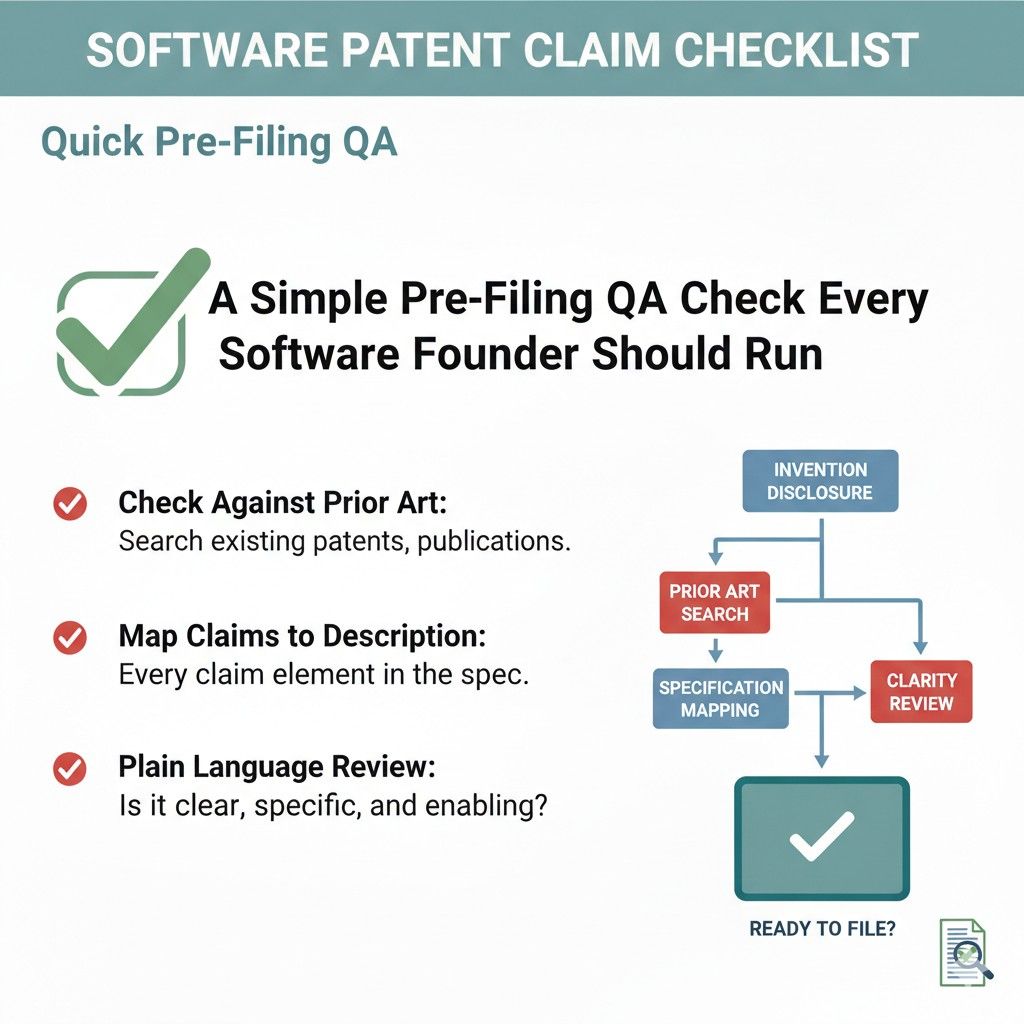
A much better habit is to open the actual product flow, system notes, or design map. Then read the claim line by line and ask whether each part truly matches what happens in the system today. This helps the business file protection that reflects its real technical value.
Watch Where the Claim Jumps Too Fast
One of the easiest ways to spot weakness is to notice where the claim skips over important action. It may move from input to output without showing the technical step that creates the benefit.
It may mention evaluation without capturing what is being evaluated or how that evaluation affects the next action.
When that happens, the claim may be leaving the most valuable part exposed. For a founder, that is a serious risk. If the technical middle is where your edge lives, that middle needs to be visible in the claim path.
Check Whether the Claim Covers the Hard Part
Not every part of a software system deserves the same attention. Some steps are easy to copy. Some are generic. Some are just expected plumbing. Then there is the hard part.
That is the part that took insight, testing, or unusual design choices to get right. A serious QA check asks whether the claim actually covers that hard part.
This is one of the most important business questions in the whole filing process. If the claim protects only the easy outer shell, it may not help much when it matters. Protection should reach the work that created the real advantage.
Find the Step That Took the Most Thought
A practical way to locate the hard part is to ask the engineering team what took the most effort to design or refine.
It may be a way of selecting data, filtering noise, ranking options, detecting states, chaining operations, or managing system behavior under changing conditions.
Once that part is identified, compare it to the claim. Is it clearly present, or is it softened into general language?
If it is only implied, the draft may be under-protecting the invention. For businesses, this is a high-value check because the hard part is often the part a competitor most wants to copy.
Separate Core Logic From Commodity Steps
Claims often include steps that are necessary but not distinctive. Receiving data, storing data, sending output, or presenting results can all be valid pieces of a software method.
But if those steps dominate the claim while the real logic stays buried, the draft may be upside down.
A founder should look for balance. The claim does not need to ignore standard system steps, but it should not let them overshadow the real technical move. The core logic should not feel like an afterthought.
Pressure-Test the Claim for Easy Workarounds
A strong pre-filing QA check does not only ask whether the claim is accurate. It also asks whether the claim is too easy to avoid. This is where business thinking becomes very important.
You are not filing the patent just to describe the invention. You are filing it to build meaningful protection around it.
That means you should read the claim with a challenger’s mindset. If a smart competitor wanted to get close to your product while changing as little as possible, where would they try to slip past the wording?
The answer will often show you where the draft is too brittle.
Imagine the Cheapest Copycat Move
The best workaround test is often the simplest one. Think about the lowest-effort change a competitor could make. Could they move one step to another layer of the system?
Could they swap the input type while keeping the same value? Could they deliver the same result in a different format? Could they break one claimed sequence into two smaller operations and avoid the language that way?
This is a very practical founder exercise because it does not require legal theory. It requires product sense. And product sense is exactly what can make a patent review much stronger.
Check Whether the Claim Protects the Logic, Not Just the Form
Many weak claims accidentally focus on one exact form of the invention. They protect the way the product happens to look or run today, but not the deeper logic underneath it. That leaves room for others to mimic the same value using small design shifts.
A better QA check asks whether the claim reaches the actual system behavior that matters.
If the same technical idea could be expressed through more than one implementation path, the draft should be reviewed carefully to make sure it is not trapped inside one narrow form.
Test the Claim for Product Drift
Software products rarely stay still. Features evolve. User flows change. Data sources expand.
Performance methods improve. Because of that, a claim that fit the invention three months ago may not fit it well now. A useful pre-filing check should test for drift between the draft and the product direction.
This matters because a patent is not just about where the product has been. It should also support where the company is going. If the draft is already outdated at filing time, the business may miss the chance to protect its strongest path.
Compare the Draft to the Roadmap
A simple but strong review step is to compare the claim not only to the current build, but also to the near-term roadmap. Look at the next product moves the team is serious about shipping.
If the claim is tied tightly to a version the company plans to leave behind, that should be addressed before filing.
For businesses, this is where patents become more than paperwork. A filing that anticipates product direction can age much better and stay more useful as the company grows.
Keep the Center Stable While Allowing Growth
The goal is not to make the claim so loose that it becomes vague. The goal is to identify the stable center of the invention and make sure the wording protects that center even as surrounding details evolve.
Good QA helps you separate what must stay fixed from what may change over time.
That is a highly strategic habit for founders. It helps the company avoid patents that become narrow relics of an early version of the product.
Check Whether the Claim Supports a Business Story
A strong software patent should not live in a silo. It should connect to the larger story of why the company matters. That does not mean the claim becomes marketing.
It means the protection should map to the value the company creates in the world.
This is especially important when the company is raising money, talking to buyers, or building a long-term moat.
A claim that cannot be tied to the business story may still exist on paper, but it will be harder to use as a real strategic asset.
Ask What This Claim Protects in Revenue Terms
One helpful check is to ask what commercial value the claim is linked to. Does it protect a workflow customers pay for?
Does it protect a system behavior that lowers cost, reduces risk, or improves output quality in a meaningful way? Does it support the product feature that makes switching harder?
This question helps founders avoid spending filing effort on protection that has little link to business value. The strongest claim work usually sits close to the company’s real economic engine.
Make Sure the Claim Fits Future Diligence
A claim should also be readable in the context of future diligence. Imagine an investor, acquirer, or partner reviewing your patent. Would they be able to see why it matters to the business?
Would they understand how it connects to the product moat? If the answer is unclear, the claim may need better alignment with the company’s real position.
This does not mean the claim needs flashy wording. It means the technical protection should connect cleanly to business significance.
Wrapping It Up
A software patent claim does not need to sound fancy to be strong. It needs to be clear. It needs to match the real invention. It needs to protect the part of the product that gives the business an edge. That is the whole point of pre-filing QA. Before you file, you are not only checking words. You are checking whether the patent supports the company you are building. That means the claim should reflect the real product, the real technical lift, and the real value customers pay for. If it does not, the filing may still go through, but it may not help when the stakes get high.
Leave a Reply