AI can help you draft patent claims faster. That part is real. It can save time, help you get unstuck, and give you a strong first pass when you are staring at a blank page. But speed is not the same as quality. That is where many founders get into trouble. A claim can sound polished and still be weak. It can look complete and still miss the part that matters most. It can use the right buzzwords and still fail to protect the real value of what you built. This is the big risk with AI-assisted claim drafting. The draft can feel done before it is actually good.
Why AI-Written Claims Can Look Strong but Still Be Weak
On the surface, AI-written claims can feel solid. They often sound clean, polished, and structured in a way that gives founders a false sense of safety. That is exactly why they deserve a closer look.
For a business, the danger is not just filing a weak claim. The real danger is making product, funding, and market decisions based on the belief that your core idea is already well protected when it is not.
Clean wording can hide shallow thinking
A claim can read smoothly and still fail to cover what makes your invention valuable.
AI is very good at producing language that sounds complete. It can mimic the shape of a patent claim with surprising ease. But sounding like a claim is not the same as doing the work of one.
This matters because businesses do not win from nice drafting alone. They win when the claim draws a clear fence around the part of the invention that gives them leverage.
If that fence is built in the wrong place, competitors may step around it without much effort.
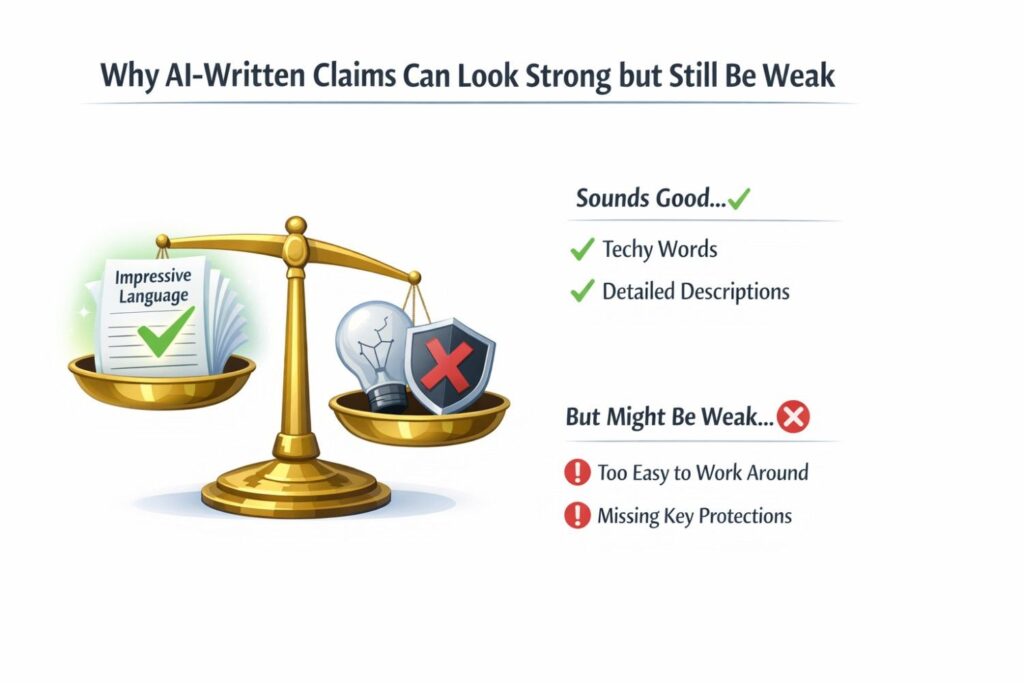
A founder may think, “We claimed the product,” while the real truth is, “We claimed one narrow version of the product and left the better commercial version exposed.”
AI often predicts language, not protection strategy
AI does not naturally think like a founder protecting a business asset. It predicts likely words based on patterns.
That means it may give you a version of what patent claims often look like, but not a version shaped around your market risk, product roadmap, and likely points of competition.
A useful review question is simple: if a smart competitor copied the best part of our product and changed a few details, would this claim still matter?
That question forces the review away from grammar and toward business value. If the answer is no, then the claim may be elegant but weak where it counts.
A polished draft can create false confidence inside the company
One of the biggest business risks with AI-assisted claim drafting is internal overconfidence. Once a draft exists, teams start treating it as real protection. Product teams move forward.
Investors hear that a patent is being filed. Founders may delay deeper review because the document looks advanced.
This is where weak claims cause more than legal problems. They can shape company decisions in the wrong direction.
A startup may tell itself it has locked down a core idea when in fact it has only described part of a feature set. The draft becomes a comfort blanket, not a true shield.
That is why review needs to happen before the claim becomes part of the company story. If the claim is going to support market trust, fundraising language, or a moat narrative, it needs to survive hard scrutiny first.
The language may be broad in the wrong way
Many founders think broad language means strong protection. Sometimes it does. Often it does not. AI can write broad words that feel expansive but actually make the claim fragile, unclear, or easy to challenge later.
Words like “module,” “engine,” “platform,” or “system” may appear useful because they sound flexible.
But if the claim leans too heavily on generic labels without clearly tying them to how the invention actually works, the result can be broad language with weak support.

That creates problems during examination and even bigger problems later if the patent is ever tested.
Broadness only helps when it is anchored to the real inventive idea. The goal is not to say everything. The goal is to cover the right thing in a way that is hard to design around.
Narrow wording can quietly give away market space
The opposite problem is just as common. AI can become too specific because it is trying to sound precise.
It may pull details from your product description and lock them into the claim too early. That can shrink your protection without making the weakness obvious.
A business should care deeply about this. A claim that focuses too tightly on today’s implementation may leave tomorrow’s version uncovered.
It may also leave room for a rival to copy the business logic, change a few technical details, and avoid the claim entirely.
A strong review process asks whether each detail in the claim is truly necessary. If removing one word would still protect the inventive core while making the claim harder to avoid, that word deserves pressure testing.
Many weak claims are not weak because they say too little. They are weak because they give away too much.
AI tends to flatten the invention into a generic pattern
Every strong patent starts with something that is actually different.
That difference may be in the workflow, the technical structure, the training method, the control logic, the data handling, or the way parts interact under real conditions. AI often smooths those sharp edges into a more familiar pattern.
This happens because AI is built to generate likely language. Truly valuable inventions often do not look like the most likely version. They look unusual. They solve a problem in a way that is not obvious at first glance.
If the draft turns that unusual logic into generic wording, the strongest part of the invention may disappear from the claim.
For businesses, that is a serious loss.
The thing that made the product hard to build may be the very thing that should sit at the center of the claim. If AI washes that out, the company may end up protecting the easy part and ignoring the real moat.
The claim may describe a feature instead of the true advantage
Founders often describe their invention through features because that is how products get built. AI often follows that same path. It may claim what the product includes, not what the invention actually achieves in a distinct way.
That difference matters. A feature can be copied, renamed, split apart, or slightly changed.
A true inventive advantage is often deeper. It may be the sequence of operations, the rule set behind a decision, the way the system adapts, or the structure that makes a result possible at lower cost, better speed, or higher reliability.
When reviewing AI-written claims, businesses should ask what the company would most hate to see copied. The answer is usually not a surface feature. It is the hidden mechanism that makes the product work better. The claim should aim there.
A strong business review starts with the threat, not the text
Many teams review claims by reading the words and asking whether they sound right. A better approach is to start with the market threat. Think about the competitor you worry about most.
Think about the version of your product that creates the most value. Think about the future state of the business, not just the current demo.
Then read the claim again.
This shift changes everything. It turns the review into a protection exercise instead of a writing exercise. It helps you spot when the claim is technically correct but commercially weak.
It also helps the team focus on what matters most: whether the claim protects the path the company plans to grow into.
A practical move here is to take one claim and rewrite it in plain business language. If the plain version does not clearly cover the company’s real edge, the formal version probably does not either.
The draft may borrow familiar language from other domains
AI sometimes pulls language patterns from adjacent technologies. The result can be a claim that seems sensible but quietly frames the invention in the wrong category.
This can distort what the company is actually trying to protect.
For example, a software invention may get drafted in language that feels like generic data processing. A control system may get framed like ordinary automation.
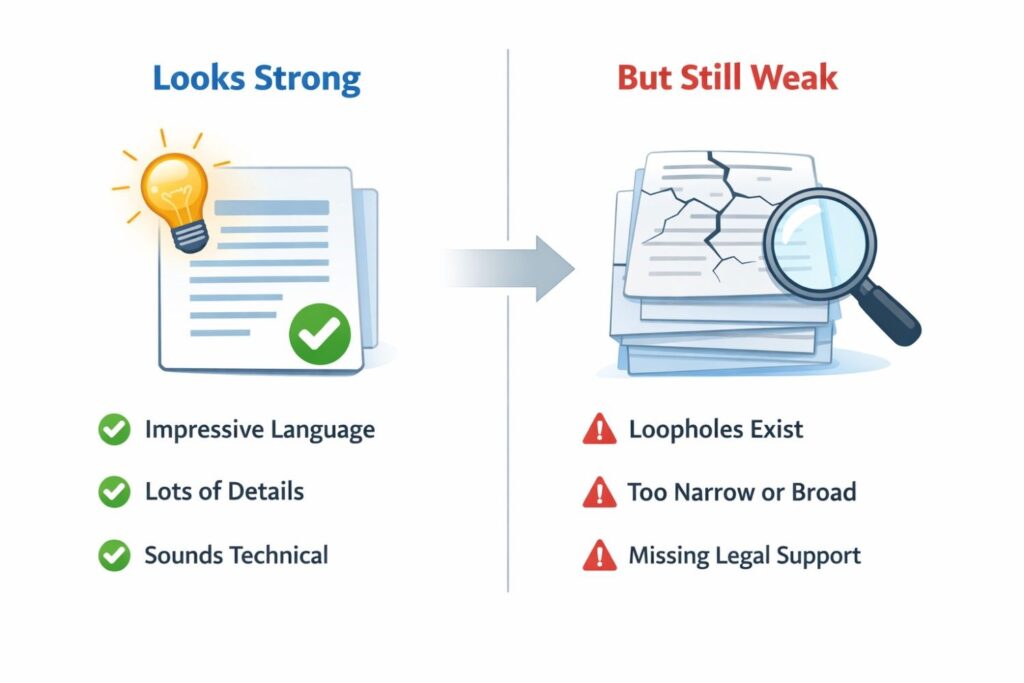
A machine learning workflow may be described in terms so broad that its real technical difference disappears. Once that happens, the review becomes harder because the words still sound professional.
Businesses should watch for this closely. The wrong frame can weaken the entire filing strategy. It can make the invention seem more ordinary than it is. It can also lead to claims that miss the strongest path for follow-on filings later.
Useful claims are built around what competitors would copy first
A very practical test for legal quality is this: what would a competitor copy first if your product started winning? That copied element is often where the claim review should focus.
AI may draft around the whole system because it has more material to work with. But broad system claims are not always the most useful starting point.
Sometimes the highest-value claim is narrower in appearance but stronger in effect because it captures the one step, rule, or interaction that others cannot easily avoid once they copy the core value.
This is especially important for startups. You do not need a claim set that sounds impressive in a vacuum. You need claim language that creates friction for real-world copycats.
Legal quality depends on support, not just style
A claim can look smart and still be unsafe if the underlying application does not support it well. AI does not always police that line carefully. It may write language that reaches beyond what the spec truly explains. That creates a hidden weakness.
For businesses, this is more than a filing issue.
If the claim reaches farther than the written support, you may lose time, spend more on revisions, or end up with a narrower outcome later than you expected. That can disrupt product timing and IP planning.
A smart internal review asks whether each important claim idea is actually explained in the draft application with enough detail. Not in vague terms. Not by implication. Clearly.
If the support is thin, the claim may be living on borrowed strength.
The draft may miss fallback positions that matter later
A single polished claim is not enough. Good protection often depends on having room to adjust during examination without losing the heart of the invention. AI-generated drafts can sometimes focus on one clean version and fail to build useful backup positions around it.
That is risky for a company because patents rarely move in a straight line. Reviewers push back. Prior art shows up. Scope changes. If the initial drafting does not leave strategic room, the business may get forced into bad tradeoffs later.
One smart way to review for this is to ask whether the claim strategy leaves more than one strong path forward.
If the main claim gets challenged, is there another version that still protects a meaningful part of the business? If not, the draft may be more brittle than it appears.
Teams should review claims with product, market, and technical context together
Claims get weaker when they are reviewed in isolation. A legal-looking document on its own can hide serious gaps. The strongest review happens when technical understanding and business context meet in the same conversation.
That means the right review lens is not only “Is this accurate?” It is also “Does this protect what drives adoption?” and “Would this still matter if our product changes in the next twelve months?”
Those are business questions, but they are also core quality questions.
A helpful way to do this is to have someone explain the claim out loud to both a technical lead and a business lead. If the technical lead says, “That is not the real trick,” or the business lead says, “That is not what gives us leverage,” the claim needs more work.
AI should speed up the first draft, not replace human judgment
The best use of AI in claim drafting is acceleration. It helps create momentum. It helps organize ideas. It helps turn raw invention notes into something reviewable. That is valuable.
But the moment a team lets AI act as final judge of legal quality, the risk rises fast.
Businesses should treat AI as a drafting assistant, not a strategy owner.
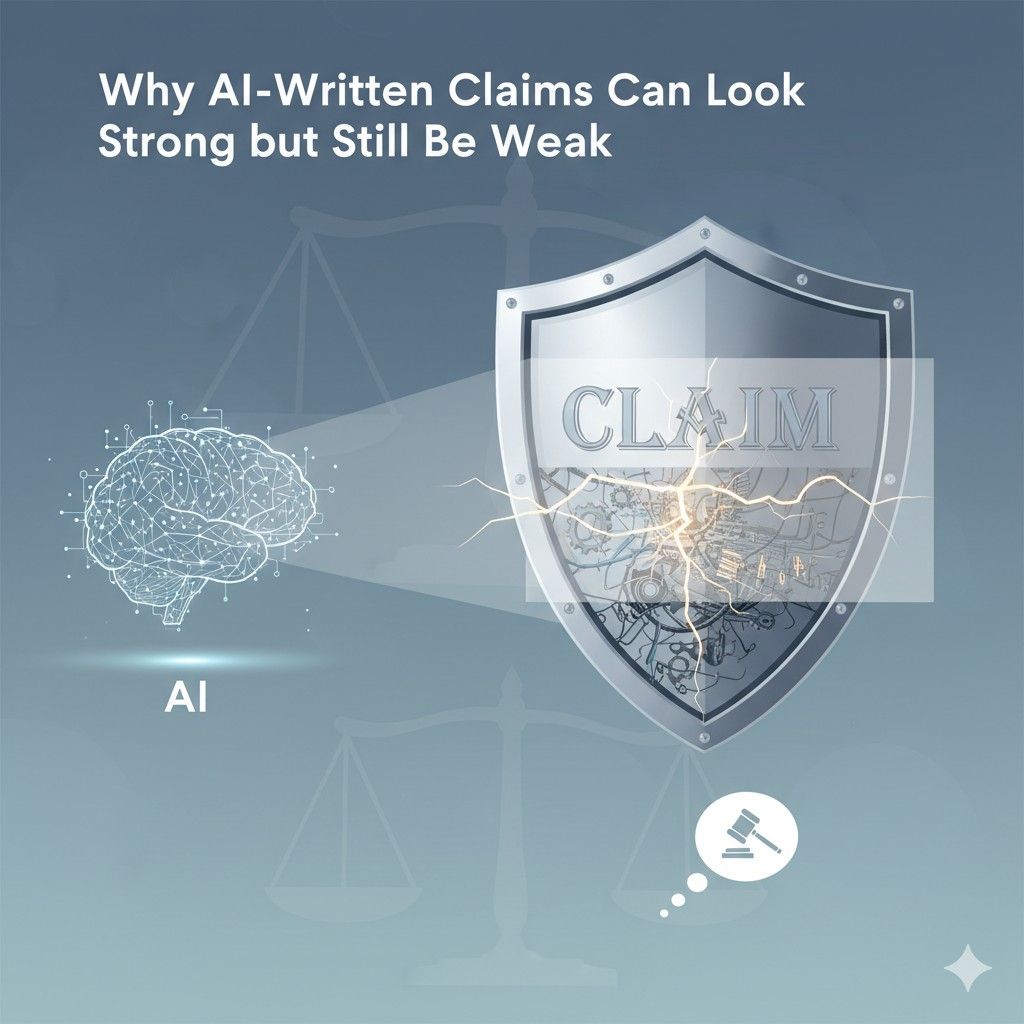
The company still needs to decide what is worth protecting, how broad to go, what future versions matter, what competitors may do, and where the real moat lives.
Those decisions shape patent quality far more than polished wording.
The First Review Test: Does the Claim Match the Real Invention?
This is the first test because nothing else matters if the claim is aimed at the wrong target. A claim can be well written, neatly shaped, and full of proper patent language, yet still fail if it does not protect the thing your team actually invented.
This happens more often than most founders think. The draft may describe a version of the product, a surface feature, or a broad technical category, while the true inventive step sits somewhere else.
Before you worry about scope, wording, or legal cleanup, you need to answer one basic question: is this claim really about the invention that gives your business an edge?
Start with the part that was hard to build
The easiest way to find the real invention is to ignore the polished text for a moment and go back to the build story. Most important inventions do not begin as perfect legal ideas.
They begin as pain. Something kept breaking. Something was too slow, too costly, too noisy, too unstable, or too manual. Then your team found a way around that wall.
That hard-won solution is often where the real value lives.
If the claim does not clearly point to the thing that was hardest to figure out, it may be claiming the wrong thing.
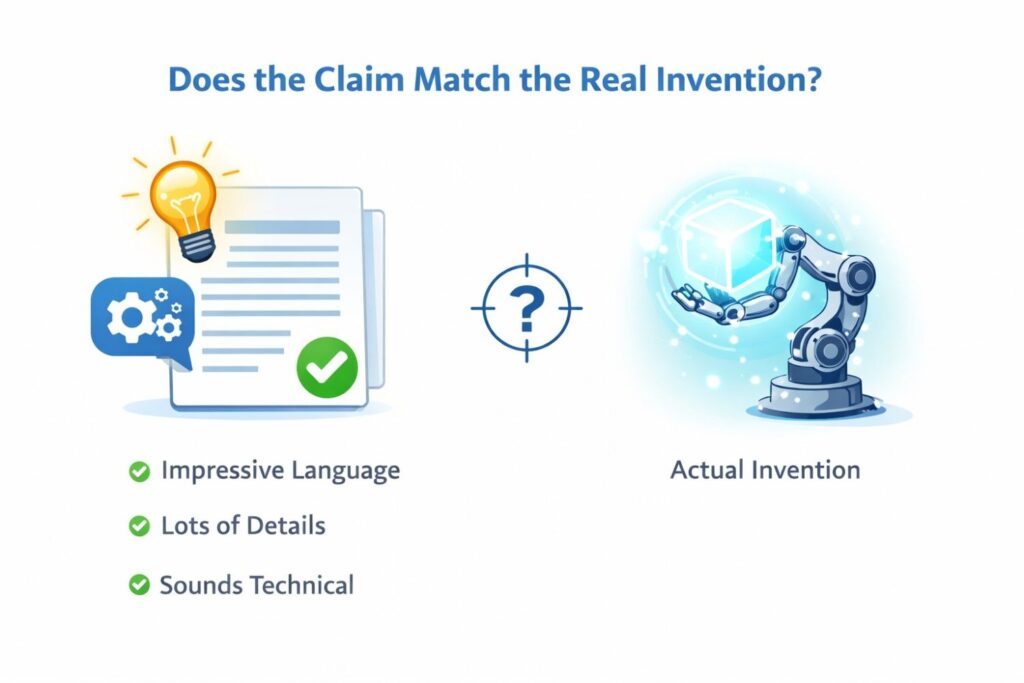
Many weak claims focus on what the product does on the outside instead of how the invention creates that result in a new way.
A founder may read the claim and think, “Yes, that sounds like our product.” But that is not the right standard. The better question is, “Does this capture the part we had to invent, not just the part users can see?”
Do not confuse the product with the invention
A product can contain many moving parts. Not all of them are inventive. Some are standard. Some are expected. Some are useful but not special. A claim becomes much stronger when it separates the everyday parts from the true step forward.
This is where teams often get pulled off course by AI-assisted drafting. The model sees the full product description and tries to summarize the whole thing.
The result may sound accurate in a broad way, but broad product accuracy is not the same as invention accuracy.
The claim may end up covering a bundle of known pieces instead of the new connection, new logic, or new method that made the product work better.
A useful internal check is to imagine removing the product brand, the user interface, and the sales pitch. What is left that is actually new? That is where the claim should begin to focus.
The claim should track the value engine
Every business has a value engine. It is the part of the invention that drives better results, saves money, improves speed, raises accuracy, or creates a better user outcome.
In many strong patents, that value engine is also the legal center of gravity.
When you review a claim, ask where the value engine shows up in the text. Not in general terms. Not by vague implication.
It should be visible and clear. If the claim reads like a description of the overall system but never lands on the mechanism that creates the special result, it may be missing the heart of the invention.
This matters for business strategy. A strong patent should protect the reason customers care, not just the fact that a product exists.
If your best business outcome comes from a special workflow, model tuning method, control sequence, or resource-saving architecture, then the claim should reflect that.
Otherwise, the patent may protect a shell while leaving the true advantage open.
Read the claim like a competitor would
One of the best review moves is to stop reading the claim like its owner and start reading it like a rival. A competitor does not care what you meant. They care what they can avoid.
They will look for details they can swap out, terms they can interpret narrowly, and gaps they can use to build around your protection.
That is why this first review test should include a simple exercise. Read the claim and ask, “If I wanted to copy our best idea without getting caught by this language, what would I change first?”
The answer tells you a lot. If the workaround is obvious, then the claim may not match the real invention closely enough.
This exercise is not just legal. It is commercial. It forces the company to see the claim as a business barrier, not a writing sample. A claim that matches the real invention should make the key path hard to sidestep.
Watch for claims that latch onto easy details
Sometimes the claim grabs onto the parts that are easiest to describe rather than the parts that matter most.
This is common when the source material is product notes, pitch decks, engineering summaries, or AI-generated drafts built from those inputs. The easier details rise to the top. The deeper inventive structure stays buried.
That is a problem because easy details are often not where your moat lives. They may be just one implementation of the invention. They may be temporary design choices. They may even change in the next release.
A smart review asks whether the current wording is tied too tightly to what was easiest to say. If so, the claim may need to be rebuilt around the more durable logic underneath.
That could be a decision rule, a sequence, a way of using input data, a feedback loop, or a system interaction that creates the real gain.
The right match is not always the broadest match
Founders sometimes assume that if a claim covers more ground, it must be closer to the real invention.
That is not always true. Sometimes a very broad claim drifts away from what is actually new. It starts to describe a problem area instead of the specific solution your team created.
That kind of mismatch is dangerous. It can make the claim look ambitious while making it easier to reject or weaken later. A better path is to anchor the claim in the true inventive move, then expand thoughtfully from there.
For business teams, this means resisting the urge to claim the whole universe on day one.
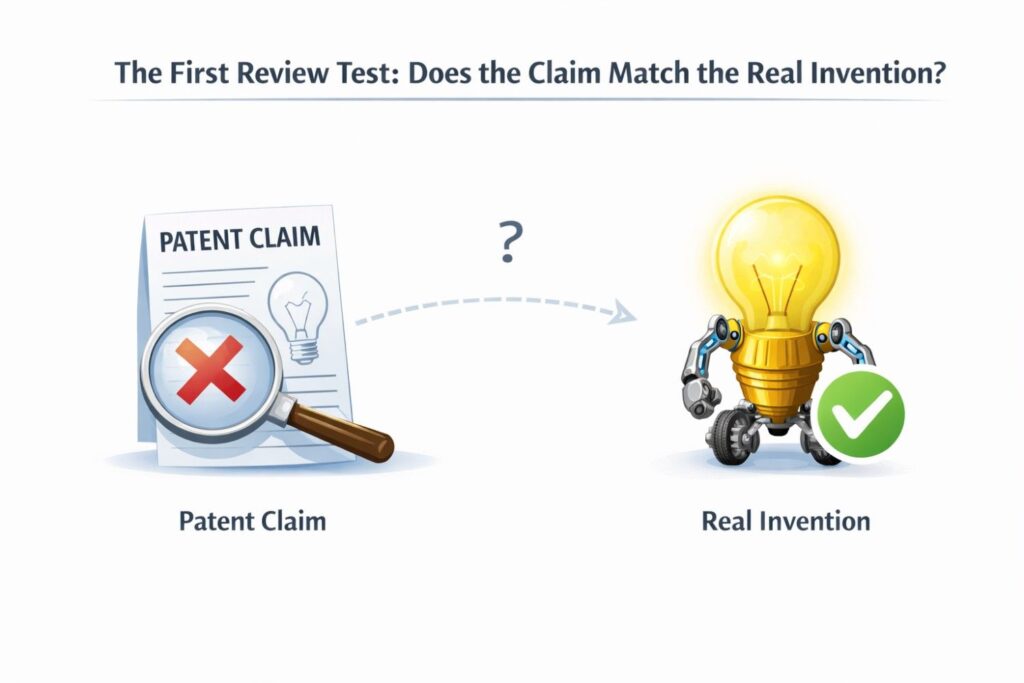
A claim that is slightly narrower but correctly aimed can be far more useful than a broad claim that misses the point. Strength starts with the right center, not the biggest footprint.
Ask what would still be true in two years
A strong invention claim should not collapse the moment your product evolves. Startups change fast. Features move. interfaces shift. Models improve.
Systems get rebuilt. If the claim only matches the product exactly as it exists this quarter, it may not match the real invention in a durable way.
That is why one of the best review questions is forward-looking. Ask what part of the invention will still matter if the company is much larger in two years.
What piece of logic or structure would you still care about protecting even after multiple product updates?
If the claim is built around temporary details, it may not be aligned with the deeper invention. If it is built around the durable core, it is more likely to stay valuable as the business grows.
Match the claim to the technical story, not just the demo
A demo shows behavior. A technical story explains why that behavior happens.
Patent quality depends far more on the second one. If the claim only mirrors the demo, it may end up protecting outcomes without protecting the engine behind them.
This is a big issue in software and AI-heavy companies. A workflow can look simple on the surface while hiding a highly original internal method.
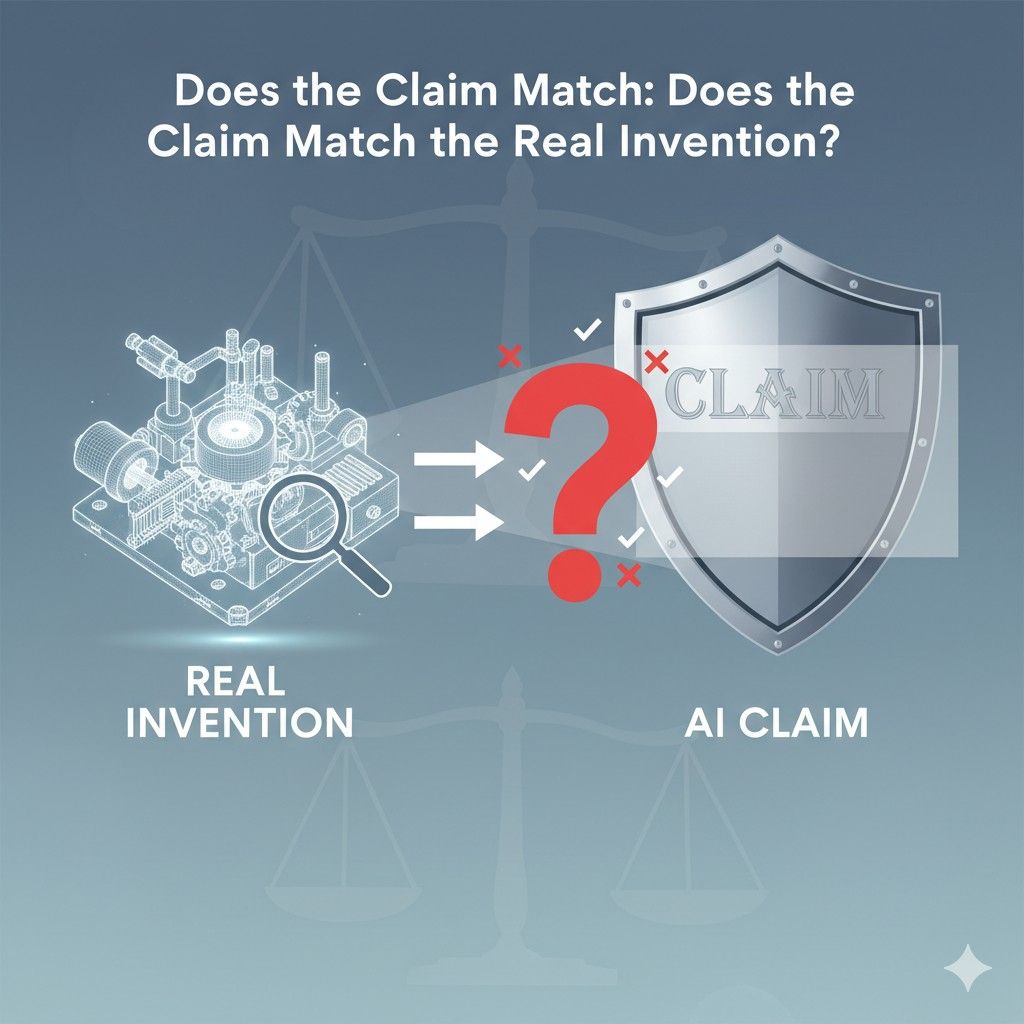
If the claim only says that the system receives data, processes it, and outputs a result, that may match the demo but not the invention.
The real step forward may sit in how the inputs are prepared, how the model is constrained, how the feedback loop works, or how the system chooses actions under limits.
How to Spot Legal Quality Problems Before You File
A claim draft can look polished and still carry serious weakness. That is why the review step before filing matters so much.
Once an application is filed, fixing core problems becomes harder, slower, and more expensive.
For a business, that is not a small paperwork issue. It can shape how much protection you really get around the thing you spent time and money building.
The goal of this review is not to make the claim sound more formal. The goal is to make sure the claim can do real work when it matters.
Start by assuming the draft has hidden gaps
The safest mindset is not trust. It is testing. Even a strong-looking draft should be treated as something that might contain weak spots under the surface.
That does not mean the draft is bad. It means good review starts with pressure, not praise.
This approach helps teams avoid one of the most common filing mistakes: accepting polished language too quickly. Legal quality problems often hide in claims that read smoothly.
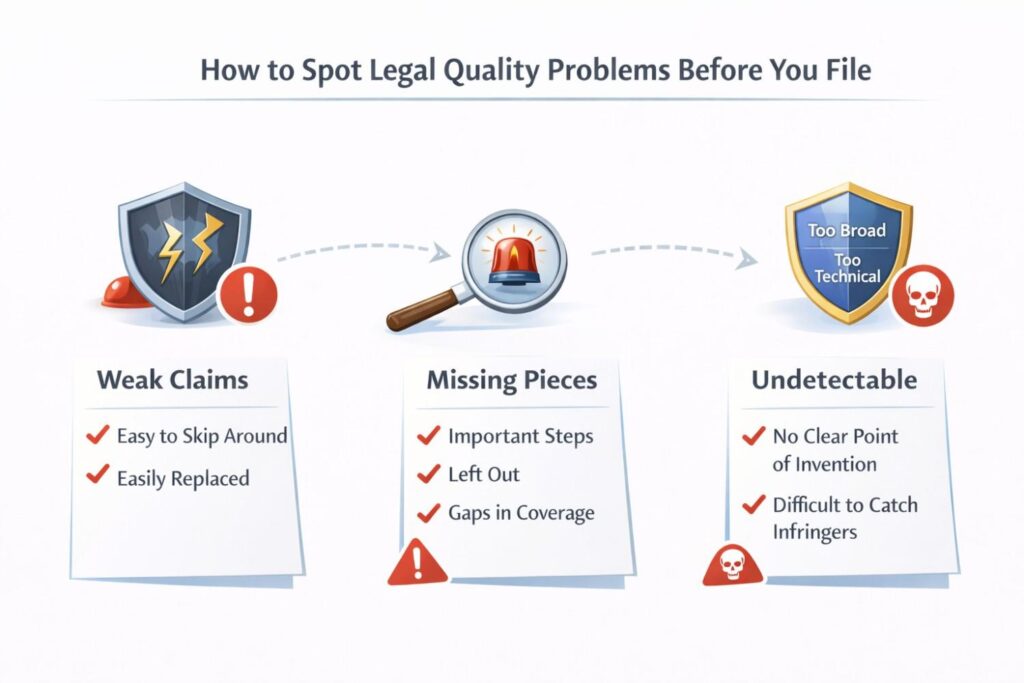
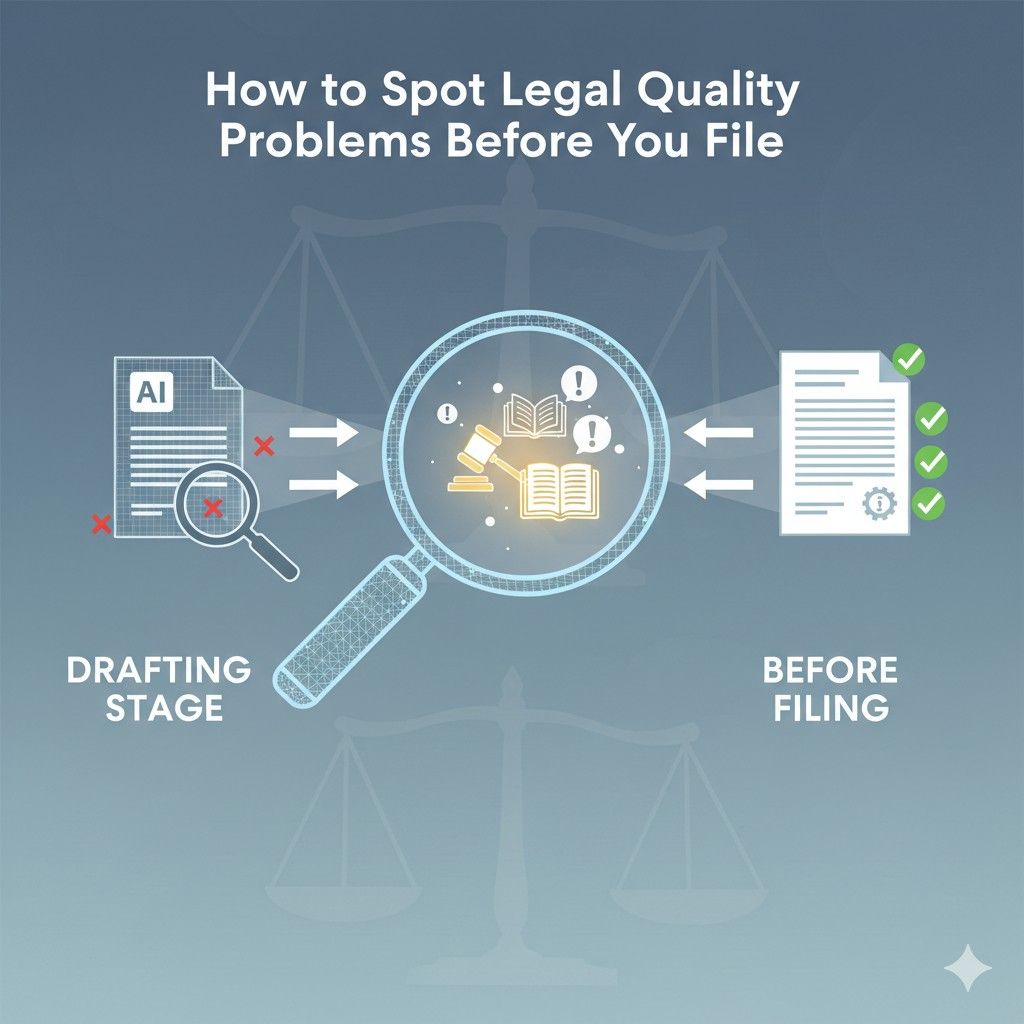
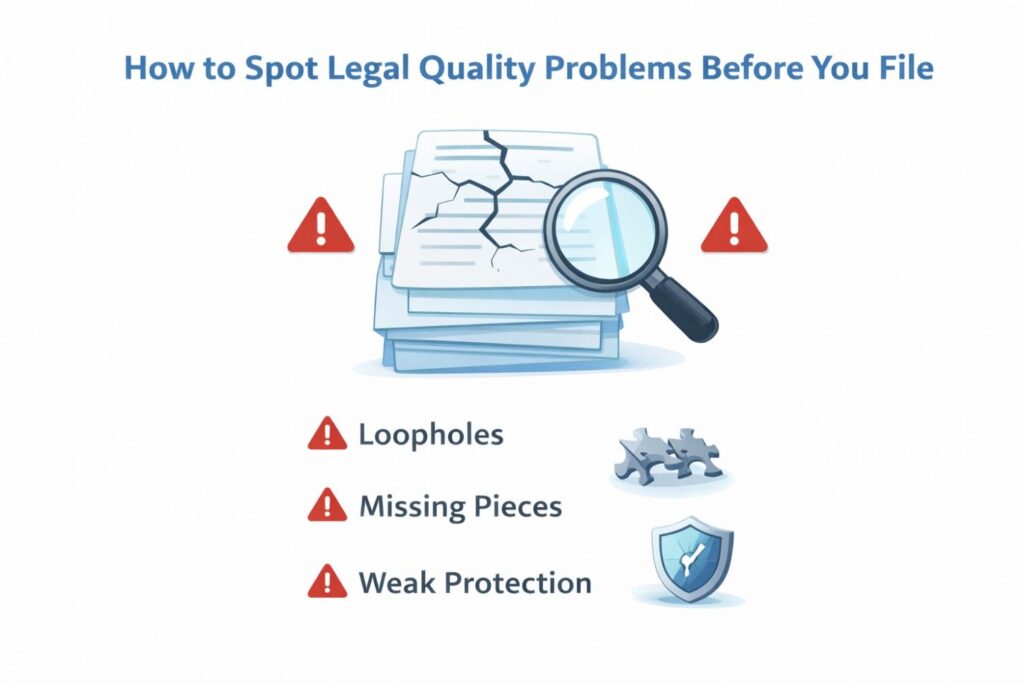
They do not always announce themselves. They often sit inside vague terms, loose connections, missing support, or wording that sounds broad but falls apart when challenged. The earlier you go hunting for those issues, the better your position before filing.
Look for claims that sound impressive but say very little
Some claims use language that feels technical and complete while actually delivering very little real protection.
They may refer to a “system,” a “module,” a “unit,” or an “engine” without making clear what that part is actually doing in the invention. The words sound serious, but the substance stays thin.
This is a warning sign because legal quality depends on more than tone. A claim should define the invention in a way that creates a real boundary.
If the wording is so general that it could describe almost anything in the field, it may be too weak to survive pressure.
A good review asks whether the claim is truly saying something specific about how the invention works, not just naming pieces in a formal way.
Ask whether each term earns its place
A useful way to test this is to slow down on every major term in the claim and ask what work that term is doing.
If a word can be removed without changing the meaning much, or if the team cannot explain what it adds, the draft may be padded with language that creates the look of structure without real value.
That matters because every word should help define the invention more clearly or protect it more effectively. Empty technical wording is not harmless. It can blur the claim and make it easier to challenge or work around.
Watch for vague language that creates uncertainty
A high-quality claim should be clear enough that the reader can tell where the protection starts and where it ends. When the wording becomes fuzzy, the legal quality drops.
This often happens when a draft uses soft phrases that seem flexible but are hard to pin down in practice.
For example, words that suggest approximation, result, or intent can become a problem if they are not grounded in clear structure or action.
The claim may say that the system is configured to improve performance, enhance accuracy, or optimize output, but unless the draft explains how that happens in a concrete way, the language may be too loose to carry weight.
Be careful with result-only claiming
A very common weakness is when a claim focuses on the desired result instead of the actual method that achieves it.
This is especially common in AI-assisted drafts because the model may summarize what the invention accomplishes rather than how it gets there.
That kind of claim may feel attractive because it sounds broad. But from a legal quality standpoint, it can be fragile. A result without a clear technical path behind it may invite pushback.
It may also leave room for others to reach the same outcome through a slightly different route and avoid the claim altogether.
Ask where the technical path appears
A strong review question is simple: where in this claim do we see the mechanism, not just the promise?
If the answer is hard to find, the claim may be too focused on what the invention achieves and not focused enough on the inventive process that makes it possible.
For business teams, this is critical. The patent should not just claim the business benefit. It should protect the path that creates that benefit.
Check whether the claim quietly narrows itself too much
Not all weak claims are vague. Some are overly tight. They include details that were true in one product version but are not necessary to define the invention.
This can happen when the drafting process pulls too directly from product specs, engineering notes, or a current implementation.
The danger is that the claim starts locking the company into one exact version of the invention. If a competitor copies the same core idea but changes a few details, the claim may no longer apply.
That is a legal quality problem because the claim gives away space that the business may later wish it had protected.
Separate essential details from optional details
A useful review move is to test every major limitation in the claim and ask whether it is truly required for the inventive concept.
If a detail is only one example of how the invention can be carried out, it may belong in the description or a narrower dependent claim, not in the main protection path.
This is where founders and engineers can add real value to review. They often know which parts of the build were flexible and which parts were non-negotiable.
That knowledge helps reveal whether the claim has been drafted too tightly around one implementation.
Look for missing support in the written description
A claim is only as strong as the support behind it in the application. One of the most serious pre-filing problems is when the claim reaches farther than the underlying write-up really supports.
The wording may sound excellent, but if the application does not explain the idea with enough substance, that claim can become unstable.
This issue is easy to miss during fast drafting. The team may know the invention deeply and assume the written draft reflects that knowledge.
But legal quality depends on what is actually on the page, not what is in people’s heads. If a claim covers a broader idea, a key variation, or a core mechanism that the description barely touches, that is a problem worth catching before filing.
Read the claim and the spec side by side
One of the smartest review habits is to compare the key phrases in the claim against the written description line by line. When you do that, weaknesses often show up fast.
A broad claim term may have only a narrow example behind it. A claimed step may appear in passing with almost no explanation. An important system interaction may be assumed rather than clearly described.
Support should be real, not implied
The right question is not whether a clever reader could infer the idea from the draft. The right question is whether the application actually teaches it in a clear way.
If the support is vague, thin, or missing, that should be fixed before filing whenever possible.
Test whether the claim can survive product change
A business rarely stays still after a filing. The product evolves, the technical stack changes, and customer needs push the system in new directions. A claim with strong legal quality should still matter even after those changes.
This is why pre-filing review should include a future test. Ask whether the claim still protects the company if the next two product releases change important implementation details.
If the answer is no, the claim may be too tied to the present version of the product and not tied enough to the durable inventive core.
Look for wording that only fits today’s build
This is a quiet but costly problem. The claim may match the current system perfectly, yet fail to cover the version the company really wants to scale.
That can happen when specific architecture choices, data structures, hardware elements, or workflow steps are written into the claim even though the broader invention does not depend on them.
A better claim usually tracks the stable core idea that will remain important even as the product grows. That is what gives the patent longer business value.
Try to break the claim on purpose
One of the best ways to spot quality problems is to attack the claim before anyone else does. This is not negative thinking. It is good strategy. Read the claim with the goal of finding the fastest way around it.
Think like a competitor who wants the same market but does not want to infringe.
Which word would you change first? Which step would you remove? Which part seems easy to replace with something slightly different? That exercise often reveals where the claim is weak, unclear, or too narrow.
A strong claim should create friction
If the claim can be avoided by making a small cosmetic change, that is a warning sign. The main claim does not need to trap every possible workaround, but it should not leave the central business value exposed.
Legal quality improves when the draft is tested against real-world avoidance behavior before filing rather than after.
Ask the business team what they would fear most
A very practical move is to ask what copycat version of the product would worry the company most.
Then compare that scenario to the claim language. If that feared copycat can likely avoid the claim, the review has found something important.
Watch for claims that mix too many ideas together
Sometimes a claim becomes weak because it tries to do too much at once. It includes multiple concepts, several layers of implementation, and too many moving parts in one sentence. The result may be hard to follow and harder to defend.
Legal quality often improves when the claim has one clear center. The main idea should be easy to identify.
If the draft tries to protect the whole system, every feature, and every business outcome in one place, the invention may get lost inside the clutter.
Keep the center of gravity clear
A good review asks what this claim is really about. Not in a broad way. In one sentence. If the team cannot answer that cleanly, the claim may need to be simplified or split into better-structured layers.
Clarity is not just a style preference. It often makes the protection more durable.
Check whether key terms change meaning as you read
Another subtle quality issue appears when the same term seems to shift in meaning across the draft.
A word may look stable at first, but then take on a broader or narrower sense depending on the sentence around it. That creates risk because the claim may appear clear until someone tries to apply it carefully.
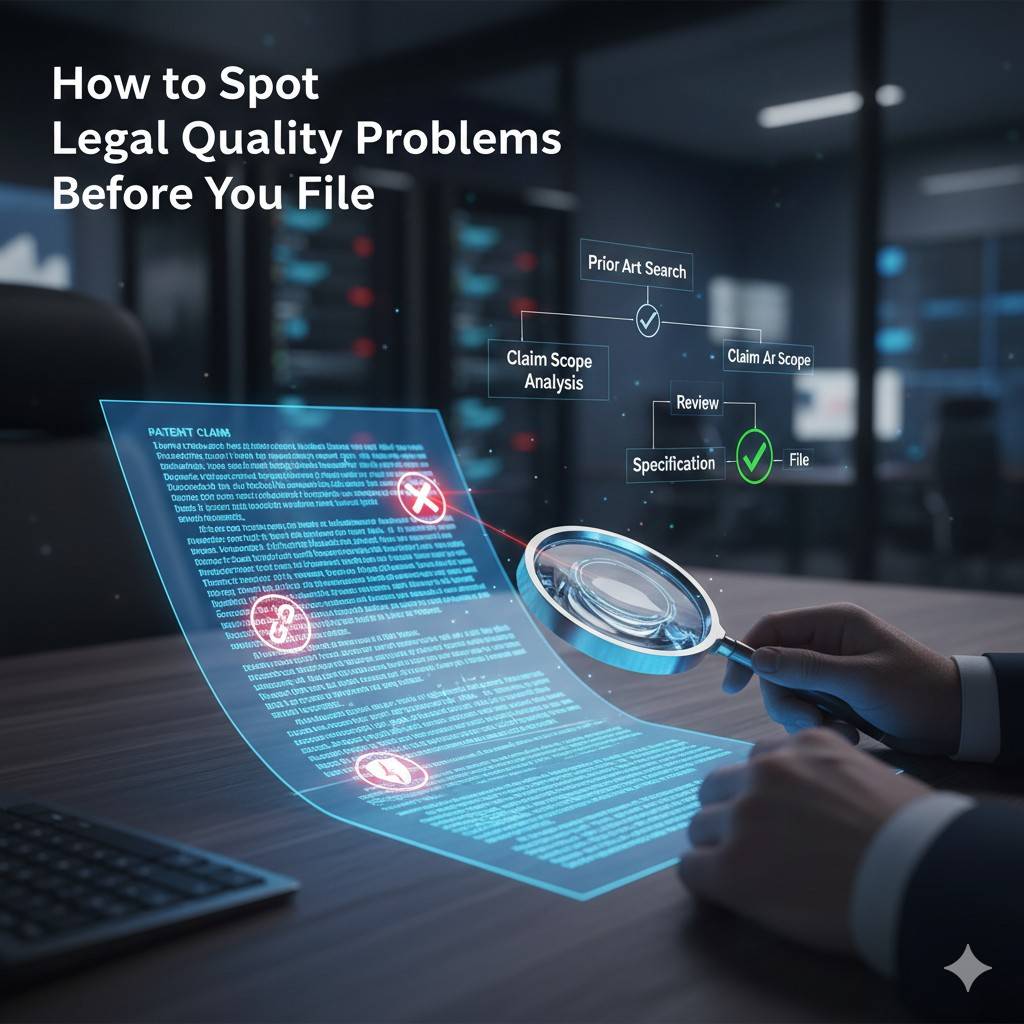
This problem is common when drafts are assembled quickly or when AI-generated text pulls language from different patterns. The wording may still read smoothly, which makes the issue easy to miss. But legal quality depends on consistent meaning.
Wrapping It Up
At the end of the day, AI-assisted claim drafting is only helpful if it leads to claims you can trust. That is the real standard. Not claims that sound polished. Not claims that look formal. Not claims that make everyone feel good for a few days. Claims that actually match the invention, hold up under pressure, and protect something the business truly cares about.
Leave a Reply