You built something new. At least, it feels new.
Now comes the big question: has someone already done it before?
That question is where prior art comes in. Prior art is anything already made public before your patent filing date that could show your invention is not new, or that it is too close to what already exists. It can be a patent, a paper, a product page, a video, a GitHub repo, a pitch deck, a blog post, a thesis, a standards document, or even an old product manual.
This guide will show you how to compare your invention against prior art in a clear, practical way. No dense legal talk. No scary patent maze. Just a founder-friendly path you can use before you spend serious time or money.
And when you want help turning your invention notes, code, diagrams, and search results into a strong patent plan, PowerPatent can help you move faster with smart software and real attorney oversight. See how PowerPatent works here.
What Prior Art Really Means
Prior art means public knowledge that came before your invention filing.
That is the simple version.
It does not have to be a granted patent. It does not even have to be a product that worked well. It only has to teach something close enough to your invention that a patent examiner, investor, buyer, competitor, or court may care.
This matters because patents are not rewards for hard work. They are rights given for inventions that are new and not an easy next step from what people already knew.
Here is the part many founders miss: prior art is not the enemy.
It shows what the world already knows. It shows where your invention may be weak. It also shows where your invention may be stronger than you thought. A good prior art review can help you find the real heart of your invention.
That heart may not be the big product idea. It may be one small method inside the product. It may be a data flow. It may be a model training step. It may be a sensor layout. It may be a control loop. It may be a clever way your system saves compute, reduces false alarms, improves timing, lowers heat, or gives users a better result.
The goal is not to prove that nothing similar exists.
Something similar almost always exists.
The goal is to find what is already out there, compare it carefully, and then ask: what do we do that they do not do?
That is where strong patent strategy starts.
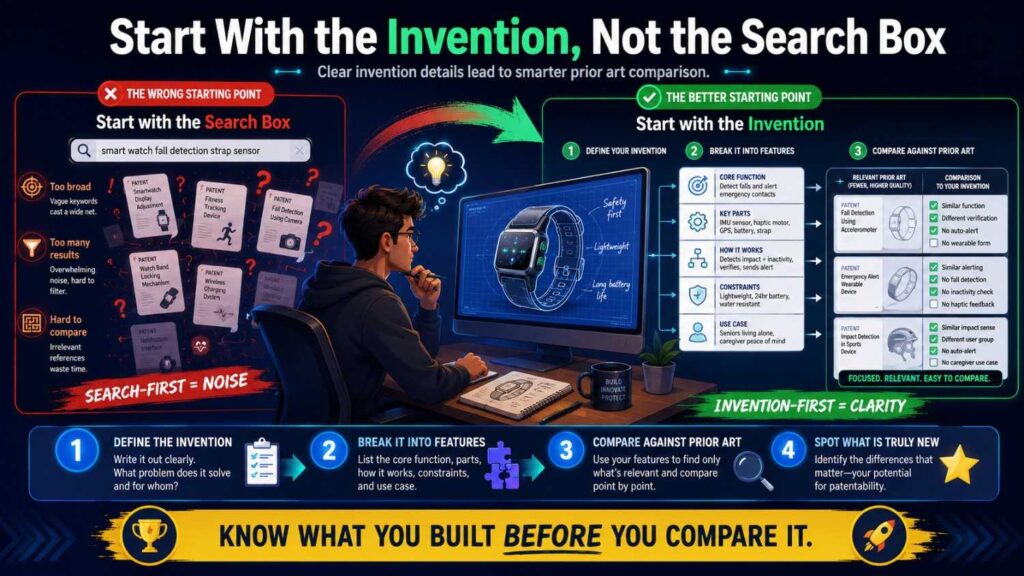
Start With the Invention, Not the Search Box
Most people begin the wrong way.
They go to Google Patents, type the product name, scan ten results, and either panic or relax too soon.
That is not enough.
Before you search, you need to write down what your invention actually is.
Not your company. Not your market. Not your product vision. Not your pitch.
Your invention.
A patent does not protect a dream. It protects a defined technical idea. So your first job is to pull the idea out of the product.
Let’s say you are building a robot for warehouses. The invention may not be “a warehouse robot.” That is too broad. The invention may be how the robot reroutes itself when a shelf is moved. Or how it blends camera data and wheel data when the floor is wet. Or how it predicts human motion near blind corners. Or how it charges itself without blocking other robots.
Let’s say you are building AI software for doctors. The invention may not be “AI for medical records.” The invention may be how your system flags missing context, ranks patient risk using weak signals, handles noisy labels, or gives a clinician a safe review path.
Let’s say you are building chip software. The invention may not be “better chip design.” It may be a layout step, a power estimate method, a verification shortcut, or a way to reduce test cycles.
A good prior art comparison starts with a clear invention statement.
Write one sentence like this:
Our invention is a system that does [main action] by using [key technical feature] so that [technical result] improves.
Keep it plain.
For example:
“Our invention is a system that detects battery swelling by comparing pressure sensor drift across charging cycles so that early failure can be caught before the pack becomes unsafe.”
That sentence gives you search hooks. It gives you the action, the feature, and the result.
Now write the invention in three layers.
The first layer is the broad idea. This is what a normal person would say.
The second layer is the technical method. This is how it works.
The third layer is the sharp edge. This is what feels different from everything else.
For the battery example, the broad idea is “detecting battery swelling.” The method is “using pressure sensor drift across charging cycles.” The sharp edge may be “normalizing sensor drift based on charge rate, pack temperature, and prior compression history.”
That sharp edge is where you should spend most of your time.
A lot of patents are won or lost in the sharp edge.
PowerPatent is built for this kind of work. You can bring your invention notes, system flow, product details, and code-level insight into a process that helps shape the invention before filing. That is much better than guessing from a blank page. See how PowerPatent helps founders move from idea to patent filing.
Separate the Product From the Patentable Idea
Founders often say, “Our product is new.”
That may be true. But patents usually care less about the product as a whole and more about the specific technical pieces inside it.
A product can be new because of branding, pricing, design, market timing, or a unique customer base. Those things may help the business, but they may not create a strong patent.
A patentable invention is usually a technical answer to a technical problem.
So ask a simple question:
What problem did we solve that was hard for other people to solve?
Then go deeper.
What failed before this?
What did your team try that did not work?
What tradeoff did you improve?
What data did you use in a new way?
What step did you remove?
What signal did you trust that others ignored?
What timing issue did you solve?
What cost did you reduce?
What accuracy problem did you fix?
What happens in your system that would surprise another engineer?
This is not just a writing exercise. It changes the search.
If you search for your product category, you will get a flood of broad results. If you search for the hard technical problem, you will find closer art.
For example, searching “AI legal software” is weak.
Searching “machine learning system to extract claim limitations from patent disclosure using dependency parsing and attorney review feedback” is much better.
Searching “drone delivery” is weak.
Searching “autonomous drone route adjustment based on wind shear and battery discharge prediction near landing zone” is better.
Searching “better database” is weak.
Searching “distributed database conflict resolution using time-bounded vector state and client trust score” is better.
The closer your search terms are to the real technical move, the better your results will be.
Build a Simple Invention Map
Before you compare your invention to prior art, make a simple invention map.
Do not make it fancy. You do not need a legal chart yet. You need a working map.
Start with the main parts.
What are the inputs?
What are the outputs?
What steps happen between them?
What hardware or software pieces are used?
What data is stored?
What decision is made?
What changes after the decision?
What result improves?
Now write those pieces in plain words.
For a software invention, your map might look like this in sentence form:
The system receives messy user data. It cleans the data. It detects missing fields. It assigns confidence scores. It compares the data to a model output. It asks for human review only when the score is below a threshold. It stores review feedback. It updates the next ranking step based on that feedback.
For a hardware invention, your map might look like this:
The device receives vibration from a motor. A sensor reads changes over time. A controller compares the changes against a stored pattern. The controller adjusts motor speed. A second sensor checks whether the vibration dropped. The device repeats this loop until the output stays within a safe range.
For a biotech or life science invention, your map may describe sample handling, detection steps, target markers, timing, dosage, or measurement rules.
Once you have the map, mark the pieces that feel ordinary.
Then mark the pieces that feel special.
Do not assume the special part is the part you love most. Your favorite feature may be common. The most protectable part may be a small behind-the-scenes step that users never see.
This is where many startups waste money. They file around the big product story instead of the technical edge. Later, they find out the broad idea was crowded, while the deeper method was the real gold.
A good prior art comparison helps you avoid that mistake.
Understand the Two Big Questions: New and Not an Easy Step
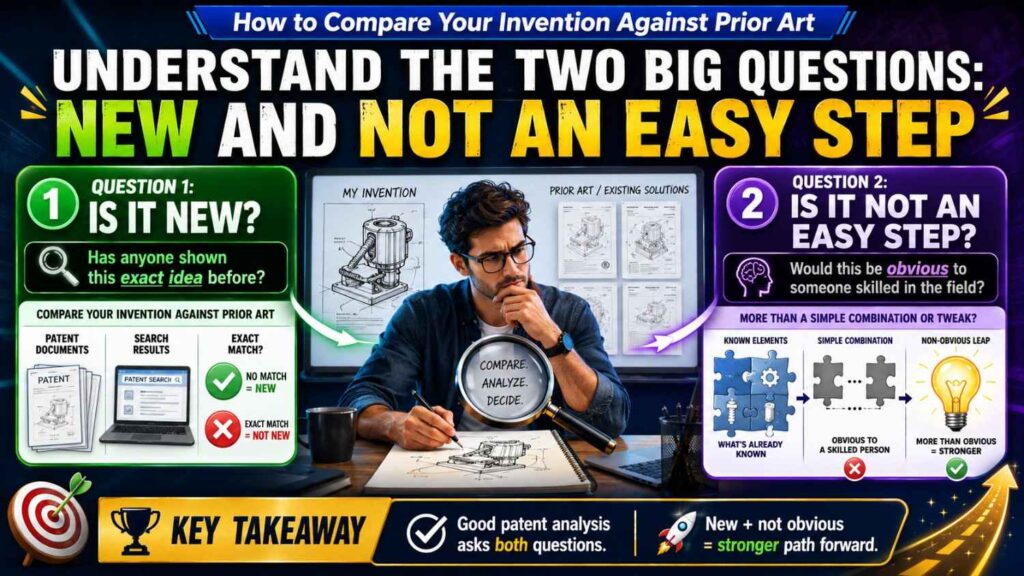
When comparing your invention against prior art, there are two big questions.
The first question is: Is it new?
The second question is: Is it an easy step from what already exists?
In patent language, these ideas often show up as novelty and obviousness. You do not need to live in the legal words, but you do need to understand the logic.
A patent examiner can reject an invention if one earlier reference already shows every important part of what you are claiming. That is the “not new” problem.
A patent examiner can also reject an invention if several references together make your invention look like an easy next step.
This second question is where founders get surprised.
They say, “No one did exactly what we did.”
That may be true.
But the examiner may say, “Reference A teaches the sensor. Reference B teaches the scoring method. Reference C teaches using that score to control the device. Putting them together would have been obvious.”
That does not always mean the examiner is right. But it does mean your prior art review should not stop at exact matches.
You need to look for close pieces that could be combined.
This is why strong patents are not just about finding a blank spot. They are about explaining why your solution is different in a meaningful way.
Maybe the prior art uses the same input but not the same timing.
Maybe it uses the same model but not the same feedback loop.
Maybe it solves the same problem but needs manual setup, while yours learns from live use.
Maybe it combines data sources in a way that creates a new result.
Maybe it works in a harsh setting where old systems fail.
Maybe it reduces compute by doing less work, not more.
Maybe it improves safety because it catches an edge case earlier.
These details matter.
They are often the difference between a weak filing and a strong one.
What Counts as Prior Art
Prior art can come from many places.
A patent is prior art. A published patent application is prior art. A research paper can be prior art. A conference talk can be prior art. A public product demo can be prior art. A standards document can be prior art. A YouTube video can be prior art. A blog post can be prior art. A GitHub repo can be prior art. A thesis can be prior art. A public sale or public use can matter too.
The key idea is simple: if the public could learn it before your filing date, it may matter.
This is why speed matters.
Founders often want to wait until the product is perfect. But waiting can create risk. Your own public launch can create problems. A competitor can publish first. A researcher can post a paper. A standards group can release a draft. A developer can push public code.
You do not need to stop building. But you should be smart.
Before you publish, pitch widely, launch, open source, submit a paper, or share deep technical details, talk to a patent team.
PowerPatent helps founders move quickly because it is built for people who do not want a slow, old-school process. It combines software that captures the invention clearly with real attorney review, so you can act before key public moments. See how it works.
Make a Search Plan Before You Search
A strong prior art search is not random.
It is a set of passes.
Each pass looks from a different angle. One search may focus on keywords. Another may focus on patent classes. Another may focus on competitors. Another may focus on papers. Another may follow citations from one close patent to other close patents.
This matters because people use different words for the same idea.
You may call it “model drift detection.” Someone else may call it “prediction decay monitoring.” A patent may call it “confidence degradation.” A paper may call it “distribution shift.” A product page may call it “data quality alerting.”
If you search only your own words, you will miss things.
Start by writing your search terms in groups.
One group is the problem words. These describe what goes wrong.
For example: drift, error, delay, failure, noise, false positive, overheating, packet loss, occlusion, misalignment, missed detection, deadlock, fraud, spoofing, leakage.
Another group is the solution words. These describe what your invention does.
For example: normalize, rank, fuse, detect, route, compress, encode, verify, train, adjust, predict, isolate, calibrate, schedule.
Another group is the technical object.
For example: sensor, battery, neural network, robot, memory, packet, model, image, token, wafer, electrode, catheter, implant, ledger.
Another group is the result.
For example: lower latency, higher accuracy, less power, better safety, faster training, reduced waste, better throughput, fewer false alarms.
Now combine them.
Do not search long sentences at first. Search small, useful combinations.
For a battery swelling invention, you might search:
battery pressure sensor swelling detection
battery pack deformation charging cycle
pressure drift battery health
battery expansion sensor charge rate compensation
lithium ion swelling pressure monitoring
Then search with different words:
battery bulge detection
cell expansion monitoring
pack compression sensor
battery mechanical strain state of health
This is how you find art written by people who think differently than you.
Good search is not about one perfect query. It is about learning the language of the field.
Use Patent Search Tools the Right Way
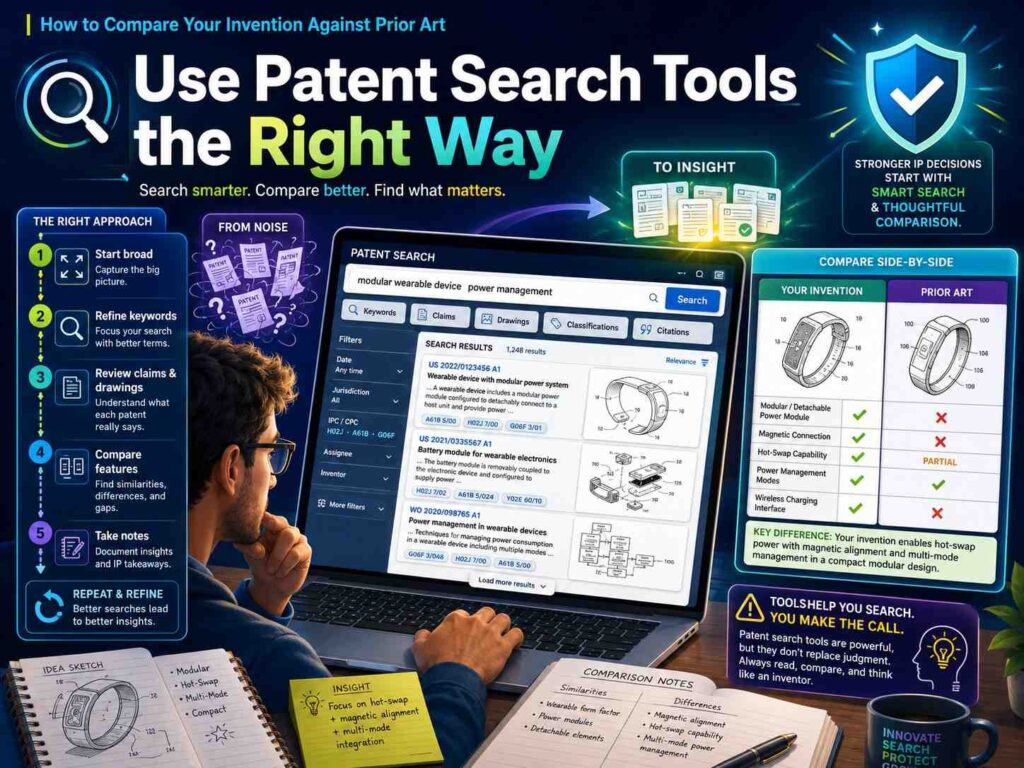
You can start with free tools.
Google Patents is easy to use and can search patents from many places, plus some non-patent literature.
USPTO Patent Public Search is useful for U.S. patents and published applications.
Espacenet is useful for global patent searching.
PATENTSCOPE is useful for international patent applications and worldwide patent collections.
Do not rely on only one tool.
Each tool has strengths and blind spots. A result that is hard to find in one tool may show up fast in another.
Start with Google Patents for broad discovery. It is fast and founder-friendly.
Then use Espacenet to look globally and explore patent families.
Then use USPTO tools for U.S. details.
Then use PATENTSCOPE for PCT filings and international applications.
When you find one close patent, do not stop. Open its citations. Look at the patents it cites. Look at the patents that cite it. Look at the inventors. Look at the owner. Look at related family members. Look at the patent classes.
A close patent is not just a document. It is a doorway.
Search Like an Examiner, Not Like a Customer
Customers search by product name.
Patent examiners search by function.
That is a big difference.
A customer may search “AI meeting assistant.”
An examiner may search “automatic speech transcription summarization action item extraction confidence score.”
A customer may search “smart insulin pen.”
An examiner may search “drug delivery device dose tracking wireless sensor reminder adherence.”
A customer may search “robot dog.”
An examiner may search “quadruped robot gait control terrain adaptation actuator feedback.”
When you compare your invention to prior art, search by what the invention does, not by what the market calls it.
This feels boring, but it works.
Patent documents often use broad, formal words. They may avoid trendy product names. They may say “computing device,” “control module,” “user interface,” “sensor assembly,” “trained model,” “network node,” or “medical device” instead of the words you use in your pitch.
So you need to search both ways.
Search the normal words. Then search the patent words.
For software, use words like module, processor, system, method, data set, trained model, score, rule, threshold, vector, embedding, output, interface, request, response, ranking, feedback, update, cluster, label, feature, and state.
For hardware, use words like housing, sensor, actuator, controller, signal, circuit, assembly, channel, layer, substrate, valve, member, coupling, mount, thermal, pressure, current, and flow.
For biotech, use words like sample, marker, assay, sequence, expression, binding, reagent, culture, pathway, composition, dose, delivery, and detection.
For robotics, use words like navigation, localization, path planning, obstacle, mapping, pose, actuator, end effector, gripper, torque, feedback, trajectory, and control.
Search terms are not magic. They are bait. Better bait catches closer art.
Learn the Field’s Patent Classes
Keywords are useful, but they are not enough.
Patent offices group inventions by technical class. These classes can help you find art even when the words are different.
One common system is the Cooperative Patent Classification system, often called CPC. You do not need to memorize it. You only need to use it as a clue.
Here is the simple way.
Find three patents that are close to your invention. Open them. Look for their CPC codes. If the same code appears across several close results, that code may matter.
Now search inside that class with your key terms.
This helps you avoid missing patents that use strange language.
For example, your invention may involve “AI for detecting broken parts in images.” One patent may say “defect detection.” Another may say “visual inspection.” Another may say “machine vision.” Another may say “anomaly classification.” The class can connect them.
Classes are especially useful when the field is old, the words have changed, or the patents are translated from another language.
Do not overdo it. Classes can be broad. But when used with keywords, they can make your search much stronger.
Compare by Features, Not by Vibes
Once you find prior art, do not just read it and say, “This feels close.”
That is too vague.
You need to compare features.
A feature is a real part of your invention. It can be a step, input, output, structure, rule, model, timing condition, sensor, data type, threshold, or result.
Build a simple comparison table in your notes.
Across the top, write the prior art references.
Down the side, write the key features of your invention.
For each prior art reference, mark whether it shows the feature clearly, partly, or not at all.
Keep the words simple.
For example, your invention may have these features:
The system receives live sensor data from a wearable device.
The system detects signal drift during a known user motion.
The system adjusts the drift score using body temperature.
The system compares the adjusted score against a personal baseline.
The system sends an alert only when the drift score and baseline change both pass a threshold.
The system updates the baseline after a confirmed false alert.
Now compare a prior patent.
Does it receive live sensor data? Yes.
Does it detect drift during a known motion? Maybe.
Does it adjust using body temperature? No.
Does it compare against a personal baseline? Yes.
Does it require both drift score and baseline change? No.
Does it update after a confirmed false alert? No.
Now you can see the gaps.
This is much better than saying, “It is kind of similar.”
Patent strength often lives in those gaps.
But be careful. A single gap may not be enough. If another reference teaches the missing feature, an examiner may combine them. So after you find gaps, ask whether those gaps would have been easy to fill.
That is where the next layer begins.
Do Not Only Ask “Do They Have It?” Ask “Do They Teach It?”
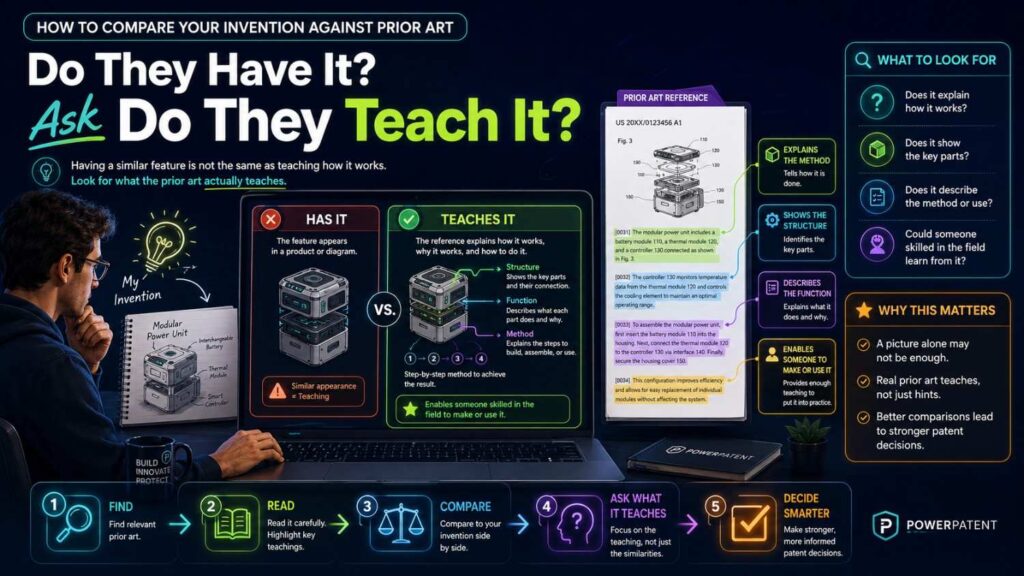
A prior art reference may mention a word but not really teach your idea.
This is important.
A patent may mention “machine learning” in one sentence. That does not mean it teaches your specific model flow.
A paper may mention “sensor fusion.” That does not mean it teaches your timing rule.
A product page may claim “smart alerts.” That does not mean it discloses how alerts are generated.
When you compare prior art, ask what the reference actually teaches.
Does it explain the same step?
Does it show the same data flow?
Does it solve the same problem?
Does it give enough detail for someone to do it?
Does it treat the feature as central or just mention it in passing?
Does it produce the same technical result?
Does it work in the same setting?
This does not mean vague art can be ignored. It may still matter. But you should not give every reference the same weight.
Some references are direct hits. They show the same thing clearly.
Some references are partial. They show one or two pieces.
Some references are background. They show the field but not your core move.
Some references are noise. They share words but not substance.
Your job is to sort them.
This sorting helps your patent team write better claims. It also helps you decide whether to file, revise, narrow, expand, or keep searching.
Find the Closest Prior Art
The most important reference is usually the closest prior art.
That is the reference that shares the most important features with your invention.
It may not be the first result. It may not have the same title. It may not be owned by a competitor. It may come from another industry.
For example, your invention may be for drones, but the closest prior art may come from self-driving cars.
Your invention may be for medical imaging, but the closest prior art may come from factory inspection.
Your invention may be for fraud detection, but the closest prior art may come from network security.
Technology crosses markets.
Do not limit yourself to your own industry.
Search the problem, not just the use case.
If your invention predicts failure from noisy signals, search noisy signal failure prediction in other fields.
If your invention reduces model hallucination by checking outputs against a structured source, search verification methods in other AI systems.
If your invention improves thermal control in a compact device, search heat control in nearby device types.
A patent examiner can use prior art from a related field if it would make sense to a skilled person. So you should think broadly too.
The closest prior art is powerful because it helps you frame the invention.
Once you know the closest art, you can say:
“Compared with this, our invention adds this.”
“Compared with this, our invention changes this.”
“Compared with this, our invention gets this result.”
“Compared with this, our invention avoids this problem.”
That comparison is the start of a strong patent story.
Look for the Missing Step
When a prior art reference feels close, slow down.
Read it again.
Then ask: what step is missing?
This one question is simple, but it is powerful.
Many inventions are not new because they use new parts. They are new because they arrange known parts in a new way, with a missing step that changes the result.
Maybe prior art collects data and shows it to a user. Your invention collects data, scores it, and only sends uncertain cases to review.
Maybe prior art trains a model once. Your invention updates a model based on live feedback after a threshold event.
Maybe prior art detects an error. Your invention predicts the error before it happens and changes a control path.
Maybe prior art measures temperature. Your invention uses temperature to adjust a pressure reading.
Maybe prior art routes requests. Your invention routes requests based on privacy risk and model confidence.
That missing step can be the key.
But it must matter.
A missing step that does not change anything may not help much. A missing step that improves safety, accuracy, speed, power use, cost, or reliability is much stronger.
So do not only write the missing step.
Write why it matters.
“Our invention adds a calibration step based on charge rate, which reduces false swelling alerts during fast charging.”
That is better than:
“Our invention includes charge rate.”
The first one explains the technical reason. The second one is just a feature.
Patent work is often about turning features into reasons.
Compare the Problem Being Solved
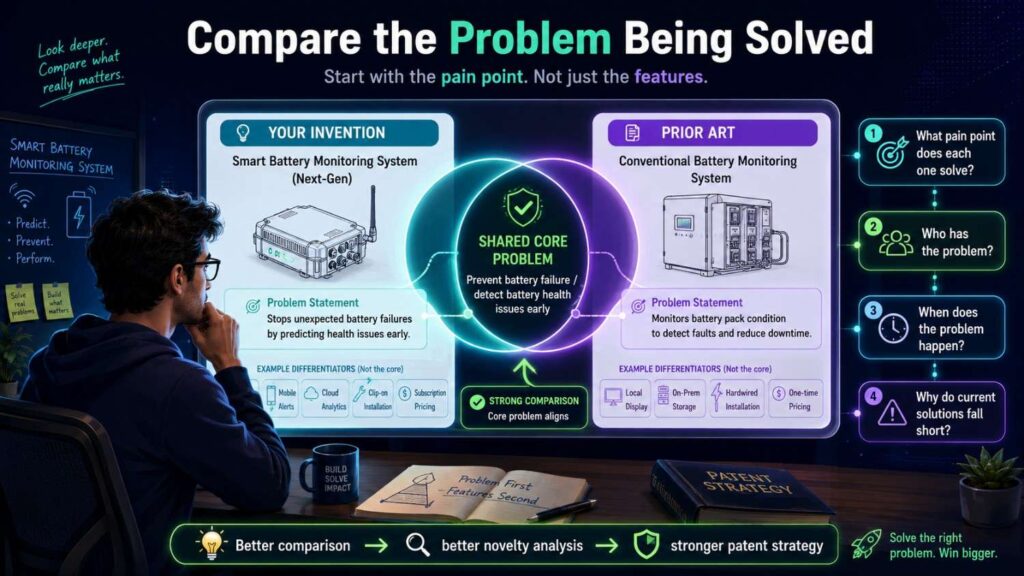
Two inventions can look similar but solve different problems.
That can matter.
Suppose prior art uses a camera and a model to detect objects in a warehouse. Your invention also uses a camera and a model in a warehouse. That sounds close.
But the prior art may solve object detection for inventory counting.
Your invention may solve safety prediction for moving forklifts.
The components overlap, but the technical problem is different.
Now ask whether the differences in problem lead to differences in method.
If yes, that may help.
Your system may use different timing, different labels, different thresholds, different feedback, different data sources, or different outputs because the problem is different.
A strong comparison should say:
The prior art is focused on X.
Our invention is focused on Y.
Because of Y, our system does Z differently.
That difference leads to a better result.
This is a clean, simple pattern.
For example:
The prior art is focused on detecting whether a machine has already failed. Our invention is focused on predicting whether the machine is likely to fail during the next use cycle. Because of that, our system compares vibration changes across matched load windows instead of using one static vibration limit. This reduces false alarms when the load changes.
That is a useful comparison.
It does not attack the prior art. It explains the technical split.
Compare the Inputs
Inputs are often where inventions differ.
Look closely at what data the prior art uses.
Does it use one sensor or many?
Does it use live data or stored data?
Does it use raw data or cleaned data?
Does it use user feedback?
Does it use environmental data?
Does it use device history?
Does it use time windows?
Does it use model outputs as inputs to another step?
Does it use context that older systems ignore?
Many modern inventions are built on better use of data.
But “we use data” is not enough. Everyone uses data.
The question is: what data, from where, at what time, for what decision?
For AI inventions, inputs matter a lot.
Prior art may use text. Your system may use text plus structured metadata plus prior user edits.
Prior art may use images. Your system may use images plus device motion plus lighting state.
Prior art may use logs. Your system may use logs plus deployment history plus model confidence.
Prior art may use a single prompt. Your system may use prompt fragments ranked by source trust.
These differences may be meaningful if they change the output.
When comparing inputs, write the reason clearly.
“Our system uses the user’s prior correction history as an input, so the model can lower confidence when the current case matches a pattern the user often rejects.”
That is much stronger than:
“Our system uses correction history.”
A good patent story connects input to result.
Compare the Outputs
Outputs can also show a real difference.
A prior art system may output a label. Your system may output a label plus a confidence score plus a reason code plus a next action.
A prior art device may output an alert. Your device may output a control signal that changes how the machine operates.
A prior art model may output a prediction. Your invention may output a ranked set of safe actions.
A prior art tool may output a summary. Your invention may output a structured workflow that triggers review only for missing claim support.
When comparing outputs, ask what the system does with the result.
Does it merely display it?
Does it change a machine state?
Does it update a model?
Does it route a task?
Does it block an unsafe action?
Does it trigger a second check?
Does it store feedback for later use?
The output is not always the final screen the user sees. It may be an internal signal.
Internal outputs can be very important.
For example, a model confidence score that controls whether a second model runs may reduce compute cost. A risk score that changes a battery charging path may improve safety. A route score that changes drone altitude may improve delivery success.
So when you compare prior art, do not stop at the user-facing result.
Look inside the system.
Compare the Timing
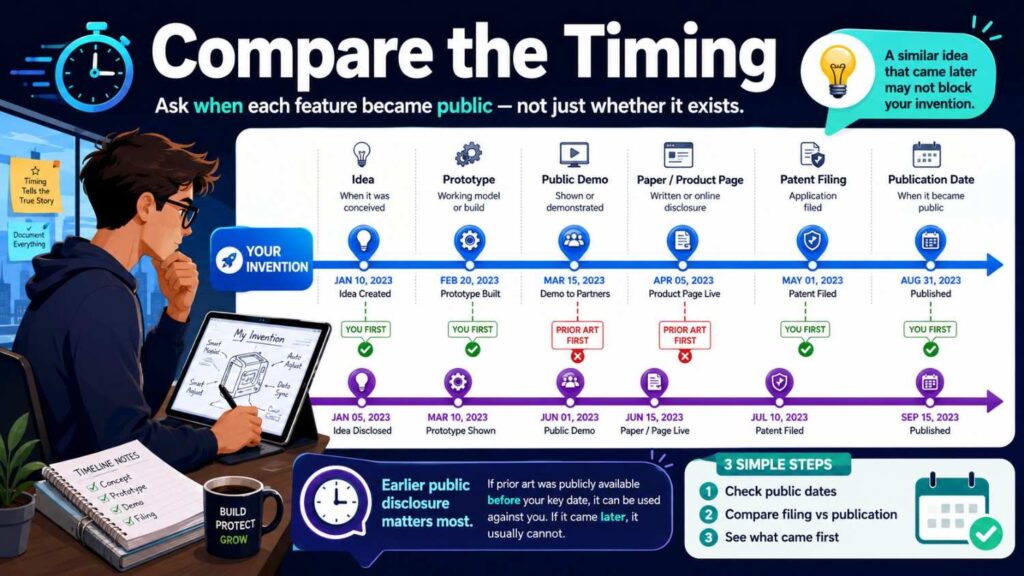
Timing is often overlooked.
But timing can be the whole invention.
Maybe older systems check once per day. Yours checks after each event.
Maybe older systems train after a batch is complete. Yours updates during the session.
Maybe older systems send all data to the cloud first. Yours makes a local decision before upload.
Maybe older systems alert after a threshold is crossed. Yours predicts the crossing and acts before it happens.
Maybe older systems run a heavy model every time. Yours runs a small model first, then a heavy model only when needed.
Timing differences can be powerful because they often change performance.
They can reduce latency. They can reduce power use. They can improve safety. They can prevent failures instead of only detecting them.
When comparing timing, be precise.
Do not say “faster.”
Say what happens earlier, later, or conditionally.
For example:
“The prior art runs calibration when the device starts. Our invention runs a smaller calibration step after each high-vibration event, which lets the device correct drift before the next measurement cycle.”
That is clear.
Compare the Order of Steps
Order matters.
Two systems can use the same ingredients but in a different order.
That different order may create a different result.
For example, suppose a system cleans data, then scores it, then asks for user review.
Your system may score the raw data first, then clean only the risky parts, then ask for review only when two scores disagree.
That is not the same method.
Or suppose prior art detects anomalies, then clusters them.
Your invention may cluster first, then detect anomalies inside each cluster. That may reduce false alarms.
Or suppose prior art compresses data before encryption.
Your invention may encrypt first, then compress only metadata. That may protect privacy differently.
When reading prior art, track the step order.
Patent drawings can help. Flowcharts can help. Claim language can help. Examples can help.
Write the steps in your own words. Then write your steps next to them.
Small order changes may matter when they solve a problem.
But again, connect the change to a result.
“Our system ranks cases before cleaning them, which avoids wasting compute on cases that are already clear.”
That is useful.
Compare the Conditions
Many inventions work only when certain conditions are met.
These conditions can be important.
A system may act only when a score passes a threshold.
A device may switch modes only when temperature and pressure both change.
A model may ask for human review only when confidence drops below a limit.
A robot may reroute only when a moving object is predicted to cross its path within three seconds.
A battery system may reduce charge current only when swelling risk and heat risk both increase.
Prior art may have the same broad action but not the same trigger.
That difference can matter.
Triggers and conditions often show intelligence in the system. They show that your invention is not just doing something, but doing it at the right moment.
When comparing prior art, search for words like threshold, condition, trigger, state, mode, event, confidence, score, limit, range, window, and rule.
Then ask:
What causes the prior art system to act?
What causes our system to act?
Are those causes the same?
Does our trigger reduce false positives, save power, improve safety, or improve speed?
If yes, write that down.
Compare the Feedback Loop
A feedback loop is often one of the strongest parts of a modern invention.
A feedback loop means the system uses results from past action to change future action.
Prior art may detect a problem. Your invention may detect it, act on it, learn from the action, and update the next decision.
That loop can be valuable.
For example, an AI coding tool may suggest fixes. Your system may track which fixes developers accept, link them to code context, and adjust future ranking.
A medical tool may flag cases. Your system may track clinician overrides and update the risk model for that clinic.
A factory sensor may detect defects. Your system may compare defect calls against later inspection results and adjust sensor weighting.
A robot may choose a route. Your system may learn which routes cause wheel slip under certain floor conditions.
When comparing prior art, look for learning and updating.
Does the old system store feedback?
Does it use feedback automatically?
Does it update a model, rule, baseline, or threshold?
Does the update happen for all users or one user?
Does it happen in real time or later?
Does it affect the same decision or a different one?
Feedback loops can be described too broadly, so be careful. “The system learns” is weak. “The system updates a baseline after a confirmed false alert” is stronger.
Compare the Technical Result
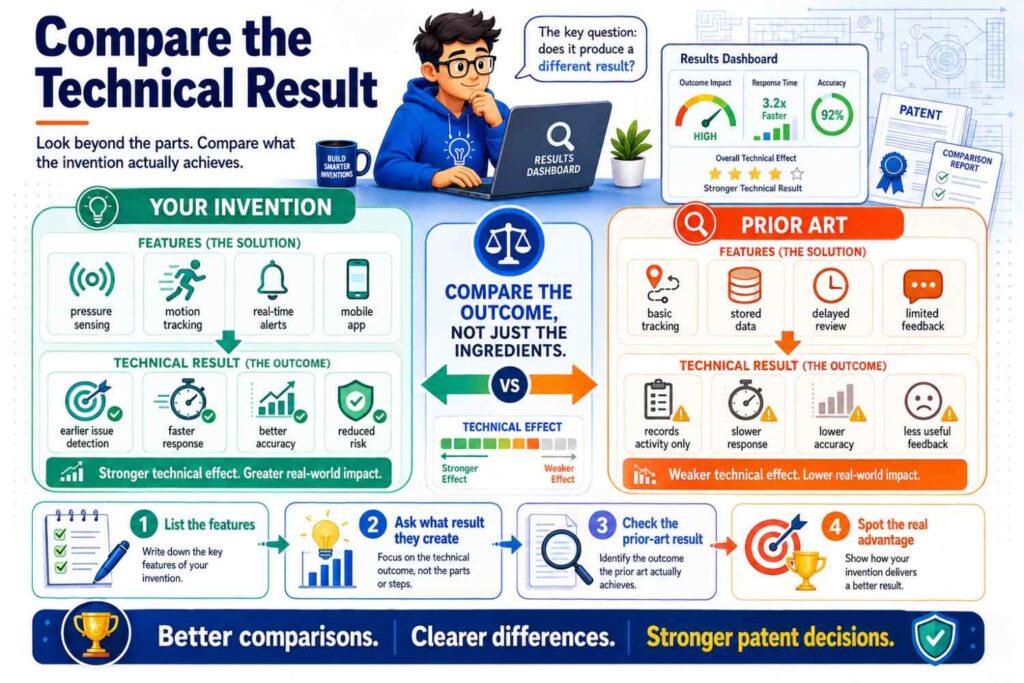
This may be the most important section.
A patent is stronger when the difference creates a real technical result.
Not just a business result.
A business result is “more users sign up” or “the company makes more money.”
A technical result is “less power is used,” “fewer false alarms occur,” “the robot stops sooner,” “data is processed faster,” “the device stays cooler,” “the model needs less training data,” “the signal is cleaner,” or “the network sends fewer packets.”
When comparing your invention to prior art, always ask:
What technical result does our difference create?
This helps you avoid weak claims.
For example, “our system displays the result in a nicer dashboard” may not be strong by itself.
But “our system groups alerts by shared root sensor drift before display, which reduces duplicate network messages and lowers review load” is better.
The technical result makes the difference meaningful.
Founders sometimes hide the best technical results because they think investors only care about market outcomes. But patent readers care about how the invention works.
So make the technical result plain.
Do not use buzzwords. Use cause and effect.
Because we do A, the system can do B.
Because we measure X earlier, the device avoids Y.
Because we update Z after feedback, the model reduces errors in the next run.
Because we split the task into two stages, the system uses less compute.
That is strong writing. It is also strong invention thinking.
Read the Claims, But Do Not Ignore the Description
Patent documents have several parts.
The claims define the legal scope. They are very important.
But the description, drawings, examples, and background can also teach prior art.
When comparing your invention, read the claims first to see what the patent is trying to protect.
Then read the description to see what it teaches.
Sometimes a feature is not in the claims but is described in detail. That can still matter as prior art.
Sometimes the claims are narrow, but the description is broad.
Sometimes the title sounds close, but the claims are about something else.
Sometimes the drawings show the system more clearly than the words.
Do not judge a patent by the title.
Patent titles are often broad and dull. A patent called “System and Method for Data Processing” may contain a very specific machine learning workflow. A patent called “Medical Device” may describe a sensor trigger similar to yours.
When you find a close patent, slow down.
Read the abstract. Read the first claim. Look at the drawings. Search within the page for your key terms. Read the parts near those terms. Look for examples. Look for the problem the patent says it solves.
Then decide how close it really is.
Do Not Panic When You Find Similar Art
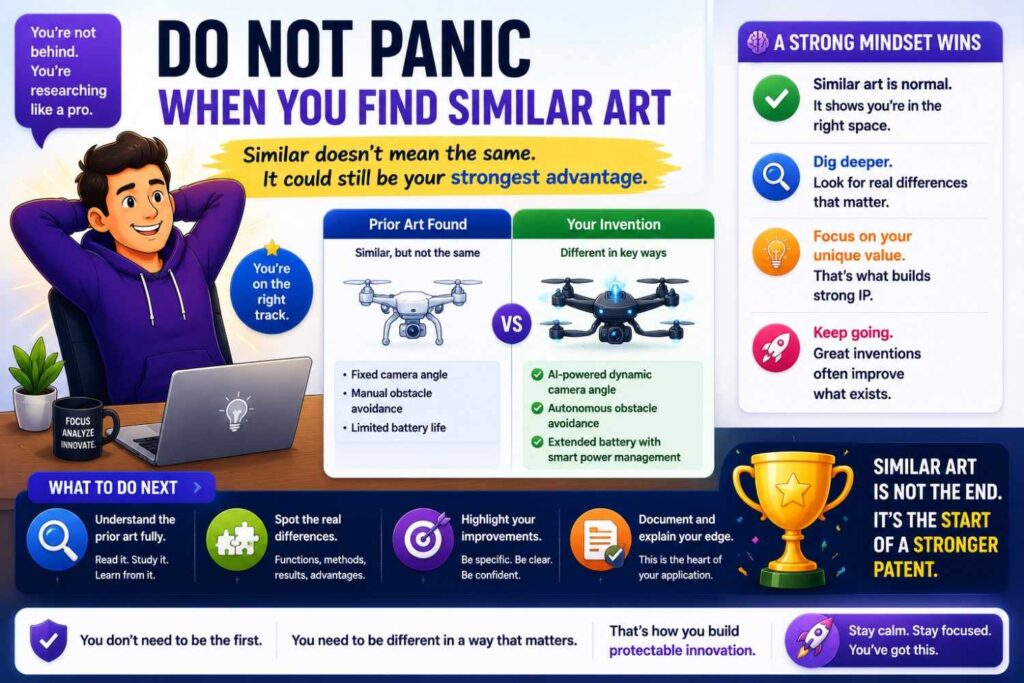
Finding similar prior art is normal.
In fact, it can be a good sign.
If no one has ever worked near your problem, maybe the market is not ready. Maybe the technical need is unclear. Maybe you are using the wrong search terms.
Similar art means the field exists.
The question is whether your invention adds something real.
When founders find close art, they often jump to one of two bad reactions.
The first bad reaction is panic: “We can’t patent anything.”
The second bad reaction is denial: “That is not exactly us, so it does not matter.”
Both are wrong.
The better reaction is calm comparison.
What does the reference teach?
What does it miss?
What problem does it solve?
What result does it get?
What does our invention do differently?
Could a person combine this reference with another one to get our invention?
If not, why not?
If yes, what narrower version of our invention may still be strong?
This is how real patent strategy works.
Sometimes you keep the broad idea. Sometimes you narrow it. Sometimes you shift to a deeper feature. Sometimes you file around several related inventions. Sometimes you decide not to file on one idea and save your budget for a better one.
That is not failure. That is smart.
PowerPatent helps founders make these choices earlier, before they burn months going in the wrong direction. Explore how PowerPatent works.
Look Beyond Patents
Patents are only part of the prior art world.
For many deep tech startups, non-patent prior art can be just as important.
This includes papers, preprints, conference slides, posters, theses, open source code, standards, manuals, product docs, regulatory filings, videos, and public datasets.
Software and AI founders should pay close attention to papers and code.
Many AI ideas show up first in arXiv papers, GitHub repos, benchmark writeups, model cards, docs, and developer blogs.
Hardware founders should look at manuals, teardown posts, product specs, datasheets, standards, and old supplier docs.
Robotics founders should look at academic papers, conference videos, simulation repos, open datasets, and technical talks.
Biotech founders should look at journal articles, sequence databases, clinical trial records, protocols, and conference abstracts.
Energy founders should look at technical reports, standards, government labs, theses, and supplier sheets.
A patent examiner may find non-patent art. A competitor may find it too.
So do not skip it.
Search the same invention map outside patent databases.
Use normal web search. Search scholar databases. Search GitHub. Search conference names. Search standards bodies. Search product manuals. Search PDFs.
When you find a close paper or product page, save it. Record the title, author or company, date, link, and the exact feature it teaches.
Dates matter. Keep them.
Watch the Dates Carefully
Prior art is tied to timing.
A document that came before your filing date may matter. A document that came after your filing date may not count the same way against you, though it can still teach you about the field.
So when you collect prior art, record dates.
Publication date. Filing date. Priority date. Product launch date. Git commit date. Conference date. Manual revision date. Blog post date.
For patents, look at the priority date, filing date, publication date, and grant date.
The priority date is often very important because it may show when the patent family first claimed the invention.
Do not confuse grant date with publication date. A patent granted last week may have been filed years ago.
Also be careful with old product pages. The current page may not show what was public years ago. Sometimes you need archived pages, old manuals, press releases, or release notes.
For your own invention, write down your key dates too.
When did you first build it?
When did you test it?
When did you share it publicly?
When did you pitch it?
When did you launch it?
When did you publish code?
When did you submit a paper?
When did you send a deck?
This helps your patent team understand risk.
Do not guess later. Keep records now.
Compare Your Invention Against One Reference at a Time
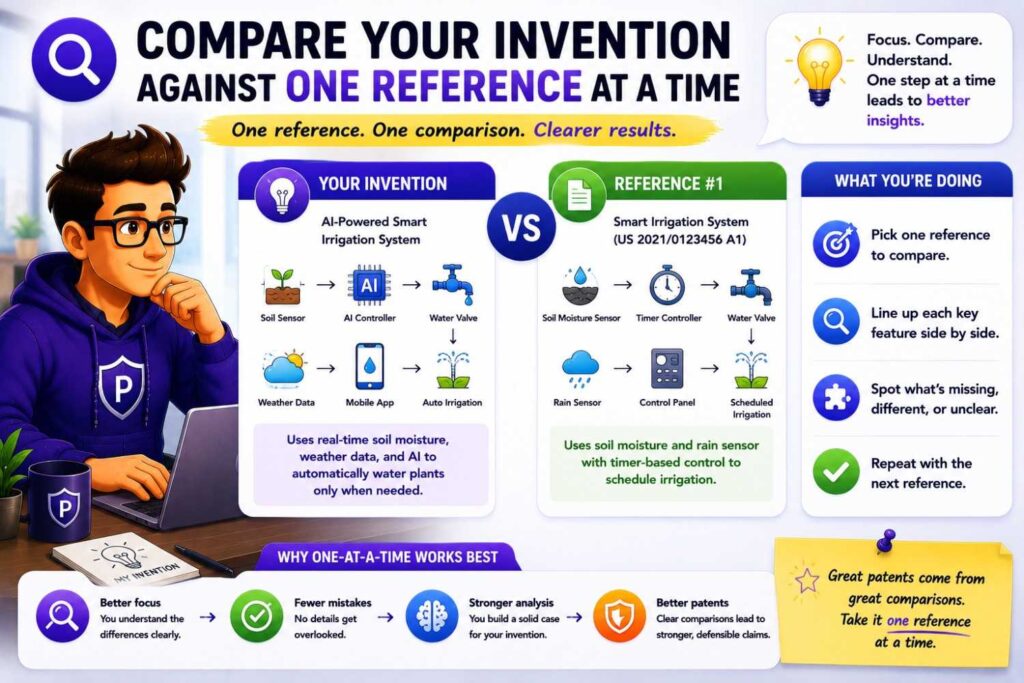
A common mistake is mixing all prior art together too early.
At first, compare your invention against one reference at a time.
Ask whether one prior art reference shows all the key parts.
If yes, that is a serious issue for that version of the invention.
If no single reference shows everything, then look at combinations.
This order matters.
If you mix references too early, you may think the invention is weaker than it is. You may see one feature in Reference A, another in Reference B, another in Reference C, and assume the whole invention is old. But unless the combination makes sense, the invention may still have room.
At the same time, do not ignore combinations. Patent examiners often combine references when reviewing obviousness.
So use two passes.
First pass: one reference at a time.
Second pass: possible combinations.
This keeps your thinking clean.
Ask Whether the Combination Makes Sense
When you look at multiple references, ask whether someone in the field would have had a reason to combine them.
Do not use hindsight.
Hindsight means looking at your invention and then saying, “Well, now that I know the answer, I can find pieces of it everywhere.”
That is not fair.
The better question is:
Before your invention, would a skilled person have been pushed toward this combination?
Maybe yes.
If two references solve the same problem in the same field, use the same parts, and one suggests improving the other, the combination may be strong.
Maybe no.
If one reference teaches a solution that would break the other, or solves a different problem, or avoids the feature you use, the combination may be weaker.
Look for signs.
Does one reference mention the other’s problem?
Does it suggest the missing feature?
Do the two systems work in compatible ways?
Would combining them improve the result?
Would combining them create extra cost, delay, risk, or failure?
Does one reference teach away from the other?
“Teach away” means a reference suggests not doing what your invention does. You do not need to use that phrase in founder notes, but the idea is useful.
If old systems avoided your path because it seemed risky, too slow, too expensive, or unreliable, and you found a way to make it work, that can help your story.
Use “Why Not Before?” as a Test
One of the best questions in patent strategy is:
Why did people not already do this?
If the answer is “they just didn’t think of it,” that may or may not be enough.
Go deeper.
Maybe they did not have the right sensor quality.
Maybe they lacked enough training data.
Maybe the compute cost was too high.
Maybe the network delay was too large.
Maybe the false positives made the old approach useless.
Maybe regulations or workflows made the obvious path hard.
Maybe the system had to work offline.
Maybe prior art assumed a fixed threshold, and you discovered that a dynamic threshold was needed.
Maybe prior art treated all users the same, and you found that personalization was the key.
Maybe prior art used raw model confidence, and you found that confidence had to be adjusted based on source trust.
This question helps you explain why the invention was not an easy step.
It also helps you write better patent disclosures.
A strong patent application should not only say what the invention is. It should help show why the invention matters.
Identify the Core Difference in One Sentence
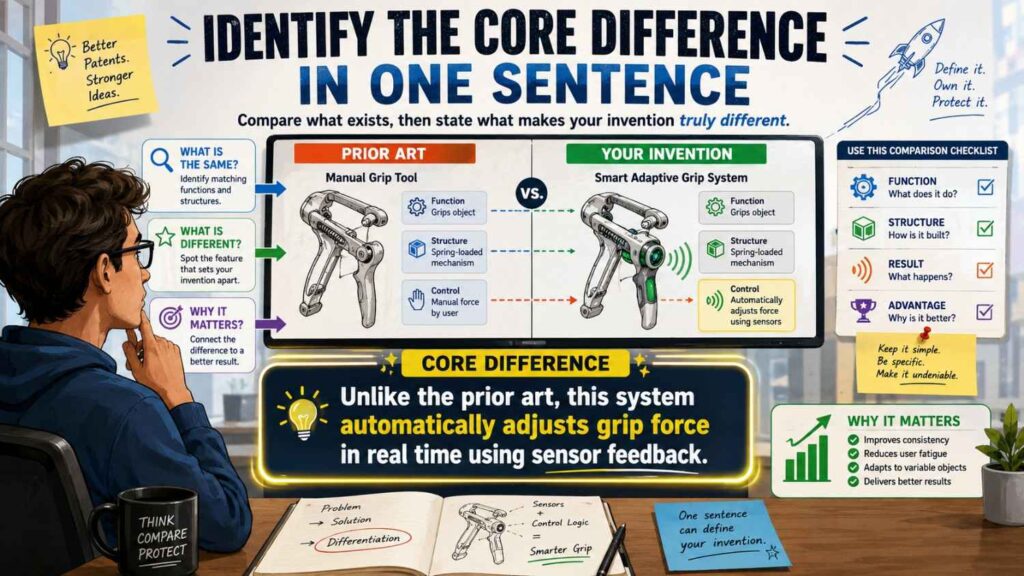
After reviewing prior art, you should be able to say the difference in one sentence.
Not ten paragraphs.
One sentence.
For example:
“Our system differs from the closest prior art because it updates the alert threshold based on confirmed false alerts from the same device, instead of using a fixed global threshold.”
Or:
“Our method differs because it verifies a model-generated answer against a structured source graph before showing it to the user.”
Or:
“Our device differs because it measures pressure drift during a controlled charging window and adjusts the swelling score based on charge rate.”
This sentence is not the full patent. It is the anchor.
If you cannot state the difference clearly, you may not understand the invention yet.
That does not mean the invention is bad. It means you need more work.
The clearer the difference, the easier it is for your patent team to draft around it.
Find More Than One Difference
One difference is good.
Several connected differences are better.
A strong invention often has a cluster of features that work together.
For example:
The system uses a special input.
It processes that input in a special order.
It uses a special trigger.
It creates a special output.
It updates itself based on feedback.
Together, those steps reduce errors.
That is stronger than a single isolated feature.
When comparing prior art, look for a bundle.
Maybe each piece exists somewhere. But the bundle may not.
Be careful, though. The bundle should not be random. The pieces should work together toward one result.
A random pile of features is weak.
A connected system is stronger.
For example:
“Our invention combines device temperature, charge rate, and pressure drift to create a swelling risk score.”
That is okay.
But better is:
“Our invention combines device temperature, charge rate, and pressure drift during matched charging windows so that temporary fast-charge expansion is not mistaken for dangerous swelling.”
Now the features have a purpose.
Check Whether Your “Difference” Is Actually in Your Product
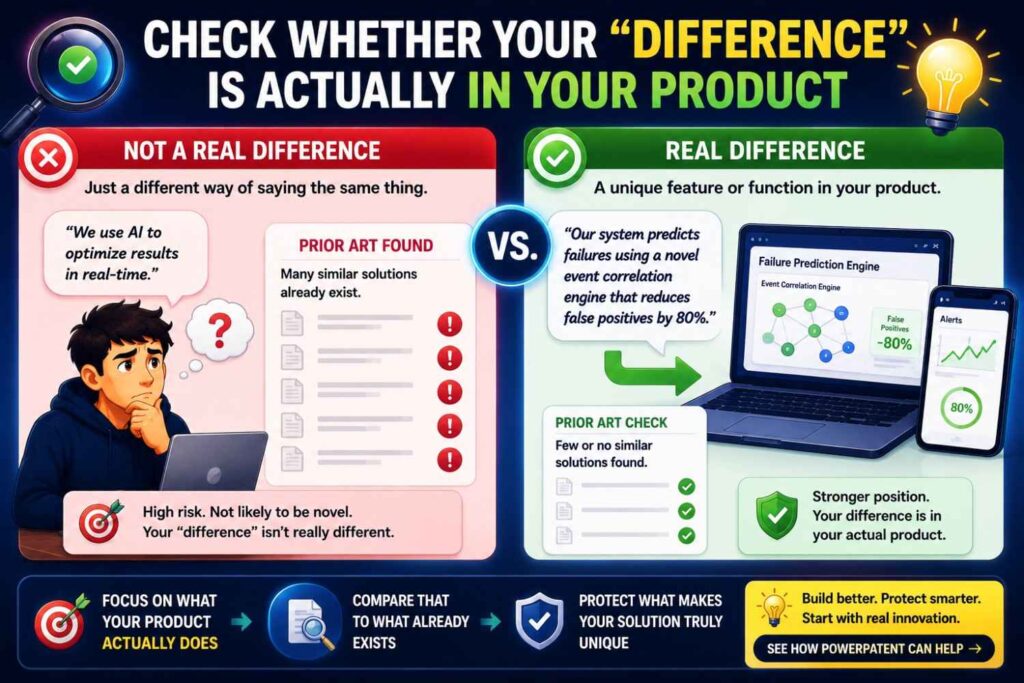
This sounds obvious, but it is easy to miss.
Do not build a patent story around a feature your product does not actually use, unless you have truly invented and can describe it.
If your team only talked about a feature in a roadmap, be careful.
If you have not built it, tested it, or designed it in enough detail, tell your patent team.
Patents can cover planned versions in some cases, but the application must still describe the invention well enough. You cannot file a vague wish.
So before you decide the difference, check your real materials.
Look at code.
Look at diagrams.
Look at model flows.
Look at design docs.
Look at test results.
Look at prototypes.
Look at user workflows.
Look at sensor logs.
Look at lab notes.
Your invention should come from real technical work.
This is where PowerPatent is useful for technical founders. The platform is designed to help turn real invention materials into patent-ready disclosure, with attorney oversight layered in. That means your patent story can be tied to what your team actually built. See how PowerPatent works.
Make a Prior Art Notes File
Do not keep everything in your head.
Create a prior art notes file.
For each reference, record the title, link, owner or author, date, short summary, closest feature, missing features, and why it matters.
Keep it simple.
The goal is not to write a law review article. The goal is to make your thinking visible.
Use plain language.
For example:
“Reference 1 uses a pressure sensor to detect battery swelling. It checks pressure during charging. It does not appear to adjust the pressure reading based on charge rate or temperature. It uses a fixed threshold. Our system uses matched charging windows and adjusts the swelling score based on charge rate and pack temperature.”
That note is useful.
It helps your team. It helps your attorney. It helps you remember why a reference mattered.
Do not paste huge chunks of text. Summarize what matters. Save the link.
Also record search terms. If you later need to search more, you will know what you already tried.
Use Prior Art to Improve the Invention
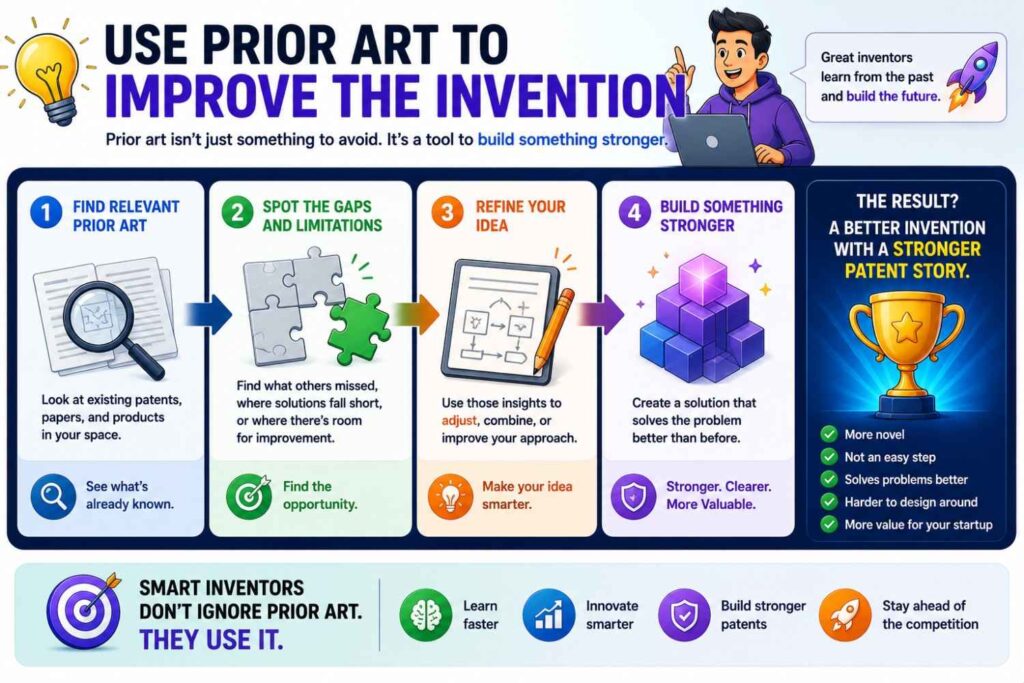
Prior art review is not just about filing.
It can make your product better.
When you read old patents and papers, you may find weak spots in your own design.
You may find an old approach that failed because it did not handle an edge case.
You may find a competitor focusing on a path you should avoid.
You may find a missing feature that would make your system more defensible.
You may find a way to make your invention more specific and stronger.
This is one reason founders should not treat patents as paperwork.
Patent work can be product work.
When done well, it forces your team to answer hard questions:
What exactly are we doing?
Why is it better?
What do others do?
Where is our edge?
What should we protect first?
What should we keep as trade secret?
What should we publish?
What should we avoid disclosing before filing?
That clarity is valuable beyond the patent.
It can help fundraising. It can help partnerships. It can help acquisition diligence. It can help the team focus.
Compare Against Competitors Without Getting Distracted
Competitor patents matter, but they are not the whole world.
Founders often search only competitor names.
That is useful, but limited.
Your closest prior art may come from a university, a failed startup, a foreign company, a supplier, a government lab, or a company in a different market.
Still, competitor searching is important.
Search the company name. Search founder names. Search key engineer names. Search old company names. Search acquired company names. Search subsidiaries. Search product names. Search assignees in patent databases.
When you find competitor patents, look at their patent families. Look at what countries they filed in. Look at claim scope. Look at continuation filings. Look at recent publications.
But do not obsess.
A competitor patent does not always block you. It may be narrow. It may be expired. It may not be granted. It may not cover your design. It may be useful prior art but not a business threat.
Freedom-to-operate is a separate question from patentability.
Patentability asks whether you can get your own patent.
Freedom-to-operate asks whether your product may infringe someone else’s patent.
They are related, but not the same.
This article is about comparing your invention against prior art for patentability. If you are about to launch a product in a crowded field, you may also need a freedom-to-operate review.
Do Not Confuse “Different” With “Patentable”
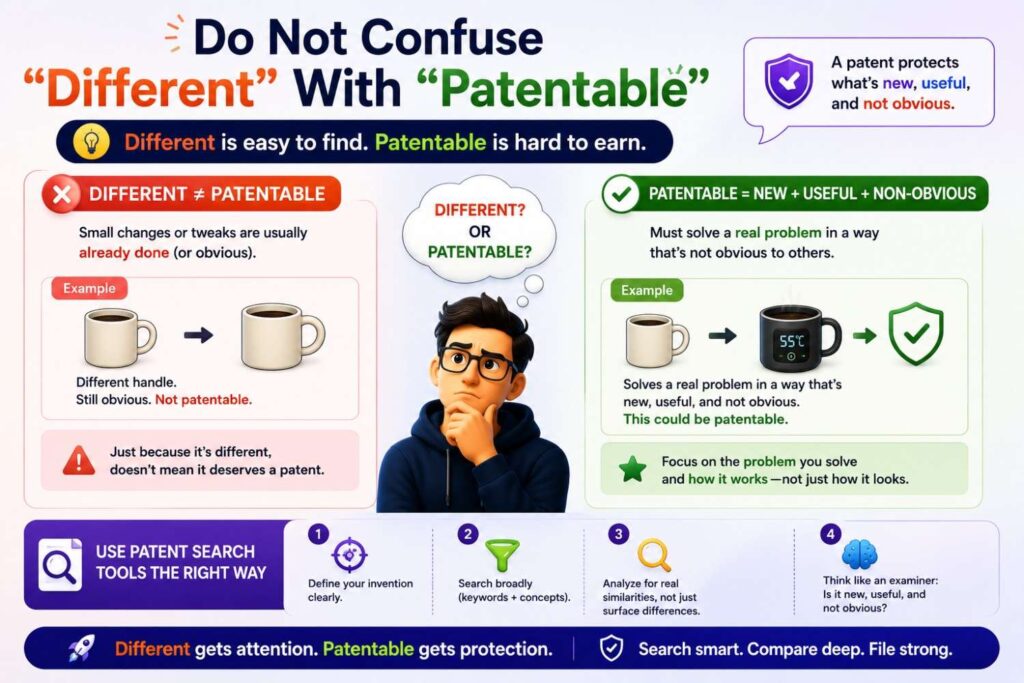
Your invention may be different from prior art and still not be patentable.
That sounds harsh, but it is better to know early.
Some differences are too small. Some are design choices. Some are normal substitutions. Some are business rules. Some are presentation changes. Some are changes a skilled person would likely make without much thought.
For example:
Changing a color is usually not enough for a utility patent.
Moving a button may not be enough.
Using a faster server may not be enough.
Doing a known process on a generic computer may not be enough.
Adding “AI” without a real technical method may not be enough.
Replacing one common sensor with another common sensor may not be enough unless it changes how the system works.
But small differences can matter when they solve a real technical problem.
A tiny timing change can prevent a crash.
A small threshold rule can reduce false alarms.
A new data pairing can improve model accuracy.
A simple hardware shape can reduce heat.
A narrow feedback loop can make a device safer.
So the question is not whether the difference is big in a marketing sense.
The question is whether the difference is technically meaningful.
Watch for Overbroad Claims in Prior Art
Prior art patents often sound broader than they really are.
A patent may use very broad language in the title or summary. But the claims may be narrower.
Do not let broad words scare you too fast.
For example, a patent may say “AI system for health monitoring.” That sounds huge. But the claims may focus on a specific wearable sensor arrangement for heart rate alerts.
Or a patent may say “system for autonomous navigation.” The claims may require a certain lidar setup that your system does not use.
This is why comparison needs care.
Read the claims. Read the details. Look for required parts.
Still, remember that even unclaimed details in the patent description may count as prior art. So do not ignore the description.
The right mindset is balanced.
Do not panic at broad titles.
Do not dismiss broad descriptions.
Read closely.
Watch for Narrow Words in Your Own Invention
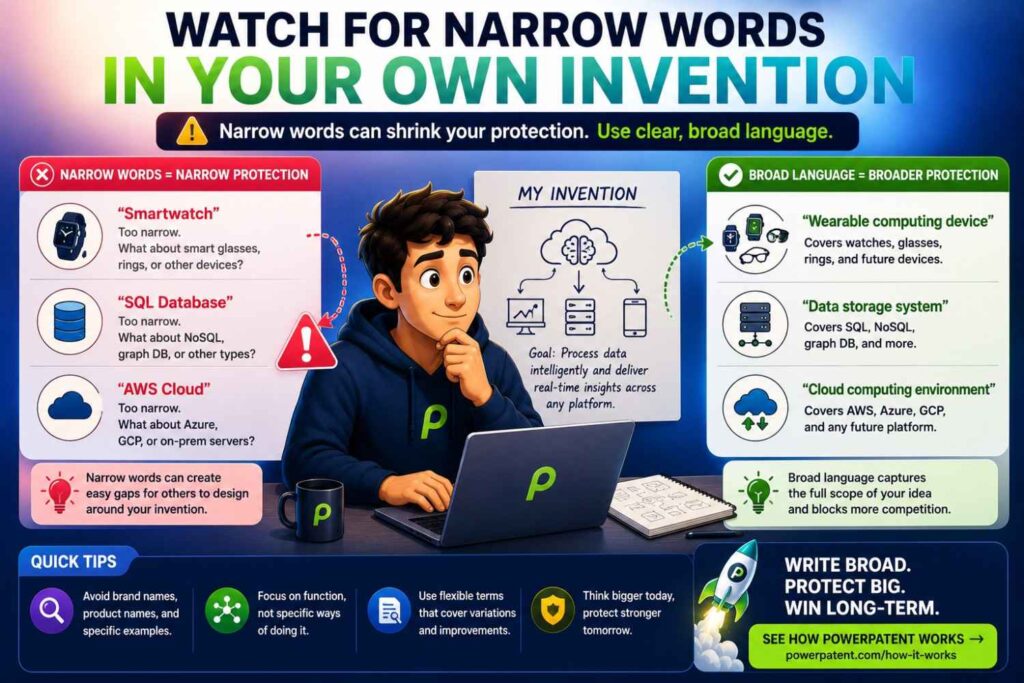
Sometimes founders describe their invention too narrowly.
They say, “Our invention is a drone system using camera model X and battery Y in a warehouse aisle.”
But the real invention may not require that exact camera, battery, or warehouse.
It may be a broader route adjustment method.
If you compare too narrowly, you may miss the bigger patent opportunity.
At the same time, do not describe it so broadly that it becomes old.
This is the art of patent strategy.
You want to find the right level.
Too broad: “A system for detecting risk.”
Too narrow: “A system using a 12-megapixel camera mounted at a 27-degree angle on our prototype cart.”
Better: “A system that detects collision risk by combining object motion data with route intent data and changing the robot path before the predicted crossing point.”
The better version is broad enough to matter but specific enough to be technical.
A good prior art review helps find that level.
Use “Must Have” and “Nice to Have” Features
When comparing prior art, split your features into two groups.
Must-have features are the ones that make the invention work.
Nice-to-have features are useful but not central.
This helps you avoid getting distracted.
For example, your invention may have a dashboard, user settings, alerts, cloud storage, and reports. Those may be useful. But the must-have feature may be the scoring method that decides when an alert should be sent.
If prior art has dashboards and reports, do not let that scare you if your core scoring method is different.
On the other hand, if prior art has the exact scoring method, the dashboard difference may not save you.
So identify the core.
Ask:
If we remove this feature, does the invention still work?
If a competitor copies this feature, do they get the main benefit?
Is this feature tied to the technical result?
Is this feature the reason customers care?
Is this feature hard to design around?
The best patent focus often comes from must-have features that are hard to avoid.
Think Like a Competitor
A useful test is to imagine a competitor trying to copy your idea.
What would they copy first?
Would they copy the full product?
Would they copy the data flow?
Would they copy the model training method?
Would they copy the sensor placement?
Would they copy the threshold rule?
Would they copy the feedback loop?
Would they copy the way you reduce compute cost?
Now compare that copied piece against prior art.
If that piece is new and meaningful, it may be worth protecting.
This helps you avoid filing on features nobody cares about.
A patent should protect business value. Not just technical trivia.
The strongest patent claims often sit where technical difference meets market value.
That is the sweet spot.
Use Prior Art to Shape Claim Strategy
Claims are the numbered sentences at the end of a patent. They define the legal boundaries.
You do not need to draft final claims yourself. But you can help shape them by giving your patent team a strong prior art comparison.
Prior art helps decide what should be in the broad claim and what should be saved for narrower claims.
A broad claim may cover the core method.
Narrower claims may add specific inputs, triggers, feedback steps, hardware layouts, model types, thresholds, timing windows, or use cases.
This layered approach matters.
If the broad claim faces prior art, the narrower claims may still survive.
Think of it like a fence with layers.
The outer fence covers the big idea. The inner fences cover more specific versions.
A good prior art comparison helps place those fences in smarter spots.
PowerPatent helps founders move through this process in a more structured way, instead of relying on scattered emails and half-finished invention notes. See how PowerPatent combines software and attorney oversight.
Example: Comparing a Software Invention Against Prior Art
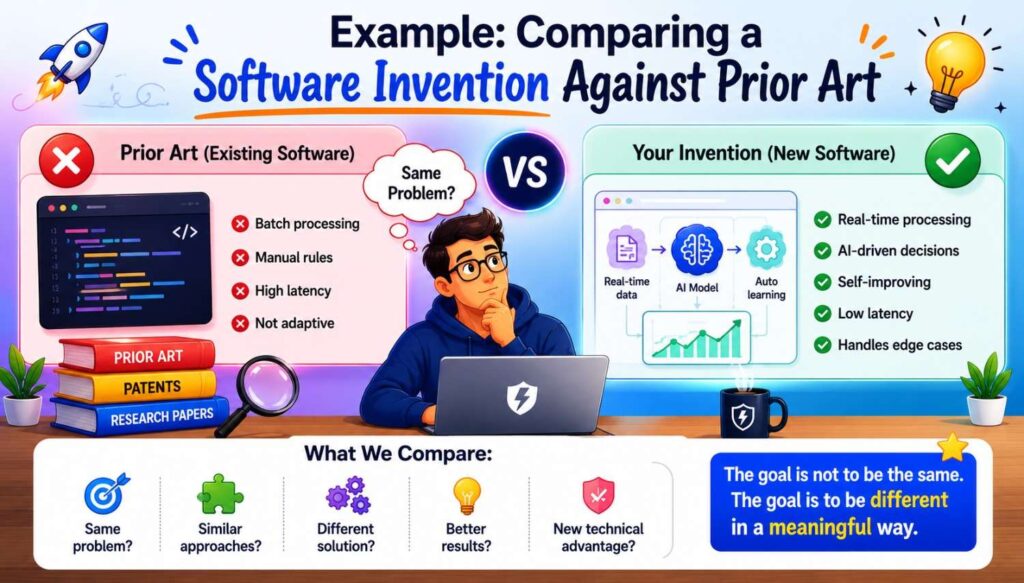
Let’s walk through a simple example.
Imagine your startup built an AI support tool.
The tool reads customer tickets, predicts the cause of the issue, suggests a fix, and routes the ticket to a human only when needed.
That broad idea is likely crowded.
So you look deeper.
Your real invention is this:
The system compares a new support ticket to past tickets, but it does not rely only on text similarity. It also checks whether the customer’s software version, error logs, and recent configuration changes match a known failure pattern.
It then creates a confidence score. If the score is high, the system suggests a fix. If the score is medium, it asks one clarifying question. If the score is low, it routes the ticket to a specialist. After the ticket is resolved, the system updates the failure pattern only if the fix worked.
Now you search.
You find prior art that classifies support tickets using text.
That is close, but it lacks logs and configuration changes.
You find prior art that uses error logs to detect software failures.
That is also close, but it does not ask clarifying questions or update failure patterns after confirmed fixes.
You find prior art that routes tickets based on confidence scores.
That is relevant, but it may not use the same multi-source failure pattern.
Now compare.
Your possible difference may be:
“Our invention uses a combined match across ticket text, software version, error logs, and recent configuration changes to choose between auto-suggesting a fix, asking a clarifying question, or routing to a specialist, and then updates the failure pattern only after a confirmed fix.”
That is much stronger than “AI support tool.”
You now have a real patent discussion.
The key is not the chatbot. The key is the decision path.
Example: Comparing a Hardware Invention Against Prior Art
Now imagine a startup building a smart pump.
The pump detects early signs of clogging.
Prior art already has pumps with pressure sensors. It also has pumps that stop when pressure gets too high.
Your invention does something more specific.
It compares pressure ripple patterns during short test pulses. It adjusts the clog score based on liquid viscosity and motor temperature. It then changes pump speed before a full clog forms.
Now compare.
Reference A detects high pressure and stops the pump. It does not use ripple patterns.
Reference B uses ripple patterns to classify flow, but it does not adjust for viscosity or motor temperature.
Reference C adjusts pump speed based on temperature, but not for clog prediction.
The closest prior art may be Reference B.
Your difference may be:
“Our pump predicts clog risk by comparing pressure ripple patterns during test pulses and adjusting the score based on viscosity and motor temperature, so the pump can change speed before a high-pressure clog occurs.”
That is a clean technical story.
It explains the input, method, condition, and result.
Example: Comparing an AI Model Invention Against Prior Art
AI inventions need special care.
A weak AI invention says, “Use a machine learning model to do X.”
That is often not enough.
A stronger AI invention explains the technical method.
Imagine your startup built a model that reviews engineering drawings for manufacturing risk.
Prior art shows models that classify drawing defects.
Your invention does more.
It breaks the drawing into regions. It links each region to a manufacturing process step. It predicts risk for each step. It then asks a human reviewer only for regions where the model confidence is low and the process step is high cost. After review, it updates a process-specific risk profile.
Now compare.
Prior art may classify defects in drawings.
Prior art may rank manufacturing risk.
Prior art may use human review for low-confidence predictions.
But maybe none of it links drawing regions to process steps and uses cost-weighted confidence to choose review targets.
Your difference may be:
“Our system links drawing regions to manufacturing process steps and uses both model confidence and process cost to select only high-risk regions for human review, then updates a process-specific risk profile based on the review.”
That is much better than “AI for manufacturing drawings.”
It is specific. It is technical. It has a workflow. It has a result.
Example: Comparing a Robotics Invention Against Prior Art
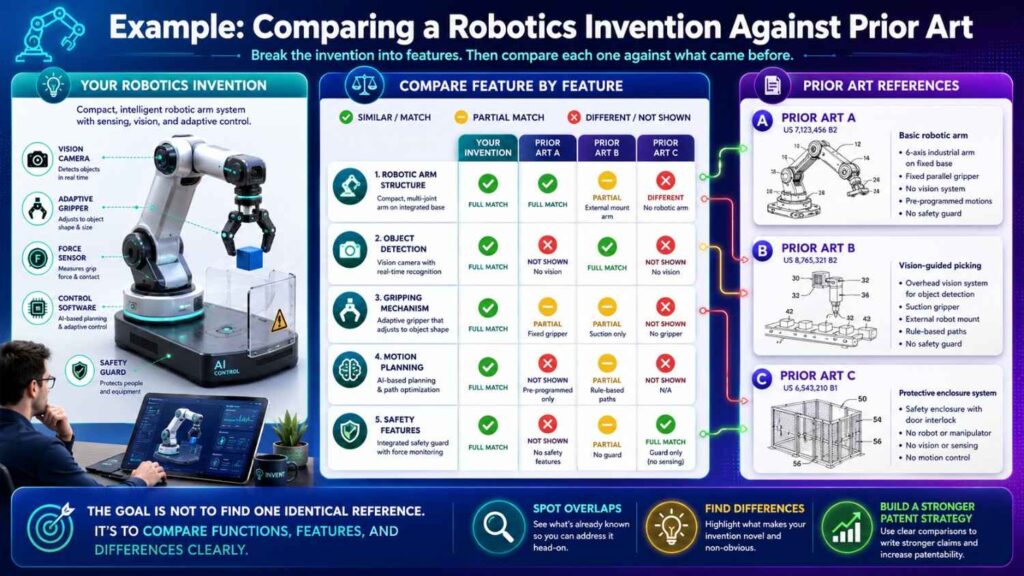
Imagine you built a warehouse robot.
Many patents already cover robot navigation, obstacle detection, and path planning.
So the broad idea is crowded.
Your real invention is about blind corners.
The robot predicts whether a human or forklift may cross its path near a blind corner by using sound direction, map data, and recent traffic history. It slows down or changes its path before the object is visible.
Now search.
You find prior art that uses cameras to detect obstacles.
You find prior art that uses sound to detect people.
You find prior art that uses traffic maps for robot routing.
You find prior art that slows near blind corners.
That is a lot.
But your key may be the combination and timing.
Your difference may be:
“Our robot predicts blind-corner crossing risk before visual detection by combining sound direction, map geometry, and recent traffic history, then changes speed or path before reaching the predicted crossing point.”
Now the comparison is focused.
The question becomes whether the prior art teaches that full prediction and control loop.
That is the right question.
Example: Comparing a Medical Device Invention Against Prior Art
Medical device prior art can be dense.
Imagine your startup built a wearable patch that predicts dehydration risk.
Prior art uses heart rate. Prior art uses skin temperature. Prior art uses sweat sensors.
Your invention uses changes across several signals during a known recovery period after activity. It builds a personal baseline and alerts only when the recovery pattern shifts from that baseline.
Now compare.
A reference that uses heart rate alone is background.
A reference that uses sweat rate and temperature may be closer.
A reference that uses personal baselines may be very close.
But the key may be the recovery period.
Your difference may be:
“Our patch predicts dehydration risk by comparing heart rate, skin temperature, and sweat signal changes during a post-activity recovery window against a personal baseline, instead of using fixed limits during activity.”
That is clear.
It shows why the timing and baseline matter.
Look for Negative Space
Prior art shows what exists.
But it also shows what is missing.
That missing space can be valuable.
As you read patents and papers, ask:
What do all of these references assume?
What do they all ignore?
What failure mode do they not handle?
What environment do they avoid?
What data source do they not use?
What happens after their method ends?
What do they require that your system does not require?
This is called looking for negative space.
For example, many systems may assume clean labels. Your invention may work with noisy labels.
Many systems may require cloud access. Your invention may work offline.
Many systems may need a fixed setup. Your invention may self-calibrate.
Many systems may detect a problem after it happens. Your invention may predict it before it happens.
Many systems may treat all users the same. Your invention may adapt to each user.
That gap can become your patent angle.
Turn Search Results Into a Patent Filing Plan
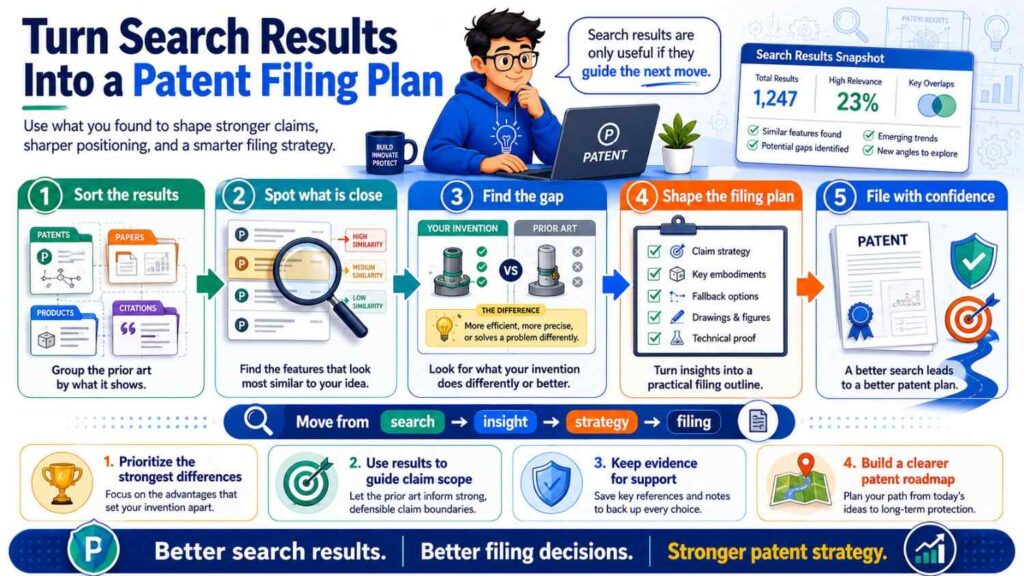
After you compare your invention to prior art, you should make a filing plan.
A simple filing plan answers four questions.
First, what is the core invention we should protect?
Second, what narrower versions should we include as backup?
Third, what prior art is closest?
Fourth, what details should we add to explain why our invention is different and better?
This filing plan does not need to be long. It needs to be clear.
For example:
“The core invention is a battery swelling risk system that uses pressure drift during matched charging windows and adjusts the score based on charge rate and pack temperature. Backup versions include different sensors, different scoring methods, fixed and dynamic thresholds, local and cloud processing, and alerts or charge-control outputs. Closest prior art includes pressure-based swelling detection and temperature-based battery health systems. The application should explain that fast charging can cause temporary expansion and that our matched-window adjustment reduces false alerts.”
That is useful.
It gives your patent team direction.
It also helps prevent a common problem: filing a thin application that does not include enough technical detail.
Include Alternatives in Your Invention Notes
When you compare against prior art, you may find that your main version is close to old work.
That does not mean you are done.
Think about alternatives.
Can the system use different sensors?
Can the method run locally or in the cloud?
Can the model be trained in different ways?
Can the threshold be fixed, dynamic, or learned?
Can the feedback come from users, devices, test results, or later outcomes?
Can the output be an alert, score, control signal, route change, or blocked action?
Patent applications often include multiple embodiments, which are different versions of the invention.
You do not need to use that word. Just think of versions.
Include the versions that are real and useful.
This helps because prior art may hit one version but not another.
It also helps because your product may change.
Startups pivot. Products evolve. Models improve. Hardware changes. A patent application should have enough room to cover the invention as it grows, while still being truthful and detailed.
Do Not Hide Bad Prior Art From Your Patent Team
If you find a close reference, share it.
Do not hide it because you are worried it will hurt your chances.
A patent team can only help if they know what you found.
Close prior art may lead to better claims. It may lead to a better disclosure. It may save you from filing something weak. It may help your attorney prepare for examiner issues.
Hiding it does not make it disappear.
Patent examiners and competitors may find it later.
It is much better to deal with it early.
A strong patent strategy is not built on pretending the world is empty. It is built on knowing the world clearly and placing your invention in the right spot.
Know When a Search Is Good Enough
No prior art search can prove that nothing exists.
That is impossible.
The goal is reasonable confidence.
A good search gives you a clear view of the field, the closest known references, and the likely differences.
You may have searched enough when the same references keep appearing, the same patent classes repeat, the same terms show up, and new searches are mostly bringing noise.
But if each search reveals new close art, keep going.
Also search more when the invention is high value, the field is crowded, you plan to raise money soon, you are near launch, or you are worried about competitors.
For important inventions, a professional search may be worth it.
But even a founder-led search is useful if done carefully.
It can help you explain the invention. It can help you spot risk. It can help your patent team move faster.
Common Mistake: Searching Too Late
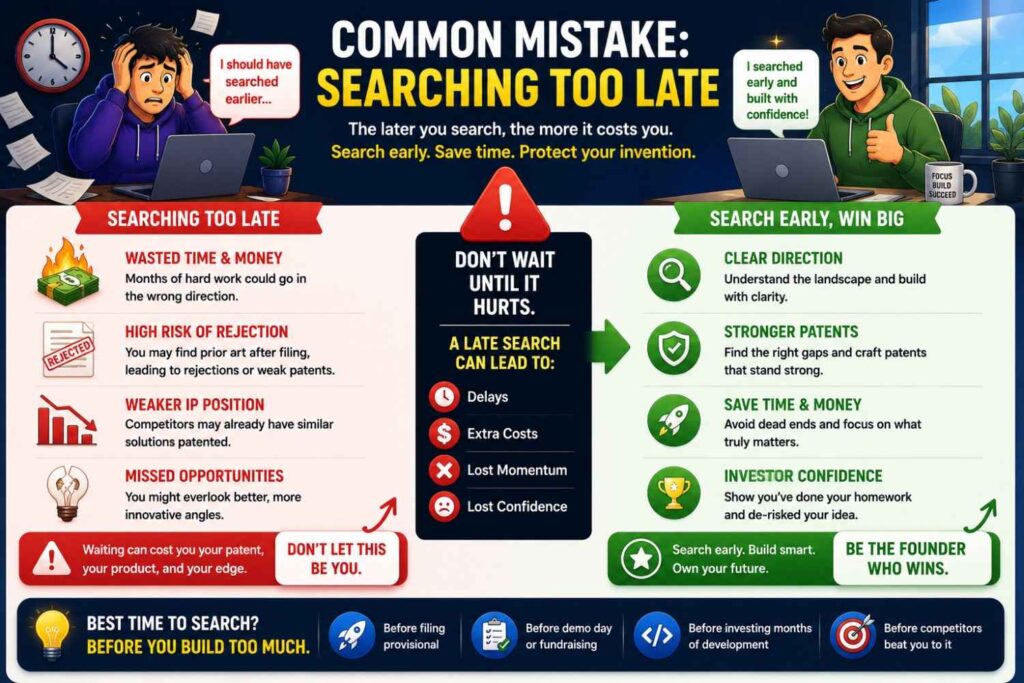
Many founders search after launch.
That is risky.
By then, public disclosures may already be out. Competitors may already be active. Your own product page may have revealed details. Your team may have posted technical content. A demo video may show the key workflow.
Search and filing should happen before major public disclosure when possible.
This does not mean you need to file on every idea.
It means you need a process.
When your team builds something technically new, capture it. Compare it. Decide whether to file before you go public.
PowerPatent is designed for this founder reality. It helps turn invention capture into a repeatable workflow, so patent work does not become a last-minute scramble. See how PowerPatent works.
Common Mistake: Searching Only Exact Words
Your words are not the only words.
This mistake kills searches.
If you call your invention “context-aware routing,” someone else may call it “conditional task assignment.”
If you call it “battery swelling,” someone else may call it “cell expansion.”
If you call it “AI hallucination control,” someone else may call it “output verification.”
If you call it “smart review,” someone else may call it “confidence-based human intervention.”
Always search synonyms.
Search older words. Search formal words. Search words used by engineers, researchers, and patent writers.
Use the prior art you find to learn better words.
Every close result teaches you search language.
Common Mistake: Ignoring Old Art
Old art can still matter.
A patent from 1998 may be prior art. A paper from 2006 may be prior art. A product manual from 2012 may be prior art.
Do not assume only recent AI-era filings matter.
Many modern inventions combine new tools with old problems. The old problem may have a long trail of prior art.
For example, current AI document review systems may face prior art from older rule-based document systems. Modern robot routing may face prior art from older automated guided vehicles. New battery systems may face older sensor and control patents.
Old art can be annoying, but it is useful.
It helps show what was already known and what changed.
Common Mistake: Ignoring Foreign Art
Prior art can come from outside your country.
A Japanese patent publication, a German thesis, a Chinese utility model, or a Korean product manual may matter.
This is why global tools matter. Espacenet, PATENTSCOPE, and Google Patents can help broaden the search beyond one country.
Translations are not perfect, but they are useful.
If a foreign reference looks close, save it and share it with your patent team.
Do not ignore it because it is harder to read.
Common Mistake: Treating a Search as a Yes-or-No Answer
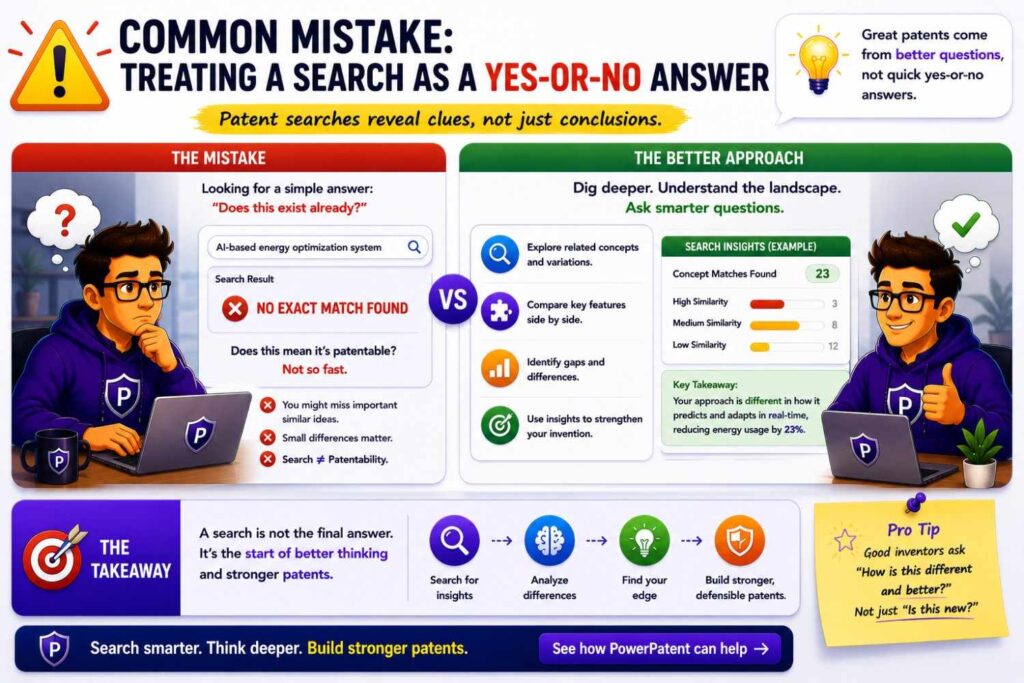
A prior art search rarely gives a clean yes or no.
It gives a picture.
The picture may say:
The broad idea is crowded.
The specific method may be open.
The sensor setup is known.
The feedback loop may be new.
The model training step needs more detail.
The timing condition is the strongest angle.
The product has several possible inventions, not just one.
That is valuable.
A search should lead to strategy, not just fear or relief.
Common Mistake: Filing Too Broad With Too Little Detail
Some founders want the broadest possible patent.
That makes sense emotionally.
But broad claims with weak support can run into prior art fast.
A better approach is often to file with a strong technical disclosure that supports broad and narrow claim layers.
You want the application to explain the invention deeply enough that the patent team can adjust during review.
This means including examples, alternatives, data flows, system diagrams, timing rules, model steps, hardware layouts, and technical results where relevant.
A thin filing may feel fast, but it can create problems later.
A strong filing gives you more options.
PowerPatent helps founders avoid thin invention capture by guiding them through the technical details that matter, then bringing in real patent attorney oversight. Learn how PowerPatent works.
How to Compare Prior Art in a Founder Meeting
If your team is reviewing an invention, keep the meeting simple.
Start with the invention statement.
Then show the closest prior art.
Then walk through the main differences.
Then decide the patent angle.
Do not let the meeting become a random debate about whether the whole product is new.
Keep asking:
What is the technical problem?
What is the technical solution?
What does the closest art show?
What does it miss?
Why does our difference matter?
What should we file on?
Bring engineers into the meeting.
They know the real invention. They know what was hard. They know what broke. They know what changed the result.
Patent work should not be trapped with only executives or lawyers.
The people building the system often hold the best patent details.
What Engineers Should Bring to Prior Art Review
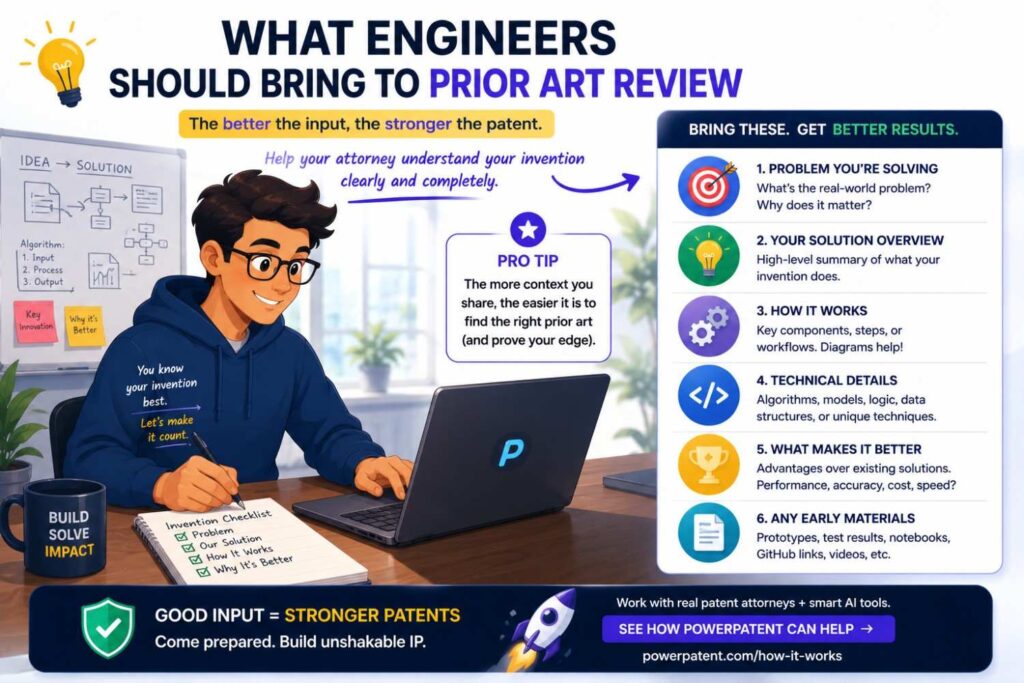
Engineers do not need to write legal arguments.
They should bring facts.
They should explain what the system does, what alternatives were tried, what failed, what worked, and why.
Good engineering notes include:
A simple system diagram.
A flow of steps.
A few examples of inputs and outputs.
A description of the hard technical problem.
A list of design choices.
Test results if available.
Known competitors or papers.
Details that are not obvious from the product UI.
Keep it plain.
The best invention notes often sound like this:
“We first tried using a fixed threshold, but it caused too many false alerts during fast charging. Then we matched charging windows by charge rate and temperature. That reduced false alerts because normal expansion during fast charge was not treated as swelling.”
That is gold.
It tells the story of the invention.
What Founders Should Bring to Prior Art Review
Founders should bring business context.
Which feature matters most to customers?
Which feature would hurt most if copied?
Which feature is hardest for competitors to work around?
Which markets are most important?
Which countries may matter?
Which launch dates are coming?
Which public disclosures already happened?
Which investors, partners, or acquirers may ask about IP?
This context helps prioritize.
Not every invention deserves the same patent spend.
Some are core. Some are defensive. Some are not worth filing. Some should stay trade secret. Some should be filed quickly before a public reveal.
A good prior art comparison supports these choices.
Prior Art Can Help You Find More Inventions
Here is a hidden benefit.
When you compare your invention against prior art, you may find more inventions inside your product.
You may start with one idea and discover three.
For example, your main invention may be a model workflow. But during review, you may notice a separate data labeling method, a deployment safety method, and a user feedback method.
Each may be patent-worthy.
This is common in deep tech.
The first invention is often the obvious one. The better inventions may be buried in the implementation.
That is why invention capture should be ongoing.
Every time your team solves a hard technical problem, pause and capture it.
Do not wait until the end of the year.
How to Compare Prior Art for a Provisional Patent
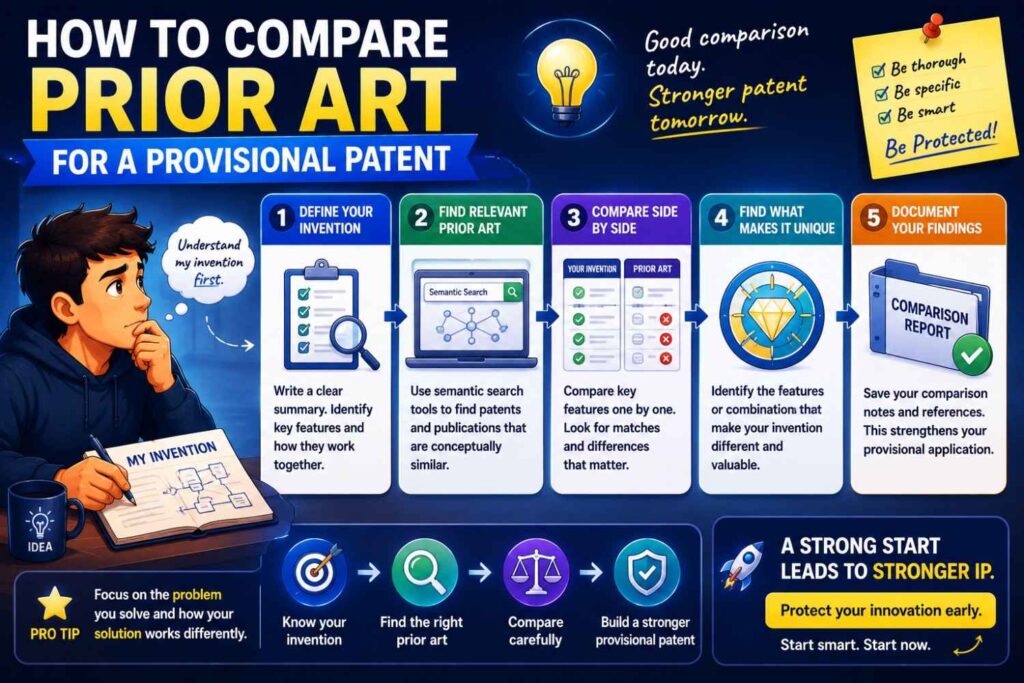
A provisional patent application can be a smart early filing tool.
But it still needs enough detail to support the invention.
Do not treat a provisional as a placeholder with vague words.
Before filing a provisional, compare your invention against prior art enough to know what details matter.
If the broad idea is crowded, your provisional should focus on the specific technical differences.
Include drawings, examples, alternatives, and technical results.
If you later file a non-provisional application, you will want the earlier provisional to support the claims.
A weak provisional can create false comfort.
A strong provisional can be very useful.
PowerPatent can help founders prepare better patent filings without slowing down the team. See how it works.
How to Compare Prior Art for a Non-Provisional Patent
A non-provisional patent application is examined.
That means prior art comparison matters even more.
Before filing, your team should know the closest references and claim around them.
The application should describe the invention with enough detail to support both broad and fallback claim positions.
The claims should not blindly cover old ground.
The description should explain the technical problem and the technical result.
You should include variations that may matter if the examiner finds close art.
A non-provisional filing is not the place for vague invention notes.
It is the place for clear technical disclosure.
How to Compare Prior Art When You Have Code
For software startups, code can be a rich invention source.
But code by itself is not always easy to turn into a patent.
You need to explain what the code does in system terms.
Look for:
Data flows.
Decision points.
Model inputs.
Ranking logic.
Feedback loops.
Error handling.
Timing rules.
Resource-saving steps.
Security checks.
User review triggers.
Control paths.
Then compare those against prior art.
Do not just search the function name. Search the behavior.
For example, a function called rankCases() is not enough.
What does it rank?
What inputs does it use?
What score does it create?
What happens after ranking?
How is feedback used?
What makes the ranking different?
Code often hides invention in plain sight.
PowerPatent is built for founders and engineers who want to turn real technical work, including code-level ideas, into stronger patent assets. Explore the process.
How to Compare Prior Art When You Have a Model
For AI and machine learning inventions, compare more than the model type.
Do not stop at “we use a transformer” or “we use a neural network.”
The model type may be known.
Look at the full pipeline.
How is training data selected?
How are labels created or cleaned?
How is weak feedback used?
How are prompts built?
How are outputs checked?
How is confidence measured?
How are errors handled?
How is human review triggered?
How does the model update?
How does the system reduce compute cost?
How does it protect privacy?
How does it run in a limited environment?
Prior art may show the model, but not your pipeline.
The pipeline is often where the invention lives.
For example, “LLM for contract review” is broad and crowded.
But “a system that breaks a contract into obligation units, maps each unit to a source clause, checks model output against the clause map, and asks for human review only when the source link is weak” is much more specific.
That is a patentable-style technical story.
How to Compare Prior Art When You Have Hardware
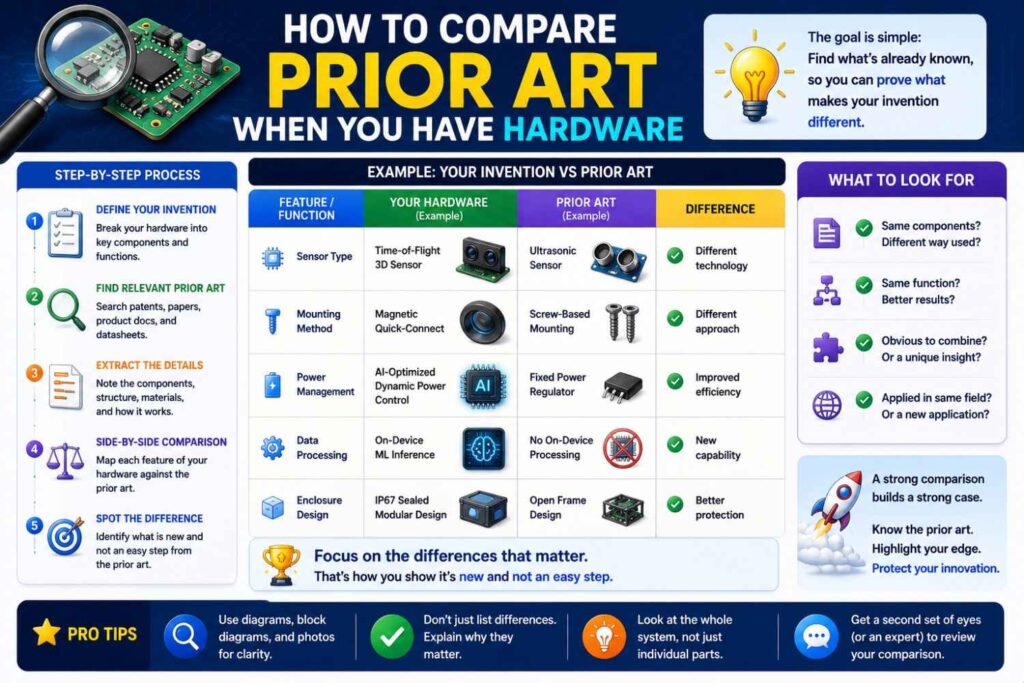
For hardware, compare structures and interactions.
Do not only compare parts.
Two devices may both have a sensor, a controller, and a housing. The invention may be how those parts are arranged or how signals move between them.
Look at:
Shape.
Placement.
Materials.
Layers.
Channels.
Mounts.
Sensors.
Actuators.
Thermal paths.
Electrical paths.
Mechanical forces.
Assembly steps.
Calibration steps.
Control loops.
Then connect structure to result.
“Our sensor is placed near the compression point so it detects early deformation before the outer housing changes shape.”
That is useful.
“Our device has a sensor” is not.
Hardware prior art can be easier to compare when you draw.
Sketch your device. Sketch the prior art. Mark the differences.
Pictures make gaps clearer.
How to Compare Prior Art When You Have a Workflow
Some inventions are workflows.
This is common in software, AI, medical tools, manufacturing, and data systems.
For workflows, compare the sequence.
What starts the process?
What decision is made first?
What data is used?
What happens if confidence is high?
What happens if confidence is low?
What does the system store?
What changes next time?
Workflow inventions can be strong when the steps create a technical result.
For example, a workflow that routes a task to a human may be weak if it is just business logic.
But a workflow that reduces model errors by using source-linked verification and targeted human review may be stronger.
Again, the technical result matters.
How to Compare Prior Art When Your Invention Is a Combination
Many inventions combine known pieces.
That is normal.
The key is whether the combination creates something new and not obvious.
When comparing a combination invention, do not hide the fact that parts are known.
Instead, focus on the connection.
How are the pieces linked?
Why are they combined?
What problem does the combination solve?
What result does the combination create?
Why would prior systems not naturally combine them this way?
For example:
Known piece A: pressure sensor.
Known piece B: battery temperature sensor.
Known piece C: charge rate tracking.
Your invention may combine them in a specific scoring method during matched charging windows to reduce false swelling alerts.
That combination may matter.
The story is not “we invented sensors.”
The story is “we invented a better way to use these signals together.”
That is honest and strong.
How to Compare Prior Art When the Field Is Crowded
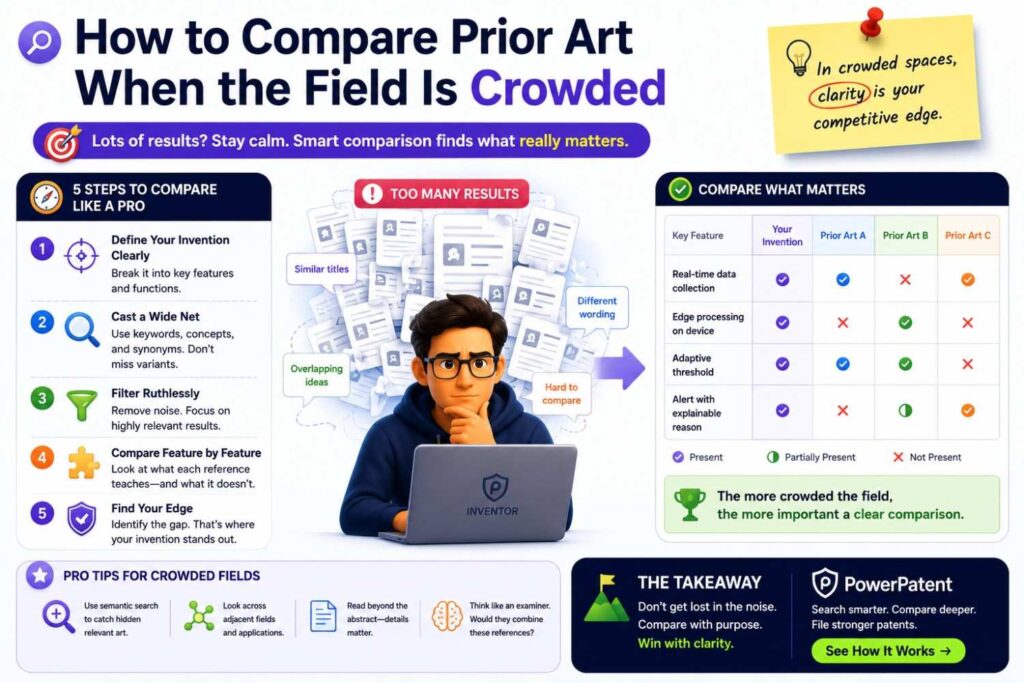
Crowded fields are not hopeless.
They just require sharper claims.
In a crowded field, broad ideas are usually taken. You need to find the narrow technical edge.
Look for:
A specific data input others do not use.
A timing window others miss.
A feedback loop others lack.
A control action others do not trigger.
A way to reduce compute.
A way to improve safety.
A way to handle edge cases.
A way to make the system work in a harsh setting.
A way to remove a step others require.
In crowded fields, your patent may not cover the whole category.
That is okay.
A narrow but meaningful patent can still be valuable if it covers a feature competitors need.
The goal is not always the widest claim. The goal is useful protection.
How to Compare Prior Art When You Are Early
Sometimes you are early.
You have a prototype, but not all details are final.
You can still compare prior art.
Focus on the technical concept and the likely versions.
Write what you know. Mark what is still open.
For example:
“We know the system will use model confidence and source trust to trigger review. We are still testing whether source trust is based on document age, author role, or past accuracy.”
That is useful.
Your patent team can help decide what to include.
Do not wait for perfect certainty if a public disclosure is coming.
Early filing can be important, but it should still be thoughtful.
How to Compare Prior Art Before a Fundraise
Investors may ask about IP.
They may not read every patent claim, but they want to know whether you understand your moat.
A prior art comparison can help you answer with confidence.
Instead of saying, “We filed a patent,” you can say:
“We reviewed the closest prior art and found that most systems detect the issue after it happens. Our filing focuses on predicting the issue earlier using a specific multi-signal feedback loop. That method is tied to the performance gains our customers care about.”
That sounds much stronger.
It shows you are not just collecting paperwork. You are building an IP position around the real technical edge.
PowerPatent helps founders create that kind of clarity faster. See how PowerPatent works.
How to Compare Prior Art Before an Acquisition
Acquirers care about whether your IP is real.
They may ask:
What do your patents cover?
How do they compare to prior art?
What products do they protect?
Are the claims broad enough to matter?
Are there pending applications?
Are there close references?
Did you file before public disclosure?
Who owns the inventions?
Were inventors properly named?
A clean prior art comparison helps.
It shows that your patents were not filed blindly.
It also helps your team explain the value of pending applications.
If your patent filings line up with your product’s core technical edge, that can support a stronger IP story.
How to Compare Prior Art Without Slowing the Team
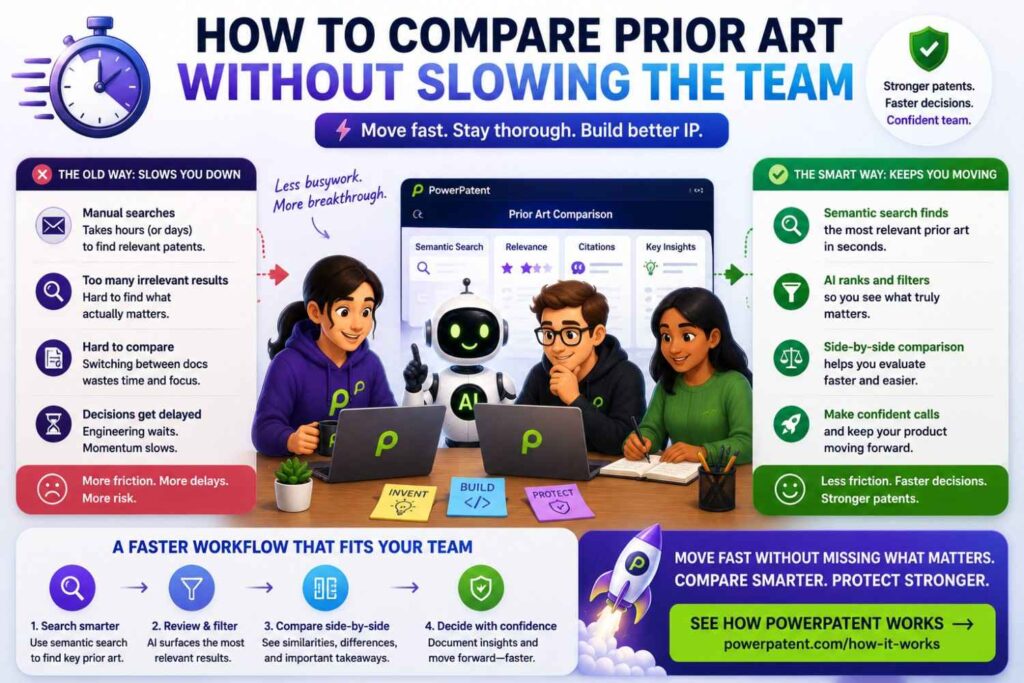
Founders worry that patent work will slow engineering.
It does not have to.
The trick is to make invention capture lightweight.
When an engineer solves a hard problem, ask for a short note:
What was the problem?
What did we try?
What worked?
Why does it work?
What result improved?
Then run a focused prior art review on that note.
Do not ask engineers to write patent applications. Ask them to explain the invention.
A good platform and process can turn those notes into action.
That is the PowerPatent idea: make patents feel less like a legal maze and more like a smart product workflow, with real attorneys still involved where it matters.
How to Decide Whether to File After Comparing Prior Art
After comparison, you may have several paths.
You may file broadly because the field looks open.
You may file narrowly because the broad idea is crowded but your method is strong.
You may file multiple related applications because the product has several inventions.
You may wait because the invention is not ready.
You may keep something as a trade secret.
You may decide not to file because the prior art is too close or the business value is too low.
That last choice can be smart.
Patent budget should go where it helps the company.
The right answer depends on the strength of the invention, the closeness of the art, the market value, the chance of copying, the company’s roadmap, and the timing of public disclosure.
Do not make the decision from fear.
Make it from comparison.
A Simple Prior Art Comparison Workflow
Here is the full workflow in plain language.
Write the invention in one sentence.
Map the inputs, steps, outputs, and technical result.
List the must-have features.
Search broad keywords.
Search synonyms.
Search patent tools.
Search papers, code, manuals, and product pages.
Find the closest references.
Compare each reference feature by feature.
Look for missing steps, different inputs, different timing, different outputs, different conditions, and different feedback loops.
Ask whether references could be combined.
Write the core difference in one sentence.
Write why the difference matters.
Share the results with your patent team.
Decide what to file.
That is the process.
It is not magic. It is careful thinking.
A Prior Art Comparison Template You Can Use
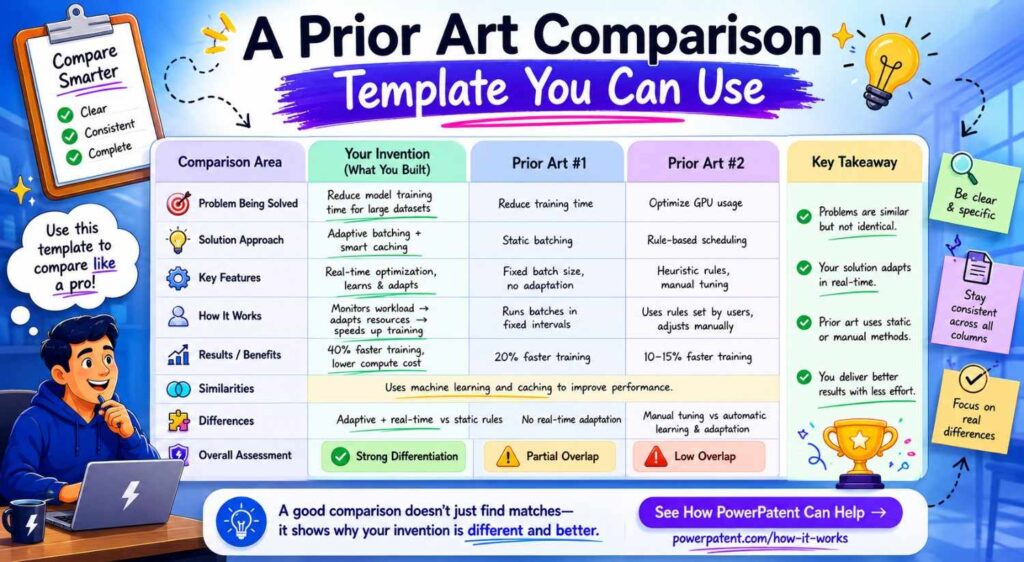
Use this as a simple working format.
Invention name:
One-sentence invention summary:
Technical problem:
Technical solution:
Main inputs:
Main steps:
Main outputs:
Technical result:
Must-have features:
Nice-to-have features:
Closest prior art reference:
What the reference teaches:
What the reference does not teach:
Main difference:
Why the difference matters:
Possible backup features:
Open questions for patent team:
Keep it short enough that people will use it.
A messy but complete note is better than a perfect blank page.
What a Strong Difference Sounds Like
A strong difference is clear, technical, and tied to a result.
Weak:
“Our system is smarter.”
Strong:
“Our system updates the risk threshold after a confirmed false alert, so later alerts are based on device-specific behavior instead of a fixed global rule.”
Weak:
“Our AI uses more data.”
Strong:
“Our system combines model confidence with source trust before showing an answer, so low-trust outputs are routed to review even when model confidence is high.”
Weak:
“Our robot is safer.”
Strong:
“Our robot predicts blind-corner crossing risk using sound direction and map geometry before the object is visible, then slows before reaching the crossing point.”
Weak:
“Our battery tool uses sensors.”
Strong:
“Our system compares pressure drift during matched charging windows and adjusts the swelling score based on charge rate and temperature, reducing false alerts during fast charging.”
This is the level you want.
What a Weak Difference Sounds Like
A weak difference is vague, cosmetic, or disconnected from a technical result.
Examples:
“Our app has a better user interface.”
“Our platform is easier to use.”
“Our system uses AI.”
“Our method is faster.”
“Our product is cloud-based.”
“Our tool is for startups.”
“Our device is smaller.”
“Our dashboard is cleaner.”
These may be true and valuable. But for patent comparison, they are not enough by themselves.
Make them technical.
Why is it faster?
How is it smaller?
What does the AI do differently?
What part of the cloud setup changes the system?
What technical result does the interface create?
For example, “cleaner dashboard” becomes more meaningful if the system groups duplicate alerts before display by identifying shared root causes, reducing data transfer and review load.
Always move from claim to mechanism.
Prior Art Comparison Helps You Write Better Disclosures
A patent disclosure should teach the invention.
Prior art comparison helps you know what to teach.
If prior art already teaches the broad sensor, your disclosure should spend more time on your scoring method.
If prior art already teaches the model type, your disclosure should explain your data pipeline.
If prior art already teaches routing based on confidence, your disclosure should explain your special confidence adjustment.
This is how you avoid wasting space on old parts and under-explaining the new parts.
A strong disclosure gives the attorney enough detail to claim the invention from several angles.
It should describe the core method, examples, alternatives, technical benefits, and implementation details.
This is especially important for startups because the product may evolve. A good disclosure can support future claim changes.
Prior Art Comparison Helps You Avoid Costly Mistakes
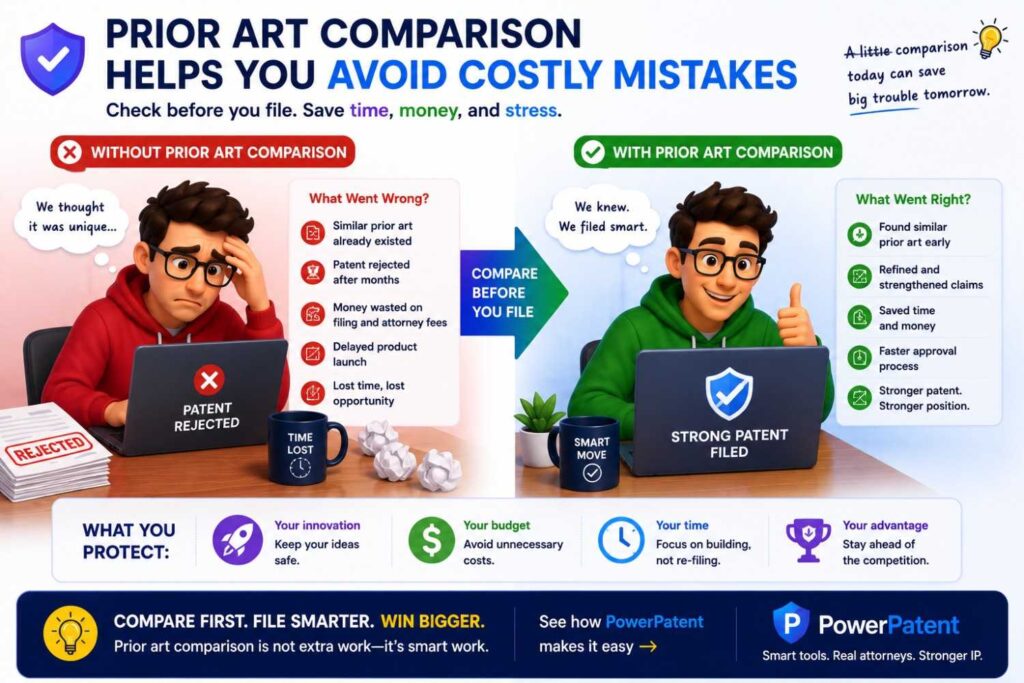
A weak patent filing can waste money.
A late filing can lose rights.
A broad filing with no detail can get stuck.
A filing focused on the wrong feature can miss the real moat.
A filing done after public disclosure can create avoidable problems.
A prior art comparison helps reduce these risks.
It does not guarantee a patent. Nothing does.
But it gives you a better starting point.
For founders, that matters.
You have limited time. Limited money. Limited attention.
You need patent work that supports the company, not paperwork that sits in a folder.
PowerPatent was built for this exact reason: to help founders protect real technical work faster, with more control and less old-school friction. See how PowerPatent works.
When to Bring in a Patent Attorney
Bring in a patent attorney when the invention may be important to the business, when prior art is close, when launch is near, when you are raising money, when you are entering a crowded field, or when you are unsure how to frame the invention.
You can do early searching yourself.
But patent judgment is not just search. It is claim strategy, filing timing, disclosure quality, inventorship, ownership, and prosecution planning.
A good attorney can help you understand whether the difference matters legally and how to describe it well.
PowerPatent combines smart software with real patent attorney oversight so founders do not have to choose between speed and quality. Learn more here.
Final Takeaway
Comparing your invention against prior art is not about proving you are the first person to ever think in your space.
It is about finding the real edge.
Start with the invention. Map how it works. Search broadly. Read closely. Compare feature by feature. Look for missing steps, timing changes, feedback loops, special inputs, and technical results. Then turn that insight into a smarter filing plan.
The best patents often come from clear thinking before filing.
Your invention may be bigger, smaller, or different than you first thought. Prior art helps you see it.
And when you are ready to protect what you are building, PowerPatent can help you move from raw invention notes to a stronger patent filing with smart software and real attorney oversight.
Leave a Reply