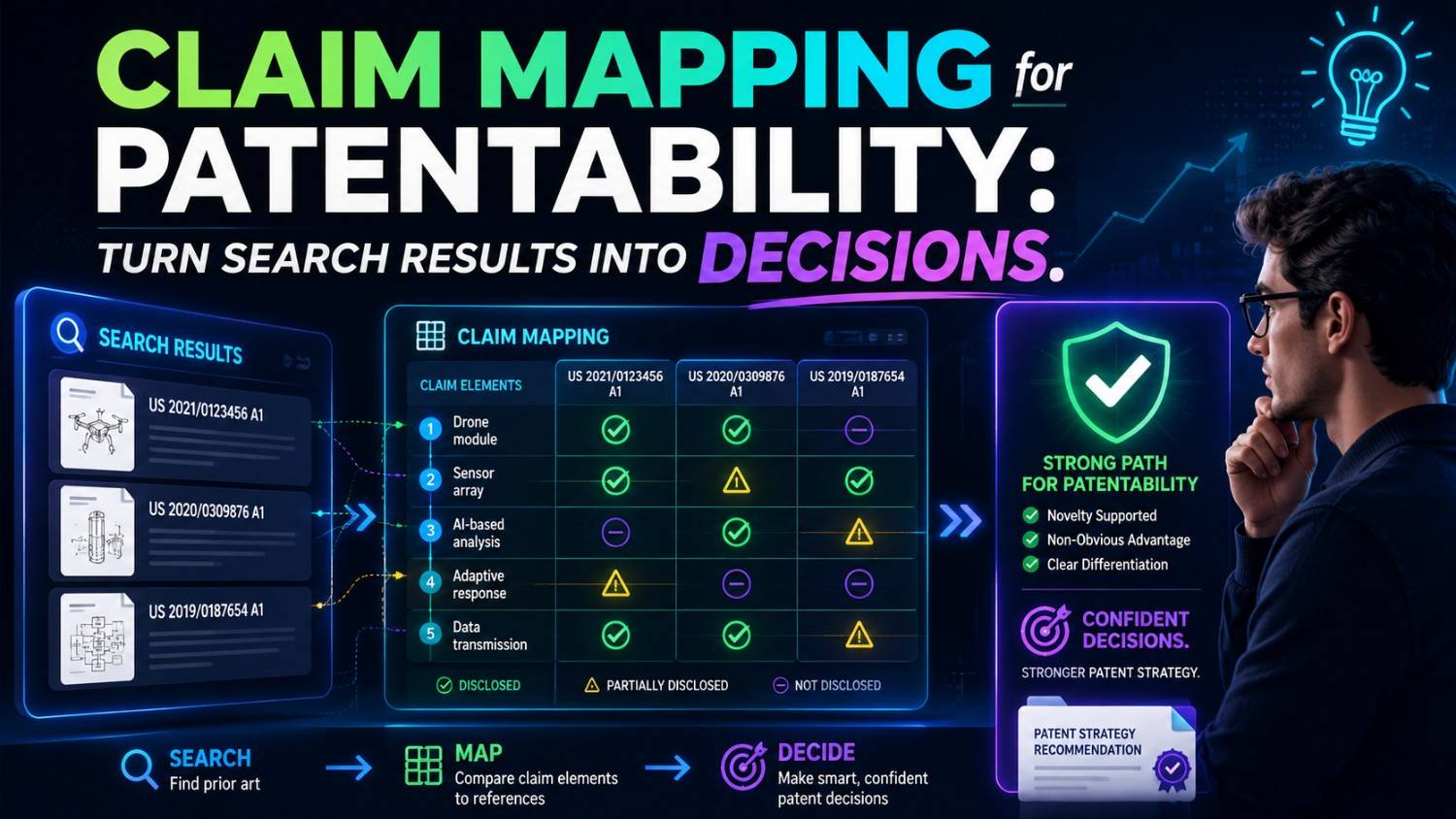
A prior art search gives you a pile of results. Claim mapping turns that pile into a clear answer.
It helps you see what is already known, what is still different, and whether your invention is strong enough to file. For founders, engineers, and inventors, this is where patent work gets real.
PowerPatent helps teams move from raw invention notes and search results into stronger patent filings, with smart software and real patent attorney oversight. See how PowerPatent works here.
What Claim Mapping Means
Claim mapping is a simple idea with a serious job.
You take the key parts of your invention and place them side by side with the closest prior art. Then you ask one question for each part:
Does this prior art show this feature?
That is the heart of it.
A claim map is not a full patent application. It is not a legal brief. It is not a fancy chart made only for lawyers. It is a working tool that helps you make better decisions before you file.
Think of it like an engineer’s checklist for patent strength.
Your invention has parts. The prior art has parts. A claim map shows where they match, where they partly match, and where they do not match at all.
That last part matters most.
The gaps are where your patent story may live.
If one prior art reference shows every key part of your invention, that is a problem. If several references show parts of your invention, but no one shows the full working combination, that may still leave room. If the prior art points away from your solution, or if your system gets a result the old systems did not get, that may help even more.
Patent offices look at whether an invention is new and whether it is an obvious next step from what came before. The USPTO explains that Patent Public Search is built to help users search patents and patent application publications and gives enhanced access to prior art. The USPTO’s obviousness guidance also focuses on the claimed invention, the prior art, and the differences between them. (USPTO)
Claim mapping brings that logic into a founder-friendly format.
It helps you stop guessing.
Why Search Results Alone Are Not Enough
A search result can feel useful and still leave you stuck.
You may find twenty patents that look close. You may find five papers that use the same words. You may find a competitor patent with a scary title. But none of that tells you what to do next.
Should you file?
Should you change the invention?
Should you narrow the claim?
Should you search more?
Should you save the budget?
Should you split the idea into several filings?
Search results do not answer those questions by themselves.
Claim mapping does.
A search result tells you, “Here is something that may matter.”
A claim map tells you, “Here is exactly how it matters.”
That difference is huge.
Many founders make decisions based on the title of a patent. That is risky. Patent titles are often broad, dull, and hard to read. A title may sound close but cover a different method. Or it may sound harmless but hide a key feature deep inside the drawings or description.
Other founders scan the abstract and stop there. That is also risky. The abstract is only a short summary. It may not show the parts that matter most.
A claim map forces you to slow down and compare the real pieces.
It turns vague fear into useful facts.
Instead of saying, “This patent looks close,” you can say:
“This reference shows the sensor and the alert, but it does not show the feedback loop that changes the threshold after confirmed false alerts.”
That is a decision-ready statement.
It gives your patent team something they can use.
The Big Goal: Decide What to Claim
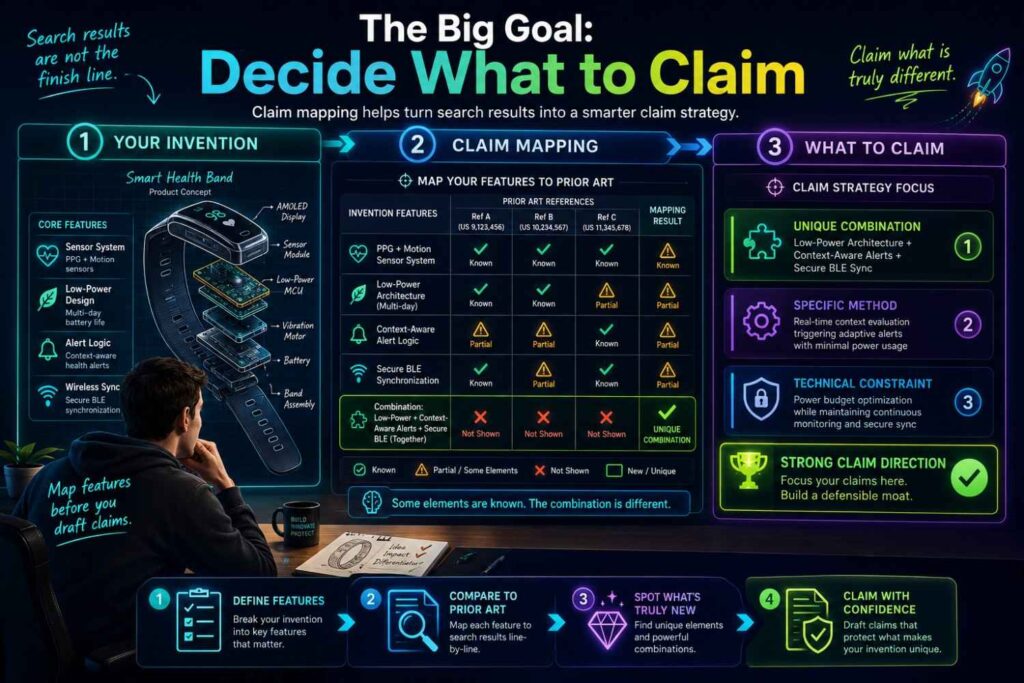
A patent claim is the part of a patent that sets the boundary of what you are trying to protect.
That boundary matters.
If it is too broad, prior art may knock it down. If it is too narrow, competitors may design around it. If it focuses on the wrong feature, the patent may miss the thing that makes your company valuable.
Claim mapping helps you find the right boundary.
It asks:
What do we need to include in the claim so it is different from the prior art?
What can we leave out so the claim is not too narrow?
What should we save for backup claims?
What technical result should we explain?
What feature is the real edge?
This is why claim mapping is not just a legal task. It is a business task.
For a startup, a patent is not only a document. It is part of your moat. It can support fundraising, partnerships, licensing, acquisition talks, and defense against copycats.
But only if it is built around the right invention.
PowerPatent helps founders and technical teams capture invention details, organize them, and move toward filings with real attorney review. That matters because the best patent strategy starts before the application is drafted. Learn how PowerPatent helps founders file better patents faster.
Start With a Plain-English Claim
Before you make a claim map, write a plain-English claim.
Do not start with legal words.
Start with what your invention actually does.
A plain-English claim is a sentence that names the system, the key steps, and the result.
For example:
“Our system detects early battery swelling by comparing pressure drift during matched charging windows and adjusting the swelling score based on charge rate and temperature.”
That is not a final patent claim. It is a working claim.
It gives you something to map.
Without this sentence, your comparison will drift. You will jump from feature to feature. You will get pulled into every prior art result. You will waste time.
A working claim keeps the team focused.
For software, it might sound like this:
“Our system ranks support tickets by matching ticket text, error logs, software version, and recent configuration changes, then asks one clarifying question only when the confidence score falls in a middle range.”
For robotics, it might sound like this:
“Our robot predicts blind-corner collision risk using sound direction, map shape, and recent traffic history, then slows before the object is visible.”
For AI, it might sound like this:
“Our model review system checks generated answers against a source graph and routes low-source-trust answers to human review, even when the model confidence score is high.”
For hardware, it might sound like this:
“Our device detects clog risk by reading pressure ripple patterns during short test pulses and changing pump speed before a high-pressure stop is needed.”
These sentences are clear. They are not perfect. That is fine.
The goal is to make the invention visible.
Once the invention is visible, you can map it.
Break the Claim Into Pieces
A claim map works only when you break the invention into pieces.
Each piece is called an element. You can think of it as a required part of the invention.
Do not make the pieces too broad.
“Uses AI” is not a good element.
“Creates a confidence score based on model output and source trust” is better.
“Has sensors” is not a good element.
“Measures pressure drift during a matched charging window” is better.
“Improves safety” is not a good element.
“Reduces charge current when swelling risk and heat risk both exceed a threshold” is better.
A good element is something you can search for, compare, and discuss.
Let’s use the battery example.
The working claim is:
“Our system detects early battery swelling by comparing pressure drift during matched charging windows and adjusting the swelling score based on charge rate and temperature.”
Now break it down.
The system measures pressure in or near a battery pack.
The system tracks pressure drift over more than one charging cycle.
The system compares pressure drift during matched charging windows.
The matched windows are based on charge rate, temperature, or both.
The system creates or adjusts a swelling score.
The adjusted score is used to trigger an alert, change charging behavior, or flag the pack for review.
Now you have map elements.
This is where the work begins.
You are not asking whether prior art shows “battery swelling detection” in a vague way.
You are asking whether it shows each part.
That is much more useful.
Pick the Right Prior Art to Map
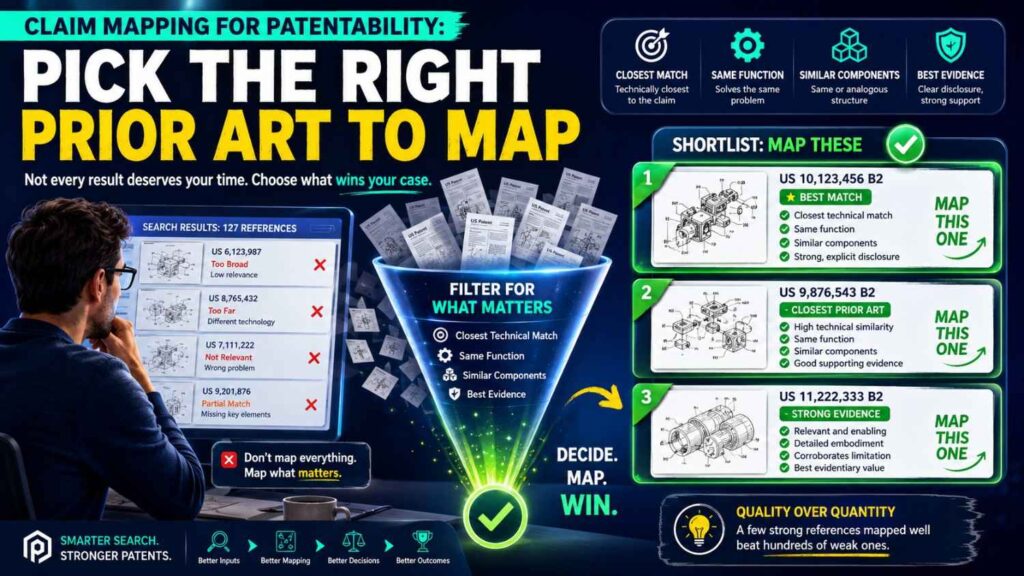
You do not need to map every search result.
That would waste time.
You need to map the closest results.
The closest prior art is the art that shares the most important features with your invention.
It may not have the same title. It may not be from your industry. It may not be from a competitor. It may be old. It may be foreign. It may be a paper instead of a patent.
Your job is to find the references that create the most serious questions.
A good first claim map often includes three to seven references.
One reference may be the closest patent.
One may be the closest paper.
One may be a competitor filing.
One may be a product manual.
One may be a related system from a different field.
You can add more later, but do not start with fifty.
Start with the ones that matter.
Google Patents says it lets users search and read patents from around the world and find prior art in its non-patent literature index, while the USPTO tool is focused on patents and patent application publications. That makes it useful to search across more than one source before choosing the references you map.
A founder-friendly rule is this:
Map the results that make you nervous.
If a reference looks like it may cover your core idea, map it.
If it only shares a buzzword, save it but do not spend too much time.
Build the Claim Map in a Simple Table
A claim map can be simple.
You do not need special software to start, though a structured tool can help as the work grows.
The left side of the table lists your claim elements.
The top row lists your prior art references.
Inside each box, you write whether the reference teaches the element.
Use plain labels.
Yes.
No.
Partial.
Unclear.
Then add a short note.
For example:
Element: Measures pressure in a battery pack.
Reference A: Yes. It uses a pressure sensor inside the pack.
Reference B: No. It uses only voltage and temperature.
Reference C: Partial. It measures force on the outer housing, not internal pressure.
Element: Compares pressure drift during matched charging windows.
Reference A: No. It uses a fixed pressure threshold.
Reference B: No. It does not measure pressure.
Reference C: Partial. It compares deformation over time but not matched charging windows.
Element: Adjusts swelling score based on charge rate and temperature.
Reference A: No.
Reference B: Partial. It adjusts health score based on temperature, but not pressure drift.
Reference C: No.
Now the picture is clearer.
Reference A may be close because it has a pressure sensor. But it lacks matched windows and score adjustment.
Reference B may be useful background for temperature-based battery health, but it does not show pressure drift.
Reference C may be close for deformation tracking, but it does not use the same charging-window method.
That is the kind of insight you need.
Do Not Treat Every “Yes” the Same
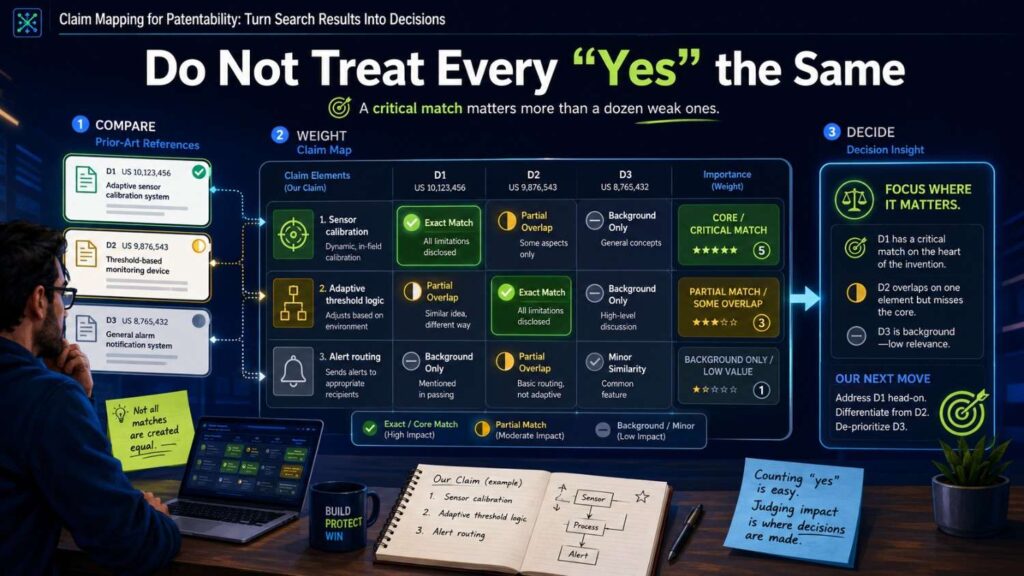
A claim map should not be a lazy checkbox exercise.
A “yes” can mean different things.
One reference may clearly teach the feature in detail.
Another may mention the feature once without explaining it.
Another may imply the feature but not show how it works.
Another may show something close, but not quite the same.
So write notes.
The note is often more important than the label.
For example, suppose your element is:
“Routes low-source-trust answers to human review even when model confidence is high.”
A prior art paper may say, “Human review may be used for low-confidence outputs.”
That is not the same.
It teaches human review based on low model confidence. Your element is about human review based on low source trust, even if model confidence is high.
That difference matters.
So the map should say:
Partial. Reference teaches human review for low model confidence, but does not teach review based on source trust when model confidence is high.
That is a strong note.
It gives your team a real distinction.
If you only write “Yes, human review,” you may miss the invention.
Map What the Reference Actually Teaches
Do not stretch prior art too far.
If a reference uses the same word, that does not mean it teaches the same feature.
Patent and research writing often use broad words.
“Confidence” can mean many things.
“Risk score” can mean many things.
“Feedback” can mean many things.
“Calibration” can mean many things.
“Dynamic” can mean many things.
“AI” can mean almost anything.
So when you map, ask what the reference actually does.
Does it show the same input?
Does it use the same timing?
Does it make the same decision?
Does it trigger the same action?
Does it update the same model, rule, threshold, or baseline?
Does it solve the same technical problem?
Does it create the same technical result?
If not, your note should say so.
This is especially important for AI and software.
A paper that says “we use a neural network” does not teach every neural network workflow.
A patent that says “confidence score” does not teach every way to create or use confidence.
A product page that says “smart routing” does not teach your routing logic.
Claim mapping helps you avoid giving too much power to vague prior art.
Map the Claims, But Also Read the Description
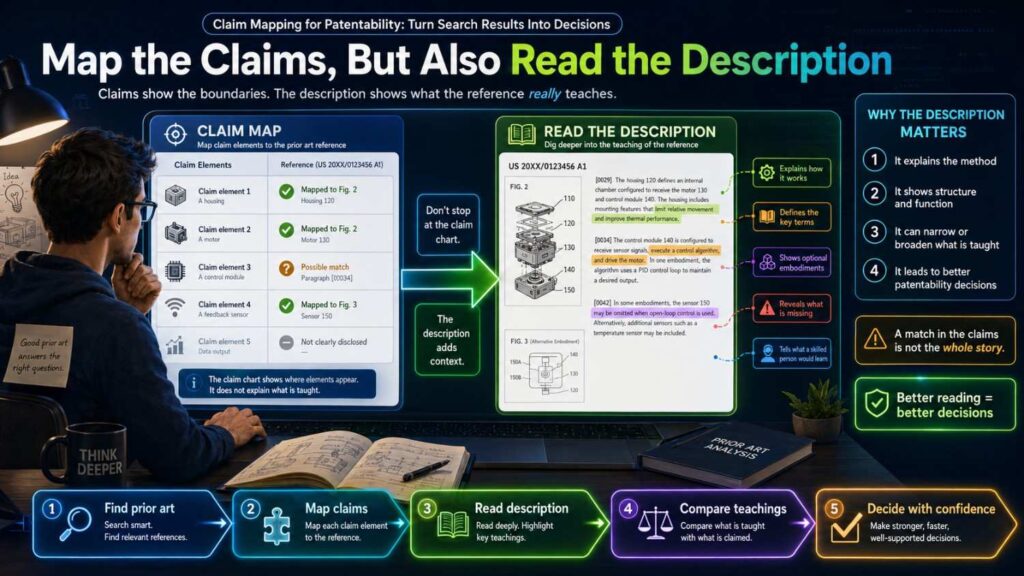
When mapping a patent reference, read more than the title and abstract.
Read the claims. They tell you what that patent is trying to protect.
Read the description. It may teach details that are not in the claims.
Look at the drawings. They may show the system flow better than the words.
Look at examples. They may reveal how the invention works in practice.
A prior art patent can matter even if the relevant feature is not in its claims. If the description publicly teaches the feature, it may still be important for patentability.
So your claim map should include where the feature appears.
Write the source location in your note.
For example:
“Yes. Paragraph 42 describes a pressure sensor placed between battery cells.”
“Partial. Figure 3 shows a feedback loop, but the text says it updates display settings, not the risk threshold.”
“No. Claims and examples use a fixed threshold only.”
These small notes save time later.
They also help your patent attorney check your work quickly.
Use the Map to Spot Novelty Problems
Novelty is the first big test.
In simple terms, your invention has a novelty problem when one prior art reference shows every key part of the claim.
This does not mean every detail in your product. It means every required element of the claim you want to file.
If one prior art reference maps to every element, your working claim may be too broad or already known.
That is not the end.
It means you need to adjust.
Maybe your real invention is narrower.
Maybe you need to add the timing feature.
Maybe you need to add the feedback step.
Maybe you need to claim the special input.
Maybe you need to focus on the control action.
Maybe you need to file on a different feature inside the product.
This is why claim mapping is useful before drafting.
It helps you avoid filing claims that are likely to be blocked.
For example, your first working claim may be:
“A system that detects battery swelling using pressure data.”
Your map may show that Reference A teaches this.
So you refine:
“A system that detects battery swelling by comparing pressure drift during matched charging windows and adjusting a swelling score based on charge rate and temperature.”
Now the map may show gaps.
The new claim is more specific, but it may be stronger.
That is a good trade when the broad version is already crowded.
Use the Map to Spot Obviousness Risk
Obviousness is the second big test.
This is where things get harder.
Your claim may not be shown in one reference, but several references together may make it look like an easy next step.
The USPTO’s obviousness guidance explains that the analysis looks at the claimed invention as a whole, the prior art, and the differences between them, with the relevant timing tied to the effective filing date for AIA applications.
For founders, here is the simple version:
If Reference A shows most of your invention, and Reference B shows the missing feature, an examiner may ask why it would not have been obvious to combine them.
Your claim map should help you think about that early.
After you map individual references, add a combination pass.
Ask:
Could Reference A and Reference B be combined in a natural way?
Do they solve the same problem?
Do they work in the same field?
Does one reference suggest the missing feature?
Would the combination improve the system?
Would the combination break something?
Would the combination make the system slower, more costly, less safe, or less reliable?
Did prior systems avoid the path you took?
This is where many strong patent stories are found.
Maybe the pieces existed separately, but no one had a reason to combine them.
Maybe the old art used fixed thresholds because dynamic thresholds caused instability.
Maybe the old art avoided local processing because devices lacked enough power.
Maybe the old art used only model confidence because source trust was not available.
Maybe the old art used pressure sensors but did not match charging windows because it did not recognize false swelling signals during fast charging.
Your map should not only show that a feature is missing. It should help explain why the missing feature matters.
Do Not Let Hindsight Trick You

Hindsight is one of the biggest traps in claim mapping.
Once you know your invention, it is easy to find its pieces everywhere.
You may look at five old references and think, “There it is. Everything was known.”
But that may be unfair.
The real question is not whether you can find the pieces after seeing your invention.
The question is whether a skilled person would have been led to put those pieces together before your invention.
This matters in claim mapping.
When you map combinations, do not just write:
“Reference A has pressure. Reference B has temperature. Reference C has charge rate. Therefore, obvious.”
That is too fast.
Ask why someone would combine them in the specific way your invention does.
Does the prior art care about the same false-alert problem?
Does it compare signals during matched windows?
Does it adjust the same score?
Does it trigger the same action?
Does it teach the same reason?
A good claim map protects you from both fear and overconfidence.
It helps you avoid saying “we are blocked” too early.
It also helps you avoid saying “we are safe” without enough thought.
Find the Element That Carries the Invention
Not every element is equally important.
Some elements are ordinary.
Some are core.
The ordinary elements may include a processor, memory, network connection, sensor, user interface, data store, or controller.
Those parts may be needed, but they may not be the invention.
The core element is the part that creates the technical difference.
It may be a special comparison.
A special trigger.
A special input.
A special timing window.
A special feedback loop.
A special control action.
A special model update.
A special sensor placement.
A special data structure.
A special way of reducing compute.
When you review a claim map, look for the element that carries the invention.
Ask:
If a competitor copied only one part, which part would matter most?
If this part were removed, would the invention lose its value?
Does this part create the technical result?
Is this part missing from the closest prior art?
Can this part be described clearly?
That feature should get special attention in the patent application.
It may need drawings.
It may need examples.
It may need different versions.
It may need backup claims.
PowerPatent helps teams capture these details because strong patents usually come from the technical edge, not from broad product labels. See how PowerPatent supports invention capture and attorney review.
Claim Mapping for Software Inventions
Software inventions can be hard to map because many prior art references use broad words.
They may all say “data,” “model,” “score,” “rule,” “workflow,” “user,” and “system.”
That does not mean they are the same.
For software, your claim elements should focus on data flow and decision logic.
What data comes in?
How is it changed?
What score is created?
What rule is applied?
What happens when the score is high?
What happens when the score is low?
What is stored?
What changes next time?
What technical result improves?
Suppose your invention is a support automation tool.
The broad idea is:
“An AI tool that routes support tickets.”
That is not enough.
A better working claim is:
“A system that routes support tickets by comparing ticket text, software version, error logs, and recent configuration changes against known failure patterns, then asking one clarifying question when confidence falls in a middle range.”
Now map it.
Does prior art compare ticket text? Probably yes.
Does it compare software version? Maybe.
Does it compare error logs? Maybe.
Does it compare recent configuration changes? Maybe not.
Does it match all of these against known failure patterns? Maybe not.
Does it ask one clarifying question only in a middle-confidence range? Maybe not.
Does it update the failure pattern after resolution? Maybe that should be added.
Your map may show that the first version is still too broad. So you refine it:
“A system that routes support tickets by combining ticket text, error logs, software version, and recent configuration changes into a failure-pattern score, asking one clarifying question when the score falls in a middle range, and updating the failure pattern only after a confirmed fix.”
Now the invention is sharper.
You are not claiming “AI support.”
You are claiming a specific decision path.
That is the difference between vague software patent work and useful software patent strategy.
Claim Mapping for AI Inventions
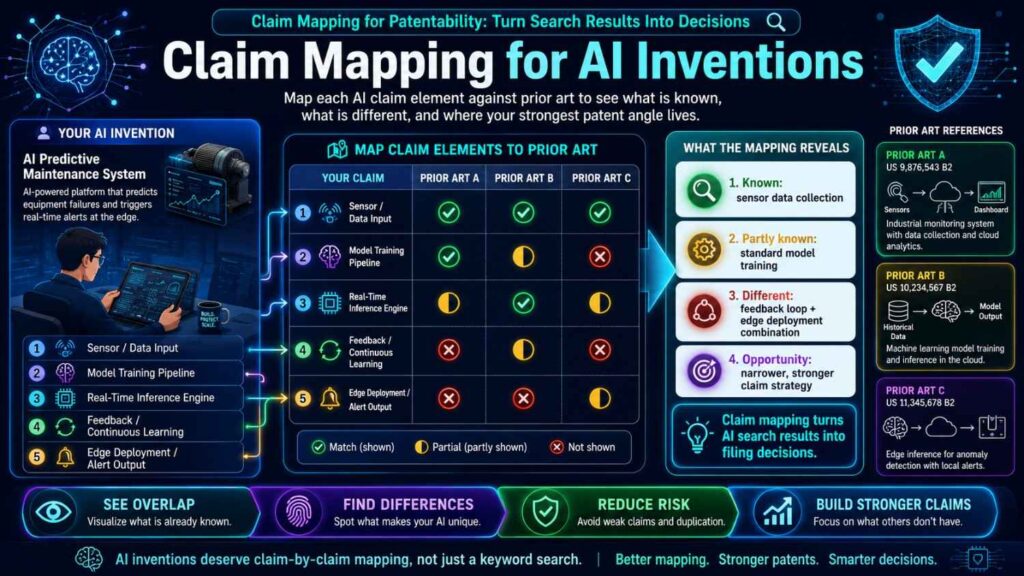
AI claim mapping needs special care.
Do not map only the model name.
The model may not be new.
The invention may live in the pipeline.
For AI, map the full system around the model.
Training data selection.
Label creation.
Retrieval.
Source ranking.
Confidence scoring.
Output checking.
Human review triggers.
Feedback use.
Model update rules.
Privacy controls.
Deployment limits.
Compute-saving steps.
Edge-device operation.
A weak AI claim says:
“A system using a machine learning model to detect risk.”
A stronger working claim says:
“A system that detects risk by generating a model confidence score, generating a separate source-trust score, comparing the two scores, and sending the output to human review when source trust is low even if model confidence is high.”
Now you can map.
Many references may show model confidence.
Some may show source scoring.
Some may show human review.
But do they show review based on a conflict between model confidence and source trust?
That may be the key.
This kind of map helps you avoid the “AI wrapper” problem.
You are not just adding AI to a known workflow.
You are explaining a technical way the system controls, checks, or improves the AI output.
That is much more useful.
Claim Mapping for Hardware Inventions
Hardware claim maps should focus on structure and interaction.
Do not stop at naming parts.
Many devices have sensors, housings, controllers, wires, mounts, and circuits.
The invention is often how those parts are arranged or how they work together.
For hardware, map features like:
Where the sensor is placed.
What the sensor measures.
How force moves through the device.
How heat moves.
How fluid flows.
How parts are joined.
How the device changes state.
How calibration occurs.
How the controller reacts.
How the structure creates a result.
Suppose your invention is a smart pump.
The broad idea is:
“A pump that detects clogs.”
That is crowded.
A better working claim is:
“A pump that detects clog risk by applying short test pulses, measuring pressure ripple patterns during the pulses, adjusting a clog score based on viscosity and motor temperature, and changing pump speed before a high-pressure stop occurs.”
Now map it.
Does the prior art use a pump? Yes.
Does it detect high pressure? Yes.
Does it apply short test pulses? Maybe.
Does it measure ripple patterns during the pulses? Maybe not.
Does it adjust the score based on viscosity and motor temperature? Maybe not.
Does it change speed before a full stop? Maybe.
The map may show that old systems react after pressure gets too high, while yours predicts the clog earlier.
That is a strong story if you can support it with clear detail.
Claim Mapping for Robotics
Robotics inventions often blend sensors, control logic, mapping, and timing.
The claim map should show the control loop.
What does the robot sense?
What does it predict?
What map or context does it use?
When does it act?
What action does it take?
How does it update future behavior?
Suppose your invention is a warehouse robot that handles blind corners.
The broad claim is:
“A robot that avoids collisions.”
That is far too broad.
A better working claim is:
“A robot that predicts blind-corner crossing risk by combining sound direction, map geometry, and recent traffic history, then slowing before the object is visible.”
Now map it.
Does prior art use cameras for collision avoidance? Yes.
Does it slow at blind corners? Maybe.
Does it use sound direction? Maybe.
Does it combine sound direction with map geometry? Maybe not.
Does it add recent traffic history? Maybe not.
Does it act before visual detection? That may be the key.
The map helps you frame the invention around prediction before visibility, not just collision avoidance.
That distinction matters.
Claim Mapping for Medical and Life Science Tools
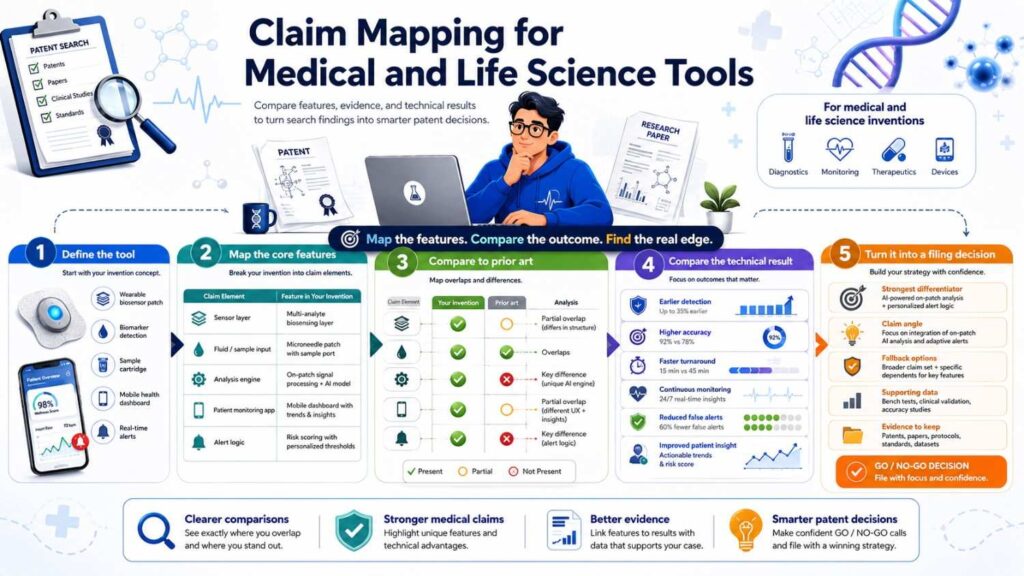
Medical and life science inventions need careful mapping because prior art can be deep and old.
Do not map only the health outcome.
Map the measurement, timing, processing, and action.
For a wearable device, the elements may include sensor type, signal window, baseline method, risk score, alert rule, and feedback.
For a diagnostic method, the elements may include sample type, marker set, detection method, comparison rule, and output.
For a treatment tool, the elements may include delivery path, dose timing, monitoring step, adjustment rule, and safety trigger.
Suppose your invention is a wearable dehydration risk tool.
The broad idea is:
“A wearable that predicts dehydration.”
A better working claim is:
“A wearable that predicts dehydration risk by comparing heart rate, skin temperature, and sweat signal changes during a post-activity recovery window against a personal baseline.”
Now map it.
Does prior art use heart rate? Yes.
Does it use skin temperature? Yes.
Does it use sweat signals? Yes.
Does it compare all three during a post-activity recovery window? Maybe not.
Does it use a personal baseline for that recovery window? Maybe not.
The map may reveal that the key is not the sensors. The key is the timing and baseline.
That is useful.
Map Technical Results, Not Just Features
A claim map should include technical results.
This is where many founders miss value.
They map what the system has, but not what the difference does.
A feature by itself may look small.
A feature tied to a result may look much stronger.
For example:
Feature: Matched charging windows.
Result: Fewer false swelling alerts during fast charging.
Feature: Source-trust score.
Result: Fewer unsupported AI answers shown to users.
Feature: Short pump test pulses.
Result: Earlier clog prediction without stopping flow.
Feature: Blind-corner risk prediction before visual contact.
Result: Slower approach before a hidden object enters the robot’s path.
Feature: Middle-confidence clarifying question.
Result: Fewer unnecessary human handoffs while avoiding bad auto-responses.
Add a “technical result” column to your map.
This helps the patent application later.
It also helps your team decide whether a feature is worth claiming.
A feature that does not change anything may not be the best anchor.
A feature that improves speed, accuracy, safety, power use, reliability, signal quality, compute cost, or control may be much more valuable.
Use Claim Mapping to Decide Whether to File
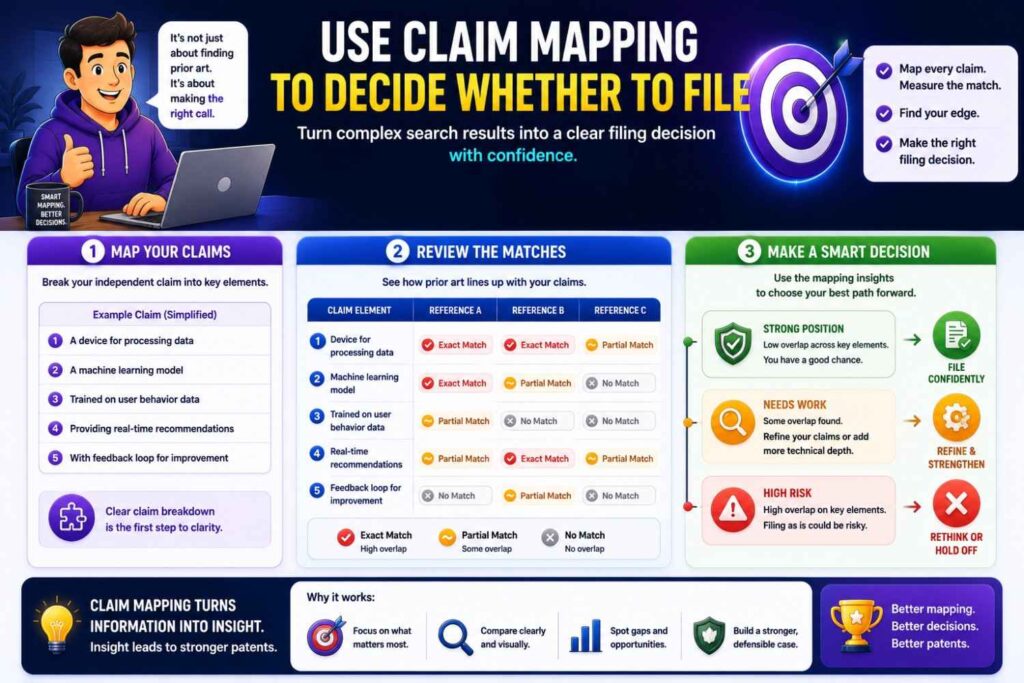
After you build the map, you need to make a decision.
Do not let the map sit in a folder.
Use it.
A strong map may show that the closest prior art misses your core element and does not clearly suggest adding it. That may support filing.
A mixed map may show that the broad idea is crowded, but a narrower method looks promising. That may support a narrower filing or a filing with layered claims.
A weak map may show that one reference teaches every important part. That may mean you need to change the claim focus.
A messy map may show that you need a better search.
The point is to turn search results into action.
Here is the founder-level decision logic:
If the broad idea is open and valuable, consider filing around the broad idea with strong technical details.
If the broad idea is crowded but your implementation is different, file around the implementation.
If the current claim is blocked but another feature is strong, shift the filing focus.
If the invention is valuable but the map is uncertain, bring in a patent attorney before public disclosure.
If the invention is weak and easy to design around, save the budget for a better invention.
This is the difference between patent activity and patent strategy.
Use Claim Mapping to Refine the Claim
A claim map often shows that your first claim is not the best claim.
That is normal.
Start broad. Map. Refine. Map again.
Let’s say your first working claim is:
“A system that detects machine failure using sensor data.”
The map shows many references.
So you refine:
“A system that predicts machine failure by comparing vibration changes during matched load windows.”
The map is better, but one reference teaches matched load windows.
So you refine again:
“A system that predicts machine failure by comparing vibration changes during matched load windows and adjusting the risk score based on temperature drift and prior maintenance history.”
Now the map shows fewer matches.
But you do not want to make the claim too narrow too soon.
So you ask:
Is temperature drift essential?
Is prior maintenance history essential?
Could the invention work with other context signals?
Should the broad claim say “context signal” while a dependent claim names temperature and maintenance?
That is claim strategy.
You should not make these choices alone if the invention matters. But the map gives your attorney a better starting point.
PowerPatent helps organize this kind of thinking so the filing can be built around the real technical edge, not a rushed summary. See how PowerPatent works.
Use Claim Mapping to Create Backup Positions
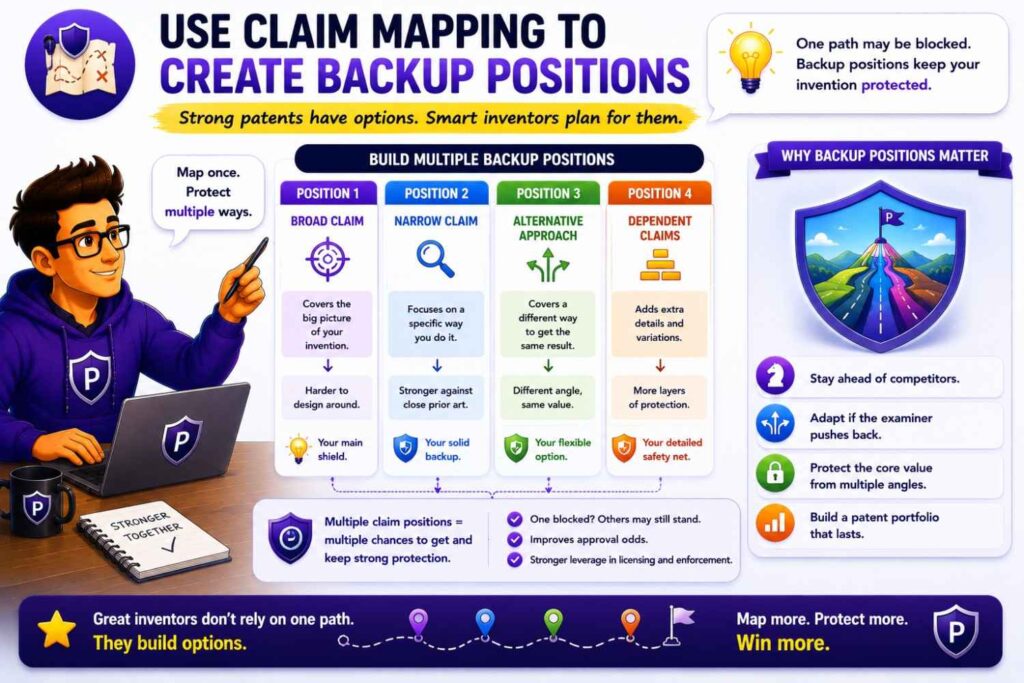
A good patent filing should not depend on one claim idea.
It should have backup positions.
A backup position is a narrower version of the invention that may survive even if the broad version runs into prior art.
Claim mapping helps you find those backups.
For example, the broad idea may be:
“Using source trust to review AI outputs.”
Backup positions may include:
Source trust based on document age.
Source trust based on author role.
Source trust based on prior answer accuracy.
Review triggered by conflict between model confidence and source trust.
Review triggered only for high-impact outputs.
A source graph used to verify each answer sentence.
A feedback loop that updates source trust after review.
You do not need to claim every backup in the same way. But you should disclose the important versions.
This is key.
If your application does not describe a backup version, it may be harder to claim later.
A strong map helps you see what to include before filing.
Use Claim Mapping to Avoid Over-Narrowing
Prior art can scare founders into making claims too narrow.
That can hurt.
If you add too many details to the main claim, competitors may avoid it by changing one small thing.
Claim mapping should help you find the minimum set of features needed to be different.
Not every product detail belongs in the broad claim.
Suppose your product uses a camera, lidar, and radar.
The invention may not need all three.
If the core idea is about predicting hidden crossing risk using non-visual cues and map geometry, the broad claim may not need to name every sensor. It may use broader language, with narrower claims that name sound, lidar, radar, or traffic history.
This is a careful balance.
Too broad can hit prior art.
Too narrow can lose value.
The map helps you find the line.
Ask:
Which elements are needed to avoid the closest prior art?
Which elements are needed to create the technical result?
Which elements are just one implementation?
Which elements could be changed by a competitor?
The answer shapes your claim plan.
Use Claim Mapping to Separate Product Features From Patent Features
Your product may have many features.
Not all of them belong in the patent claim.
A product feature may be valuable for users but not central to the invention.
A patent feature is a technical part that helps make the invention new and useful.
For example, your product may have a beautiful dashboard.
The claim map may show that dashboards are common.
But your system may group duplicate alerts by shared root cause before showing them, reducing network messages and review time.
The dashboard is a product feature.
The root-cause grouping may be the patent feature.
Another example:
Your app may let users approve AI outputs.
Approval buttons are common.
But your system may route outputs to approval based on a mismatch between source trust and model confidence.
The button is not the key.
The routing rule may be.
Claim mapping helps you avoid filing on surface-level product details when the deeper workflow is stronger.
Use Claim Mapping to Find Hidden Inventions
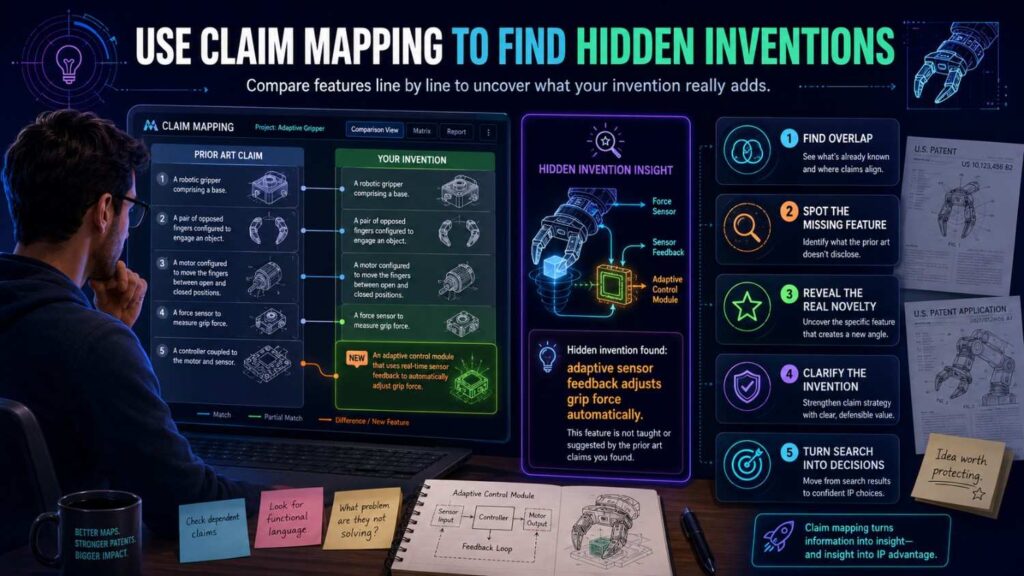
A claim map can reveal inventions you did not know you had.
This happens often.
You start mapping one invention and notice that the real difference is somewhere else.
Maybe you thought the invention was the model.
The map shows the model is common.
But your data labeling method is new.
Maybe you thought the invention was the sensor.
The map shows the sensor is old.
But your calibration loop is different.
Maybe you thought the invention was the alert.
The map shows alerts are common.
But your threshold update method is special.
This is good news.
It means the map is working.
Do not force the original idea if the stronger invention is hiding inside the product.
Shift.
A smart patent process follows the strongest technical edge.
Use Claim Mapping Before Public Disclosure
Timing matters.
If you are about to publish a paper, release a product, pitch with technical slides, post a demo video, open source code, or share detailed architecture, do claim mapping before that event if possible.
Once details are public, patent options may become more complex.
Your own disclosure can become part of the story. Competitors may also learn from it.
Claim mapping before disclosure helps you decide what to file first.
It does not mean you need to file on everything.
It means you should make an informed decision.
PowerPatent is built for founders who move fast and cannot afford a slow, confusing patent process. It helps turn technical work into a clearer path toward filing, with real attorney oversight. See how PowerPatent can help before launch.
Use Claim Mapping Before Fundraising
Investors may not ask for a claim chart, but they care about your moat.
A founder who can explain the patent position clearly sounds more prepared.
Instead of saying:
“We searched and think we are unique.”
You can say:
“We mapped the closest references. The broad space is crowded, but the prior art we found does not show our feedback loop that updates the risk threshold after confirmed false alerts. That loop is central to the performance gain customers care about. Our filing strategy focuses there.”
That is much stronger.
It shows judgment.
It shows you know the field.
It shows the patent is tied to the product’s real advantage.
Claim mapping can also help you avoid overclaiming during investor talks.
You do not need to say, “No one has ever done anything like this.”
That is rarely true.
You can say, “The closest art does X. We do Y. The difference matters because Z.”
That is more credible.
Use Claim Mapping Before an Acquisition
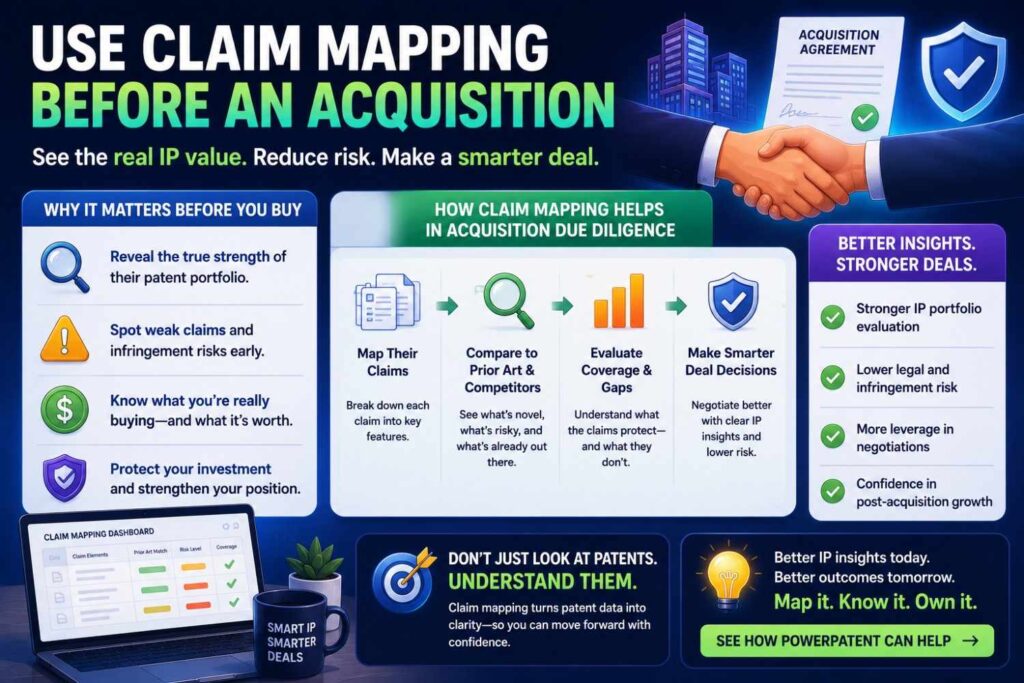
During acquisition talks, IP diligence can get serious.
A buyer may ask what your patents cover and whether the claims are meaningful.
They may compare your filings to prior art.
They may ask whether your core product is protected.
They may ask whether your pending claims are likely to survive.
A clean claim map can help tell that story.
It can show that your team did not file blindly.
It can show that the claims were built around known gaps.
It can help explain why a pending application matters even before it grants.
It can also reveal weaknesses before the buyer finds them.
That gives you a chance to file continuations, refine claims, or prepare a better explanation.
For startups, this can be a meaningful part of company value.
Use Claim Mapping for Continuation Strategy
A continuation is a later patent application tied to an earlier one.
It can let you pursue different claim angles based on the same original disclosure.
Claim mapping can help decide what continuation claims to file.
Maybe your first patent focused on the broad system.
Later, the market shows that competitors are copying one specific workflow.
You can map that workflow against the prior art and decide whether a continuation should focus there.
Maybe the examiner allowed a narrow claim, but the map shows another path may be stronger.
Maybe new competitor products reveal which features matter most.
Claim mapping keeps your patent family alive and useful.
It helps you avoid treating a patent filing as a one-time event.
For deep tech startups, IP should grow with the product.
The Most Important Columns in a Claim Map
A useful founder claim map does not need to be complex.
But it should capture the right things.
At minimum, include the claim element, the prior art reference, whether the element is taught, where it is taught, what is missing, and why the difference matters.
The “why it matters” part is often the difference between a weak map and a strong map.
For example:
Element: Updates threshold after confirmed false alert.
Prior art: Reference A.
Mapping: No. Reference A uses fixed thresholds.
Why it matters: Fixed thresholds caused false alerts in changing conditions. Our update step adapts to the specific device and reduces repeat false alerts.
That note is useful for claim strategy.
It also helps write the patent application.
It gives the attorney a reason, not just a feature.
Be Honest About Partial Matches
Partial matches are common.
Do not force them into yes or no.
A partial match means the reference shows something close but not the full element.
Partial matches deserve careful notes.
For example:
Element: Uses source trust to route AI output to review.
Reference: Paper B.
Mapping: Partial. Paper B scores source reliability for ranking search results, but does not use the score to route generated model output to human review.
That is useful.
Another example:
Element: Compares pressure drift during matched charging windows.
Reference: Patent C.
Mapping: Partial. Patent C tracks pressure over charging cycles, but does not match windows by charge rate or temperature.
This kind of note helps you see whether the difference is real.
It also helps your attorney decide whether to claim the broader feature or the narrower one.
Do Not Hide Weaknesses in the Map
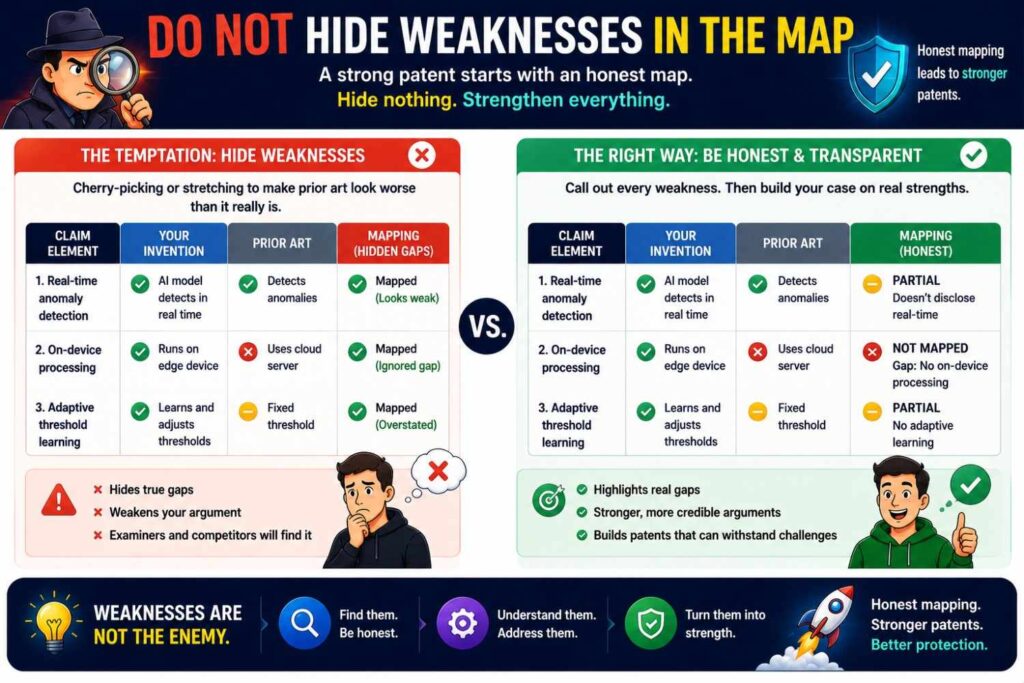
A claim map is not marketing copy.
It should be honest.
If a reference teaches an element, say so.
If the reference is close, do not downplay it.
If you are unsure, mark it unclear.
The goal is not to make the invention look good. The goal is to make a good decision.
A biased map can lead to a weak filing.
A clear map can lead to a stronger one.
Founders sometimes worry that writing down close prior art will hurt them.
But hiding close art from your patent team is worse.
A good attorney can use the information to shape better claims and disclosures.
The prior art exists whether you write it down or not.
Do Not Map Too Early Without Understanding the Invention
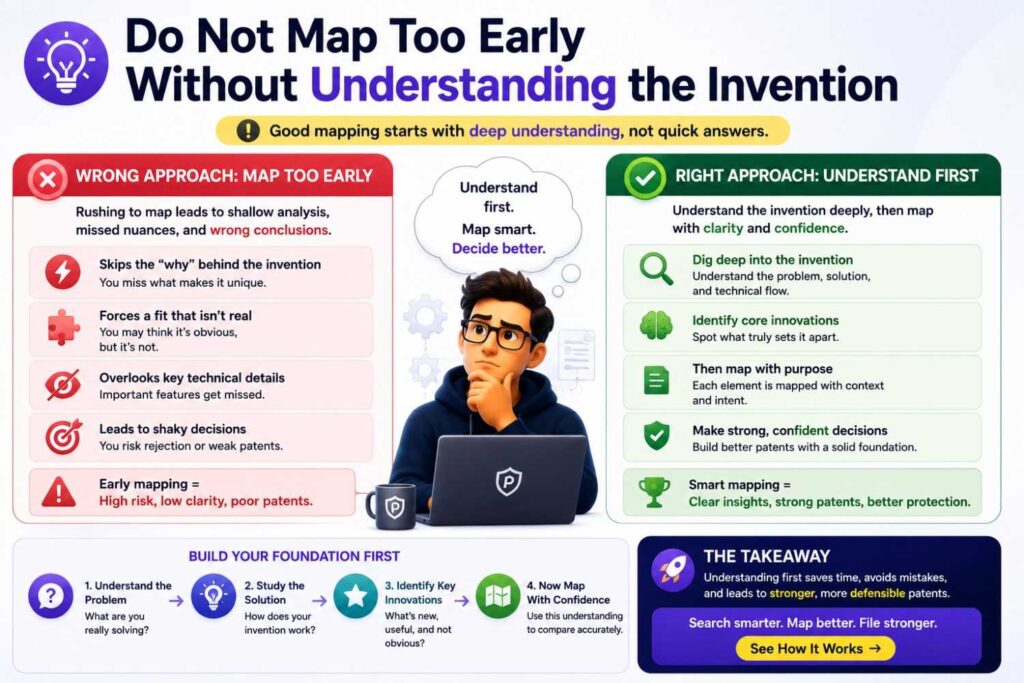
Claim mapping fails when the invention is fuzzy.
If the team cannot explain how the invention works, the map will be weak.
Before mapping, make sure you know:
What problem is being solved.
What technical step solves it.
What input is used.
What output is created.
What changes because of the output.
What result improves.
What part was hard to build.
What alternatives were tried.
What failed.
What is different from standard practice.
Engineers are essential here.
They know the real invention.
A founder may describe the product. An engineer can describe the technical move.
Both views matter.
PowerPatent helps bring those views together so the patent process is not built on vague summaries alone. Explore PowerPatent’s founder-friendly process.
Do Not Map Every Product Detail
A product may have hundreds of details.
A claim map should focus on the invention.
If you map too much, the signal gets lost.
Do not map login screens, colors, pricing flows, routine cloud hosting, standard dashboards, or common admin settings unless they are tied to the technical invention.
Focus on the parts that create the technical result.
For software, that often means the data flow, decision rule, model pipeline, feedback loop, or control step.
For hardware, that often means the physical structure, sensor placement, material interaction, signal path, or control logic.
For biotech, that may mean the marker set, sample step, detection method, timing, or treatment adjustment.
For robotics, it may mean sensing, prediction, planning, actuation, and feedback.
The cleaner the map, the clearer the decision.
Use Claim Mapping to Decide What to Disclose
A patent application needs enough detail.
Claim mapping helps show what details matter.
If prior art is close on the broad idea, your application should explain the specific difference in depth.
For example, if prior art already teaches pressure-based battery swelling detection, your application should not spend all its energy explaining basic pressure sensors.
It should explain matched charging windows, charge-rate adjustment, temperature compensation, scoring rules, false alert reduction, and possible outputs.
If prior art already teaches model confidence, your application should explain source trust, confidence conflicts, review routing, feedback, and technical safeguards.
If prior art already teaches robot slowing near blind corners, your application should explain the prediction before visibility, the use of sound direction, map geometry, and traffic history, and how those inputs change the control path.
A claim map tells you where to add detail.
That detail may be what gives your attorney room to draft and revise claims later.
Use Claim Mapping to Decide What Not to Claim
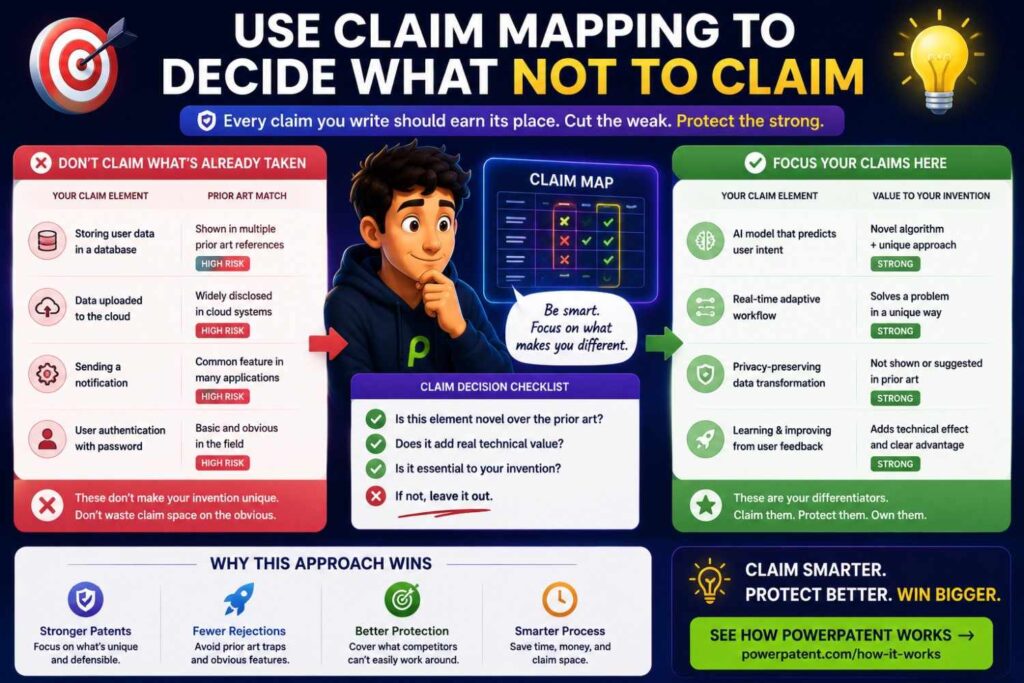
Some features are not worth claiming.
They may be old.
They may be easy to avoid.
They may not matter to customers.
They may not be tied to the technical result.
They may be better kept as trade secrets.
Claim mapping helps identify those features.
Suppose your product has a special ranking formula with exact weights.
If the general ranking method is patentable, you may not want to put every exact weight into the broad claim. You may disclose examples, but claim the broader logic.
Or suppose a tuning parameter is easy to change. If you claim only that exact number, competitors can avoid it.
Or suppose a backend implementation detail is not visible and hard to detect. In some cases, trade secret protection may be worth discussing.
A claim map does not make these decisions alone, but it helps frame them.
Use Claim Mapping With Search Iteration
Claim mapping often reveals search gaps.
You may map three references and notice that none addresses a key term.
That does not always mean the term is new. It may mean you used the wrong search words.
For example, your map may use “source trust.”
Prior art may use “document reliability,” “evidence score,” “provenance weight,” or “citation confidence.”
Your map may use “matched charging window.”
Prior art may use “normalized charge interval,” “charge segment,” “cycle phase,” or “operating window.”
Your map may use “false alert.”
Prior art may use “false positive,” “spurious alarm,” or “incorrect fault detection.”
Good mapping leads to better searching.
Better searching leads to better mapping.
Treat it as a loop.
Search. Map. Learn new words. Search again. Map again.
Stop when the picture is clear enough to make a decision.
Read Figures Like Evidence
Patent drawings are often easier to understand than patent language.
Do not skip them.
A figure may show the data flow.
It may show a feedback loop.
It may show sensor placement.
It may show a controller path.
It may show a timing sequence.
It may show the missing step.
When mapping, cite the figure in your note.
For example:
“Partial. Figure 4 shows sensor feedback to the controller, but the text says the feedback changes display brightness, not risk scoring.”
Or:
“Yes. Figure 2 and the related description show a model confidence score used to trigger human review.”
Figures can also reveal differences.
Your system may have a loop that prior art lacks.
Your sensor may be placed at a different force point.
Your model may verify output before display, while prior art verifies after display.
Those visual gaps can become claim strategy.
Watch for Broad Prior Art Language
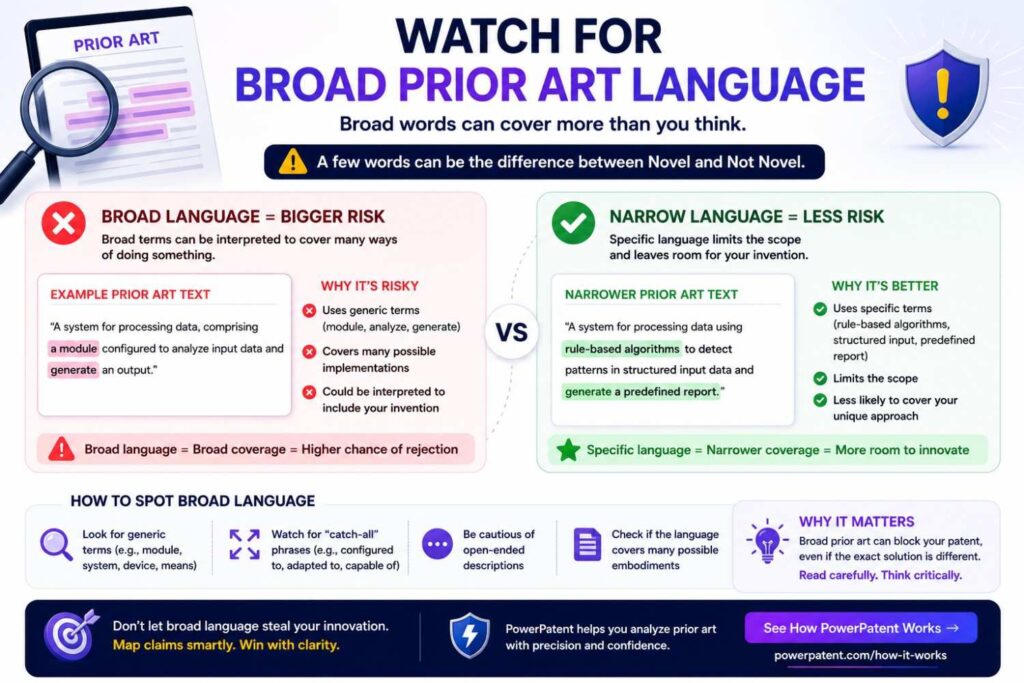
Prior art often uses broad language.
A patent may say “the system may use any sensor.”
Does that mean it teaches your exact sensor use?
Maybe. Maybe not.
A paper may say “feedback can improve the model.”
Does that teach your specific feedback loop?
Probably not by itself.
A product page may say “real-time risk scoring.”
Does that teach your score inputs and trigger rules?
Usually no.
Do not ignore broad language, but do not let it do more work than it should.
In the map, note the level of detail.
For example:
“Broad mention only. The reference says feedback may be used, but does not describe updating a device-specific threshold after a confirmed false alert.”
This helps your patent team judge the risk.
Watch for Hidden Prior Art in the Background Section
Some patent applications describe old systems in the background section.
That can be useful.
But be careful.
Applicants may describe problems in the field or known approaches. Those statements may shape how the examiner sees the art.
When mapping, note whether the feature is in the background, summary, detailed description, examples, figures, or claims.
A feature described as old in the background may be harder to claim broadly.
A feature described only as part of the invention may still be prior art if the patent publication came before your filing, but it may have different weight in your analysis.
Do not overthink this alone.
Just capture the location and share it with your patent team.
Claim Mapping and “Teaching Away”
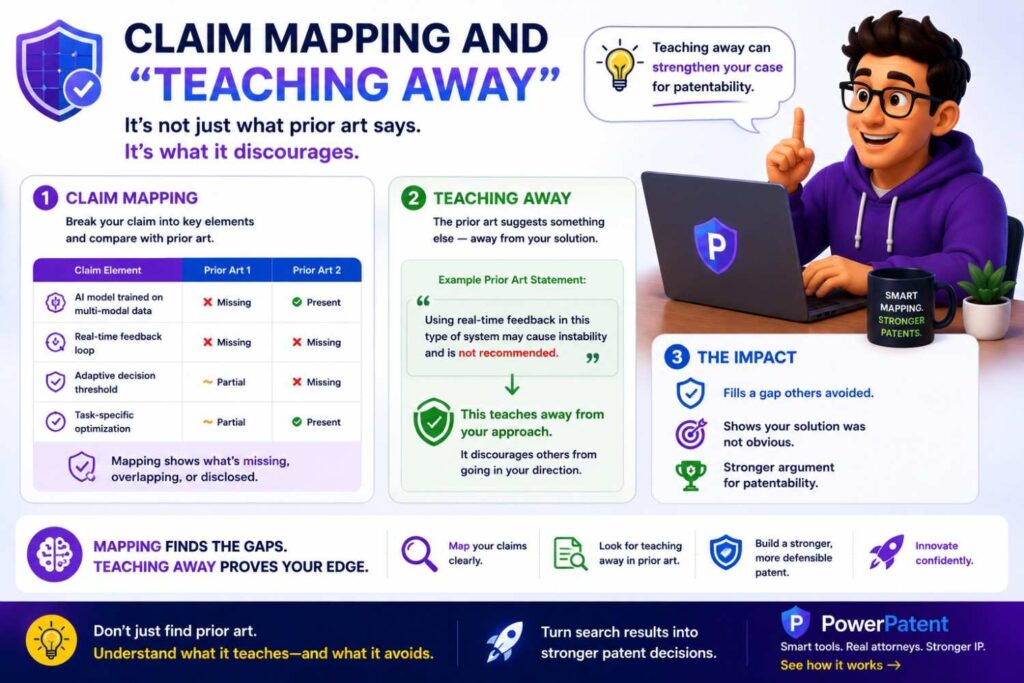
Sometimes prior art helps you because it points away from your solution.
For example, prior art may say a method should avoid local processing because it drains battery.
Your invention may make local processing work by running a small model first and only sending uncertain cases to a larger model.
Prior art may say pressure signals are unreliable during fast charging.
Your invention may solve that by comparing matched charging windows.
Prior art may say human review should be used only for low model confidence.
Your invention may show that high-confidence outputs can still need review when source trust is low.
This kind of point matters.
In your map, add a note:
“Reference appears to teach away from using pressure during fast charging because it treats fast-charge expansion as noise. Our method uses matched windows to turn that noisy period into a useful comparison.”
That is a strong insight.
It may help support why your invention was not an easy step.
Claim Mapping and Unexpected Results
Sometimes your invention works better than expected.
That can matter.
Maybe your method reduces false positives more than expected.
Maybe it cuts compute cost sharply.
Maybe it keeps accuracy while using less data.
Maybe it improves safety in an edge case others missed.
Maybe it works in a harsh environment where older methods failed.
If you have test results, include them in the map notes.
You do not need a perfect study at the early stage. Even prototype results can help the team understand the invention.
For example:
“Internal tests showed that matching charging windows by charge rate reduced false swelling alerts during fast charging compared with a fixed threshold.”
That is useful.
Be honest about what the data shows.
Do not overstate.
But do not hide results that explain why the invention matters.
Claim Mapping and Commercial Value
Patentability is not the only question.
A claim may be patentable but not valuable.
Claim mapping should be paired with business judgment.
Ask:
Would a competitor want to copy this feature?
Is this feature tied to customer value?
Is it hard to design around?
Is it visible enough to detect copying?
Does it support our product roadmap?
Does it matter to investors, partners, or acquirers?
Does it cover a future platform, not just today’s feature?
This is where founders add value to the patent process.
Attorneys can help with claim scope and legal risk. Engineers can explain the system. Founders can explain what matters to the business.
The best patent decisions combine all three.
Claim Mapping for Multiple Inventions
A product often contains more than one invention.
Do not force everything into one claim map.
Make separate maps for separate inventions.
For example, an AI medical tool may have:
A data cleaning invention.
A model scoring invention.
A human review routing invention.
A patient-specific baseline invention.
A privacy-preserving deployment invention.
A reporting workflow invention.
Each may need its own map.
Some may be weak.
Some may be strong.
Some may be worth filing now.
Some may need more development.
Some may be kept as trade secrets.
Separating them prevents confusion.
It also helps you build a patent portfolio, not just one filing.
Claim Mapping for Product Roadmaps
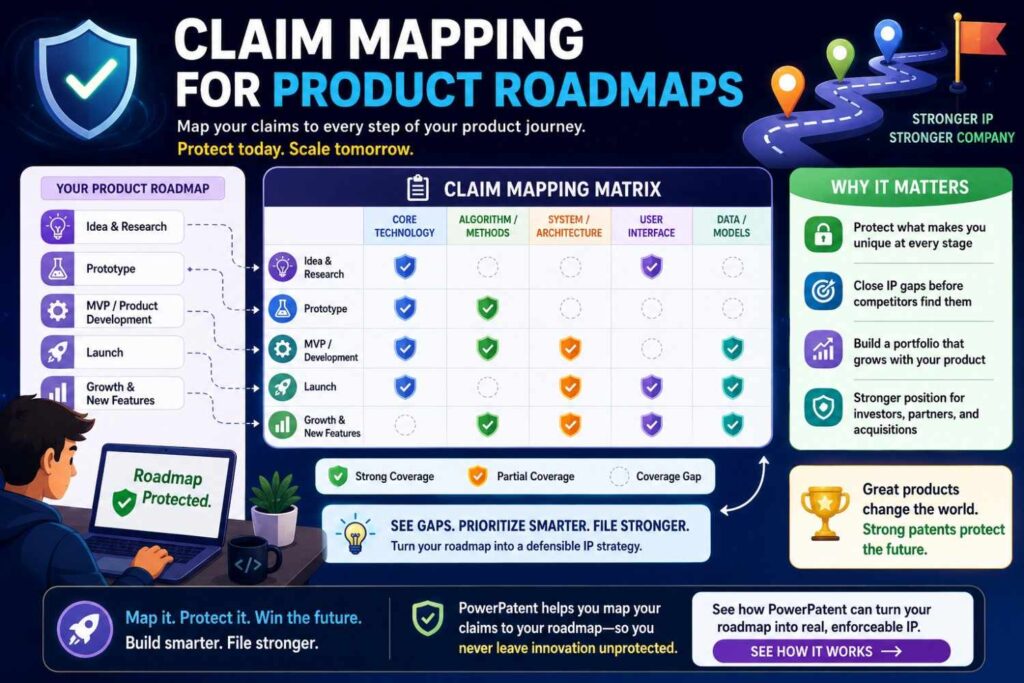
Your current product is not the only thing that matters.
Startups change.
A claim map can include planned versions if they are real enough to describe.
Suppose your current system uses temperature and pressure. Your roadmap includes humidity, vibration, and acoustic signals.
If those signals are true alternatives for the same scoring method, they may belong in the disclosure.
Suppose your current AI workflow uses human review. Your roadmap includes automated second-model review.
That may be another version worth describing.
Suppose your robot currently slows near blind corners. Later it may reroute or signal other robots.
Those outputs may be important.
Do not file only for the prototype if the invention is broader.
But do not invent vague future features just to sound broad.
The application should describe real technical options your team can explain.
PowerPatent helps founders capture both what has been built and what is technically planned, so the patent filing can support the company’s path forward. See how PowerPatent works.
Claim Mapping Before Drafting
Claim mapping should happen before drafting when possible.
It gives the drafter a clean view of the field.
It helps avoid wasting time on weak claim angles.
It shows where the disclosure needs more detail.
It helps the attorney ask better questions.
It helps the team choose examples.
It helps create fallback positions.
Without a map, drafting can become a guess.
The application may spend pages on standard parts and only a few lines on the real difference.
That is backward.
The claim map tells the drafter where the invention lives.
Claim Mapping During Drafting
Claim mapping can also help during drafting.
As claims take shape, map them again.
A draft claim may include an element that is not needed.
It may leave out the key difference.
It may use words that are too narrow.
It may use words that are too broad.
It may fail to capture the technical result.
Mapping draft claims against prior art helps catch those issues early.
For example, the draft claim may say:
“Receiving sensor data and generating a risk score.”
The map shows prior art teaches that.
So the claim may need to add:
“Comparing sensor drift during matched operating windows.”
Or:
“Adjusting the risk score based on a context signal.”
Or:
“Updating a device-specific threshold after a confirmed false alert.”
The exact choice depends on the invention and prior art.
The map keeps the discussion grounded.
Claim Mapping After an Office Action
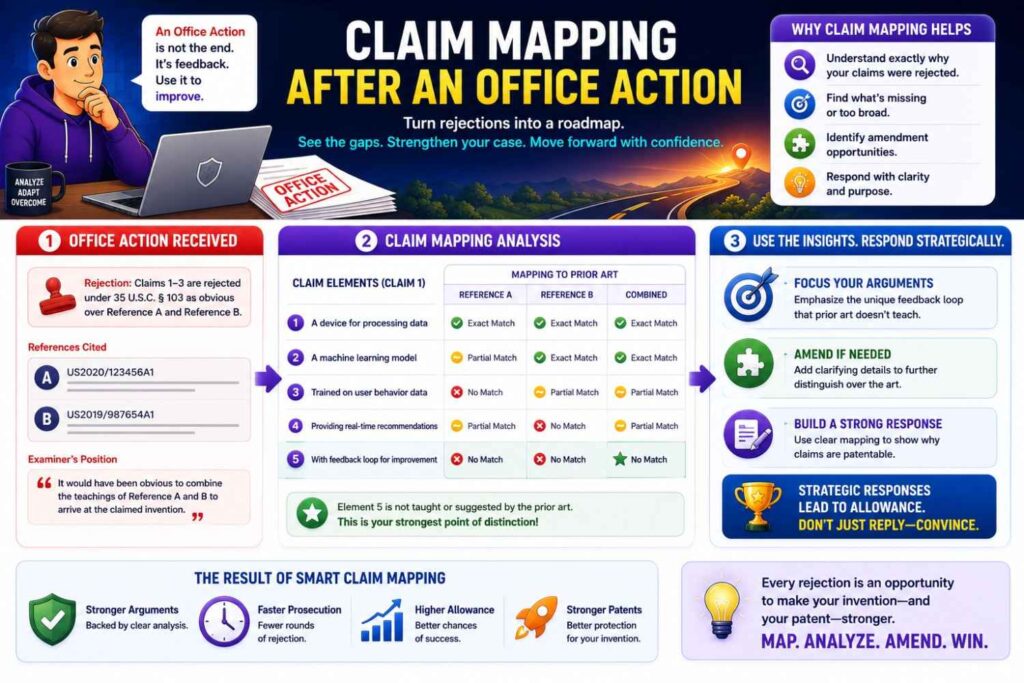
After filing, a patent examiner may reject claims based on prior art.
That is normal.
Claim mapping becomes useful again.
Map the examiner’s references against the rejected claims.
Do not just read the rejection and react emotionally.
Ask:
Which claim element does the examiner say is taught?
Where does the examiner find it?
Is that reading fair?
Is the feature actually the same?
Is the examiner combining references?
Is there a reason to combine them?
Does the combination miss a timing rule, trigger, feedback loop, or technical result?
Can the claim be amended to clarify the difference?
Does the specification support that amendment?
This is where early disclosure quality matters.
If your application described the key alternatives and results, you may have more room to respond.
If the application was thin, options may be limited.
Claim mapping before filing can make prosecution easier later.
Claim Mapping for Competitor Monitoring
After you file, keep watching the field.
Competitors may publish new patent applications.
Claim mapping can help you understand whether they are moving toward your space.
Map competitor claims against your product.
Map your claims against their disclosures.
Map their new filings against your pending applications.
This can support continuation strategy, product design, and business planning.
It can also help you spot white space.
If competitors are patenting around one part of the field, your team may find another path worth protecting.
Patent strategy is not a one-time event.
It should track the product and the market.
Keep the Language Simple
A claim map should be useful to founders, engineers, and attorneys.
Do not bury it in legal language.
Use short, clear phrases.
Instead of:
“Wherein the apparatus comprises a plurality of sensing modalities configured to perform inferential state estimation.”
Write:
“System uses more than one sensor to estimate device state.”
Instead of:
“Dynamic threshold modification responsive to post-event validation.”
Write:
“Threshold changes after the system confirms whether the alert was right.”
Plain language does not make the work less serious.
It makes the work usable.
The attorney can turn the idea into proper claim language later.
Your job at the mapping stage is clarity.
Keep the Map Small Enough to Use
A map that nobody reads is not helpful.
Start with the core claim and the closest references.
Do not build a giant chart unless the decision requires it.
A practical founder map may fit on a few pages.
For a high-value invention, a deeper map may be worth it.
But even then, keep the structure clean.
Use one row per element.
Use short notes.
Link to source locations.
Highlight the strongest gap.
End with a decision.
A claim map should lead somewhere.
The Decision Section Matters Most
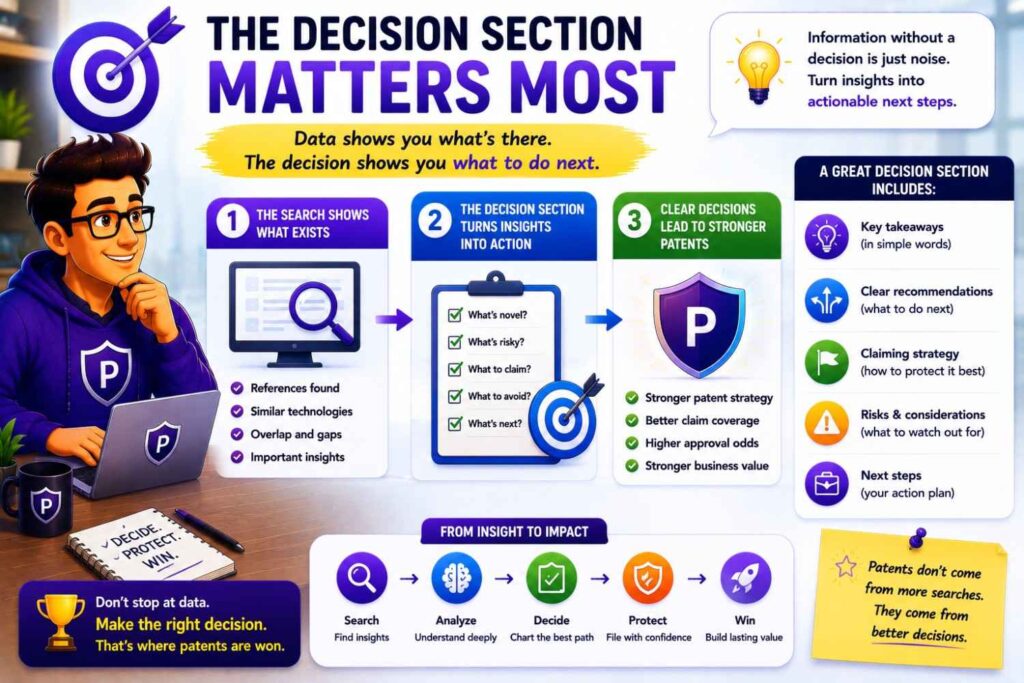
Every claim map should end with a short decision section.
Do not leave the reader to guess.
Write something like:
“The broad idea of detecting battery swelling with pressure sensors appears crowded. The strongest filing angle is comparing pressure drift during matched charging windows and adjusting the score based on charge rate and temperature. The closest references do not appear to show that full combination. Recommend preparing a filing focused on this scoring method, with backup claims covering different context signals, alert actions, and charge-control outputs.”
That is useful.
Another example:
“The broad idea of AI support ticket routing is crowded. The prior art shows text classification and confidence-based routing. The stronger angle is the combined failure-pattern score based on ticket text, software version, error logs, and recent configuration changes, plus the middle-confidence clarifying question. Recommend more searching on configuration-change matching before filing.”
That is honest and actionable.
The map should not just describe.
It should guide.
A Simple Claim Mapping Workflow
Here is a practical workflow you can use.
Write the invention in one plain sentence.
Break it into key elements.
Pick the closest prior art references.
Map each element against each reference.
Mark yes, no, partial, or unclear.
Add short notes with source locations.
Identify which reference is closest.
Check whether one reference shows every element.
Check whether multiple references could be combined.
Find the strongest missing element.
Tie that element to a technical result.
Refine the working claim.
Add backup claim ideas.
Decide whether to file, search more, revise, or pause.
This is the basic motion.
It is not fancy.
It works.
Example Claim Map: AI Output Review
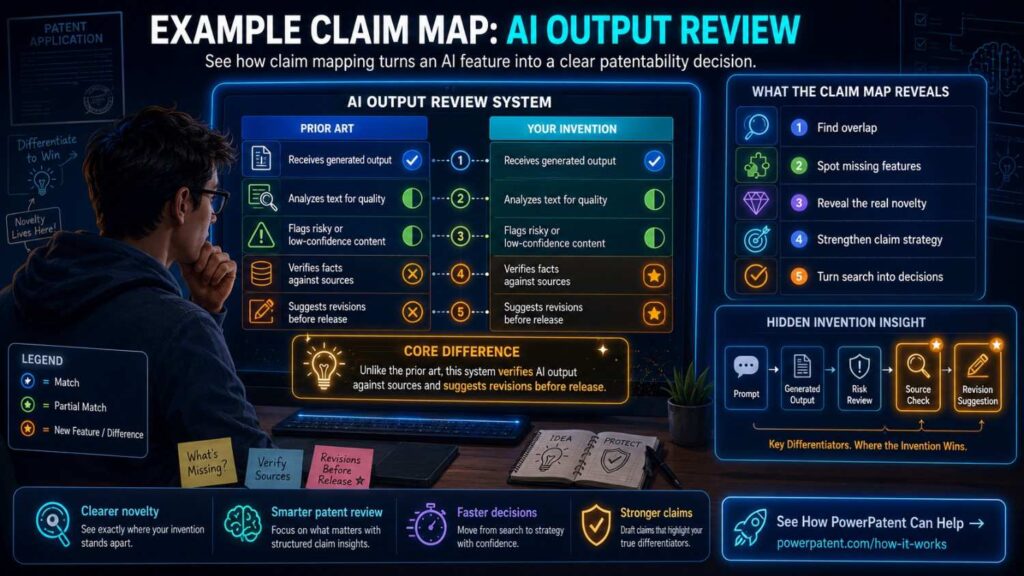
Imagine your startup builds an AI research assistant for technical teams.
The system drafts answers from internal documents. But before showing an answer, it checks whether the sources are reliable.
Your working claim is:
“A system that generates an answer using a model, creates a model confidence score, creates a source-trust score, compares the scores, and sends the answer to review when source trust is low even if model confidence is high.”
Break it into elements.
The system generates an answer using a model.
The system creates a model confidence score.
The system creates a source-trust score.
The system compares model confidence and source trust.
The system sends the answer to review when source trust is low.
The review can happen even when model confidence is high.
The system may update source trust after review.
Now map.
Reference A shows model-generated answers and confidence scores. It sends low-confidence answers to review. It does not create source-trust scores.
Reference B ranks documents based on reliability. It does not generate AI answers or route answers to review.
Reference C uses citations to support model answers. It does not compare source trust against model confidence.
The map shows that pieces exist. But the key may be the conflict rule: low source trust can trigger review even when model confidence is high.
That gives you a filing angle.
The technical result may be fewer unsupported high-confidence answers.
That is the story.
Example Claim Map: Battery Safety
Imagine your startup builds a battery monitoring system.
Your working claim is:
“A system that detects swelling risk by measuring pressure drift during matched charging windows and adjusting the swelling score based on charge rate and pack temperature.”
Elements:
Measures pressure related to battery expansion.
Tracks pressure drift over time.
Defines matched charging windows.
Matches windows based on charge rate or temperature.
Adjusts swelling score using charge rate and temperature.
Triggers alert or charge-control action based on the score.
Reference A uses pressure sensors to detect swelling with a fixed threshold.
Reference B uses temperature to estimate battery health.
Reference C compares battery behavior across charge cycles, but not pressure drift.
The map may show that no one reference teaches the full claim.
The combination risk is real because pressure, temperature, and charge cycles are all known.
So the key question becomes:
Would prior art suggest using matched charging windows to reduce false swelling alerts during fast charging?
If not, that may be the strongest angle.
The technical result is reduced false alerts while still catching dangerous swelling early.
That is much more powerful than saying “we use sensors.”
Example Claim Map: Robot Blind-Corner Control
Imagine your startup builds warehouse robots.
Your working claim is:
“A robot that predicts blind-corner crossing risk using sound direction, map geometry, and recent traffic history, then slows before the object is visible.”
Elements:
Robot has map data showing blind corners.
Robot receives sound direction data.
Robot uses recent traffic history.
Robot predicts crossing risk before visual detection.
Robot changes speed or path before reaching the crossing point.
Reference A slows robots near blind corners using map data.
Reference B uses sound to detect people.
Reference C uses traffic data for route planning.
No single reference shows the full system.
But could they be combined?
Maybe.
The claim map should ask whether prior art uses sound direction and traffic history to predict a hidden crossing before visual detection.
If not, the pre-visual prediction loop may be the claim focus.
The technical result is earlier control action before the hidden object appears.
That is the edge.
Example Claim Map: Support Ticket Routing
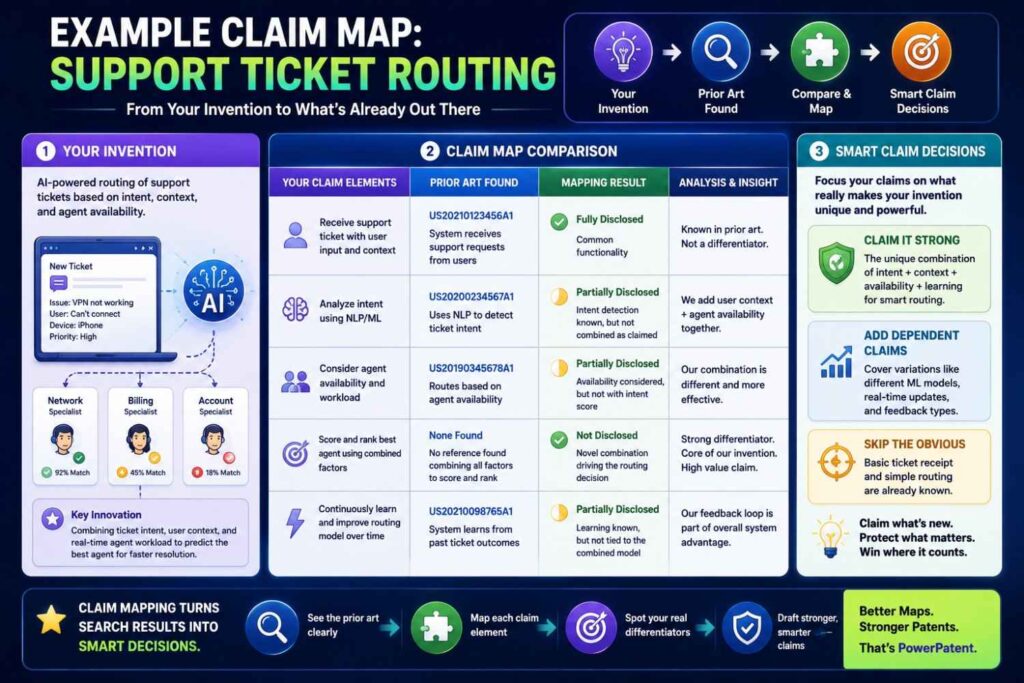
Imagine your startup builds AI support software.
Your working claim is:
“A system that routes support tickets by creating a failure-pattern score from ticket text, error logs, software version, and recent configuration changes, then asking one clarifying question when the score is in a middle-confidence range.”
Elements:
Receives a support ticket.
Uses ticket text.
Uses error logs.
Uses software version.
Uses recent configuration changes.
Creates a failure-pattern score.
Uses a middle-confidence range.
Asks one clarifying question before routing.
Updates the failure pattern after confirmed resolution.
Reference A classifies tickets using text.
Reference B uses logs to detect software failure.
Reference C routes tickets based on confidence.
Reference D asks clarifying questions in a chatbot flow.
The map shows a crowded field.
The strong angle may be the combined failure-pattern score plus the middle-confidence clarifying question before routing.
If the system also updates patterns only after confirmed fixes, that may be another strong element.
The technical result is fewer wrong auto-responses and fewer unnecessary human handoffs.
That is a clear claim story.
What Makes a Claim Map Weak
A weak claim map is vague.
It maps broad themes instead of real elements.
It says “AI” instead of “source-trust score.”
It says “sensor” instead of “pressure drift during matched charging windows.”
It says “feedback” instead of “threshold update after confirmed false alert.”
It says “similar” without explaining how.
It ignores partial matches.
It hides close prior art.
It does not include source locations.
It does not end with a decision.
A weak map gives false comfort.
A strong map gives clarity, even if the answer is not what you hoped.
What Makes a Claim Map Strong
A strong claim map is specific.
It breaks the invention into meaningful pieces.
It maps the closest references.
It notes exact matches, partial matches, and gaps.
It explains why the gaps matter.
It considers combinations.
It ties differences to technical results.
It suggests claim refinements.
It supports a decision.
It is honest enough for attorneys and clear enough for founders.
That is the goal.
Claim Mapping Does Not Replace a Patent Attorney
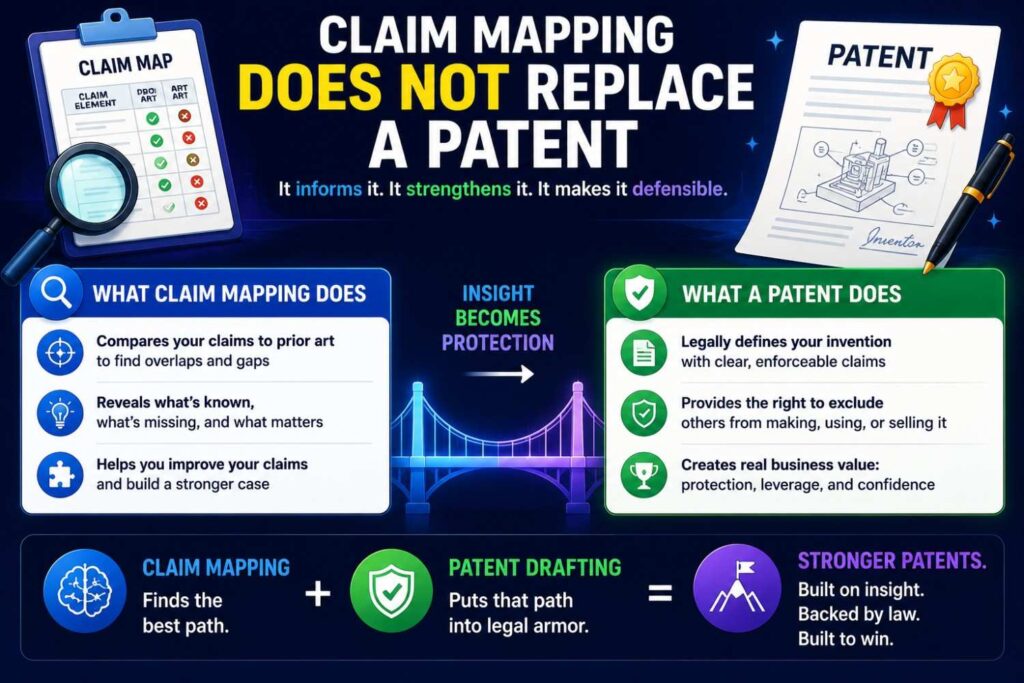
Claim mapping is powerful, but it is not a substitute for legal judgment.
Patentability can turn on legal rules, claim wording, filing dates, prior art status, examiner views, and case law.
A founder-led map is a great starting point.
An attorney-led review is important when the invention matters.
PowerPatent combines both sides: smart tools that help capture and organize the invention, plus real patent attorney oversight to guide filing strategy. That means founders do not have to choose between moving fast and filing carelessly. See how PowerPatent works.
How PowerPatent Fits Into This Process
Founders do not need more paperwork.
They need a faster path from invention to decision.
That is what PowerPatent is built for.
You can start with the raw material your team already has: product notes, code details, diagrams, model flows, design docs, search results, and engineer explanations.
PowerPatent helps turn that material into a clearer invention record.
Then real patent professionals can review the work, shape the claims, and help move toward filing.
This is especially useful for deep tech teams because the best patent details are often buried in the build process.
A traditional patent process may miss those details if it starts with a short founder summary.
A better process starts with how the system actually works.
That is where claim mapping adds value.
It turns “we think this is new” into “here is the technical gap we should protect.”
Common Mistake: Mapping the Product Instead of the Invention
Your product may be broad.
Your invention is usually narrower.
A founder might say:
“We built a platform that automates patent drafting.”
That is a product.
The invention may be:
“A system that maps invention disclosure sections to claim elements, detects missing support, and routes unsupported claim elements for attorney review before filing.”
That is more specific.
Mapping the product leads to weak results.
Mapping the invention leads to useful decisions.
Before you map, ask:
What technical move are we protecting?
What makes it hard to copy?
What does it do that old systems do not?
What result improves?
If you cannot answer, pause and clarify the invention first.
Common Mistake: Making Every Feature Required
Do not turn every product detail into a claim element.
If your working claim has twenty required parts, it may be too narrow.
A competitor may avoid one part and escape.
Claim mapping helps you find which elements are truly needed.
For example, your prototype may use AWS, Python, a specific model, a specific vector database, and a certain dashboard layout.
Those may not belong in the broad claim.
The real invention may be the logic that compares source trust and model confidence before review routing.
Keep implementation details as examples or backup positions when appropriate.
Do not let them choke the main claim.
Common Mistake: Ignoring the “Why”
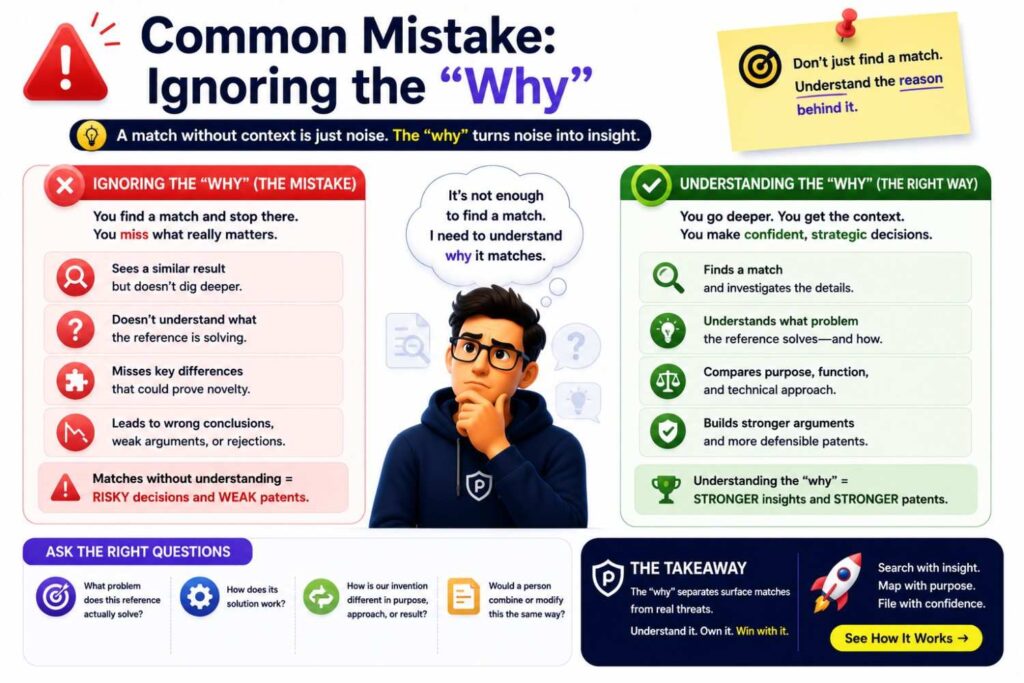
A map that only says yes or no is incomplete.
You need the why.
Why is this feature different?
Why does it matter?
Why would the prior art not lead there?
Why does the result improve?
This is where persuasion begins.
Patents are technical documents, but they still need a clear story.
The story is not hype.
It is cause and effect.
Because the system does A, it can do B.
Because the device measures X during Y, it avoids Z.
Because the model checks source trust before display, it catches unsupported answers.
Because the robot predicts before visual detection, it slows earlier.
That is the kind of writing that makes a patent disclosure stronger.
Common Mistake: Treating All Prior Art as Equal
Some references matter more than others.
A competitor blog post with vague claims may be less important than a detailed patent.
A patent with the same title may be less important than a paper that teaches the core method.
A foreign reference may be more important than a local result.
An old manual may be more important than a new marketing page.
Rank your references.
Which one is closest?
Which one shows the most elements?
Which one shows the core element?
Which one could combine with the closest reference?
Which one is just background?
This helps you focus.
Common Mistake: Stopping at the First Gap
Finding a missing feature is good.
But do not stop.
Ask whether another reference teaches that missing feature.
If yes, ask whether combining the references makes sense.
If no, ask whether the missing feature is important enough.
A missing feature that does not affect the result may not help much.
A missing feature tied to a clear technical result is much stronger.
For example, prior art may miss “green button on the dashboard.” That likely does not matter.
Prior art may miss “review trigger based on source-trust conflict.” That may matter.
Quality of the gap matters more than the number of gaps.
Common Mistake: Forgetting Dates
When mapping prior art, record publication dates and filing dates.
For patents, record priority date if available.
A reference published after your filing date may not be the same kind of risk as a reference published before.
A patent granted recently may have been filed years ago.
A product page may have changed over time.
A GitHub repo may have commit dates.
A paper may have preprint and journal dates.
Do not rely on memory.
Write dates into the map.
Common Mistake: Ignoring Non-Patent Art
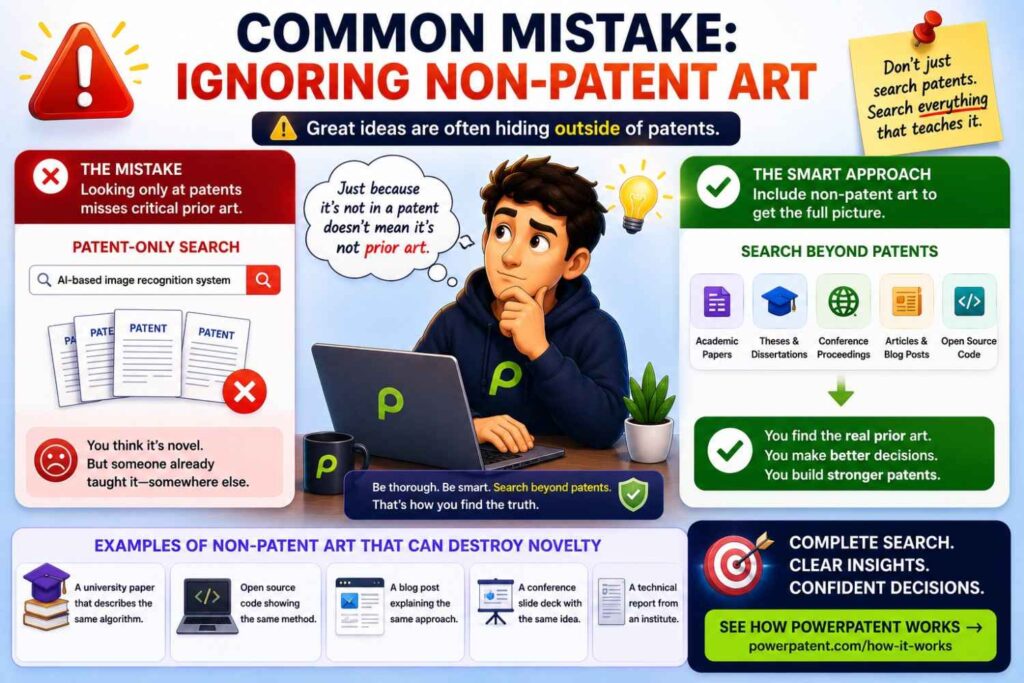
Prior art is not only patents.
Research papers, open source code, standards documents, manuals, product docs, videos, conference talks, theses, and public datasets can matter.
For software and AI, non-patent art is often very important.
For hardware, manuals and standards can be key.
For robotics, conference papers and videos may be useful.
For biotech, papers and protocols may matter.
Do not map only patents if the field publishes heavily outside patents.
A strong patentability view looks at the real technical world, not just patent databases.
Common Mistake: Claim Mapping Too Late
Claim mapping after filing can still help, especially during examination.
But mapping before filing is better.
Before filing, you can adjust the disclosure.
You can add examples.
You can include alternatives.
You can explain technical results.
You can build backup positions.
After filing, you may be limited by what the application already says.
This is why early mapping is powerful.
It shapes the filing while there is still time.
How to Talk About the Map With Your Team
A claim map should not stay with one person.
Bring it to the team.
Ask engineers whether the mapped elements are accurate.
Ask product leaders which features matter most.
Ask founders which areas matter to the business.
Ask attorneys how the claims should be shaped.
Keep the discussion focused.
Do not debate whether the product is “innovative” in a broad sense.
Ask whether the mapped invention is new enough, strong enough, and valuable enough to file.
The best patent decisions come from clear cross-functional input.
How to Talk About the Map With a Patent Attorney
When you share the map with a patent attorney, include the working claim, the closest references, the element-by-element comparison, and your questions.
Do not only send links.
Explain what you think the gap is.
For example:
“We think Reference A is closest because it uses pressure sensors for swelling detection. It does not appear to compare pressure drift during matched charging windows or adjust the score based on charge rate. Is that enough of a distinction, or should we focus more on the false-alert reduction method?”
That is a useful question.
It helps the attorney give better advice.
It also saves time.
How to Make the Map Attorney-Friendly
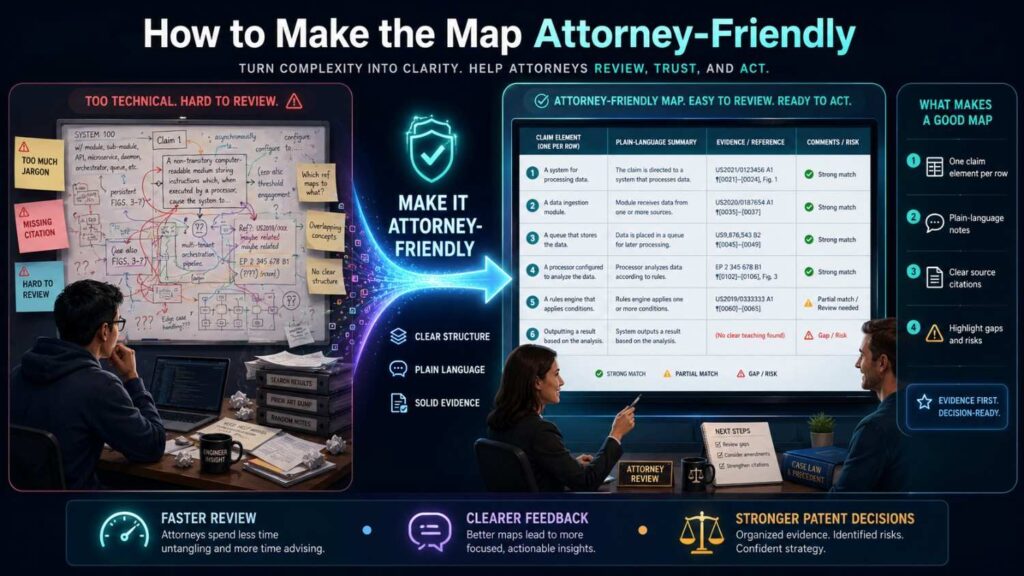
Use clear labels.
Use source links.
Use short notes.
Do not paste long blocks of patent text.
Do not use legal conclusions unless you are sure.
Instead of saying, “This reference does not anticipate,” say:
“This reference appears not to show matched charging windows.”
Instead of saying, “This is non-obvious,” say:
“We did not find a reference that suggests using matched charging windows to reduce false swelling alerts during fast charging.”
That is more helpful.
Let the attorney handle the legal conclusion.
Your map should present the facts clearly.
How to Make the Map Founder-Friendly
Founders need decisions.
So summarize the map in plain language.
What is crowded?
What is open?
What is the strongest claim angle?
What is risky?
What should we file?
What should we search next?
What should we not waste time on?
A founder does not need every paragraph of every patent.
They need the strategic meaning.
For example:
“The broad AI support-routing idea is crowded. The strongest angle is the combined failure-pattern score using logs, version, and recent configuration changes, plus the middle-confidence clarifying question. We should file around that workflow if it is core to the product.”
That is founder-friendly.
How to Make the Map Engineer-Friendly
Engineers need accuracy.
Show them the elements.
Ask whether each element reflects how the system works.
Ask what is missing.
Ask what was hard.
Ask what failed before the current design.
Ask what could be changed without losing the result.
Ask what a competitor would copy.
Engineers can often spot the real invention better than anyone.
They may say:
“The key is not the score. The key is when we run the score.”
Or:
“The source-trust part is easy. The hard part is updating trust without letting one bad review corrupt the system.”
Or:
“The sensor placement matters more than the algorithm because the signal is useless unless measured at that point.”
Those comments can change the claim strategy.
Claim Mapping and Trade Secrets
Not every technical edge should be patented.
Some details may be better kept secret.
Claim mapping can help with that decision.
If a feature is hard to reverse engineer, not visible from the product, and not needed to explain the patentable invention, trade secret protection may be worth discussing.
But trade secrets have limits.
If a competitor can inspect the product and learn the feature, secrecy may not last.
If the feature is likely to be independently developed, patent filing may be better.
If disclosure would give away too much and the claim value is low, secrecy may be better.
This is a business and legal decision.
A claim map helps by showing which features are needed for patentability and which may be optional details.
Claim Mapping and Design-Around Thinking
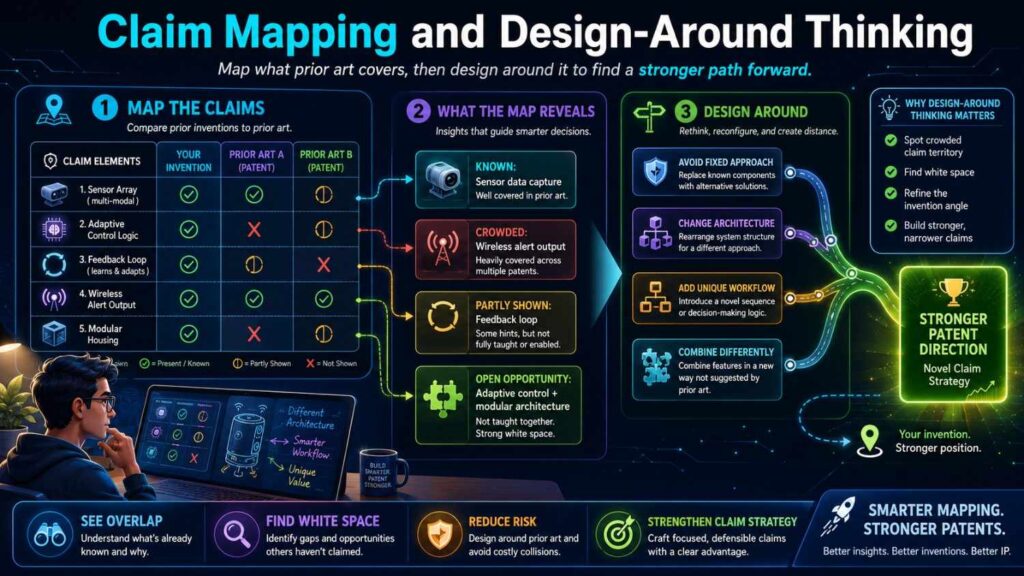
A strong claim map should include design-around thinking.
Ask how a competitor might avoid the claim.
If your claim requires temperature, could a competitor use humidity?
If your claim requires sound direction, could a competitor use vibration?
If your claim requires human review, could a competitor use a second model?
If your claim requires a fixed set of inputs, could a competitor remove one?
This does not mean you should make the claim vague.
It means you should draft with alternatives in mind.
The patent application should describe different ways to practice the invention when those ways are real.
This gives your attorney more room to write claims that are harder to avoid.
Claim Mapping and Detectability
A patent is more useful when you can tell if someone is using the invention.
Some backend methods are hard to detect from outside.
That does not make them worthless, but it matters.
In your map, add a business note:
Can we detect use?
Would it show in product behavior?
Would it appear in logs during a partnership?
Would a customer see it?
Would a competitor advertise it?
Would testing reveal it?
Would discovery in litigation be needed?
A claim that is hard to detect may still be valuable, especially for fundraising or defensive use. But detectability should be part of the decision.
Claim Mapping and Claim Breadth
Claim breadth is not about using broad words.
It is about covering meaningful variations while staying clear of prior art.
A broad claim that reads on old systems is weak.
A narrow claim that covers only one exact prototype may be easy to avoid.
Claim mapping helps balance this.
For each element, ask:
Can this be stated more generally?
Would a more general statement hit prior art?
Can examples support the general statement?
Should the broad claim use a general term and the backup claim use the specific term?
For example:
Specific: “charge rate and temperature.”
Broader: “charging context data.”
Even broader: “operating context data.”
The map helps decide which level is safe.
If prior art already uses operating context data broadly, you may need “charging context data” or even “charge rate and temperature.”
If prior art does not teach matched operating windows at all, you may have room for broader language.
This is where attorney judgment is key.
Claim Mapping and Dependent Claims
Dependent claims are narrower claims that add extra features.
They are useful backup tools.
Claim mapping helps decide what dependent claims should cover.
Good dependent claim ideas often come from:
Features missing in some references.
Technical results.
Alternative inputs.
Alternative outputs.
Special triggers.
Feedback updates.
Hardware placements.
Timing windows.
Edge cases.
Fallback workflows.
For example, a broad claim may cover source-trust-based AI review.
Dependent claims may cover source trust based on author role, document age, citation support, past accuracy, user feedback, or conflict with model confidence.
A broad claim may cover matched operating windows.
Dependent claims may cover charging windows, load windows, temperature windows, pressure drift, vibration drift, or post-event recovery windows.
These layers can make the filing stronger.
Claim Mapping and Specification Support
A claim is only useful if the application supports it.
Claim mapping may reveal claim ideas that are not yet described in your invention notes.
Before filing, add support.
If you may want to claim source trust based on author role, describe it.
If you may want to claim charge-rate matching, describe it.
If you may want to claim different control outputs, describe them.
If you may want to claim a second-model review instead of human review, describe it if it is a real version.
Do not assume you can add details later.
A strong application gives you room.
A thin one can trap you.
Claim Mapping and Technical Story
Every strong patent filing needs a technical story.
Not hype.
Not marketing.
A clear explanation of problem, solution, and result.
Claim mapping helps build that story.
The prior art did X.
X had a problem.
Our invention does Y.
Y solves the problem by doing Z.
The result is better because of A.
For example:
Prior systems used fixed pressure thresholds to detect battery swelling. Fixed thresholds can create false alerts during fast charging because temporary expansion may look like dangerous swelling. Our system compares pressure drift during matched charging windows and adjusts the swelling score based on charge rate and temperature. This reduces false alerts while still detecting early swelling risk.
That is a strong story.
It is simple.
It is technical.
It is grounded in the map.
Claim Mapping and White Space
White space is the open area between what the prior art teaches and what your product does.
Claim mapping helps find it.
But white space is not always valuable.
The open area must matter.
A white space around a tiny unused feature may not be worth filing.
A white space around a core workflow may be valuable.
When you find white space, ask:
Is this central to our product?
Will competitors need it?
Does it create a real technical result?
Can we describe it well?
Can we detect copying?
Can it support future products?
If yes, you may have a strong filing opportunity.
Claim Mapping and Portfolio Planning
One patent rarely protects a whole company.
A portfolio is a set of filings that protect different parts of the technology.
Claim mapping helps plan that portfolio.
It can show that one invention is ready to file now.
Another needs more testing.
Another is blocked by prior art.
Another should be split into a separate filing.
Another should be kept secret.
Over time, this creates a smarter IP plan.
For example, an AI infrastructure startup may build filings around:
Model output verification.
Source trust scoring.
Compute-saving routing.
Human review feedback.
Deployment safety controls.
Customer-specific model adaptation.
Each filing can be mapped separately.
Together, they may protect the real system better than one broad filing.
The Best Time to Claim Map
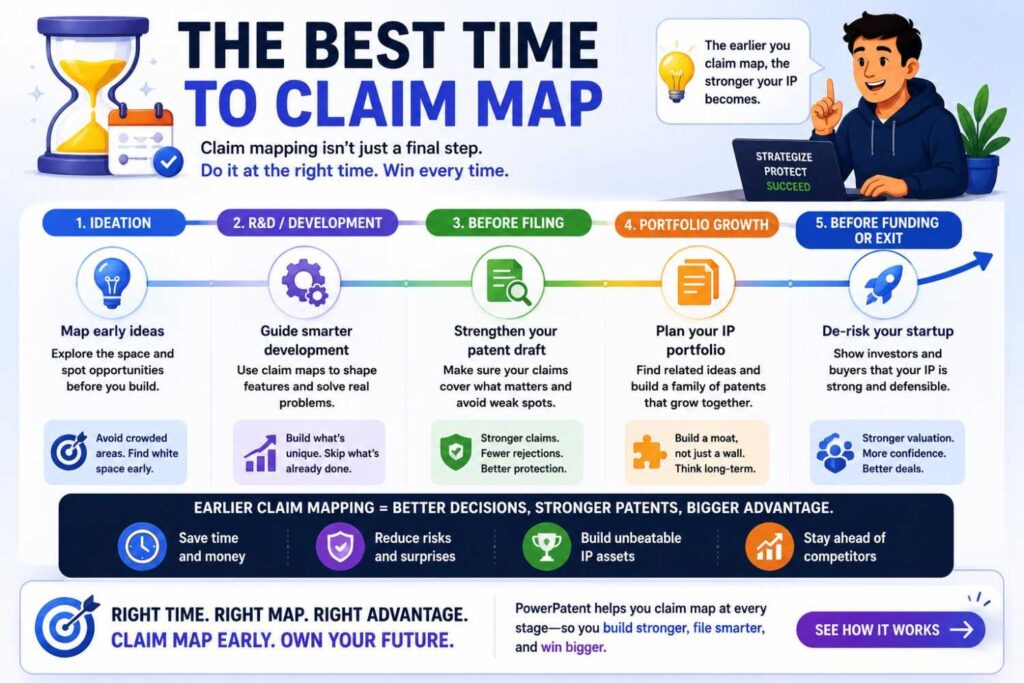
The best time is when the invention is clear enough to explain and before you disclose it publicly.
That may be after a prototype.
It may be after a design review.
It may be before a launch.
It may be before a conference talk.
It may be before investor diligence.
It may be before open sourcing.
Do not wait until everything is perfect.
But do not map so early that the invention is only a vague wish.
The sweet spot is when engineers can explain the technical method and why it works.
A Founder’s Claim Mapping Template
Use this simple template.
Working claim:
Closest prior art:
Element one:
Does Reference A teach it?
Does Reference B teach it?
Does Reference C teach it?
Notes:
Element two:
Does Reference A teach it?
Does Reference B teach it?
Does Reference C teach it?
Notes:
Strongest missing element:
Technical result:
Combination risk:
Backup claim ideas:
Business value:
Recommended decision:
This is enough to start.
You can make it deeper later.
A Better Way to Think About Patentability
It is not a gut feeling.
It is not the number of search results.
It is not whether your product feels new.
It is a careful comparison between what you want to claim and what came before.
Claim mapping gives you that comparison.
It helps you move from:
“I think this is new.”
To:
“The closest prior art shows A and B, but not C. C matters because it creates D. We should claim C in a way that covers our product and future versions.”
That is the shift.
That is where real patent strategy starts.
Final Takeaway
Search results are only the beginning.
Claim mapping turns them into decisions.
It shows what the prior art teaches, what it misses, what your invention really adds, and where your patent filing should focus.
For founders, this is a powerful habit. It saves time. It reduces guesswork. It helps avoid weak filings. It helps uncover stronger inventions. It helps your patent attorney move faster and with better facts.
Start with a plain-English claim. Break it into elements. Map the closest prior art. Look for the real gap. Tie that gap to a technical result. Then decide what to file.
That is how you turn search into strategy.
And when you want help turning invention notes, code, diagrams, and search results into stronger patent filings, PowerPatent is built to help. It combines smart software with real patent attorney oversight so founders can protect what they are building without slowing down.
Leave a Reply