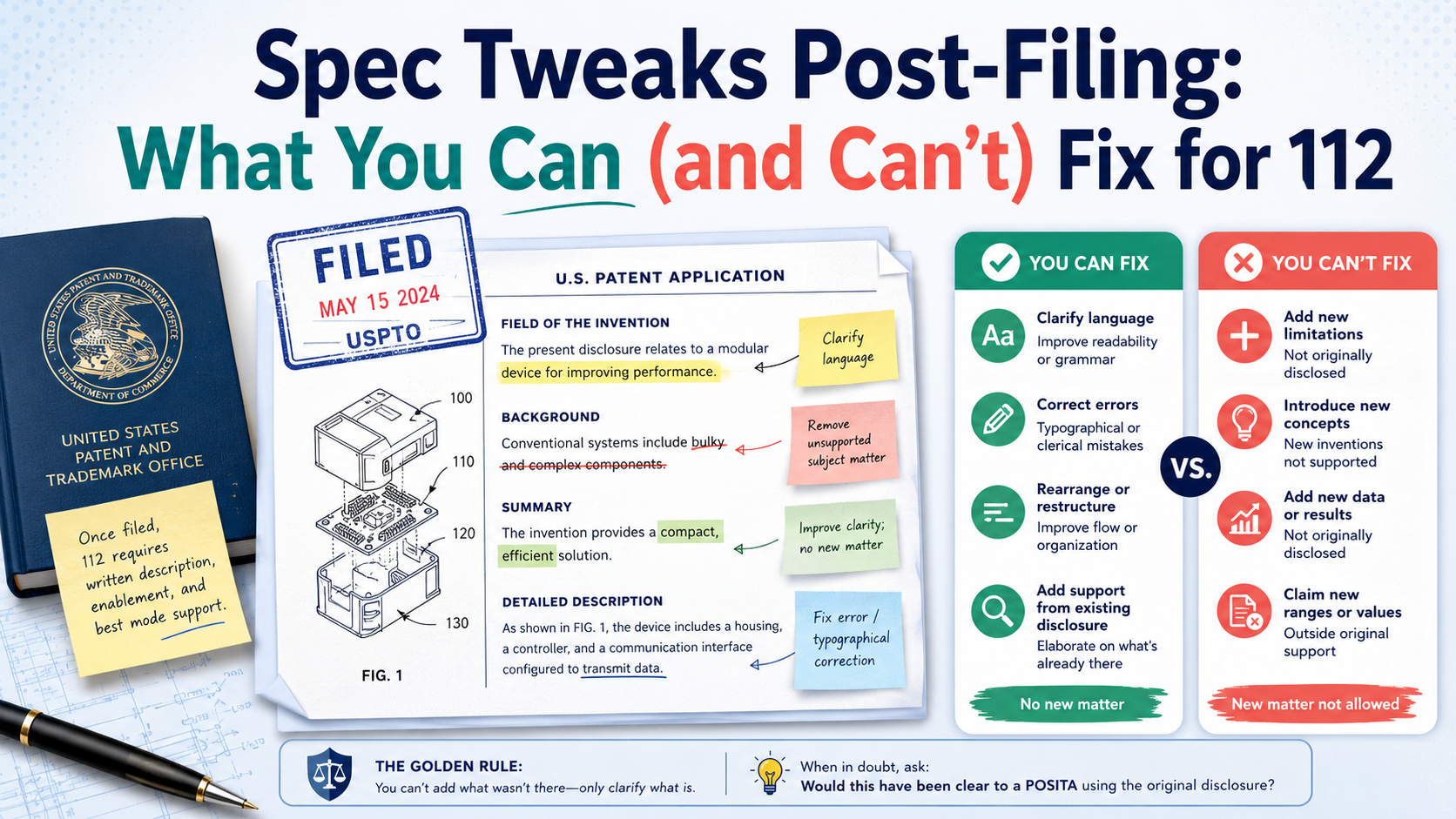
A patent filing date can feel like a finish line. It is not. It is more like wet concrete. You may still smooth the surface, clean up marks, and make the shape clearer. But you cannot pour in new concrete after the fact and pretend it was always there.
The first job is to know which 112 problem you are fixing
When a founder sees a 112 rejection, the first reaction is often, “Can we just explain it better?” Sometimes the answer is yes.
Sometimes the answer is no. The difference comes down to one simple question: was the support already in the application when it was filed?
That question drives almost everything.
A patent application is not just a story about your product. It is the proof that you had the invention on the filing date.
After that date, you may polish what is already there. You may point the examiner to the right page.
You may change the claims so they better match the filing. You may fix unclear words. But you cannot add missing invention meat and act like it was always included.
That is why post-filing tweaks must be handled with care. A rushed fix can create a bigger problem than the one you started with.
A smart fix can save months, reduce back-and-forth, and protect the strongest version of the idea.
For a founder, this is where the filing stops being “paperwork” and starts being strategy.
If the spec was drafted with strong fallbacks, examples, diagrams, and clear use cases, you have room to move. If it was thin, every move gets harder.
PowerPatent helps teams build that room early, before the filing date locks the door. You can see how the process works here: https://powerpatent.com/how-it-works
A 112 issue is not always the same kind of issue
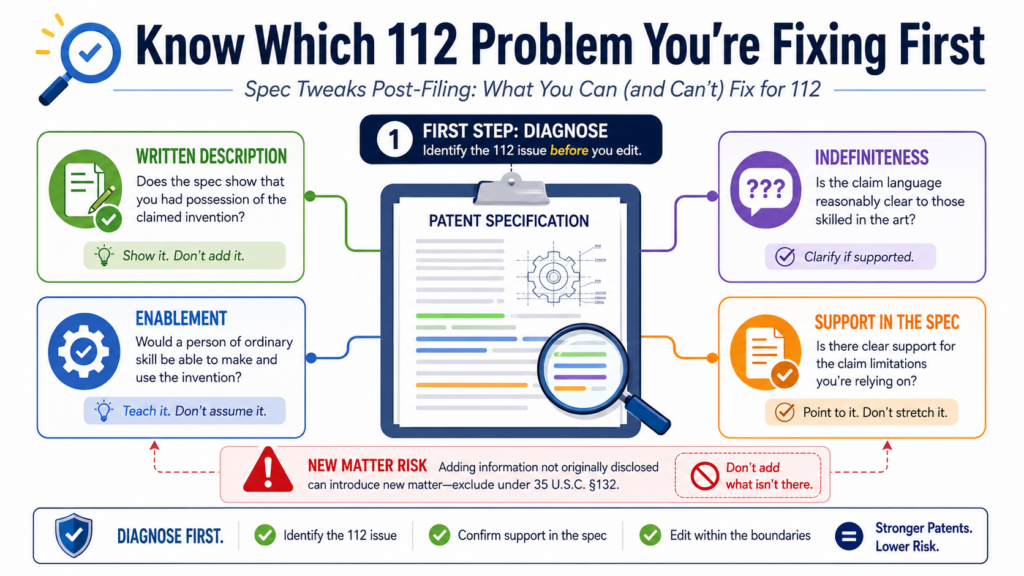
Section 112 covers several different problems.
In plain words, the application must show what the invention is, teach people in the field how to make and use it, and make the claims clear enough so others can understand the border of the patent.
The USPTO describes these as separate 112 requirements, including written description, enablement, and definiteness.
That matters because each type of problem has a different cure.
If the examiner says the claims are unclear, you may be able to fix the wording. If the examiner says the claim has no written support, you may need to show where the spec already described that feature.
If the examiner says the application does not teach enough, you may need to argue that a skilled person could make and use the invention from what was filed. In some cases, you may need to narrow the claim to match the real disclosure.
The danger is treating every 112 rejection like a grammar issue. It is not. Some 112 issues are wording problems.
Some are proof problems. Some are missing-detail problems. Only the first two are usually fixable without major damage.
The fix starts with the rejection, not with the urge to rewrite
Before touching the spec, read the rejection like a map. Do not jump straight into edits.
Find the exact claim term, phrase, step, or feature the examiner has flagged. Then match that issue to the filed spec, drawings, examples, and original claims.
This is where founders can help their patent team a lot. You know the product, the code, the model, the system flow, and the edge cases.
Your job is not to write legal arguments. Your job is to help find the technical truth that was already filed.
A good review asks a few core questions. Did the original filing name this part? Did it show this flow? Did it explain this output? Did it describe this model behavior?
Did a drawing show the structure even if the text used different words? Did the original claims already include the idea in some form?
If the answer is yes, the fix may be clean. If the answer is no, the team has to be more careful. You may need a continuation, a new filing, or a narrower claim plan rather than a risky amendment.
You can often fix unclear claim language without changing the invention
Many post-filing fixes are not about adding technology. They are about making the claim words line up with the technology that was already disclosed.
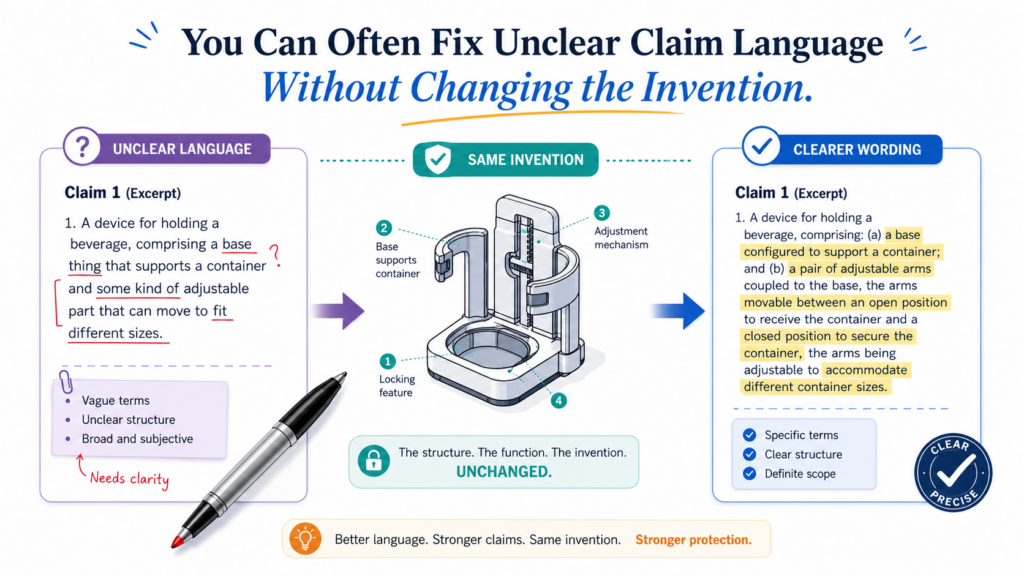
This is often the best kind of fix because it can improve the application without crossing into new matter.
Claims are the part of the patent that define the fence. The spec is the support behind the fence.
If the fence is crooked, you may be able to straighten it. But you cannot move the fence onto land the original filing never covered.
This shows up often in software, AI, robotics, chips, medical devices, clean tech, and other deep tech filings. A claim may use a broad term like “processor,” “engine,” “module,” “model,” “controller,” or “signal.”
The examiner may ask what that term means or how it works in the invention. If the spec already explains the part, you can often adjust the claim language to be clearer.
That kind of fix can be powerful. It does not make the invention smaller for no reason. It makes the invention easier to examine.
It also makes the final patent easier to read later when an investor, partner, competitor, or buyer looks at it.
Clearer words can be safer than bigger words
A lot of founders think broader words are always better. That is not true. A broad claim that is unclear or unsupported may fail. A clear claim with strong support may be far more valuable.
For example, say the claim says “training a model based on data.” That may be too thin if the invention is really about filtering sensor data before training, weighting rare events, and updating the model only when a confidence score passes a set level.
If the spec already describes those steps, the claim can be changed to include them.
That is not a loss. That is often a better patent path.
The goal is not to claim the whole universe. The goal is to claim the part of the universe you actually built and described.
Strong patents often win because they are specific where it matters and broad where the support allows.
This is why PowerPatent is built for technical teams. The system is designed to help turn real engineering detail into patent-ready detail, with attorney review layered in.
That helps you avoid vague filings that sound big but are hard to defend. See the workflow here: https://powerpatent.com/how-it-works
The best claim edits use words the spec already supports
When fixing a 112 issue, the safest words are usually words already in the filing. That does not mean every amendment must copy the spec word for word. But the meaning should be clearly backed by what was filed.
If the spec says the system “ranks candidate outputs using a confidence score,” then a claim amendment around ranking, candidate outputs, and confidence scores may have support.
If the spec never talks about confidence scores, adding that idea later may be a problem.
Drawings can help too. A block diagram, flow chart, data path, or architecture figure may support an amendment, especially when the text describes what the drawing shows.
Original claims can also help because they are part of the original disclosure. The USPTO treats the application as a whole when looking at whether the inventor had possession of the claimed invention.
This is why “small” drafting choices at the start are not small. Labels in figures matter. Alternate examples matter. Input and output detail matters. Failure modes matter. So do fallback versions.
A strong original filing gives your future self more tools.
You can clean up the spec, but you cannot add missing invention substance
There is a big difference between fixing form and adding substance.
Form fixes are things like correcting a typo, fixing a reference number, making wording consistent, or changing a sentence so it reads more clearly.
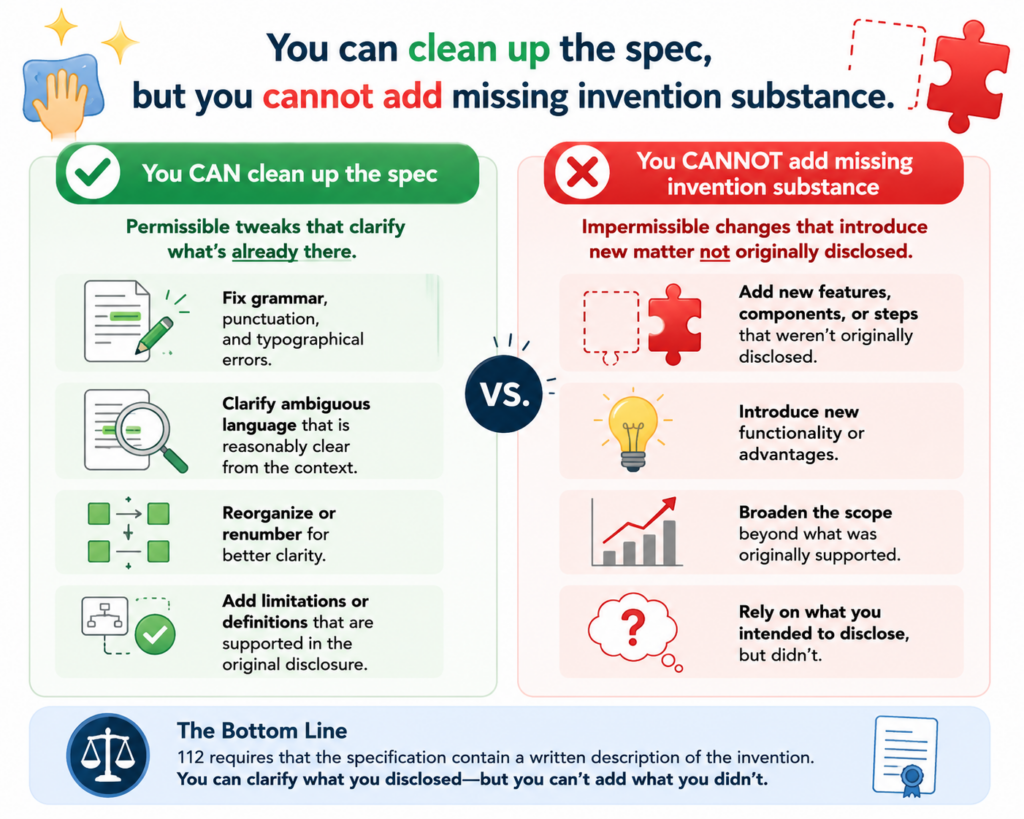
These changes may be allowed when they do not add new technical content. Substance fixes are different. They add information that was not really present at filing. That is where the risk begins.
The USPTO rules on new matter are strict because the filing date has value. If applicants could add new technical details later while keeping the old filing date, the system would be unfair.
So the test is not, “Did the founder really know this?” The test is closer to, “Did the application as filed show this clearly enough?”
That can be painful for technical founders. You may have had the feature in your code. You may have shown it in a demo.
You may have explained it to your team. But if it did not make it into the filed application, it may not be available as support for that filing.
The MPEP section on new matter explains that matter not present in the specification, claims, or drawings on the application filing date cannot be added later by amendment.
The painful rule is simple: later knowledge does not fix an earlier gap
Imagine your filed spec says your AI tool “selects a response.” After filing, the examiner says the claim is not supported because the claim says the tool selects a response using a two-stage scoring process with a safety filter.
You check the spec and realize the two-stage scoring process is not described. The safety filter is in your product, but not in the filing.
That is not a small gap. That is likely a support gap.
You may be able to claim “selecting a response” if that is supported. You may be able to argue that the filed system implies some selection logic.
But adding the exact two-stage scoring process and safety filter to the old application may be new matter if the original filing did not show it.
This is where founders need to slow down. A bad amendment can pollute the file history and create future weakness.
A better path may be to file a continuation-in-part or a new application for the added feature while still pursuing supported claims in the first case.
The key is not panic. The key is sorting what was filed from what was known but not filed.
A strong response separates explanation from new disclosure
You can explain what the original spec already means. You cannot use the response as a back door to add new invention detail.
That line can feel thin, so here is the practical way to think about it. If you are pointing to an existing paragraph, figure, claim, or example and explaining how it supports the claim, you are likely in safer territory.
If you are writing a fresh technical description that the filing never taught, you are likely moving toward new matter.
This matters most in fast-moving startups. Product teams keep building after the patent is filed.
By the time an Office Action arrives, the product may be much better than the version described in the application. That is normal. But the new product version does not automatically belong in the old filing.
This is why PowerPatent’s approach is so useful for builders. It helps capture technical depth while the invention is fresh, not months later when everyone is trying to rebuild the story from memory.
The faster you turn real work into a strong filing, the less you depend on risky patchwork later. Learn more here: https://powerpatent.com/how-it-works
The safest post-filing tweak is often a claim change, not a spec change
When a 112 issue appears, many people want to edit the spec first. That can be the wrong instinct. Often, the cleaner move is to amend the claims so they fit the spec that already exists.
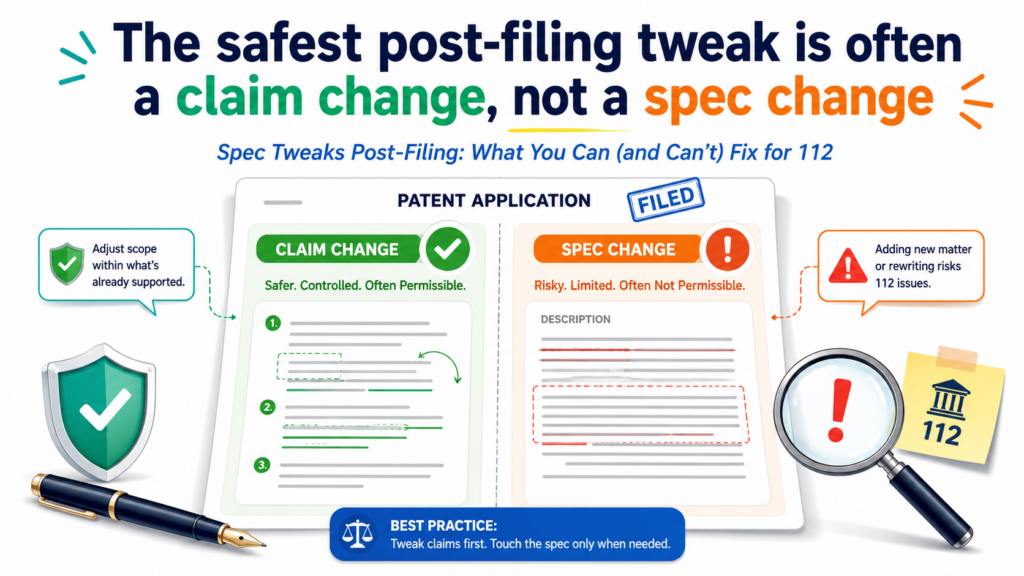
This is less dramatic than rewriting the application, but it is often more effective. The claims are what the examiner is rejecting.
If the claims reach beyond the written support, the answer may be to pull them back to what the filing actually teaches.
If the claims are unclear, the answer may be to define the disputed term through better claim wording.
This does not mean giving up. It means building the patent on stable ground.
A claim that is tied to real support can still be broad. It can still block key competitor paths. It can still matter in fundraising, diligence, licensing, and acquisition talks.
But it has a better chance of surviving because it is connected to the filed disclosure.
Narrowing is not always weakness when it protects the core
Founders often fear narrowing because it feels like losing ground. That fear is understandable. You filed because you wanted protection.
Now someone is telling you to limit the claim. It can feel like the patent is shrinking before it is even granted.
But smart narrowing is not the same as surrender.
A weak broad claim may look good on paper and fail when tested. A focused claim that covers the real product, the key technical step, or the hard-to-copy system behavior may be much stronger.
The question is not, “Did we keep every possible word broad?” The question is, “Did we protect the thing that makes the invention valuable?”
For example, if the real value is a low-latency control loop for a robotic arm, a claim that clearly covers that loop may matter more than a vague claim to “automated control.”
If the real value is a model update method that reduces false alarms, claim that method with care. If the real value is how data moves through your system, protect that path.
Good patents are not just wide. They are sharp.
The claim should match the business use case
A 112 fix is not only a legal task. It is a business task.
Before you amend, ask what the claim needs to protect. Is the target your current product? A planned product line? A platform layer? A data pipeline? A model training flow?
A device architecture? A manufacturing step? A partner integration? A likely copycat move?
This is where technical founders bring huge value. Your patent team can map the law, but you know where the business is going.
The best 112 response blends both views. It fixes the rejection while keeping the claim aimed at the commercial center of the invention.
That is also why early drafting should not be treated as a one-time legal chore. The best filings are built from real product insight, real engineering notes, and real future plans.
PowerPatent gives founders a faster way to capture those details with software, then adds real attorney oversight so the final filing is not just fast, but strong. Start here: https://powerpatent.com/how-it-works
Written description problems are about proof, not polish
A written description issue means the examiner is asking whether the filed application really shows that the inventor had the claimed invention on the filing date. This is not about whether the invention is good.
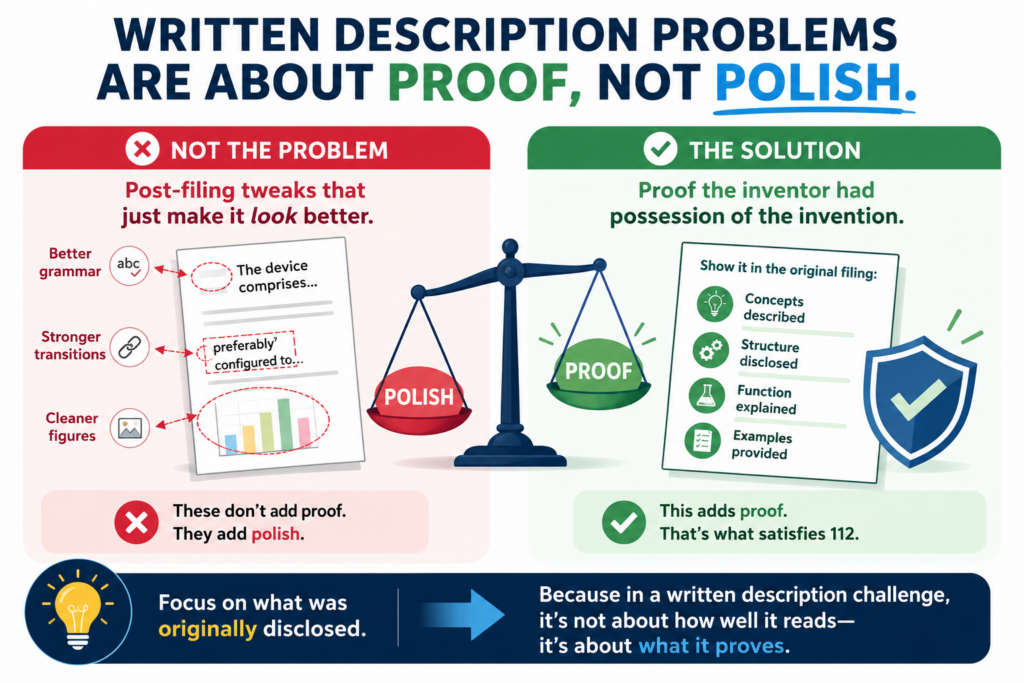
It is not about whether the product works. It is about whether the patent filing itself shows enough detail to support the claim.
The USPTO treats written description as separate from enablement, which means teaching how to make and use the invention is not always enough by itself. The filing must also show possession of the claimed idea.
This is where many software and AI filings get into trouble. The draft may talk about a result, like better matching, faster routing, safer control, or improved prediction.
But the claim may later try to cover the method that creates that result. If the filed spec did not explain that method with enough detail, the claim may feel too big for the original disclosure.
The fix is not to write a brand-new story. The fix is to build a support map from what already exists in the filing.
You look for exact words, similar words, diagrams, examples, data flow, system blocks, original claims, and any step-by-step logic that shows the invention was already there.
The strongest support is usually hiding in the boring parts of the filing
Founders often focus on the abstract and summary because those parts feel like the “pitch.” But support often lives deeper in the spec.
It may be in a flow chart. It may be in a short example. It may be in a figure label. It may be in a paragraph that explains how one module sends data to another.
That is why you should not respond to a written description rejection from memory. You should respond from the filed document.
The question is not, “Did our system do this?” The question is, “Where did the filed application show this?”
This is also why broad technical words can hurt you. A phrase like “using machine learning” may sound flexible, but it may not support a later claim to a very specific model update method.
A phrase like “processing sensor data” may not support a claim to a special filtering sequence unless that sequence was disclosed.
A strong patent filing gives you many ways to say, “Yes, this was already described.” A thin filing forces you to argue from shadows.
The practical move is to build a claim-by-claim support chart
Before changing anything, make a simple support chart. Take each claim phrase that the examiner challenged and place the best support next to it. Do not paraphrase first. Find the real filed text first.
For example, if the claim says “generating a ranked set of candidate actions based on a confidence value,” look for every place the filed spec talks about ranking, candidate actions, scores, thresholds, confidence, model outputs, or decision logic. If the figure shows this path, note that too.
If an original claim used a similar idea, add it.
Once you see the support clearly, you can choose the safest fix. You may argue that the claim is already supported. You may amend the claim to use the same words as the spec.
You may remove an unsupported feature. You may split the claim into a narrower version now and save broader ideas for a later filing if support exists elsewhere.
PowerPatent helps founders avoid this scramble by capturing more of the invention at the start, while the engineers still remember the why, how, and edge cases.
That makes the later support map much easier to build. See how it works here: https://powerpatent.com/how-it-works
Enablement problems are about whether someone can make and use the invention
Enablement is different from written description. Written description asks whether the filing shows you had the invention.
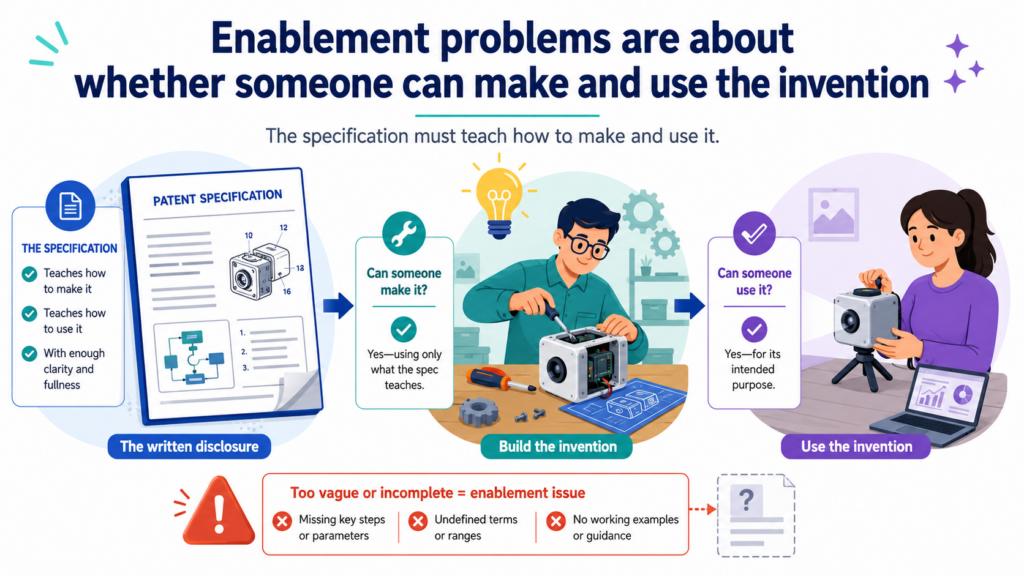
Enablement asks whether the filing teaches enough so a person skilled in the field can make and use it without too much trial and error.
The USPTO states that enablement is separate from written description, so an application can run into one issue even when the other seems fine.
For founders, this is a key point. A filing may clearly say what the invention is, but still not teach enough about how it works. This happens a lot when the draft uses high-level product language instead of engineering detail.
For example, a filing might say the system “detects abnormal behavior in real time.” That sounds clear.
But if the claim depends on a special real-time detection method, the spec should explain the inputs, the model or rule path, the timing logic, the output, and how the system handles hard cases.
Without that, the examiner may say the filing does not enable the full claim.
The post-filing fix depends on what was already taught. If the spec includes enough steps, examples, system structure, and context, you may be able to explain that a skilled person would know how to implement it. If the spec only states the result, you may need to narrow the claim.
The best enablement response explains the path from input to output
In technical terms, enablement often lives in the path. What comes in? What changes? What checks happen? What comes out? What hardware, software, model, sensor, chip, device, or control step is used? What happens when the first try fails? What is optional? What is required?
A good response does not need to turn the patent file into a product manual. But it should show that the filing gave enough teaching for the claimed invention.
If the original spec already had examples, use them. If the figures show the system path, point to them. If the claim can be amended to match the taught path more closely, consider doing that.
This is where founders and engineers can make the response much stronger. Your patent team may know how to answer the examiner, but your team knows what details matter in the system.
You can explain which parts are standard, which parts are special, and which parts are the reason the invention works.
That context can shape a clean response without adding new matter.
Do not confuse “we know how” with “the filing teaches how”
This is one of the most common founder traps.
Your team may know exactly how to build the invention. Your repo may show it. Your notebooks may show it. Your prototype may prove it. But the patent application has to stand on what it disclosed at filing.
Later code, later tests, and later product detail may help you understand the issue, but they usually cannot be used to add missing teaching into the old application.
That does not mean you are stuck. It means you need the right path. You may keep fighting for claims that are enabled by the filed spec.
You may file a new application for the newer implementation. You may use a continuation strategy if the parent has enough support. You may adjust the claim set so it protects the core without depending on missing detail.
The cleanest move is to draft with enablement in mind from day one. That is why PowerPatent is built around real invention capture, not just form filling.
It helps turn technical work into a filing that has more depth, more examples, and better fallbacks, with attorney review before it goes out the door. Learn more here: https://powerpatent.com/how-it-works
Definiteness problems are often the easiest 112 issues to fix, but they still matter
A definiteness issue means the examiner thinks the claim is not clear enough. Under 35 U.S.C. 112(b), claims must point out and distinctly claim what the inventor regards as the invention.
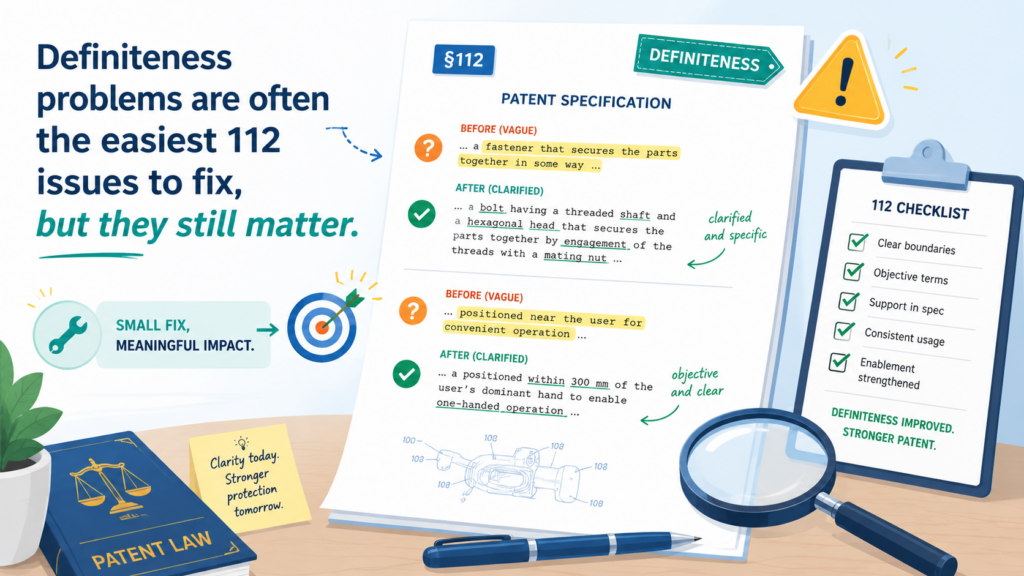
The USPTO explains that, in examination terms, this means the claim language must be definite.
This type of issue can feel less serious than written description or enablement. In many cases, it is easier to fix.
But you should not brush it off. Claim clarity affects the strength of the patent. A vague claim may be harder to allow, harder to enforce, and harder for a buyer or investor to trust.
Definiteness problems often come from words that have no clear boundary. Terms like “near,” “fast,” “smart,” “optimal,” “thin,” “secure,” or “high quality” may raise questions if the spec does not explain what they mean in context.
The problem is not that these words are banned. The problem is that the claim must give enough clarity for the invention’s border to be understood.
The cleanest fix is to replace fuzzy words with working facts
When a claim uses a fuzzy word, ask what that word means in the actual invention. If “fast” means under a certain time, say the time if the spec supports it.
If “secure” means encrypted using a certain process, use that process if it was filed. If “near” means within a set distance, range, signal strength, or network zone, anchor it in supported detail.
Sometimes the fix is as simple as giving the term a clear reference point. A claim may say “the selected output is better than a prior output.”
Better how? More accurate? Lower latency? Lower power use? Fewer false positives? A smaller memory load? The answer should come from the filed spec, not from a fresh idea invented during prosecution.
This is where careful claim wording can save a lot of time. You want the examiner to understand what is being claimed.
You also want future readers to know where the patent fence sits. That future reader may be a competitor, investor, acquirer, licensee, judge, or opposing lawyer.
Clear words are not weak words. Clear words are strong words.
A clarity fix should not quietly shrink the business value
Even when a definiteness fix seems simple, do not make it on autopilot. A small word change can alter the claim’s reach.
For example, changing “user device” to “mobile phone” may clear up one issue, but it may also cut out laptops, vehicles, wearables, embedded systems, and industrial terminals.
Changing “model” to “neural network” may help in one case, but it may exclude rules engines, trees, transformers, hybrid systems, or future model types if those were meant to be covered.
The better move is to pick a clear term that still matches the business goal and the filed support. You may define “user device” through function instead of naming only one device type.
You may refer to “a machine learning model” if the spec supports different model forms. You may use a range, condition, or step rather than a narrow product label.
This is where software plus attorney oversight makes a real difference. PowerPatent helps technical teams capture the invention in plain detail, while real patent attorneys help shape that detail into claims that are clear, useful, and aligned with the business. Start here: https://powerpatent.com/how-it-works
New matter is the line you cannot cross after filing
New matter is the hard stop. If the technical detail was not in the application as filed, you generally cannot add it later to that same application.
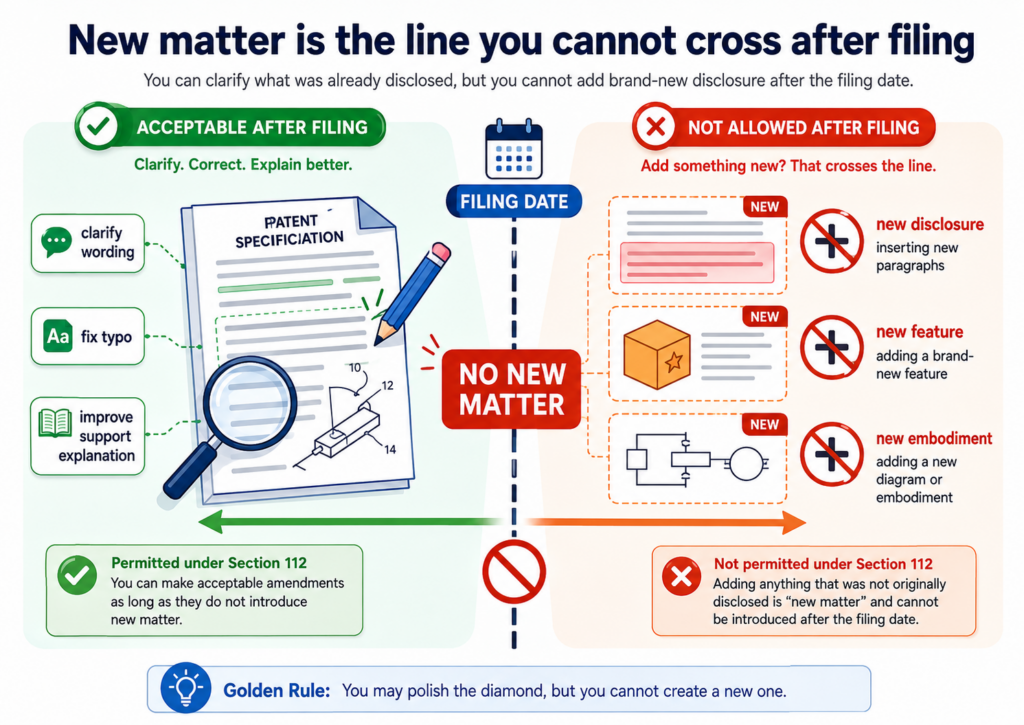
The USPTO’s written description guidance focuses on whether the filed application shows possession of the invention, and its new matter rules prevent applicants from adding later technical content as if it had been there from the start.
This rule can feel harsh, especially for startups. Your product may change every week. Your model may improve.
Your device may get a better sensor. Your control logic may become smarter. Your data pipeline may gain new steps. But the patent filing date is tied to what was actually disclosed on that date.
That does not mean new work is lost. It means new work often needs a new filing path.
The mistake is trying to force the new work into the old case. That may create a record that hurts you later. It may also fail during examination because the examiner can object that the amendment adds new matter.
A smarter path is to protect the old invention with the old filing and protect the new improvement with a new or follow-on filing.
The test is whether the old filing already told the technical story
When deciding if a tweak adds new matter, do not ask whether the new detail is “related” to the original filing.
Many things are related. Ask whether the original filing reasonably showed that exact detail, or at least showed it clearly enough that the amendment is supported.
For example, if the original filing described “ranking outputs,” adding “ranking outputs using a confidence score” may be supported if the spec already discussed scores, confidence values, or similar ranking logic.
But if the spec never mentioned scoring at all, that amendment may be risky.
If the original filing described “a sensor,” adding “a LiDAR sensor with a rotating mirror assembly” may be supported only if the filing had that kind of sensor detail.
If it only used “sensor” in a broad way, the narrower feature may not be available as filed support.
This is not about magic words. It is about whether the filed application truly taught the idea.
The safest strategy is to split old support from new improvement
When you find a gap, name it honestly. Do not hide it. Do not pretend it is not there. Separate what the old filing supports from what the team built later.
The supported material can stay in the current case. The new improvement can become a new filing, a continuation-in-part, or part of a broader portfolio plan, depending on the facts and timing.
The right choice depends on the filing family, publication dates, product plans, investor needs, and prior art risk.
For founders, the practical lesson is simple. Do not wait until an Office Action to capture the next version of the invention.
If the product has moved forward in a meaningful way, update the patent strategy while the details are fresh. That can protect the next moat before it becomes public, copied, or buried in old sprint notes.
PowerPatent is built for this kind of founder rhythm. It helps teams move fast, capture new invention detail, and work with real patent attorneys without slowing the company down. See how PowerPatent helps here: https://powerpatent.com/how-it-works
Means-plus-function language can turn a small wording choice into a big 112 problem
Some claim words look harmless, but they can pull the claim into a special rule under 112(f). This often happens when a claim uses words like “means for” or uses a vague placeholder word that only says what something does, not what it is.
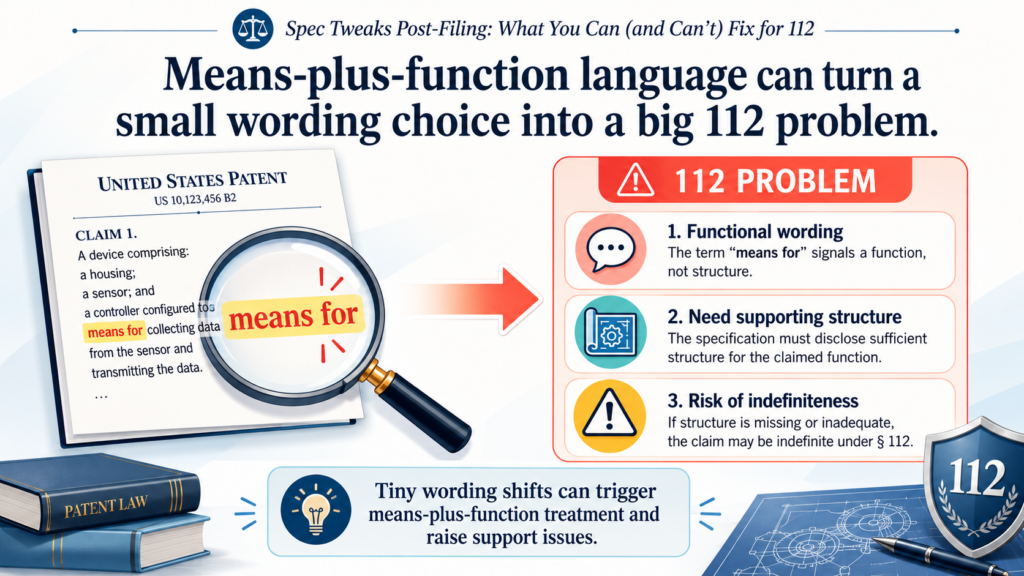
In software claims, this can become a serious issue because the spec may need to disclose enough structure, steps, or algorithm detail to support that function.
The USPTO’s MPEP section on 112(f) explains how examiners identify and interpret these kinds of functional claim limits.
This matters because many startup filings use words like “module,” “engine,” “unit,” “component,” or “system” without enough detail behind them. Those words are not always bad.
They can be fine when the spec explains what the part is and how it works. The problem starts when the claim only says the part performs a function, while the spec does not give enough support for the actual way the function is carried out.
For example, a claim may say “a scoring module configured to select a safe route.” That may sound clear to the team that built it. But the examiner may ask what structure or process supports that module.
Does the spec show the inputs? Does it show how the score is made? Does it explain how route choices are ranked? Does it describe what makes a route safe? If not, the claim may be exposed.
Functional claiming is not the enemy, but empty function words are risky
Founders often need functional claim language because modern products are built around behavior. AI systems classify. Robots adjust. Devices detect. Platforms route.
Models score. Sensors trigger. Chips manage. That is normal. A patent claim does not always need to name every low-level part.
But functional words need a backbone.
A claim that says “detecting fraud” may be too loose if the spec does not explain the detection path. A claim that says “optimizing battery use” may be weak if the filing never describes the signals, rules, model, or control loop.
A claim that says “generating a recommendation” may need support for how the recommendation is built, filtered, ranked, or sent.
The goal is not to remove all function words. The goal is to make sure the function is tied to real disclosed structure or real disclosed steps.
When the original filing has that support, you can often amend the claim to point toward it. When the filing does not, you may need to narrow the claim or file a follow-on application.
The practical fix is to turn black-box words into supported system behavior
When a 112(f) or functional language issue shows up, do not argue from labels. Argue from behavior that the filed spec already described.
If the spec says a model receives sensor data, extracts motion features, compares those features to stored profiles, and triggers a control action when a score crosses a threshold, that is useful support.
A claim can often be adjusted to use that path. The claim does not have to expose private code. But it should give enough shape so the claimed function is not just a black box.
This is a strong place to use drawings, flow charts, and examples from the original filing.
A simple figure that shows input data, a trained model, a scoring step, a decision gate, and an output action can help support clearer claim language.
But the figure should not stand alone if the text never explains it. The best filings use both.
This is exactly why PowerPatent pushes teams to capture how the invention works, not just what the product does.
Software helps pull out the technical flow. Real patent attorneys help turn that flow into a filing that can stand up later. See how that works here: https://powerpatent.com/how-it-works
You can fix antecedent basis issues, but do not ignore what they reveal
An antecedent basis issue is usually a claim clarity problem. It means a claim refers to something as if it was already introduced, but it was not. For example, the claim may say “the model” before it ever says “a model.”
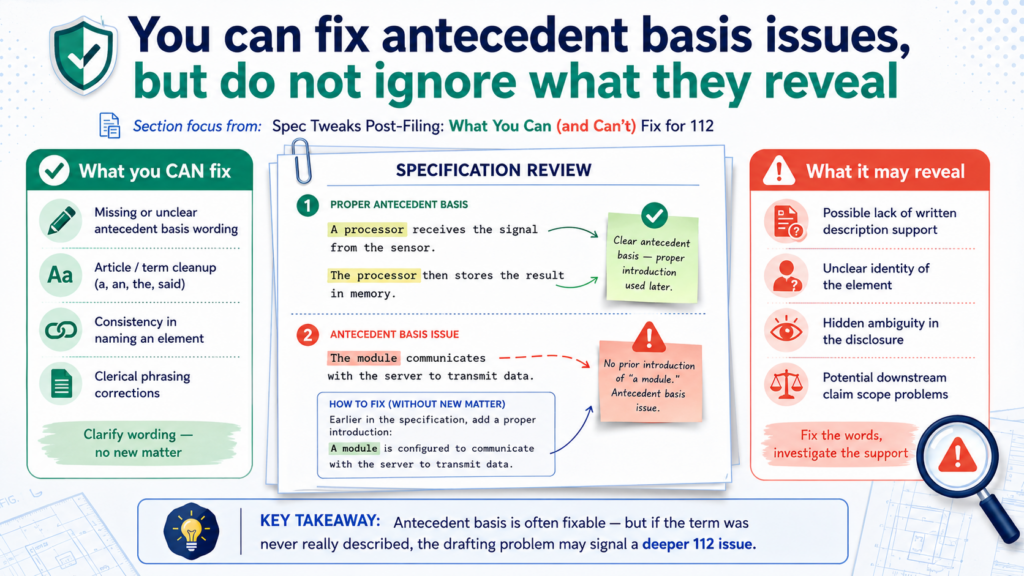
Or it may refer to “the second score” when only one score was introduced. These issues are often fixable, but they still deserve attention because they can reveal deeper claim confusion.
In many cases, the fix is simple. You introduce the item properly, make the wording consistent, and ensure each later reference points back to the right thing.
The USPTO includes lack of antecedent basis among common claim clarity concerns under its definiteness guidance.
But do not treat this as just a typo hunt. A missing antecedent basis issue may show that the claim was assembled too quickly.
It may show that the claim changed during drafting but the rest of the language did not catch up. It may show that two different concepts were blurred together. That can be dangerous when the invention is technical.
Small claim errors can create big uncertainty around the patent fence
Imagine a claim that recites “a trained model,” then later says “the prediction model,” then later says “the classifier.”
Are those the same thing? Are they different parts? Does one include the other? If the spec is clear, the fix may be easy. If the spec also uses these words loosely, the problem becomes bigger.
This is common in fast filings. Founders use one term in their pitch deck, engineers use another in the repo, and the patent draft uses a third.
That may not feel like a big deal inside the company. Everyone knows what they mean. But the examiner does not live inside your team. Future readers will not either.
A strong patent filing uses consistent names for important parts. If there are different versions, it explains the relationship.
A model may be a classifier in one example and a ranking model in another. A server may be a cloud system in one setup and an edge device in another. That is fine when the spec makes it clear.
The best fix cleans the term map without adding new technology
Post-filing, you can often clean up terms by making the claim language match the spec. If the spec consistently says “prediction model,” and the claim switches between “classifier” and “model,” you may amend the claim toward the supported term.
If the spec clearly shows that a “score” and a “confidence value” refer to the same kind of output, you may be able to align the wording.
But be careful. A wording fix should not add a new technical meaning. If “confidence value” was never in the filing, do not add it just because it sounds better.
If “classifier” is narrower than “model,” do not change the word unless that narrowing is intended and supported. If “edge device” is different from “user device,” do not swap terms casually.
This is where a term table created before filing can prevent pain later. It does not need to be fancy. It just needs to align the core nouns of the invention with the real system.
PowerPatent helps teams turn that kind of product knowledge into a cleaner filing from the start, with smart software and attorney oversight working together. Learn more here: https://powerpatent.com/how-it-works
Drawing fixes can help, but drawings cannot smuggle in new features
Drawings are often underrated in patent filings. For deep tech startups, a good drawing can carry a lot of support.
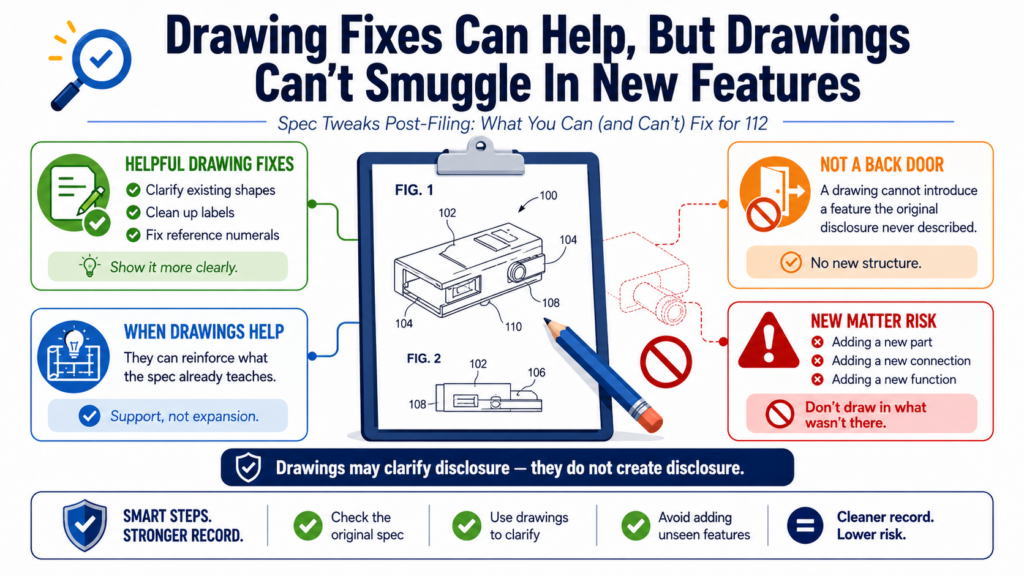
It can show the system layout, data flow, hardware relationship, process order, model pipeline, or user interaction. When a 112 issue comes up, the drawings may become one of the best places to find support.
But drawings have the same filing-date limit as the text. You can correct drawings after filing in some cases, but you cannot use drawing changes to add new invention substance that was missing.
The MPEP explains that new matter cannot be added to the disclosure after filing, and the disclosure includes the specification, claims, and drawings.
That means a missing box in a system diagram may matter. A missing arrow may matter. A missing sensor, model, filter, valve, circuit, layer, or control step may matter.
If that feature is central to the later claim and the original filing never showed it, a new drawing may not solve the old problem.
A drawing can support a claim when it shows the real relationship clearly
A drawing does not need to look beautiful to be useful. In many patents, the best drawing is a clear map of how the invention works. It shows the parts and their relationship. It gives the reader a way to understand the text.
For a software invention, a useful figure may show a client device, a server, a data store, a model training system, an inference system, and a feedback loop.
For a hardware invention, it may show layers, sensors, circuits, housings, flow paths, or mechanical links.
For a robotics invention, it may show perception, planning, control, and actuation. For a biotech or chemistry invention, it may show process stages, compositions, or measurement logic.
When the text and drawings work together, your post-filing options improve.
If the claim says a first module sends a filtered signal to a second module, and the drawing already shows that connection, you may have a stronger support story. If the text also explains the signal and the filter, even better.
The problem is when the drawing is only a box with a product name inside it. That may help tell a high-level story, but it may not support detailed claim amendments later.
The smart move is to use drawings as support, not decoration
After a 112 rejection, review every figure with fresh eyes. Look at the labels. Look at the arrows. Look at the order of steps.
Look at the reference numbers. Look at whether the drawings show optional paths, fallback paths, and different versions.
Then match those drawings to the claim terms. If the claim says “receiving sensor data,” find the sensor and the data path.
If the claim says “generating a ranked list,” find the ranking step or the output list. If the claim says “updating a control parameter,” find the feedback loop or controller. If the drawing gives support, use it.
But do not overstate it. A figure that shows a generic “AI engine” may not support every possible AI method. A figure that shows a “sensor” may not support a highly specific sensor type.
A figure that shows a “filter” may not support a special filter sequence unless the filing tells that story.
PowerPatent helps teams create filings that are not just wordy, but structurally useful. The goal is to capture the real invention in text and figures so you have room to respond later. See the process here: https://powerpatent.com/how-it-works
Examples and fallback versions are your best friend when 112 pressure hits
A thin spec gives you one path. A strong spec gives you many. That is why examples and fallback versions matter so much.
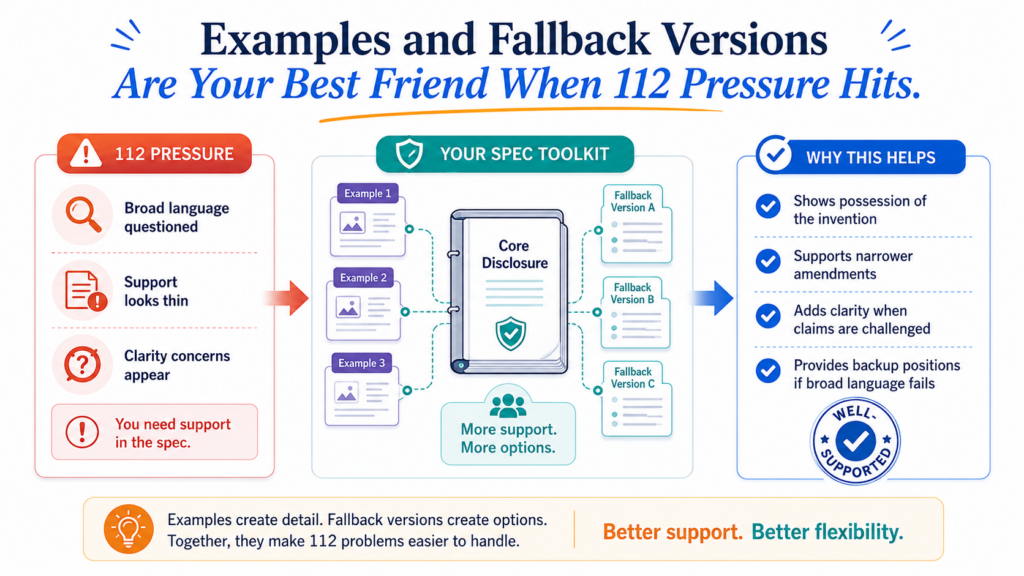
An example shows the invention in action. It may describe one setup, one use case, one device, one model type, one data source, one rule set, or one process flow.
A fallback version gives you a narrower but still useful way to claim the invention if the broad version gets challenged. Together, they create room to move during examination.
This is especially important because 112 problems often appear when a claim is too broad for the disclosure. The claim may try to cover every way of doing something, while the spec only explains one way.
Enablement guidance focuses on whether the disclosure teaches the full scope of the claimed invention without undue experimentation.
For startups, that phrase “full scope” is where the danger hides. If your claim covers five types of devices, but the spec only explains one, the examiner may push back.
If your claim covers any model, but the spec only gives one vague sentence about machine learning, you may have a problem.
A fallback is not a weaker invention; it is a safer landing zone
Founders sometimes dislike fallback language because it feels like planning for failure. It is not. It is planning for leverage.
A fallback can protect the core even when the broad claim faces pressure. It can keep the case moving. It can help you avoid abandoning the important claim set.
It can also help you build a layered patent portfolio, where one claim covers the broad system and another covers a key technical route.
For example, a broad claim may cover selecting an action based on sensor input. A fallback may cover selecting the action using a filtered sensor stream and a confidence threshold.
Another fallback may cover a specific type of sensor, timing rule, or control output. If those details are in the spec, you have options. If they are not, you may not.
This is why the best patent filings often feel more detailed than a pitch deck. A pitch deck sells the big idea. A patent filing must protect the many workable forms of that idea.
Post-filing, your fallback search should be ruthless and honest
When 112 pressure appears, search the spec for fallback support before deciding what to amend. Look for narrower features that still matter to the product and the business.
Look for optional parts that can become claim limits. Look for concrete steps that make the invention work. Look for examples that align with your current product or likely competitor copy.
Then ask the hard question. If we added this limit, would the claim still matter?
If the answer is yes, you may have a strong path. If the answer is no, you may be narrowing into something that clears the rejection but protects little. That is not always wrong, but it should be a conscious choice.
This is where founders should stay close to the patent process. Do not leave the response to legal wording alone. Bring product context.
Bring roadmap context. Bring competitor context. The best answer is not just the one that gets allowed. It is the one that gets allowed and still protects something the company cares about.
PowerPatent is designed for that exact balance. It helps founders move quickly, keep control, and work with real patent attorneys who understand that a patent is not just a form.
It is part of the company’s moat. See how to build that moat here: https://powerpatent.com/how-it-works
The best 112 response starts with a clean support map before anyone edits a word
A 112 rejection can make a team want to move fast. That is natural. Nobody wants a patent case to drag on. But speed without a support map can be risky.
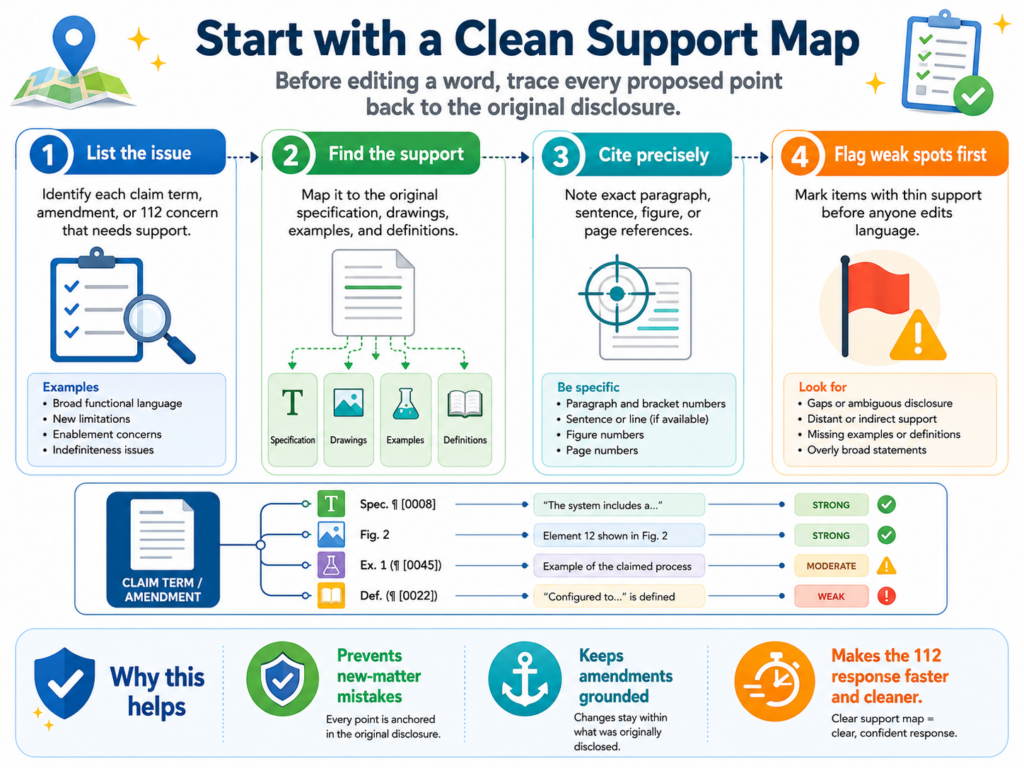
Before the claims are changed, before the spec is touched, and before anyone drafts a long argument, the team should build a clean map between the rejected claim language and the application as filed.
This matters because the USPTO treats written description, enablement, and definiteness as separate requirements. A response that helps one issue may not fix the other.
For example, clearer claim language may fix a definiteness concern, but it may not solve a missing written description problem if the original filing never showed the claimed feature.
The USPTO’s MPEP explains that Section 112 includes distinct requirements for the specification and claims, which is why the type of 112 issue has to be identified before the fix is chosen.
A support map turns panic into a plan
The support map does not need to be fancy. It needs to be honest. Start with the exact words the examiner challenged. Then place next to each phrase the best support from the original spec, drawings, and original claims. The goal is not to prove the examiner wrong at first. The goal is to see what you truly have.
For founders, this is a strong moment to bring engineering detail into the room. Pull up the filed application.
Pull up the product notes only as background, not as a substitute for the filing. Then ask where the filed document shows each part of the claimed invention.
If the claim says the system “updates a model based on user feedback,” find where the filing talks about model updates, feedback signals, timing, training, weighting, or output changes.
If the support is clear, the response can be firm. If the support is partial, the claim may need careful adjustment. If the support is missing, the team should stop trying to force the issue and look at other paths.
The honest map protects the current case and the next one
A support map also helps avoid bad file history. When you make an argument to the USPTO, that argument can matter later.
If you overstate what the spec says, you may create weakness that a competitor can use. If you make a sloppy amendment, you may narrow the claim more than needed.
The better move is to make every response traceable. The claim says this. The spec supports it here. The drawing shows it there.
The original claim hinted at it here. That kind of response is easier for the examiner to follow and easier for your future patent to defend.
This is also why the first filing matters so much. When PowerPatent helps founders capture the real invention early, the later support map has more places to point.
That means less panic, fewer blind spots, and better room to protect what matters. See how the process works here: https://powerpatent.com/how-it-works
Examiner interviews can help clear up 112 issues before you file a response
A written response is not always the first best move. Sometimes a short examiner interview can save weeks of guessing.
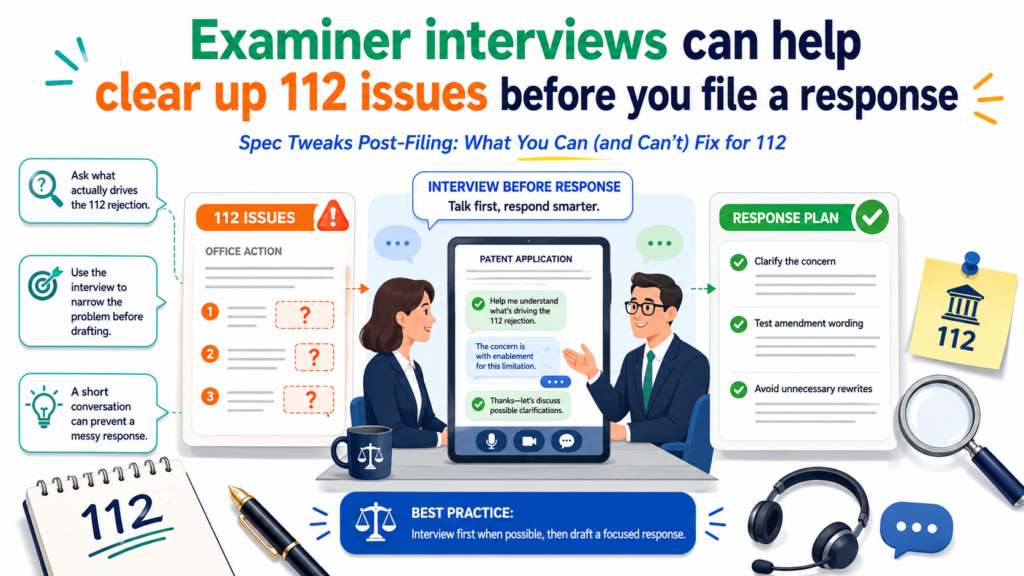
The goal is not to argue hard or turn the interview into a sales pitch. The goal is to understand what the examiner truly thinks is unclear, unsupported, or not enabled.
This can be very useful for 112 issues because the written rejection may be short. It may quote a claim phrase and say it lacks support. But the real concern may be narrower.
The examiner may be confused by a term. The examiner may not have seen a paragraph that supports the feature. The examiner may think one word in the claim reaches beyond the spec. An interview can help reveal the real problem.
That does not mean the examiner will always agree. It does mean the team can respond with more precision. A precise response is often better than a long response.
The best interview question is not “will you allow this?”
Founders often want a yes-or-no answer. That is understandable, but 112 issues usually need a better question. Instead of asking whether the examiner will allow the claim, ask what specific part of the claim is unclear.
Ask whether a proposed amendment would address the concern. Ask whether the examiner sees support in a cited paragraph or figure.
This turns the call into a useful working session. You are not trying to win the whole case in one conversation. You are trying to find the cleanest path forward.
For example, if the examiner says “adaptive threshold” is unclear, the team can ask whether the issue is the word “adaptive,” the lack of a starting threshold, the update rule, or the link between the threshold and the output.
Each answer leads to a different fix. If the spec already explains the update rule, the claim can point to it. If the spec does not, the team may need a narrower route.
A good interview still needs a disciplined written record
An examiner interview is not a place to casually add new technical facts. The same new matter problem still applies.
The team should not say, “Actually, our system uses a second model that was not in the filing,” and then try to build the case around that missing detail.
The better way is to keep the interview tied to the filed application. Talk about the claim. Talk about the spec. Talk about the figures. Talk about the original disclosure.
If newer product details help the team understand the issue internally, fine. But the official response should be built on the filing as submitted.
That is why it helps to enter the interview with a support map and a few possible claim edits. You can test which path the examiner views as cleanest without making random concessions.
PowerPatent gives founders a better starting point for these moments because the filing is built from real technical input, then reviewed by real patent attorneys.
That mix gives the team more confidence when prosecution starts. Learn more here: https://powerpatent.com/how-it-works
A continuation can save claim scope when the first path gets tight
Sometimes the best fix is not one fix. It is a two-track plan.
You may amend the current case to move it toward allowance while keeping broader or different claim ideas alive through a continuation, when the filing family and timing support that route.

A continuation is powerful because it can let the applicant pursue different claims based on the same original disclosure. But it does not solve a missing-support problem by magic.
The later claims still need support in the earlier filing if they are relying on that earlier filing date. The written description requirement still asks whether the original application shows possession of the claimed invention.
This is where founders need to think like portfolio builders, not just case responders. The first case may protect one version of the invention.
A continuation may pursue another angle. One claim set may focus on the product workflow. Another may focus on the data path, model update, device structure, or control method.
The current case should not carry every business goal alone
A common mistake is trying to make one claim set do everything. The founder wants it to cover the current product, future roadmap, competitor workarounds, platform architecture, and every possible vertical.
That is too much pressure for one case, especially after a 112 rejection.
A better patent plan may use the current case to secure a strong allowed claim, while a continuation keeps the family open for other supported claim paths.
This can be especially useful when the examiner is pushing back on broad words, but the spec includes several useful examples.
For example, the first case may move forward with claims tied to a specific sensor-processing-control loop.
A continuation may later pursue claims focused on model training, edge deployment, or feedback correction, as long as those ideas were already supported in the parent filing. That is not delay for delay’s sake. That is scope management.
A continuation works best when the original spec has real depth
A continuation is only as strong as the disclosure behind it. If the first filing is thin, the continuation may have little room to grow. If the first filing is rich, the continuation can be a major asset.
This is why founders should not think of the first application as a cheap placeholder.
A weak first filing can trap the whole family. A strong first filing can become a base for years of claim strategy.
The key is to include enough technical versions at the start. Not fake versions. Not filler. Real ways the invention can be made, used, adjusted, and deployed.
For software, that may mean different data sources, model types, scoring paths, user flows, system layouts, and update rules. For hardware, it may mean different materials, shapes, sensors, circuits, connections, and operating modes.
PowerPatent helps teams build that deeper first filing without slowing down the company.
The platform helps capture invention detail quickly, while attorney oversight helps shape it into a patent strategy that can support more than one claim path. Start here: https://powerpatent.com/how-it-works
A continuation-in-part or new filing may be the right home for later improvements
When the team built something after the filing date, that later work may be valuable. It may even be the best part of the product now. But if it was not in the original application, it may need its own filing path.
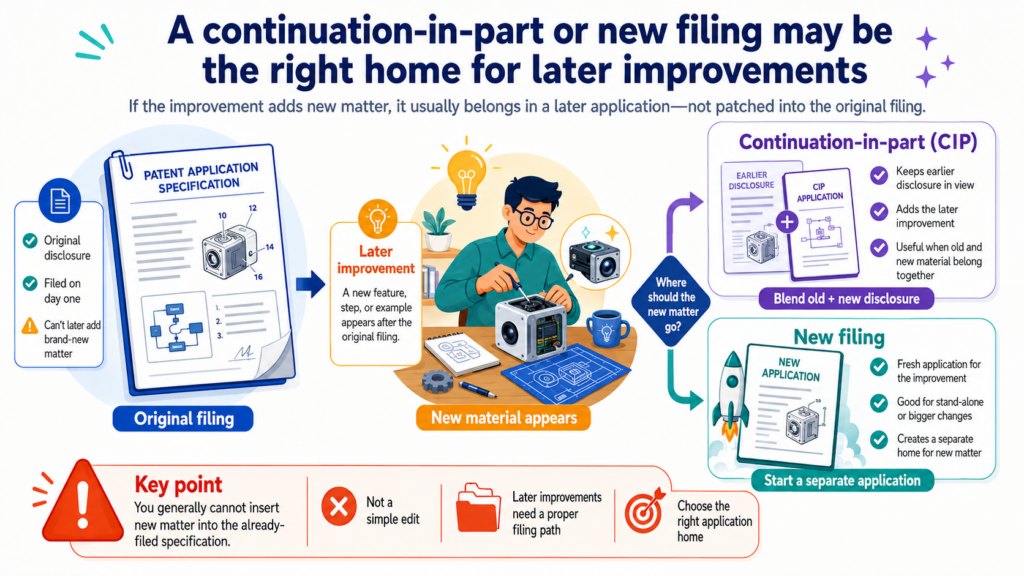
That path may be a new application. In some situations, it may be a continuation-in-part, often called a CIP. The right choice depends on timing, disclosure, prior art, publication, product launch, investor plans, and how closely the new improvement connects to the earlier filing.
The key point is simple: later improvements should be protected cleanly, not forced into an old application where they do not belong.
The USPTO’s new matter and written description framework makes this point important. The filed application must support what is later claimed, and adding missing technical substance after filing can create a new matter issue.
New work deserves protection instead of risky patching
Founders sometimes feel bad when they learn that a later feature may not fit into the first case. They should not.
This is normal in a startup. Your invention should improve. Your system should get sharper. Your product should learn from users, tests, and failures.
The mistake is not improving the product. The mistake is failing to capture the improvement before it becomes public or copied.
For example, your original filing may cover a core AI routing system. Three months later, your team builds a new feedback method that cuts errors in half.
If the feedback method was not in the first filing, do not treat that as a drafting footnote. Treat it as a possible new invention. It may deserve its own claim set, its own examples, and its own filing date.
That is how strong patent portfolios are built. Not by pretending one filing covers everything forever, but by capturing important advances as the company moves.
The best time to file the improvement is before it becomes old news
Patent strategy should follow the product rhythm. When a sprint creates a real technical advantage, pause long enough to ask whether it should be captured.
When a customer problem leads to a new system behavior, ask whether it is more than a feature. When a model, device, process, or data flow becomes hard to copy, ask whether that is part of the moat.
This does not mean filing on every small change. It means building a habit of spotting patent-worthy improvements early.
The best candidates are usually changes that improve speed, accuracy, safety, reliability, cost, scale, energy use, manufacturing, privacy, or user control in a way competitors would care about.
This is where PowerPatent fits the way startups actually work. You do not need a slow, old-school process every time your team makes progress.
PowerPatent helps founders capture inventions faster, route them through smart software, and bring in real patent attorneys to make the filing stronger. See how PowerPatent helps teams move from invention to filing here: https://powerpatent.com/how-it-works
After-final 112 fixes need a sharper plan because the room to move is smaller
A final rejection does not always mean the case is over, but it does mean your next move needs more care. After final, the USPTO has rules about when amendments may be entered.
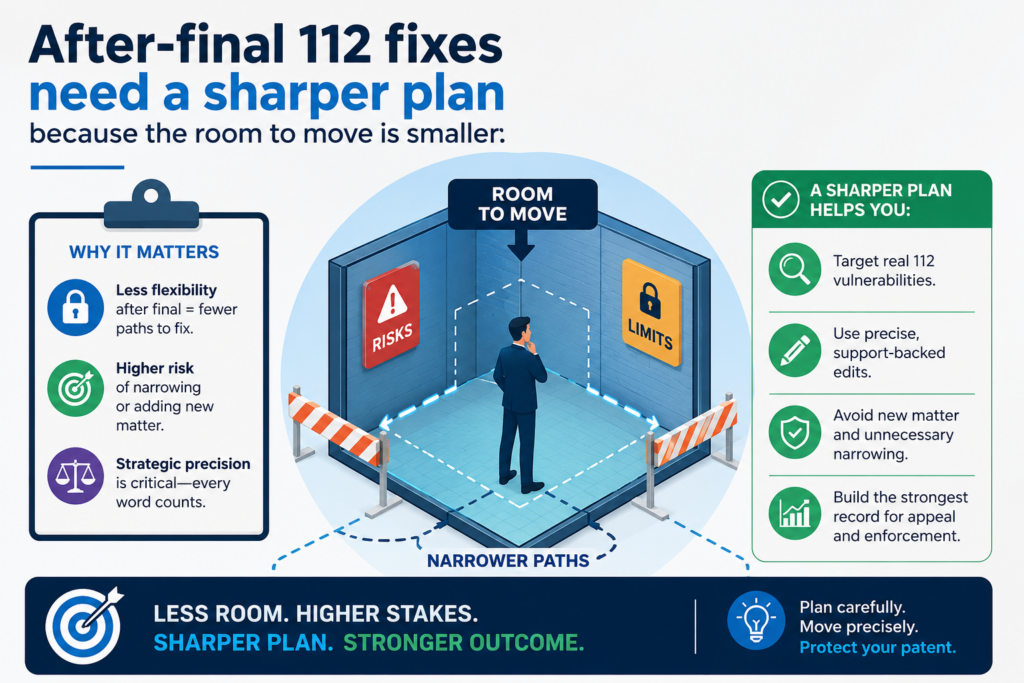
Some amendments may be accepted when they place the case in better condition for appeal or adopt examiner suggestions, but you should not assume every new claim change will be entered just because it seems helpful.
This matters for 112 issues because founders often wait too long to take the rejection seriously. The first Office Action comes in.
The team makes a light response. The examiner is not convinced. Now the case is final, and the team wants to make bigger edits. That may still be possible, but the path is tighter.
The best time to build a strong 112 plan is before final. That means understanding the examiner’s concern early, mapping the support early, and testing claim language early.
Waiting until the last moment can turn a fixable issue into a costly fork in the road.
A final rejection is a signal to choose, not drift
After final, the question is no longer just “what is the perfect claim?” The question becomes “what is the best next procedural move for the business?” You may file an amendment.
You may request continued examination. You may appeal. You may file a continuation. You may accept a narrower claim now and keep other scope alive elsewhere.
This is not just a legal choice. It is a startup choice.
If the claim is close to allowance and still covers the product well, moving toward allowance may be smart. If the examiner is clearly wrong and the claim has strong support, appeal may be worth discussing with counsel.
If the case needs more claim work, continued examination may be the cleaner path. If the current claim path has become too narrow, a continuation may help preserve other angles supported by the original filing.
The mistake is treating every final rejection like a crisis. It is not a crisis. It is a decision point.
The cleanest after-final move is often the one that removes friction without giving away the moat
When 112 issues remain after final, look for changes that directly answer the examiner’s concern without cutting into the heart of the invention. If the examiner says a term is unclear, fix that term with supported language.
If the examiner says a feature lacks written support, decide whether the claim can be tied to support already in the spec. If the issue is enablement, decide whether the claim can be narrowed to the taught working path.
Do not add random limits just to get movement. A random limit can make the patent easier to allow but less useful later.
The better limit is one that is already part of the product value, already shown in the filing, and still hard for a competitor to design around.
PowerPatent helps founders avoid late-stage scramble by creating stronger applications earlier, with smart software and real attorney oversight.
Better first filings give you more options when the examiner pushes back. See how it works here: https://powerpatent.com/how-it-works
Do not amend the spec just because the claim feels weak
When a 112 rejection hits, it can be tempting to open the specification and start adding detail. That instinct can be dangerous.
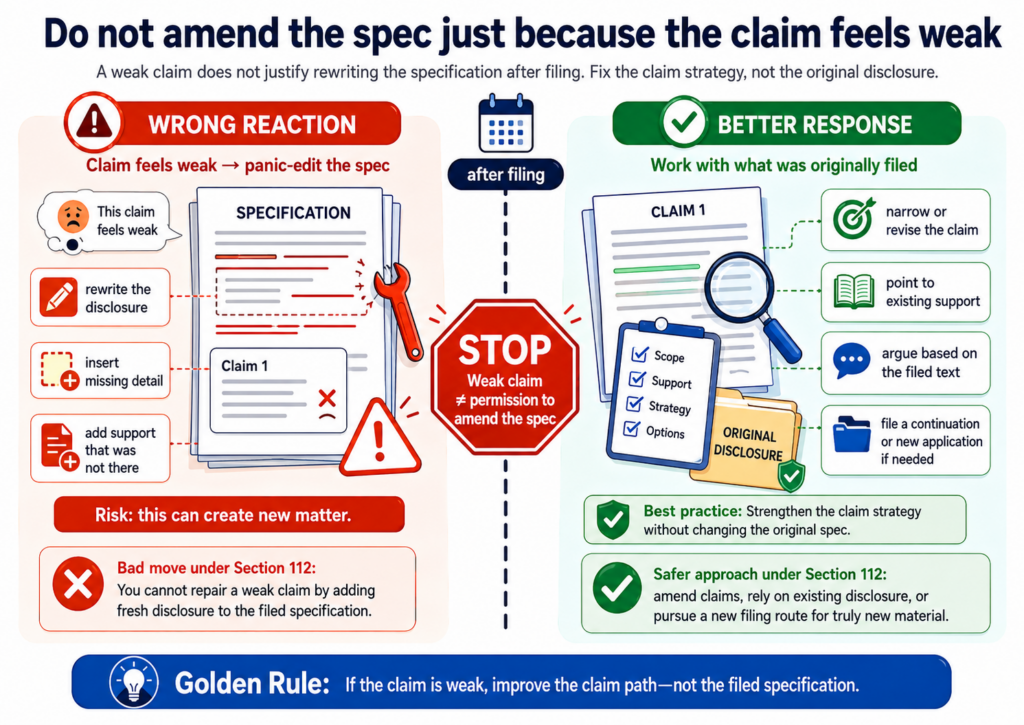
The USPTO makes clear that amendments and claims must have descriptive basis in the original disclosure, and new matter cannot be introduced after the filing date.
This is why spec edits should be made with care. You can correct errors. You can make certain clarifying changes when they do not add new technical substance.
But you cannot use a spec amendment to fill in missing invention detail that was not present when the application was filed.
For founders, the simple rule is this: the spec is not a live product page. It does not update every time the product improves.
It is a filing-date record. You can work with what it says, but you cannot quietly turn it into a new technical document and keep the old date.
The better move is to first ask whether the claims can be fixed
Most 112 fixes should start with the claims, not the spec. If the claims reach too far, bring them closer to the filed support.
If the claims use vague words, make them clearer. If the claims blend two ideas, separate them. If the claims use terms that do not match the spec, align the wording.
That approach is usually cleaner because it keeps the original disclosure intact and adjusts the patent fence to match it.
A spec amendment may still be useful in some cases, especially to fix obvious errors or improve formal consistency. But it should not be the default move.
Think of the spec as the foundation and the claims as the building frame. If the frame hangs over empty air, you can pull it back onto the foundation.
What you cannot do is pour new foundation under it after the filing date and pretend it was always there.
The founder’s job is to protect the technical truth of the filing
When your attorney asks whether a claim feature is supported, do not answer from memory alone. Open the filed application.
Find the words. Find the drawing. Find the example. Find the original claim. If you cannot find it, say so.
That honesty saves time. It also prevents risky arguments.
The worst response is a confident claim that the filing supports something when it does not.
The second worst response is giving up too early when the support is actually there but buried. A careful support review prevents both mistakes.
This is one reason PowerPatent is built for technical founders and engineers. It helps capture the invention with real detail from the start, so the later prosecution record is not built on guesses.
Strong filings make clean amendments easier. Learn more here: https://powerpatent.com/how-it-works
Claim amendments should protect the workaround you fear most
A 112 fix should not only answer the examiner. It should also keep pressure on the competitor path you care about.
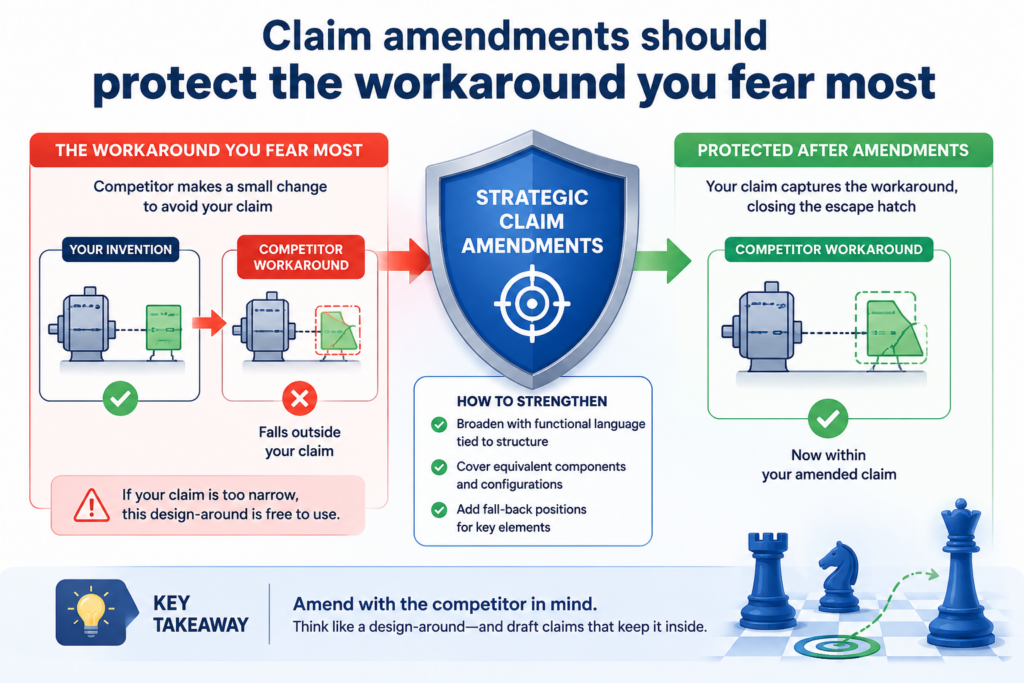
A claim that gets allowed but misses the obvious workaround may not help much. A claim that is narrower but still blocks the key copycat move can be far more useful.
This is where founders need to bring business judgment into the patent process.
The examiner is focused on whether the claim meets the legal rules. Your team also needs to ask whether the amended claim still matters in the market.
Suppose your invention is a model update method that works well with messy field data. The examiner objects that the claim is too broad because the spec only supports a certain kind of update rule.
You may narrow to that update rule if it is the reason the product works. That could still be strong. But if you narrow to a side feature that competitors can avoid easily, you may win allowance and lose practical value.
The best amendment is tied to the technical edge, not a random detail
Every invention has a center of gravity. It may be speed. It may be accuracy. It may be lower memory use. It may be safer control. It may be less power draw. It may be a better data pipeline. It may be a cleaner user flow. It may be a manufacturing step that cuts cost.
A good 112 amendment should stay close to that center.
If the claim needs more structure, add structure that matters. If the claim needs clearer steps, add steps that drive the result.
If the claim needs support from an example, choose the example that maps to the product and the likely competitor path.
Do not let the response drift into details that are easy to avoid or not important to the business.
This is where a founder’s input is not optional. A patent attorney may know which claim amendment is likely to pass review.
The founder knows which claim amendment would still matter if a competitor copied the product six months from now.
The right question is what would a smart competitor change first
Before you approve a narrowing amendment, imagine a competitor reading the claim. What would they change first to avoid it?
Would that change be easy? Would it make their product worse? Would it raise cost? Would it break the main benefit? Would customers care?
If the workaround is cheap and painless, the claim may be too narrow in the wrong way. If the workaround forces the competitor to give up the advantage, the amendment may still be strong.
This thinking is very important for AI, software, hardware, and platform patents because there are often many ways to describe the same system.
You want claims that cover the meaningful technical route, not just one surface form.
PowerPatent helps founders connect patent drafting to the real product moat.
The platform helps capture engineering detail, while real attorney oversight helps shape that detail into claims that protect what the business actually cares about. See the process here: https://powerpatent.com/how-it-works
A 112 problem can reveal that your patent process needs to change
A 112 rejection is not only a prosecution event. It is feedback on how the invention was captured.
Sometimes the examiner is wrong. Sometimes the claim needs a clean edit. But sometimes the rejection shows that the first filing was too thin, too vague, or too far from the real engineering work.
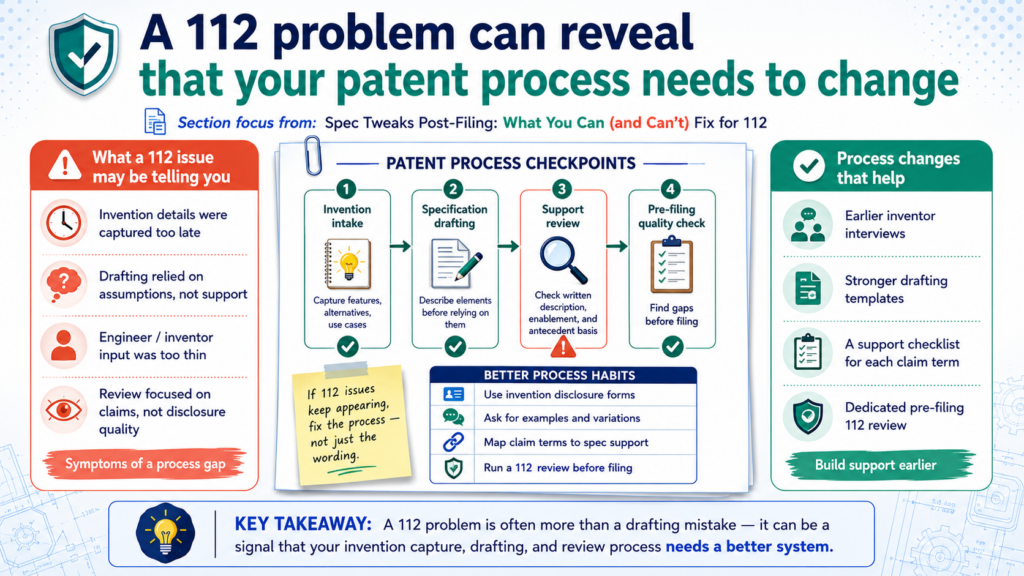
That lesson is valuable.
If the spec did not explain how the system worked, change how you capture inventions. If the figures were too generic, change how you prepare drawings.
If the claims used product buzzwords instead of technical steps, change how the team talks about invention scope. If later improvements keep falling outside the first filing, change how often you review the roadmap for new filings.
The USPTO separates written description and enablement, which means a filing needs to both show possession of the invention and teach enough about making and using it.
For founders, that means a strong patent process should capture both the “what” and the “how” before the filing date.
The best patent teams build a repeatable invention capture habit
Patent strength does not come from one heroic drafting session. It comes from a habit. When engineers solve a hard problem, capture it. When a model improves because of a new data flow, capture it.
When a device becomes cheaper, faster, safer, or more reliable because of a design choice, capture it. When the team finds a workaround others missed, capture it.
This does not mean filing every small idea. It means creating a simple rhythm where important technical wins do not vanish into chat threads, sprint tickets, or private demos.
A good invention capture habit asks what changed, why it matters, how it works, what else could work, what the fallback versions are, and what a competitor would likely copy.
Those answers become the raw material for stronger patent filings.
The real goal is fewer emergency fixes and more confident filings
Post-filing tweaks will always be part of patent work. Office Actions happen. Claim edits happen. Examiner questions happen. But the goal is to avoid relying on risky patches because the original filing was weak.
A strong original filing gives you room. It gives you fallback positions. It gives you examples. It gives you clear terms.
It gives you figures that support the claim path. It gives your attorney better tools. It gives your startup more confidence when investors, partners, or acquirers look at the IP.
PowerPatent is built around that idea. It helps founders move fast without treating patents like an afterthought.
Smart software helps capture the invention. Real patent attorneys help protect it. The result is a faster, clearer, stronger path from technical work to filed IP. Start here: https://powerpatent.com/how-it-works
Conclusion
Post-filing 112 fixes are not about sounding smarter. They are about staying honest with what was filed and making the strongest supported claim possible.
You can clarify words, tighten claims, point to buried support, and protect the real edge of the invention. But you cannot add missing technical detail after the filing date and call it original.
Leave a Reply