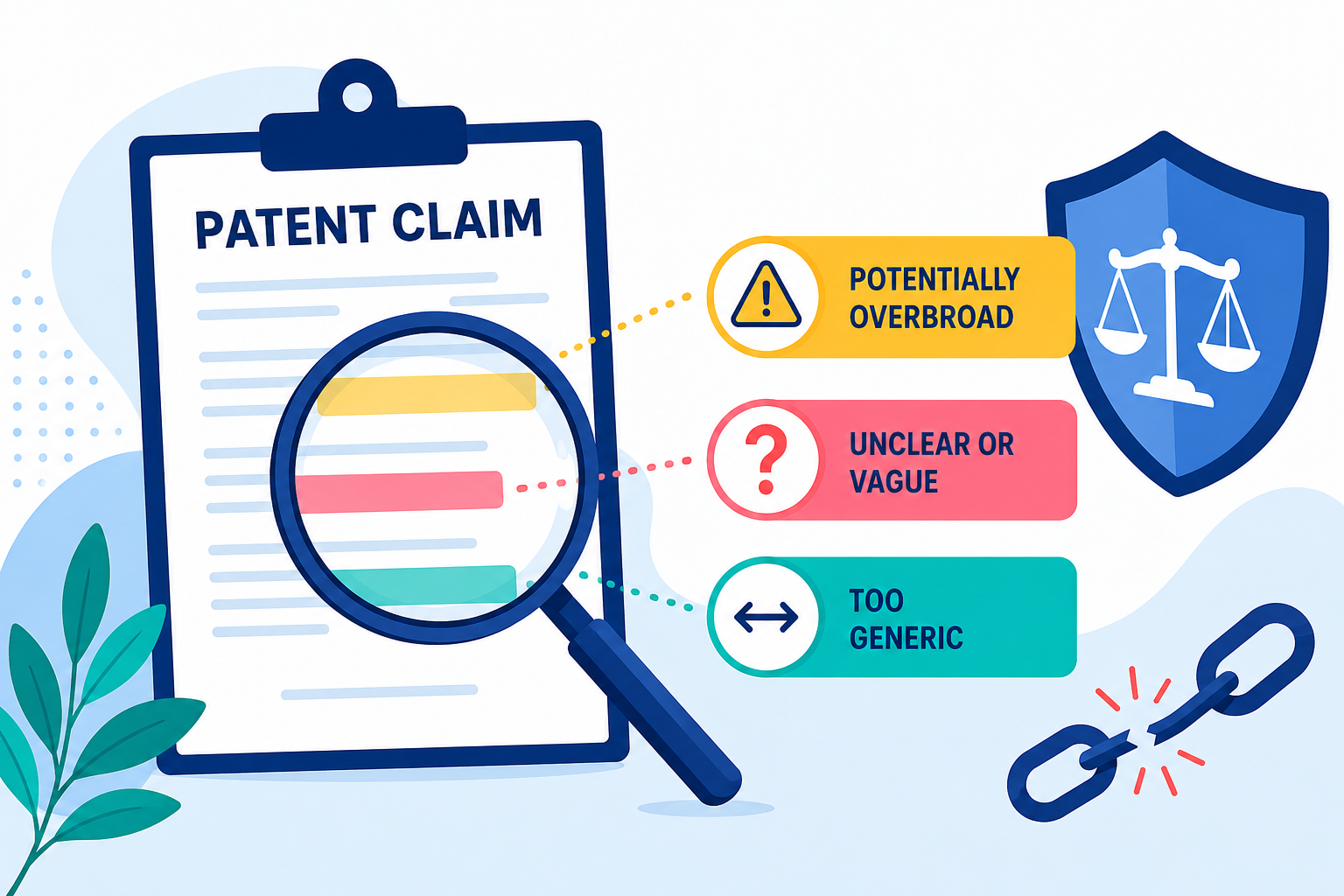
A patent claim is the part of a patent that says what your invention covers. It is where the real protection lives. If the words are too soft, too wide, too vague, or too easy to work around, your patent may look strong on paper but fail when it matters. PowerPatent helps teams catch these issues faster with smart software and real attorney review. See how it works here: https://powerpatent.com/how-it-works
Why patent claim review is where your real protection gets tested
A patent can look clean, long, and impressive, but still have weak claims. That is because the claim section is not meant to sound smart. It is meant to draw a clear fence around the invention.
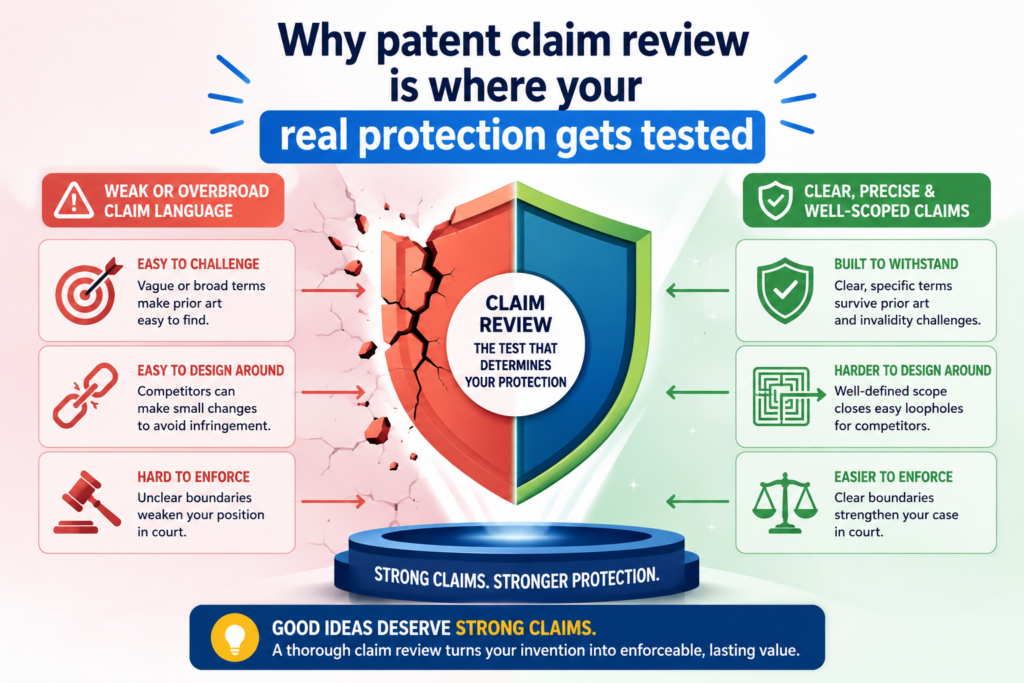
If that fence has holes, a competitor may walk around it. If that fence reaches too far, it may get pushed back, rejected, or attacked later.
This is why claim review matters so much. It is the step where you stop asking, “Does this sound good?” and start asking, “Can this actually protect the thing we built?”
For a startup, that question is not theory. It is tied to money, speed, leverage, and control. A weak claim can make an investor less excited. A claim that is too broad can slow down the patent process.
A claim that misses the key feature can leave your real product exposed. A claim that uses unclear words can create doubt right when you need confidence.
PowerPatent is built for this exact problem. It helps founders and technical teams move faster while still getting real attorney oversight, so the claims are not just drafted, but reviewed with care. You can see how that process works here: https://powerpatent.com/how-it-works
The claim is not a product description, and that is where many teams go wrong
Many founders read a patent claim and expect it to describe the product the same way a pitch deck or product page would.
That is a mistake. A claim is not trying to explain the product to a customer. It is trying to define what others should not be able to copy.
That means a good claim must be both broad and clear. It should not be so narrow that someone can avoid it with a tiny change. It should not be so wide that it tries to cover things the team did not invent. The balance is delicate.
A claim that says too much can become easy to avoid. A claim that says too little can become too vague. A claim that uses fancy words may still fail if those words do not show what the invention really does.
A strong review starts by asking what the claim is trying to protect
Before you judge any single word, step back. Ask what business value the claim is meant to protect. Is it protecting a core model flow?
A special data step? A system design? A user action? A hardware setup? A control method? A way to improve speed, accuracy, cost, privacy, safety, or scale?
This matters because claim review is not just grammar review. It is invention review. You are checking whether the claim matches the heart of the thing your team built.
A useful question is this: “If a competitor copied our best feature, would this claim likely read on what they did?” If the answer is not clear, the claim may need work.
Another useful question is: “Could a competitor make one small change and avoid the claim?” If the answer is yes, the claim may be too narrow or tied to details that do not need to be there.
The goal is not to make the claim huge. The goal is to make it strong. Strong means clear, supported, hard to dodge, and tied to what makes the invention valuable.
How to spot weak claim language before it creates real damage
Weak claim language often hides in plain sight. It may sound normal. It may even sound polished.
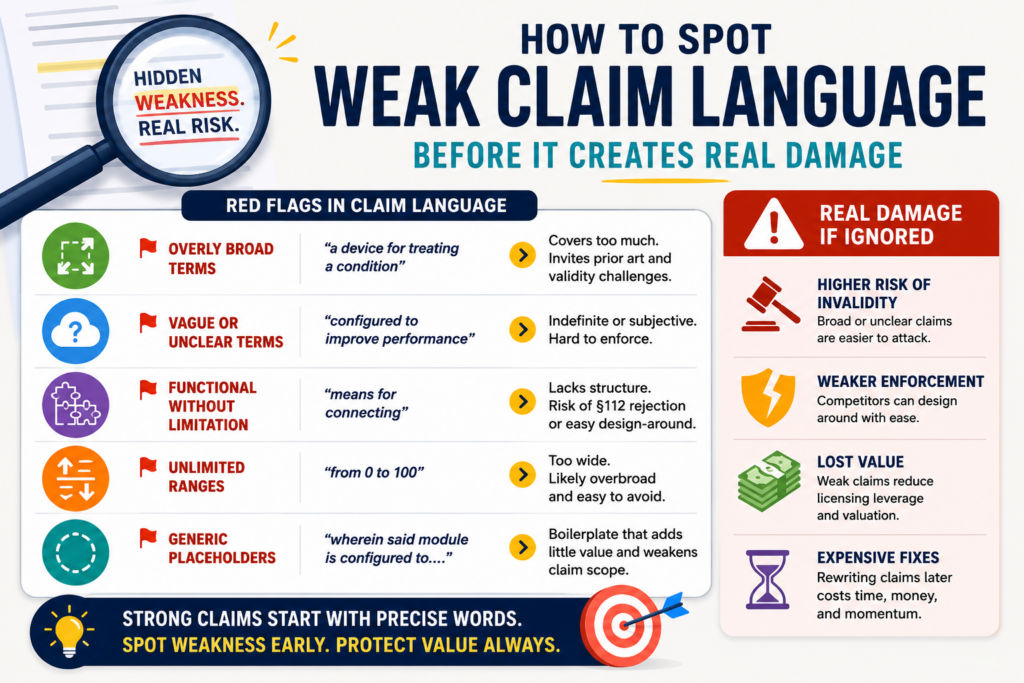
But when you slow down and look closely, you may find words that do not carry enough weight.
The danger is that weak words create weak rights. If a claim depends on soft terms, unclear actions, or loose links between parts, the claim may be easier to reject, attack, or design around.
That does not mean every claim must be packed with detail. It means every important word must earn its place.
A strong claim should tell a clear story of structure, steps, or function. It should show how the invention works at a high enough level to give useful coverage, but with enough detail to avoid sounding like a wish.
Weak language often sounds broad, but it does not act broad
Some claim words feel broad because they are general. Words like “thing,” “data,” “system,” “module,” “engine,” “process,” and “platform” can be useful, but they can also become empty if the claim never explains what they do.
For example, a claim that says a “system configured to improve results” sounds wide. But improve what results?
How? Based on what input? Through what action? With what output? Without those answers, the claim may not give clear protection.
This is a common issue in software and AI patent claims. The team knows what the invention does, so the claim feels clear to them.
But a patent examiner, investor, buyer, or later challenger may not share that inside knowledge. They only have the words.
Weak language also appears when claims use result-only wording. A claim may say the system “detects risk,” “improves accuracy,” “selects an optimal output,” or “reduces latency.”
Those results may be true, but the claim still needs enough detail about how the result is reached.
A simple test is to cover the result and see what is left
When you review a claim, cover up the result words in your mind. Remove phrases like “improves performance,” “increases security,” “reduces error,” or “generates better predictions.” Then ask what concrete invention remains.
If the claim still explains a meaningful way to reach the result, the language may be strong. If the claim becomes empty, the claim is leaning too hard on the outcome.
This does not mean you should delete all result words. Results are useful because they show value. But they should not be the only thing holding the claim together.
A better claim often ties the result to a specific technical path. For example, instead of only saying that a system improves model output, the claim may point to how the system changes training data, updates a feature set, adjusts a model layer, filters a signal, controls a device, or changes a processing order.
The right level of detail depends on the invention. That is why claim review works best when technical founders and patent professionals work together. The founder knows what is new.
The attorney knows how to shape the claim so it can stand up. PowerPatent combines both sides in one smoother workflow, which helps teams avoid slow back-and-forth and missed details. You can explore the workflow here: https://powerpatent.com/how-it-works
How to find language that is too broad for the invention
Overbroad language is different from strong broad language. Strong broad language protects the invention without being trapped by small details.
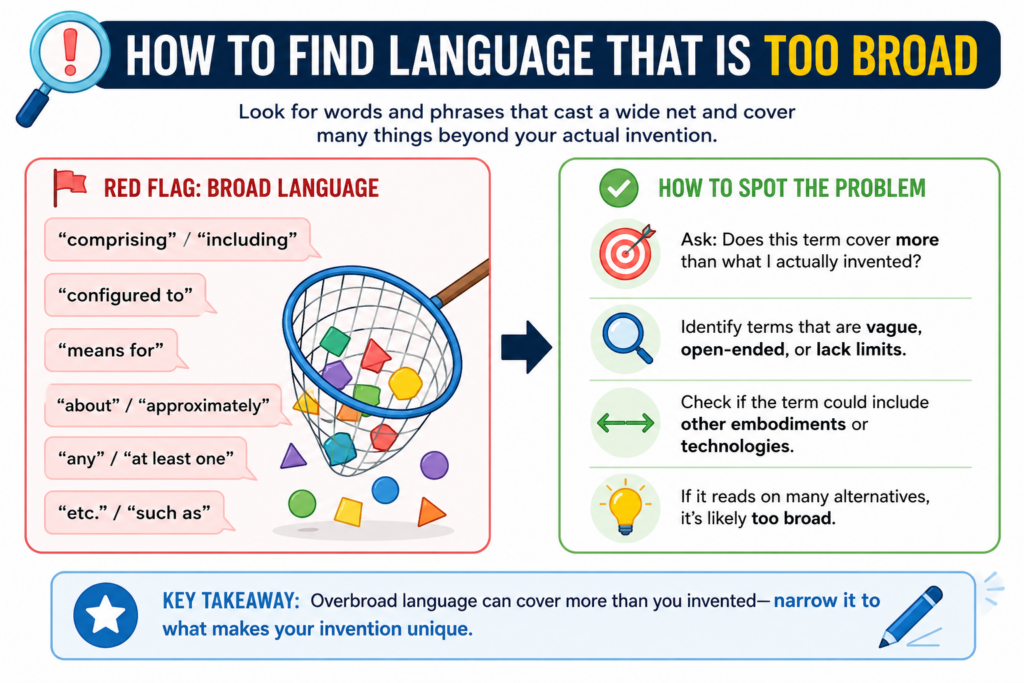
Overbroad language tries to cover more than the team actually invented, described, or can support.
This can create trouble. A patent office may reject the claim. A competitor may later argue the claim should never have been allowed.
A buyer may see risk during review. An investor may worry that the patent sounds ambitious but lacks depth.
For a startup, overbroad claims can also waste time. The team may spend months fighting for language that was never likely to survive. That slows down the patent process and pulls attention away from building.
A claim is too broad when it reaches past the real invention
The first sign of overbreadth is a claim that could cover many ways of doing something, even though the application only teaches one narrow way.
This is common when a team wants to own a full market category instead of the actual technical advance they created.
For example, a team may build a special way to clean sensor data before feeding it into a model. But the claim may try to cover any system that uses sensor data to make a prediction.
That is likely too broad. The real invention may be in the cleaning step, the timing, the signal choice, the model update, or the feedback loop.
The same issue appears in hardware, robotics, biotech tools, security systems, and cloud platforms. The claim may stretch to cover a whole problem area when the invention is really one smart solution inside that area.
A strong review asks whether the claim covers things the team did not invent
One practical way to test overbreadth is to ask, “Would this claim cover a simple old version of the idea?” If yes, the claim may be too broad.
Another question is, “Would this claim cover a totally different way to solve the same problem?” If yes, the claim may need clearer limits.
Good claim review does not mean making the claim small. It means making the claim honest and hard to break. The best claims often protect the core idea without pretending to own every possible path.
You can also compare the claim against the invention story. The story should explain the problem, why the old way failed, what the team changed, and why that change matters. If the claim skips the change and only claims the goal, it may be too broad.
This is especially important for AI inventions. Saying “use a machine learning model to do X” may not be enough if many people already use models for similar tasks.
The stronger claim often lives in the training flow, the data structure, the model control, the feedback loop, the edge deployment, the privacy step, or the way the output is used.
Founders do not need to become patent experts to catch this. They only need to know where to look. During review, ask whether the claim protects the invention’s real move, not just its business result.
How to tell when a claim is too narrow and easy to avoid
A claim can be weak even when every word is clear. This happens when the claim includes details that do not need to be there.
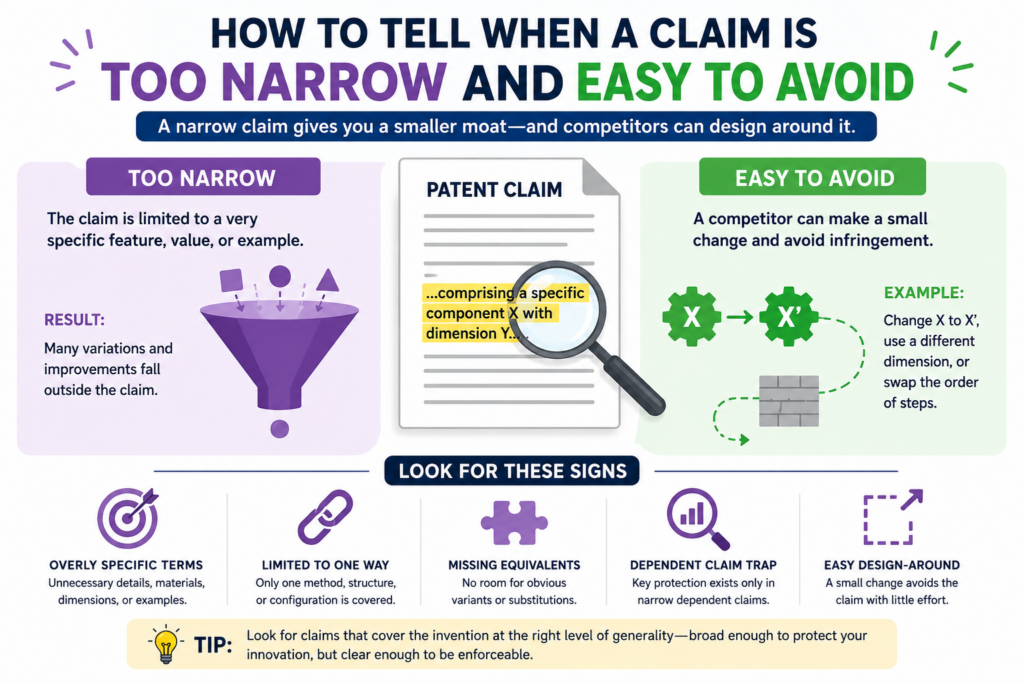
These extra details can shrink the claim until it only covers one exact version of the product.
That may feel safe because the claim matches what the team built. But patents are not only for what you built today. They should also protect smart variations that others may use tomorrow.
A narrow claim may include a certain screen layout, a certain data format, a certain number of steps, a certain order, a certain device type, or a specific tool that is not truly needed.
If a competitor can remove or swap that detail and still copy the value, the claim may be too narrow.
The danger is not detail itself, but needless detail
Detail is not bad. In fact, detail often makes a patent stronger. The issue is whether the detail belongs in that specific claim.
Some details are central. They explain what makes the invention new. Other details are just examples. They may be useful in the description, but harmful in the main claim.
For example, if the invention works because data is processed in a special order, then the order may belong in the claim.
But if the order is just one way to build the product, adding it to the broad claim may create an escape route. A competitor may change the order and argue they do not use the claim.
The same is true for numbers. A claim that says “three sensors” may be strong if three sensors are required. But if the invention works with two, three, four, or many sensors, that number may be a trap.
A simple avoidability test can reveal narrow claim traps
To review for narrowness, try to design around your own claim. Ask how a competitor could copy the main value while avoiding one word. Then repeat that exercise for each major detail.
If changing one small feature avoids the claim without losing the benefit, that feature may not belong in the broadest claim.
It may belong in a later claim, where it protects a specific version without limiting the main protection.
This is where claim layers become useful. A broad claim can protect the main idea. Narrower claims can protect preferred versions, special settings, backup features, and commercial details. This gives the patent more depth.
A good patent is not one giant claim trying to do everything. It is more like a set of fences. The outer fence protects the core.
Inner fences protect more exact forms. If one fence gets challenged, another may still help.
This is why founders should not review claims only by asking, “Does this describe our product?” They should also ask, “Does this cover the copycat version we fear most?”
That small shift changes the whole review process.
How to review unclear words that can weaken a patent claim
Unclear words are dangerous because they make people guess. A patent claim should not force the reader to wonder what a key term means.
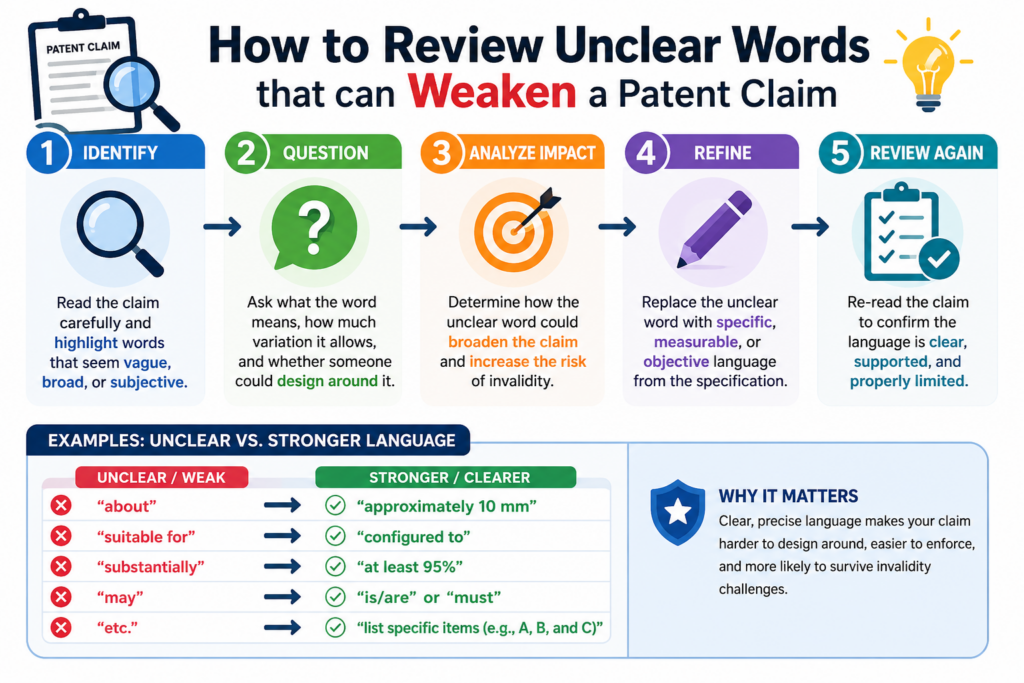
When a claim uses words that can be read in many ways, it creates room for doubt. Doubt is where weak protection begins.
This does not mean every word must be long or technical. In fact, simple words are often stronger. The issue is whether the word gives a clear line.
If the line is blurry, a competitor may argue that the claim does not cover them. A patent examiner may also push back because the claim does not say enough.
A vague word may look harmless until the claim is tested
Words like “about,” “near,” “fast,” “smart,” “better,” “dynamic,” “optimized,” “automatic,” and “relevant” can be useful in some cases, but they need support. By themselves, they may be too loose.
A claim that says a system chooses a “relevant result” may sound fine, but relevant to what? A user goal? A search term? A model score? A past action? A risk level?
The same problem happens with words that describe quality. A claim may say that a system creates a “high-quality output” or a “more accurate result.”
That may be true, but the claim should explain what makes the output better. Is it less noisy? More stable? Faster to compute? Safer to use? Easier to verify?
Weak claim language often hides behind words that feel normal in product talk. Founders use these words every day when talking to users, investors, and team members.
But patent claims need tighter language than a pitch. A pitch can inspire. A claim must define.
A clear word should tell the reader what must be present
A simple way to review unclear language is to ask whether two smart people could read the same word and disagree about what it covers. If yes, the claim may need more shape.
For example, “user data” may be clear in a product meeting, but it may not be clear enough in a claim. Does it mean profile data, live behavior data, sensor data, payment data, location data, or all of these?
If the invention depends on one kind of data, the claim should say so. If the invention can use many types, the claim can name the larger class while the description gives examples.
The goal is not to make the claim stiff. The goal is to remove avoidable confusion. A strong claim does not make the reader work too hard to understand the invention’s moving parts.
During review, circle every word that sounds like a judgment instead of a clear feature.
Then ask whether the claim or the patent description gives that word enough meaning. If not, revise it. A small fix here can save a large problem later.
How to catch claim language that is not backed by the invention
A patent claim should be supported by what the patent describes. If the claim says the invention can do something, the rest of the patent should help show how.
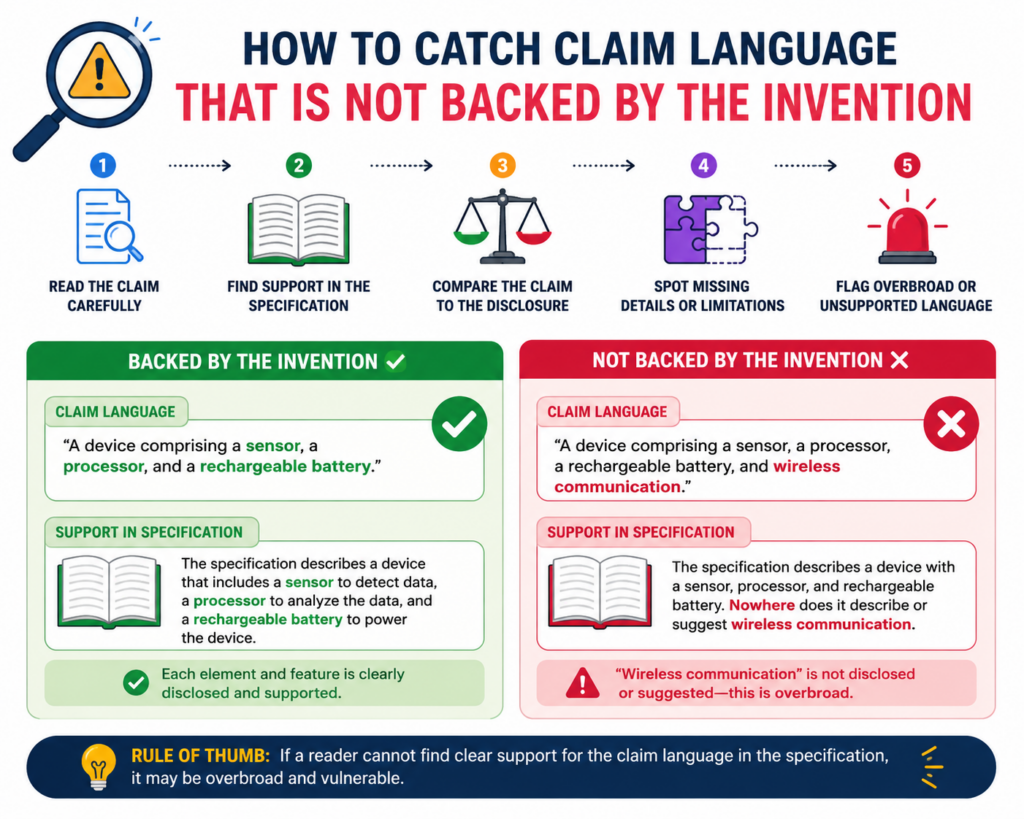
When the claim reaches beyond the story, examples, drawings, or technical details, it can become weak.
This is one of the most common problems in early patent drafts. The team wants broad protection, so the claim uses broad words.
But the draft may only explain one narrow version. That gap can create trouble. A strong claim needs roots. The deeper the roots, the harder it is to pull up.
Support is what turns a broad claim into a believable claim
A claim can be broad and still be strong. But broad language needs backup. If the claim covers different kinds of devices, data sources, models, or workflows, the patent should explain enough of those options.
It does not need to describe every possible version in painful detail. But it should show that the inventor truly had more than one version in mind.
This matters a lot for startups because products change. The version you file around today may not be the version you sell next year.
Your claim should protect the real invention across likely changes. But if the claim is broader than the filing supports, that protection may not hold.
Think of support as the bridge between the claim and the invention. If the claim says “sensor data,” but the patent only talks about one camera in one example, you may want to add support for other sensors if they truly work.
If the claim says “machine learning model,” but the patent only explains one kind of model, you may want to show other model types that can use the same idea.
The review should compare every broad word to the full patent story
A useful review step is to take each broad word in the claim and ask where the patent supports it. If the claim says “device,” where does the patent explain what kinds of devices may be used?
If the claim says “network,” where does the patent explain the network setup? If the claim says “training data,” where does the patent explain where that data comes from and how it is handled?
This is not just a drafting exercise. It is a business protection exercise. If your company may expand from one use case to another, the patent should be written with that path in mind. A narrow filing may protect today’s demo but miss tomorrow’s product.
PowerPatent helps teams bring the technical story into the patent process earlier, so the claim does not float away from what was actually built.
The mix of smart software and attorney review helps founders spot gaps before they turn into delays. You can see the process here: https://powerpatent.com/how-it-works
The key is simple: do not let the claim promise more than the patent teaches. But also do not let a thin draft shrink the invention by accident. Good review keeps both sides in balance.
How to find hidden limits that make a claim easy to design around
A hidden limit is a word or phrase that quietly narrows the claim more than you meant. It may seem small. It may even seem helpful. But if it is not needed, it can give a copycat a clean path around your patent.
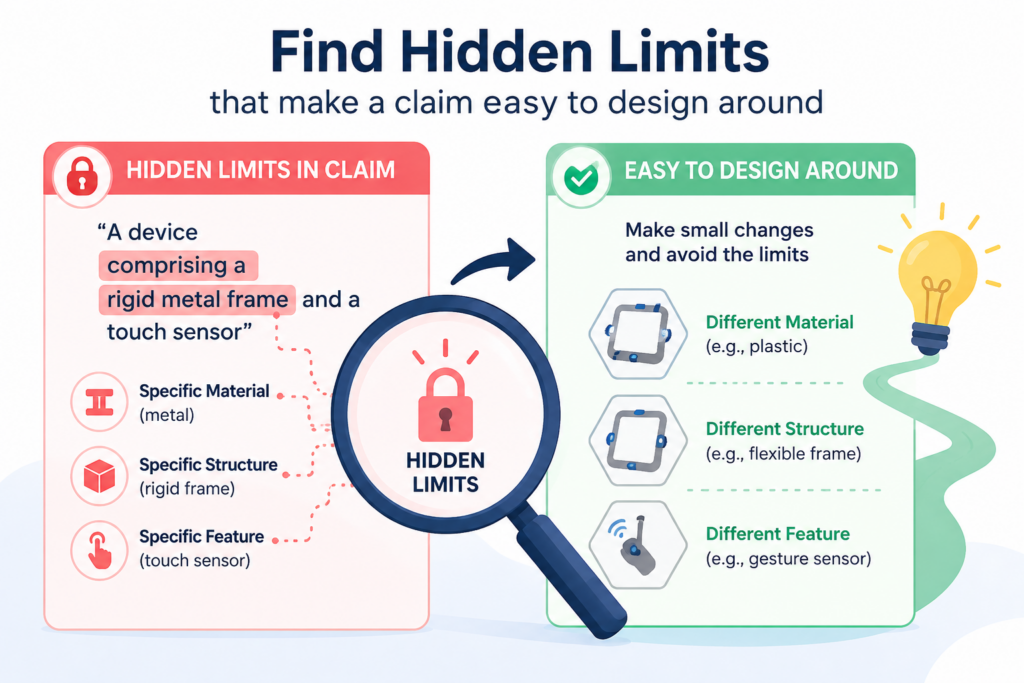
These hidden limits often come from the product your team already built. The claim may mention a certain app screen, a certain cloud setup, a certain sensor type, a certain database, or a certain order of steps simply because that is how the current version works. But the current version is not always the full invention.
A claim should not confuse the first build with the core idea
Founders are close to the product, so it is easy to claim the exact product instead of the invention behind it. This is natural. You know the version that works.
You know the code, the data flow, the model, the hardware, and the user path. But a competitor does not need to copy your exact build to take the value.
That is why hidden limits are so costly. A claim that says the system receives data from “a mobile phone camera” may miss a version that receives the same kind of data from a drone, a fixed camera, a wearable device, or a machine sensor. If the camera source is not the invention, the claim may be too narrow.
The same issue appears in software claims when the claim names a specific interface, file type, server setup, or timing step.
If the invention works without that detail, the detail may belong in a narrower claim, not the broadest one.
The best way to find hidden limits is to attack your own claim
Read the claim like a competitor. Do not ask whether the claim covers your product. Ask how someone could get the same benefit without meeting one claim phrase.
Could they swap the data source? Could they move one step from the device to the cloud? Could they use a different model? Could they change the timing? Could they replace one module with two smaller services?
Could they avoid a named output format? Could they skip a user action and still get the same result?
This exercise often reveals words that were added out of habit. Those words may still matter, but they may belong in a later claim.
The broad claim should protect the main inventive move. More specific claims can protect the exact product version.
This is not about being vague. It is about being careful. A strong claim should say enough to define the invention, but not so much that it only protects your first build.
When you review, ask one hard question for every limit: “Does the invention fail without this?” If the answer is yes, the limit may belong. If the answer is no, consider moving it out of the broad claim and into a narrower one.
How to review “means,” “module,” and “engine” language without getting trapped
Software and AI patents often use words like “module,” “engine,” “unit,” “component,” and “processor.”
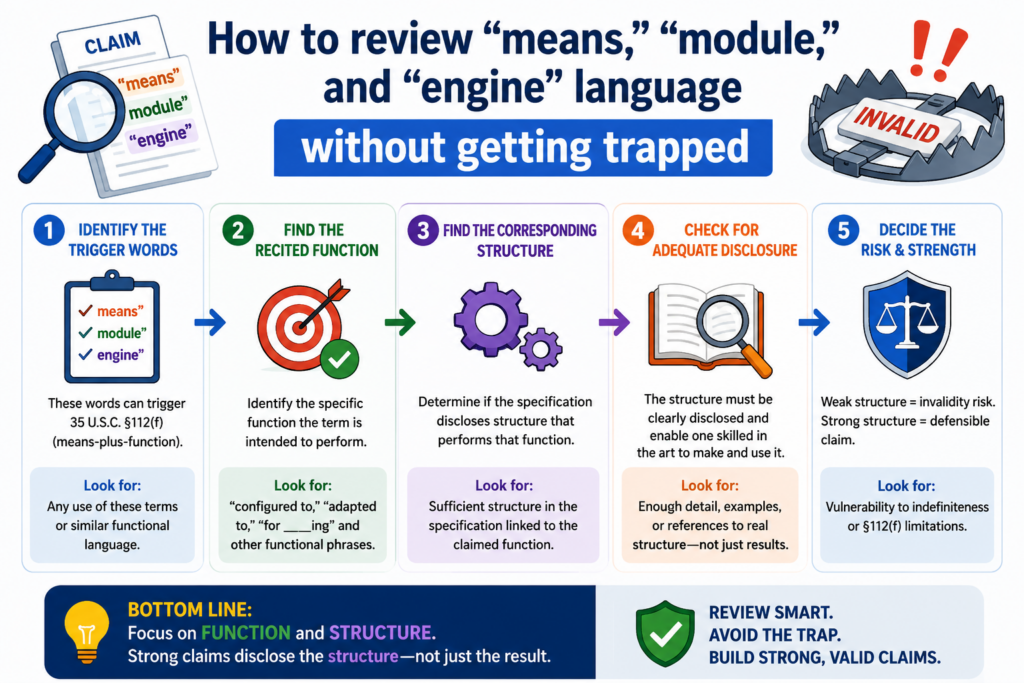
These words are common, but they can become weak when they do not explain enough. A claim that says a “decision engine” makes a decision may sound technical, but it may not say what the engine really does.
The issue is not the word itself. The issue is empty function language. If the claim names a part but only says the result it creates, the claim may be thin.
A stronger claim often explains the input, the action, and the output in a clearer way.
A named component should do more than wear a label
A “ranking module” is not strong just because it has a name. The claim should help the reader understand how ranking happens in the invention.
Does it rank based on a score? A trained model? A rule set? A change in user context? A risk signal? A feedback loop? A live sensor stream?
When a claim uses a label without real action, the label can become a mask. It hides the fact that the claim may not describe the invention clearly enough. This can make the claim easier to challenge and harder to enforce.
The same applies to hardware. A “control unit” that controls something should be tied to real control steps or signals.
A “processing unit” that processes data should be tied to the kind of processing that matters. General labels are not always bad, but they should not be the only thing carrying the claim.
A useful review method is to replace labels with plain actions
When reviewing a claim, take each component name and ask what it actually does. Then say that action in plain words. If the component cannot be explained without using the same vague label again, the claim may need work.
For example, instead of relying on “an optimization engine configured to optimize a route,” the claim may explain that the system receives live location data, compares the data with stored route limits, updates a cost score, and selects a route based on the updated score. That is still simple, but it gives the claim more structure.
This does not mean every claim should include a long recipe. Too much detail can narrow the claim. But there should be enough action to show the invention’s real shape.
For AI inventions, this review is even more important. “AI engine” is rarely enough. The claim should point to what the AI system receives, what it changes, how it is trained or used, and what output matters.
The value may be in data prep, model update timing, output filtering, feedback scoring, edge use, privacy protection, or human review flow.
Strong claims do not hide behind labels. They make the key action clear.
How to check whether the claim matches the real business value
A patent claim should protect the part of the invention that matters most to the business. This sounds obvious, but many claims miss it.
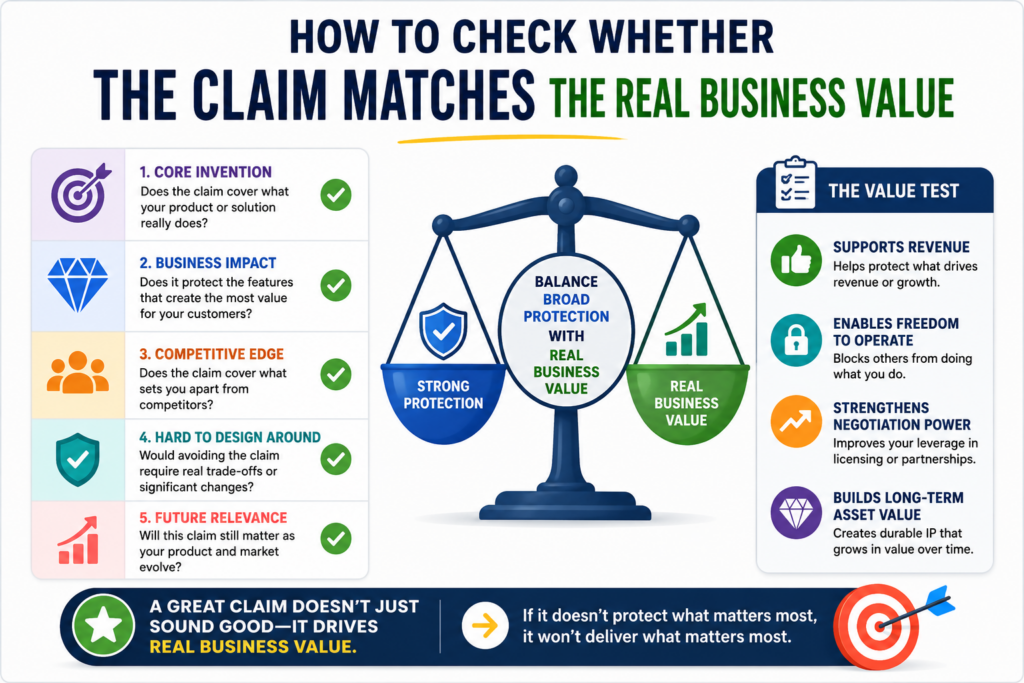
They protect a side feature, a setup detail, or a narrow workflow while the true value sits somewhere else.
For a founder, this is one of the most important claim review steps. A patent is not just a technical document. It should support the company’s moat. It should make copying harder.
It should protect the reason customers choose you, the reason investors care, and the reason competitors may want to imitate you.
The strongest claim often follows the money, the user value, and the technical edge
To review business fit, ask what makes the product hard to copy. Is it the data flow? The model training loop? The way the system handles edge cases?
The hardware layout? The control logic? The speed gain? The way the system reduces manual work? The way it keeps private data safe? The way it turns messy input into useful output?
Then compare that answer to the claim. If the claim spends most of its words on parts that do not drive value, it may be off target. If it ignores the feature that creates the main advantage, it may be weak even if it is well written.
This happens often when teams file quickly without a clear invention map. The claim may be drafted around what is easiest to describe, not what is most important to protect.
That can leave the company with a patent that looks official but does not help much when the market heats up.
A strong review connects claim words to founder strategy
A practical way to review this is to imagine three future events. First, a competitor copies your best feature.
Second, an investor reviews your patent during diligence. Third, a buyer asks whether your IP protects the core product. In each case, would the claim help?
If the claim would not cover the copycat version, it may need broader or cleaner language. If the claim would confuse an investor, it may need a clearer link to the technical edge. If the claim would not support the company’s main moat, it may need to be refocused.
This is where a founder’s input is vital. Attorneys can shape claims, but founders know where the product is going.
Engineers know what was hard to build. Product leaders know what users value. The best claim review brings those views together.
PowerPatent is designed to make that teamwork easier. It helps teams turn technical work into stronger patent drafts with real attorney oversight, without slowing the company down. Startups can see the full process here: https://powerpatent.com/how-it-works
A good claim should not merely describe an invention. It should protect the part of the invention that gives the company power.
How to review claim language against real competitor workarounds
A useful patent claim should make copying harder, not just describe what your team built.
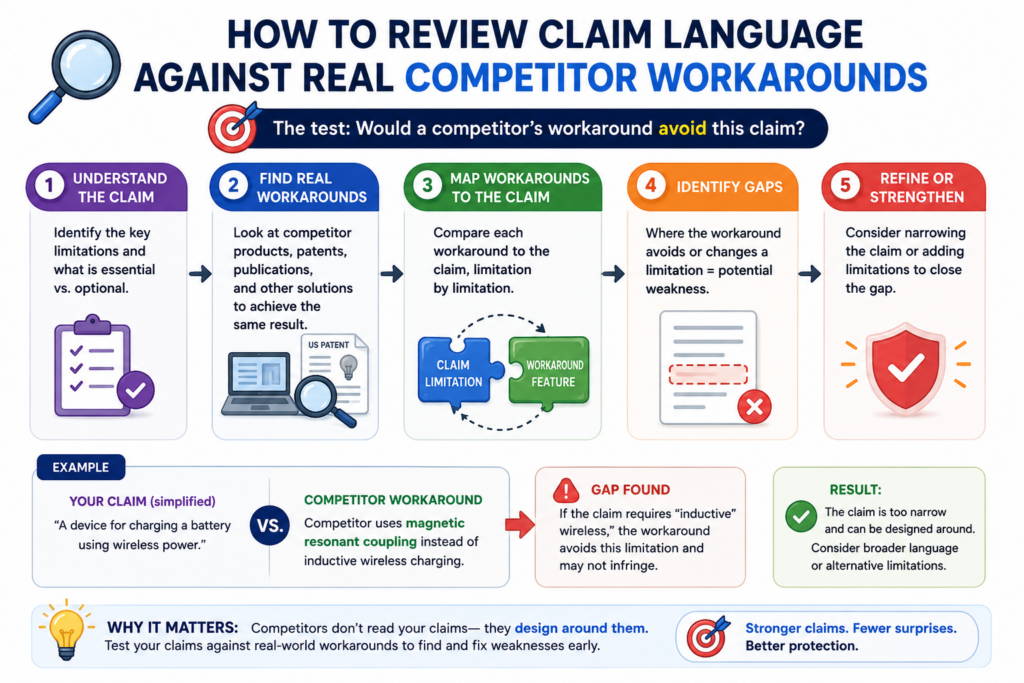
That is why one of the best review methods is to read the claim like a competitor who wants the same result without stepping inside your fence.
This is not a negative exercise. It is one of the most practical ways to make claims stronger.
When you look for workarounds before filing, you give yourself a chance to fix the weak spots early. When someone else finds them later, you may not get that chance.
A competitor will not ask, “How do we copy this exactly?” They will ask, “How do we get the same customer value with a small change?” Your review should do the same.
A workaround test shows whether the claim protects the core or only the current build
Start by reading the claim slowly and picking out each required piece. Every required piece is a gate.
To infringe the claim, a competitor usually has to pass through each gate. That means every extra gate gives them another way to avoid the claim.
This is why claim review is so important. A claim may look strong because it has many details. But if some details are not truly needed, they may hurt you. They can turn the claim into a narrow path that only covers your exact product.
Imagine a claim for a system that reviews machine data and sends an alert to a mobile device. If the real invention is the way the system detects a failure pattern, the “mobile device” part may be too limiting.
A competitor could send the alert to a dashboard, email system, control panel, or API endpoint and argue they are outside the claim.
That does not mean “mobile device” should never appear. It may belong in a narrower claim. The issue is whether it belongs in the broad claim that is meant to protect the main idea.
The best question is whether a copycat can change one word and keep the value
During review, take one claim term at a time and try to replace it. Replace the device. Replace the data source. Replace the model type. Replace the output. Replace the order of steps.
Replace a user action with an automatic action. Replace a cloud step with an edge step. Then ask whether the invention still works and still gives the same business value.
If the answer is yes, the claim may be too tied to one version. The language may need to be broader, cleaner, or moved into a later claim.
This is where founder insight matters. A patent professional may not know which parts are easy to swap unless the technical team explains the product deeply.
Engineers often know which features are fixed and which are flexible. Founders know where competitors are likely to move. A good review uses that knowledge before the claim is locked in.
PowerPatent helps teams pull that technical context into the patent process earlier, with smart tools and real attorney oversight.
That can help founders spot avoidable limits before they become expensive gaps. You can see how the process works here: https://powerpatent.com/how-it-works
How to find claim words that rely too much on the user’s intent
Claims can become weak when they depend too heavily on what a user wants, thinks, chooses, or prefers. User intent can matter in some inventions, but it is often hard to prove and hard to define.
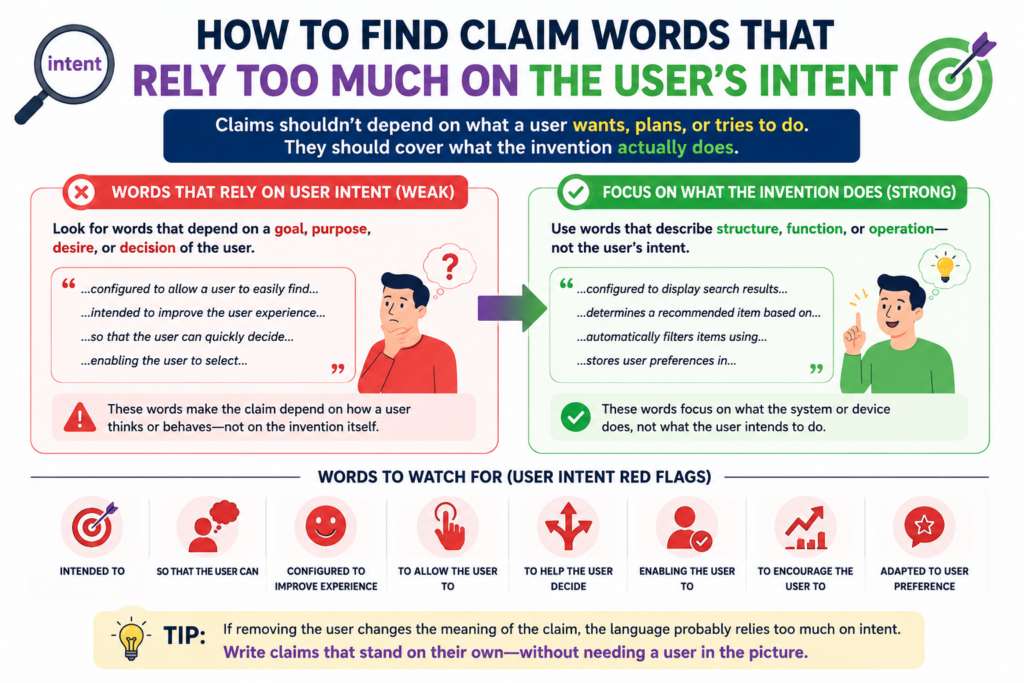
A strong claim should focus as much as possible on clear system actions, clear inputs, clear outputs, and clear technical steps.
This issue appears often in software, AI tools, marketplaces, health platforms, fintech products, and workflow systems.
The product may feel user-driven, so the claim may say the system acts “based on a user goal,” “based on user interest,” or “in response to user preference.” Those phrases can be useful, but they should not be vague.
If the claim depends on a user’s hidden state of mind, it may create proof problems later. It may also make the claim feel less technical.
Strong claims turn user intent into observable signals
Instead of leaning on what the user meant, a stronger claim often points to what the system can actually detect.
This may include a user input, a selected setting, a behavior pattern, a search term, a stored profile value, a sensor reading, a click path, a time period, or a response to a prompt.
For example, “based on user interest” may be too loose by itself. A clearer version may refer to user activity data, selected tags, saved items, prior actions, or a score created from those signals.
The goal is not to add needless detail. The goal is to make the claim easier to understand and harder to dismiss.
In many inventions, the real value is not that the user has a goal. The real value is how the system turns messy user signals into a useful action. That is where the claim should place more weight.
Review the claim by asking whether the system acts without reading minds
A simple test is to ask whether the claim still makes sense if you remove the user’s hidden thoughts. Can the system step be understood from data, signals, or actions?
Can the output be tied to something the system receives or stores? Can the claim explain how the system responds without needing to prove what a person intended?
This matters because patents need clear boundaries. If a claim says the system recommends content “when the user wants help,” the line is soft.
If the claim says the system detects a pause in task progress, compares the pause with prior task data, and sends a suggested next step, the line is clearer.
The same rule applies to enterprise tools. A claim may say that software “supports a manager’s decision.”
That sounds useful, but it may be stronger to claim the data path, scoring method, alert rule, permission flow, or report generation step that creates the support.
User value still matters. The patent should explain why the invention helps people. But the claim should not rest only on feelings, wishes, or broad intent. It should show the technical action that creates the value.
How to catch overbroad claims that sound like owning the whole problem
One of the biggest red flags in patent claim review is language that tries to own the problem instead of the solution.
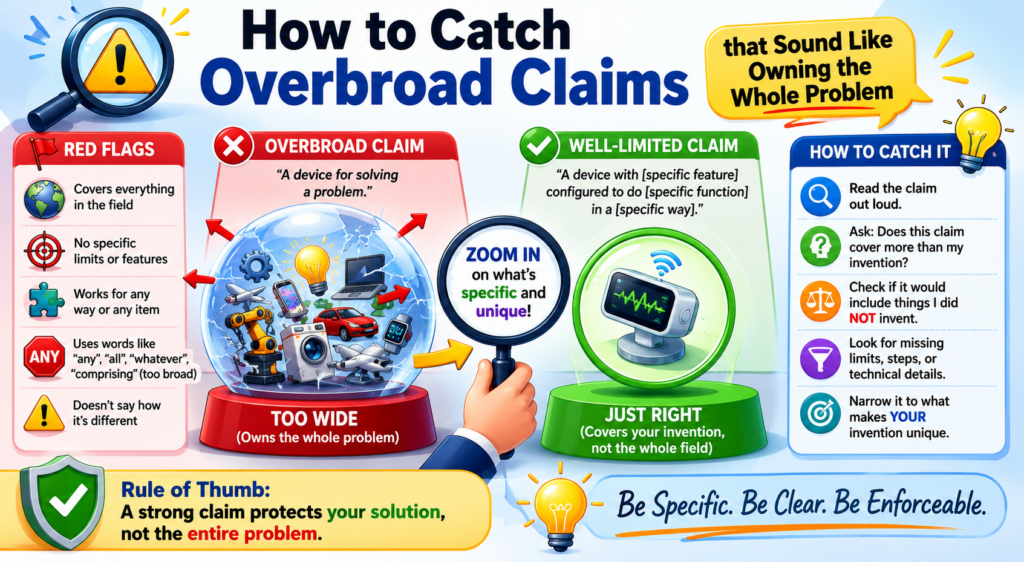
This often happens when a startup has a powerful idea and wants wide protection. The team may try to claim every way to solve a customer pain, even though the invention is one specific way to solve it.
That can make the claim look exciting, but it can also make it fragile. A patent usually cannot claim a goal in the abstract.
It needs to claim the inventive way the goal is reached.
A claim that tries to cover the whole problem may face pushback because other people may have solved parts of that problem before. Even if the exact product is new, the broad goal may not be.
The claim should protect the inventive path, not just the desired result
Many weak claims are built around phrases like detecting fraud, improving safety, reducing downtime, increasing accuracy, saving energy, finding a match, ranking options, or automating review.
These are valuable outcomes. But they are also broad business or technical goals.
The claim becomes stronger when it explains the path your invention uses to reach that goal.
That path may be a special data filter, a new timing rule, a different model update process, a device arrangement, a privacy-preserving step, a control loop, or a way to combine signals that were not combined before.
For example, a broad claim to “detect equipment failure using sensor data” may be too close to the general problem.
A stronger claim may focus on how the system groups sensor events, compares them to a baseline, updates a risk score, and triggers a control action under certain conditions.
The exact right words depend on the invention, but the idea is the same. Claim the move, not just the dream.
A useful review question is whether the claim could describe a whole industry
When reading a claim, ask whether it could describe nearly every company trying to solve the same problem.
If yes, the claim may be too broad. A strong broad claim should still feel tied to your technical contribution.
This does not mean the claim should be small. It can cover many versions. It can protect a wide family of products. But it should not read like a wish to own the category.
There is also a business reason to avoid this trap. Overbroad claims can slow the patent process. They can invite rejections. They can force rounds of changes that cost time and focus.
For a startup, delays matter. You want protection that moves with the company, not language that gets stuck because it overreaches.
PowerPatent helps founders move faster without skipping the hard thinking. The platform helps bring technical detail, founder context, and attorney review into one cleaner path.
That helps teams aim for claims that are broad enough to matter and grounded enough to survive. Learn more here: https://powerpatent.com/how-it-works
How to review claim order so the invention is easy to follow
Claim review is not only about single words. It is also about flow. A claim can use clear terms but still feel weak if the parts are in a confusing order.
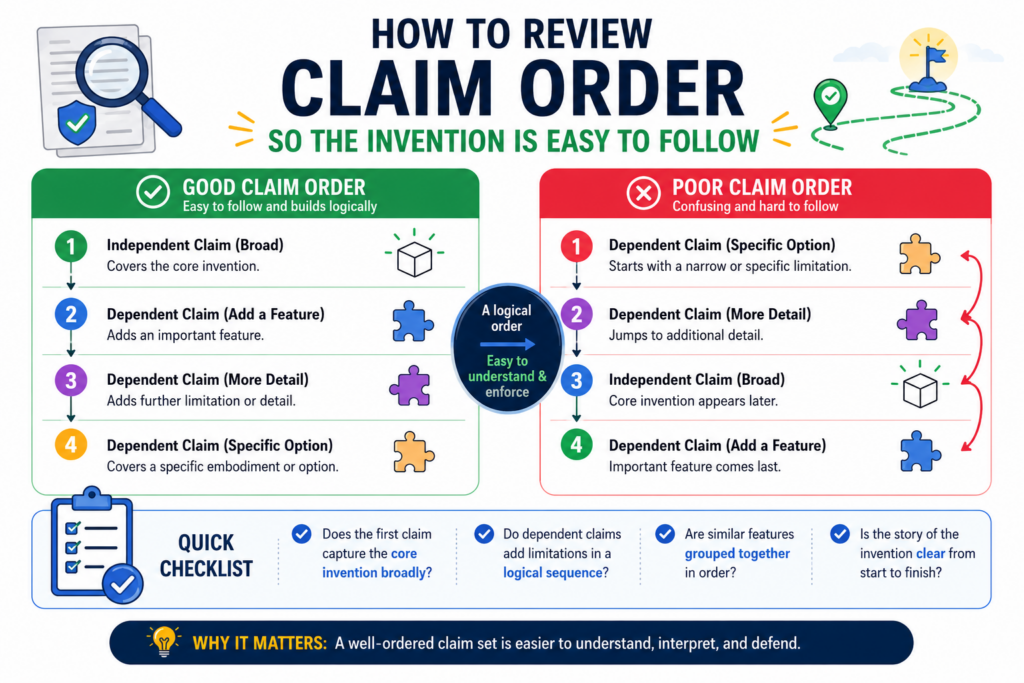
When the order is hard to follow, the invention may look less solid than it really is.
A good claim has a natural path. It introduces the main parts, explains what they receive, shows what they do, and connects the output to the value.
The reader should not have to jump back and forth to understand how the invention works.
This is especially important for software and AI inventions, where the steps may happen across devices, servers, models, databases, and user interfaces. If the claim flow is messy, the invention may feel messy too.
A clean claim flow helps the reader see the technical story
A strong claim often begins with the main environment, such as a system, method, device, or computer-readable medium. Then it moves through the key action in a clear order.
The claim does not need to read like a product manual, but it should have enough sequence to make sense.
For example, if the invention receives data, transforms the data, scores the transformed data, and then takes action based on the score, the claim should not hide the transformation until the end.
The flow should help the reader understand why each step matters.
Poor order can also create unwanted limits. If a claim states steps in a strict order, it may imply that the order is required.
Sometimes that is correct. Other times, the invention works even if steps happen in a different sequence or at the same time. Review should catch this.
If order matters, make it clear. If order does not matter, avoid wording that suggests a fixed sequence.
A strong review reads the claim out loud like a process story
Reading the claim out loud can reveal problems that silent reading misses. If you have to stop, backtrack, or explain the claim in simpler words, the written claim may need work.
If the claim uses a term before introducing it, that is a sign of poor flow. If an output appears before the system creates it, the order may confuse the reader.
This review method is simple, but powerful. Patent claims are dense by nature, yet they should still have logic. The reader should be able to trace cause and effect.
For founders, this is a useful place to add value. You do not need to know patent rules to spot a confusing story. You can ask whether the claim matches how the system actually works.
You can ask whether the main breakthrough appears early enough. You can ask whether the claim spends too much time on setup and not enough time on the invention.
A clear claim is not just easier to read. It is easier to defend, easier to explain, and easier to connect to the product. That matters when investors, buyers, partners, or competitors review your IP.
How to check dependent claims without treating them like an afterthought
Dependent claims are the claims that add more detail to a broader claim. Many founders skip over them because the first claim feels like the main event. That is a mistake.
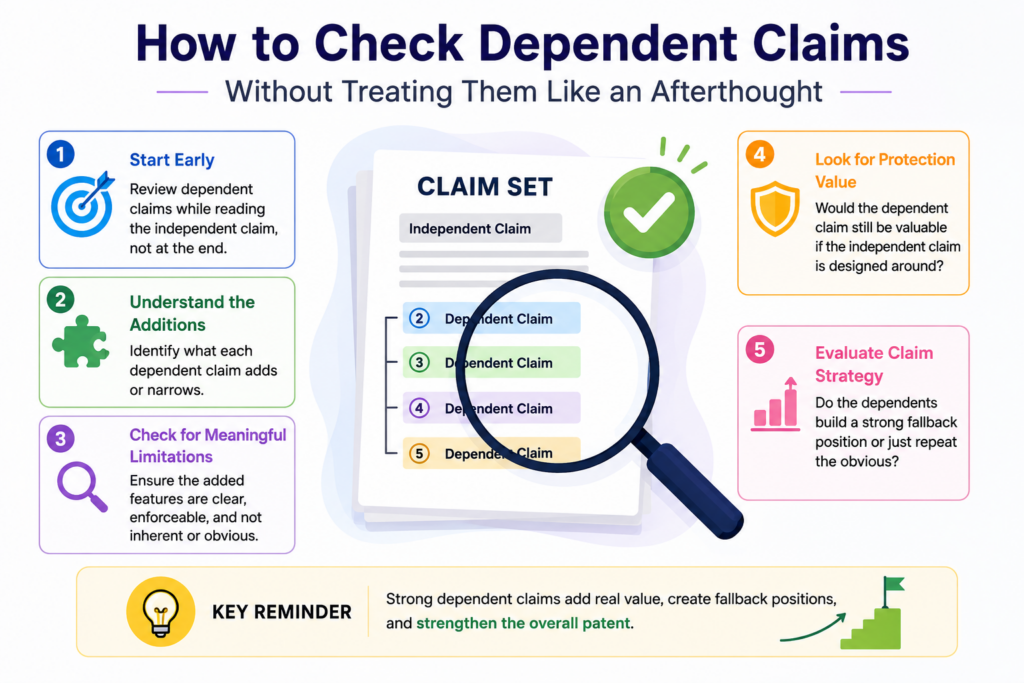
Dependent claims can give a patent depth, backup positions, and better coverage for key product versions.
A strong patent does not rely on one claim to do all the work. It uses a layered set of claims. The broad claim protects the core idea.
The dependent claims protect important details, fallbacks, commercial features, and technical improvements.
When reviewed well, dependent claims can make the whole patent stronger.
Dependent claims should protect meaningful versions, not random details
A weak dependent claim adds detail that does not matter. It may name a feature just because it exists in the product.
It may claim a setting, display, format, or routine step that does not add much protection. That is a missed chance.
A strong dependent claim adds a detail that could matter in the real world. It may cover a version that customers use often. It may protect a feature competitors are likely to copy.
It may add a technical step that helps overcome prior systems. It may support a narrower path if the broad claim faces pushback.
For example, if the broad claim covers a model-based control system, dependent claims may protect a specific feedback loop, a confidence score, an edge-device update, a fail-safe rule, or a privacy step.
These details are not random. They support real product value.
Dependent claims also help tell the invention story. They show the range of ways the invention can work. They give the patent more texture. They can help show that the team thought beyond one narrow demo.
Review each dependent claim by asking what job it performs
Every dependent claim should have a reason to exist. It may protect a business-critical feature. It may create a fallback.
It may cover a likely competitor variant. It may support a specific technical advantage. If you cannot explain the job of a dependent claim, it may need to be revised.
This is also a good place to check for missing claims. Sometimes the most important product feature is not in any dependent claim.
The broad claim may cover the general idea, but a key commercial version may be left out. That can happen when the patent draft is created before the product team shares the full roadmap.
Founders should review dependent claims with future plans in mind. What will the product likely support in six months? What feature would a competitor copy first?
What technical detail would matter most in a funding round or acquisition review? Those answers can guide which dependent claims deserve attention.
PowerPatent is designed to help startups move through this kind of review with more speed and less confusion. The goal is not to drown founders in legal work.
The goal is to help them file smarter, with software that captures technical detail and attorneys who help shape it into stronger protection. See how PowerPatent works here: https://powerpatent.com/how-it-works
How to review claim language for missing links between steps
A patent claim can name the right parts and still feel weak if it does not show how those parts connect. This is a common issue in software, AI, robotics, sensors, medical tools, and data systems.
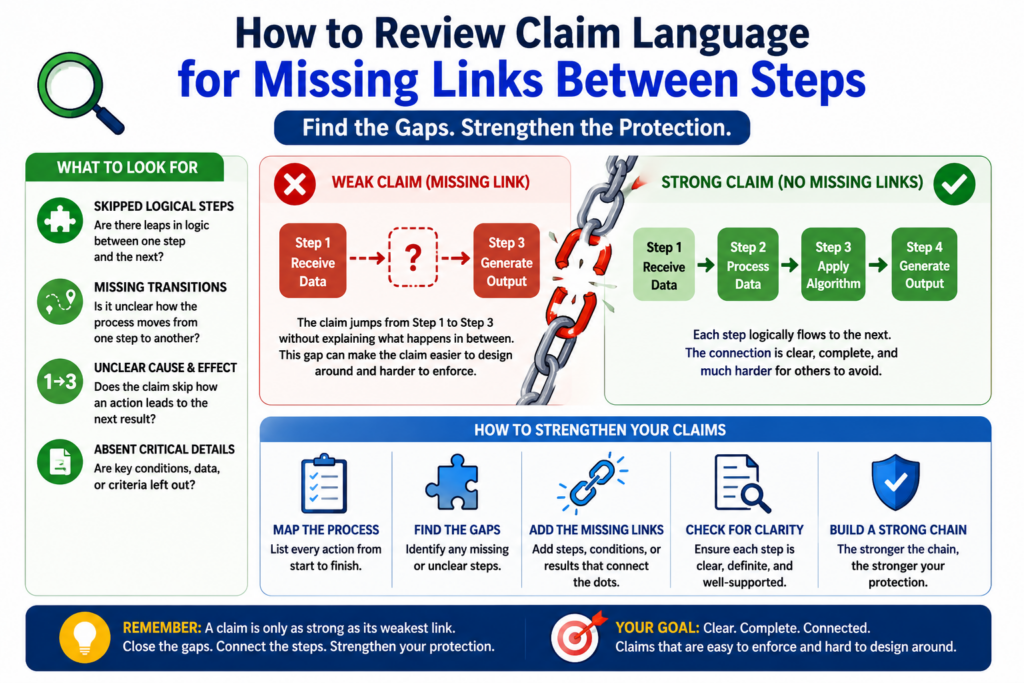
The claim may say that one part receives data, another part processes data, and another part creates an output. But it may not explain how one step leads to the next.
That missing link can create doubt. A strong claim should not feel like a pile of parts. It should feel like a working invention.
When claims lack connection, they become easier to attack. A reader may ask whether the claimed system is truly one invention or just a set of known pieces placed next to each other.
That is not where you want to be. The claim should show cause and effect in simple, direct words.
The claim should make the invention feel like a chain, not a drawer of parts
Think of the claim as a chain. Each step should connect to the next. The system receives something. It changes something.
It checks something. It sends something. It triggers something. The output should depend on the earlier action.
Weak claim language often fails because it names parts without showing dependency. For example, a claim may say that a system gets sensor data, stores user data, runs a model, and sends an alert.
But why does the model run? What does it use? How does the alert relate to the model output? What makes the alert part of the invention instead of a normal notification?
The fix is not always to add more words. The fix is to add better links. Phrases like “based on,” “using,” “in response to,” and “according to” can help, but only when they point to real relationships.
If everything is “based on” everything else, the claim may still feel loose.
A good review follows the data from start to finish
One practical way to review a claim is to follow the main data, signal, command, or object through the full claim.
Ask where it enters, how it changes, what uses it, and what result it creates. If the path breaks, the claim may need a clearer bridge.
This is especially useful for AI claims. If the claim says the system creates a prediction, the review should ask what data fed the prediction, how the model used it, and what changed because of the prediction.
If the output does not drive a real step, the claim may feel like a general idea instead of a technical invention.
For founders, this review can be very practical. You can map the claim against the product flow. If the product has a clean technical path but the claim does not show it, the claim is leaving strength on the table.
PowerPatent helps teams turn technical flows into clearer patent language with software and real attorney oversight.
That means fewer missing links, fewer slow loops, and better claims from the start. See how it works here: https://powerpatent.com/how-it-works
How to find claim language that sounds strong but adds no real protection
Some claim words sound powerful, but they do not actually protect much. They make the claim feel bigger without making it harder to copy. This kind of language can waste space and hide the parts that matter.
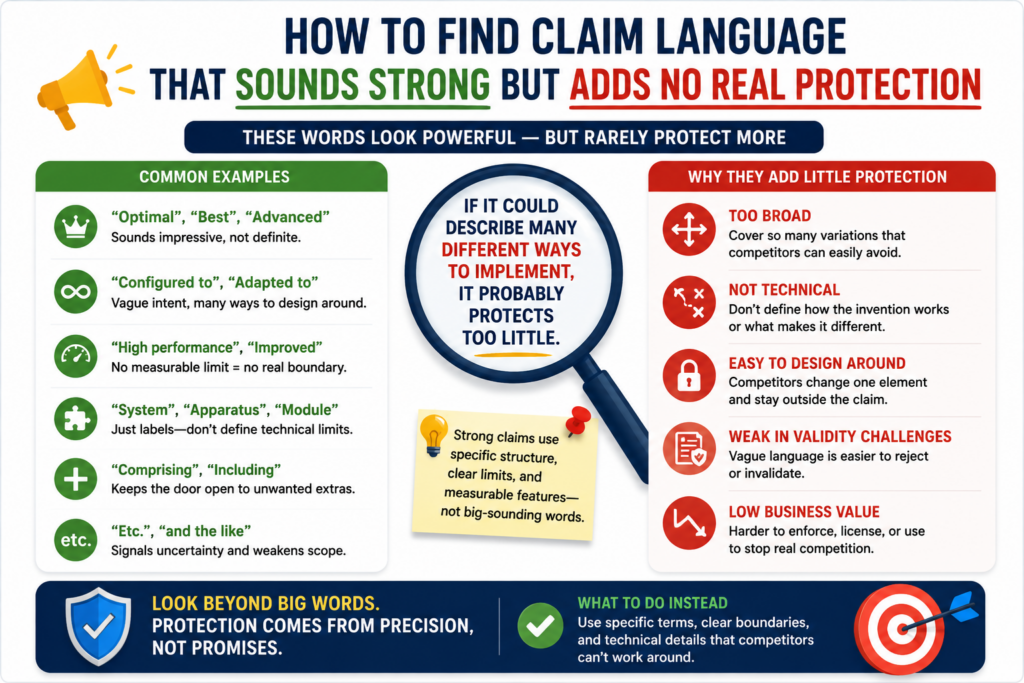
Words like “advanced,” “intelligent,” “seamless,” “robust,” “scalable,” and “efficient” may work in a sales page.
They do not usually do much in a patent claim unless they are tied to a clear technical feature. A claim should not try to impress. It should define.
This is where many founders get misled. A claim may look high-value because it uses bold words. But when you test those words, they may not tell a reader what must be present.
Strong patent words create boundaries, not mood
The best claim language draws lines. It tells someone what the invention includes and what steps matter. It does not rely on mood, style, or marketing force.
For example, “a smart routing system” may sound useful, but the word “smart” does not set a clear boundary.
A stronger claim may explain that the system updates a route score using live traffic data and machine status data before selecting a route. That kind of language gives the claim more shape.
The same is true for “secure,” “fast,” or “personalized.” These can be good ideas, but the claim should show how the system becomes secure, fast, or personalized.
Does it encrypt a certain value? Does it reduce a processing step? Does it build a user score from stored actions? The claim should point to the mechanism, not just the label.
A simple review method is to ask what changes if the word is removed
Take each strong-sounding word and remove it from the claim. If nothing changes, the word may not be doing real work. It may be fluff inside the claim.
This does not mean every broad word is bad. Sometimes a broad word is needed because the invention can work in several ways.
But even broad words should help define the invention. They should not just decorate the claim.
A good claim review is ruthless about empty language. It asks whether each word creates meaning, support, or scope. If a word does none of those things, it may distract from the real invention.
This matters because patent claims are already hard enough to read. Extra words can make them harder. A cleaner claim is often easier to defend, easier to understand, and easier to connect to the company’s value.
For startups, this is a big deal. Investors and buyers may not read every word with patent-law depth, but they can often sense when a claim is clear versus padded.
A claim that gets to the point gives more confidence than one that hides behind fancy words.
How to review claim language for old ideas hiding inside new words
A claim can sound new because it uses modern terms, but still cover an old idea.
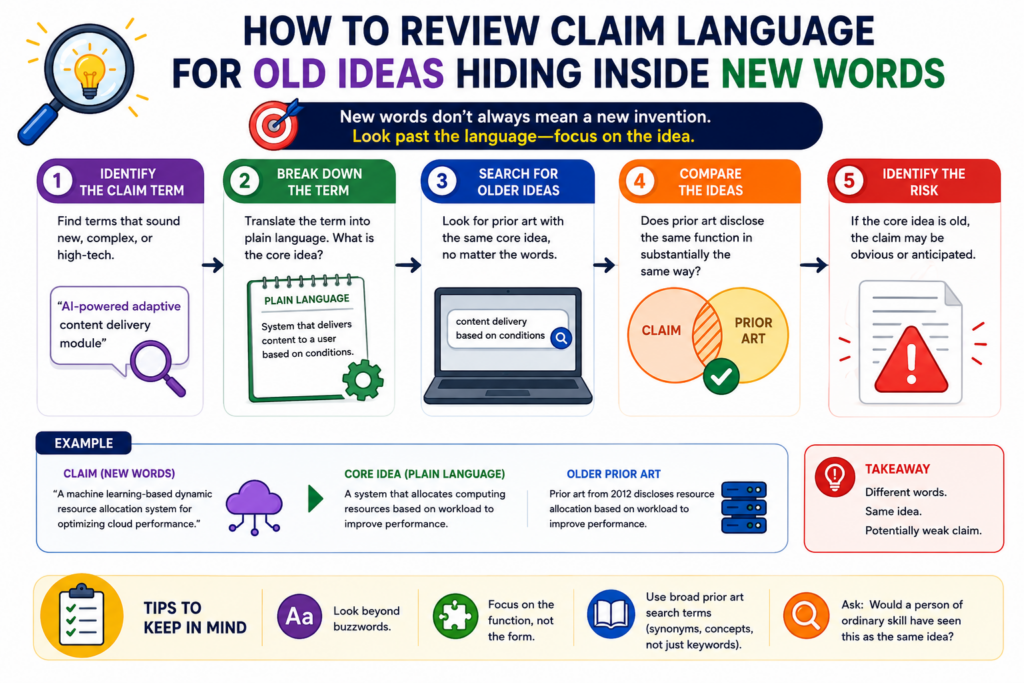
This is common when teams use words like AI, blockchain, cloud, edge, automation, digital twin, or predictive analytics. These words may describe the field, but they do not automatically make the claim strong.
A patent claim should protect what is new about the invention, not just place an old process inside a new tech setting. If the claim says a known workflow is done “using AI,” the review should ask what the AI changes in a real way.
Modern words can be useful, but they must not be a costume for old steps.
The review should separate the technology label from the real technical change
Start by asking what would remain if the trendy word were removed. If the claim still describes the same old process, then the claim may not be strong enough.
The invention may need to be framed around the specific technical improvement.
For example, a claim that says an AI system reviews documents and sends a recommendation may be too broad if people already reviewed documents and sent recommendations before.
The stronger point may be how the system extracts certain fields, checks conflicts, trains on a special data set, routes uncertain cases, or updates the review based on feedback.
In hardware, the same issue appears when a known device is called connected, smart, or cloud-enabled.
The claim should ask what the connection enables that was not done before. Does it change timing? Control? Safety? Fault handling? Calibration? Remote updates? Data fusion?
A strong review asks what the invention does better at the technical level
The key question is not, “Is this in a hot field?” The key question is, “What technical thing is different?”
That difference might be small but important. It may be a cleaner data path, a faster control loop, a new way to reduce false alarms, a better training method, a safer device response, or a way to handle missing data. The claim should bring that difference forward.
This is one reason founders should not wait until the last minute to think about patents. The best patent work often starts while the team still remembers what was hard to build.
Engineers can explain the failed attempts, edge cases, and design choices that led to the final solution. Those details can make the claim much stronger.
PowerPatent helps capture those details early, so the final claim is not just “AI does X.” It becomes a clearer story of what your team actually invented. Learn more about the process here: https://powerpatent.com/how-it-works
A strong claim should not borrow strength from buzzwords. It should earn strength from the invention.
How to check whether the claim is too tied to today’s product roadmap
Startups move fast. The product you ship today may change in three months. The customer you serve today may lead you to a bigger market next year.
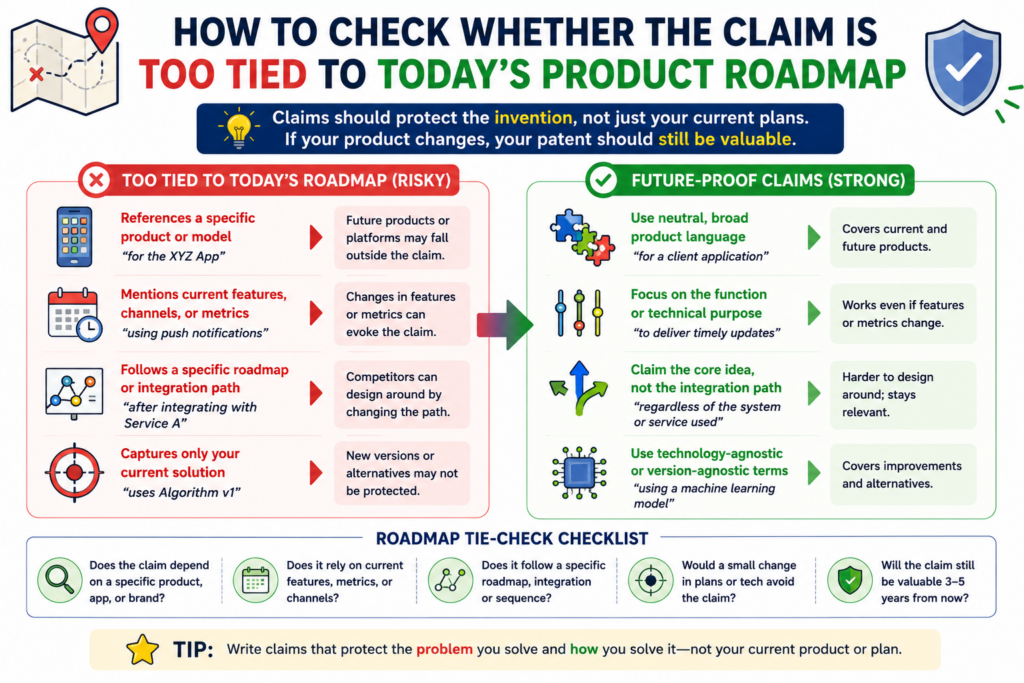
If your claims are locked to the first roadmap, they may fail to protect the company as it grows.
This is a quiet risk. The claim may look correct because it matches the current plan. But patents should protect the invention across smart future versions, not just the first release.
A claim that is too tied to today’s roadmap may include current UI choices, current data fields, current deployment choices, or current customer workflows. Those may change. If they are not central to the invention, they may limit the claim too much.
Good claim review looks beyond the current build without losing support
The goal is not to claim every future idea. That would be unsafe and weak. The goal is to protect the core technical idea in a way that still fits likely product growth.
Ask what will stay true even if the product changes. Will the same kind of data still be processed? Will the same decision logic still matter?
Will the same feedback loop still improve output? Will the same device relationship still create value? Those stable parts are often better anchors for the broad claim.
Then ask what may change. The app may become an API. The cloud process may move partly to the edge. A single model may become several models. A human approval step may become automatic.
A dashboard may become a direct machine command. If the invention still works across those changes, the broad claim should not be trapped in only one version.
A strong review separates invention roots from product branches
Think of the invention like a tree. The roots are the core technical ideas. The branches are product versions. A strong claim should protect the roots. Other claims can protect the branches.
This is where dependent claims can help. The broad claim can stay focused on the core. Later claims can cover the current product details, key roadmap features, and special versions. That gives the patent both reach and backup.
Founders should bring roadmap context into claim review. Not vague dreams, but real likely paths.
Tell the patent team what the product may become, what customers are asking for, and what competitors may try. That information can shape better claims.
Without that context, a claim may overfit the first build. In startup terms, that is like writing a contract for a product that already changed by the time the ink is dry.
A patent should support the company’s next moves, not freeze the company in its first version.
How to review claim language for proof problems before you need proof
A claim may be valid on paper but hard to use in the real world if you cannot tell when someone practices it.
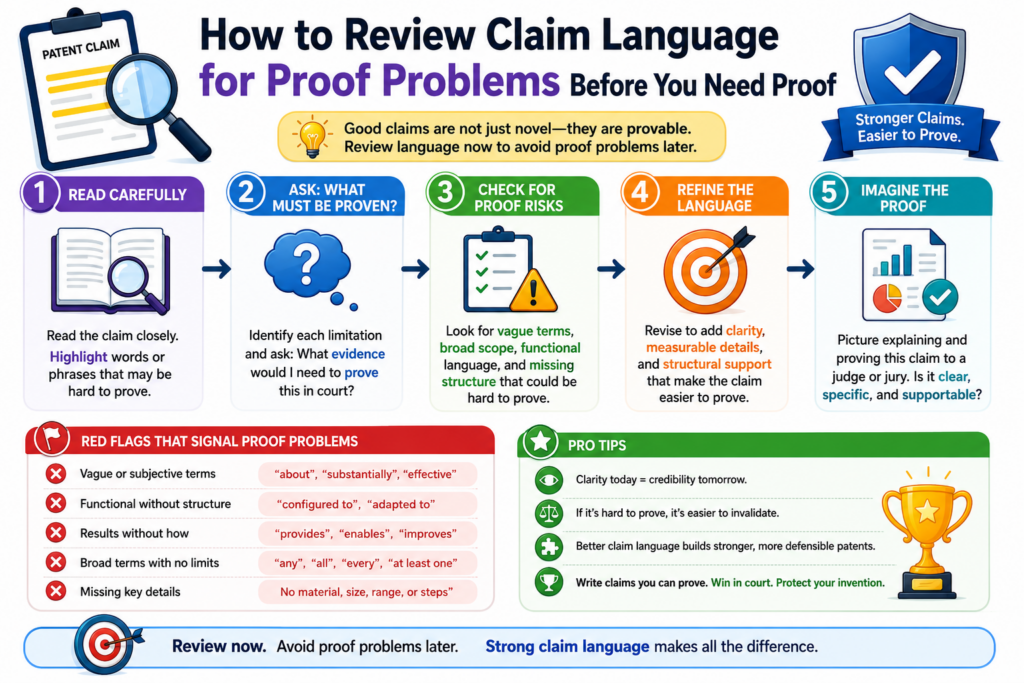
This is a major issue in claim review. If the claim depends on hidden steps inside a competitor’s system, private data, secret model weights, or internal intent, it may be hard to prove.
That does not always make the claim bad. Some inventions are naturally internal. But it does mean you should think carefully about proof while reviewing the language.
A patent is stronger when you can connect the claim to things that can be seen, tested, logged, bought, used, or reasonably inferred from the product.
The best claims often include signs that can be observed from outside
For software and AI tools, proof can be hard because much of the work happens behind the scenes.
A competitor may not show how their model is trained or how their backend makes decisions. If the claim only covers hidden training steps, you may face a proof challenge later.
That is why it can help to include claim elements tied to visible outputs, system behavior, user-facing actions, API responses, device changes, reports, alerts, or performance patterns.
These may not reveal everything, but they can make the claim easier to connect to real-world conduct.
For example, if the invention improves anomaly detection, the claim might still include internal scoring steps.
But it may also connect those steps to a generated alert, a changed control setting, or a selected response action. The visible result helps show the claimed process in action.
A practical review asks how you would know a competitor is using the claim
Read the claim and imagine a competitor launches a similar product. What could you inspect? What could a customer see?
What could a product demo reveal? What could public docs, API behavior, device output, or testing show? If every important claim step is hidden, the claim may need a more useful structure.
This does not mean you should weaken the claim just to make proof easy. It means proof should be part of the strategy.
A claim that is broad, clear, and also easier to observe can be more useful than a claim that sounds perfect but hides entirely inside a black box.
For deep tech startups, this review is especially important. Many inventions involve models, chips, control systems, infrastructure, or private workflows.
A smart patent strategy may use a mix of claims. Some claims protect internal methods. Others protect system behavior, outputs, or product-level actions. Together, they create a stronger net.
PowerPatent helps founders think through these issues with smart software and real attorney review, so the claims are built for business use, not just filing. See how PowerPatent works here: https://powerpatent.com/how-it-works
How to review claim language for the right level of technical detail
A patent claim needs enough detail to show the invention clearly, but not so much detail that the claim becomes tiny.
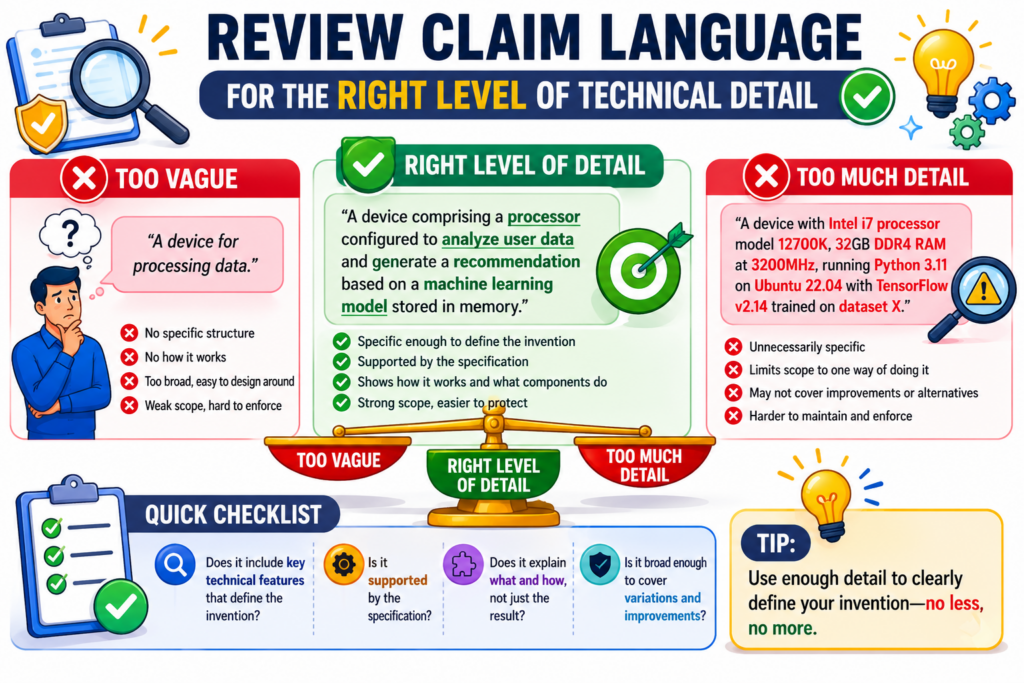
This is one of the hardest parts of claim review. Too little detail can make the claim feel like an idea. Too much detail can make it easy for a competitor to avoid.
The right level depends on what your invention actually adds. If your team created a new data flow, the claim should show that flow. If your team created a better control rule, the claim should show the rule enough to make it real.
If your team built a better way to train or use a model, the claim should not hide that work behind a broad phrase like “using artificial intelligence.”
A strong claim does not try to explain every engineering choice. It focuses on the few choices that make the invention work.
The claim should explain the core move, not the full product build
Founders often want claims that cover the whole product. That is understandable, but it can lead to weak drafting. A product may include user accounts, dashboards, databases, APIs, alerts, logs, permissions, and reports.
Many of those parts may be normal. The claim should not waste too much space on normal pieces unless they help define the invention.
The better question is this: what technical move makes this invention different from a normal product in the same space? That move should guide the claim.
For example, if the invention is a new way to reduce false alerts in an industrial system, the claim should focus on how the system filters signals, compares patterns, updates risk, or changes alert timing.
It does not need to claim every screen, every setting, and every admin tool unless those details matter.
The review should remove detail that does not change the invention
A practical review step is to ask whether each detail changes the strength of the claim. If a detail explains the heart of the invention, it may belong.
If it only describes one product version, it may be better placed in a dependent claim. If it adds nothing, it may be removed.
This is where PowerPatent can help teams move faster. The platform helps gather the technical story from founders and engineers, then pairs smart software with real attorney review so the final claim is more focused. You can see how that works here: https://powerpatent.com/how-it-works
The goal is not to make claims long. The goal is to make them exact. A claim should be broad where the invention is broad, narrow where the invention truly needs a limit, and clear at every key step.
Conclusion
Strong patent claim review is not about making claims sound clever. It is about finding weak words before they cost you speed, money, or control. Look for vague terms, broad promises, hidden limits, missing links, and details that make the claim easy to avoid.
Then tie each claim back to the real invention, the product value, and the way a competitor may copy you. When founders and attorneys review claims together, patents become sharper and more useful. PowerPatent helps make that process faster, clearer, and safer with smart software plus real attorney oversight: https://powerpatent.com/how-it-works
Leave a Reply