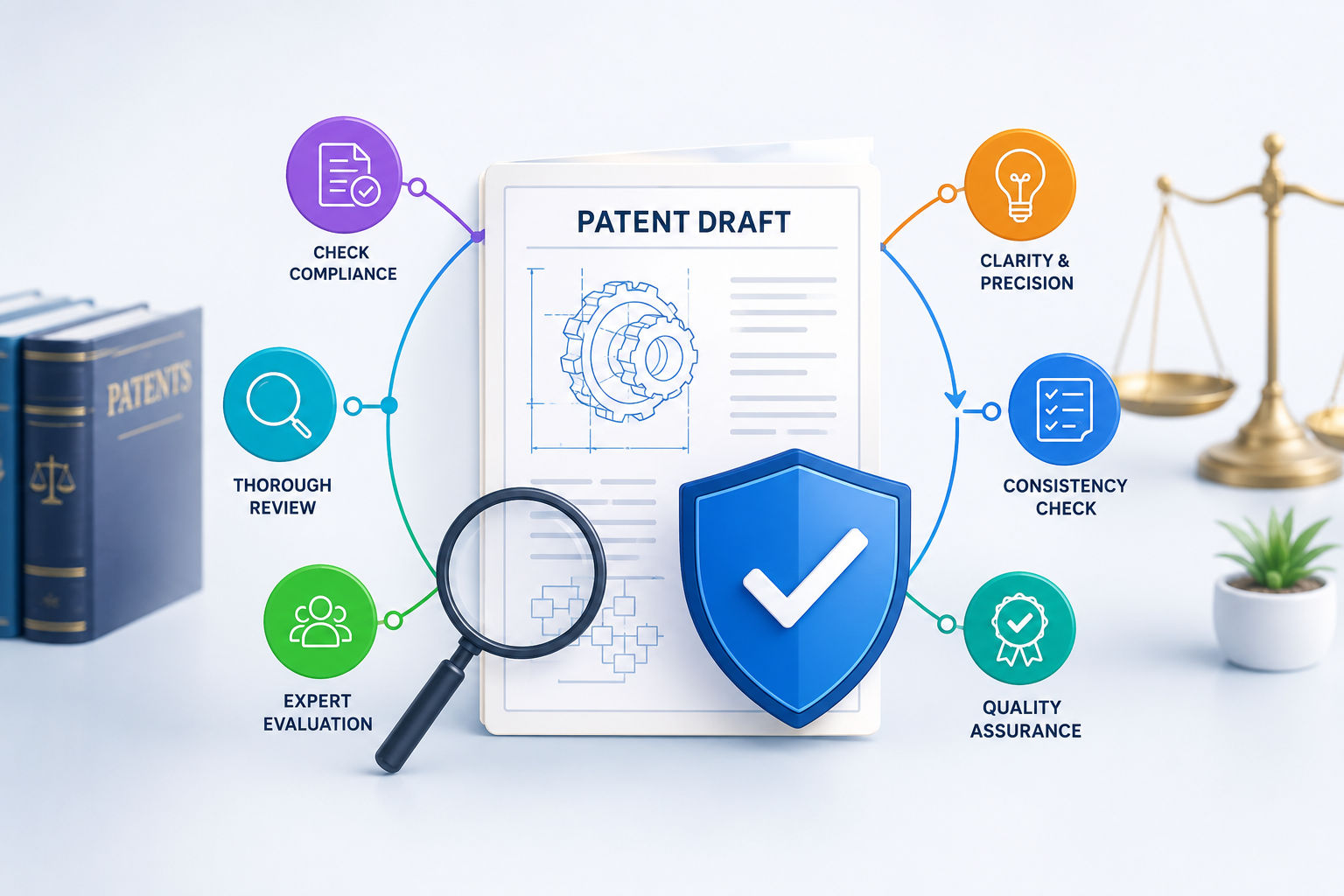
A patent draft is not just a document. It is the legal shield around a client’s idea. For a law firm, draft quality is where trust is won or lost. One weak claim, one missed detail, or one unclear line can turn a strong invention into a soft target.
Quality control should begin before the first claim is written
A strong patent draft starts long before the writer opens a claim set. It starts when the firm learns what the invention really is, why it matters, how it works, and what makes it different from older ways of doing the same thing.
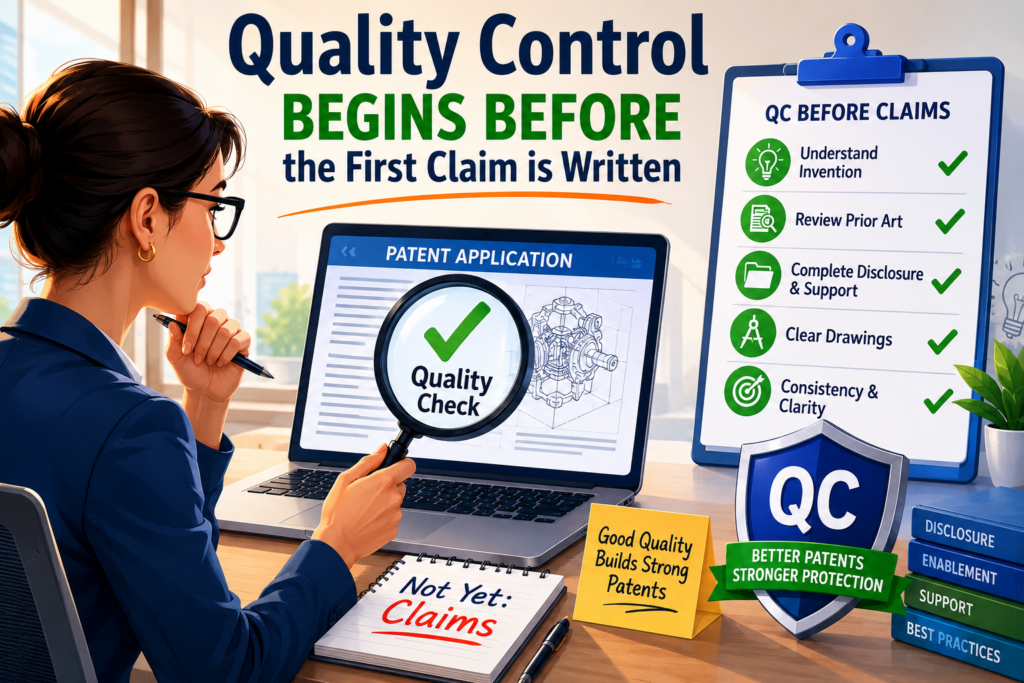
Many draft problems happen because the writer starts too soon. The draft may look clean on the page, but the base is weak. The invention may be too broad, too narrow, or not clear enough to defend later.
For law firms, the first quality control step is simple but often missed. The team must slow down just enough to understand the invention before trying to protect it.
This does not mean adding weeks of delay. It means using a clear intake process that helps the attorney, patent agent, or draft team pull the right facts from the client at the start.
The invention intake should force the right facts to the surface
A good intake process should help the client explain the invention in plain words. What problem did they see?
Why were old tools not good enough? What did they build? What parts are new? What parts are optional? What parts are core? What would a rival try to copy?
These questions matter because patent drafts often fail when they describe the product but miss the invention. A product may have many parts, but the patent needs to protect the new idea inside the product.
If the firm does not find that center point early, the claims can drift. They may cover things the client does not need, while missing the feature that gives the company real value.
The intake should also capture real examples. If the invention is software, the team should ask for system flows, user steps, data inputs, model outputs, code logic, and edge cases.
If the invention is hardware, the team should ask for drawings, part changes, test results, and build choices.
If the invention uses AI, the team should ask what the model does, what makes the training or use unique, and how the result improves a task.
A clear intake record makes every later review sharper
The intake record should not be a messy pile of emails. It should be a clean working source that the whole drafting team can trust.
When reviewers later check the draft, they should be able to compare every key part of the patent draft against the intake record. This makes review faster and more exact.
The record should also show what the client believes is most valuable. Some inventions have one main breakthrough. Others have several smaller changes that work together.
The firm should know which parts matter most to the client’s business. A patent can be legally polished and still miss the real business need. That is not quality. That is just clean formatting.
This is where modern tools can help. PowerPatent helps founders and patent teams turn technical details into a clearer patent workflow, with smart software and real attorney oversight working together.
Firms that want a better way to move from invention notes to stronger drafts can explore the process here: https://powerpatent.com/how-it-works
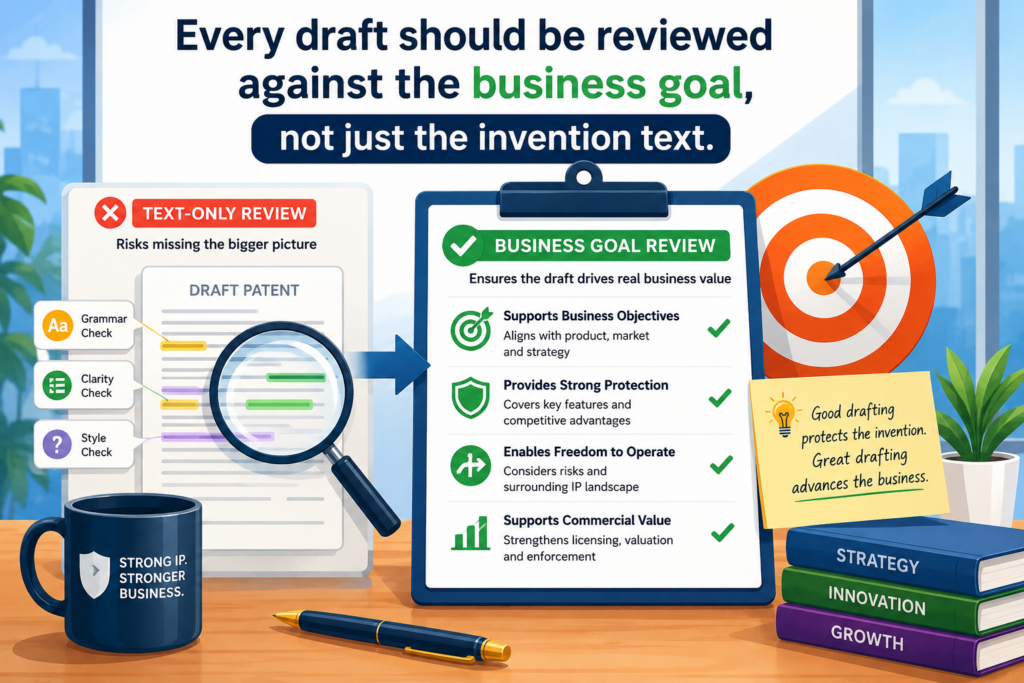
Every draft should be reviewed against the business goal, not just the invention text
Patent quality is not only about whether the draft describes the invention. It is also about whether the draft supports the client’s plan.
A startup that is raising money, preparing for launch, building a moat, or entering talks with a larger partner may need a different patent focus than a company filing for a small product update.
The law firm’s quality control process should account for that.
When a reviewer checks a draft, the first question should not be, “Does this read well?” The better question is, “Does this protect what the client needs to protect?” That question changes the whole review. It pushes the reviewer to think like a strategist, not just an editor.
The claim set should match the client’s real risk
The claims are the heart of the patent draft. They decide what the client is trying to protect. If the claims are too narrow, competitors may design around them with small changes.
If they are too broad without support, they may face trouble later. The best claims sit in the right zone. They are bold, but they are backed by the description. They aim at the thing that gives the client power in the market.
A quality control review should test the claims against real-world copying. The reviewer should ask how a competitor would avoid the claim. Would they remove one small step?
Would they move one function to another server? Would they change the order of actions? Would they use a different name for the same result? Would they perform the same idea with a different data source?
This is a practical review, not an academic one. The goal is to see whether the claims hold up against the kind of copying that happens in business.
A patent that only protects one exact product version may not help much if the client changes the product next quarter. A stronger draft should cover the core idea while still being tied to real technical support.
The draft should protect future versions when the facts support it
Startups change fast. Engineers improve the system. Product teams test new flows. AI models get updated.
Hardware designs get smaller, faster, or cheaper. A patent draft should not be frozen around one early prototype unless that is all the invention supports.
Quality control should check whether the draft includes enough variations. This may include different system setups, different user paths, different ways to process data, different device forms, and different ways to perform the key function.
The point is not to stuff the draft with random options. The point is to capture smart, believable versions that the client may use later.
This matters because a patent application is often filed early in the life of a product. The client may still be building, testing, or changing the invention.
A high-quality draft gives the client room to grow. It does not lock them into one narrow version if the invention is broader.
Law firms that want to serve modern founders need a process that keeps pace with how startups build.
PowerPatent is built around that need, helping technical teams move fast while still getting real attorney-backed protection. Learn how the process works here: https://powerpatent.com/how-it-works
The specification should make the invention easy to understand and hard to attack
The specification is where the draft explains the invention in full. It gives context, examples, system details, drawings, and support for the claims.
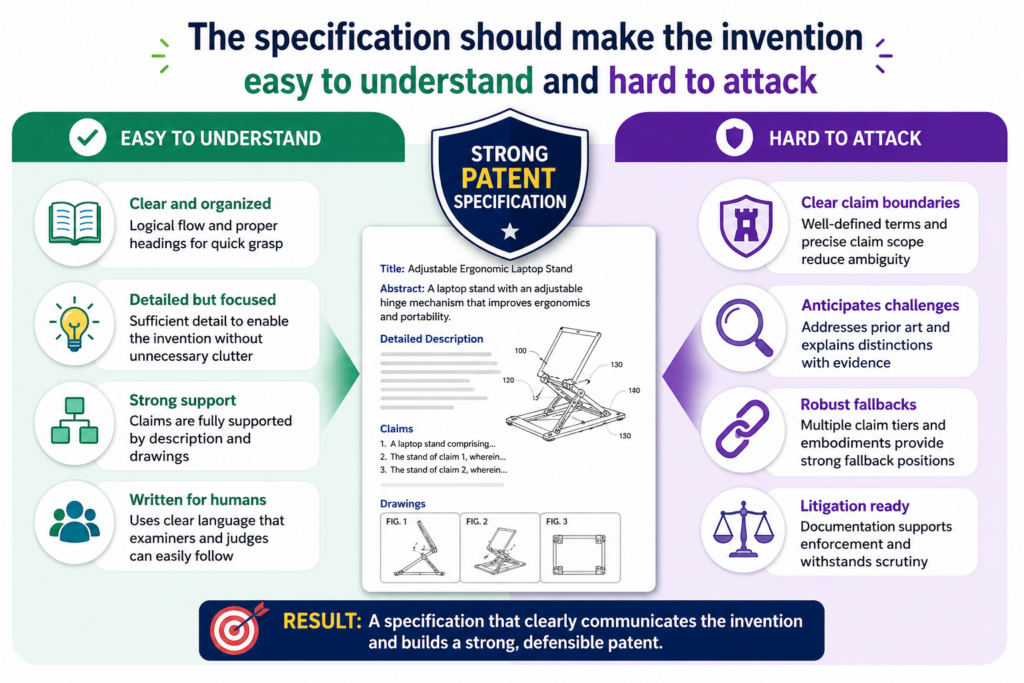
In many weak drafts, the claims get most of the attention while the specification becomes a long, loose description.
That is risky. The claims need the specification behind them. If the specification is thin, vague, or out of sync with the claims, the whole draft can suffer.
A strong quality control process treats the specification like a support structure. Every important claim idea should have clear backing in the written description.
Every key term should be explained in a way that a reader can follow. Every drawing should connect to the text. Every example should help, not confuse.
The best specifications explain the invention in layers
A high-quality specification usually explains the invention in layers. It starts with the problem. Then it explains the main idea.
Then it shows the system or method. Then it gives examples. Then it adds variations. This flow helps the reader build understanding step by step.
The problem section should be clear and useful. It should not overstate or attack older systems in a careless way. It should explain the gap that led to the invention.
The summary should then point to the improvement without promising too much. The detailed description should show how the invention works in enough depth that the claims feel grounded.
A good reviewer should look for jumps in logic. If the draft says the invention improves speed, the text should explain how. If the draft says the invention reduces errors, the text should show what changes reduce those errors.
If the draft says a model makes a better prediction, the text should explain what inputs, steps, or training choices support that result. The reader should not have to guess.
Each technical term should be clear enough to survive close review
Patent drafts often use terms that sound clear to the writer but may not be clear to others. Words like module, engine, platform, model, layer, node, signal, profile, and score can mean different things in different settings.
A quality review should flag key terms and ask whether they are explained well enough.
This does not mean the draft needs heavy language. In fact, simple language is often stronger.
The draft should define important parts by what they do, how they connect, and how they help the invention work. If a term is central to the claims, the specification should give examples and context.
The reviewer should also check that the same term is used the same way throughout the draft. If the draft calls something a “prediction score” in one place and a “risk value” in another, the reader may wonder whether those are the same thing.
Sometimes different terms are needed. But when terms change by accident, the draft becomes weaker.
For law firms, this is one of the easiest ways to improve quality fast. Build a habit of checking term consistency before partner review. It saves time, reduces comments, and gives clients a cleaner draft.
Claim review should be a stress test, not a grammar pass
Many firms review claims line by line, but the review can become too focused on small wording edits. Clean words matter, but claim quality is deeper than grammar.
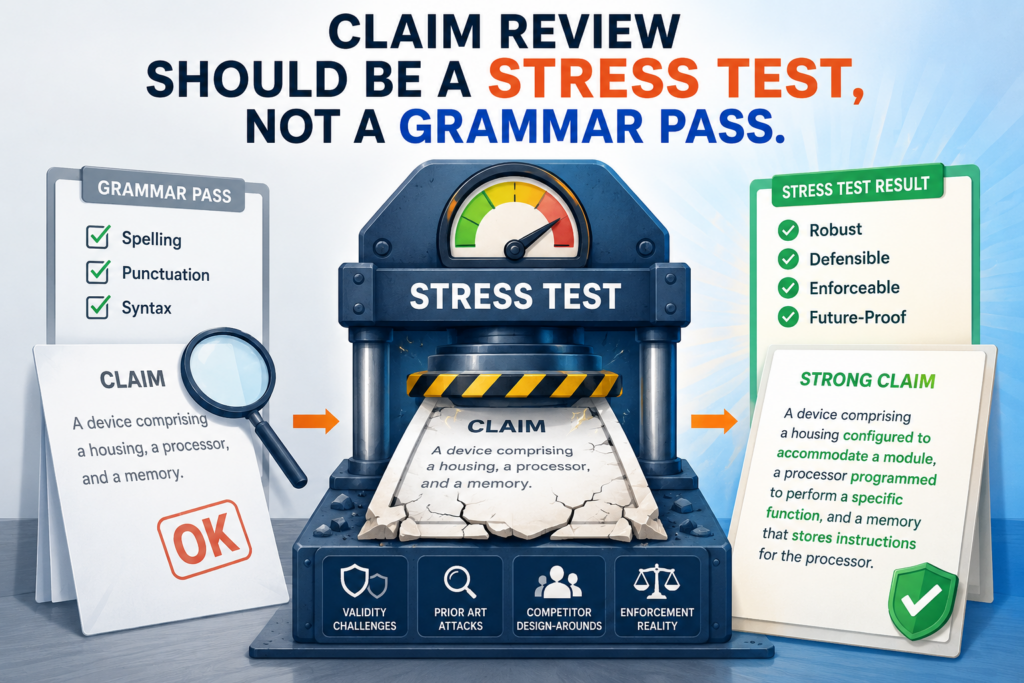
A strong claim review asks whether the claim has the right scope, the right support, the right structure, and the right fallback positions.
Claims should be tested like they will be challenged. That does not mean the reviewer must assume every claim is bad.
It means the reviewer should look for weak spots before someone else does. A client pays the firm to catch these problems early.
The independent claims should carry the main value
Independent claims are usually where the main protection sits. During quality control, the reviewer should read each independent claim and ask what business act it would cover.
Does it cover the client’s product? Does it cover a competitor’s likely copy? Does it focus on the real technical difference? Does it include extra limits that do not need to be there?
Extra limits are one of the most common claim problems. A drafter may add details from the product because they are true, but not because they are needed.
Each extra limit gives a competitor another path around the claim. If a detail is not needed to define the invention, it may belong in a dependent claim or in the specification instead.
At the same time, the claim cannot be so broad that it loses support or meaning. Quality control should find the right balance.
The reviewer should ask whether each claim element earns its place. If it does not, it should be changed, moved, or removed.
Dependent claims should create real fallback value
Dependent claims should not be filler. They should give the client useful backup positions. If the broad claim faces pushback later, the dependent claims should offer narrower but still valuable paths.
A weak dependent claim only adds a minor detail that does not matter. A strong dependent claim protects a feature that may still be worth owning.
During review, the team should test whether the dependent claims cover key product features, likely design changes, technical improvements, and important use cases.
They should also check whether the dependent claims are too repetitive. Repeating the same idea in slightly different words does not add much value.
This is where a structured review process helps. The reviewer should map dependent claims back to the invention record, the product plan, and the specification.
The goal is to make sure the claim set is not just long, but useful.
For firms that want to improve drafting speed while keeping attorney judgment at the center, PowerPatent offers a modern path.
It helps turn complex technical input into cleaner patent work, with software and real legal review working together: https://powerpatent.com/how-it-works
The drawing review should confirm that the draft shows the invention clearly enough to support the claims
Patent drawings are often treated like a support task, but they carry real weight. A clean drawing can make a complex invention feel simple. A weak drawing can make even a strong idea feel hard to follow.
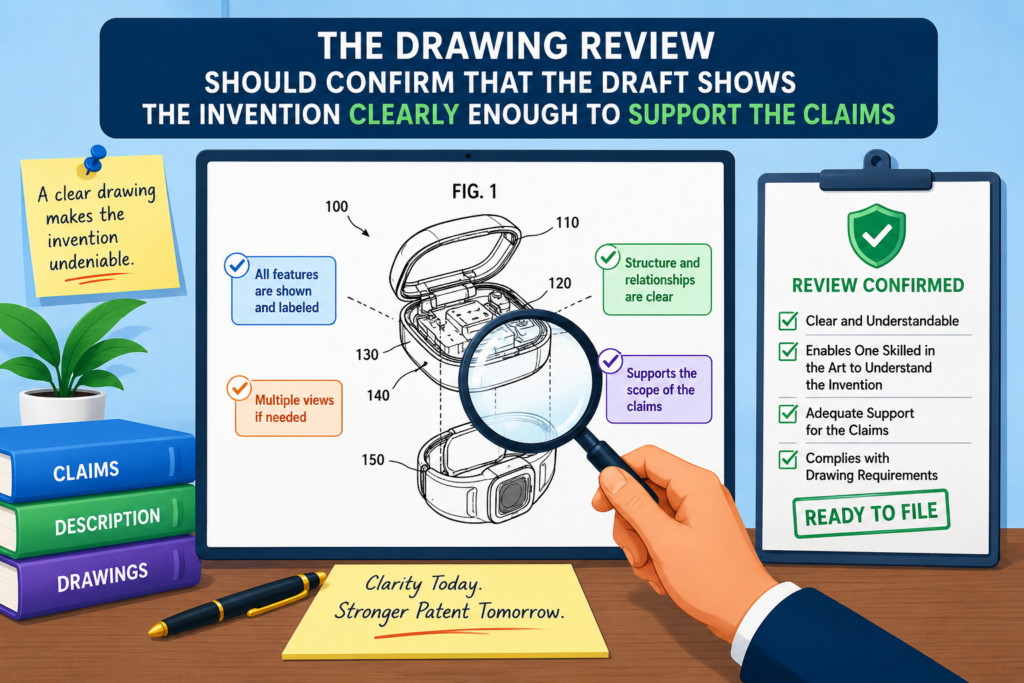
For law firms, drawing review should be part of draft quality control, not a late formatting step. The drawings should help the reader understand the invention, connect with the written text, and support the claim language.
A drawing does not need to be fancy. In many cases, simple is better. What matters is that the drawing shows the right parts, the right flow, and the right links between the parts. If the invention is a system, the drawing should show how the system pieces connect.
If the invention is a process, the drawing should show the steps in a clear order. If the invention is a device, the drawing should show the parts that matter, not a cluttered product picture that hides the core idea.
The first quality check is alignment. Each drawing should match the specification. Each reference number should point to the right thing. Each figure should be discussed in the text.
Each key part shown in a figure should have a reason to be there. When drawings and text do not match, the draft starts to feel careless. Worse, it can create confusion during examination or later review.
The figures should tell the story of the invention without making the reader work too hard
A good figure set has a flow. The first figure may show the whole system. The next figure may show a method.
Another figure may show a closer view of a key part. Later figures may show other versions or use cases. This order helps the reader move from the big picture to the details.
During review, the team should ask whether the figures tell a clear story. The reviewer should be able to look at the drawings and understand the main idea before reading every line of the description. If the reviewer cannot do that, the figures may need work.
For software patents, diagrams are especially important. A system diagram can show user devices, servers, databases, models, and output tools. A flowchart can show how data moves through the process.
A more detailed figure can show what happens inside a model, engine, or rules layer. These visuals help the draft support the claims without forcing every detail into one long text block.
For hardware inventions, the drawings should show the structure with enough detail to make the invention real. The reviewer should check whether the figures show the new arrangement, not just a finished product shell.
If the invention is about how two parts move together, the drawing should show that movement. If it is about a special shape, position, layer, or connection, the figure should make that point easy to see.
The drawings should support broad claims and backup positions with care
The drawing review should not only ask whether the figures look neat. It should ask whether the figures support the claim plan.
If an independent claim covers a broad system, the figures should show a version that backs up that system. If dependent claims cover special features, there should be enough visual or written support for those features as well.
This is where many drafts get thin. The claims may cover several versions, but the figures only show one product setup. That may be enough in some cases, but often the draft can be stronger with a few added views or alternate flows.
A reviewer should ask whether a competitor could argue that the draft only shows one narrow version. If that risk is real, the team should consider adding clearer support before filing.
The team should also check whether the figures include too much detail. Extra details can make a drawing look complete, but they can also create a narrow impression.
If the figure shows a very specific screen, button, database layout, or device shape, the written text should make clear that the invention is not limited to that one example unless the client wants it that way.
Modern drafting tools can help firms catch drawing gaps earlier, especially when the invention comes from code, product notes, or technical diagrams.
PowerPatent helps turn complex invention material into a more guided patent process, with smart software and real attorney oversight in the loop. Firms and founders can see how that works here: https://powerpatent.com/how-it-works
The internal review process should have clear roles so nothing important is missed
A patent draft should not depend on one person catching every issue. Even strong drafters miss things. People get close to their own work.
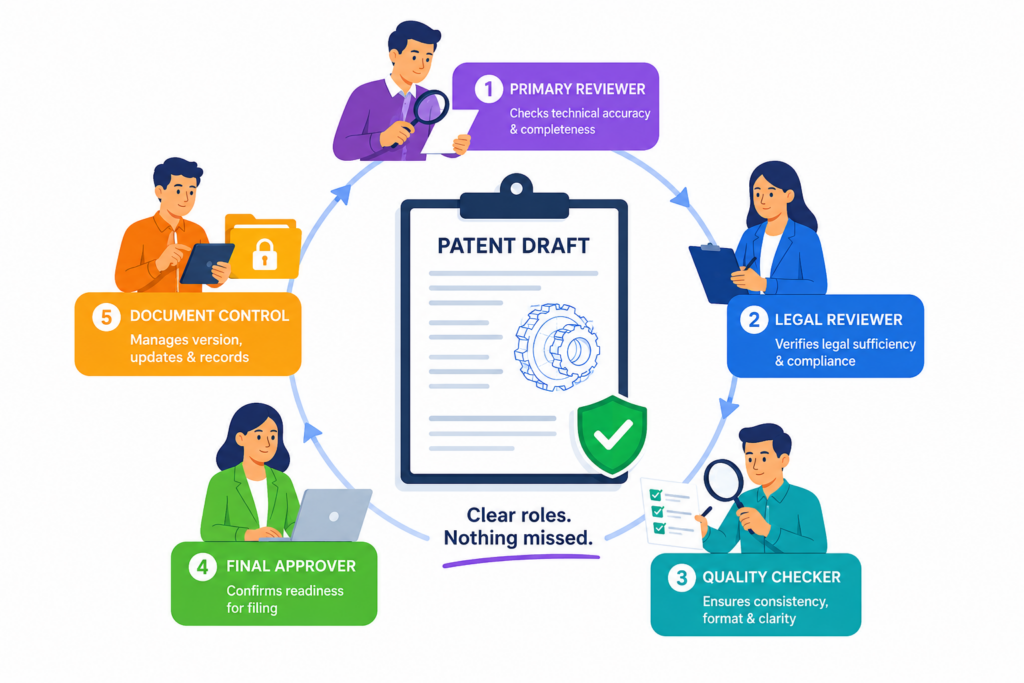
They see what they meant to write, not always what the draft actually says. That is why law firms need a review process with clear roles. Each person should know what they are checking and why it matters.
The best review systems are simple enough to use on every draft. If the process is too heavy, busy teams will skip it. If it is too loose, problems will slip through.
The goal is not to create paperwork for the sake of paperwork. The goal is to build a repeatable path that improves the draft before it reaches the client or the patent office.
A useful review process often has more than one layer. The drafter checks the first complete version. A second reviewer checks the claims and support. A supervising attorney checks strategy and risk.
A final proofing pass catches names, numbers, formatting, and filing details. The exact roles may change by firm size, but the rule stays the same. The draft should be reviewed from more than one angle.
The first review should be done by the drafter with distance and discipline
The drafter’s self-review is the first gate. It should happen after the drafter has stepped away from the document for a short period when possible.
A fresh read helps the drafter see unclear wording, missing support, and claim issues that were not obvious during drafting.
This review should not be a quick spell check. The drafter should read the claims first and ask whether each claim still matches the invention. Then the drafter should read the specification and confirm that each major claim idea is supported.
Then the drafter should check the drawings against the text. This first pass should remove avoidable problems before another attorney spends time on the draft.
The drafter should also check for client-specific facts. Company name, inventor names, product terms, dates, project names, and technical labels should be correct.
These may seem like small items, but mistakes here hurt trust. When a client sees basic errors, they may wonder whether deeper parts of the draft are also wrong.
A strong self-review also looks for writing quality. Patent writing should be exact, but it should not be hard to read on purpose. If a sentence is too long, it should be broken up.
If a term is vague, it should be clarified. If a paragraph tries to do five things at once, it should be reshaped. The cleaner the draft, the easier it is for later reviewers to focus on strategy.
The second reviewer should challenge the draft like a careful outsider
The second review is where the firm gets real leverage. This reviewer should not simply polish the drafter’s words. They should challenge the draft.
They should ask whether the claims are too narrow, whether the support is strong enough, whether the examples are useful, and whether the description leaves open room for future product changes.
This reviewer should also test the claim language against possible design-arounds. A good patent draft should make it harder for a rival to copy the value while making a small change. The reviewer should think like a competitor for a moment.
What would they remove? What would they rename? What would they move to another device or server? What would they do manually instead of automatically? These questions help the firm find weak claim language before it becomes a client problem.
The supervising attorney should then focus on business fit and legal risk. This is the point where experience matters. The attorney should ask whether the draft serves the client’s market, funding plan, product roadmap, and filing strategy.
A draft can be technically correct but still not be the right draft for the client. The final quality check should make sure the work is not only polished, but useful.
PowerPatent is built for this kind of modern patent workflow. It helps technical teams and patent professionals move from invention detail to stronger draft work without losing the value of real attorney judgment.
To see how smart software and attorney oversight can work together, visit https://powerpatent.com/how-it-works
Client review should be guided so founders and engineers can give better feedback
Client review is one of the most important parts of patent draft quality control, but many firms handle it poorly.
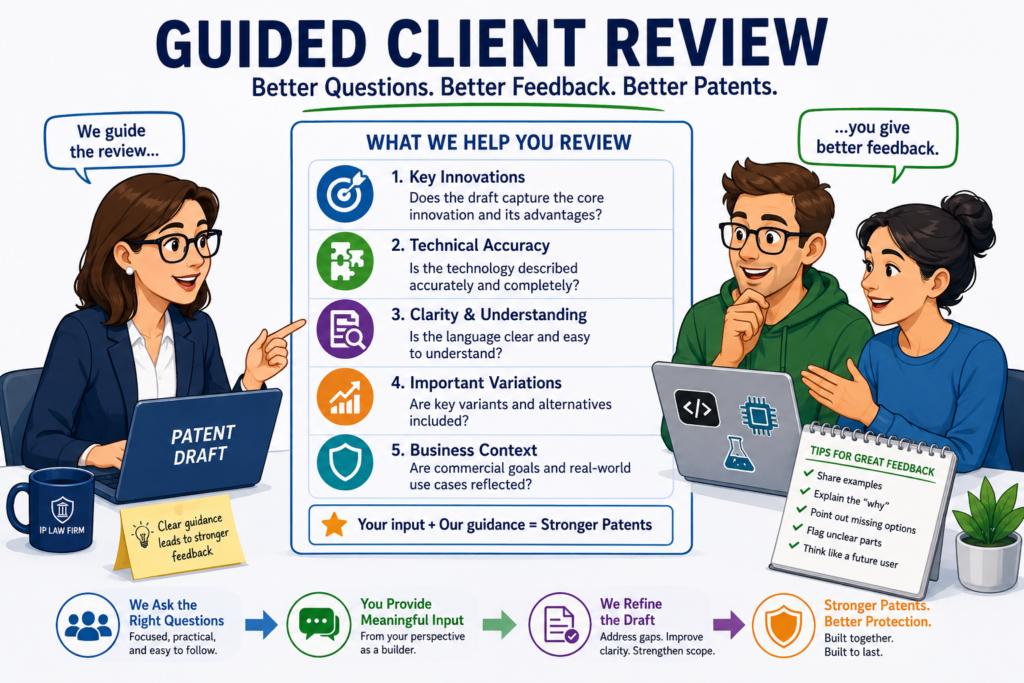
They send the draft to the client and ask for comments. That sounds simple, but it often creates weak feedback. Founders and engineers may not know what to review.
They may focus on word choice while missing a technical gap. They may assume the legal parts are fixed and only comment on product names. They may feel lost and delay the review.
A better process guides the client. The law firm should explain what kind of feedback is helpful. The client should know that they do not need to rewrite claims or understand every patent rule.
Their main job is to confirm the technical facts, point out missing versions, flag wrong assumptions, and tell the firm if the draft misses the business value of the invention.
This is especially important for startups. Founders move fast. Engineers are busy shipping product. They do not want a slow, confusing review cycle.
A clean client review process helps them give better input with less stress. It also helps the firm avoid last-minute surprises right before filing.
The client should review the invention story before getting buried in details
A strong client review starts with the big picture. The firm should ask the client to read the draft and confirm whether the invention story feels right. Does the draft explain the problem clearly?
Does it describe the real improvement? Does it capture what the team built? Does it leave out any feature that may matter in the next product version?
This kind of review is valuable because the client often knows the invention in a way no outside drafter can.
The attorney may understand the law. The patent agent may understand the technical structure. But the founder or engineer knows why the invention matters in the product and in the market.
The firm should also ask the client to look for missing alternatives. Many clients describe the version they built first, not the other versions they may build later. A smart review prompt can help them remember those future paths.
For example, the client may have tested another data source, another model type, another sensor layout, another user flow, or another way to trigger the same result. Those details can become useful support in the draft.
The key is to keep the review focused. Clients should not be expected to perform a full legal analysis.
They should be guided toward the parts only they can verify. When the firm makes the client’s role clear, the feedback gets sharper and the process moves faster.
The firm should turn client comments into stronger protection, not just edits
Client comments are not just corrections. They are raw material for better protection. If a founder says, “We may also do this with a different model,” that may point to a useful alternate embodiment.
If an engineer says, “That step can happen before or after the scoring step,” that may help broaden a method claim.
If the product lead says, “The real value is that this removes manual review,” that may sharpen the invention story.
The quality control process should include a careful review of client comments after they come in.
The team should decide what belongs in the claims, what belongs in the specification, what belongs in the drawings, and what should be left out.
Not every client comment should be added blindly. Some comments may narrow the draft too much. Others may introduce terms that are not helpful. The attorney’s job is to turn feedback into useful patent support.
The firm should also close the loop with the client. After changes are made, the firm should explain the major updates in plain words.
This builds confidence. It also helps the client feel that the draft is not just a legal document passing through a black box. It is a work product tied to their invention, their goals, and their future.
PowerPatent was built with this exact founder pain in mind. It helps make the path from invention to patent clearer, faster, and easier to manage, while still keeping real attorney oversight where it matters. Founders and firms can see the process here: https://powerpatent.com/how-it-works
Prior art review should shape the draft before filing, not after trouble starts
Prior art review is one of the most useful quality control steps in patent drafting because it shows the firm what the invention is really standing against.
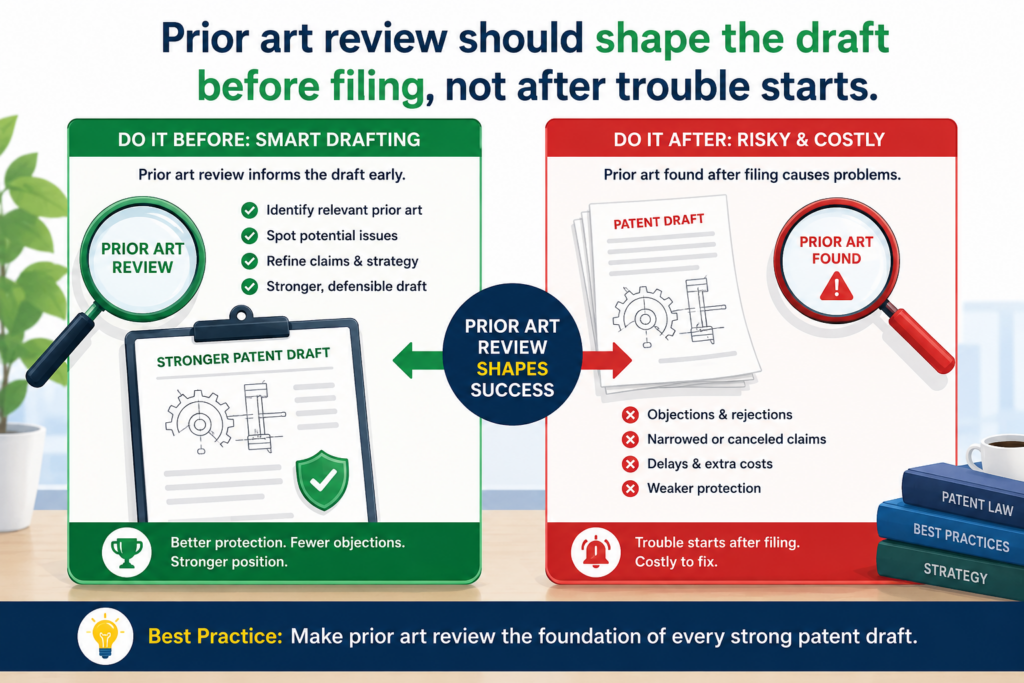
A draft written without a careful look at older systems may sound strong at first, but it can fall apart when similar work appears later.
The goal is not to scare the client or make the draft smaller than it needs to be. The goal is to write with open eyes.
A good prior art review helps the drafting team see which parts of the invention are common, which parts may be close, and which parts look more distinct.
This lets the firm draft claims that are more focused and better supported. It also helps the specification explain the improvement with more care.
When the draft understands the field, it usually becomes clearer, stronger, and easier to defend.
Law firms do not need every prior art review to become a huge research project. The level of review should fit the client’s budget, timeline, and business need. But even a focused review can reveal important risks.
If the client is filing a key patent for a core product, a deeper review may be worth it. If the filing is time-sensitive, a lighter review may still help the team avoid obvious problems.
The draft should use prior art knowledge to sharpen the invention story
Prior art should not be treated as a separate task that sits outside the draft. It should shape the draft itself. If older tools already performed one part of the process, the draft should not act like that part is new.
If the real improvement is a better order of steps, a better data structure, a better control method, or a better way to reduce errors, the draft should bring that point into focus.
This matters because vague invention stories create weak patent drafts. A draft that says the invention is “better” without showing why is not enough.
A stronger draft explains the old problem in fair and simple terms, then shows how the invention changes the result. It does not need to attack older systems. It just needs to make the improvement clear.
During quality control, the reviewer should ask whether the claims reflect what appears to be different from the prior art. If the claims focus on common parts, they may invite problems.
If the claims include the real improvement but bury it under extra limits, they may miss value. The review should find the cleanest way to claim the key difference while staying true to the invention.
The specification should also include useful technical context. If the invention improves speed, accuracy, storage use, battery life, security, or user control, the draft should explain how that happens.
Prior art review can help the team avoid broad statements and write a more grounded story.
The team should avoid drafting around prior art with narrow language too soon
Prior art review can make some drafters overreact. They see similar older work and quickly make the claims too narrow.
That may feel safe, but it can hurt the client. Narrow claims may be easier to file, but they may not give the client meaningful protection.
A better approach is to use prior art as a guide, not a cage. The firm should look for the actual difference, then protect it in a thoughtful way. Sometimes the right answer is a broad claim with careful support.
Sometimes it is a layered claim set with strong fallback positions. Sometimes it is a better explanation in the specification that shows why the invention is not just a routine change.
Quality control should catch both risks. It should catch claims that are too broad in light of older work, and it should catch claims that become too narrow because the drafter got nervous. The best result is a draft that is bold, honest, and well supported.
This is where smart software can help, but it should not replace attorney judgment. Tools can help organize invention details, compare concepts, and speed up the drafting path.
Attorneys still need to decide what matters, what to claim, and how to protect the client’s real business edge.
PowerPatent brings software and real attorney oversight together so founders and firms can move faster without giving up careful review. You can see the workflow here: https://powerpatent.com/how-it-works
Terminology control should keep the draft clean, steady, and easy to enforce
Patent drafts often become weak because of small language problems that grow into larger confusion.
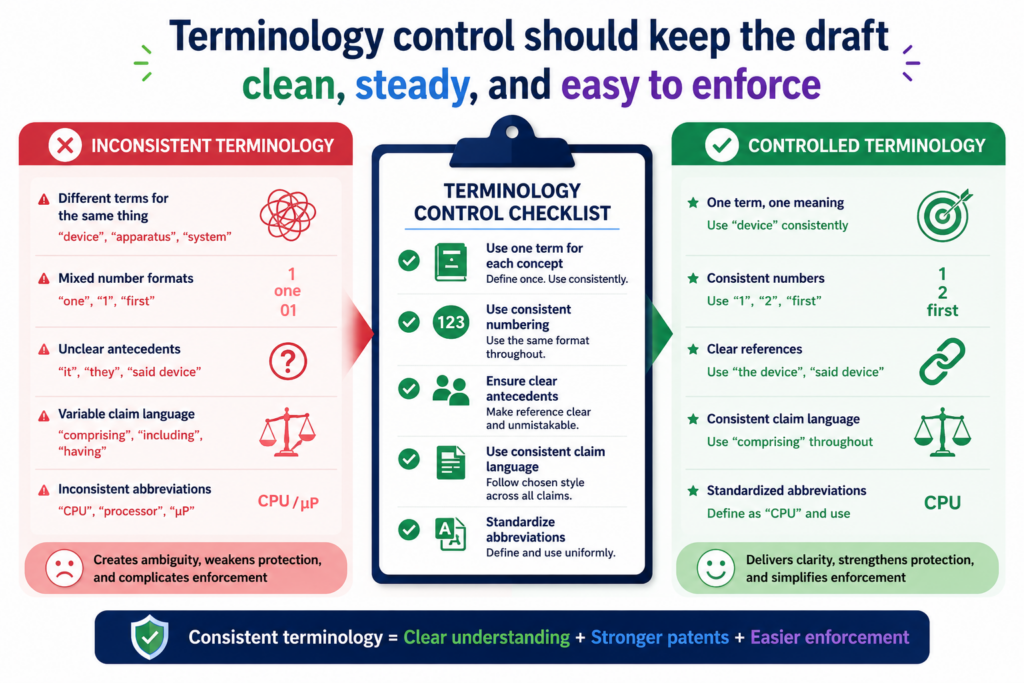
A term changes halfway through the draft. A feature is called by a product name in one section and a broad technical name in another.
A claim uses a phrase that is never explained in the specification. A drawing label does not match the text.
None of these mistakes may seem dramatic alone, but together they make the draft harder to understand and easier to challenge.
Terminology control is the habit of using words with care from start to finish. For law firms, it should be a formal part of patent draft quality control.
The team should know which terms are key, how those terms are used, and whether the draft uses them in a steady way.
This does not mean every patent draft should sound stiff. Simple language is often better. The point is not to use bigger words.
The point is to use the right words and keep them steady. When a reader sees the same part, step, value, or system element across the draft, the wording should help the reader follow the invention without guessing.
The firm should create a term map before the draft gets too large
A term map is a simple internal guide that connects the invention’s main parts to the words used in the draft.
It can include the name of each system part, each key step, each data item, each output, and each claimed feature. The term map does not need to be complex. It just needs to keep the team from drifting.
For example, if the invention uses a score that predicts whether a machine part may fail, the team should decide what to call that score. It might be a “failure risk score,” a “maintenance score,” or a “predicted fault value.”
The choice depends on the invention and claim plan. But once the team chooses the term, the draft should use it with care. Random switches can create doubt.
This is especially important when the client uses internal product names. Product names are often useful during invention intake, but they may be too narrow or too tied to branding for the patent draft.
A client may call a tool “Atlas,” but the patent may need to call it a “routing engine” or “resource allocation system.” The quality review should make sure internal names do not limit the invention by accident.
The reviewer should also check terms in the claims against terms in the specification. A claim term should not appear for the first time with no clear support.
If the claim says “adaptive control layer,” the specification should explain that layer in plain words and give examples of what it does.
Clean wording helps clients, examiners, and future enforcement teams
The first reader of the draft may be the client, but many other readers may come later. An examiner may review the claims.
Investors may look at the filing. A future buyer may study the portfolio. A litigation team may one day inspect every phrase. Clean terminology helps all of them.
When the words are steady, the draft feels more credible. The invention is easier to follow. The claims feel connected to the description.
The drawings make more sense. Reviewers spend less time asking basic questions and more time judging the real value of the invention.
Terminology control also reduces rework. Many late-stage draft problems happen because terms were not cleaned up early. A partner changes a claim term, but the specification still uses the old phrase.
A figure label is updated, but the text is not. A client comment adds a new term, but nobody checks whether it fits the rest of the draft. These are preventable errors.
Law firms can improve this quickly by making terminology review a required step before final attorney review.
The drafter should read the claims, mark the key terms, then check the specification and drawings for support and consistency. The second reviewer should do the same from a fresh view.
For technical founders, this kind of clarity builds trust. They want to know that the patent actually protects the invention they built.
PowerPatent helps make that process clearer by turning invention details into a more structured patent workflow, backed by real attorney oversight. To see how that helps teams move with more confidence, visit https://powerpatent.com/how-it-works
Claim support review should prove that every important claim has a strong home in the specification
A patent claim should never feel like it was dropped into the draft at the end. It should feel like it grows naturally from the specification.
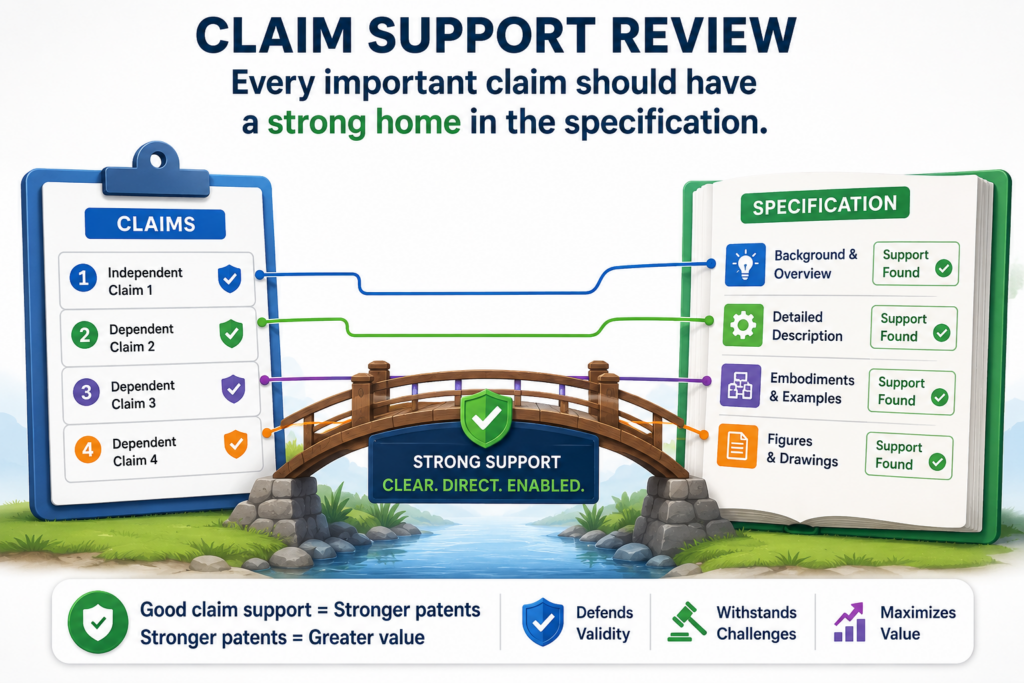
Claim support review is the process of checking whether each claim feature is clearly backed by the written description, drawings, and examples. This is one of the most important quality control steps a law firm can build.
A weak support review creates risk. The claims may use words that are not explained. They may include steps that the specification only hints at.
They may cover versions that the draft does not really describe. These gaps can become serious later. They can lead to office action problems, amendment limits, client frustration, and reduced patent value.
A strong support review gives the firm confidence before filing. It shows that the claim set is not just clever, but grounded.
It also helps the team find places where the specification needs more detail, more examples, or cleaner links to the drawings.
The review should trace each claim element back to clear written support
The best way to review claim support is to trace each claim element into the specification. The reviewer should read the independent claims first and identify each required feature.
Then the reviewer should ask where the draft explains that feature, how it works, and how it connects to the rest of the invention.
This process should be done with care. It is not enough for a word to appear somewhere in the draft. The support should actually explain the idea.
If a claim says a system “updates a model based on user feedback,” the specification should describe what kind of feedback may be used, how it may update the model, and what result may follow.
If the draft only mentions feedback once in a vague sentence, the support may be too thin.
The same review should happen for dependent claims. Dependent claims often include the best backup positions, so they deserve real support.
If a dependent claim covers a special threshold, signal type, training method, device setting, or user action, the specification should support it. Otherwise, the claim may look like an afterthought.
This review also helps with future flexibility. When the specification supports multiple versions of a feature, the firm may have more room to respond during examination. When the specification is narrow, options may be limited.
The team should add support before filing rather than hoping to fix it later
One of the hardest truths in patent drafting is that some problems are much easier to fix before filing than after filing.
If the draft lacks support for a key idea, the team should address it before the application is filed. Waiting can close doors.
That is why claim support review should happen while there is still time to make meaningful changes. The reviewer should not wait until the final hour. If new support is needed, the team may need to ask the client for more technical detail. This is normal.
A short follow-up with an engineer can often add major value. The engineer may explain a step, an alternate version, a data flow, or a design choice that makes the draft stronger.
The firm should also check whether the drawings support the claims. Some claim ideas are easier to understand when shown in a figure.
If the claims cover a system layout, a process order, or a device structure, the drawings should help support that story. Text and figures should work together.
This kind of review is not busywork. It is protection work. It helps the firm file drafts that can stand up better under pressure.
It helps clients avoid avoidable mistakes. It also reduces the chance that a valuable invention is limited by a thin first draft.
PowerPatent is designed for teams that want stronger patent work without slow, messy back-and-forth.
It helps founders capture invention details and move through a smarter attorney-backed process. Law firms and startup teams can learn more here: https://powerpatent.com/how-it-works
Version control should protect the firm from draft confusion, lost edits, and filing mistakes
Version control sounds basic, but it is one of the most common places where patent draft quality breaks down.
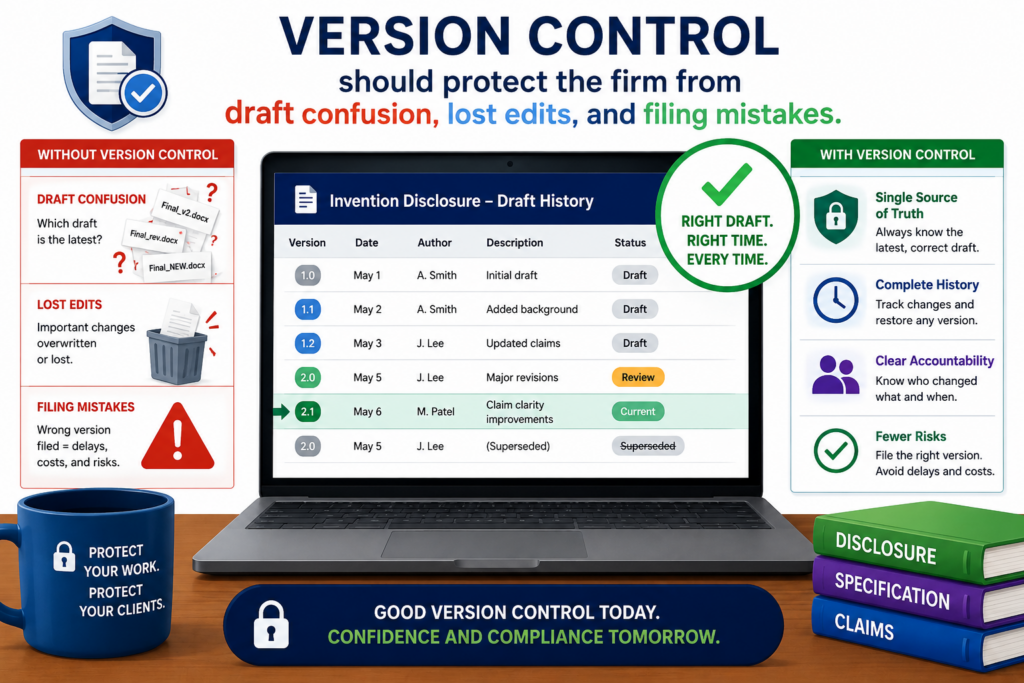
A patent application may pass through a drafter, a reviewing attorney, a partner, a client, an engineer, a paralegal, and a filing team.
Each person may add comments, accept changes, rename files, or send a new copy by email. Without a clear version control process, the team can lose track of which draft is current, which comments were handled, and which changes were approved.
This is not just an admin problem. It is a quality problem. If a claim change is made in one version but not carried into the final version, the client may lose important scope.
If a client correction is added to the specification but not reflected in the drawings, the draft may become inconsistent. If an old draft is filed by mistake, the damage can be hard or impossible to fix later.
A good law firm treats version control as part of legal quality. It should be simple, strict, and easy for the whole team to follow.
Every draft should have one source of truth. Every major change should be traceable. Every final filing document should be checked against the approved draft before it is submitted.
The firm should make it impossible to mistake an old draft for the final draft
A strong version process starts with naming. Draft names should be clear enough that anyone on the team can tell what they are looking at. A file name should show the matter, draft stage, date, and owner or review state.
The firm should avoid vague names like “final,” “final revised,” or “final clean,” because those names often become false within hours.
The review path should also be clear. The team should know where comments belong, who is allowed to accept changes, and when a draft becomes locked for filing.
This matters most near the end of the process, when many people are moving fast. The last day before filing is not the time to wonder whether the client’s latest comments made it into the right copy.
Quality control should include a version audit before filing. The reviewer should confirm that the final specification, claims, drawings, abstract, and filing papers are all based on the approved version.
The reviewer should also confirm that no unresolved comments remain in the document, no tracked changes are hidden, and no internal notes are left in the text.
This sounds simple, but it saves firms from painful errors. It also gives clients more confidence. A founder or engineer may not see every behind-the-scenes step, but they can feel when a process is calm, clean, and controlled.
Clean version control helps the attorney focus on judgment instead of cleanup
Patent attorneys should spend their best thinking on claim scope, invention support, and client strategy. They should not waste high-value time hunting for missing edits or comparing five messy files.
Better version control gives the legal team more room to do the work that actually protects the client.
The firm should also decide how client comments are handled. Some clients will comment in Word. Others will send emails. Some engineers may add notes in shared documents.
The firm needs a process for bringing all comments into one controlled review path. The attorney should not rely on memory or scattered messages.
After client comments are handled, the firm should save a clean record of major decisions. For example, if the team decides not to add a feature because it is not part of the invention, that decision should be noted internally.
If the client confirms that a certain product detail is optional, that should be reflected in the draft and captured in the file. These records help later if questions come up.
Modern patent work moves fast, especially for startups. PowerPatent helps bring more order to the process by using smart software with real attorney oversight, so invention details, draft work, and review steps can move with more control. Firms and founders can see how it works here: https://powerpatent.com/how-it-works
Final proofing should be treated as a legal safety check, not a spelling task
Final proofing is often viewed as the boring last step. That is a mistake. The final proof is the last chance to catch errors before the draft leaves the firm.
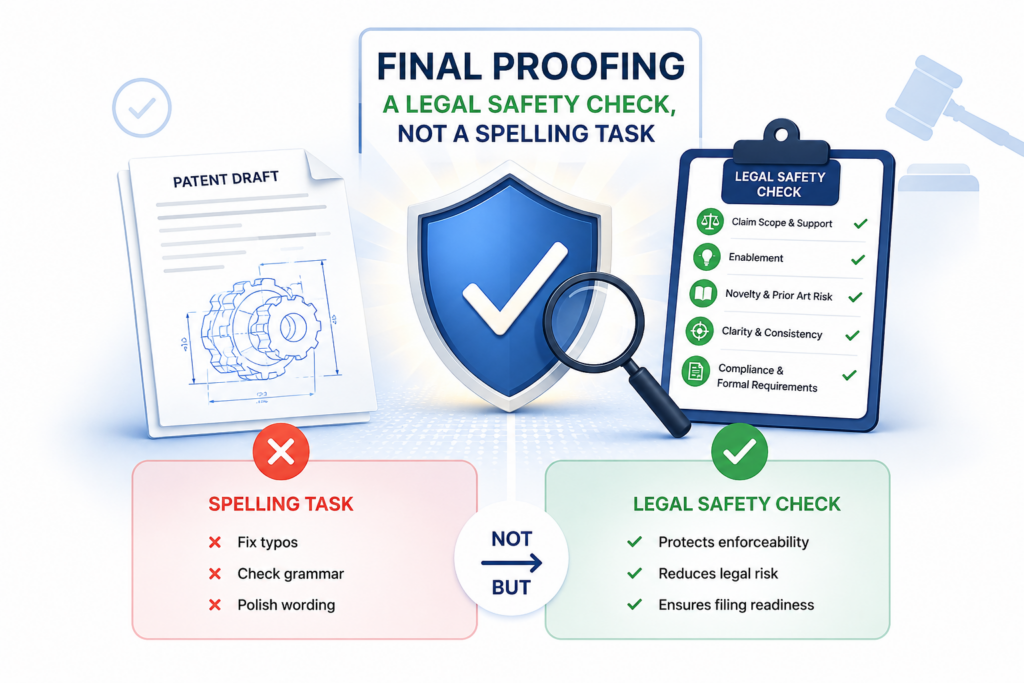
At this stage, even small mistakes can harm trust, create filing problems, or weaken the document.
A wrong figure number, missing claim dependency, mismatched term, or incorrect inventor name can turn a strong draft into a stressful filing.
The final proof should not try to rethink the entire strategy. That work should happen earlier. The final proof has a different job.
It confirms that the approved strategy has been carried into a clean, complete, and ready-to-file document. It is the last safety gate.
For law firms, the final proof should be done with discipline. It should not be rushed just because everyone is ready to file.
It should follow a steady review path that checks the parts most likely to break. This includes the claims, specification, drawings, abstract, title, reference numbers, page formatting, paragraph numbering if used, and filing data.
The final proof should check the full document as one connected whole
A patent draft is not a set of separate parts. The claims, written description, drawings, and filing documents must work together.
A final proof should check that connection. If the claims refer to a “control module,” the specification should support that term.
If the drawings show a “control engine,” the reviewer should decide whether that mismatch matters and fix it if needed. If a method claim has five steps, the specification should not describe only four.
The final proof should also check claim dependencies. Each dependent claim should refer to the right claim. The wording should make sense when read with the parent claim.
If a dependent claim adds a feature that conflicts with the independent claim, the team should catch it before filing. These errors are easy to miss when edits are made late.
Reference numbers deserve special care. They help connect drawings to the text, but they can become messy after revisions. If a part number changes in one figure but not in the written description, confusion follows.
A careful final proof should check every figure label against the text. It should also make sure each drawing is actually discussed.
The abstract should also be reviewed. It should be accurate and clean, but not overloaded. The title should match the invention without being too narrow.
The background should avoid careless statements that could hurt the client later. The whole draft should feel controlled from the first page to the last.
The final proof should remove anything that does not belong in the filing copy
Before filing, the team should make sure the document contains only what should be filed. No internal notes. No comments. No questions to the client. No drafting reminders.
No highlighted uncertainty. No track changes. No placeholder figure text. No empty sections. No copied template language that does not fit the invention.
Template errors are a quiet danger in patent drafting. Templates can help firms move faster, but they can also carry old language into a new matter. A final proof should look for signs that text from another application slipped through.
This includes wrong technology terms, old product names, mismatched figure references, and broad boilerplate that adds noise without support.
The final proof should also check the client-facing version, not only the filing version. If the firm sends a final copy to the client, that copy should be clean and easy to review.
It should show the client that the firm has control. Founders and engineers may not judge the draft like patent lawyers, but they will notice sloppiness. A clean final copy helps build trust.
This is one reason modern patent workflows matter. When software can help organize inputs, drafts, and review paths, attorneys can spend more time on careful judgment and less time chasing preventable errors.
PowerPatent combines smart tools with real attorney review so teams can move faster while keeping quality at the center. Learn more here: https://powerpatent.com/how-it-works
Conclusion
Patent draft quality control is not a final polish step. It is the system that protects the client, the firm, and the value of the invention. Strong firms review the draft from every angle: invention fit, claim strength, support, drawings, terms, versions, client input, and final filing readiness.
When this process is clear, repeatable, and backed by the right tools, teams move faster with fewer mistakes. For modern firms and founders, the best path is smart software plus real attorney oversight. PowerPatent helps make that path simple, strong, and practical: https://powerpatent.com/how-it-works
Leave a Reply