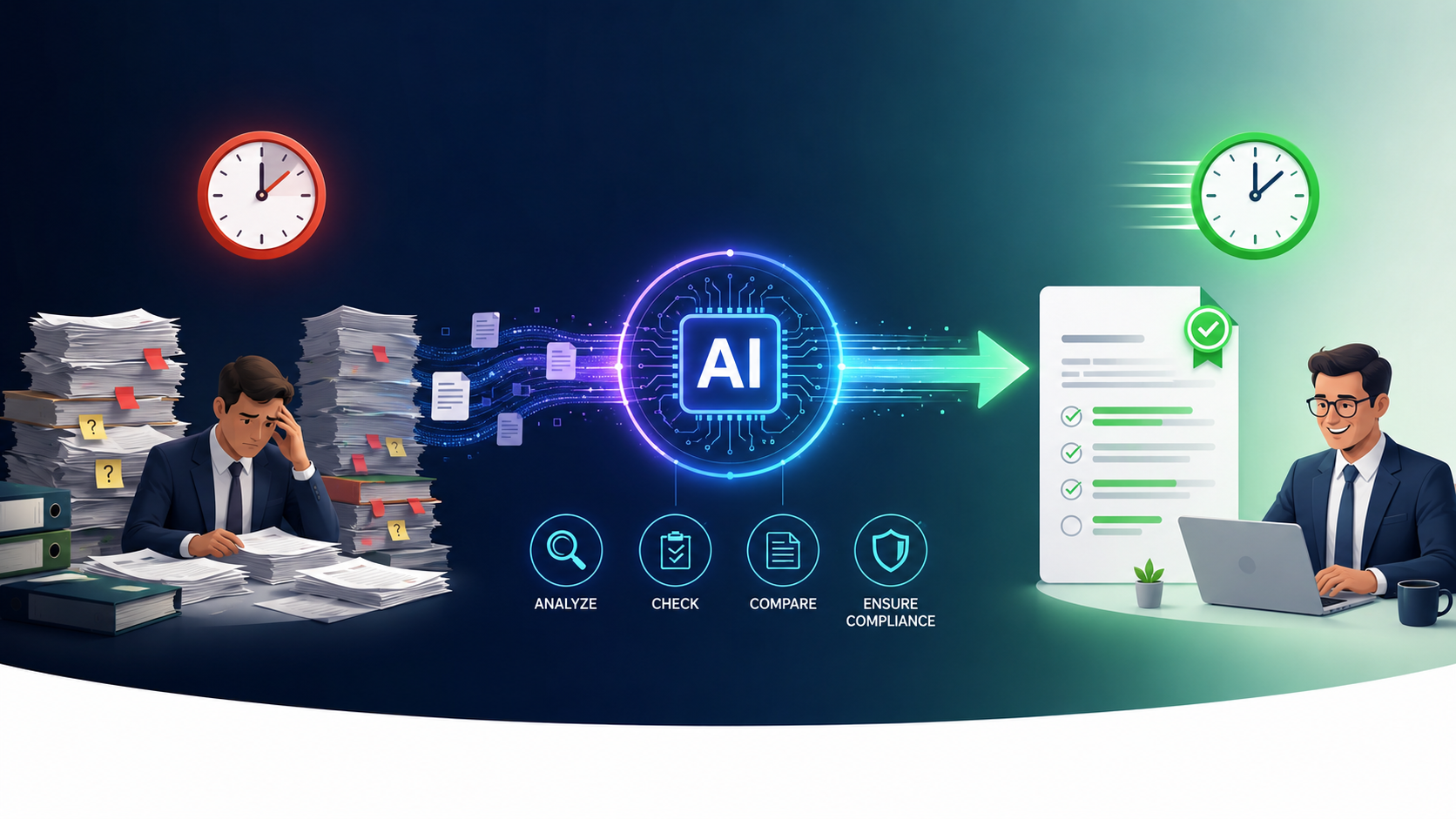
Patent attorneys do not lose time because they lack skill. They lose time because draft review is packed with tiny checks that demand deep focus. Every claim must line up with the spec. Every term must stay clear. Every figure must match the story. Every weak spot must be found before it becomes an expensive problem later.
AI helps attorneys start draft review with a clear map of the invention
A patent draft is not just a long document. It is a careful story about what an invention is, how it works, why it is different, and what parts should be protected.
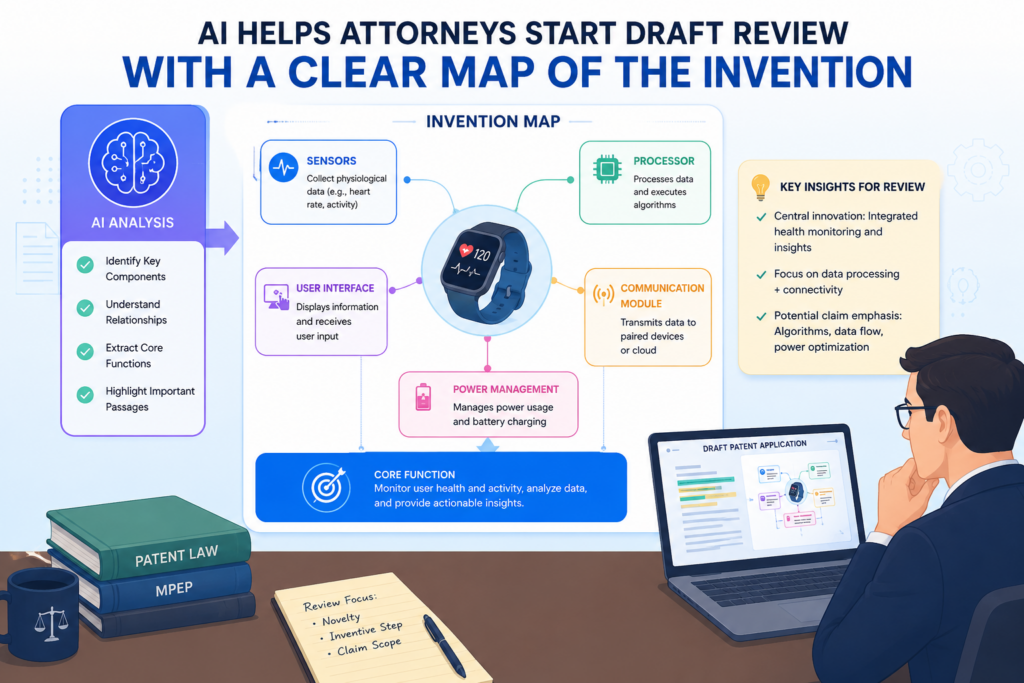
When an attorney reviews a draft, the first job is to understand that story fast without missing the small things that matter.
This is where AI can make a big difference.
A strong AI tool can read the draft, pull out the main parts of the invention, find the key steps, spot the main system pieces, and show how each part connects.
That gives the attorney a clean starting point. Instead of spending the first hour trying to rebuild the whole picture from scratch, the attorney can begin with a working map.
That map is not the final answer. It is a guide. The attorney still decides what matters, what needs to change, and what risks must be fixed. But the review starts with more order and less guesswork.
For a founder, this means the first draft can move faster through review. It also means the attorney can spend more time on the hard judgment calls that protect the business, not just on sorting through text.
AI can help separate the core idea from the extra detail
Many invention drafts include too much noise. This is common, especially when the draft starts from technical notes, product docs, code comments, architecture diagrams, lab notes, or founder interviews.
Engineers often explain everything because they do not know what the patent attorney needs most.
That is not a bad thing. More detail can be useful. But during review, the attorney must separate the core invention from background material, optional features, examples, and future ideas. Doing that by hand takes time.
AI can help by grouping the draft into clear buckets. It can show what looks like the main inventive idea, what looks like a supporting feature, what looks like a use case, and what may be extra context.
This helps the attorney move through the draft with more speed.
The attorney can then ask better questions. Is the draft protecting the real product? Is it too narrow? Is it trying to cover too many things at once? Is there a stronger angle hidden in the technical details?
This matters because patent value often lives in the framing. Two drafts can describe the same invention, but one can protect a meaningful business moat while the other only protects a small feature. AI can help attorneys reach that framing work sooner.
The first review pass becomes less about searching and more about thinking
The old review process can feel like digging through a long document with a highlighter.
The attorney checks whether the title fits, whether the summary matches the claims, whether terms are used the same way, whether the figures are explained, and whether each claim has enough support.
AI can make that search work much faster. It can surface the places where a term changes, where a part appears in a claim but is missing from the description, or where a figure label is used in one place but not another.
These are not small issues. A small mismatch can create confusion, and confusion can weaken a filing.
When AI handles more of the locating work, the attorney can focus on meaning. Does the claim language match the invention?
Does the draft support both narrow and broad protection? Does the filing leave room for future product changes? Does the text help the founder protect what the company is truly building?
That is why PowerPatent is built around a smart mix of software and real attorney oversight. AI helps speed up the draft review process, but the attorney brings the judgment.
Founders get both speed and care. You can see how that works here: https://powerpatent.com/how-it-works
AI reduces time spent checking claim support across the draft
Claims are the heart of a patent application. They define what the patent is trying to protect.
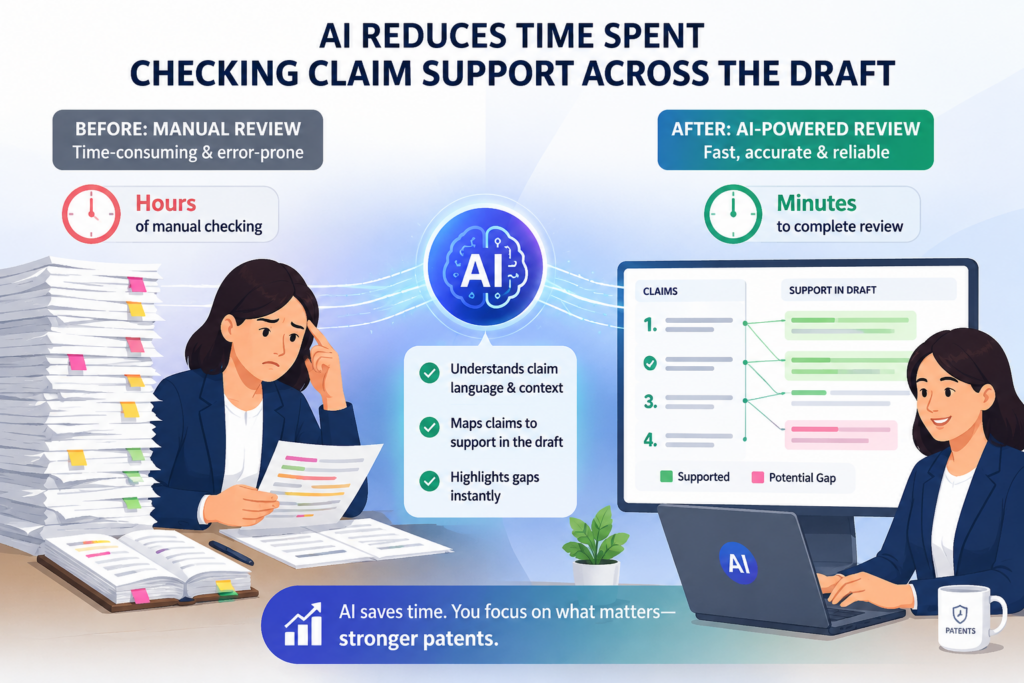
That is why attorneys spend so much time checking them. A claim cannot just sound good. It needs support in the rest of the draft.
This support check can be slow. The attorney has to look at each claim term and make sure the description explains it.
The attorney also needs to make sure the figures, examples, and written details line up with the claim language. If the claim says the invention includes a certain step, the draft should explain that step clearly.
AI can help by tracing claim language back to the specification. It can identify where each claim element appears in the written description.
It can also flag places where support seems weak, thin, or missing. This gives the attorney a faster way to see where the draft may need more detail.
The key point is simple. AI does not decide whether the claim is legally strong. The attorney does that. But AI can help find the support trail faster.
AI can spot when the claims and description drift apart
In patent drafting, drift happens when the claims say one thing and the body of the application says another. Sometimes the claim uses a broader term, while the description only explains one narrow example.
Sometimes the description uses one name for a component, while the claim uses a different name. Sometimes a claim includes a step that was discussed in an invention meeting but never fully added to the draft.
These issues are easy to miss because patent drafts are long and dense. A human reviewer may catch many of them, but it still takes time. AI can help by comparing the claim set against the full draft and pointing out possible gaps.
For example, a claim may refer to a “prediction engine,” while the description uses “model service,” “classifier,” and “inference module” in different places.
AI can show the attorney that these terms may need to be tied together. That saves time and reduces the chance that the draft creates confusion later.
This is especially useful for AI, software, robotics, biotech tools, semiconductor systems, and other deep tech inventions.
These drafts often contain many moving parts. A small wording shift can change the scope of protection.
Strong support checks help avoid expensive fixes later
When support problems are caught late, they can become costly. The attorney may need to rewrite large parts of the draft. The founder may need to answer more questions.
The filing date may slip. In some cases, the team may have to make hard choices because the draft does not support the protection they wanted.
AI helps move those checks earlier. That is the real win.
A faster review does not mean a rushed review. It means the attorney can see risk sooner.
When AI flags possible weak support, the attorney can decide whether to add more examples, explain more technical paths, adjust the claim language, or ask the founder for missing details.
For founders, this can protect both time and money. It also keeps the patent process from becoming a drag on the team. Most startups cannot afford long delays, especially when they are fundraising, launching, hiring, or talking to partners.
PowerPatent helps founders bring their technical work into a process that is easier to manage.
The platform helps organize invention details, while real patent attorneys review the work with care. That makes it easier to move from idea to filing with more confidence. Learn more here: https://powerpatent.com/how-it-works
AI helps find unclear language before it slows down the attorney
Patent drafts must be precise, but they should not be messy. When language is unclear, review takes longer.
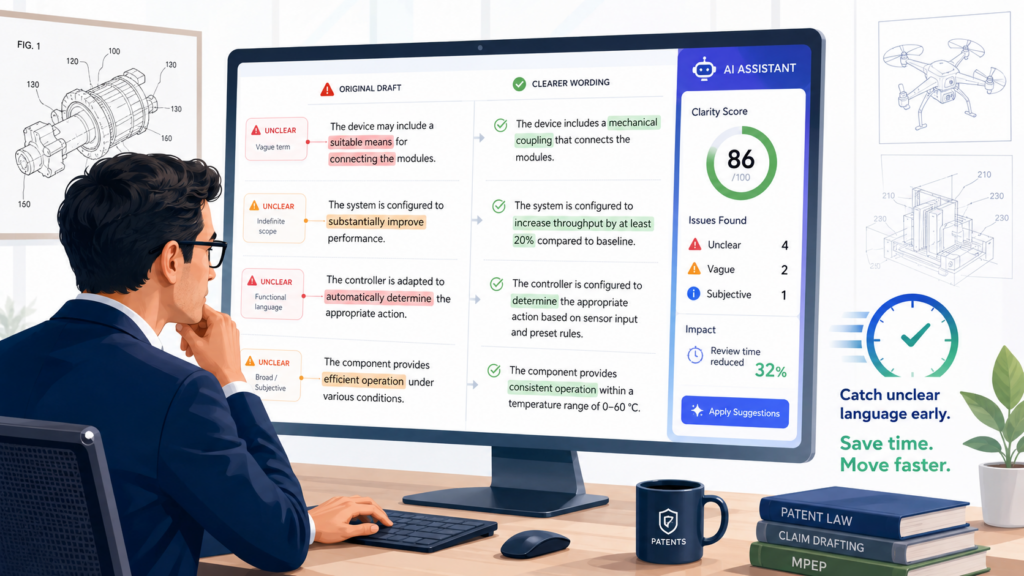
The attorney has to stop, interpret the sentence, compare it to other parts of the draft, and decide whether the wording creates a risk.
This can happen often. A draft may use vague phrases like “in some cases,” “as needed,” “based on the data,” or “the system improves the result.”
Those phrases may be fine in normal writing, but in a patent draft they can leave open questions. What cases? What data? What result? What part of the system performs the action?
AI can help by finding these unclear spots early. It can flag wording that may need more detail. It can also identify long sentences that carry too many ideas at once. This makes the draft easier for the attorney to review.
The goal is not to make the draft sound fancy. The goal is to make it clear.
AI can make technical writing easier to review without making it less technical
Founders often worry that simplifying a patent draft will weaken it. That is not the goal. A good patent draft can be simple and technical at the same time. Simple does not mean shallow. It means clear.
AI can help by suggesting where a sentence may need to be broken into cleaner parts. It can show where a term may need a short explanation. It can identify when a paragraph jumps from one idea to another too quickly.
This is helpful because attorneys do not review words in isolation. They review the flow of the invention. They need to understand how the system works from start to finish.
If the draft explains the invention in a tangled way, the attorney has to spend more time untangling it before improving it.
A cleaner draft lets the attorney move faster. It also makes it easier for the attorney to see where the invention may have broader protection potential. When the technical story is clear, the legal strategy can become clearer too.
Clear drafts help founders stay involved without getting lost
A patent application should not feel like a black box to the founder. The founder should be able to understand what is being filed and why it matters.
That does not mean the founder needs to become a patent expert. It means the process should be clear enough for smart decisions.
AI can help create that clarity during review. When unclear language is flagged, the attorney and founder can focus on the exact issue. They do not need to debate the whole document. They can answer targeted questions.
For example, the question may be whether a model retrains after each user action or only after a batch of events.
It may be whether a sensor signal is filtered before or after a control command is generated. It may be whether a chip design feature applies to one circuit block or to a full system.
These small answers can shape the strength of the patent. AI helps bring them to the surface faster.
That is the kind of speed founders need. Not careless speed. Useful speed. Speed that helps the team file better while staying focused on building the company.
AI improves consistency checks across long patent drafts
Patent drafts can be long because inventions need room to be explained from many angles. There may be a title, background, summary, figures, detailed description, examples, claims, and an abstract. Each part must work with the others.
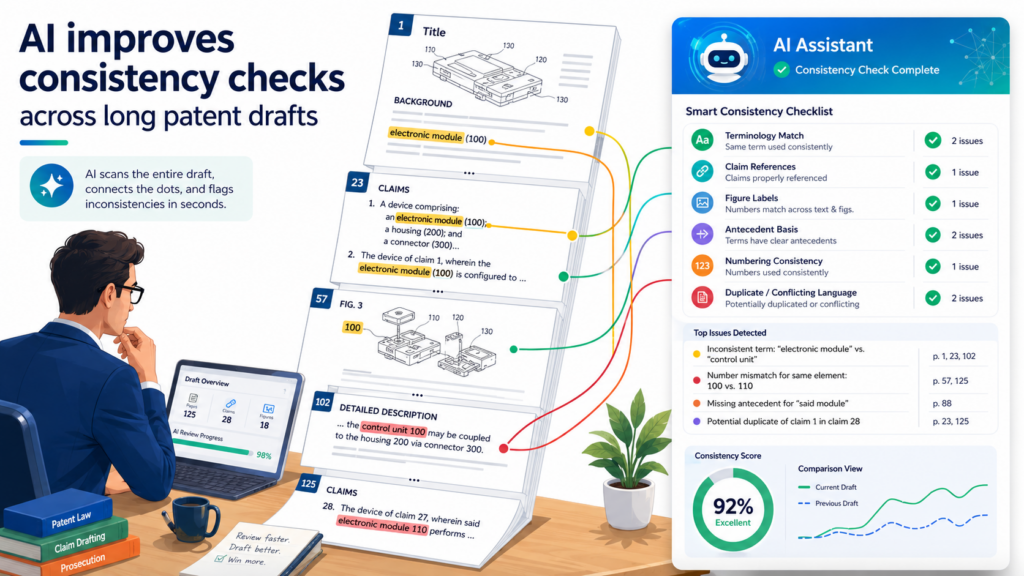
Consistency across all of that text is hard to check by hand. It is even harder when the invention changes during drafting.
Maybe the founder adds a new embodiment. Maybe the attorney rewrites the claims. Maybe a figure is updated. Maybe a term changes after a technical review.
AI can help by checking the whole draft for mismatches. It can find where one phrase appears in one section but not another.
It can identify when the same component has multiple names. It can catch numbering issues, figure reference issues, and places where a claim term does not appear in the detailed description.
These checks do not sound exciting, but they matter. A cleaner draft is easier to review, easier to file, and easier to defend.
AI can reduce the mental load of small but important checks
Attorneys are trained to catch details. But attention is still a limited resource. When an attorney spends too much time checking repeated labels, figure numbers, and term usage, less energy is left for the bigger questions.
AI helps protect that energy.
It can run through the draft and highlight possible inconsistencies before the attorney begins a deeper review.
Then the attorney can confirm what matters. Some flagged items may be harmless. Others may show a real issue. Either way, the attorney is not starting from zero.
This is especially valuable when reviewing drafts under time pressure.
Startups often need filings before a launch, demo, investor meeting, public talk, customer pilot, or research paper. In those moments, speed matters. But speed without quality is dangerous.
AI gives the attorney a faster way to check the basics so the important review work does not get squeezed.
Consistency helps make the patent story easier to follow
A patent application should guide the reader through the invention. If the draft keeps changing names for the same thing, the story becomes harder to follow.
If the figures show one structure and the text describes another, trust drops. If the claims introduce language that the rest of the draft does not support, the filing can become weaker.
AI helps by making those issues more visible.
This is not just about neat writing. It is about creating a stronger record. A clear, consistent draft can help reduce confusion later. It can also help the attorney shape claims that match the invention more closely.
For founders, this means fewer avoidable problems. It also means the patent process feels less random. The team can see what is being checked, why it matters, and how the draft is getting better.
PowerPatent was built for this kind of modern patent work. The platform helps technical teams move faster, while real attorneys guide the parts that require care and judgment. See the process here: https://powerpatent.com/how-it-works
AI helps attorneys review drafts with more focus and less context switching
Draft review often forces attorneys to jump between many tasks.
They read claims, check the spec, inspect figures, review technical notes, compare invention disclosures, look for missing details, and think about strategy. Each switch takes mental energy.
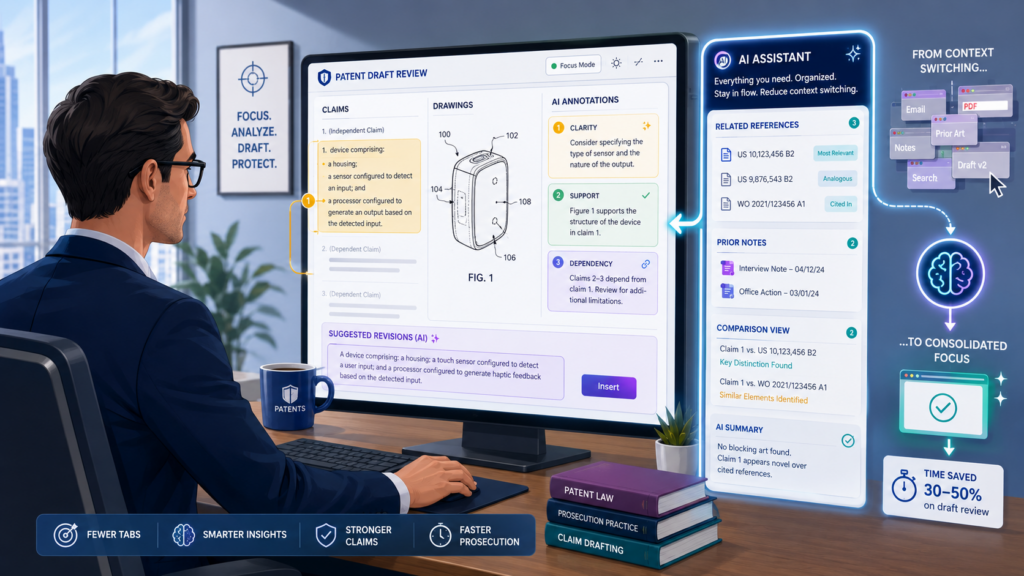
AI can reduce that friction by placing useful review signals in one place. It can show possible support gaps, unclear phrases, term changes, and missing figure links in a more organized way. This helps the attorney stay in flow.
Flow matters because patent review is deep work. The attorney must hold the invention in mind while also thinking about claim scope, future product paths, examiner review, and business value.
Every unnecessary search breaks that focus.
AI does not remove the hard thinking. It removes some of the extra searching around that thinking.
AI gives attorneys a faster way to ask better review questions
A strong review is not just about fixing typos or cleaning grammar. It is about asking better questions. What is the real inventive step?
What part of the product gives the company an edge? What claim language gives room for future versions? What parts of the draft need more examples?
AI can help attorneys reach those questions sooner.
When AI summarizes the invention, traces claim support, and flags weak spots, the attorney can quickly see where deeper review is needed. The attorney can then spend time on questions that shape the filing.
For example, the attorney may see that the draft describes a machine learning pipeline in detail, but the claims focus only on one output step. That may lead to a broader claim strategy.
Or the attorney may see that the claims cover a device, but the business value is really in the control method. That may lead to a better filing plan.
Faster review can create better founder conversations
When review is slow, founder conversations can become vague. The attorney may ask broad questions because the draft is not yet organized enough to ask sharper ones. That can frustrate founders, especially technical founders who are already busy.
AI helps turn review into a more focused exchange.
Instead of asking, “Can you explain the system again?” the attorney can ask, “Does the scoring model update before or after the routing decision?” Instead of asking, “What is new here?” the attorney can ask, “Is the main edge the sensor fusion step, the training method, or the real-time control loop?”
Those are better questions. They respect the founder’s time. They also lead to better answers.
This is where AI and attorney skill work well together. The AI helps find the pressure points. The attorney knows which ones matter. The founder gives the technical truth. Together, the draft gets stronger.
That is the kind of process PowerPatent supports. It helps founders avoid the slow, confusing path and move toward a more direct way to protect what they are building. Learn how it works here: https://powerpatent.com/how-it-works
AI helps attorneys catch weak claim language before it becomes a bigger problem
A patent draft can look clean on the surface and still have weak claim language hiding inside it. This is one of the main reasons draft review takes time. The attorney is not only reading for grammar.
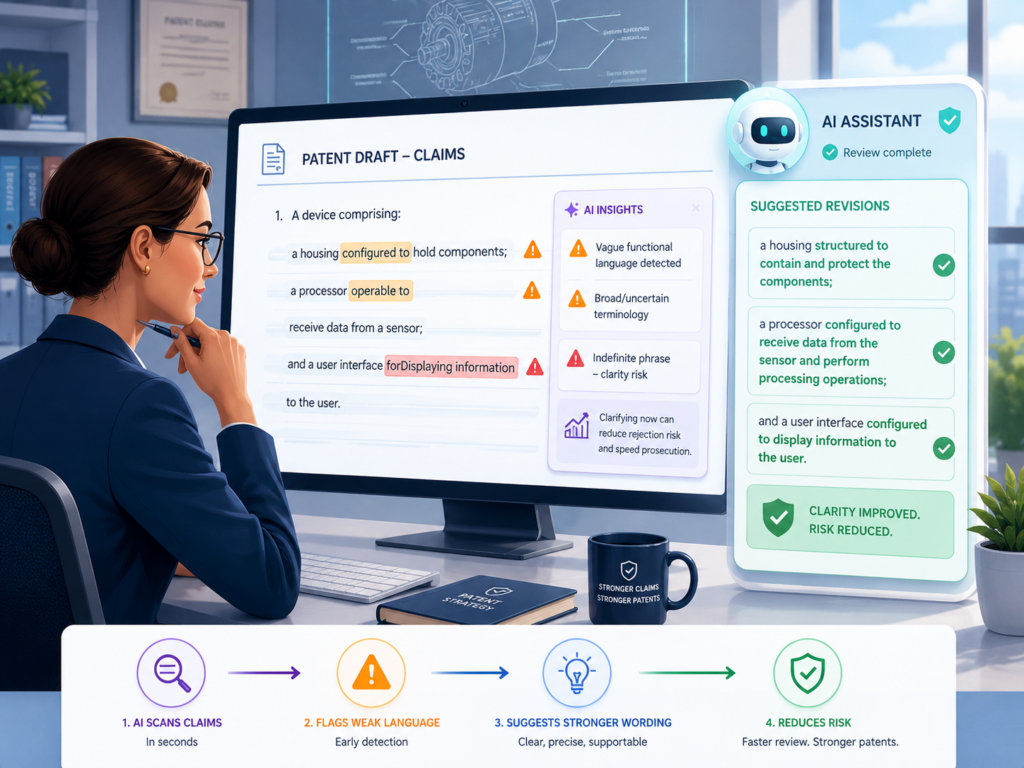
The attorney is reading for risk. A single soft word can make a claim easier to work around. A single narrow phrase can shrink the value of the filing. A single unclear step can create trouble later.
AI helps by giving the attorney a faster way to spot these weak spots. It can scan the claims and point out words that may be too vague, too narrow, too broad without support, or not tied clearly to the invention.
It can also compare the claim language against the rest of the draft to see whether the wording is backed by real detail.
This matters because claims are where the protection lives. The rest of the application explains the invention, but the claims draw the line around what the company wants to protect. If that line is weak, the patent may not do its job.
A founder may think the hard part is describing the product. In truth, the hard part is describing the product in a way that protects the business.
That means the attorney must review every claim with care. AI does not remove that care. It makes the review path cleaner so the attorney can find the right issues faster.
AI can help show when a claim is too narrow for the business goal
Many patent drafts start too narrow. This often happens when the draft is based too closely on the current product. The claims may describe the exact version the team built, but not the bigger idea behind it.
That can be risky because startups change fast. The product may look different in six months. The model may be updated. The workflow may shift. The system may move from one market to another.
AI can help the attorney see when the claims are tied too tightly to one example.
It can flag repeated narrow details, such as a specific data type, a specific interface, a specific hardware setup, or a specific order of steps. Those details may be useful in some claims, but they may not belong in the broadest claim.
The attorney can then decide whether the draft needs a broader version of the idea. That broader version may focus on what the invention does, not only on the exact way one product does it today.
For example, a startup may build a tool that uses sensor data to predict machine failure. The first draft may focus on one type of sensor in one type of machine.
But the real invention may be a smarter way to combine signals and trigger action before failure happens. AI can help surface that mismatch. The attorney can then shape the claims to better match the business value.
Stronger claim review helps founders protect where the company is going
A good patent filing should not only protect the product as it exists today. It should also leave room for where the company may go next. That is why draft review must look beyond the first version of the invention.
AI can help attorneys compare the claims against the full invention story. If the draft includes future versions, alternate workflows, or optional parts, AI can help show whether those ideas are reflected in the claims.
This helps the attorney decide whether the filing is too narrow or whether more claim coverage may be useful.
This is very important for deep tech startups because the first product is rarely the final product. A robotics company may change its control logic. A health tech company may update its model.
A chip startup may move from one architecture to another. A developer tool may add new automation steps. The patent strategy should be strong enough to support that growth.
PowerPatent helps founders move through this work with more speed and less confusion. Smart software helps organize and review the draft, while real patent attorneys make the legal calls.
That gives founders a better way to protect what they are building without slowing the team down. You can see how PowerPatent works here: https://powerpatent.com/how-it-works
AI helps attorneys review figures and descriptions with fewer missed details
Figures are not decoration in a patent draft. They help explain the invention. They show parts, steps, flows, systems, screens, devices, data paths, and relationships.
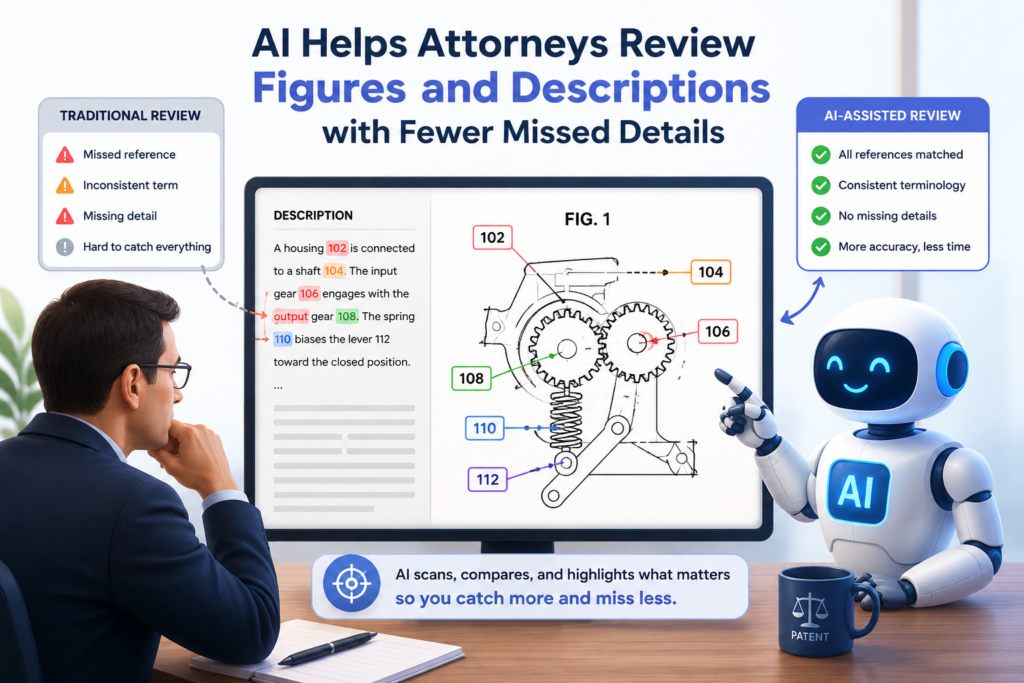
When the figures and the written description do not match, the attorney has to stop and fix the gap. That can take real time, especially in long software or hardware filings.
AI can help by comparing figure labels, written descriptions, and claim terms. It can flag when a figure number is missing, when a part is named one way in the image and another way in the text, or when the draft talks about a step that does not appear in the figures.
It can also help the attorney see whether the figures explain the invention in the right order.
This does not replace the attorney’s review. The attorney still decides whether the figures support the claims and whether the application tells a complete story. But AI can reduce the slow manual work of hunting for mismatches.
For startups, this is a big deal because figures often come from many places. Some may come from engineering diagrams.
Some may come from product flows. Some may be made after a founder call. Some may be updated after the claims change. When many hands touch the draft, small errors can slip in.
AI gives the attorney a faster way to catch those errors before they create confusion.
AI can help connect each drawing to the part of the invention it supports
A strong patent draft uses figures with purpose. Each figure should help explain a key part of the invention. Some figures may show the full system.
Others may show a method, a data flow, a user action, a control loop, a training process, or a device layout. During review, the attorney needs to make sure each figure supports the claims and the written description.
AI can help by mapping figures to sections of the draft. It can show where each figure is discussed and whether that discussion is thin or complete. If
Figure 3 shows a model training process, but the description only gives two short lines about it, the attorney may want more detail.
If Figure 5 shows a fallback process that never appears in the claims, the attorney may decide whether that fallback should matter more.
This is useful because good patents often need multiple layers of detail. The broad idea needs support. The narrower examples need support too. Figures can help build that support, but only if the draft explains them well.
AI can also help check whether the figure flow makes sense. If the system is introduced after the method that depends on it, the attorney may choose to reorder or rewrite parts of the description. That makes the draft easier to follow and easier to review.
Better figure review can make the whole filing feel more complete
When figures are weak, the application can feel thin. When figures are strong and well explained, the invention becomes easier to understand. That helps the attorney, the founder, and anyone else who later reads the filing.
AI can help improve this part of review by pointing out where the drawings and text do not support each other. It may find that a data store appears in the figure but is never described.
It may find that a step in a flowchart is described in the text but has no clear place in the figure. It may find that two figures show similar parts with different names.
These are the kinds of details that take time to check by hand. They are also the kinds of details that can make a draft feel unfinished if they are missed.
The real benefit is not just speed. It is confidence. When the attorney can review a cleaner map of figures, terms, and descriptions, the final draft can be stronger.
The founder can also understand the filing better because the invention is shown in a clearer way.
PowerPatent helps make this process smoother for technical teams. Founders can bring in their product details, code ideas, system flows, and invention notes, then work through a process supported by AI and reviewed by real attorneys.
That means fewer blind spots and a faster path to a serious filing. Learn more here: https://powerpatent.com/how-it-works
AI helps attorneys turn founder notes into review-ready patent content
Many patent drafts begin with raw material. A founder may share a product spec, a pitch deck, code comments, design docs, research notes, customer problem notes, or a recorded invention meeting.
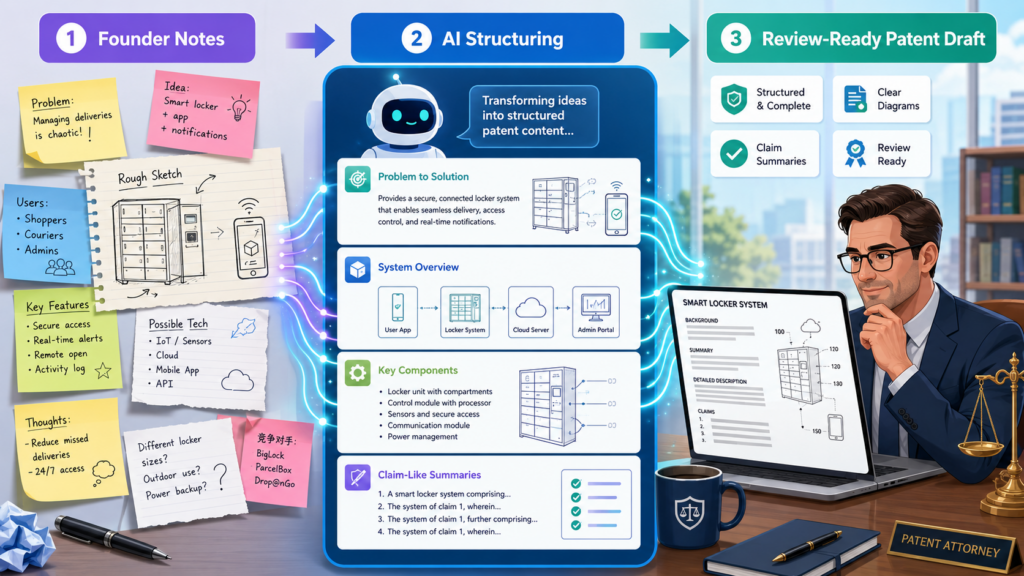
That raw material may contain the invention, but it is rarely ready for attorney review in its first form.
This is where a lot of time gets lost. The attorney has to sort through the material, identify what matters, remove repeated points, ask follow-up questions, and turn messy inputs into a clear patent story. AI can help with that early cleanup.
AI can read founder notes and pull out the main technical points. It can group related ideas. It can identify missing details.
It can point out where the notes describe a result but not the mechanism behind the result. It can also help turn scattered information into sections that are easier for the attorney to review.
This is not about letting AI write a patent without supervision. That would be risky. The value comes from using AI to make the raw material easier to work with before the attorney applies legal judgment.
For founders, this can make the process feel much less painful. Instead of trying to write a perfect invention disclosure from scratch, they can share what they already have.
The system can help organize it. The attorney can then review a cleaner, more useful version.
AI can help attorneys ask fewer broad questions and more precise questions
When founder notes are messy, attorneys often have to ask broad questions. They may ask the founder to explain the whole invention again.
They may ask for more detail about the system, the workflow, the technical problem, or the difference from older tools. These questions are valid, but they can take time.
AI can help make the questions more precise.
For example, after reading the notes, AI may show that the draft explains the input data and output result, but not the step that transforms the input into the output.
That gives the attorney a sharper question. The attorney can ask exactly how that transformation happens. The founder can answer faster because the question is specific.
This makes a big difference for busy founders. They do not want long legal homework.
They want to protect the invention and get back to building. When AI helps narrow the questions, the patent process becomes less of a burden.
It also helps the attorney. Better inputs lead to better drafts. Better drafts lead to faster review.
Faster review means the attorney can spend more time on claim strategy, support, and risk, rather than trying to decode scattered notes.
Clean invention intake can reduce review time before the draft even exists
The best way to reduce draft review time is to improve what happens before the draft is written. If the invention intake is weak, the draft will need more repair. If the intake is clear, the draft starts stronger.
AI helps by improving this first step. It can guide the founder to explain the problem, the technical fix, the system parts, the method steps, the data flow, the alternate versions, and the business value.
It can also help show where the founder has not yet given enough detail.
This makes the attorney’s job easier because the review starts with better material. The attorney can see the invention faster.
The draft can be built with stronger support from the start. The review can then focus on improving the filing instead of fixing missing basics.
This is one of the reasons PowerPatent is built for modern startup teams. It helps turn technical work into patent-ready material without forcing founders into a slow, old process.
AI helps organize the invention. Real attorneys oversee the work. The result is a faster and clearer path from idea to filing.
For a startup, that can mean less delay before a launch, demo, fundraise, or partner meeting. It can also mean more control over the patent process.
Founders can see what is happening, understand what is being protected, and move with more confidence.
PowerPatent gives technical founders a better way to protect their work while staying focused on growth. See how it works here: https://powerpatent.com/how-it-works
AI helps attorneys compare draft versions without losing the thread of the invention
Patent drafts change many times before filing. The first version may focus on the product. The next version may focus more on the claims.
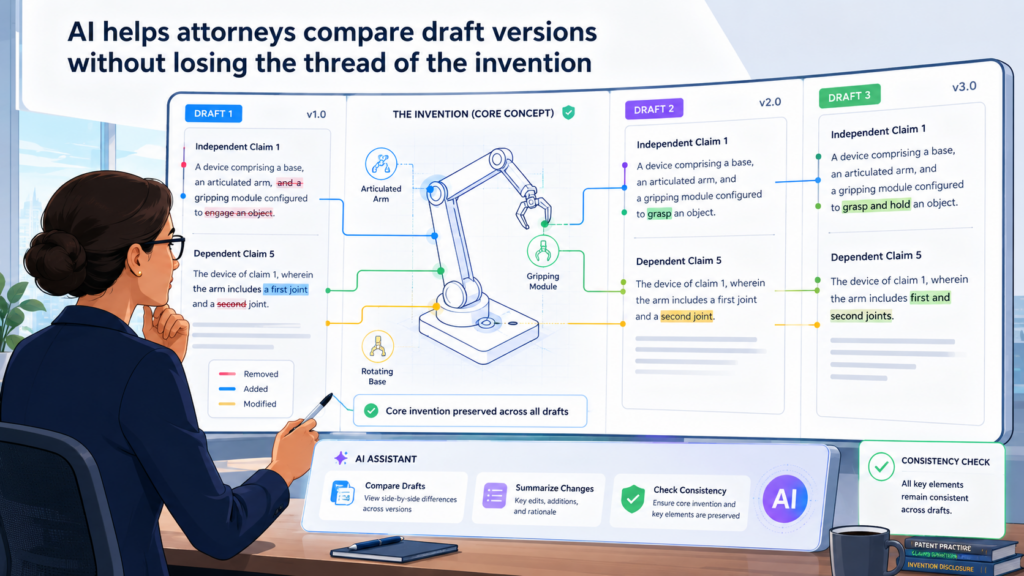
A later version may add more examples, update figures, adjust terms, or include new details from the founder. Each change can improve the filing, but each change can also create new review work.
This is where draft review can become slow. The attorney must know what changed, why it changed, and whether the change created a new issue somewhere else.
A small update in the claims may require changes in the summary, detailed description, figures, and abstract.
A new term added in one section may need support across the full draft. A removed feature may still appear in a figure. These are easy problems to create and hard problems to catch when review is fully manual.
AI can help by comparing versions in a more useful way. It can do more than show redlines. It can help explain what changed in plain terms. It can show which claim elements were added, removed, narrowed, or broadened.
It can flag when a change in one place may need a matching change somewhere else. That gives the attorney a faster way to stay in control.
The real value is not just speed. It is continuity. A strong patent draft should keep the same invention story from start to finish, even as the draft evolves. AI helps preserve that story while the attorney improves the filing.
AI can help attorneys see whether edits made the draft stronger or just longer
Not every edit improves a patent draft. Some edits add useful support. Other edits add clutter. Some changes make the claims clearer.
Others make the draft harder to read. During review, the attorney must decide whether each change helps the filing or creates more risk.
AI can help by showing the effect of edits across the full document. If a founder adds a new technical example, AI can help show whether that example supports a claim, explains a figure, or introduces a new feature that is not tied to the rest of the draft.
If a claim is rewritten, AI can help show whether the specification still supports the new wording. If several terms are changed, AI can help find old terms that were left behind.
This makes review more focused. The attorney does not have to treat every edit as equal.
The attorney can look first at the changes that may affect claim scope, support, clarity, or consistency. That means review time is spent where it matters most.
For founders, this can prevent the “why is this taking so long?” feeling that often comes with patent work.
Many delays come from version cleanup. AI can reduce that cleanup by making changes easier to track and easier to check.
Version review becomes a way to protect quality instead of a slow document chore
A patent draft is not finished just because it has enough words. It is finished when the words work together.
That means every version needs careful review. The claims, description, drawings, and examples must stay aligned as the document changes.
AI helps attorneys review that alignment faster. It can show whether a newly added embodiment is described in enough detail. It can flag if a figure still points to a removed step.
It can find places where the draft says “the invention” too narrowly after the claims have been broadened. It can also help identify where a section now feels out of order because later edits changed the flow.
The attorney still makes the final call. AI does not know the full business goal, the filing strategy, or the founder’s future roadmap unless those things are built into the review process. But AI can make the review surface much clearer.
That is exactly the kind of work PowerPatent is built to support. Founders need filings that move fast, but they also need filings that are carefully reviewed.
PowerPatent combines smart software with real attorney oversight so version changes do not turn into hidden risk. See how the process works here: https://powerpatent.com/how-it-works
AI helps attorneys spend more time on strategy and less time on cleanup
The highest value work in patent review is not fixing commas. It is not checking the same figure number ten times.
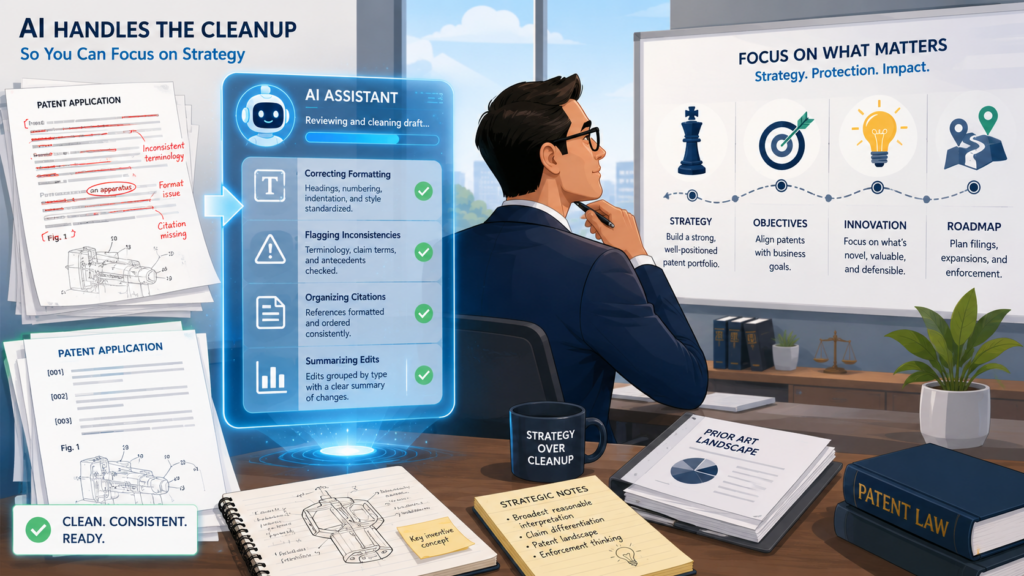
It is not hunting for every place a term appears. Those tasks matter, but they are not where the attorney’s deepest value lives.
The attorney’s real value is in strategy. What should the patent protect? How broad should the first claim be? What fallback positions should be included? Which technical details make the invention harder to copy?
What should be saved for another filing? How does this patent support the company’s market position?
Manual review can bury attorneys under cleanup tasks before they get enough time for those bigger questions. AI helps change that balance.
It can handle the first pass on many repeat checks, such as term consistency, support mapping, figure references, wording issues, and missing details. That gives the attorney more room to think about what the filing should accomplish.
This is a major shift. AI does not make patent attorneys less important. It makes their judgment more available.
The attorney is no longer forced to spend as much time digging through the draft for basic issues. Instead, the attorney can use that time to shape the draft into a stronger business asset.
For startups, this matters because a patent is not just a legal file. It can support fundraising, partnerships, market position, licensing, and future exits. A faster review process is helpful, but a smarter review process is far more valuable.
AI can help connect the patent draft to the founder’s real business goal
A patent draft should not be reviewed in a vacuum. The attorney needs to understand what the founder is trying to protect. Is the company trying to protect a core platform?
A key model? A hardware design? A workflow that competitors may copy? A method that makes the product faster, safer, cheaper, or more accurate?
AI can help organize the technical material so the attorney can better connect the draft to that business goal. It can identify which parts of the draft appear central and which parts appear optional.
It can show where the claims focus too much on implementation details and not enough on the broader value. It can also highlight features that appear often in the disclosure but are not clearly reflected in the claims.
That gives the attorney a better starting point for strategy. The attorney can decide whether the draft should protect the broad system, a key method, a data pipeline, a device structure, a model training approach, a control process, or a set of fallbacks.
This is especially important for founders who are moving fast. The patent should match the business, not just the current feature list.
If the draft only protects today’s product screen or one narrow technical setup, it may fail to protect the larger idea the company is built around.
Better strategy review can make one filing do more work for the company
A well-reviewed patent draft can cover more than one layer of value. It can protect the broad idea, the best technical path, the main product version, and useful fallback details.
This does not happen by accident. It happens when the attorney has enough time and clarity to review the draft strategically.
AI helps create that time and clarity.
When AI reduces cleanup work, the attorney can spend more time asking whether the claim set is balanced. The broad claims should not be unsupported. The narrow claims should not be so limited that they have little value.
The description should include enough examples to support different angles. The figures should help explain the invention in a way that makes the filing stronger.
This is where PowerPatent gives founders a better path. The platform helps collect and structure the invention, while attorney review keeps the process grounded in real patent judgment.
Founders do not have to choose between speed and care. They can move faster while still getting attorney oversight where it matters.
For a technical team, that can mean fewer lost hours, fewer unclear drafts, and a better chance that the filing protects the company’s real edge. Learn how PowerPatent helps founders file better patents here: https://powerpatent.com/how-it-works
AI helps attorneys reduce review cycles by catching missing technical detail earlier
One of the biggest causes of long draft review is missing technical detail. A draft may describe what the invention does, but not how it does it.
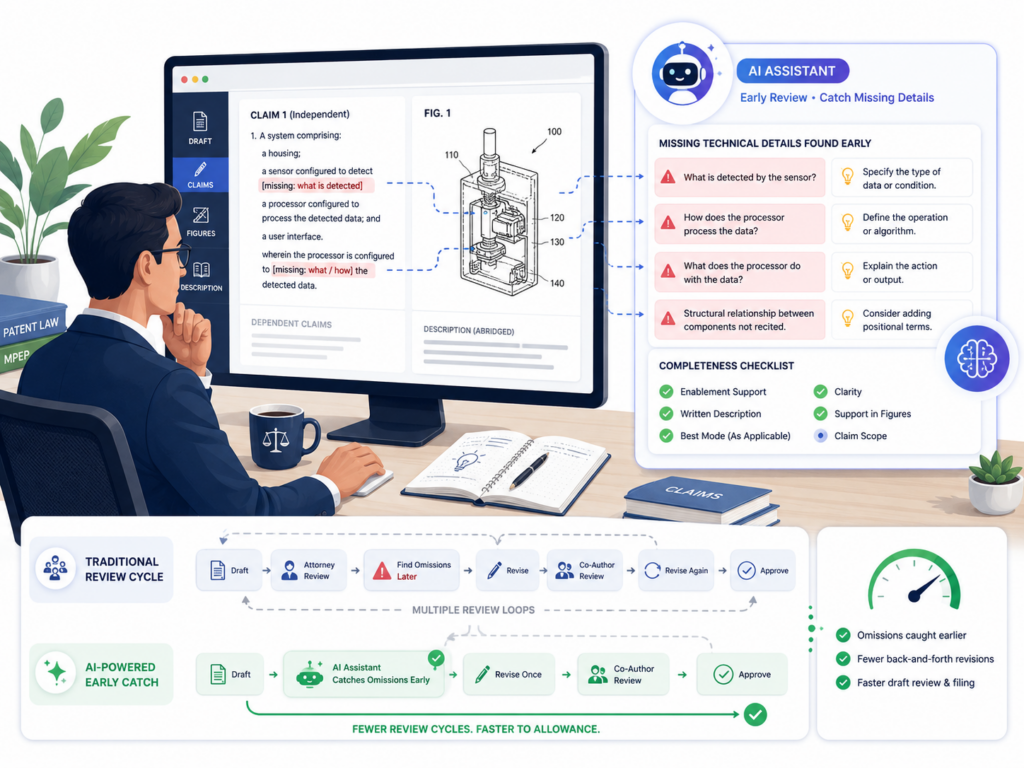
It may explain the result, but not the steps that create the result. It may show a system at a high level, but leave out the parts that make the system different.
When this happens, the attorney has to stop and go back to the founder. That creates another review cycle.
The founder answers questions. The draft is updated. The attorney reviews again. New questions may appear. Time slips away.
AI can help reduce these cycles by finding missing detail earlier in the process. It can scan the draft for places where the explanation jumps too quickly. It can point out when a feature is named but not explained.
It can identify where a claim includes a step that the description does not fully teach. It can also show where the draft relies on broad words without giving enough concrete examples.
This helps the attorney ask better questions before the draft is too far along. Instead of waiting until the final review to discover that key details are missing, the team can fix those gaps sooner.
For founders, this is one of the most practical benefits of AI-assisted review. It turns patent work from a long back-and-forth into a tighter process.
The founder spends less time answering repeated questions and more time giving targeted answers that improve the filing.
AI can help reveal the difference between a product feature and a patent-ready invention
A product feature is what users see or use. A patent-ready invention is the technical way that feature works.
Those are not always the same thing. Founders often explain the feature because that is what they are used to pitching. But attorneys need the mechanism behind the feature.
AI can help find this gap. It can flag when the draft says the system “improves accuracy,” “reduces delay,” “detects risk,” or “automates a workflow” without explaining the technical steps that produce that result.
It can show where the draft needs more detail about data inputs, processing steps, model behavior, hardware interaction, timing, control logic, memory use, or system architecture.
This is very useful for software and AI startups. A founder may say the product uses AI to recommend an action.
But the patent draft may need to explain how signals are selected, how the model is trained or used, how the output is generated, and how the system changes what happens next. Without that detail, the draft may feel thin.
The attorney can use AI’s flags as a guide, then work with the founder to add the missing technical substance. That makes the draft stronger and review faster.
Early gap detection helps avoid rushed fixes near the filing deadline
Patent filings often become urgent. A team may need to file before a product launch, investor demo, trade show, research release, customer pilot, or public announcement.
When missing details are found late, the process becomes stressful. The attorney may need fast answers. The founder may be busy. The filing may need heavy edits close to the deadline.
AI helps reduce that pressure by moving gap detection earlier.
When the draft is checked early for missing support, unclear mechanisms, and weak examples, the team has more room to fix the problems properly.
The attorney can ask for the right technical detail. The founder can respond with better context. The final review becomes less about emergency repair and more about careful finishing.
This is a better way to work. It respects the founder’s time and protects the quality of the filing. It also helps attorneys avoid spending late-stage review time on issues that could have been caught much earlier.
PowerPatent is designed around this exact idea. The platform helps founders get their invention details into a clearer form, then pairs that speed with real attorney review.
The result is a patent process that feels less slow, less confusing, and more useful for fast-moving technical teams.
Founders who want to protect their work without getting stuck in old patent workflows can see how PowerPatent works here: https://powerpatent.com/how-it-works
AI helps attorneys spot draft risks that may not be obvious on a first read
A patent draft can look strong when the story is clear, the figures are neat, and the claims seem complete. But some risks only appear when the attorney looks deeper. The draft may lean too much on one example.
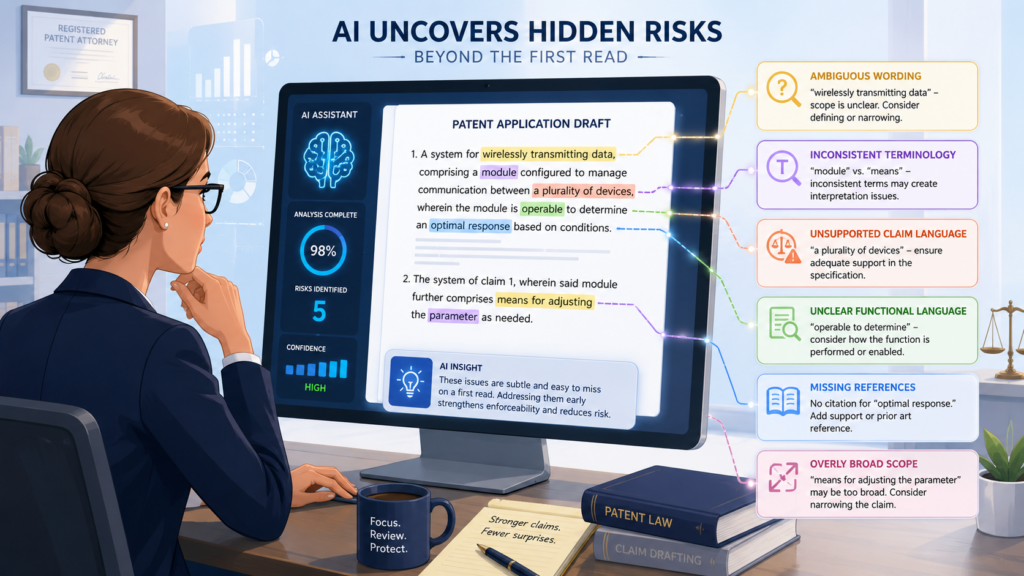
It may describe a result without enough detail about the way that result is reached. It may use words that sound broad but are not well supported. It may also leave out alternate ways the invention could work.
These risks can slow review because they require careful reading across the whole draft. The attorney must check not only what is written, but also what is missing.
That is harder than fixing simple errors. Missing material does not always announce itself. The attorney has to notice that a concept should be there and then decide how to handle it.
AI can help by scanning the draft for patterns that often point to risk. It can notice when a major feature appears only once. It can flag when the claims depend on a term that is barely explained.
It can show where the draft says the system “improves” something but does not clearly explain the technical cause of that improvement. These signals give the attorney a faster way to find places that deserve extra care.
The attorney still makes the judgment call. AI should not decide whether a patent draft is ready. But it can act like a tireless review helper that brings possible weak spots to the surface.
AI can help attorneys focus review on the parts most likely to affect protection
Not every draft issue has the same weight. A small wording error may be easy to fix. A weak claim term can affect the value of the filing. A missing technical step can force a larger rewrite.
A narrow example that appears in the broadest claim can make the patent easier for a competitor to design around.
AI helps by giving attorneys a better sense of where to look first. Instead of reading the whole draft with the same level of concern on every line, the attorney can start with the areas that may affect claim scope, support, and clarity.
This can reduce review time because the attorney is not wasting attention on low-value checks before finding the real issues.
For example, if the draft claims a system that adapts in real time, AI may flag whether the written description explains what triggers the adaptation, what data is used, what changes in the system, and how the output is affected.
If those parts are thin, the attorney can fix the problem before the draft moves further.
This kind of focused review is especially useful for startup inventions. The team may be moving fast. The product may still be changing.
The filing may need to happen before a demo, customer meeting, public launch, or investor update. AI helps the attorney protect quality even when time is tight.
Better risk spotting can help founders avoid paying for avoidable rework
Founders do not want to pay for the same problem twice. They do not want a draft to be reviewed, rewritten, reviewed again, and then reopened because an issue was missed earlier. That kind of back-and-forth creates cost, stress, and delay.
AI can help reduce that waste by helping the attorney catch draft risks earlier. If a section is thin, the founder can add more detail sooner.
If a claim is too narrow, the attorney can adjust it before other parts of the draft are built around it.
If an important feature is missing from the description, the team can add support while the invention is still fresh in everyone’s mind.
This does not mean every patent draft becomes simple. Strong patents still require skill. But the process can become cleaner. The review can move from broad hunting to targeted improvement.
PowerPatent is built for founders who want that kind of clear, faster path. The software helps surface issues, organize invention details, and support a smoother review process.
Real patent attorneys still guide the work, so founders get speed without giving up careful oversight. You can see how the process works here: https://powerpatent.com/how-it-works
Conclusion
AI helps patent attorneys review drafts faster by clearing away slow, repeat work so they can focus on real strategy. It helps find missing support, unclear terms, weak claim language, figure issues, version changes, and gaps in technical detail before they turn into costly delays.
But the real power comes from pairing AI with human judgment. That is where PowerPatent stands out. Founders get smart software that speeds up the process, plus real patent attorney oversight that keeps the filing strong and thoughtful. To protect what you are building with more speed and confidence, visit https://powerpatent.com/how-it-works
Leave a Reply