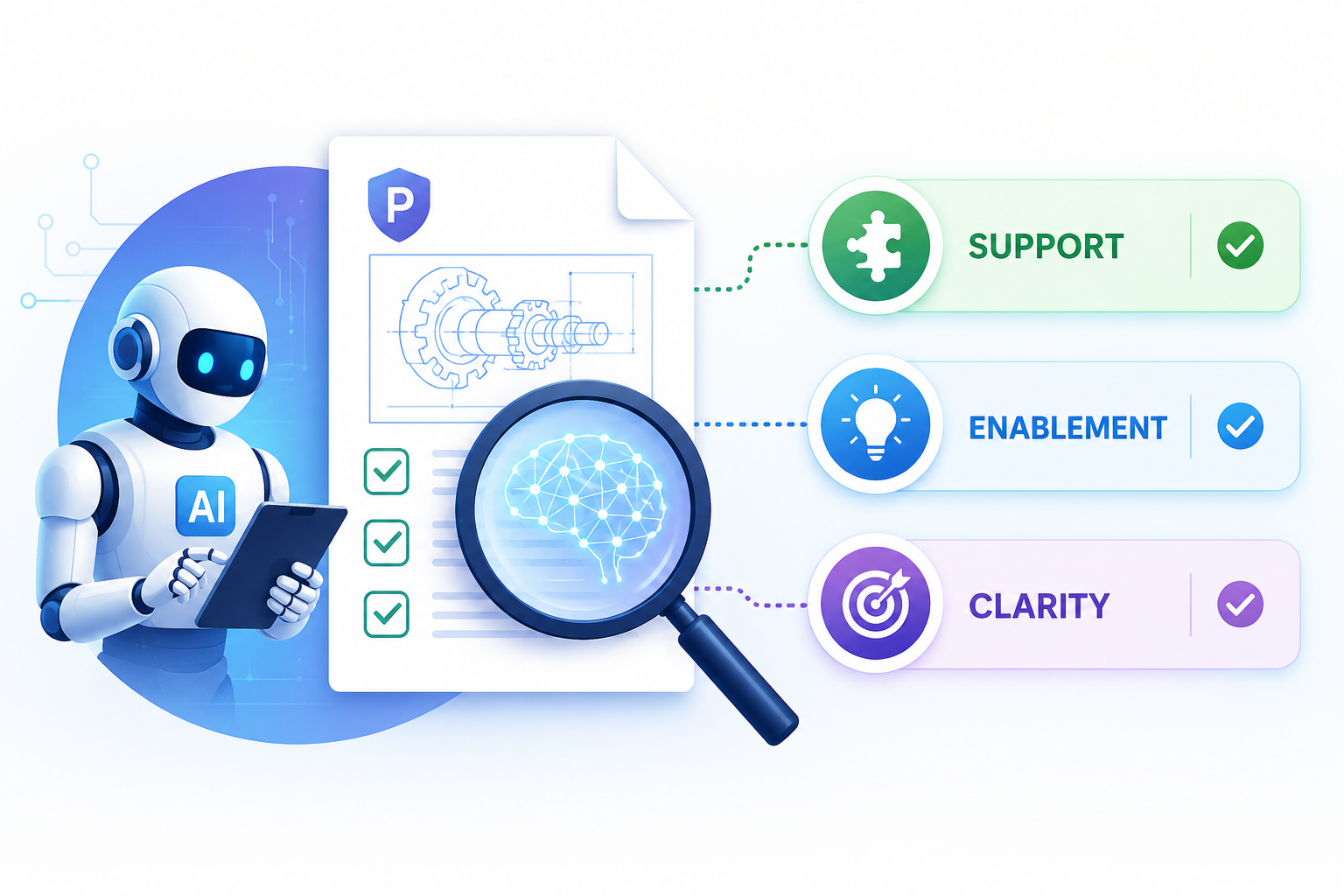
A patent application does not win because it sounds smart. It wins because it is clear, backed up, and useful. That is where Section 112 matters. In simple terms, Section 112 asks whether your patent explains what the invention is, shows enough support for what you claim, teaches others how to make and use it, and uses words that are clear enough to understand.
Support means your claims must match what your draft actually teaches
A strong patent claim should feel bold, but it cannot float in the air. It needs a base. That base is the patent draft itself.
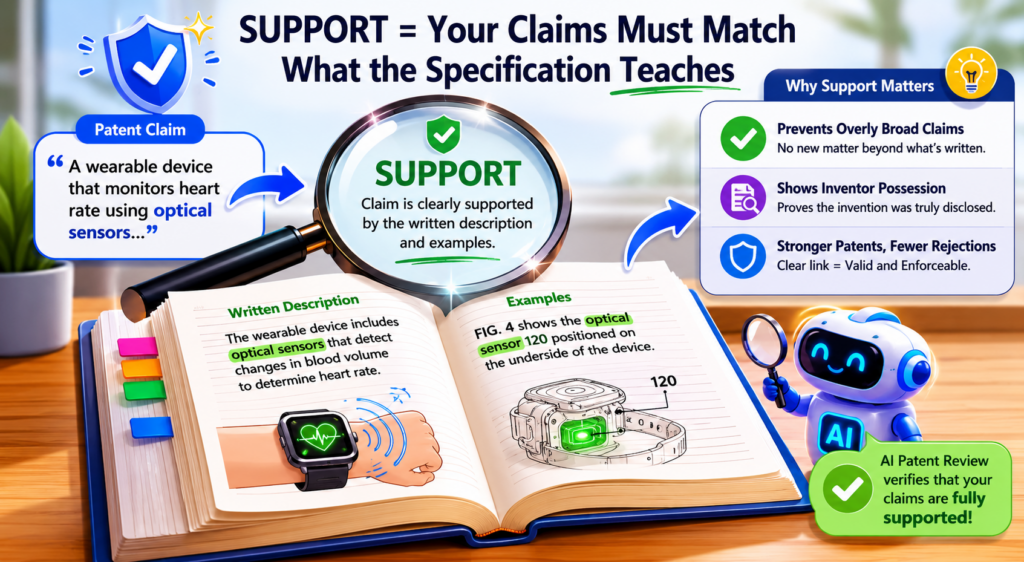
When people talk about “support” under Section 112, they are really asking a simple question: does the patent application show that the inventor truly had the invention at the time of filing?
Not just the idea. Not just the goal. The actual working shape of the invention.
For AI inventions, this matters a lot because the first draft often sounds too broad. A founder may say, “Our system uses AI to detect risk.” That may be true, but it may not be enough.
What kind of risk? What data goes in? What does the model look for? What comes out? How does the system act on that result? Where does the value happen? A patent draft must connect those dots.
Your claim should not outrun your story
Think of each claim as a promise. The rest of the patent must show why that promise is fair. If the claim says the system can classify images, text, audio, and sensor data, then the draft should not only explain image data.
If the claim says the model can work in real time, then the draft should show how speed is handled.
If the claim says the system adapts over time, then the draft should explain what changes, when it changes, and what causes the change.
This is where many software and AI patent drafts get weak. The founder knows the product. The engineer knows the pipeline. The team may have code, tests, logs, model cards, diagrams, and internal docs.
But the patent draft may still be thin because it does not pull enough of that knowledge into the application. The result is a gap between what the claim says and what the draft supports.
AI patent review helps catch that gap before it turns into a serious issue. Instead of waiting for an examiner to point out that the claim is broader than the description, the review can flag places where the draft needs more detail.
It can compare claim language against the written description. It can ask whether each claim term has a clear home in the draft.
It can show where the patent says “the system determines a score” but never explains how that score is made.
A support check should look for missing links, not just missing words
Support is not only about whether the same word appears in two places. A claim may use the phrase “confidence value,” while the draft uses “probability score.” That may be fine if the meaning is clear.
But a deeper review should ask whether the patent explains the actual role of that value. Is it used to rank results? Trigger an alert? Select a model? Reject bad data? Change a user interface? Send a command to another system?
This is where AI review can be very useful. A smart review does not just search for matching terms. It checks the chain of meaning. It looks for whether the invention is shown in enough forms.
It asks whether the draft gives enough examples to make the claim feel earned. It can point out when a broad claim needs more fallback positions, such as different data types, model types, training flows, thresholds, user actions, or system layouts.
For a founder, this is not just a legal clean-up step. It is a business step. A weak patent can look fine when filed, but become painful later when a buyer, investor, partner, or competitor reads it closely.
A strong draft gives your company more room to stand on. It helps show that the invention was not just a vague idea. It was a real technical system with real parts and real choices.
Support should be built from the invention outward
The best way to fix support issues is not to add fancy words. It is to go back to the invention and ask what makes it work.
For an AI system, that may include the data source, the feature extraction method, the model structure, the training process, the validation step, the output format, the feedback loop, the deployment setting, and the way the system handles bad or uncertain results.
The patent does not need to include every line of code. It also does not need to reveal trade secrets that are not needed for the patent. But it should describe enough technical detail to show that the team had a real solution.
That means the draft should not stop at “AI analyzes the data.” It should explain what the AI receives, what it learns from, what it compares, what it produces, and how that result improves the system.
This is especially important when the invention lives in the details. Many AI startups are not inventing “AI” in general.
They are inventing a better way to clean data, reduce false alerts, tune a model, combine signals, protect privacy, route tasks, detect edge cases, or make a model useful in a hard setting.
Those details are often the heart of the patent. If they stay buried in code or pitch decks, the patent may miss the real value.
A stronger draft gives you more paths when the claim must change
Patent claims often change during review. That is normal. But when the draft has thin support, you may not have many safe ways to narrow the claim.
You may want to add a detail later, but if that detail was not described in the original filing, it may be too late. This is one of the most painful patent mistakes because it is hard to fix after filing.
That is why early AI patent review should ask a hard question: does this draft give us room to move? A good draft should include the main version of the invention, but also practical variations.
It should show different ways the system can be built, trained, deployed, and used. It should include enough examples so the claims can be adjusted without losing the core idea.
PowerPatent is built for this kind of front-end review. It helps technical teams turn what they already know into a cleaner, stronger patent story, with smart software and real attorney oversight.
That means founders can move fast while still building a filing that has real depth. You can see the process here: PowerPatent how it works.
Support is not a box to check at the end. It is the frame that holds the patent together. When the claims match the draft, the patent becomes easier to defend, easier to explain, and easier to trust.
Enablement means the patent must teach the invention well enough to be real
Enablement sounds complex, but the core idea is simple. A patent should teach someone skilled in the field how to make and use the invention without a huge guessing game.
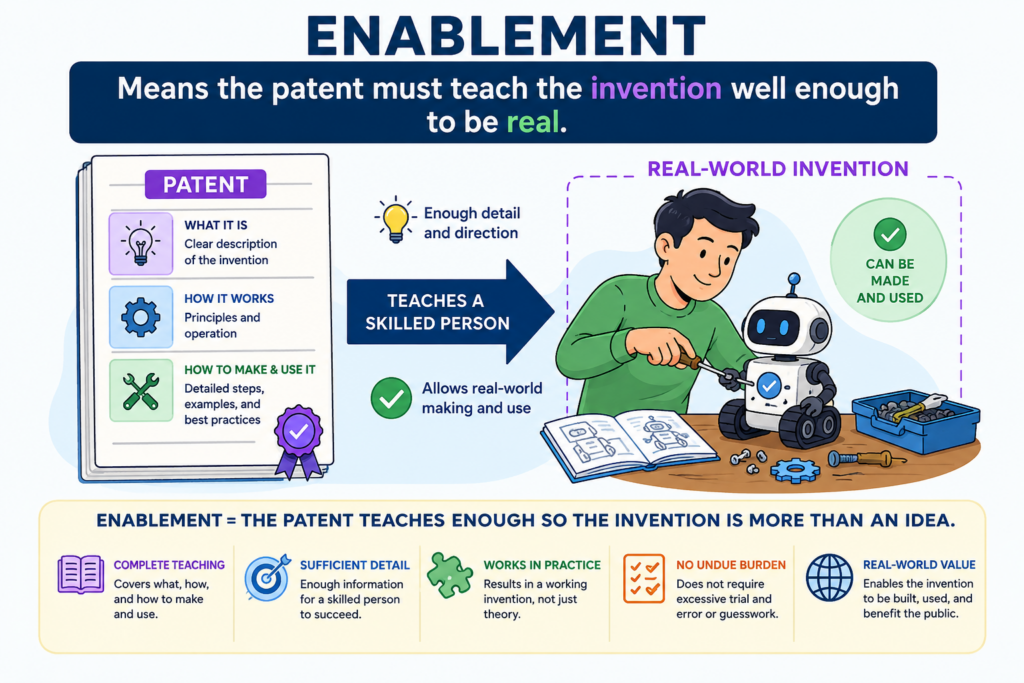
The law gives inventors a powerful right, but the inventor must give the public a real teaching in return.
For AI and software patents, this does not mean you must publish every private detail. It does mean the draft must explain the invention clearly enough that it is not just a dream, a result, or a black box.
This is where many AI patent drafts run into trouble. They describe what the system achieves, but not enough about how the system achieves it. They say the model predicts, ranks, detects, recommends, or generates.
But they do not explain the data flow, the model behavior, the steps before and after the model, or the way the result is used. That can make the invention feel like a wish instead of a working system.
A patent should teach the path, not just name the destination
Imagine reading a patent that says, “The system improves diagnosis using machine learning.” That may sound useful, but it leaves too much open.
What data is used? Is it image data, lab data, patient history, device signals, or a mix? How is the data prepared? What does the model output?
How is the output checked? What does the system do when confidence is low? What part of the process is new?
A strong AI patent draft walks through the path. It helps the reader understand the flow from input to result.
It does not need to drown the reader in code, but it should give enough structure that the invention feels buildable. The reader should be able to see the parts, the order, the purpose, and the reason the system works.
AI patent review can help by finding places where the draft jumps too quickly. It can flag broad statements like “the model is trained on data” and ask what kind of data, what labels, what features, what loss target, what update rule, what validation step, or what deployment setting matters.
It can spot where the draft says “in one example” but never gives a real example. It can show where a step depends on hidden knowledge that never appears in the application.
Enablement issues often hide inside broad results
One common problem is result-only language. This happens when a claim or description focuses on the outcome instead of the method.
Phrases like “optimize the process,” “improve accuracy,” “reduce error,” “detect anomalies,” or “generate a recommendation” can be fine, but only when the draft also explains the technical way the result is reached.
For a founder, this is easy to miss because product language often focuses on benefits.
Your website may say the product “finds fraud faster” or “makes robotics safer” or “helps teams ship better code.” That is good marketing. But a patent needs the deeper layer.
It needs to show the mechanism. It should explain what signals are used, how the system decides, how the decision changes the output, and why the process is different from a normal approach.
This is not about making the draft longer for no reason. It is about making the draft useful. A useful patent teaches the parts of the invention that matter.
It shows the reader how the system can be practiced. It also gives the patent examiner a clearer reason to see the invention as technical and concrete.
Enablement should match the full width of the claim
The broader the claim, the more teaching the draft may need. If the claim covers many types of models, many types of data, or many use cases, the draft should support that width with enough examples and explanation.
A claim that covers all neural networks, all sensors, all users, and all industries may sound powerful, but it can become fragile if the draft only teaches one small version.
This is why a careful AI review should test the claim against the examples. If the draft teaches one model for one use case, can the claim fairly cover several models and several use cases?
If the patent says the invention works across cloud, edge, and mobile systems, does it explain what changes in each setting? If the claim covers real-time control, does the draft explain timing, latency, and how fast decisions are handled?
The goal is not to make every claim narrow. The goal is to make the scope honest and defensible. A broad claim can be strong when the draft gives enough teaching to back it up.
A narrow claim can still be valuable when it protects the real product advantage. The key is to know what the draft can carry before filing.
A practical enablement review should ask what an engineer would need
A simple way to test enablement is to think like an engineer reading the patent. Could that engineer understand the system architecture?
Could they identify the input data, the processing steps, the model role, and the output action?
Could they build a working version without filling in major blanks? Could they tell which parts are required and which parts are optional?
This engineering view is especially useful for AI because many inventions depend on small design choices. A model may work because of a certain training set structure.
A prediction may be better because of how features are combined. A robot may move more safely because the system blends model output with rule-based checks.
A medical tool may reduce false positives because it uses a second review layer. These are not minor details. They may be the invention.
PowerPatent helps teams capture this technical truth before it gets lost. Founders can bring the real work, such as diagrams, notes, code logic, model behavior, product flows, and engineering insight, into a guided process that helps shape a stronger filing.
Real patent attorneys stay involved, so the draft is not just filled with AI-generated text. It is reviewed with judgment. Learn more here: PowerPatent how it works.
Enablement protects the strength of the patent because it proves the invention is more than a claim to a result. It shows the reader that the team knew how to make the system work.
For deep tech founders, that matters. Your edge is often hidden in how the system is built. A strong patent should make that edge clear enough to protect.
Clarity means the reader should know where the fence starts and ends
A patent claim is like a fence around your invention. If the fence is clear, people can see what is inside and what is outside.
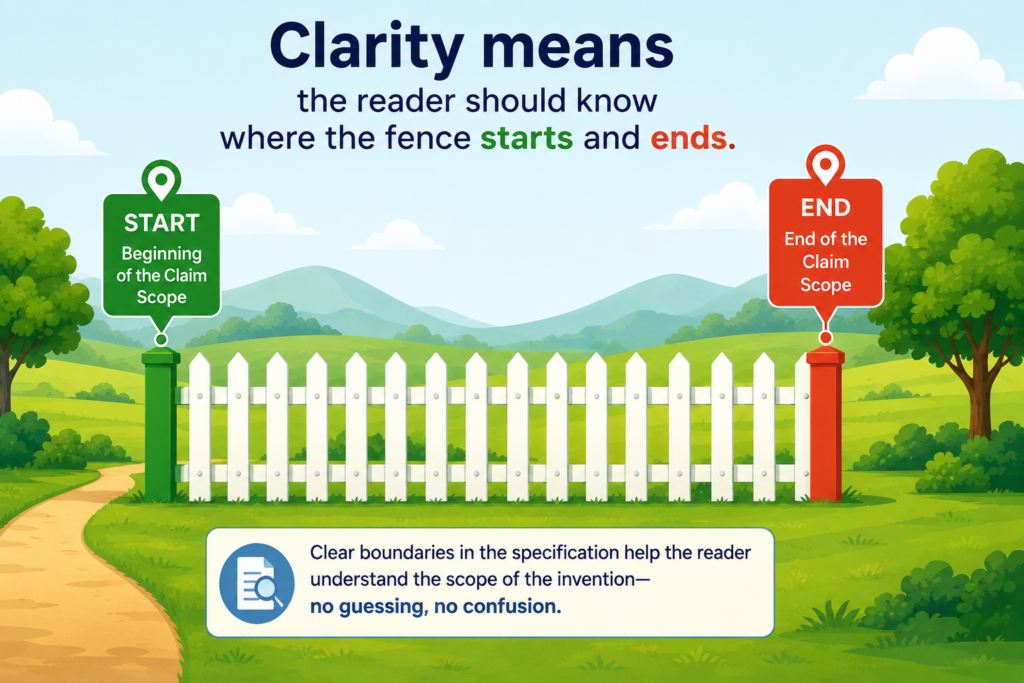
If the fence is blurry, the patent can become hard to use, hard to defend, and easy to attack. This is the heart of clarity under Section 112.
The statute says the patent must end with claims that point out and claim the invention, and the USPTO treats written description, enablement, and claim clarity as separate issues that can each create problems during review.
For AI inventions, clarity is often harder than it looks. The team may use words every day that make sense inside the company.
Words like “risk,” “intent,” “quality,” “context,” “confidence,” “relevance,” “similarity,” “state,” “agent,” “policy,” and “optimization” may feel normal to engineers.
But in a patent claim, these words can become dangerous when they are not tied to clear steps, clear data, or clear system behavior.
A vague claim can sound broad, but broad is not always strong. A strong claim is clear enough that a reader can understand the protected space.
That reader may be a patent examiner, an investor, a buyer, a judge, a competitor, or a future partner. If they have to guess what the words mean, the claim may lose power.
A claim term should not make the reader guess what it controls
The first job of an AI patent review for clarity is to find terms that feel open-ended. This does not mean every term must be narrow. It means each key term should have a clear role.
When the claim says the system “generates a confidence score,” the draft should explain what the confidence score represents.
It should say whether the score reflects model certainty, data quality, match strength, error risk, user intent, device state, or some other value.
The same is true for words like “optimized.” A claim that says the system “optimizes a workflow” can feel impressive, but it may not tell the reader what actually changes.
Does the system reduce time, reduce cost, rank tasks, pick a model, tune a threshold, change a route, select a user prompt, or change a machine command? Without that detail, the term can become soft.
This is where AI review can help in a very practical way. It can scan the claim for words that need anchors. It can compare those words to the description. It can ask whether the draft gives examples.
It can flag terms that are used in different ways across the application. It can show where the same idea has three names, or where one name is used for three different ideas.
In many startup drafts, this happens because different people touched the invention. The founder may describe the business result. The engineer may describe the system flow.
The patent drafter may describe the legal structure. The product team may describe the user value.
Each view is useful, but the final patent needs one clean language system. If the application calls the same thing a “score,” a “rank,” a “signal,” and a “confidence value,” the draft should make the relationship clear.
The best clarity review starts with the words an examiner will question
A good clarity review should not only look for grammar issues. It should look for claim words that could trigger a real objection.
This includes words that lack a clear boundary, words that depend on a person’s opinion, words that name a result without naming the action, and words that refer to something not defined in the draft.
For AI systems, clarity also depends on whether the claim makes clear what is done by the model and what is done by the larger system. This matters because an invention is often not the model alone.
The value may come from how the model is trained, how data is prepared, how outputs are checked, how actions are triggered, how feedback is collected, or how a human user stays in the loop.
A claim that says “a machine learning model identifies an event” may be too thin if the real invention includes sensor filtering, edge processing, threshold adjustment, and a second safety rule.
The model is part of the story, but not the whole story. Clear claims help show the real system.
Clarity also protects the business story behind the patent
Founders often think clarity makes a patent weaker because clear words can feel less dramatic than broad words. In truth, clarity often makes a patent more useful.
A clear claim is easier to explain in a board meeting. It is easier to map to a product. It is easier for an investor to understand. It is easier for an acquirer to value. It is easier for a competitor to respect.
When a patent claim is vague, it can create false comfort. The team may feel protected because the words are big. But when the patent is reviewed closely, the gaps show up.
That is the wrong time to learn that a key term is unclear. It is much better to catch that issue before filing, while the team can still fix the draft.
This is a major reason PowerPatent blends smart software with real attorney oversight. Software can help spot unclear terms, missing definitions, mismatched phrases, and thin claim support.
Attorneys can use judgment to decide what should be tightened, what should stay broad, and what should be explained in the written description. That mix gives founders speed without giving up care. See how the process works here: https://powerpatent.com/how-it-works
Clarity is not about making the invention small. It is about making the invention understandable. When your claims are clear, your patent does not need to shout.
It stands with quiet strength because the reader can see what you built, how it works, and where the protected space begins.
AI review should connect every claim to real disclosure in the patent draft
A strong Section 112 review should not treat the claims and the description as separate worlds. They must work together. The claims define the protected invention.
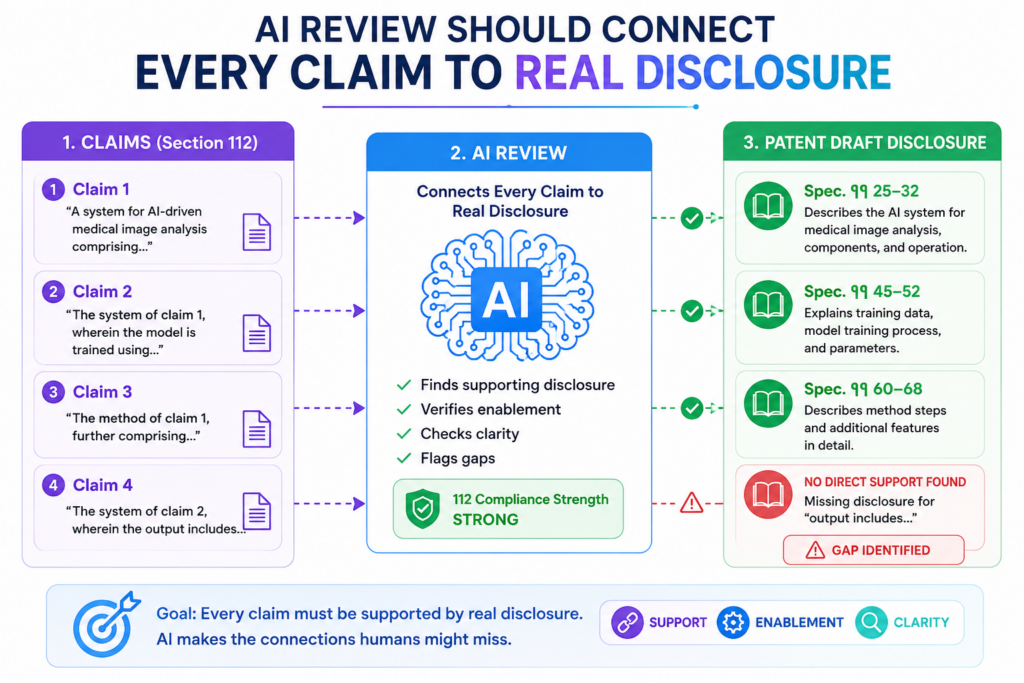
The description teaches and supports that invention. When these two parts drift apart, the patent becomes weak. This can happen even when the technology is excellent.
In AI and software patents, drift is common because claim drafting often happens after the invention has already been described in a more natural way. The draft may explain a “model pipeline,” while the claims talk about “processing units.”
The draft may focus on “feature vectors,” while the claims use “data representations.” The draft may describe a “risk score,” while the claims use “classification output.” These differences are not always wrong, but they must be clear.
The USPTO guidance treats written description and enablement as distinct requirements.
Written description asks whether the application shows the inventor had the claimed invention, while enablement asks whether the application teaches how to make and use it well enough.
A good AI patent review should check both at the claim level, not only at the whole-draft level.
The claim chart should become a stress test, not a paperwork step
A practical way to review support is to walk through each claim phrase and ask where it lives in the draft. This does not need to be a formal chart for the founder to understand the value.
The idea is simple. Every important claim phrase should point back to text, figures, examples, or flow steps in the application.
If the claim says the system “receives training data from a plurality of data sources,” the draft should show those sources.
If the claim says the system “normalizes the training data,” the draft should explain what normalization means in this invention.
If the claim says the system “selects one of multiple models based on context,” the draft should describe the context, the selection logic, and what happens after selection.
The review should also look for claim steps that appear only once in the draft, with no detail. That may be a sign the step was added late.
Late-added claim language can be risky when the original description does not carry it. It may sound like a smart narrowing point, but if the draft does not support it, the team may not be able to rely on it later.
This is especially important for startups that file early. Early filing can be smart, because it helps protect work before a launch, pitch, demo, paper, or customer pilot.
But early filing also means the draft must be built carefully. If the product is still changing, the patent should include enough variations to protect the direction of the work, not only the exact version on the screen today.
The review should find both missing support and silent assumptions
Many Section 112 problems come from silent assumptions. The inventor knows something, so the draft skips it.
The engineer knows why the model output matters, so the draft does not explain it. The founder knows the product only works because of a special data step, but the draft treats that step like background.
AI review can help surface these silent assumptions by asking simple but sharp questions.
What happens before the model runs? What happens after the model gives an output? What makes the result better than a normal system?
What fails if this step is removed? What data is needed? What is optional? What is required? Where does the human user fit? Where does the system act on its own?
These questions matter because patents protect technical choices, not just business goals. A claim that says “improving user engagement” may not carry much weight unless the patent explains the technical mechanism.
But a claim that describes a specific way to select training samples, tune a model, generate a ranked output, and trigger a user interface change may have a clearer foundation.
Claim support should include fallback positions for later review
A patent application is not frozen in a perfect world. During examination, claims may be rejected. Prior art may appear. The examiner may say the claim is too broad.
The attorney may need to amend the claim to make it stronger. At that point, the original draft becomes the toolbox. If the toolbox is empty, the team has fewer options.
This is why support review should look beyond the current claim set. It should ask whether the draft includes useful fallback details.
For AI inventions, fallback details may include different model types, different feature sets, different data sources, different threshold rules, different deployment systems, different user roles, different training methods, and different ways to handle errors.
These details should not be dumped into the patent as random filler. They should be tied to the invention’s real value.
The best fallback positions come from the actual product and engineering work. They come from the choices the team made because the obvious path did not work.
PowerPatent helps founders capture these details before they disappear into Slack threads, code comments, pitch notes, and old diagrams.
The platform helps turn technical input into a cleaner patent story, while real attorneys review the result.
That means the filing can move faster and still give the company stronger options later. Learn more here: https://powerpatent.com/how-it-works
A claim-to-disclosure review is not busywork. It is one of the best ways to find weak spots before they become expensive.
When each claim has a clear home in the draft, the patent feels more solid. It also gives the founder more confidence because the filing is not just broad. It is backed by real teaching.
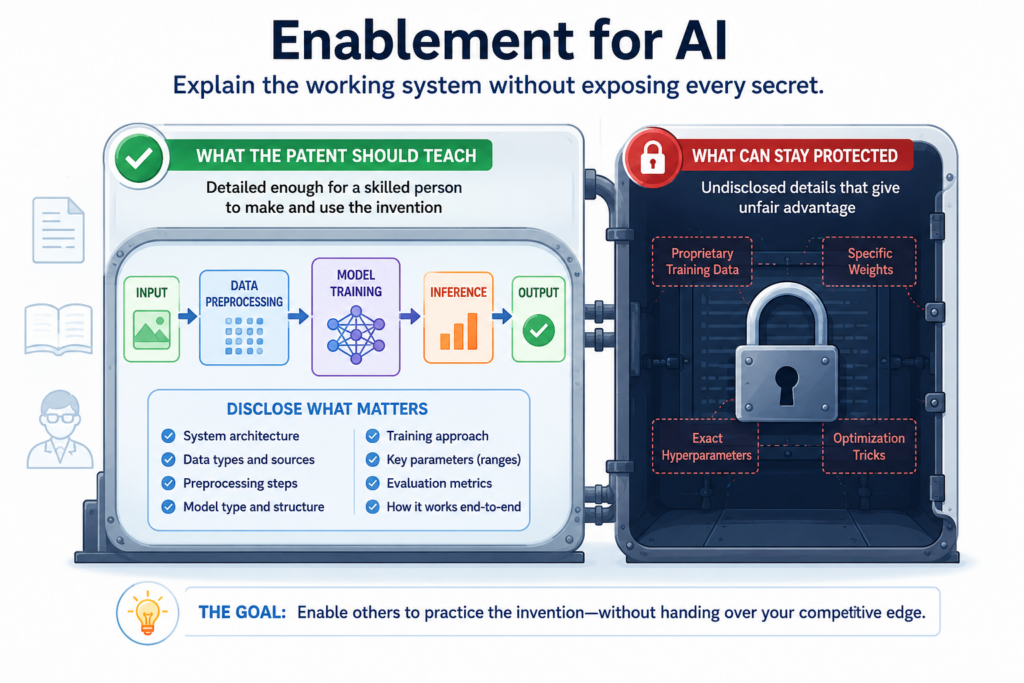
Enablement for AI should explain the working system without exposing every secret
Many founders worry that a strong patent draft will force them to give away too much. That fear is fair.
AI startups often have private data, internal tuning methods, special prompts, model weights, customer workflows, and product tricks they do not want copied.
But enablement does not mean publishing every internal secret. It means teaching the invention well enough that the patent bargain is real.
The key is balance. A weak draft hides too much and becomes hard to defend. A careless draft gives away details that may not be needed.
A strong draft explains the invention at the right level. It teaches the system, the flow, the important choices, and the working examples, while keeping unnecessary private detail out.
The statute requires the specification to describe the invention and the manner and process of making and using it in clear and exact terms so a skilled person can make and use the invention.
For AI inventions, this often means the draft should explain inputs, processing, model behavior, outputs, and use of those outputs. It does not always mean listing every training record, every parameter, or every private business rule.
A good AI patent draft should teach the invention at the right depth
The right depth depends on where the invention lives. If the invention is a new model structure, the draft should explain that structure. If the invention is a training method, the draft should explain the training flow.
If the invention is a data cleaning method, the draft should describe the data problem and the cleaning steps.
If the invention is a way to use model output in a device or workflow, the draft should explain how the output changes that device or workflow.
This sounds simple, but many drafts miss it because they describe the wrong thing. They spend too much time on generic computer parts and too little time on the real technical move.
They describe servers, networks, processors, and memory, but barely explain the data path.
They mention a machine learning model, but do not say why this model is part of a better system. They describe the user interface, but do not explain the decision logic behind it.
AI review should push the draft toward the real invention. It should ask where the technical value comes from. It should separate normal system plumbing from the new idea. It should make sure the patent teaches enough about the part that matters.
For example, a startup may build an AI tool that reviews engineering logs to predict system failure. The invention may not be “using AI to predict failure.” That is too broad and too thin.
The real invention may be a way to convert raw logs into event windows, compare those windows to past failure patterns, assign confidence based on missing signal types, and trigger different alerts based on device state. That is a much stronger story.
The draft should explain enough examples to make the invention feel buildable
Examples are powerful because they make abstract AI ideas concrete. A patent that says “the model processes data” feels thin.
A patent that explains a sample input, a processing flow, a model output, and a system response feels real.
The example does not need to disclose confidential customer data. It can use a safe, general, or made-up sample that still teaches the system.
For AI enablement, examples can show how data is received, cleaned, labeled, embedded, ranked, filtered, compared, scored, or acted upon. They can show how the system handles low confidence.
They can show what happens when the model changes. They can show how feedback improves future results. They can show how edge devices, cloud systems, and user tools work together.
This is where many startup teams have an advantage. They often have real product thinking, real tests, real diagrams, real customer pain, and real edge cases. The patent process should draw from that material.
A founder should not have to start from a blank page. The invention is already inside the work. The job is to pull it out in a way that supports the patent.
Enablement review should separate what must be disclosed from what can stay private
A smart review should help the team decide what to include and what to leave out. Not every technical fact belongs in the patent. Some details may be better kept as trade secrets.
Some details may be too tied to a current product version. Some may not matter to the claimed invention. Other details, however, may be essential. Leaving them out could make the patent thin.
This is where attorney oversight matters. AI tools can flag missing details, thin examples, and vague teaching.
But a patent attorney can help judge whether a detail is needed for support and enablement, whether it should be generalized, whether it should be claimed, and whether it should stay out of the filing.
For founders, this is a control issue. You do not want a process that turns your invention into a black box, and you do not want a process that spills too much. You want a process that helps you protect the right parts.
PowerPatent is built around that idea. It gives teams a faster way to turn technical work into a patent draft, while keeping real attorney review in the loop. You can explore the process here: https://powerpatent.com/how-it-works
Good enablement does not make your patent weaker. It makes your patent more honest, more useful, and harder to dismiss.
It shows that the invention is not just a goal. It is a working system with a clear path from input to result.
Section 112 review should make AI claims easier to amend when prior art appears
No founder wants to think about rejection when filing a patent. But rejection is a normal part of the process. A patent examiner may find older patents, papers, products, or public systems that are close to your idea.
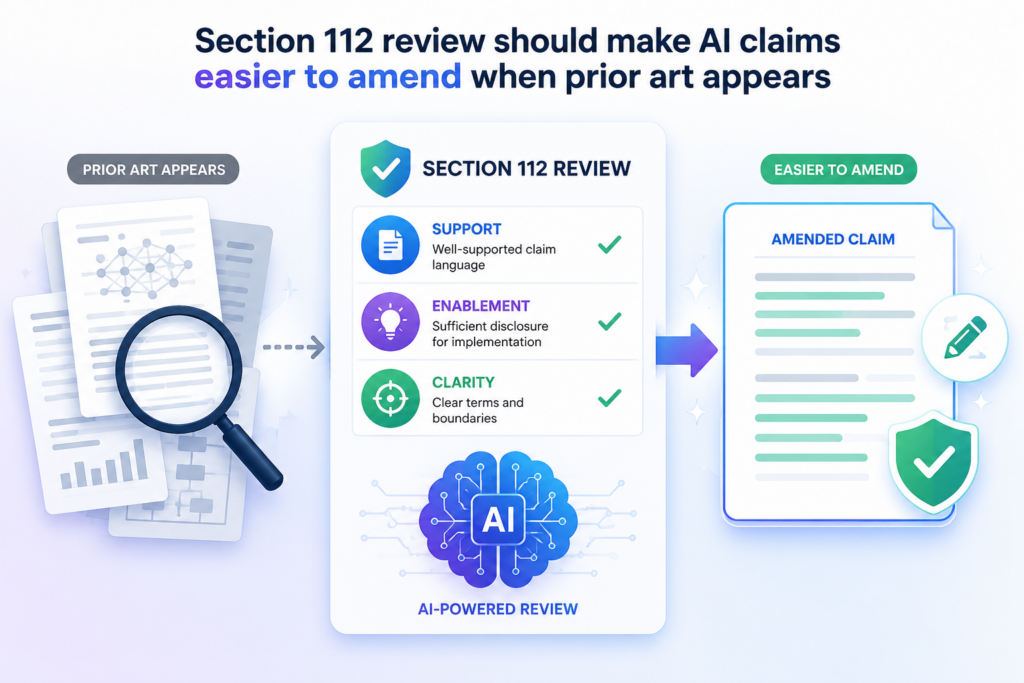
When that happens, your team may need to adjust the claims. The strength of your original draft will decide how much room you have.
This is where Section 112 review becomes a future-proofing step. It does not only help you file a cleaner application. It helps you preserve choices for later.
A draft with strong support, strong enablement, and clear language gives your attorney more ways to respond. A thin draft traps you.
For AI startups, this matters because the field moves fast. New papers appear. Open-source models change.
Product features spread quickly. What feels new today may need sharper framing later. Your patent application should be ready for that.
The best claim amendments come from details already in the draft
When prior art appears, the natural move is to narrow the claim around what makes your invention different. But you can usually only add details that were already supported in the application as filed.
That means the original draft must include enough detail before you know exactly what prior art the examiner will rely on.
This is why a strong draft should include more than one layer of the invention. It should explain the broad system, but also the important technical choices under it. It should show the main workflow, but also the fallback paths.
It should describe the preferred model, but also useful variations. It should explain the core output, but also how that output is used in different settings.
For example, suppose your claim covers an AI system that predicts equipment failure. The examiner finds prior art that also predicts equipment failure.
If your draft only says “use a model to predict failure,” you may have little room to move.
But if your draft explains a special way to build event windows, weight sensor gaps, merge maintenance history, and trigger different responses based on device state, you may have stronger amendment options.
This is not about stuffing the patent with random ideas. It is about giving the application a deep enough base. The best details are the details that came from solving the real problem.
A Section 112 review should test whether each fallback detail is actually usable
Not every detail in a draft is helpful. Some details are too vague. Some are not tied to the claims. Some are mentioned once but never explained.
Some are described as background instead of part of the invention. A good AI review should test whether fallback details are actually usable.
A detail is more useful when it is connected to a clear technical role. If the draft says the system may use “context,” that may not help much unless the draft explains what context means.
If the draft says the system may use “feedback,” the review should ask what feedback is collected, when it is collected, and how it changes the system.
If the draft says the system may use “multiple models,” it should explain why more than one model is used and how selection works.
This matters because future claim amendments need clean support. A vague fallback detail may not save the claim. A clear fallback detail can become the path to allowance.
AI review should help founders protect the invention behind the product, not just the current screen
A startup product changes. The model changes. The user interface changes. The data changes. The pricing changes. The market changes.
If the patent only protects the exact current product screen, it may become stale too fast. But if the patent protects the deeper technical method, it can stay valuable even as the product grows.
Section 112 review helps find that deeper layer. It asks what must remain true even if the user interface changes. It asks what data flow matters even if the model is swapped.
It asks what decision logic matters even if the first market is replaced by a bigger one. It asks what technical idea gives the company its edge.
For many AI companies, the answer is not “we use a model.” The answer is a specific way to collect data, structure it, train on it, filter it, score it, route it, explain it, or act on it. That is the layer the patent should support.
This is also where founders can save time and money. A weak filing may lead to long back-and-forth, expensive fixes, and disappointing claim scope.
A stronger filing can give the attorney better material from the start. It may not avoid every rejection, but it can make the path cleaner.
PowerPatent helps teams do this earlier. Instead of waiting until the patent process becomes slow and painful, founders can use a guided system to capture technical detail while the invention is still fresh.
Real patent attorneys then help shape that material into a filing strategy. That gives founders more speed, more control, and more confidence. See how it works here: https://powerpatent.com/how-it-works
A good patent is not only written for filing day. It is written for the hard moments after filing. It should give your team options when prior art appears, when claims need to change, and when the business needs the patent to hold up.
A founder-friendly AI patent review should turn legal risk into clear engineering tasks
The worst kind of patent feedback is feedback a founder cannot use. A note that says “possible Section 112 issue” may be accurate, but it does not help much by itself. Founders and engineers need plain tasks.
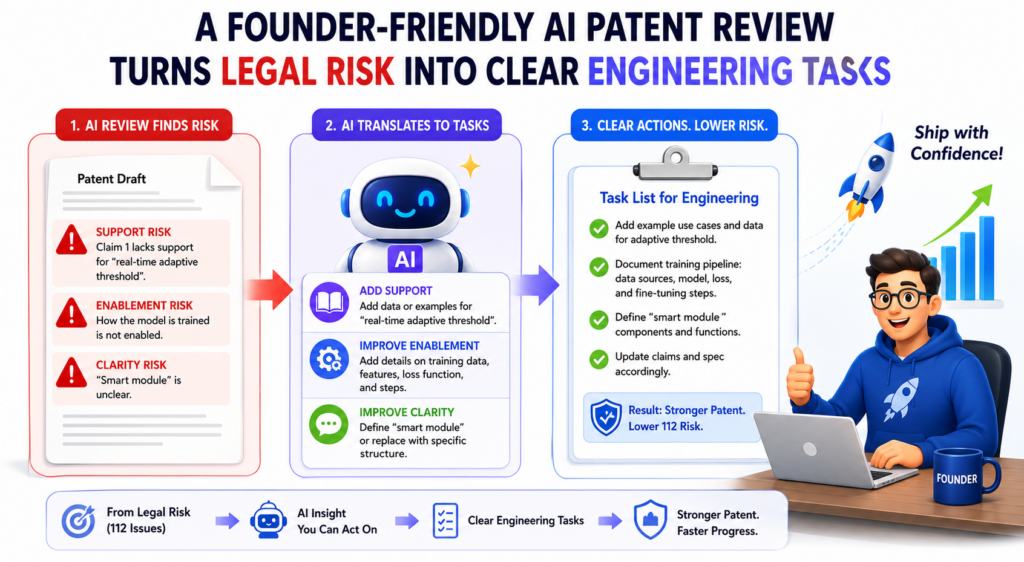
They need to know what is missing, where it belongs, and how to fix it. That is why AI patent review should turn legal risk into clear draft improvements.
This is especially important for deep tech teams. The people who understand the invention best are often the people with the least patience for vague legal comments.
They want to build. They want to ship. They want to know what is needed and why. A good review process respects that.
Section 112 is not just a legal filter. It is a way to check whether the patent tells the invention story well enough. Support asks whether the draft shows the team had the invention.
Enablement asks whether the draft teaches the invention. Clarity asks whether the claims define the invention in words people can understand. Those ideas can be turned into simple, practical work.
The review should show the gap and the fix in plain words
When a claim is not supported, the review should point to the missing detail. It should not simply say “insufficient written description.”
It should say that the claim mentions a model selection step, but the draft does not explain how the model is selected.
It should say that the claim covers real-time processing, but the draft does not explain timing, latency, or streaming data.
It should say that the claim uses a confidence score, but the draft does not define what the score measures.
When enablement is weak, the review should explain what a skilled reader would need. It should ask for the input data, the processing steps, the output format, and the action taken by the system.
It should ask for at least one working example. It should ask what happens when the model is wrong, uncertain, or missing data. It should ask how the system improves over time, if that is part of the invention.
When clarity is weak, the review should name the unclear terms. It should show where a term changes meaning. It should point out when two terms seem to mean the same thing.
It should ask for a clean definition. It should suggest using the same term across the claim and description when the same thing is meant.
This kind of feedback helps engineers respond fast. It turns patent review from a mystery into a workflow.
A useful review should pull answers from the work the team already has
Most founders do not need to invent new details for the patent. They need to collect details they already have. The answer may be in the product spec. It may be in a system diagram.
It may be in a model evaluation note. It may be in a design review. It may be in a demo script. It may be in code comments. It may be in a customer pilot report.
AI patent review can help point the team to the right source. If the draft lacks training detail, the team may need the model notes. If the draft lacks data flow, the team may need the architecture diagram.
If the draft lacks examples, the team may need a sample workflow. If the draft lacks fallback positions, the team may need the product roadmap and engineering tradeoff notes.
This is one of the best ways to make patent work less painful. The patent process should not feel like writing a school paper from scratch. It should feel like shaping the real invention into a clear asset.
The best review process keeps founders moving without skipping attorney judgment
Speed matters for startups. A team may need to file before a demo, investor meeting, launch, partnership talk, public release, or research paper.
Waiting months can create risk. But speed without quality can create a different risk: a patent that looks filed but does not protect enough.
The right answer is not slow legal work or blind automation. The right answer is a better system.
AI can help review the draft quickly, find missing support, flag unclear terms, compare claims to the description, and spot places where enablement is thin.
Attorneys can then apply judgment. They can decide what matters, what to claim, what to describe, what to keep private, and how to shape the filing for the company’s goals.
That combination is what makes PowerPatent different. It is built for founders who want strong IP without old-school delay.
It helps teams turn code, models, product flows, and invention notes into patent-ready material, backed by real patent attorneys.
The result is a process that feels more like modern product work and less like a black box. Start here: https://powerpatent.com/how-it-works
A founder-friendly Section 112 review should leave the team with clearer claims, stronger support, better teaching, and less guesswork.
It should help the company file with more confidence. It should also help the team understand what the patent is really protecting.
That is the point. A patent is not just a document. It is a business tool.
It should help your company protect the hard work behind the product, raise trust with investors, and keep competitors from copying the part that makes your system special.
A good AI patent review makes that tool sharper before it matters most.
AI review should catch claim terms that sound strong but lack a clear base
A patent claim can look powerful when it uses wide words. But wide words can become weak when the draft does not explain them.
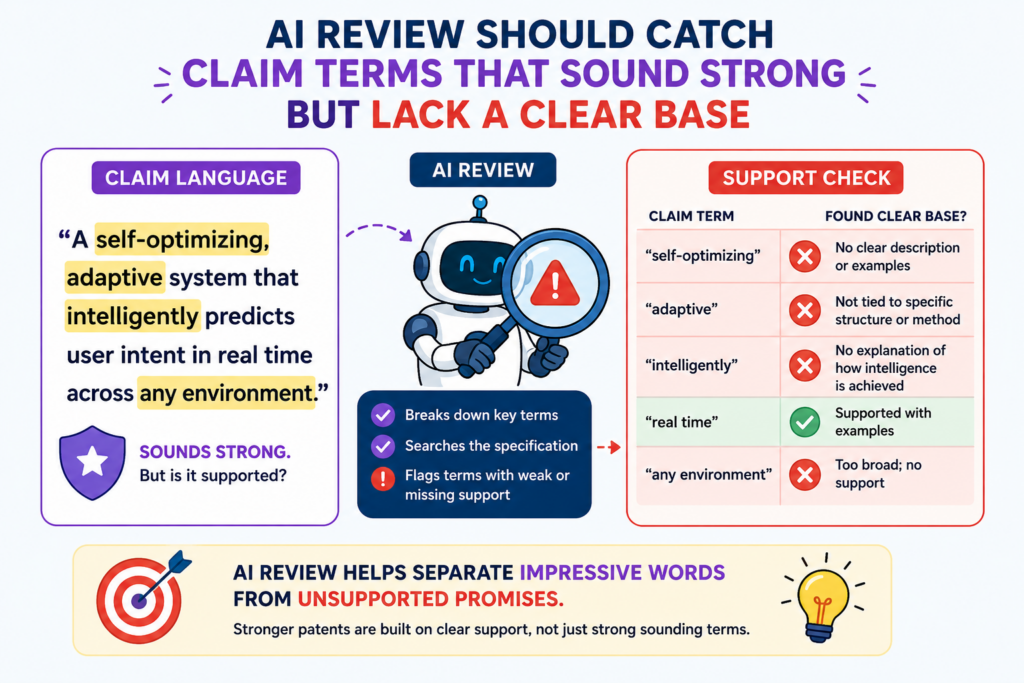
This is a common problem in AI patent work because teams often use words that make sense inside the company but are not clear to an outside reader.
The claim should use words the draft can carry with confidence
A claim may say the system creates an “adaptive score,” a “smart profile,” a “risk state,” or a “context signal.” Those words may be useful, but only if the draft explains what they mean.
The review should ask whether each key term has a clear job in the invention. It should also ask whether the term is tied to data, steps, outputs, or system actions.
For example, “context signal” may be too loose by itself. It becomes stronger when the draft explains that the signal may include device state, user history, sensor quality, time, location, recent events, or model confidence.
It becomes even stronger when the draft explains how that signal changes what the system does next.
Clear claim terms help your patent survive real pressure later
A patent is often tested long after it is filed. An investor may read it during diligence. A buyer may review it before a deal.
A competitor may study it before launching a similar product. A patent examiner may question the scope. In each case, clear words help.
AI review should not make the claim small just to make it safe. It should make the claim firm. The goal is to keep useful scope while removing fog.
A claim that is clear, supported, and tied to real system behavior often gives a founder more value than a claim that sounds broad but cannot stand up.
This is why PowerPatent helps teams turn technical work into stronger patent material before filing.
Smart review can flag weak terms early, while real attorney oversight helps decide how to fix them without giving away more than needed. See how it works here: https://powerpatent.com/how-it-works
AI review should find missing support before the examiner does
A founder should not learn about missing support for the first time in an office action. By then, the team may have fewer choices.
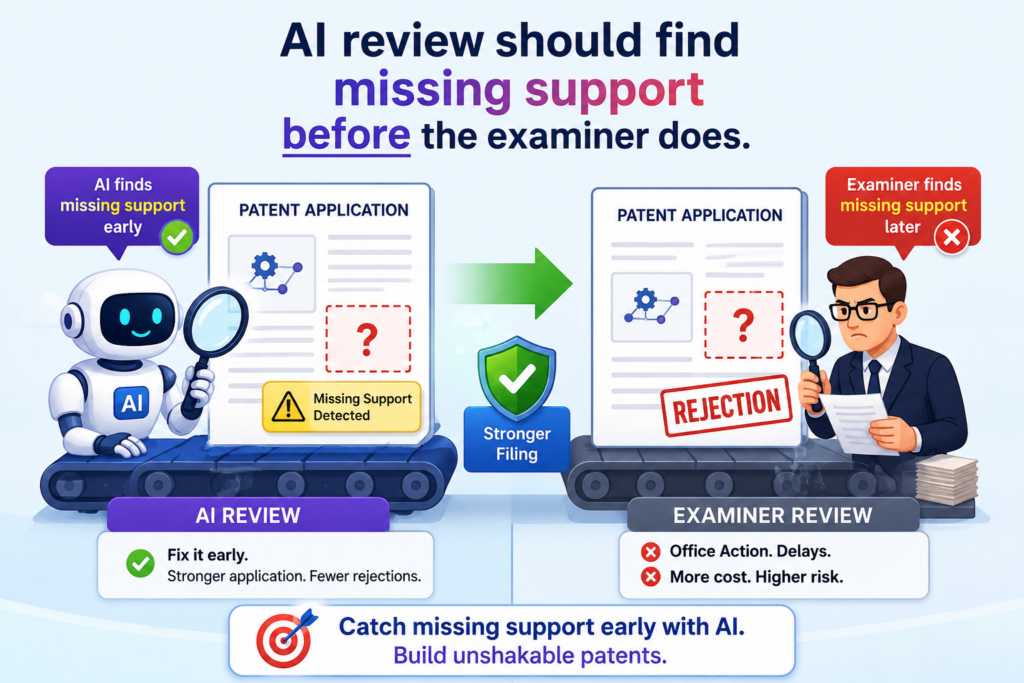
The better path is to find those gaps before filing, while the draft can still be improved.
Every important claim phrase should have a home in the written draft
A support review should read the claim like a map. Each important phrase should point to a clear place in the patent description. If the claim says the system uses a training filter, the draft should explain that filter.
If the claim says the system updates a model based on user feedback, the draft should explain what feedback is used and how the model changes.
If the claim says the system sends a control command, the draft should show when and why that command is sent.
This is where AI can help move faster. It can compare claim terms against the draft and flag phrases that appear weak, unclear, or unsupported.
It can also find terms that appear in the claim but do not appear in the description at all. That does not always mean the claim is wrong, but it is a sign that the draft needs closer review.
Missing support is often a sign that the real invention is trapped in someone’s head
Many support problems happen because the team knows the invention too well. The founder assumes the flow is obvious.
The engineer assumes the model behavior is clear. The product lead assumes the user action is easy to infer. But a patent cannot depend on silent knowledge.
A better draft pulls that knowledge into the application. It explains the real steps. It shows useful examples. It gives the reader enough detail to understand what the team actually built.
This does not mean adding long filler. It means adding the right detail in the right place. A few clear paragraphs about data flow, model output, feedback, or system action can make a major difference.
PowerPatent helps founders collect these details from code, product notes, diagrams, and invention records, then shape them with attorney review. Start here: https://powerpatent.com/how-it-works
Enablement gets stronger when the draft shows a real working path
Enablement is not about sounding technical. It is about teaching the invention well enough. For AI systems, that means the draft should show a working path from input to result.
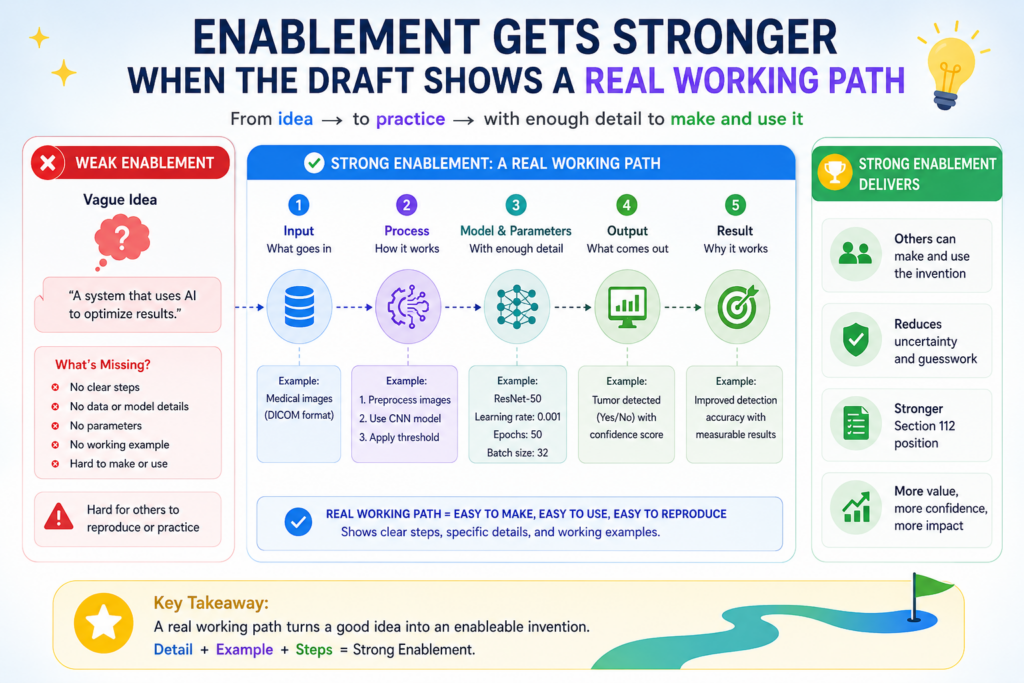
The reader should be able to understand how the system gets data, processes it, uses a model, creates an output, and acts on that output.
The draft should explain what happens before, during, and after the model
Many weak AI patent drafts focus only on the model. They say the system trains a model or applies a model. But the real invention often lives around the model.
It may live in how the data is cleaned. It may live in how the input is split into useful parts. It may live in how the model output is checked, ranked, routed, or shown to a user.
A stronger draft explains the full chain. It does not need to include private code or every model weight. It should explain the steps that matter.
If the invention improves safety, the draft should explain how the system detects risk and what action follows.
If the invention improves search, the draft should explain how results are ranked and refined. If the invention improves automation, the draft should explain how the output changes a real process.
A simple example can do more than pages of vague language
One strong example can make an AI invention much easier to understand. The example can show a sample input, a processing step, a model result, and a system response.
It can use general data instead of private customer data. The point is not to reveal secrets. The point is to teach the invention clearly.
For instance, a draft for an AI quality control tool could explain how an image is received, how defects are detected, how a confidence score is made, how low-confidence cases are sent for human review, and how confirmed results improve later detection. That kind of teaching makes the system feel real.
PowerPatent helps teams add this type of useful detail without turning the patent into a messy technical dump.
The platform helps organize the invention, and attorney review helps keep the filing focused. Learn more here: https://powerpatent.com/how-it-works
Clarity improves when the same idea keeps the same name
Clear patent writing is not fancy writing. It is steady writing.
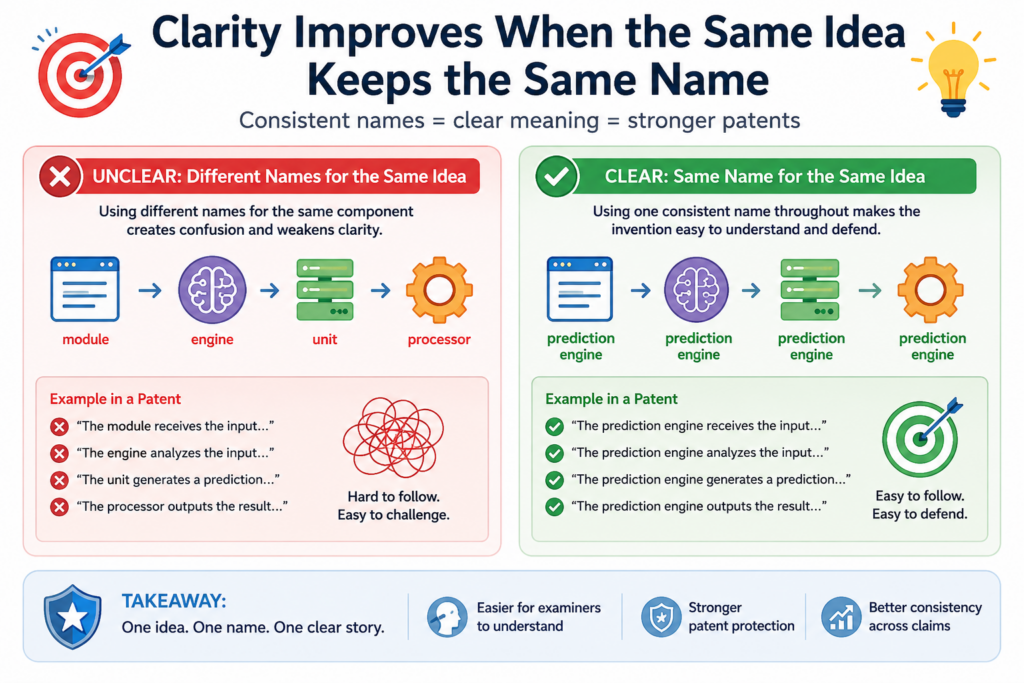
When one part has one name, that name should stay the same unless there is a real reason to change it. This sounds small, but it can make a big difference in AI patents.
Mixed names can make a simple invention look confusing
A draft may call one value a “score” in one place, a “rank” in another place, and a “confidence output” somewhere else.
Sometimes those terms mean different things. Sometimes they mean the same thing. If the draft does not explain the difference, the reader has to guess.
That guessing can hurt the patent. It may create confusion about what the claim covers. It may make the examiner ask for clarity. It may make later readers question whether the claim matches the description.
AI review can catch these naming problems. It can find when the same term is used in different ways.
It can find when different terms seem to point to the same part. It can also flag terms that appear in drawings, examples, and claims with no clear link between them.
A clean word system makes the patent easier to defend and easier to value
A patent is not only read by patent examiners. It may also be read by investors, buyers, partners, and competitors.
A clean word system helps all of them understand the invention faster.
This is especially useful for startups. You do not want your patent to feel like a puzzle. You want it to show that your team built something real and that the protected space is clear. Strong naming helps with that.
The best fix is often simple. Pick the right term. Define it in plain words. Use it in the claims and description with care. Explain related terms only when they truly mean something different.
PowerPatent helps teams make this kind of cleanup earlier, so the filing feels more polished before attorney review is complete. See the process here: https://powerpatent.com/how-it-works
A strong Section 112 review should make the attorney’s work sharper
AI review is not a replacement for a patent attorney. It is a way to make attorney review better.
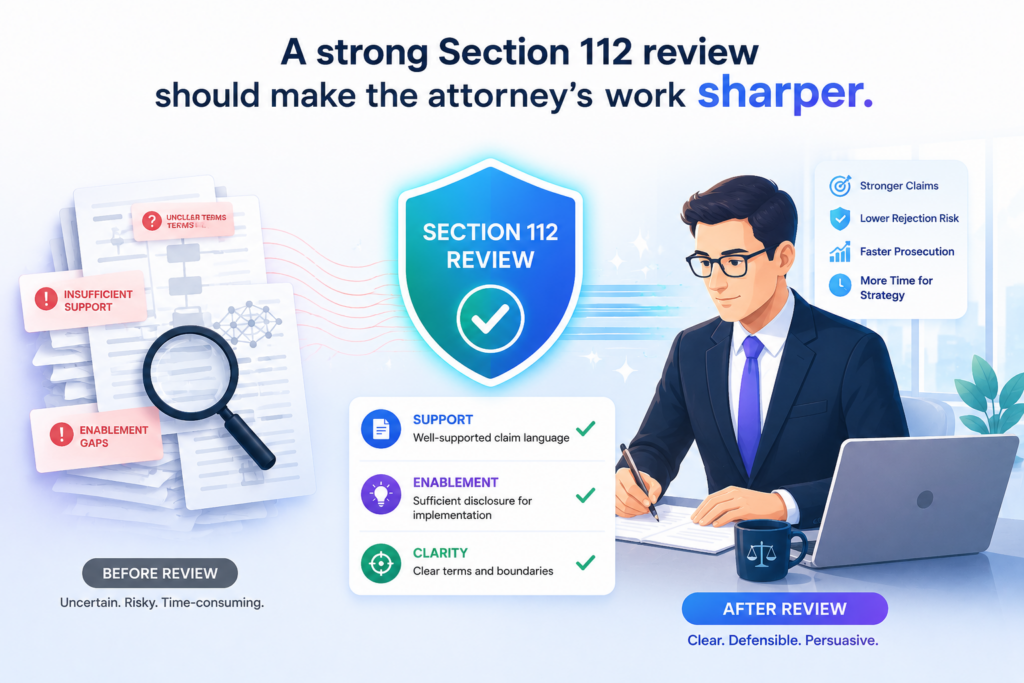
When the software finds gaps early, the attorney can spend more time on strategy, claim scope, filing choices, and risk. That is better for the founder and better for the final patent.
The best process gives the attorney cleaner material to judge
Patent attorneys need good invention detail. They need to know what was built, what problem it solves, why it works, and what makes it different.
If the first draft is vague, the attorney has to spend time digging for basic facts. If the draft is already organized, the attorney can focus on higher-value work.
This is where AI review can help a lot. It can flag missing support, thin teaching, unclear terms, mixed naming, and weak examples.
It can help the team add technical facts before the attorney does the deeper review. That makes the whole process faster and more useful.
For founders, this means less back-and-forth and less confusion. The team can see what is missing in plain words.
Engineers can answer targeted questions. Product leaders can add real use cases. The attorney can then shape the material into a stronger application.
Better inputs lead to better claims and fewer painful surprises
A patent filing is only as strong as the material behind it. If the invention details are thin, the claims may be thin.
If the examples are vague, the claim support may be weak. If the terms are unclear, the review process may slow down later.
A strong Section 112 review helps fix these problems early. It turns legal risk into clear action. It helps the team file with more confidence. It also helps protect the work that makes the startup valuable.
That is the reason PowerPatent combines smart software with real attorney oversight. Founders get speed, structure, and control, while still getting human legal judgment where it matters.
You can see how PowerPatent helps technical teams file better patents faster here: https://powerpatent.com/how-it-works
Conclusion
AI patent review is not just a faster way to check a draft. It is a smarter way to protect the real work behind your invention. When support, enablement, and clarity are reviewed early, your patent can become stronger, cleaner, and easier to defend.
For AI founders, this means fewer gaps, fewer delays, and more confidence before filing. The goal is simple: show what you built, teach how it works, and claim it in clear words. PowerPatent helps you do that with smart software and real attorney oversight. See how it works here: https://powerpatent.com/how-it-works
Leave a Reply