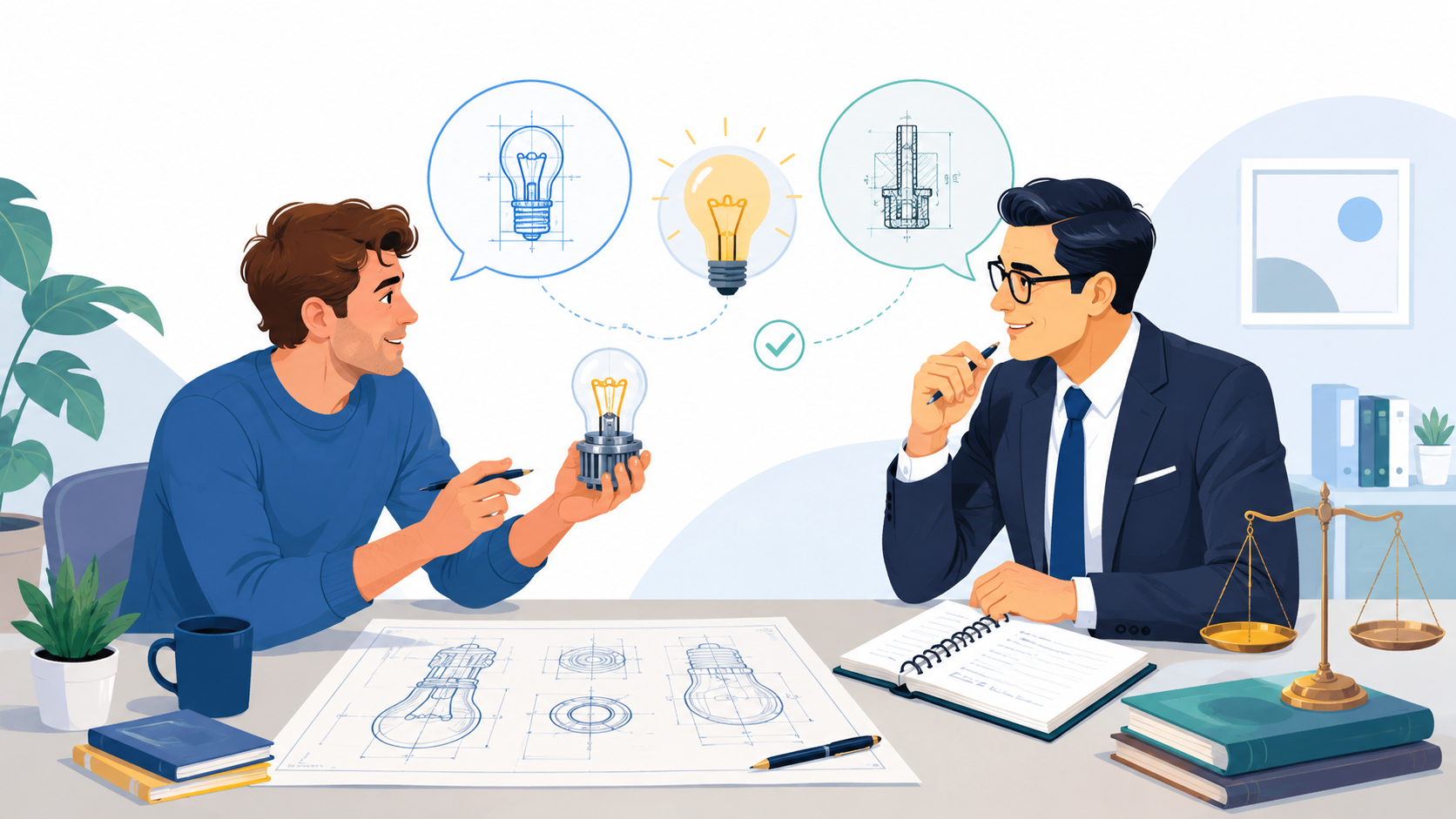
A strong patent does not start with legal words. It starts with clear talk. Most problems between inventors and patent attorneys happen for one simple reason: the inventor sees the invention in their head, but the attorney has to turn that idea into words that protect it. When the two sides do not fully understand each other, good ideas get missed, drafts feel off, claims become too narrow, and the whole process takes longer than it should.
Start With the Real Invention, Not the Patent Form
A better patent conversation starts before the first draft. It starts when the inventor explains what was actually built, why it matters, and what changed because of it. This sounds simple, but it is where many patent projects go wrong.
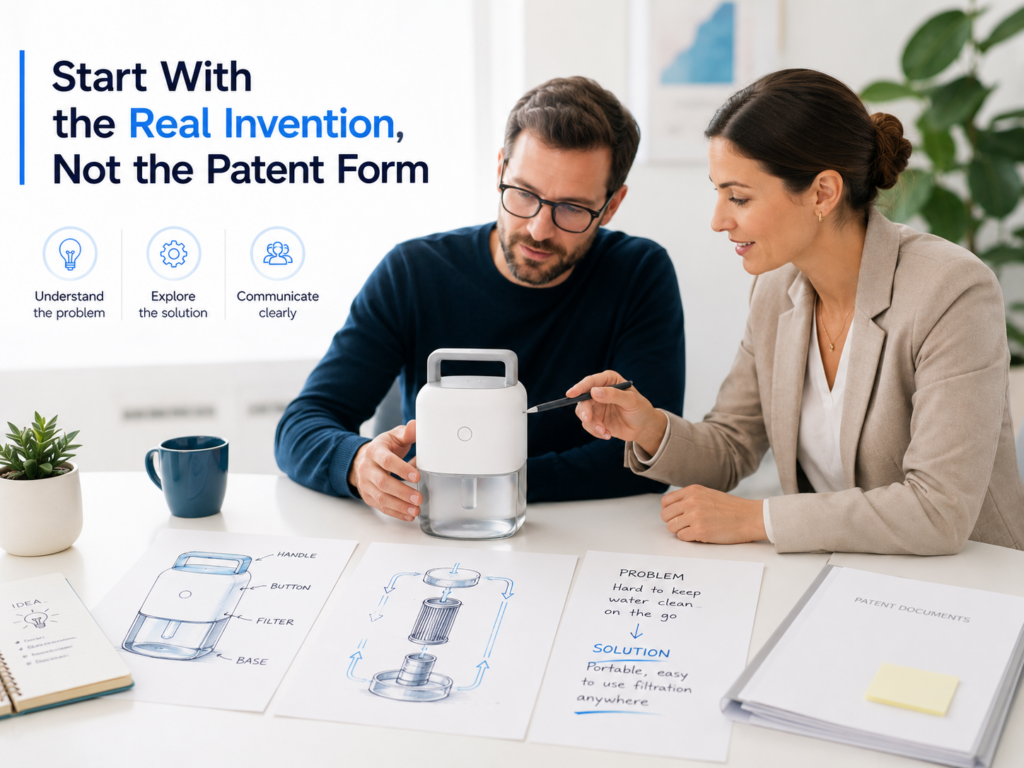
Many inventors try to sound “patent ready” too early. They write long invention notes that sound formal but hide the real idea.
They use broad words like “system,” “method,” “platform,” and “engine,” but they do not explain the actual change they made. Patent attorneys then have to guess what is new, what is important, and what should be protected.
That guessing creates risk.
The United States Patent and Trademark Office explains that a patent application may need a written description, claims, drawings, and other parts, and many inventors work with a patent attorney or agent to draft them.
That means the attorney’s work depends heavily on the quality of the information the inventor shares at the start.
So the first goal is not to “write like a lawyer.” The first goal is to tell the truth about the invention in a clear way.
Explain What Changed in the World Because of the Invention
A patent attorney needs to know what is different now that your invention exists. That difference may be a new way to process data.
It may be a faster workflow. It may be a better model pipeline. It may be a new chip layout, a new sensor setup, a new robotic motion path, or a new way to reduce errors in a system.
The best inventor-attorney conversations begin with change.
You can say, “Before this invention, the system had to do X. Now it can do Y.” That single frame helps the attorney find the heart of the invention.
It also makes the rest of the conversation much easier because it creates a clear before-and-after story.
Describe the Old Way Before You Describe Your Way
Before you explain your invention, explain the old pain. Tell your attorney what people used before, why it was slow, why it failed, why it cost too much, or why it could not scale.
This does not need to be a full market report. It only needs to be clear enough to show the problem.
For example, instead of saying, “We invented an AI-based scheduling system,” you might say, “Most scheduling tools treat each task as fixed. Our system predicts when a task will slip and moves related tasks before the delay spreads.”
That is far more useful. It shows the old way. It shows the new way. It gives the attorney a path to ask better questions.
This is also where founders can save serious time. If the attorney understands the pain early, they do not need five calls to figure out why the invention matters. They can move faster from rough idea to strong patent draft.
At PowerPatent, this is one reason we focus on structured invention capture. The goal is to help founders explain the invention in a way that gives the attorney useful material from the start. You can see how the process works here: https://powerpatent.com/how-it-works
Do Not Hide the Simple Version of the Idea
Many technical founders make the same mistake. They think the invention must sound complex to be valuable.
So they start with the hardest version of the idea. They describe every module, every condition, every data path, and every edge case.
That can be useful later. But it is not the best starting point.
Your attorney first needs the simple version. What does the invention do? What problem does it solve? What makes it different? What parts are required? What parts are optional? What would a copycat likely copy?
Once those answers are clear, the deeper technical details become much easier to place.
Use Plain Words Before Technical Words
Plain words do not make your invention weaker. They make it easier to protect.
If your invention is about reducing power use in a wearable device, say that first. Then explain the sensor logic, signal thresholds, device states, and control rules.
If your invention improves model training, say what gets better first. Then explain the data cleaning step, training loop, feature selection, feedback layer, or model update path.
The plain version gives the attorney a map. The technical version fills in the map.
A useful way to think about this is simple: your attorney cannot protect what they do not understand. And they cannot understand what is buried under unclear words.
Separate the Invention From the Product
This is one of the most important communication habits for founders.
Your product may have many features. Your invention may only be one part of the product. If you mix them together, the attorney may spend too much time on the full product and not enough time on the protectable idea.
For example, a startup may have a health app with user profiles, reminders, dashboards, alerts, and machine learning.
But the invention may be a specific way of detecting a risk pattern from noisy sensor data. The app is the product. The detection method may be the invention.
That difference matters.
Tell the Attorney What You Would Still Keep If the Product Changed
A strong way to find the invention is to ask: “If we changed the user interface, the brand, the device, or the customer, what part would still be valuable?”
That answer often points to the real invention.
Maybe the valuable part is not the screen. It is the back-end logic. Maybe it is not the robot arm. It is the way the robot decides where to move next. Maybe it is not the app. It is the way the app cleans, ranks, and acts on data.
When you explain that to your attorney, the conversation becomes much more strategic. Now you are not just filing paperwork. You are helping build a moat around what makes the company hard to copy.
Give the Attorney the Business Reason Behind the Patent
A patent attorney can draft better when they know the business goal. This does not mean they need your full pitch deck or your private investor plan. But they do need context.
Are you filing because you are about to raise money? Are you trying to protect a core algorithm? Are you building a patent wall around a hardware platform?
Are you trying to stop larger players from copying your approach? Are you filing before a product launch, demo day, publication, or customer pilot?
These facts change the conversation.
Explain the Risk You Care About Most
Some patents are meant to protect a core product. Some support fundraising. Some protect a research path.
Some block direct copying. Some create future licensing options. Some give a startup more leverage in talks with partners or acquirers.
Your attorney should know which risk matters most.
For example, if you are worried that a large company will copy your workflow after seeing a demo, say that clearly.
If you are worried that a competitor will patent around you, say that too. If your main goal is to preserve rights before public disclosure, that changes timing.
The USPTO notes that the patent process includes steps such as deciding whether a patent is right, searching for similar inventions, applying, working with an examiner, and maintaining a patent.
That process has many decision points, so clear business context helps your attorney guide you with less wasted motion.
Build a Shared Story Before Drafting Begins
The best patent teams do not jump straight into drafting. They first agree on the story of the invention.
That story does not need to be fancy. It needs to answer a few core questions in plain words. What problem existed? What did the inventor build? Why is it better?
What are the key parts? What parts can change while the idea stays the same? What should a competitor not be able to copy?
When the inventor and attorney agree on that story, the draft becomes easier to review. The inventor can look at the patent and ask, “Does this still match the story?” The attorney can look at each claim and ask, “Does this protect the story without being too narrow?”
Use the First Call to Find the Center of Gravity
A strong first call should not be a random tour of the product. It should find the center of gravity. That means the main idea that holds the invention together.
This is where the attorney should ask direct questions. What is the most important step? What data matters most? What part cannot be removed? What part gives the best result? What would a competitor copy first? What did the team try that did not work?
Inventors should answer in simple, honest terms. The goal is not to impress the attorney. The goal is to equip the attorney.
This is why better tooling helps. When founders can upload notes, diagrams, examples, and technical details in a guided way, the attorney can spend less time hunting for the idea and more time shaping it into protection.
PowerPatent combines smart software with real attorney review so this handoff is smoother from the start. See the workflow here: https://powerpatent.com/how-it-works
Make the Invention Easy to Repeat in Conversation
If you cannot explain the invention in a few clear sentences, the patent process will feel harder than it should.
This does not mean the invention is simple. It means the core message is clear.
A good explanation might sound like this: “Our system reduces false alerts in factory sensors by comparing live signal patterns against machine-specific behavior profiles. It updates those profiles over time, so the alert rules change as the machine ages.”
That gives the attorney a strong base. It shows the problem, the solution, and the likely area of novelty.
Create a Shared Short Description
Inventor and attorney should agree on a short description early. This description is not a final claim. It is not legal text. It is the shared plain-English version of the invention.
This short description helps everyone stay aligned. It helps the founder explain the invention to the attorney.
It helps the attorney explain the draft back to the founder. It helps the team review whether the patent still covers the right thing.
Without this shared description, every review call can drift. One person may think the invention is the data pipeline.
Another may think it is the user flow. Another may think it is the hardware setup. That drift causes slow reviews and weak drafts.
Clear talk prevents that.
Prepare the Right Material Before the First Attorney Call
Great communication starts before anyone gets on a call. When an inventor shows up with scattered thoughts, the attorney has to spend the meeting pulling basic facts out of the conversation. That wastes time. It also makes it easier for key details to get missed.
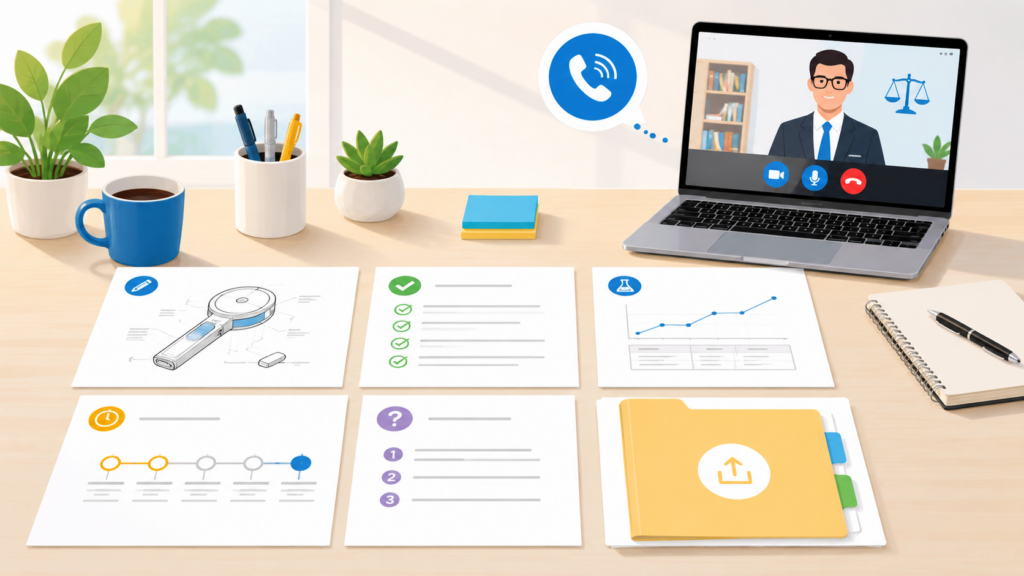
The better move is to prepare a simple invention packet before the first real discussion. This does not need to be perfect. It does not need to sound legal. It just needs to show what the invention is, how it works, and why it matters.
Think of this packet as the bridge between your brain and the patent draft. The clearer the bridge, the faster your attorney can cross it.
Share the Problem in the Same Way a User Would Feel It
Start with the pain. Not the market size. Not the company vision. Not a long history of the field. Just the pain.
What was slow? What broke? What was too costly? What was hard to measure? What made users angry? What made the system fail? What forced engineers to build a workaround?
A patent attorney needs this because the problem gives shape to the invention. Without the problem, the invention can sound like a random feature. With the problem, the invention starts to look like a real technical answer.
For example, “We built a smart routing tool” is too thin. “Delivery routes kept failing when traffic changed after the route was already assigned, so we built a system that changes the route plan based on driver location, package priority, and live delay risk” is much stronger.
That gives the attorney something useful to work with. It shows a real need. It shows what changed. It also points to the parts of the system that may deserve protection.
Keep the First Version Rough but Clear
Many inventors delay sending material because they want it to be polished. That is a mistake. Your attorney does not need a perfect memo. Your attorney needs raw truth.
A rough diagram, a short video, a marked-up screenshot, or a few plain notes can be more useful than a long formal document. The point is to help the attorney see the invention fast.
If the invention is software, show the data flow. If it is hardware, show the parts and how they connect. If it is AI, show what goes in, what happens in the middle, and what comes out. If it is a process, show the steps from start to finish.
Simple beats fancy here. Clear beats complete when the process is just starting.
Bring Examples That Show the Invention in Action
One of the best ways to improve communication is to bring examples. Do not only explain what the system can do. Show one real case.
A good example lets the attorney see how the invention behaves. It also reveals details you may forget to mention. Many important patent details appear only when you walk through a real use case.
For example, a founder might say, “Our system ranks alerts.” That is vague. But when they show a real alert flow, the attorney may learn that the system first filters weak signals, then groups related signals, then scores them based on time, source trust, and user history. That is far more useful.
Examples turn vague ideas into working inventions.
Show a Before-and-After Result
A before-and-after example is even better. Show what happened without the invention, then show what happens with it.
Maybe the old system missed defects. Your system catches them earlier. Maybe the old workflow needed a human review step. Your workflow removes it. Maybe the old model drifted over time. Your model updates itself based on fresh data.
This kind of example helps the attorney understand the gain. It also helps them ask sharper questions. They may ask what part creates the better result, what parts are required, and what other versions could work.
That is exactly the kind of discussion that leads to stronger patent coverage.
Explain What Failed Before You Found the Working Version
Inventors often skip the failed attempts. They want to focus on the final answer. But failed attempts can be very helpful.
When you tell your attorney what did not work, you help them understand why the final design matters. You also help them see the hard choices behind the invention.
Maybe you tried fixed rules before using adaptive rules. Maybe you tried one sensor before combining many. Maybe you tried a standard model before building a special training loop. Maybe you tried a simple threshold before using a time-based pattern.
These details can show that the invention was not obvious from the start. They also help your attorney understand the real engineering work that went into it.
Do Not Clean Up the Story Too Much
A clean story is easy to read, but a too-clean story can hide the best details.
Your attorney should know the messy path. They should know where the team got stuck. They should know what surprise led to the final design. They should know what changed after testing.
This is not about making the invention sound harder than it is. It is about showing the real path from problem to solution.
A strong patent conversation is not a sales pitch. It is an honest build story.
Share the Parts That May Change Later
Startups move fast. The first version of your product may not be the version you sell next year. That means your patent communication should not focus only on today’s exact build.
Tell your attorney which parts are likely to change.
Maybe the model type may change. Maybe the device may use a different sensor. Maybe the cloud system may move partly to the edge. Maybe the customer workflow may change. Maybe the mobile app may later become an API.
This matters because the attorney can think about broader ways to describe the invention. The goal is not only to protect what you built today. The goal is to protect the smart idea under it.
Separate Fixed Parts From Flexible Parts
Some parts of the invention may be required. Other parts may be optional. Your attorney needs to know the difference.
If a certain sensor is required, say so. If any sensor could work, say that too. If a model must be trained in a specific way, explain why. If several training methods could work, explain the range.
This helps the attorney avoid making the patent too narrow by accident.
Many weak patent drafts happen because one version of the product gets treated like the whole invention.
A founder says, “We used a camera,” and the draft starts to sound like the invention requires a camera. But maybe radar, lidar, or another input could also work. That difference matters.
Use a Tool That Helps You Capture the Invention Cleanly
Most inventors are not trained to explain inventions for patents. That is normal. It is also why the process should not rely on a blank document and a long email thread.
A better system guides the inventor through the right questions. It helps collect examples, diagrams, technical notes, and product context in one place. Then a real attorney can review the material with less confusion and more focus.
That is the kind of workflow PowerPatent was built for. It helps founders turn rough invention details into a clearer patent process, with smart software and real attorney oversight working together. You can explore the process here: https://powerpatent.com/how-it-works
Give the Attorney a Strong Starting Point
When the attorney starts with clear material, the entire project gets better.
The first call becomes deeper. The draft becomes more focused. The review takes less time. The inventor feels more in control. The attorney can spend less energy decoding and more energy protecting.
That is the real value of preparation. It does not slow the process down. It speeds it up.
Speak in Layers So the Attorney Can See the Full Invention
Inventors often explain too much at once. They jump from the big idea to the deepest technical detail, then back to the business use case, then into a future version, then into a product roadmap.

The attorney may understand parts of it, but the full picture can become hard to follow.
A better way is to speak in layers.
Start with the simple idea. Then explain the main parts. Then explain how the parts work together. Then explain the deeper technical choices. Then explain other versions. This gives the attorney a clean path from simple to complex.
Good communication is not about saying less. It is about putting each detail in the right place.
Start With the One-Sentence Core
Every invention should have a plain core sentence. This sentence does not need to cover every detail. It only needs to capture the main idea.
For example, “Our system predicts when a machine is likely to fail by comparing live sensor data to a changing profile of that specific machine.”
That sentence is not a full patent claim. It is a starting point. It tells the attorney what the invention does, what type of data it uses, and what makes it more specific than a basic alert system.
Once this sentence is clear, the attorney can ask better questions. What sensors are used? How is the profile made? How does it change? What counts as a failure risk? What happens after the risk is found?
The one-sentence core creates order.
Make Sure the Sentence Names the Real Action
A weak core sentence often hides the action. It says, “Our platform improves decisions using AI.” That does not tell the attorney enough.
A stronger sentence names the action. It says, “Our system scores loan risk by comparing a borrower’s live cash flow patterns against similar past accounts and changing the score when new payment behavior appears.”
Now the attorney can see the movement of the invention. Data is compared. A score changes. New behavior affects the result. That is much easier to discuss.
The core sentence should not sound like marketing. It should sound like a clear explanation from one smart person to another.
Move From the Big Picture to the Main Parts
After the core sentence, explain the main parts of the invention. Keep this plain. You are not trying to write the patent. You are helping the attorney build a mental model.
For a software invention, the main parts might include the input data, the processing logic, the decision layer, and the output.
For a hardware invention, they might include the key components, how they connect, and what happens when the device is used. For a biotech or materials invention, they might include the starting material, the change made, and the result.
The goal is to help the attorney see the invention as a working system.
Give Each Part a Job
Do not only name the parts. Explain what each part does.
A “data module” is not clear. A “data module that removes duplicate sensor readings before risk scoring” is clear. A “control unit” is not enough. A “control unit that changes motor speed when vibration crosses a moving limit” is better.
Jobs matter because patents often turn on what the parts do together. The attorney needs to know the role of each part so they can decide what to protect.
When every part has a job, the invention becomes easier to draft and easier to review.
Explain the Flow Like a Story
Once the attorney knows the parts, walk through the flow. This is where many inventors become too abstract. They talk about architecture instead of action.
A better approach is to tell the story of one run.
What happens first? What happens next? What does the system check? What choice does it make? What changes because of that choice? What output is created? What does the user, machine, model, or device do after that?
This gives the attorney a real path through the invention.
Use One Real Input and One Real Output
A real input and output make the flow concrete.
For example, if your system handles medical sensor data, use a sample input such as heart rate, motion, temperature, and time.
Then explain what the system does with those inputs and what output it creates. If your system handles code review, show a sample code change and explain how the system finds risk.
You do not need to share private customer data. You can use a clean example. The point is to give the attorney something they can trace.
When an attorney can trace one full run, they can often see missing details in the draft before they become problems.
Add the Deep Details Only After the Flow Is Clear
Deep technical details are very important. But they work best after the attorney understands the basic flow.
Once the flow is clear, you can explain the harder parts. You can talk about model weights, signal noise, memory limits, timing windows, device states, data labels, edge behavior, calibration, control rules, error handling, or whatever matters for your invention.
Now those details have a place to land.
Tell the Attorney Which Details Create the Advantage
Not every technical detail deserves the same attention. Some details are just normal build choices. Others are the reason the invention works.
Tell your attorney which is which.
Maybe the database choice is not important, but the way the data is grouped is key. Maybe the user interface is not important, but the timing of the alert is key. Maybe the model type can change, but the feedback loop is key.
This helps the attorney avoid protecting the wrong thing. It also helps them write a draft that keeps the focus on the real edge.
Use Future Versions to Expand the Conversation
A patent discussion should not only cover the current build. It should also cover likely future versions.
This does not mean you should invent fake features. It means you should think about reasonable ways the same core idea could be used.
Could the same method work in another industry? Could it run on another device? Could it use another type of data? Could the output trigger a different action? Could the system be used by a customer, a machine, or another software system?
These questions help the attorney understand the range of the invention.
Think Like a Copycat
One of the most useful communication tricks is to ask, “How would a smart competitor copy this without copying the exact product?”
That question often reveals gaps.
A competitor might use a different model, a different sensor, a different screen, or a different workflow.
But they may still copy the core logic. If you only explain your current product, the attorney may not hear those alternate paths.
By thinking like a copycat, you help your attorney think more broadly.
This is one area where PowerPatent can help founders move faster. A guided process makes it easier to capture the core invention, examples, and alternate versions before the attorney drafts.
That means the attorney can focus on strategy sooner. Learn how it works here: https://powerpatent.com/how-it-works
Make Review Calls About Decisions, Not Wordsmithing
Patent review can become painful when the inventor and attorney spend too much time debating small wording choices and not enough time making the big decisions.
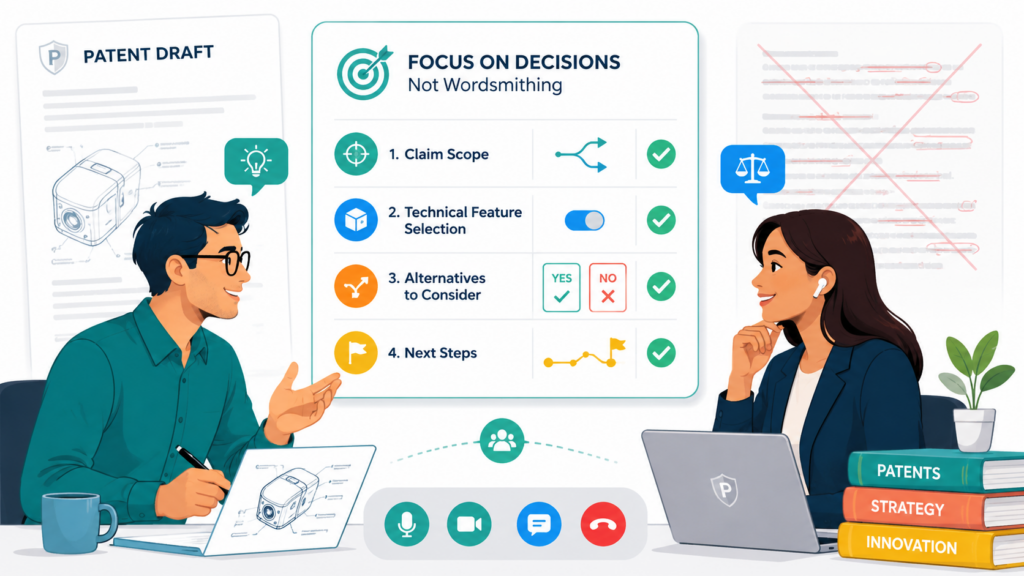
Words matter, of course. But early review calls should focus on whether the patent protects the right invention in the right way.
A founder does not need to become a patent lawyer. The founder needs to help the attorney confirm the facts, the technical meaning, and the business goal.
That changes the whole tone of the review.
Instead of asking, “Do I like this sentence?” the better question is, “Does this part still describe how the invention works?” Instead of asking, “Would I say it this way?” ask, “Would this wording wrongly leave out an important version?”
Read the Draft for Meaning First
The first review should not be a grammar edit. It should be a meaning check.
When you read the draft, ask whether it matches the invention. Does the background describe the real problem? Does the summary capture the main idea? Do the drawings show the important flow?
Does the detailed description include the core version and other useful versions? Do the claims seem aimed at the valuable part?
You do not need to know every legal rule to spot a meaning problem. You know your invention. That is your job in the review.
Mark Confusion Instead of Rewriting Everything
When you see a sentence that feels wrong, do not always try to rewrite it yourself. Instead, explain what is confusing.
You might say, “This makes it sound like the sensor is required, but we can use other inputs.” Or, “This paragraph misses the part where the model updates after feedback.”
Or, “This example sounds like a user must approve the result, but in our main version the system acts on its own.”
That kind of comment is far more useful than changing words without explaining the issue.
Your attorney can fix wording. You need to flag the technical truth behind the wording.
Review the Claims With a Simple Question
The claims are the part that defines the legal edge of the patent. They can look strange to inventors because they are written in a special format. But you can still review them in a useful way.
Start with one simple question: “What would a competitor have to do to fall inside this?”
This makes the claim review more practical.
If the answer sounds too narrow, say so. If the claim seems to require a part that is not actually required, flag it.
If the claim misses the main thing a copycat would copy, explain that. If it describes a small feature but not the big invention, raise that concern.
Do Not Judge Claims by How Natural They Sound
Claims often do not read like normal writing. That is okay. The goal is not beauty. The goal is protection.
So do not get stuck on whether the claim sounds smooth. Focus on what it covers.
A claim may sound odd but still be strong. Another claim may sound simple but be too narrow.
Your attorney can explain why certain words are used. Your role is to make sure the words do not change the technical meaning in a bad way.
This is where trust matters. The attorney understands claim style. You understand the invention. Better patents happen when both sides respect what the other side brings.
Use Review Calls to Decide Scope
Scope means how wide or narrow the patent protection may be. This is one of the most strategic parts of the process.
If the draft only covers your exact product, it may be too narrow. If it tries to cover too much without support, it may create problems. The right answer depends on the invention, the field, the prior work, and the business goal.
Inventors can help by explaining what must stay covered.
For example, you may say, “We need this to cover both phone-based and web-based versions.” Or, “We should not limit this to one type of sensor.” Or, “The key thing is the ranking method, not the dashboard.”
These comments give the attorney real direction.
Talk About Tradeoffs Openly
Patent drafting often involves tradeoffs. A broader claim may face more pushback. A narrower claim may be easier to get allowed but may not protect enough.
A fast filing may be useful before a public launch, but it may require later follow-up. A deep filing may be stronger but may take more input from the team.
These are not problems. They are decisions.
Inventors and attorneys should talk about them directly. The best communication happens when no one pretends there is only one perfect path.
A founder should feel free to ask, “What do we gain by saying it this way?” and “What do we risk if we leave this part out?” A good attorney should answer in plain words.
Keep Comments Tied to the Business Goal
A patent draft can be technically correct but still weak for the company’s needs. That is why review comments should connect back to the business goal.
If the company is trying to protect a core platform, the draft should not read like it only covers a small customer workflow. If the company is filing before fundraising, the draft should clearly show the technical value.
If the company is worried about a specific competitor path, the draft should address that path where possible.
This does not mean the patent should become a pitch deck. It means the patent should be aligned with why the company is filing.
Ask Whether the Draft Protects the Reason You Care
Before approving a draft, ask yourself one strong question: “If a competitor copied the part of our product that makes us valuable, would this patent help?”
You may not know the full legal answer. But your instinct matters. If the draft feels aimed at the wrong thing, say so before filing.
This is why a smoother review process is so valuable. PowerPatent helps inventors and attorneys work from clearer invention records, guided workflows, and attorney oversight, so review can be more focused and less painful. You can see the approach here: https://powerpatent.com/how-it-works
Build a Shared Language for Hard Technical Ideas
Inventors and patent attorneys often use the same words in different ways. That creates quiet confusion.
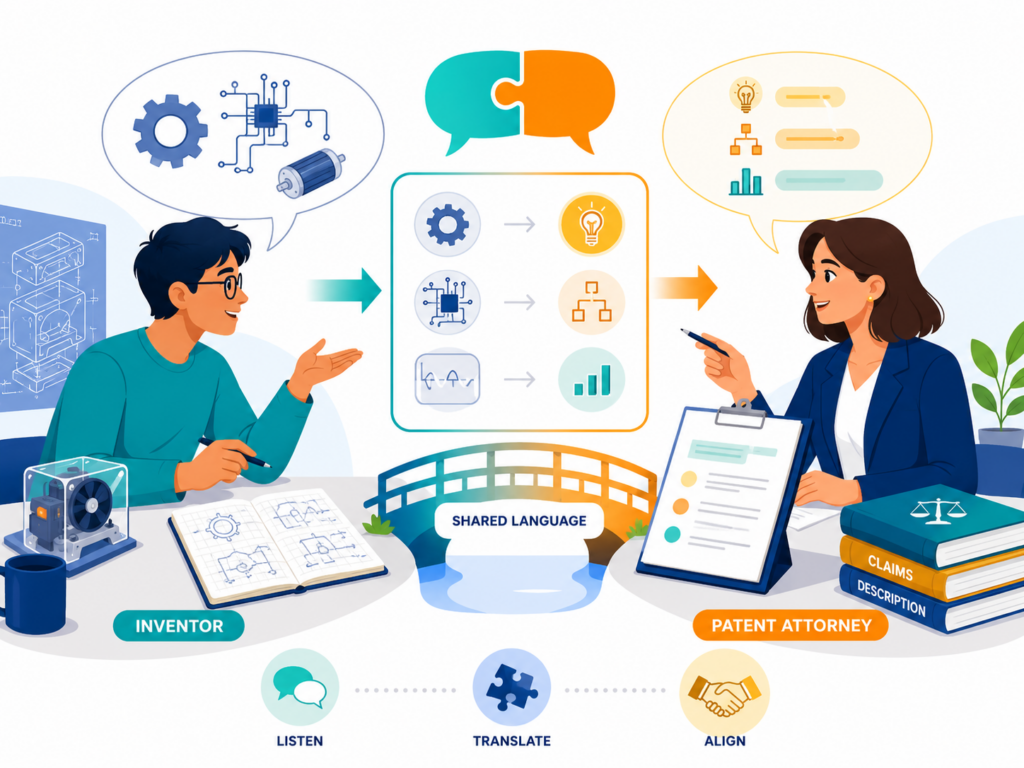
An engineer may use a term because it has a very specific meaning inside the product. An attorney may use the same term in a broader way to avoid making the patent too narrow.
A founder may use a business term that means one thing to customers and another thing to the technical team.
These gaps can cause real trouble if no one catches them.
The fix is to build a shared language early. This does not require a full dictionary. It only requires both sides to slow down when a word could mean more than one thing.
Define the Words That Matter Most
Some terms are central to the invention. These words deserve care.
If your invention uses words like “profile,” “score,” “node,” “agent,” “event,” “risk,” “state,” “map,” “signal,” “model,” “rule,” or “session,” make sure your attorney knows what those words mean in your system.
Do not assume the meaning is obvious. In technical work, simple words often carry hidden meaning.
For example, “profile” might mean a user profile, a machine profile, a learned behavior profile, a stored record, or a temporary pattern built during runtime. Those are not the same thing.
Explain Terms With Examples, Not Only Definitions
A definition helps, but an example helps more.
Instead of saying, “A machine profile is a set of machine data,” say, “A machine profile may include the normal vibration range, expected heat level, average cycle time, and past failure pattern for one machine.”
Now the attorney can see the thing more clearly.
Examples also reveal whether a term is too narrow or too broad. If your attorney uses a word in the draft and the example no longer fits, you can catch the issue early.
Watch Out for Product Names and Internal Nicknames
Engineering teams love internal names. They name tools, workflows, models, and modules. These names are useful inside the company, but they can confuse a patent discussion.
Your attorney may not know whether “Falcon,” “Atlas,” “SmartRank,” or “CoreFlow” means a product, a feature, a model, a method, or a code name.
Internal names should be translated into plain function.
Instead of saying, “Atlas handles the update,” say, “The update engine changes the machine profile when new sensor data shows a lasting shift.”
That second version is much easier to protect.
Keep Brand Language Away From the Invention
A patent is not a product brochure. Brand names and feature names can distract from the real invention.
If the invention is a ranking method, talk about the ranking method. If it is a control process, talk about the control process. If it is a device structure, talk about the structure.
You can still tell the attorney how the feature appears in the product. But the main discussion should focus on what the invention does, not what the company calls it.
This helps the attorney draft in a way that can survive product name changes later.
Make Sure Technical Words Do Not Narrow the Patent by Accident
Sometimes a technical word is accurate but too narrow. For example, an inventor may say “neural network” because that is what the current product uses.
But if the same idea could work with other machine learning models, it may be better to describe the broader idea first and then include the neural network as one version.
The same issue appears with hardware. An inventor may say “camera” because the prototype uses a camera. But if another image sensor or sensing device could work, the attorney needs to know that.
This does not mean the attorney should avoid details. It means the details should be placed carefully.
Tell the Attorney When a Word Is Just One Example
When you mention a specific tool, model, sensor, material, protocol, or platform, tell your attorney whether it is required or just one option.
Say, “We use Bluetooth now, but other wireless links could work.” Or, “We use a transformer model in the current build, but the key part is the feedback-based update.” Or, “The prototype uses a wrist device, but the same method could run in a ring, patch, or phone.”
These comments help the attorney keep the patent from being tied too tightly to one product version.
Create a Simple Glossary During the Project
A short shared glossary can prevent many problems. It does not need to be formal. It can be a simple running note with key terms and plain meanings.
The glossary should include only the words that matter. Too many definitions can slow things down. The point is to capture terms that might be misunderstood.
This is especially useful when several people are involved. A founder, engineer, product lead, outside attorney, and in-house counsel may all join the process. A shared glossary keeps everyone aligned.
Update the Glossary When the Draft Changes
The glossary should not be frozen on day one. As the draft evolves, the team may choose better words. When that happens, update the shared language.
For example, the team may start with “risk score” but later use “failure likelihood value” because it is more precise. Or the team may replace “user profile” with “behavior profile” because the profile is not always tied to a person.
These small language choices matter. They shape how the invention is understood.
PowerPatent’s guided process can make this kind of clarity easier because invention details, technical notes, and attorney feedback can be organized in a cleaner way than scattered email threads. See how PowerPatent helps teams move from idea to filing here: https://powerpatent.com/how-it-works
Share Drawings, Flows, and Visuals Before the Draft Is Written
Many inventors try to explain everything in words. That is hard. Inventions are often easier to understand when someone can see the parts, the flow, or the change over time.
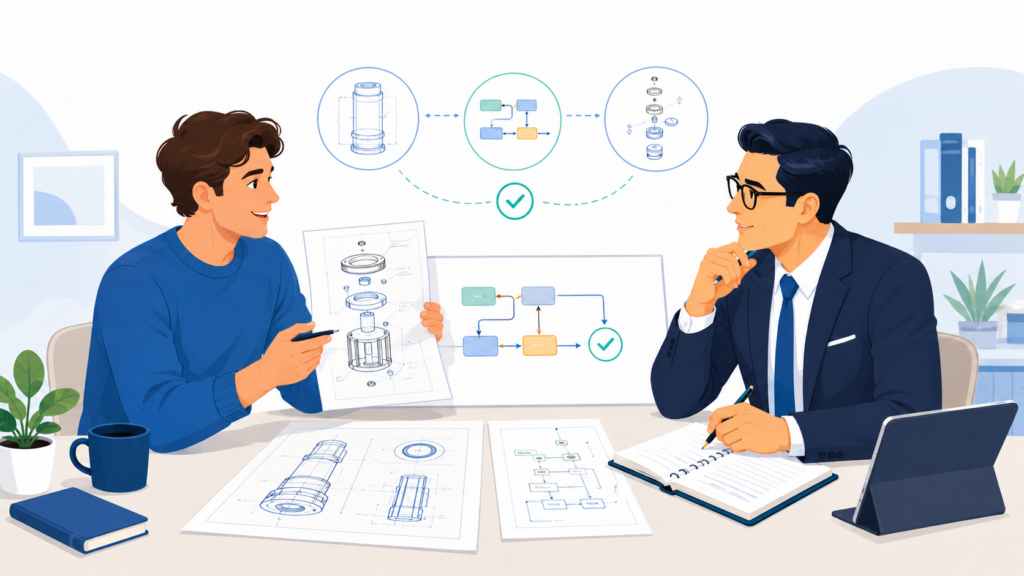
A simple drawing can save a long meeting.
It does not need to be beautiful. It does not need to look like a patent drawing. A hand sketch, whiteboard photo, system map, data flow, screen flow, or block diagram can help the attorney understand the invention much faster.
Visuals are not a replacement for clear words. They are a way to make clear words easier to trust.
Use Visuals to Show How the Invention Moves
A good visual shows movement. It shows how data, energy, control, signals, parts, or decisions move through the invention.
For software, this may be a flow from input to processing to output. For hardware, it may show how parts connect and respond.
For AI, it may show where data enters, how it is cleaned, how a model uses it, and how the result changes the system.
When the attorney can see the movement, they can ask better questions.
They may notice that a key step is missing. They may ask whether the order of steps matters. They may ask whether a step can happen on a device, in the cloud, or across both. These questions can improve the draft before it starts.
Show the Normal Path and the Edge Path
Most inventors show the normal path. That is helpful, but not always enough.
You should also show what happens when things go wrong or when the system handles a harder case. This can reveal important parts of the invention.
For example, if a system predicts failure, what happens when sensor data is missing? If a robot adjusts its path, what happens when the path is blocked?
If an AI tool ranks documents, what happens when two documents have the same score? If a device changes power modes, what happens when battery level drops during use?
These edge paths may contain valuable invention details.
Use Drawings to Separate Required Parts From Optional Parts
A visual can also show what is required and what is flexible.
You might show one main version of the system, then explain which parts could change. The attorney can then decide how to describe the invention in a way that covers the core without locking the patent to one version.
This is especially important for startups. Your product may change. Your customer may change. Your device may change. Your cloud setup may change. The patent should not become outdated just because the roadmap moved.
Mark the Parts That Create the Advantage
When you share a visual, do not make the attorney guess which parts matter most. Point them out.
You might say, “This feedback step is the key.” Or, “This timing window is what reduces false results.” Or, “This matching layer is what lets the system work with messy data.”
That simple note can change the whole draft.
A visual with no explanation can still leave the attorney unsure. A visual with clear comments becomes a powerful tool.
Show More Than One Version When You Can
If the invention can be built in more than one way, show more than one version. This helps the attorney understand the full range of the idea.
Maybe the main version runs in the cloud, but another version runs on a local device. Maybe one version uses a camera, while another uses audio or motion data.
Maybe one version sends an alert to a user, while another version controls a machine directly.
These versions may help the attorney draft a richer application.
Do Not Treat the Prototype as the Only Invention
Your prototype is proof that the idea works. But it may not be the full invention.
Many founders accidentally describe the prototype as if every part is required. Later, they realize the key idea could work in other forms. By then, the draft may already be too narrow.
To avoid this, use visuals to show the prototype and then talk about what could change.
You can say, “This is how we built it today, but the core idea is the way the system updates the control rule based on live feedback.”
That one sentence helps the attorney see beyond the first build.
Use Visuals to Speed Up Review
Drawings are not only useful before drafting. They are also useful during review.
When you review a patent draft, compare the written description to your visual. Does the draft include the main flow? Does it explain the key step? Does it show the alternate version? Does it leave out the edge case? Does it make one optional part sound required?
This makes review much faster.
Keep the Visuals in the Same Place as the Draft Notes
Scattered files slow everything down. One diagram in Slack, one video in email, one note in a document, and one comment in a call transcript can create confusion.
Keep the invention material organized. This helps both the founder and the attorney. It also helps later if the company files more patents from the same technology.
PowerPatent is built around this kind of smoother invention workflow. It helps founders capture what they built, give attorneys better context, and move toward filing with more confidence. You can explore how it works here: https://powerpatent.com/how-it-works
Set Clear Roles So Everyone Knows What They Own
A patent project becomes messy when no one knows who owns each decision. The inventor thinks the attorney will figure out the technical details.
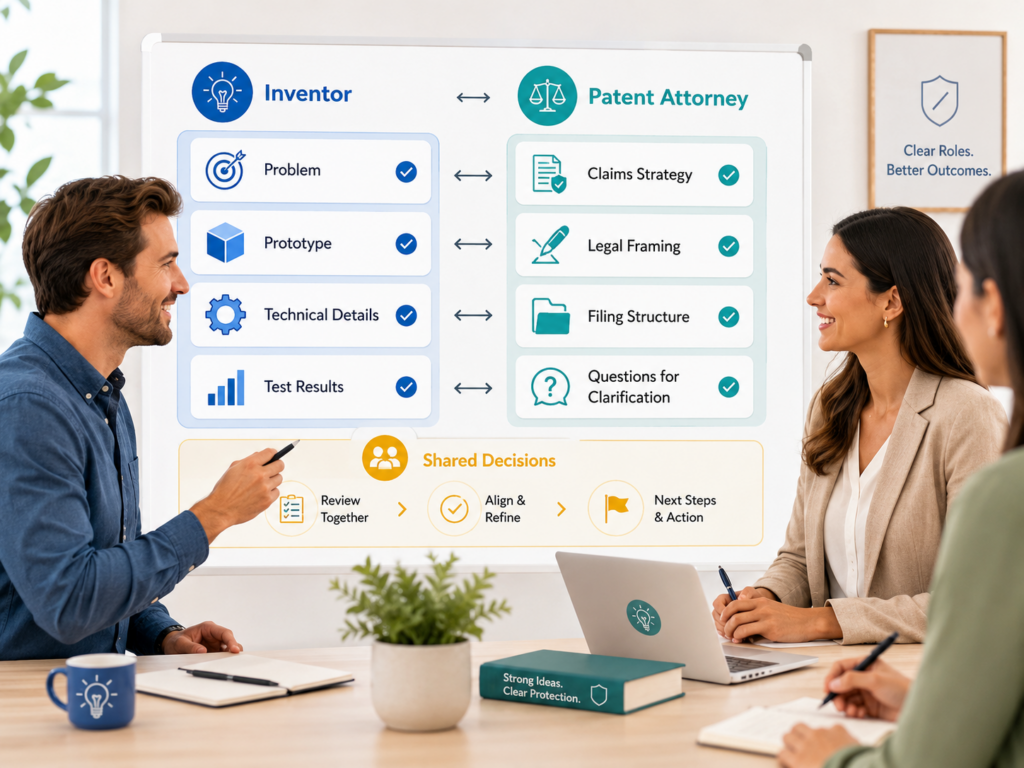
The attorney thinks the inventor will flag what matters most. The founder thinks the engineer reviewed the draft. The engineer thinks the founder handled it.
That is how mistakes slip through.
Clear roles make the process faster and safer. They also reduce stress. Everyone knows what to check. Everyone knows what to decide. Everyone knows when to speak up.
The goal is not to add more process. The goal is to remove confusion.
The Inventor Owns the Technical Truth
The inventor’s main job is to protect the truth of the invention. That means making sure the attorney understands how the invention works, what parts matter, and what details should not be changed.
The attorney can ask smart questions, but they cannot read the inventor’s mind. If the draft says something technically wrong, the inventor must flag it.
If the draft leaves out a key step, the inventor must say so. If the draft makes the invention sound narrower than it is, the inventor should explain why.
This is not a legal task. It is a truth task.
Review for Accuracy Before Style
Inventors should read the draft first for accuracy. Do not worry at first about whether the writing sounds natural. Patent writing has its own style. Focus on whether the draft is true.
Ask whether each major part works the way the draft says it works. Ask whether the order of steps is correct. Ask whether the examples match the real system. Ask whether the draft uses words that would confuse your team.
If the technical truth is right, the attorney can polish the legal language. If the technical truth is wrong, no amount of polish can fix the risk.
The Attorney Owns the Protection Strategy
The attorney’s job is to turn the invention into a patent application that is useful, clear, and strategic. That means deciding how to draft claims, how to describe versions, how to handle known prior work, and how to position the application.
Inventors should not have to master claim drafting. They should understand the goal, but they do not need to write the claims alone.
A strong attorney will explain choices in plain words. They will say why a claim is broad or narrow. They will explain why certain examples are included. They will tell the inventor where more detail is needed.
Ask the Attorney to Explain the Strategy Behind the Draft
A founder should not approve a patent draft without understanding the basic strategy.
You can ask, “What is the main thing this application is trying to protect?” You can ask, “Where is the broad coverage?” You can ask, “What parts are backup positions?” You can ask, “What would you want an examiner to understand first?”
These questions help you move beyond passive review.
They also make the attorney’s thinking visible. When you understand the strategy, your comments become sharper and more useful.
The Founder Owns the Business Goal
In many startups, the inventor and founder are the same person. But not always. Sometimes the inventor is an engineer, researcher, or product lead. The founder or executive team may have a different view of the company’s goals.
That business view matters.
The founder should make sure the patent effort supports the company’s larger plan. Are you trying to protect the core product? Support fundraising? Build a portfolio around a platform? Protect a new market entry? Prepare for partner talks? Reduce copycat risk?
These goals should be shared early.
Connect Patent Decisions to Company Timing
Timing changes patent communication.
If a demo, launch, paper, grant, pitch, or customer pilot is coming soon, the attorney needs to know. If the product is still changing, say so. If a key feature may be removed, explain that too.
A patent plan should fit the company’s real timeline. It should not live in a separate legal world.
This is where speed and clarity matter most. PowerPatent helps founders move quickly without losing attorney oversight, so the patent process can keep pace with the business. See how it works here: https://powerpatent.com/how-it-works
Assign One Final Decision Maker
Too many reviewers can slow a patent project down. Engineers may disagree on technical wording. Founders may disagree on business focus. Attorneys may need one clear person to make the final call.
That final decision maker should not ignore other input. But they should be responsible for moving the project forward.
Without a final owner, drafts can sit for weeks. Comments can conflict. Filing dates can slip. The team can lose momentum.
Gather Input Before the Final Review Call
The best approach is to gather comments from all key people before the final review call. Then the final decision maker can work with the attorney to resolve open issues.
This keeps the process clean.
It also respects everyone’s time. The attorney does not have to handle random comments from five people across five channels. The founder does not have to chase unclear feedback. The inventor does not feel ignored.
Ask Better Questions So the Attorney Can Give Better Answers
A patent attorney can only give strong guidance when the question is clear. Many inventors ask questions that are too broad, too late, or too hidden inside long emails. That makes it hard for the attorney to answer in a useful way.
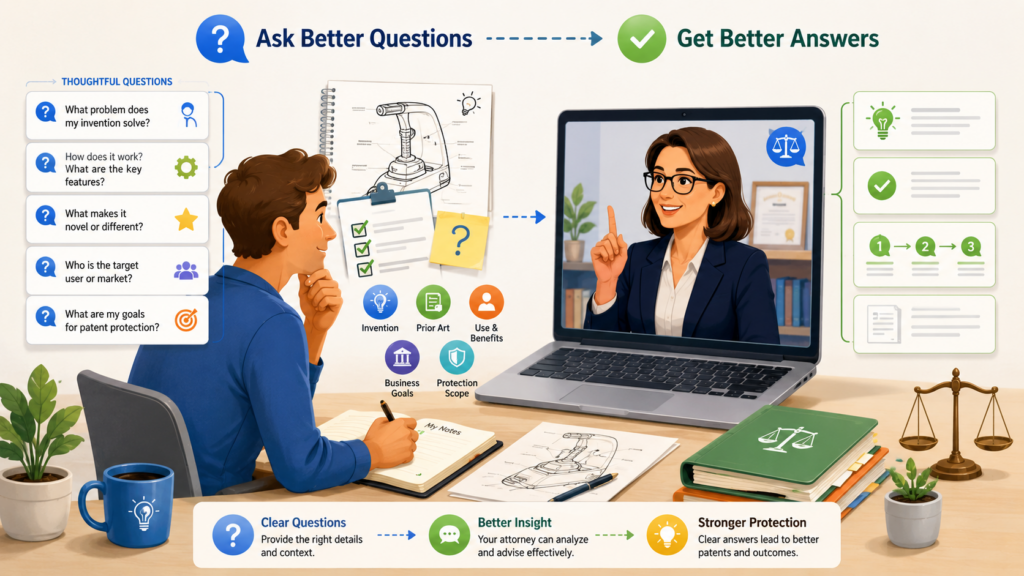
A better question gives context. It points to the decision you are trying to make. It also tells the attorney what kind of answer would help you move forward.
For example, “Is this okay?” is not a great question. It does not tell the attorney what you are worried about.
A stronger question is, “Does this draft make the invention sound limited to our current mobile app, even though we may also offer it through an API later?” That question gives the attorney a real issue to address.
Good questions speed up the process because they remove guesswork. They also help the inventor feel more in control.
Instead of waiting for the attorney to explain everything, the inventor can guide the conversation toward the choices that matter most.
Ask Questions That Point to Risk
The best questions are often risk questions. They help you understand what could go wrong if you choose one path over another.
You might ask whether a phrase makes the patent too narrow. You might ask whether the draft leaves out a future version.
You might ask whether filing now is better than waiting for more test data. You might ask whether the claims focus on the part a competitor would likely copy.
These questions are practical. They are not about showing that you know patent law. They are about making better decisions.
When an inventor asks risk-based questions, the attorney can respond with strategy instead of general advice. That makes the conversation more valuable.
Turn Worries Into Clear Questions
Inventors often feel that something is wrong, but they do not know how to say it. That is normal. You may read a draft and feel that it does not capture the “magic” of the invention.
You may feel that a claim misses the real edge. You may feel that a drawing makes the system look simpler than it is.
Do not bury that feeling. Turn it into a clear question.
You can say, “I am worried this draft focuses too much on the dashboard and not enough on the scoring method. Is that a real issue?” Or you can say, “I am worried this claim requires human approval, but our main value is that the system can act without human approval. Should we change that?”
This kind of question gives the attorney a direct path to help you. It also keeps the review from turning into vague dissatisfaction.
Ask About the Why Behind Legal Choices
Some patent language may feel strange to inventors. The attorney may use broad terms instead of product names. They may avoid words you use every day inside your team.
They may include versions that are not in the product yet. They may write claims in a way that does not sound natural.
Instead of assuming the draft is wrong, ask why.
A good attorney should be able to explain the reason in plain words. They might say a term is broader. They might say a specific example is useful as a backup.
They might say a detail should stay out of the main claim because it could narrow protection too much.
That explanation helps you trust the process.
Do Not Accept Confusion as Normal
Patent work can be complex, but the communication should not feel impossible. If you do not understand why something is written a certain way, ask.
You should not need a law degree to understand the basic plan for your own invention. You may not understand every legal detail, but you should understand the main goal.
A clear attorney will welcome smart questions. They know that better understanding leads to better review. They also know that inventors catch important technical issues when they understand what the draft is trying to do.
Ask What Is Missing Before You Ask What Sounds Wrong
Many review conversations focus only on what is written. But the bigger danger is often what is missing.
A draft may be accurate but incomplete. It may describe the main version but leave out the cloud version. It may explain the input data but not the feedback loop. It may include one sensor but not other possible sensors. It may show the normal workflow but not the failure case.
So ask, “What is missing?” early and often.
This question helps both sides step back. It also helps the attorney think beyond the first version of the product.
Review the Draft Against the Copycat Test
One strong way to find missing material is to imagine a competitor. Ask what a smart competitor would change to avoid your patent while still copying the value of your invention.
Would they change the user interface? Would they use a different model? Would they replace the sensor? Would they move the process from cloud to device? Would they turn an automatic step into a semi-automatic step? Would they rename the same logic?
Now ask whether the draft covers those likely changes where possible.
This does not mean every possible version can or should be covered. But it helps you and the attorney discuss scope in a real business context.
Ask for the Next Decision, Not the Whole Universe
Inventors sometimes ask huge questions because they want certainty.
They ask whether the patent will be strong, whether it will be allowed, whether it will stop all competitors, whether it will help with investors, and whether it will be worth the cost.
Those are fair concerns, but they may not be answerable in one clean way.
A better approach is to ask for the next decision. Should we add more examples before filing? Should we include this alternate version?
Should we file before the demo? Should we split this into more than one patent idea? Should we revise the claims to focus more on the feedback step?
These questions move the work forward.
Keep Each Question Tied to an Action
A good patent question should lead to a next step. If the answer will not change what you do, it may not be the right question for that moment.
For example, asking, “Is this invention good?” is too broad. Asking, “Do we have enough detail to file a strong first application before next week’s public demo?” is much better. It points to a real action.
This is how strong founder-attorney communication works. It is not endless theory. It is clear talk that supports clear action.
PowerPatent helps make this easier by giving founders a more guided way to capture invention details, share context, and work with attorney oversight.
The process is built to reduce confusion and help teams move from idea to filing with more confidence. You can explore it here: https://powerpatent.com/how-it-works
Use Time Well So the Patent Process Does Not Drag
Poor communication often shows up as delay. A draft sits unread. A question goes unanswered. A call ends without clear decisions.

A founder sends new details after the attorney has already drafted. An engineer gives feedback too late. The filing date gets pushed again.
Most of this can be avoided with better time habits.
Patent work does not need to feel slow. But it does need rhythm. The team should know when information is due, when drafts will be reviewed, when decisions must be made, and who is responsible for each step.
This matters even more for startups because timing is often tied to public events. A launch, investor pitch, customer pilot, paper, conference talk, product demo, or grant submission may create real pressure.
If the patent process is not managed well, the company may end up rushing at the worst possible time.
Share Key Dates at the Start
The attorney should know the company’s key dates as early as possible. Do not wait until the draft is nearly done to mention that a public demo is coming.
If there is a planned launch, say the exact date. If there is an investor meeting, say when it happens. If a paper may be posted online, say when it may go live. If a customer will see the product, explain what they will see and when.
This helps the attorney plan the filing path. It also helps them warn you when time is tight.
A patent timeline should be built around real business events, not around vague hopes.
Treat Public Sharing as a Serious Timing Trigger
Inventors often underestimate how much timing matters before public sharing. A public demo, website post, conference talk, pitch deck, open-source release, academic paper, sales call, or customer trial can affect patent strategy.
You do not need to panic. You do need to communicate early.
Tell your attorney what will be shared, who will see it, whether there is any confidentiality agreement, and whether the invention itself will be shown. The attorney can then help you decide what to file and when.
The key habit is simple. Before you disclose the invention outside the company, bring the attorney into the timing conversation.
Do Not Wait for Perfect Information
Startups rarely have perfect information. The product is changing. The model is improving. The hardware is being revised. The test results are still coming in. The customer use case is still forming.
If you wait until everything is final, you may wait too long.
Good communication means telling the attorney what is known, what is still changing, and what decisions are pending. That lets the attorney help you choose the right filing approach.
Sometimes a first filing can capture the core idea while later filings add improvements. Sometimes it is better to gather more detail first.
The right answer depends on the facts. But the attorney cannot advise well if they do not know what is uncertain.
Label Details as Final, Likely, or Still Changing
When you share technical material, make clear which parts are stable and which parts may change. This saves time.
For example, the core feedback loop may be final, while the user interface is still changing.
The sensor setup may be likely, while the exact housing is still being tested. The model pipeline may be fixed, while the training data source may expand.
This helps the attorney decide where to focus. It also helps avoid drafting the patent around parts that may be gone next month.
Set Review Windows That People Will Actually Meet
A patent draft cannot move forward if no one reviews it. But many teams do not plan review time. They assume they will “look at it later.” Later becomes next week. Next week becomes next month.
A better approach is to set a review window before the draft arrives.
The founder, inventor, and any key engineer should know when they are expected to review. They should also know what kind of feedback is needed. The attorney should not have to chase basic approval for days.
This does not require heavy process. It requires respect for timing.
Give Reviewers a Clear Job
A draft review goes faster when each person knows what to look for.
The inventor should check technical accuracy. The founder should check business alignment. The attorney should check legal structure and protection strategy. If another engineer reviews, they should focus on the part they know best.
When everyone comments on everything, review becomes messy. When each person has a role, review becomes faster and sharper.
Clear review roles also prevent last-minute surprises. The person who understands the model should not discover a model error the night before filing.
The founder should not realize too late that the draft misses the company’s main product direction.
Keep Communication in One Main Place
Patent projects get slow when communication is scattered. A key detail is in one email. A diagram is in a Slack thread.
A comment is in a meeting transcript. A founder gives approval in a text message. An engineer shares a correction in a separate document.
That makes it too easy for something important to get lost.
Use one main place for invention material, comments, drafts, and decisions. This helps the attorney and the team stay aligned. It also creates a cleaner record of what was decided.
Reduce Side Conversations That Do Not Reach the Attorney
Side conversations are normal inside a startup. Engineers may discuss a feature. Founders may debate strategy. Product teams may revise the roadmap.
But if those talks change the invention or the filing plan, the attorney needs to know.
A good rule is this: if the side conversation changes what should be protected, bring it back into the main patent workspace.
PowerPatent is designed to support this kind of cleaner workflow. Instead of letting invention details scatter across messages and files, it helps teams capture the important material and work with attorney oversight in a more organized way. See how it works here: https://powerpatent.com/how-it-works
Be Honest About What You Know, What You Built, and What You Only Plan to Build
Strong patent communication requires honesty. Not dramatic honesty. Just clear, practical honesty.
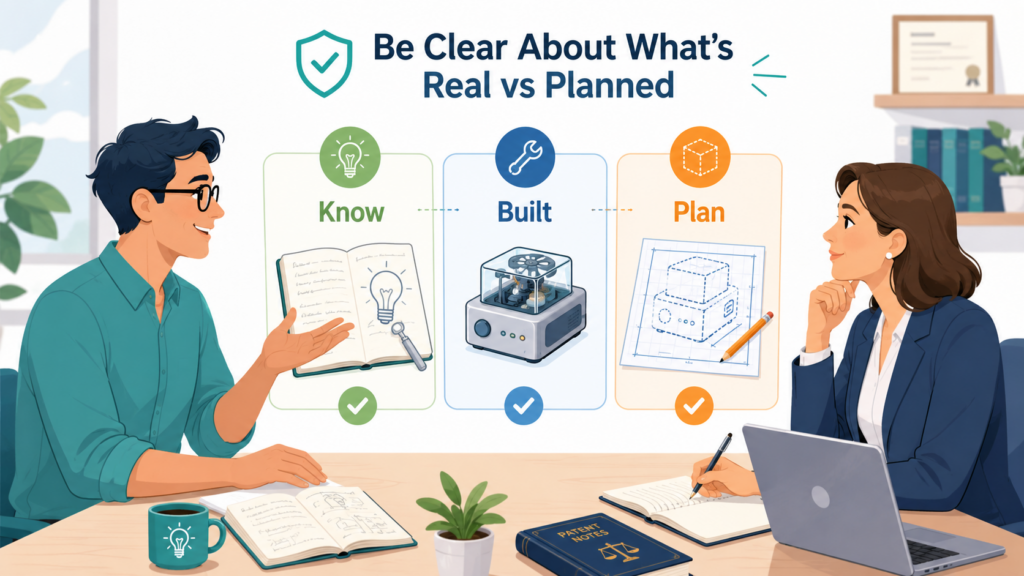
Inventors sometimes blur the line between what exists, what is being tested, what is planned, and what is only an idea.
They do this because they are excited. They can see where the product is going. They know the roadmap. They want the patent to cover the future.
That future view is useful. But the attorney needs to know which details are real today and which details are possible future versions.
This matters because a patent application should be grounded in a real, clear description of the invention. If the attorney does not know what has actually been built or enabled, they may draft with the wrong level of detail.
Explain the Current Working Version First
Start by showing what works now. This gives the attorney a solid base.
If the system is live, explain the live version. If it is a prototype, show the prototype. If only part of it is working, be clear about that. If the result is based on test data, explain the test setup. If a step is still manual but will later be automated, say so.
This does not weaken your position. It helps the attorney draft with care.
A strong patent application can include more than the exact current build, but the attorney needs to understand the current build before expanding outward.
Do Not Oversell the State of the Technology
Founders are used to selling. They pitch investors, customers, hires, and partners. But a patent conversation is different.
With your attorney, you do not need to make the invention sound more complete than it is. You need to make it clear.
If a feature is planned but not built, say it is planned. If test results are early, say they are early. If the system works in one setting but has not been tested in another, say that.
This helps the attorney ask the right follow-up questions. It also helps avoid a draft that sounds confident in areas where the technical support is thin.
Separate Proven Results From Expected Results
Inventors often talk about what the invention “does” when they really mean what they expect it to do at scale. That difference matters.
If you have measured a result, share the measurement. If you believe a result will happen based on early testing, explain that. If the benefit is expected but not yet proven, label it that way.
For example, “The system reduced false alerts by 32 percent in our test data” is different from “We expect the system to reduce false alerts in production.” Both may be useful, but they are not the same.
Your attorney can decide how to describe benefits in the application, but they need accurate input from you.
Share the Test Conditions Behind the Result
A result is more useful when the attorney understands how it was reached.
If you say the system is faster, explain what it was compared against. If you say it is more accurate, explain what data was used.
If you say it uses less power, explain the device setting. If you say it reduces human review, explain the workflow before and after.
This helps the attorney understand the technical effect. It may also help them describe the invention in a more concrete way.
The goal is not to turn the patent application into a lab paper. The goal is to give the attorney enough truth to write with strength.
Be Clear About Future Versions
Future versions can be important. A patent should not ignore them just because the product has not reached them yet. But the attorney needs to know they are future versions.
You might say, “Today this runs in the cloud, but we believe the same logic can run on-device.” Or, “The current version uses camera data, but the same method could use radar data.”
Or, “Right now a human approves the output, but the next version will allow automatic action under certain confidence levels.”
This gives the attorney a broader view while keeping the facts clean.
Explain Why the Future Version Would Still Work
Do not only name possible future versions. Explain why they are tied to the same invention.
If you say the method could use another sensor, explain what kind of data the sensor needs to provide.
If you say it could work in another industry, explain what problem is shared. If you say the system could run on another device, explain what parts would remain the same.
This helps the attorney decide whether and how to include those versions.
A vague future idea may not add much. A well-explained alternate version can make the application stronger.
Tell the Attorney About Known Limits
Every invention has limits. Maybe it works only with enough data. Maybe it struggles with rare cases.
Maybe it needs calibration. Maybe it works best under certain conditions. Maybe it fails when signals are too noisy.
Share those limits.
This may feel uncomfortable, but it is useful. Limits help the attorney understand the invention more deeply. They may also help define what makes the invention work.
For example, if the system only works when it uses a moving baseline instead of a fixed threshold, that limit may point to the core idea.
If the device only works when two sensors are placed a certain distance apart, that may be important.
Limits Can Reveal the Real Invention
A limit is not always a weakness. Sometimes it shows the key design choice.
If you tried many paths and only one worked, the reason it worked may be the invention.
If the system handles noisy data only because of a special filtering step, that step may be central. If the model fails without a feedback rule, the feedback rule may deserve focus.
Honest limits lead to better questions. Better questions lead to better patents.
PowerPatent helps founders capture these details before they get lost. By combining smart software with real attorney oversight, it gives inventors a clearer way to explain what works, what is changing, and what should be protected. Learn more here: https://powerpatent.com/how-it-works
Teach the Attorney the Market Without Turning the Patent Into a Pitch Deck
A patent attorney does not need your entire sales story. But they do need to understand the market enough to see why the invention matters.
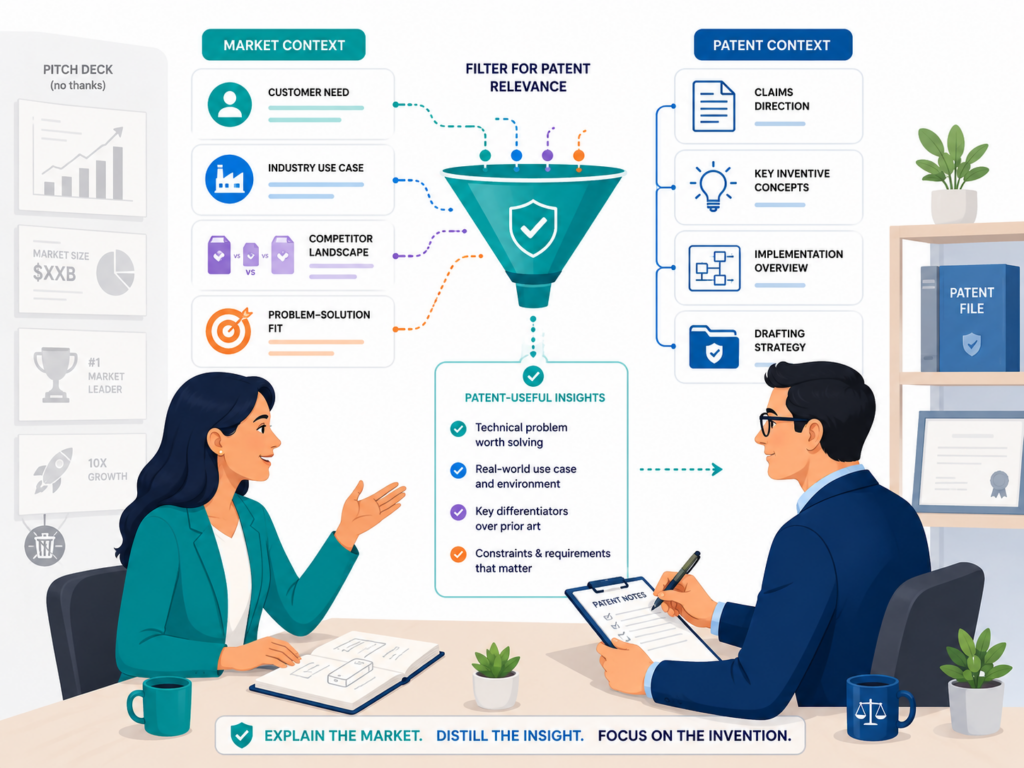
This is a careful balance. Too much market talk can distract from the technical invention. Too little market context can make the draft miss the business value.
The goal is to give the attorney enough real-world context to understand what customers need, what competitors may copy, and which parts of the technology are most important to protect.
A patent is not a marketing document. But it should not be blind to the business.
Explain Who Has the Problem
Tell the attorney who feels the pain that led to the invention. Is it a factory operator, a doctor, a software developer, a logistics manager, a security team, a data scientist, a patient, a teacher, or another system?
This helps the attorney understand the setting. It also helps them understand why certain steps matter.
For example, a delay of one second may not matter in one field but may be critical in another.
A small false positive rate may be acceptable in one product but costly in another. A low-power design may be nice in a plugged-in device but essential in a wearable.
The user context gives meaning to the technical choices.
Keep the User Story Tied to the Technology
Do not let the user story become a long business pitch. Tie it back to what the invention does.
Instead of saying, “Hospitals need better tools,” say, “Nurses receive too many low-value alerts, so our system groups sensor events and sends only alerts that match a rising risk pattern.”
That keeps the focus where it belongs. The customer pain explains the technical solution.
This helps the attorney draft a background and description that feel grounded without becoming promotional.
Explain What Competitors Are Likely to Copy
This is one of the most useful things a founder can share.
A patent attorney can think broadly, but the founder often knows the market threats best. You may know which companies are building nearby.
You may know which feature customers care about most. You may know which part of your system would be easiest to imitate after a demo.
Share that.
If a competitor would likely copy the workflow, say so. If they would copy the model update method, say so.
If they would copy the device arrangement, say so. If they would avoid your user interface but copy the back-end process, say that clearly.
Focus on Copying the Value, Not Copying the Look
Many founders think about copying in terms of what the product looks like. But competitors often copy the value, not the look.
They may use a different dashboard. They may change the labels. They may use another cloud provider. They may hide the same logic behind a different user flow.
Your attorney needs to understand what part creates the value so the patent does not over-focus on surface details.
A good communication habit is to say, “The part we cannot let others copy is…” Then finish that sentence in plain words.
Explain Why Customers Choose Your Approach
Customer value can point to patent value. If customers care about speed, accuracy, privacy, reliability, ease of setup, lower cost, better timing, or reduced manual work, explain which technical part creates that value.
Do not just say the product is better. Say why.
For example, “Customers like this because it catches risk earlier” is useful. But “It catches risk earlier because the system updates the baseline after each machine cycle instead of waiting for a daily batch process” is much better.
That gives the attorney a technical hook.
Link Each Business Benefit to a Technical Cause
Every major benefit should have a cause inside the invention. Faster because of what? More accurate because of what? Lower power because of what? Easier setup because of what? Fewer errors because of what?
This cause-and-effect thinking makes communication much stronger.
It also helps avoid vague patent drafting. A draft that says the invention “improves performance” is not as strong as one that explains the mechanism behind the improvement.
Your attorney can decide how to use the information, but you should provide the link.
Share the Roadmap Without Losing Focus
A startup roadmap can be useful for patent planning. It may reveal future filings, new product lines, or broader versions of the invention. But the roadmap should not overwhelm the current project.
When sharing roadmap details, make clear what is part of this invention and what may be a separate invention later.
For example, your current invention may be the way the system ranks risk. A future invention may be the way the system explains the ranking to a user.
Another future invention may be the way the system adapts to a new data source.
These may belong together or separately. The attorney can help decide.
Use the Roadmap to Spot More Patent Opportunities
Good communication can turn one patent discussion into a larger IP strategy.
As you explain the roadmap, the attorney may see other invention areas. A founder may realize that the team has built several protectable advances, not just one. An engineer may remember a clever workaround that deserves attention.
This is where the process becomes strategic.
PowerPatent is built for founders who need this kind of clarity without slowing down the company. It helps turn code, models, workflows, and technical notes into a clearer patent path with real attorney oversight. You can see how it works here: https://powerpatent.com/how-it-works
Create a Feedback Loop After Filing So Future Patents Get Stronger
The communication work should not end when the patent application is filed. Filing is a major step, but it is not the end of the company’s invention story.

Your product will change. Your team will learn more. New features will ship. New technical problems will appear. Competitors may react. Customers may ask for new things. The market may move.
That means inventor-attorney communication should become a repeatable loop, not a one-time event.
The first patent project should teach the team how to work better on the next one.
Hold a Short Post-Filing Review
After filing, the team should pause and review what worked. This does not need to be long. It should be practical.
Ask whether the attorney got the right information early. Ask whether the inventor had enough time to review. Ask whether key diagrams were ready. Ask whether comments were clear.
Ask whether the draft captured the real invention. Ask whether the process felt rushed at any point.
This review helps the next filing go faster.
Capture Lessons While They Are Fresh
Do not wait months to write down lessons. Once the filing is done, people will move on. Details will fade.
Capture what the team should do differently next time. Maybe engineers should prepare diagrams earlier. Maybe the founder should share business goals at the start.
Maybe the attorney should explain claim strategy before the final draft. Maybe review comments should be gathered in one place.
Small process changes can save huge time later.
Keep an Invention Log as the Product Evolves
Many startups only think about patents when a big filing deadline appears. That creates pressure. A better habit is to keep a light invention log as the team builds.
This does not need to be complex. It should capture new technical problems, clever fixes, failed attempts, test results, product changes, and future ideas.
When the next patent conversation starts, the team will not have to rebuild the story from memory.
Record the Why Behind Each Technical Change
The most valuable part of an invention log is not just what changed. It is why the change was made.
For example, do not only record that the team changed the scoring method. Record that the old method produced too many false alerts when sensor data was missing, and the new method solved that by weighting recent signals differently.
That “why” is often where the invention lives.
Attorneys can do much better work when they can see the reason behind technical choices.
Watch for New Inventions Hidden Inside Product Work
Engineers often solve hard problems without thinking of them as inventions. They may call them fixes, patches, workarounds, or improvements. But some of those changes may be patent-worthy.
A founder should build a habit of noticing these moments.
When the team says, “We finally solved the data drift issue,” that may be worth capturing. When an engineer says, “The normal approach did not work, so we built our own,” that may be worth discussing. When a customer asks, “How are you doing that?” that may be a signal.
Turn Engineering Wins Into Patent Conversations
Not every engineering win needs a patent. But the right ones should be reviewed.
A good question is, “Would this be painful if a competitor copied it?” Another is, “Did this unlock a major product advantage?” Another is, “Was this hard to figure out?” Another is, “Will this matter to investors, partners, or future buyers?”
These questions help decide whether to bring the idea to an attorney.
The goal is not to patent everything. The goal is to avoid missing the ideas that truly matter.
Use Each Filing to Improve the Next One
Every patent project should make the team smarter. The first filing may reveal what material attorneys need. The second filing may be smoother. The third may become part of a real portfolio strategy.
This is how strong startup IP is built. Not through panic. Not through last-minute emails. Not through dense legal talk. Through steady communication, clear invention capture, and better teamwork.
Founders who build this habit early have an edge. They can move faster because they are not starting from scratch each time.
They can protect more thoughtfully because they understand what to share. They can work better with attorneys because the process has a rhythm.
Make Patent Communication Part of the Build Culture
The best teams do not treat patents as a separate legal chore. They treat invention capture as part of building.
When an engineer solves a hard problem, the team captures it. When the product changes, the team notes why.
When a public launch is planned, the team checks whether anything should be filed first. When the attorney asks for detail, the team knows where to find it.
That is a calmer, smarter way to protect innovation.
PowerPatent helps founders create this kind of workflow by combining smart software with real patent attorney oversight.
It is built for teams that move fast but still want strong protection. Explore how PowerPatent helps turn inventions into filings here: https://powerpatent.com/how-it-works
Conclusion
Better communication between inventors and patent attorneys comes down to clear facts, simple words, shared goals, and steady teamwork. When inventors explain the real problem, the working solution, the key details, and the business reason behind the filing, attorneys can protect the invention with more speed and care.
Strong patents are not built from rushed emails or confusing calls. They are built from a clean process where both sides know what matters and what to do next. PowerPatent makes this easier with smart software and real attorney oversight, helping founders protect what they build without slowing down. Learn more here: https://powerpatent.com/how-it-works
Leave a Reply