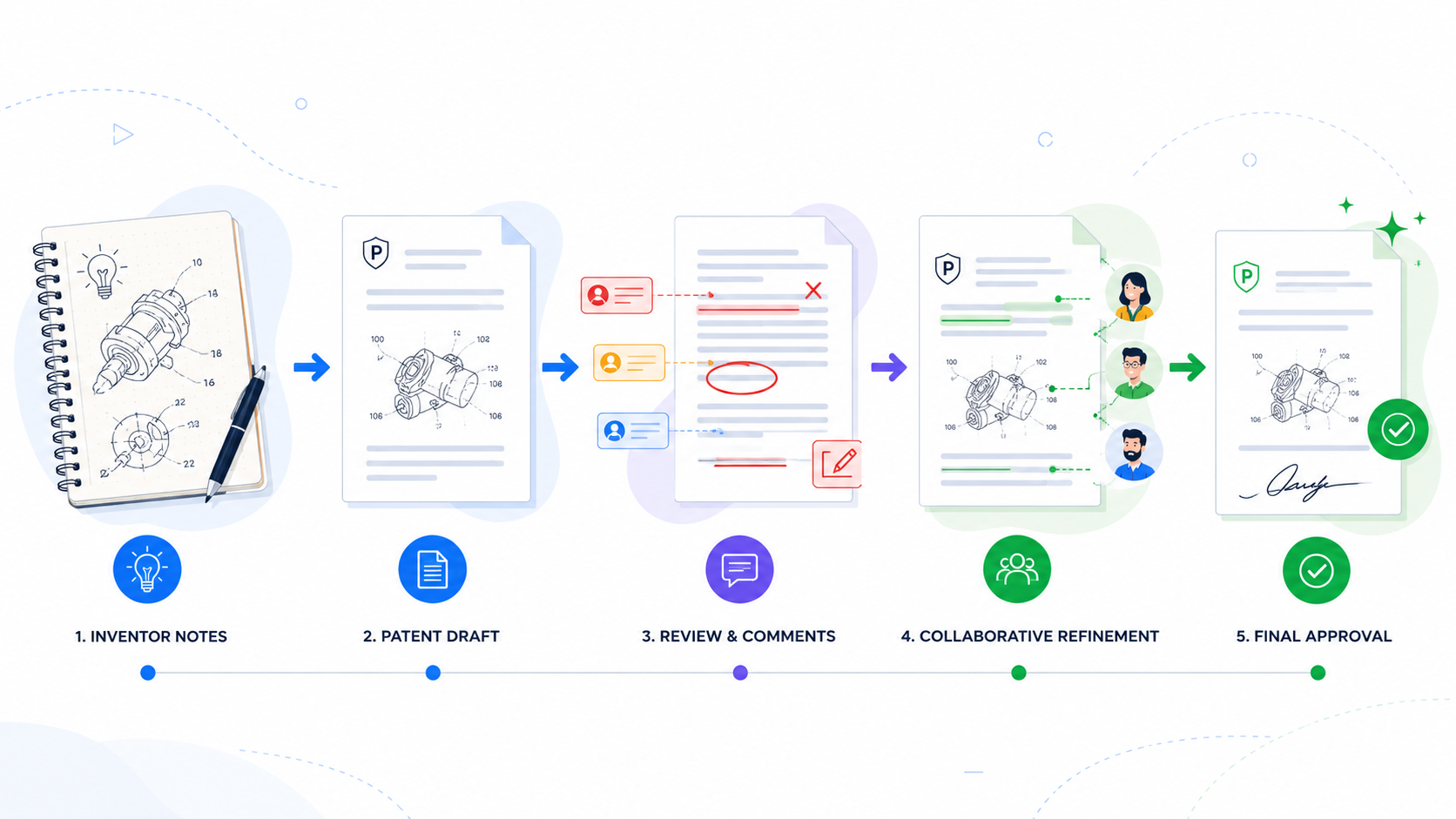
A strong patent does not start with perfect words. It starts with messy notes, quick drawings, code comments, lab results, voice memos, product sketches, and the founder saying, “I think this part is new.” The real work is turning that raw idea into a clear patent draft that protects the invention without slowing the team down. That is where the patent draft review workflow matters.
Start The Review Before The Draft Exists
The biggest mistake in patent drafting is waiting too long to review the invention. Many teams think the review starts after the first patent draft is written. That sounds normal, but it often creates extra work.
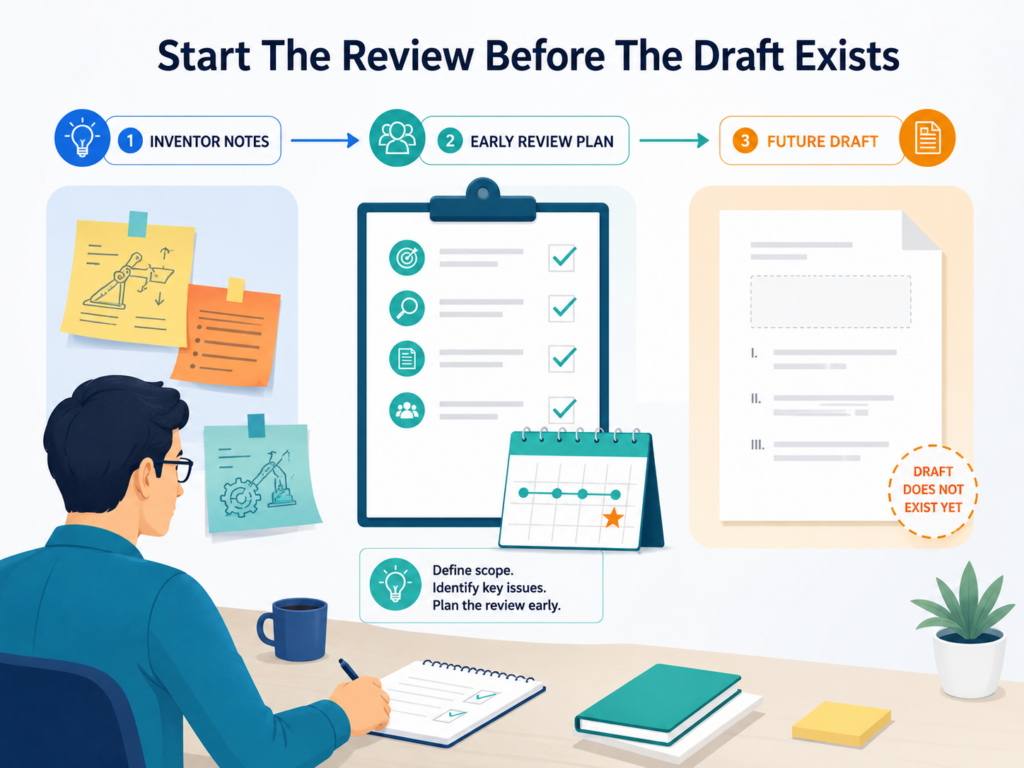
By then, the attorney may have already guessed at key parts. The inventor may see gaps only after pages have been written.
The claims may point in a direction that does not match the real business value. This is how a patent draft becomes slow, expensive, and hard to fix.
A better workflow starts before the draft exists. The first review should be a review of the invention itself. This does not need to be formal or painful.
It should feel like a clear product conversation. The goal is simple. Everyone should understand what was built, why it matters, what makes it different, and what parts may become valuable later.
The First Review Should Clean Up The Raw Notes
Inventor notes are rarely neat. That is fine. A founder may send screenshots, rough sketches, GitHub notes, test data, emails, diagrams, or a short recording from a product meeting.
An engineer may explain the invention in five different ways because the idea is still taking shape. This is normal.
The review workflow should not punish messy thinking. It should turn messy thinking into clear invention material. The first step is to sort the notes into plain groups. One group explains the problem.
One group explains the old way people solved it. One group explains the new way. One group explains the parts, steps, data flow, models, rules, hardware, software, or user actions. One group explains results, tradeoffs, and options.
This step matters because a patent draft is only as strong as the raw material behind it. If the notes are thin, the draft will feel thin.
If the notes skip the key technical choice, the patent may miss the best part. If the notes only describe the final product, the patent may fail to cover the deeper system behind it.
At PowerPatent, this early cleanup is where smart software can help a lot. Instead of asking founders to fill out long forms, the process can help pull structure from the materials inventors already have.
Then real patent attorneys can review the right details instead of wasting time trying to decode scattered files. You can see how this faster path works here: https://powerpatent.com/how-it-works
The Review Should Find The Real Invention, Not Just The Product
A product is not always the invention. This is a key point for founders. The product is what users see. The invention is often the smart method hidden inside it.
For example, a startup may think the invention is a dashboard. But the real invention may be how the system ranks alerts, removes bad data, changes a model based on user action, or runs faster with less compute.
A medical device team may think the invention is the device shape. But the strongest part may be how sensor data is filtered before a signal is shown.
A robotics team may think the invention is the robot. But the protectable value may sit in the control method.
This is why the first review must ask better questions. What happens inside the system that a user cannot see? What step makes the result better, faster, safer, cheaper, or more useful?
What would a competitor copy if they wanted the same outcome? What part was hard to build? What did the team try that failed before finding this way?
These questions help the team move from “we built a thing” to “we found a specific new way to solve a hard problem.” That shift is the heart of a strong patent draft.
The First Review Should Protect Future Versions Too
Founders often describe only the version that exists today. That makes sense because they are close to the current product. But a patent should not only protect today’s build. It should also support the versions the team may build next.
This does not mean guessing wildly. It means asking where the invention could go. Could the system work with another type of data?
Could the same method work on a phone, server, edge device, robot, vehicle, chip, sensor, or cloud tool? Could the model be swapped? Could a manual step become automatic? Could a rule-based process become AI-driven? Could one user flow become many user flows?
The review should capture these future paths before drafting starts. Once they are captured, the draft can describe the invention with enough range.
That gives the team more room later. It also helps avoid a narrow patent that only covers one exact product screen or one exact build.
The Best Notes Explain Choices, Not Just Features
A strong invention record should explain why the team made certain choices. This is where many inventor notes fall short. They say what the system does, but not why it does it that way.
The “why” is powerful. It can show the technical reason behind the invention. It can explain why a common approach did not work.
It can show why the new approach gives a better result. It can help the attorney write a draft that feels complete and defensible.
For example, it is not enough to say the system “filters bad inputs.” The better note explains what counts as bad input, how the system spots it, what happens after it is removed, and why this makes the output more useful.
It is not enough to say the model “learns from feedback.” The better note explains what feedback is used, when it is used, how it changes the model, and why that change improves the next result.
This is the kind of detail that turns a weak draft into a strong one. It also makes review easier later because the attorney and inventor are not debating vague words. They are checking clear technical choices.
Turn Inventor Notes Into A Draft Map Before Writing Claims
Once the raw notes are clean, the next step is not to write the full patent draft right away. The next step is to build a draft map.
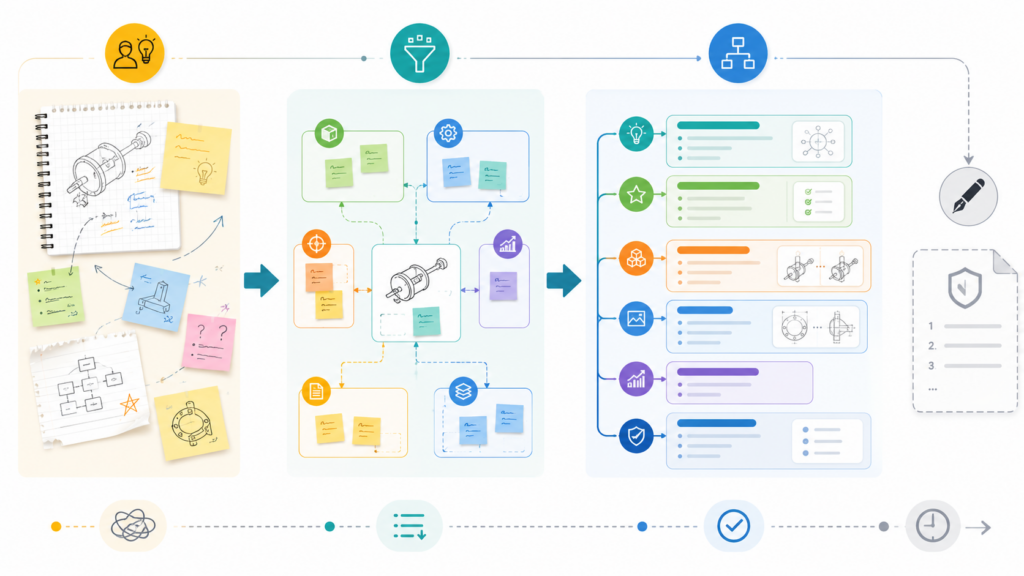
This map is a simple plan for what the patent should cover. It helps the team agree on the main idea before time is spent writing long sections.
A draft map is useful because patents can drift. Without a map, the draft may focus too much on background, too little on the invention, or too much on one product example.
A map keeps everyone aligned. It shows what the attorney plans to claim, what examples will support those claims, what drawings may be needed, and what terms need careful wording.
The Draft Map Should Name The Core Idea In Plain Words
Before legal language enters the picture, the team should be able to say the invention in one clear sentence.
This sentence does not need to sound fancy. In fact, it should not sound fancy. It should sound like something a smart founder could explain to a new engineer on the team.
The sentence might say that the system detects a weak signal from noisy sensor data before taking an action. It might say that the software changes how a model ranks results based on a special feedback loop.
It might say that a device reduces power use by changing modes based on a certain event. The words should be simple, but the meaning should be exact.
This plain sentence becomes the anchor for the review. If a later claim does not match it, the team can ask why.
If a drawing does not support it, the drawing can be fixed. If the draft spends too much time on side details, the team can bring it back to the anchor.
For founders, this step is also a great test of business value. If no one can explain the invention clearly, the draft is not ready. The team may need one more invention call. That small pause can save days of cleanup later.
The Draft Map Should Separate The Must-Have Parts From The Optional Parts
Every invention has parts that matter more than others. Some parts are required for the invention to work. Some parts are only examples. Some parts are nice add-ons. Some parts are only there because of the current product design.
The review workflow should separate these early. This helps avoid a common patent problem: putting too many details into the main claim.
When that happens, the patent may become too narrow. A competitor may be able to avoid it by changing one small detail.
The team should look at each part and ask a simple question. Does the invention still work without this?
If the answer is yes, that part may belong in a later claim or an example, not the main claim. If the answer is no, it may belong closer to the center.
This is where attorney oversight matters. Software can help organize the parts. Inventors can explain what is important. But a skilled patent attorney can help decide how to place those parts so the draft has strength and room.
PowerPatent brings those pieces together so founders do not have to choose between speed and care. Learn more here: https://powerpatent.com/how-it-works
The Draft Map Should Plan The Drawings Before The Full Draft
Drawings are not decoration. They are part of the review workflow. They help everyone see whether the invention has been captured clearly.
For software, the drawings may show system blocks, data flow, model training flow, user flow, or decision logic. For hardware, they may show parts, connections, movement, signals, or physical structure.
The draft map should list the drawings before the full draft is written. This helps the attorney see what needs support. It helps the inventor spot missing steps. It also helps reviewers understand the invention faster.
A good drawing plan can prevent major confusion. If a claim says data moves from one module to another, the drawing should support that.
If the draft says the system updates a model after a user action, the drawing should show that loop. If the invention depends on timing, order, placement, or selection, the drawing should make that clear.
The Drawing Review Should Catch Gaps Before Words Hide Them
Words can hide weak spots. Drawings expose them.
When a team looks at a flow chart, it becomes easier to see if a step is missing. When a team looks at a system diagram, it becomes easier to see if a part has no clear role.
When a team looks at a device figure, it becomes easier to see if the draft describes a feature that is not shown.
This is why the drawing review should happen early. It should not be saved for the end. Late drawing fixes are painful because they can affect the claims, the detailed description, and the way the whole draft is framed.
The best review is simple. The inventor should be able to walk through each drawing and explain what happens.
The attorney should be able to point to each important claim idea and find support in the figures. If that cannot happen, the map needs more work before the full draft is written.
Build The First Draft Around The Claims, Not Around Pretty Writing
A patent draft is not a normal article. It is not a pitch deck. It is not a product page. The most important part is not whether the writing sounds smooth.
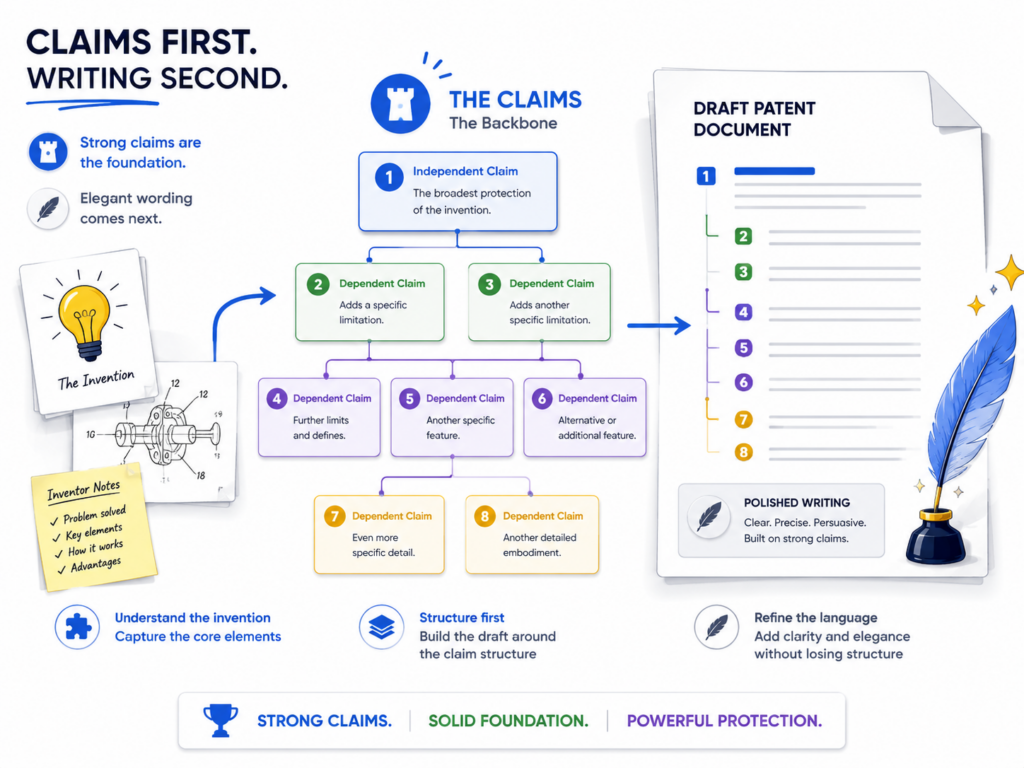
The most important part is whether the draft protects the right thing in the right way. That starts with the claims.
The claims are the part that defines what the patent is trying to protect. They are the center of the whole draft. Everything else should support them. The drawings should support them.
The detailed description should support them. The examples should support them. The terms should support them. When the claims are weak, unclear, too narrow, or aimed at the wrong idea, the rest of the draft can look polished and still miss the mark.
For a founder, this is the point where the review needs to become sharp. The question is not “Does this draft sound official?” The better question is “Would this stop a smart competitor from copying the valuable part of what we built?” That single question can change the whole review.
The First Claim Review Should Focus On The Business Risk
Many inventors review claims like they are checking a grammar paper. They look for missing words, typos, or awkward phrases. Those details matter later, but they are not the first concern. The first concern is business risk.
A strong claim should point at the part of the invention that a competitor would most want to copy. If the patent only covers a small product detail that is easy to change, it may not help much.
If the claim is packed with parts that are not needed, it may be too easy to design around. If the claim skips the true technical edge, it may fail to protect the company’s core value.
This is why the first claim review should be done with the founder mindset. The team should imagine a competitor looking at the product and trying to copy it without getting caught.
What would they keep? What would they change? What would they avoid? What would they copy because it creates the real user value?
That exercise helps the team test the claims. If a competitor could keep the main benefit while changing one small detail, the claim may need work.
If the claim protects a low-value feature while the core engine sits outside the wording, the draft needs to be adjusted before it goes further.
PowerPatent helps teams move through this kind of review with more control because the workflow is built for technical founders, engineers, and patent attorneys to work from the same source of truth.
The goal is not just to create a patent document. The goal is to protect the important part without making the process slow or confusing. You can explore the workflow here: https://powerpatent.com/how-it-works
The Claims Should Match The Thing You Would Hate To See Copied
The easiest way to review a claim is to ask one direct question. If another company used this exact method, system, or design, would you feel they copied the heart of your invention?
If the answer is yes, the claim may be aimed in the right place. If the answer is no, the claim may be focused on the wrong thing.
This test is simple, but it is powerful because it cuts through legal wording. It brings the review back to the founder’s real concern.
For example, a team may have built an AI tool that helps users find errors in technical documents. The first draft may claim the user interface because that is what the inventor described most clearly.
But the deeper value may be in how the system ranks likely errors, checks them against context, and learns from reviewer feedback. If the claim only covers the screen, it may miss the engine.
The same thing happens in hardware. A founder may describe the shape of a device because it is easy to see.
But the real edge may be a sensor layout, a heat path, a control loop, or a way of reducing wear. The claim review should keep digging until it finds the part that matters most.
The Draft Should Use The Claims As A Checklist For Support
Once the claims point in the right direction, the next job is support. Every important claim idea should be backed up in the rest of the draft. This is where many drafts fall apart.
The claims say one thing, but the description does not fully explain it. Or the drawings show only part of it. Or the draft uses a key word without making it clear enough.
A good review checks each claim piece against the description. If the claim says the system “selects” something, the draft should explain how selection may happen.
If the claim says the system “updates” a model, the draft should explain what causes the update, what may be updated, and what the result may be. If the claim says a device “moves” between states, the draft should describe those states and what triggers the move.
This does not mean the draft must lock itself into one tiny version. It means the draft should give enough support so the claims feel real, complete, and flexible.
The best drafts give examples without making the invention feel trapped inside only one example.
The Support Review Should Look For Silent Assumptions
Inventors often assume certain details are obvious because they live inside the product every day. But a patent draft cannot rely too much on what is “obvious to the team.” The reader may not know the product.
The patent office may not know the field in the same way. A future buyer, investor, judge, or competitor may read the document years later.
Silent assumptions create weak spots. The draft may say a system receives data, but not explain where the data comes from. It may say the system improves accuracy, but not explain what changes inside the process.
It may say a module sends an alert, but not explain what causes the alert. These gaps can make the draft harder to defend.
The review should look for places where the inventor says, “Well, of course it does that.” That phrase is a warning sign. If it matters, it should be in the draft.
The patent does not need to explain every tiny engineering detail, but it should explain the invention well enough that the important steps are not left to guesswork.
Review The Technical Story So The Patent Feels Real, Not Vague
A strong patent draft tells a technical story. It shows the problem, the old limits, the new approach, and the result. This story does not need to be dramatic.
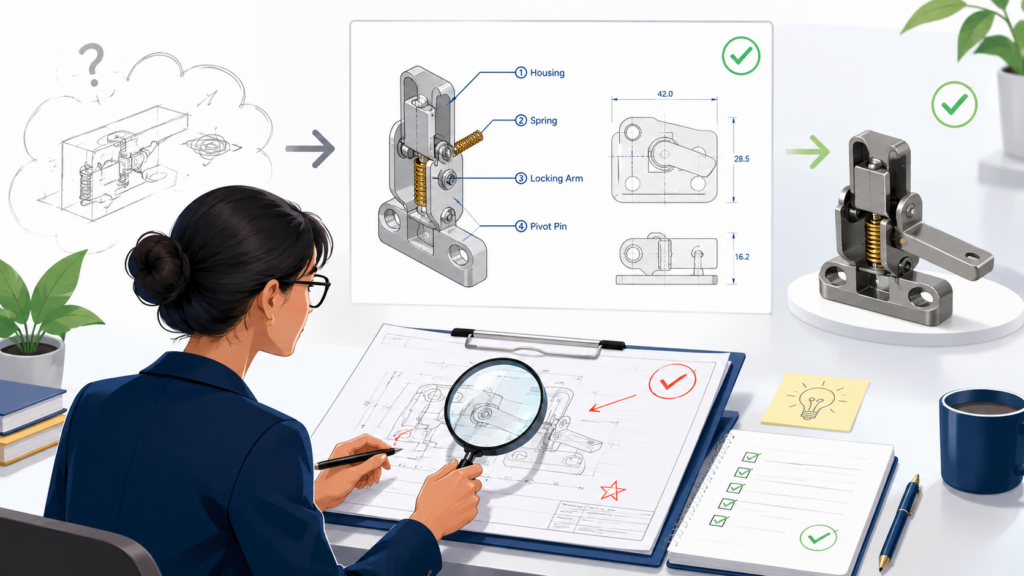
It needs to be clear. The reader should understand why the invention exists, how it works, and why the chosen path matters.
Vague drafts are dangerous. They may sound broad, but they often feel empty. They use big words without showing the real build.
They say the system “uses AI,” “optimizes performance,” or “improves results,” but they do not explain the steps that create the improvement. That kind of writing may look impressive at first glance, but it does not give the team strong protection.
The review should make the draft feel grounded. A founder should be able to read it and say, “Yes, this is what we built, and this is why it matters.” An engineer should be able to read it and see the logic.
An attorney should be able to read it and see enough support for the claims. When all three are true, the draft is moving in the right direction.
The Problem Section Should Be Sharp And Honest
The problem section should not be long. It should not try to teach the entire field. It should show the pain that led to the invention. This matters because the problem gives shape to the solution.
For example, if the invention is a faster way to process sensor data, the problem should explain why old processing methods were too slow, too noisy, too costly, or too hard to use in real time.
If the invention is a smarter review tool for code, the problem should explain what old tools miss and why those misses matter. If the invention is a new medical device workflow, the problem should explain the practical issue the device or method solves.
The review should remove background that does not help. Many drafts spend too much time describing the industry in a general way.
That can bury the invention. The better move is to keep the background tight and focused on the gap that the invention fills.
The problem should also avoid overclaiming. A patent draft does not need to say that every old method is bad. It should simply show where old approaches had limits. Honest writing is stronger than hype. It also gives the draft a more mature tone.
The Problem Should Lead Naturally Into The Invention
The best problem sections make the invention feel needed. After reading the problem, the reader should almost expect the solution. The draft should make the path feel logical.
If the problem is bad data, the invention should explain how the system finds, cleans, ranks, filters, or handles that data. If the problem is wasted power, the invention should explain how the device changes modes, cuts load, times an action, or shifts resources.
If the problem is slow review, the invention should explain how the system selects what needs human attention first.
This review step is simple but important. The team should read the problem and then read the main claim.
Do they match? Does the claim solve the stated problem? Does the description explain the link? If not, the draft may feel scattered.
PowerPatent’s workflow helps founders and attorneys keep this connection clear from the start. The goal is to avoid a draft that sounds official but misses the actual reason the invention matters.
See how PowerPatent helps teams move from technical detail to strong filing work here: https://powerpatent.com/how-it-works
The Detailed Description Should Explain The Engine
The detailed description is where the invention gets real. This section should not simply restate the claims in longer words. It should explain how the invention may work in practice.
For software, this may mean describing inputs, outputs, data structures, model steps, training flow, ranking logic, rules, feedback loops, user actions, permissions, devices, and system parts.
For hardware, it may mean describing parts, materials, positions, signals, movement, shapes, sensors, power flow, and use cases.
For biotech, robotics, climate tech, fintech, semiconductors, or medical tools, the description should explain the technical choices that make the invention useful.
The review should ask whether the draft explains the engine behind the result. If the draft says the system produces a better result, it should explain what inside the system helps create that result.
If the draft says the device is easier to use, it should explain what structure or step makes use easier. If the draft says the model is more accurate, it should explain what data, process, or update path helps accuracy.
The Draft Should Avoid Empty Result Words
Words like “better,” “faster,” “smarter,” “optimized,” and “improved” can be useful, but only if the draft explains what they mean. A patent draft should not rely on result words alone. It should show the mechanism.
For example, instead of only saying the system improves recommendations, the draft should explain that the system groups user actions, weights certain signals, removes stale inputs, and updates a score before generating the next recommendation.
Instead of only saying the device reduces heat, the draft should explain the airflow path, material choice, spacing, control step, or power adjustment that reduces heat.
During review, every result word should trigger a check. How does the invention create that result? Is the cause explained? Is there an example? Is there a drawing? Is there a claim path? This kind of review makes the draft stronger and less fluffy.
Founders should not be afraid to push for clarity here. If a sentence sounds fancy but does not tell you what happens, it should be rewritten.
Clear beats clever. Specific beats broad but empty.
Review The Draft From The Inventor’s View Before The Attorney’s Deep Edit
After the first full draft is ready, the inventor review should happen before the attorney does the deepest legal polish. This may sound backward, but it saves time.
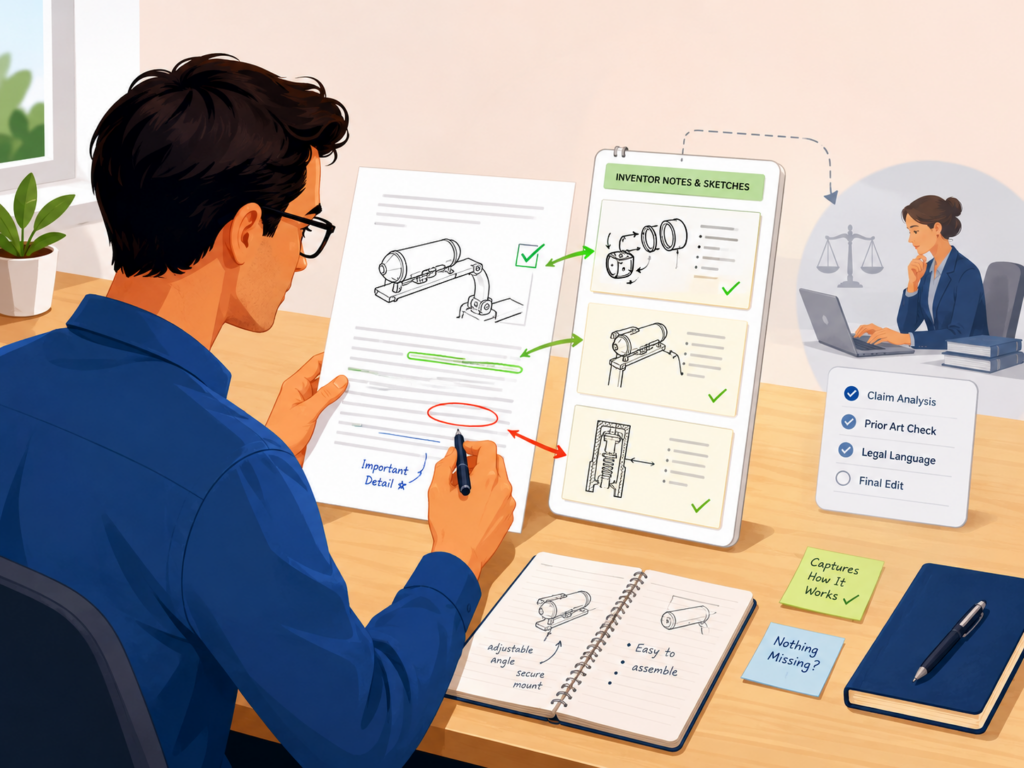
The inventor is the best person to catch technical mistakes, missing steps, wrong names, bad assumptions, and product details that do not match reality.
The inventor review should not try to rewrite the whole patent like a blog post. The goal is not style. The goal is truth, completeness, and fit.
The inventor should confirm that the draft describes the invention correctly and covers the versions that matter.
This review should be calm and structured. A rushed inventor review leads to shallow comments.
The inventor may only fix typos and miss major gaps. A careful review, on the other hand, can turn a decent draft into a much stronger filing.
The Inventor Should Read For Accuracy First
The first pass should be about accuracy. Does the system work the way the draft says it works? Are the steps in the right order?
Are the parts named correctly? Are the inputs and outputs right? Are optional steps described as optional? Are required steps described as required? Are the examples true?
This matters because small technical errors can create big problems later. A draft may describe a model update as happening before a user action when it actually happens after.
It may describe data as coming from a sensor when it actually comes from a third-party source. It may say a module is on a user device when it may run on a server. These may look like small details, but they can affect claim scope and support.
The inventor should mark anything that feels wrong, even if the wording sounds minor. The attorney can decide how to fix it, but the inventor should not stay silent. A patent draft is not the place to be polite about technical mistakes.
The Inventor Should Flag Where The Draft Is Too Narrow
Accuracy is not only about whether the current product is described correctly. It is also about whether the draft is too narrow.
Many first drafts lean too hard into the exact version the team built. That can be a problem if the invention could work in other ways.
The inventor should look for words that accidentally limit the invention. Words like “always,” “must,” “only,” “required,” or “the user clicks” can make the draft feel narrower than needed. Sometimes those words are correct. Often they are not.
For example, the current product may use a button click, but a later version may use voice input or automatic detection.
The current product may run in the cloud, but a later version may run on an edge device. The current model may use one type of training data, but the method may work with other data too.
The inventor should point these out in plain comments. A good comment might say that this step is one example, not the only way. Or that this component could be local or remote.
Or that the trigger could be manual or automatic. These comments help the attorney broaden the description where it makes sense.
This is exactly where a modern patent workflow can save founders from costly rework.
PowerPatent helps technical teams capture these comments in a more organized way, while attorney review keeps the final document grounded and useful. See the process here: https://powerpatent.com/how-it-works
The Inventor Should Review The Examples Like A Future Product Roadmap
Examples are powerful because they give the draft depth. They show how the invention can be used in real settings.
But examples can also become too narrow if they only describe one customer, one workflow, one data type, or one device.
The inventor review should treat examples like a smart product roadmap. The inventor should ask whether the draft includes the main version, near-term versions, and likely future versions.
This does not mean adding wild guesses. It means adding realistic paths the company may take.
For a software startup, that may include different user roles, data sources, model types, integration points, or deployment paths.
For a robotics startup, that may include different robot sizes, control modes, sensors, tools, or environments. For a climate tech company, that may include different energy sources, sites, signals, or control goals.
The point is to give the patent room to age well. A startup changes fast. The patent draft should not become outdated the moment the product changes.
The Inventor Should Add The “We Also Tried” Details
One of the most valuable things an inventor can add is what did not work. These details can show why the invention is not just a random idea. They can explain the hard path that led to the final design.
For example, the team may have tried a simple rule-based filter before creating a weighted scoring method. It may have tried a normal sensor layout before changing the angle or spacing.
It may have tried sending all data to the cloud before moving part of the process to the edge. These details can help the attorney understand what makes the invention meaningful.
The draft may not need every failed attempt, but the review should surface them. The attorney can decide which details help. Sometimes a small note about why one approach failed can make the invention story much stronger.
Founders often forget these details because they feel like old problems. But in patent work, those old problems can be gold.
They show the real thinking behind the invention. They also help the team explain the gap between the old way and the new way.
Run A Claim-To-Spec Review So Nothing Important Is Left Unsupported
After the inventor has reviewed the draft for technical truth, the next review should be more exact. This is the claim-to-spec review. “Spec” is a common short name for the written description and drawings.
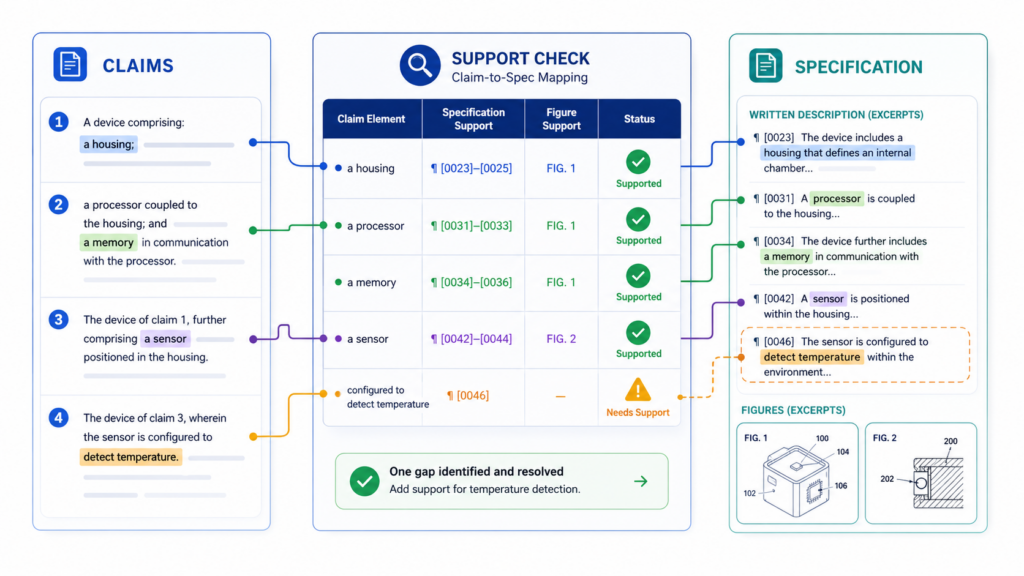
In simple terms, this review checks whether every important part of the claims is supported by the rest of the draft.
This step is not exciting, but it is one of the most important parts of the workflow. It is where the team catches gaps before filing. A claim may sound strong, but if the description does not back it up, the draft may be weaker than it looks.
A claim may use a word that seems clear to the team, but the description may not explain it well enough. A claim may include a step that was never shown in a figure.
A careful claim-to-spec review makes the patent draft feel connected. The claims, drawings, and description should not feel like separate documents. They should feel like one clear story.
Each Claim Term Should Have A Home In The Draft
Every key claim term should appear in the description in a useful way. It is not enough for a word to appear once. The draft should explain what the word means in the context of the invention and how it may work.
For example, if a claim uses the term “confidence score,” the description should explain what the score may represent, how it may be made, what inputs may affect it, and how it may be used.
If a claim uses “control signal,” the description should explain what the signal may control and what may cause it. If a claim uses “training event,” the description should explain what kind of event may count and how the system responds.
This review should be done with patience. The team should not assume that a claim term is safe just because it sounds normal.
A term can be common and still need context. The question is not whether the word exists in the field. The question is whether this draft supports the way the claim uses it.
The Review Should Check For Matching Language Without Becoming Robotic
There should be a healthy match between the claims and the description. If the claims use one phrase and the description uses a totally different phrase for the same thing, the draft can become confusing. The review should catch that.
At the same time, the draft should not become robotic. It should not simply copy the claims over and over. The description should explain, expand, and give examples. It should support the claims in natural language.
This is a balance. The attorney may use careful wording in the claims, while the description gives more detail in plain technical terms.
The inventor does not need to control this balance alone. The inventor’s job is to spot places where the wording seems to point to the wrong thing or where a key idea has no clear support.
PowerPatent helps make this kind of review easier because the workflow is built to connect invention notes, draft content, attorney review, and founder feedback.
That means fewer lost comments and fewer late surprises. Learn more here: https://powerpatent.com/how-it-works
The Drawings Should Support The Claim Path
A claim should not feel disconnected from the drawings. The drawings do not need to show every possible version, but they should support the main path. If a claim covers a system, there should be a figure that shows the system parts.
If a claim covers a method, there should be a flow that shows the steps. If a claim covers a device, there should be a figure that shows the parts and how they relate.
During review, the team should read each main claim and then look at the drawings. Can the team point to the parts? Can the team follow the steps?
Can the team see the loop, signal, action, or structure that matters? If not, a drawing may need to be added or changed.
This step is especially useful for software and AI inventions. Many software patents become hard to follow because the draft describes abstract modules without showing how data moves.
A simple flow chart can make the invention easier to understand. A system diagram can show where the model runs, where the data comes from, and where the output goes. A training flow can show how the system improves over time.
The Review Should Catch Figure Labels That Create Confusion
Figure labels may seem small, but they affect readability. If the same part has different names in different figures, the review becomes harder.
If the text refers to a part number that does not appear in the drawing, the draft feels sloppy. If a figure includes a part that is never explained, the reader may wonder why it is there.
The review should catch these issues before final approval. The team should make sure part names, numbers, and descriptions line up. This makes the draft easier to read and easier to trust.
A clean figure set also helps future work. If the company files more patents later, clear figures and terms can become a useful base.
They help the team keep language consistent across related inventions. This is a small process win that can become very valuable as the patent portfolio grows.
Use A Red-Team Review To Test How A Competitor Might Design Around The Draft
After the draft looks accurate and supported, the team should test it from the outside. This is the red-team review.
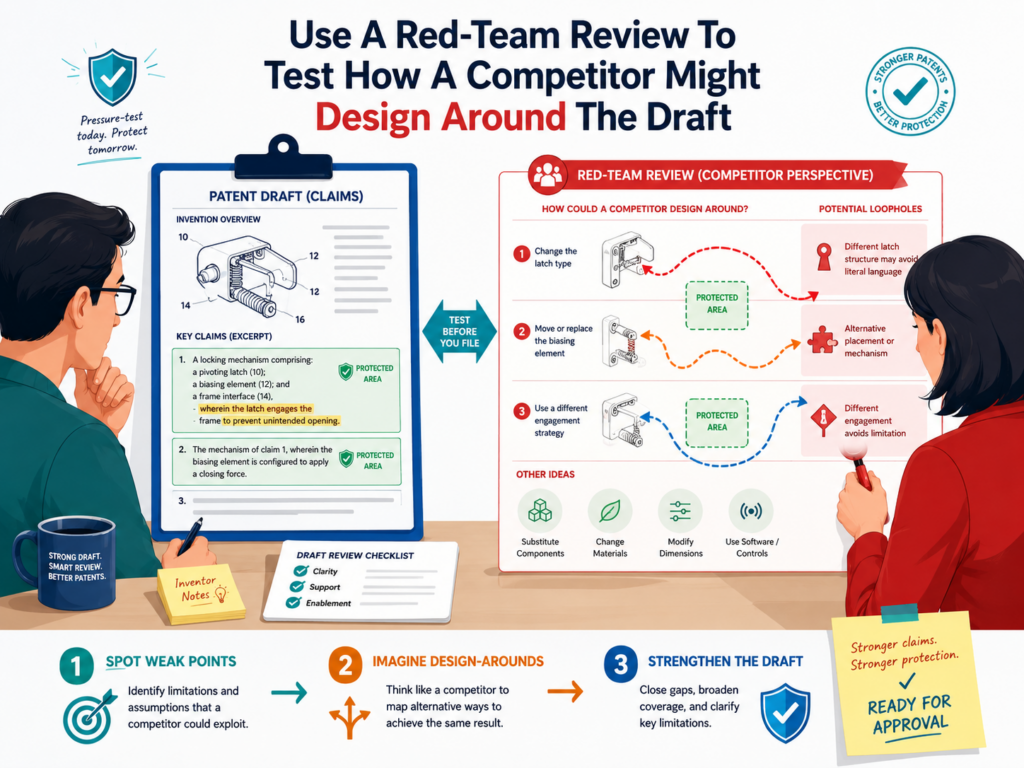
The goal is to think like a competitor. That may feel strange, but it is one of the best ways to find weak spots.
A normal review asks whether the draft describes the invention. A red-team review asks whether the draft would still matter if someone tried to copy the value while changing the details.
This is the difference between a patent that looks nice and a patent that may actually help protect the business.
This review does not need to be hostile. It should be practical. The team should imagine a smart competitor reading the patent and looking for a way around it.
Where would they attack? What would they change? What part would they claim is different? What part would they copy because it gives the same result?
The Red-Team Review Should Start With The Most Likely Copycat Path
The first question is simple. How would someone copy this without copying it exactly?
A competitor rarely copies every detail. They may change the user interface. They may use a different model. They may move a process from the cloud to a device. They may replace a rule with a score.
They may use different sensors. They may change the order of two steps. They may rename the modules. They may combine two parts into one.
The review should test whether the claims still matter after those changes. If a small change avoids the claim while keeping the main benefit, the claim may be too narrow.
If the description does not support broader wording, the draft may need more examples. If the drawings only show one version, the team may need to add another figure or explain alternatives in the text.
This is where the workflow becomes strategic. The goal is not just to file something. The goal is to file something that maps to real market risk.
For a startup, this can matter during fundraising, partnerships, acquisition talks, and competitive fights.
The Team Should Test The Claim Against Product Substitutes
A strong review looks beyond exact copies. It also looks at substitutes. A substitute is a different way to give the customer a similar result.
For example, if the invention ranks alerts using a special score, a competitor may group alerts instead of ranking them.
If the invention updates a model after user feedback, a competitor may update a rules engine instead. If the invention changes device power based on sensor input, a competitor may use time-based prediction instead of direct sensor input.
The team should ask whether these substitutes are close enough to worry about. Not every substitute needs to be covered. A patent cannot and should not cover the whole market.
But if a substitute is an obvious copy path, the draft should at least be reviewed for whether it can support broader or alternate coverage.
PowerPatent’s mix of smart tooling and real attorney oversight is useful here because this is not just a writing task. It is a strategy task.
The platform helps technical teams move fast, while attorneys help shape the filing into something more useful than a generic document. You can see how that works here: https://powerpatent.com/how-it-works
The Red-Team Review Should Look For Easy Word Changes
Sometimes a claim is easy to avoid because it uses words that are too tied to one version.
A competitor may be able to argue that their product does not have the same “module,” “database,” “server,” “threshold,” “score,” “sensor,” or “user action” because they use a slightly different structure or label.
The review should not panic over every word. But it should ask whether the words are doing the right job. Are they broad enough where they should be broad?
Are they specific enough where they need to be specific? Are they tied to the product because they must be, or only because the first draft copied product language?
Product language is often too narrow for patents. A product team may use internal names, brand terms, feature names, or code names.
Those terms may be useful during invention capture, but they usually need to be translated into more general technical language for the draft.
The Final Red-Team Question Is Whether The Patent Still Feels Valuable After A Design Change
At the end of this review, the team should make one final check. Imagine the competitor changes the look, the labels, and one or two steps, but keeps the same core value. Does the patent still feel useful?
If the answer is yes, the draft is likely in a better place. If the answer is no, the team should decide whether the draft can be improved before filing. Sometimes the fix is a claim change.
Sometimes it is more support in the description. Sometimes it is another example. Sometimes it is a new drawing. Sometimes it is a separate filing for a different invention path.
This kind of review is where founders start to feel real confidence. They are no longer just approving a document because it looks official.
They are approving it because they understand what it covers, why it matters, and how it fits the company’s risk.
Review The Draft For Breadth Without Making It Loose
A strong patent draft needs room. It should not cover only one tiny product screen, one exact code path, or one narrow build. Startups move fast.

The product that exists today may look different in six months. The draft should protect the invention in a way that can still matter as the product grows.
But breadth is not the same as vague writing. A draft can sound broad and still be weak. This happens when it uses big, general words but does not explain the real method, structure, or logic.
The goal is not to make the draft sound large. The goal is to give it a strong center and smart range around that center.
A good review asks whether the draft covers the invention at the right level. If it is too narrow, a competitor may step around it. If it is too loose, the patent office may push back, or the draft may not feel tied to a real invention.
The best draft sits in the middle. It is clear enough to be real, but broad enough to protect more than one version.
The Review Should Separate Real Breadth From Fake Breadth
Real breadth comes from support. Fake breadth comes from empty words. This is an important difference.
A draft has real breadth when it explains several ways the invention can work. It may describe different data sources, different model types, different device forms, different triggers, different user roles, different hardware layouts, or different ways to carry out a step.
These are not random extras. They are useful paths that show the invention can live in more than one form.
A draft has fake breadth when it says the invention can be used “in any system” or “with any data” but does not explain how.
That kind of language may look helpful, but it often adds little value. It can make the draft feel thin because the words reach wider than the details.
During review, the team should look for broad statements and ask whether the draft backs them up. If the draft says a method can work across many devices, it should give examples of those devices.
If it says a model can be updated in different ways, it should explain at least a few update paths. If it says an alert can be sent to many user types, it should explain why those users matter and how the alert may change.
Broad Language Should Still Feel Anchored To The Invention
The best broad language does not float away from the invention. It stays anchored. It keeps pointing back to the technical idea that makes the invention useful.
For example, a draft for an AI review tool should not merely say the system works with “documents.” It should explain how the system handles different document types while still using the same core review method.
A draft for a sensor system should not merely say the system works with “signals.” It should explain how the signal is received, checked, changed, ranked, or used in the invention.
This type of review helps the team avoid two traps. The first trap is filing a narrow draft that only protects the current product. The second trap is filing a vague draft that tries to cover too much without enough detail. Both can hurt.
At PowerPatent, the workflow is built to help founders find this balance faster. Smart software helps organize invention detail.
Real attorney oversight helps shape that detail into a draft that can support stronger coverage. That means founders get speed without giving up care. See how the process works here: https://powerpatent.com/how-it-works
The Review Should Check Every Limit In The Main Claim
The main claim is usually where breadth matters most. Each word in that claim can affect what the patent may cover. That is why every limit should be reviewed with care.
A limit is any required part, step, or condition in the claim. If the claim says the system must use a camera, then a product without a camera may fall outside that claim.
If the claim says the system must receive a manual input, then a fully automatic system may fall outside it. If the claim says the model must be trained in one way, then a different training method may avoid it.
Some limits are needed. They make the invention clear. They show what is new. They give the claim shape. But some limits are there by accident.
They come from the current product, not from the invention itself. Those accidental limits can make the patent weaker.
The Simple Test Is Whether The Invention Still Works Without The Limit
The review should ask a plain question for each important limit. Does the invention still work if this detail changes?
If the answer is yes, the detail may not belong in the broadest claim. It may belong in a later claim, an example, or the description. If the answer is no, the detail may be central and may need to stay.
This is not a task the founder should handle alone. The founder brings product truth. The attorney brings claim strategy. Together, they can decide whether a detail is a must-have part of the invention or just one version.
This is where a good workflow saves time. Without a clear review process, teams debate wording too late, often right before filing. With a clear process, the team checks limits early and fixes narrow language before it becomes hard to unwind.
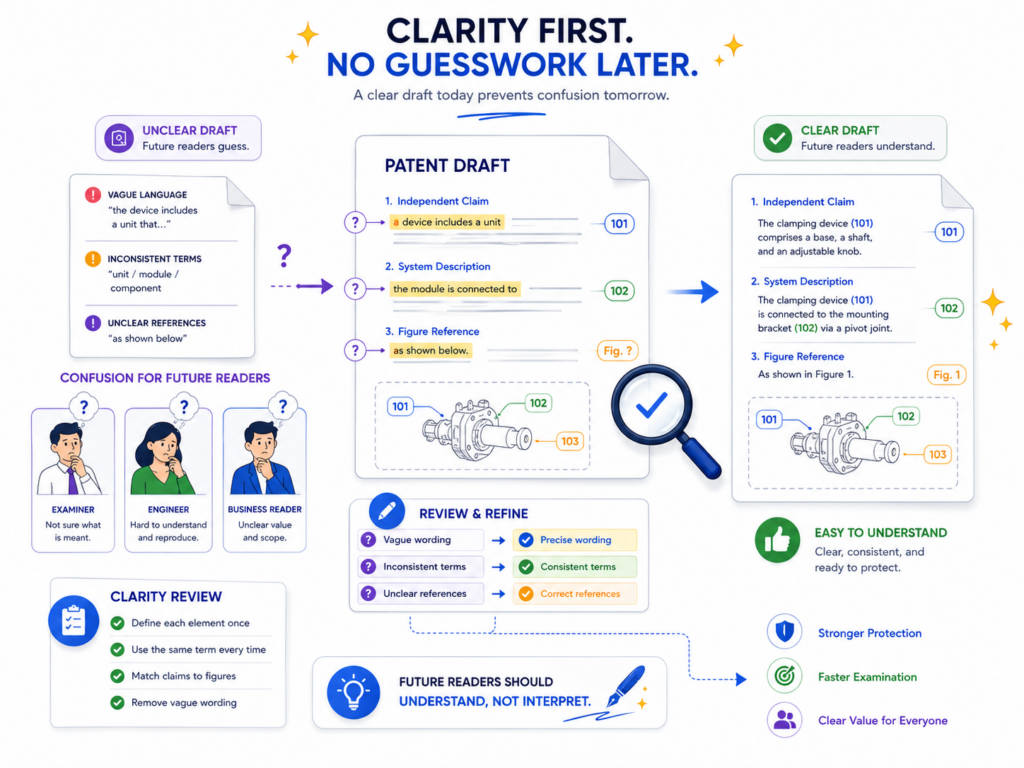
Review The Draft For Clarity So Future Readers Do Not Guess
A patent draft has many future readers. The patent office will read it. Investors may read it. A buyer may read it during diligence.
A partner may review it before a deal. A competitor may study it. A court may read it years later. The inventor may even come back to it after the product has changed.
That is why clarity matters. A draft that only makes sense to the original team is not good enough. The draft should explain the invention in a way that a skilled reader can follow without guessing.
Clarity does not mean dumbing the invention down. It means removing avoidable confusion. It means using names in a steady way.
It means explaining steps in a clear order. It means showing how parts connect. It means saying what matters and not hiding the invention inside heavy wording.
The Review Should Remove Product Nicknames And Internal Terms
Most startups use internal terms. A team may call a feature “the brain,” “the picker,” “the cleanup layer,” “the magic score,” or “the green path.” These names can be useful inside the company, but they can confuse a patent draft.
A patent should use clear technical names. Instead of “magic score,” the draft may say “confidence score,” “risk score,” or “match score,” depending on what the value means.
Instead of “brain,” the draft may say “decision engine,” “machine learning model,” “control module,” or “selection logic.” The right term depends on the invention.
The review should find internal names and replace them with terms that make sense outside the company. This does not mean making the words cold or complex. It means using simple names that describe function.
This step also helps future portfolio work. If a company files more patents later, clear terms make it easier to keep the story consistent.
A messy naming system can create confusion across filings. Clean language helps the whole IP strategy feel more mature.
A Clear Term Should Tell The Reader What The Part Does
A good term should carry meaning. “Processing module” may be too vague if the module does a special kind of work. “Ranking module” may be clearer if the module ranks items.
“Signal filter” may be clearer if it filters sensor signals. “Feedback update engine” may be clearer if it updates a model based on feedback.
During review, the team should ask whether each key name tells the reader enough. If a name is too broad, the description should explain it.
If a name is too narrow, the attorney may adjust it. The goal is not perfect wording on the first try. The goal is to make sure no important part is hidden behind a lazy label.
PowerPatent helps because inventor notes, draft terms, and attorney edits can stay connected in one smoother process. That helps teams avoid scattered comments and lost context.
For founders who want to protect serious technical work without getting buried in old-school back-and-forth, this makes a real difference. Learn more here: https://powerpatent.com/how-it-works
The Review Should Make The Order Of Steps Easy To Follow
Many inventions involve steps. Data is received, changed, checked, scored, stored, sent, displayed, or used to control something.
A device moves from one state to another. A model learns from one event and then changes later behavior. A user action triggers a system action. Order matters.
The review should check whether the draft explains the order clearly. If steps can happen in different orders, the draft should say so.
If one step must happen before another, that should be clear. If steps can happen at the same time, that should be explained too.
Confusing step order can create problems. It can make the invention hard to understand. It can make the claims feel mismatched with the description. It can create narrow wording by accident.
For example, if the draft always describes a manual review before an automatic score, it may not support a version where the score comes first and the review happens only for risky cases.
The Draft Should Say When Order Is Flexible
A lot of software inventions are not locked to one order. Some steps may happen in parallel. Some may happen only when needed.
Some may happen at setup, while others happen during use. Some may happen on a server, device, or both.
The review should find places where the order is flexible and make sure the draft does not accidentally make it fixed.
This can be done with careful wording and good examples. The goal is to describe the real invention without trapping it inside one flow chart.
This matters even more for fast-moving startups. Product flows change. Infrastructure changes. The team may move a step from the back end to the front end. It may make a manual step automatic.
It may run a process in batches instead of real time. The patent draft should support those changes when they are part of the same invention idea.
Review The Draft For Prior Art Risk Without Freezing The Team
Prior art means earlier public information that may be close to the invention.

It can include patents, papers, products, manuals, videos, open-source projects, blog posts, or other public work. A draft review should consider this risk, but it should not turn into panic.
The goal is not to prove the invention is perfect before writing anything. The goal is to understand the closest known work and shape the draft around what is truly different.
This makes the patent stronger. It also helps the team avoid claiming old ideas too broadly.
Founders sometimes fear this step because they think finding similar work means the invention is dead. That is not always true.
Many strong inventions improve on old systems. The key is to find the real difference and explain it well.
The Review Should Compare The Invention To The Closest Known Work
The most useful question is not “Has anyone done anything in this field?” In most fields, the answer is yes. The better question is “What is the closest thing, and how is our approach different in a way that matters?”
This keeps the review focused. If the invention is an AI tool for document review, the team does not need to panic because other document tools exist.
It needs to understand what those tools do and how this system handles review in a different way. If the invention is a battery control method, the team does not need to panic because battery control exists.
It needs to identify the special control path, trigger, signal use, or system behavior.
The draft should then make that difference clear. It should not hide the core distinction under generic wording. If the new value comes from a certain data path, the draft should explain that path.
If it comes from a control timing method, the draft should explain timing. If it comes from reducing false alerts, the draft should explain the signal logic behind that result.
The Draft Should Not Overstate What Is New
A strong draft does not need hype. It does not need to claim that the company invented the whole field. It needs to describe the specific improvement with care.
Overstating novelty can create risk. It may make the draft sound less credible. It may distract from the real invention. It may invite pushback.
The better approach is precise confidence. The draft should show what the invention does, what makes it different, and why that difference matters.
This is another place where attorney oversight is important. Founders know the product and the market. Attorneys know how claim language may be read and challenged.
PowerPatent brings both sides into a faster review process, helping teams avoid the slow, unclear, and expensive patterns that often hurt patent filings. See how PowerPatent supports this process here: https://powerpatent.com/how-it-works
The Review Should Use Prior Art To Improve The Claims
Prior art should not only be treated as a threat. It can also be a guide. It can help the team see where the claim should focus.
If old systems already collect data, the claim may need to focus on how the data is changed or used. If old systems already train models, the claim may need to focus on a special feedback loop or update condition.
If old devices already include a sensor, the claim may need to focus on the placement, signal use, control logic, or physical result.
This makes the claim more honest and more useful. It helps avoid broad claims that are easy to reject. It also helps avoid narrow claims that miss the true point.
The Review Should Keep The Team Moving
Prior art review can become a rabbit hole. There is always more to search. There is always another paper, patent, or product. A startup cannot stop building while it waits for perfect certainty.
The workflow should be practical. Review the closest known work. Use it to sharpen the draft. Capture the technical difference. Then move forward with attorney guidance.
This is how founders protect momentum. The team does not ignore risk, but it also does not freeze. A good patent workflow gives enough structure to make smart filing decisions without slowing the company to a crawl.
Review The Draft For Commercial Fit Before Final Legal Polish
A patent draft can be technically correct and still miss the business. That is why commercial fit matters. This review asks whether the draft protects what the company actually cares about.
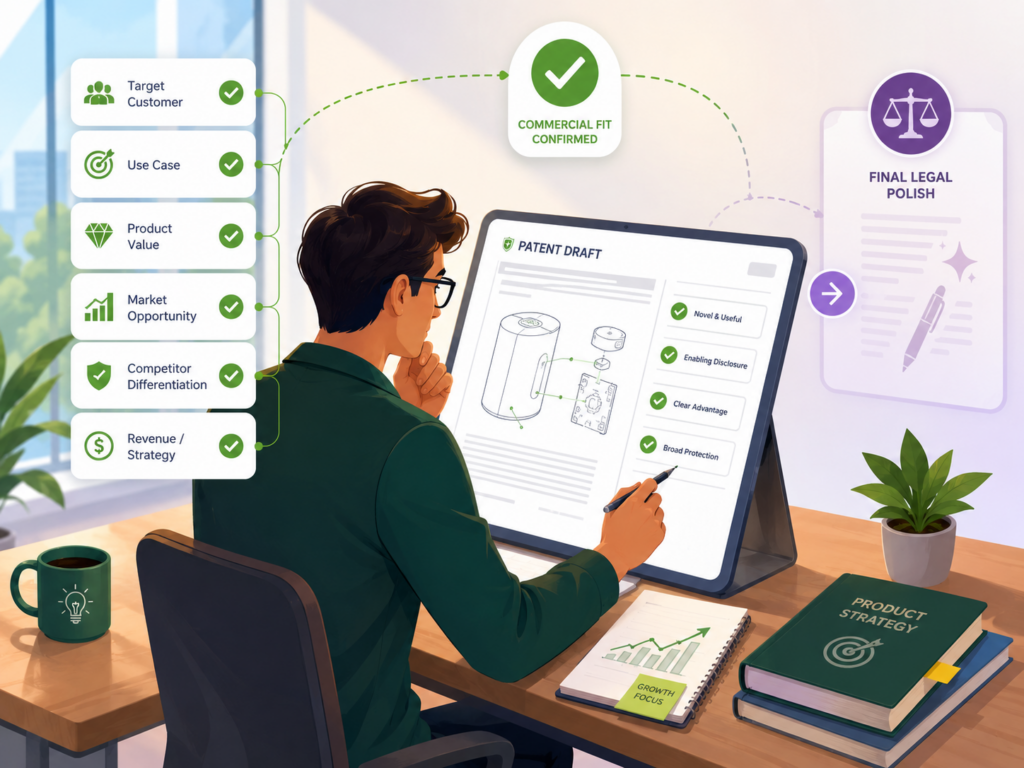
For startups, patents are not trophies. They are tools. They can help with fundraising, partnership talks, customer trust, market defense, acquisition value, and long-term leverage. But they only help if they are aimed at the right part of the business.
A commercial fit review connects the draft to the company’s strategy. It asks what product line the patent supports, what market risk it addresses, what roadmap it protects, and what value it may create later.
This step should happen before final legal polish because business comments can still change the claim focus, examples, and framing.
The Review Should Start With The Company’s Most Important Use Case
Every invention may have many use cases, but one or two usually matter most to the business. The draft should not ignore them.
For example, an AI startup may use the same core engine for sales teams, legal teams, and healthcare teams.
But the first commercial use may be healthcare. If that is where the revenue, risk, or investor interest sits, the draft should include examples that support that market.
A robotics company may use the same control method in warehouses and farms, but its first major partner may be in logistics. The draft should make sure that use case is covered.
This does not mean the patent should be limited to one market. It means the important market should be clearly supported.
A patent that covers everything in theory but does not speak well to the company’s main business can feel less useful.
The Draft Should Match The Roadmap Without Revealing Too Much
A patent draft should support future plans, but it should be careful. It should not read like a secret roadmap dumped into public view.
Once a patent publishes, others may read it. The team should include enough detail to support the invention, but not unnecessary business secrets that do not help the patent.
This balance matters. The draft should describe technical paths that support future claims and examples.
But it does not need to reveal pricing plans, customer names, launch dates, internal metrics, or private go-to-market plans. Those details usually do not belong in a patent.
The review should ask whether each business detail helps the filing. If it supports the invention, keep it in technical form. If it is just company strategy, keep it out.
PowerPatent is built for founders who need this balance. The platform helps turn technical work into patent-ready material, while real attorneys help decide what belongs in the filing and what should stay internal.
You can see the founder-focused process here: https://powerpatent.com/how-it-works
The Review Should Ask Whether The Patent Supports Fundraising And Diligence
Investors often want to know whether a startup has protected its core technology. A strong patent filing can help tell that story. But the filing should match what the company claims is important.
If the pitch deck says the company has a unique AI engine, but the patent mostly covers a user dashboard, there is a mismatch.
If the company says its value is in a device control method, but the patent focuses mostly on a housing shape, there may be a gap. If the company says its advantage is a data pipeline, the draft should support that pipeline with real detail.
This review can be simple. The founder should compare the patent draft to the company’s investor story. Do they point to the same advantage? Do they support the same moat? Do they show the same technical edge?
The Patent Should Help Explain Why The Company Is Harder To Copy
A good patent filing should make the company’s edge easier to explain. It should help a founder say, “This is the part we built that others cannot easily copy without stepping into our protected space.”
That does not mean the patent does all the work. A moat can also include data, speed, brand, customers, know-how, and execution.
But the patent should support the technical side of the moat. It should make the company’s special work visible in a controlled, formal way.
This is why the draft review should not be treated as a legal chore. It is a business asset review. The founder should care about it the same way they care about product, fundraising, and key customer contracts.
Run The Final Approval Review With A Clean Decision Process
Final approval should not feel like chaos. By this point, the team has reviewed the invention, claims, support, drawings, clarity, prior art risk, and business fit.
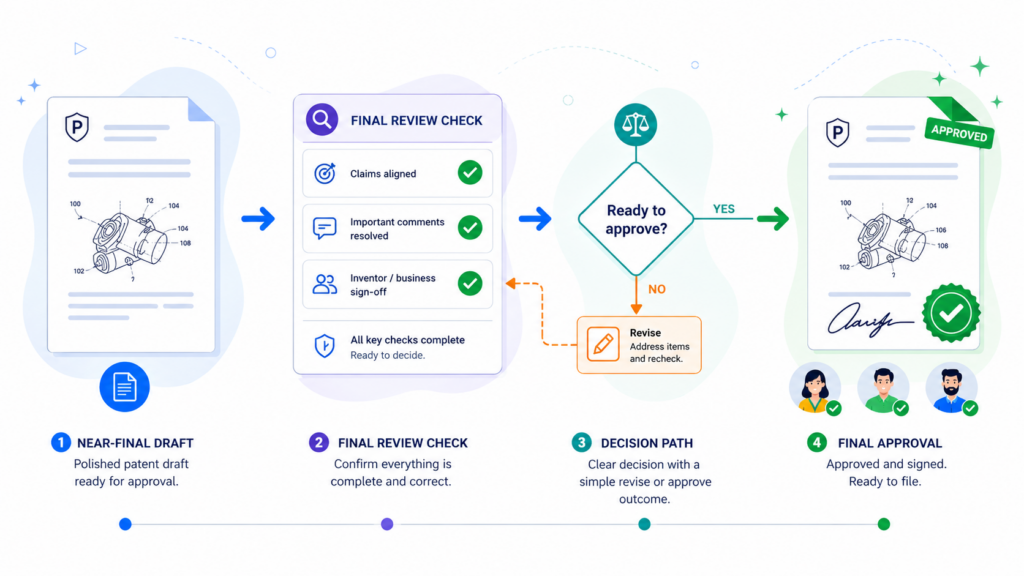
The final review should bring everything together and decide whether the draft is ready to file.
This step should be calm, focused, and clear. The goal is not to reopen every old debate. The goal is to confirm that the important issues have been handled and that the team understands what is being filed.
Many teams struggle here because final review happens under pressure. A public launch is coming. A fundraise is active.
A disclosure deadline is near. A founder is traveling. An engineer is busy. Comments come in late. Versions get mixed up. The process becomes stressful.
A better workflow avoids that. It gives final approval a clear path.
The Final Review Should Focus On Open Issues, Not Fresh Rewrites
At final approval, the team should look at open issues. These are the questions that were raised earlier and still need a decision. Maybe the team needed to confirm whether a step could happen on-device.
Maybe the attorney needed to broaden an example. Maybe the inventor needed to check a drawing. Maybe the founder needed to decide whether to include a future use case.
The final review should close those loops. It should not become a full rewrite unless something serious was missed. If the workflow has been done well, most major issues should already be handled.
This matters because late rewrites create risk. A rushed change can break support. A last-minute claim edit can create mismatch with the description.
A new example can require drawing changes. Final approval should be careful, not frantic.
The Team Should Know What Changed Since The Last Version
Version confusion is one of the most common causes of bad final reviews. A founder may review one draft while the attorney edits another. An inventor may comment on an old version.
A paralegal may update drawings while someone else changes part names. This leads to mistakes.
The final approval process should make changes easy to see. The team should know what changed, why it changed, and whether the change solved the issue. This does not require a complex system, but it does require discipline.
PowerPatent’s modern workflow helps reduce this kind of friction by giving teams a clearer path from inventor input to attorney-reviewed filing material.
Instead of chasing scattered emails and stale attachments, founders can work through a more organized process built for speed and control. Learn how it works here: https://powerpatent.com/how-it-works
The Final Approval Should Confirm Filing Readiness
Filing readiness means the draft is ready enough to move forward. It does not mean every sentence is perfect. It means the team has made smart choices and understands the filing.
The founder should know what invention is being protected. The inventor should confirm the technical story is accurate. The attorney should confirm the draft is ready for filing.
The drawings should match the description. The claims should point to the core value. The examples should support the current and likely future versions. The team should understand any known tradeoffs.
This kind of approval gives confidence. It turns filing from a blind handoff into a clear business decision.
Final Approval Should End With Ownership, Not Guesswork
The final step is ownership. Someone should be responsible for saying yes. In a startup, this is often the founder, CEO, CTO, or head of product.
That person does not need to understand every legal detail, but they should understand the business purpose of the filing.
They should know why this patent matters. They should know what product or roadmap it supports. They should know what risk it helps reduce.
They should know that real attorney review has happened. They should feel confident that the team did not just file something to check a box.
That is the point of a strong patent draft review workflow. It turns raw invention notes into a serious filing through a process that is clear, fast, and strategic. It helps founders protect what they are building without losing momentum.
PowerPatent helps make this easier by combining smart software with real patent attorney oversight, so technical teams can move from idea to filing with more speed, less confusion, and more confidence. To see the full process, visit https://powerpatent.com/how-it-works
Conclusion
A strong patent draft review workflow gives founders more than a finished document. It gives them control, clarity, and confidence before they file. When inventor notes are cleaned up, claims are checked, drawings are reviewed, technical gaps are fixed, and attorney oversight is built into the process, the final patent is far more likely to protect what truly matters.
The goal is not to slow the company down. The goal is to protect the hard work while the team keeps building. PowerPatent helps make that path faster, clearer, and safer with smart software and real patent attorney review: https://powerpatent.com/how-it-works
Leave a Reply