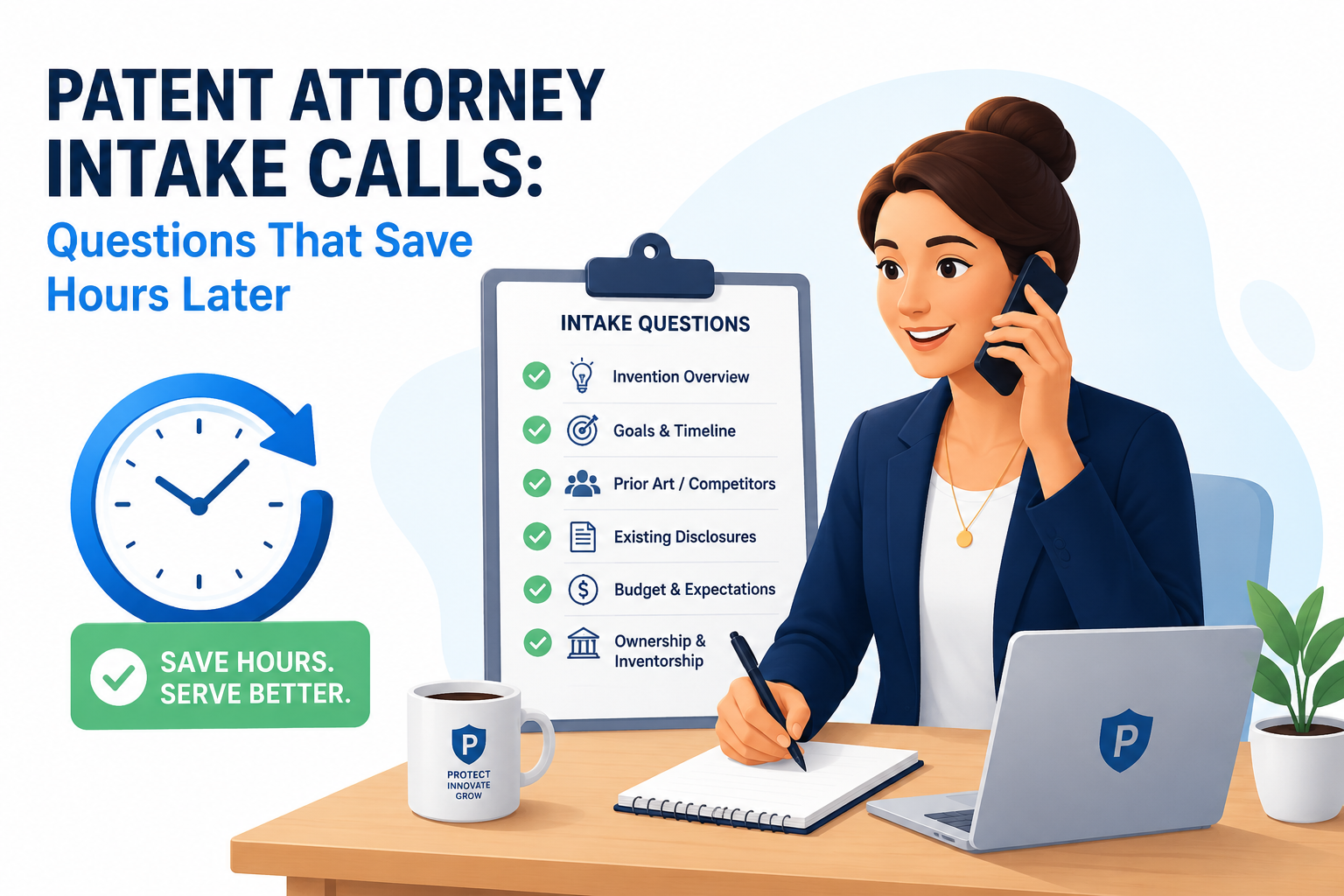
A patent attorney intake call can either save your team hours or create weeks of back-and-forth. The difference is simple: the right questions. In this guide, we will break down the questions that make patent intake calls sharper, faster, and more useful. We will show how founders can prepare, what attorneys should ask, and how platforms like PowerPatent help teams turn messy invention details into cleaner patent work with smart software and real attorney oversight.
Why Intake Calls Matter More Than Most Founders Think
A patent intake call is not just a first chat. It is the place where the whole patent path starts to take shape.
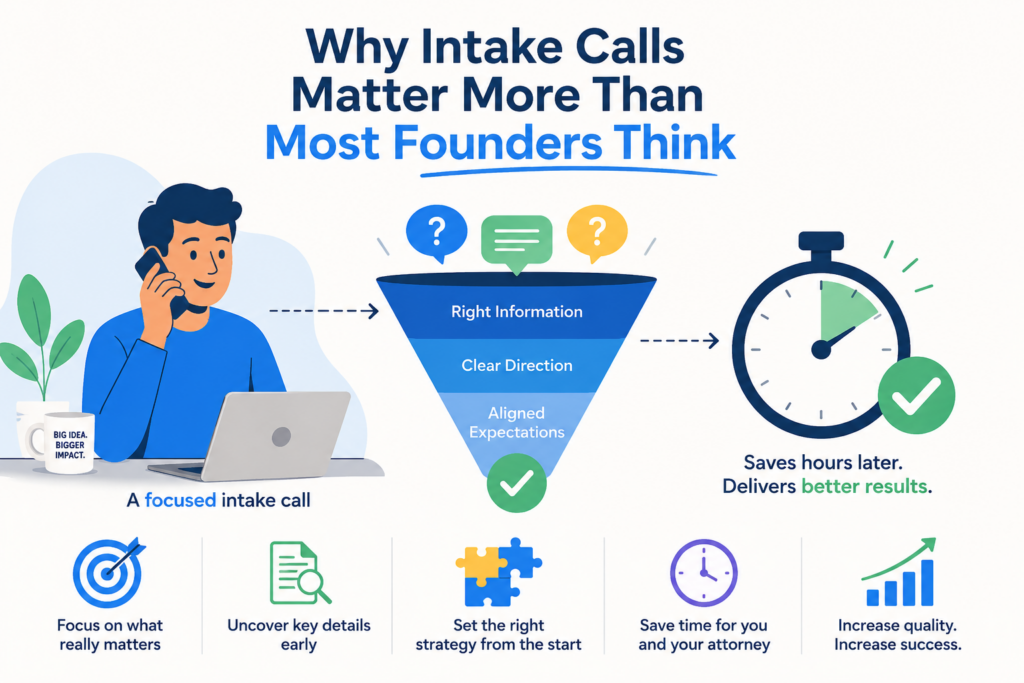
If the call is clear, the work after it becomes faster. If the call is vague, the work after it becomes messy. That is why a strong intake call can save many hours later.
For a startup, this is a big deal. Your team may be moving fast. Your engineers may be shipping new code. Your product may still be changing. Your model may be getting better every week.
Your hardware may have new parts, new settings, or new test results. In the middle of all that, it is easy for the real invention to get buried inside long notes, screenshots, demos, and half-finished ideas.
A good intake call pulls the invention out of that noise.
It helps the patent attorney understand what you built, why it matters, and how it is different from what came before. It also helps your team see the invention more clearly.
Many founders walk into the call thinking they have one idea. By the end, they often see that they may have several patent-worthy ideas hiding inside the same product.
That is where time is saved. The attorney does not have to guess. The founder does not have to keep repeating the story. The engineer does not have to answer the same question in five different emails. Everyone gets aligned early.
For deep tech teams, this is even more important. The value of the patent may depend on small details. It may be how data is cleaned before training. It may be how a sensor handles noise.
It may be how a model chooses one output over another. It may be how a robot corrects itself after a failed action. These details may sound small in a product meeting, but they can be central to a strong patent.
That is why the intake call should not feel like a casual intro. It should feel like a focused working session.
The intake call sets the quality of the whole patent process
The first call decides what gets noticed. If the right questions are asked, the attorney can spot the strongest parts of the invention.
If the wrong questions are asked, the team may spend hours writing about features that are not the real edge.
A weak intake call often leads to a weak invention record. The draft may come back with missing steps. The claims may focus on the wrong thing. The attorney may need more meetings.
Engineers may need to dig through old chats, code comments, lab notes, or design docs. This adds delay at the worst time.
A strong intake call works the other way. It turns scattered knowledge into a clear map. The attorney can see the problem, the old way, the new way, the key steps, the best use cases, and the business reason for protecting it.
This does not mean the founder needs to speak like a patent expert. They do not. In fact, the best intake calls are usually simple.
The founder explains the product in plain words. The attorney asks sharp questions. The team then gets to the core of the invention.
The best intake calls make the invention easy to explain
A strong patent does not start with fancy words. It starts with a clean story. What problem did you see? Why were the old ways not good enough? What did you build?
What happens inside the system? Why does it work better? Where could a competitor copy you?
These are simple questions, but they create strong answers.
For example, a founder may say, “We built a better way to match patients to trials.” That is useful, but not enough.
A better intake call will go deeper. It will ask how the matching works, what signals are used, what the system does when data is missing, how the output is ranked, and what part of the process gives the best result.
That deeper story is where the patent value often lives.
This is also where PowerPatent helps. Instead of forcing founders to start from a blank page, PowerPatent helps collect invention details in a cleaner way.
Smart software helps organize the idea, and real patent attorneys help review the work so the final path is not just fast, but also thoughtful. You can see how the process works here: https://powerpatent.com/how-it-works
Founders save time when they stop treating intake as a formality
Many founders treat the intake call as something to “get through.” They jump on the call, describe the product, answer a few questions, and move on. That can work for a simple idea, but it is not enough for serious technology.
The better move is to treat the intake call as a strategy session.
This is where you decide what matters most. This is where you decide what details need to be captured now, before the product changes.
This is where you find out whether the invention is one filing, several filings, or part of a larger patent plan. This is also where you can avoid wasting time on parts of the product that may not help you build a strong IP position.
A smart intake call is not about making the attorney understand every single line of code or every part number in the system. It is about giving the attorney enough of the right facts to protect the technical edge.
A strong call helps separate the product from the invention
One of the biggest time drains in patent work is mixing up the product with the invention. They are not always the same thing.
A product is what users see. The invention is often what makes the product work in a new way.
The product may be a dashboard, app, chip, lab tool, robot, model, API, or workflow. But the invention may be hidden under the surface.
For example, the product may be an AI tool that writes reports. The invention may be the way the system checks source data before generating the report. Or it may be the way it scores uncertainty.
Or it may be the way it adjusts output based on user edits. The user sees a report. The patent may need to protect the engine behind it.
This is why the intake call should always ask where the real edge lives. Is it in the data flow? The model design? The control logic? The interface?
The training loop? The device shape? The timing? The feedback step? The way pieces work together?
When this is clear early, the attorney can work faster. The founder gets better guidance. The engineer spends less time explaining things that do not matter.
A clear intake call reduces costly rework
Rework is one of the silent killers in patent projects. It does not always look dramatic. It may just be one more email.
Then another call. Then a revised diagram. Then a new example. Then a draft that has to be reshaped because the main invention was not clear at the start.
Each small fix takes time. Each delay increases the chance that the team gets busy, loses context, or ships a public update before the filing is ready.
This is why intake quality matters so much. A good call catches missing facts before they become draft problems.
It gives the attorney the right raw material. It helps the team decide what must be included, what can wait, and what should not be shared publicly until the filing plan is clear.
The real goal is fewer gaps later
The best intake calls are designed to find gaps. Not in a harsh way. In a helpful way.
The attorney is trying to learn what is known, what is unknown, and what still needs proof.
They may ask for examples, test results, diagrams, user flows, screenshots, data types, timing steps, system parts, and alternate versions. Each answer lowers the chance of confusion later.
This is also where founders get more control. When the intake process is organized, you are not waiting weeks to learn that something important was missing. You know sooner.
You can get the right engineer involved sooner. You can pull the right materials sooner. You can make better filing choices sooner.
For a startup, that speed is not just nice. It can protect your launch, your fundraise, your customer demos, and your market lead.
What A Patent Intake Call Must Do Before Anyone Starts Writing
A patent intake call should not rush into drafting. That is like building a house before checking the ground. The call must first create a clear base.
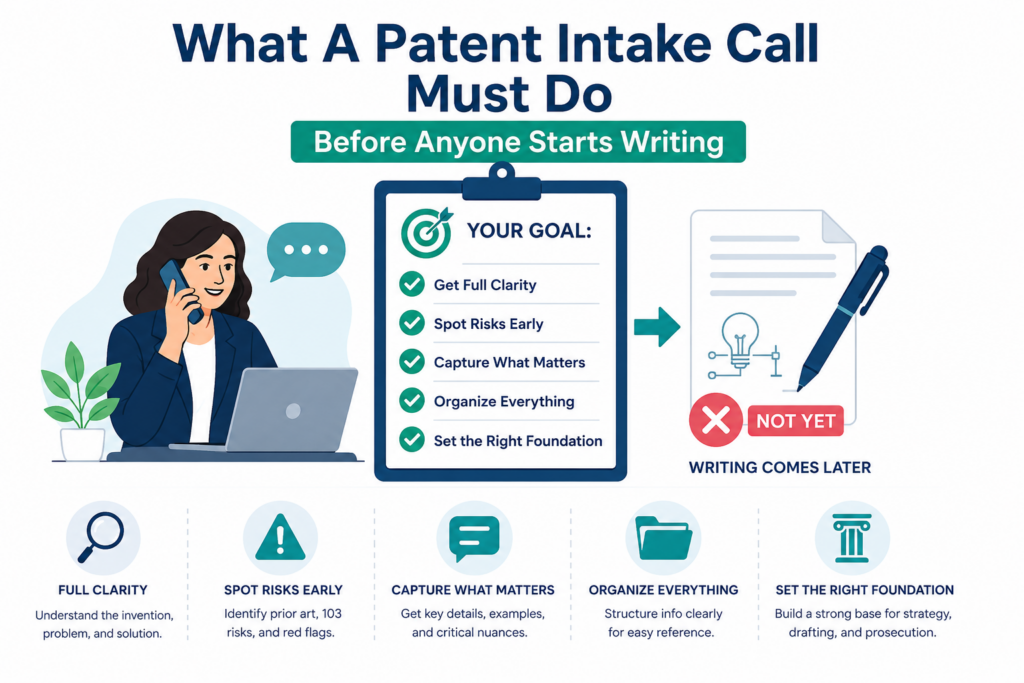
The attorney needs to understand the invention in plain words, then connect that story to the parts that may matter for a patent. When this step is skipped, the draft may sound polished but still miss the point.
The intake call has one job at the start: find the useful truth. Not the pitch deck version. Not the sales page version.
Not the big vision from the founder’s mind. The call must find what was actually built, what is planned soon, what works now, and what makes it different.
This is where many teams lose time. They talk about the market first. They explain why the product is exciting. They describe the customer pain.
All of that can help, but it is not enough. A patent attorney needs to know what the system does in a new way. The best calls move from the business story into the working details fast.
That does not mean the call should be cold or hard. It should feel like a smart conversation with a clear path. The attorney should help the founder slow down at the right moments.
When the founder says, “Our system predicts failures earlier,” the next question should not be, “What is your company vision?” It should be, “How does the system know a failure may happen?”
That is where the real work begins.
The call should turn the idea into a clean invention story
The first version of an invention is usually messy. That is normal. Founders speak in shortcuts because they live inside the product every day.
Engineers may describe the invention using internal names, model labels, tickets, or code words. The attorney may not know what those words mean yet.
A strong intake call turns those shortcuts into a clean story. It should make the invention easy to understand without making it weak or too simple.
The story should explain the problem, the old way, the new way, and the result. This gives the attorney the shape of the invention before going deeper.
For example, “We use AI to improve scheduling” is too broad. A cleaner story may be, “Our system predicts which jobs are likely to miss their target time, then changes the order of jobs based on live machine status and past delay patterns.”
That second version is still simple, but it gives the attorney something useful.
The call should keep moving toward that kind of clear language.
The best story is simple, but not shallow
Simple does not mean thin. It means understandable. A founder should not try to sound like a lawyer. In fact, that often makes the call worse. The best explanation sounds like one smart builder explaining the system to another smart person who has not seen it before.
The attorney should help make the idea sharper by asking what changes when the invention is used. Does it save time? Does it reduce errors? Does it make a machine safer?
Does it improve model output? Does it use less power? Does it avoid manual review? Does it work when data is messy? Does it adapt to new inputs?
These answers help show why the invention matters. They also help the attorney decide what details deserve the most attention.
The call should find the true technical edge
Many startup products have several features, but not every feature is the invention. The intake call must separate what is new from what is normal. This is not always obvious at first.
A founder may think the invention is the whole product. An engineer may think it is one small step. The attorney needs to pull both views together.
The true technical edge is the part that gives the product its special power. It may be a data step, a control rule, a training method, a hardware layout, a feedback loop, a safety check, a user action, or a mix of these.
The point is not to name it perfectly in the first five minutes. The point is to keep asking until the edge becomes visible.
This is also where a good intake call can save a lot of later work. If the edge is found early, the attorney can write toward it. If the edge is missed, the draft may focus on surface features and need major changes.
The edge is often hiding in the boring details
The strongest patent details are not always the parts that sound exciting in a demo. Sometimes the important part is the error handling. Sometimes it is the way the system decides when not to act.
Sometimes it is how the model handles missing data. Sometimes it is how the device stays stable under stress. Sometimes it is how the system updates without breaking the user flow.
These “boring” details can matter because competitors may copy them if they work. A good intake call should ask about the parts of the system that were hard to build, not just the parts that look good on screen.
That is why founders should bring someone technical to the call when possible. The founder can explain the business value.
The engineer can explain what was hard, what changed, and what made the system finally work. Together, they give the attorney a much better view.
The call should define what must be protected first
A startup may have more ideas than it can file at once. That is normal. The intake call should help decide what deserves attention now. This is a strategic choice, not just a paperwork choice.
The best first filing often protects the part of the technology that is closest to the company’s core advantage.
It may also cover something that will be shown soon, sold soon, published soon, or used in a customer pilot. If the team is about to reveal the invention, timing matters. The intake call should bring that out early.
This is where PowerPatent can make the process much smoother. Founders can move invention details into a guided workflow, then get real attorney review so the team is not guessing what matters.
That mix of software and attorney oversight helps teams move faster while still keeping the work serious. You can explore the process here: https://powerpatent.com/how-it-works
The first filing should match the business risk
The intake call should ask where a competitor would hurt the company most. Would they copy the core system? Would they copy the data method? Would they copy the user flow?
Would they build a cheaper version using the same logic? Would they sell into the same customers with the same technical promise?
These questions help shape the patent plan around business risk. A patent is not just a trophy. It should support the company’s future. It should help protect the thing investors, buyers, partners, and customers care about.
That is why intake calls should not only ask, “What did you invent?” They should also ask, “What would be painful if someone else copied it?”
The First Question Should Be About The Problem, Not The Product
The strongest intake calls often start with a simple question: what problem were you trying to solve?
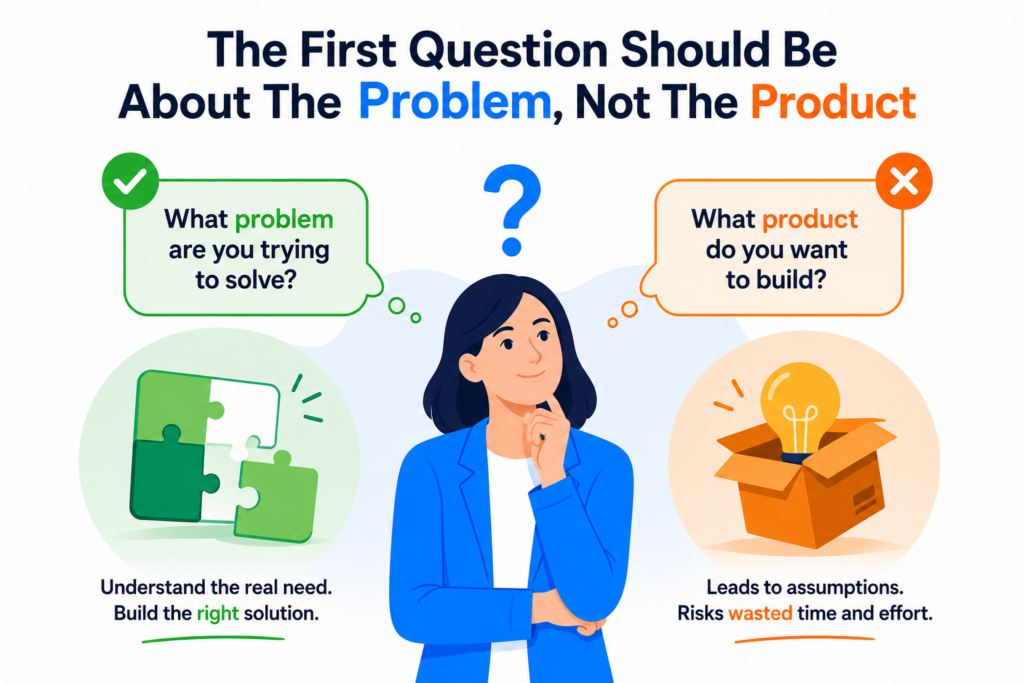
This question sounds basic, but it does a lot of work. It gives context. It shows why the invention exists.
It helps the attorney understand what was broken, slow, costly, risky, or hard before your team built something better. Without this problem story, the invention can look like a random set of features.
Founders often want to start with the product because that is what they have been building. They may say, “We built a platform for logistics planning,” or “We built a model for medical image review,” or “We built a new sensor system.”
That is useful, but the product is not the best starting point. The problem gives the product meaning.
A patent attorney needs to know why the old way failed. Was it too slow? Too manual? Too costly? Too prone to error? Too hard to scale? Too dependent on expert review? Too limited by noisy data?
Too rigid when conditions changed? These details help show why the invention is more than a normal product update.
The problem also helps keep the rest of the call focused. When the team understands the pain clearly, every later question can connect back to it.
The problem frames the invention in a stronger way
A clear problem makes the invention easier to explain. It gives the attorney a before-and-after view. Before your system, something was hard. After your system, that thing became easier, faster, safer, or more accurate.
This matters because many technical inventions are hard to understand in isolation. A model architecture, control flow, sensor layout, or data process may sound dry on its own. But when tied to a clear problem, the value becomes easier to see.
For example, saying “we created a new routing method” is vague. Saying “delivery routes kept failing when live traffic, warehouse delays, and driver limits changed at the same time, so we built a method that updates the route order based on all three signals” is much stronger. It shows the pain. It shows the setting. It points toward the technical answer.
The attorney can now ask better questions. Which signals matter most? How are they weighted? What happens when signals conflict? How does the system update the route? What output is sent to the user or machine?
A weak problem leads to weak details
When the problem is vague, the call often drifts. The attorney may ask broad questions. The founder may give broad answers.
The draft may later include generic language that does not show the real value of the invention.
A weak problem sounds like, “People need better tools,” or “Current systems are inefficient,” or “AI can help automate this.” Those statements may be true, but they are not sharp enough. A strong problem names the real pain in the real workflow.
For example, “Factory teams lose time because current inspection systems flag too many false defects when lighting changes during a shift” is useful.
It gives the attorney a clear place to dig. The invention may involve image correction, confidence scoring, sensor timing, or feedback from human review. Now the call has direction.
The problem question should uncover the old way
After the founder explains the problem, the next question should explore the old way. How did people handle this before? What tools did they use? What steps were manual? What workarounds did they create? Where did the old process break down?
This is not just background. It helps the attorney understand the gap between the old method and the new method. It also helps the team avoid overclaiming. Sometimes founders think their product is new because the user experience is better.
But the real invention may be narrower. Other times, founders think their idea is ordinary because they have lived with it for months, but the old way shows that their solution is actually quite meaningful.
Talking about the old way also helps reveal competitors. A founder may mention a common tool, a known workflow, a lab process, or an open-source method.
The attorney can use that context to ask smarter questions about what your system does differently.
The old way helps show what changed
The key question is not only “what existed before?” It is “what did your team change?”
Did you remove a step? Add a signal? Combine data sources that were not used together before? Move a decision from a human to a machine? Change when a model updates? Make a device smaller? Let a system run with less power? Turn a slow batch process into a live process?
Change is the heart of the invention story. If the call can name the change clearly, the later patent work gets easier.
This is why founders should not hide the old way or worry that talking about it makes the invention weaker. The old way is useful. It gives the attorney a map. It helps the team show what is different in a more honest and powerful way.
The problem should connect to the customer pain
A patent is about the invention, but the customer pain still matters. The call should ask why the problem matters in the real world. What happens if it is not solved? Who feels the pain? What does it cost them? What risk does it create?
This helps the attorney understand practical impact. It can also help the team choose examples for the patent draft.
A strong example is not just a made-up use case. It reflects how the technology creates value in the real world.
For a startup, this connection is important. You are not filing patents for decoration. You are building a moat around a real business. The intake call should help show how the invention supports that business.
Customer pain helps rank what to file first
If a startup has several inventions, customer pain can help decide which one matters most. The invention that solves the biggest customer pain may deserve early protection.
The invention that supports the main buying reason may also be worth filing before a public launch.
For example, if customers buy your system because it works well with messy data, then the messy-data handling may be more important than the dashboard.
If customers buy because the system saves power at the edge, then the power-saving method may be central. If customers buy because the robot can recover from failed movements, then the recovery logic may be the key.
This is where a strong intake call becomes strategic. It does not just gather facts. It helps the company protect the part of the invention that supports growth.
The Second Question Should Find The Exact Point Of Novelty
After the problem is clear, the intake call should move to the exact point of novelty. In simple words, this means the part that feels new.
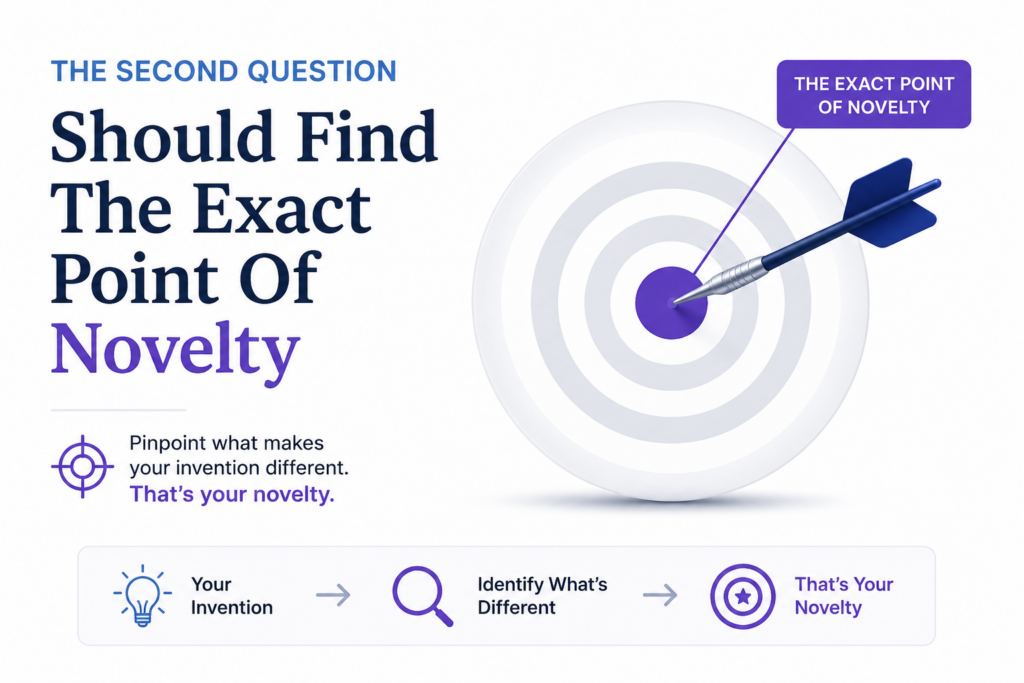
It is the step, feature, structure, flow, rule, or mix of parts that your team believes was not done this way before.
This is one of the most important parts of the call. It is also one of the easiest parts to blur. Founders may say the whole platform is new. Engineers may focus on one small part.
Product leaders may point to the user experience. The attorney needs to guide the team toward the exact difference that matters.
This does not mean the team must prove patentability on the call. That comes later. The goal is to capture the team’s best view of what is new and why it matters. The attorney can then explore it, test it, and shape it into a stronger filing plan.
A good question here is simple: what does your system do that other systems do not do in the same way?
The answer may take time. That is fine. The call should slow down here. This is not the place to rush.
The point of novelty should be stated in plain words
The best answer is not packed with legal terms. It should sound like clear builder language.
For example, “Our system checks three live signals before it lets the model make a recommendation,” or “Our device changes the pressure pattern based on the tissue response,” or “Our platform learns from rejected outputs without adding those rejected outputs directly into the training set.”
These answers are useful because they name an action. They show what the invention does. They give the attorney something concrete to explore.
A weak answer sounds like, “We use AI in a new way,” or “Our platform is smarter,” or “We automate the workflow.” Those phrases may be true, but they are too soft. They do not show the point of novelty. They do not tell the attorney where to dig.
Plain words help the attorney ask better follow-up questions
When the novelty is stated clearly, the attorney can ask strong follow-up questions. What are the three live signals? Why those signals? What happens if one is missing? How is the recommendation changed?
What does the device measure? How does it change the pressure pattern? What counts as a rejected output? How does the system learn without adding it to the training set?
These questions can uncover the real invention. Sometimes the first answer is only the doorway. The deeper value may be in the decision rule, the timing, the fallback step, or the way different parts work together.
This is why founders should not worry if their first answer is rough. A good intake call is built to refine the answer.
The novelty question should separate results from mechanisms
One common intake mistake is talking only about the result. The founder says, “Our system gives more accurate predictions,” or “Our device lasts longer,” or “Our process saves time.” These results matter, but they are not enough.
The attorney needs to know how the result happens. What is the mechanism? What steps create that better outcome? What is different inside the system?
For example, “more accurate predictions” may come from a better data filter, a new training method, a unique scoring layer, a feedback loop, or a way to handle missing inputs.
Each path may point to a different invention. If the intake call only captures the result, the draft may miss the mechanism.
The same is true for hardware. Saying “the device is more stable” is not enough. The attorney needs to know what structure, material, geometry, control step, or sensor feedback makes it stable.
The mechanism is where protection gets stronger
A patent should not only say what the system achieves. It should explain how the system works. That is where the attorney can write with more confidence. That is also where the team can make the filing harder for competitors to design around.
If the mechanism is clear, the patent can cover not just one product screen or one version of the system, but the deeper method that makes the product valuable. This is where strong intake questions save hours later.
Instead of fixing a draft after the fact, the team can capture the mechanism at the start. Instead of sending ten follow-up emails, the attorney can ask the core questions in one focused call. Instead of guessing what matters, everyone can see the heart of the invention sooner.
PowerPatent is built for this kind of focused work. The platform helps teams move from raw invention notes to a clearer patent process, while real attorneys review and guide the filing.
For busy founders, that means less confusion and more control. See how it works here: https://powerpatent.com/how-it-works
The novelty question should test if the invention has variants
A strong intake call should not stop at the first version of the invention. It should ask about variants.
Could the system work with different inputs? Different models? Different sensors? Different timing? Different hardware parts? Different user actions? Different scoring methods?
Variants matter because they help the patent become more useful. A startup product may change after filing. The first version may not be the final version. If the patent only covers the exact current setup, it may miss where the product is going next.
This is especially true for startups. Your first customer may ask for changes. Your engineering team may swap one model for another.
Your hardware may move from prototype to production. Your workflow may become more automated. A good intake call should catch the core idea across these changes.
Variants help protect the idea beyond the first build
The attorney should ask what parts are required and what parts can change. This is a powerful question. It helps separate the core invention from the current product version.
For example, maybe the system currently uses camera data, but it could also use thermal data. Maybe the model currently updates once per day, but it could update after each batch.
Maybe the device currently has three sensors, but the same method could work with two or five. Maybe the user now approves each step, but later the system could act on its own.
These details can save major time later. They allow the attorney to draft with a wider view from the start. They also help the company avoid filing something that becomes outdated as soon as the product evolves.
The Third Question Should Reveal What Is Already Public
One of the most urgent questions in any patent intake call is whether the invention has already been shared. This should come early, not at the end.
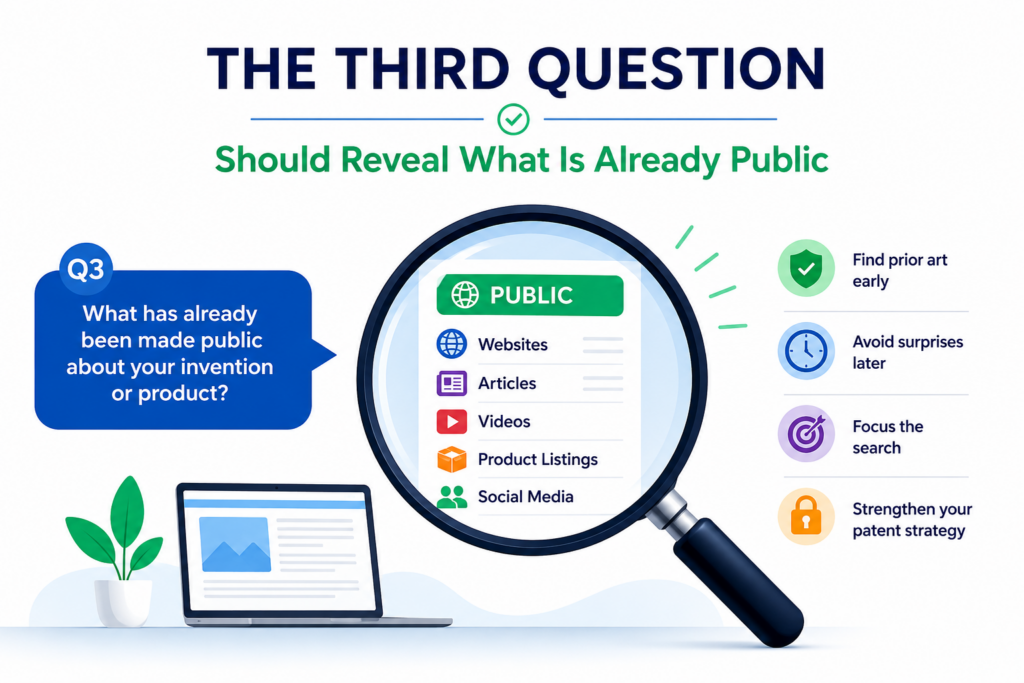
Public sharing can affect timing, strategy, and what must happen next. A founder may not think a demo, pitch deck, GitHub post, customer pilot, conference talk, grant paper, video, blog post, or sales call matters. But it might.
This does not mean founders should panic. It means the attorney needs the facts. The intake call should calmly gather what was shared, when it was shared, who saw it, and how much detail was included. That information can shape the filing plan.
Startups move fast. They pitch investors. They talk to customers. They apply to accelerators. They post product updates.
They send technical decks to partners. They let pilot users test early tools. In that world, public disclosure questions are not side questions. They are central.
The worst thing is for the attorney to learn about a public demo after the draft is almost done. That can force rushed changes and new strategy calls. A clear intake question at the start can prevent that.
The call should create a clear timeline of what was shared
A good intake call should ask for dates. Not vague dates like “a while ago” or “early this year.” The team should try to name the month, day, and setting when possible.
The attorney needs to know when the invention was first shared outside the company and what details were included.
This can feel tedious, but it saves time. A clear timeline helps the attorney understand urgency. It also helps the team decide whether to file quickly, whether to narrow the filing, or whether more review is needed.
For example, a founder may say, “We showed the product to a customer last quarter.” That is not enough. The better follow-up is: what did they see? Did they see the technical flow?
Did they get slides? Did they sign an agreement? Did they receive a recording? Did the demo show only the output, or did it explain how the system works?
Those details matter.
Not every disclosure is the same
A public landing page is different from a private technical deck. A demo under a signed agreement is different from a conference talk. A high-level investor pitch is different from a paper that explains the method. The attorney needs to know the difference.
This is why the intake call should not ask only, “Was it public?” Many founders do not know how to answer that.
A better call asks what happened in real terms. Who saw it? What did they receive? Could they keep it? Did it include diagrams? Did it show source code? Did it explain the steps? Was it recorded? Was it posted online?
This style of questioning gets better facts without making the founder feel trapped.
The call should ask about planned public events
The intake call should not only look backward. It should also look forward. Is there a product launch coming? A demo day? A customer rollout? A press release? A grant filing? A paper submission? A trade show? An investor data room update?
These events can change the urgency of the patent work. If the team plans to reveal the invention soon, the filing plan may need to move faster.
If the event only shares high-level benefits, the attorney may help the team avoid exposing too much before filing.
This is a place where patent intake becomes business protection. The attorney is not just drafting a document. They are helping the team avoid a mistake that could hurt the company later.
The best time to ask is before the launch calendar gets crowded
Founders often contact a patent attorney right before a big event. That is common, but it is not ideal.
The more warning the team has, the better the process can be. Still, even when time is tight, a strong intake call can make a difference.
The attorney should ask what must go public and what can stay private until filing. Sometimes the public message can focus on benefits, while the technical details stay out of view.
Sometimes the team needs a quick filing before a demo. Sometimes the best move is to split the work into a first filing now and a fuller filing later.
PowerPatent helps founders move faster in moments like this because the process is built around speed, structure, and attorney oversight.
When timing matters, a guided system can help reduce back-and-forth and make the intake process cleaner. Learn more here: https://powerpatent.com/how-it-works
The call should gather the actual materials that were shared
It is not enough to talk about what was disclosed. The attorney should ask for the actual materials if they exist.
Slides, screenshots, papers, emails, videos, demo scripts, website pages, GitHub commits, customer docs, and pitch decks can all help.
The reason is simple. People remember disclosures imperfectly. A founder may think a deck was high-level, but one slide may include a detailed flow.
An engineer may think a demo did not show the method, but a screen recording may reveal internal labels or steps. The actual file is better than memory.
This saves time later because the attorney does not have to keep asking what was shown. They can review the material directly and shape the filing plan with better facts.
The file tells the truth faster than a long explanation
A good intake process should make it easy to upload or share materials. The less friction there is, the faster the attorney can work.
This is one reason software-backed patent workflows can be so helpful. They give founders a cleaner place to collect documents, notes, and invention context.
The key is not to drown the attorney in every file the company has ever made. The key is to share the materials tied to the invention and any public or outside-facing event.
That gives the attorney enough context to make smart choices without wasting time.
The Fourth Question Should Identify Every Person Who Helped Create The Invention
A patent intake call should ask who helped create the invention. This is not just an admin detail. It is a core fact that needs to be handled carefully. Startups often build in teams.

A founder may have the first idea. An engineer may solve the hard part. A data scientist may design the model flow.
A hardware lead may change the structure. A contractor may build a key module. A university lab member may help test the system.
The intake call should bring these people into view early.
This question saves time because inventorship issues can become painful if they are handled late.
If the wrong people are named, or if key contributors are missed, the team may need more review and correction. It is better to ask carefully at the start.
The goal is not to make the founder nervous. The goal is to understand who contributed to the inventive parts.
Not everyone who worked on the product is necessarily an inventor. But the attorney needs to know who added ideas to the parts that may be claimed in the patent.
The call should separate builders from inventors
Many people may help build a product. Some write code. Some run tests. Some collect data. Some design the user interface. Some fix bugs. Some make product choices.
Some follow instructions from others. These contributions can be valuable to the company, but they may not all count as inventing.
The intake call should ask who came up with the key technical ideas. Who suggested the new method? Who designed the special workflow?
Who found the fix that made it work? Who changed the model, device, or process in a way that matters? Who solved the problem that others could not solve?
These questions help the attorney understand the people side of the invention.
The right people can clarify the invention faster
Identifying the right contributors is not only about names on a filing. It also helps the attorney know who to talk to.
The person who solved the hardest part can often explain the invention in five minutes better than someone else can explain it in an hour.
That saves time. It also improves accuracy. If the key engineer joins the call, they can answer how the system actually works.
If the data lead joins, they can explain the training flow. If the hardware designer joins, they can explain why a certain structure was chosen.
Founders should not feel they have to carry the whole call alone. The best intake calls often include both a business owner and a technical contributor. One explains why the invention matters. The other explains how it works.
The call should ask about contractors, partners, and universities
Startups often get help from outside people. That help may come from contractors, advisors, design firms, research partners, customer pilots, labs, universities, or open-source communities. The intake call should ask about this clearly.
This matters because outside involvement can affect ownership, documents, and future risk. The attorney may need to review agreements or ask follow-up questions. It is much better to know this before drafting than after.
For example, if a contractor helped design the core algorithm, the team may need to confirm assignment terms. If a university lab helped develop a key method, there may be institutional rights to review.
If a customer helped shape the invention during a pilot, the attorney may need to understand what was contributed and what agreements existed.
Outside help should be discussed without delay
Some founders hesitate to mention outside help because they fear it will slow things down. In reality, hiding it creates more delay. A strong intake call treats this as a normal startup fact and handles it early.
The attorney should ask who touched the invention, what they contributed, and what agreements were in place. This gives the team a clean view of any issues before the filing process goes too far.
This is another place where a structured platform helps. PowerPatent helps founders organize invention details and related materials so attorney review can happen with less chaos.
That means fewer surprise issues and fewer rushed document hunts. See how PowerPatent works here: https://powerpatent.com/how-it-works
The call should name who can approve technical accuracy
After inventors and contributors are identified, the intake call should ask who will review the draft for technical accuracy.
This is a separate question, and it matters. The person who signs off on the invention details should understand the system deeply.
Many delays happen because the draft goes to the wrong reviewer. A busy founder reviews it but misses a technical error.
Then an engineer sees it later and requests major changes. Or the draft goes to several people with no clear owner, and comments conflict.
A better intake call sets this up early. It asks who should be the main technical reviewer, who should review business scope, and who has final say. This makes the later review cycle much cleaner.
One clear technical owner prevents comment chaos
Draft review can become messy when everyone comments at once. One person wants broader language. Another wants narrower technical terms.
Another wants product names removed. Another adds details from a future version. The attorney then has to sort through mixed comments and ask more questions.
A clear technical owner reduces this. That person can gather input, resolve internal disagreements, and send cleaner feedback. This saves hours and keeps the filing on track.
For startups, this is especially useful because no one has extra time. A focused review process keeps patent work from becoming a drag on the product team.
The Fifth Question Should Pin Down The Best Version Of The Invention
A strong intake call should ask about the best version of the invention. Not just the first version. Not just the demo version. Not just the version that happens to be live today.
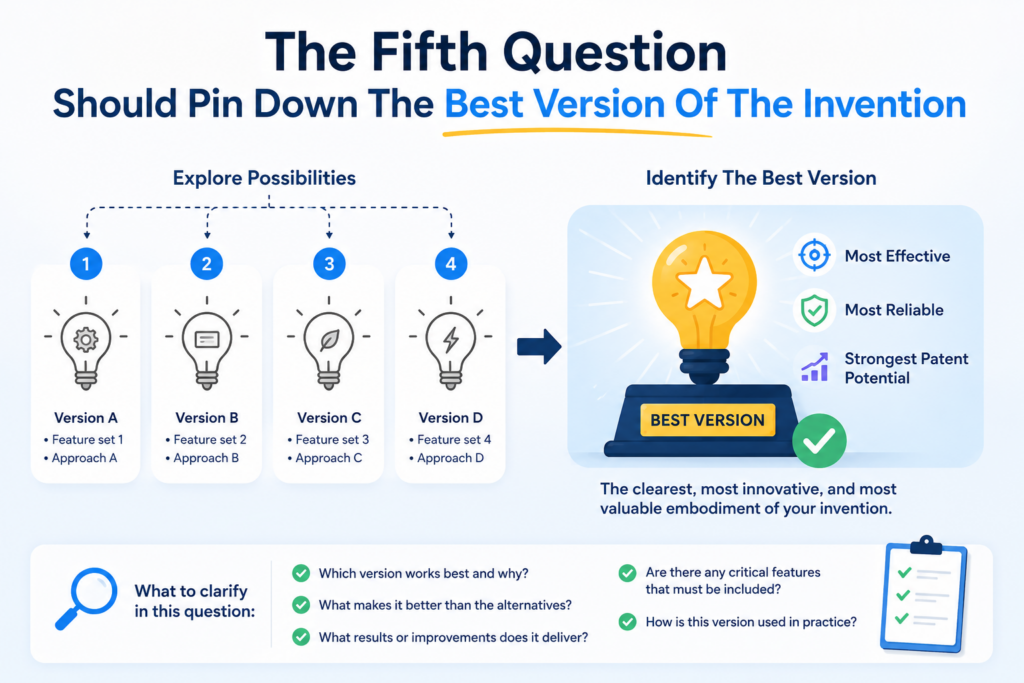
The attorney needs to know which version works best, which version the team believes is most valuable, and which version the company plans to build toward.
This question matters because startups change quickly. The product today may be a thin slice of the full idea. The prototype may include temporary choices.
The final product may use different data, different parts, different settings, or more automation. If the intake call only captures the current version, the filing may become too narrow.
The best version question helps the attorney see the invention’s full shape. It also helps the founder think strategically.
What is the core idea across versions? What is optional? What is preferred? What is planned next? What should competitors not be able to copy?
The best version is not always the current version
Founders often describe what exists today because that feels safest. They may say, “Right now, we use this model,” or “Right now, the device has this layout,” or “Right now, the user approves each output.” That is useful, but it may not be the full invention.
The attorney should ask where the system is going. Will the model change? Will the device become smaller? Will the user approval step become automatic?
Will the system support more data types? Will the workflow move from a desktop tool to an API? Will the edge device later sync with a cloud system?
These details help the patent draft account for growth.
The patent should not be trapped inside a prototype
A prototype often includes limits that are not central to the invention. It may use one sensor because that was available. It may use one model because that was fast to build.
It may require manual review because the team has not yet automated the last step. If the patent focuses too much on those temporary choices, it may fail to cover the better version later.
The intake call should ask which parts are truly required. If the invention can work with different models, say that.
If it can work with different sensors, say that. If it can run locally or in the cloud, say that. If the user step can be manual or automatic, say that.
This does not mean the draft should become vague. It means the attorney should understand the invention with enough range to protect the real idea, not just the first build.
The call should ask what makes the best version best
It is not enough to name the best version. The attorney should ask why it is best. Does it improve speed? Reduce errors? Lower cost? Save power? Improve safety? Work with less data? Handle edge cases better? Scale to more users? Fit into customer workflows more easily?
The “why” helps show the value of the invention. It also helps the attorney choose examples and draft details that support the strongest story.
For example, a team may say the best version uses a local model on an edge device. The attorney should ask why local matters.
Maybe it lowers delay. Maybe it protects private data. Maybe it works when the network fails. Maybe it reduces cloud cost. Each reason points to a different kind of value.
The best version can reveal hidden inventions
Sometimes the best version includes a second invention that the team has not noticed. For example, the first invention may be a prediction method.
But the best version may include a special update method that keeps the model accurate over time. That update method may deserve its own filing or at least careful treatment.
The intake call should listen for these hidden ideas. When a founder says, “In the full version, it will also self-tune,” the attorney should not let that pass.
They should ask how self-tuning works, what data triggers it, what limits are placed on it, and how the system avoids bad updates.
This is how a single intake call can uncover a broader patent plan.
PowerPatent is useful here because it helps teams capture invention details in a structured way instead of losing future versions in scattered notes.
With software to organize the idea and real attorney oversight to guide the filing, founders can move with more confidence. You can see the process here: https://powerpatent.com/how-it-works
The call should also ask about the simplest version that still works
The best version matters, but so does the simplest working version. This is the lean version of the invention. It helps the attorney understand the minimum set of steps or parts needed for the idea to function.
This question is powerful because it separates the core invention from extra features.
If the invention still works without a certain screen, data type, sensor, or setting, that part may not be central. If the invention fails without a certain step, that step may be important.
The simplest version can help the attorney write more clearly and avoid unnecessary limits. It can also help the team think about how competitors might copy the invention in a stripped-down way.
Competitors often copy the simple version first
A competitor may not copy your full product. They may copy the core method with fewer features. They may remove the fancy dashboard, use a different model, or skip an optional step. If your patent only covers the full version, it may miss the way copying really happens.
That is why the intake call should ask about the simplest version that still delivers the key result.
What must happen for the invention to work at all? What can be changed without losing the benefit? What can be removed? What must stay?
These answers help the attorney build a stronger filing strategy and save the team from painful scope fixes later.
The Sixth Question Should Ask What The System Does Step By Step
A good intake call should ask the founder to walk through the invention step by step. This is where the idea moves from a strong story into a real working shape.
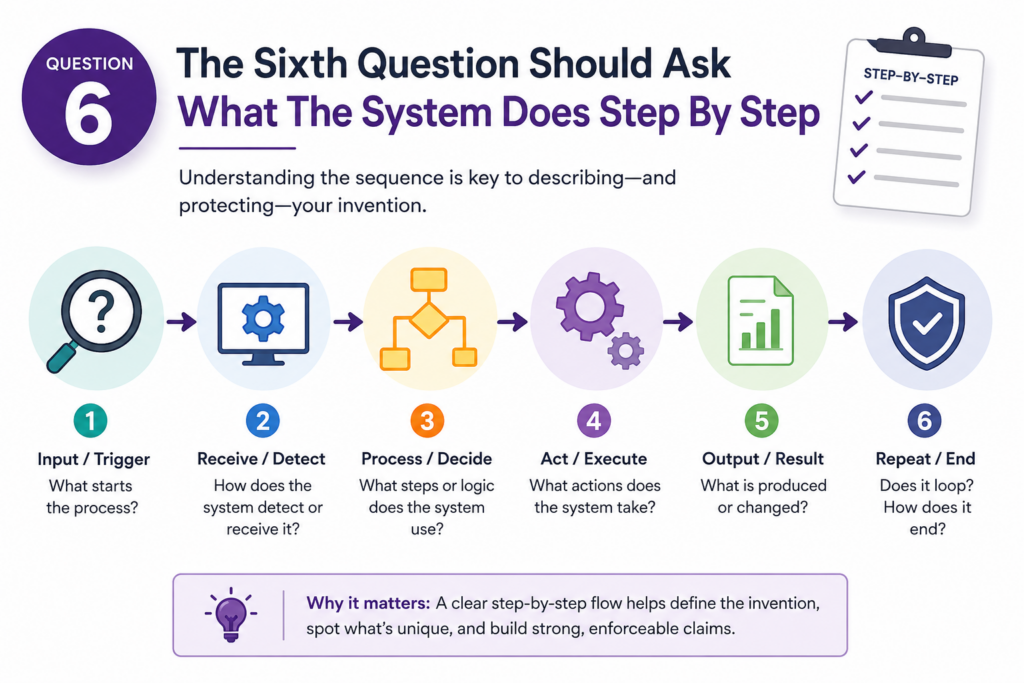
The attorney does not need every line of code, every circuit trace, or every lab note. But they do need to understand the flow of the invention from start to finish.
This question saves a huge amount of time because many patent drafts get stuck when the process is not clear. The founder may explain the benefit well. The engineer may explain the hard part well.
But if no one explains the full flow, the attorney has to fill in gaps later. That leads to follow-up calls, new diagrams, draft changes, and slow review cycles.
The step-by-step walkthrough should start at the first input. What comes into the system? Where does it come from? Who or what provides it? Then it should move through the major actions.
What does the system check, change, compare, rank, train, measure, control, display, store, send, or trigger? Then it should end with the output. What does the user, device, model, machine, database, or other system receive at the end?
This sounds simple, but it is one of the most powerful parts of the call. It turns “we built a smarter system” into “here is how the system works.”
A clear flow makes the invention easier to protect
When the attorney understands the flow, they can see where the invention lives. It may live at the input stage, where data is collected or cleaned. It may live in the middle, where a decision is made.
It may live at the output stage, where the result is ranked, shown, or used to control something. It may live across the full chain, where the parts work together in a way that creates a new result.
Without the flow, the patent work can become too abstract. The draft may say the system “analyzes data” or “generates a recommendation,” but that does not tell the real story.
The attorney needs to know what kind of data, how it is analyzed, what rules are used, what the system does when the data is poor, and how the recommendation is created.
That detail is not fluff. It is the raw material of a stronger filing.
The best walkthrough starts with one real example
The easiest way to explain the flow is to use one real example. A founder might say, “Let’s say a factory sensor sends a pressure reading that is higher than normal.” Then the team can walk through what happens next.
The system receives the reading, checks it against past patterns, compares it with temperature data, decides whether the reading is likely noise, updates a risk score, and sends a warning only if the score crosses a certain level.
That kind of example gives the attorney a clear path. It also helps the team remember details they may have skipped in a broad explanation.
The example does not have to be perfect. It should be real enough to show the invention in action. Once the attorney understands one example, they can ask about other examples, edge cases, and alternate versions.
The walkthrough should include what happens when things go wrong
Many founders explain the happy path first. That is normal. The happy path is the clean version of the invention. But strong intake calls also ask about the messy path. What happens when the input is missing? What happens when two signals conflict?
What happens when the model is unsure? What happens when a sensor fails? What happens when a user enters bad data? What happens when a device loses network access?
These questions often reveal very valuable invention details. A system that works only when everything is clean may not be very special. A system that works when the world is messy may have a much stronger technical story.
This is especially true for AI, robotics, health tech, climate tech, manufacturing tech, fintech, security, and other complex fields. The hard part is often not the simple case.
The hard part is making the system work in the real world, where data is incomplete, users make mistakes, machines behave oddly, and conditions change.
Error handling can be the hidden core of the invention
Do not rush past error handling. It can be the secret sauce.
For example, an AI tool may not be special because it gives a prediction. Many tools give predictions. The special part may be that it knows when not to trust its own prediction.
A medical device may not be special because it measures a signal. The special part may be how it rejects bad readings during motion.
A supply chain platform may not be special because it creates a schedule. The special part may be how it repairs the schedule when one warehouse falls behind.
These details can save hours later because they help the attorney avoid a shallow draft. They also help the team protect what competitors would actually want to copy.
PowerPatent helps teams capture these flows in a more organized way, so invention details do not get lost across calls, docs, and chat threads.
With smart software and real attorney oversight, founders can move from rough technical notes to a clearer filing path. See how it works here: https://powerpatent.com/how-it-works
The walkthrough should show what happens before and after the invention runs
A strong patent intake call should not only ask what happens inside the invention. It should also ask what happens before and after.
What starts the process? Is it a user action, a sensor event, a scheduled job, a model trigger, a device state, or a message from another system?
After the invention produces an output, what happens next? Does a user approve something? Does a machine act? Does a database update? Does a second model run? Does the system send a warning?
This context helps the attorney understand how the invention fits into the larger product. It also helps reveal more possible patent angles.
For example, the invention may not be just a model. It may be the way the model is triggered by a device state and then used to control a machine.
Or it may not be just a data filter. It may be the way filtered data changes what the user sees and how the system learns from later user edits.
The surrounding workflow can make the invention stronger
Sometimes the core technical step is small, but the way it fits into the workflow is powerful. The attorney needs to see that.
The intake call should ask what systems are connected, what data moves between them, what role the user plays, and what changes after the output is produced.
This does not mean the patent must claim the entire product. It means the attorney needs enough context to choose the right level of protection.
A founder can help by explaining the invention as a chain of events, not just a feature. That chain gives the attorney a much better base for drafting.
The Seventh Question Should Ask What Was Hard To Build
One of the most useful intake questions is also one of the simplest: what was hard to build?
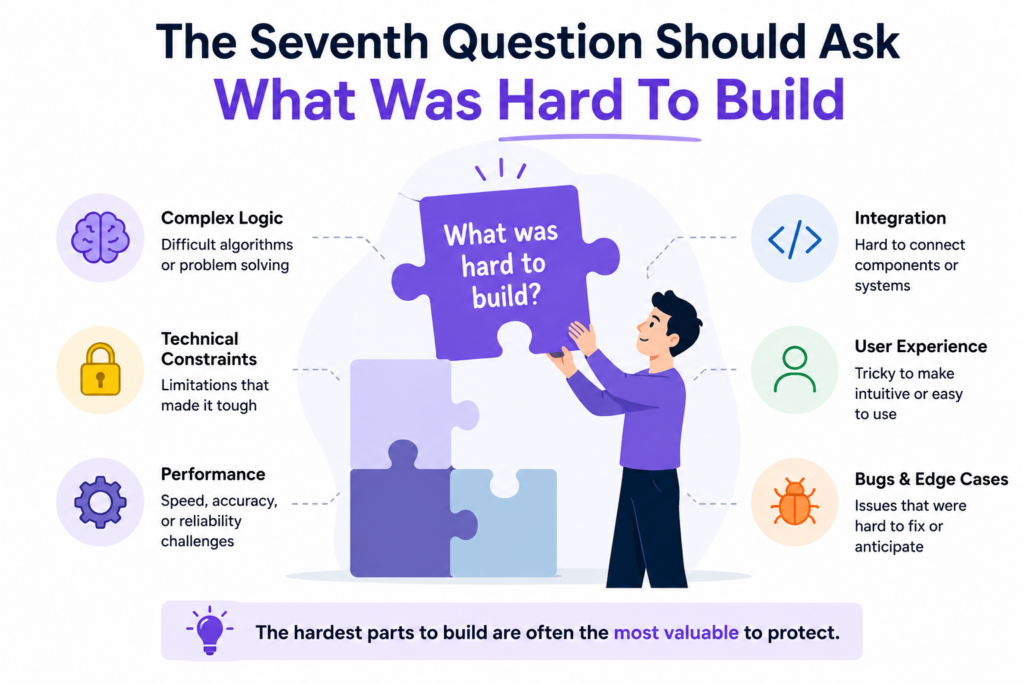
This question cuts through buzzwords fast. It helps the attorney find the real work, the real insight, and the real technical edge. Founders often skip this because they are used to making the product sound smooth.
In sales, you want the product to feel easy. In a patent intake call, you need to explain what was hard before it became easy for the user.
The hard part often points to the invention. Maybe the system worked in a demo but failed with live data. Maybe the model gave good results in the lab but broke with customer inputs.
Maybe the device worked in one temperature range but failed in another. Maybe the robot could complete a task only when the object was placed perfectly. Maybe the software could scale only after the team changed the data structure.
These struggles matter. They show what your team solved. They also help the attorney understand why the solution was not obvious from the start.
The hard part reveals the real technical win
The real technical win is often not the feature the user sees. It is the fix that made the feature possible.
A founder may say, “Our app gives instant quotes.” The hard part may be that the system must check multiple live data sources, reject stale values, predict missing fields, and still respond in under one second.
A hardware founder may say, “Our device detects leaks early.” The hard part may be that the signal is weak, the background noise changes by location, and normal vibration looks like a leak.
When the attorney hears what was hard, they can ask better questions about the solution. What did you try first? Why did it fail? What changed? What finally worked? Is the winning method tied to a special rule, structure, sequence, setting, or data format?
Those answers are gold for patent work.
Failed attempts can make the final invention clearer
Many founders do not think failed attempts matter. They do. The attorney does not need a full history of every dead end, but a few failed attempts can show why the final solution matters.
For example, if the team tried a standard model and it failed with rare cases, that helps frame the new model flow. If the team tried a normal sensor layout and it gave noisy readings, that helps explain the new layout.
If the team tried a manual review process and it slowed the workflow, that helps show the value of automation.
Failed attempts also help the team describe the invention in a more grounded way. Instead of saying, “We improved the system,” the team can say, “The first approach failed because the system treated short spikes as real events.
The new approach checks the spike against a second signal and only acts when both signals follow a matching pattern.”
That kind of detail makes the patent story much stronger.
The call should ask who solved the hard part
After the team names the hard part, the attorney should ask who solved it. This ties back to inventorship, but it also helps with accuracy. The person who solved the hard part often knows the details best.
They may remember the old approach, the bug, the test result, or the key design choice.
They may know why the team picked one method over another. They may also know which parts are required and which parts are just current product choices.
Bringing that person into the intake process can save hours. It prevents the attorney from getting a secondhand version of the invention. It also prevents the founder from having to chase answers later.
The right technical voice can prevent weak drafting
A weak draft often comes from thin technical input. The attorney may understand the business goal but not the inner workings.
The founder may approve a high-level description because it sounds fine. Then, late in the process, an engineer says, “That is not how it works.” Now the draft needs repair.
This can be avoided when the person who solved the hard part helps early. They do not need to lead the whole call. They can join for the technical section, answer key questions, and review the core flow.
This is a smart use of engineering time. A focused intake call may save many scattered follow-ups later.
The call should turn hard parts into claimable features
The attorney’s job is to take the hard-won technical work and shape it into protection. The founder’s job is to explain the hard part clearly enough for that to happen.
This does not require legal language. It requires plain facts. What was the problem inside the system? What did the team change? What does the system now do differently? What result does that change create? What parts of the change can vary?
For example, “We tuned the model better” is weak. “We added a confidence gate that routes low-confidence outputs to a second model trained on rare cases” is stronger. “We improved the device” is weak.
“We changed the inlet shape so fluid slows before reaching the sensor, which reduces false readings during pressure spikes” is stronger.
The best patent material often comes from engineering pain
The messy engineering story can become the clean patent story. The pain shows what needed to be fixed. The fix shows what may be new. The result shows why it matters.
This is why founders should not hide technical struggle. A patent intake call is not a pitch contest. It is a discovery session. The more clearly the team explains the hard part, the more useful the output can be.
PowerPatent helps founders and engineers move these details into a more usable form, so the attorney is not starting with a blank page or scattered notes.
That makes the process faster and helps avoid costly gaps. Learn more here: https://powerpatent.com/how-it-works
The Eighth Question Should Ask How A Competitor Would Copy The Invention
A strong intake call should ask a direct question: how would a competitor copy this?
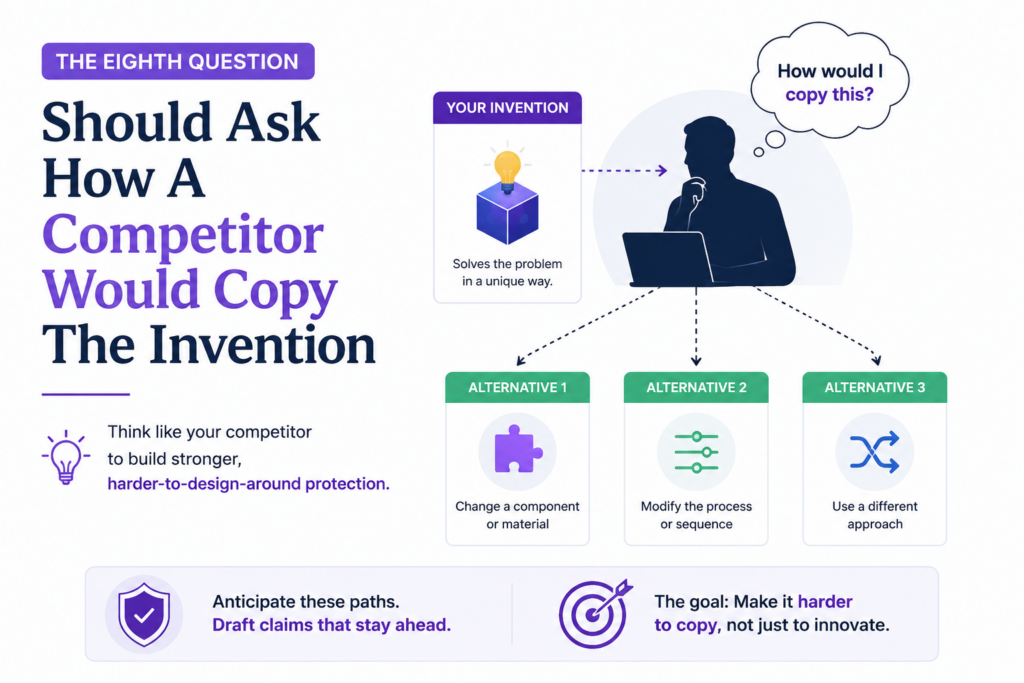
This question may feel uncomfortable, but it is very useful. It pushes the team to think beyond the current product and focus on what needs protection.
A patent should not only describe what you built. It should help protect the thing a competitor would want to take.
Founders often think about the product from the customer’s point of view. That is good for selling. But for patent strategy, the team also needs to think from a competitor’s point of view. If another company wanted the same benefit, what would they copy?
Would they copy the model flow? The data pipeline? The device shape? The feedback loop? The user workflow? The timing of the control step? The way results are ranked?
This question can change the entire filing plan. It helps the attorney see where the moat should be.
Copying may happen below the surface
A competitor may not copy your brand, design, or full interface. They may copy the hidden engine.
They may use different labels, a different screen, or a different cloud provider. They may build a smaller version that still uses your core method.
That is why the intake call should look below the surface. The attorney should ask what parts of the invention are visible to users and what parts are hidden inside the system.
If the most valuable part is hidden, the patent draft may need strong technical examples and careful explanation of internal steps.
For AI and software inventions, this is common. The user may only see an output, but the value comes from how the system picks data, trains a model, checks quality, routes tasks, or updates results.
For hardware, the user may only see the final device, but the value may come from internal geometry, material placement, thermal control, signal handling, or manufacturing steps.
A competitor’s shortcut can reveal what matters most
Ask this during intake: if a competitor wanted the same result with the least work, what would they copy first?
The answer often points to the core invention. They may not copy every feature. They may skip optional settings.
They may ignore the premium interface. They may use a different database. But they will likely copy the method that creates the main result.
That is the part the attorney needs to understand deeply.
This question also helps avoid narrow drafting. If the current product uses one kind of input, but a competitor could use a similar input to get the same result, the attorney should know that.
If the current device uses one layout, but a competitor could use a slightly changed layout, the attorney should know that too.
The call should ask what would be easy to design around
A design-around is a way for a competitor to avoid your exact setup while still taking the value. The intake call should ask where this might happen. This is not a negative question. It is a strategic one.
For example, if your invention currently uses three steps, could someone remove one step and still get most of the benefit? If your system uses a specific model, could someone use a different model?
If your device uses one sensor location, could someone move the sensor slightly? If your workflow uses a user approval step, could someone automate that step?
These questions help the attorney draft with smarter range. They also help the team understand which details are central and which details are optional.
Good intake questions protect against narrow thinking
Narrow thinking is a common patent problem for startups. The team is so focused on the product it just built that it forgets how the idea could be copied in other forms. A good intake call breaks that pattern.
The attorney should ask about substitutes. What else could perform the same role? What other data could be used?
What other structure could work? What other order of steps might still solve the problem? What other environment could use the same method?
These answers help the attorney think beyond the current build.
PowerPatent gives founders a more guided way to capture these details before they become missed chances.
The platform helps organize invention details, while real attorney oversight helps shape the filing strategy around what matters most. See how it works here: https://powerpatent.com/how-it-works
The call should link copying risk to business value
Not all copying risk is equal. A competitor copying a small side feature may not matter much.
A competitor copying the main technical engine could be a serious threat. The intake call should ask which kind of copying would hurt the business most.
This is where patent strategy becomes company strategy. The attorney should understand what the company sells, what customers value, what investors care about, and what competitors are likely to chase.
The filing should support that reality.
For example, if the company wins because its system works with poor-quality data, then the data-handling method may be critical.
If it wins because its device performs with lower power, then the power method may matter more than the interface. If it wins because it shortens a workflow from hours to minutes, then the process flow may be the key.
The best protection starts with the biggest threat
A good intake call helps rank the threats. It asks what the company would hate to see copied in one year, two years, or five years. It also asks what the team plans to show publicly soon.
This helps decide what to file first. It also helps decide what details to emphasize in the draft.
Founders should not think of this as fear-based planning. It is practical planning. You worked hard to build something valuable. The intake call should help protect the part that gives you leverage.
The Ninth Question Should Ask What Data, Inputs, And Outputs Matter Most
For many modern inventions, the heart of the system is data. This is especially true for AI, software, robotics, climate tech, health tech, fintech, security tools, and automation platforms.

A patent intake call should ask what data goes into the system, what happens to it, and what comes out.
This question sounds simple, but it can uncover the core invention. Sometimes the new idea is not the model itself.
It is the data used by the model. Sometimes the new idea is not the output itself. It is how the output is ranked, filtered, checked, or used. Sometimes the new idea is the way the system turns messy inputs into useful actions.
If the attorney does not understand the inputs and outputs, the draft may stay too broad.
It may talk about “receiving data” and “generating a result” without showing what makes the invention special. That creates weak work and more revision time.
The call should name the important inputs in plain words
The attorney should ask what information the system receives.
This may include sensor readings, user actions, text, images, audio, video, location data, device states, model outputs, lab results, transaction records, machine logs, customer records, or third-party data.
The point is not to list everything forever. The point is to identify which inputs matter to the invention.
Some inputs may be normal background data. Others may be central. The intake call should ask which inputs drive the special result.
For example, a system may use many fields, but the key invention may depend on combining live temperature data with machine vibration data.
Another system may use many user signals, but the key invention may be how it handles missing answers. Another system may use images, but the key may be how it chooses which image regions to review.
The right input detail can make the invention easier to explain
Inputs give the invention a starting point. They help the attorney explain what the system is working with and why the old methods had trouble.
For example, saying “the system analyzes images” is too broad. Saying “the system receives low-light images from a moving inspection camera and corrects them before defect scoring” is much more useful.
It tells the attorney what kind of images matter and why the process may be special.
The same is true for data quality. Does the system handle missing data? Noisy data? Conflicting data? Private data? Fast-changing data? Rare events? Unlabeled data? These details often shape the invention.
The call should ask what the system does to the data
After the inputs are clear, the call should ask what happens to them. Does the system clean, normalize, rank, split, compare, merge, label, compress, encrypt, score, route, transform, or store the data?
Does it create new data from old data? Does it decide which data to ignore? Does it change the model based on the data?
This middle layer is often where the invention lives. The founder may think the output is the important part, but the attorney may find that the special step is how the data is prepared or changed before the output is created.
For AI companies, this is critical. Better model results often come from better data handling. For hardware companies, better device results often come from better signal processing.
For workflow companies, better automation often comes from better routing and decision logic.
Data handling is often the quiet moat
A company’s quiet moat may be the way it handles messy, private, or hard-to-get data. That may not be visible in the product demo, but it may be hard for competitors to copy once protected.
A strong intake call should ask what data steps took the most work. Was it hard to label data? Was it hard to clean it?
Was it hard to combine sources? Was it hard to update records safely? Was it hard to keep personal data private? Was it hard to get useful output from rare cases?
These answers may reveal patent-worthy details that would otherwise be missed.
PowerPatent is built for teams that need to turn technical detail into real patent work without slowing down the company.
The platform helps collect invention information in a guided way, and real patent attorneys help review and shape the filing. Learn how it works here: https://powerpatent.com/how-it-works
The call should define the output and what happens next
The output is not always just a result on a screen. It may be a command, score, alert, label, ranked list, control signal, updated model, changed device state, report, recommendation, or stored record.
The intake call should ask what the system produces and how that output is used.
This matters because the use of the output may be part of the invention. A prediction alone may not be the full story.
The system may use the prediction to adjust a machine, route a task, request human review, block a risky action, update a schedule, or trigger a second process.
The attorney should ask what makes the output useful. Is it faster? More accurate? More trusted? Easier to act on? Safer? More complete? More explainable? More private?
The output should connect back to the problem
A strong intake call links the output to the original problem. If the problem was false alarms, how does the output reduce them? If the problem was slow review, how does the output speed it up?
If the problem was unstable control, how does the output improve stability? If the problem was poor data quality, how does the output stay useful anyway?
This connection creates a clear patent story. It also makes the later draft easier to review because everyone can see why each step is included.
When the input, data handling, and output are all clear, the attorney can work much faster. The invention no longer feels like a cloud of features. It becomes a process that can be described, tested, and protected.
The Tenth Question Should Ask For Proof That The Invention Works
A patent intake call should ask what proof the team has that the invention works. This does not mean the team needs perfect lab results or a finished product before talking to an attorney.
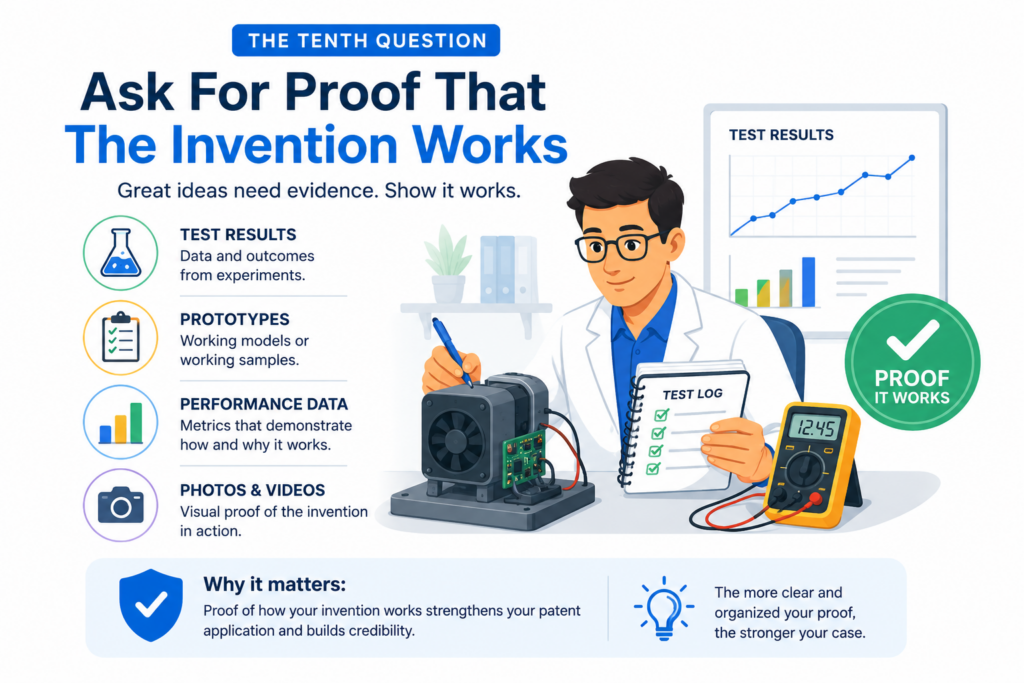
Many strong filings start while the product is still early. But the attorney should understand what has been tested, what has been shown, and what still needs work.
Proof helps the attorney write with more confidence. It also helps choose examples.
If the team has test data, before-and-after results, screenshots, prototypes, customer feedback, benchmark reports, or internal notes, those materials may help explain the invention more clearly.
This question also helps separate working ideas from future hopes. A patent filing can include planned versions in many cases, but the attorney needs to know what is real now and what is still expected.
That difference matters for strategy and accuracy.
The call should ask what has been built so far
The attorney should ask whether the invention exists as code, a prototype, a model, a device, a workflow, a simulation, a design, a lab test, or a written plan. The answer helps set the level of detail available.
If the system is already built, the team may have logs, screenshots, architecture diagrams, test results, or product flows.
If it is a prototype, the team may have design files, trial runs, or videos. If it is a planned invention, the team may need to explain the design in more detail and show how it would work.
This question also helps avoid confusion during drafting. If the attorney assumes something is already built when it is only planned, the draft may need correction later.
If the attorney assumes something is only planned when it is already tested, they may miss useful support.
Built, tested, and planned should be kept separate
A strong intake process should clearly separate what is built, what is tested, and what is planned. These are not the same.
Something can be built but not fully tested. Something can be tested in simulation but not in the field. Something can be planned but not coded yet.
Something can work for one customer setting but not all settings. These differences are normal for startups, but they should be clear.
When the attorney understands the stage of each part, they can write more carefully and ask better follow-up questions.
The call should ask for numbers when numbers help
Not every invention needs numbers to be understood. But when numbers exist, they can be very helpful.
The intake call should ask whether the team has measured speed, accuracy, power use, error rate, latency, cost, failure rate, throughput, memory use, conversion rate, or another useful result.
Numbers can make the story sharper. Instead of saying “the system is faster,” the team might say “the system reduced review time from thirty minutes to three minutes in our internal test.”
Instead of saying “the model is more accurate,” the team might say “the model reduced false positives by twenty percent on a test set.” Instead of saying “the device uses less power,” the team might say “the prototype ran for twice as long under the same battery limit.”
These details may help the attorney understand why the invention matters.
Numbers should be honest and tied to context
Numbers are useful only when they are honest. The intake call should ask where the numbers came from.
Were they from a lab test, customer pilot, simulation, benchmark, internal demo, or early estimate? What was being compared? Was the test small or large? Were the conditions controlled?
This does not mean the team needs perfect proof. It means the attorney should know the context so the filing can be accurate.
Founders should never stretch results to make the invention sound bigger. Strong patent work is built on clear facts. A real early result is better than a bold claim that cannot be backed up.
The call should gather materials that support the proof
If proof exists, the attorney should ask for the materials. These may include charts, logs, model results, screenshots, diagrams, CAD files, test reports, demo videos, customer notes, or internal write-ups.
The goal is not to bury the attorney in files. The goal is to share the materials that help explain how the invention works and why it is better.
This can save hours later because the attorney can use real examples instead of chasing missing detail. It can also help the team avoid long explanation emails. A clear chart or diagram may answer several questions at once.
Good evidence makes review faster and cleaner
When the draft includes accurate examples based on real materials, the review process is often smoother.
The technical team can recognize the invention. The founder can see how the patent supports the business. The attorney can write with less guesswork.
PowerPatent helps make this easier by giving founders a clearer way to organize invention details and supporting materials, with real patent attorneys involved to guide the work.
This helps teams move faster without treating patents like a rushed form. See how PowerPatent works here: https://powerpatent.com/how-it-works
A strong intake call does not need perfect proof. It needs the best truth available at the time. What works now? What has been tested?
What is still being built? What result matters most? When those answers are clear, the next stage becomes much easier.
Conclusion
A great patent intake call is not a formality. It is where hours are saved, weak drafts are avoided, and the real invention becomes clear. When founders come ready to explain the problem, the new step, the hard part, the proof, the public timeline, and the way a competitor might copy the idea, the whole process moves faster and smarter.
The goal is not to sound legal. The goal is to tell the truth clearly, while the attorney shapes it into protection. PowerPatent helps make that easier with smart software and real attorney oversight. See how it works here: https://powerpatent.com/how-it-works
Leave a Reply