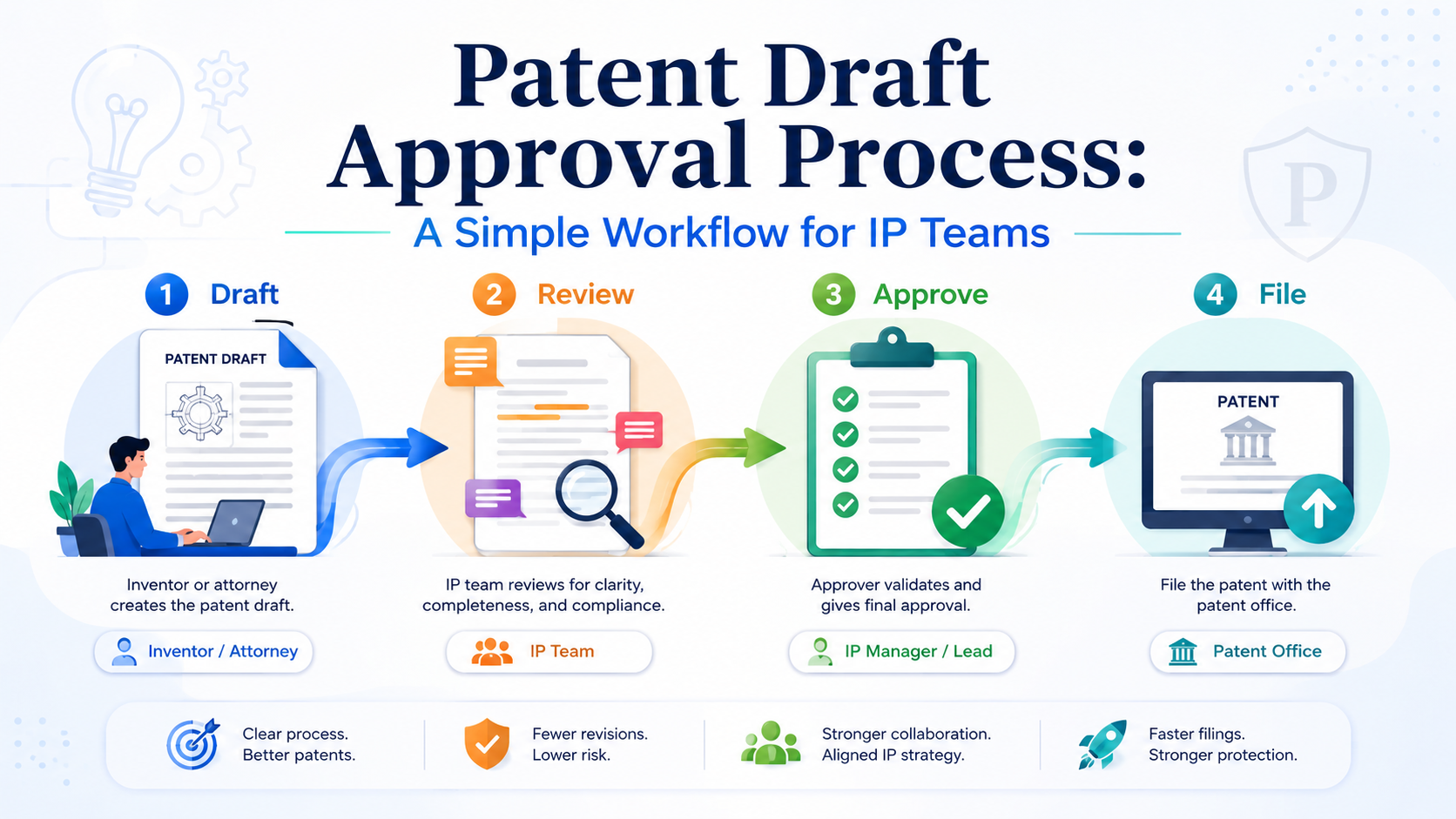
A strong patent draft should not feel like a mystery box. Your IP team should know what was invented, why it matters, what the draft protects, who must review it, what changes are needed, and when the draft is ready to file. When that flow is unclear, teams lose time. Engineers get pulled into long email threads. Attorneys wait for missing details. Founders worry that the company is moving too slowly. Good ideas sit in limbo.
Start The Approval Process Before The Patent Draft Is Written
A clean patent draft approval process does not start when the draft lands in someone’s inbox. That is already too late. By then, the attorney has made many choices.
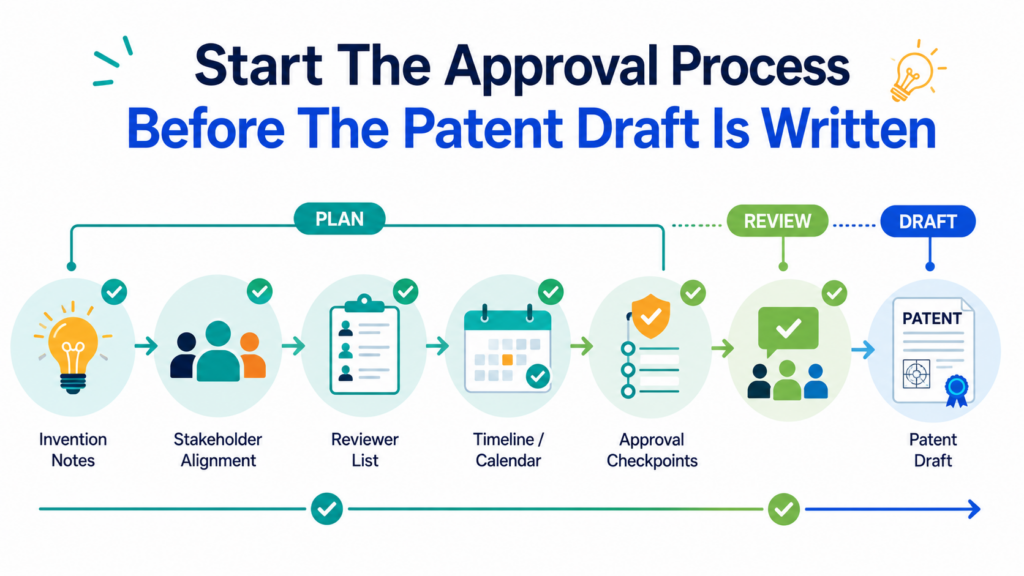
The invention has already been shaped into claims, figures, and a story. If the team has not aligned before that point, the review often turns into a slow round of “wait, that is not what we meant.”
The best IP teams start earlier. They treat the draft as the result of a clear intake process, not the starting point.
This one shift saves days or even weeks. It also leads to stronger drafts because the attorney has better raw material before writing begins.
For a startup, this matters a lot. Your engineers are busy. Your founder is busy. Your product is changing fast.
Nobody has time for five review cycles because the first version missed the real point of the invention. A smart process makes the first draft much closer to the final draft.
The invention record should explain the real business value, not just the technical feature
Many invention notes focus only on what was built. That is useful, but it is not enough. A patent draft needs to show what makes the idea different, useful, and worth protecting.
The review team should know why this feature matters to the company before the draft starts.
For example, an engineer may say, “We built a faster model routing method.” That may be true, but it does not give the full picture.
The better note explains what problem the method solves, why old methods failed, what changed in the system, and why customers or users benefit from it.
That deeper context helps the attorney write with purpose. It also helps the IP team decide whether the draft should focus on speed, accuracy, cost savings, privacy, hardware limits, data flow, user actions, or another key advantage.
A good invention record should make the reviewer feel the pain the invention solves
The person reading the invention record should be able to feel the problem. They should understand what was hard before the invention existed. They should see why the team had to build something new.
This does not mean the record needs to be long. It means it needs to be clear. A few strong paragraphs can do more than ten pages of loose notes. The best records explain the old way, the new way, and the reason the new way wins.
PowerPatent helps teams capture this early detail in a simple way, so the draft does not depend on scattered Slack threads, lost design notes, or rushed calls.
When smart software guides the intake and real attorneys review the work, the team can move faster without guessing. You can see how that kind of workflow works here: https://powerpatent.com/how-it-works
The approval owner should be named before drafting begins
Every patent draft needs one clear owner inside the company. This person does not have to be the only reviewer.
But they should be the one who keeps the review moving, collects input, resolves internal questions, and tells outside counsel when the team is ready.
Without an approval owner, drafts drift. One engineer says the claims look fine. Another says the figures are wrong. The founder wants to wait. Legal wants a cleaner version.
Nobody knows who has the final say. This is how a patent draft gets stuck for three weeks while everyone assumes someone else is handling it.
The approval owner brings order. They do not need to know every legal detail. They need to understand the product, the company goal, and the people involved.
In many startups, this person may be the founder, head of engineering, product lead, or internal IP lead.
The approval owner should protect speed and quality at the same time
Speed alone is not the goal. A fast bad draft is still a bad draft. But endless review is also dangerous. The approval owner’s job is to keep both sides in balance.
That means they should push reviewers to give clear comments, not vague worries. They should separate must-fix issues from nice-to-have edits. They should make sure inventors focus on technical truth, while attorneys focus on claim strength and filing strategy.
The best approval owners do not let the process become a group writing project. They make sure each person reviews the part they are best suited to review.
This keeps feedback useful and prevents the draft from getting watered down by too many opinions.
The team should agree on the filing goal before the first draft
A patent draft can be written in many ways. It can aim to protect a core platform. It can protect a narrow product feature. It can block a likely copycat. It can support fundraising, partner deals, or future licensing. The right draft depends on the goal.
If the goal is not clear, the draft may feel “fine” but still miss the business need. This is one of the most common mistakes in patent work. A technically correct draft is not always a strategically useful draft.
Before drafting starts, the team should answer a simple question: what would make this patent valuable to the company three years from now?
The answer shapes everything. It affects what examples are included, how broad the claims should try to be, what drawings are needed, what fallback versions should be described, and how the invention is framed.
A patent draft should match the company’s future, not only today’s product
Startups change fast. The first product may not be the final product. The first model may not be the long-term system. The first customer use case may not be the largest market.
A smart approval process forces the team to think beyond what shipped last week. Reviewers should ask whether the draft covers likely future versions.
They should check whether the draft is tied too tightly to one code path, one interface, one vendor, one model type, or one deployment setup.
This is where attorney oversight matters. A strong patent attorney can help turn a narrow engineering write-up into a broader protection story, while still keeping the draft honest and grounded.
PowerPatent combines this legal review with tools that help teams move quickly through the hard parts. Learn more here: https://powerpatent.com/how-it-works
Build A Draft Review Map That Shows Who Reviews What And When
Once the draft is ready, the biggest risk is messy review. Messy review does not always look messy at first. It may look like a normal email chain.
Someone sends the draft. Five people reply at different times. Some comments are in the document. Some are in email. Some are in Slack. Some are said on a call and never written down.
Then the attorney has to guess which comments matter. The approval owner has to chase missing input. The engineers have to reread the same sections again. The founder sees delay and starts to lose trust in the process.
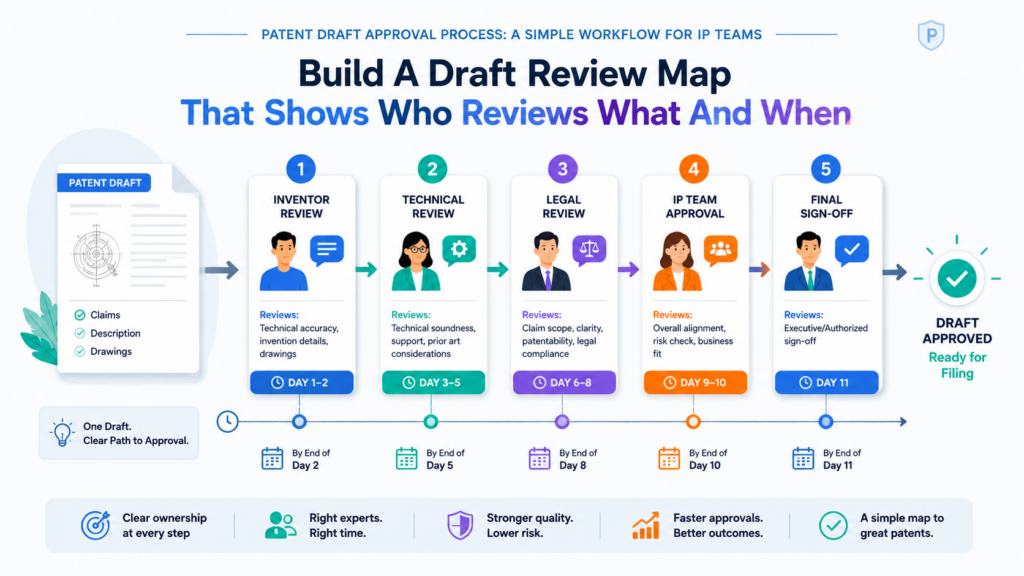
A draft review map prevents this. It tells the team who reviews the draft, what each person should check, when their feedback is due, and who gives final approval. This is simple, but it is powerful.
The first review should focus on technical truth
The first people to review the draft should usually be the inventors or the engineers closest to the work. Their job is not to rewrite legal language. Their job is to check whether the draft is technically true.
They should read the description, the figures, and the examples with one question in mind: does this explain what we actually built and what we believe we invented?
This review catches serious issues early. Maybe the draft says the system trains a model when it really selects from trained models.
Maybe it says a device sends data to a server when the key step happens on the device. Maybe it shows a sequence that works in a demo but not in the real architecture. These details matter.
A patent draft does not need to copy the code line by line. In fact, it usually should not. But it must be accurate enough that the invention is described clearly and honestly.
Engineers should comment on facts, not legal style
Engineers often get stuck when they see patent language for the first time. It may feel formal. It may repeat ideas.
It may use words that do not sound like normal product writing. That can lead engineers to spend too much time trying to make the draft sound nicer.
That is not the best use of their time.
The engineer’s highest-value job is to flag wrong facts, missing steps, unclear flows, weak examples, and places where the draft is too narrow or too broad from a technical point of view.
They should say what is wrong and what the correct version should be. They should not try to turn the patent draft into a blog post, product spec, or investor deck.
This is why the approval owner should give reviewers a clear role before they open the draft. A simple review note can save hours of confusion.
It can tell engineers to focus on accuracy, coverage, and missing variants. It can tell business leaders to focus on value and use cases. It can tell counsel to focus on legal strength.
The second review should focus on business fit
After the technical review, the draft should be checked for business fit. This review is often done by a founder, product leader, business lead, or IP lead. The goal is to see whether the draft protects what the company actually cares about.
This is different from technical truth. A draft can be technically right but still weak from a business view. It may spend too much space on a small detail and too little on the real product edge.
It may describe one customer workflow but miss the larger platform. It may protect a backend process but ignore the user-facing value that competitors would copy.
The business reviewer should ask whether the draft supports the company’s market position. If a competitor read the patent after it published, would they understand that this area is protected?
If a future investor reviewed the filing, would it support the story that the startup owns something important? If the product changes, would the filing still matter?
The business review should connect the draft to the moat
A moat is what makes the company hard to copy. In patent work, the moat is not always the same as the feature demo.
It may be the data handling method behind the feature. It may be the way the system adapts over time. It may be the way the product works under real-world limits.
The business reviewer should help the attorney see this. They should explain what competitors are likely to copy, what customers care about, and what parts of the system are most tied to long-term value.
This does not mean the business reviewer should make legal calls. It means they should give strategic context. When attorneys understand the company’s edge, they can draft and revise with sharper aim.
PowerPatent is built for this kind of team flow. It helps founders, engineers, and attorneys work from a shared process instead of a messy thread.
That means fewer missed details, cleaner review, and faster movement toward filing. See the process here: https://powerpatent.com/how-it-works
The final review should focus on filing readiness
The last review should not reopen every old debate. It should confirm that the draft is ready to file.
This is the moment to check that the main comments were resolved, the inventors are correct, the drawings match the text, and the claims line up with the invention story.
This final review should be owned by the approval owner and counsel. Too many people in the final round can slow the process for no good reason. By this point, the technical and business issues should already be handled.
The final review should be calm and focused. The team should know what changed since the last version. They should know whether any open issues remain. They should know who has authority to say yes.
Final approval should be a clear decision, not a vague silence
A patent draft should not be treated as approved just because nobody replied. Silence is not approval. It creates risk.
Later, someone may say they never reviewed the draft, never agreed to a change, or did not realize the filing was moving forward.
The better path is direct approval. The approval owner should record that the draft has been reviewed and approved for filing.
The attorney should confirm that the draft is ready based on the current instructions. The team should keep a clear record of the final version.
This does not need to be heavy. It just needs to be clear. A clean approval record protects the team from confusion and gives everyone confidence that the filing moved forward for the right reasons.
Create A Clear Comment System So Reviews Do Not Turn Into Chaos
A patent draft approval process can break down fast when comments are not handled in a clear way. The draft may be strong.
The attorney may be skilled. The inventors may care deeply. But if the feedback is scattered, late, unclear, or repeated, the whole process slows down.
This is where many IP teams lose time. Not because the invention is hard to understand, but because the review process has no simple rules.
One person leaves comments in the draft. Another sends a long email. Someone else replies in a chat thread.
A founder adds notes after the attorney has already revised the claims. An engineer questions a drawing that was already fixed in another version. Soon, nobody knows which version is the real one.
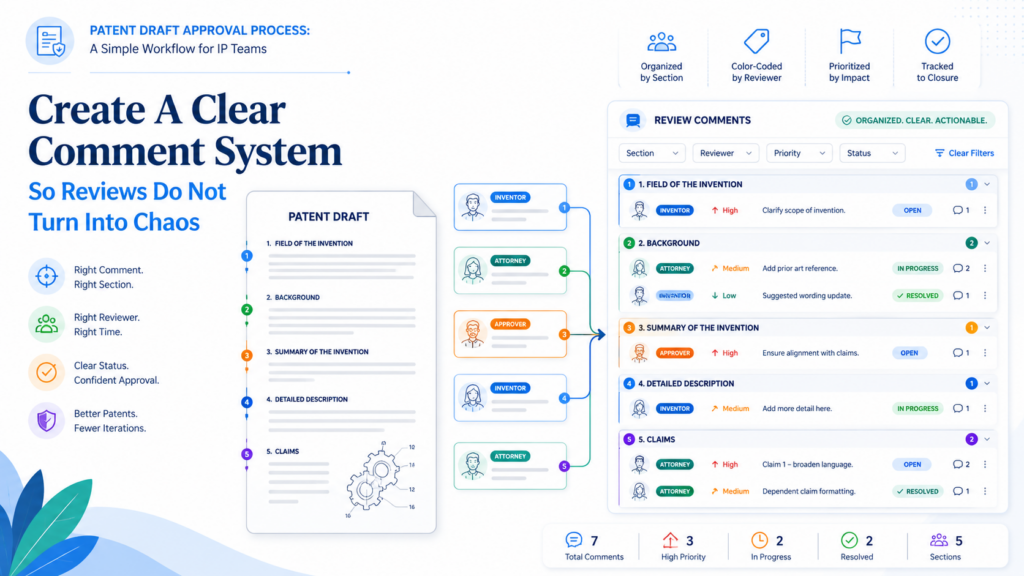
The solution is not more meetings. The solution is a clear comment system.
The comment system should tell reviewers where to leave feedback, what kind of feedback is helpful, how to mark urgent issues, and when comments are closed. It should also help the approval owner see which issues are still open and which ones are done.
This may sound basic, but it has a large impact. A clean comment system helps the team make faster choices.
It helps attorneys revise the draft without guessing. It helps engineers avoid re-reading the same text again and again. Most of all, it makes review feel less painful.
Feedback should be tied to the exact part of the draft
The most helpful comments are placed next to the exact sentence, figure, claim, or paragraph that needs attention.
This keeps the review simple. The attorney does not have to hunt for the issue. The approval owner does not have to translate the concern. Other reviewers can see the comment in context.
A vague comment like “the model section is wrong” creates extra work. A better comment says, “This paragraph says the model is retrained after each user action, but in our system the model score is updated while the base model stays the same.”
That one comment gives the attorney what they need. It shows the wrong part, explains the problem, and gives the correct detail.
Good comments reduce back-and-forth. They also reduce risk. When comments are clear, the final draft is more likely to reflect the actual invention.
Reviewers should explain the reason behind each important change
A useful comment does not only say what should change. It explains why the change matters. This is especially important in patent drafts because one edit can affect several parts of the application.
For example, an engineer may want to remove a step because the current product no longer uses it. But the attorney may want to keep that step as one possible version of the invention, as long as it is still accurate.
If the engineer explains the reason behind the comment, the attorney can decide whether to revise the text, keep the concept as an alternate version, or ask a follow-up question.
This is how strong drafts are made. Not by blindly accepting every edit, but by understanding what each edit means.
The approval owner should coach the team to give comments that include context. A comment should not be a command thrown over the wall. It should be a clear signal that helps the attorney improve the draft while keeping the protection strong.
Comments should be grouped by importance
Not every comment has the same weight. Some comments affect the heart of the invention. Some fix a small typo. Some improve clarity. Some raise a business concern. Some are only personal style choices.
If all comments are treated the same, the team wastes time. The attorney may spend energy on minor wording while a major technical issue stays open.
The founder may think the draft is almost done when a core claim issue still needs review. The approval owner may struggle to decide what must be fixed before filing.
A better system groups comments by importance. The most urgent comments are those that affect accuracy, claim scope, inventor names, filing strategy, or key business value.
Medium-level comments may affect examples, drawings, or wording that could be clearer. Low-level comments may be grammar, formatting, or style.
This does not require a complex tool. It requires discipline. Each reviewer should know when they are raising a must-fix issue and when they are offering a nice-to-have suggestion.
The approval owner should stop minor edits from delaying filing
Patent drafts are not marketing pages. They do not need to sound elegant. They need to be clear, complete, accurate, and strategically useful.
A draft can be ready to file even if one sentence feels a bit formal or one phrase does not sound like normal product language.
This is hard for some teams. Founders and engineers often care about wording because they care about the invention. That is good. But too much wordsmithing can slow the process and add little value.
The approval owner should protect the review from endless polish. If a comment does not affect accuracy, claim strength, business fit, or filing readiness, it should not block approval.
The attorney can decide whether to accept it, but the team should not let small edits reopen the whole draft.
PowerPatent helps teams keep this work organized by giving them a clearer path from invention details to attorney-reviewed draft.
Instead of hunting through loose comments and old threads, teams can move through a guided process with real legal oversight. You can see how PowerPatent supports faster, cleaner patent work here: https://powerpatent.com/how-it-works
Version control should be simple and strict
Version confusion is one of the fastest ways to damage a patent draft review. When different people review different versions, the team loses trust in the process.
Comments get duplicated. Old errors come back. New changes are missed. The attorney may revise the wrong draft.
A simple version rule can prevent this. At any point in time, there should be one active draft for review. The file name or platform should make it clear which version is current.
Old versions should be archived or marked as closed. Nobody should keep editing a private copy after the review window ends.
This sounds small, but it changes the feel of the process. Everyone knows where to look. Everyone knows which comments matter. The approval owner can track progress without confusion.
The team should keep a clean record of what changed
Every major revision should have a short change note. It does not need to be long. It should simply explain what changed and why.
For example, the note may say that the claims were revised to focus more on edge processing, the drawings were updated to show a second device, and the description was expanded to include a cloud-based version.
This helps reviewers avoid reading the whole draft from scratch each time. It also helps founders and counsel see whether their concerns were handled. A good change note makes the next review faster.
The attorney should not have to defend every small wording choice, but the team should be able to see how major issues were resolved. This builds confidence and keeps the process moving.
The best comment system creates calm
A calm review process is not slow. It is focused. It gives each person a clear role. It gives each comment a place. It gives each issue an owner. It gives the final decision a clean path.
When the comment system works, the draft does not feel like a problem. It feels like a living document moving toward approval. That is the goal.
A good patent draft approval process should reduce stress, not add to it. It should help inventors feel heard, help attorneys make stronger choices, and help founders protect the company without losing momentum.
Use An Attorney Review Stage That Improves Strategy, Not Just Wording
Attorney review is not just a legal checkpoint. It is where the patent draft becomes stronger, sharper, and more useful for the business. A good attorney does far more than fix formal language.
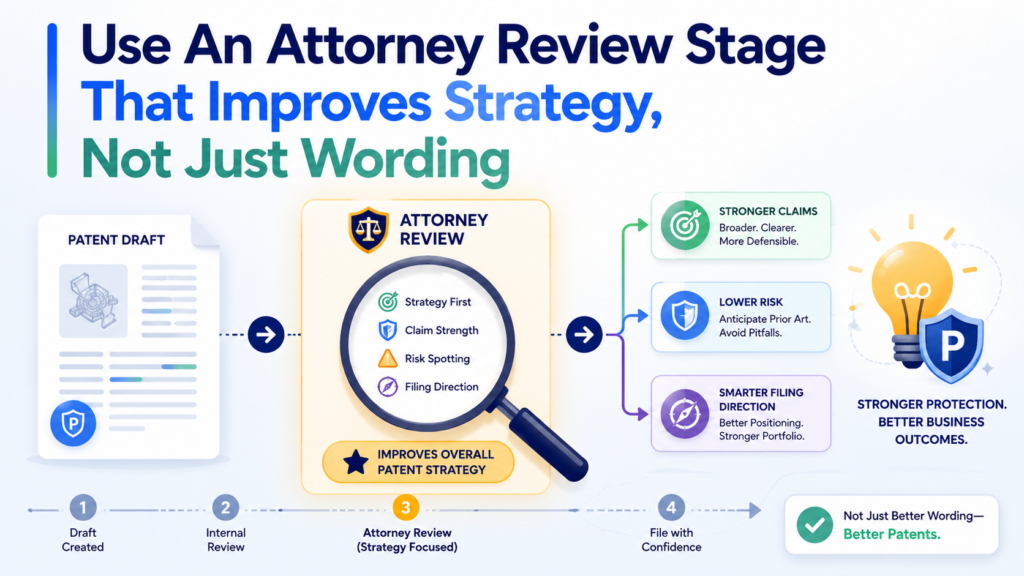
They look at the invention from many angles. They ask whether the claims are too narrow. They check whether the description gives enough support.
They look for weak spots that a competitor could use. They help shape the draft so it has real value after filing.
This stage matters because a patent draft is not only a record of what the team built. It is a tool.
It may help the company defend its product, raise money, support a deal, block copycats, or build long-term value. That means attorney review should be strategic.
Many teams make the mistake of treating attorney review like final proofreading. They send a draft, ask whether it looks good, and move on. That is not enough.
A draft may look clean but still fail to protect the most important parts of the invention.
A strong attorney review should test the draft. It should ask hard questions. It should look for missing versions of the invention. It should make sure the claims match the company’s goals.
The attorney should check whether the claims protect the real invention
The claims are one of the most important parts of a patent application. They define the legal boundary the team is trying to protect.
That means the attorney must look closely at what the claims cover and what they leave out.
A common problem is that claims may be too tied to the current product. They may include steps that are not truly needed.
They may depend on one kind of device, one data source, one user flow, or one model type. If those limits are not needed, they may make the protection weaker.
Another problem is the opposite. Claims may be written too broadly without enough support in the description.
That can create trouble later. The goal is not to write the biggest claim possible. The goal is to write claims that are strong, supported, and useful.
The attorney should look for the smallest set of parts that make the invention work
A useful way to review claims is to ask what parts are truly needed. What is the core idea? What steps make it different? Which details are helpful examples, and which ones are required?
This question helps avoid accidental limits. For example, if the invention works with many types of sensors, the claim should usually not be locked to one sensor unless there is a good reason.
If the invention can run on a phone, server, chip, robot, or edge device, the draft should not quietly suggest that only one setup matters.
This is where attorney skill is important. The attorney can help separate the core invention from the product details around it. That gives the startup more room as the product grows.
PowerPatent combines smart tools with real attorney oversight, so teams do not have to choose between speed and quality.
The software helps organize the invention details, while attorneys help shape the filing into something stronger. See how PowerPatent works here: https://powerpatent.com/how-it-works
The attorney should test the draft against likely competitor moves
A strong patent draft should make a copycat’s life harder. That means the attorney should think like a competitor during review.
If another company wanted to build around this patent, what would they change? Could they swap one step?
Could they move the process from the cloud to the device? Could they use a different model type? Could they change the order of steps? Could they remove one detail and still get the same result?
These questions help reveal weak spots. They show where the draft may need more examples, broader language, or alternate versions.
They also help the team understand whether the filing lines up with the market.
This is not about fear. It is about being honest. Competitors do not copy your product exactly if they can avoid it.
They copy the value and change the details. A strong patent draft should try to cover the value-driving idea, not only the exact first build.
The review should include future versions the team can already see
Most startups know where the product may go next. The team may have plans for a mobile version, a model update, an enterprise workflow, a hardware product, an API, or a new data source.
If those versions are tied to the same invention, they should be discussed during attorney review.
This does not mean the team should invent fake features. It means the draft should include real, reasonable versions that the team can explain.
Patent applications often benefit from describing different ways the invention can be used, built, or arranged.
A founder should not assume the attorney knows every future path. The attorney can only work with the information provided.
That is why a strong approval process gives the attorney business context, product plans, and technical variants before the final draft is approved.
The attorney should review support across the whole draft
Claims need support in the description and drawings. If a claim says the system can do something, the draft should explain that idea well enough.
If a drawing shows one setup, the text may need to explain other setups too. If the team wants to protect a method, device, and system, the draft should support each angle.
This support review is not glamorous, but it is vital. A draft can fail later if it does not give enough detail.
The attorney should make sure the application has depth. It should describe the main flow, key parts, possible variations, and practical examples.
The goal is to make the draft sturdy. Not bloated. Not stuffed with empty words. Sturdy.
A strong draft gives the team fallback positions
A fallback position is a narrower version of the invention that can still be useful if the broadest version is challenged or rejected.
This matters because patent review can involve back-and-forth with the patent office. A good draft gives the attorney room to adjust.
For example, the broad idea may involve routing data based on a score. A fallback version may involve a specific way of generating the score, a specific device setup, or a specific privacy rule.
If the original draft describes these versions well, the attorney has more options later.
This is why the approval process should not only ask, “Is the draft accurate?” It should also ask, “Does the draft give us room to respond later?” That is a deeper and more strategic question.
Attorney review should end with a clear recommendation
At the end of attorney review, the team should know where things stand.
The attorney should be able to say whether the draft is ready to file, needs targeted changes, or needs major revision. The recommendation should be clear enough for the approval owner to act.
This does not mean the attorney must explain every legal detail. It means the team should not be left guessing.
If the draft is ready, say so. If it needs work, explain what work matters most. If there is a tradeoff, explain it in simple terms.
The best attorney review makes the team more confident. It gives founders a better sense of what they are protecting. It gives engineers a chance to confirm the technical story. It gives the company a cleaner path to filing.
Make Inventor Approval Fast, Focused, And Easy To Complete
Inventor approval is one of the most important parts of the patent draft approval process. It is also one of the easiest parts to slow down.
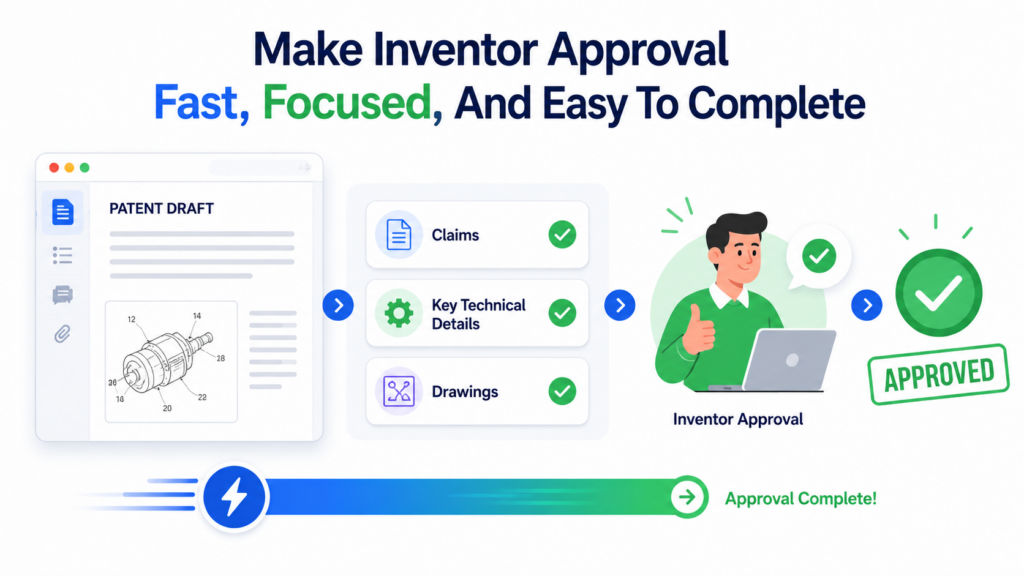
Inventors are often busy building the product, fixing customer issues, training models, shipping code, or helping sales. They may not have time to read a long patent draft with full focus unless the process is simple.
A smart IP team respects that. It does not dump a long document on inventors with a vague message like “please review.”
It gives them a focused task. It tells them what to look for. It gives them a simple way to flag issues. It sets a clear deadline. It keeps the review short enough to complete but serious enough to catch real mistakes.
Inventor approval should not be a rubber stamp. The inventors are the people most likely to spot technical errors, missing steps, or wrong assumptions. Their input can make the draft much better. But they need guidance.
When this stage is designed well, inventors feel respected. They do not feel trapped in legal work. They can give strong feedback without losing a full day.
Inventors should review the invention story first
Before inventors read every claim or every formal section, they should review the invention story. This is the plain explanation of what the invention is, what problem it solves, how it works, and why it is different from older ways.
If this story is wrong, the rest of the draft may be wrong too. That is why the invention story should come first.
The inventor should ask whether the draft captures the real idea. Does it describe the hard part correctly? Does it explain the new step or structure clearly?
Does it show why the invention is not just a normal use of known tools? Does it leave out an important technical reason the system works?
These questions help the inventor focus on what matters.
The invention story should be easy enough for a smart non-inventor to follow
A good patent draft is technical, but it should still be clear. If the invention story is so dense that only one engineer can understand it, the draft may need work.
The goal is not to oversimplify the invention. The goal is to explain it in a way that a skilled reader can follow.
Inventors can help here. They know where people get confused. They know which words are internal team shorthand and which words are more widely understood. They know when a diagram hides a key step.
During review, inventors should mark places where the draft uses the wrong term, skips a key link, or makes the invention sound less important than it is. This kind of feedback can improve both clarity and strength.
PowerPatent helps capture inventor input earlier and more cleanly, so attorneys are not trying to rebuild the invention from scattered notes.
That means inventors can spend less time explaining the same idea over and over and more time building. See how PowerPatent helps teams move from idea to attorney-reviewed filing here: https://powerpatent.com/how-it-works
Inventors should confirm that the examples are correct
Examples make a patent draft stronger when they are accurate and useful. They show how the invention can work in real settings. They can also support different versions of the invention. But bad examples can create problems.
An example may be too narrow. It may describe a setup that the team no longer uses. It may include a step that is not required.
It may suggest a limit that the team did not intend. Inventors are often the best people to catch these issues.
The review should ask inventors to look at examples with care. If the draft gives a sample workflow, does it match the actual process? If the draft describes a model, does it use the right input and output?
If the draft describes hardware, are the parts connected correctly? If the draft shows a user action, does the system really respond that way?
Examples should not trap the invention inside one product version
Startups change. The product today may be different next month. That is normal. A patent draft should avoid sounding like the invention only works in the current version unless that is truly the case.
Inventors should watch for accidental traps. For example, a draft might say the invention always uses a certain database, always runs in a certain order, or always needs a certain user action. If those details are only examples, the draft should say so more clearly.
This is where inventor review and attorney review work together. The inventor knows what is technically true.
The attorney knows how to write it in a way that preserves protection. When both sides work well together, the draft becomes more flexible and more useful.
Inventors should not be asked to make legal decisions
Inventors should not have to decide claim strategy, filing scope, or legal wording. That is not their job. Asking them to do this slows review and creates stress.
Their job is to confirm technical accuracy, fill gaps, explain variants, and flag anything that does not match the invention.
The attorney’s job is to turn that input into a strong patent draft. The approval owner’s job is to keep the process moving.
This division of labor matters. When inventors are asked to approve legal strategy, they may freeze. They may delay because they are not sure what approval means. They may over-edit because they think every word is their responsibility.
A better approval message is clear. It should tell inventors that they are reviewing for technical truth and completeness, not legal style.
Inventor approval should feel like a guided review, not an open-ended homework task
A guided review is easier to complete. The approval owner can give inventors a short note explaining which parts to read first, where to leave comments, and what kind of feedback matters most. The note should be direct and respectful.
The inventor should know that silence is not ideal. They should either approve the draft or flag concerns.
If they are too busy, the approval owner should help them focus on the highest-value sections, such as the summary, figures, examples, and claim concepts.
This keeps the work moving without lowering quality.
Inventor approval should be recorded clearly
Once inventors have reviewed the draft, their approval should be recorded. This does not need to be complex. The team should know who reviewed the draft, when they reviewed it, and whether they approved it or asked for changes.
This record helps avoid confusion later. It also helps the team know when the draft can move to final filing approval.
The approval owner should not rely on memory. Patent work often spans weeks or months. People forget what they approved. Versions change. A clear record protects the team.
Inventor approval is not just a step to check off. It is a quality gate. When handled well, it improves the draft and speeds the process at the same time.
Use A Business Review To Make Sure The Patent Supports The Company Strategy
A patent draft should serve the business. It should protect something that matters. It should support where the company is going. It should help the team build value, not just create a filing for the sake of filing.

This is why business review is a key stage in the approval process. It brings the draft out of pure technical review and connects it to company strategy.
For startups, this is especially important. Money and time are limited. The team cannot protect everything at once.
The company needs to choose the inventions that support its edge. A patent draft should match that edge as closely as possible.
Business review does not replace attorney review. It adds context. The founder, product lead, or IP lead may know which features customers care about, which competitors are watching, which deals are coming, and which parts of the product are most important to the company’s future. That insight can make the draft sharper.
The business reviewer should ask what the patent is meant to protect
Every patent draft should have a business reason. That reason may be to protect a core technology. It may be to support investor trust. It may be to make the company harder to copy.
It may be to build a stronger position before a partnership or sale. It may be to protect a future platform, not just the first product.
The business reviewer should make sure that reason is clear. If nobody can explain why the filing matters, the team should pause and ask better questions.
A strong business review looks at the draft from the outside. It asks what a competitor would learn from the published application.
It asks what an investor would see in the company’s IP story. It asks whether the draft protects a real business advantage.
The draft should protect the value, not only the feature
A feature is what the user sees. Value is why the feature matters. A patent draft may need to cover the hidden system that creates the value, not just the visible button, screen, or workflow.
For example, a startup may have a feature that recommends a next action for a user. The real invention may not be the recommendation itself.
It may be how the system selects the right data, updates the score, protects privacy, reduces delay, or adapts to a changing signal.
The business reviewer can help identify this difference. They can say, “This feature matters because it reduces manual review by half,” or “Customers care because this works without sending sensitive data to the cloud.” That kind of input helps the attorney aim the draft at the real moat.
PowerPatent helps founders and IP teams connect invention details with filing strategy, while real attorneys review the work.
That helps teams avoid shallow filings and move toward patents that better match business goals. Learn how it works here: https://powerpatent.com/how-it-works
The business review should check for market timing
Patent timing matters. A company may need to file before a product launch, demo day, investor meeting, customer pilot, public talk, research paper, open-source release, or partner pitch. If the approval process ignores timing, the company can create risk.
The business reviewer should know what public events are coming. They should tell the IP team if the invention may be shown, sold, described, published, or shared soon. This helps counsel decide how fast the filing must move.
This does not mean every draft should be rushed. It means timing should be visible. A team should not discover two days before launch that a draft has been sitting in review for three weeks.
The approval process should protect the company before public disclosure
Public disclosure can affect patent options. The rules can vary by country, and timing can matter a lot. This is one reason attorney oversight is so important. The business team should not try to guess the legal risk on its own.
What the business team can do is simple. It can tell counsel what is about to be shared and when.
It can flag upcoming launches, demos, investor decks, blog posts, papers, talks, and customer materials. This gives counsel the information needed to guide filing timing.
A strong approval process includes this check before final approval. It makes sure the draft is not only technically ready, but also timed correctly for the company’s plans.
The business reviewer should look beyond the first product
Many startups file too narrowly because they only think about the product in front of them. That can be a mistake. If the invention may support a wider platform, the draft should be reviewed with that future in mind.
The business reviewer should ask where the company may go next. Could the same invention apply to a different customer type?
Could it work in another industry? Could it be used with other data, devices, models, or workflows? Could it become part of an enterprise platform, developer tool, hardware product, or API?
These questions do not mean the draft should become vague. They mean it should avoid unnecessary limits when the invention is broader.
A good business review helps the patent age well
A patent can last a long time. The product may change many times during that period. The company may enter new markets. The technology stack may shift. The first version may look old after two years.
A useful patent draft should try to age well. It should capture the deeper idea, not only the current packaging. It should describe enough versions to support future growth. It should leave room for the company to evolve.
The business reviewer helps by bringing the long view. They can say, “We may use this in our enterprise product next year,” or “This could apply to our hardware roadmap,” or “The model may change, but the data routing logic is the key.” These simple comments can have a major impact on the final draft.
Business approval should be decisive
At the end of business review, the company should make a clear decision. Does this draft support the business goal? Does it protect something worth filing? Is the timing right? Are there any strategic concerns that must be addressed before filing?
The answer should not be vague. The approval owner should record the decision and move the draft forward if it is ready.
Business review is not about making the patent perfect. It is about making sure the filing is aligned with the company’s real needs. When that happens, patents stop feeling like paperwork. They become part of the startup’s growth strategy.
Set Filing Readiness Rules Before The Final Approval Meeting
The final approval stage should be calm, fast, and clear. It should not be the first time people raise major concerns. It should not become a fresh review of every sentence. It should not turn into a debate about whether patents matter.
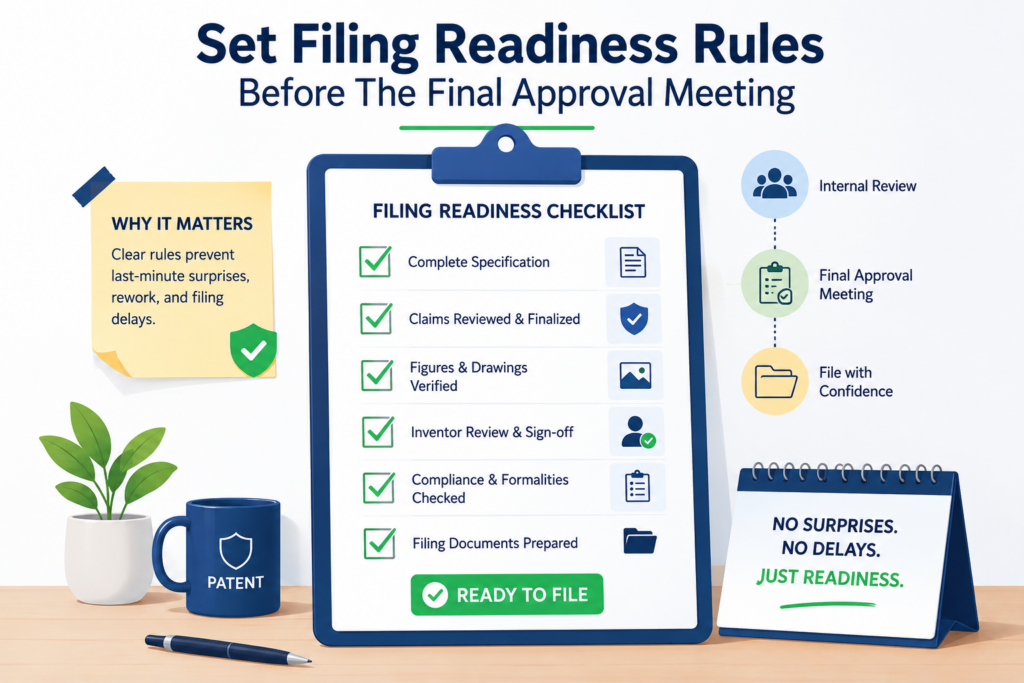
By the time the team reaches final approval, the draft should already be technically checked, attorney reviewed, inventor approved, and tied to business strategy.
Filing readiness rules make this possible.
These rules define what must be true before the team says yes to filing. They help the approval owner avoid last-minute confusion. They also help counsel know when the draft is approved and ready to move forward.
Without readiness rules, the final stage can become messy. Someone may ask whether the claims are broad enough, even though that was already reviewed. Someone may question the drawings, even though inventors already approved them.
Someone may want to add a new feature that was not part of the original invention. These issues can be valid, but they need a process. Otherwise, final approval becomes endless.
Filing readiness should confirm that all must-fix comments are closed
Before final approval, the approval owner should make sure all must-fix comments have been handled. These are the comments that affect technical accuracy, claim scope, business value, inventor information, drawings, or filing timing.
A must-fix comment should not disappear without a decision. It should be resolved, accepted, revised, or clearly deferred with attorney input. The team should know what happened.
This does not mean every small suggestion must be accepted. Some comments may be rejected because they would narrow the draft too much.
Some may be saved for a later filing. Some may be unnecessary. The key is that important comments must be addressed, not ignored.
The final review should not restart closed debates
A common cause of delay is reopening issues that were already decided. This can happen when a new reviewer joins late or when someone reads only the final draft without context.
The approval owner should prevent this. If an issue was reviewed by the right people and resolved, it should stay closed unless new facts appear. Final approval should focus on readiness, not on repeating the whole process.
This is not about shutting down good feedback. It is about respecting the workflow. A clear process gives every concern a place. But it also gives the team a way to finish.
PowerPatent helps reduce this kind of late-stage confusion by keeping the invention workflow more organized from the start.
With smart software and real attorney review, teams can move through each stage with more confidence and fewer loose ends. You can see how PowerPatent helps here: https://powerpatent.com/how-it-works
Filing readiness should confirm the correct inventors and ownership path
Inventor names matter. The team should confirm that the listed inventors are the people who contributed to the claimed invention. This is not always the same as the full product team.
It is not always the manager, founder, or person who wrote the most code. It depends on who contributed to the inventive idea being claimed.
This is an area where attorney guidance is important. The business team should not guess. But the approval process should make sure the question is asked before filing.
The company should also make sure it has a path to own or control the rights it needs. For startups, this often means checking employment agreements, contractor agreements, or assignment documents with counsel.
Inventor review should include a direct check on contribution
The final approval process should include a direct inventor check. The team should ask whether anyone important is missing and whether anyone listed did not actually contribute to the claimed invention.
This can feel awkward, but it is better to ask before filing than to fix confusion later. The approval owner can handle it in a simple, respectful way. The goal is accuracy, not politics.
Patent work should not become a reward system or title system. It should reflect real inventive contribution. Counsel can help make that call, but the team must provide the facts.
Filing readiness should confirm drawings and text match
Drawings are often reviewed too lightly. That is a mistake. Patent drawings can shape how people understand the invention. If the drawings show the wrong flow or leave out a key part, the draft may be weaker.
Before final approval, the team should check that drawings match the text. If the text says the system includes a local device, a remote server, and a model selection engine, the drawings should support that structure.
If the method has five major steps, the flow diagram should not show only three unless there is a reason.
This check should not be treated as design polish. Patent drawings do not need to look like product mockups. They need to support the invention clearly.
Drawing labels should use terms that match the draft
A small label mismatch can create confusion. If the text calls something a “routing engine” and the drawing calls it a “decision module,” reviewers may wonder whether those are the same thing. Sometimes different terms are fine, but they should be intentional.
The approval owner and attorney should check for consistency. This helps the draft read more smoothly and reduces later questions.
Engineers can be very helpful here. They often notice when diagrams do not match the system. Their input can prevent mistakes that non-technical reviewers may miss.
Filing readiness should end with a clear filing instruction
The final step is a direct instruction to file. The attorney should not have to guess whether the company is ready. The approval owner should confirm that the draft is approved and that counsel may proceed.
This instruction should include the final version, the filing type if known, the timing need, and any final business notes. If there is a public disclosure deadline, it should be repeated clearly.
A clean filing instruction gives everyone confidence. It shows that the review process is complete. It helps counsel act quickly. It helps the company keep a clear record.
The goal of the entire approval process is not to make review longer. It is to make approval easier, faster, and safer. When readiness rules are clear, the final yes becomes simple.
Keep The Patent Draft Moving With A Simple Timeline That People Can Actually Follow
A patent draft approval process needs a timeline. Not a rough hope. Not a quiet wish that people will review when they have time.
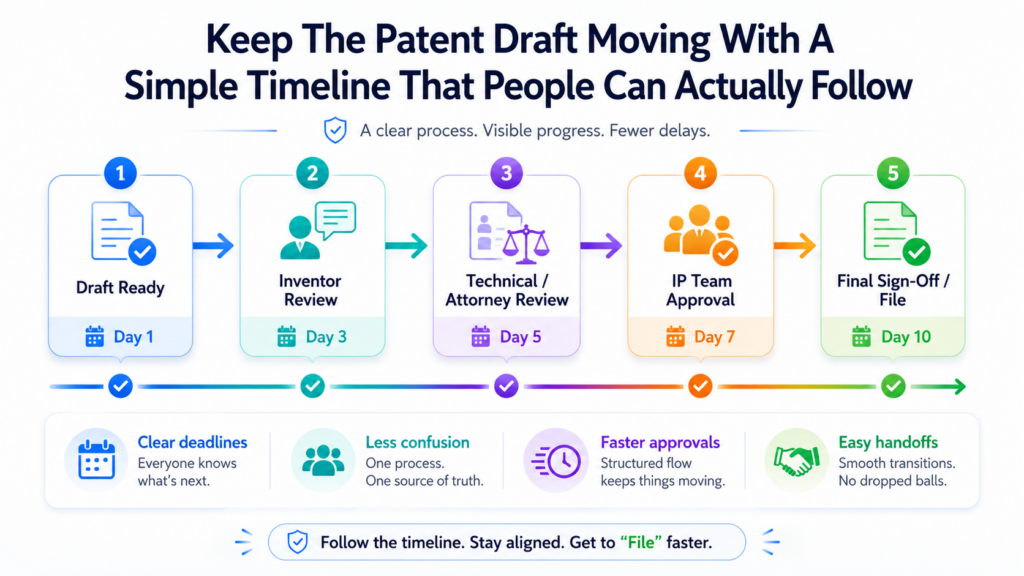
A real timeline that shows when each stage starts, when feedback is due, and when the draft should be ready for filing.
This matters because patent drafts often sit still for simple reasons. The engineer thought the founder was reviewing first. The founder thought counsel was waiting on the engineer.
Counsel thought the company needed more time. The approval owner thought the comments were done, but one key person never opened the draft.
A timeline removes that fog.
The best timeline is simple enough that everyone can follow it. It should not feel like a project management maze. It should show the review stages in plain words. It should give each person a clear due date.
It should build in enough time for real review, but not so much time that the work drifts.
For startups, speed matters. But speed does not mean panic. A good timeline lets the team move quickly without making sloppy choices. It gives inventors enough time to review the technical parts.
It gives the attorney enough time to revise with care. It gives the founder enough time to make a business call. It gives the company a clean path to filing before launch, demo, sale, or disclosure.
The timeline should start from the filing need, not from the draft date
Many teams build the timeline from the day the first draft is ready. That can work, but it is often the wrong starting point. The better starting point is the filing need.
Ask when the company needs the application filed. Is there a product launch coming? Is there an investor pitch? Is there a public demo? Is there a partner meeting? Is there a research paper, open-source release, or customer pilot? The filing need should shape the timeline.
If the company needs to file before a public event, the team should work backward from that date. This gives everyone a clear sense of urgency. It also helps counsel flag whether the timeline is safe or too tight.
A patent draft does not live in a vacuum. It is tied to real company moves. The approval timeline should reflect that.
A deadline should be paired with a reason people understand
People are more likely to meet a deadline when they understand why it matters. “Please review by Friday” is fine. “Please review by Friday because we need to file before the product demo next Wednesday” is stronger.
The reason creates focus. It tells reviewers that the task is not just legal admin. It is tied to protecting the company before something becomes public. That makes the work feel real.
The approval owner should use plain words. They should not scare the team. They should simply connect the review to the business event. When people see the link, they usually move faster.
PowerPatent helps teams connect invention work, review work, and filing work in one cleaner path. That means fewer lost steps and less confusion when timing matters.
See how PowerPatent helps founders and IP teams move faster here: https://powerpatent.com/how-it-works
Each review stage should have a clear time box
A time box is a set window for review. It tells the team when a stage starts and when it ends. This prevents open-ended review, which is one of the biggest causes of delay.
Technical review may get a few business days. Business review may get a shorter window if the founder has already seen the invention record.
Attorney revision may get a set period based on the size of the changes. Final approval may be limited to confirming readiness, not reopening every issue.
The exact timing will vary by team and draft complexity. A simple invention may move quickly. A deep tech filing with many figures and technical variants may need more time.
The point is not to force every draft into the same schedule. The point is to give every draft a schedule at all.
A time box should make room for real review, not pretend review
A review window that is too short can create false approval. People may approve without reading. That is risky. The goal is not to rush people into silence. The goal is to give them a fair chance to review and a clear reason to act.
The approval owner should match the review window to the role. An inventor who needs to check technical accuracy may need more time than a business lead who only needs to confirm strategic fit.
An attorney revising core claims may need more time than an attorney fixing drawing labels.
Good timelines are realistic. They respect people’s time while still protecting momentum.
The approval owner should send fewer, better reminders
Nobody likes being chased. But patent drafts do need reminders. The key is to make reminders useful, not annoying.
A good reminder says what is due, who needs to act, where to comment, and what happens next. It should not be long. It should not blame anyone. It should make the next step easy.
Instead of sending five vague pings, the approval owner should send one clear message at the start, one reminder before the deadline, and one closeout message when the stage ends. That is often enough.
The reminder should also name the cost of delay in a calm way. For example, if late comments may push the filing past a launch date, say that plainly. If comments received after the deadline may need to go into a later filing, say that too, with attorney guidance.
Reminders should reduce thinking, not add work
The best reminder makes the task easier to complete. It may point the inventor to the most important sections. It may say that the reviewer only needs to check figures and examples. It may note that legal wording comments are not required.
This matters because busy people delay tasks that feel unclear. When the task is simple, they are more likely to do it.
A reminder is not just a nudge. It is a tool for clarity.
A good timeline includes an escalation path
Sometimes a reviewer does not respond. Sometimes a major concern appears late. Sometimes a launch date moves. Sometimes counsel needs more detail. The timeline should include a simple way to handle these moments.
Escalation does not mean drama. It means knowing who decides what happens next. If an inventor is unavailable, who can help confirm the technical details? If a founder has not approved, who can make the business call? If a new issue appears, who decides whether it blocks filing or moves to a later filing?
Without an escalation path, the draft stalls. With one, the team can keep moving.
Escalation should protect quality while avoiding endless delay
Some issues should block filing. If the draft is technically wrong, missing the real invention, or naming the wrong inventors, the team should stop and fix it. Other issues may not need to block filing.
A minor example, a future feature, or a nice-to-have wording change may be handled later or left out if counsel agrees.
The escalation path helps separate these cases. It gives the approval owner a way to make a clean decision with counsel instead of letting every concern become a full stop.
A strong timeline is not rigid. It is controlled. It helps the team move fast while still making smart calls.
Use A Pre-Filing Quality Check To Catch Problems Before They Become Expensive
The pre-filing quality check is the last serious look before the patent application is filed. It should be calm, focused, and practical.
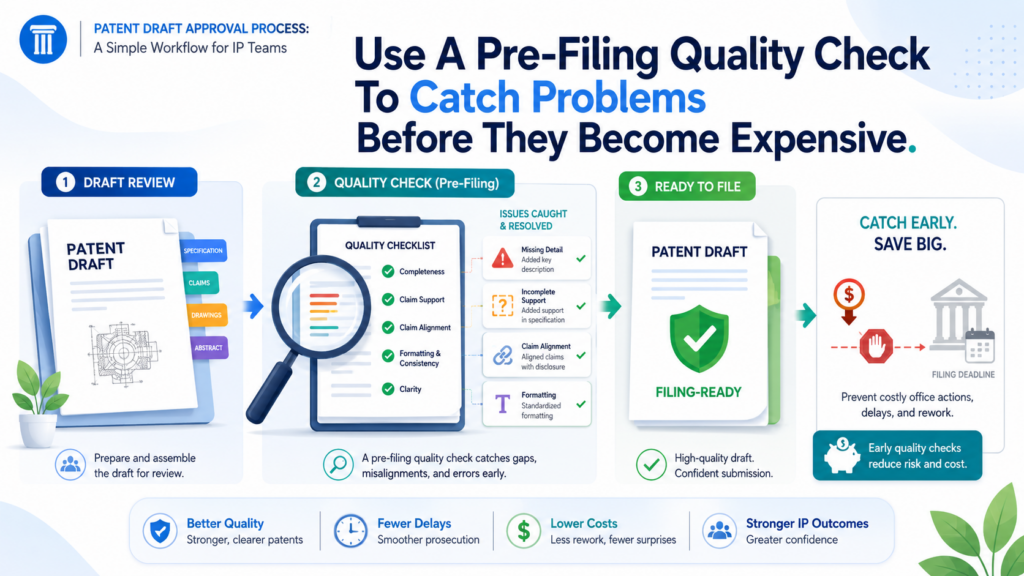
This is not the time to rewrite the whole draft. It is the time to catch the kinds of mistakes that create cost, delay, or regret later.
Many teams skip this step because they are tired by the end of review. The draft has gone through inventors, counsel, and business leads.
Everyone wants to be done. That is understandable. But a short, focused quality check can save the company from painful issues.
Think of it as the final safety pass. Not a creative pass. Not a style pass. A safety pass.
The team should confirm that the invention is described correctly, the claims match the goal, the figures support the text, the right people are named, the filing timing still works, and no late business event has changed the risk. These checks do not need to take long if the earlier process was clean.
The quality check should confirm that the draft still matches the latest product facts
Startups move fast. The product may change while the patent draft is being reviewed. A model may be replaced. A system flow may be updated.
A customer requirement may change. A feature may be renamed. A backend method may shift after a performance fix.
This creates a risk. The draft may have been accurate when written but partly outdated by the time it is approved.
The pre-filing quality check should catch that. The approval owner should ask whether anything important changed since the first draft.
If nothing changed, great. If something did change, counsel should decide whether the draft needs an update before filing.
Not every product change matters. A new button label may not matter. A change to the core method might. The attorney can help decide.
The team should separate product changes from invention changes
This is important. A patent draft does not need to track every product update. It is not a product manual. It is meant to describe the invention and useful versions of it.
If the product changed in a way that does not affect the invention, the filing may still be ready. If the change affects the core idea, the draft may need revision.
For example, a new user interface color likely does not matter. A new model selection method may matter a lot. A new deployment option may matter if the draft currently suggests only one setup.
A change in where data is processed may matter if privacy or speed is part of the invention.
The quality check should help the team spot the difference.
PowerPatent helps teams keep invention details organized as the product evolves, so the filing process does not depend on memory or scattered messages.
With guided software and real attorney oversight, teams can catch key changes before they become expensive. See how it works here: https://powerpatent.com/how-it-works
The quality check should look for hidden narrowing words
Patent drafts can become weaker when they include words that accidentally narrow the invention. Words like “always,” “must,” “only,” “required,” and “the invention is” can create problems if they are used carelessly.
Sometimes these words are correct. If a step is truly required, the draft may need to say so. But often they appear by habit. They can make one example sound like the only way the invention works.
The attorney should review for these issues, but the team can help too. Engineers may know when a step is optional. Business leaders may know when the company plans to support other versions.
A strong draft should be clear about what is required and what is just one example.
Optional parts should be described as optional when they are not central
If a system can work with or without a certain part, the draft should not imply that the part is required unless counsel has a reason. This gives the company more room.
For example, if the invention can work with local processing or cloud processing, the draft should not say it only works in the cloud.
If it can use different model types, it should not sound locked to one. If it can use different user inputs, devices, or data types, the description should leave room where accurate.
This is not about being vague. It is about being precise. The draft should protect the true invention while avoiding needless limits.
The quality check should confirm that examples are useful and safe
Examples help explain the invention. But examples should be chosen with care. A weak example can make the invention sound small.
A confusing example can make the draft harder to understand. An outdated example can create questions later.
The pre-filing check should ask whether the examples support the strategy. Do they show the most important use cases?
Do they explain why the invention helps? Do they include enough variation? Do they avoid tying the invention to one customer, vendor, or internal project name?
Examples should make the draft stronger. They should not distract from the core idea.
Customer names and sensitive details should be handled with care
Patent applications can become public. That means the team should be careful about including customer names, private data, secret roadmap details, or sensitive business terms unless counsel says it is appropriate.
The draft can often describe a use case without naming the customer. It can describe data types without exposing private datasets.
It can explain technical value without revealing business secrets that do not need to be in the filing.
This is another reason why final review should include business input. Engineers may focus on accuracy, while business leaders may spot sensitive details.
The quality check should confirm filing logistics
Even the best draft can be delayed by simple logistics. The team should confirm that counsel has what they need to file.
This may include inventor names, assignments, drawings, filing instructions, entity details, priority information, and any known public disclosure dates.
These details are not exciting, but they matter. A missing signature or unclear filing instruction can slow the process at the worst time.
The approval owner should make sure nothing basic is missing. Counsel should confirm the filing path. The team should know the expected next step after filing.
The filing package should be treated as the source of truth
Before filing, there should be one final package. This is the version the company approved. It should include the final draft and the final drawings. Everyone should know that this is the version moving forward.
This avoids last-minute confusion. Nobody should send edits to an old draft after the final package is approved. Nobody should assume a comment was included unless it appears in the final version or counsel confirms it.
A clean filing package makes the final step smooth.
Build A Post-Filing Review So The Team Learns From Every Draft
The patent draft approval process should not end the second the application is filed. Filing is a major milestone, but it is also a learning moment.
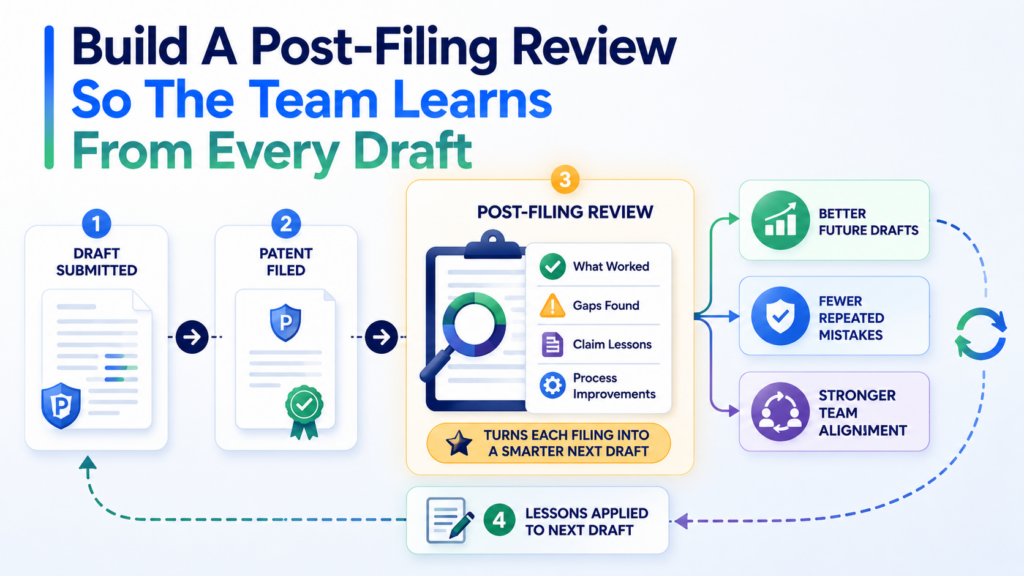
The team should take a short look back and ask what worked, what slowed things down, and what should improve next time.
This is how IP teams get better. They do not rebuild the process from scratch for every invention. They learn. They adjust. They make the next draft smoother.
A post-filing review does not need to be long. It should be practical. The goal is not to blame anyone. The goal is to improve the system.
For a startup, this is powerful. The first patent draft may feel hard. The second should feel easier. The fifth should feel like a known process. Over time, the company builds an IP habit.
Inventions get captured earlier. Reviews get cleaner. Attorneys get better input. Founders make faster decisions. The company protects more of what matters with less stress.
The team should review the timeline honestly
After filing, look at the timeline. Did the review stay on track? Which stage took longer than expected? Did inventors respond quickly? Did business review happen at the right time?
Did attorney revisions get delayed because key details were missing? Did final approval happen cleanly?
These questions help the team find bottlenecks.
Maybe the invention record was too thin, so drafting took longer. Maybe too many reviewers were included. Maybe engineers were not told what to check.
Maybe the founder joined too late and reopened strategy questions near the end. Each of these problems can be fixed.
The goal is to make the next process simpler.
The best post-filing review focuses on the process, not personalities
It is easy to blame people when a draft is late. That is usually not helpful. Most delays happen because the process was unclear, not because people did not care.
A good review asks what the system should do better. Should the intake form ask better questions? Should the attorney get product diagrams earlier? Should inventors receive a shorter review guide?
Should final approval require a clearer decision? Should the timeline start from launch dates instead of draft dates?
These are useful questions because they lead to action.
PowerPatent is designed to help teams build a smoother repeatable path for patents, from early invention capture through attorney-reviewed filing.
That means each filing can make the next one easier. Learn how PowerPatent supports modern patent workflows here: https://powerpatent.com/how-it-works
The team should capture reusable language and examples
Each patent draft teaches the team something. It may reveal a better way to describe the platform.
It may create a strong explanation of a core system. It may include a useful drawing style. It may define terms the team will use again.
The post-filing review should capture these reusable pieces. This does not mean copying the same patent over and over. Each invention needs its own careful draft. But a company can build a shared language for its technology.
This is especially helpful for deep tech startups. The same platform may produce many inventions.
If each draft uses totally different terms, the portfolio can feel scattered. If the team builds a clear vocabulary, future drafts become easier and more consistent.
Reusable language should stay flexible as the company grows
The team should not lock itself into old terms forever. Product names, architecture, and strategy may change. Reusable language should be reviewed and improved over time.
The goal is not rigid templates. The goal is a living knowledge base. It should help attorneys understand the company faster.
It should help engineers explain new ideas faster. It should help founders see how each filing fits into the larger IP story.
A useful knowledge base can include plain descriptions of the platform, common system parts, standard drawing references, known technical problems, common customer use cases, and prior filings. But it should remain simple and usable. If nobody reads it, it will not help.
The team should note what invention details were missing
One of the best post-filing questions is simple: what did counsel need that we did not provide early enough?
The answer can improve the next invention intake. Maybe the attorney needed more detail about alternatives. Maybe the team did not explain why old methods failed.
Maybe drawings were missing. Maybe the inventors did not give enough examples. Maybe the business value was unclear.
These gaps should be turned into better intake prompts for next time.
For example, if the attorney had to ask three times about alternate deployment setups, the next intake should ask about cloud, edge, device, and hybrid versions.
If the team forgot to mention future use cases, the next intake should ask where the invention may be used in one to three years.
Missing details are clues, not failures
A missing detail is not a disaster. It is a clue. It shows where the process can become stronger.
The team should treat these gaps with curiosity. The first few filings will teach the company how its inventions should be explained. That is normal. The important thing is to capture the lesson.
Over time, this makes the whole IP process faster. Attorneys ask fewer repeat questions. Inventors give better notes. Drafts need fewer revisions. The company becomes better at turning technical work into protectable assets.
The post-filing review should connect the patent to the portfolio
A patent application is not just a standalone document. It is part of a larger IP portfolio. After filing, the team should ask how this application fits with existing and future filings.
Does it protect a new layer of the product? Does it strengthen a core platform area? Does it support a future market? Does it overlap with another filing? Does it reveal a gap that the team should protect next?
This portfolio view helps the company file with more purpose. It also helps avoid random filings that do not build toward a stronger position.
A good portfolio has a clear story
Investors, partners, acquirers, and future team members may not read every patent in detail. But they should be able to understand the story. The portfolio should show that the company is protecting the hard parts of what it is building.
That story may be about faster AI systems, safer robotics, better medical devices, improved chips, cleaner energy hardware, stronger developer tools, or another technical edge. Each patent should add to that story.
The post-filing review is a good time to update the story. It helps the team see what has been protected and what still needs attention.
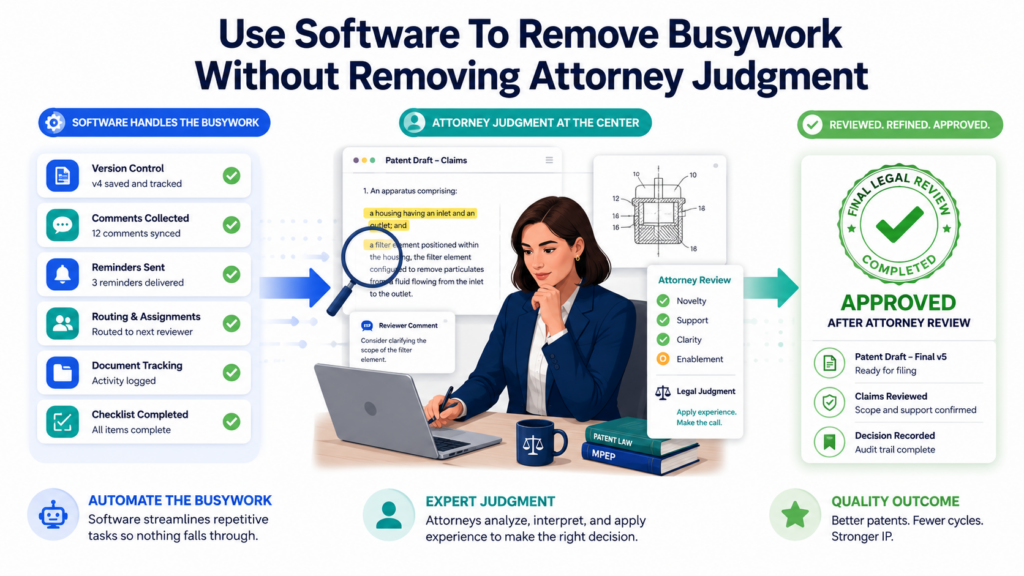
Use Software To Remove Busywork Without Removing Attorney Judgment
A patent draft approval process has many moving parts. Invention notes. Draft versions. Comments. Inventor reviews.
Attorney changes. Business approvals. Filing deadlines. Assignment questions. Drawing updates. Public disclosure risks. Portfolio links.
If all of this lives in email, chats, and folders, the team will struggle. Not always at first, but soon.
The more inventions the company has, the harder it becomes to track what is happening. A process that worked for one draft may break at five. At ten, it may become painful.
This is where software can help.
Good patent software does not replace judgment. It removes busywork. It gives the team a clearer path. It helps capture invention details, route reviews, track status, manage versions, and keep people aligned.
It helps attorneys spend more time on strategy and less time chasing missing information.
But software alone is not enough. Patent work still needs real attorney oversight. The tool can organize and speed up the process, but legal judgment matters. The strongest workflow combines smart software with human legal review.
That is the model PowerPatent is built around.
Software should make invention capture easier for engineers
Engineers should not need to learn patent law to share an invention. They should be able to explain what they built in simple words, add diagrams or notes, and answer guided questions.
The software should help pull out the important details. What problem did the team solve? What was hard about the old way? What is new about this approach? What are the key steps? What other versions might work? What product or business goal does this support?
These questions help turn raw invention ideas into useful draft material. They also reduce the need for long follow-up calls.
The best tools help engineers explain without slowing them down
A busy engineer will not use a tool that feels like homework. The process must be light, clear, and respectful of their time.
The tool should guide them through the right details without making them write a legal document. It should support attachments, code context, diagrams, and plain explanations. It should make it easy to add missing details later.
When invention capture is easy, teams capture more ideas earlier. That gives the company more options. It also prevents last-minute scrambles before launch.
PowerPatent helps technical teams turn inventions, code, models, and product breakthroughs into attorney-reviewed patent filings through a more modern workflow. See how it works here: https://powerpatent.com/how-it-works
Software should give the approval owner a clear dashboard
The approval owner needs to know what is happening at all times. Which drafts are waiting on inventor review? Which ones need attorney revision?
Which comments are still open? Which filings are close to a disclosure date? Which applications are approved but not yet filed?
A dashboard can make this clear. It replaces guesswork with visibility.
This is valuable because the approval owner is often juggling many other tasks. They may be a founder, product lead, operations lead, or internal counsel. They need a fast way to see status without digging through emails.
Visibility helps prevent quiet delays
The worst delays are often quiet. Nothing looks wrong, but nothing moves. A draft sits with one reviewer. A comment waits for counsel. A founder forgets to approve. A drawing update is missing.
Software can surface these stuck points. It can show what needs action. It can help the approval owner nudge the right person at the right time.
This does not replace leadership. It supports it.
Software should keep versions and comments in one place
Version control is one of the biggest practical problems in patent draft approval. Software should solve it. Reviewers should know which draft is current.
Comments should stay tied to the right version. Closed issues should remain visible. Final approvals should be recorded.
This reduces confusion. It also creates a cleaner record.
When comments live in one place, the attorney can revise faster. The approval owner can see what is open. Reviewers can avoid repeating old points. The final approval becomes easier because everyone knows what changed.
A clean record helps the team trust the process
Trust matters. If people think comments vanish, they will repeat themselves. If they think the wrong version may be filed, they will slow down. If they think approval is unclear, they will hesitate.
A clean system builds trust. People can see progress. They can see decisions. They can see the final draft.
This makes the process feel more professional and less stressful.
Software should support attorney judgment, not hide it
The biggest mistake is thinking software can replace a good patent attorney. It cannot. Patent drafting involves strategy, legal judgment, technical understanding, and experience.
A tool can help organize and speed up the work, but it should not remove human review.
Attorney oversight is what turns organized invention details into a stronger filing strategy.
The attorney can decide how to frame claims, how to support broad coverage, how to handle prior art concerns, how to avoid needless limits, and how to respond to business goals.
The best workflow uses software for speed and attorneys for strength
This is the balance modern IP teams need. Software handles the repeatable parts. Attorneys handle the judgment parts.
Founders get more speed. Engineers get less friction. The company gets stronger filings.
That is the heart of the PowerPatent approach. It is not old-school patent work with a new wrapper. It is a better way for modern teams to move from invention to filing with less delay and more confidence.
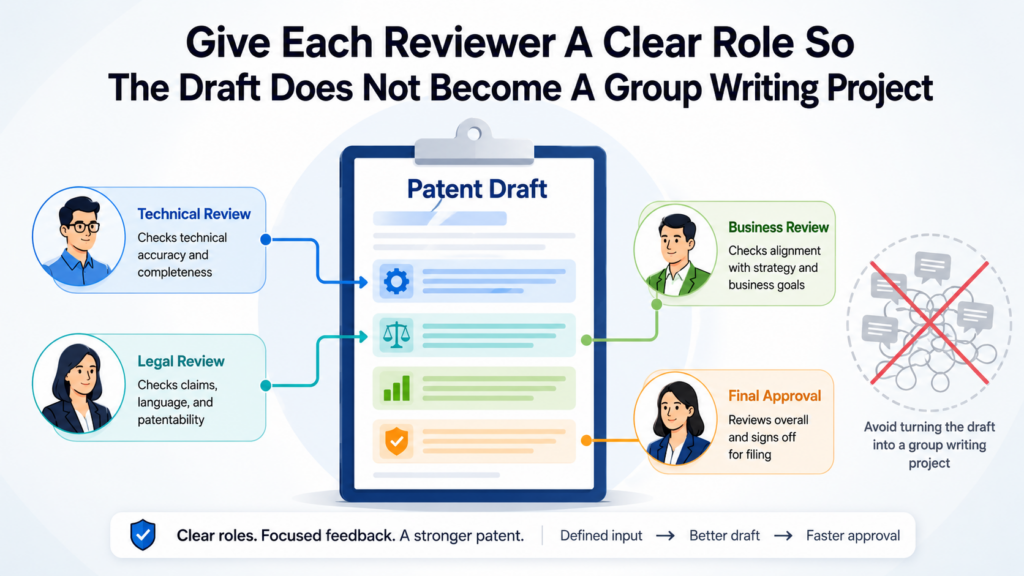
Give Each Reviewer A Clear Role So The Draft Does Not Become A Group Writing Project
A patent draft should not be edited like a shared blog post. When everyone tries to rewrite everything, the draft gets slower and weaker.
People start debating style. Engineers change legal phrasing. Founders rewrite technical sections. Business leads add marketing language. Counsel has to untangle it all.
This is why each reviewer needs a clear role.
A strong approval process tells each person what they are responsible for and what they should not worry about.
This keeps feedback sharp. It also helps people finish their review faster because they are not trying to judge the whole document.
The draft approval process works best when each person brings their own strength. Inventors bring technical truth.
Attorneys bring patent strategy. Business leaders bring market context. The approval owner brings order. Together, they make the draft stronger.
Inventors should own accuracy and completeness
Inventors should focus on whether the draft correctly describes the invention. They should check the technical flow, examples, drawings, terms, and variants. They should flag missing steps, wrong assumptions, or details that make the invention sound narrower than it is.
They should not feel responsible for legal wording. They do not need to decide whether a claim has the perfect legal form. They should simply explain what is true and what is missing.
This makes inventor review faster and better.
Inventors should explain variants the team may use later
One of the most valuable things inventors can do is explain other ways the invention could work. These variants may not be in the current product yet, but they may be real and reasonable extensions.
For example, the invention may work with different data types, devices, models, sensors, timing rules, or user flows. If those variants are accurate, they may help the attorney draft broader support.
Inventors should not invent fake possibilities. But they should not hide real ones just because they are not in version one.
Business leaders should own strategic fit
Business leaders should not spend their time editing figure labels. Their job is to make sure the filing supports the company’s goals.
They should ask whether the draft protects something the company cares about. They should flag upcoming public events.
They should explain how the invention fits the market. They should identify likely competitor behavior. They should point out future product paths that matter.
This input helps counsel align the patent with business value.
Business review should keep the patent tied to the company moat
The company moat is the thing that makes the startup hard to copy. A patent draft should protect that moat when possible.
Business leaders can help by explaining why customers care, what competitors may copy, and which technical pieces create the company’s edge. This context is often missing from raw invention notes.
When the attorney understands the moat, the draft can become more focused and more valuable.
PowerPatent helps bring this context into the workflow, so patent work is not just a legal task off to the side. It becomes part of how the company protects what it is building. Learn more here: https://powerpatent.com/how-it-works
Attorneys should own claim strategy and legal strength
The attorney’s role is to turn invention details and business context into a strong patent draft. They should own the claim structure, legal phrasing, support strategy, filing approach, and final legal review.
This does not mean attorneys should ignore the team’s comments. It means they should use those comments through the lens of patent strategy.
A founder may ask for simpler wording. An engineer may ask to remove a detail. A business lead may want to add a use case. The attorney should decide how each change affects protection.
Attorneys should explain tradeoffs in plain words
Patent review becomes better when attorneys explain tradeoffs simply. For example, they might say that adding one detail could make the claim easier to understand but narrower.
Or they might say that keeping several examples gives the company more room later. Or they might say that a new feature is better saved for a separate filing.
This helps the team make smarter decisions. It also builds trust.
The best attorney communication is clear, direct, and practical. It does not drown the team in legal terms.
The approval owner should own the process
The approval owner keeps the work moving. They set the timeline, gather comments, resolve confusion, track versions, and make sure final approval is clear.
This person is the process leader. They do not need to be the top legal expert. They need to be organized, trusted, and able to push for decisions.
Without an approval owner, even a strong draft can stall.
The approval owner should protect the team from review sprawl
Review sprawl happens when too many people join too late, comments spread across too many places, and every small issue becomes a reason to delay. The approval owner should prevent this.
They should limit review to the right people. They should make sure comments go in the right place. They should close issues when they are resolved. They should keep the final approval focused.
This is how the team avoids turning the draft into a never-ending project.
Conclusion
A good patent draft approval process gives your IP team speed, control, and confidence without turning patents into a slow legal maze. When inventors, founders, business leads, and attorneys each know their role, the draft gets stronger and the company moves faster.
The goal is simple: capture the real invention, review it with care, fix what matters, approve with clarity, and file before opportunity or risk passes by. PowerPatent helps modern teams do this with smart software and real attorney oversight, so you can protect what you are building without slowing down. See how it works here: https://powerpatent.com/how-it-works
Leave a Reply