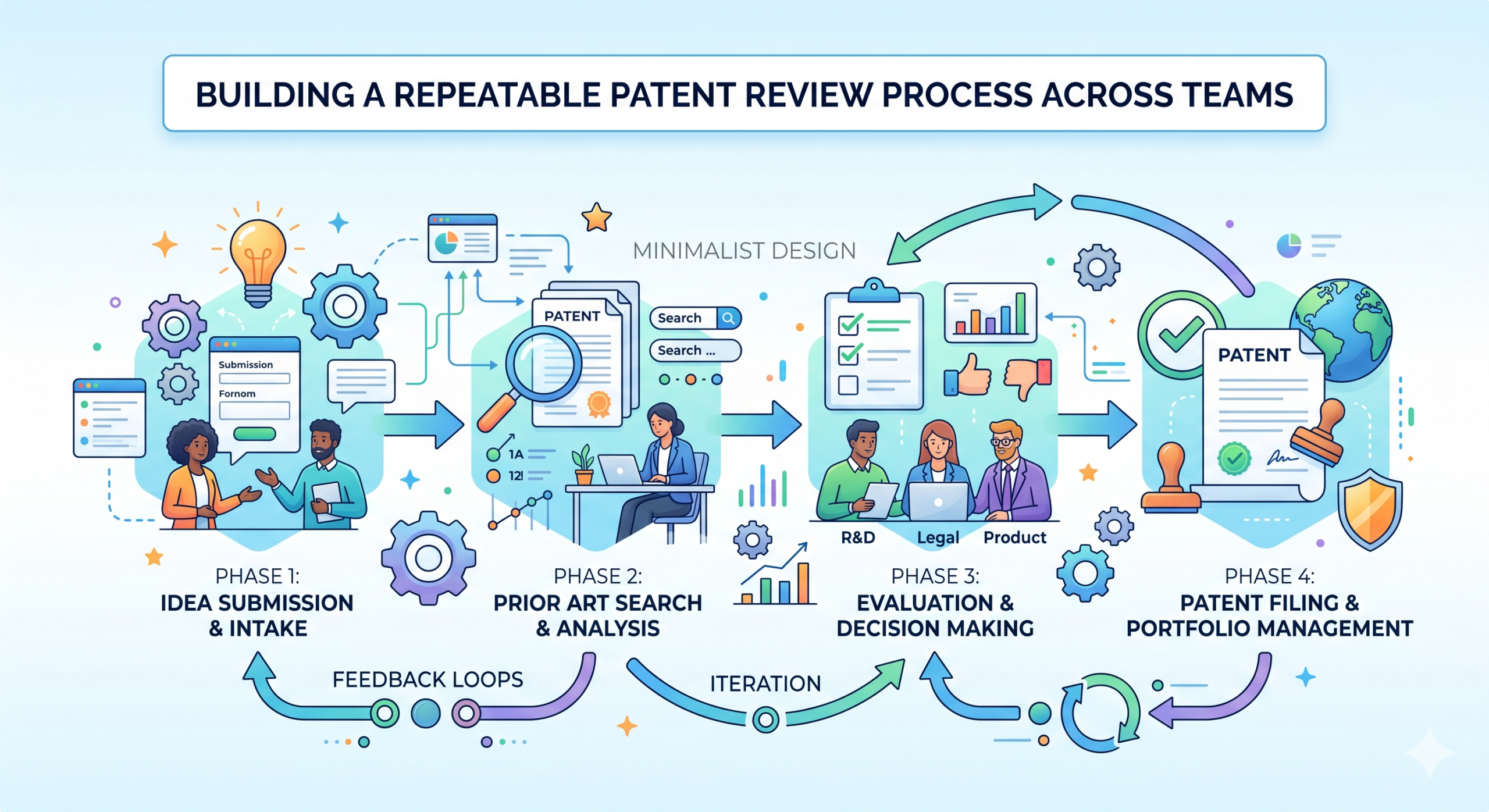
A patent review should not feel like a fire drill. PowerPatent helps teams do this with smart software, guided workflows, and real patent attorney oversight, so founders can protect what they are building with more speed and confidence. You can see how it works here: https://powerpatent.com/how-it-works
Why Patent Review Breaks Down Across Teams
Patent review breaks down when no one knows who owns the next step. The idea may be strong. The team may care.
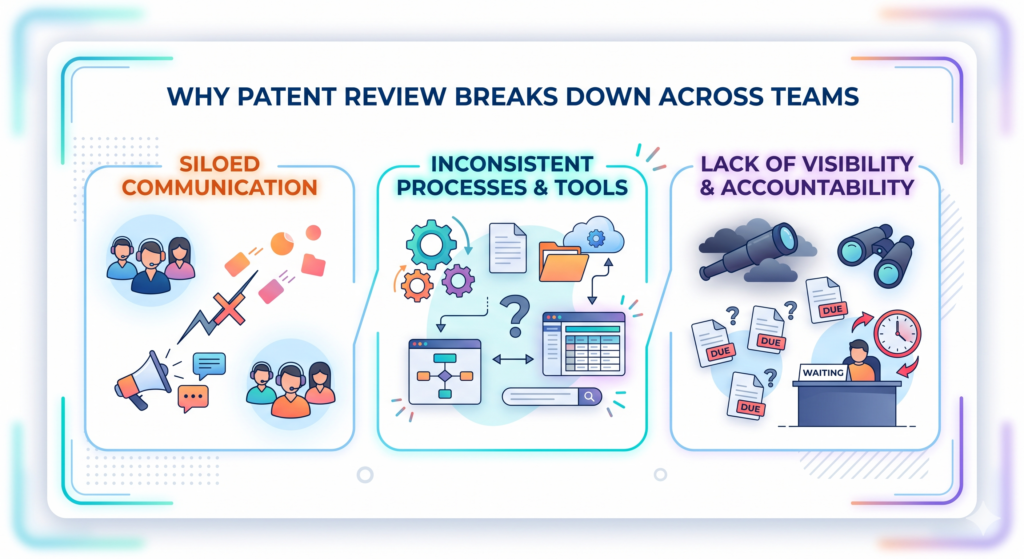
The company may even have budget for patents. But if the process is not clear, the work becomes soft, slow, and easy to ignore. That is where good inventions get lost.
In a fast startup, most people are not thinking about patents during the day. Engineers are fixing bugs, building models, testing systems, and shipping features.
Product teams are working with users, shaping roadmaps, and trying to hit launch dates. Founders are raising money, hiring people, closing deals, and keeping the company alive. Patent review often sits in the middle of all this, waiting for someone to make time.
The problem is not that teams are careless. The problem is that patent review is usually built like a legal task when it should be built like an operating system. It needs clear inputs. It needs owners.
It needs a rhythm. It needs a simple way for people to share ideas without writing a legal memo. It needs a way to decide what matters now, what can wait, and what should be dropped.
When the process is loose, every new invention feels like a custom project. Someone has to ask where the notes are. Someone has to find the right engineer. Someone has to explain what was new.
Someone has to guess whether the feature was already shown to customers. Someone has to check if a paper, demo, pitch deck, GitHub commit, or public launch created a timing issue. By the time the team has answers, the energy is gone.
A repeatable review process fixes this by turning invention capture into a normal company habit. The goal is not to make everyone a patent expert.
The goal is to make it easy for smart people to share what they built, why it matters, and how it is different from old ways.
Patent review fails when it depends on memory
Most patent problems start with a simple sentence: “We will come back to this later.”
Later rarely comes.
A founder may remember that an engineer created a new ranking method. A product lead may remember that the team built a clever way to reduce compute cost.
A machine learning lead may remember that the model pipeline solved a hard data issue. But memory is not a process. Memory fades, especially when the team is moving fast.
The best time to capture an invention is when the work is still fresh. At that point, the team still knows what was hard, what changed, what failed before, and why the final method worked.
Those details are gold. They help turn a rough idea into something a patent attorney can review with real context.
When teams wait too long, they lose the “why.” They may still know what the product does, but they forget the path that made it special.
They forget the dead ends. They forget the tradeoffs. They forget the test results that proved the new approach worked better. That makes the patent review weaker, slower, and more expensive.
A strong process captures ideas early, before the details get buried. It does not ask busy engineers to write long reports. It asks for enough clear detail to start the review.
PowerPatent is built around this kind of flow: smart software helps gather the right invention details, while real patent attorneys help review and shape the protection strategy. Teams that want this kind of guided path can explore it here: https://powerpatent.com/how-it-works
The first fix is to capture ideas close to the work
The capture step should happen where invention already happens. That may be in sprint reviews, design reviews, model review meetings, architecture talks, product planning, customer feedback sessions, or post-launch reviews.
Do not make patent review feel like a separate legal event that only happens once a quarter. That is too far away from the real work.
The best process asks one simple question often: “Did we solve a hard problem in a new way?”
That question works because it does not sound legal. Engineers can answer it. Founders can answer it. Product leaders can answer it. It points people toward the core of patent value without making them think in patent terms.
The answer may be yes when the team creates a new method, a new system, a new workflow, a new data process, a new model structure, a new hardware setup, a new user interaction, or a new way to make something faster, cheaper, safer, more accurate, or more reliable.
The answer may also be yes when the team takes known parts and connects them in a way that produces a better result.
This is why invention capture should be light, frequent, and tied to normal team habits. The less extra work it creates, the more likely people are to use it.
Patent review fails when teams use different standards
Another common problem is that each team uses a different meaning of “worth patenting.”
The founder may think an invention is worth patenting if it helps the company raise money. The engineering lead may think it is worth patenting only if it is technically brilliant.
The product lead may think it matters if customers love it. The sales team may care if competitors can copy it. The legal team may care if it is clear, new, and tied to business value.
All of these views matter, but they need to be brought together. Without shared standards, the team will argue in circles. Strong ideas may be ignored because they look too small.
Weak ideas may move forward because one person is excited. Review meetings become based on taste instead of judgment.
A repeatable process gives the team a shared screen. It helps everyone judge ideas through the same simple lens. The best lens is not “Is this cool?” The better question is, “Would protecting this help the company win?”
That question brings the team back to strategy. A patent is not a trophy. It should support a business goal. It may protect a key product feature. It may create a fence around a core technical method.
It may make the company more attractive to investors or buyers. It may block a larger player from copying the engine behind the product. It may give the company more room to partner, license, or defend its market.
The second fix is to define what a strong invention means for your company
A strong invention is not always the biggest idea in the room. Sometimes it is the quiet system that makes the product work. Sometimes it is a hidden backend method that saves money at scale.
Sometimes it is a workflow that makes a hard task feel simple for the user. Sometimes it is the way the team gets clean results from messy data.
This is why review standards should be written in plain words. Your team should know that an idea may deserve review when it solves a hard technical problem, creates a clear edge over competitors, supports a product line that matters, is hard to design around, or is likely to show up in future versions of the product.
The standard should also help teams say no. Not every idea should become a patent filing. Some ideas are too narrow. Some are easy to copy around. Some do not match the company’s future.
Some are better kept as trade secrets. Some are not ready yet. A good review process protects focus by helping the company spend patent budget on the ideas that matter most.
This is where having software plus attorney oversight can save time. The software helps teams gather and sort invention details in a consistent way.
The attorney helps judge what is worth moving forward. That mix gives founders speed without guessing. PowerPatent was built for teams that want both control and expert review in one smoother path: https://powerpatent.com/how-it-works
Patent review fails when timing is unclear
Timing is one of the most dangerous parts of patent review because it is easy to miss.
A team may be proud of a launch, demo, investor deck, conference talk, blog post, open-source release, customer pilot, sales call, or public roadmap.
But public sharing can affect patent options. The rules can be strict, and waiting too long can create real risk.
This does not mean teams should hide everything or stop selling. It means they need a clean way to check patent timing before public moments happen. The patent review process should be connected to the company’s launch process, not placed after it.
When patent review happens only after launch, the team is playing defense. When it happens before launch, the team has choices. It can decide whether to file, wait, revise, keep something private, or share only part of the story.
The third fix is to connect patent review to public release checks
A simple patent check should happen before major public events. The team does not need a long legal meeting.
It needs a short review of what will be shown, what is new, and whether any key technical method should be protected first.
This check is especially important for startups in AI, robotics, chips, biotech tools, climate tech, medical devices, cybersecurity, developer tools, and other deep tech fields where the real value often sits inside the system.
A pitch deck may reveal more than the founder thinks. A demo may expose a key workflow. A technical blog may explain the exact method competitors need.
A repeatable patent review process helps the team move fast while staying safe. It does not block launches. It gives founders a better way to launch with confidence.
Build One Clear Owner for the Patent Review Process
A repeatable patent review process needs one clear owner. Not ten owners. Not “legal and product together.” Not “the CTO will watch it when needed.” One owner.
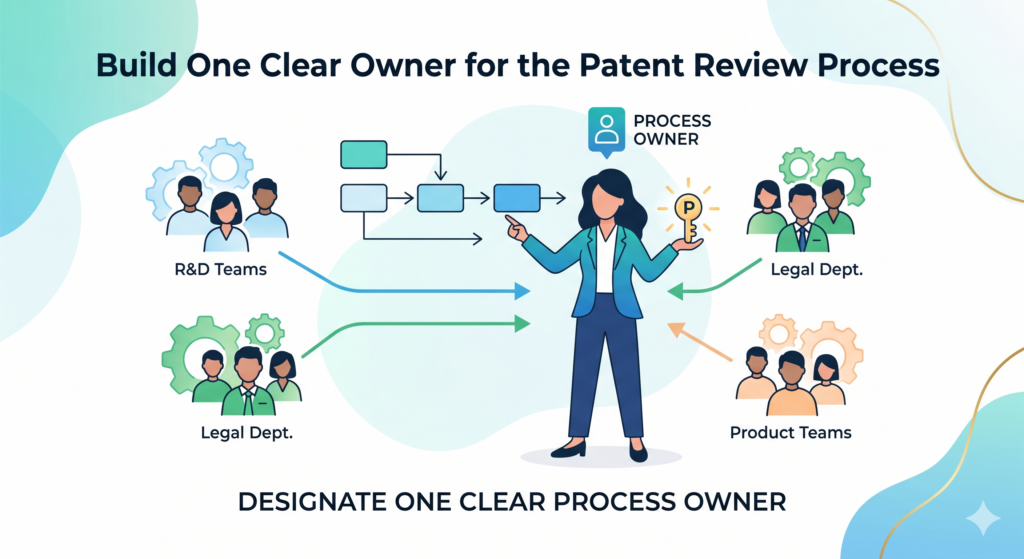
That owner does not need to make every decision alone. In fact, they should not. Patent review works best when it pulls ideas from engineering, product, design, research, sales, customer success, and leadership.
But one person must own the flow. One person must know where each idea sits, what is missing, who needs to review it, and what must happen next.
Without that owner, the process becomes a group chat. Everyone cares, but no one drives. The strongest ideas sit in a doc. The review meeting gets pushed. The founder assumes legal is handling it.
Legal assumes engineering is adding detail. Engineering assumes the founder will say which ideas matter. That is how good inventions fall through the cracks.
The owner is not there to act like a gatekeeper. They are there to keep the path clear. Their job is to make sure ideas move from “someone mentioned this” to “we know whether this should be protected.”
That movement matters because speed is part of patent strength. A slow review process creates risk. A clear owner reduces that risk.
The owner should be close enough to the product to understand value
The best patent review owner is usually someone who understands the company’s product, roadmap, and technical edge. In a small startup, this may be the founder, CTO, head of product, or a senior technical program lead.
In a larger team, it may be an IP lead, innovation lead, product counsel, or someone in legal operations who works closely with engineering.
The title matters less than the behavior. The owner must be trusted by technical teams. Engineers should feel safe sharing rough ideas with them.
Product leaders should believe they understand what matters to the roadmap. Founders should trust them to raise urgent issues before public launches. Attorneys should trust them to gather enough detail for a useful review.
A poor owner treats patent review like paperwork. A strong owner treats it like company strategy. They know that the best inventions are often buried inside normal work.
They ask good questions. They keep the process light. They do not make engineers feel judged for not using legal words.
The owner should also have enough authority to get answers. If a key engineer needs to explain a system, the owner can ask for time. If a launch is coming, the owner can request a quick patent check.
If an idea is stuck, the owner can push it forward. If leadership must decide whether to file, the owner can bring the right facts to the table.
The owner’s real job is to remove friction
A patent review owner should make the process easier for everyone else. They should not send long forms with vague questions.
They should not ask for perfect invention writeups before review. They should not create a system that only legal people understand.
Their job is to make the first step simple. That may mean asking an engineer to explain the problem in plain words. It may mean turning meeting notes into an invention summary.
It may mean pulling diagrams from a design doc. It may mean using software that guides the team through the right questions so no one starts from a blank page.
This is where a platform like PowerPatent can help. Instead of forcing teams to manage patent review through scattered docs and endless email chains, PowerPatent gives teams a more guided way to collect invention details, work with real patent attorneys, and move from idea to action with more confidence. You can explore the workflow here: https://powerpatent.com/how-it-works
The owner should run a clean review rhythm
A process only works when it has a rhythm. Patent review should not happen only when someone panics before a launch. It should have a normal place in the company’s operating system.
For early startups, that rhythm may be a short monthly review. For deep tech teams with heavy invention flow, it may be every two weeks.
For teams close to major launches, it may be tied to sprint cycles or product release gates. The right rhythm depends on how often the team creates new technical work and how often that work becomes public.
The key is that the rhythm must be known. People should know when ideas are reviewed. They should know how to submit them. They should know what happens after submission. They should know when they will hear back.
When the rhythm is clear, patent review stops feeling like a mystery. Engineers do not have to wonder whether their idea disappeared.
Product teams do not have to guess if launch materials need review. Founders do not have to wake up at midnight wondering whether they missed a filing window.
The review rhythm should match the speed of invention
A team building one major product update each quarter may not need weekly patent reviews.
A team building new AI model methods, robotics control systems, chip designs, or data pipelines may need a much tighter loop. The review rhythm should follow the pace of real technical change.
The best signal is not company size. It is invention density. A five-person team can create more protectable work than a fifty-person team if they are solving hard technical problems every week.
The patent process should be designed around where invention actually happens, not around a fixed corporate calendar.
This is also why the owner should look across teams, not just inside legal. Some of the best invention signals come from places that do not sound like patent sources.
A customer success call may reveal that the team solved a problem no competitor can handle.
A sales objection may show where the product has a unique edge. A support ticket may lead to a new automated fix. A research review may show a model trick that makes the whole product work better.
A strong owner sees these signals and turns them into review inputs.
The owner should report progress in plain language
Leadership does not need a dense patent report every week. But founders and executives do need visibility.
They should know how many ideas are being reviewed, which ones support major business goals, which ones are urgent because of launch timing, and which ones need a decision.
This reporting should be simple. The owner should explain the status in words normal people understand. An idea may be new and needs more detail. Another may be ready for attorney review.
Another may be worth filing soon. Another may not fit the roadmap. Another may be better held back as internal know-how.
The point is not to create a patent dashboard for show. The point is to make sure patent review becomes part of how the company makes smart choices. When leaders can see the flow, they can make better calls on budget, timing, and focus.
Clear ownership creates trust across the whole team
When people know who owns the process, they know where to go. That alone changes behavior. Engineers share ideas sooner.
Product teams flag public releases earlier. Founders ask better questions. Attorneys get cleaner input. The company stops relying on luck.
A clear owner is the center of the system. They do not need to be the smartest technical person in the room.
They need to be the person who keeps ideas moving, keeps people aligned, and makes sure the company does not lose value simply because no one followed through.
That is the first real step toward a repeatable patent review process.
Create a Simple Invention Intake That People Will Actually Use
Most invention intake forms fail because they ask too much too soon. They sound legal. They look long.
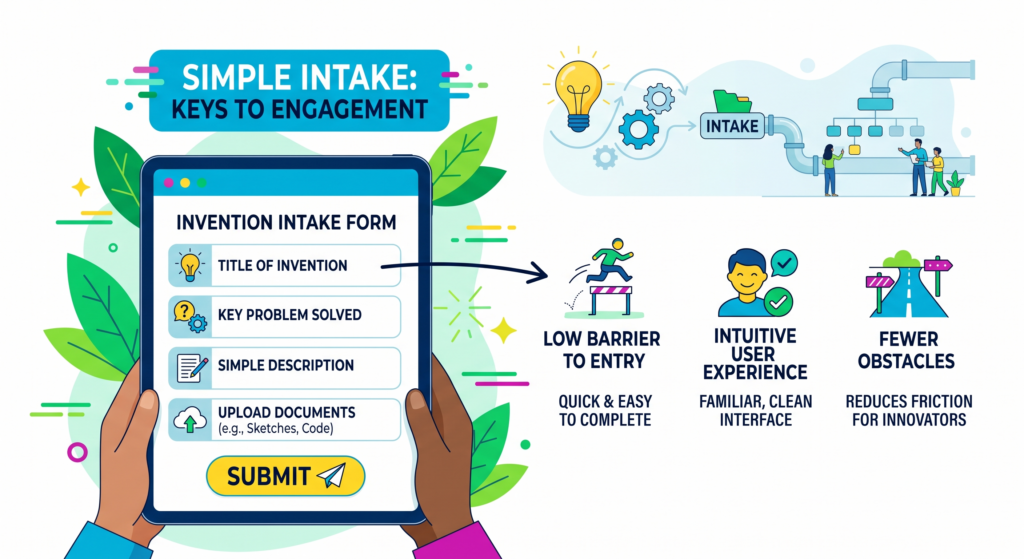
They make smart people feel like they need to write a perfect patent draft before they can share an idea. That is the wrong move.
A good invention intake should feel like a short conversation. It should help the inventor explain what they built, what problem it solves, why old ways did not work well enough, and why the new approach matters. That is enough to begin.
The intake step is not the final patent filing. It is the doorway. If that doorway is heavy, people avoid it. If it is simple, they use it.
Founders should be careful here. Many teams try to solve patent review by creating a huge invention disclosure form.
It may ask for technical diagrams, full claim ideas, competitor names, market value, publication history, product screenshots, code links, inventor names, and long written answers. Some of that may be useful later. But asking for all of it at the start can kill the process.
The first intake should capture the core signal. The deeper review can come next.
The intake should start with the problem, not the invention
Many inventors struggle to explain what is new. But they can usually explain the problem they were trying to solve. That is where the intake should begin.
Ask what was hard. Ask what kept breaking. Ask what was too slow, too costly, too inaccurate, too risky, too manual, or too painful.
Ask what the team tried before. Ask why those old ways were not good enough. This helps uncover the real invention.
For example, an engineer may say, “We improved the matching system.” That sounds broad. It may not seem patent-worthy.
But when asked about the problem, they may explain that the old system failed when data was sparse, so they created a new fallback method that uses user behavior patterns in a special sequence. Now the idea has shape.
A product lead may say, “We made onboarding easier.” That sounds like a product tweak.
But the real invention may be a new way to infer user setup needs from early actions and auto-build a custom workspace. That could be much more important than the first sentence suggests.
The problem is the door into the invention. Start there.
A useful intake turns rough thoughts into review-ready facts
The goal of intake is not beautiful writing. The goal is useful facts. The team should be able to explain the before, the after, and the reason the change matters.
A strong intake should help the reviewer understand what the system did before the invention, what the team changed, how the new method works at a high level, what parts are most important, and what result improved.
It should also capture whether the idea has already been shown outside the company or will be shown soon.
This does not require legal language. In fact, legal language often makes the intake worse. Engineers should not write like attorneys. They should write like builders explaining their work to another smart builder.
PowerPatent helps with this by guiding teams through the details that matter, without forcing them to start from a blank page or guess what a patent attorney needs.
That saves time for the team and gives attorneys better material to review. See how the process works here: https://powerpatent.com/how-it-works
The intake should fit inside the tools your team already uses
A patent process fails when it asks people to leave their normal work too often. If your team lives in product docs, design docs, GitHub, Jira, Notion, Linear, Slack, Figma, or internal research notes, the intake process should connect to that world.
This does not mean every tool must be fully integrated on day one. It means the process should respect how people already work. An engineer should be able to link to a design doc.
A product manager should be able to attach a roadmap note. A founder should be able to add a short voice-style summary after a meeting. A researcher should be able to point to an experiment result.
The intake should not punish people for sharing early. If the first version is messy, that is fine. The owner can clean it up later. What matters is that the idea enters the system before it disappears.
The best patent intake systems feel low-pressure. They say, “Tell us enough so we can help.” They do not say, “Prove this is perfect before we pay attention.”
Make the first submission small and the second step deeper
A useful pattern is to split intake into two stages. The first stage captures the idea quickly. The second stage gathers deeper detail only if the idea seems worth review.
This respects people’s time. It also keeps the review process from filling up with half-complete forms that no one wants to read.
The first stage may capture a plain English summary, the problem solved, the team involved, the product area, and any public timing risk. The second stage can gather diagrams, examples, technical variations, test results, and business value.
This staged approach also helps attorneys. They do not need every detail for every idea. They need enough to decide which ideas deserve deeper work.
Once an idea moves forward, they can ask better questions because they already understand the basic shape.
Founders should treat intake like a funnel, not a filing cabinet. The goal is to move the right ideas forward, not to store every thought forever.
The intake should capture business value early
Technical value matters. Business value matters too. A patent may be harder to justify if it protects something the company does not plan to use, sell, or build around. That does not mean every invention must be tied to this quarter’s revenue.
Some patents support future products. Some support partnerships. Some protect deep research that may become central later. But the team should still ask why the idea matters to the company.
The intake should capture whether the invention supports a core feature, a major cost advantage, a better user result, a key performance gain, a future product line, a security improvement, or a competitor gap.
These answers help leadership choose where to spend time and money.
This is especially important for startups. Patent budgets are not endless. The company needs to focus on inventions that support its edge. A repeatable intake process helps create that focus.
The best intake question is simple and sharp
One of the most useful questions is this: “Would we be upset if a competitor copied this?”
That question cuts through noise. If the answer is yes, the idea deserves a closer look. If the answer is no, it may still matter, but it may not be a top patent priority. The question is not perfect, but it helps teams think like owners.
Another useful question is: “Does this help us win in a way that is hard to see from the outside?” Many strong inventions sit behind the scenes.
Competitors may see the product result but not the hidden method. Patent review can help decide whether to protect that method through a patent or keep it private.
Good intake makes these choices easier. It gives the team enough information to act without turning every idea into a legal project.
Train Each Team to Spot Patent-Worthy Work in Their Own Language
A repeatable patent review process only works when each team knows what to look for. You cannot expect engineers, product managers, designers, researchers, sales leaders, and founders to spot inventions the same way.

They see different parts of the company. They use different words. They notice different kinds of value.
That is why training matters. But the training should not feel like a legal class. It should feel like a practical guide to spotting valuable work before it gets lost.
The goal is simple. Each team should know when to raise its hand and say, “This might be worth reviewing.” They do not need to decide whether something is patentable.
They do not need to write claims. They do not need to understand every rule. They just need to recognize invention signals.
A good patent review process teaches people to see those signals in their daily work.
Engineers should look for hard technical problems that were solved in a new way
Engineers are often closest to the invention, but they are not always the first to call it out. This happens because many engineers think their work is “just implementation.”
They may see a clever method as normal problem-solving. They may not realize that the hard part they solved could be the exact thing the company should protect.
Training should help engineers notice moments where they made something work that did not work before.
That may include a new architecture, a better data pipeline, a faster model process, a more stable control system, a new way to reduce compute cost, a safer device behavior, or a method that handles edge cases better than old systems.
The key is to frame patents around problem-solving, not legal theory. Ask engineers to watch for moments when the team had to invent, not just build.
Ask them to flag work that took real thought, testing, failure, and redesign. Ask them to share ideas even if they are unsure.
Engineers should also know that an invention does not need to be a giant breakthrough. Many valuable patents protect practical improvements that make a product work better. A small change can matter if it creates a real edge.
The best engineer training uses real examples from the company
Generic patent training is easy to forget. Company-specific examples stick.
Take past features and walk through what might have been reviewed. Show how a backend change could be an invention. Show how a model tuning method could matter.
Show how a workflow that reduces user errors could be worth discussing. Show how a system that handles bad data could become part of the company’s defensible edge.
When engineers see examples from their own work, patent review becomes real. It stops feeling like something that only applies to famous inventions or huge labs. It becomes part of building.
PowerPatent can help make this easier because the platform is designed to turn technical work into clearer invention records with attorney guidance.
That is useful for teams that build fast and do not want valuable ideas trapped in scattered notes. Learn more here: https://powerpatent.com/how-it-works
Product teams should look for features that create a customer edge
Product teams are great at seeing value. They know what users care about. They know which features close deals. They know where the product feels different from the market. That makes them important to patent review.
But product teams may miss inventions because they focus on user value, not technical method.
They may say, “Customers love this workflow,” without asking what new system makes the workflow possible. They may see a feature as a user experience win when it is also a technical win.
Training should help product teams connect user outcomes to hidden systems. If a feature saves time, improves accuracy, reduces mistakes, or makes a complex task feel simple, the team should ask how it works under the hood.
Sometimes the patent-worthy idea is not the screen the user sees. It is the logic, timing, data handling, model behavior, or automation behind the screen.
Product teams should also flag roadmap areas where the company plans to invest heavily. If a feature will become central to the business, patent review should happen early. Waiting until after the feature is public can create avoidable risk.
Product signals help rank patent value
Not every technical idea deserves the same attention. Product teams help decide which ideas matter most by connecting inventions to market value.
An invention tied to a core product line may deserve faster review than an internal tool with limited use. A method that supports a major customer promise may matter more than a small feature experiment.
A workflow that competitors are likely to copy may deserve stronger attention than a one-off improvement.
This does not mean product should control patent decisions alone. It means product context should shape the review.
A patent strategy that ignores the roadmap can waste money. A patent strategy tied to the roadmap can protect the parts of the business that matter most.
Sales and customer teams should watch for competitor and customer signals
Sales and customer teams may seem far from patents, but they hear things no one else hears. They hear what buyers compare. They hear which features make prospects lean in.
They hear when competitors claim they can do the same thing. They hear where users are frustrated with old tools. These signals can point to inventions worth protecting.
A sales call may reveal that a certain automation is the reason a buyer chooses your product. A customer support thread may reveal that your system solves a painful edge case better than others.
A renewal call may show that a hidden backend method creates real customer trust. These are not just sales insights. They are patent review signals.
Training should help customer-facing teams know when to pass those signals back. They should not be asked to judge technical novelty. They should simply flag moments where the product’s edge becomes clear in the market.
Market feedback can reveal what is worth protecting
Sometimes a team does not know which invention matters until customers react. A feature that seemed minor during development may become a major reason customers buy.
A technical method that felt like plumbing may become the thing that makes the product more reliable than competitors.
Customer-facing teams help catch this. They bring real-world proof into the patent review process. That proof can help leadership decide which ideas deserve budget and speed.
This is also useful for future filings. When teams understand why customers care, attorneys can better frame the invention around real problems and useful results.
The review becomes stronger because it is grounded in both technical detail and market value.
Leadership should set the patent lens for the whole company
Founders and executives do not need to review every idea in depth. But they must set the lens. They must tell the company what kinds of inventions matter most to the business.
That lens may focus on core platform technology, product features that drive growth, methods that reduce cost, systems that improve safety, data advantages, AI model improvements, hardware design, manufacturing methods, or tools that create a long-term moat. The lens depends on the company.
When leadership does not set this direction, teams guess. Engineering may submit everything. Product may submit only visible features. Legal may review in isolation. The process becomes noisy.
When leadership sets the lens, the whole company gets sharper.
A clear strategy helps teams say yes and no faster
Patent review should not be a place where every idea gets equal weight. A company needs focus. The right ideas should move quickly. The weak or off-strategy ideas should be parked or dropped.
Leadership can make this easier by naming the areas where protection matters most. For example, a startup may decide that its highest priority is protecting the engine behind its core product, not every user-facing feature.
Another startup may decide that workflow patents matter because competitors can easily copy visible product behavior. Another may focus on data processing methods because that is where its real edge lives.
Once this is clear, teams can spot better ideas and waste less time. That is what repeatability looks like.
Score Inventions With a Clear Business and Technical Lens
Once ideas enter the process, the team needs a way to judge them. This is where many companies get stuck.
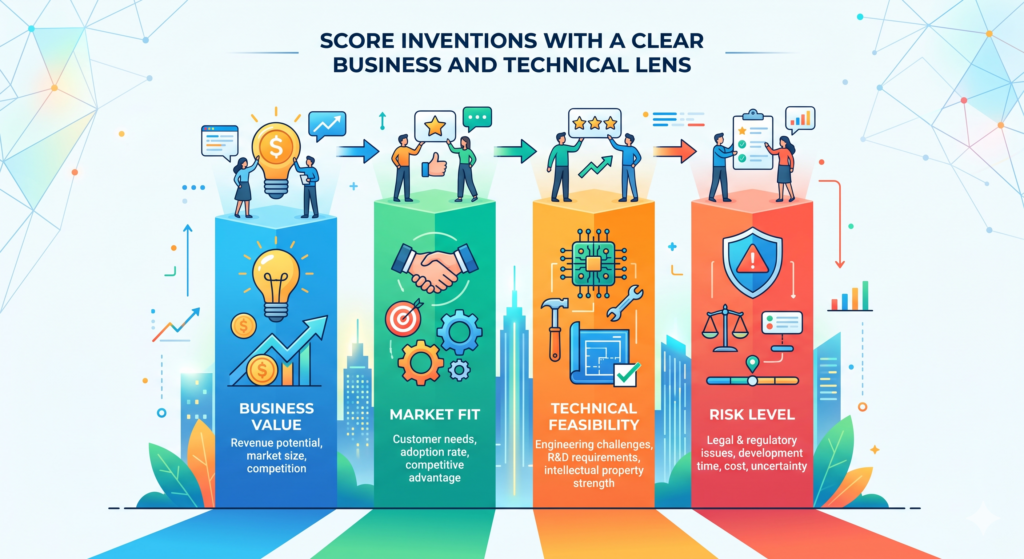
They collect invention ideas, but they do not know how to rank them. Everything feels interesting. Everything has a champion. Everything could matter someday.
That is not a process. That is a pile.
A repeatable patent review process needs a clear scoring method. The score does not need to be complex.
It should help the team make better decisions faster. It should bring business, technical, timing, and competitive factors into one shared view.
The point is not to turn patent strategy into math. The point is to create a fair and steady way to compare ideas.
The score should measure business value first
A patent should help the company. That sounds obvious, but many teams forget it. They get excited about technical cleverness and skip the business question.
A clever idea may be worth protecting, but only if it supports where the company is going.
Start with the business value. Does the invention protect a key product? Does it support a major revenue path? Does it matter to customers?
Does it make the product faster, cheaper, safer, more accurate, or easier to use? Does it help the company stand apart from competitors? Does it support a story investors care about?
These questions help the team avoid patenting random clever work. Startups need strong patents, not just more patents.
A small number of well-chosen filings can be far more useful than a large set of weak or scattered filings.
Business value also changes over time. An idea that seemed small six months ago may become central after a product pivot.
Another idea that once looked important may lose value if the roadmap changes. That is why scoring should not be frozen forever. The team should be able to revisit ideas as the company learns.
Business value keeps patent spend tied to company goals
Patent work takes time and money. Founders should spend both with care. A scoring process helps make that spend more deliberate.
When business value is part of the score, patent review becomes easier to explain to leadership.
The team is not saying, “This is interesting.” The team is saying, “This protects a core part of how we win.” That is a much stronger reason to act.
PowerPatent helps teams connect invention details with a smarter review process, so founders are not forced to guess which ideas deserve attention.
With software support and real attorney oversight, teams can move from rough invention notes to clearer filing decisions. You can see the path here: https://powerpatent.com/how-it-works
The score should measure technical strength
Business value matters, but technical strength matters too. A patent review process should ask whether the invention is truly tied to a new way of solving a problem.
Technical strength does not mean the idea must sound fancy. It means the idea has substance. There should be a real method, system, process, structure, or technical change behind it.
The team should be able to explain what is different from old ways and why the difference matters.
A strong technical idea often has a clear before-and-after story. Before, the system failed under certain conditions. After, it handled them. Before, the model needed too much data.
After, it worked with less. Before, the device required manual setup. After, it adjusted itself. Before, the workflow took ten steps. After, it took three because the system performed a new kind of automation.
That story helps attorneys understand the invention. It also helps the company decide whether the idea has enough depth to protect.
Technical strength often lives in the details
The most valuable part of an invention may not be the broad idea. It may be the specific way the team made the idea work.
For example, “using AI to review documents” is broad and weak by itself. But a specific method for selecting evidence, ranking conflicts, handling missing context, and producing a reliable review path may have more substance. “Improving robot navigation” is broad.
A specific sensor fusion method that reduces drift in a certain environment may be stronger. “Making payments safer” is broad. A specific fraud detection flow that updates risk based on live behavior may be more useful.
The scoring process should push teams to find the concrete method. If the team cannot explain how the idea works, it may not be ready. That does not mean it is bad. It may need more detail, more testing, or more thought.
The score should include ease of detection
A patent is often more useful when you can tell if someone else is using the invention. This is called detectability in many legal circles, but teams can think of it in simple words: “Could we spot copying?”
Some inventions are easy to see because they show up in the product. A user-facing workflow, device behavior, interface flow, or visible system output may be easier to detect.
Other inventions are hidden deep inside backend systems. They may still be valuable, but if no one can tell whether a competitor uses them, the company should think carefully.
This does not mean hidden inventions should never be patented. Many deep tech inventions are hidden and still worth protecting. But the team should discuss the issue. Sometimes a hidden method is better kept as a trade secret.
Sometimes a patent is still the better path because the company expects partners, customers, regulators, audits, or technical outputs to reveal enough. Sometimes the filing itself creates investor value or helps build a broader IP fence.
The key is to make detectability part of the review instead of ignoring it.
Some ideas need a patent while others need silence
A repeatable review process should not assume every valuable idea belongs in a patent filing.
Some ideas may be better kept private, especially if they are hard to reverse engineer and can be protected as internal know-how.
This choice is strategic. A patent requires public disclosure. A trade secret requires secrecy. The right answer depends on the invention, the product, the market, and the company’s goals.
Founders should not make this call alone if the idea matters. This is where attorney oversight is important.
A good review process brings the question forward early so the team can decide with clear eyes.
The score should include timing risk
Timing can change priority fast. An idea with medium business value may become urgent if the team is about to launch, publish, present, demo, open source, or sell it publicly.
An idea with high value may still have time if it will stay internal for months.
This is why every score should include timing. The review owner should know whether the invention has already been shared outside the company, whether it will be shared soon, and whether any public event is planned.
That single factor can decide whether the team needs fast attorney review.
Startups often move so fast that timing risk becomes the most important factor. A founder may be preparing an investor deck. A product team may be writing a launch post. An engineer may be preparing a conference talk.
A developer relations lead may be about to publish a technical walkthrough. Any of these can create issues if the company has not reviewed patent options first.
Timing turns patent review from nice-to-have into urgent work
A strong scoring process does not only ask, “Is this idea good?” It also asks, “Do we need to act now?”
That question protects the company. It helps the team avoid the worst kind of regret: knowing they had something worth protecting, but moved too late.
A repeatable process makes urgency visible. It does not depend on one founder remembering every planned disclosure. It builds timing checks into the intake and review flow, so the company can move fast with less risk.
Run Patent Review Meetings That Drive Decisions, Not Debate
Patent review meetings can become a waste of time if they are not designed well. Too many people join. The agenda is unclear. The loudest voice wins. Engineers explain too much or too little.
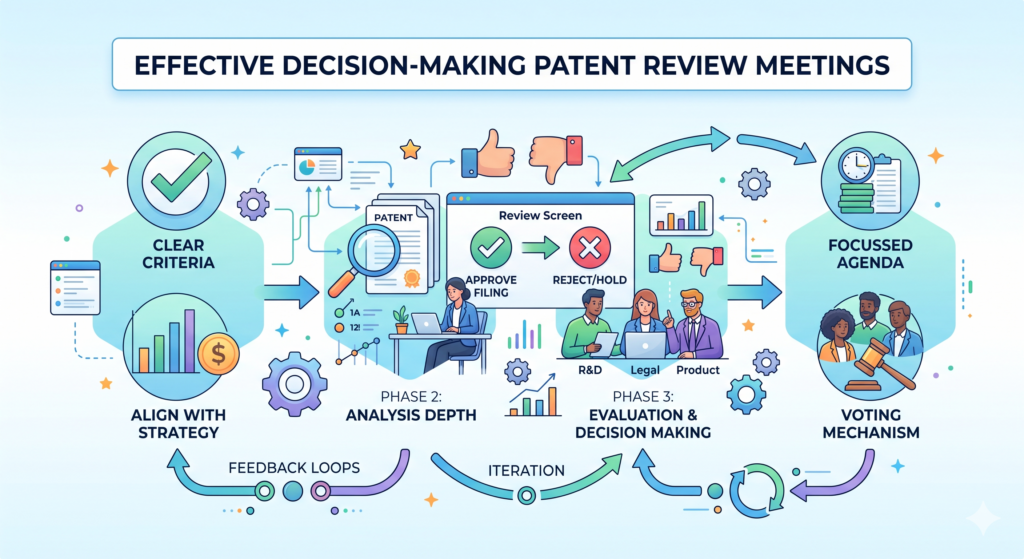
Product talks about roadmap pressure. Legal asks for details no one brought. The meeting ends with vague next steps.
That is not a review. That is a discussion.
A strong patent review meeting should drive decisions. It should help the team decide whether an idea should move forward, needs more detail, should wait, should be kept private, or should be dropped.
Every meeting should end with a clear next step and a clear owner.
The meeting does not need to be long. It needs to be prepared.
The meeting should start before people enter the room
The best review meetings are won before they begin. The owner should prepare the ideas, gather the basic facts, check for missing details, and send a short pre-read.
People should not spend the first half of the meeting trying to understand what the invention is.
The pre-read should be plain and useful. It should explain the problem, the new approach, the product area, the business value, the technical value, and any timing risk.
It should include links to useful docs or diagrams if needed. It should not be a giant packet.
When people have context before the meeting, the conversation improves. Engineers can correct details. Product can speak to market value. Leadership can make tradeoffs. Attorneys can ask sharper questions.
Without preparation, the meeting becomes a live discovery session. That may be useful once in a while, but it should not be the normal process.
Prepared reviews respect the time of technical teams
Engineers and researchers are busy. Pulling them into unclear meetings creates frustration. If the process wastes their time, they will stop engaging. That is dangerous because their input is often the most important part of the review.
A prepared process shows respect. It says, “We did the work to understand your idea. Now we need your help on the parts only you know.”
That changes the tone. Engineers are more likely to share better detail when they feel the process is serious and efficient.
PowerPatent is useful here because it helps organize invention information before attorney review, making it easier for teams to move from raw idea to structured discussion.
This can reduce back-and-forth and help founders move faster. You can learn more here: https://powerpatent.com/how-it-works
The right people should be in the room, but not everyone
Patent review needs input from different sides of the company, but bigger meetings are not always better.
The core group should usually include the process owner, a technical person who understands the invention, a product or business person who understands value, and legal or patent counsel when the idea is ready for that level of review.
Founders may join for high-value ideas or budget decisions. They do not need to join every early screen. Engineers should join when their knowledge is needed, not just to sit through business debate.
Product leaders should join when roadmap value is unclear. The goal is to bring the smallest group that can make the next decision.
This keeps the process moving. It also reduces meeting fatigue.
Each person should know their role in the review
A review meeting works best when each person brings a clear lens.
The technical person explains how the invention works and what makes it different. The product person explains why it matters to customers or the roadmap.
The business leader explains how it fits company strategy. The attorney explains legal strength, risks, and filing path. The process owner keeps the meeting focused and captures the decision.
When roles are unclear, people talk past each other. Engineers may debate product value. Product may guess at technical depth.
Founders may jump to filing decisions before the facts are clear. Attorneys may have to pull basic context from scratch.
Clear roles make the meeting faster and more useful.
The meeting should force a next-step decision
The most important rule is simple: every reviewed idea must leave with a status.
The status may be that the idea is ready for attorney review. It may need more technical detail. It may need product validation. It may be held for a later roadmap stage. It may be moved toward filing.
It may be rejected. It may be considered for trade secret treatment. The exact status can vary by company, but the idea must not leave the meeting floating.
Floating ideas kill repeatability. They create hidden work. They force the owner to chase people later. They make inventors feel ignored. They also make it hard for leadership to trust the process.
A decision does not always mean a final answer. Sometimes the right decision is to gather more detail by a specific date. That is fine. But the next step must be clear.
No idea should leave the meeting with “we will think about it”
“We will think about it” is not a status. It is a delay.
If the team needs more time, name the missing fact. If the team needs more detail, name the person who will provide it.
If the team needs attorney input, send it for review. If the team is unsure about business value, ask product or leadership for a call. If the team does not see value, say no and explain why.
This level of clarity builds trust. People are more likely to submit ideas when they know the process gives real answers.
The meeting should produce a short decision record
After the review, the owner should create a short decision record. It should capture what was discussed, what was decided, why the decision was made, who owns the next step, and when it should happen.
This record does not need to be long. It needs to be clear. It helps prevent repeated debate. It helps attorneys see context. It helps leadership review the pipeline. It helps the company learn over time.
Decision records are also useful when people leave the company. Startups change fast. Team members move roles. Founders get busy. Without records, the company loses history. With records, the process survives normal change.
The record should explain the “why,” not just the outcome
A decision record that says “approved” or “rejected” is not enough. The team should capture why.
An idea may be approved because it protects a core product method and launch is coming soon. Another may be rejected because it is easy to design around.
Another may be held because the roadmap is uncertain. Another may move to trade secret review because it is hidden and hard to detect.
The “why” helps future decisions. It trains the team. It makes the scoring system better. It also helps new leaders understand how the company thinks about patents.
A repeatable patent review meeting is not about talking more. It is about making better choices with less drag.
Build Patent Checks Into Product and Engineering Workflows
The best patent review process is not separate from the way the company builds. It sits inside the work.
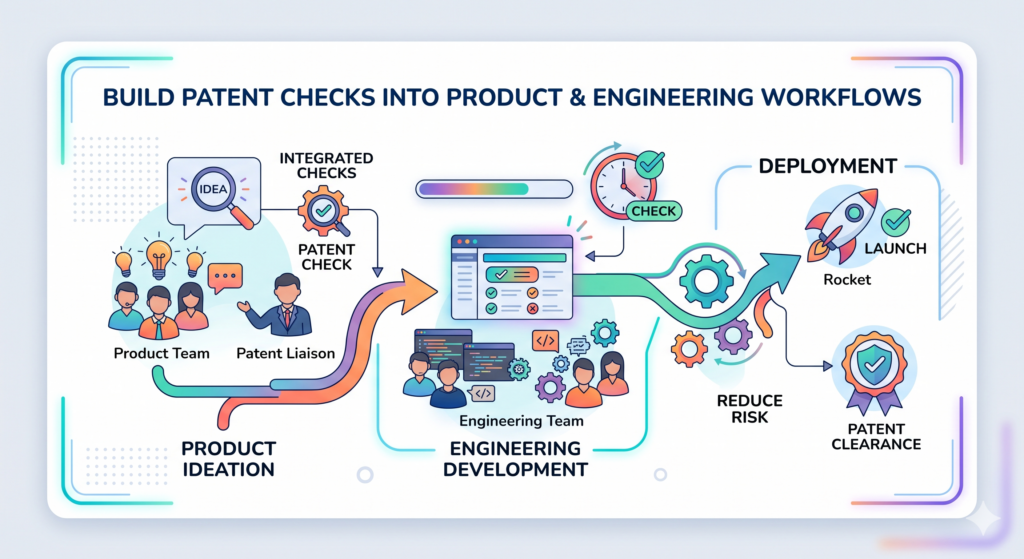
It shows up at the right moments. It asks the right questions before decisions become rushed.
If patent review lives outside normal workflows, it will always be late. Teams will remember it after the roadmap is set, after the demo is built, after the blog is drafted, or after the product has shipped. By then, the company may have fewer options.
A repeatable process connects patent review to the moments when invention naturally appears. That includes planning, design, build, test, release, and post-launch learning.
Add patent review to roadmap planning
Roadmap planning is one of the best times to spot future inventions. At this stage, the team is deciding what problems matter.
They are talking about what must improve. They are naming big bets. They are choosing where to invest engineering time.
This is a perfect place to ask whether the team expects to solve a hard problem in a new way. If yes, the patent review owner should track that area before the work is done. This early signal helps the company prepare.
The team does not need to file anything during roadmap planning. It simply needs to mark areas where invention is likely. Then, as the work moves forward, the owner can check in at the right time.
This is much better than waiting for someone to remember after launch.
Roadmap signals help the team protect future value
A startup’s most important patents often come from the work that shapes its future, not just the work it has already shipped. Roadmap planning helps the team see that future.
If a new product line depends on a hard technical method, that method should be watched. If a major feature will expose a new workflow to users, it should be reviewed before launch.
If a research project may become the company’s core platform, it should enter the patent pipeline early.
PowerPatent helps founders and teams move from invention signals to attorney-backed review without slowing down the company’s build cycle.
That matters when the roadmap is moving fast and the team needs a clean process. See how it works here: https://powerpatent.com/how-it-works
Add patent review to design and architecture reviews
Design and architecture reviews are rich with invention signals. This is where teams discuss system choices, tradeoffs, constraints, failure modes, and new approaches. It is often where the real invention first becomes clear.
A patent review owner does not need to attend every technical meeting. But teams should know how to flag invention moments during these reviews. When someone says, “We tried the normal way and it failed,” that is a signal.
When someone says, “We had to create a new path,” that is a signal. When someone says, “This makes the system work under conditions others cannot handle,” that is a signal.
The owner can then follow up with a light intake. The idea enters the process while the details are still fresh.
Architecture notes are often better than memory
Design docs and architecture notes can be very helpful for patent review because they capture the thinking behind the system.
They often explain why certain choices were made, what alternatives were considered, and what tradeoffs mattered.
Those details can fade quickly once the system is built. Capturing them early helps the patent attorney understand not just what the invention is, but why it was needed.
Teams should not write design docs for patents only. That would add too much friction. Instead, the patent process should reuse what already exists.
If an architecture doc explains the invention well, link it. If a diagram shows the flow, attach it. If a decision log explains failed approaches, save it.
The best process uses normal engineering work as raw material.
Add patent review before public release
Public release is one of the most important review points. Before the company shares a new feature, technical method, demo, paper, blog post, open-source repo, investor deck, or conference talk, someone should ask whether patent review is needed.
This does not mean every launch needs a full legal review. That would slow the company down. But every meaningful public release should include a simple patent check.
The check should ask whether the release shows a new technical method, explains how a key system works, reveals a major product workflow, or shares details competitors could use. If the answer is yes, the team should review patent options before release.
This is a small habit that can prevent big regret.
Patent checks should protect speed, not block launches
Many founders worry that patent review will slow launches. A bad process can do that. A good process does the opposite. It gives the team a faster way to decide what needs attention and what does not.
When the review process is built into launch planning, there is less panic. The team does not discover patent issues the night before a public demo.
The owner has already seen the feature. The attorney has enough context. Leadership can make a clear call.
This helps the company launch with confidence.
Add patent review after major technical wins
Not every invention is obvious during planning. Sometimes the team discovers the real breakthrough during the build. A model starts working after weeks of failure.
A device becomes stable after a clever control change. A data system becomes faster after a new indexing path. A security system catches attacks with a new signal.
These moments should trigger review.
A post-win check can be simple. After a major technical success, the team asks what changed, why it worked, and whether the new method creates company value. This can happen during sprint review, research review, or post-launch review.
The best inventions often appear after failure
Failure is often the path to invention. When the normal way does not work, the team has to create a new way. That new way may be the thing worth protecting.
This is why patent review should pay attention to hard-won fixes. A bug that took weeks to solve may reveal a deeper system method.
A performance issue may lead to a new architecture. A customer edge case may lead to a new automation flow.
A strong process does not wait for polished breakthroughs. It watches for hard problems solved with new thinking.
Make patent review feel like part of building
The best outcome is cultural. Patent review should feel like part of building a strong company, not like a legal tax.
When teams see patent review as part of product and engineering quality, they engage. They understand that protecting invention is part of protecting the company’s future.
They see that patents can support fundraising, partnerships, market defense, and long-term control.
The process should be simple, steady, and useful. It should help people do the right thing without making them stop their real work.
A built-in process beats a perfect process that no one uses
Founders should not wait for the perfect patent workflow. Start with a simple one that fits the company.
Put review checks into roadmap planning, architecture reviews, launch planning, and post-win reviews. Assign an owner. Use guided software. Bring in attorney oversight when needed.
The process can improve over time. What matters most is that it exists, people understand it, and ideas move through it.
That is how patent review becomes repeatable across teams.
Create a Shared Patent Review Language Across the Company
A repeatable patent review process needs shared words. This sounds small, but it is one of the biggest reasons teams either move fast or get stuck. When each team uses different words for the same thing, patent review becomes slow.

Engineering talks about systems, product talks about features, sales talks about customer pain, and leadership talks about market edge. Everyone may be looking at the same invention, but they do not see it the same way.
The fix is not to force everyone to use legal words. That would make the process worse. The fix is to create a shared company language that helps people explain inventions in plain terms.
The best patent review language is simple. It helps the team describe the problem, the old way, the new way, the result, and the business reason.
If every team can speak in that structure, patent review becomes much easier. An engineer can explain what changed in the system.
A product lead can explain why users care. A founder can explain why the idea matters to the company. A patent attorney can then review the idea with better context.
This shared language also helps reduce fear. Many smart people avoid patent conversations because they think they need to sound legal.
They do not. They just need to explain what they built and why it matters. When the company makes that clear, more people speak up.
Teach teams to explain the problem before the solution
The problem is the best starting point because everyone can understand it. A problem gives the invention a reason to exist.
Without the problem, the idea may sound like a random technical choice. With the problem, the value becomes clear.
For example, “we changed the data sync system” may sound minor. But “our system kept losing updates when users moved between weak networks, so we built a new sync path that repairs missing state without asking the user to restart” sounds much stronger. The second version shows pain, action, and value.
A good patent review process should teach teams to begin with what was not working. What was too slow? What broke? What was costly?
What was hard for users? What made the model fail? What made the device unsafe or unstable? What did competitors not solve well?
Once the problem is clear, the solution becomes easier to judge. The team can see whether the new approach was meaningful or just routine.
The problem story helps attorneys ask better questions
A patent attorney does not just need to know what the system does. They need to understand why the change mattered. The problem story gives them that context. It helps them see the gap between old methods and the new approach.
This is why PowerPatent focuses on turning raw invention details into a clearer review path. The software helps teams gather the right facts, and real patent attorneys help shape the next steps.
That mix can make the process much easier for busy founders and technical teams. You can see how it works here: https://powerpatent.com/how-it-works
Make “old way versus new way” a normal habit
The phrase “old way versus new way” is simple, but it is powerful. It helps teams explain what changed without using complex terms.
The old way is what people did before. It may be what the company used to do, what competitors do, what standard tools do, or what the team first tried.
The new way is the change the team created. It may be a new method, a new system, a new sequence, a new model behavior, a new hardware layout, or a new user flow.
This comparison helps the review team see the invention more clearly. If the old way and new way sound almost the same, the idea may need more work. If the difference is clear and useful, the idea may deserve deeper review.
This habit also helps prevent vague invention notes. Instead of saying, “We made onboarding smarter,” the team can say, “The old way asked every user the same setup questions.
The new way watches the first three user actions, predicts the setup path, and builds a custom workspace before the user asks.” That is much more useful.
The contrast should be specific but still easy to read
The team should not bury the review in tiny details at the first step. The contrast should be simple enough for a non-expert to understand, but specific enough to show what changed.
A good old-way/new-way explanation gives the reviewer a clean mental picture. It does not try to prove the whole case. It gives enough shape to decide whether more review is needed.
This is especially helpful across teams. Product can understand it. Leadership can understand it. Attorneys can use it. Engineers can add detail later.
Use result-based language to show why the invention matters
A patent review process should always ask what improved. The improvement may be speed, accuracy, safety, cost, reliability, privacy, ease of use, battery life, compute use, error rate, setup time, or any result that matters to the business.
Results help separate real inventions from normal work. A change that creates no clear benefit may not be worth review. A change that creates a measurable or important benefit deserves attention.
The result does not always need to be a perfect number. Early inventions may not have full data yet. But the team should still explain what got better and why that improvement matters.
If numbers exist, use them. If the result is based on user behavior, explain that. If the result is a new capability that did not exist before, say that.
The key is to connect the invention to impact.
Results help leaders make faster decisions
Founders and executives need to choose where to spend patent budget. Result-based language helps them make those choices.
An idea that cuts cloud cost by a large amount may matter because it improves margins. An idea that reduces false alerts may matter because it improves trust.
An idea that makes a device safer may matter because it supports market entry. An idea that shortens setup time may matter because it increases customer growth.
When the result is clear, the business value is easier to see.
Keep legal terms out of early invention review
Legal terms can come later. Early invention review should stay in plain language. This helps more people join the process and lowers the chance that good ideas are missed.
Teams should not worry about using words like “claims,” “prior art,” or “embodiments” during intake.
They should focus on what was built, what changed, and why it matters. The attorney can translate the useful detail into the right legal form later.
This is important because legal words can make people freeze. Engineers may think they are not qualified.
Product teams may stay quiet. Founders may delay because the process feels heavy. Plain words create motion.
Simple language creates better raw material
Simple language is not weak. It is often better. A clear invention summary in plain words gives attorneys stronger raw material than a vague summary dressed up in legal terms.
The best review language should sound like one smart builder explaining an important change to another smart builder. That is enough to start.
A shared language gives the whole company a common way to spot and explain patent-worthy work. It turns patent review from a mysterious legal process into a normal business habit.
Decide What to File, What to Hold, and What to Drop
A repeatable patent review process is not only about finding ideas. It is about making clear choices. Some ideas should move toward filing. Some should be held for more proof. Some should stay private. Some should be dropped.
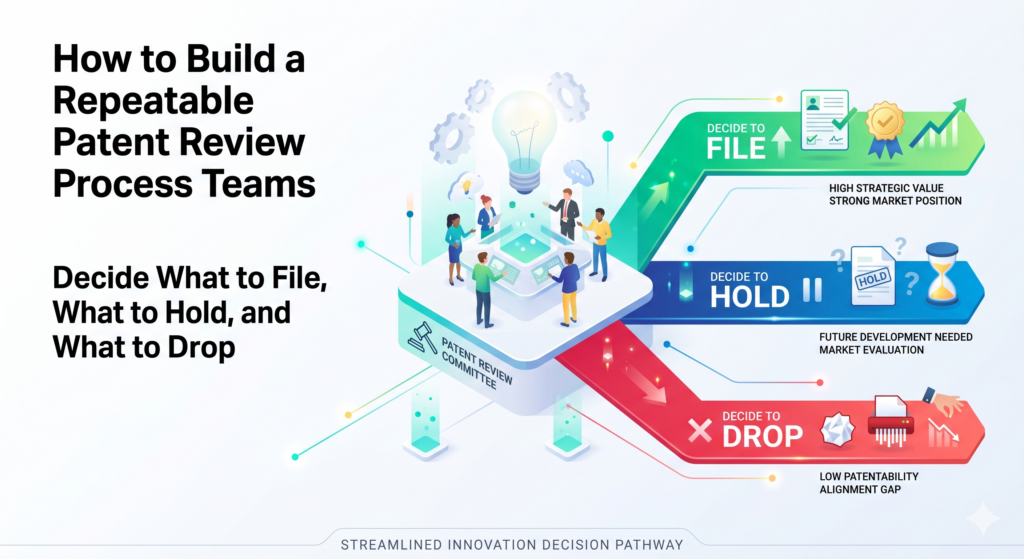
This decision point is where discipline matters. A company that files everything wastes money and creates a messy patent portfolio.
A company that files too little may leave its best work exposed. The goal is to create a steady way to choose.
The best decisions come from a mix of business value, technical strength, timing risk, competitive importance, and attorney input. No single factor should control every call.
A highly technical idea may not be worth filing if it has no link to the business. A business-critical idea may need fast filing even if the first version is not perfect. A hidden process may be better kept secret if it cannot be detected from the outside.
A strong review process makes these choices visible. It helps the team decide with care instead of emotion.
Filing should be tied to company advantage
The strongest reason to file is that the invention protects something important to how the company wins. That may be the core engine of the product. It may be a key workflow users love.
It may be a method that makes the system cheaper to run. It may be a safety feature that opens a market. It may be a technical path competitors will likely need to copy.
Filing should not be driven only by excitement. A founder may love an idea because the team worked hard on it. An engineer may love an idea because it was elegant.
A product lead may love an idea because users noticed it. These are useful signals, but they are not enough by themselves.
The question should be sharper: does this invention help the company hold ground, gain leverage, or build a stronger position?
If yes, filing may be worth serious review.
A good filing decision protects the future, not just the current product
Many patents are most useful when they protect where the product is going, not only where it is today.
A startup may file around a method that supports future versions, new markets, or partner use cases. This is why the review process should include roadmap context.
A narrow invention tied only to a temporary feature may be less useful. A broader technical method that supports the company’s future platform may be more valuable.
The team should ask whether the idea will still matter in two or three product cycles.
PowerPatent can help teams work through this kind of decision with guided software and real attorney oversight. That support matters because filing choices should be fast, but not careless.
You can see how PowerPatent helps founders move from invention to review here: https://powerpatent.com/how-it-works
Holding an idea can be the right move
Not every good idea is ready for filing. Sometimes the invention is promising but not mature enough. The team may need more test results.
The product direction may still be uncertain. The method may change during development. The business value may not be clear yet.
In those cases, holding the idea can be smart. But holding should not mean forgetting. A held idea needs a clear reason, a clear owner, and a future review date.
This is where many teams fail. They say, “Let’s come back later,” but they do not define when or why. The idea then disappears. A repeatable process prevents that by creating a real holding status.
A held idea should stay in the pipeline. It should be reviewed again when a key event happens, such as a successful test, a roadmap decision, a customer win, a launch plan, or a technical milestone.
A holding status should always include the missing fact
The team should be clear about what is missing. Maybe the idea needs proof that it improves speed. Maybe the team needs to know whether the feature will ship.
Maybe attorney review found that the idea needs more technical detail. Maybe leadership needs to decide whether the market is important enough.
Naming the missing fact keeps the process honest. It also makes the next step easier. The owner knows what to track. The inventor knows what to add. Leadership knows why the idea has not moved forward.
Holding is not delay when it is done well. It is a way to keep promising ideas alive without rushing into weak filings.
Some ideas should stay private
Some inventions may be more valuable as internal secrets. This can be true when the method is hard to see from outside the company and gives the business a real edge.
Examples may include internal data cleaning methods, model tuning workflows, operational tools, ranking formulas, manufacturing settings, or backend cost systems.
A patent can be powerful, but it requires disclosure. That means the company tells the public how the invention works in exchange for potential protection. For some hidden methods, that trade may not make sense.
This is not a decision to make casually. The company must be able to keep the information secret.
That means access controls, clean documentation, employee practices, vendor limits, and care around public sharing. If the team cannot keep the method private, a trade secret plan may be weak.
Privacy only works when the company treats it seriously
Saying “we will keep it secret” is not enough. The company needs habits that support secrecy. People should know what not to publish.
Sensitive details should not appear in public talks, sales decks, open-source repos, or casual posts. Internal access should be limited to people who need it.
This is another reason a repeatable patent review process is helpful. It creates a place to decide whether something should be filed or protected quietly.
Without that decision point, teams may accidentally reveal private methods because no one told them the method was sensitive.
Dropping weak ideas protects the process
A strong patent process needs the courage to say no. Dropping weak ideas is not failure. It is focus.
Some ideas are not important to the business. Some are too easy to design around. Some are normal implementation work.
Some are already known. Some are tied to a product path the company no longer plans to pursue. Some are too narrow to justify cost.
If the team never drops ideas, the pipeline becomes clogged. Review meetings get longer. Attorney time gets wasted. Inventors stop trusting the process because everything feels stuck.
Dropping weak ideas keeps the process clean and makes room for stronger work.
Every no should teach the team something
When an idea is dropped, the owner should explain why in plain language. The reason should not be harsh or vague. It should help the team learn.
For example, an idea may be dropped because it does not support the roadmap, because the improvement is too small, because competitors can avoid it easily, or because the team lacks enough detail to show a real technical change. This feedback helps future submissions get better.
Over time, teams learn what matters. They submit stronger ideas. Review meetings move faster. Patent strategy becomes sharper.
Work With Patent Attorneys Without Slowing the Team Down
Patent attorneys play a key role in a strong review process, but the way a company works with them matters. If attorneys are brought in too late, the company may miss timing issues.
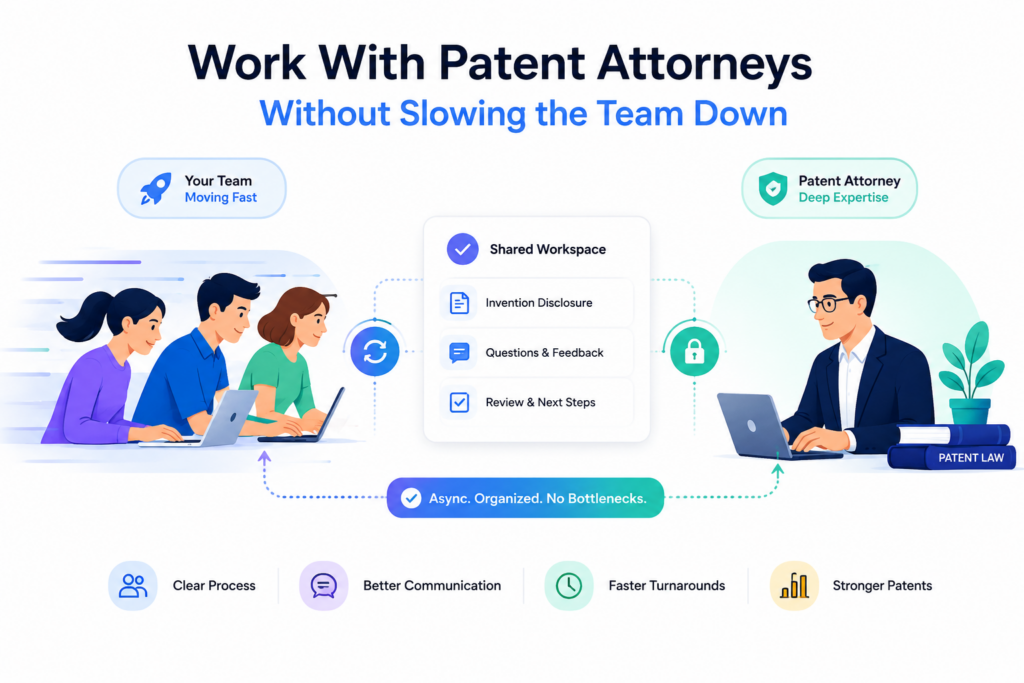
If they are brought in too early on every rough thought, the process can become slow and expensive. The goal is to bring attorney oversight at the right moments with the right information.
A repeatable process helps attorneys do better work. It gives them clean invention summaries, useful context, product value, timing facts, and access to the right technical people. This reduces back-and-forth and helps the company make faster decisions.
Founders should not think of patent attorneys as a final step only. They should think of them as strategic partners who help choose what to protect and how to protect it.
But that partnership works best when the team prepares well.
Give attorneys clear invention packets, not scattered notes
Attorneys need facts. They need to understand the invention, the problem, the old way, the new way, the result, and the business context.
If those facts are scattered across Slack threads, design docs, code comments, pitch decks, and meeting notes, review becomes harder.
A clear invention packet solves this. It does not need to be long, but it should be organized. It should include a plain English summary, the technical problem, the new approach, key diagrams or links, known public disclosure dates, planned launch dates, inventor names, and business importance.
This makes attorney review faster and more useful. It also reduces the chance that important details are missed.
The packet should be prepared by the process owner, with help from the inventors. Engineers should not have to become legal project managers. Their role is to explain the invention. The owner’s role is to make the information usable.
A better packet leads to better attorney questions
When attorneys receive clear input, they can ask sharper questions. Instead of spending time asking what the product does, they can ask what makes the method different.
Instead of guessing at business value, they can ask how broad the protection should be. Instead of hunting for timing facts, they can focus on filing strategy.
This is one reason PowerPatent is useful for busy teams. It helps organize invention details and connect them with attorney review, so the process feels less like a maze.
Founders can move faster while still getting real legal oversight. Learn more here: https://powerpatent.com/how-it-works
Use attorneys for judgment, not cleanup only
Some teams treat patent attorneys like document cleaners. They gather a messy idea, hand it over, and expect the attorney to turn it into a patent.
That can work poorly because the attorney may not have enough context to shape the strongest strategy.
Attorney value is not just writing. It is judgment. A good attorney can help decide whether an idea is worth filing, how to frame the invention, what variations to include, what risks to consider, and how the filing fits the company’s goals.
To get that value, the company must bring attorneys into the right conversations. They should see the roadmap context.
They should understand why the invention matters. They should know whether competitors are likely to copy it. They should know whether timing is urgent.
This does not mean attorneys need to attend every meeting. It means the process should give them enough context to advise well.
Strategic review saves money over time
Strong attorney input can prevent wasted filings. It can also prevent narrow filings that miss the real invention. Both mistakes are costly.
A weak filing may give the company little value. A narrow filing may protect one version while leaving competitors room to copy the main idea in a different way. A rushed filing may miss key variations that the team already knows but forgot to share.
A repeatable review process helps avoid these mistakes by creating better input before drafting starts.
Keep inventor interviews focused and respectful
Inventor interviews are often needed for important filings. These sessions help attorneys understand the invention more deeply. But they should be run with care.
Engineers and researchers may not enjoy long legal calls. They may also use time that could go toward building. The process owner should make these interviews focused.
The attorney should come prepared. The team should know what topics will be covered. The meeting should aim to fill gaps, not restart the whole review.
A good inventor interview feels like a clear technical conversation. The attorney asks about the problem, the alternatives, the key steps, the most important variations, the results, and the ways the invention could be used. The inventor explains what matters and corrects any misunderstandings.
Inventors should leave feeling heard, not drained
Inventors are more likely to support the patent process when they feel respected.
If interviews are confusing, repetitive, or too long, they may avoid future participation. If the process is clear and efficient, they are more likely to share better ideas next time.
The owner can help by preparing inventors before the meeting. They can explain the goal, share the invention summary, and tell the inventor that plain language is enough. This reduces stress and improves the conversation.
Create a feedback loop after attorney review
Attorney review should not disappear into a black box. After review, the team should receive a clear update. The idea may be recommended for filing.
It may need more detail. It may be weak. It may be better as a trade secret. It may need faster action because of public timing.
This feedback should be captured in the patent review system. It should also be shared with the right people in plain language.
Inventors should understand what happened to their idea. Leadership should understand the business decision. The owner should know the next step.
Feedback makes the whole process smarter
Over time, attorney feedback trains the company. Teams learn what kinds of ideas are stronger. They learn which details matter. They learn how timing affects decisions. They learn when to flag public disclosures.
This learning effect is powerful. The company gets better at invention capture. Attorney review becomes faster. Filing decisions become cleaner. The process becomes truly repeatable.
Protect Timing Before Launches, Demos, and Public Sharing
Timing is one of the easiest parts of patent review to overlook and one of the hardest to fix after the fact. Startups are built to share.
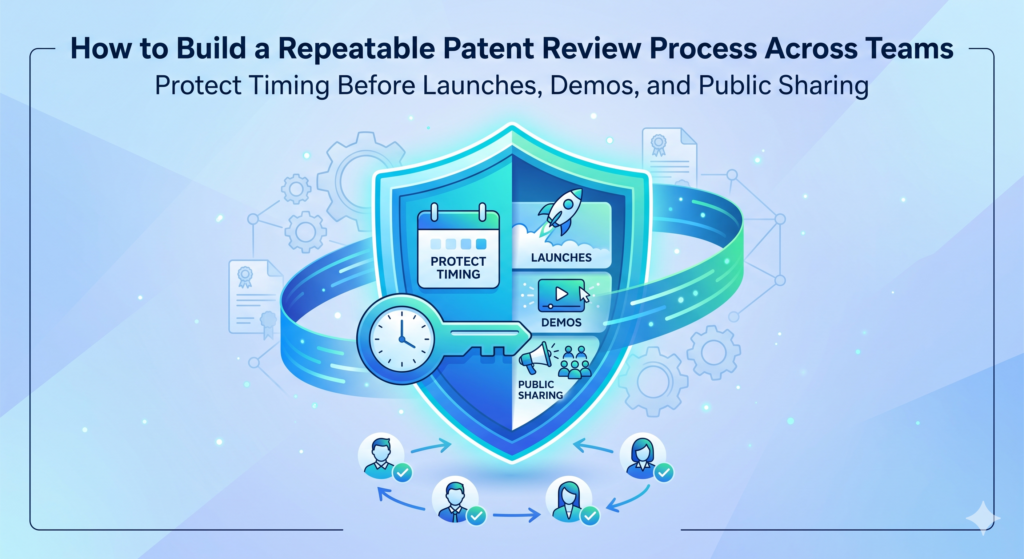
They launch, pitch, demo, publish, open source, recruit, sell, and raise money. All of that is normal. But when a company shares technical details before reviewing patent options, it may create risk.
A repeatable patent review process must protect timing without turning the company into a slow legal machine. The goal is not to stop public sharing. The goal is to check the right things before the company speaks.
This matters most for teams that build technical products. A demo can show more than expected. A blog post can explain the key method. A pitch deck can reveal the system architecture.
A conference talk can disclose the breakthrough. An open-source release can expose code that shows the invention. Even a customer pilot can matter if the details are shared outside the company.
The process should help teams spot these moments early.
Build a patent check into launch planning
Launch planning usually includes product, marketing, sales, support, analytics, and sometimes legal review. Patent review should be part of that same motion when the launch includes new technical work.
The check can be simple. The team should ask whether the launch reveals a new method, system, workflow, model behavior, device design, data process, or technical result that the company may want to protect.
If the answer is yes, the idea should be reviewed before the launch goes public.
This does not mean every launch needs a patent filing. It means every meaningful technical launch should receive a quick screen. Some launches will need no action.
Some will need a fast filing. Some will need small changes to what is shared publicly. Some will need deeper attorney review.
The launch check should happen early enough to matter
A patent check the day before launch is better than no check, but it is not ideal. The best time is when launch materials are being planned, not when they are already final.
Early review gives the team options. They may decide to file before launch. They may decide to remove certain technical details from public materials.
They may decide to delay one part of the disclosure. They may decide the risk is low and move ahead.
This is how patent review supports speed. It prevents last-minute panic.
PowerPatent helps founders build a smoother path from invention capture to attorney-backed review, which can be especially useful before launch moments.
You can see how the process works here: https://powerpatent.com/how-it-works
Watch investor decks and sales materials closely
Many founders think patent timing only matters for public blog posts or product launches.
But investor decks and sales materials can also reveal important details. Even if the audience is smaller, the company should be careful about what it shares and when.
Investor decks often explain why the technology is different. Sales decks often explain how the product solves a hard customer problem. Technical sales calls may go even deeper.
A founder may share architecture diagrams, model workflows, data methods, or performance claims to build trust.
These materials can be valuable for fundraising and sales. The answer is not to make them empty. The answer is to review sensitive technical content before it is shared broadly.
The best deck review focuses on the “secret sauce” slides
Not every slide needs patent review. Company mission, market size, team background, and customer pain may not raise the same issues.
The review should focus on slides that explain how the product works, why it performs better, what method makes it different, and what technical edge competitors do not have.
Those slides deserve care. The team should ask whether the information has already been protected, whether it should be protected before sharing, or whether it can be described at a higher level.
This helps founders tell a strong story without giving away more than they should.
Treat technical content as a disclosure risk
Technical content is often created by people who want to teach. That is a good thing.
Developer relations, research, engineering, and product marketing teams may write posts, papers, docs, talks, and tutorials that help users understand the product. But helpful content can also reveal inventions.
A technical blog post may show a new pipeline. A white paper may explain a model training method. API docs may reveal a workflow.
A GitHub repo may show implementation details. A demo video may show system behavior step by step.
This content should have a patent check when it covers new or important technical work.
Public teaching should be planned, not accidental
A company can share useful technical content and still protect its ideas. The key is planning.
Before publishing, the team should decide what can be shared safely, what should be filed first, and what should stay internal.
This decision should happen before the content is final. It is much easier to shape a draft than to fix a published post.
A repeatable patent review process gives content teams a clear path. They do not need to guess. They know when to ask for review and who owns the answer.
Keep a disclosure log
A disclosure log is a simple record of what was shared, when it was shared, who received it, and what invention it related to.
This can include public launches, blog posts, conference talks, investor decks, customer demos, open-source releases, technical docs, and papers.
The log helps the company understand timing. It also helps attorneys review options with better facts. Without a log, the team may rely on memory, which is risky.
The log does not need to be complex. It needs to be accurate and easy to update.
A disclosure log turns chaos into clarity
Startups share information constantly. Without a log, no one has the full picture. Marketing knows about the blog.
Sales knows about the deck. Engineering knows about the repo. The founder knows about the investor pitch. Legal may know none of it.
A disclosure log brings these threads together. It helps the company see what has happened and what is coming next.
This is one of the simplest ways to make patent review stronger across teams.
Measure and Improve the Patent Review Process Over Time
A repeatable process should get better with use. Patent review is not something a company sets once and forgets.
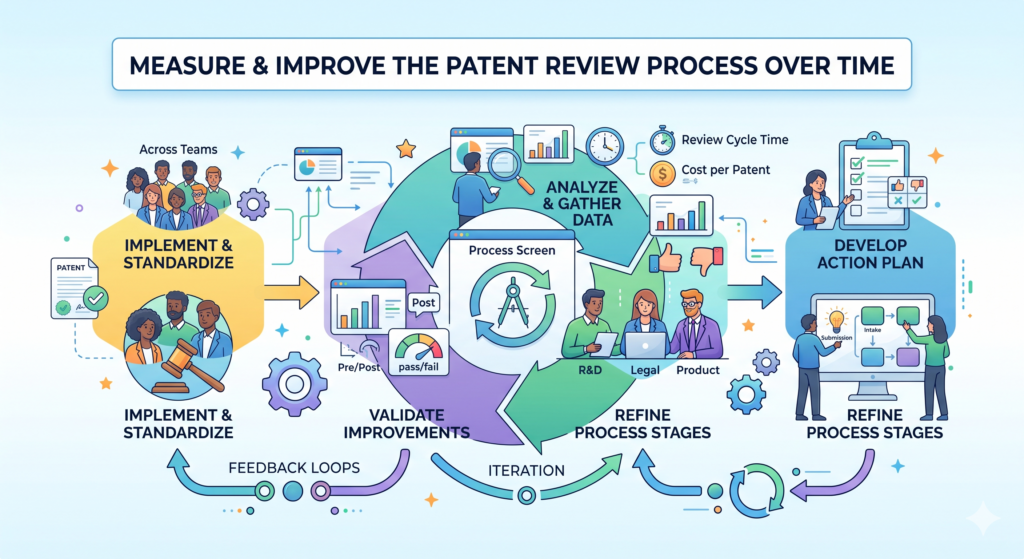
As the team grows, the product changes, the market shifts, and the invention flow increases. The process must learn.
Measurement helps. But the goal is not to create vanity metrics. The goal is to see whether the process is working.
Are teams submitting good ideas? Are reviews happening fast enough? Are launch risks being caught early? Are attorneys getting useful information? Are filing decisions tied to company goals? Are inventors still engaged?
These questions show whether the process is healthy.
A strong patent review process is measured by quality, speed, clarity, and business fit.
Track whether ideas are entering the system early
The first sign of a healthy process is early capture. Ideas should enter the system while they are still fresh, not months after launch.
The owner should watch where ideas come from. Are they coming only from founders? That may mean engineers are not trained.
Are they coming only from engineering? That may mean product and sales are missing market signals. Are ideas showing up only before launches? That may mean the process is reactive.
A strong process gets invention signals from many places. Engineering, product, research, design, customer teams, and leadership should all know how to raise ideas.
Early capture is the best defense against lost value
The longer the delay between invention and review, the more detail gets lost. People forget the old approach. They forget the failed attempts. They forget why the final method worked. They forget what was shown publicly.
Tracking early capture helps the company protect detail before it fades. It also helps the owner find weak spots in the workflow.
PowerPatent can support this by giving teams a guided way to capture invention details and move them toward attorney review. For founders who want a cleaner, faster path, the workflow is here: https://powerpatent.com/how-it-works
Track review speed without rushing judgment
Speed matters, but speed should not mean careless decisions. The team should track how long it takes for an idea to move from intake to first review, from review to attorney input, and from attorney input to filing decision.
Slow review can create risk, especially before public launches. It can also frustrate inventors. If people submit ideas and hear nothing for weeks, they may stop participating.
At the same time, not every idea needs instant action. Some need more data. Some need product validation. Some can wait.
The process should move quickly enough to protect options while allowing thoughtful judgment.
Delays usually point to unclear ownership or missing facts
When ideas stall, the owner should ask why. Is no one assigned? Is the technical summary weak? Is the business value unclear? Is attorney review waiting on diagrams? Is leadership slow to approve budget? Is the launch date unknown?
Each delay has a cause. Fixing the cause improves the process.
The goal is not to blame people. The goal is to remove friction.
Track decision quality
A patent review process is only useful if it helps the company make good decisions. That means the team should look back at what it chose to file, hold, keep secret, or drop.
Were filed ideas tied to important products? Did held ideas get reviewed again? Did dropped ideas stay dropped for good reasons?
Did any urgent launch risk get missed? Did any filed idea later seem off-strategy? Did attorneys have enough detail to draft strong filings?
These questions help the process mature.
Good decision records make quality review possible
You cannot improve decision quality if you do not know why decisions were made. That is why short decision records matter. They give the company a memory.
A clear record explains the invention, the decision, the reason, the owner, and the next step. Later, the team can review those records and see patterns.
Maybe too many weak ideas are reaching attorney review. Maybe business value is not being captured early enough.
Maybe engineering details are strong, but market context is missing. Maybe product teams need better training. These insights help the process improve.
Track inventor engagement
Inventors are the heart of the process. If they stop engaging, the process fails. The company should pay attention to how inventors experience patent review.
Do they know how to submit ideas? Do they get feedback? Do interviews feel respectful? Do they understand what happened to their submissions? Do they feel the company values their work?
Inventor engagement does not require big rewards or complex programs. Often, simple respect is enough.
Thank people. Give updates. Explain decisions. Make the process easy. Show how their ideas support the company’s future.
Feedback keeps inventors coming back
When inventors hear nothing after submitting an idea, they may assume the process is pointless. When they receive clear feedback, they learn and stay involved.
Even a rejected idea can build trust if the reason is clear. The inventor may understand that the idea did not fit the roadmap or needed more technical depth. That makes the next submission stronger.
A repeatable process should make inventors feel included, not used.
Improve the process in small steps
The best patent review process is not built in one giant project. It improves over time. The owner should look for small changes that remove friction.
Maybe the intake form is too long. Shorten it. Maybe launch reviews happen too late. Move them earlier. Maybe review meetings lack decisions. Add status rules.
Maybe attorneys get messy input. Create better invention packets. Maybe product teams do not submit ideas. Train them with examples.
Small fixes compound. Over time, the process becomes faster, clearer, and more trusted.
A simple process used every week beats a perfect process no one follows
Founders should resist the urge to overbuild. Patent review should be strong, but it should not become heavy. The process should match the company’s stage, speed, and risk.
A seed-stage startup may need a simple monthly review and launch check. A growth-stage deep tech company may need a fuller pipeline, scoring model, attorney cadence, and disclosure log.
The right process is the one that helps the team protect important ideas without slowing the company down.
Repeatability is not about complexity. It is about making the right behavior easy to repeat.
Conclusion
A repeatable patent review process is not extra work. It is how a serious company protects the ideas that make it different.
The process does not need to be heavy. It needs to be clear. One owner. Simple intake. Shared language. Team training. Smart scoring. Clean review meetings. Launch checks. Attorney oversight. Decision records. Regular improvement.
Leave a Reply