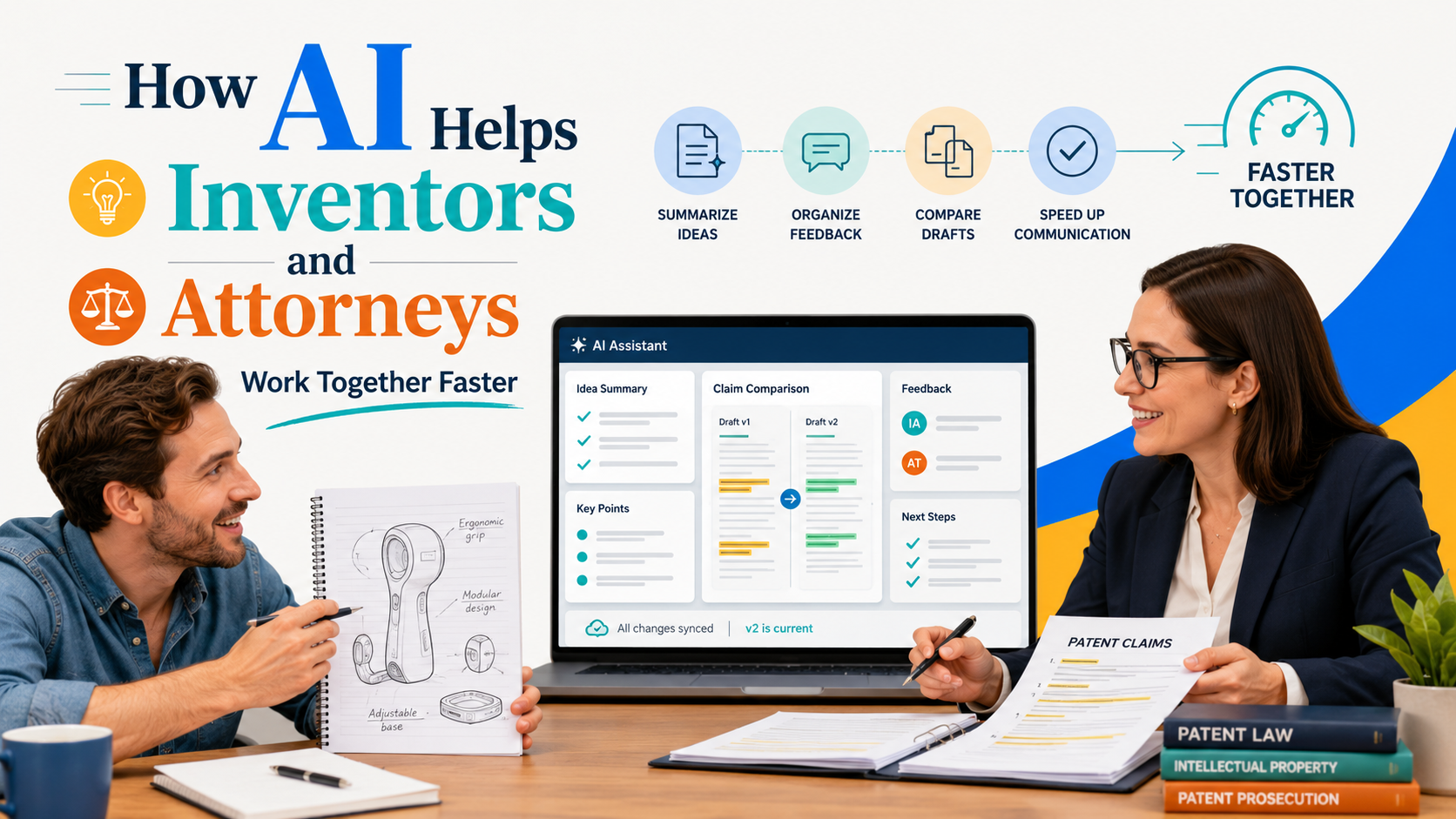
Inventors move fast. Attorneys need to be careful. That gap can slow a patent down before it even starts. A founder may have the idea in their head, the code in a repo, a rough sketch on a whiteboard, and a few notes in Slack. A patent attorney needs that same idea in clear words, with enough detail to protect what matters. The problem is not lack of skill. The problem is friction.
AI Gives Inventors a Faster Way to Explain What They Built
Most patent delays start in a very normal place. The inventor knows the invention, but the attorney does not know it yet.
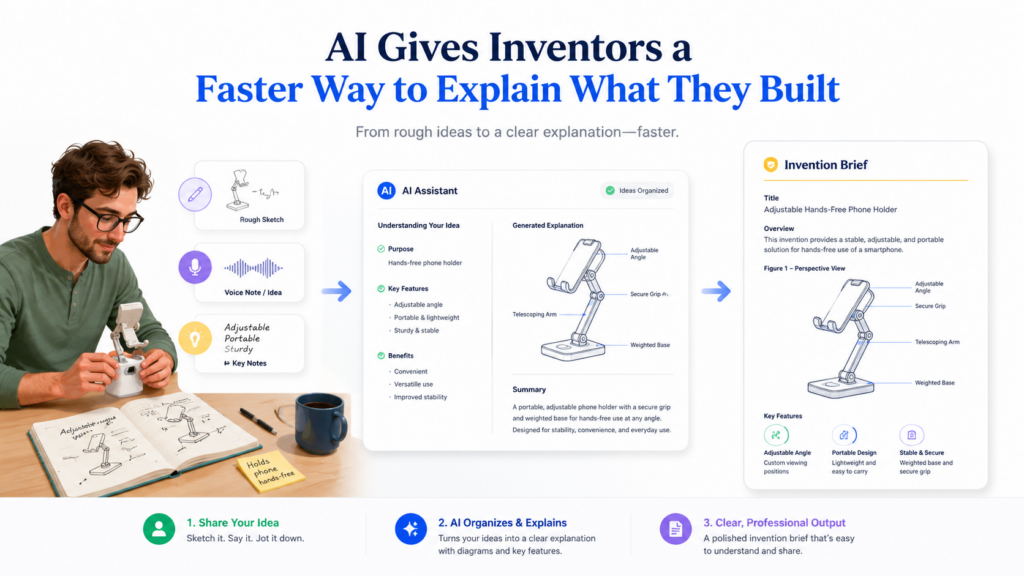
The attorney needs to learn what was built, why it matters, how it works, what makes it different, and where the real value lives.
That takes time because most inventions do not arrive as neat stories. They arrive as code, notes, drawings, product plans, demo videos, test results, customer feedback, and half-finished thoughts.
AI helps by turning that raw material into a cleaner first draft of the invention story. This is powerful because the first version of the story is often the hardest part.
Once the idea is written down in a clear way, the inventor and attorney can react to it, fix it, expand it, and shape it. The work becomes easier because everyone is looking at the same thing.
AI Helps Pull the Idea Out of the Inventor’s Head
Inventors are often too close to their own work. What feels obvious to them may be the most important part of the invention.
A founder might say, “It just routes the data better,” while the attorney needs to know how the routing works, what problem it solves, what steps happen in what order, and why the old way was not enough.
AI can ask better starting questions. It can help the inventor explain the system in plain words. It can turn a rough voice note into a structured summary.
It can take a product brief and point out the parts that may need more detail. This does not mean AI knows what should be patented. It means AI helps reveal the parts that deserve a closer look.
The Best Use of AI Is Not to Sound Smart, but to Get Clear Faster
A good patent process is not about using fancy words. It is about getting the real invention into the open.
AI helps remove the blank page problem. Instead of asking an inventor to sit down and write a perfect invention report from scratch, AI can guide them step by step.
For example, an engineer can explain the invention in normal language. The AI can then shape that explanation into sections such as the problem, the old way, the new way, the main system parts, the steps taken by the software, the data used, and the result. That gives the attorney something useful much sooner.
This is a big deal for startups because time is expensive. Every hour a founder spends trying to write a patent memo is an hour they are not building, selling, hiring, or talking to users.
AI makes the process feel less like homework and more like a guided work session.
PowerPatent is built around this idea. It helps founders move from messy invention details to a cleaner patent workflow, while still keeping real attorney oversight in the loop. You can see how that works here: https://powerpatent.com/how-it-works
AI Helps Capture Details Before They Get Lost
In fast-moving teams, invention details disappear quickly. A key design choice may live in a pull request. A smart workaround may be buried in a Slack thread.
A model change may be explained in one meeting and never written down again. Months later, when the team finally talks to a patent attorney, the reason behind the choice may be hard to remember.
AI helps teams capture more of that detail while it is still fresh. It can turn meeting notes into invention records.
It can summarize technical docs. It can help compare early versions with later versions. It can highlight what changed and why the change mattered. This gives the attorney a stronger starting point.
Better Notes Lead to Better Attorney Review
Attorneys do their best work when they have strong facts. They need clear input from the people who built the product.
AI can help organize those facts, but the attorney still brings the judgment. The attorney can ask what is truly new, what should be kept broad, what needs more support, and what should be left out.
This is where AI and attorneys work best together. AI speeds up the gathering and sorting. The attorney handles the legal thinking and strategy.
The inventor stays involved because the system is easier to follow. Nobody is stuck waiting on a long email chain just to understand the basic shape of the invention.
That faster handoff can change the whole mood of the patent process. Instead of feeling slow and heavy, it starts to feel like part of the build process.
The team can protect ideas closer to the time they are created. That matters because startups do not move in neat patent timelines. They move in sprints, launches, pivots, and investor calls.
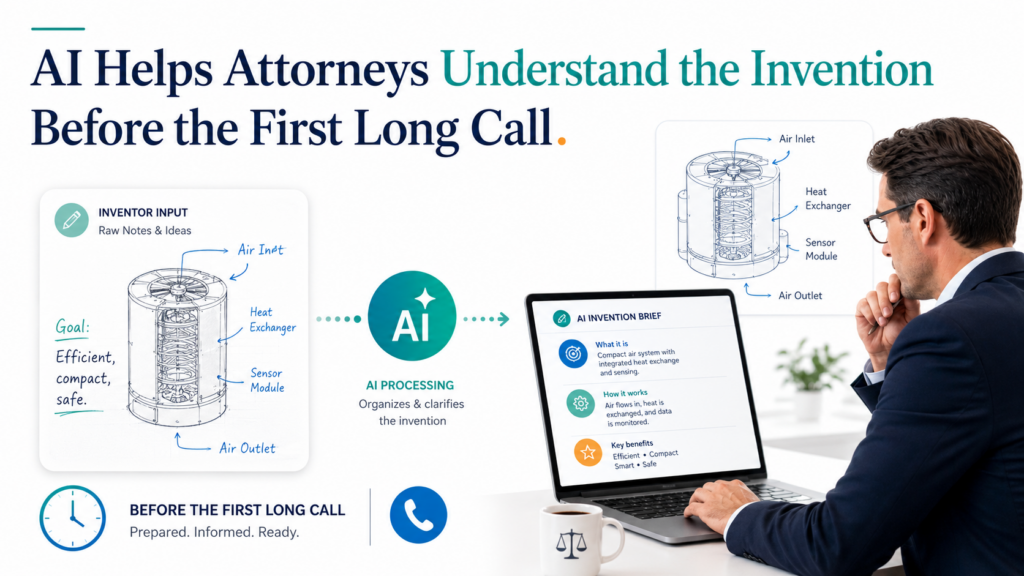
AI Helps Attorneys Understand the Invention Before the First Long Call
A patent attorney does not need a perfect story on day one. But they do need enough detail to see the shape of the invention. They need to know what the inventor built, what problem it solves, how it works, and what parts may be worth protecting.
Without that, the first call can turn into a slow discovery session where everyone is trying to find the invention in real time.
AI can make that first call much more useful. Instead of starting with a blank page, the attorney can start with a clear invention brief.
That brief can include the main idea, the system parts, the process steps, the key data, the user flow, the technical change, and the result. It may not be final. It may not be ready to file. But it gives the attorney a strong map.
This changes the role of the first attorney call. The call no longer has to be about basic facts only. It can become a sharper strategy session. The attorney can ask better questions.
The inventor can give better answers. Both sides can spend time on the hard parts instead of using half the meeting to explain what the product does.
The First Draft Helps the Attorney See What to Ask Next
A good patent conversation is often driven by good questions. The attorney may ask why one system design was chosen over another. They may ask what happens when the model receives weak data.
They may ask what the software does when two outputs conflict. They may ask what part of the process creates the better result.
These are not random questions. They help the attorney find the parts that may make the invention strong.
But the attorney can only ask these questions when they understand the basic invention first. AI helps by giving them that basic view faster.
For example, a founder may upload a product spec, a short demo script, and a few notes from an engineering meeting. AI can help turn that material into a plain-English overview.
The attorney can review it and spot gaps before the call. That means the call can focus on missing details, edge cases, and the best way to explain the invention.
This is a better use of everyone’s time. The inventor is not forced to repeat the same basic story again and again.
The attorney is not trying to build the whole picture from scattered notes. The team can move straight into the details that matter.
Faster Understanding Does Not Mean Less Care
Speed only helps when the work stays careful. A rushed patent can be weak. A thin patent can miss the real value. AI should never be used to skip legal review or push a half-formed idea into a filing. That is not the smart path.
The smart path is using AI to prepare better raw material so the attorney can do stronger work. AI can help gather, sort, and explain.
The attorney still decides what matters, what is risky, what needs support, and how the invention should be framed.
That is the balance founders should want. They should not want a fully automated patent machine with no human judgment.
They should want a faster process that still has a trained attorney watching the details. That is where real speed and real protection meet.
PowerPatent is designed for this kind of teamwork. It gives inventors a faster way to share what they built, while attorney oversight helps make sure the final work is not just fast, but sound. See the process here: https://powerpatent.com/how-it-works
AI Makes the Attorney Call More Focused and Less Draining
Many inventors dread patent calls because they feel long, dense, and hard to prepare for. They worry they will say the wrong thing.
They worry they will forget a key detail. They worry the attorney will not understand the product quickly enough.
AI can reduce that stress. When the invention is already organized before the call, the inventor can review it and correct it.
They can see what the attorney will likely ask about. They can add missing examples. They can flag what is most important to the business.
This makes the call feel less like an exam and more like a working session. The inventor comes in ready. The attorney comes in prepared.
The goal is not to drag the idea out of someone’s head. The goal is to refine what is already on the page.
Better Prep Creates Better Strategy
Patent strategy is not just about writing what exists. It is about thinking ahead. What might competitors copy?
What parts may become core to the product? What will the company still use in two years? What is the broad idea behind the current version?
AI helps surface the current details. The attorney helps turn those details into a strategy. When that handoff is smooth, the company can make smarter choices earlier. It can protect more than a single feature.
It can protect the deeper method, workflow, or system design that gives the company an edge.
That is why faster understanding matters so much. It is not just about saving time. It is about giving the attorney more room to think.
AI Helps Turn Messy Technical Material Into Clear Patent Inputs
Inventors rarely create invention material in a clean format. They create code, tickets, sketches, test notes, model logs, user flows, API docs, design reviews, and product roadmaps.
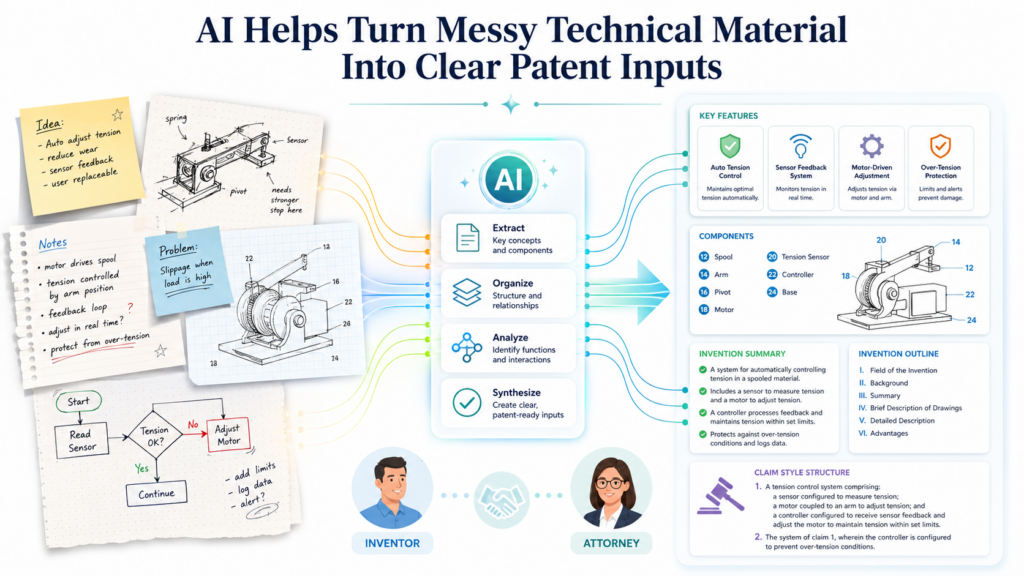
This material is useful, but it is not always easy for a patent attorney to read quickly. It may be too technical in one place and too vague in another. It may explain what the system does without explaining why it matters.
AI can help turn that scattered material into clear patent inputs. This does not mean the AI is creating the final patent by itself. It means the AI is helping the team build a better package of information for attorney review.
That package can save days or weeks. It can also reduce the risk that a key detail gets missed. This matters because many valuable inventions are hidden inside small design choices.
The founder may think the invention is the whole product, but the strongest idea may be a specific way the product handles data, ranks results, trains a model, detects a risk, or updates a workflow.
AI Can Translate Engineering Work Into Business-Level Meaning
Engineers often describe inventions by how they are built. Founders often describe them by what they do for the customer.
Patent attorneys need both. They need the technical steps, but they also need to understand the real-world problem and why the solution is better.
AI can help bridge that gap. It can take a technical note and restate it in simpler words. It can take a customer problem and connect it back to the system design.
It can help explain why a certain process is faster, safer, cheaper, more accurate, or easier to use.
For example, an engineering note may say that the system uses a staged scoring process before sending data to a final model. That may sound small. But the business meaning may be huge.
The staged scoring process may reduce cost, improve speed, and make the system more reliable under heavy load. AI can help surface that connection so the attorney can explore it.
This is very useful because patent work lives at the meeting point of technical detail and business value. The attorney needs to know how the invention works, but they also need to know why anyone should care.
Clear Inputs Help Avoid Weak Drafts
A weak draft often starts with weak input. If the attorney only gets a high-level product pitch, the patent may stay too broad in the wrong way and too thin in the places that matter.
If the attorney only gets raw code, they may miss the product context. If they only get a demo, they may not see the deeper system steps.
AI helps by shaping the input before the attorney starts drafting. It can organize the material into a clearer story.
It can show where the facts are strong and where the team needs to add more. It can help the inventor explain not only what the system does, but what makes it different.
This helps the attorney write from a stronger base. It also gives the inventor more control. The inventor can review the summary and say, “That part is not right,” or “This is the key part,” or “We should also explain this backup method.”
That kind of early correction is far better than fixing a misunderstanding after a full draft has already been written.
AI Helps Find the Missing Pieces Earlier
One of the best uses of AI is gap-finding. A good AI workflow can help point out when an invention description is missing a clear problem, a step-by-step process, an example, a system part, an input, an output, or a reason the result is better.
This does not replace attorney review. It simply makes the review cleaner. The attorney can see the gaps sooner and ask targeted questions. The inventor can answer while the details are still fresh.
Imagine a startup is protecting a new AI workflow for medical data review. The first notes explain that the system gives a risk score.
But they do not explain how the system handles missing data, how it weighs different signals, or how it alerts a human reviewer. Those missing details may be important. AI can help flag those gaps before the attorney call.
The Best Patent Inputs Are Built Before the Draft Starts
Many teams treat patents like a writing task. They think the main job starts when the attorney begins drafting. In reality, a strong patent often starts earlier. It starts with clear invention capture.
The better the capture, the better the draft can be. The more complete the invention story, the easier it is for the attorney to protect the right parts.
AI helps make invention capture less painful. It gives the team a way to collect and organize the raw material without turning the process into a burden.
This is especially important for technical founders who are short on time. They do not want a process that pulls them away from building for weeks. They want a faster path that still respects the depth of their work.
That is the promise of PowerPatent: smart software that helps organize the invention, paired with real patent attorney oversight so the work does not lose human judgment. Learn more here: https://powerpatent.com/how-it-works
AI Helps Reduce Back-and-Forth Without Cutting Out the Inventor
Back-and-forth is one of the biggest hidden costs in patent work. It shows up as long email threads, repeated questions, unclear comments, missed attachments, draft reviews, and follow-up calls.
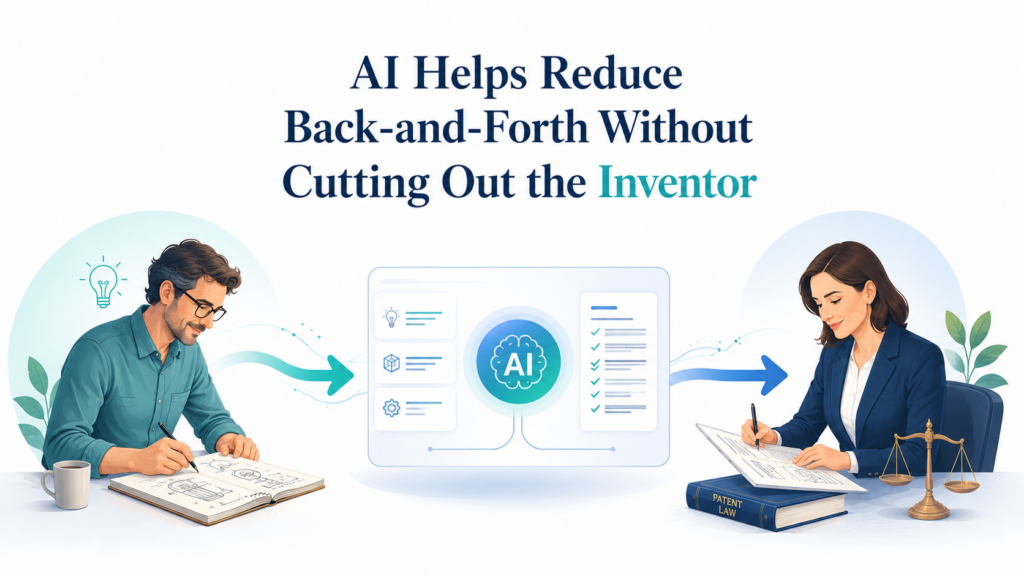
Some back-and-forth is healthy. It helps the attorney learn the invention and helps the inventor correct the record. But too much back-and-forth slows everyone down.
AI can reduce the waste without removing the inventor from the process. That last part is important. The goal is not to silence the inventor. The goal is to make each round of feedback better.
When AI is used well, the inventor can give input in a simpler way. The attorney can review a more organized version of that input. Questions can be grouped. Missing facts can be flagged.
Draft comments can be easier to understand. The process becomes smoother because fewer people are hunting through scattered messages.
AI Helps Turn Feedback Into Clear Changes
Patent drafts can be hard for inventors to review. Even when the attorney writes clearly, the document may still feel long and unfamiliar. Inventors may not know where to comment.
They may not know whether a detail belongs in the summary, the drawings, the examples, or the claims. They may know something is wrong, but not know how to explain the fix.
AI can help turn inventor feedback into clearer comments. An inventor might say, “This is not quite how the model chooses the final output.”
AI can help them expand that into a more useful note, such as which step is wrong, what the system actually does, what inputs it uses, and what result it creates.
That helps the attorney make the right change faster. It also helps avoid vague comments like “make this stronger” or “this is too narrow.” Those comments may be true, but they are hard to act on without more detail.
Clear Feedback Saves More Time Than Fast Feedback
Fast feedback is good, but clear feedback is better. A quick reply that creates confusion may cost more time later. A thoughtful reply that explains the issue can save a full round of review.
AI helps inventors slow down in the right way. It can guide them to explain the missing detail before sending the comment.
It can help them compare the draft language to the real product. It can help them say what should be changed and why.
This does not mean the inventor has to become a patent expert. They do not need to learn every rule or term. They just need a better way to share what they know. AI gives them that path.
AI Helps Attorneys Ask Fewer but Better Questions
Attorneys often need to ask many questions because the input is incomplete.
They may ask what happens first, what happens next, whether a step is required, whether there are other versions, whether the system works without a certain feature, or whether the invention applies beyond the current product.
AI can help group these questions and connect them to the source material. Instead of sending the inventor ten separate messages over two weeks, the attorney can send one focused request that covers the missing facts.
That is better for the founder, better for the engineer, and better for the attorney.
It also makes the process feel more respectful. Inventors are busy. They want to help, but they do not want to be pulled into endless small questions that could have been grouped earlier. AI helps create that grouping.
The Inventor Still Owns the Truth of the Invention
Even with AI, the inventor remains the source of truth. AI may summarize, suggest, and organize, but it can be wrong.
It can miss context. It can make something sound more certain than it is. It can overstate a feature or smooth over an important limit.
That is why inventor review matters. The inventor should check that the invention story is accurate.
The attorney should check that the legal strategy is sound. AI should sit between them as a helper, not as the final decision-maker.
This is where PowerPatent’s model is helpful. It is not about letting AI run wild. It is about using smart tools to help people work faster, while real attorney oversight keeps the process grounded.
For founders who want speed without losing care, that balance matters. See how PowerPatent supports this workflow here: https://powerpatent.com/how-it-works
AI Helps Attorneys Build Better Drafts From Stronger Source Material
A patent draft is only as strong as the thinking behind it. The attorney’s skill matters a lot. But the quality of the source material also matters. If the attorney has a rich, clear, detailed record of the invention, the draft can be more complete.
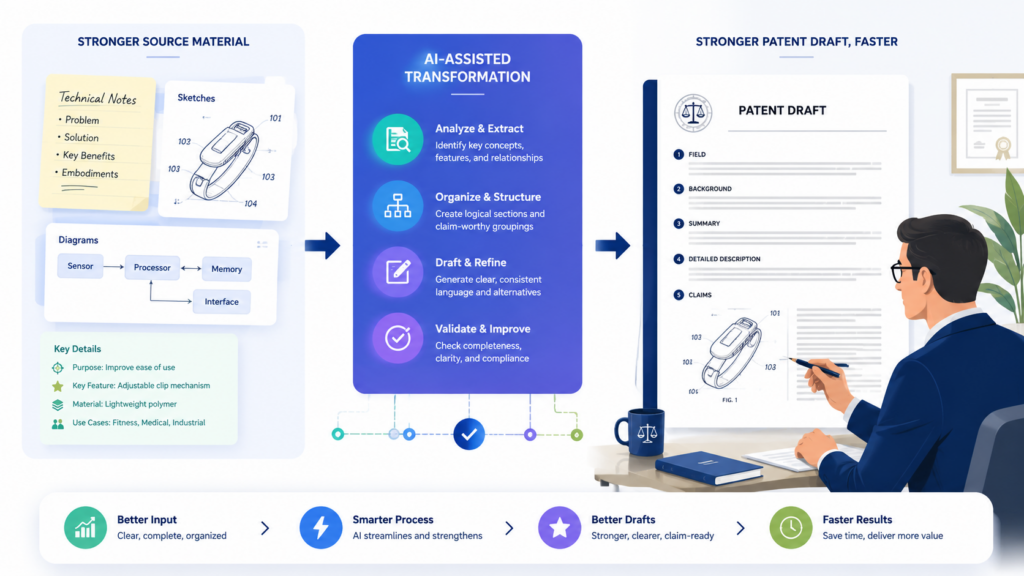
If the source material is thin, the attorney has to spend more time chasing details or making safe assumptions that may not fully capture the invention.
AI helps improve the source material before drafting begins. It can help collect examples, explain system flows, map inputs to outputs, and show different ways the invention may be used.
This gives the attorney more to work with. It can also help the attorney see patterns across the material that might otherwise stay hidden.
This is not a small benefit. Strong patents often depend on strong examples. They need enough detail to show how the invention can work in the real world.
They also need enough breadth to avoid being trapped inside one narrow product version. AI can help gather both the concrete details and the wider variations.
AI Helps Build a Fuller Invention Record
A strong invention record answers more than “What did we build?” It also answers “Why did we build it this way?” and “What other ways could this work?” These questions matter because a startup’s product may change.
The first version may not be the version that wins the market. If the patent only covers the first version too tightly, the company may lose value later.
AI can help inventors think through variations. It can ask whether the system could use different data sources, different models, different sensors, different user roles, different devices, or different timing steps. It can help capture backup approaches and optional features.
The attorney can then decide what belongs in the patent and how to frame it. Not every variation will matter. Not every idea should be included. But having the options visible gives the attorney more strategic choices.
Broader Thinking Should Still Be Tied to Real Support
There is a danger in using AI badly. AI can generate a lot of possible versions very quickly. Some may be useful.
Some may be too far from what the team actually built. A strong patent should not be filled with empty guesses just because they sound broad.
The better approach is to use AI to prompt real thinking from the inventor. The inventor can confirm which variations are real, planned, tested, or technically sensible. The attorney can then decide how to use that information.
This is how AI can support quality instead of just volume. It helps the team find more detail, but the humans still decide what is true and useful.
AI Helps Attorneys Spend More Time on Judgment
Patent drafting includes many tasks. Some are deeply strategic. Others are more mechanical.
Gathering details, cleaning notes, organizing sections, and comparing different invention descriptions can take a lot of time. AI can help with those tasks so the attorney can spend more energy on judgment.
That judgment is where attorneys add major value. They think about what the invention really is. They decide how to describe it without boxing it in.
They look for weak spots. They think about how a competitor might design around it. They help choose the right filing path.
AI can speed up the prep work, but it cannot replace that judgment. Founders should be careful with any process that claims patents can be fully handled by AI with no attorney review.
Speed is useful only if it leads to better decisions, not just faster documents.
Strong Drafts Come From Human and AI Teamwork
The best process is not human-only or AI-only. Human-only can be slow and expensive when the raw material is messy.
AI-only can be risky because the tool does not truly understand legal strategy, business goals, or the full truth of the invention.
The best path is teamwork. AI helps gather and organize. Inventors correct and explain. Attorneys guide and protect.
This creates a better draft process because each person, and each tool, is doing the job it is best suited for.
PowerPatent was built for this new way of working. It helps technical teams move faster while keeping attorney oversight where it belongs.
That means founders can protect important work without getting buried in an old, slow process. Explore the workflow here: https://powerpatent.com/how-it-works
AI Helps Startups Protect Ideas Closer to the Speed of Building
Startups do not wait for perfect timing. They ship, test, change, and learn. A product that looks one way in January may look very different by April.

A model may improve. A workflow may change. A customer need may push the team in a new direction. This speed is good for the business, but it can make patent work hard.
Traditional patent processes often feel too slow for this pace. By the time the team starts a patent, the product may have already changed.
By the time the attorney gets the full story, the inventors may be focused on the next release. By the time the draft is ready, some details may be old.
AI helps bring patent capture closer to the speed of building. It lets teams record invention details as they happen. It helps turn fresh work into clear summaries.
It helps attorneys review stronger input sooner. This makes patents feel less like a separate legal project and more like part of the company’s normal build rhythm.
AI Makes Invention Capture a Habit, Not a Fire Drill
Many startups wait too long to think about patents. They wait until a fundraise. They wait until a big launch.
They wait until a competitor appears. They wait until an investor asks, “What IP do you have?” Then the team rushes to remember what was invented months ago.
That is a hard way to work. It creates stress and increases the chance that important details are missed.
AI can help turn invention capture into a lighter habit. After a sprint, the team can summarize what changed. After a technical breakthrough, an engineer can record a short explanation.
After a design review, the team can capture why one approach beat another. AI can help organize these notes so they are useful later.
This does not mean every note becomes a patent. It means the company builds a living record of innovation. When it is time to file, the team is not starting from memory. They have a trail.
Small Capture Moments Can Create Big Patent Value
The best invention details are often small at first. A new ranking step. A faster sync method. A better way to clean data.
A safer fallback process. A smarter way to connect tools. These may not feel like big inventions in the moment, but they can become very valuable if they support the core product.
AI helps catch these moments before they fade. It can help teams notice when a change solved a real technical problem.
It can help ask, “What was hard about this?” and “Why did the old way fail?” Those questions often lead to the heart of the invention.
For a startup, this can become a real advantage. Instead of filing patents only after big public milestones, the company can build a steady protection plan around its best technical work.
AI Helps Founders Move Faster Without Losing Control
Founders want speed, but they also want control. They do not want a black-box process where they hand off their idea and hope the final draft makes sense.
They want to know what is being protected. They want to understand the plan. They want to make sure the patent matches the business.
AI can help by making the process more visible. It can show summaries, invention maps, draft sections, and open questions in plain language.
This helps founders stay involved without needing to become patent experts.
The attorney still leads the legal work. But the founder can follow the reasoning better. They can see why certain details matter.
They can help shape the business angle. They can make sure the filing supports the company’s future, not just its current feature set.
The Real Win Is Speed With Confidence
Fast is not enough. A fast patent process that leaves the founder confused is not a win. A fast process that skips attorney review is not a win. A fast process that misses the real invention is not a win.
The real win is speed with confidence. The inventor knows the invention was captured. The attorney has better material to review.
The founder understands the strategy. The company moves forward without letting protection fall behind the product.
That is what AI makes possible when it is used the right way. It removes drag from the process, but it does not remove human care.
It makes the work lighter, but not weaker. It helps inventors and attorneys meet in the middle faster.
For startup teams that want to protect what they are building without slowing down, PowerPatent offers a modern path: smart AI tools, simple workflows, and real attorney oversight. See how it works here: https://powerpatent.com/how-it-works
AI Helps Teams Spot Patent-Worthy Ideas Earlier
Many strong inventions are not obvious at first. They do not always arrive as big “aha” moments. In a startup, a valuable invention may look like a small fix, a faster process, a cleaner workflow, or a smarter way to handle a hard edge case.
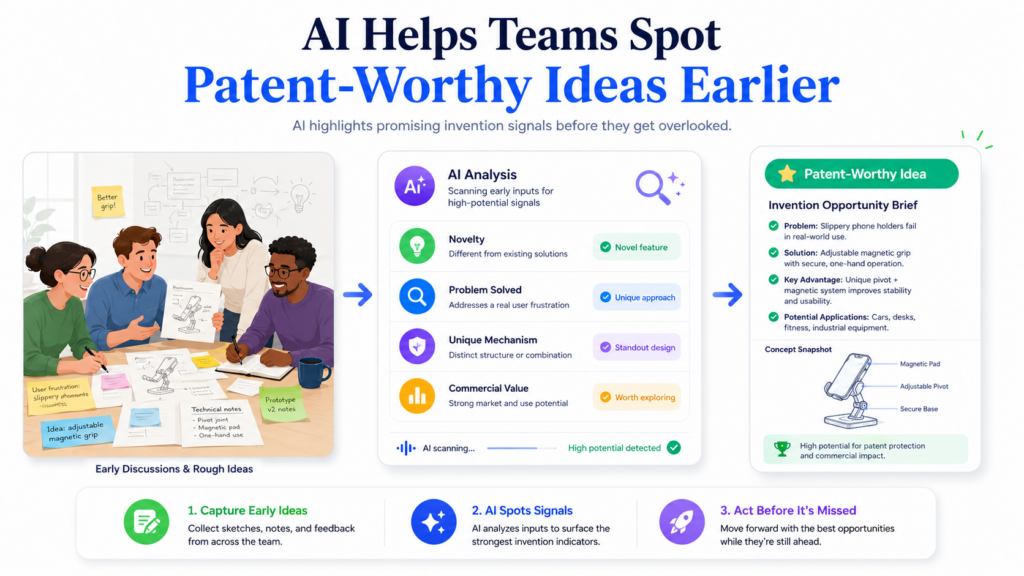
The team may move past it quickly because the goal is to ship the product, not stop and label every breakthrough.
That is where AI can help. It can look at the work a team is already doing and help point out where there may be something worth discussing with a patent attorney.
This does not mean AI decides what is patentable. It means AI helps the team notice patterns that humans often skip when they are busy.
For example, an engineer may build a new way to reduce model errors when user data is incomplete. A product lead may create a new flow that lets a user complete a complex task with fewer steps.
A robotics team may design a better sensor timing method. A security team may find a new way to detect risky behavior before damage happens. Each of these may be more than a feature. Each may be the start of an invention story.
AI Can Watch for Signals Hidden in Normal Work
Most startup work already creates signals. Code comments show why changes were made. Product specs explain what problem the team is solving.
Test notes show what failed and what improved. Support tickets show where users struggled. Meeting notes capture tradeoffs. Roadmaps show where the company is placing its bets.
AI can help review this material and pull out possible invention signals. It can notice when the team solved a technical problem in a new way.
It can flag when a feature creates a surprising result. It can help group related changes into a single invention theme. This gives founders a better way to decide what deserves attorney review.
The key is not to file on everything. That would be expensive and unfocused. The key is to build a clear intake process so good ideas do not vanish.
The Best Time to Capture an Invention Is While the Team Still Remembers the Why
The “why” behind an invention is often more important than the “what.” A product may have a feature, but the invention may live in why that feature works better than the old approach.
The team may have tried three paths, rejected two, and found one that solved the hard problem. That story matters.
If the team waits too long, that story can fade. Engineers move to new tasks. Founders get pulled into sales. Product choices become normal. What once felt new becomes “just how the system works.”
AI helps prevent this loss. It can prompt the team to explain what changed, what problem was solved, what other paths were considered, and why the final design worked.
These answers make attorney review much stronger because they show the real thinking behind the invention.
AI Helps Founders Build a Smarter IP Pipeline
A startup should not treat patents as random one-off projects. The better approach is to build an IP pipeline.
That means the company has a simple way to catch new ideas, review them, rank them, and decide what to protect.
AI can make this pipeline easier to run. It can help create invention summaries. It can compare related ideas.
It can help founders see which ideas support the core product, which ones may block competitors, and which ones are less important. The attorney can then focus on the ideas that matter most.
This helps startups spend patent budget with more care. Instead of filing because something feels exciting in the moment, the company can make decisions based on product value, technical depth, market timing, and business goals.
A Clear Pipeline Makes Patent Work Less Stressful
Without a pipeline, patent work often becomes urgent at the worst possible time. A fundraising round starts.
A public launch is near. A partner asks about IP. A competitor copies a feature. Suddenly the team has to move fast, but the invention details are scattered.
With a pipeline, the company is not starting from zero. It already has captured ideas. It already has summaries.
It already knows which inventions are likely more important. The attorney can review faster because the raw material is ready.
PowerPatent helps make this kind of process easier for technical teams. It gives founders a way to move from invention capture to attorney-backed patent work without turning the process into a slow legal maze. You can see how it works here: https://powerpatent.com/how-it-works
AI Helps Inventors Explain Software, Models, and Data Systems More Clearly
Software inventions can be hard to explain because much of the work happens behind the screen.

A user may see a simple result, but the real invention may be hidden in how data is processed, how a model is selected, how a system ranks choices, or how different services work together. Attorneys need to understand that hidden layer.
AI can help inventors explain these systems in a clearer way. It can turn technical notes into plain words. It can help describe the order of steps.
It can help name the inputs, outputs, rules, checks, and fallback actions. This is especially useful for AI, machine learning, automation, security, fintech, robotics, and deep tech startups where the core value may not be visible from the product demo alone.
A demo shows what the system does. A patent needs to explain how the system gets there. AI can help bridge that gap before the attorney starts drafting.
AI Can Turn Code-Level Thinking Into Patent-Level Understanding
Engineers often think in code. They think in functions, data structures, APIs, pipelines, models, logs, and states. That is natural.
But a patent attorney needs to understand the invention at a higher level too. They need to know the flow, the technical problem, the improvement, and the parts that may apply beyond one exact code version.
AI can help translate code-level details into a more useful invention explanation. It can summarize what a module does.
It can explain how data moves through a process. It can describe what changes when certain conditions are met. It can help separate core steps from optional steps.
This helps the attorney see the invention without needing to read every line of code. It also helps the inventor avoid oversharing code when a clearer system explanation would be more useful.
Clear System Flow Is Often More Valuable Than Raw Technical Density
A common mistake is thinking that more technical detail always makes the patent process better. Detail matters, but only when it is the right detail.
Dumping thousands of lines of code on an attorney may create more confusion than clarity. What the attorney often needs first is the system flow.
The system flow should explain what comes in, what happens, what decisions are made, what changes, and what comes out. Once that flow is clear, the attorney can ask for deeper detail where it matters.
AI helps create that first flow. It can take scattered technical material and turn it into a plain explanation that the inventor can correct. This saves time and helps the attorney focus on the parts that may deserve protection.
AI Helps Explain Model Behavior Without Making It Sound Like Magic
AI and machine learning products are often described in vague ways. Teams may say the system “uses AI to predict risk” or “uses machine learning to match users.”
That may be fine for a sales page, but it is not enough for serious patent work. The attorney needs more detail.
AI can help the inventor explain what data is used, how the model is trained, how outputs are ranked, how confidence is handled, how errors are reduced, and what the system does when the model is unsure.
It can also help explain human review steps, feedback loops, and model updates.
This matters because many AI inventions are not just about using a model. The real invention may be how the model is guided, how results are checked, how data is prepared, or how the system combines machine output with human action.
Better AI Patent Inputs Start With Better Plain-English Questions
Inventors do not need to write like lawyers. They need to answer clear questions in plain language. What problem did the model solve?
What made the old way fail? What data does the system use? What does the system do before the model runs? What happens after the model gives an answer? What improves because of this design?
AI can guide these questions and organize the answers. The attorney can then turn those answers into a stronger filing strategy.
This is the kind of workflow PowerPatent is built to support. It helps founders explain complex software and AI systems in a way attorneys can use, while keeping real attorney oversight in the process. See how PowerPatent helps here: https://powerpatent.com/how-it-works
AI Helps Attorneys Compare the Invention Against What Already Exists
One hard part of patent work is understanding what makes the invention different. Founders often know their product is better, but they may not know how to explain the difference in a way that helps an attorney.
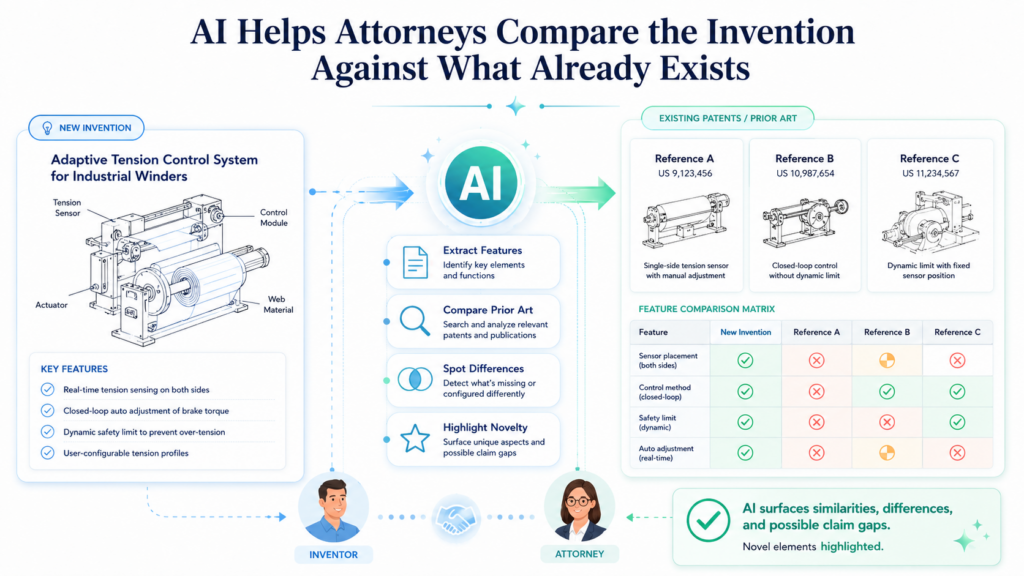
They may compare against direct competitors, but not against older technical methods. They may focus on business value, while the attorney needs to understand the technical change.
AI can help prepare this comparison. It can help the inventor describe the old way, the pain point, the attempted fixes, and the new approach.
It can also help organize known competitor methods, public docs, academic ideas, product pages, and internal notes into a clearer view for attorney review.
This does not replace a formal search or legal analysis. It does not mean AI can promise that an invention is new.
But it can make the early comparison much sharper. It helps the team bring better context to the attorney, which can lead to better questions and better drafting choices.
AI Can Help Define the Old Way More Clearly
Many patent discussions focus too quickly on the new idea. But the old way matters too. To explain why an invention is valuable, the team must often explain what was hard before.
Was the old system too slow? Too costly? Too manual? Too error-prone? Too rigid? Too hard to scale? Too dependent on clean data?
AI can help inventors write a clean version of that old-way story. It can pull from product notes, customer interviews, support tickets, and engineering docs. It can help connect user pain to the technical problem.
For example, a founder may know that manual review took too long. But the deeper issue may be that old systems could not rank cases by real-time risk, could not handle missing fields, and could not update the review order when new events arrived. That deeper framing gives the attorney more to work with.
Strong Difference Stories Make Stronger Drafting Choices
When the attorney understands the old way and the new way, they can draft with more purpose. They can focus on the parts that create the improvement.
They can avoid spending too much space on details that are not central. They can ask whether the invention works in other settings. They can think more clearly about how someone might try to copy around it.
A weak difference story can lead to a weak patent draft. A strong difference story gives the attorney a better path.
AI helps by making the difference story easier to build. It can ask what failed before, what was tried, what changed, and why the result improved. The inventor can confirm the facts. The attorney can shape the strategy.
AI Can Help Organize Search Material Without Replacing Attorney Judgment
Founders often find related material before talking to an attorney.
They may have competitor links, old patents, blog posts, research papers, technical docs, or open-source projects. This material can be useful, but it can also be messy.
AI can help summarize and group this material. It can help show which references seem close and which seem less relevant.
It can help create a simple comparison table for internal use, though the final legal view should come from the attorney.
The main benefit is speed. Instead of dumping twenty links into an email and hoping the attorney can make sense of them, the team can share a cleaner overview.
The attorney can then review the most important material and decide what it means.
AI Should Not Be Treated as a Patentability Judge
This is important. AI can help with early comparison, but it should not be trusted to decide whether an invention can be patented.
Patentability depends on facts, rules, claims, timing, and legal judgment. AI can miss things. It can misunderstand a reference. It can sound certain when it is not.
The better use is simple. Let AI help gather and organize. Let the attorney judge. Let the inventor explain the technical truth.
That balance gives founders a faster and safer path. It helps them avoid the two extremes: filing blindly without context or getting stuck in endless research before taking action.
PowerPatent helps founders move through this process with more clarity. Its software helps organize invention details, while real attorney oversight helps keep the strategy grounded. Learn more here: https://powerpatent.com/how-it-works
AI Helps Make Patent Draft Reviews Easier for Busy Founders
Reviewing a patent draft can feel hard for founders. The document is long. The language may feel unfamiliar. The founder may not know which parts matter most.
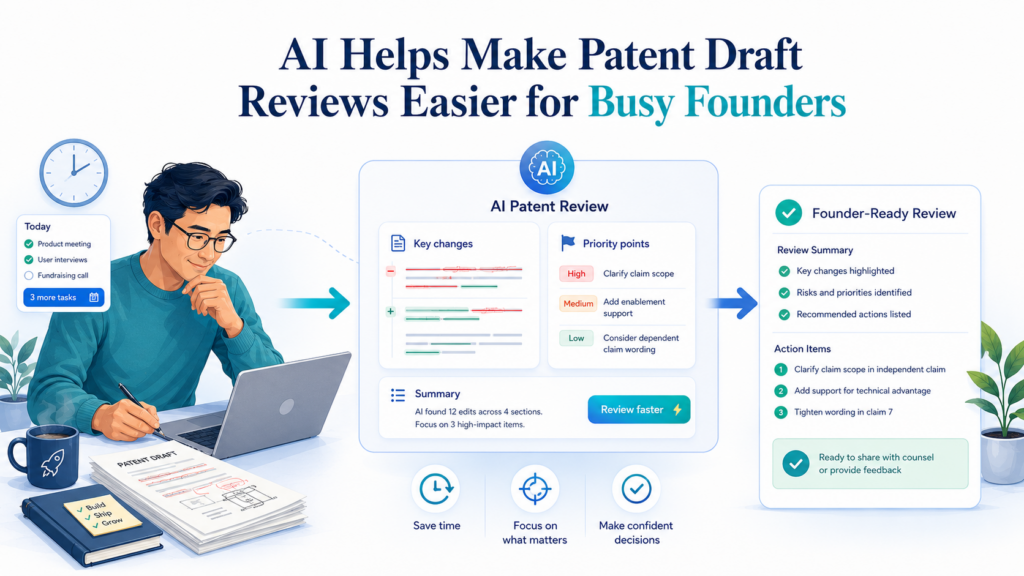
They may worry that they are supposed to catch legal issues, when their real job is to make sure the invention is described correctly.
AI can make draft review easier by helping founders focus on what they know best. It can summarize sections in plain language. It can help compare the draft to the original invention notes.
It can point out where a feature seems unclear or where an example may need more detail. This helps the founder review more confidently.
The attorney still owns the legal quality. The founder owns the technical truth and business fit. AI helps connect those roles.
AI Can Help Founders Read the Draft Without Getting Lost
A patent draft has many parts, and each part has a purpose. But a founder does not need to become an expert in patent structure to give useful feedback. They need to understand the story the draft is telling.
AI can help by creating a plain-language review layer. It can explain what the draft says the invention is. It can summarize the main system.
It can restate the process steps. It can highlight examples. It can show the founder where the draft may not match the product.
This makes review less tiring. Instead of reading the whole document cold and guessing where to comment, the founder can review a guided summary first. Then they can go deeper into the sections where their input matters most.
The Founder’s Review Should Focus on Accuracy, Breadth, and Business Fit
A strong founder review should answer a few practical questions. Does this describe what we built? Does it miss the key part? Does it make the invention sound too narrow?
Does it include examples that support where the product may go next? Does it protect what a competitor would want to copy?
AI can help frame these questions in simple words. It can also help the founder turn rough feedback into clear notes for the attorney.
For example, instead of saying, “This section is wrong,” the founder can explain, “The system does not choose the final action right after the score.
It first checks user context, then compares the result with a policy rule, then sends it to review if confidence is low.” That is much more useful.
AI Helps Reduce Review Cycles
Every draft review cycle takes time. The attorney sends a draft. The founder reads it. Comments come back. The attorney revises.
More questions appear. The process repeats. Some of this is needed. But poor review structure can create extra cycles that do not add value.
AI can help reduce those cycles by making comments clearer the first time. It can group related feedback.
It can separate technical corrections from business concerns. It can help the founder explain whether a change is required, optional, or future-facing.
This helps the attorney revise faster. It also helps avoid confusion. When comments are precise, the next draft is more likely to be right.
Better Review Builds More Trust Between Founder and Attorney
Trust grows when both sides feel understood. Founders want to know the attorney understands the product.
Attorneys want to know the founder is giving clear, accurate input. AI helps support that trust by making the shared record clearer.
The process becomes less emotional and more practical. The founder is not stuck wondering whether the draft protects the right thing.
The attorney is not stuck interpreting vague notes. Both sides can work from a cleaner set of facts.
PowerPatent makes this kind of review process easier because it is built for modern technical teams. It helps founders stay involved without turning patent work into a full-time job. See how it works here: https://powerpatent.com/how-it-works
AI Helps Keep Patent Work Aligned With Business Goals
A patent is not just a document. It is a business tool. For a startup, the goal is not to collect patents for show. The goal is to protect what gives the company an edge.
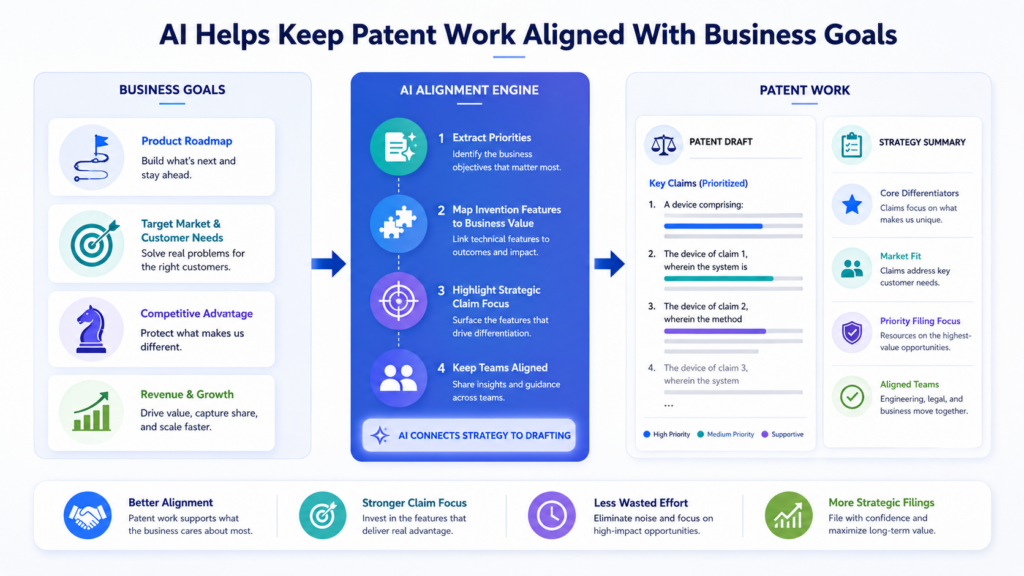
That may mean protecting a core workflow, a model pipeline, a data method, a hardware design, a user experience, or a system that competitors would want to copy.
AI can help keep the patent process connected to these business goals. It can help founders map inventions to products, markets, customers, roadmap items, and investor messages.
It can help show which inventions support the company’s strongest story. This helps the attorney understand not just what was built, but why it matters to the company.
This is important because patent work can become too narrow when it focuses only on the current feature. A startup needs protection that supports where the business is going, not just what the demo shows today.
AI Helps Connect Technical Work to Market Value
Technical teams often solve hard problems that are invisible to the market.
A user may not care about the backend method, but they care about the result. They care that the product is faster, safer, smarter, cheaper, more accurate, or easier to use.
AI can help connect the backend work to the market value. It can take engineering notes and link them to user benefits.
It can help explain why a technical change supports a stronger product promise. It can help founders see which inventions are tied to revenue, retention, trust, speed, or scale.
This makes the patent discussion more strategic. The attorney can better understand which parts are central to the business. The founder can better decide where to invest patent budget.
The Most Valuable Patent Work Protects the Edge, Not the Decoration
Not every feature deserves patent attention. Some features are nice, but easy to change. Some are useful, but not central. Some are visible, but not where the real advantage lives.
The best patent work focuses on the edge. The edge is the part of the product that makes the company hard to copy.
It may be a workflow, a model process, a control system, a data loop, or a method that improves results over time.
AI can help the team find that edge by asking better questions. What would hurt if a competitor copied it?
What took the team a long time to figure out? What makes the product perform better? What will still matter as the product grows?
AI Helps Build a Patent Plan That Matches the Roadmap
A startup roadmap changes, but it still gives clues about what matters. If the company plans to expand into new markets, add new model types, support new users, or automate more of the workflow, the patent plan should take that into account.
AI can help compare invention ideas against the roadmap. It can help show which ideas are tied to near-term launches and which may support long-term value. It can help founders prepare better notes for attorney strategy calls.
The attorney can then help decide which filings should come first, which ideas need more work, and which details should be captured now for later use.
Strategy Means Choosing What Not to File Too
A smart patent plan is not just about saying yes. It is also about saying no or not yet. Some ideas may not be ready.
Some may be too minor. Some may be better kept as trade secrets. Some may not support the company’s core story.
AI can help organize the options, but humans must make the call. The founder understands the business. The attorney understands the patent strategy. Together, they can decide where protection makes sense.
PowerPatent helps founders bring this business context into the patent process without slowing everything down.
Its tools make invention details easier to organize, and attorney oversight helps turn those details into a real strategy. Learn how it works here: https://powerpatent.com/how-it-works
AI Helps Reduce Costly Delays Before Filing
Patent delays often do not come from the writing itself. They come from missing facts, unclear notes, slow reviews, and late decisions. A team may think the attorney has everything needed, only to learn that a key detail is still missing.
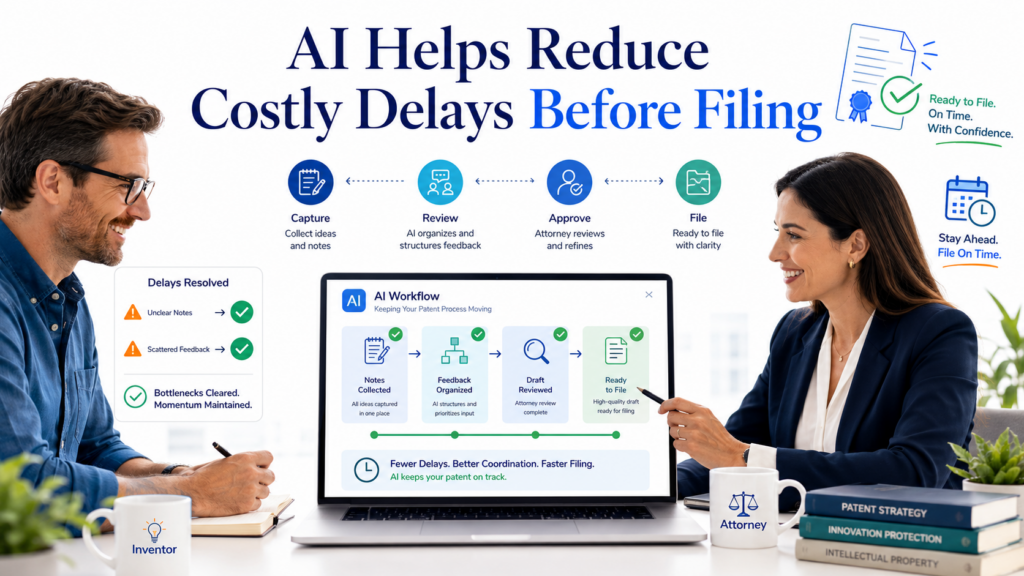
The attorney may send a question, then wait days for an answer. The inventor may respond, but the response may create two more questions. That kind of delay adds up fast.
AI helps reduce these slowdowns by making the early process more complete. It helps inventors gather the right details before the attorney has to ask for them. It helps founders see what is still unclear.
It helps technical teams explain how the invention works in a way that is easier to review. This does not make the process careless. It makes the process better prepared.
For startups, this matters because timing can be tight. A company may be preparing for a launch, investor meeting, demo day, public release, partnership talk, or customer rollout.
Patent work should not become a last-minute scramble. AI helps the team get ahead of the work while the invention is still fresh.
Delays Often Start With Weak Invention Intake
The first step in a patent process is invention intake. This is where the team explains the idea, the problem, the solution, and the technical details. If this step is weak, every later step becomes harder.
A weak intake may say, “We built a new AI tool that makes decisions faster.” That sounds useful, but it does not give the attorney enough to work with.
A stronger intake explains what data enters the system, what steps happen, what is different from the old method, what result improves, and what other versions may exist.
AI helps turn weak intake into stronger intake. It can guide the inventor through clear questions. It can help expand short answers.
It can show where the explanation is too thin. It can help the team add examples before the attorney starts drafting.
A Better Start Makes the Whole Process Smoother
When the first intake is strong, the attorney can move faster with more confidence. The first call is sharper. The draft is less likely to miss the core idea. The inventor’s review is easier because the draft is based on better facts.
This is where founders can save the most time. They should not wait until the end of the process to clean things up.
They should make the front end stronger. AI gives them a practical way to do that without turning patent prep into a huge project.
PowerPatent is built around this kind of smarter intake. It helps founders organize their invention details early, then connects that work with real attorney oversight.
That means less guessing, fewer loose ends, and a faster path toward filing. See how it works here: https://powerpatent.com/how-it-works
AI Helps Catch Filing Blockers Earlier
A filing blocker is anything that stops the team from moving forward. It may be a missing diagram, an unclear system step, an unknown inventor, an open business decision, or a draft section that does not match the product. These blockers are painful when they show up late.
AI can help spot blockers earlier. It can review the invention summary and ask whether certain details are missing.
It can help compare the draft against the source notes. It can flag when a section seems vague or when an example does not explain the full flow.
The attorney still decides what must be fixed before filing. But AI can help make the issue visible sooner, so the team has more time to respond.
The Best Filing Process Feels Boring in a Good Way
A good filing process should not feel like a panic. It should feel clear, steady, and controlled. The team should know what is being protected.
The attorney should have the right details. The founder should understand what decisions are still open.
AI helps make that possible by reducing chaos. It turns scattered material into a cleaner process. It gives the team a better way to move from idea to review to filing.
That kind of calm matters. When patent work feels calm, founders are more likely to do it early and do it well. When it feels painful, they delay it until the last possible moment.
Conclusion
AI helps inventors and attorneys work together faster by removing friction from the parts that slow patent work down most: unclear notes, missing details, long calls, messy drafts, and slow reviews. It helps inventors explain what they built in simple words, gives attorneys better material to review, and helps founders stay in control without losing focus.
But the real power comes when AI works with human skill, not instead of it. Smart software can organize the invention, while real attorneys guide the strategy. That is how PowerPatent helps startups protect important ideas faster, with more confidence. See how it works: https://powerpatent.com/how-it-works
Leave a Reply