
A patent draft is not just a document. It is the story of an invention, written in a way that can protect real business value. Redlining is where that story gets sharper, stronger, and safer. In this guide, we will walk through how inventors and attorneys can review patent drafts with more speed, less confusion, and better results. We will also show how smart tools, clear workflows, and real attorney review can help teams move faster without losing quality. PowerPatent helps founders do exactly that. See how it works here: https://powerpatent.com/how-it-works
Redlining Is Where A Patent Draft Becomes A Strong Business Asset
Patent draft redlining is not just “editing.” It is the careful act of testing every part of the draft before it becomes something the company may depend on for years.
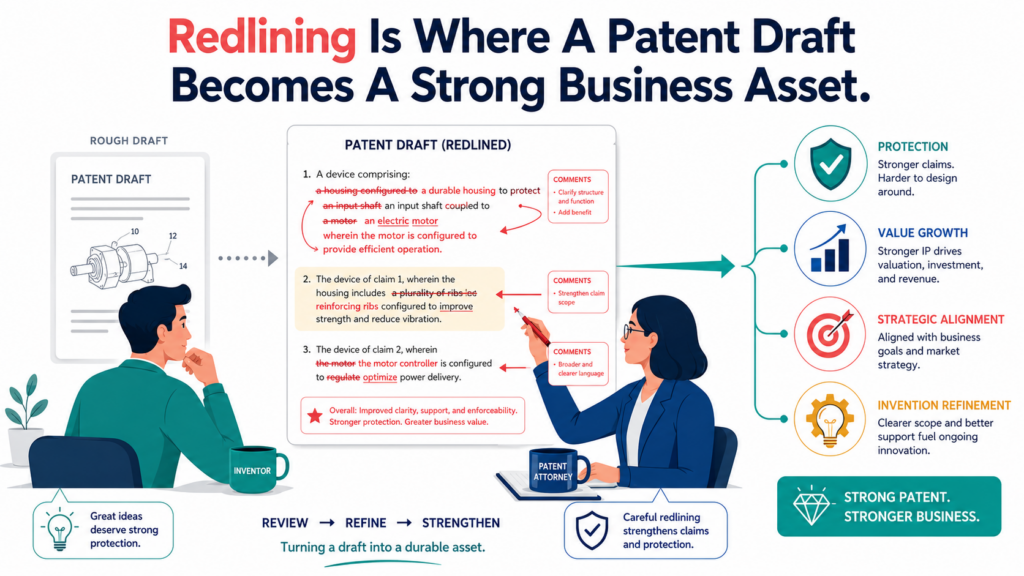
A patent can shape funding talks, deal value, product strategy, and the way competitors think about copying your work. That is why redlining should never be treated like a quick grammar check.
For an inventor, the first draft may feel close to finished because the main idea is already there. But a first draft is only the start. It may explain the invention, but it may not yet protect it in the strongest way.
It may describe one working version, but miss other ways a competitor could build around it. It may use words that make sense inside the company, but not words that will help later during review, licensing, or enforcement.
For an attorney, redlining is the moment to bring legal skill and technical care together. The job is not to overwrite the inventor’s work.
The job is to protect the true invention while keeping the draft honest, clear, and broad enough to matter. Strong redlining should make the patent easier to understand, harder to attack, and more useful for the business.
This is why inventors and attorneys need a shared process. When both sides treat redlining as a team effort, the draft improves fast. The inventor brings the truth of how the system works.
The attorney brings the skill to turn that truth into durable patent language. When those two things meet, the draft becomes stronger than either side could make alone.
If your team wants this kind of guided patent workflow without getting buried in slow back-and-forth emails, PowerPatent helps combine smart software with real attorney oversight.
You can see how the process works here: https://powerpatent.com/how-it-works
Why Redlining Should Start With The Business Goal
Before anyone edits a sentence, the team should ask what this patent is meant to protect. That question sounds simple, but it changes everything.
A patent for a core product feature should be reviewed with a different level of care than a patent for a small improvement.
A patent meant to support fundraising may need a clearer story. A patent meant to block competitors may need more fallback positions and more careful claim support.
Inventors often start with the technical breakthrough. That is natural. They know what was hard to build. They know what finally worked. But a patent draft needs to connect that breakthrough to business value.
The redline review should ask which part of the invention gives the company an edge. Is it faster? Is it cheaper? Is it more accurate? Is it safer? Does it use less compute? Does it make a workflow possible that was not practical before?
These details should shape the redlines. When a draft explains why the invention matters, it becomes easier for readers to see the point. That does not mean adding hype.
Patent drafts should not sound like marketing pages. But they should make the problem and solution clear enough that the value is not buried.
How To Keep The Patent Focused Without Making It Too Narrow
A common mistake in redlining is making the draft too tied to the exact product that exists today. This is risky because products change. Code changes. Models change. Hardware changes.
The first commercial version may not be the best version a year from now. If the patent only protects one narrow setup, it may lose value as the company grows.
Good redlining protects the invention behind the product, not just the product screen or current build.
For example, if the invention is a new way to rank signals, the draft should not only describe one dashboard where the ranked signals appear.
If the invention is a model training method, the draft should not only protect one dataset or one model type unless that limit is truly needed.
The attorney should look for places where the draft says too much in a narrow way. The inventor should help explain which parts are required and which parts are just examples.
This is one of the most important redline conversations. A word that feels harmless can later become a wall.
Why Every Redline Should Have A Reason
Redlines become messy when edits appear without purpose. Inventors may feel like the attorney changed things just to change them.
Attorneys may feel like inventors are rejecting changes without understanding why they matter. The best way to avoid this is to make the reason behind each important redline clear.
Not every small wording change needs a long comment. But major changes should be tied to a goal.
The comment can explain that the edit broadens the claim support, removes a risky limit, matches the figures, fixes unclear language, or adds support for a future version. When the inventor understands the reason, review becomes faster and more useful.
The same rule works in reverse. When an inventor changes language back, they should explain why. Maybe the edited wording is no longer technically true.
Maybe it implies a step that the system does not perform. Maybe it misses a key part of the workflow. These comments help the attorney protect the invention without adding errors.
Inventors Should Redline For Truth, Scope, And Future Value
Inventors do not need to think like attorneys to give great redline feedback. They need to think like builders.

The strongest inventor review is built around three simple questions. Is this true? Is this too narrow? Does this cover where the product may go next?
That review style is powerful because inventors see things attorneys cannot always see from notes, drawings, or interviews. Inventors know which parts were hard. They know which shortcuts failed.
They know which features are just user interface choices and which features are the real engine. They also know where the company may take the invention in the next version.
The worst inventor redline is a surface-level review. That means only fixing typos, changing names, or saying the draft “looks good” without stress testing the substance.
A patent draft may look polished and still miss the most important protection. Inventors should read with care, not fear.
Their job is not to make the draft perfect alone. Their job is to make sure the attorney has the technical truth needed to make the draft strong.
A useful inventor review starts slowly. Read the draft once without editing. Try to understand the story. Then read it again and mark anything that feels wrong, too narrow, too broad in a false way, or missing.
This two-pass method reduces random edits and helps the inventor see the whole draft before reacting to single sentences.
Redline The Draft Against The Real System
The first job is to compare the draft to the real invention. Not the pitch deck version. Not the simple customer demo version. The real working system.
This matters because patents can become weak when they describe things that are not quite true. A draft may say that a server “selects” something when the real system ranks and filters it.
It may say that a model is “trained” during use when the system actually updates thresholds but does not retrain the model. It may describe data as “real time” when the product uses batch updates. These details matter.
Inventors should flag each mismatch clearly. The goal is not to make the draft more complex. The goal is to make it accurate.
A patent can be broad and still be true. But it should not rely on loose words that create confusion later.
When reviewing, inventors should also check the order of steps. Many software and AI inventions depend on the sequence of actions. Data is received, cleaned, transformed, scored, compared, stored, displayed, or used to trigger an action.
If the draft gets the sequence wrong, the claims may not match the invention. If the draft locks the sequence too tightly, it may miss other useful versions.
Confirm What Is Required And What Is Only One Example
This is one of the most valuable things an inventor can do during redlining. For every important feature, ask whether it is required or just one way to build the invention.
For example, the draft may say the system uses a neural network. But maybe the invention works with other models too. If so, the inventor should say that. The draft may say the output appears on a mobile app.
But maybe it could also appear through an API, an admin panel, an alert, or an embedded tool. The draft may say the data comes from a sensor. But maybe it could come from a database, image stream, user input, or third-party feed.
This does not mean every patent should name every possible thing. That can become clutter. But it does mean the attorney should know what is core and what is flexible.
Once the attorney knows that, the redlines can shape the draft so it protects more than one build.
Add Missing Variations Before The Draft Gets Locked
A strong patent draft should not only protect what the startup has built today. It should also support smart future paths. Redlining is the best time to add those paths because the team is already looking closely at the language.
Inventors should ask what the next three product versions may include. Will the model become more automated? Will the tool support more data types?
Will the workflow move from human approval to automatic action? Will the system run on-device instead of in the cloud? Will the invention move from one industry into another?
These future paths should not be random guesses. They should be realistic options the company may actually care about. Adding them can make the patent more useful over time.
It can also give the attorney more room to create fallback language, which may help if the patent office pushes back later.
This is where PowerPatent can help founders move faster. The platform is built to help teams capture invention details, organize technical input, and work with real patent attorneys without losing control of the process.
For founders who want to protect what they are building while still moving fast, this workflow can make patent drafting feel far less painful. Learn more here: https://powerpatent.com/how-it-works
Attorneys Should Redline For Claim Support Before They Redline For Style
A patent draft can sound smooth and still fail at the most important job. The claims must be supported by the rest of the draft. This is where attorney redlining needs to start.
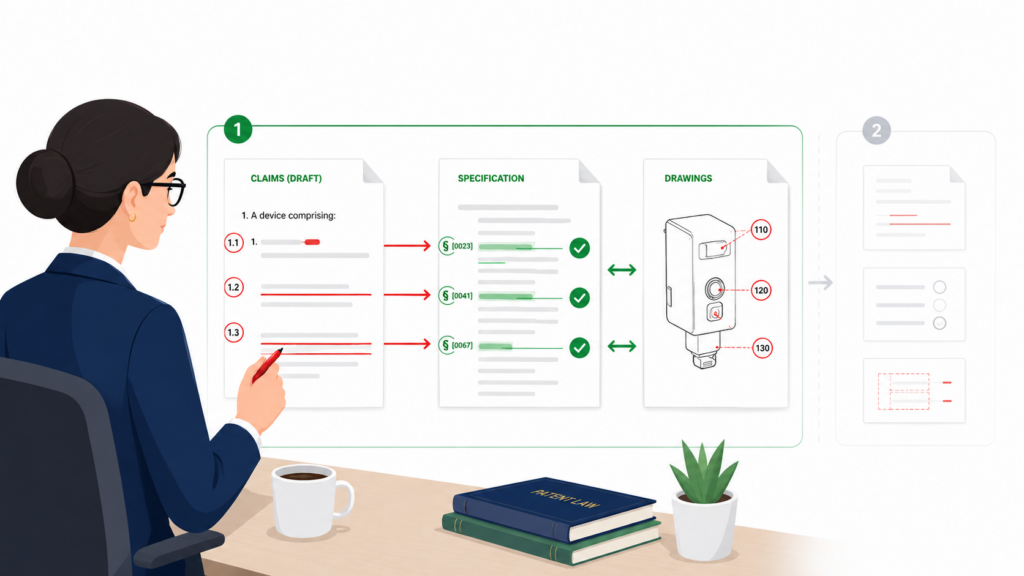
Claims are the fence around the invention. The description is the ground that holds that fence in place. If the claims reach farther than the description supports, the draft can become weak.
If the description is rich but the claims miss the best parts, the patent may protect too little. Redlining should bring both pieces into balance.
This is why attorneys should avoid starting with style edits. Style matters, but it is not the first fight. The first fight is whether the draft gives enough support for the protection the client needs.
Before changing sentence flow or word choice, the attorney should read the claims and ask whether every important claim idea appears clearly in the body of the draft.
This is also where many first drafts need the most care. Inventors often explain the system from the inside out. They describe what they built, what tools they used, and what happens in the product.
But patent claims often need a wider view. They may need to protect methods, systems, computer-readable media, devices, workflows, model behavior, data handling, user actions, and backend actions. A good redline pass checks whether the draft supports those angles.
Build The Draft Around The Claims Without Making It Feel Forced
A strong patent draft should feel connected. The claims, summary, drawings, and detailed description should all tell the same story from different angles. When redlining, the attorney should look for gaps between those parts.
For example, a claim may say the system generates a risk score using a set of weighted signals. The detailed description should not only say “the system generates a risk score.”
It should explain where the signals come from, how they may be weighted, what kinds of rules or models may be used, how the score may change the next action, and what variations may exist.
The point is not to overload the draft with needless detail. The point is to give the claims a strong base.
The attorney should also make sure that the draft supports both broad and narrow versions. A broad claim may protect the big idea. A narrower claim may protect a safer version if the broad claim faces pushback.
During redlining, the attorney should look for support for each layer. This may include alternate data types, alternate processing steps, alternate user devices, alternate model types, alternate outputs, and alternate ways to trigger an action.
Use Redlines To Add Fallback Positions That Actually Matter
Fallback positions are not filler. They are backup paths. If the broadest claim is challenged, a good patent draft should still have useful ground to stand on.
The best fallback positions are tied to real value. They protect parts of the invention that competitors would still care about.
They also reflect how the company may actually build, sell, or improve the product. A fallback that nobody would use is not very helpful.
Attorney redlines should add fallback detail where the draft is too thin. This is often done in the detailed description, not only in the claims.
The attorney may add language that explains optional steps, alternate setups, and different ways the invention can work.
But these additions should be reviewed by the inventor for truth. An attorney should not guess at technical variations without inventor input.
Good fallback drafting is a team sport. The attorney can see where legal support is needed. The inventor can say which variations are real. Together, they can turn a thin draft into one that has layers.
Make Sure The Draft Does Not Accidentally Give Away The Narrowest Version
One of the most common redlining problems is accidental narrowing. This happens when the draft uses words that make one version sound like the only version.
Words like “must,” “always,” “required,” “the invention is,” and “necessary” should be used with great care. Sometimes they are correct. Often they are not.
A startup may currently use one database, one model type, one sensor, one app flow, or one cloud setup. That does not mean the invention needs those exact parts to work.
During redlining, attorneys should check for language that locks the invention to today’s product stack. If the invention can work in more than one way, the draft should say so clearly.
This does not mean using vague language everywhere. It means being careful about which parts are core and which parts are examples.
The attorney should also watch for hidden limits in examples. A sentence may start as an example but read like a rule.
The redline should make the difference clear. Phrases like “in some cases,” “in one example,” and “in certain versions” can help, but they should not be used blindly. The real goal is clear scope, not word padding.
PowerPatent helps founders and attorneys keep this process moving without turning redlines into chaos.
It helps organize the invention story, capture key technical details, and keep attorney review connected to what the team actually built. You can explore the workflow here: https://powerpatent.com/how-it-works
The Best Redlines Make The Invention Harder To Design Around
A patent draft should not only describe what the inventor built. It should make copying harder. That means redlining should focus on design-around risk.
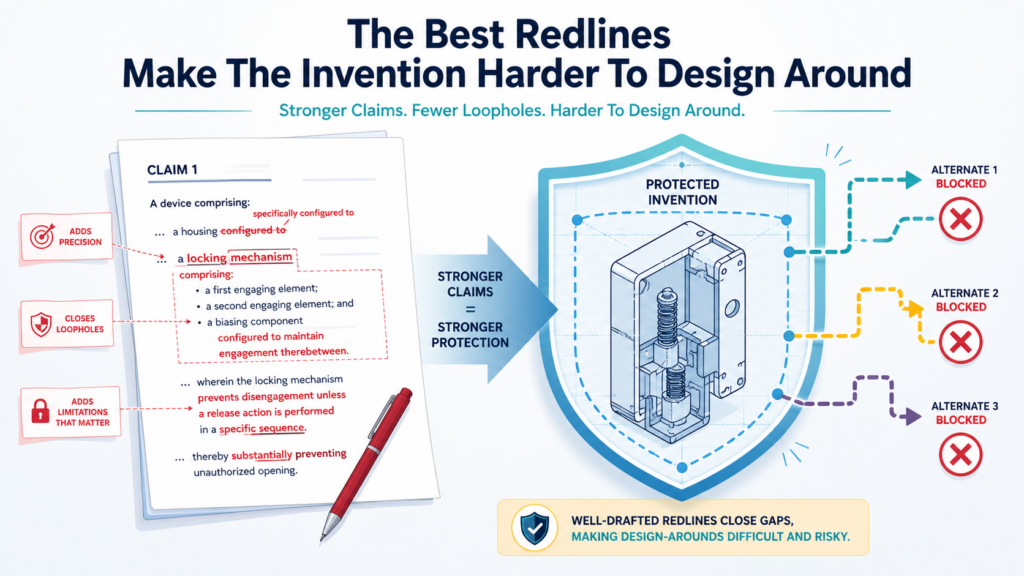
A design-around is when a competitor studies the patent and makes a small change to avoid it. This is not rare. Smart competitors look for narrow words, missing variations, and claim limits that are easy to dodge.
If a patent says the invention requires one specific type of input, output, model, device, or sequence, a competitor may try to change that one thing and keep the same benefit.
Good redlining asks a direct question: if a competitor wanted the same result, how would they avoid this draft?
That question is powerful. It forces the team to think like the market, not just like the builder. The inventor knows which parts are easy to change.
The attorney knows which words may create loopholes. Together, they can close gaps before the patent is filed.
This does not mean trying to claim everything under the sun. Overreaching can create its own problems. The goal is not to be greedy. The goal is to protect the real inventive idea in a way that covers fair variations.
Review Every Key Feature As A Possible Escape Hatch
During redlining, each key feature should be tested. Is this feature truly required? Could someone remove it and still get the same main benefit? Could someone replace it with a known alternative?
Could the order change? Could the work be split between two systems? Could a human perform part of it? Could an external service perform part of it?
These questions often reveal weak spots. A draft may say a mobile device performs a step, but in practice the step could happen on a server.
A draft may say a machine learning model makes a decision, but the value may come from the way data is prepared before the model sees it.
A draft may say the output is a score, but a competitor could use a ranking, label, alert, threshold, or suggested action instead.
The redline should adjust the draft to cover the real range of useful versions. Sometimes this means adding broader language.
Sometimes it means adding examples. Sometimes it means changing the claims. Sometimes it means adding a new figure or a new paragraph that shows an alternate workflow.
Separate The Result From The Exact Tool Used To Get It
Many startup inventions are built with specific tools. Teams use certain models, frameworks, cloud systems, APIs, chips, sensors, or databases. Those choices may be smart, but they may not be the invention.
A redline review should separate the result from the tool. If the inventive value is better fraud detection, faster image review, cleaner data mapping, safer robot control, or smarter resource use, the draft should not become trapped inside the exact tool used in the first build unless that tool is truly the point.
This matters even more for software and AI startups. Tools change fast. A model that feels advanced today may be replaced soon.
A patent that only protects one model name, one architecture, or one vendor service may age badly. The redline should protect the method, flow, data structure, control logic, or system behavior that creates the value.
This does not mean removing all tool details. Details help show that the invention works. They can also support narrower claims.
The key is balance. The draft can include specific examples while making clear that those examples are not the only path.
Ask What A Competitor Would Copy First
The strongest redline work often starts with a plain business question. What would a competitor copy first?
They may not copy the whole product. They may copy the part that makes the product faster, cheaper, easier, or more accurate. They may copy the backend flow and build a different front end.
They may copy the data pipeline and use a different model. They may copy the user workflow and use a different scoring method. They may copy the automation step and plug it into another platform.
Inventors should tell attorneys which pieces carry the most value. Attorneys should then check whether those pieces are protected in the claims and supported in the body.
If the most valuable piece only appears once in a narrow example, the draft needs work.
A good patent draft should make the competitor’s easy path harder. Redlining is the time to do that.
Once the application is filed, there may be less room to add new matter later. That is why the best teams are careful before filing, not after.
Inventor Comments Should Teach, Not Just Correct
Great inventor comments do more than say “wrong” or “fix this.” They teach the attorney what matters. The better the comment, the better the next redline.
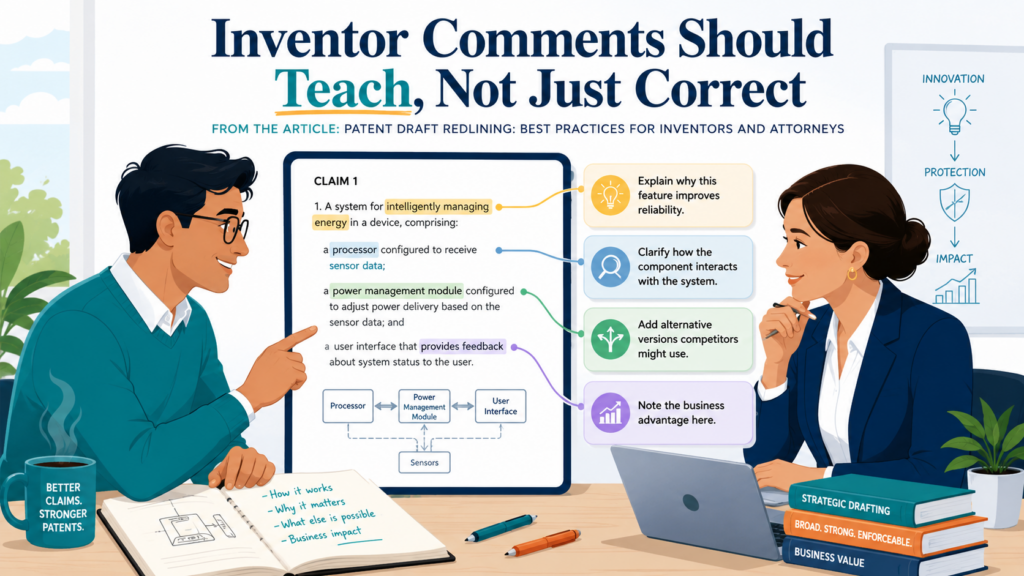
Inventors are often busy, so it is tempting to leave short comments. A comment like “not accurate” may be true, but it does not give the attorney enough to work with.
A better comment explains what is inaccurate, what the real system does, and whether the difference matters for protection.
For example, instead of saying “this is wrong,” the inventor might explain that the system does not train the model after each user action.
It updates a user-specific preference score and then uses that score in the next recommendation. That one comment gives the attorney a clear path. It fixes the fact pattern and may reveal a stronger invention.
Redlining works best when the attorney can see the why behind the correction. This does not require long essays. It requires useful context.
Explain The Real Reason A Change Matters
Some technical corrections are minor. Others are central. The attorney needs to know which is which.
If the draft uses “database” but the system could use any structured store, the inventor should explain that the term may be too narrow.
If the draft says “image” but the system works with video frames, sensor streams, or 3D scans, the inventor should explain that broader input types matter.
If the draft says “manual approval” but the roadmap includes automatic approval, the inventor should flag that future direction.
These comments help the attorney make stronger choices. Without that context, the attorney may fix the sentence but miss the strategy.
Inventors should also speak up when a redline adds a word that changes the technical meaning. Patent language can be careful, but it must still match reality.
If a redline says “classifying” when the system is actually ranking, that difference may matter. If it says “predicting” when the system is detecting, that may matter too. The inventor’s job is to guard the truth of the invention.
Use Comments To Show What Is Core And What Is Optional
The most useful inventor feedback often sounds like this: “This part is required, but this part is just one example.”
That simple idea can change the strength of the draft. Attorneys need to know what cannot be removed without losing the invention. They also need to know what can change while the invention still works.
If the system must normalize data before scoring, say that. If normalization is only helpful but not required, say that too.
If the current product uses three inputs but the method can work with two or more, explain that. If a human review step is only used for enterprise customers and not needed in the core workflow, make that clear.
This helps avoid two bad outcomes. The first bad outcome is a draft that is too narrow because it treats optional parts as required. The second is a draft that is too vague because it fails to explain the real engine. Both can hurt value.
Add Examples From Failed Attempts And Edge Cases
Inventors often leave out the most useful details because they seem messy. Failed attempts, edge cases, and hard tradeoffs can be very helpful in a patent draft.
If the team tried a simple rule-based method and it failed, that may help explain why the invention matters. If the system handles noisy data in a special way, that may be important.
If the method works when data is missing, delayed, conflicting, or low quality, that may be worth adding. If a control system avoids unsafe actions under certain edge cases, that may become a strong fallback position.
These details should not turn the patent into a diary. But they can add depth. They show that the invention solves a real problem, not a made-up one. They also give the attorney more material for claims and support.
A strong comment might say that the key challenge was not just scoring data, but scoring it when the input sources arrive at different times and have different confidence levels. That kind of detail can turn a generic draft into a much stronger one.
PowerPatent is built for this kind of inventor-attorney teamwork. It helps founders capture technical input in a clear way and move from idea to draft without losing the details that make the invention valuable.
You can see how PowerPatent helps teams move faster here: https://powerpatent.com/how-it-works
Attorneys Should Redline With The Patent Office In Mind
A patent draft is written for more than the inventor. It is also written for the patent office. That means attorney redlining should prepare the application for review from the start.
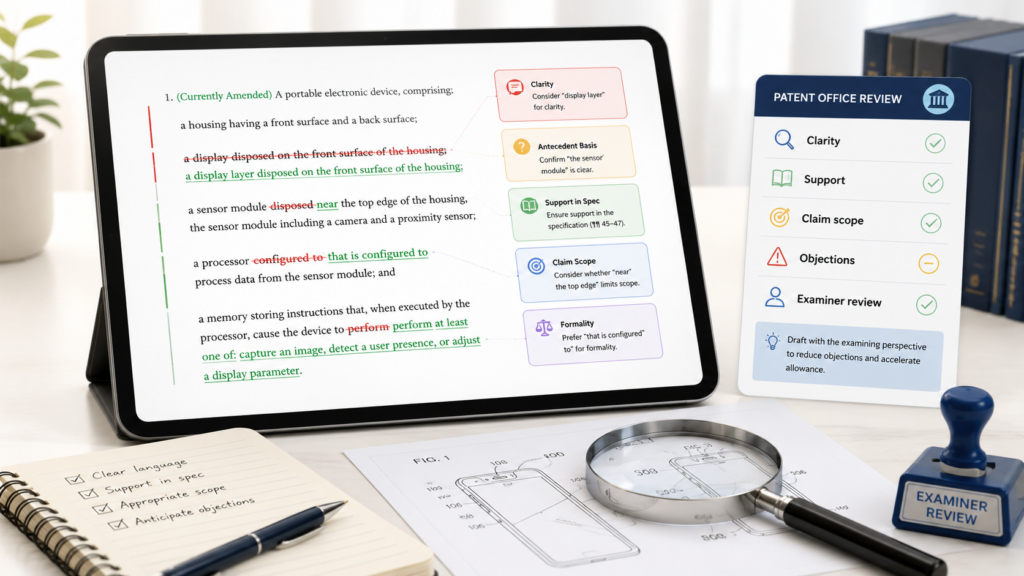
The patent office may question whether the invention is new, whether it is clear, whether it is too abstract, whether the claims are supported, or whether the wording is definite enough.
A good draft cannot remove every risk, but it can reduce avoidable problems. Redlining is the moment to do that.
This is especially important for software, AI, automation, medical tech, robotics, fintech, and data-heavy inventions. These areas often need careful drafting because the value may sit in logic, workflows, model behavior, or system coordination.
If the draft reads like a broad business idea with no technical detail, it may face trouble. If it explains how the system improves a technical process or solves a technical problem, it is usually in a better position.
Attorneys should redline with likely objections in mind. They should ask what an examiner may misunderstand.
They should look for vague words, unsupported claims, thin technical sections, missing examples, and unclear links between steps.
Make The Technical Improvement Easy To See
A strong draft should make the improvement clear. The improvement should not be hidden in a long paragraph or buried under product language.
If the invention reduces latency, improves model accuracy, saves memory, lowers compute cost, improves safety, reduces false positives, preserves privacy, improves device control, or handles messy data better, the draft should say that in a grounded way. It should connect the improvement to the technical steps that create it.
This matters because a patent application should not sound like it only claims a desired result. It should explain how the result is achieved. Redlining should turn vague results into clear mechanisms.
For example, “the system improves recommendations” is weak by itself. A better draft explains that the system creates a user-specific signal set, weights the signals based on recent context, filters low-confidence inputs, and updates the ranking before the next output is shown.
That gives shape to the invention.
Avoid Result-Only Language That Sounds Too Thin
Many weak drafts use result-only language. They say the system “optimizes,” “improves,” “detects,” “predicts,” or “automates” without explaining how. These words are not bad by themselves, but they need support.
Attorney redlines should push the draft toward action. What data is received? What is changed? What is compared?
What rule, model, score, threshold, map, or control step is used? What output is produced? What happens because of that output?
The draft does not need to reveal secret source code. It also does not need to explain every implementation detail. But it should provide enough technical substance to show that the inventor has more than a goal.
This is where careful attorney questions help. If a paragraph says the system “selects the best route,” the attorney should ask how the route is selected.
Is it based on cost, risk, delay, battery level, load, weather, user priority, sensor confidence, or some weighted mix? The answer may become valuable patent support.
Redline For Clarity Before The Examiner Has To Guess
Patent examiners are busy. If they have to guess what a term means, the draft may suffer.
Clear language helps the examiner understand the invention faster. It also helps the attorney respond later if the office raises issues.
This does not mean making the draft childish. It means avoiding needless fog. Terms should be used consistently. If the draft uses “score,” “rank,” “confidence value,” and “priority value,” the attorney should check whether those terms mean different things or whether the draft is mixing words randomly.
If they are different, the draft should explain the difference. If they are the same, the draft should use one term or make the relationship clear.
The redline should also fix unclear references. If “the module” appears before the module is introduced, that needs repair.
If “the data” could mean three different inputs, the sentence should be tightened. If a step says “based on the above,” the draft should name what the step is based on.
A clean draft is not just easier to read. It is easier to defend.
Redlining Should Protect The Invention Without Overloading The Draft
A strong patent draft needs depth, but it should not become a junk drawer. More words do not always mean more protection.
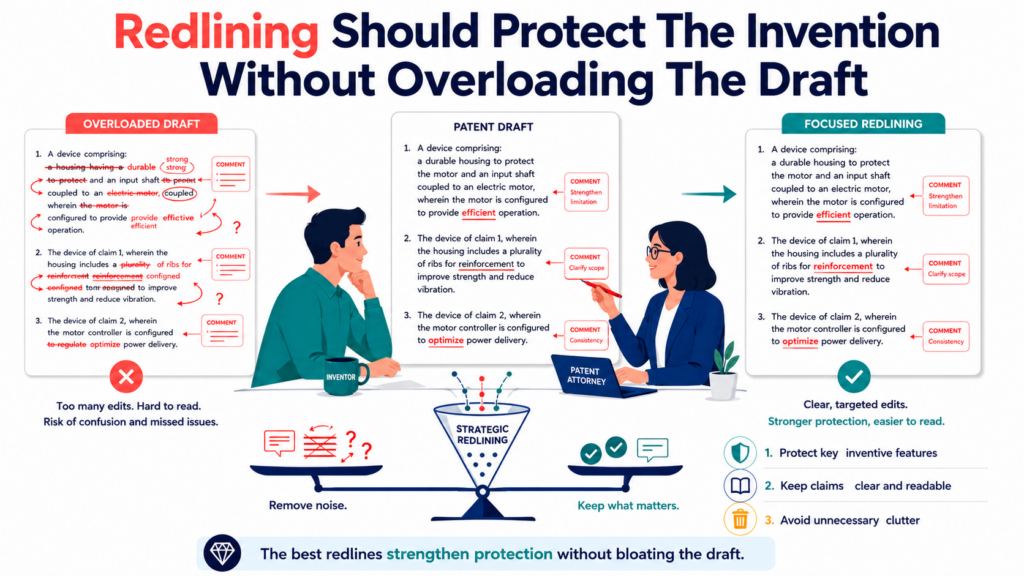
In fact, too much unfocused language can make the draft harder to read and harder to manage.
The goal of redlining is not to add every possible detail. The goal is to add the right detail. The draft should include enough support to protect the invention, enough examples to show useful variations, and enough structure to make the claims clear.
It should not bury the main idea under random features, loose ideas, or product notes that do not help.
This is where both inventors and attorneys need discipline. Inventors may want to add everything because every part feels important.
Attorneys may want to add broad language to preserve options. Both instincts can be good, but they need control. A patent draft should be rich, not bloated.
Keep The Main Invention Visible From Start To Finish
A reader should be able to understand the main invention without getting lost. The background should explain the problem. The summary should point to the solution.
The figures should support the flow. The detailed description should show how the invention works. The claims should protect the heart of it.
During redlining, the attorney should check whether the draft still has a clear center. If new paragraphs are added, they should connect back to the main invention.
If new examples are added, they should support claim strategy. If new terms are introduced, they should be needed.
Inventors can help by marking which parts matter most. If a feature is only a product setting or customer preference, it may not deserve much space. If a feature is part of the core technical advantage, it may need more support.
Remove Noise That Creates Risk Without Adding Value
Some details do not help. They may even hurt.
Brand names, vendor names, internal code names, temporary product labels, customer-specific workflows, and outdated architecture choices can create confusion.
Sometimes they also make the draft feel narrower than it should be. During redlining, these should be checked carefully.
There may be times when a specific technical component matters. But many times, the exact commercial tool is just one example.
The attorney should avoid locking the invention to a vendor or product name unless there is a clear reason. The inventor should flag anything that is temporary, private, or not central.
Noise can also come from marketing language. Patent drafts should not say the invention is “revolutionary,” “world-class,” or “game-changing.” That language does not help.
It can make the draft feel less serious. Strong drafting shows value through clear technical facts, not hype.
Add Detail Where It Gives The Claims More Room
The best detail is useful detail. It gives the attorney room to claim the invention in strong ways. It supports fallbacks. It explains alternatives. It makes the technical improvement easier to understand.
For example, if the invention uses a score, useful detail may explain how the score can be generated, updated, weighted, compared, stored, or used to trigger an action.
If the invention uses a model, useful detail may explain what inputs may be used, how outputs may be applied, how confidence may be handled, or how the model may interact with rules.
If the invention controls a device, useful detail may explain feedback loops, safety limits, sensor inputs, or timing.
This kind of detail does not feel like fluff because it has a job. It supports protection.
PowerPatent helps teams avoid the two common extremes: thin drafts that miss value and bloated drafts that slow everyone down.
Its software-guided workflow helps capture the right invention details while real patent attorneys review the work for quality and strategy. Learn how it works here: https://powerpatent.com/how-it-works
Redlining Should Make The Claims Match The Real Invention Story
The claims are the most important part of the patent draft, but they should not feel disconnected from the rest of the application.
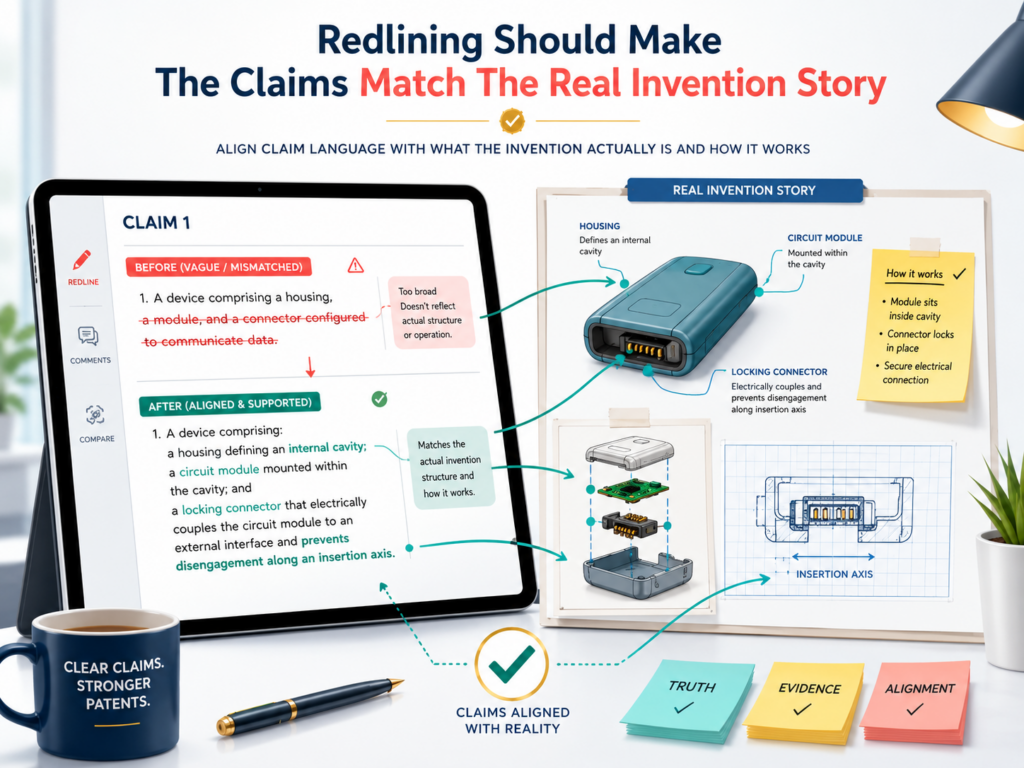
A strong claim set should grow out of the invention story. It should not feel pasted on at the end.
When redlining a patent draft, both the inventor and the attorney should read the claims with one question in mind: do these claims protect the reason this invention matters?
That question keeps the review focused. A claim may be technically correct but still weak for the business. It may cover a small part of the product while missing the real breakthrough.
It may use words that are too narrow. It may depend on a feature that is easy for a competitor to avoid. It may protect the visible user interface while leaving the backend method open.
A good claim redline checks the match between the claim language and the invention’s true value. This is not only a legal task. Inventors should read the claims, even if the language feels strange at first.
They should not worry about making them perfect. They should look for missing parts, wrong limits, and wording that does not reflect the system.
Read Each Claim Like A Competitor Would
Inventors often read claims like builders. They ask whether the words describe what they made. Attorneys often read claims like legal tools.
They ask whether the words are clear, supported, and defensible. Both views matter, but there is a third view that is just as important: read the claims like a competitor.
A competitor will not ask whether the claim gives credit for the work. A competitor will ask how to avoid it. They will look for required steps they can skip. They will look for specific terms they can replace.
They will look for a narrow order of actions. They will look for language tied to one device, one database, one model, one screen, or one user action.
During redlining, the attorney should mark these weak spots. The inventor should explain whether each part is truly needed.
If the claim says a mobile app receives the output, but the invention works through an API, dashboard, or automated trigger, that may need a change.
If the claim requires a neural network, but the value comes from the data transformation before scoring, that may need a broader framing.
Make The Independent Claims Broad But Not Hollow
Independent claims are the big claims. They stand on their own. They should protect the core invention in a way that is broad enough to matter, but not so broad that they sound empty.
A hollow claim tries to own a result without enough structure. It may say the system receives data, analyzes it, and produces a result. That may be too thin, especially for software and AI inventions.
The redline should add the real technical shape. It should show what kind of data is used, what is done to it, what decision or transformation takes place, and how the output changes something useful.
At the same time, the claim should not include every product detail. If an independent claim includes too many small parts, it may become easy to avoid. A competitor may only need to remove one required feature to step outside the claim.
That is why redlining independent claims takes care. The attorney must find the smallest set of parts that still captures the invention. The inventor must confirm that those parts are real and central.
Use Dependent Claims To Capture Valuable Details
Dependent claims add narrower details. They are not throwaway lines. They are where a patent can protect important variations, backup positions, and commercial features.
During redlining, dependent claims should be reviewed for business value. Each one should earn its place. A dependent claim that adds a random feature may not help much.
A dependent claim that covers a real competitor path, a key technical advantage, or a future roadmap feature may be very useful.
Inventors should tell the attorney which dependent claim details matter most. For example, a detail about reducing false positives may matter more than a detail about where a button appears.
A detail about processing data locally for privacy may matter more than a detail about a specific dashboard layout. A detail about adaptive thresholds may matter more than a detail about sending an email alert.
This is why claim redlining should not be rushed. Once the claims are filed, they shape the fight. They also shape the value story behind the patent.
If your team wants a faster way to move from invention details to attorney-reviewed patent work, PowerPatent gives founders a clearer path. You can explore it here: https://powerpatent.com/how-it-works
Redlining The Drawings Means Checking The Logic, Not Just The Labels
Patent drawings are not decoration. They help explain the invention. They can support the claims.
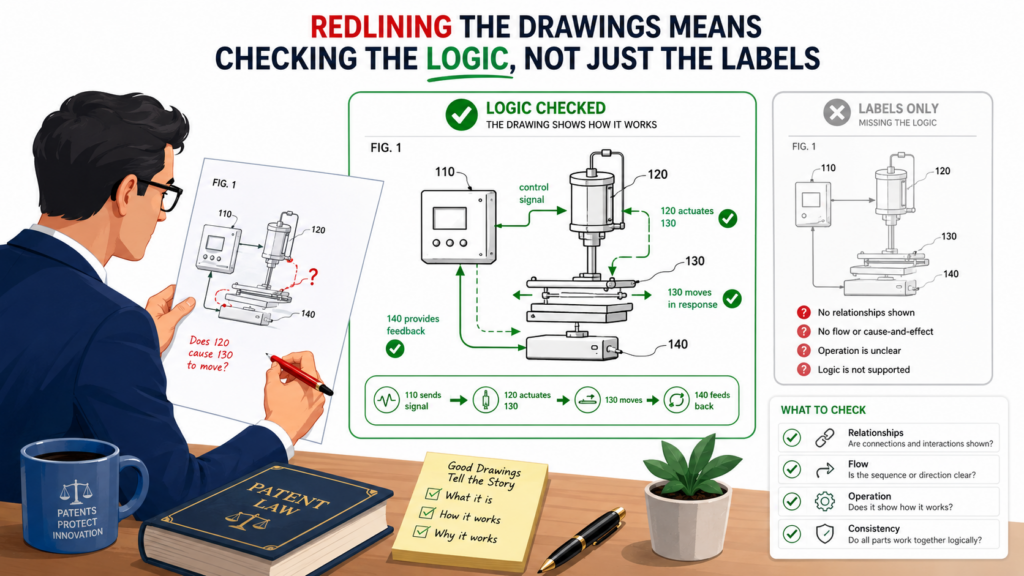
They can make a complex system easier to understand. Redlining the drawings should be treated as a serious part of the draft review, not a side task.
Many inventors look at the figures quickly and focus on whether the labels are spelled correctly. That is not enough. The better question is whether the drawings show the invention in a way that supports the protection the company wants.
A figure can be clean and still miss the key workflow. A diagram can look professional and still show the wrong relationship between parts.
Attorneys should redline drawings with the same care they bring to the claims. If the claims describe a sequence, the figures should help show that sequence. If the invention has different system parts, the figures should show how they connect.
If the draft depends on data flow, the figures should make that flow clear. If there are alternate versions, the figures should not make one version look like the only possible build.
Check Whether The Figures Show The Actual Invention
The first drawing review should be practical. Does the figure match the system? Are the right parts shown? Are the arrows going in the right direction? Are steps missing?
Does the diagram show a user action when the real system acts automatically? Does it show cloud processing when the roadmap includes edge processing? Does it show one input source when the invention can handle many?
These checks may sound basic, but they matter. A figure can quietly narrow how people understand the invention.
If every drawing shows one exact setup, and the text does not explain alternatives, the draft may feel smaller than it should. That does not mean every figure must show every variation. It means the drawing set should support the full story.
Inventors should also check whether the drawings show internal details that should not be central.
Sometimes a diagram includes product architecture that was only used for a first build. If that architecture is not the invention, it may need to be framed as an example or simplified.
Use Flowcharts To Reveal Missing Steps
Flowcharts are especially useful for redlining software, AI, data, and automation inventions. A flowchart forces the team to explain what happens first, what happens next, and what changes because of the invention.
During redlining, inventors should compare each flowchart step to the actual workflow. If a step is too vague, the attorney may need more detail.
If a step is too narrow, the inventor should say what other versions are possible. If a step is missing, it should be added before filing.
A flowchart can also reveal claim gaps. If the flowchart shows data being filtered before scoring, but the claims skip filtering, that may be a missed chance.
If the claims require a feedback update, but the flowchart does not show feedback, the body may need better support. The figure, claims, and text should work together.
Make Sure Reference Numbers Do Not Create Confusion
Reference numbers help connect the drawings to the written description. But they can create problems when they are used carelessly.
During redlining, the attorney should check that each reference number points to the right thing and is used in a steady way. The same number should not refer to two different parts.
The same part should not be given different numbers unless there is a reason. If the text says “ranking engine 120,” the figure should clearly show ranking engine 120.
If the drawing shows “confidence score 145,” the description should explain what confidence score 145 means.
Inventors do not need to become drawing experts, but they should flag anything confusing. If they cannot tell what a figure means, a future reader may have the same problem. Clear drawings save time later.
Redlining The Background Should Be Careful, Plain, And Strategic
The background section may seem simple, but it deserves care. It sets the stage for the invention. It explains the problem.
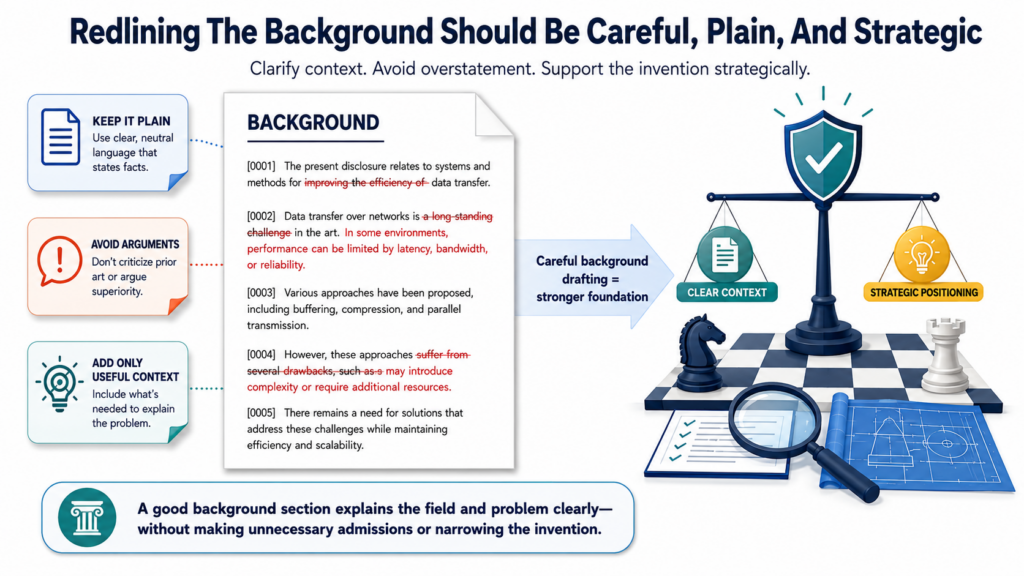
It helps the reader understand why the invention was needed. But if it is written poorly, it can create risk.
A weak background can say too much, admit too much, or frame the invention too narrowly. It can accidentally make prior systems sound more complete than they were.
It can use harsh language that is not needed. It can focus on a problem that is not the real reason the invention matters.
Redlining the background should be done with a light but sharp touch. The goal is to explain the problem without giving away more than needed. The background should not become a long history lesson.
It should not attack other systems. It should not make broad claims that may be hard to support. It should simply show the reader the gap that the invention addresses.
Do Not Turn The Background Into A Confession
Inventors sometimes want to explain everything that came before.
They may write that existing systems already did many things, then say their invention improves one small piece. That may be true in a general sense, but the wording matters.
The background should not overstate what others could do. If it says existing tools already performed a function, that statement may later be used against the application.
Attorneys should redline broad admissions with care. If a point does not need to be said, it may be better to remove it or phrase it more generally.
For example, instead of saying “current systems already identify all relevant risk factors but are slow,” the draft might say that some systems may rely on limited or delayed inputs, which can make timely risk handling difficult.
That type of wording leaves room. It points to the problem without giving too much away.
Keep The Problem Real And Tied To The Invention
The background should describe a real problem, not a fake one. But it should also be tied to what the invention actually solves.
If the invention improves model performance under noisy data, the background should not spend most of its time talking about user interface friction.
If the invention improves robot path planning, the background should not focus only on cloud storage. If the invention reduces compute use, the background should make that pain clear.
This helps the whole draft feel stronger. The reader sees the problem. Then the summary and detailed description show the solution.
Then the claims protect the solution. That flow is persuasive because it is easy to follow.
Avoid Hype And Keep The Tone Measured
The background is not a sales page. Words like “broken,” “terrible,” “revolutionary,” or “impossible” usually do not belong there. They may sound exciting, but they can make the draft weaker.
A measured tone works better. It shows the problem without drama. It explains limits without exaggeration. It keeps the focus on the technical need.
Attorneys should redline marketing language out of the background. Inventors should not worry that this makes the invention less impressive. Clear facts are more persuasive than big claims.
PowerPatent helps founders turn rough invention notes into a cleaner patent story with attorney review built into the process.
That can make it easier to avoid common drafting mistakes before they become expensive. See how PowerPatent helps here: https://powerpatent.com/how-it-works
Redlining The Summary Should Create A Clear Bridge To The Claims
The summary section has a simple job. It should introduce the invention in a way that connects to the claims and prepares the reader for the detailed description. It should not be a copy of the background.
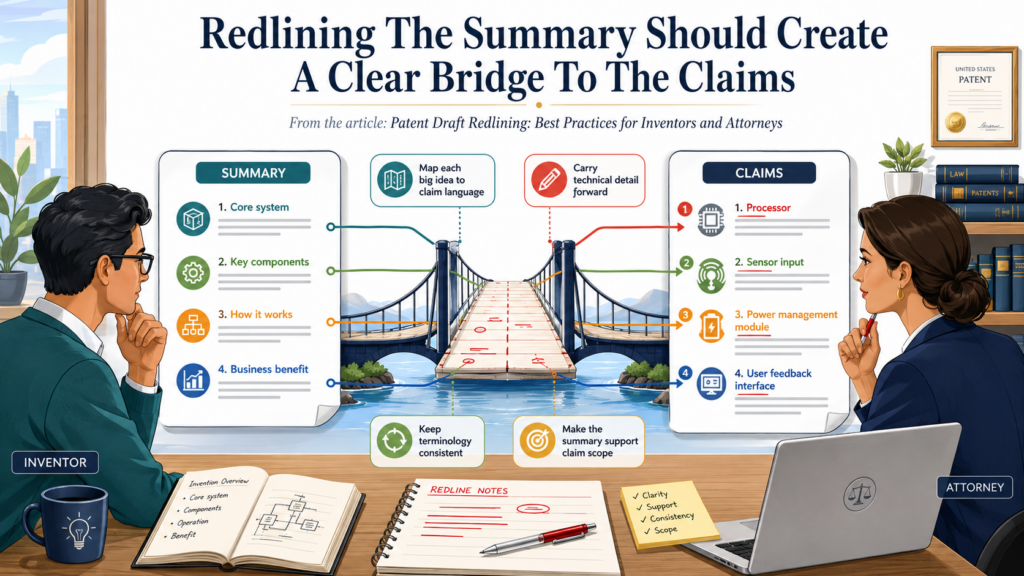
It should not be a marketing pitch. It should not introduce ideas that are never supported later.
A good summary gives the reader a clean view of the invention. It often tracks the claims, but it should not feel stiff or confusing.
During redlining, attorneys should make sure the summary supports the claim strategy. Inventors should check that it does not distort the technical idea.
The summary matters because it is one of the first places people look to understand the invention.
If it is too narrow, the invention may look small. If it is too broad, it may feel unsupported. If it is unclear, the rest of the draft starts with confusion.
Align The Summary With The Independent Claims
The summary should match the core claim ideas. If the independent claims focus on generating a control signal based on filtered sensor data, the summary should not only talk about displaying sensor data to a user.
If the claims focus on a privacy-preserving data process, the summary should not frame the invention mainly as a dashboard.
This kind of mismatch is common when drafts evolve. The claims may change, but the summary may not get updated.
Or the summary may be written first, before the best claim strategy is clear. Redlining should bring them back into sync.
The attorney should compare the summary against each independent claim and ask whether the same invention is being described.
The words do not need to be identical. In fact, exact repetition can make the draft clunky. But the core ideas should match.
Keep The Summary Broad Enough To Support Growth
A startup patent should not be trapped inside the first product version unless that is the only invention. The summary should give room for future versions.
If the invention can be used across different devices, industries, data types, or system setups, the summary may need to reflect that. It should not only describe the current customer use case.
For example, a system first built for healthcare scheduling may include a broader resource allocation method.
A tool first built for warehouse robotics may include a broader path-planning process. A platform first built for finance may include a broader anomaly detection method.
Inventors should tell attorneys when the invention has wider use. Attorneys should then decide how to reflect that in a careful way. The summary can help set that wider frame.
Do Not Add Promises The Draft Cannot Support
The summary should not promise results the draft does not explain. If it says the invention improves accuracy, the detailed description should explain how.
If it says the system reduces compute use, the draft should support that with a clear mechanism. If it says the method improves safety, the body should show what safety step or control logic causes that improvement.
This is not about proving the invention with lab data in every case. It is about keeping the draft honest and grounded. Redlining should remove vague promises or replace them with clear technical statements.
A strong summary makes the invention easy to grasp. It does not try to impress with buzzwords. It earns trust by being clear.
Redlining The Detailed Description Should Strengthen The Invention From The Inside
The detailed description is where the invention gets its depth. It explains how the system, method, device, or process works.
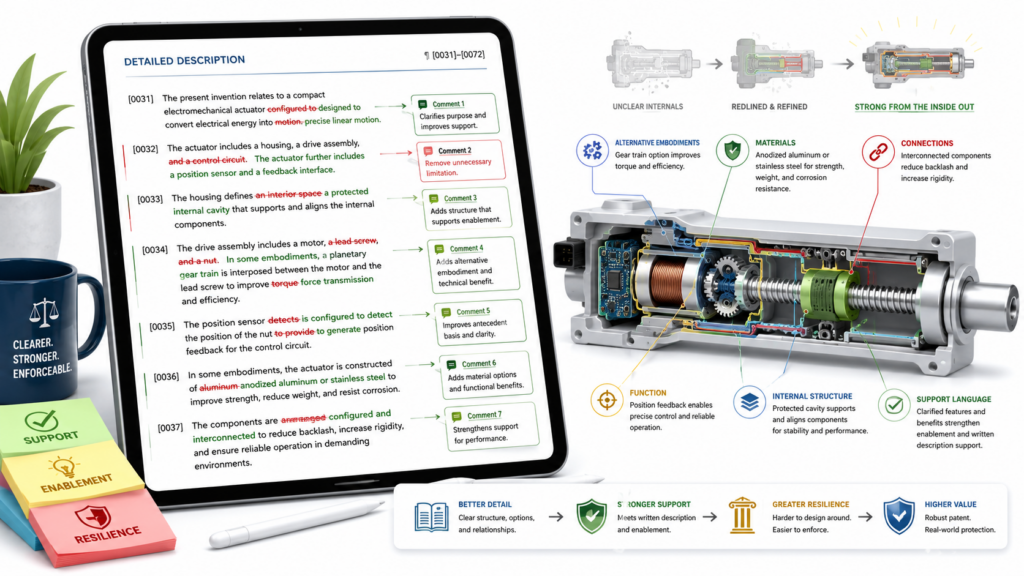
It gives examples. It supports the claims. It helps future readers understand what the inventor actually contributed.
This is often the longest part of the patent draft, so redlining can feel heavy. But it is also where some of the most valuable improvements happen.
A thin detailed description can leave claims unsupported. A confusing one can make the invention harder to defend. A narrow one can limit the patent’s value.
The best redline review of the detailed description is not just a search for typos. It is a full stress test of the invention.
Every major paragraph should have a purpose. It should explain a part of the invention, support a claim, show a variation, define a term, or connect a figure to the story.
Make Each Example Do Real Work
Examples are useful when they add support. They are weak when they only add length.
During redlining, the attorney should check whether each example helps the claim strategy. Does it show a different input? A different output? A different device? A different order of steps?
A different way to process data? A different way to trigger action? If yes, it may be worth keeping or expanding. If no, it may need to be cut or rewritten.
Inventors should review examples for truth. If an example describes a version that would not work, say so. If it describes a version that could work with small changes, explain those changes. If it misses a better example, suggest one.
Tie The Description Closely To The Figures
The detailed description should walk through the figures in a clear way. If the figure shows a system, the text should explain the system.
If the figure shows a flow, the text should explain the flow. If the figure shows an alternate version, the text should make that clear.
Redlining should fix gaps between figures and text. If a figure includes a component that is never described, the description should be updated.
If the text describes a component that does not appear anywhere, the attorney should decide whether a figure is needed or whether the text is enough.
This connection makes the draft easier to read. It also helps support the claims because the invention is explained from more than one angle.
Watch For Terms That Drift Over Time
Long drafts often develop term drift. A concept may be called one thing in the first section, another thing in the figures, and a third thing in the claims. This creates confusion.
Attorney redlines should make terms steady. If the invention uses a “confidence score,” do not randomly call it a “trust score,” “certainty value,” and “quality marker” unless those are different things.
If they are different, explain the difference. If they are not, choose one term and use it with care.
Inventors should help confirm technical meaning. Sometimes two words sound similar to an attorney but mean different things in the product.
Sometimes two words sound different but can be safely treated as examples of a broader term. That is why redlining should stay collaborative.
PowerPatent makes this kind of detailed review easier by helping teams capture invention details in a structured way, then move through attorney-backed drafting with more clarity.
For startup teams that want speed without sloppy patents, that mix matters. Learn how it works here: https://powerpatent.com/how-it-works
Conclusion
Patent draft redlining is where a good idea becomes a stronger patent asset. Inventors should check truth, missing details, future versions, and weak spots competitors could use. Attorneys should check claim support, clear wording, fallback paths, drawings, and patent office risk. The best redlines are not random edits.
They are smart choices that make the draft clearer, broader where it should be broad, and precise where it must be precise. When inventors and attorneys work together with the right process, patents move faster and protect more. PowerPatent helps make that easier. See how it works here: https://powerpatent.com/how-it-works
Leave a Reply