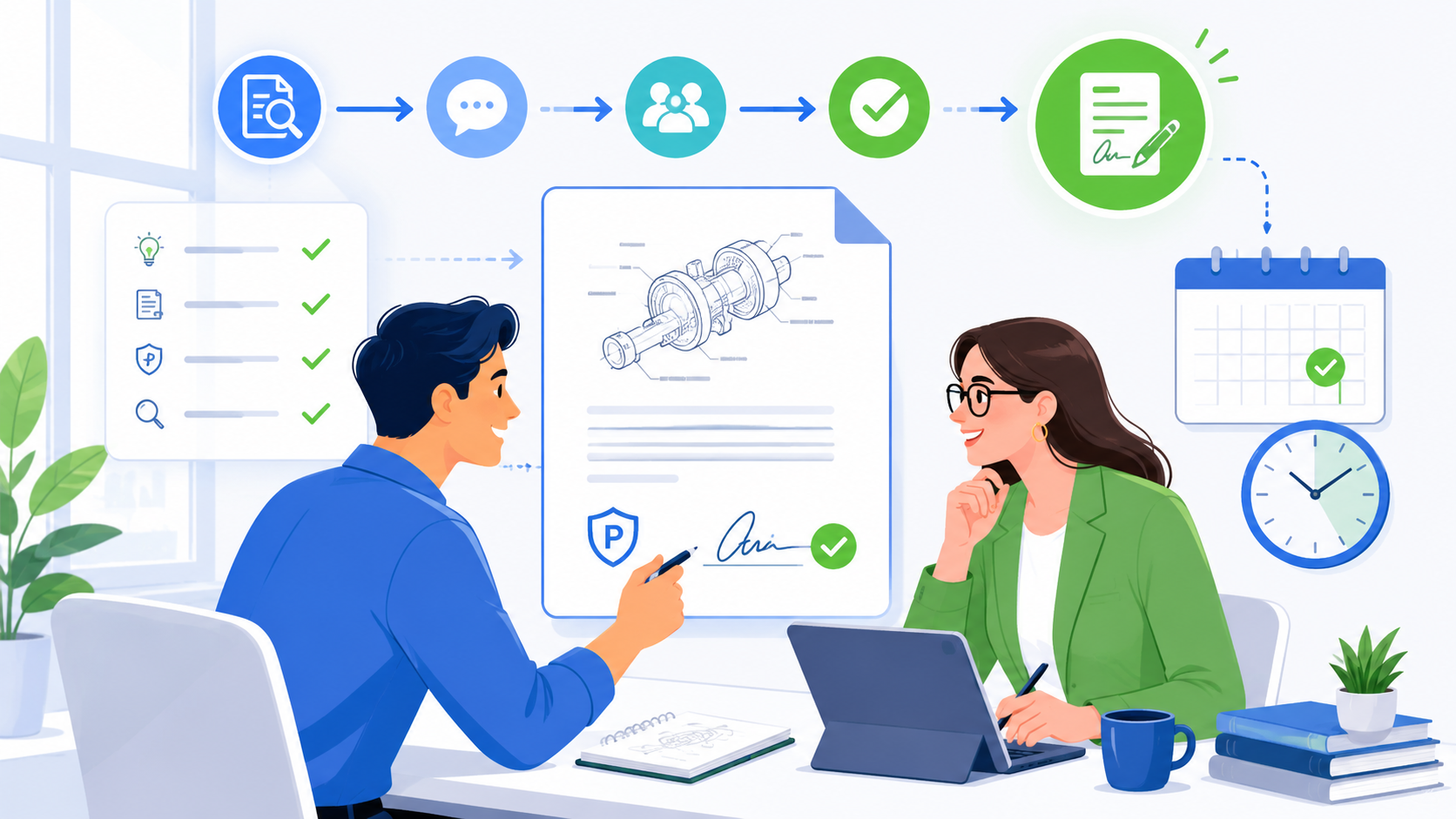
Last-minute patent filing delays almost never come from the invention itself. PowerPatent helps teams do this with smart software and real attorney oversight, so founders can file with more control and less stress. Learn how it works here: https://powerpatent.com/how-it-works
Why Inventor Sign-Off Becomes A Filing Bottleneck
Inventor sign-off sounds simple from the outside. The patent draft is ready, the inventors review it, they approve it, and the filing moves ahead. But in real startup life, this step can become one of the biggest sources of delay.
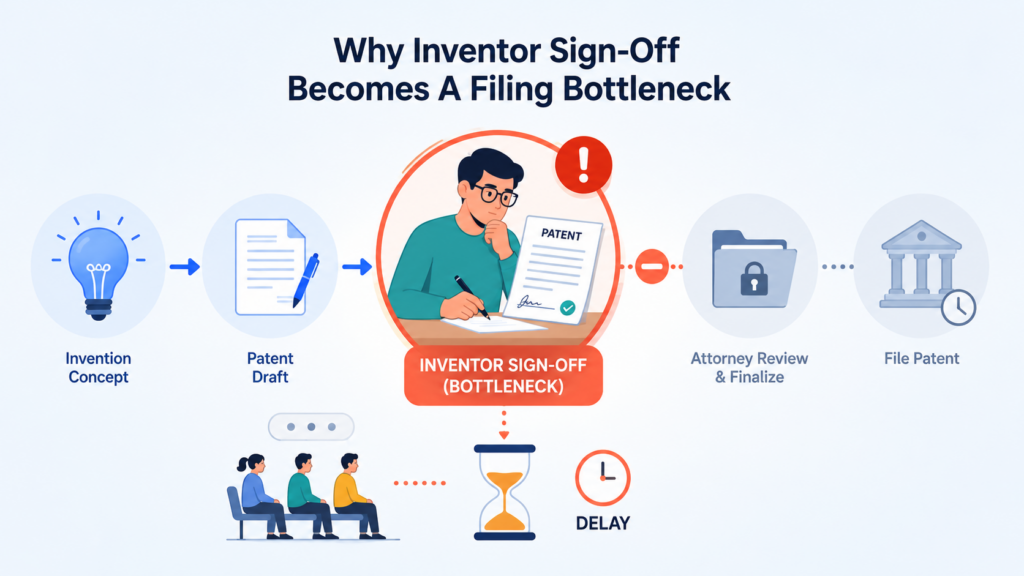
The reason is simple. Inventors are busy building, selling, hiring, testing, fixing bugs, speaking with customers, and trying to keep the company alive. Patent review often lands on their desk at the exact moment they have the least room to think.
That is why the sign-off step should never be treated as a casual “please review when you can” task. It needs structure. It needs a clear owner. It needs a clean path from draft to approval.
When this does not exist, everyone waits. The attorney waits for inventor comments. The founder waits for the attorney.
The operations team waits for signatures. The deadline keeps moving closer. What should be a calm final step turns into a rush.
A patent filing is not just a document task. It is a business protection task. If your company has a public launch, investor meeting, demo day, customer pilot, conference talk, paper release, app release, GitHub push, or sales pitch coming up, filing timing matters.
A late sign-off can create real risk because the company may expose the invention before the patent team is ready.
This is why founders should treat inventor sign-off like a product release gate. You would not ship production code without knowing who approved it, what was checked, and what changed at the end.
The same thinking should apply to patents. A patent draft protects the technical edge of the business. It should move through a review path that is clear, fast, and controlled.
The Real Problem Is Usually Not The Review
Many teams think the delay happens because inventors take too long to read the draft. That can happen, but it is not the deeper issue.
The deeper issue is that inventors are often asked to review the wrong thing at the wrong time with unclear instructions.
An engineer may receive a long patent draft and not know what kind of feedback matters. They may try to rewrite every sentence. They may focus on grammar. They may get stuck on claim wording.
They may worry that one example is missing. They may ask whether the patent should cover a future version that is not built yet. None of these questions are bad, but without guidance, the review can spiral.
A better workflow tells inventors exactly what to check. They should confirm that the technical idea is described correctly, that the examples make sense, that no key version is missing, and that the named inventors are right.
They do not need to act like patent attorneys. They do not need to make the draft sound legal. They need to help make sure the invention is accurate and complete.
The Founder Must Remove Guesswork Early
The founder or patent lead should not wait until the final draft to explain the goal of review. Before the draft is shared, the review standard should be clear.
Inventors should know that their job is to catch technical gaps, not polish legal language. They should also know the deadline for comments and what happens if they do not respond.
This is where many startups lose time. They send a draft with a soft note such as “please take a look.” That sounds polite, but it creates risk. “Take a look” does not say what to check.
It does not say when feedback is due. It does not say whether silence means approval. It does not say who has final say if inventors disagree. The result is delay.
A stronger message is calm but direct. It says the draft is ready for technical review. It explains the specific areas to check. It gives a clear date and time for comments.
It explains that the filing team will move forward after that review window unless a major issue is raised. This keeps the process respectful while still protecting the filing schedule.
Delays Grow When Inventors Join Too Late
Another common mistake is waiting until the full patent draft is almost done before asking inventors to confirm the invention. At that point, any missing detail can cause a painful rework.
The attorney may need to revise the description, adjust drawings, rethink claim scope, or add new examples. That is not always a problem, but when the deadline is close, it can slow everything down.
The better approach is to involve inventors earlier in a lighter way. Before a full draft is prepared, the team should confirm the core invention, the main technical steps, the best examples, and the known variations.
This early check does not need to be long. It just needs to catch the big gaps before the full draft is built.
PowerPatent is designed around this kind of smoother flow. Instead of making founders chase loose emails and scattered notes, it helps turn invention details into a guided process with smart software and real patent attorney oversight.
That gives founders more control and helps the patent team move faster. You can see how the process works here: https://powerpatent.com/how-it-works
Early Alignment Saves The Final Week
The final week before filing should not be used to discover what the invention is. It should be used to confirm that the draft matches what the team already agreed on.
That is the heart of a strong sign-off workflow. You move the hard thinking earlier. You leave only focused review for the end.
When inventors are aligned early, final review becomes much easier. They are not surprised by the draft. They understand why certain examples were included.
They know what the filing is meant to protect. They can review faster because they are not starting from zero.
This also helps with founder confidence. A founder does not want to wonder whether the filing is missing something important on the night before submission. A clear workflow gives the founder a visible path.
The team knows who reviewed what, what changed, what was approved, and what still needs attention. That makes the filing feel less like a scramble and more like a controlled business move.
Build The Sign-Off Workflow Before The Draft Is Ready
The best time to build an inventor sign-off workflow is not when the draft is finished. It is before drafting begins.
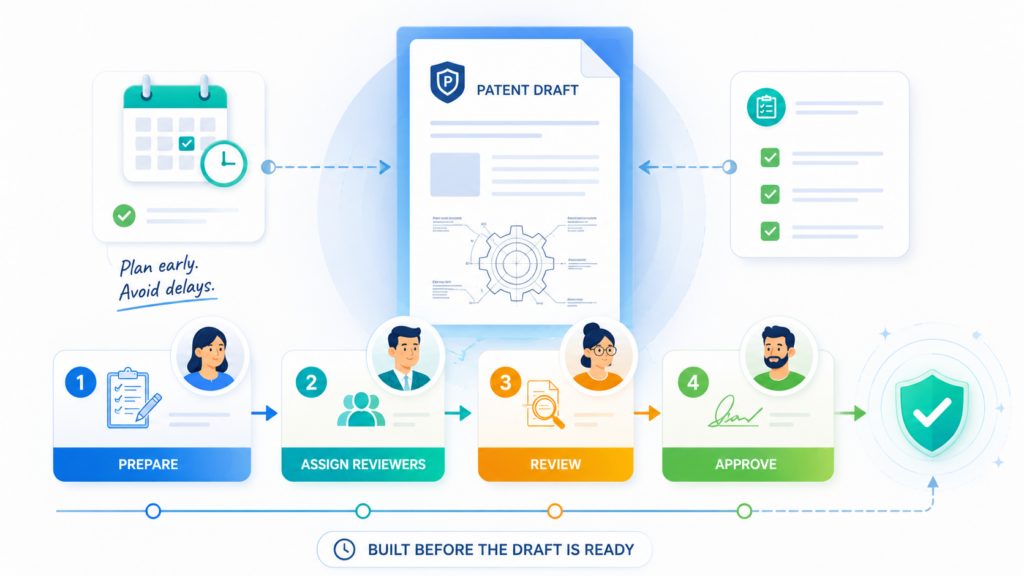
That may sound early, but it is the only way to avoid the last-minute mess that slows down so many filings. A workflow created at the end is usually just a chase plan. A workflow created at the start becomes a filing system.
The founder should decide who owns the sign-off process before the patent work begins. This person does not need to be a patent expert. They need to be organized, direct, and trusted by the team.
In many startups, this may be a founder, chief of staff, product lead, engineering lead, or operations manager. Their job is to keep the review moving, make sure the right people are involved, and prevent unclear handoffs.
A sign-off workflow should answer a few plain questions before anyone gets busy. Who are the likely inventors? Who has final business approval? Who gives technical approval? Who talks to the attorney?
What deadline is the company trying to meet? What outside event makes timing important? What happens if one inventor is unavailable? These answers shape the entire filing path.
When these questions are handled early, the patent process feels lighter. The attorney has better input. The inventors know what is coming. The founder does not need to chase people in panic. Most delays are avoided before they ever appear.
Start With A Filing Calendar, Not A Draft
A common mistake is treating the patent draft as the center of the process. The better center is the filing calendar. The calendar should be built around the business reason for filing.
Maybe the company is launching a beta. Maybe a customer pilot starts soon. Maybe investors will see a technical demo. Maybe a research paper is going live. Maybe a founder is about to speak at a conference.
Once the business date is known, the team should work backward. The filing date should not be the same day as the public event.
That creates too much pressure. The internal review date should be earlier. The inventor comment deadline should be earlier than that. The first technical intake should happen earlier still.
This is simple, but powerful. When the team works backward, sign-off stops being a surprise. Inventors can make time.
Attorneys can plan revisions. Founders can spot risk early. The whole process becomes more calm because everyone sees the road before they are already at the cliff.
The Calendar Must Include Human Delay
Most calendars fail because they assume people respond right away. Real teams do not work that way. People are in meetings.
Engineers are debugging. Founders are fundraising. Someone may be sick, traveling, offline, or deep in a customer issue. A useful filing calendar includes room for real life.
That does not mean the process should be slow. It means the process should not depend on perfect timing. If inventor comments are needed by Friday, the draft should not be sent late Thursday.
If signatures are needed before filing, the team should not wait until filing day to collect them. If one founder must approve final scope, that approval should be scheduled before the last round of cleanup.
This is where a workflow becomes more than a checklist. It becomes a way to protect focus. Inventors can review when they have the right context.
Attorneys can revise without rushing. Founders can make better calls because they are not under needless pressure.
Decide What Sign-Off Actually Means
One reason sign-off gets messy is that no one defines what approval means. Does inventor sign-off mean the technical description is correct? Does it mean the claims are perfect?
Does it mean the founder agrees with the filing strategy? Does it mean the inventors accept that the draft is ready to file even if future products may add more features later?
These are different things. If they are mixed together, review becomes slow and confusing. A smart workflow separates them.
Inventors approve technical accuracy. The founder or company lead approves business direction. The patent attorney guides legal strategy and filing readiness.
This matters because inventors may disagree about small wording choices. A founder may care more about broad product coverage.
An attorney may need to balance detail with claim scope. If everyone thinks they are approving the same thing, small issues can block the whole filing.
Clean Roles Create Faster Decisions
The inventor should not carry the full burden of patent strategy. The founder should not be stuck checking every technical detail alone.
The attorney should not have to guess which product version matters most. Each person should have a clear role.
Inventors should confirm that the invention is described in a way that matches the real technical work. They should flag missing steps, missing system parts, wrong diagrams, wrong examples, and names of people who may have helped invent the idea.
Founders should confirm that the filing matches the company’s product and business goals. Attorneys should help shape the filing so it can be useful, clear, and properly prepared.
When the roles are clean, the review moves faster. People stop commenting on everything and start focusing on what only they can judge. That is how teams avoid endless loops.
PowerPatent helps founders keep this flow clear because the process is built to gather technical input, organize invention details, and support attorney review without making the founder manage everything by hand.
For busy teams that need speed and confidence, that matters. Learn more here: https://powerpatent.com/how-it-works
Create A Review Path Before Sharing Files
Before any draft is shared, the team should decide how comments will be handled. This sounds basic, but it prevents a lot of pain.
If one person comments in email, another comments in a document, another sends Slack messages, and another gives feedback on a call, the patent team has to rebuild the truth from scattered notes. That wastes time and creates risk.
The workflow should have one main place for comments and one person who makes sure feedback is complete. It should also set a rule for late comments.
Late feedback can be important, but it should not quietly derail the whole process. If a late issue is major, it should be raised clearly. If it is minor, it may need to wait for a later filing or continuation strategy, depending on the attorney’s advice.
Final Review Should Be Narrow
A strong workflow makes the final sign-off narrow on purpose. By the time the final draft is ready, the team should not be debating the entire invention again.
The final review should confirm that key earlier comments were handled, no major technical error remains, inventor names are correct, and the filing can move forward.
This is how startups keep speed without being reckless. The process gives inventors a real voice, but it does not let review drift forever.
It gives founders control, but it does not force them to become patent experts. It gives attorneys the input they need, but it does not bury them in scattered messages.
Name The Right Inventors Before The Final Review Starts
One of the fastest ways to slow down a patent filing is to leave inventor names unclear until the end. This may feel like a small admin step, but it can create real delay when the filing deadline is close.

If the team is still asking “Who should be listed?” after the draft is done, the whole process can get stuck. People need to be checked.
Roles need to be understood. The attorney may need to ask more questions. And if someone was missed, the team may need to review the draft again with that person included.
Inventor naming should not be treated like a reward, job title, or company credit line. It is not the same as authorship on a blog post or ownership of a feature.
It is about who helped create the actual inventive idea being claimed in the patent. That is why this step needs care. But care does not mean chaos. A simple early workflow can make this much smoother.
Founders should start the inventor check during the invention intake stage, not at the final signature stage.
Ask who came up with the key idea, who helped shape it, who solved the hard technical problem, and who added a part that made the invention work in a new way.
Also ask who only followed directions, built what someone else designed, tested the system, or managed the project. These facts help the patent attorney guide the final call.
Do Not Wait For Memory To Do The Work
In fast startups, invention history gets blurry. The team may have discussed the idea in Slack, shipped a prototype, changed the model, rewritten the backend, and moved on to the next sprint before anyone stops to document what happened.
By the time a patent draft is ready, people may not remember who contributed what. This is how delays begin.
A strong inventor sign-off workflow captures the story early. It does not need to be fancy. It needs to be clear.
The team should record when the idea started, what problem it solved, who was in the key design talks, who made the breakthrough, and what changed after testing. This gives the attorney a better base for asking the right questions.
This also protects team trust. Nothing creates friction faster than inventors feeling surprised by a patent filing that names some people but not others.
When the process is clear from the start, people understand that inventor naming is based on contribution to the invention, not rank, effort, or politics.
Keep The Conversation Calm And Fact-Based
Inventor naming can feel personal, so the founder should frame it in a careful way. The goal is not to decide who matters most. The goal is to make the filing accurate.
A person can be deeply valuable to the company and still not be an inventor on a specific patent. Another person may have made one key technical contribution and need to be listed, even if they were not the project lead.
This is why the conversation should stay grounded in facts. What did each person add to the inventive idea? What problem did they help solve?
Did they create a new method, system, model step, data flow, interface, training process, hardware setup, or technical improvement? Did their input change what the patent is trying to protect?
When these questions are asked early, the final review becomes easier. The attorney can help assess the facts.
The company can avoid last-minute confusion. The inventors can review the draft with a clearer sense of why they are involved.
Make Inventor Confirmation Part Of Draft Review
Once the first full draft is ready, inventor confirmation should be part of the review. This does not mean every inventor decides the final legal answer alone.
It means each person gets a chance to flag missing contributors or correct the record. This is useful because inventors often remember details that founders miss.
For example, one engineer may remember that a machine learning feature came from a whiteboard session with a data scientist.
A product lead may remember that the first version did not include the automated ranking step, but a later design meeting added it.
A founder may remember the business value, but not the exact person who shaped the technical path. These details matter.
PowerPatent helps make this easier by giving teams a more guided way to capture invention details and move them through attorney-backed review.
Instead of trying to pull the full invention story from scattered messages, founders can use a cleaner process that supports speed, accuracy, and stronger filings. You can see how PowerPatent works here: https://powerpatent.com/how-it-works
Create A Clear Cutoff For Inventor Changes
There should be a point in the workflow where inventor changes become urgent, not casual.
Before that point, the team should welcome corrections. After that point, any new inventor issue should be raised directly and quickly, because it may affect filing readiness.
This cutoff should be tied to the filing calendar. For example, inventor questions should be mostly resolved before final draft approval, not after signature packets are being prepared.
If a new issue appears late, the founder should make sure the attorney sees it right away. Hiding or delaying the issue only makes things worse.
The best sign-off workflows do not ignore messy questions. They create a safe place to handle them early. That is the difference between a controlled filing and a last-minute fire drill.
Give Inventors A Review Guide So They Know What To Check
A patent draft can feel strange to a technical person. It may describe the invention in broad terms. It may use examples that are not written like product docs.
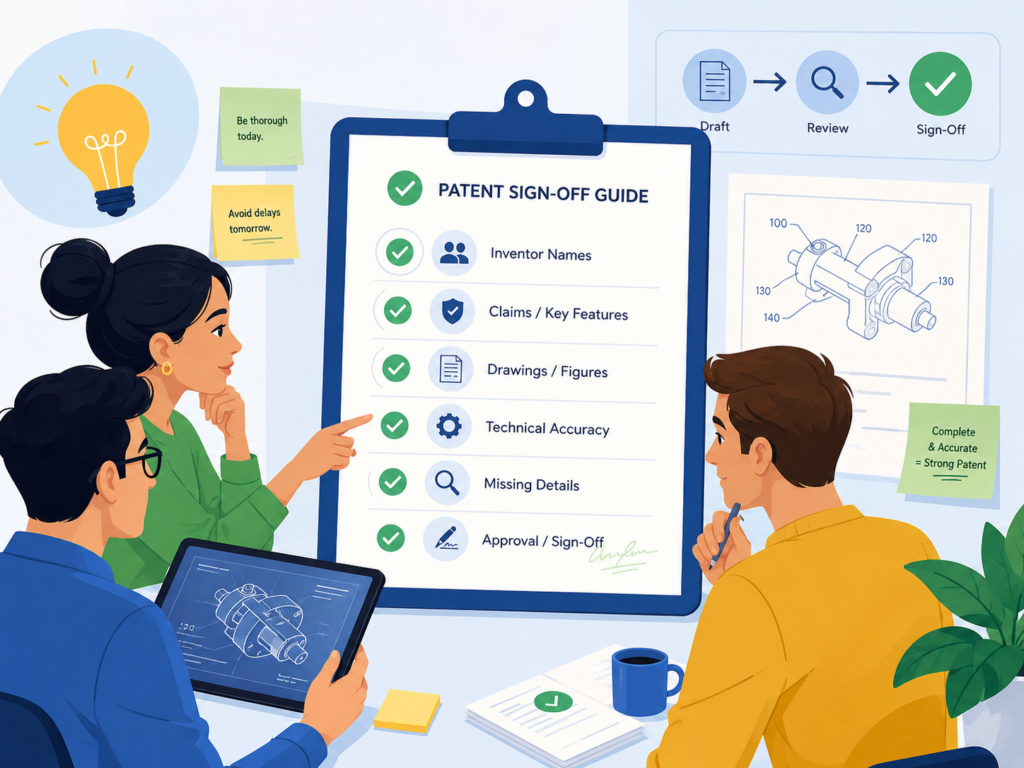
It may include drawings, claims, and descriptions that do not match how engineers normally talk. If you send that draft without guidance, inventors may not know where to focus.
This is a major cause of delay. The inventor opens the draft, sees many pages, and thinks they need to edit everything. They may spend time changing wording that does not matter much.
They may avoid the claims because they look too formal. They may leave comments like “this sounds weird” without saying whether the technical meaning is wrong. The attorney then has to sort through unclear feedback.
A good review guide fixes this. It tells inventors what kind of feedback is useful, what they can skip, and what must be flagged.
The guide should be short, direct, and written in plain language. It should make the review feel doable.
Inventors Should Review For Technical Truth
The main job of an inventor is to confirm technical truth. The draft should describe the invention in a way that is correct, complete enough, and not misleading.
It should include the key parts that make the invention work. It should not leave out a major step, system piece, data source, model function, user action, device part, or processing stage that is central to the idea.
Inventors should also check whether the examples show the invention well. A patent does not need to describe every product detail, but the examples should help explain the idea.
If the best example is missing, the filing may be weaker than it needs to be. If the draft only shows an old version and leaves out the current version, the team should catch that before filing.
This is especially important for startups working with AI, robotics, chips, biotech tools, developer platforms, climate tech, security systems, or any product where the technical edge is not obvious from the user interface.
The most valuable part of the invention may be hidden inside the workflow, model, training path, control loop, data structure, or backend logic. Inventors are the people most likely to spot when that hidden value is not explained well enough.
Tell Inventors What Not To Spend Time On
A strong review guide also tells inventors what not to worry about. They do not need to make the draft sound like a blog post. They do not need to remove every repeated technical phrase.
They do not need to rewrite formal patent language just because it sounds stiff. They do not need to answer legal strategy questions alone.
This saves time and lowers stress. When inventors know they are not expected to act like attorneys, they give better feedback. They focus on substance instead of style. They flag the technical gaps that can actually affect the filing.
The founder should make this clear in the review request. The message should say that wording may sound broader than product docs on purpose, and that the attorney will handle legal language.
The inventor’s job is to say whether the draft describes the invention correctly and whether anything important is missing.
Ask For Decisions, Not Open-Ended Thoughts
Open-ended review requests create open-ended delay. When you ask, “Any thoughts?” you invite broad comments, side ideas, future product debates, and low-priority edits. That may be useful early, but it is dangerous close to filing.
A better approach is to ask for decisions. Is the technical description accurate? Are the drawings correct enough to file? Are the main versions included? Are any key examples missing?
Are the named inventors correct based on what you know? Are there any serious issues that should block filing?
These questions keep the review focused. They also help the founder and attorney separate blocking issues from nice-to-have changes. Not every comment should stop the filing.
Some ideas may belong in a later filing. Some wording changes may not matter. Some future product features may be too early to include.
The workflow should help the team make these calls instead of treating every comment as equal.
Use A Clear Response Format
Inventors should not be forced to guess how to respond. The review request should ask them to reply with approval, approval with comments, or not approved due to a specific blocking issue.
This creates a clean record and avoids vague responses like “looks fine I guess” or “still reading” that do not clearly move the filing forward.
The best response is simple. The inventor confirms that they reviewed the draft for technical accuracy and either approves it or gives specific comments.
If they see a major issue, they should explain what is wrong and where it appears. If they think something is missing, they should describe the missing part in practical terms.
This kind of response helps the attorney act fast. It also gives the founder more confidence that sign-off was real, not rushed or unclear.
PowerPatent is built for founders who want this kind of cleaner, faster process.
It helps turn invention work into a guided path with software support and real patent attorney review, so teams do not have to manage every approval step through messy email threads. Learn more here: https://powerpatent.com/how-it-works
Turn Sign-Off Into A Defined Internal Gate, Not A Loose Email Thread
A good inventor sign-off workflow needs one simple idea at the center. Sign-off is not a casual note. It is an internal gate. That means the filing does not move forward because someone vaguely said the draft “looks okay.”
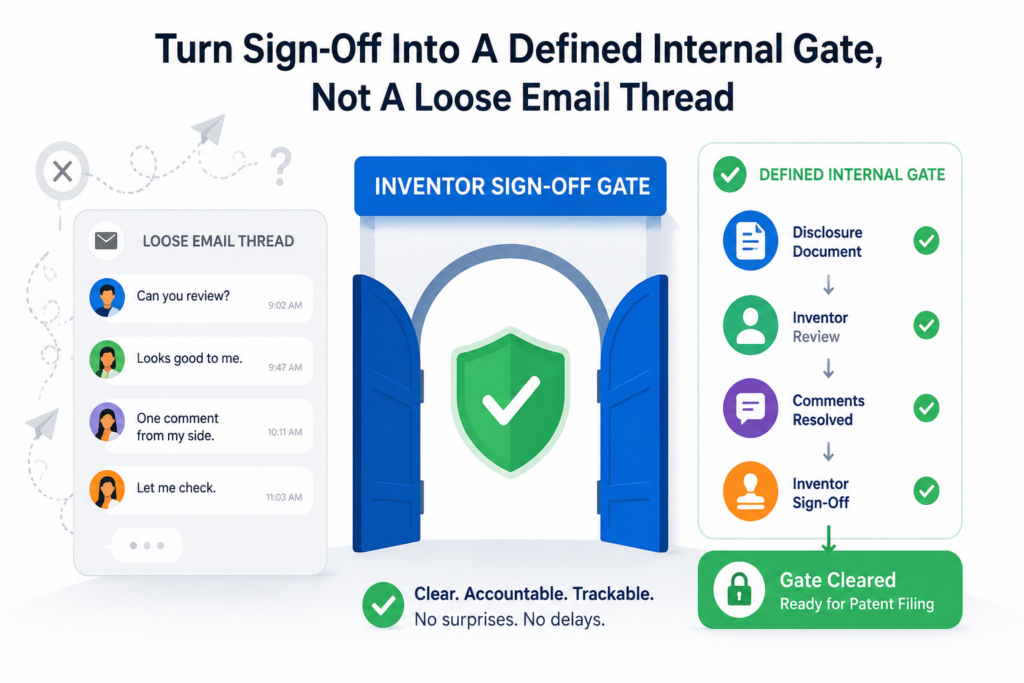
It moves forward because the right people reviewed the right things, gave clear approval, and any open issues were handled in a controlled way.
This matters because patent filings often happen near important business moments. A founder may want to file before a launch, investor pitch, demo, sales call, partner meeting, research post, or product release.
At that point, the team does not have room for fuzzy approval. The company needs to know whether the invention has been reviewed, whether the names are right, whether the draft matches the technical work, and whether the filing team can move.
A loose email thread does not give you that control. It creates long chains, hidden replies, side comments, old versions, and unclear decisions. One inventor may comment on version three while another is reading version five.
A founder may think a comment was handled, while the attorney is still waiting for an answer. Someone may approve the draft in Slack, but that approval may not be visible to the person preparing filing papers.
The better path is to turn sign-off into a clear gate with one owner, one current draft, one comment window, and one final approval moment.
This does not need to feel heavy. In fact, it should feel lighter because everyone knows what is happening.
Make One Person Responsible For The Gate
Every sign-off process needs a single owner. This person is not replacing the attorney. They are not replacing the inventors.
They are the person who keeps the internal process moving. Without this owner, responsibility spreads across the team and then disappears.
The owner should track who needs to review, who has reviewed, who has not answered, what issues are still open, and what date the filing team is working toward.
They should also make sure no one is reviewing an old draft. This sounds simple, but it is one of the biggest ways to avoid delay.
In a small startup, the owner may be the CEO or CTO. In a larger team, it may be someone in operations, legal, product, or engineering leadership. The title matters less than the behavior.
The owner must be able to follow up with busy people, ask clear questions, and push for decisions without creating drama.
The Gate Owner Should Not Let Silence Become Confusion
Silence is dangerous in a sign-off workflow. It can mean approval. It can mean the inventor forgot. It can mean they are blocked.
It can mean they saw a problem but have not had time to explain it. If the team does not define what silence means, the filing can stall.
The gate owner should set the rule before review starts. For example, the review request can say that comments are due by a certain date and that any blocking issue must be raised before then.
But the owner should still try to get direct approval from each key inventor rather than relying on silence alone. Direct approval creates confidence.
The goal is not to pressure inventors into careless review. The goal is to prevent unclear review. A good workflow respects technical input while still keeping the filing on track.
Keep One Live Version Of The Draft
Version control is a quiet source of filing delays. It often starts with good intentions. Someone downloads the draft, adds comments, saves a new copy, and sends it back.
Another person comments on a different copy. The attorney revises a clean version. A founder forwards an older file to a new reviewer. Soon the team has four drafts and no one knows which one is current.
That is how final sign-off gets messy. A comment may appear fixed in one version but not another.
A late reviewer may raise an issue that was already handled. A founder may approve the wrong file. The team loses time because it has to reconcile documents instead of filing.
A strong workflow keeps one live version as the source of truth. The gate owner should make it clear where comments belong and which version is current.
If a new version is shared, the old one should no longer be used for review. This is especially important when deadlines are tight.
The Final Draft Should Be Marked Clearly
The final review version should not look like just another draft. It should be labeled in a clear way so everyone understands that this is the version being reviewed for filing.
The message that shares it should explain what changed since the prior version and what kind of review is needed now.
This reduces repeat comments. It also helps inventors focus on final checks rather than reopening every old issue. When people know they are looking at the final version, they tend to make more direct decisions.
PowerPatent helps teams avoid this kind of loose-document chaos by giving founders a more guided way to move from invention details to attorney-reviewed patent work.
That means fewer scattered files, fewer unclear handoffs, and more control before filing day. See how PowerPatent works here: https://powerpatent.com/how-it-works
Separate Blocking Issues From Nice-To-Have Edits
Not every comment should stop a filing. This is one of the most important rules in the whole workflow. Some comments point to true technical errors. Some point to missing examples.
Some improve clarity. Some are style choices. Some are ideas for future filings. If all comments are treated the same, the process slows down.
The gate owner and attorney should help separate blocking issues from non-blocking edits.
A blocking issue is something that may make the filing wrong, incomplete in a serious way, or not aligned with the invention being protected. A non-blocking edit may make the draft nicer, but it does not need to delay filing.
This does not mean small comments are ignored. It means the team makes smart timing choices. Near a deadline, the question is not “Can this draft be made better forever?” The question is “Is this draft ready to protect the invention we need to file now?”
The Best Workflow Makes Tradeoffs Visible
Founders make tradeoffs all day. Patent filing is no different. A late comment may be useful, but adding it may require new attorney review, drawing updates, or claim changes.
Sometimes that is worth it. Sometimes it is better to file now and handle the extra idea later with the attorney’s guidance.
The key is to make the tradeoff visible. Do not let late comments drift around in chat messages. Put them in front of the right decision-maker. Ask whether the issue affects filing readiness. Then decide.
This is how a startup keeps speed and quality together. The team does not rush blindly. It also does not let every small edit become a roadblock.
Build Signature Readiness Into The Workflow From Day One
Inventor signatures are easy to forget until they are suddenly urgent. That is a mistake. Signature readiness should be part of the workflow from the start, because signatures can become a real filing delay if the team waits too long to prepare.

For many patent filings, inventors may need to sign an oath or declaration. The rules can depend on the type of application and filing path, so the attorney should guide the exact requirement. But the practical lesson for founders is simple.
Do not wait until the last hour to confirm names, email addresses, legal names, locations, availability, and signing steps.
Under USPTO rules, an inventor’s oath or declaration must identify the inventor by legal name, identify the application, include the required inventor belief statement, and state that the application was made or authorized by that person.
This is why signature readiness is not just paperwork. It is part of filing control.
If an inventor is traveling, on leave, no longer with the company, slow to respond, using an old email address, or unsure what they are signing, the filing team can lose time. Those issues are much easier to handle early than the day before filing.
A founder should think of signatures as a path, not a task. The path starts with knowing who the inventors are likely to be. Then it moves to confirming legal names and contact details.
Then it moves to explaining what the signing step is for. Then it moves to sending signature packets in a clean and trackable way. Then it ends with confirmation that all required documents are received and ready.
Confirm Legal Names Early
Startups often use nicknames, handles, shortened names, preferred names, or internal profile names.
That may be fine for daily work, but patent documents need more care. The team should confirm each inventor’s full legal name early. This is not the time to guess.
The gate owner should collect names as part of the invention intake process. If someone uses a different legal name than their everyday work name, that should be known before documents are prepared.
If an inventor has moved, changed email addresses, or left the company, that should also be handled early.
This simple step can save a lot of time. It prevents the filing team from preparing documents that need to be corrected later. It also helps avoid confusion when the attorney prepares formal papers.
Contact Details Should Be Checked Before Final Draft Approval
The team should not wait until the draft is approved to find out that an inventor is unreachable. As soon as likely inventors are known, the gate owner should confirm how each person can be reached quickly.
This is especially important for remote teams, global teams, former employees, university collaborators, contractors, advisors, or co-founders who are no longer active day to day.
The goal is not to create pressure. It is to make sure the filing team can complete the process without chasing people at the last second. If someone is hard to reach, the attorney should know early so the right plan can be made.
Explain What The Signature Means In Plain Words
Inventors can get nervous when they receive formal patent documents. They may not understand what the oath or declaration is.
They may worry that signing means they personally own the patent, accept legal risk, or approve every business decision around the filing. Confusion can slow signatures.
The review process should explain the signing step in plain language. The inventor is confirming key statements required for the filing process.
The exact legal meaning should come from the attorney, but the founder can still make the process less scary by saying what the document is, why it is needed, and who can answer questions.
This is another place where clean communication matters. A rushed message that says “sign this ASAP” may work sometimes, but it can also create concern. A better message gives context and points the inventor to the attorney or filing lead for questions.
Do Not Let Signature Questions Sit In Private Threads
If an inventor asks a question about what they are signing, that question should be handled by the right person.
The founder should not guess at legal answers. The gate owner should route the question to the attorney or filing team. This protects the company and helps the inventor feel respected.
The most important thing is speed with clarity. Inventors should not feel ignored. The filing team should not discover late that someone held back because they had an unanswered question.
PowerPatent combines smart software with real attorney oversight, which is exactly what helps during this stage.
Founders get a more organized process, while inventors can have the right review and signing steps handled with more confidence. Explore the process here: https://powerpatent.com/how-it-works
Use E-Signature Carefully And Correctly
Electronic signatures can make filing work faster, but teams should still follow the rules that apply to patent correspondence and attorney guidance.
The USPTO broadened the types of electronic signatures allowed for patent correspondence through a 2024 final rule, including broader acceptance of third-party signing tools in the covered context.
That is helpful for modern teams, but it does not mean signature steps should be treated casually.
The gate owner should make sure the correct person signs, the document is complete, and the signed version is returned through the right channel.
A signature from the wrong email, an incomplete form, or a missing page can still create delay. Good software and attorney oversight help reduce that risk.
Track Signature Status Like A Filing Risk
Signature tracking should be visible. The founder should know which inventors have signed, which have not, and which have questions. This should not live only in one person’s memory.
As filing day gets closer, unsigned documents become filing risks. The workflow should surface those risks early. That lets the team act while there is still time, instead of discovering the issue after everything else is ready.
Create A Two-Round Review So Final Approval Is Fast
Many startup patent reviews fail because they try to do everything in one round.
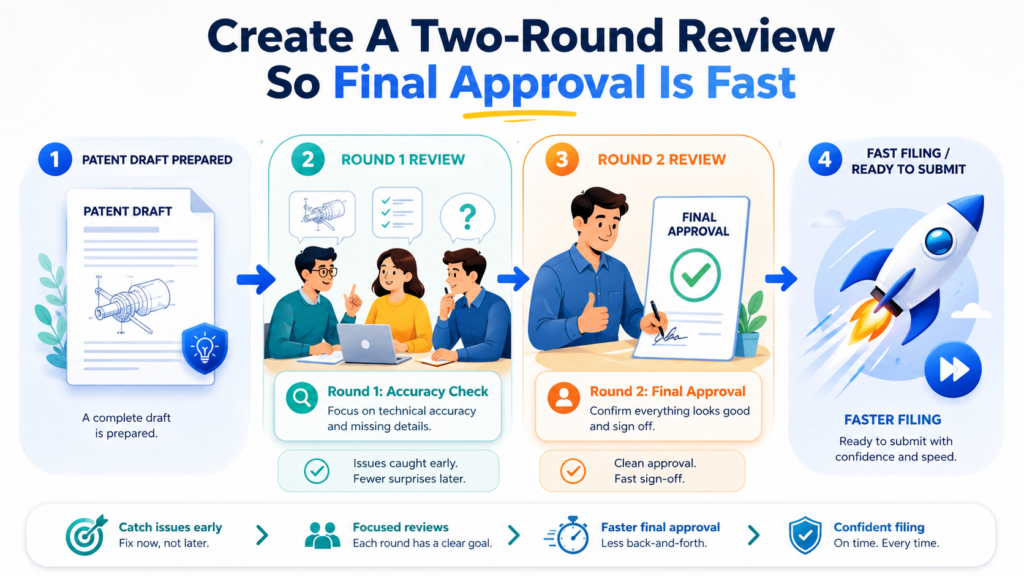
The team sends a full draft, asks for comments, waits, collects scattered feedback, revises, asks again, and then discovers new issues. This can turn into a loop with no clear ending.
A better workflow uses two planned review rounds. The first round is for substance. The second round is for final approval.
When those rounds are clearly different, inventors know how to focus, attorneys get better input, and founders avoid endless review drift.
The first round should happen when the draft is complete enough for meaningful technical review, but still early enough to make changes without panic. Inventors should be asked to check the heart of the invention.
They should flag wrong technical details, missing key examples, incorrect system flow, unclear model behavior, weak diagrams, or missing variations that matter now.
The second round should happen after the attorney has addressed the main comments. This round should be narrow. Inventors should not restart the whole debate unless there is a true problem.
They should confirm that the earlier issues were handled and that no serious technical error remains.
This sounds simple, but it changes the whole feel of the process. People stop treating every draft like a blank page. They understand what kind of feedback is needed at each stage.
The First Round Should Invite Real Technical Feedback
The first review round is where you want inventors to speak up. This is the time to catch meaningful issues. If the system description misses a step, say it now. If the data path is wrong, say it now.
If a model is described as supervised but the real method uses a different training path, say it now. If the hardware setup leaves out a sensor, chip, controller, actuator, or device state, say it now.
This round should have enough time for thoughtful review. The founder should not send the draft late at night and ask for deep comments the next morning unless there is truly no other option. The better the first round, the smoother the final round.
The review request should also remind inventors that perfect wording is not the goal. The goal is technical accuracy and useful coverage.
If the draft uses broad language, that may be intentional. If it repeats terms, that may be part of how patent drafts are written. Inventors should focus on whether the invention is right.
The First Round Should End With A Decision Point
A first review round should not stay open forever. It needs a close date. After that date, the attorney and gate owner should sort comments, resolve open questions, and decide what changes are needed.
This close date is important because it prevents endless drip feedback. If comments keep arriving one at a time over many days, the draft may never settle. A clear review window gives inventors a fair chance to comment while keeping the filing moving.
If an inventor needs more time, they should say so early. If they see a major issue, they should raise it right away rather than waiting to send a polished set of comments later. The workflow should reward early warning.
The Second Round Should Confirm, Not Rebuild
The second review round is where many teams lose time because they do not explain its purpose.
Inventors may think they are being asked to review the entire draft again from zero. That leads to new style edits, new questions, and new debates. The final approval then drifts.
The second round should be framed differently. The message should say that the main comments have been addressed and the team is now seeking final technical sign-off.
Inventors should check the revised areas, confirm that major issues are resolved, and flag only blocking problems.
This does not silence inventors. It protects the filing timeline. If there is a real issue, it should still be raised. But if the comment is minor, speculative, or better saved for a later filing, it should not automatically block submission.
Final Approval Should Be A Clear Yes Or No
The second round should end with a clear answer. The team needs to know whether the draft is approved for filing from a technical standpoint. A vague response does not help.
A good final approval response says that the inventor has reviewed the draft for technical accuracy and approves it for filing, or approves it subject to specific comments, or does not approve because of a stated blocking issue. That gives the attorney and founder something concrete to act on.
PowerPatent helps startups create this kind of focused review path, so the work does not get lost in open-ended drafting loops.
With smart software and real attorney support, founders can move from invention capture to filing with more control. See how PowerPatent works here: https://powerpatent.com/how-it-works
Make The Review Rounds Match The Business Deadline
The two-round review only works if it fits the business clock. If the company needs to file before a public launch, the review schedule must be built backward from that date.
The first round cannot start two days before the filing deadline and still leave room for thoughtful changes.
The founder should give the patent team the real business deadline as early as possible. Do not hide the launch date.
Do not assume the attorney can absorb any delay. If timing matters, say so. A strong filing workflow depends on honest timing.
Earlier Review Gives Better Protection
When inventors review earlier, the patent team has more room to improve the draft. They can add examples, clean up drawings, adjust scope, and make sure the filing better matches the company’s technical edge.
Rushed final review often leads to narrow choices. The team may only have time to fix obvious errors. Earlier review gives the team room to build a stronger filing, not just a faster one.
Use A Pre-Filing Freeze To Stop Late Chaos
At some point, a patent draft needs to stop changing. This is hard for startups because the product keeps changing. Engineers keep improving the system. Founders keep learning from customers.
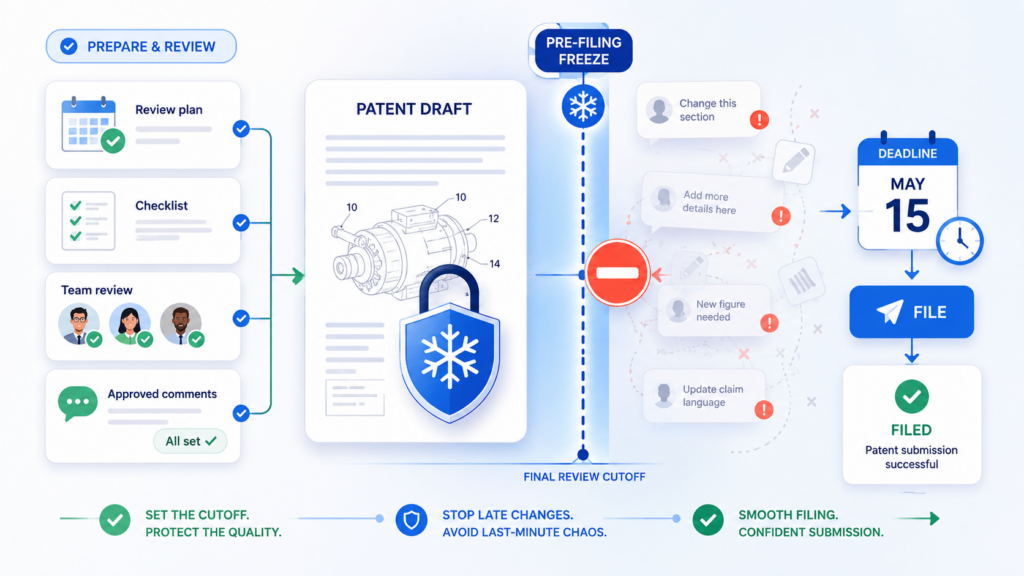
New ideas appear every week. That is normal. But if every new thought goes into the current filing until the final hour, the filing can break down.
A pre-filing freeze solves this. It creates a point where the team says, “This filing protects the invention as defined for this application.
New ideas after this point will be handled separately unless they are truly critical.” This gives the attorney time to prepare the final papers and gives the founder confidence that the filing will not keep shifting.
The freeze does not mean the company stops innovating. It means the current filing needs a stable target. Without that target, the patent team is trying to protect a moving object.
This is especially important in fast-moving technical teams. AI models change. Data flows change. Hardware setups change. User workflows change. Backend rules change.
Security controls change. If the team waits for the product to be “done,” it may never file. A smart workflow protects the core invention now and then captures later improvements in future filings as needed.
Define What Is Inside The Filing
A pre-filing freeze starts by defining what this filing is meant to cover. The founder, inventors, and attorney should be aligned on the core invention. Is the filing about a model training method?
A system architecture? A user workflow? A data processing step? A device control method? A security technique? A robotics behavior? A chip-level improvement? A biotech workflow?
When the scope is clear, late comments are easier to judge. If a new comment improves the core invention, it may matter.
If it is a separate future product idea, it may belong elsewhere. This helps the team avoid cramming unrelated ideas into one filing at the last second.
The filing should be strong, but it should also be coherent. A patent draft that tries to capture every idea the company has ever had can become unfocused. A clear filing target helps the attorney build a better document.
The Freeze Should Be Communicated, Not Implied
Do not assume inventors know when changes are frozen. Tell them. The gate owner should send a clear note when the pre-filing freeze begins.
The message should explain that the team is now moving into final filing preparation and that only blocking technical issues should be raised from this point forward.
This does not need to sound harsh. It can be respectful and calm. The point is to protect the process. People are more likely to cooperate when they understand why the freeze exists.
Create A Place For Future Ideas
One reason inventors keep adding late comments is that they fear useful ideas will be lost.
A good workflow solves this by creating a place for future ideas. When someone raises a useful but non-blocking improvement, the team should capture it for later review.
This makes it easier to say no to late changes without dismissing the idea. The founder can say, “This is valuable, but it does not need to delay this filing. Let’s capture it for a follow-on review.” That keeps trust high and filing momentum strong.
This is a smart strategy for startups because innovation rarely happens once. One patent filing may protect the first core idea.
Later filings may protect improvements, new use cases, better workflows, or stronger technical versions. The key is to have a system that keeps capturing ideas without letting each one delay the current filing.
Future Ideas Should Not Live Only In Chat
If future patent ideas stay in Slack, email, or someone’s memory, they may disappear.
The team should capture them in a place that can be reviewed later with the attorney. This creates a living invention pipeline instead of a one-time scramble.
PowerPatent is built for this kind of ongoing invention capture. It helps founders turn technical work into a more organized patent process, with software that supports speed and attorney review that helps protect quality.
For startups that keep inventing, that matters. Learn more here: https://powerpatent.com/how-it-works
Make Emergency Changes Rare And Clear
Sometimes a late change really does matter. Maybe the draft has a serious technical mistake. Maybe the named inventors are wrong.
Maybe a key embodiment is missing. Maybe the claims do not match the actual invention. A pre-filing freeze should not block real issues.
But emergency changes should be rare and clearly handled. The gate owner should route the issue to the attorney quickly.
The founder should understand whether the change affects filing timing. The team should decide whether to revise now, file as planned, or adjust strategy.
A Freeze Gives You Better Judgment Under Pressure
The biggest value of a pre-filing freeze is not just fewer edits. It is better judgment. When everything is open, every comment feels urgent.
When the filing is frozen, the team can ask a sharper question. Is this issue serious enough to change the filing now?
That question helps founders protect both speed and quality. It keeps the team from rushing blindly, but it also stops endless polish from putting the filing at risk.
Build Founder Approval Into The Same Workflow
Inventor sign-off is critical, but it is not the only approval that matters. The founder or company lead also needs to approve the filing from a business point of view.
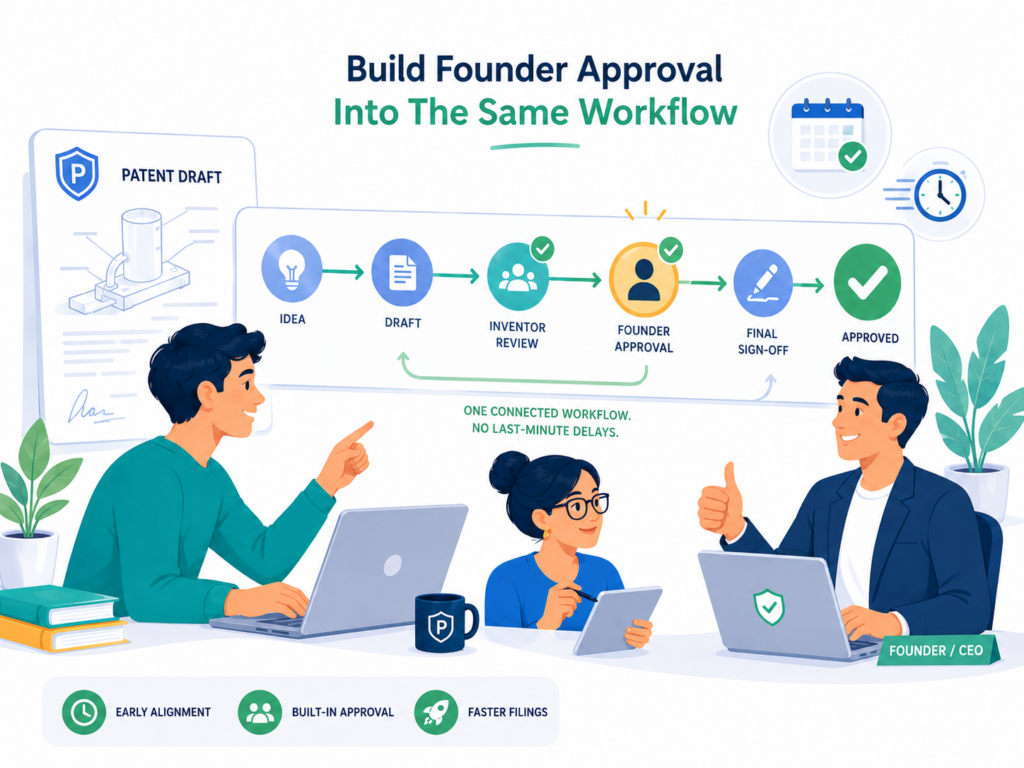
This is different from technical review. Inventors confirm the invention is right. The founder confirms that the filing supports the company’s strategy.
This step often gets skipped or blurred. A founder may assume that if the inventors approve the draft, the filing is ready. That may be true, but not always.
The draft may be technically accurate yet not focused on the most valuable part of the business. It may cover a feature that is interesting but not central.
It may miss the product direction the company is betting on. It may fail to match what investors, customers, or competitors will care about.
Founder approval should happen before filing, and it should be part of the same workflow. The founder does not need to become a patent attorney. They need to ask whether this filing protects the right business edge.
The Founder Should Review For Business Fit
Business fit means the filing matches what makes the company hard to copy. A technical invention can be real, but not every technical invention is equally valuable. The founder should think about what gives the company leverage. Is it the speed of the system? The way data is used?
The way the model improves? The way hardware and software work together? The way the product handles a hard workflow? The way the backend automates something competitors still do by hand?
The founder should read the draft with that lens. If the filing spends too much time on a small feature and not enough time on the core technical moat, that should be discussed.
If the filing covers the current demo but not the broader platform direction, that may matter. If the draft is strong but aimed at the wrong product path, that should be caught before filing.
This is not about over-controlling the legal work. It is about making sure the patent effort supports the company’s growth plan.
Founder Review Should Happen Before Final Inventor Sign-Off
The founder’s business review should not happen after all inventors have already approved the final draft. If the founder then asks for major changes, the draft may need to go back to inventors again. That creates delay.
A better workflow places founder review before or alongside the first inventor review round. The founder can confirm the strategic target while inventors confirm technical accuracy. Then the attorney can revise with both sets of input in mind.
This makes final approval faster because the team is not discovering business concerns at the end.
The Founder Should Know What Not To Micromanage
Founder approval matters, but it should not become a bottleneck. Founders are often tempted to rewrite the draft to sound like a pitch deck, landing page, or product spec. That can slow the process and may not improve the filing.
The founder should focus on business direction, product relevance, competitor risk, and timing.
The attorney should handle patent language. Inventors should handle technical accuracy. When the founder tries to own every sentence, review gets slower and less useful.
The founder should ask clear questions. Does this filing cover the technical advantage we care about? Does it align with the product we are building?
Does it leave out a known version that matters? Does it need to be filed before a planned public event? Are we comfortable moving forward now, or is there a real strategic gap?
Approval Should Be Visible To The Filing Team
Founder approval should not be trapped in a private call or side message. The filing team should have a clear record that the founder has approved the filing direction. This helps everyone move with confidence.
A simple written approval can do the job. It should confirm that the founder has reviewed the draft or filing summary and approves moving forward, subject to attorney guidance and any final technical comments. The wording does not need to be fancy. It needs to be clear.
PowerPatent helps founders stay involved without drowning in patent admin. The platform is designed to make the process easier to follow while real attorneys help guide the filing.
That gives founders more control, more speed, and less last-minute stress. See how it works here: https://powerpatent.com/how-it-works
Founder Approval Protects The Patent Budget
Patent work costs time and money. A weak workflow wastes both. If the founder does not approve direction early, the company may spend attorney time drafting around the wrong focus.
If inventors are not guided, they may create extra revision loops. If signatures are not ready, filing can be delayed even after the work is done.
Founder approval helps protect the budget because it makes the filing goal clear. The team can spend effort where it matters most.
Clear Approval Also Helps Future Filings
A good founder approval step creates a record of why the company filed this application. That record can help later when the team plans more filings.
It shows what the company saw as the core invention, what product direction mattered, and what future ideas were left for later.
This turns patent work into an ongoing IP strategy, not a one-time document task.
Use PowerPatent To Make The Workflow Faster, Cleaner, And Easier To Control
A strong inventor sign-off workflow is simple in theory. In practice, it is hard to run manually when the team is busy. Founders are building the company. Engineers are shipping product.

Attorneys need clean input. Deadlines are real. When the process depends on scattered emails, old files, loose comments, and manual chasing, delay becomes likely.
PowerPatent helps solve that problem by bringing more structure to the patent process. It is built for founders, engineers, inventors, startups, and patent teams that need to move fast without losing quality.
The goal is not to make patents feel bigger or harder. The goal is to make them easier to control.
With PowerPatent, invention details can be captured in a more guided way. Technical input can be organized before drafting. Attorney review is part of the process, so founders are not left trying to figure everything out alone.
This matters because a strong filing depends on both speed and judgment. Software helps move the work. Attorneys help make sure the work is handled with care.
For startups, that combination is powerful. It helps turn patent filing from a stressful event into a repeatable workflow. You can see how PowerPatent works here: https://powerpatent.com/how-it-works
Software Alone Is Not Enough
Patent work is not just form filling. A good patent filing needs technical detail, legal judgment, business context, and careful timing. That is why software alone is not enough.
A tool may help collect information, but founders still need attorney oversight to shape the filing and guide important decisions.
PowerPatent combines smart software with real patent attorney support. That means founders get the speed and structure of a modern platform, while still having human legal review where it matters.
This is especially useful during inventor sign-off because many delays come from unclear roles, missing details, and late questions.
The software helps create a cleaner path. The attorney oversight helps make sure the path leads somewhere useful.
The Best Workflow Supports Founders And Inventors
Inventors should not have to become patent experts. Founders should not have to become filing managers.
Attorneys should not have to dig through messy notes to understand the invention. A good system supports each person in the role they already play.
PowerPatent helps inventors share technical details in a more usable way. It helps founders stay close to the process without needing to manage every small step by hand.
It helps attorneys work from better organized information. That can reduce delays and improve confidence before filing.
This is exactly what a modern startup needs. The company can keep building while still protecting what matters.
PowerPatent Helps Reduce Last-Minute Scrambles
Last-minute patent delays usually come from the same places. Missing inventor input. Unclear draft approval.
Wrong or incomplete names. Scattered comments. Late business review. Signature confusion. A rushed filing calendar. These are workflow problems, not invention problems.
PowerPatent helps by making the process more visible and organized. When invention capture, review, and attorney guidance are part of a smoother flow, the founder is less likely to be surprised near the deadline.
The team can spot gaps earlier. Inventors can give better input. Attorneys can move with better context.
That does not mean every filing becomes effortless. Patent work still needs thought. But the process can become far less chaotic.
Control Is The Real Founder Benefit
The biggest benefit is control. Founders do not just want a patent filed. They want to know that the right invention is being protected, the right people have reviewed it, and the process will not slow down the company at the worst possible time.
PowerPatent gives founders a way to move faster while staying thoughtful. That is the balance that matters. Speed without control is risky. Control without speed is painful. The right workflow gives you both.
If your team is preparing to file, or if you know a launch, investor meeting, demo, or public release is coming, now is the time to tighten the workflow. Do not wait until the last week to find out who needs to approve what.
Start building a cleaner patent process here: https://powerpatent.com/how-it-works
Make Patent Filing A Repeatable Company Habit
The best startups do not treat patents as one-off emergencies. They build a habit around invention capture and filing decisions. When engineers solve hard problems, the team knows how to capture them.
When founders plan launches, they know when to check for patent risk. When a filing starts, everyone knows how review and sign-off will work.
That habit compounds. The first filing becomes easier to manage. The second becomes faster. The third becomes more strategic. Over time, the company builds not just patents, but an IP process that supports growth.
The Workflow You Build Now Protects Future Speed
A clean inventor sign-off workflow does more than save one filing. It teaches the company how to protect inventions without slowing down. That matters because the best startups keep creating new things.
If every patent filing becomes a fire drill, the team will avoid the process. If the workflow is clear and light, the team is more likely to use it.
That is how patents become part of building, not a break from building.
PowerPatent helps make that shift. It gives founders a modern way to protect deep tech, software, AI, hardware, and other hard-built inventions with more speed, more clarity, and real attorney oversight. Learn more here: https://powerpatent.com/how-it-works
Map Every Approval To A Real Person Before The Filing Clock Starts
A strong inventor sign-off workflow begins with one clear truth. A task that belongs to “the team” usually belongs to no one. When a patent filing is close, vague ownership becomes expensive.
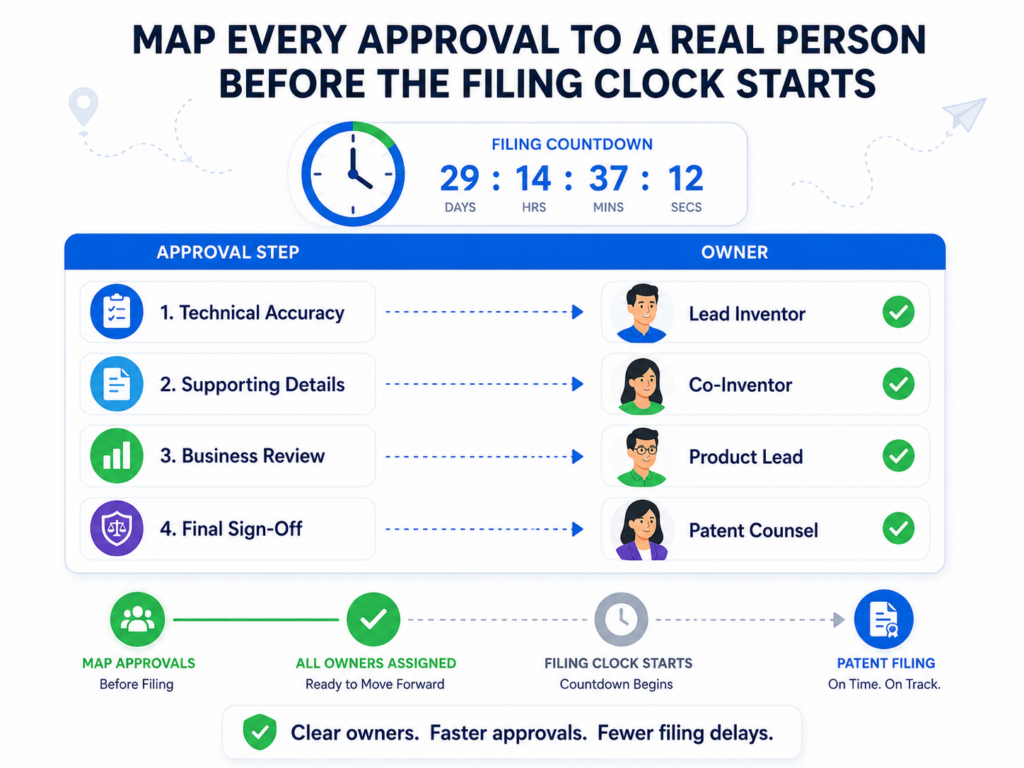
The draft may be strong. The invention may be valuable. The attorney may be ready. But if no one knows exactly who must approve what, the process can still stall.
This is why every approval should be mapped to a real person before the filing clock starts. Do not wait until the draft is finished. Do not assume the founder will handle it.
Do not assume the inventors will know what to do. Write down who owns technical review, business approval, inventor confirmation, signature follow-up, attorney communication, and final filing readiness.
This does not need to be complex. In fact, the best system is very simple. The point is to remove doubt. If a question comes up, everyone should know who answers it.
If a comment is late, everyone should know who follows up. If an inventor is unsure what to review, everyone should know who guides them. If the attorney needs a decision, there should be one clear person who can get that decision fast.
Approval Maps Stop Hidden Delays
Hidden delays are the worst kind because no one notices them until time is almost gone. A hidden delay can be as small as one unanswered question. The attorney may be waiting for the founder.
The founder may think the CTO is handling it. The CTO may think the inventor already replied. The inventor may be waiting for a newer draft. Each person believes the process is moving, but nothing is actually happening.
An approval map prevents this by turning every step into a named responsibility. It shows who is expected to act and when.
This creates healthy pressure without creating panic. People are more likely to move quickly when the request is clear and the owner is known.
The map also helps the founder see weak spots early. If one inventor is hard to reach, that risk becomes visible. If the final business approver is traveling, the team can plan around it.
If a technical lead is overloaded, someone else can help gather comments. The workflow becomes more honest because it reflects real people, not ideal conditions.
The Best Owner Is Not Always The Most Senior Person
Many startups make the mistake of assigning every approval task to the CEO or CTO. That can work in a very small team, but it often creates a bottleneck.
Senior leaders are busy, and patent sign-off requires follow-through. The best owner is the person who will actually move the process forward.
Sometimes that is the founder. Sometimes it is the chief of staff. Sometimes it is an engineering manager who knows the inventors well. Sometimes it is an operations lead who is good at tracking details. The key is not title. The key is reliability.
The owner must be able to ask direct questions without making people defensive. They must know when to push, when to escalate, and when to bring in the attorney.
They should also be comfortable saying, “This comment is not blocking,” or “This needs a decision today,” while still staying respectful.
Make The Approval Path Visible To Inventors
Inventors should not feel like the patent process is happening behind a curtain. When they know the approval path, they can respond faster and with more confidence.
They understand who is collecting comments, where feedback should go, what deadline matters, and how final approval will be handled.
This matters because inventors are often busy with product work. If the patent process feels unclear, it may fall behind more urgent tasks.
But when the request is clear, focused, and tied to a real filing date, inventors are more likely to treat it as important.
A visible approval path also reduces side conversations. Instead of one inventor asking another inventor what to do, or sending a private message to the founder, the team knows the right channel. That keeps comments together and prevents confusion.
Visibility Builds Trust Before Pressure Builds
Patent filings can create tension when the team feels rushed. Inventors may wonder why they are being asked for quick approval.
Founders may feel frustrated when comments are late. Attorneys may need answers fast. A visible process lowers that tension because people know what is coming before pressure builds.
This is one of the most useful habits a startup can build. Share the workflow early. Explain the review purpose. Show the filing target. Make ownership clear. Then the final week feels less like an emergency and more like the end of a planned process.
PowerPatent helps founders create a cleaner path from invention capture to attorney-reviewed filing work.
That means fewer mystery steps, fewer loose handoffs, and more control when deadlines matter. See how it works here: https://powerpatent.com/how-it-works
Tie Each Approval To A Filing Decision
Approvals should not exist just for form. Each approval should answer a real filing question. Technical approval answers whether the invention is described correctly.
Founder approval answers whether the filing supports the company’s business goals. Inventor confirmation helps ensure the right contributors are involved. Signature completion supports filing readiness.
When approvals are tied to decisions, people take them more seriously. They also know how to review. A founder does not waste time editing sentence style.
An inventor does not try to make claim language sound natural. The attorney does not have to guess which comments matter most.
Clear Decisions Make Filing Day Calm
Filing day should not be the day when everyone is still trying to understand what they approved.
By then, the team should already know that the technical review is done, the founder has approved direction, inventor names have been checked, signatures are ready or handled under attorney guidance, and the filing team can move.
That calm does not happen by accident. It comes from mapping approvals early and making sure each approval has a real owner.
Make Inventor Review Easier By Giving Context Before The Draft Arrives
Many inventors delay review because they receive a patent draft with no warm-up. One day, a long document appears in their inbox.
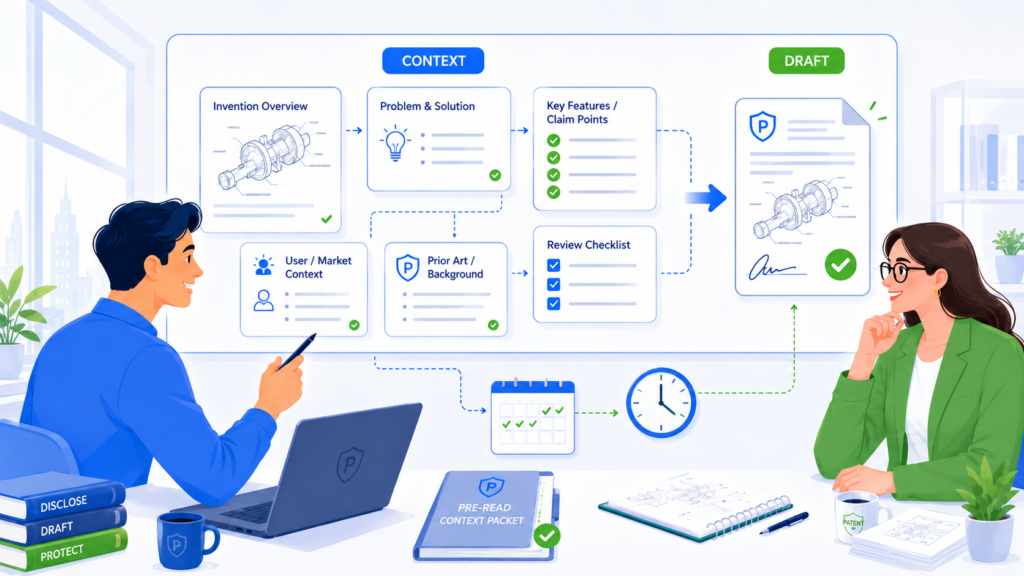
It may be full of formal sections, drawings, claim language, and broad descriptions. The inventor opens it between meetings and does not know where to begin. That delay is not laziness. It is a workflow failure.
A better sign-off process gives context before the draft arrives. Tell inventors what the filing is about, why it matters, when the review will happen, and what they will be asked to check.
This short context step can save days later because it prepares the inventor’s mind before the real review starts.
For technical teams, context is everything. Engineers and inventors think in systems, tradeoffs, versions, and edge cases.
If they understand the goal of the filing, they can review the draft faster. If they do not, they may get stuck trying to understand the whole patent process instead of checking the invention.
The Pre-Review Message Should Set The Frame
Before sharing the draft, send a clear pre-review message. It should say that a patent application is being prepared for a specific invention area. It should explain the filing goal in plain words.
It should identify the expected review window. It should tell inventors that their main job will be technical accuracy, not legal editing.
This small message changes the tone. It turns review from a surprise into a planned task. It also helps inventors make room in their schedule.
A busy engineer may ignore a sudden document request, but they are more likely to prepare for a known review window tied to a filing deadline.
The message should be short but complete. It should not overwhelm people with legal detail. It should simply help them understand what is coming.
Context Reduces Unhelpful Comments
When inventors do not understand the purpose of the draft, they may comment on the wrong things.
They may say the language sounds broad, the examples are not the latest product copy, or the claims feel hard to read. These comments may be understandable, but they may not help the filing move forward.
When inventors get context first, their comments become sharper. They know that broad language may be intentional. They know that the draft does not need to match marketing text.
They know that their role is to check the technical heart of the invention. That saves attorney time and prevents needless revision loops.
Explain The Business Reason For Speed
Inventors are more likely to respond quickly when they know why timing matters. A vague deadline feels arbitrary.
A real business reason feels important. If the company needs to file before a demo, launch, investor meeting, research release, customer pilot, trade show, GitHub release, or public announcement, say so.
This does not mean creating fear. It means giving adults the real reason behind the request.
Technical teams often respond well when they understand the risk. If a patent filing is part of protecting the company before public exposure, inventors should know that.
The founder should make the timing clear without sounding dramatic. A simple explanation is enough.
The company is preparing to disclose or ship something related to the invention, and the team wants the filing in place first. That makes the review meaningful.
Speed Works Best When It Feels Shared
A rushed request can feel like someone else’s emergency. A shared deadline feels different. When inventors know the business reason, they are more likely to help protect the company. The review becomes part of the build process, not an outside chore.
This matters in deep tech and software startups, where the people inventing the system often care deeply about the company’s edge.
They do not want competitors copying the hard parts. They just need a process that respects their time and helps them contribute clearly.
PowerPatent helps teams create this kind of smoother process by guiding invention capture and supporting attorney-reviewed filings.
It helps founders work with inventors in a more organized way, so review feels less like a last-minute fire drill. Learn more here: https://powerpatent.com/how-it-works
Give Inventors A Plain-English Summary First
Before asking inventors to review the full draft, it can help to give them a short summary of the invention being filed.
This summary should describe the problem, the core solution, the main technical parts, and the product or system area it supports. It should be written in plain English.
This summary is not a replacement for the draft. It is a map. It helps inventors know what they are about to review.
It also gives them a chance to catch a major mismatch early. If the summary itself is wrong, the team can fix direction before everyone spends time reading the full application.
A Summary Helps Busy Inventors Review Faster
Busy inventors do not always have time to read a full patent draft in one sitting.
A good summary lets them understand the filing focus quickly, then review the full draft with better aim. They can jump into the sections that matter most and give more useful feedback.
This is not about cutting corners. It is about improving review quality. People make better comments when they know what they are looking for.
Conclusion
Inventor sign-off should never be the thing that slows a strong patent filing at the finish line. When you define owners early, guide inventors clearly, confirm names, manage signatures, freeze late changes, and connect filing work to launch plans, the whole process becomes faster and calmer. The goal is not more paperwork. The goal is control.
Your team can keep building while still protecting the ideas that make the company hard to copy. PowerPatent helps founders do this with smart software and real attorney oversight, so patent filing feels clear, fast, and built for startups: https://powerpatent.com/how-it-works
Leave a Reply