A strong software or AI patent does not start with legal words. It starts with a clear talk between the person who built the idea and the attorney who knows how to protect it. PowerPatent helps make this teamwork faster by combining smart software with real attorney oversight. You can see how it works here: https://powerpatent.com/how-it-works
Attorney–Inventor Collaboration Turns Raw Technical Work Into A Patent That Protects The Business
A software or AI invention often starts as a fix. A founder sees a slow step, a weak model output, a broken workflow, a costly manual task, or a bad user experience. Then the team builds something better.
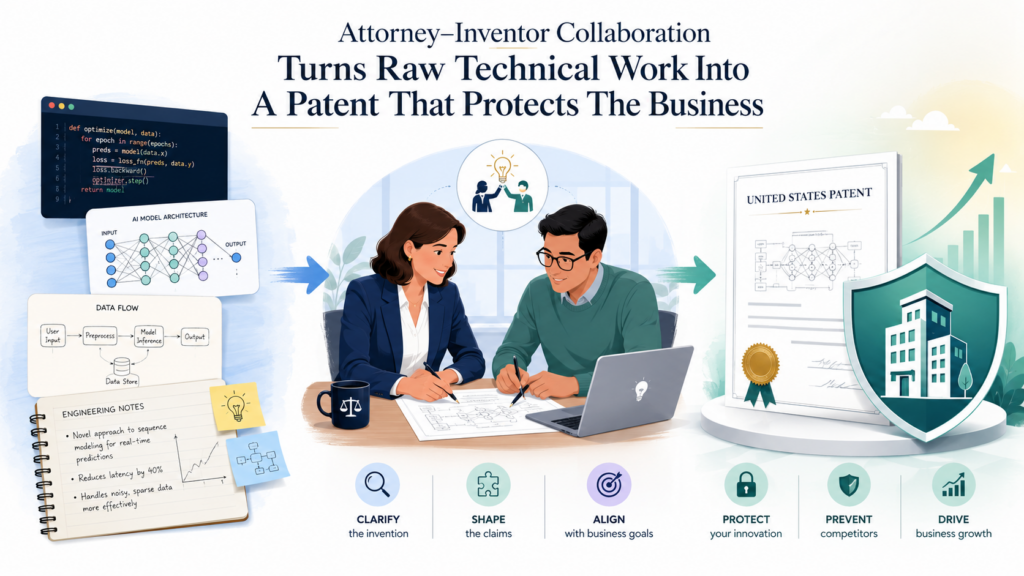
At first, it may not feel like a patentable invention. It may feel like “just how our system works.” That is exactly why attorney–inventor collaboration matters so much.
A patent attorney cannot protect what they do not understand. An inventor cannot always see which part of the system matters most for patent protection. The attorney brings the patent lens.
The inventor brings the real build story. When both sides work together, the patent becomes more than a document. It becomes a business asset tied to the company’s real edge.
The inventor knows the build, but the attorney knows how to frame the value
The inventor knows the messy truth. They know why the first version failed. They know which model choice worked better. They know why the data had to be cleaned in a certain way.
They know why a normal tool was not enough. They know the small change that made the whole system faster, cheaper, safer, or more accurate.
But the attorney knows how to turn that into a strong patent story. A good attorney does not just ask, “What does the product do?” They ask, “What changed inside the system?” They look for the step that creates the result.
They also look for backup ways to describe the invention, so the patent does not become too narrow.
The best patent conversations start before the invention feels finished
Many founders wait too long to talk to a patent attorney. They wait until the product is polished, the demo is live, the pitch deck is done, or the customer pilot has started.
That can create risk. In software and AI, the best patent ideas are often found while the team is still testing, tuning, and solving hard tradeoffs.
Early attorney–inventor collaboration helps capture the true invention before the team forgets the path they took. This matters because the “why” behind the build is often just as important as the final product.
If the team only shares the finished screen or the final model output, the attorney may miss the deeper system design that made it work.
This is especially true for AI inventions. The model itself may not be the only important part.
The value may come from how data is selected, how labels are created, how confidence scores are used, how outputs are checked, how errors are reduced, how the system handles edge cases, or how humans stay in the loop. These are the details that can shape stronger claims.
PowerPatent is built for this kind of early teamwork. It helps founders organize invention details while real patent attorneys review the work, improve the strategy, and help avoid gaps. You can explore the process here: https://powerpatent.com/how-it-works
A strong patent is not just a technical write-up
Many software teams think a patent is just a long description of their system. That is not enough. A strong patent needs a clear invention center.
It needs to show what is new, why it matters, and how the system reaches a better result. The attorney and inventor must work together to find that center.
If the patent only describes the app at a high level, it may be weak. If it only describes code without explaining the useful result, it may also miss the mark. The goal is to connect the inner technical steps to the real-world benefit.
That benefit might be faster processing, fewer errors, lower compute cost, stronger privacy, better recommendations, cleaner automation, improved safety checks, or more accurate predictions.
The attorney helps separate features from inventions
Not every feature is an invention. A dashboard, button, alert, or report may be useful, but the deeper invention may sit behind it. For example, the visible feature may be a fraud warning.
The real invention may be a way of scoring account behavior using a special mix of time-based signals, device signals, and user action history. The user sees a warning. The patent should focus on the system that made the warning smarter.
This is where the attorney’s questions matter. They help the inventor move past the surface. They ask what happens before the user sees the result.
They ask what the system does differently from normal tools. They ask what would break if a competitor tried to copy the outcome without knowing the method.
The inventor’s job is not to speak in legal terms. The inventor’s job is to explain the build in plain words, with enough detail that the attorney can spot the protectable parts. The attorney’s job is to shape that into a patent that fits the business goal.
The best collaboration protects the future product, not just today’s version
Software changes fast. AI systems change even faster. A startup may change its model, replace a vendor, rebuild the backend, or shift the user flow within months.
If the patent only covers today’s exact version, it may lose value as the product grows.
That is why attorney–inventor collaboration must include future thinking. The attorney should ask what parts of the system are likely to stay true even if the product changes.
The inventor should share planned upgrades, alternate designs, and possible ways the same idea could be used in other products.
The patent should cover the core idea in more than one practical form
A strong software or AI patent often describes the best version, but it also describes other ways to do the same smart thing.
This does not mean guessing wildly. It means mapping the realistic paths a technical team might take.
For example, an AI patent may describe one type of model, but it may also explain how the process could work with another model type.
A workflow patent may describe one data source, but also explain how other trusted data sources could be used. A security patent may describe one threat signal, but also explain how related signals could support the same decision.
This makes the patent harder to design around. It also gives the company more room to grow.
For founders, this is a key reason to work with a system that keeps both speed and legal care in the loop.
PowerPatent helps teams capture the invention, expand the right details, and work with attorney oversight without turning the process into a slow, painful mess. See how it supports founder-friendly patent work here: https://powerpatent.com/how-it-works
The First Attorney–Inventor Meeting Should Find The Real Technical Edge Fast
The first real patent meeting should not be a slow legal interview. It should feel like a focused product and engineering review with one goal: find the part of the invention that creates business power.
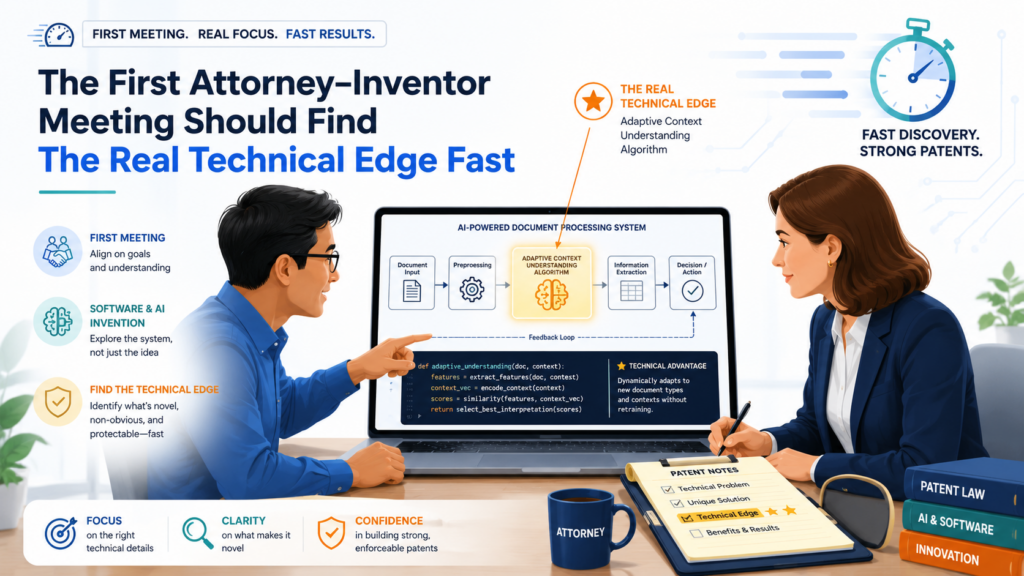
For software and AI patents, this meeting can save weeks of confusion if it is done well.
The attorney does not need a perfect slide deck. The inventor does not need to prepare a law-school answer. What both sides need is a clean, honest walk-through of the problem, the old way, the new way, and the reason the new way works better.
Start with the pain before you start with the solution
The best patent stories begin with the problem. Not a vague problem like “AI is slow” or “manual work is bad.” The problem should be sharp. It should show the exact pain the team faced and why normal tools did not solve it well.
For example, a startup might say its system “automates document review.” That is too broad.
A better starting point would be that existing review tools missed risky clauses when the clause text was split across sections, written in unusual wording, or tied to data in another document.
Now the attorney can see the real issue. The invention is not just automation. It may be a better way to connect context across documents before making a review decision.
A clear problem helps the attorney defend why the invention matters
When the problem is specific, the patent can tell a stronger story. The attorney can explain why the invention is not just a generic computer process. The inventor can show the technical steps that solve the real pain.
Together, they can avoid weak language that makes the invention sound like a basic business idea.
This is very important for software and AI. A patent should not read like, “Use AI to make something better.” That is too thin. It should explain what the system does in a concrete way.
It should show how data moves, how decisions are made, how outputs are improved, and how the system handles hard cases.
The attorney should push for plain, clear detail. The inventor should welcome that push. The questions may feel simple, but they often reveal the most valuable parts of the invention.
Bring the failed paths into the conversation
Inventors often skip the failed attempts because they think only the final version matters. That is a mistake.
Failed paths can show why the invention is smart. They can reveal what was hard, what was not obvious, and what the team had to change to make the system work.
If the team tried a basic model and it failed, say why. If a rules-based system created too many false alerts, explain what caused them. If a normal database query was too slow, show where the delay came from.
If a single-agent AI flow gave unstable answers, explain why the new multi-step flow worked better.
The attorney can use failed attempts to sharpen the invention story
A good attorney will not turn every failed path into the patent. But they will use those details to understand what makes the invention different. Sometimes the strongest claim comes from the adjustment that solved a failed path.
For example, maybe the invention is not just “ranking support tickets.” Maybe the invention is ranking support tickets by combining customer health score, message urgency, product area, past account behavior, and a model-based risk estimate, then changing the routing path when confidence is low. That is much more useful.
The failed versions help prove why that mix matters.
Explain the system like you are training a smart new engineer
The inventor should not explain the invention like they are pitching a customer. They should explain it like they are teaching a strong engineer who just joined the team.
That means giving enough detail for the attorney to understand the moving parts, without drowning the meeting in code.
The attorney needs to know what comes in, what happens to it, what changes, what comes out, and why the result is better. This simple flow can uncover the heart of almost any software or AI invention.
The best details are the ones that show cause and effect
Cause and effect is the key. Do not only say the system is accurate. Explain what makes it accurate. Do not only say it is faster.
Explain which step was removed, reduced, batched, cached, ranked, filtered, compressed, or handled in a new way. Do not only say it improves privacy. Explain how the data is masked, split, transformed, stored, checked, or limited.
These details help the attorney write a stronger patent. They also help the founder see the invention more clearly. Many teams discover during the patent meeting that their real edge is not where they thought it was.
This is one reason PowerPatent is useful for busy technical teams. It helps organize the invention in a way that makes attorney review more focused and less painful.
Instead of starting from a blank page, founders can move through a clearer process with smart tools and real legal oversight. You can see the flow here: https://powerpatent.com/how-it-works
The meeting should end with a clear patent direction
A first meeting should not end with vague notes. It should end with a working view of what the patent may protect.
That view can change later, but both sides should leave with the same basic answer: this is the core invention, this is why it matters, and these are the parts we need to describe in more detail.
The attorney should also flag missing facts. The inventor should know what to gather next.
That may include system diagrams, model flow notes, sample inputs and outputs, test results, screenshots, architecture notes, or details about planned versions.
The goal is not to make the inventor do legal work
The inventor should not have to become a patent expert. The goal is to make the invention clear enough that the attorney can do strong legal work.
A smart process keeps the inventor focused on what they know best: how the system works and why it wins.
The strongest patents come from this clean split. The founder shares the real build story. The attorney shapes it into protection. The company gets a patent path that matches the product and the market.
The Inventor Should Explain The Invention Through The “Before, Breakthrough, After” Story
A strong software or AI patent needs a strong invention story. That story does not have to be dramatic. It just has to be clear.
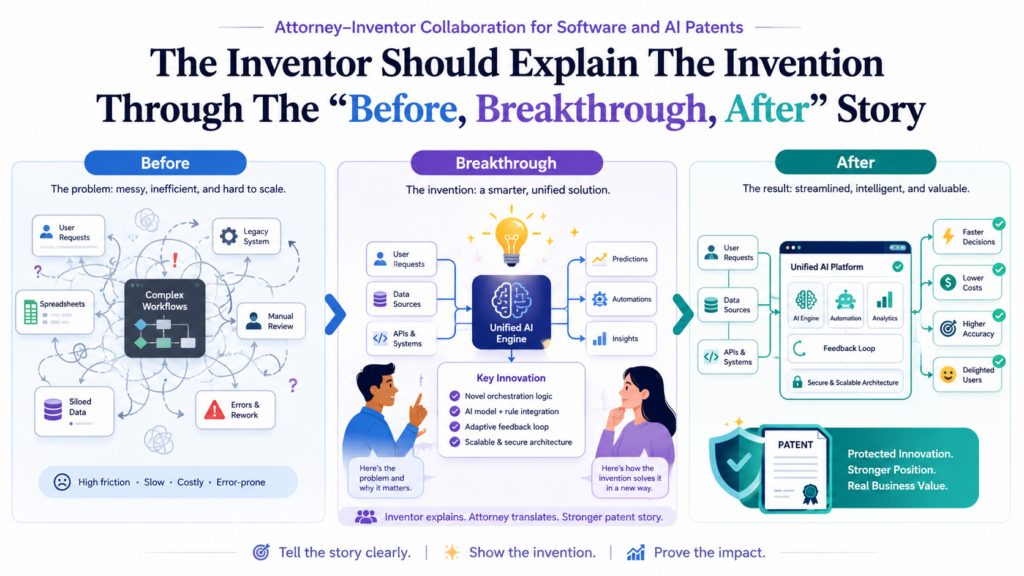
The best way to make it clear is to explain what life looked like before the invention, what changed inside the system, and what became possible after that change.
This is not fluff. This is the structure that helps the attorney understand the real value. It also helps the patent avoid sounding like a thin idea pasted on top of generic software.
The “before” should show the exact weakness in the old way
The inventor should start by describing the old way in simple terms. This may be an old internal workflow, a common tool, a known model setup, a manual review process, or a standard software pattern.
The point is not to write a history lesson. The point is to show the gap.
For example, a founder should not say, “Old systems were bad at personalization.” That is too soft.
A better version would explain that old systems gave the same recommendation to users who looked similar on paper, even when their recent behavior showed different intent.
That makes the problem clearer. It gives the attorney something real to work with.
In AI, the “before” can include bad predictions, high false positives, low trust, weak labels, slow training, noisy data, poor model explainability, or outputs that break when the input changes slightly.
In software, the “before” can include too many clicks, too much delay, poor routing, heavy compute cost, unsafe access, weak audit trails, or messy handoffs between systems.
The old way should be described with respect, not hype
The old way does not need to be mocked. A patent story is stronger when it sounds fair.
The inventor can explain that existing tools worked in normal cases, but failed under certain conditions. That kind of detail feels more credible. It also helps show why the invention matters.
A weak story says, “Nobody could do this before.” A stronger story says, “Existing systems could do X when the data was clean, but they struggled when Y happened.
Our system handles Y by doing Z before making the final decision.” That is clear, useful, and grounded.
The attorney can use that kind of story to frame the invention with more care. It helps the patent focus on the technical gap, not just the business result.
The “breakthrough” is the part the attorney must protect
The breakthrough is not always a giant discovery. In software and AI, it may be a careful system design choice. It may be a new order of steps. It may be a way to combine signals.
It may be a special check before an output is trusted. It may be a smarter way to split data, route tasks, reduce noise, or recover from bad inputs.
The inventor should explain the breakthrough like a real build decision, not like a slogan. The attorney needs to know what changed inside the system. Did the system filter data before scoring it?
Did it create a temporary profile before matching? Did it use one model to check another model? Did it update a user state based on a time window? Did it convert messy input into a structured form before taking action?
The best breakthrough details show why the result improved
The most useful details are the ones that tie the technical step to the better result. A claim that says “generate a prediction” may be weak.
A description that shows how the prediction becomes more reliable because the system first removes conflicting signals and then weights recent events more heavily may be much stronger.
This is where many inventors need help. They know the system works, but they may not have written down why. The attorney should keep asking simple questions until the cause and effect becomes clear.
Why does this step reduce errors? Why does this model flow save cost? Why does this routing rule improve speed? Why does this check make the result safer? Why does this data structure help the system scale?
Those answers can shape the patent.
The “after” should connect the invention to business value
The patent should not be only about internal mechanics. It should also show why those mechanics matter. The “after” explains what became better once the invention was used.
For a startup, this can be huge. A better AI system may lead to fewer support calls, faster onboarding, safer approvals, better fraud detection, cleaner code review, stronger customer insights, or lower cloud spend. These benefits matter because they show why the invention has real-world value.
Business value should not replace technical detail
The “after” should never be the whole patent story. Saying “our system saves time” is not enough. The attorney and inventor must connect the time savings to the actual technical steps that made it happen.
For example, instead of saying “the system makes training faster,” the inventor might explain that the system groups low-quality training records before training, removes records with conflict scores above a set level, and then retrains only a smaller model layer instead of the full model. Now the attorney has something concrete.
This is why collaboration is so important. The founder knows the business win. The engineer knows the technical reason. The attorney knows how to turn both into a patent that can matter later.
PowerPatent helps teams capture this full story without making the process feel like a legal maze.
Founders can bring the invention forward in plain language, while attorney oversight helps shape it into something stronger. See how the process works here: https://powerpatent.com/how-it-works
The Attorney Should Ask Questions That Reveal The Hidden Invention
A great patent attorney does not just collect facts. A great patent attorney finds the invention hiding inside those facts.
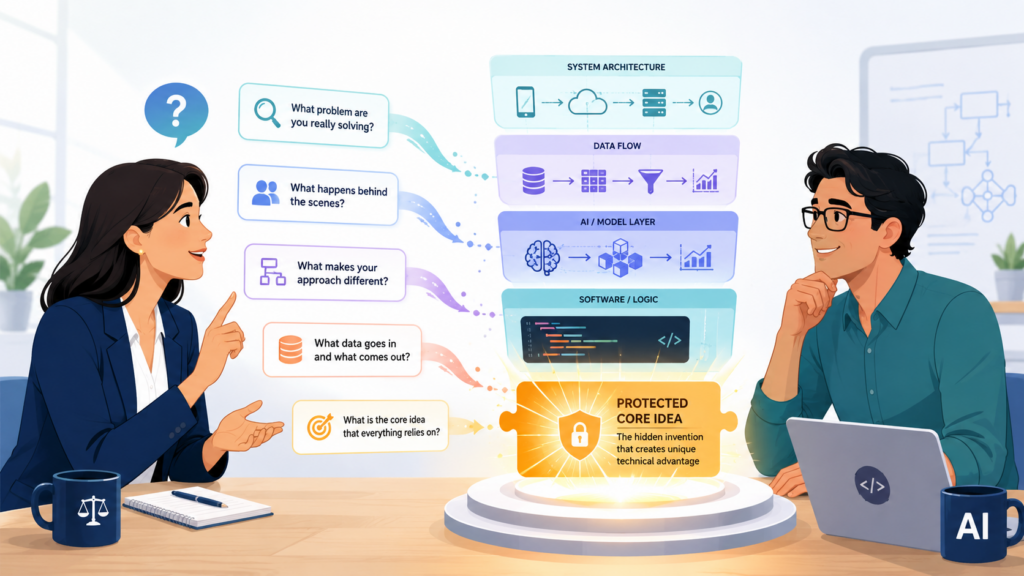
This is especially true for software and AI, where the most valuable part may not be visible in the product demo.
The demo may show a clean dashboard, a smart output, or a simple user action. But the invention may live deeper in the system.
It may sit in the data flow, the model pipeline, the error-handling logic, the ranking method, the security layer, or the way different tools talk to each other.
The right questions make the invention sharper
The attorney should ask questions that help the inventor move from result to mechanism. Result means what the user sees. Mechanism means what the system does to create that result.
For example, if the inventor says, “The system gives better answers,” the attorney should ask how the system decides which answer is better.
If the inventor says, “The model learns from feedback,” the attorney should ask what kind of feedback, how it is stored, how it changes the next output, and how bad feedback is handled.
These questions may sound basic, but they are powerful. They force the team to name the actual steps. Once the steps are clear, the attorney can start shaping the patent around the parts that matter most.
The best questions are simple and hard to dodge
A useful attorney question often sounds like something a smart product manager would ask. What comes into the system first? What does the system do next? What does it ignore? What does it save?
What does it compare? What does it change? What happens when the data is missing? What happens when the model is unsure? What happens when two signals disagree?
These questions turn vague invention talk into clear invention material. They also expose gaps. If the inventor cannot explain how a result is reached, that part may need more work before it becomes the center of the patent.
This is not a problem. It is a gift. Better to find the gap during drafting than after filing.
Hidden inventions often live in edge cases
Many software and AI inventions are born from edge cases. The happy path is easy. The hard part is what happens when the input is messy, the model is uncertain, the user behaves strangely, the data is incomplete, the system is under heavy load, or the result could create risk.
Inventors should bring edge cases into the patent conversation early. Attorneys should actively ask for them. Edge cases often show why the invention is more than a normal software flow.
For example, an AI triage system may work well when customer messages are clear. The real invention may be how it handles mixed messages that include a billing issue, a technical issue, and a cancellation threat in the same note.
A health software system may work well with full records. The real invention may be how it makes a safe recommendation when key fields are missing. A security system may work well with known attack patterns.
The real invention may be how it reacts to a new behavior pattern that is not yet labeled as risky.
Edge cases can make the patent harder to copy
When a patent describes only the main path, a competitor may find another path around it. But when the patent also captures smart handling of real-world complexity, it can become more useful.
The attorney should not overload the patent with every possible edge case. That can make the document messy.
But the best edge cases should be included because they show the invention’s depth. They also give the attorney more ways to write meaningful claims.
The inventor should think of edge cases as proof of real engineering work. Anyone can describe a smooth demo. The strongest inventions often live in the parts that keep working when the demo conditions disappear.
Attorneys should ask about alternatives before the draft is done
A patent should not lock the company into one version of the invention too early. Software changes. AI models change.
Cloud tools change. User needs change. That means the attorney should ask about alternate ways to build the same idea.
Could the system use another model type? Could the same logic run on a device instead of a server? Could the score be based on another data source?
Could the steps happen in a different order? Could a human review step be optional? Could the method work in another industry?
Alternatives help protect the core idea instead of one product build
The inventor should not guess about fantasy versions. But realistic alternatives are very important. They help the attorney describe the invention in a flexible way. That can make the patent useful even after the product changes.
For example, a startup may currently use one large language model provider. The patent should not depend only on that provider unless that provider is truly central to the invention.
The core idea may be the orchestration method, the confidence check, the retrieval flow, the data guardrail, or the human review loop.
PowerPatent helps founders and attorneys work through these details with more structure.
It gives teams a smarter way to turn product knowledge into patent-ready invention material while keeping attorney review in the loop. Learn more here: https://powerpatent.com/how-it-works
Inventors Should Bring The Right Technical Materials Without Drowning The Attorney In Noise
The best patent work happens when the attorney gets enough technical detail to understand the invention, but not so much random material that the real point gets buried.
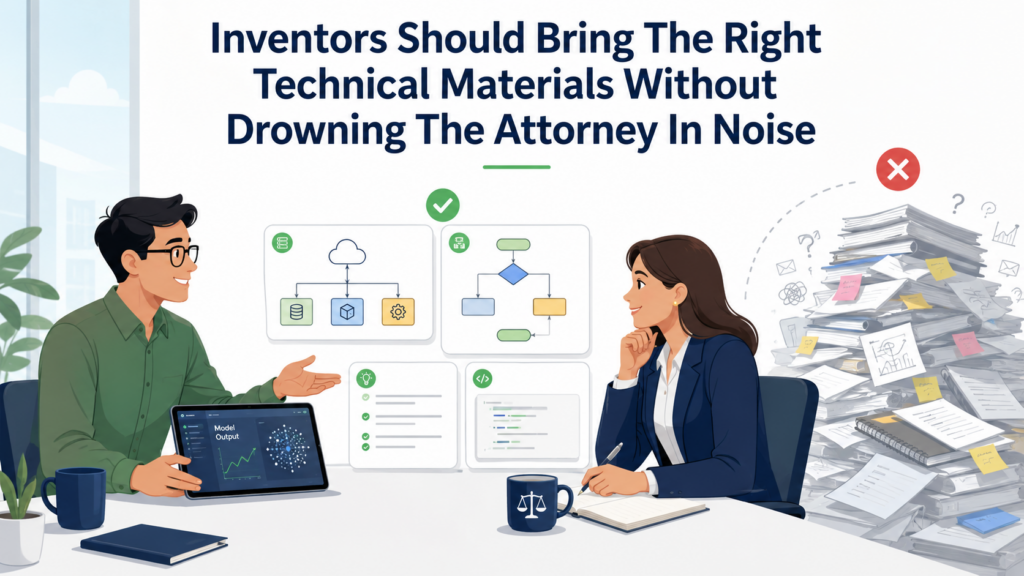
Founders and engineers often struggle with this. They either send almost nothing, or they send a mountain of files with no guide.
Both create problems. Too little detail makes the patent thin. Too much unfiltered detail makes the process slow. The goal is to give the attorney a clean path into the invention.
A simple system walk-through is more useful than a giant code dump
Most patent attorneys do not need to read the full codebase to understand the invention. Code can help in some cases, but a clear system walk-through is usually more valuable at the start.
The inventor should explain the main flow in plain words. What data enters the system? Where does it come from? What does the system do first? What step changes the data? What step makes a decision?
What step creates the final output? What does the system store for later? What makes this flow different from a normal approach?
This kind of walk-through gives the attorney a map. Without the map, screenshots and code snippets may create more confusion than clarity.
Diagrams are powerful when they show movement
A good diagram does not need to be pretty. It needs to show how things move. It should show inputs, processing steps, model calls, databases, checks, outputs, and feedback loops.
A rough box-and-arrow sketch can be more useful than a polished marketing diagram.
For AI inventions, the diagram should show where training data comes from, how it is cleaned, how the model is trained or used, how outputs are checked, and how the system improves over time.
For software inventions, the diagram should show the system parts and how they work together.
The attorney can use the diagram to spot the patentable center. The inventor can use it to explain details without getting lost.
Sample inputs and outputs can make the invention real
Software and AI patents become much clearer when the attorney can see examples. The inventor should share sample inputs and outputs when possible.
These do not need to include sensitive customer data. They can be fake examples that reflect the real structure.
A sample input might be a messy user request, a set of device signals, a transaction record, an image, a log file, a code snippet, or a group of business rules.
A sample output might be a score, a label, a route, a warning, a summary, a recommendation, a generated draft, or an action taken by the system.
Examples help the attorney avoid vague language
Without examples, the patent can become too abstract. It may say the system receives data and generates a result. That kind of language is often weak. With examples, the attorney can describe the invention with more weight.
For example, instead of saying “the system ranks items,” the patent can explain that the system ranks unresolved support requests by turning each request into a structured issue record, matching the issue record to account risk data, and raising the priority when the system detects a churn pattern. That is much clearer.
Examples also help catch misunderstandings early. The attorney may think one field is important when the inventor knows another field drives the result. Seeing a sample makes that easier to fix.
Test results can help show the invention’s effect
If the team has test results, they should share them. They do not have to be perfect. Even early numbers can help the attorney understand what changed.
A software startup may have speed tests, error rates, latency numbers, user completion rates, cost savings, or throughput results.
An AI startup may have accuracy scores, false positive rates, confidence trends, training time changes, model performance comparisons, or human review reduction data.
The attorney should use results to support the story, not overstate it
Test results are helpful, but they should be used carefully. A patent should not promise more than the system can deliver. The goal is to show that the technical approach has a real effect.
For example, if a new data-cleaning step reduced model errors in testing, the attorney can understand why that step matters.
If a routing method reduced manual review time, the attorney can see how the system creates value. If a caching method lowered compute cost, the attorney can connect the technical design to a practical benefit.
The inventor should be honest about what was tested, what was not tested, and what is still being improved. Clear facts make better patents than hype.
Keep sensitive details controlled but do not hide the invention
Founders sometimes worry about sharing too much. That concern is fair. But hiding the key invention from the attorney can weaken the patent.
The goal is not to expose every secret. The goal is to give the attorney enough to protect the right thing.
This is where a structured process matters. It helps separate core invention details from extra noise. It also helps decide what belongs in the patent and what may be better kept as a trade secret.
Collaboration helps decide what to patent and what to keep private
Not every technical detail should go into a patent. Some things are better kept private, especially if they are hard to reverse engineer and not needed to explain the invention. Other things must be described clearly enough to support the patent.
The attorney and inventor should talk through this carefully. The inventor knows what competitors could figure out from the product.
The attorney knows what the patent needs to teach. Together, they can choose a smart path.
PowerPatent is built to make this easier for busy founders. It helps organize technical material, reduce chaos, and bring real attorney oversight into the process so the final filing is not based on guesswork. You can see how it works here: https://powerpatent.com/how-it-works
Claim Strategy Should Be A Business Talk, Not Just A Legal Task
The claims are the most important part of a patent. They define what the patent is trying to protect.
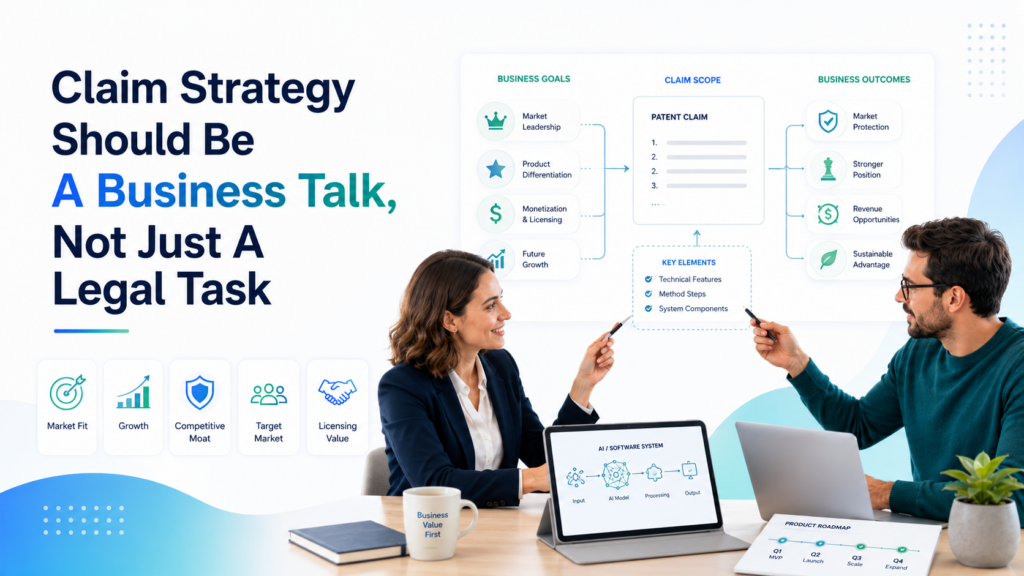
But for founders, claim strategy should not feel like a secret legal exercise done behind a curtain. It should be a business talk between the attorney and the inventor.
A software or AI patent can be technically correct and still be weak for the business. That happens when the claims protect the wrong thing, protect only one version, or miss the part competitors would actually copy. Strong collaboration helps prevent this.
The attorney needs to understand what competitors would copy
The inventor should help the attorney understand the market. Who are the likely copycats? What part of the product would they want?
What would they copy first? What would they avoid? What parts are visible from the outside? What parts can be guessed from results? What parts are hidden inside the backend?
This is not a marketing exercise. It directly affects patent strength. If competitors can copy the outcome while changing the internal steps, the patent may need broader claim support.
If the invention depends on a unique internal method, the patent should capture that method carefully.
The best claims are aimed at real-world copying
A patent is more useful when it maps to how others might build around the startup. For example, if the startup’s edge is a special feedback loop that improves model behavior over time, the claims should not focus only on the user screen.
If the edge is a cost-saving inference pipeline, the claims should not focus only on the final answer shown to the user.
The attorney should ask the inventor, “What would scare you most if a competitor copied it?” That answer can be very revealing. It shows where the business value lives.
Claims should cover the core, not every small feature
Founders sometimes want a patent to cover everything. That is understandable. They worked hard. Every feature feels important. But a strong patent needs focus.
The attorney should help the inventor separate the core invention from extra product details. The core invention is the part that creates the key advantage. Extra details may support the story, but they should not always narrow the main claim.
For example, a system may have a dashboard, alerts, user roles, reports, and integrations. Those may be useful.
But the core invention may be the way the system turns noisy event data into a trusted risk score. If the main claim is packed with dashboard details, it may become too narrow.
Narrow details can belong in backup positions
This does not mean small details are useless. They can be very helpful as backup positions. The attorney may use them in dependent claims or in the written description. This gives the patent layers.
The broad layer aims at the core idea. The narrower layers cover useful versions. This helps the company keep options open while still showing specific examples.
The inventor’s job is to tell the attorney which details are required and which are optional. That may sound simple, but it is one of the most important parts of the whole process.
AI claim strategy must avoid sounding like “just use a model”
AI patents need special care. A weak AI claim may sound like, “Use a machine learning model to predict something.”
That is often not enough. The claim should focus on the specific technical process that makes the AI system work better.
This may include how data is prepared, how features are selected, how a model is trained, how model outputs are checked, how confidence is used, how feedback changes later outputs, or how the system combines model and non-model logic.
The attorney and inventor must name the AI role clearly
The attorney should ask whether the AI model is the invention or just one tool used by the invention. This question matters a lot.
Sometimes the model architecture or training method is the real invention. Other times, the invention is the workflow around the model.
For many startups, the value is not the model alone. It is the way the system uses the model inside a practical product flow.
For example, the invention may be a method that uses a model to extract contract terms, then checks those terms against a policy graph, then sends only uncertain cases to a human reviewer. The model is important, but the protected idea may be the full review flow.
Claim strategy should support funding, sales, and future leverage
Patents are not only for lawsuits. For startups, they can support fundraising, enterprise sales, partnerships, and long-term defensibility. That means claim strategy should reflect how the company plans to win.
A patent around a narrow internal feature may be useful. A patent around the company’s main platform method may be far more useful. A patent that covers future product lines may become even more valuable.
Founders should connect patent claims to the company roadmap
The inventor should share where the product is going next. The attorney should know which features are core to the roadmap, which markets the company may enter, and which technical systems may be reused across products.
This helps the claims protect the company’s future, not just its current release. It also helps avoid filings that look good on paper but do little for the business.
PowerPatent helps founders take a more strategic path by combining smart invention capture with attorney oversight. That helps teams move faster while still thinking deeply about what the patent should protect. Explore the process here: https://powerpatent.com/how-it-works
The Best Collaboration Makes Patent Drafting Faster Without Making It Shallow
Speed matters for startups. Founders are raising money, shipping product, hiring teams, closing pilots, and fighting for attention.

They cannot afford a patent process that drags on for months because every detail is trapped in email threads.
But speed without care is dangerous. A rushed patent can miss the invention, use weak language, or protect the wrong thing. The goal is not to choose between fast and strong.
The goal is to build a collaboration process that gives the attorney the right details early, so the draft gets stronger faster.
Most delays come from unclear invention capture
Patent delays often happen because the first invention notes are too vague. The attorney receives a short product summary, a pitch deck, or a few screenshots.
Then they have to chase basic facts. What is new? How does it work? What happens inside the system? What is required? What is optional? What problem did this solve?
Every unanswered question slows the process. Worse, the draft may start before the true invention is clear. That can lead to major rewrites later.
A clear intake process saves time and improves quality
A strong intake process gives the attorney the invention’s center early. It captures the problem, the old way, the new technical steps, the key benefits, the examples, the alternatives, and the business goal.
This does not mean the inventor has to write the patent. It means the inventor shares the right raw material. The attorney then turns that material into a strong patent draft.
When this works well, the drafting process becomes much smoother. The attorney asks better follow-up questions.
The inventor gives better answers. The draft needs fewer major changes. The final filing is more likely to match the real product.
Software tools can help, but attorney judgment still matters
AI and software can make patent work faster. They can help collect invention details, organize notes, create structured summaries, find gaps, and make collaboration less painful.
This is a huge win for founders who do not have time for slow back-and-forth.
But software alone is not enough. Patent strategy still needs human judgment. A real attorney must decide what matters, how to frame the invention, how to avoid weak claim choices, and how to protect the business goal.
The strongest process combines smart tools with real review
This is the heart of modern patent work. The founder should not be stuck in an old, slow process. But they also should not rely on a fully automated filing with no serious legal oversight.
PowerPatent was built around this balance. It helps founders move quickly with smart software while keeping real patent attorneys involved.
That means the team can capture the invention more clearly, reduce delays, and still get the benefit of legal judgment. You can see how that works here: https://powerpatent.com/how-it-works
Draft review should focus on meaning, not wordsmithing
When the inventor reviews the patent draft, they should not worry about every formal phrase. Patent drafts have a style.
Some parts will feel strange to engineers. The inventor’s main job is to check whether the draft is technically right and complete.
Does it describe the real system? Does it miss a key step? Does it make an optional part sound required? Does it describe the wrong order?
Does it use a term in a way that could confuse the engineering team? Does it leave out the best version? Does it fail to mention a future version that matters?
Inventor review is where many patent mistakes get caught
The attorney may be strong, but they did not build the system. The inventor has to review the draft with care. A small technical mistake can cause big trouble later.
If the draft says the model must receive one type of input, but the real system can use several input types, that should be fixed. If the draft says the process always uses human review, but human review is only used when confidence is low, that should be fixed too.
The best review is not about making the draft sound prettier. It is about making it true, flexible, and aligned with the business.
Speed should never remove the strategic conversation
A fast process still needs strategy. The attorney and inventor should talk about what to protect, what to keep private, what competitors may copy, and what future versions should be covered.
These talks do not need to be long. They just need to happen. A focused thirty-minute strategy talk can prevent a weak filing. A clear review of future product plans can make a patent much more useful.
The fastest strong patents come from prepared collaboration
When inventors prepare clear technical details and attorneys ask sharp questions, the whole process moves better. The patent is not rushed. It is focused.
That is the real win. Founders get speed without losing quality. Attorneys get better facts without chasing every detail. The company gets protection that fits what it is building.
Inventors Should Help The Attorney Understand What Is Required, What Is Optional, And What Can Change
One of the most useful things an inventor can do during patent work is explain which parts of the system are truly required and which parts are just one current choice.
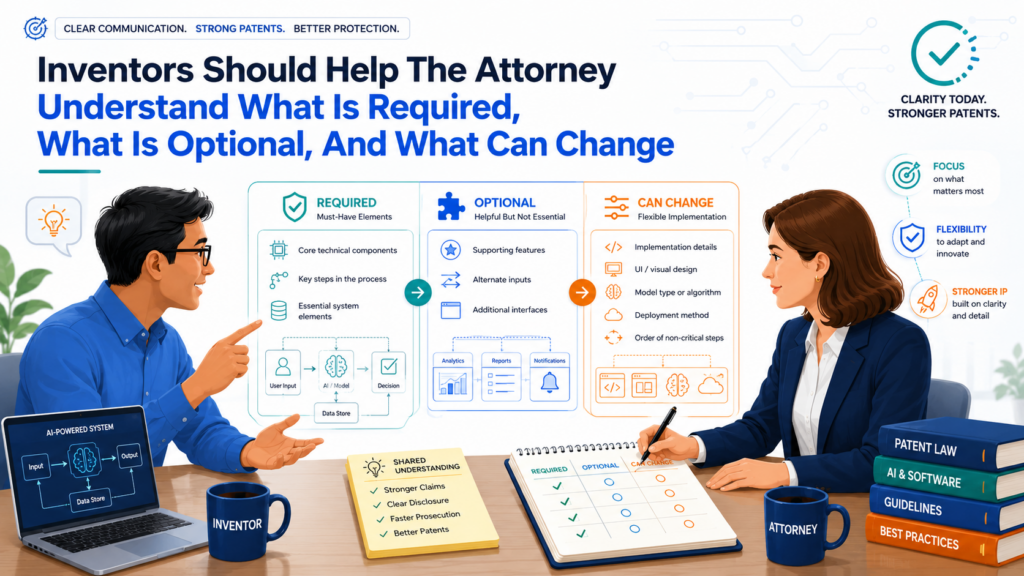
This sounds simple, but it can decide whether the patent becomes broad enough to matter or narrow enough to be easy to avoid.
Software and AI products change all the time. A startup may switch databases, change model providers, move from one cloud setup to another, add new data sources, or rebuild the user flow after customer feedback.
If the patent treats every current detail as required, it may only protect one frozen version of the product. That is a problem because the company itself may not use that exact version a year later.
The attorney needs the inventor’s help to avoid that trap. The inventor knows which parts are central to the invention. The attorney knows how to write those parts so the patent can support both the current build and realistic future versions.
When both sides talk openly, the patent can protect the core idea without being trapped by product choices that may change.
The current build is only the starting point
The current build is important because it proves the invention is real. It gives the attorney concrete steps, examples, and technical detail. But the current build should not always define the full scope of the patent.
For example, a startup may currently use a certain large language model to analyze customer messages. But the real invention may not be that model.
The real invention may be the way the system breaks a message into issue types, checks each issue against customer account history, assigns a risk level, and routes the case to the right team. If the patent focuses too much on one model provider, the claim may become too small.
This is why the attorney should ask what could be swapped out without breaking the invention. Could another model be used? Could another storage layer work? Could another scoring method support the same flow? Could the process run on a mobile device, server, private cloud, or edge device? These answers help the attorney draft with room to breathe.
Required steps should be named with care and backed by real reasons
When the inventor says a step is required, the attorney should ask why. A required step should not be required just because the current code does it that way. It should be required because the invention needs it to produce the better result.
For example, if the system must create a confidence score before sending an AI output to a user, that may be central. If the system happens to store that score in one specific database table, that may not be central.
The first detail may belong near the heart of the patent. The second may be useful as an example, but it may not belong in the broadest claim.
This kind of sorting is where collaboration becomes strategic. The inventor helps the attorney avoid wrong assumptions. The attorney helps the inventor see which details may limit protection too much.
Optional features can still make the patent stronger
Optional does not mean useless. Many optional features help show the depth of the invention. They can support backup claim positions, explain real use cases, and make the patent more complete.
For example, an AI system may optionally include a human review step when the model is uncertain. It may optionally store reviewer feedback to improve later outputs.
It may optionally send different alerts to different user roles. These details may not be required in every version, but they can help show how the invention works in a real product.
The key is to describe optional features as optional. If the patent makes an optional step sound mandatory, it may create problems later. A competitor may avoid the patent by skipping that step.
Even worse, the startup’s own product may change and no longer match the patent’s main description as well as it should.
The attorney should build layers around the invention
A strong patent often has layers. The broadest layer covers the core technical idea. Narrower layers cover useful versions, extra checks, special data sources, preferred model types, and real product flows. This layered approach gives the company more chances to protect value.
The inventor should think of the patent like a smart fence around the business. The fence should cover the main land, not just one chair on the porch.
But it should also mark the important structures inside the land. That way, the patent can protect the big idea while still showing real working examples.
PowerPatent helps founders capture these layers in a cleaner way. The platform helps organize invention details so attorneys can see the core, the options, and the future paths more clearly.
That means less guesswork and better collaboration. You can see how it works here: https://powerpatent.com/how-it-works
Future versions should be discussed before filing
A patent application can often include more than the current release. It can describe planned versions when those versions are real enough to explain.
This is a major chance for startups because the product roadmap may show where the true platform value is going.
The inventor should tell the attorney what is likely to change over the next six to eighteen months.
Will the system support new data types? Will the model become multi-modal? Will the workflow move from human-assisted to fully automated in some cases? Will the same invention be used in another industry? Will the platform move from single-user decisions to team-based decisions?
A roadmap can turn a narrow filing into a strategic asset
The attorney does not need every dream feature. But realistic future versions can make the patent much more useful. They help the attorney draft a filing that grows with the company.
This is especially important for AI startups. The first version may use text. The next version may use images, audio, video, sensor data, code, or structured records. The first version may support one workflow.
The next version may support many workflows. If the attorney knows this early, the patent can be written with better support.
The result is simple. The patent has a better chance of protecting the company’s real direction, not just the first demo.
Attorney–Inventor Collaboration Should Make AI Patents More Concrete, Not More Buzzword-Heavy
AI is powerful, but AI language can get vague very fast. Words like intelligent, automated, predictive, generative, adaptive, and smart may sound exciting, but they do not protect much by themselves.
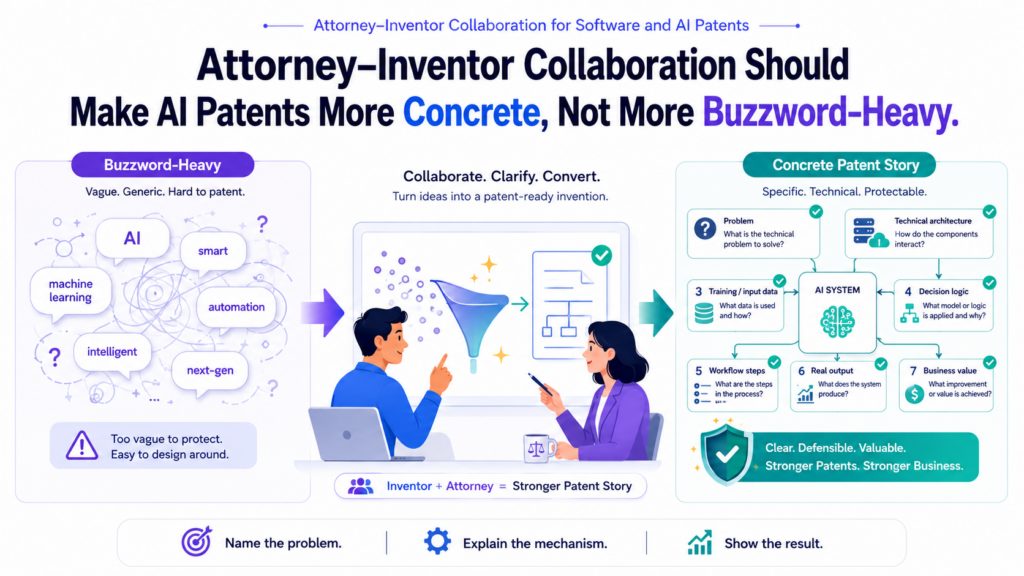
A strong AI patent needs concrete steps. It needs to explain what the system receives, how it processes the information, how the model is used, how outputs are checked, and why the result is better.
This is where the inventor and attorney must work closely. The inventor may speak in product terms. The attorney may think in patent terms. Together, they need to turn broad AI claims into a clear technical story.
The goal is not to make the patent sound impressive. The goal is to make it precise, useful, and hard to misunderstand. A patent that says “use AI to improve decisions” is weak.
A patent that explains how the system uses a model output, a confidence gate, a rules check, and a feedback loop to reduce risky decisions is much stronger.
The model is not always the invention
Many founders assume the model is the patentable part because AI feels new. Sometimes that is true.
A new model structure, training method, data labeling process, or inference technique may be the invention. But often, the model is only one tool inside a larger system.
The real invention may be the workflow around the model. It may be how the system prepares the input, chooses the right model, combines the model output with other signals, checks the output, sends uncertain cases to humans, or learns from later results.
For example, a startup may use a known model to review sales calls. The invention may not be the model itself.
It may be a system that compares call transcripts to deal stage, customer objections, past win patterns, and manager feedback, then creates coaching actions based on confidence and business risk. That system design may be where the value lives.
The attorney should ask what the AI is actually doing
The attorney should not accept “we use AI” as the answer. They should ask what the AI receives, what it produces, and how the system uses that output.
They should also ask what happens when the model is wrong, uncertain, slow, biased, incomplete, or inconsistent.
These questions make the invention concrete. They also help avoid a patent that sounds like a general wish. In AI patents, the details around uncertainty and control can be very important.
A system that blindly accepts every model output may not be as strong as a system that knows when to trust, check, change, or reject the output.
The inventor should explain those control points clearly. They often reveal the smartest part of the system.
Training data can be a major part of the invention
For many AI systems, the data work is more important than the model. The team may have created a special way to collect examples, clean records, remove conflicts, create labels, balance classes, detect bad samples, or keep private data safe. That work can create the performance gain.
Inventors often underplay this because data prep feels like plumbing. But in AI, the plumbing may be the invention.
If the system works because the team found a better way to turn messy raw data into useful training material, the attorney needs to know that.
Data steps should be explained as actions, not as vague quality claims
The inventor should not only say the data is cleaner. They should explain how it becomes cleaner. Does the system compare records from two sources?
Does it remove samples when labels disagree? Does it create synthetic examples for rare cases? Does it split private fields from useful signals? Does it weight newer records more heavily than older ones? Does it test samples against a rule before training?
These actions matter. They can turn a vague AI story into a specific technical method.
The attorney can then decide how to use those details. Some may belong in the main claim. Some may belong in backup claims. Some may belong in the written description to support future claim choices.
AI output handling can be the strongest protectable layer
Many AI systems are not valuable because they generate an answer. They are valuable because they know what to do with the answer.
The output may be scored, checked, routed, filtered, rewritten, compared, stored, or used to trigger another system action.
This is especially important for enterprise AI. Customers do not only want a model response. They want safe, useful, trusted action.
A patent that captures the action layer may be stronger than a patent that only talks about generating text, scores, or predictions.
Confidence logic often shows real system maturity
One key area to discuss is confidence. What happens when the model is sure? What happens when it is unsure? Does the system ask for human review? Does it run a second model? Does it pull more context? Does it give a limited output? Does it block an action?
These details show that the system is built for real-world use, not just a demo. They can also help the patent describe a technical improvement in how AI is controlled.
PowerPatent is useful here because it helps founders explain AI inventions in a structured way while real patent attorneys help sharpen the strategy.
That combination can keep the filing clear, detailed, and business-focused. You can learn more here: https://powerpatent.com/how-it-works
Software Patent Collaboration Should Focus On System Flow, Data Movement, And Technical Change
Software patents get stronger when they explain how the system works under the hood. That does not mean dumping code into a patent. It means showing the flow.

It means explaining how data moves, how decisions happen, how system parts interact, and what technical change creates the better result.
A founder may see the invention as a product feature. A user may see a button, alert, dashboard, or recommendation.
But the patent often needs to focus on what happens behind that surface. The attorney and inventor should work together to translate the product feature into a system-level story.
This is especially important because software ideas can sound abstract when described too broadly. “Manage tasks better” is not enough. “Predict churn” is not enough.
“Automate onboarding” is not enough. The patent needs to describe the technical process that makes the feature work in a new or better way.
Data movement often reveals the invention
Software systems are full of movement. Data enters, changes form, gets stored, gets compared, gets scored, gets routed, and creates outputs. The path of that movement often shows where the invention lives.
For example, a system may receive raw event logs from a user’s product activity. It may group those events into sessions, compare the sessions to known patterns, assign a health score, and trigger a workflow when the score drops below a level. The invention may be the specific way the system turns messy event data into a meaningful action.
The inventor should walk the attorney through this movement step by step. The attorney should ask where the data changes, where the decision points are, and where the system becomes different from a normal approach.
Inputs and outputs should be tied to real system steps
A weak software description says the system receives input and produces output. A strong description explains what kind of input, what happens to it, and why the output is useful.
For example, instead of saying a system receives user data and generates a recommendation, the inventor can explain that the system receives time-stamped user events, removes repeated events from the same session, maps remaining events to intent signals, compares those signals with account state, and then generates a next-best action. That gives the attorney real material.
The more clearly the inventor explains the flow, the easier it is for the attorney to draft a patent that protects the actual system.
Technical change should be separated from business outcome
Software products often create business value. They save time, reduce cost, increase conversion, lower risk, or improve customer experience.
Those outcomes matter. But for patent work, the attorney must also understand the technical change that creates the outcome.
For example, a system may reduce customer support time. But how? Does it route tickets differently? Does it cluster similar cases? Does it retrieve prior solutions? Does it score urgency? Does it detect when a customer is likely to leave? Does it auto-fill missing facts before a human review?
The patent should connect the technical step to the business win
The strongest story joins both sides. It explains that a technical method creates a practical result. The attorney should help write that connection without turning the patent into a sales pitch.
The inventor can help by naming the direct cause. Because the system groups events before scoring, it avoids false signals. Because the system checks user role before access, it reduces unsafe data exposure.
Because the system caches a transformed record, it reduces repeat processing. Because the system routes low-confidence cases to review, it improves trust.
This cause-and-effect link makes the invention easier to understand and harder to dismiss as a vague idea.
Architecture details matter when they support the invention
Not every architecture detail belongs at the center of the patent. But some architecture choices are very important.
The invention may depend on where data is processed, how services talk to each other, how state is stored, how updates are pushed, or how privacy is preserved.
For example, a privacy-focused software invention may depend on splitting sensitive data from derived signals. A real-time system may depend on processing certain events before others.
A security platform may depend on a special way of sharing risk updates across devices without exposing raw data.
The attorney should know which architecture choices create value
The inventor should explain which architecture choices are just implementation details and which ones create the advantage.
If a microservice design is only a current engineering choice, it may not need to limit the claim. If the separation of services is what protects private data, then it may be central.
This is another reason collaboration matters. The attorney can only make good drafting choices when the inventor explains the reason behind the design.
PowerPatent helps technical founders organize these details without slowing the company down.
It gives teams a way to capture invention flow, key system parts, and attorney-reviewed strategy in one more founder-friendly process. See how it works here: https://powerpatent.com/how-it-works
The Draft Review Should Be A Technical Accuracy Check And A Business Alignment Check
When the attorney sends a patent draft, the inventor’s review is one of the most important steps in the whole process. This is not the time to skim. It is also not the time to get stuck on legal phrasing that feels unusual.
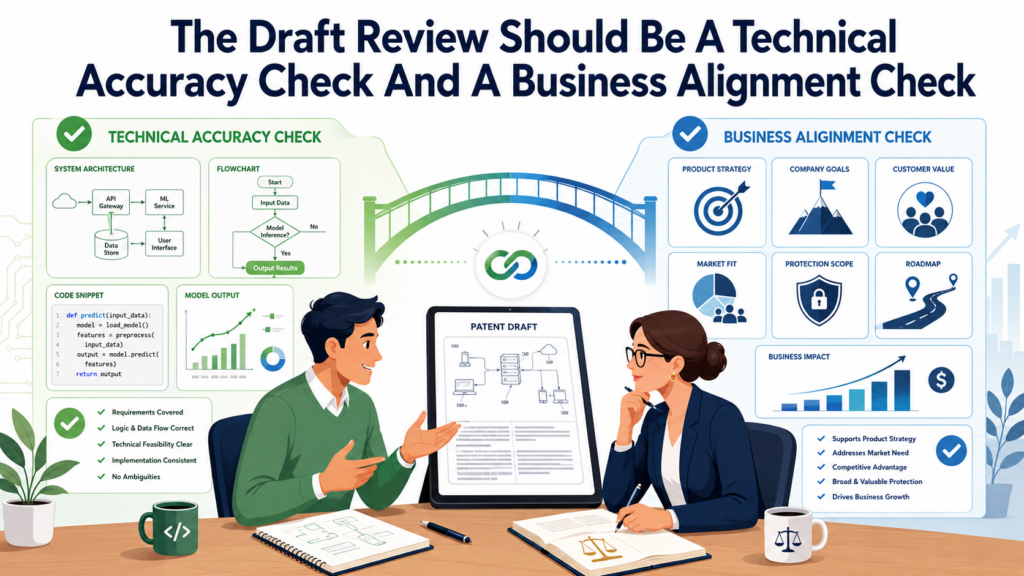
The inventor’s main job is to make sure the draft is technically accurate, complete, and aligned with the company’s real business direction.
A patent draft can look formal. Some sentences may be long. Some terms may feel different from normal engineering language.
That is okay. The key question is not whether the draft sounds like a blog post. The key question is whether it protects the invention correctly.
The attorney and inventor should treat review as a working session, not a handoff. The attorney has turned the invention into patent form. Now the inventor must make sure nothing important was lost in translation.
The inventor should check whether the draft describes the real system
The first review should focus on truth. Does the draft describe how the system actually works? Does it put steps in the right order? Does it describe inputs correctly?
Does it explain outputs correctly? Does it make optional steps sound required? Does it leave out a key check, filter, score, model call, or feedback loop?
Small mistakes can matter. If the draft says the system always performs a certain step, but the real system only does it in high-risk cases, that should be corrected.
If the draft says the system uses a rules engine, but the real value comes from a model-and-rule combination, that should be clarified. If the draft says data is stored before scoring, but scoring happens first, the order should be fixed.
Technical review should focus on meaning over style
Inventors do not need to rewrite the whole draft. They should focus on meaning. If a term is wrong, mark it.
If a step is missing, explain it. If an example is misleading, correct it. If a broad statement sounds too narrow, flag it.
This kind of review helps the attorney improve the patent. It also prevents future problems. A patent should not force the company into a technical story that is not true.
The best reviews are direct and plain. The inventor can say, “This step is optional,” “This can also use another model,” “This output is not shown to the user,” or “This happens only after the confidence check.” Simple comments like that can make the draft much stronger.
The inventor should check whether the patent covers the business edge
Technical accuracy is not enough. The draft should also match the business edge. A patent may describe the system correctly but still miss the thing that makes the company hard to copy.
The inventor and founder should ask whether the draft protects what competitors would want. Does it cover the workflow that creates customer value?
Does it cover the data process that improves results? Does it cover the control point that makes the AI safe? Does it cover the system design that lowers cost or improves speed?
Business alignment keeps the patent from becoming a nice technical memo
A patent is not just a record of what the team built. It should support the company’s position in the market. That means the review should include product leaders, technical leads, and sometimes the CEO or CTO.
This does not mean everyone needs to edit every word. It means the right people should confirm that the patent points at the right target.
If the company’s main edge is enterprise trust, the patent should not focus only on a minor UI improvement. If the company’s main edge is a special AI review loop, the patent should not focus only on generic automation.
If the company’s main edge is low-cost scale, the patent should describe the system choices that create that scale.
The review should include future product plans
Before filing, the team should ask whether the draft supports where the product is going. This is the last major chance to add realistic future versions before the application is filed.
The inventor should check whether the draft includes likely alternatives. Can the invention work with different data types? Different models?
Different devices? Different user roles? Different industries? Different levels of automation? Different privacy settings?
A draft can often be improved by adding clear future examples
Future examples should be real enough to describe. They should not be wild guesses. But if the team has a clear roadmap, those planned versions may belong in the patent application.
For example, a text-based AI review system may soon process images or audio. A single-user workflow may soon support teams.
A cloud-based system may later support on-device processing. A tool used in finance may also work in healthcare, insurance, logistics, or cybersecurity.
Adding these examples can make the patent more flexible. The attorney can decide how to include them without making the draft unfocused.
PowerPatent makes this review process easier by giving founders a more organized way to work with attorney oversight.
The goal is not just to file faster. The goal is to file smarter, with fewer missed details and a clearer link to the company’s future. Learn more here: https://powerpatent.com/how-it-works
A Strong Collaboration Process Helps Startups Build A Patent Portfolio, Not Just One Patent
One patent can be useful. A smart patent portfolio can be much more powerful. For software and AI startups, the goal should not always be to file one patent and stop.
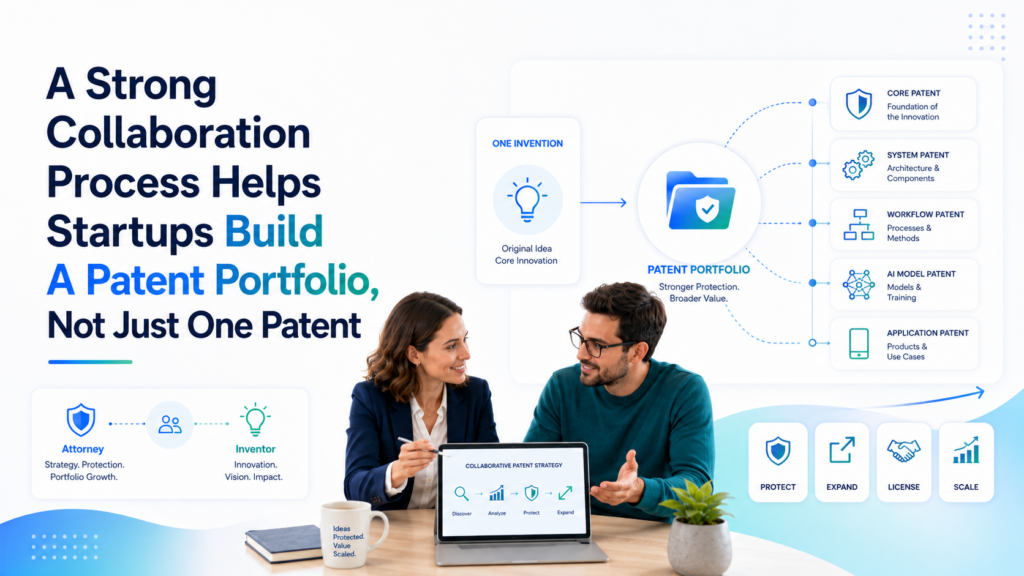
The better goal is to build a thoughtful set of filings around the company’s core technology, product roadmap, and market position.
This is where attorney–inventor collaboration becomes an ongoing habit. The best patent work does not happen once at the end of a build cycle. It happens as the company learns, ships, improves, and finds new technical edges.
A startup that treats patents as a one-time task may miss important inventions. A startup that builds a steady collaboration process can capture valuable ideas as they appear.
A portfolio should follow the product roadmap
A strong patent portfolio is not random. It should follow the company’s plan. The first filing may protect the core platform.
Later filings may protect major improvements, new use cases, special data methods, AI control systems, integrations, privacy methods, speed improvements, or new user workflows.
The attorney should understand the roadmap. The inventor should help identify which upcoming features contain real technical work.
The founder should connect the patent plan to business goals such as fundraising, enterprise sales, partnerships, and future exits.
Each filing should have a clear reason to exist
A patent filing should not be made only because something was built. It should have a purpose. It may protect a core method competitors would copy. It may cover a new product line.
It may strengthen the company’s position before a fundraise. It may support a partnership. It may protect a technical improvement that lowers cost or increases trust.
When each filing has a reason, the portfolio becomes stronger. It tells a clear story about the company’s innovation. It also helps avoid spending money on filings that do not support the business.
This is why founders should not think of patent work as paperwork. It is part of strategy.
Invention capture should become a light, repeatable habit
Startups move fast. Teams ship new features, fix hard bugs, test new models, and improve workflows every week.
Many of those changes will not need a patent. But some may be important. The problem is that teams often forget the details by the time they talk to an attorney.
A light invention capture habit can solve this. When the team solves a hard technical problem, someone should record what changed, why it mattered, what failed before, and what result improved. This does not need to be long. It just needs to preserve the story while it is fresh.
The best patent ideas are often found right after a hard problem is solved
When engineers finally solve a hard problem, they often move on right away. That is normal in startup life. But from a patent point of view, that moment is valuable.
The team still remembers the failed paths, the tradeoffs, the strange edge cases, and the exact change that made the system work.
Those details are gold. They can help the attorney write a better patent later.
PowerPatent is built to help make this easier. It gives founders and technical teams a more modern way to capture invention details and work with real patent attorneys without drowning in old-school process. See how it works here: https://powerpatent.com/how-it-works
Portfolio planning should include competitor behavior
A startup should think about what competitors are likely to copy. Not every internal feature needs patent protection. But if a technical method gives the company a clear market edge, it may deserve attention.
The attorney should ask how a competitor might reach the same customer outcome. The inventor should explain which parts are visible, which parts are hidden, and which parts are hard to design around. The founder should explain which areas matter most for market control.
Good patents make copying less comfortable
A good patent portfolio does not need to block every possible path. But it can make direct copying harder, riskier, and less attractive.
It can also create leverage in investor talks, partner talks, and future business deals.
This is especially important in software and AI, where features can appear easy to copy from the outside.
A competitor may see the interface and try to build the same result. Patents can help protect the deeper technical work that makes the result possible.
The collaboration should get better over time
The first patent process may take more explanation. The attorney is learning the company’s technology.
The inventors are learning how to describe invention details. The founder is learning how patents fit the business.
Over time, the process should get smoother. The attorney begins to understand the platform.
The inventors learn what details matter. The company gets better at spotting patent-worthy work before it disappears into the normal product cycle.
A strong process turns patents into a startup advantage
The real win is not just having filings. The real win is having a repeatable system for protecting hard work. That system gives founders more confidence.
It helps investors see that the company is serious about defensibility. It helps technical teams understand that their best ideas are being protected.
Attorney–inventor collaboration is the engine behind that system. Smart software can make it faster. Real attorney oversight can make it stronger. Together, they help startups protect what they are building without slowing down the build.
That is exactly the kind of patent process PowerPatent was made for. It helps founders move from raw invention to attorney-reviewed patent work with more speed, more control, and less stress. You can explore the process here: https://powerpatent.com/how-it-works
Conclusion
Attorney–inventor collaboration is what turns a smart software or AI idea into a patent that can actually help the business. The inventor brings the real build story, the hard choices, the failed paths, and the hidden technical edge. The attorney turns that into clear protection that can support growth, funding, sales, and long-term control.
For startups, this teamwork should not be slow or painful. It should be focused, practical, and built around the product roadmap. PowerPatent makes that easier with smart software plus real attorney oversight. See how it works here: https://powerpatent.com/how-it-works
Leave a Reply