Hardware patents are won or lost in the small details. PowerPatent helps make that teamwork faster and clearer by combining smart software with real attorney oversight. You can see how the process works here: https://powerpatent.com/how-it-works
Start With The Real Device, Not The Patent Idea
A strong hardware patent starts with the real thing the inventor built or plans to build. Not the pitch deck. Not the product name. Not the broad idea. The real device.
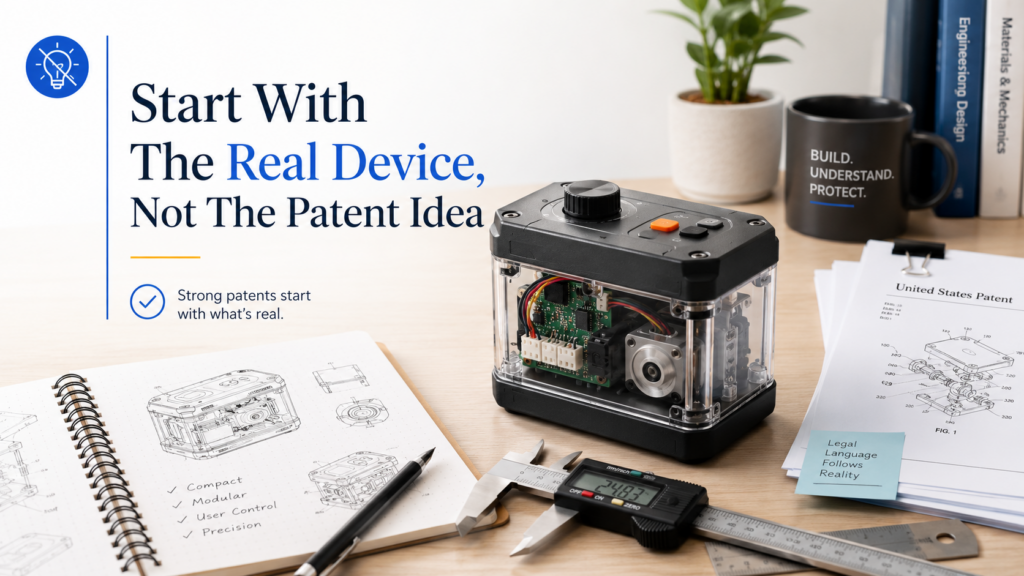
This matters because a hardware invention is not just an “idea.” It is a set of choices. The shape of a part. The way two pieces connect. The path of heat. The way a sensor sits inside a housing.
The way a user touches the device. The way power moves through the system. The way the device survives dust, water, force, wear, or bad use.
When an attorney and inventor work together, the first job is to slow down and look at the device as it really exists.
Many founders rush this step. They think the attorney only needs a short summary. That is risky. A short summary often hides the best parts of the invention.
A better move is to walk through the device like a smart competitor would. Ask what makes it useful. Ask what makes it hard to copy.
Ask what part took the longest to solve. Ask what part looks simple now, but was painful to figure out. That pain is often where the patent value lives.
For example, a medical device founder may think the invention is “a wearable sensor that tracks fluid levels.” But the real invention may be the way the sensor stays accurate while the patient moves.
Or the way the housing blocks sweat without blocking the signal. Or the way the device clips on without changing pressure at the skin. Those details are not side notes. They may be the heart of the patent.
This is where attorney–inventor collaboration becomes powerful. The inventor brings the story of the build. The attorney turns that story into a patent plan.
You can see how PowerPatent helps founders move from raw invention details to a clearer patent path here: https://powerpatent.com/how-it-works
The First Conversation Should Feel Like A Product Teardown
The first real meeting should not feel like a legal meeting. It should feel like a deep product teardown.
The attorney should want to know how the device works, what every part does, and why each design choice was made. The inventor should come ready to explain the device in plain words, not polished investor words.
This meeting should cover the device from the outside in. Start with what the user sees and touches. Then move into what happens inside. Then move into what makes it different from older tools, products, or lab setups.
The goal is not to make the patent sound fancy. The goal is to make it true, complete, and useful.
The Inventor Should Explain What Changed From The First Version
The first version of a hardware product is often messy. That is good. The messy path can show what the invention really solved.
An inventor should explain what the first prototype could not do. Maybe it broke under load. Maybe it got too hot. Maybe a sensor gave noisy data. Maybe a clip slipped out of place.
Maybe a valve jammed. Maybe the battery drained too fast. Maybe the device worked on a bench but failed in the field.
These failures help the attorney see the “why” behind the invention. They show the gap between a rough idea and a working device.
They also help the attorney avoid writing a weak patent that only protects the final shape, while missing the deeper system that made the device work.
For hardware patents, the strongest protection often comes from this question: what had to be changed so the device could work in real life?
That question leads to better claims, better drawings, better examples, and a better patent story.
The Attorney Should Pull Out The Hidden Invention
Inventors often miss their own best ideas because they are too close to the work. What feels obvious after months of building may not be obvious to others.
A founder may say, “We just moved the sensor here,” as if that was a small thing. But that sensor placement may have solved noise, heat, size, and calibration at the same time.
A good patent attorney listens for those moments. They hear the words “we just” and pay close attention. In hardware, “we just” often hides a breakthrough.
The attorney should ask why the sensor moved, what happened before it moved, what changed after it moved, and whether the same result could be reached in another way. This is not nitpicking. It is how the attorney finds the real borders of the invention.
A strong patent should not protect only one exact version unless that is the only thing new. It should protect the smart idea behind the version, where possible.
That requires the inventor to explain the device deeply and the attorney to ask careful questions.
The Best Details Are Often In The Tradeoffs
Every hardware device is full of tradeoffs. Stronger may mean heavier. Smaller may mean hotter. Cheaper may mean weaker.
More sealed may mean harder to cool. More flexible may mean less stable. More accurate may mean more power use.
These tradeoffs are gold for patent work.
When the attorney knows the tradeoffs, they can write the patent in a way that shows why the invention is not just a random design. It is a smart balance. It solves a real problem under real limits.
For example, a drone hardware team may design a mount that reduces vibration without adding much weight. The mount may look simple.
But if it keeps a sensor stable while staying light enough for flight, that balance matters. The patent should capture the structure, the function, and the reason behind the design.
The inventor should not hide tradeoffs to make the product sound perfect. The attorney needs the full truth. A patent is stronger when it explains the real problem and the real solution.
The Device Should Be Broken Into Protection Zones
Once the attorney understands the device, the next step is to break it into zones. This does not mean turning the patent into a list. It means looking at the device through different layers of value.
One zone may be the outer shape. Another may be the internal layout. Another may be the way parts move. Another may be the electronics. Another may be the sensor position.
Another may be the control logic. Another may be the way the device is made, sealed, charged, cleaned, attached, or tested.
This is where many hardware patent efforts fall short. The team focuses only on the whole product. But competitors rarely copy the whole thing at once. They copy the part that gives them the market edge.
They may change the housing but keep the mechanism. They may change the material but keep the layout. They may change the app but keep the sensing method.
Attorney–inventor collaboration helps the team ask a sharper question: which parts of this device must be protected so a competitor cannot take the value and make a small change?
The Patent Plan Should Match The Business Risk
Not every detail deserves the same level of focus. The attorney and inventor should connect the patent plan to the business risk.
If the product’s value comes from a new hinge design, the hinge needs deep coverage. If the value comes from a disposable cartridge, the cartridge may need its own focus.
If the value comes from the way the device is assembled at low cost, then manufacturing steps may matter. If the value comes from sensor accuracy, then placement, shielding, calibration, and signal flow may matter more than the case shape.
This is why a founder should not treat a patent as a form to fill out. It is a business tool. The best patent work protects the parts of the device that create market power.
PowerPatent is built to help founders and engineers organize these details without getting buried in legal back-and-forth.
It gives teams a clearer way to capture invention details, while real patent attorneys help shape the final protection. Learn more here: https://powerpatent.com/how-it-works
The Best Starting Point Is A Clear Invention Record
Before drafting starts, the inventor should create a simple record of the device.
This should explain what the device does, how it works, what problem it solves, what earlier solutions failed to solve, and what design choices make it better.
This record does not need to be fancy. It needs to be clear. Photos, sketches, CAD images, test notes, part names, and short plain-English notes can be more useful than a long technical memo. The key is to help the attorney see the invention from many angles.
A hardware patent is easier to draft when the attorney can see the device, understand the build path, and compare versions. Without that, the attorney may have to guess.
Guessing is dangerous. It can lead to thin patents, missed features, and claims that do not match how the device will actually compete in the market.
A Good Record Saves Time And Prevents Weak Drafting
Many patent delays happen because the attorney has to keep asking for basic details. What is this part called? What does it connect to? Is this required or optional? Can this be made from another material? Does the sensor have to be in that spot? What happens if the device is larger or smaller? Does this work only with one type of motor, battery, chip, or fluid?
When the inventor answers these questions early, the drafting process moves faster. More important, the patent gets stronger.
This is one reason PowerPatent focuses on making the invention capture process smoother. Founders should not have to chase email threads and rewrite the same answers again and again.
The process should help them explain the invention once, clearly, then work with attorney oversight to turn that into real protection.
Build The Patent Around The Parts A Competitor Would Copy First
A hardware patent should not only describe the device. It should protect the parts that create the edge. That is the core of good attorney–inventor teamwork.
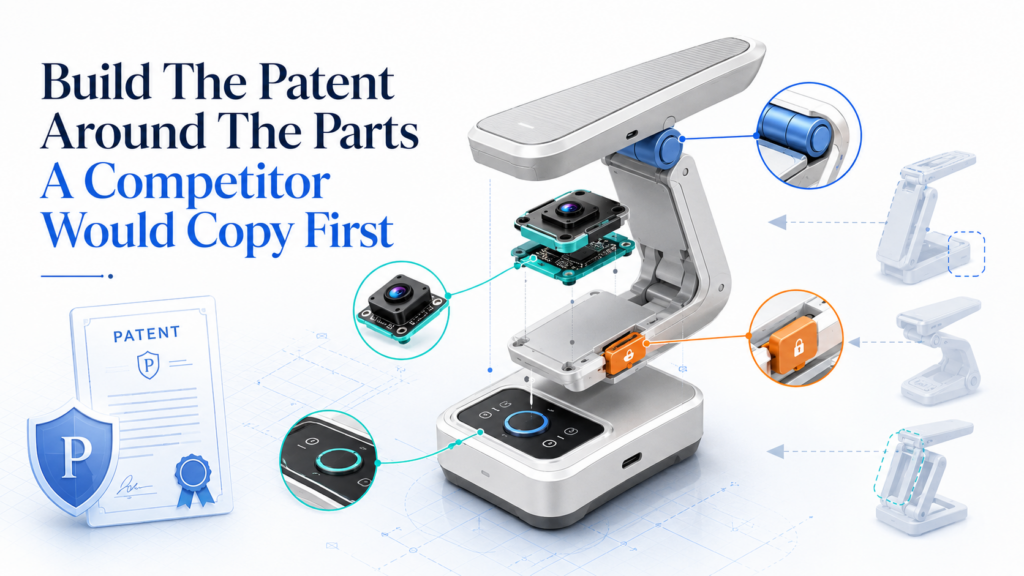
The inventor knows where the product is special. The attorney helps turn that value into protection that is hard to dodge.
This starts with a hard question. If a rival saw the product at a trade show, what would they try to copy first? They may not copy the full device.
They may copy the one part that makes it smaller, cheaper, safer, faster, easier to use, or easier to make. That is where the patent work should focus.
For a device company, the most valuable feature may not be the feature that looks most exciting in the product demo. It may be the quiet part inside the device that makes the demo possible.
It may be the seal that keeps fluid away from the electronics. It may be the spring force that keeps contact steady. It may be the shape of a channel that controls flow.
It may be the mount that keeps a camera stable. It may be a housing choice that lets the product pass drop tests.
A founder should not expect the attorney to guess this. The inventor needs to explain what parts matter most.
The attorney then needs to ask how those parts could be changed by someone trying to avoid the patent.
PowerPatent helps founders capture those key design details in a cleaner way, with smart software and real attorney review working together. You can see how it works here: https://powerpatent.com/how-it-works
The Best Patent Strategy Starts With Copycat Thinking
The most useful patent meeting is not only about what the device does. It is about how someone else might steal the value without copying the exact product. This is where the attorney and inventor should think like a careful copycat.
A copycat may change the material. They may move a sensor a few millimeters. They may change the shape from round to square.
They may replace a hinge with a flexure. They may use a different connector. They may split one part into two parts. They may combine two parts into one molded piece.
If the patent only protects the exact version shown in one prototype, that kind of copy may slip through. This is why the inventor must explain which parts are required and which parts are just one good way to build the invention.
The attorney should press for this line. Is the metal frame required, or could plastic work? Does the sensor have to sit on the left side, or does it only need to sit away from heat? Does the device need three channels, or does it need at least one channel with a certain flow path? Does the clamp need a spring, or does it need a bias force that holds contact?
These questions can feel slow, but they make the patent much stronger.
The Inventor Should Separate Must-Have Features From Nice-To-Have Features
In hardware, not every feature deserves the same weight. Some features make the invention work. Some make it cheaper.
Some make it look better. Some help with comfort. Some are only there because the first prototype used available parts.
The attorney needs to know the difference.
A must-have feature is usually tied to the result. Without it, the device may fail, lose accuracy, break, leak, overheat, drain power, or become hard to use. A nice-to-have feature may improve the product, but it may not be the thing that makes the invention new.
This difference matters because patent claims are built around limits. If the patent includes too many limits, it may become easy to avoid.
If it includes too few, it may be too broad or unsupported. The attorney’s job is to find the right level, but the inventor’s input is what makes that possible.
For example, a founder may say the device includes a silicone gasket. The attorney should ask whether silicone is required. Maybe the true idea is not silicone.
Maybe the true idea is a soft seal placed between a sensing chamber and a rigid shell so fluid pressure stays stable. That broader idea may give better protection, if the invention record supports it.
Drawings Should Show The Invention From More Than One Angle
Hardware patents depend heavily on drawings because devices are physical. A good drawing can show what words alone may miss.
The USPTO says drawings are required when they are needed to understand the subject matter being claimed, and the written record and drawings can be important support for later claim changes.
This is why attorney–inventor collaboration on drawings is so important. The attorney may know what needs to be shown for patent support. The inventor knows what the drawing must not leave out.
A simple outside view is rarely enough for a serious device patent. The patent may need exploded views, cross-section views, inside views, flow path views, circuit layout views, sensor placement views, attachment views, and use-state views. The goal is not to make the patent pretty. The goal is to make the invention clear.
If a device changes shape during use, the drawings should show that change. If a cartridge locks into place, the drawings should show the lock before, during, and after engagement.
If the sensor only works because of its angle, distance, or shield, the drawings should make that visible.
The Best Drawings Protect The Hidden Parts
Many hardware products look simple from the outside. The real work happens inside. That is why the inventor should never assume the outside view tells the full story.
A good attorney will ask for internal views because competitors often copy what users never see. For example, a smart inhaler may look like a normal handheld shell.
But inside, there may be an airflow channel, pressure sensor, battery board, valve seat, and mouthpiece seal that work together in a new way. If the patent only shows the shell, it may miss the most valuable invention.
The inventor should mark up images and CAD screenshots in plain words. “This wall blocks heat.” “This opening lowers back pressure.” “This rib keeps the cartridge aligned.” “This gap lets the part flex without cracking.” Those notes help the attorney turn physical design choices into clear patent support.
This is also where PowerPatent can reduce delay. Instead of forcing founders to explain everything in scattered emails, the process can help organize the invention so attorneys can review the right details faster.
See how PowerPatent helps make patent work clearer here: https://powerpatent.com/how-it-works
Claims Should Match The Real Commercial Moat
The claims are the part of the patent that define the legal protection. But founders do not need to think like lawyers to help with claims. They need to think like builders. They need to explain what gives the product its market edge.
The USPTO’s guidance makes clear that patent applications must describe the invention and explain how to make and use it in a full, clear way, so claim strategy needs support in the written description, examples, and drawings.
For hardware, the claim plan should follow the business moat. If the market edge is the sensor package, the claims should not spend all their energy on the outer case.
If the market edge is disposable use, the claims should cover the cartridge, the reader, and the way they interact. If the edge is low-cost manufacturing, the claims may need to cover part shape, assembly flow, and how the device avoids extra parts.
The Founder Should Review Claims For Business Fit
Before filing, the inventor and founder should review the claims in plain English with the attorney.
The goal is not to rewrite legal language alone. The goal is to ask whether the claims cover what the business cares about.
A helpful question is this: if a competitor copied our core value but changed the outside look, would this patent still matter? Another useful question is this: if we changed our own product design next year, would this patent still protect the new version?
Hardware products change fast. The first version may not be the final version. A good patent plan should leave room for the product to grow, as long as the original filing supports those paths. That is why the first filing needs enough detail.
Use Prototypes, Test Data, And Failure Notes To Make The Patent Stronger
A hardware patent becomes much stronger when the attorney understands the build path. The final device matters, but the road to the final device often matters just as much.
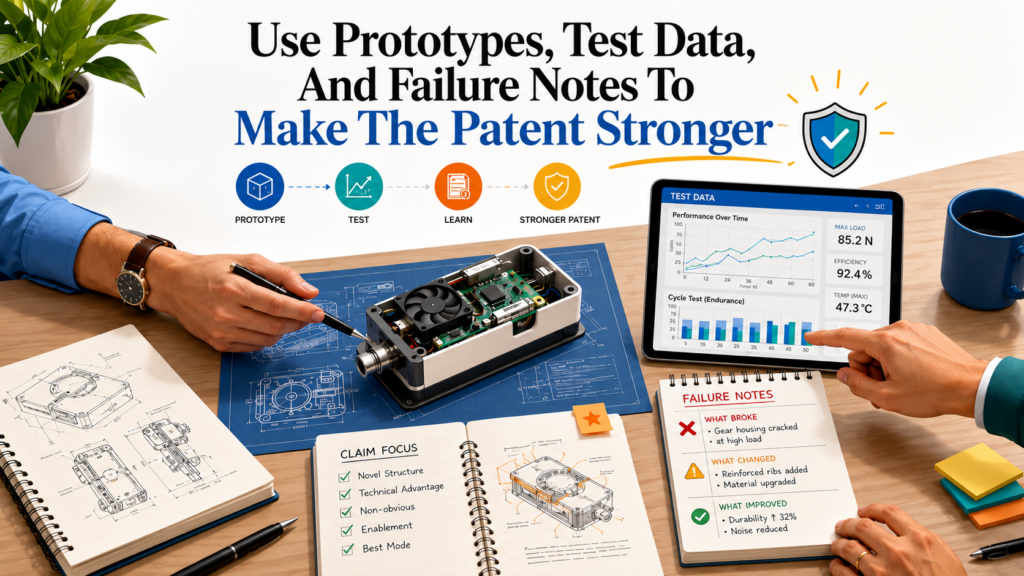
Prototypes, tests, and failures show why the invention works and why it is not just a simple design choice.
Many founders hide rough prototype notes because they think patents should only show the clean final version. That is a mistake.
The attorney does not need every messy lab detail, but they do need the lessons. What failed? What changed? What result improved? What tradeoff did the team solve?
This is where hardware patents are different from many other patent projects. The device may have gone through ten rounds of parts, materials, shapes, mounts, circuits, and firmware changes before it worked. Each change may reveal something important.
A founder may think the invention is “a better wearable patch.” But the testing history may show that the real breakthrough was a layered structure that kept skin contact stable while lowering sweat buildup.
Or the real breakthrough may be a pressure path that stayed accurate while the patient walked. Without prototype and test context, the attorney may write the patent too broadly, too narrowly, or around the wrong feature.
PowerPatent helps teams bring these invention details together so the attorney can see the full picture faster. You can learn how the process works here: https://powerpatent.com/how-it-works
Test Results Help Show Why The Device Matters
Test data does not need to be perfect to be useful. Early test results can show what the invention improves.
They can show better battery life, lower heat, stronger sealing, cleaner signal, faster response, better comfort, lower vibration, fewer leaks, or easier assembly.
The attorney can use this context to draft a better description. Even when exact numbers are not needed in the claims, the patent can still explain the problem and the improvement. That helps make the invention easier to understand.
For example, suppose a founder builds a new cooling structure for a compact imaging device. The final design may include a heat spreader, air gap, shell material, and sensor position.
Test notes may show that earlier versions blurred images after ten minutes because the sensor got too hot. The new structure may keep the sensor stable for much longer.
That story matters. It helps the attorney see why the parts are arranged the way they are. It also helps the patent explain the device as a working solution, not just a set of parts.
The Inventor Should Share The Bad Results Too
Bad results are often more useful than good results. A failed test can show what problem the invention solved. It can also help the attorney avoid claiming a version that does not work well.
If a bracket cracked under stress, say so. If a seal failed when exposed to heat, say so. If a sensor position gave noisy readings, say so. If a motor caused signal issues, say so. If a housing shape made assembly too slow, say so.
This does not make the invention weaker. It gives the attorney a sharper map.
Bad results also help separate the invention from guesses. A competitor may later argue that the design was obvious. A strong patent record can help show that the final design came from solving real problems, not from picking a random part shape.
While patent law is more complex than this, the practical point for founders is simple: the story of testing can help explain why the final device matters.
Failure Notes Help Find Claim Variations
A good patent does not only cover one final product. It should also cover useful variations where possible. Failure notes can help identify those variations.
When an inventor says, “We tried five versions and two worked,” the attorney should ask why those two worked. Maybe both versions used different materials but shared the same geometry.
Maybe both used different sensors but shared the same placement rule. Maybe both used different housings but shared the same pressure-relief channel.
That shared pattern may be the invention.
This is why collaboration matters. The inventor may see five prototypes. The attorney may see a family of claim options. Together, they can turn the test path into stronger coverage.
Prototype Changes Can Reveal The Broad Idea
A patent that only covers one prototype can become stale when the product changes. A better patent tries to protect the deeper idea behind the working versions.
For example, a robotics company may test three gripper designs. One uses rubber pads. One uses a flexible lattice. One uses a soft bladder. At first, these may look like different ideas.
But testing may show that the real invention is not the exact pad, lattice, or bladder. It may be the way the contact surface changes shape while keeping force below a certain level.
That broader insight can only come from inventor input. The attorney cannot see it from a single polished product image.
The inventor should explain what stayed the same across working versions and what changed across failed ones. That contrast is powerful.
Manufacturing Notes Should Not Be An Afterthought
For hardware and device patents, manufacturing can be part of the invention. The way a part is molded, folded, sealed, printed, welded, coated, bonded, aligned, cut, or tested may be where the value lives.
Many founders focus only on the finished device. But if the product is hard to make at scale, the manufacturing method may be a major moat.
A competitor may be able to copy the look of the product, but not the process that makes it low-cost, reliable, or small enough to sell.
The attorney should ask how the device is made. The inventor should explain where assembly was hard, what changed to reduce steps, and what process choices made the product reliable.
For example, if a device uses a snap-fit that also aligns an optical sensor, that may matter. If a molded channel removes the need for a separate tube, that may matter.
If a part is shaped so it can only be assembled one way, that may matter. If a test fixture calibrates the device during assembly, that may matter.
The Patent Should Cover The Product And The Making Of The Product When It Matters
Sometimes the best patent plan includes both device coverage and method coverage. The device coverage may protect the physical product. The method coverage may protect how it is made, used, calibrated, or installed.
This is especially important for hardware that depends on precise assembly or setup. A medical device may need a calibration step.
A sensor module may need alignment. A battery device may need a thermal bonding process. A lab tool may need a priming method. A wearable may need a fitting process.
The attorney can decide how to frame this, but the inventor must provide the facts. What steps are required? What order matters? What step gives the key result? What step could be changed without losing the result?
When the inventor shares manufacturing and use details early, the attorney has more room to build a stronger filing.
The Filing Should Include Enough Detail Before The Clock Starts
One of the most practical reasons to collaborate early is that patent filings have strict limits. Once an application is filed, new matter generally cannot be added to that same application later.
The USPTO explains that later claim changes and amendments must be supported by the original disclosure, which means the first filing needs to be rich enough from the start.
This is a major point for hardware founders. A thin provisional filing may feel fast and cheap, but if it leaves out the key device details, later work can become painful.
The team may think they “filed a patent,” but the filing may not support the claims they want later.
A good first filing should describe the invention, the working versions, useful alternatives, drawings, materials where helpful, part relationships, use cases, and key variations.
It does not need to include every possible detail, but it should not leave the attorney guessing.
A Fast Filing Should Still Be A Smart Filing
Speed matters for startups. But speed should not mean careless filing. The goal is to move fast while still capturing the invention well.
This is exactly the kind of problem PowerPatent is built to solve. Founders need a faster path, but they still need real attorney oversight.
Software can help gather and organize details. Attorneys can help shape those details into a filing that protects the business.
You can see how PowerPatent helps founders file with more clarity and less delay here: https://powerpatent.com/how-it-works
Turn Engineer Language Into Patent Language Without Losing The Truth
Inventors and attorneys often speak different languages. Engineers speak in parts, tests, tolerances, boards, housings, signals, loads, failure modes, and build steps.
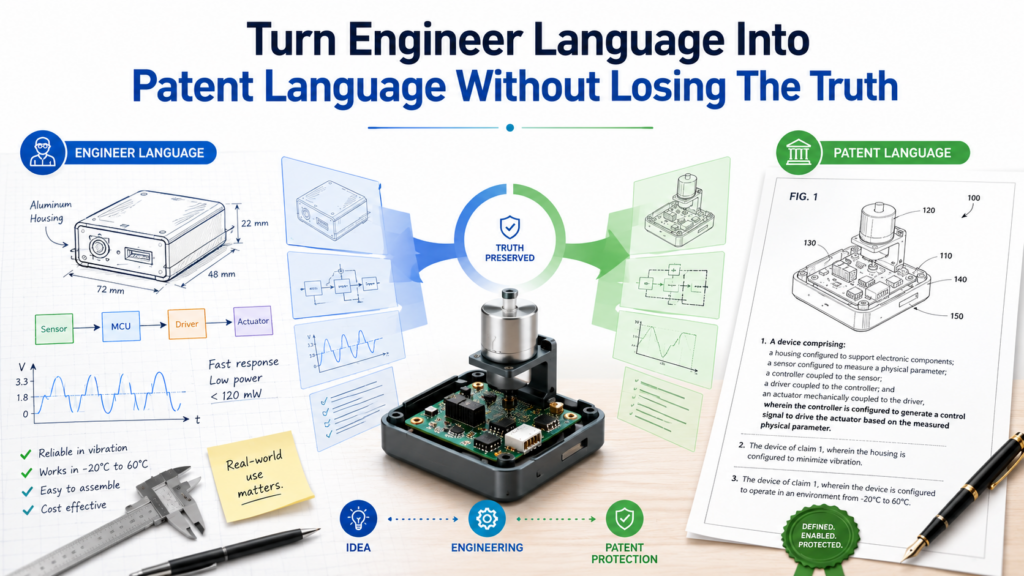
Patent attorneys speak in claims, embodiments, support, scope, and disclosure. Good collaboration turns one language into the other without losing the meaning.
This is not just a writing task. It is a protection task.
If the attorney makes the invention sound too broad, the patent may not be well supported. If the attorney makes it too narrow, a competitor may step around it.
If the inventor only gives lab language, the attorney may miss the business value. If the attorney only gives legal language, the inventor may not catch technical mistakes.
The best process keeps both sides in the loop. The inventor explains the real device in plain terms. The attorney translates that into patent structure. Then the inventor checks whether the translation still matches the device.
This review loop is where many strong patents are made.
PowerPatent makes this loop easier by helping founders organize invention details before and during attorney review. See how the platform works here: https://powerpatent.com/how-it-works
Plain English Should Come Before Legal Drafting
Before the patent is drafted, the team should be able to explain the invention in simple words. If the team cannot explain it simply, the patent may become confused.
The plain-English version should answer a few core questions in paragraph form. What is the device? What problem does it solve? What parts make it work? What is different from older tools? What did the team try before? What changes made the biggest difference? What would a competitor copy?
This simple story becomes the foundation for the patent.
A founder should not worry about using perfect patent terms. In fact, early overuse of legal words can hurt the process.
It can hide the real technical story. The attorney can add the correct structure later. What the attorney needs first is clear truth.
The Best Patent Drafts Start With The Builder’s Words
A strong patent often starts with the way the inventor explains the device at a whiteboard. Those words may be rough, but they carry the real logic.
An inventor might say, “This rib keeps the cartridge from twisting when the user pushes it in.” That is better than saying, “The device has an improved support structure.”
The first sentence tells the attorney what the rib does and why it matters. The second sentence sounds polished but says almost nothing.
The attorney can later describe the rib in broader language, such as a guide feature, alignment feature, support member, or anti-rotation structure. But the attorney needs the builder’s words first.
This is why founders should not sanitize every detail. Explain it like you would explain it to a smart teammate who has never seen the device before.
The Attorney Should Ask For Alternatives
One of the most important jobs of the attorney is to ask what else could work. Hardware inventors often describe the best version. Patent attorneys need to know the useful versions.
Could the part be metal, plastic, ceramic, or composite? Could the sensor be optical, electrical, pressure-based, thermal, magnetic, or acoustic? Could the housing be rigid or flexible? Could the device be worn, mounted, handheld, implanted, clipped, docked, or placed on a surface? Could the power source be a battery, wired source, charging pad, energy harvester, or external module?
The goal is not to claim fantasy. The goal is to capture real alternatives that the inventor believes could work.
This matters because product design changes. Supply chains change. Customer needs change. The first prototype may use one sensor because it was easy to buy.
The shipped product may use another sensor because it is cheaper or better. The patent should not break just because the product matures.
Alternatives Must Be Real Enough To Support
The attorney should not add empty alternatives just to make the patent look broad. Patent applications need real support.
The USPTO’s written description and enablement rules focus on whether the application describes the invention and teaches how to make and use it clearly enough for the relevant field.
For founders, the practical lesson is simple. Share alternatives you have tested, considered, or can reasonably explain. Do not throw in random options that no one understands.
If a flexible hinge could be replaced by a living hinge, a pin hinge, or a spring arm, explain how each would work. If a fluid sensor could use two different sensing methods, explain what changes in the device.
If a casing material could vary, explain what properties matter, such as stiffness, heat transfer, sealing, or skin comfort.
This gives the attorney real material to work with.
Inventors Should Review The Draft Like A Competitor
When the draft comes back, the inventor should not only check for typos. They should review it like a competitor and like a builder.
As a builder, the inventor should ask whether the draft is technically correct. Are the parts named clearly? Are the drawings accurate? Does the description match how the device works? Are any features described as required when they are only optional? Are any optional parts missing? Are the key failure fixes explained?
As a competitor, the inventor should ask whether the draft is easy to avoid. Could someone move the sensor and escape? Could someone change the material and escape? Could someone replace one part with two parts and escape? Could someone copy the key value while avoiding the exact wording?
This kind of review is far more useful than a passive approval.
The Founder Should Ask For A Plain-English Claim Walkthrough
Claims can be hard to read. That is normal. But the founder should still understand the business meaning of the claims before filing.
A good attorney should be able to walk through the claims in plain English. The founder should ask what each main claim is trying to protect.
The founder should also ask what design changes might still be covered and what design changes might fall outside.
This does not mean the founder becomes the attorney. It means the founder takes ownership of the business goal.
A patent is not just paperwork. It is a tool for the company. If the founder cannot explain what the patent is trying to protect, the company may not be using the tool well.
The Final Draft Should Be Checked Against The Product Roadmap
Hardware products evolve. The product that gets filed today may not be the product sold in eighteen months.
That is why the attorney and inventor should compare the draft against the product roadmap before filing.
Will the next version be smaller? Will it use a different battery? Will the sensor move? Will the device connect to a base station? Will a disposable part be added? Will the device move from lab use to home use? Will the product need a new form factor for a different customer?
If these paths are likely, the patent should include support where possible.
A Patent Should Protect The Direction, Not Just The Snapshot
A weak filing protects only the current snapshot. A stronger filing protects the direction of the invention.
This does not mean claiming things the team has not invented. It means explaining known variations and likely product paths that grow from the same core idea.
The attorney can help decide what belongs in the filing. The inventor can explain what is technically real.
PowerPatent helps founders move faster without losing this depth. The platform gives inventors a better way to share the device story, while real attorneys help turn that story into protection. Learn more here: https://powerpatent.com/how-it-works
Make The Drawings Do Heavy Lifting
For hardware and device patents, drawings are not decoration. They are part of the protection strategy. A clear drawing can show the device in a way that makes the written description stronger, easier to read, and easier to support later.
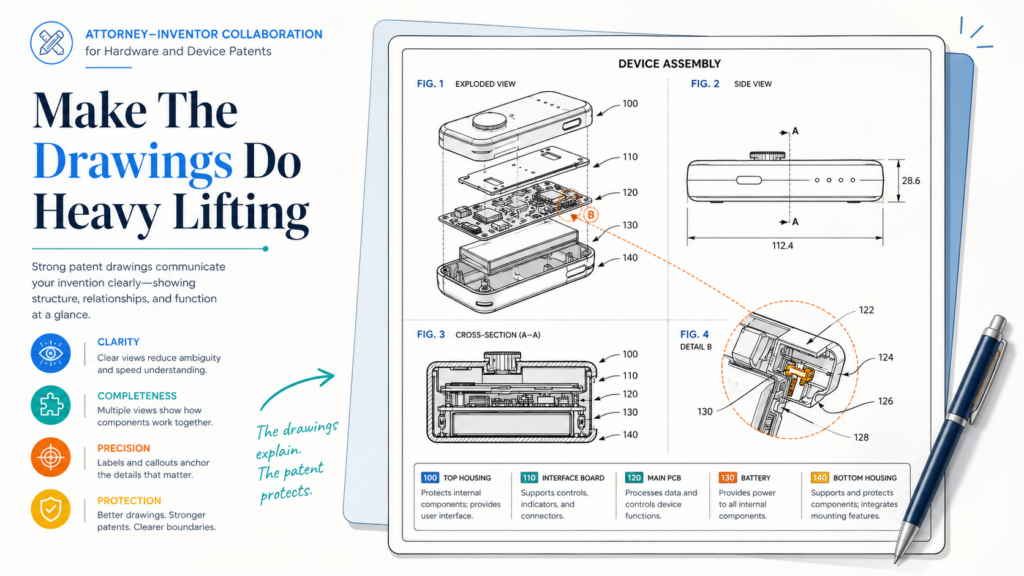
Many founders treat drawings as a final step. They send a few CAD screenshots and assume the attorney will handle the rest.
That can work for simple inventions, but it is risky for serious hardware. The best drawings are planned early because they shape how the invention is understood.
A good drawing set should help a reader see the device from the outside, inside, and during use. It should show the parts that create the result.
It should make the key relationships clear. It should show the difference between the device at rest and the device in action if that difference matters.
The attorney knows what patent drawings need to support. The inventor knows which views reveal the real invention. When they work together, the drawings become much more than pictures.
PowerPatent helps hardware teams organize invention materials so drawings, descriptions, and attorney review can connect more smoothly. You can explore the process here: https://powerpatent.com/how-it-works
The First Drawing Question Is What Must Be Understood
Before choosing views, the team should ask what the reader must understand to grasp the invention. That question is better than asking what images are easiest to make.
If the invention is about airflow, the drawings should show the airflow path. If it is about heat, the drawings should show heat-related structures.
If it is about attachment, the drawings should show the attachment steps. If it is about sensor accuracy, the drawings should show sensor position, spacing, shielding, and the part that holds the sensor steady.
A patent drawing does not need to show every tiny commercial detail. But it should show the parts that support the invention.
The USPTO’s guidance reflects that drawings may be needed when they help explain the subject matter of the application.
This is why a founder should not just send beauty renders. Beauty renders are made to sell. Patent drawings are made to explain.
Patent Drawings Should Remove Distraction
A product render may include color, shadows, logos, styling, textures, buttons, screen graphics, and surface details. A patent drawing should usually be cleaner. It should guide attention to structure and function.
The inventor should help the attorney and draftsperson remove what does not matter and show what does.
If a logo is not part of the invention, it may distract. If a decorative curve is not important, it may not need focus. If an internal rib is key, it should be visible and labeled.
The best drawings are simple but not shallow. They show enough detail to support the invention without burying the reader in noise.
Cross-Sections Are Often Where The Value Appears
For many devices, the outside view tells only ten percent of the story. Cross-sections show what is inside. They reveal channels, cavities, seals, walls, supports, sensors, contacts, clips, layers, and spacing.
If the invention involves fluid, gas, heat, light, force, or electric connection, cross-sections can be vital. They can show how the device routes movement or energy through the body of the product.
For example, a device that measures blood flow may need a cross-section showing the sensor window, optical path, pressure surface, and skin-facing layer.
A smart tool may need a cross-section showing how a battery, board, motor, and shield fit into a small handle. A filtration device may need a cross-section showing flow paths and sealing points.
The inventor should identify which internal relationships make the device work. The attorney can then make sure the drawing set supports those relationships.
Exploded Views Help Show How Parts Work Together
An exploded view can be very useful when the invention depends on how parts fit together. It can show order, alignment, connection, and assembly.
This is especially helpful for cartridges, wearables, handheld tools, lab devices, sensor units, medical devices, robotics parts, and consumer hardware.
Exploded views can show how a seal sits between two shells, how a board fits into a frame, how a latch enters a slot, or how a disposable part mates with a reusable base.
The key is not just showing parts floating apart. The key is showing why their relationship matters.
The inventor should tell the attorney which parts must be aligned, which parts carry load, which parts block movement, which parts seal, and which parts are replaceable. That helps the drawing set support the patent strategy.
Use-State Drawings Can Protect The Real Customer Moment
Some hardware inventions are only clear when shown in use. A device may bend, lock, pierce, clamp, inflate, rotate, slide, heat, cool, scan, dose, measure, or dock. If the patent only shows the device sitting still, it may miss the core action.
Use-state drawings show what happens when the product meets the user, patient, machine, sample, tool, package, or environment.
For a wearable, this may mean showing the device on skin. For a surgical tool, this may mean showing the tool near tissue. For a factory sensor, this may mean showing the sensor mounted near a moving part.
For a charger, this may mean showing the device docked. For a test cartridge, this may mean showing a sample entering and moving through the device.
The Inventor Should Explain The Real-World Setting
Hardware devices do not live in perfect lab space. They live in pockets, clinics, cars, homes, factories, bags, bodies, hands, walls, pipes, and weather. The setting can matter.
The inventor should explain where the device is used, how it is held, what it touches, what force is applied, what dirt or fluid it faces, and what mistakes users may make.
This information can shape drawings and description. If the device works because it prevents wrong insertion, show the insertion path.
If it works because it keeps a surface clean, show the cover. If it works because it tolerates a user pressing too hard, show the force path.
A patent that understands real use is usually stronger than one that only describes a perfect device on a table.
The Drawing Labels Should Match The Written Story
Drawings and text must work together. If the drawing labels are confusing, the whole patent becomes harder to follow. If the same part has different names in different places, the reader can get lost.
The attorney should keep naming consistent. The inventor should check that the names make sense.
A “retainer,” “clip,” “support,” “guide,” and “housing member” may sound clear to a patent professional, but the inventor needs to confirm what each term refers to.
The written description should explain what each important part does, not just what it is.
Good Labels Help Future Review
A patent may be read years later by investors, partners, examiners, competitors, courts, buyers, or future team members. Clear labels help everyone understand the invention faster.
The goal is not to make the patent casual. It still needs to be formal. But formal does not mean confusing.
A strong device patent should be clear enough that a skilled person can understand the parts, the relationships, and the use.
This is one of the places where PowerPatent’s software-plus-attorney model can help. Founders can provide visual and technical context, while attorneys help turn that context into a clear filing. Learn more here: https://powerpatent.com/how-it-works
Keep The Filing Broad Enough For Growth And Clear Enough For Support
A hardware patent must balance two needs. It should be broad enough to protect the business as the product grows.
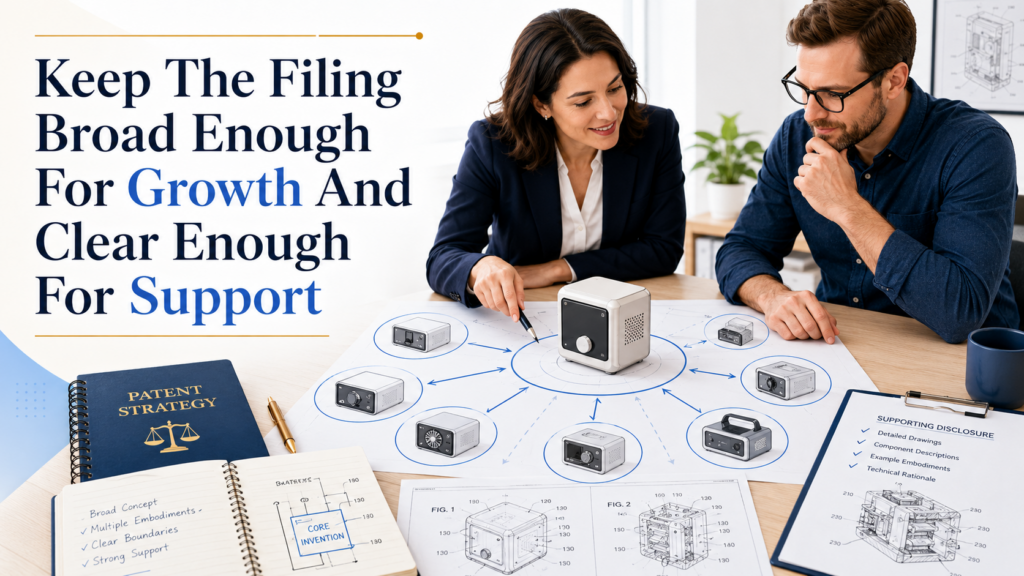
It should also be clear enough to support what is claimed. This balance is where attorney–inventor collaboration matters most.
Founders often want the broadest patent possible. That is understandable. No founder wants a competitor to make a tiny change and escape. But broad claims need a strong foundation.
The filing must explain the invention well enough and show enough versions, options, and details to support the protection being sought.
On the other hand, some founders go too narrow. They describe only the exact prototype in front of them. That may feel safe, but it can limit future value.
A competitor may change the shape, material, size, sensor type, or mounting method and still take the core idea.
The right answer is not “broad” or “narrow.” The right answer is supported breadth. That means the patent describes the core idea, the important parts, and the useful variations in a way that is honest, clear, and tied to the real invention.
PowerPatent helps founders move toward this balance by making it easier to capture invention details and then work with real attorneys who can shape those details into a stronger filing. See how it works here: https://powerpatent.com/how-it-works
The First Filing Should Not Trap The Company In Version One
Hardware startups change fast. Version one is often a learning tool. Version two may be the real product. Version three may be the product that scales.
If the first patent filing only covers version one, the company may regret it. The patent may not match the product that finally wins the market.
This is why the attorney should ask about the roadmap before filing. The inventor should share likely changes, even if they are not final.
Will the device become smaller? Will it move from wired to wireless? Will it use a new sensor? Will a disposable part be added? Will the product work with more than one cartridge? Will the housing change for mass production? Will the device move from a clinic to home use?
These are not side issues. They can affect the patent.
Product Roadmap Details Can Create Better Coverage
A roadmap helps the attorney understand what should be described as optional, what should be shown as a variation, and what should not be locked into the claims too early.
For example, if the prototype uses screws but the product will likely use snap-fits, the patent should not make screws sound required unless they truly are.
If the prototype uses aluminum but plastic may work, the patent should explain the important material properties instead of naming only one material.
If the device has one sensor now but may use two later, the patent should describe how one or more sensors may be arranged if that is part of the invention.
This does not mean padding the filing with random ideas. It means making sure the filing reflects the real path of the product.
Broad Terms Need Clear Meaning
Patent language often uses broader terms than engineering notes. A “fastener” may cover a screw, clip, latch, adhesive, weld, or snap-fit.
A “biasing member” may cover a spring, flex arm, elastic body, or magnetic force. A “sensor” may cover several sensing types.
Broader terms can be useful, but only when the patent explains them well. If a broad term is vague, it can create confusion. If it is supported by examples and context, it can help the patent cover real design changes.
The inventor should help the attorney choose broad terms that still match the invention. The attorney should explain what those terms mean in plain language.
The Patent Should Explain Examples Without Making Them The Only Option
A common patent drafting skill is to describe one or more examples while making clear that the invention is not limited to only those examples, where appropriate. This matters a lot for hardware.
If the device uses a clip in the prototype, the patent may also explain that other attachment structures could be used, if they perform the needed function.
If the device uses a certain sensor, the patent may explain other sensor types that could work. If the housing has a round shape, the patent may describe other shapes if the shape is not central.
The inventor must help keep this honest. Some features truly are required. Others are not. The attorney needs to know which is which.
The Filing Should Support Future Claim Changes
Patent claims may change during examination. That is normal. But claim changes must be supported by what was filed.
The USPTO makes clear that amendments and claims need a descriptive basis in the original disclosure, and new matter cannot simply be added after filing.
For hardware companies, this is a major reason to include enough detail at the start. If a competitor appears later and the original filing does not describe the feature you now want to claim, the company may have fewer options.
A strong filing gives the attorney more room. It includes the main device, key subparts, alternatives, use methods, assembly methods, materials where helpful, sensor options, control paths, mechanical relationships, and drawings that show the invention clearly.
Thin Provisionals Can Create A False Sense Of Safety
A provisional application can be useful, especially when speed matters. But a thin provisional can be dangerous if it leaves out the real invention.
The USPTO explains that a provisional application includes a specification and, where needed, drawings, and that it is abandoned after twelve months if the proper next step is not taken.
The practical lesson is simple. Filing fast is not enough. Filing well matters.
A founder should not treat a provisional as a placeholder with no substance. If the provisional is meant to support later claims, it should describe the invention with care.
The attorney and inventor should work together before filing, even when time is tight.
This is where PowerPatent can help founders avoid costly shortcuts. The platform is built to help capture the invention clearly, while attorney oversight helps turn that information into a better filing.
Learn more here: https://powerpatent.com/how-it-works
The Patent Should Leave Room For Product Families
Many hardware startups do not end with one product. They build a family. A device may lead to cartridges, docks, chargers, mounts, sensors, tools, kits, disposables, software interfaces, calibration systems, and accessories.
The patent strategy should think about that early.
A single filing may not cover everything. But the first filing can often lay the groundwork. It can describe how the main device works with related parts.
It can show the system around the device. It can explain how a user installs, replaces, charges, cleans, or pairs the product.
System-Level Thinking Can Protect More Value
A competitor may not copy only the device. They may copy the system. For example, they may sell a reusable reader and a disposable cartridge.
They may sell a wearable sensor and a charging dock. They may sell a robotic tool and a special end effector. They may sell a test unit and a set of sample containers.
If the patent only describes the main unit, it may miss the business model.
The inventor should explain how money will be made. Is the value in the device, the disposable, the data, the mount, the kit, the consumable, the calibration method, or the full workflow?
The attorney can then shape the patent plan around what the business needs to defend.
That is the real point of attorney–inventor collaboration. The attorney is not just writing a document.
The inventor is not just handing over drawings. Together, they are building a protection plan around the parts of the hardware business that matter most.
Use The Attorney As A Design Stress Tester Before You File
A good patent attorney does more than write. For a hardware or device patent, the attorney should also stress test the invention story before anything is filed.
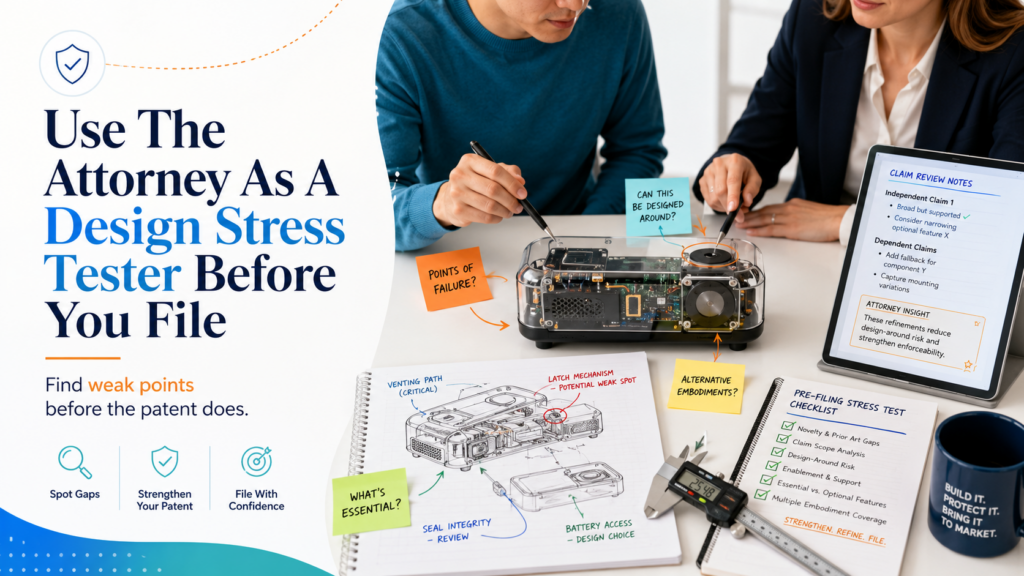
This does not mean the attorney is judging the product like an investor. It means the attorney is looking for weak spots in how the invention is explained, claimed, and supported.
This is a very useful step for founders because hardware products often feel clear to the team that built them. The inventor knows why each part is there. The engineer knows why the shape changed.
The product lead knows why the device has to fit in a certain place. But none of that is obvious to an outsider unless it is explained.
A patent filing has to stand on its own. It should not depend on the inventor being in the room later to explain what a part means or why a design choice matters.
If the patent leaves out the reason behind the structure, the filing can become thin. If it names parts without showing how they work together, it can become hard to use. If it treats a prototype feature as required when it is not, it can become too narrow.
That is why the attorney should push on the device before filing. They should ask what happens if a competitor moves a part, changes a material, flips an orientation, changes a shape, combines two pieces, splits one piece, or uses a different sensing method.
These questions are not meant to slow the founder down. They are meant to save the founder from filing a patent that protects the wrong thing.
PowerPatent is built for this kind of clear, guided collaboration. It helps inventors share the real details of what they built, then brings in real attorney oversight to shape those details into better protection. You can see how it works here: https://powerpatent.com/how-it-works
A Strong Patent Review Should Feel Like A Smart Challenge
The attorney should not just accept the first version of the invention summary. They should challenge it. Not in a harsh way, but in a useful way. The goal is to find the edges of the invention before a competitor does.
For example, if the inventor says the device needs a “curved housing,” the attorney should ask whether the curve is required.
Does the curve help the device fit the body? Does it guide fluid? Does it reduce stress? Does it improve grip? Does it protect a sensor? Or is it only a styling choice?
That one question can change the whole filing. If the curve is part of the invention, the patent should explain why. If the curve is not required, the patent should avoid making the claim depend on it too much.
The same logic applies to parts, materials, sizes, sensors, motors, batteries, mounts, seals, screens, ports, and control units. The attorney should keep asking what matters and why.
The Best Questions Expose The Real Invention
A good attorney question often sounds simple. Could this part be in another place? Could the device work without this element? What part cannot be removed? What would make the product fail? What did older devices do differently? What did your team try that did not work?
These questions may feel basic, but they cut deep. They help separate the invention from the product styling. They also help the inventor see which parts are central and which parts are only one version.
For a founder, the best way to answer is with direct, plain words. Do not try to sound legal. Say what happens in the real device.
Say what breaks. Say what improves. Say what changes when the part moves. Say what must stay the same for the result to happen.
That kind of clear answer gives the attorney better material than polished language ever could.
The Attorney Should Look For Design-Around Paths
A design-around is a change a competitor might make to avoid the patent while still taking the value of the invention.
In hardware, design-arounds are common because physical products can often be changed in visible ways while keeping the same core result.
A competitor may change the housing shape. They may replace a spring with an elastic arm. They may move a sensor from the top to the side. They may change a cartridge from a round form to a flat form.
They may use a magnet instead of a latch. They may place the electronics in a dock instead of inside the handheld unit.
The attorney should think about these paths before filing. The inventor should help by explaining which changes would still work and which changes would destroy the benefit.
This is not about making the patent cover every possible product in the world. It is about making sure the patent covers the real invention, not only the first commercial shell.
The Founder Should Ask What A Rival Could Change
Before filing, the founder should sit with the attorney and ask a very direct question: what could a rival change and still get our benefit?
This question forces the team to think beyond the current design. It also helps the attorney decide where to add more examples, more drawings, or more language.
If the current draft only shows one latch, but other latch types could work, the filing may need to explain that. If the current draft only shows one sensor spot, but the true need is distance from heat, the filing should focus on that relationship.
This step is especially important for startups because the first filing may become the base for later filings. A weak base limits future options. A thoughtful base gives the company more room.
Do Not Let Speed Remove The Hard Questions
Startups move fast. That is good. Speed can help a company beat larger players. But patent speed without clear thought can create fragile protection.
A fast filing should still ask the hard questions. What is new? What is required? What can change? What does the device do better? What did the team test? What will competitors copy? What parts tie to revenue? What does the roadmap look like?
These questions do not need months of delay. They need a better process.
That is the value of using a patent workflow built for founders and engineers. PowerPatent helps teams capture details faster while still keeping real attorney review in the loop.
That mix matters because software alone cannot judge every strategic issue, and attorney work alone can become slow if the invention details are scattered.
You can learn how PowerPatent helps founders file faster without losing control here: https://powerpatent.com/how-it-works
The Right Process Makes Speed Safer
Speed becomes safer when the inventor knows what to share and the attorney knows what to look for. A founder should not have to guess what matters.
The process should draw out the right details: the problem, the old limits, the parts, the variations, the test results, the use cases, and the business risk.
When those details are organized, the attorney can spend less time chasing missing facts and more time shaping protection.
That is what strong collaboration does. It turns speed into an advantage instead of a shortcut.
Protect The Interface Between Hardware, Software, And Data
Modern devices are rarely just mechanical. Many hardware products include sensors, firmware, mobile apps, cloud systems, machine learning models, dashboards, calibration tools, and data flows.

For these inventions, the strongest patent work often happens at the interface between the physical device and the digital system.
This is where many teams leave value on the table. A founder may think they need a hardware patent for the device and maybe a software patent for the app. But the real invention may sit between the two.
It may be the way the device collects signals, cleans them, uses them to adjust behavior, sends them to another system, or turns them into useful action.
For example, a wearable health device may be valuable because the sensor placement reduces noise, but the signal processing may also matter.
A robotic tool may be valuable because the gripper is soft, but the control loop may be what lets it handle fragile objects.
A smart appliance may be valuable because the chamber shape improves flow, but the device may also adjust heating based on sensor feedback.
Attorney–inventor collaboration is critical here because the attorney needs to understand both the physical device and the digital behavior. The inventor needs to explain how the full system works, not just the visible object.
PowerPatent is built for deep tech teams that often work across code, devices, models, and systems.
It helps founders turn complex technical work into clearer patent filings with real attorney oversight. See how the process works here: https://powerpatent.com/how-it-works
The Device Should Be Described As A System When The System Creates The Value
A hardware product may include a sensor module, processor, memory, power source, wireless link, app, server, model, and output screen.
If the patent only describes the shell and sensor, it may miss how the invention actually helps the user.
The attorney should ask how data moves through the product. What is sensed? Where is the signal processed? What noise is removed? What decision is made? What action happens next? Does the device change behavior based on the data? Does the app guide the user? Does the system learn from past use?
The inventor should explain this in simple cause-and-effect terms. The sensor detects something.
The controller compares it. The device adjusts something. The app alerts the user. The model improves the estimate. The device stores or sends the result.
That flow can become very important patent material.
The Physical Arrangement Can Make The Data Better
In device patents, data quality often depends on physical design. A signal is not just a number.
It is shaped by where the sensor sits, how the housing blocks noise, how the user holds the device, how heat moves, how light enters, how pressure is applied, or how fluid flows.
The attorney should not treat data as separate from the hardware. The inventor should explain how the device shape improves the signal.
For example, a sensor may be angled to reduce glare. A shield may block motor noise. A flexible layer may keep contact pressure stable.
A channel may slow fluid before it reaches a detection zone. A mount may reduce vibration. A thermal path may keep a chip from drifting.
These physical details can be central to the patent. They show why the device is not just a generic sensor connected to generic software.
Firmware And Control Logic Should Be Explained In Plain Words
Many hardware products depend on firmware. Firmware may control timing, power, sensing, safety checks, calibration, motion, alerts, or data transfer.
Yet inventors often give attorneys only a block diagram and assume that is enough.
A better approach is to explain what the device decides and why. What input does it receive? What threshold does it check? What pattern does it look for? What mode does it enter? What does it shut off? What does it change? What does it warn about?
The attorney can then decide how to describe the control logic in a patent-friendly way. The inventor does not need to provide perfect legal language. They need to provide clear logic.
Control Choices Can Be Patent-Worthy When They Solve A Device Problem
Not every software step belongs in a patent claim. But some control choices are deeply tied to the hardware problem.
For example, a device may pulse power to reduce heat while keeping readings accurate. A pump may change speed based on pressure feedback.
A wearable may delay a reading until motion drops. A robotic arm may soften grip when a sensor detects slip. A charger may adjust current based on device temperature.
These are not just app features. They are device behaviors. They can be part of the invention if they solve a real technical problem.
The attorney and inventor should work together to describe those behaviors as part of the full system.
Data Outputs Should Be Connected To Real User Action
A device may collect data, but the value often comes from what the user can do with it. The patent should not stop at “data is displayed” if the invention gives the user a better action path.
Does the device tell a patient to adjust placement? Does it tell a technician to replace a cartridge? Does it guide a surgeon’s motion?
Does it warn that a part is misaligned? Does it adjust a machine before failure? Does it trigger a cleaning cycle? Does it change a dose, pressure, speed, or temperature?
This matters because hardware devices often compete on real-world outcomes. The patent should explain how the device leads to those outcomes.
The Inventor Should Explain The Moment Of Use
A founder should describe the moment when the user gets value. This may be the moment a nurse sees an alert, an operator fixes a machine, a parent checks a child’s reading, a technician swaps a module, or a robot changes its grip.
That moment can help the attorney understand the business value and the technical path. It can also help the patent show why the device matters in practice.
A strong patent does not need marketing fluff. But it should make the practical benefit clear.
Do Not Forget The Backend If It Matters
Some devices depend on cloud systems, shared data, remote updates, model training, fleet learning, device pairing, or secure access. If that backend helps the invention work, the attorney should know.
For example, a device may improve calibration by comparing readings across many units. A machine sensor may learn normal vibration patterns over time.
A home medical device may sync with a clinician dashboard. A smart tool may receive updated control settings based on field data.
If the backend is part of the invention, the filing should describe it clearly.
The Patent Should Match The Full Product Architecture
The inventor should provide a simple architecture story. What happens on the device? What happens in the app? What happens in the cloud? What happens later when the device is updated or serviced?
This helps the attorney avoid treating the invention as a single isolated object when the real product is a connected system.
For deep tech startups, this can be the difference between a patent that protects a component and a patent that protects the full business engine.
PowerPatent helps founders capture both physical and digital invention details so attorney review can be more complete. Learn more here: https://powerpatent.com/how-it-works
Keep Inventors Involved Through Draft Review, Not Just Disclosure
Many patent projects start with a strong inventor meeting and then go quiet. The attorney drafts. The inventor waits. Then a draft appears near the filing deadline. The inventor skims it, finds a few small errors, and approves it.
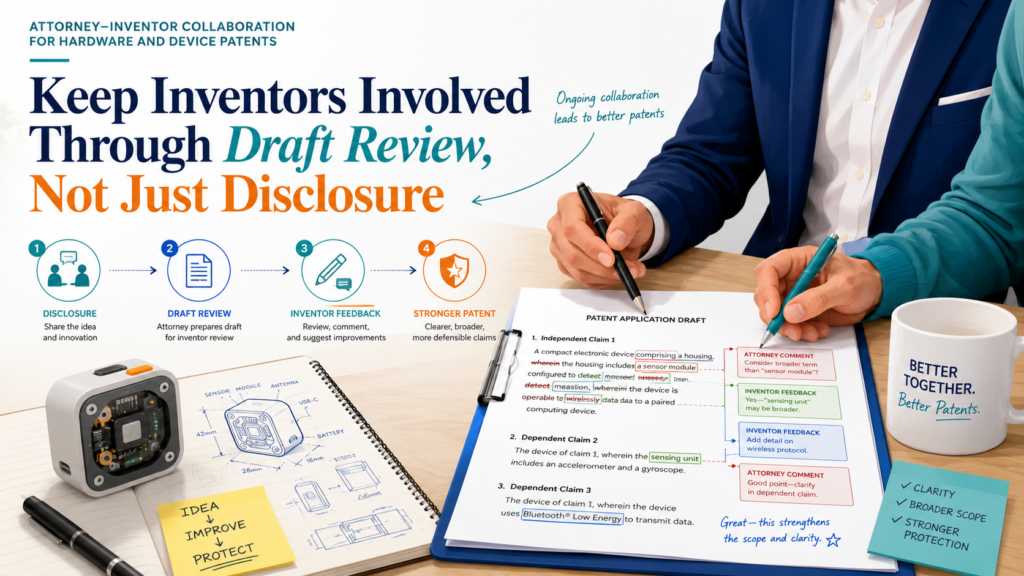
That is not enough for a serious hardware patent.
Inventors should stay involved during review because they are the only people who can confirm that the patent matches the real device.
They know which parts are required, which parts can change, which drawings are accurate, which examples are realistic, and which statements may create problems later.
Draft review is not a formality. It is a quality control step. For hardware and device patents, it may be one of the most important steps in the whole process.
The attorney can write strong legal language, but the inventor must make sure the technical story is true. If the draft says a sensor is “above” a chamber when it is really beside it, that may matter.
If the draft says a seal is fixed when it can be removable, that may matter. If the draft says a housing is rigid when part of it may flex, that may matter. Small words can create big limits.
PowerPatent helps make this kind of review less painful by giving founders and inventors a more organized process, paired with real attorney oversight. You can see how it works here: https://powerpatent.com/how-it-works
Inventor Review Should Be Structured, Not Casual
A casual review often catches spelling errors and misses strategy issues. A structured review checks whether the patent protects the real invention.
The inventor should read the draft with a few clear goals. First, check whether the device is described correctly. Second, check whether the important parts are shown in the drawings.
Third, check whether optional features are not described as required. Fourth, check whether likely future versions are supported. Fifth, check whether the draft covers the part a competitor would copy.
This review does not need to turn the inventor into a lawyer. It simply makes sure the patent is built on the real product.
The Inventor Should Mark Confusing Language
If a sentence feels confusing to the inventor, it may confuse others too. Patent language can be formal, but it should not be unclear.
The inventor should mark any sentence that seems technically wrong, too narrow, too broad, or hard to follow.
The attorney can then revise or explain. Sometimes the language is chosen for a legal reason. Sometimes it is just unclear and should be improved. Either way, the conversation makes the patent better.
Inventors should never approve a draft they do not understand at a basic level. They do not need to understand every legal nuance, but they should understand what the patent says the device is and does.
Drawings Deserve A Separate Review Pass
Drawings should not be reviewed as an afterthought. They deserve their own pass because drawings often carry key support for hardware patents.
The inventor should check whether the drawings show the right parts, the right relationships, the right internal views, and the right use states.
They should check whether labels match the written description. They should check whether any important hidden feature is missing.
For example, if the invention depends on how a cartridge locks into a reusable base, the drawings should show the cartridge, the base, the lock, and the engaged state.
If the invention depends on airflow, the drawings should show the airflow path. If the invention depends on sensor shielding, the drawings should show the shield.
Missing Drawing Views Can Limit Future Options
A missing drawing does not always ruin a filing, but it can make later claim work harder. If the original application does not show or describe a feature clearly, it may be harder to rely on that feature later.
That is why drawing review should happen before filing, not after. The inventor should ask whether the drawing set would let a skilled person understand the device without a live demo.
If the answer is no, the drawing set may need more work.
Claims Need A Business Review, Not Just A Legal Review
Claims define the protection, but founders often avoid them because they are hard to read. That is understandable, but risky.
The founder should ask the attorney to explain the main claims in plain English. What does this claim cover? What product feature is it aimed at? What could a competitor change and still be at risk? What could a competitor change and likely avoid it? Does this claim map to the product we plan to sell?
This business review is important because the attorney may not know the company’s full market plan unless the founder explains it.
Claims Should Be Compared Against Revenue Drivers
A patent is strongest when it protects the thing that drives business value. For a hardware company, that may be the reusable unit, the disposable part, the sensor package, the docking station, the calibration method, the workflow, the manufacturing process, or the full connected system.
The founder should compare the claims against those revenue drivers. If the company plans to make money from disposable cartridges, but the claims only focus on the reader, the patent plan may need more thought.
If the company’s value is in sensor accuracy, but the claims focus on the case shape, the plan may be off.
This is why founder involvement matters. The attorney can draft. The founder must connect the draft to the business.
Review Should Include Future Product Versions
Before filing, the inventor should compare the draft to the product roadmap. This is not about adding wild ideas. It is about making sure known likely versions are not ignored.
If the next version may use a different connector, sensor, latch, material, mount, shape, or power source, the attorney should know.
If the device may be sold in a kit, paired with a dock, or used with disposables, the attorney should know. If the device may move from lab use to home use, the attorney should know.
The Draft Should Not Lock The Company Into Today’s Prototype
A patent that reads like a photo of the first prototype may become less useful as the company grows. The filing should describe the current version clearly, but it should also support reasonable variations tied to the same invention.
This balance is hard to get right without collaboration. The inventor knows what might change. The attorney knows how to describe those changes in a way that supports the filing.
PowerPatent helps founders avoid the old pattern of slow, unclear back-and-forth. It gives teams a better way to move from invention detail to attorney-reviewed patent work. Explore the process here: https://powerpatent.com/how-it-works
Align The Patent With Fundraising, Partnerships, And Market Timing
A patent is not only a legal document. For a hardware startup, it can support fundraising, partnerships, hiring, pricing, manufacturing talks, pilot programs, and exit value.
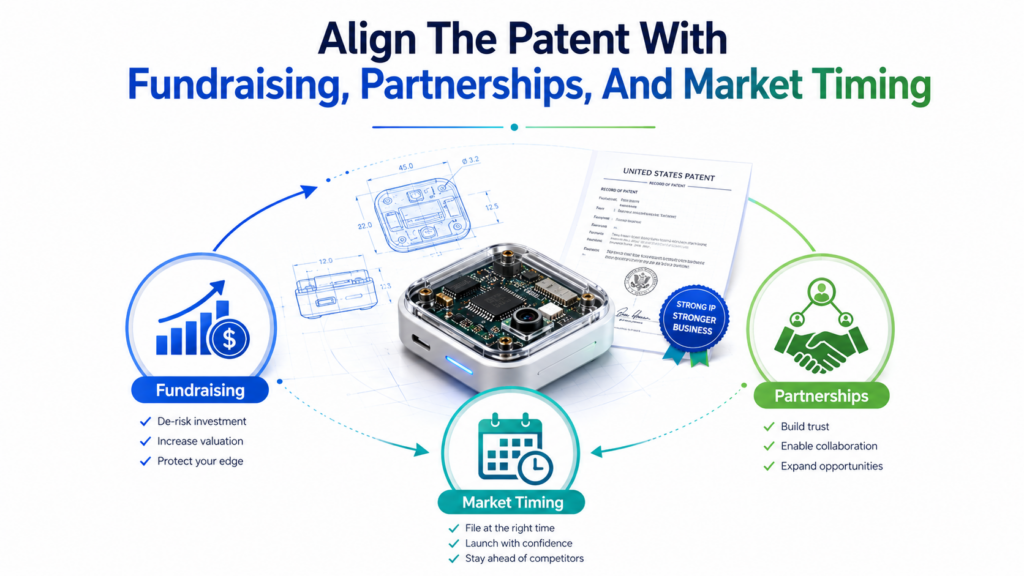
That does not mean a patent will do all the work by itself. It means the patent strategy should match the company’s business timing.
Attorney–inventor collaboration should include business context. The attorney needs to know what the company is trying to do next.
Is the startup raising a seed round? Entering pilots? Showing prototypes to partners? Sending samples to manufacturers? Launching a beta? Talking to a large buyer? Preparing for regulatory work? Moving from prototype to production?
These moments can affect filing timing and patent scope.
For example, if a founder is about to show the device publicly, filing may need to happen before that disclosure. If the company is about to send CAD files to a manufacturer, the team may need both patent and contract planning.
If the company is preparing for investor diligence, the patent story should be clear enough to explain what is protected and why it matters.
PowerPatent helps founders move faster when timing matters, while still keeping real attorney oversight in the process. See how it works here: https://powerpatent.com/how-it-works
The Patent Story Should Support The Fundraising Story
Investors do not want legal jargon. They want to understand why the company can win. A good patent strategy can help support that story if it is tied to the product’s edge.
The founder should be able to explain the patent position in simple terms. What part of the device is hard to copy? What did the team invent? What filings protect that edge? What future filings may be needed as the product grows?
This does not mean making big claims or overpromising. It means being clear.
A strong patent story can show that the company is serious about protecting what it built. It can also show that the team understands where the value lives.
The Attorney Can Help Clean Up The Message Without Turning It Into Hype
Founders should avoid saying things like “we own the whole space” unless that is clearly true, which is rare. They should also avoid vague claims like “we have IP” with no clear link to the product.
A better message is more specific. The company has filed around the sensor layout that improves signal quality. Or the company has filed around the cartridge structure that lowers contamination risk.
Or the company has filed around the control method that reduces power use while keeping readings stable.
Specificity builds trust.
The attorney can help the founder speak clearly without overstating. That helps with investors, partners, and future diligence.
Filing Timing Should Be Planned Around Public Disclosure
Hardware startups often show their products early. They pitch, demo, test, pilot, ship samples, post videos, visit trade shows, run trials, and talk to manufacturers. These actions can create patent timing issues.
The founder should tell the attorney before any public demo, public sale, public pitch, website launch, crowdfunding page, conference talk, pilot rollout, or non-confidential partner meeting. The attorney can then help decide what should be filed first.
The key is simple. Do not surprise your patent team after the disclosure already happened.
Inventors Should Build A Disclosure Habit
A good habit is to treat public sharing as a trigger. Before sharing the device outside trusted confidential channels, ask whether the invention has been captured and filed in the right way.
This does not need to slow the company down. It just needs to become part of the launch process.
For a hardware team, this is especially important because product demos reveal a lot.
A demo may show the device shape, user flow, sensor placement, cartridge structure, charging method, docking behavior, and use setting. Even if the inside is hidden, a smart competitor can learn from what is shown.
A fast, organized patent process can help founders move without panic. PowerPatent is designed for teams that need speed, clarity, and attorney review without the old slow process. Learn more here: https://powerpatent.com/how-it-works
Partnerships Require A Clear View Of What Is Yours
Hardware startups often work with manufacturers, design firms, research labs, suppliers, hospitals, pilot customers, and larger companies.
These relationships can be valuable, but they can also create confusion around who created what.
Before deep partner work begins, the founder and attorney should understand which invention details already belong to the startup and which new work may be created with others.
This is not just a contract issue. It is also a patent planning issue. If a supplier helps change a part, is that change part of your invention? If a pilot partner suggests a new use case, does that affect the filing? If a manufacturer improves the assembly method, who owns that improvement?
Collaboration Records Can Prevent Future Fights
The inventor should keep clear records of what the team invented and when. These records do not need to be dramatic.
They should show the design path, prototype changes, test results, and key decisions.
When a patent application is prepared, these records help the attorney understand the invention. They can also help the company explain its ownership story later.
A clean record is not just paperwork. It is business hygiene.
Market Timing Should Shape The Filing Roadmap
A single patent filing may not be enough. Hardware products often need a roadmap. The first filing may protect the core device.
Later filings may cover improvements, manufacturing methods, software control, disposable parts, docking systems, accessories, or product families.
The attorney and founder should discuss what may need to be filed now and what may be saved for later as the product develops.
This is a strategic choice. Filing everything too early may waste money on ideas that change. Filing too little may leave key value exposed.
The right plan depends on the product stage, funding, market risk, and technical roadmap.
The Patent Roadmap Should Follow The Product Roadmap
A hardware company’s patent roadmap should not live in a separate legal folder. It should follow product work.
When the team creates a new prototype, solves a major failure, changes a manufacturing method, adds a sensor, improves battery life, reduces part count, creates a new cartridge, or launches a new use case, the patent plan should be checked.
This does not mean every change becomes a filing. It means every important change gets reviewed.
PowerPatent can help founders keep patent work closer to product work, so important ideas are less likely to be missed. See how it works here: https://powerpatent.com/how-it-works
Create A Collaboration Rhythm That Fits How Hardware Teams Actually Work
The best attorney–inventor collaboration is not a single meeting. It is a rhythm.
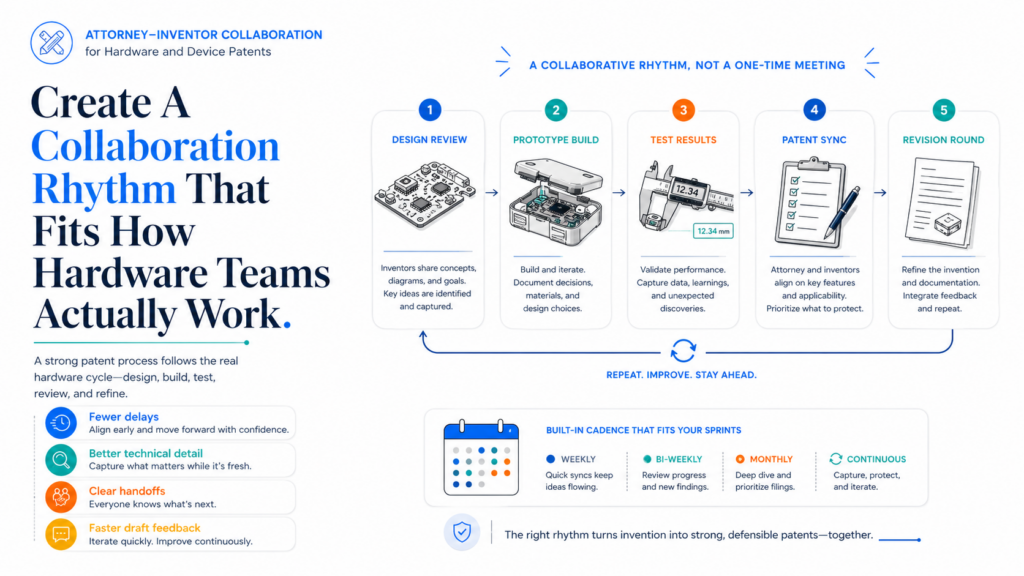
Hardware development moves through builds, tests, failures, fixes, suppliers, demos, and revisions. Patent work should fit that rhythm instead of forcing founders into a stiff, outdated process.
A traditional patent process often waits until the founder says, “We need to file.” By then, details may be scattered across notebooks, CAD files, chat threads, emails, test sheets, and people’s memories.
The attorney has to gather everything under pressure. The inventor has to explain months of work in one rush. Mistakes become more likely.
A better rhythm captures invention details as the product changes. It does not require a legal meeting every day. It simply creates touchpoints when important technical changes happen.
This is especially useful for hardware because invention often happens during problem solving. The new idea may come when a seal fails, when a sensor drifts, when a board overheats, when a part breaks, when a user holds the device wrong, or when a manufacturer says a part is too hard to make. Those moments should not be lost.
PowerPatent gives founders a better way to organize invention details and work with attorneys without drowning in back-and-forth. Explore how it works here: https://powerpatent.com/how-it-works
Patent Checkpoints Should Match Product Milestones
Instead of treating patents as a separate project, founders should connect patent review to product milestones.
Useful checkpoints include the first working prototype, a major design change, test success after repeated failure, supplier handoff, pilot launch, public demo, production design freeze, and new product version.
At each checkpoint, the team should ask what changed and why. Did the product solve a new problem? Did the team remove a part? Did they improve reliability? Did they make assembly easier? Did they create a new user flow? Did they find a better sensing method?
These questions can reveal new patent value.
Small Changes Can Become Big Protection Points
Some of the best hardware inventions look small after they work. A groove, spacer, vent, latch, rib, coating, sensor angle, or timing rule can make the whole product perform better.
Because these changes look small, teams often fail to report them. They assume only big breakthroughs matter.
That is not true. In hardware, small physical choices can create large business value. A part that makes the product reliable, manufacturable, accurate, safe, or easy to use may deserve serious patent attention.
The collaboration rhythm should make it normal for inventors to flag these changes.
Inventors Should Keep A Simple Running Invention Log
A running invention log can be simple. It should capture what changed, why it changed, who worked on it, what problem it solved, and what proof exists.
Photos, sketches, CAD snapshots, test notes, and short plain-English explanations can all help.
The goal is not to create busywork. The goal is to prevent memory loss.
A founder may think they will remember the key details later, but hardware development moves fast.
After five more builds, the reason behind an old change may blur. That reason may be exactly what the attorney needs.
The Log Should Focus On Decisions, Not Diary Entries
A useful invention log does not need to record every meeting. It should record decisions and results.
For example, the team changed the vent position because the first position allowed dust to reach the sensor. The team added a flexible mount because rigid mounting caused signal spikes.
The team changed the cartridge shape because users inserted it backward. The team added a thermal gap because the board heated the fluid chamber.
These notes are direct, useful, and easy for an attorney to understand.
When the time comes to file, this log can make the patent process faster and better.
Attorney Meetings Should Be Focused And Technical
Inventors are busy. Attorneys are busy. Collaboration works best when meetings have a clear purpose.
A strong meeting should focus on one invention area at a time. For example, one meeting may cover the sensor package.
Another may cover the cartridge. Another may cover the manufacturing process. Another may cover control logic. Another may cover the next product version.
This keeps the conversation deep instead of scattered.
The Attorney Should Leave Each Meeting With Clear Technical Answers
After each meeting, the attorney should understand what the device does, what changed, why it matters, what alternatives exist, what drawings may be needed, and what business risk the feature addresses.
The inventor should leave knowing what else to provide. Maybe the attorney needs CAD images, test data, photos, use cases, alternative materials, or a simple flow of device operation.
This kind of meeting reduces confusion and cuts down on repeated questions.
Collaboration Should Include The Right People At The Right Time
Hardware inventions often come from more than one person. The founder may know the business goal. The mechanical engineer may know the part geometry.
The electrical engineer may know the board and sensors. The firmware engineer may know control logic. The manufacturing lead may know assembly limits. The clinician, operator, or customer may know the use case.
The attorney does not always need everyone in every meeting. But they do need access to the person who knows the answer.
Missing The Right Inventor Can Lead To Missing The Real Invention
If only the founder speaks to the attorney, key technical details may be missed. If only the engineer speaks, the business value may be unclear. If the manufacturing person is left out, a major process invention may be ignored.
A good patent process brings in the right person when needed.
PowerPatent helps founders and teams capture invention input more clearly, so the attorney can review a fuller picture without the old chaos. Learn more here: https://powerpatent.com/how-it-works
Make The Collaboration Produce A Patent The Company Can Actually Use
The final goal is not to have a patent application sitting in a folder. The goal is to create patent assets the company can use.
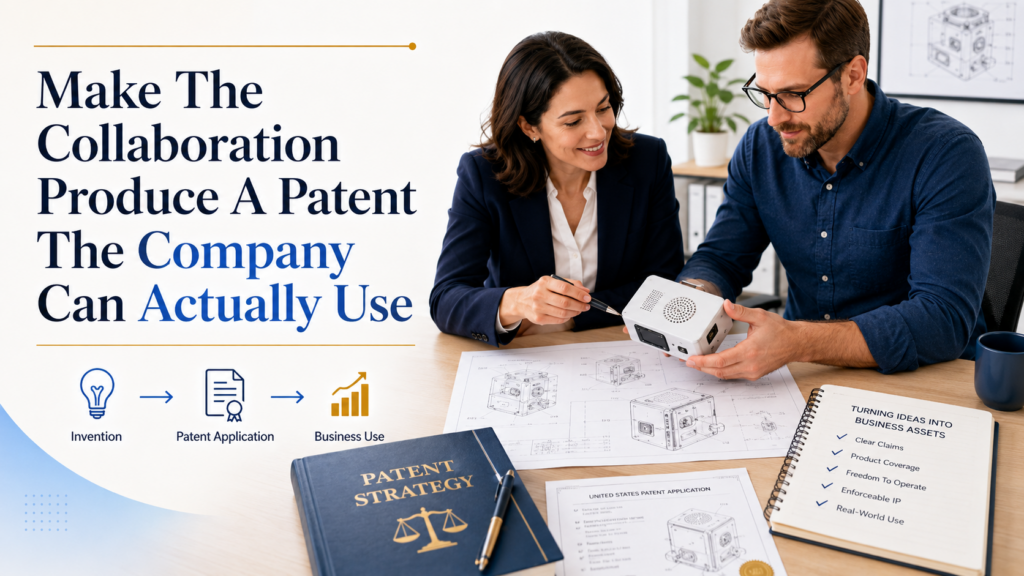
A useful patent supports the business. It helps the company explain its edge, defend its space, talk to investors, work with partners, guide future filings, and make copying harder.
That kind of patent does not happen by accident. It comes from careful collaboration between the attorney and the inventor.
The inventor brings the truth. The attorney brings the structure. The founder brings the business goal. When those three pieces line up, the patent becomes much stronger.
For hardware and device companies, this matters even more because the product is physical. It can be inspected, reverse engineered, tested, opened, scanned, copied, and changed.
A competitor may not need your code or your notes to learn from your device. They may learn by buying it.
A strong patent should be ready for that world. It should protect the parts that matter, not just the product name or the outer shell.
PowerPatent helps founders build this kind of protection faster by combining smart software with real attorney oversight. You can see the process here: https://powerpatent.com/how-it-works
A Useful Patent Is Clear To The Business Team
A company should know what each patent filing is meant to protect. The founder should be able to explain the main point in simple words.
The product team should know which features are covered. The investor story should connect the patent to the product edge.
This does not mean every team member reads every claim. It means the company has a clear view of why the filing matters.
Patent Work Should Not Be A Black Box
Old-school patent work can feel like a black box. The inventor sends details. The attorney sends back a dense draft.
The founder approves because the deadline is close. No one is fully sure what was protected.
That is not good enough for a modern hardware startup.
Founders need more control and more clarity. They need to understand what is being filed and why. They also need attorney support so they do not have to become patent experts.
That is the gap PowerPatent is built to close.
A Useful Patent Helps Guide Future Product Choices
A good patent can also help the product team make smarter choices. When the team understands what has been filed, they can design future versions with more awareness.
For example, if the company has filed around a cartridge-locking method, the next cartridge design can build from that core idea.
If the company has filed around a sensor shield, future sensor packages can stay aligned with that protection. If the company has filed around a control method, firmware updates can be reviewed for new patentable improvements.
Patent work should not freeze product design. It should support it.
Future Improvements Should Be Captured As They Happen
Hardware teams should watch for improvements after the first filing. A better seal, faster assembly method, safer connector, lower-power control mode, improved calibration method, or new disposable structure may become the next patent filing.
The first patent is often just the start.
A good attorney–inventor relationship makes it easier to spot these updates. A good platform makes it easier to capture them before they are forgotten.
A Useful Patent Makes Copying More Expensive
No patent can stop all competition by magic. But a strong patent can make copying harder, riskier, and more costly. It can force competitors to design around the protected features.
It can help the startup negotiate from a stronger position. It can support investor confidence. It can give the company more control as the market grows.
For hardware companies, this matters because copycats can move fast once a product is visible. They can copy the shape, source similar parts, and make small changes. The patent should be built with that risk in mind.
The Patent Should Protect The Value, Not The Vanity
Some parts of a product look impressive but are not the main moat. Other parts look boring but are the reason the product works. The attorney and inventor must focus on the value.
If the patent protects only the vanity features, it may not help much. If it protects the core working idea, it can become a real asset.
This is why the collaboration must keep returning to one question: what would hurt us most if a competitor copied it?
A Useful Patent Keeps The Company Moving
Founders do not want patents to slow them down. They want protection that fits the speed of building. The right process should make patent work feel clear, guided, and useful.
That means simple invention capture. Smart attorney review. Clear drafts. Strong drawings. Business-aware claim strategy. Practical filing timing. Ongoing improvement capture.
This is not about making patents feel easy by making them weak. It is about making the process easier while keeping the work serious.
PowerPatent Helps Founders Protect Hardware Without Losing Momentum
PowerPatent combines smart software with real patent attorney oversight so founders can move faster and still file with care.
For hardware and device teams, that means a better way to organize drawings, prototypes, invention notes, technical details, and product strategy.
The result is a smoother path from invention to filing, with less confusion and more control.
Explore how PowerPatent works here: https://powerpatent.com/how-it-works
Conclusion
Attorney–inventor collaboration is the difference between a patent that merely describes a device and a patent that protects the real business value inside it. For hardware and device teams, the strongest filings come from clear teamwork: the inventor shares the build story, failures, drawings, tests, tradeoffs, and future plans, while the attorney turns those details into focused protection.
When this happens early, founders avoid weak filings, missed features, and slow back-and-forth. PowerPatent helps make that process faster, clearer, and more founder-friendly with smart software plus real attorney oversight. See how it works here: https://powerpatent.com/how-it-works
Leave a Reply