
In-house IP teams sit in the middle of a very hard job. PowerPatent helps teams do this with smart software and real attorney oversight, so companies can move faster without losing quality or control. Learn how it works here: https://powerpatent.com/how-it-works
Build One Clear System Before You Ask Anyone To Move Faster
The best in-house IP teams do not win because they push people harder. They win because they remove confusion.
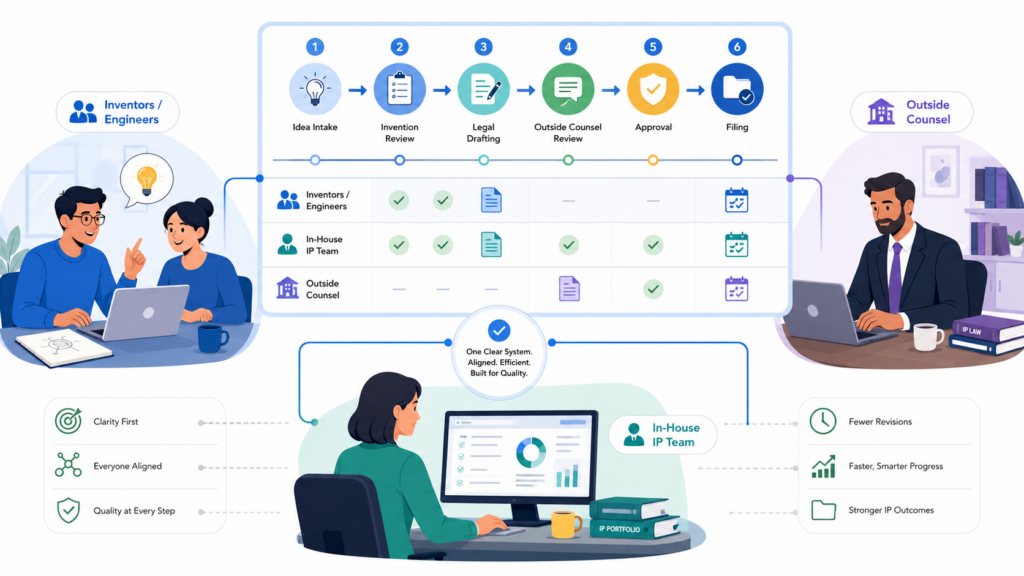
They build a simple system that shows inventors, internal attorneys, business leaders, and outside counsel what needs to happen next. That sounds basic, but it is where most patent programs either become smooth or start to break.
In many companies, the patent process starts with a loose message from an engineer, a rushed meeting, or a half-written invention form. Then the legal team tries to fill in the gaps.
Outside counsel asks more questions. The inventor gets pulled back in days or weeks later. By then, the team has moved on to the next sprint, the next release, or the next customer issue. The idea may still be strong, but the process now feels slow and painful.
A better system starts earlier. It gives each person a clear role. The inventor explains the problem, the new way the team solved it, and why the solution matters.
The in-house IP team decides whether the idea fits the company’s patent plan. The attorney shapes the legal path. Outside counsel helps draft and file, but does not have to guess what the business really cares about.
The Goal Is Not More Patents, It Is Better Control
A strong IP system is not about collecting as many filings as possible. That can waste money fast. The real goal is control.
The company needs control over what gets captured, what gets reviewed, what gets filed, and what gets dropped. Without that control, the patent budget gets pulled in too many directions.
For example, a startup may have ten smart technical ideas in one quarter. Not all ten deserve a patent filing right away.
Some may be small product choices. Some may be easy for others to design around. Some may support a core product that investors, buyers, or partners will care about. Others may be useful but not central.
The in-house IP team’s job is to make those calls with care. They should not wait until outside counsel has already spent hours digging into an invention. They should guide the flow from the start.
A Simple Intake Path Makes Everyone Better
A good intake path helps inventors share useful details without making them feel like they are filling out a legal exam. Engineers and product builders do not want to write long legal documents.
They want to explain what they built, why it was hard, and why it works better than what came before.
That is why the intake process should feel like a smart product interview, not a dense form. It should ask what problem the team faced, what old methods failed, what new step or system made the difference, and where the invention may show up in the product.
It should also ask what is public, what may be shared soon, and whether a demo, paper, pitch, launch, or customer meeting is coming up.
Those details help the IP team act fast. They also help outside counsel draft with more strength because they are not starting from a blank page. They can see the real story behind the invention.
PowerPatent helps teams capture those details in a cleaner way, with software that supports the invention workflow and real attorney oversight to keep quality high.
For teams that want speed without chaos, this can make the patent process feel far less painful. You can see how PowerPatent works here: https://powerpatent.com/how-it-works
The In-House Team Must Own The Map
Outside counsel can be a great partner, but they should not be the only group holding the map.
The in-house team knows the company’s product plans, funding goals, risk areas, competitor moves, and key technical bets. That context is what turns a patent filing from a legal task into a business asset.
This means the in-house team should keep a live view of the full invention pipeline. They should know which ideas are new, which are under review, which are with outside counsel, which are waiting on inventor feedback, and which are ready to file.
This view does not need to be complex. In fact, it should be simple enough that the legal team can use it every week.
The Map Should Show Business Value, Not Just Legal Status
Many IP trackers only show basic legal steps. They show whether a draft is pending, filed, or waiting for review. That is useful, but it is not enough. The better map also shows why the filing matters.
It should connect each invention to a product area, technical theme, customer need, or company goal.
It should show whether the invention protects a key feature, a platform layer, a model improvement, a workflow, a data pipeline, a user experience, or a system design. This helps the company make smarter calls when budget gets tight.
When the team can see both legal status and business value, meetings become sharper. The question is no longer, “What is the status of this patent?” The better question is, “Does this filing still protect something important, and are we moving fast enough before it becomes public?”
Make Inventors Feel Like Partners, Not Homework Machines
Inventors are the source of the whole patent program. Without them, there is nothing to protect. Yet many companies treat inventors like a bottleneck instead of a partner.

They send long forms, ask vague questions, schedule meetings at bad times, and then wonder why invention disclosures come in late or incomplete.
Strong in-house IP teams do the opposite. They make it easy for inventors to share ideas. They respect the inventor’s time.
They explain why the work matters. They show inventors how their ideas may help the company win. That shift changes the whole culture.
Inventors do not need to become patent experts. They do need to understand what kind of details make an idea worth protecting. They need to know that patents are not just about finished products.
A patent may protect a method, a system, a model, a workflow, an architecture, a training process, a device, or a way of handling data. When inventors understand this, they start spotting protectable ideas earlier.
The Best Time To Capture Ideas Is Before The Team Moves On
Technical teams move fast. They solve hard problems and then quickly treat those solutions as normal. What felt like a breakthrough on Monday can feel obvious by Friday. That is why waiting too long to capture inventions is risky.
The in-house IP team should create small, repeatable moments where invention capture becomes part of normal work.
This can happen after major sprints, before product launches, during roadmap reviews, after research milestones, or when a team solves a problem that blocked progress for a long time.
The key is to ask about the work while it is still fresh. At that point, inventors can explain the failed paths, the tradeoffs, and the reason the final solution was clever.
Those details often make the patent stronger because they show why the invention was not just a routine choice.
Ask Better Questions And You Will Get Better Inventions
A weak question gets a weak answer. If the IP team asks, “Do you have any inventions?” many engineers will say no.
They may think an invention has to be a huge scientific breakthrough. They may not realize that a smart improvement to speed, accuracy, security, cost, reliability, or user control can matter.
A better question is more direct. Ask what the team built that was hard. Ask what changed in the system that made the product better.
Ask what the team tried that did not work. Ask what competitors would have trouble copying. Ask what customers now get that they could not get before.
These questions help inventors tell the real story. They also make the process feel less like legal paperwork and more like a technical review.
PowerPatent is built around this idea. It helps turn technical input into a clearer patent path, while real attorneys stay involved so the work does not lose legal strength.
For deep tech startups and fast-moving teams, this can help protect important ideas without slowing the builders down. Learn more here: https://powerpatent.com/how-it-works
Inventor Trust Is Built In Small Moments
Inventors will support the patent process when they believe it is worth their time. That trust comes from small things. The IP team should respond quickly when an inventor submits an idea.
They should explain what happened to it. They should avoid pulling inventors into repeated meetings that cover the same ground. They should share wins when patents are filed, allowed, used in funding talks, or tied to business value.
Never Let The Invention Go Into A Black Box
One of the fastest ways to lose inventor support is to let ideas disappear. An engineer submits a disclosure, hears nothing for months, and then gets a sudden request to review a draft.
That feels broken. It teaches the inventor that the process is slow, unclear, and not worth much attention.
The fix is simple. Keep inventors informed at key points. Let them know when the idea is accepted for review, when outside counsel is drafting, when their input is needed, and when the filing is complete.
The update does not need to be long. It just needs to show that their work matters.
This also helps quality. When inventors stay close to the process, they catch mistakes earlier. They can tell when a draft misses the real technical point.
They can explain why one feature matters more than another. They can help the attorney avoid writing something that sounds broad but does not match the real invention.
Turn Outside Counsel Into A True Extension Of The Team
Outside counsel can bring great strength to an IP program. They can draft patent applications, handle office actions, give filing advice, and bring a wider view from other patent work they have seen.

But outside counsel can only do their best work when the in-house team gives them the right context, the right rules, and the right level of direction.
The mistake many companies make is sending outside counsel a raw invention disclosure and expecting them to figure out the rest. That may work for simple matters, but it often leads to slow drafts, more review cycles, and higher costs.
Outside counsel may not know which product line matters most, which competitor risk is real, which claim scope is most useful, or which technical detail is central to the business.
The in-house IP team should not treat outside counsel like a vendor who simply receives tasks. The better model is to treat them like an extension of the team, with clear lanes and strong input.
That means outside counsel should understand the company’s product roadmap, invention themes, budget limits, filing goals, review rules, and risk comfort level.
When outside counsel has that context, the first draft gets better. The questions get sharper. The filing plan becomes more useful.
The in-house team spends less time correcting basic issues and more time shaping the patent portfolio in a smart way.
Give Outside Counsel The Business Story, Not Just The Invention Story
A patent application should explain the invention. But the filing decision should be guided by the business story behind it. Outside counsel needs to know why the company cares about this idea.
Is it tied to a key product feature? Does it protect a future platform? Does it support a funding story? Does it block a likely competitor path? Does it help with a partnership, acquisition, or market entry plan?
Without this context, outside counsel may draft around the wrong center of gravity. They may focus too much on a small technical detail while missing the larger system that gives the company leverage.
Or they may write claims that sound clever but do not protect the parts of the product that matter most.
The in-house team should explain the business value in plain words before drafting begins. This does not need to be long.
It should make clear what the invention protects, where it fits in the product, why it may matter in the market, and what the company wants the patent to do.
Make The First Draft Better By Framing The Point Of The Filing
Before outside counsel starts drafting, the in-house team should share the core point of the filing. This is the main idea the patent should protect. It is not a full claim set. It is a plain-English guide.
For example, the point may be to protect how a system chooses between two model outputs in real time. It may be to protect a way of reducing compute cost during training.
It may be to protect a device layout that improves heat control. It may be to protect a workflow that lets a user do something safer, faster, or with fewer steps.
This framing helps outside counsel draft with purpose. It also gives inventors a simple way to check whether the draft is on track. If the draft does not protect the main point, the team can fix the issue early instead of waiting until the final review.
PowerPatent helps companies bring this kind of structure into the patent workflow.
It helps technical teams and legal teams turn raw invention details into clearer, stronger work, with real attorney oversight built in. See how PowerPatent works here: https://powerpatent.com/how-it-works
Set Clear Review Rules Before The Draft Comes Back
Patent drafts can get stuck when nobody knows who should review what. Inventors may focus on wording.
Business leaders may question strategy. In-house counsel may rewrite too much. Outside counsel may wait for full feedback before moving forward. Days turn into weeks.
A strong review process avoids this by giving each person a clear job. The inventor should check technical accuracy. The in-house IP team should check business fit, legal strategy, and claim direction.
Outside counsel should fix the draft and explain major choices. Business leaders should only review when the filing affects budget, public plans, or major company priorities.
Do Not Let Every Reviewer Review Everything
When too many people review the full patent draft without clear roles, the process becomes noisy. One person may suggest adding product marketing language.
Another may want to remove technical detail. Another may ask for broad claims without understanding the support needed in the application. Outside counsel then has to sort through feedback that may not point in the same direction.
The in-house IP team should manage this. They should guide reviewers toward the parts that matter to them. Inventors should spend most of their time on drawings, system flow, examples, technical terms, and whether the application describes the invention correctly.
The legal team should focus on claim strength, fallback positions, filing timing, and whether the draft supports future strategy.
This makes reviews faster and better. It also protects inventor time, which is one of the most important resources in any fast-moving company.
Create A Patent Calendar That Matches The Product Calendar
A patent program cannot run on legal dates alone. It must also match the product calendar. This is one of the biggest jobs for an in-house IP team.
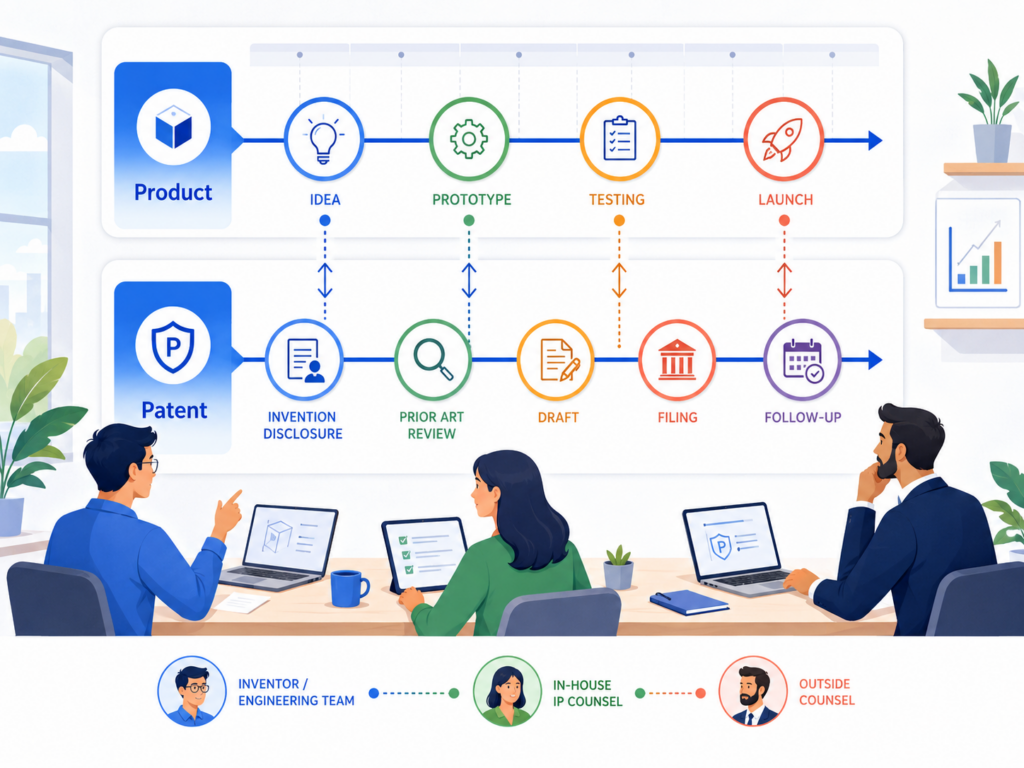
The team must know when new features may launch, when papers may be published, when demos may be shown, when customers may test the system, when investors may see details, and when public marketing may start.
If the IP team learns about these events too late, the company may lose options.
A public release, conference talk, open-source push, sales deck, grant filing, app launch, or customer pilot can all create timing pressure. Even when there is still a path to file, the rush can hurt quality and raise stress.
The best in-house teams build a simple habit. They stay close to product, research, engineering, marketing, and sales. They do not wait for someone to invite legal into the room.
They create a steady rhythm where public-facing plans are checked for possible patent issues before details leave the company.
This does not mean legal slows everything down. In fact, the right patent calendar does the opposite. It lets the company move faster because people know what needs to be filed before something becomes public.
The Product Roadmap Is Also An Invention Roadmap
A product roadmap shows what the company plans to build. An invention roadmap shows what the company may need to protect.
These two maps should be connected. Every major product change should raise a simple question: what did we create here that others would want to copy?
That question should be asked before launch, not after. It should also be asked during planning, because some of the strongest inventions appear when the team is still deciding how to build the product.
Early design choices can create valuable patent opportunities if they solve hard problems in a new way.
For example, a team building a new AI feature may invent a better way to clean data, score outputs, reduce false results, handle user feedback, or route tasks between models.
These may not look like product features to a customer, but they may be very important to the company’s edge.
Place IP Checks At Natural Points In The Build Cycle
The in-house IP team should not force engineers into extra process for no reason. The better move is to place IP checks where teams already pause and think.
This may be during sprint reviews, architecture reviews, release planning, research readouts, model performance reviews, security reviews, or launch readiness meetings.
At each point, the IP team can listen for signals. Did the team solve a hard technical problem? Did they choose an approach that is different from common methods?
Did they improve speed, cost, accuracy, privacy, safety, or scale? Did they create a system that competitors may need once the market catches up?
These signals help the IP team catch inventions without slowing the builders. They also help the company avoid the bad habit of treating patents as an afterthought.
PowerPatent is useful for teams that want this kind of faster capture process. It helps companies move from invention signals to attorney-backed patent work with less drag. You can see the workflow here: https://powerpatent.com/how-it-works
Public Disclosure Planning Must Be Simple And Firm
Many inventors do not know what counts as a public disclosure. They may think only a press release or product launch matters. But public sharing can happen in many ways.
A slide deck, demo, blog post, pitch event, GitHub update, customer call, white paper, poster session, thesis, app store listing, or conference talk may all matter.
The in-house IP team should teach this in simple language. The rule should be easy to remember: before you show the details of how it works to people outside the company, check whether the idea should be protected first.
This does not mean every external conversation needs legal review. That would be too heavy. It means teams should know when technical details are about to leave the company and when those details might relate to a new invention.
Make The Review Fast Enough That People Actually Use It
A disclosure review process only works if it is fast. If product and engineering teams believe legal review will take too long, they will avoid it or bring legal in at the last minute. That creates more risk, not less.
The in-house IP team should make the review path clear and quick. When someone plans to share technical details outside the company, they should know exactly where to send the material, what context to provide, and when they can expect a practical answer.
The legal team should focus on the parts that reveal how the invention works, not on slowing down normal business talk.
A fast review process builds trust. Over time, teams start to see IP review as a safety check, not a roadblock.
Use A Clear Triage Method So The Best Ideas Get Filed First
Not every invention should become a patent filing. That is true even in very smart companies. Some ideas are useful but easy to copy around.
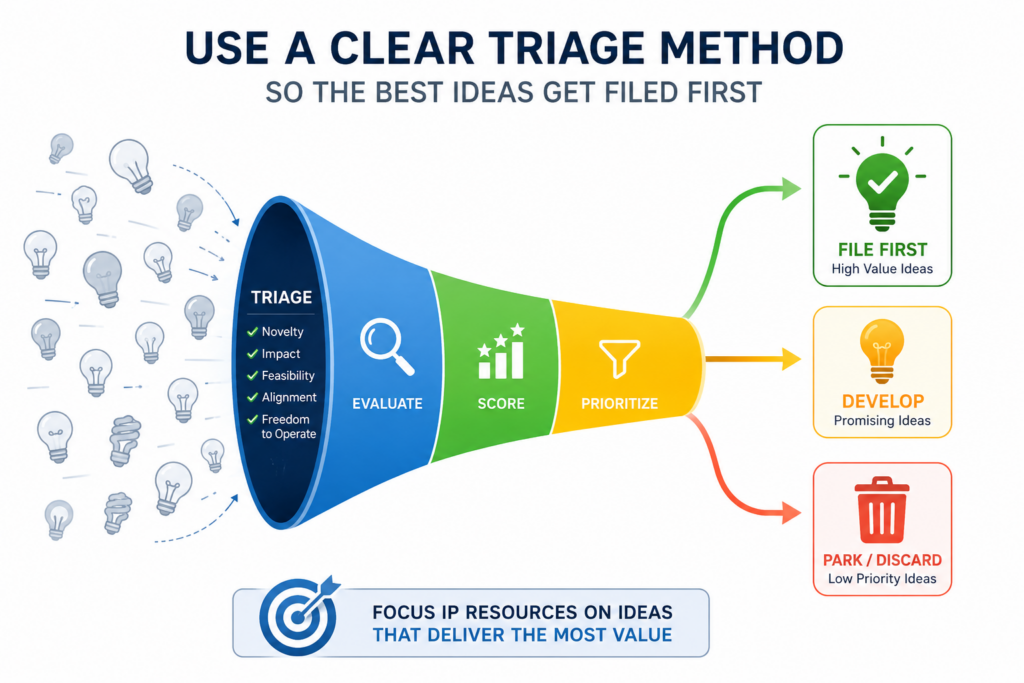
Some are too narrow. Some are not tied to a business goal. Some may be better kept secret. Some may not be worth the cost right now.
This is why in-house IP teams need a clear triage method. Triage simply means sorting ideas by value, timing, and fit. The goal is to make better choices before money is spent.
Without triage, a patent program can become reactive. The loudest inventor, the most urgent launch, or the most recent idea may get attention, while deeper strategic inventions get missed.
Good triage is not about saying no to inventors. It is about making sure the company files the right patents at the right time for the right reasons.
When inventors understand this, they are less likely to feel rejected if their idea is not filed. They can see that the team is making business choices, not judging the quality of their work.
Start With The Business Use Of The Patent
The first triage question should be simple: how could this patent help the company? The answer may vary. It may protect a core product.
It may make the company look stronger to investors. It may support a future deal. It may create a barrier for competitors. It may protect a technical platform that will power many future features.
If there is no clear answer, the team should pause. That does not mean the idea has no value.
It may mean the timing is not right, the invention needs more development, or the team needs more context. But filing without a reason can turn into waste.
A patent should earn its place in the portfolio. It should connect to the company’s goals in a way that people can explain in plain words.
A Strong Filing Often Protects A Direction, Not Just A Feature
One common mistake is filing only on what exists in the product today. That can be too narrow.
A good patent strategy looks at where the company is going. It asks what technical direction the company is taking and what future versions may need protection.
For example, if the current product uses one type of model, the patent may need to describe other model types that could work in the same system.
If the product supports one device, the draft may need to cover other devices. If the workflow handles one use case, the application may need to explain related use cases that the company may enter later.
This is where in-house teams add huge value. They know the roadmap. They can help outside counsel draft in a way that supports today’s product and tomorrow’s plan.
PowerPatent helps teams think through inventions in a more structured way, so they can move faster while still keeping attorney judgment in the loop. For startups and technical teams, that can mean fewer missed ideas and fewer rushed filings. Learn more here: https://powerpatent.com/how-it-works
Balance Technical Strength With Market Value
A brilliant technical idea is not always a strong patent target. The company also needs to ask whether the idea matters in the market.
Will others want to use the same approach? Does it solve a problem that many teams will face? Is it hard to detect if someone copies it? Is it tied to a product area where the company wants to lead?
The in-house IP team should bring together legal, technical, and business views. Inventors can explain why the idea is clever. Product leaders can explain why customers care.
Business leaders can explain how the area fits the company’s growth. Attorneys can explain whether the idea can be protected in a useful way.
The Best Triage Meetings Are Short But Sharp
A triage meeting does not need to be long. In fact, shorter is often better. The team should come in with enough detail to make a decision or assign a next step.
The goal is not to debate every possible angle. The goal is to decide whether to file now, gather more detail, hold the idea, publish defensively, keep it as a trade secret, or pass.
The meeting should end with a clear owner and a clear next action. If the decision is to file, outside counsel needs the right materials. If more detail is needed, the inventor should know what question to answer.
If the idea is not moving forward, the reason should be recorded so the team does not revisit the same issue again and again.
This discipline keeps the pipeline clean. It also helps the company spend its patent budget with more care.
Keep Inventor Interviews Focused, Fast, And Useful
Inventor interviews are one of the most important parts of the patent process. They are also one of the easiest parts to waste.
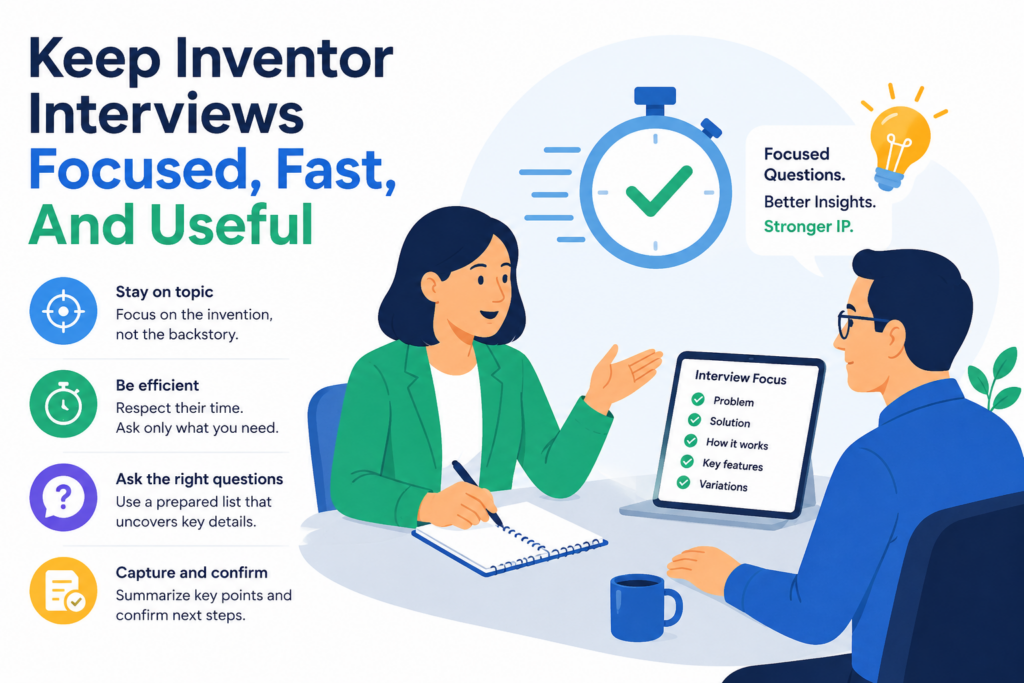
A weak interview feels like a long meeting where the attorney asks broad questions, the inventor gives scattered answers, and nobody leaves with a clear view of the invention. A strong interview feels like a sharp technical conversation with a clear goal.
The in-house IP team should help shape these interviews. They should make sure outside counsel comes prepared.
They should make sure inventors know what to bring. They should guide the conversation toward the details that matter most for the filing.
Inventors are busy. Their time should be treated with care. If an inventor has to explain the same thing three times because the process is unorganized, the system is failing.
The better approach is to capture strong notes, record key diagrams when allowed, and make sure outside counsel understands the main technical point before the call ends.
Prepare The Inventor Before The Interview
Many inventors walk into patent interviews without knowing what the attorney needs. They may explain the product from the user’s point of view, when the attorney needs to understand the system under the hood.
Or they may jump into tiny technical details before explaining the main problem and solution.
A short prep note can make the interview much better. The inventor should know that the goal is to explain what was hard, what the team built, why it is different, what choices were made, and what other ways might also work.
They should bring diagrams, flowcharts, screenshots, data, test results, design notes, or examples if those help explain the invention.
The in-house team can also tell inventors what not to worry about. They do not need to use legal words. They do not need to write claims. They do not need to know whether the idea is patentable. They just need to explain the invention clearly and honestly.
Start With The Problem Before The Solution
A good inventor interview should begin with the problem. What was not working before? Why did old methods fall short? What made this problem hard? What limits did the team face? Was the issue speed, cost, safety, accuracy, memory, heat, security, scale, trust, or user control?
This matters because the problem gives meaning to the solution. It helps outside counsel understand why the invention is more than a small design choice. It also helps the patent application tell a stronger story.
Once the problem is clear, the team can move into the solution. The inventor can explain the new system, method, process, or design. They can show where the invention lives and how it changes the outcome.
Capture Alternatives While The Inventor Is In The Room
One of the most useful parts of an inventor interview is the discussion of alternatives. A patent application may be stronger when it describes more than one way to practice the invention.
This gives the company more room later and may help avoid a draft that is too tied to one product version.
Inventors often know these alternatives, but they may not mention them unless asked. They may say, “We used this model,” but also know that other models could work.
They may say, “We do this on the server,” but the same idea could run on a device, in the cloud, or across both. They may say, “We use this sensor,” but other sensors may support the same result.
Good Alternatives Are Not Random Add-Ons
The goal is not to stuff the application with every possible variation. That can make the draft messy. The goal is to capture real alternatives that still connect to the invention.
The attorney should ask which parts are required, which parts are optional, and which parts could change without losing the main benefit.
This is where a strong attorney and a prepared in-house team can work well together. The attorney can think about claim support. The inventor can explain technical reality. The in-house team can keep the discussion tied to product and business goals.
PowerPatent helps make this process easier by giving teams a better way to move from technical invention details to attorney-guided patent work.
For teams that want cleaner invention capture and faster filing paths, this can be a major advantage. Explore it here: https://powerpatent.com/how-it-works
Make Draft Review A Quality System, Not A Last-Minute Scramble
Patent draft review is where many good ideas get weakened. Not because people are careless, but because the process is rushed or unclear. The draft may arrive close to a filing deadline.
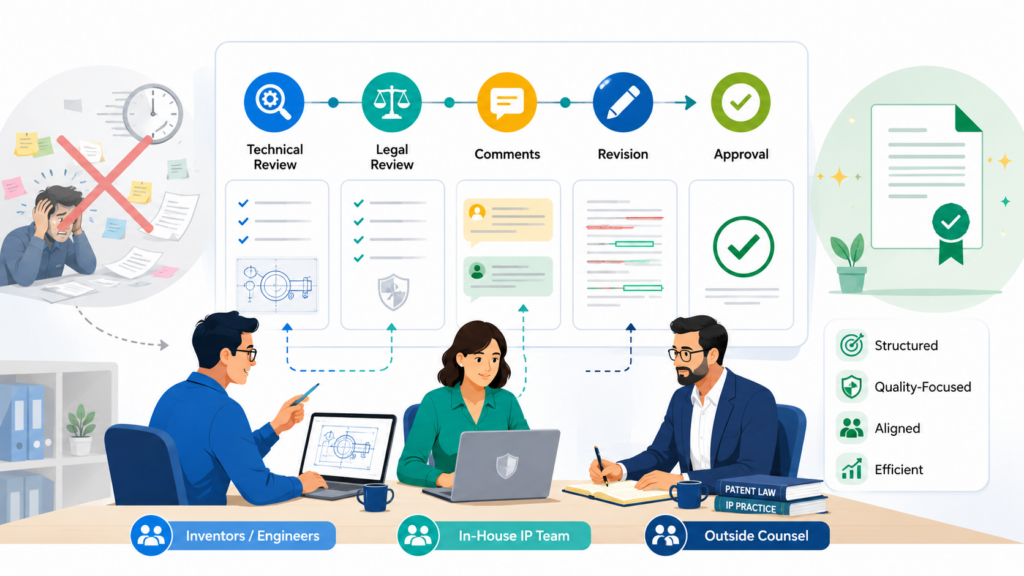
The inventor may be busy. The in-house attorney may be pulled into other work. Outside counsel may need fast comments. Everyone wants quality, but the review process does not support it.
Strong in-house IP teams treat draft review as a quality system. They do not rely on heroic last-minute effort. They create a clear review flow that helps the right people catch the right issues at the right time.
The goal is not to make the draft perfect in one pass. The goal is to catch the issues that matter most before filing.
These include wrong technical details, missing examples, narrow wording, weak support for future versions, unclear drawings, and claims that do not match the business need.
The First Review Should Check Direction, Not Every Word
When a first draft arrives, the team should not start by polishing sentences. That is a poor use of time. The first review should check whether the draft is pointed in the right direction.
Does the application describe the real invention? Does it explain the hard problem? Does it cover the main system or method? Does it include the product version and likely future versions? Do the claims aim at the right value? Are the drawings clear enough to support the story?
If the answer is no, word-level edits will not fix the real issue. The team should correct the direction first. Outside counsel should understand what is missing and why it matters.
Inventors Should Review For Truth, Not Legal Style
Inventors often get distracted by legal writing. Patent drafts can sound strange to engineers.
The wording may feel broad, formal, or repetitive. If inventors try to rewrite the draft into normal engineering language, review can slow down and the legal value may suffer.
The in-house team should tell inventors what to focus on. Their main job is to check truth and completeness. Is the system described correctly?
Are the steps in the right order? Are terms used in a way the team accepts? Are important parts missing? Are there examples that would make the invention clearer? Does anything sound impossible or misleading?
This gives inventors a clear role and helps them review faster. It also helps outside counsel receive feedback they can act on.
PowerPatent supports a more guided patent workflow, helping teams keep technical accuracy and attorney oversight connected.
That matters because a patent is only useful if it protects the real invention in a way the company can trust. See how it works here: https://powerpatent.com/how-it-works
The Second Review Should Tighten Strategy
Once the technical direction is right, the next review should focus on strategy. This is where the in-house IP team and outside counsel should look closely at the claims, fallback positions, examples, and business fit.
A strong patent application should not depend on one narrow claim. It should have layers. If the broadest version faces trouble later, the company should have backup positions that still protect useful ground.
Those backup positions often come from examples, alternatives, and technical details captured early.
Do Not File Until The Team Can Explain What The Patent Is Meant To Protect
Before filing, the in-house team should be able to explain the goal of the application in simple words. This is a powerful test. If the team cannot explain what the patent is meant to protect, the draft may not be ready.
The explanation should name the technical idea, the business reason, and the likely value. For example, the filing may protect a way to route AI tasks based on confidence scores so the product can reduce errors and compute cost.
Or it may protect a device control method that improves safety during real-time use. Or it may protect a data pipeline that makes a hard model training process faster and more reliable.
When the team can say this clearly, it becomes much easier to review the draft. It also becomes easier to explain the portfolio to leaders, investors, partners, or future buyers.
Run The Portfolio Like A Living Business Asset
A patent portfolio is not a storage box. It is a living business asset. It should change as the company changes. Some filings become more important over time. Some become less useful.

New product lines create new gaps. Competitors move. Markets shift. Funding plans change. The in-house IP team must keep the portfolio aligned with the company’s real direction.
This is where coordination becomes strategic. It is not enough to file patents and track deadlines. The team must understand what the company is trying to become. Then it must shape the patent program to support that path.
For a startup, this can be especially important. Investors may ask what protects the company’s edge. Partners may want to know whether the company owns the key technology.
Buyers may look for patents that map to the product and market. A scattered portfolio can weaken that story. A focused portfolio can make the company look more serious, more defensible, and more ready for growth.
Review The Portfolio Against The Roadmap
At least a few times a year, the in-house IP team should compare the patent portfolio to the product and research roadmap. This review should be simple but direct.
What are we building now? What will matter in the next twelve to twenty-four months? Which filings protect those areas? Where are the gaps? Which old filings no longer support the plan?
This review helps the team avoid two common problems. The first is over-investing in old ideas that no longer matter. The second is missing new areas that are becoming central to the company.
Gaps Are Easier To Fix When They Are Found Early
A portfolio gap is not always a crisis. It may simply mean the company has not yet captured inventions in a new area. But if the gap is found late, after a product launch or public push, the options may be more limited.
The in-house IP team should watch for new technical themes as they emerge.
If the company starts moving into a new market, using a new model type, building a new hardware layer, changing its data strategy, or creating a new platform, the IP team should ask what protection is needed.
This is also a good time to involve outside counsel in a focused way. Instead of asking outside counsel for broad advice with little context, the in-house team can bring a clear question: here is where the product is going, here is what we have filed, and here is where we may need coverage.
PowerPatent can help teams keep invention capture and filing work more connected to what the company is actually building.
For growing companies, this can make the difference between a pile of filings and a patent portfolio with a clear purpose. Learn more here: https://powerpatent.com/how-it-works
Use Portfolio Reviews To Guide Future Invention Capture
A portfolio review should not end with a report that sits in a folder. It should shape what the team does next. If the review shows that one product area is underprotected, the IP team should meet with that engineering group.
If the review shows that many filings are too narrow, the team should improve invention interviews. If the review shows that outside counsel keeps missing business context, the team should change the drafting brief.
This is how the patent program gets better over time. Every review should improve the next capture cycle, the next drafting cycle, and the next filing decision.
The Best Portfolio Strategy Is Easy To Explain
A strong patent strategy does not need to sound complex. In fact, if it is too hard to explain, it may not be clear enough. The in-house team should be able to describe the portfolio in plain words.
They should be able to say which technical areas the company is protecting, why those areas matter, where new filings are planned, and how the current portfolio supports company goals.
This helps leaders trust the IP program. It also helps outside counsel understand the broader mission.
When everyone can see the strategy, coordination becomes easier. Inventors know what kinds of ideas matter.
Attorneys know how to shape filings. Outside counsel knows where to focus. The company gets more value from every patent dollar.
Give Each Person A Clear Role So Nothing Falls Between The Cracks
A strong patent process works when every person knows what they own. The inventor owns the truth of the invention. The in-house IP team owns the business fit and the overall process.

The internal attorney owns the legal strategy. Outside counsel owns the drafting work, filing work, and prosecution support. Business leaders own the larger company direction that guides filing choices.
When these roles are blurry, the work slows down. Inventors may think legal will figure out the technical details. Outside counsel may think the in-house team already checked the business value.
Business leaders may think every invention is already covered. The in-house team may assume outside counsel is pushing the matter forward, while outside counsel is waiting for feedback.
This is how patent programs lose time. Not because people are lazy, but because the process does not make ownership clear.
The best in-house IP teams prevent this by setting simple rules. Every invention should have one internal owner. Every draft should have one legal owner.
Every outside counsel task should have one clear due date and one clear output. Every inventor request should explain exactly what is needed and why.
The In-House IP Team Should Act Like The Hub
The in-house IP team should not try to do everyone’s job. That creates stress and limits scale. Instead, the team should act like the hub that keeps all parts connected.
This means the team keeps the invention moving from intake to review to drafting to filing. It also means the team protects the company from messy handoffs.
If an inventor gives half an answer, the in-house team helps close the gap. If outside counsel needs more context, the in-house team decides who should provide it. If a business leader changes the roadmap, the in-house team updates the patent plan.
The hub role is powerful because it keeps the process from becoming a chain of disconnected tasks. A patent filing is not just a form that moves from person to person. It is a strategic project. It needs context, judgment, timing, and follow-through.
Clear Ownership Reduces Rework
Rework is one of the hidden costs of a weak patent process. A draft has to be redone because the attorney did not know the product direction.
An inventor has to join another call because the first interview missed key details. Outside counsel has to revise claims because the business goal changed late. The filing deadline becomes stressful because no one tracked the launch date closely.
Clear ownership reduces these problems. It makes each step cleaner. The inventor knows what to explain. The attorney knows what to review. Outside counsel knows what to draft. The in-house team knows what to approve.
This does not make the process rigid. It makes it calmer. People can still adjust when new facts appear, but they are not guessing who should act next.
PowerPatent helps teams build this kind of cleaner flow by combining smart software with real attorney oversight.
That means technical teams can share ideas, legal teams can stay in control, and the company can move toward filing with less confusion. See how it works here: https://powerpatent.com/how-it-works
Outside Counsel Needs Guardrails, Not Micromanagement
In-house teams should give outside counsel clear direction, but they should not need to micromanage every sentence. The goal is to create guardrails. Guardrails tell outside counsel what good work looks like for this company.
Those guardrails may include preferred claim style, draft length, review timing, inventor interview format, budget expectations, naming rules, drawing style, and how much business context should appear in each draft.
They may also include rules for when outside counsel should ask before spending more time.
Guardrails Help Firms Scale With The Company
As the company grows, the IP team may use more than one outside firm. Without guardrails, each firm may work in a different way. That can make the portfolio uneven.
Some applications may be broad and strategic. Others may be narrow and product-bound. Some may have strong fallback support. Others may lack useful detail.
Guardrails help different attorneys work toward the same standard. They give the company a common way to judge quality. They also make onboarding faster when a new outside attorney joins the program.
Good outside counsel will welcome clear direction. It helps them serve the company better. It also reduces wasted time, because they do not have to guess what the in-house team wants.
Build A Feedback Loop That Makes Every Filing Smarter Than The Last One
Great IP teams do not treat each patent filing as a one-time event. They use each matter to improve the next one. Every invention disclosure, interview, draft, filing, and office action gives the team data.

It shows what worked, what slowed things down, what confused inventors, and what outside counsel needs to do better.
This feedback loop is where a patent program becomes stronger over time. Without it, the same problems repeat. Inventors keep giving thin disclosures. Outside counsel keeps asking the same late questions.
Drafts keep missing product context. Filing decisions keep coming too close to launch. The team works hard, but the system does not learn.
The in-house IP team should make learning part of the process. After important filings, the team should look back and ask what could be improved.
Not in a heavy way. Not with blame. Just with a clear view of how to make the next filing cleaner, faster, and more useful.
Review The Process, Not Just The Patent
Many teams only review the final patent draft. That is not enough. The process that created the draft matters just as much.
The team should ask whether the invention was captured early enough. They should ask whether the inventor had a clear role.
They should ask whether outside counsel received strong context before drafting. They should ask whether review cycles were smooth. They should ask whether the final filing still matched the business goal that started the matter.
This type of review helps the IP team spot patterns. If every AI-related filing requires extra inventor calls, the intake process may not be asking the right model questions.
If every hardware filing has drawing issues, the team may need better visual capture at the start. If every review takes too long, the process may be asking too many people to review the same draft.
Small Fixes Can Save Weeks Over A Year
The best improvements are often small. A better intake question can reduce a later meeting. A clearer outside counsel brief can improve the first draft.
A standard inventor prep note can make interviews sharper. A simple deadline tracker can prevent last-minute filing stress.
These small fixes add up. Over a year, they can save many hours of inventor time and many rounds of outside counsel revision. They can also improve the quality of the portfolio because each filing starts with better input.
The key is to keep improving the system. The team does not need a perfect process on day one. It needs a process that learns.
PowerPatent is designed for teams that want a smarter way to manage patent work without adding more legal drag.
With software to support the workflow and attorney oversight to protect quality, it helps teams capture better inputs and move with more confidence. Learn more here: https://powerpatent.com/how-it-works
Give Outside Counsel Direct, Useful Feedback
Outside counsel cannot improve if feedback is vague. Saying “make it broader” or “this does not feel right” is not enough. The in-house team should explain what was missing and what good would look like.
For example, the team might say the draft focused too much on the user interface and not enough on the backend system. Or the claims covered the current product but missed planned future versions.
Or the application did not explain why the invention improves speed, accuracy, safety, or cost. This kind of feedback gives outside counsel something concrete to fix.
Feedback Should Be Given While The Matter Is Still Fresh
The best time to give process feedback is soon after the work is done. If the team waits months, people forget the details. Outside counsel may not remember why certain choices were made.
Inventors may not recall what was hard about the review. The in-house team may lose the chance to improve the next matter.
A short note after a filing can be enough. The team can record what went well, what slowed down, what should change next time, and whether the outside firm met the expected standard. Over time, these notes become a playbook for better coordination.
This also helps manage outside counsel relationships in a fair way. The company can reward firms that understand the business and deliver strong work.
It can coach firms that need to adjust. It can move work away from firms that keep missing the mark.
Teach The Company What To Share, When To Share It, And Who To Tell
A strong IP program depends on awareness across the company. The in-house team cannot be everywhere.
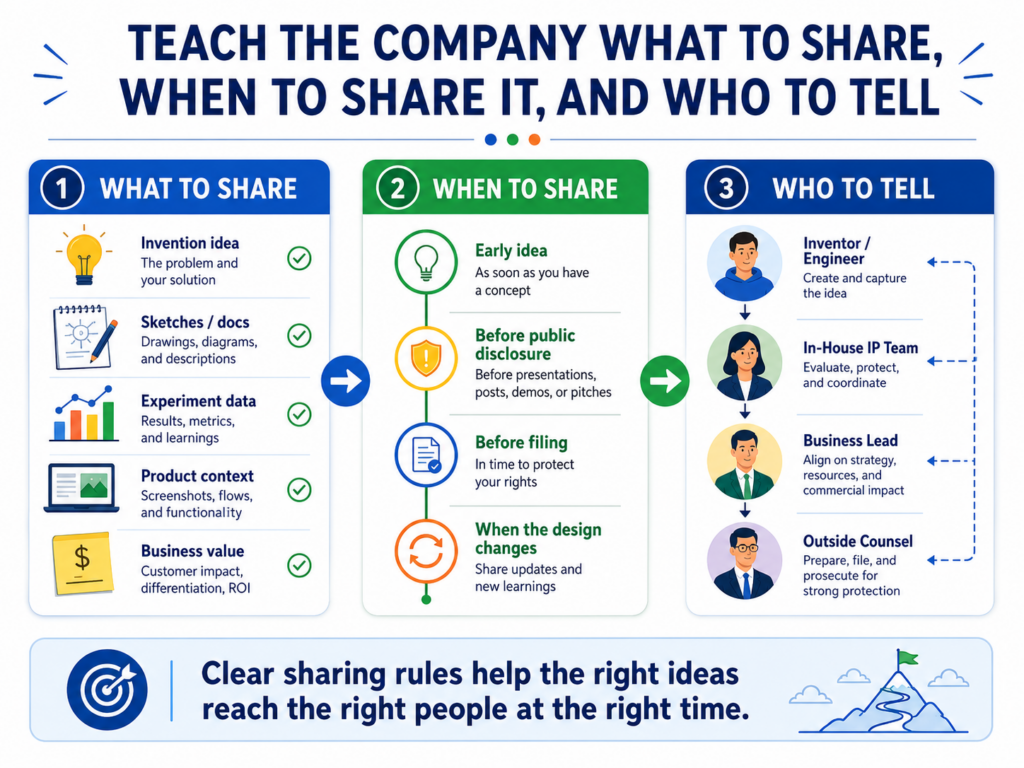
They cannot sit in every product meeting, research call, customer demo, investor pitch, marketing review, and engineering standup. So the company needs simple rules that help people know when to bring legal in.
This does not mean turning every employee into a patent expert. That would not work. The goal is much simpler.
People should know what kinds of ideas may matter, what kinds of public sharing may create risk, and who to contact before details leave the company.
The best in-house teams teach this in plain language. They do not scare people. They do not bury them in legal rules.
They explain that early notice helps the company protect important work without slowing launches or deals.
Training Should Be Short, Practical, And Tied To Real Work
Most people do not remember long legal training. They remember examples that feel close to their own work. So the in-house IP team should use real company situations when teaching inventors and business teams.
For engineers, the training should show that inventions can live inside systems, models, workflows, data handling, devices, security methods, testing methods, and performance improvements.
For product teams, it should show how new user flows or platform features may reflect deeper technical choices. For marketing and sales teams, it should show when public materials may reveal too much about how something works.
The training should make one thing very clear. If the team is about to show a new technical solution outside the company, they should check with the IP team before doing it.
Use Plain Examples, Not Legal Theory
Plain examples work better than abstract rules. An engineer may not respond to a long talk about disclosure rules. But they will understand a simple example: before showing a new model-routing method in a conference talk, tell the IP team.
Before posting code that reveals a new data cleaning pipeline, tell the IP team. Before giving a customer a deep technical demo of a new control system, tell the IP team.
Examples help people act. They also reduce fear. Employees learn that the goal is not to block sharing. The goal is to protect the company first when protection is needed.
PowerPatent helps companies turn early invention signals into a clearer patent process.
That is especially useful when many technical teams are building at once and the legal team needs a faster way to capture what matters. See how PowerPatent works here: https://powerpatent.com/how-it-works
The Best Training Creates A Reflex
The goal of IP training is to create a reflex. When someone sees a new technical solution, they should think, “Should we tell the IP team?” When someone prepares a public talk, they should think, “Are we sharing how this works?” When someone plans a launch, they should think, “Did we protect the core idea first?”
That reflex protects the company. It also makes coordination easier because the IP team gets early signals instead of late emergencies.
Repeat The Message In Small Ways
One training session is not enough. People forget. Teams change. New employees join. Product plans move. The message needs to show up in small, steady ways.
The in-house IP team can bring it up during onboarding, engineering reviews, launch planning, research updates, and founder or executive check-ins.
The message should stay simple. Share new technical ideas early. Flag public technical details before they go out. Ask for help before the deadline is close.
When this becomes normal, the patent process starts to feel less like a legal event and more like part of how the company builds.
Use Budget As A Strategy Tool, Not Just A Spending Limit
Patent budgets can create tension. In-house teams want strong protection. Business leaders want cost control.
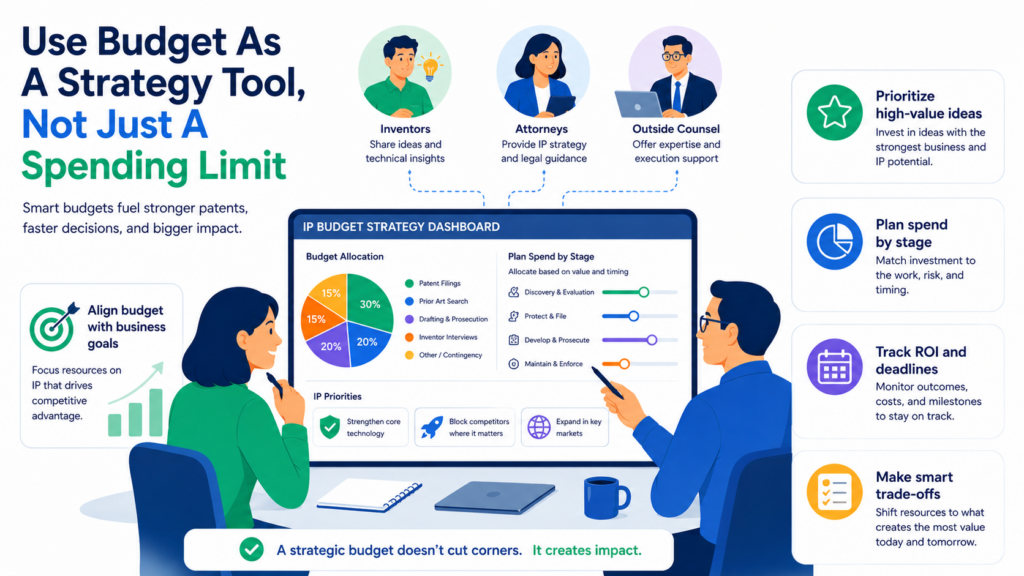
Outside counsel wants enough time to do quality work. Inventors want their ideas taken seriously. If budget is handled poorly, it can make the whole process feel like a fight.
Strong IP teams treat budget as a strategy tool. They do not ask, “How can we spend less on everything?” They ask, “Where should we spend more because it matters, and where should we be careful because the value is lower?”
This is a much smarter frame. Some inventions deserve deeper work, more examples, more claim planning, and more review.
Others may need a lighter approach or may not need filing at all. The in-house team should help the company make those choices with care.
Not Every Filing Should Get The Same Level Of Spend
A core platform invention should not be treated the same as a small product improvement. A filing tied to a future funding story may need more strategic thought than a narrow defensive filing.
A patent that protects a hard-to-copy technical edge may deserve more investment than one that covers a feature likely to change soon.
The in-house team should match spend to value. This means setting different levels of effort for different matters.
High-value filings may need deeper inventor interviews, more examples, better drawings, more claim strategy, and closer in-house review. Lower-priority filings may need a faster path or may be held until the business case is clearer.
Budget Discipline Starts Before Outside Counsel Begins Work
The best time to control cost is before drafting starts. Once outside counsel begins with unclear instructions, cost can grow quickly.
The in-house team should define the scope of work upfront. They should tell outside counsel what is expected, what the budget range is, what questions need approval, and what the filing is meant to protect.
This gives outside counsel a clear lane. It also helps prevent surprise bills. More important, it forces the in-house team to think carefully about value before spending begins.
PowerPatent can help teams reduce wasted motion by making invention capture and patent workflow more organized from the start.
With smart software and real attorney oversight, teams can move faster while keeping legal quality in view. Learn more here: https://powerpatent.com/how-it-works
Cost Reviews Should Look At Value, Not Just Hours
It is easy to look at outside counsel bills and focus only on hours. But hours alone do not tell the full story.
A higher-cost filing may be worth it if it protects a core product area and is done well. A lower-cost filing may still be wasteful if it is weak, narrow, or disconnected from the business.
The in-house team should review cost against value. Did the work support a key company goal? Did the draft need too many revisions? Did outside counsel ask smart questions early? Did the filing protect the right technical area? Did the process respect inventor time?
Cheap Work Can Become Expensive Later
A low-cost patent application can become expensive if it is poorly drafted. It may fail to support good claims later. It may miss key examples. It may not cover future product versions.
It may require more work during prosecution. It may give the company a weak asset that looks fine on paper but does little in practice.
That does not mean every filing should be expensive. It means every filing should be scoped with care. The right cost is the cost that matches the value and complexity of the invention.
Good budget management is not about cutting corners. It is about putting the right level of effort in the right places.
Conclusion
In-house IP teams do their best work when they make the patent process clear, fast, and tied to the business. Inventors should know how to share ideas. Attorneys should know what matters most. Outside counsel should have the context needed to draft strong filings without wasted back-and-forth.
When everyone moves through one clean system, the company protects better ideas, avoids delays, and spends money with more care. PowerPatent helps make this easier by combining smart software with real attorney oversight, so teams can turn technical work into stronger patent protection with less friction. See how it works here: https://powerpatent.com/how-it-works
Leave a Reply