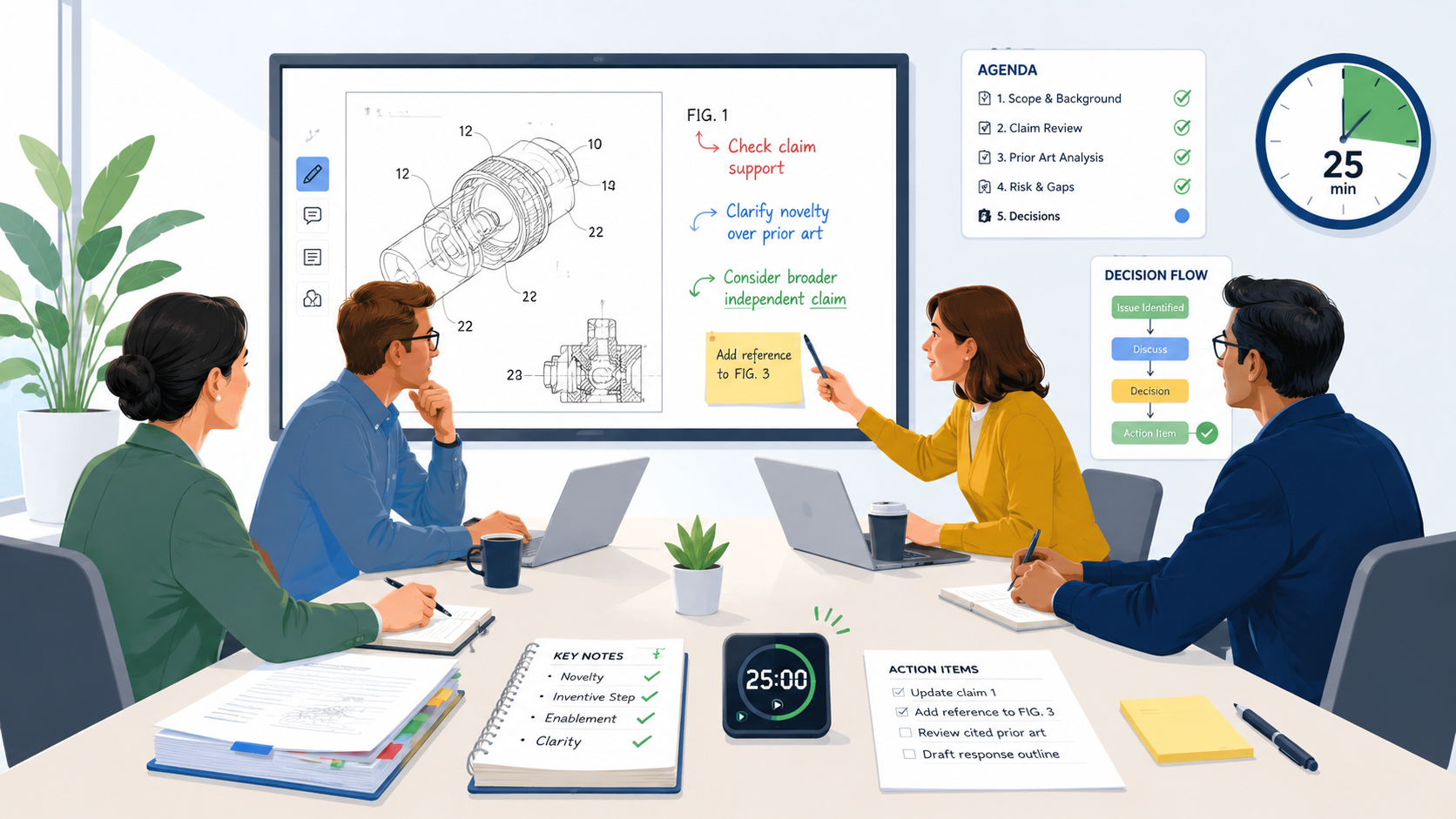
Patent review meetings should help your team make clear choices fast. PowerPatent helps teams make this process smoother by combining smart software with real attorney oversight, so invention review does not become a slow, messy guessing game. You can see how it works here: https://powerpatent.com/how-it-works
Why Most Patent Review Meetings Waste Time
Most patent review meetings waste time because they are treated like open talks instead of decision meetings.
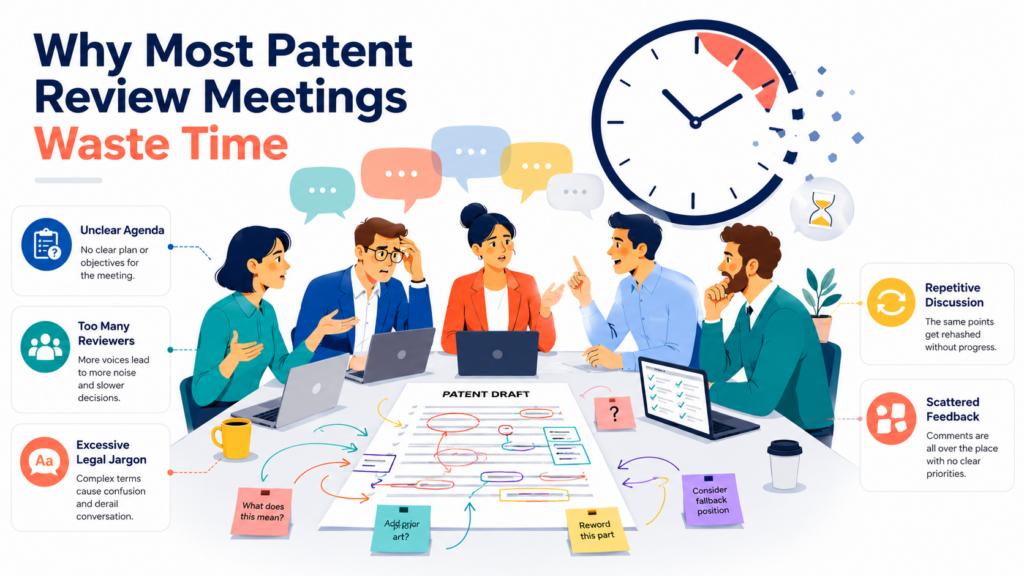
A team gets in a room, opens a few notes, and starts talking about the invention from the top. That sounds normal, but it is where the meeting starts to break.
The inventor explains the product. Then someone asks how it works. Then someone asks what is new. Then the founder asks whether it is worth filing.
Then the attorney asks for more detail. Soon the meeting becomes a long replay of work that should have happened before the call.
A patent review meeting should not be where people first learn the invention. It should be where people make smart choices about the invention.
That one shift changes everything.
When the meeting is used for learning, it gets slow. When the meeting is used for deciding, it gets sharp.
The meeting fails when the team brings raw thoughts instead of clear inputs
A raw thought is not ready for review. It may be a smart idea, but it is not ready to be judged. The team still needs to know what problem it solves, how it works, what makes it different, and why the business cares.
Many engineers do not know what patent teams need. That is not their fault. They are busy building.
They may think, “This is just part of the system,” when it is actually the most valuable part. Or they may think, “This is obvious,” when the way they solved the problem is not obvious at all.
This is why the process before the meeting matters so much.
Before anyone joins a patent review meeting, the invention should be written in plain words. Not legal words. Not a huge report.
Just a clear story. What was hard? What did the team try? What finally worked? What result did it create? What would a competitor want to copy?
That is enough to turn a messy meeting into a useful one.
The first job is to remove mystery before the call starts
A patent review meeting should not begin with the sentence, “Can you walk us through this?”
That sentence sounds harmless, but it often burns the first twenty minutes. A better meeting starts with everyone already having the same basic facts. Then the live time can be used to test the strength of the idea.
The team should know the product area. They should know the feature or system being reviewed. They should know the technical change.
They should know why the change matters. They should also know what decision has to be made by the end of the meeting.
This does not mean the team needs a perfect write-up. It means the meeting needs enough structure so smart people are not forced to guess.
PowerPatent is built for this kind of flow. It helps teams turn invention notes, code ideas, technical documents, and founder input into a cleaner review path, with real attorney oversight layered in.
That way, the meeting is not wasted on basic collection. It can focus on what to protect and why. Learn more here: https://powerpatent.com/how-it-works
The meeting fails when no one owns the decision
Another reason patent review meetings drag is that no one knows who gets to decide. The inventor knows the technical truth.
The founder knows the business need. The attorney knows the patent risk. The product lead knows the roadmap. But if no one owns the final call, the group can talk forever.
A strong meeting has one clear owner. That person does not need to know everything. They only need to guide the room toward a useful result.
That result may be to move forward with a filing. It may be to collect more detail. It may be to split one invention into several ideas.
It may be to pause because the idea is not core to the business. It may be to keep the idea secret instead of filing right now.
What matters is that the meeting ends with a real outcome.
A weak meeting ends with, “Let’s think about it.” A strong meeting ends with, “Here is the next action, here is the owner, and here is the date.”
The room should not vote on whether the idea feels cool
Patent review is not a taste test. The team is not there to decide whether an idea sounds exciting.
The team is there to decide whether the idea has value, whether it can be described clearly, whether it supports the business, and whether it deserves legal spend.
That means the meeting needs a shared way to judge ideas.
A good review looks at the problem, the solution, the difference, the business use, the risk of copying, and the timing.
When teams use these same points every time, the meeting becomes faster because people stop arguing from personal taste.
This is where many startups get into trouble. They review inventions only when someone remembers.
They file only when a big launch is close. They rely on memory. They wait too long. Then the review becomes urgent, stressful, and incomplete.
The better path is to make patent review a normal part of the build cycle. Not a huge event. Not a legal fire drill. Just a smart checkpoint that helps protect the best work before it leaks into the market.
Set the Goal Before the Meeting Starts
A patent review meeting without a clear goal is like a product meeting without a roadmap. It may feel active, but it will not move the company forward.
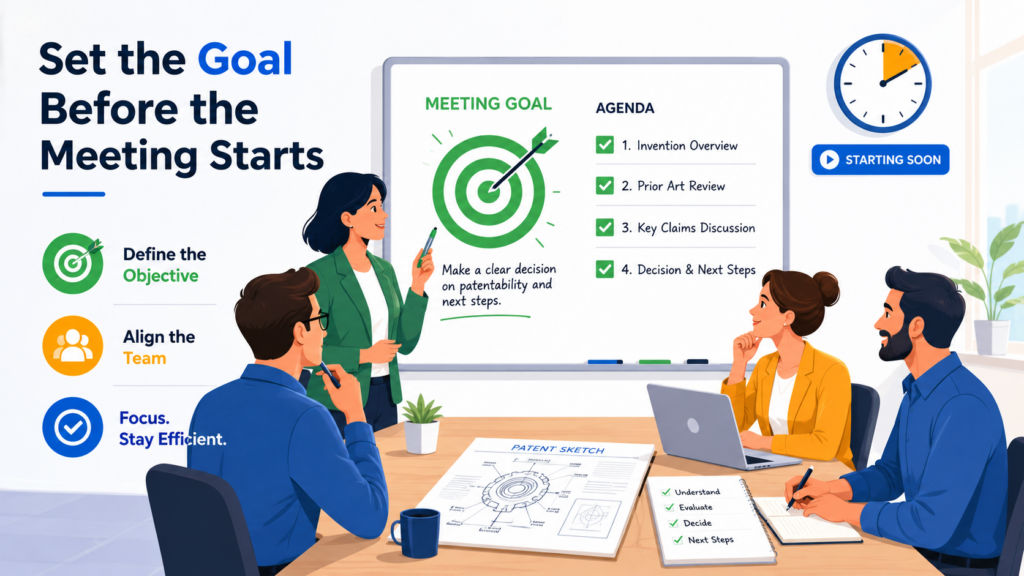
People will share views, ask questions, and bring up edge cases. But the team will struggle to land the plane.
The goal must be set before the meeting starts.
Not during the meeting. Not halfway through. Before.
The goal should be so clear that every person knows why they are there. Are you deciding whether to file? Are you choosing which version of the idea to protect?
Are you checking whether the invention is ready for attorney drafting? Are you deciding whether more inventor input is needed? Are you ranking several ideas because budget is tight?
Each goal creates a different meeting.
When the goal is unclear, people prepare in the wrong way. The engineer may prepare a deep technical demo when the real need is a business value call.
The founder may show up ready to approve spend when the real need is to fix gaps in the invention story. The attorney may ask broad questions because no one has explained the desired outcome.
A clear goal saves time before the meeting even begins.
The best goal is a decision, not a discussion topic
Many teams write meeting topics that sound clear but are still too loose. “Review new AI workflow” is not a goal. “Discuss patent options for model training system” is not a goal. “Talk about invention disclosures” is not a goal.
Those are topics.
A real goal points to a decision.
The goal should say what will be decided by the end of the meeting. For example, the team may need to decide whether an AI training workflow is ready for a provisional patent filing.
Or the team may need to decide which part of a new hardware design is the true invention. Or the team may need to decide whether a customer-facing feature should be filed before launch.
That kind of goal gives the room a finish line.
A clear goal protects founder time and engineer focus
Founder time is expensive. Engineer focus is even more fragile. Every extra meeting pulls people away from building, selling, hiring, or shipping. So the patent review meeting has to earn its place on the calendar.
The easiest way to protect time is to make the meeting decision-first.
Before the invite goes out, write the goal in plain words. Put it at the top of the meeting notes. Send it with the pre-read. Repeat it at the start of the call. Then use it to stop side paths.
When someone goes too deep into a topic that does not help the decision, the meeting owner can bring the room back without sounding rude. They can say, “That may matter later, but today we need to decide whether this is ready to file.”
That simple line saves the meeting.
PowerPatent helps teams create this kind of cleaner handoff between invention capture, review, and attorney action.
Instead of forcing founders and engineers to turn messy notes into legal-ready material on their own, the platform helps shape the work into a more useful review process, backed by real patent attorneys. See how it works here: https://powerpatent.com/how-it-works
Prepare the Invention Story Before Anyone Joins the Call
A patent review meeting gets much faster when the invention story is already clear. This does not mean the team needs a polished legal document.
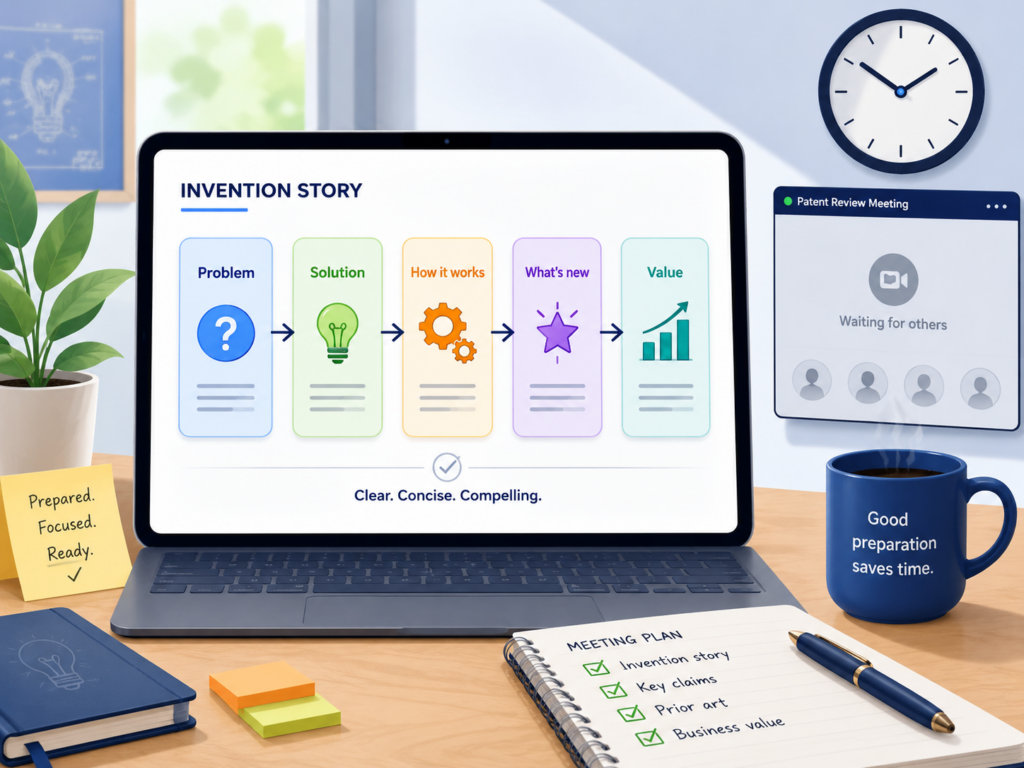
It means the team needs a plain, useful explanation that helps everyone understand the idea before the meeting starts.
The invention story is not a pitch deck. It is not a product spec. It is not a full patent draft. It is the simple version of what happened. There was a problem. The team tried to solve it.
The normal ways were too slow, too costly, too weak, too hard to scale, or not good enough. Then the team built a better way. That better way created a result that matters.
That is the core story.
When this story is missing, the meeting becomes a live interview. The attorney has to pull the facts out one question at a time. The founder has to guess whether the idea has business value.
The engineer has to explain the same system from several angles. Everyone burns time trying to find the real point.
The better move is to prepare the story before the meeting. This gives the room something to test, sharpen, and decide on.
Make the story about the problem, not just the feature
Many teams start with the feature. They say, “We built a new dashboard,” or “We changed the model pipeline,” or “We added a better matching system.” That is not wrong, but it is not enough. A feature alone does not show why the invention matters.
The story should begin with the problem.
What was hard before this work? What kept breaking? What took too long? What did customers hate? What did the old system fail to do? What did the team need that existing tools could not give them?
This is where the real invention often appears.
For example, a startup may think the invention is a new workflow screen. But the deeper invention may be the way the system predicts missing data before the user asks for it.
Another team may think the invention is a faster search tool. But the real invention may be the way the system ranks results using live product signals and user behavior at the same time.
The feature is what people see. The invention is often the hidden method that makes the feature work.
A strong patent review meeting should help the team find that hidden method.
The story should explain why the old way was not enough
A good invention story makes the old way feel limited. It shows the gap that pushed the team to build something new.
This does not need to be dramatic. It just needs to be clear. Maybe the old system used too much compute. Maybe it needed too much manual review. Maybe it failed when data was noisy.
Maybe it worked in a demo but failed at real scale. Maybe it was fine for one customer but broke when many customers used it at once.
These details matter because they help the team see the technical reason behind the invention.
Without this context, people may treat the invention like a small product change. With the context, they can see why the work may be worth protecting.
This is especially important for deep tech teams. The best ideas are often buried inside systems, models, controls, sensors, APIs, data flows, or backend logic.
They may not look flashy. They may not show up in a product screenshot. But they may be the very thing that makes the company hard to copy.
PowerPatent helps founders and engineers pull these details out earlier, so the meeting does not depend on memory or guesswork.
It helps turn technical work into a clearer invention record, with real attorney review added to keep the process grounded. You can explore the workflow here: https://powerpatent.com/how-it-works
Keep the story short enough to use
A common mistake is to over-prepare. Someone writes a long document with too much background, too many screenshots, and too many side notes. Then no one reads it. The meeting starts, and the team is back at zero.
The invention story should be short enough that busy people will actually read it.
It should explain the problem, the better way, the main technical steps, the result, the business use, and the timing. It should also point out what is still unknown. That is enough to guide a useful review.
The goal is not to answer every possible patent question before the meeting. The goal is to make sure the meeting starts from a shared base.
The best pre-read makes the live meeting sharper
A good pre-read does three things. It gives the room the basic facts. It shows where the invention may be strong. It also shows where the team still needs to think.
The pre-read should not hide weak spots. If the team is not sure whether the idea has been used before, say that. If the system is not built yet, say that. If the feature is launching next month, say that. If the idea came from customer work, say that too.
These details do not ruin the meeting. They make it better.
Patent review is not about pretending every idea is ready. It is about finding the right path for each idea. Some ideas need fast filing.
Some need more detail. Some need to be split into parts. Some should not be filed at all. A clear story helps the team make that call without wasting an hour.
Invite Only the People Who Can Change the Outcome
A patent review meeting should be small. This is one of the simplest ways to save time.

Many teams invite too many people because they do not want anyone to feel left out. That sounds kind, but it often hurts the meeting.
More people means more context setting, more opinions, more side comments, and more pressure to explain things that do not affect the decision.
The right people are not always the most senior people. They are the people who can change the outcome.
That usually means someone who understands the invention, someone who understands the business need, and someone who understands the patent process. In a startup, this may be one inventor, one founder or product leader, and one patent attorney.
For a larger technical team, it may include an engineering lead or research lead who can explain how the system fits into the broader roadmap.
The key is to avoid turning the meeting into a show.
A review meeting is not a demo day. It is not a company update. It is not a place to impress the room. It is a working session for making a clear choice.
The inventor should be there, but not every builder needs to be there
The main inventor should be in the meeting. This is the person who can explain what was actually built and why it is different.
They can answer the hard questions. They can say what failed before the final approach worked. They can explain tradeoffs that do not appear in a product spec.
But not every engineer who touched the code needs to attend.
If five engineers join, the meeting may turn into a technical debate. That can be useful in a design review, but it is often too much for patent review.
Patent review needs enough detail to understand and protect the invention. It does not need every internal debate about code style, library choices, or small design preferences.
The meeting owner should ask who has the clearest view of the invention. That person should speak for the technical side. Others can send notes before or after the meeting.
The founder’s role is to bring business judgment
The founder does not need to explain every technical step. The founder needs to help the room judge why the invention matters.
Is this idea core to the product? Does it support a future product line? Would it matter if a competitor copied it?
Does it help the company raise money, win customers, defend a market, or build a moat? Is the launch coming soon? Is there a reason to move fast?
These are business questions, not legal questions.
A patent review meeting gets stronger when the founder speaks to these points clearly. A technically interesting idea may not deserve urgent filing if it is far from the business.
A small-looking backend method may deserve fast action if it protects the thing customers pay for.
That is why business context matters.
PowerPatent is useful here because it helps connect invention capture with founder-level decision making.
The platform is built to help teams see not just what was invented, but why it may matter to the company, while attorney oversight helps guide the next step. Learn more here: https://powerpatent.com/how-it-works
The attorney should guide risk, not dominate the room
A good patent attorney does not turn the meeting into a legal lecture. They help the team see the invention more clearly.
They ask sharp questions. They test what is new. They help spot gaps. They explain timing risks in plain words. They help decide whether the idea is ready for the next step.
The attorney should not be forced to discover the invention from scratch during the meeting. That is slow and expensive.
When the attorney has a good pre-read, the meeting becomes much more valuable. They can ask focused questions instead of broad ones. They can help shape the invention.
They can tell the team where more detail is needed. They can also help stop the team from filing on something too thin, too vague, or too far from the business.
That balance matters.
Keep observers out unless they have a real job
Observers often make patent review meetings worse. They listen quietly for most of the time, then ask broad questions near the end.
Or they pull the team into topics that are not needed for the decision. Or they make inventors feel like they are presenting instead of collaborating.
If someone does not have a clear role, they do not need to be in the room.
They can read the summary later.
This is not about hiding information. It is about protecting focus. The best meetings are not the ones with the most people. They are the ones with the right people, ready to make the right call.
Use the First Five Minutes to Lock the Meeting Frame
The first five minutes decide the quality of the whole meeting.
If the meeting starts loose, it usually stays loose. People open with small talk. Someone asks what the meeting is about.

Someone else starts explaining the product from the beginning. Then the group drifts. By the time the real discussion starts, the meeting is already half gone.
A strong meeting starts with a clear frame.
The meeting owner should state the purpose, the decision needed, the time limit, and what will not be covered today. This does not need to sound stiff. It just needs to be direct.
For example, the meeting can begin by saying that the purpose is to decide whether this invention is ready for a provisional filing before the product launch.
The team will spend the first part checking the invention story, the next part testing what may be new, and the final part assigning next steps. The meeting will not cover branding, pricing, or general product roadmap unless those topics affect the patent decision.
That kind of opening saves a huge amount of time.
It gives everyone permission to stay focused.
Start with the decision, then move to the facts
Many teams do this backward. They start with facts, then hope a decision appears. A better meeting starts by naming the decision first.
When people know the decision, they listen differently.
If the decision is whether to file before launch, everyone pays attention to timing, public disclosure, readiness, and business value.
If the decision is whether to split one idea into two filings, everyone listens for separate inventive parts. If the decision is whether the idea is worth more research, everyone listens for gaps and unknowns.
The same facts become more useful when the decision is clear.
The meeting owner should repeat the decision in plain words. Then they should ask whether anyone sees a reason that decision cannot be made today. This is a strong move because it brings hidden blockers out early.
Maybe the engineer says the final design is still changing. Maybe the founder says the feature may be cut from the roadmap.
Maybe the attorney says the pre-read is missing the key technical steps. If those issues come up in minute five, the team can adjust. If they come up in minute fifty, the meeting feels wasted.
A clear frame keeps strong voices from taking over
Every team has people who think out loud. They may be smart and helpful, but they can pull a meeting off track without meaning to.
Patent review meetings are especially vulnerable because the topics are deep. One technical question can lead to a ten-minute detour.
The meeting frame gives the leader a polite way to bring things back.
They can say, “That is useful, but let’s tie it back to the filing decision.” Or, “That detail may matter during drafting, but today we need to decide whether this is worth moving forward.” Or, “Let’s park that because it does not affect the invention we are reviewing.”
This is not rude. It is respectful. It protects everyone’s time.
PowerPatent helps reduce this pressure because more of the basic structure is handled before the meeting.
When the invention record, technical notes, and review flow are already organized, the live conversation can stay closer to the real decision. See how PowerPatent helps teams move from invention to action here: https://powerpatent.com/how-it-works
Keep the meeting frame visible until the end
A frame is not only for the opening. It should guide the whole meeting.
If the team starts to drift, return to the decision. If the discussion becomes too broad, return to the invention.
If people start debating product strategy, return to what must be decided today. If the attorney asks for more detail, connect the request to the next action.
This prevents the meeting from becoming a pile of interesting comments.
Patent review can easily become abstract. People may talk about possible competitors, future features, investor views, product changes, research paths, and legal details. Some of that may matter. Much of it may not matter today.
The frame helps sort useful input from noise.
End the meeting by restating the frame and the result
The final minutes should answer the same question the meeting started with.
Did the team make the decision? If yes, what is it? If no, why not? What is missing? Who owns it? When will it be ready?
This closing step matters because people often leave meetings with different views of what happened. The founder may think the team agreed to file.
The engineer may think more tests are needed first. The attorney may think the invention is not ready until the technical flow is clearer.
Do not let that happen.
Say the result out loud. Write it down. Send it after the meeting. A patent review meeting is only useful if the decision survives after the call ends.
Focus the Review on What Is New, Useful, and Hard to Copy
A patent review meeting should not try to cover every detail of the product. It should focus on the parts that may matter for protection.
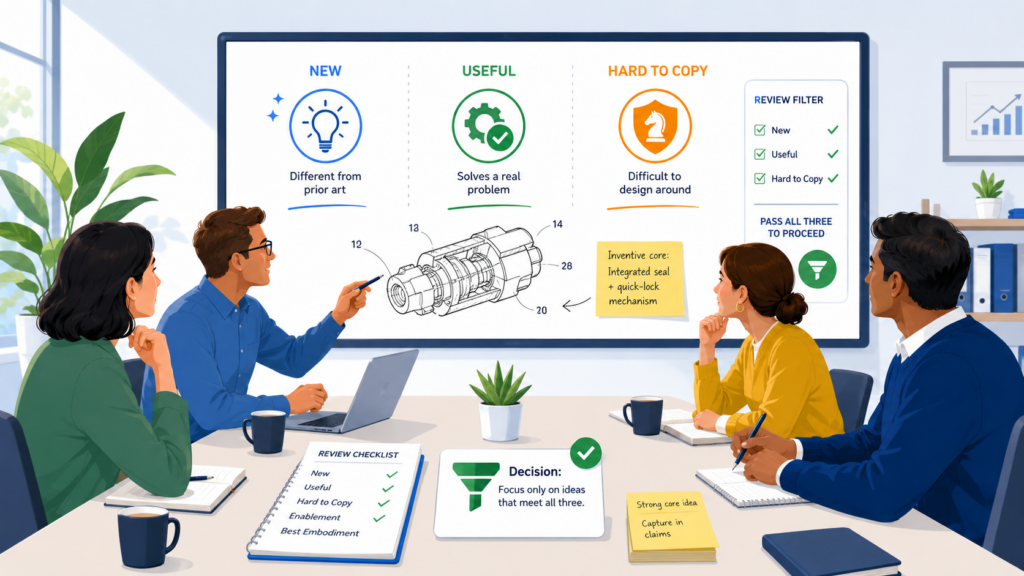
The most useful question is simple: what did the team do that is new, useful, and hard for others to work around?
This question keeps the meeting grounded. It moves the team away from vague claims like “our system is smarter” or “our platform is faster.” It pushes the team toward clear invention points.
New means the team is not just using a standard method in a standard way. Useful means the idea solves a real problem. Hard to copy means a competitor would care about using the same approach or a close version of it.
A patent review meeting should search for that overlap.
Not every useful feature is patent-worthy. Not every clever technical move matters to the business. Not every business-critical feature has a protectable invention inside it. The meeting exists to sort these things out.
Ask what changed inside the system
The outside feature is often not the invention. The inside change usually matters more.
A customer may see a simple button, a faster report, a better alert, or a cleaner workflow. But the patent discussion should ask what changed inside the system to make that possible.
Was there a new data path? A new ranking method? A new control loop? A new model update process? A new way to reduce errors? A new way to handle bad input? A new way to use signals from different sources?
These inside changes are often where the strongest ideas live.
Founders sometimes miss this because they focus on what customers see. Engineers sometimes miss it because they think the inside change is just “how we made it work.” The review meeting brings both views together.
The founder brings the market reason. The engineer brings the technical truth. The attorney helps shape the idea into something that can be reviewed and possibly protected.
Look for the step a competitor would need to copy
A strong patent review question is this: if a competitor wanted the same result, what would they likely copy?
This question cuts through noise.
Maybe they would copy the user interface. Maybe they would copy the data cleaning method. Maybe they would copy the model serving setup.
Maybe they would copy the sensor placement. Maybe they would copy the order of operations. Maybe they would copy a special rule that makes the whole system work better.
The answer points the team toward the most valuable part of the invention.
It also helps avoid filing on the wrong thing. A team may be proud of one part of the system, but the market may care about another part. The review meeting should connect technical novelty with business value.
PowerPatent helps teams capture these invention details in a more organized way, so the strongest parts do not get lost in scattered docs, tickets, or memory.
With attorney oversight, teams can move faster while still making careful decisions. You can see the process here: https://powerpatent.com/how-it-works
Separate the invention from normal engineering work
Startups build fast. Every week brings fixes, changes, and improvements. Not all of them belong in a patent review meeting.
The team should learn to separate normal engineering work from invention-level work.
Normal engineering work may include cleaning up code, changing a database field, moving a button, improving load time in a routine way, or using a common tool as expected.
Invention-level work often appears when the team had to solve a hard problem in a non-standard way.
It may involve a new method, a new system design, a new flow, a new use of data, or a new way to combine known parts to create a better result.
The difference is not always obvious. That is why the review exists.
But the team should not treat every change as equal. If everything is urgent, nothing is urgent. If every product update gets a full patent meeting, people will stop taking the process seriously.
Use the review to find the sharp edge
The sharp edge is the part of the invention that makes it stand apart.
It may be one step. It may be one rule. It may be one system connection. It may be one way of using data that others do not use.
It may be one timing choice that makes the method work better. It may be a small technical move that creates a large practical gain.
The meeting should keep pushing until the sharp edge is clear.
Do not stop at “we made it faster.” Ask how. Do not stop at “we improved accuracy.” Ask what changed.
Do not stop at “we automated the workflow.” Ask what decision the system now makes and what inputs it uses. Do not stop at “we reduced cost.” Ask which step was removed, replaced, or changed.
The sharper the invention point, the better the next step will be.
Turn Inventor Input Into Clear Action, Not More Homework
The best patent review meetings turn live discussion into clear action. They do not end with a vague request for more information.
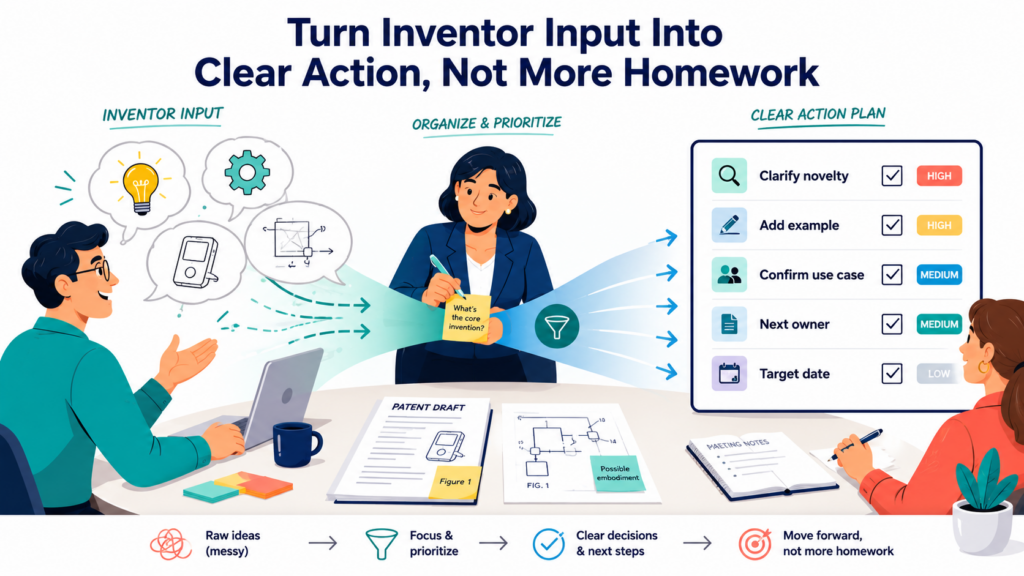
They do not leave the inventor wondering what to send. They do not leave the founder unsure whether anything is moving.
This is where many meetings fail.
The attorney asks for more detail. The engineer nods. The founder assumes the process is moving. Then a week passes. The engineer is busy. The attorney is waiting. The founder thinks the filing is underway. Nothing happens.
The issue is not bad intent. The issue is unclear action.
A good meeting turns every open question into a specific next step. It names the owner. It states what “done” looks like. It sets the order of work. It makes the next move easy to start.
Do not ask inventors for “more detail”
“More detail” is one of the worst follow-up requests in patent review.
It sounds clear, but it is not. More detail about what? The code? The model? The product? The test results? The failed attempts? The data flow? The customer problem? The system architecture? The edge cases?
Inventors are not mind readers. If the request is vague, they may send the wrong thing. Or they may send too much. Or they may delay because they do not know where to begin.
The better request is narrow.
Ask for the exact missing piece. Ask for a diagram showing how data moves from input to output. Ask for a short note explaining what happens when the system receives bad data.
Ask for the three design options the team rejected and why. Ask for the test result that shows the new method works better. Ask for the part of the code or model flow that shows the key step.
The clearer the ask, the faster the answer.
Make the next step small enough to complete
Inventors are busy. They are shipping product, fixing issues, helping customers, and building the next thing. If the follow-up task feels large, it may sit untouched.
The meeting owner should break follow-up into small, direct asks.
Instead of asking an engineer to “document the system,” ask them to explain one flow in plain words. Instead of asking for “all test data,” ask for the result that compares the old way and new way.
Instead of asking for “technical details,” ask for the part that shows what changed and why it mattered.
Small tasks move. Large vague tasks stall.
This is one reason PowerPatent is built around a smoother invention workflow. It helps reduce the burden on founders and technical teams by making invention capture more guided, organized, and attorney-reviewed.
The goal is not to make engineers become patent experts. The goal is to help them give the right input with less friction. You can learn more here: https://powerpatent.com/how-it-works
Capture decisions while the meeting is still fresh
Do not wait until the next day to write the meeting summary. The summary should be captured as the meeting closes or right after.
Memory fades fast. Small details get lost. People remember decisions differently. The longer the delay, the greater the chance that the next step becomes unclear.
The summary should state what was reviewed, what was decided, what is missing, who owns each action, and what happens next.
It should also capture the reason behind the decision. That reason is important. A month later, the team may forget why an idea was paused or why filing was approved.
Good records prevent repeated debates.
If the team decides not to file, write why. If the team decides to wait, write what event will trigger another review.
If the team decides to move forward, write what must happen before drafting starts. If the team decides to split the invention, write the split clearly.
Close the loop so the meeting creates momentum
A patent review meeting should create motion. It should not just create notes.
The meeting owner should send the summary quickly and make the next step visible. If more inventor input is needed, the inventor should know exactly what to provide.
If attorney drafting is next, the attorney should have the core invention story and missing items. If founder approval is needed, the founder should know the cost, timing, and business reason.
Momentum matters because patent timing can be unforgiving. Product launches, investor decks, customer demos, conference talks, public posts, and sales materials can all create pressure. A slow process can lead to missed chances.
The best teams do not wait until panic arrives. They create a steady review rhythm. They capture ideas early. They review them cleanly. They decide with confidence. Then they move.
That is what patent review meetings are supposed to do.
They are not meant to drain the team. They are meant to protect the work that gives the company its edge.
Build a Simple Patent Review Scorecard Before the Meeting
A patent review meeting gets much better when the team has a shared way to judge each idea. Without a shared method, every person brings a different lens. The inventor may care about technical effort.
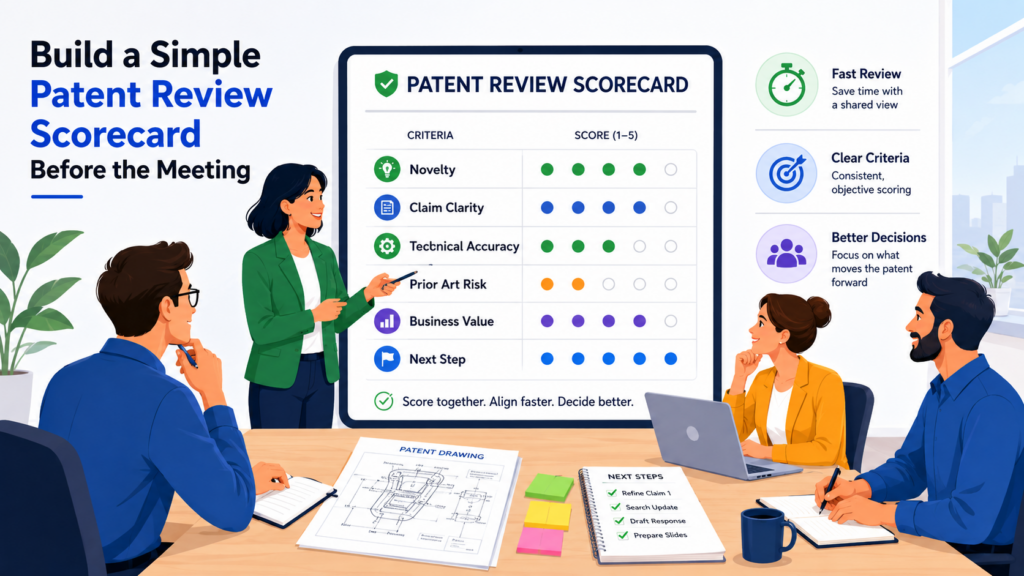
The founder may care about market value. The attorney may care about whether the idea can be claimed clearly. The product lead may care about launch timing. All of those views matter, but they need to work together.
This is why a simple scorecard helps.
The scorecard should not be a big form that slows people down. It should be a plain way to compare ideas before the team spends more time or money.
The goal is not to turn patent review into math. The goal is to stop the meeting from becoming a loose opinion fight.
A strong scorecard helps answer a few key questions. Is this idea important to the business? Is it tied to a product or future product? Would a competitor want to copy it? Is the idea clear enough to explain?
Does the team have enough technical detail? Is there any timing pressure because of a launch, demo, paper, pitch, or customer rollout? Is this one invention or several?
When the team reviews every idea through the same lens, the meeting gets faster. People stop arguing from gut feel. They start comparing the same signals.
The scorecard should help the team choose, not impress itself
Some teams make the mistake of turning scoring into theater. They create complex tables, long ratings, and heavy forms that no one wants to fill out. That defeats the point. A scorecard should make the decision easier, not create another admin task.
The best scorecard is simple enough to use in a live meeting. It should help the team see whether the invention is strong, weak, urgent, unclear, or not worth more time right now.
The scorecard should also help the team avoid two common traps.
The first trap is filing on ideas just because they sound exciting. An idea may sound smart, but if it does not support the business, it may not be the best use of budget.
The second trap is ignoring quiet ideas because they do not sound flashy. Some of the most valuable inventions live deep inside the system. They may be hard to explain, but they may also be hard for competitors to avoid.
A scorecard makes those quiet ideas easier to notice.
The score should point to the next action
A score is only useful if it changes what happens next.
If an idea scores high on business value and timing pressure, the team may decide to move fast. If it scores high on technical value but low on clarity, the next step may be to collect better inventor input.
If it scores high on business value but low on technical difference, the team may need attorney review before spending more time. If it scores low across the board, the team may decide to drop it or revisit later.
The score should not be used to shame ideas. It should help route them.
This is important because not every invention is at the same stage. Some are ready for filing. Some are still being tested.
Some are useful but not central. Some are core to the company but still need better proof. The meeting should not force all ideas into one path.
PowerPatent helps teams create a cleaner path from raw invention notes to smart review. It helps founders and engineers organize the facts, then adds real attorney oversight so the team can make stronger decisions without getting stuck in legal fog. You can see how it works here: https://powerpatent.com/how-it-works
Keep the scorecard tied to company strategy
A patent review scorecard should not live apart from the company plan. It should reflect what the company is trying to protect.
If the company is building a core AI platform, then model workflows, training systems, data handling, inference speed, and feedback loops may matter a lot.
If the company is building medical hardware, then sensor placement, device control, calibration, safety checks, and manufacturing methods may matter.
If the company is building robotics, then motion planning, perception, control systems, and human-machine interaction may matter.
The scorecard should help the team ask, “Does this invention protect the thing that makes us special?”
That question is more useful than asking, “Is this cool?”
Cool does not always mean protectable. Cool does not always mean valuable. Cool does not always mean urgent. But if an invention helps protect the core of the company, the team should pay attention.
A good scorecard also protects the budget
Patent budgets are real. Startups do not have endless money to file on every idea. A strong review process helps founders spend with more confidence.
This does not mean the cheapest path is always best. A weak patent strategy can cost more later if the company fails to protect its strongest work. But a messy patent process can also waste money by chasing ideas that do not matter.
The scorecard gives the founder a cleaner view. It shows which inventions deserve action now, which ones need more proof, and which ones should wait.
That is what good patent review does. It helps the company move with care, but without dragging.
Keep the Meeting Away From Legal Jargon
Patent review meetings often become slow because people start using words that only one person in the room fully understands. This creates a quiet problem.

People stop asking questions because they do not want to sound lost. The attorney thinks the team understands. The inventor thinks the legal side is too hard. The founder leaves with fuzzy confidence instead of real clarity.
That is dangerous.
A patent review meeting should be spoken in plain language. Everyone should understand what is being discussed.
If a word is not clear, it should be explained right away. The point of the meeting is not to sound legal. The point is to make a good business and invention decision.
Simple words make the meeting faster. They also make it more honest.
When people understand the conversation, they can challenge weak points. They can add missing facts. They can spot wrong assumptions. They can make better choices.
Plain words help inventors share better information
Inventors often know the invention better than anyone, but they may not know what patent words mean. If the meeting is full of legal language, the inventor may give short answers or stay quiet. That is a missed chance.
The attorney and meeting owner should use simple questions.
Instead of asking whether the invention has novel elements, ask what the team did that they have not seen others do. Instead of asking about embodiments, ask what versions of the idea could be built.
Instead of asking about enablement, ask whether someone could build the system from the explanation. Instead of asking about prior art, ask what similar tools, papers, products, or methods the team knows about.
This simple shift makes inventors more useful in the meeting.
It also makes the meeting feel less like a test.
The inventor should not feel like they are being cross-examined. They should feel like they are helping the company protect important work.
The founder should demand clarity without apology
Founders should never pretend to understand patent talk when they do not. If the meeting is unclear, the founder should stop and ask for the plain version.
That is not weakness. That is leadership.
A founder does not need to become a patent expert. But they do need to understand what the team is deciding.
They need to know whether the idea is ready, why it matters, what risk exists, what the next step costs in time and effort, and what could happen if the company waits.
If the answer is full of jargon, it is not ready for a decision.
A good patent partner should be able to explain the path in simple words. That is one of the reasons PowerPatent pairs smart software with real attorney oversight. The software helps organize the invention.
The attorney oversight helps keep the strategy sound. The founder gets a clearer path without having to decode old-school legal language. Learn more here: https://powerpatent.com/how-it-works
Simple language does not mean shallow thinking
Some people think plain language makes the meeting less serious. That is wrong. Plain language often makes the thinking sharper.
When an idea cannot be explained simply, it may mean the team does not understand it well enough yet.
Or it may mean the wrong part of the system is being reviewed. Or it may mean the invention is still too broad and needs to be narrowed.
Simple language forces clarity.
For example, “We improved machine learning performance through an adaptive optimization framework” may sound impressive, but it does not tell the team much.
A better version might say, “The system changes how it trains the model based on which data is causing the most errors, so it gets better without wasting compute on easy cases.”
That second version is easier to review. It shows the problem, the method, and the result.
The meeting notes should be plain enough for a new team member to understand
After the meeting, the notes should not read like a legal memo that only one person can use. They should be plain enough that a new founder, engineer, or attorney could understand what was reviewed and what was decided.
This matters because patent work often stretches over months or years. People leave. Product plans change.
New features build on old systems. Investors ask about the patent plan. Acquirers review the company’s IP. A clear record helps everyone later.
Plain notes also reduce repeat meetings. When the record is clear, the team does not have to ask the same questions again.
The meeting should create durable clarity, not just temporary agreement.
Review Timing Before You Review Everything Else
Timing can make or break a patent review meeting. A strong invention can become harder to protect if the team waits too long or shares too much too early.
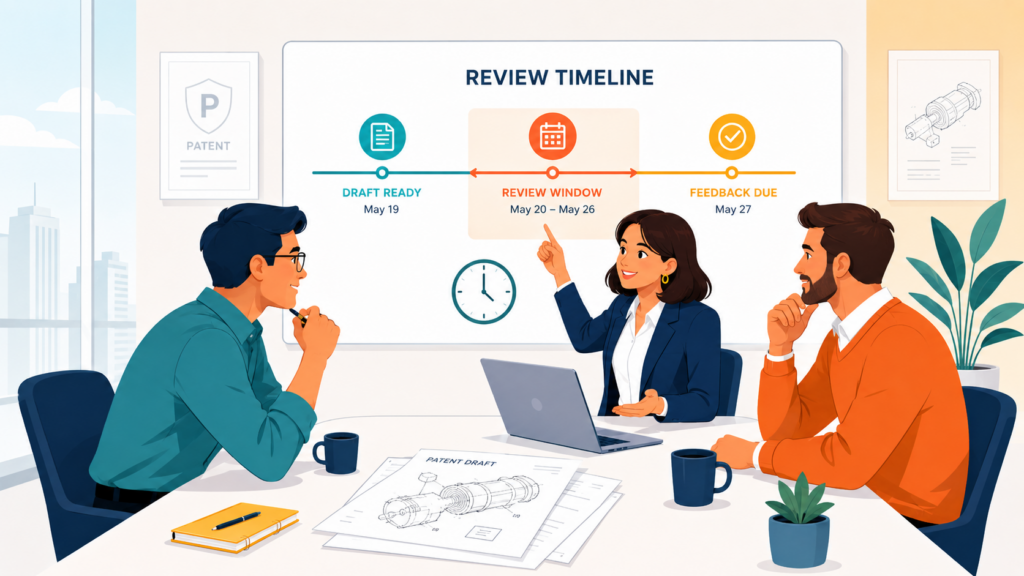
That does not mean founders need to panic. It means timing should be discussed at the start, not as an afterthought.
Many startups wait until a launch is close before thinking about patents. This creates stress. The product team is rushing. The founder is busy with sales or fundraising.
The attorney is trying to understand the invention quickly. The engineer is being pulled back into old work while trying to ship new work.
That is a bad way to make careful decisions.
A better review process asks about timing early.
Is the feature already public? Has it been shown to customers? Was it in a pitch deck? Has it been posted online?
Is it in a paper, demo, app store release, GitHub repo, sales deck, API docs, or conference talk? Will it launch soon? Are investors asking about protection? Is a competitor moving in the same area?
These questions help the team decide how urgent the meeting really is.
Timing pressure should change the meeting shape
If there is no timing pressure, the team can focus on quality. It can sharpen the invention story, gather more detail, review more versions, and decide with more room.
If there is timing pressure, the meeting needs to become more direct.
The team should quickly decide whether the idea is strong enough to move forward, what minimum detail is needed, who must provide it, and what must happen before public release.
The goal is not to rush blindly. The goal is to avoid slow drift when the clock matters.
A meeting about a future research idea is different from a meeting about a feature going live next week. The agenda should reflect that.
Public sharing should be treated as a serious signal
Many founders do not think of public sharing as part of patent strategy. They think of it as marketing, sales, hiring, or fundraising. But from a patent process point of view, public sharing can matter a lot.
That does not mean the company should stop talking about its product. Startups need to sell, hire, raise, and build trust. It means the patent review process should know what is being shared and when.
A review meeting should ask whether the invention will be disclosed in enough detail that others could understand it.
A vague marketing claim may not create the same concern as a technical blog post, product demo, open-source release, or customer document that explains how the system works.
This is where real attorney oversight matters. Founders should not have to guess what kind of sharing creates risk.
PowerPatent helps teams move faster by connecting invention review with attorney-guided next steps, so public plans and patent plans do not work against each other. See the process here: https://powerpatent.com/how-it-works
Do not wait for the invention to feel perfect
A common timing mistake is waiting until the invention is fully built, fully tested, and fully stable. That sounds safe, but it can be risky.
Startups change fast. The first version may lead to a better second version. The second version may lead to a third.
If the team waits for the “final” version, the market may already know too much, or a competitor may move, or the company may lose track of the original inventive work.
Patent review should happen when the team has enough detail to explain the idea clearly, not only when the product is finished.
This is especially true for fast-moving fields like AI, robotics, biotech tools, climate tech, chips, automation, and developer infrastructure. The invention may sit inside a workflow long before it becomes a polished product feature.
Review early, then update as the work grows
Early review does not mean filing on every half-formed thought. It means catching strong ideas before they vanish into the sprint cycle.
The first review can decide that an idea is promising but not ready. That is still useful. The team can mark what is missing and come back later.
Or the review may show that a filing should happen soon because the core method is already clear, even if product details will change.
The best teams build patent review into their normal rhythm. They do not wait for a crisis. They review important technical work as it appears, then update the plan as the company learns more.
This makes patent work calmer, cheaper, and more strategic.
Use the Meeting to Find the Real Invention, Not Just the First One
The first idea brought into a patent review meeting is not always the real invention. It may be the visible feature, the customer-facing result, or the part that sounded most exciting in a product update. But the strongest patent idea may be underneath it.
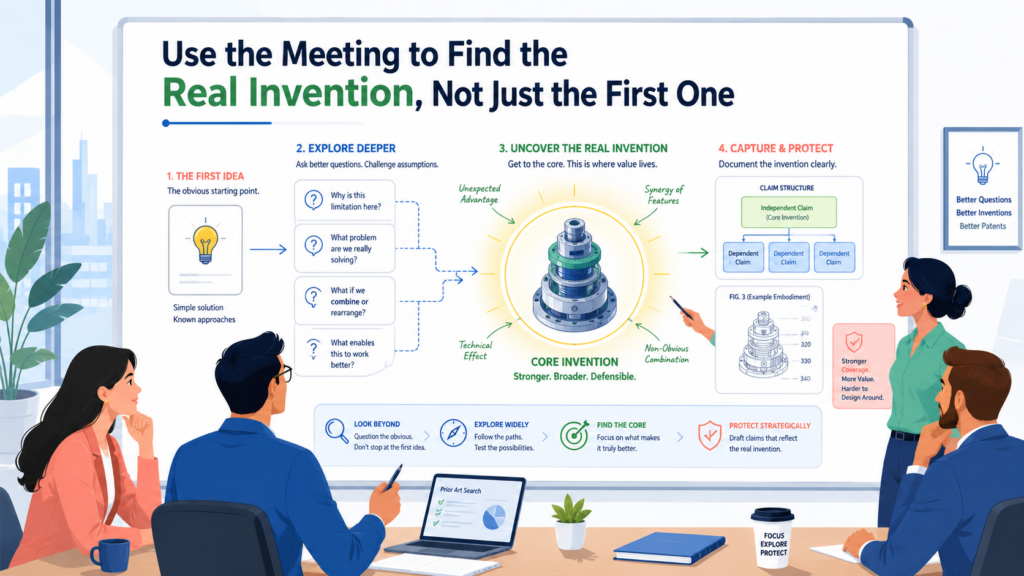
A good review meeting digs one level deeper.
The team should ask what had to happen inside the system to make the result possible. It should ask what was hard, what failed, what changed, and what the new method makes possible. This is how the meeting finds the real invention.
For example, a team may say the invention is a new AI assistant for customer support. But the real invention may be how the system routes uncertain answers to different review paths based on risk.
Another team may say the invention is a faster battery tool. But the real invention may be a new way to adjust charging behavior based on live sensor readings and user patterns.
The first label is often too broad. The real invention is more exact.
The meeting should separate outcomes from methods
Outcomes are what the invention achieves. Methods are how it gets there.
Both matter, but they are not the same.
A team may say the system reduces errors, saves energy, improves accuracy, speeds up review, lowers cost, or makes better choices.
Those are outcomes. They are useful, but they are not enough for a strong review. The meeting needs to ask how the system creates that outcome.
What steps happen? What inputs are used? What rules are applied? What changes based on feedback? What is different from the old flow? What part is automatic now? What is measured? What is adjusted?
These questions move the meeting from a product claim to an invention story.
The method is where protection often becomes clearer
A broad outcome can be hard to protect because many teams may want the same result. But a specific method can be easier to understand, review, and act on.
For example, “make the model more accurate” is too broad. “Select training samples based on live error patterns from a deployed model, then update the model using only the samples most likely to reduce costly failures” is much clearer.
That second version gives the team something real to discuss.
It may still need attorney review. It may still need more detail. It may or may not be worth filing. But at least the meeting has moved from a vague result to a specific method.
PowerPatent helps technical teams make this jump. It helps turn raw engineering work into clearer invention material, while real attorneys help review what is worth protecting and how to move forward. Learn more here: https://powerpatent.com/how-it-works
Ask what would still matter if the product changed
Products change. In startups, they change all the time. Screens change. names change. workflows change. customers ask for new things. The roadmap shifts. A feature that looked central in January may be replaced by June.
A patent review meeting should look for the invention that survives those changes.
If the user interface changes, does the technical method still matter? If the first customer use case changes, does the system approach still apply?
If the model is swapped, does the data flow still create value? If the hardware form changes, does the control method still matter?
This question helps the team avoid filing only on surface details.
The durable idea is often more valuable than the launch feature
A launch feature may be important now, but the durable invention may support many future products. That is where strategic patent review becomes powerful.
The meeting should ask whether the idea applies beyond the first version. Could it work in other products? Could it protect a platform layer? Could it cover a method the company will use again and again? Could it make future versions harder to copy?
This does not mean the team should make the invention vague. It means the team should understand the deeper value.
A strong patent review meeting protects not only what the company is shipping today, but also the technical ground the company plans to own tomorrow.
End Every Meeting With a Clear Patent Path
A patent review meeting is not done when people stop talking. It is done when the next path is clear.
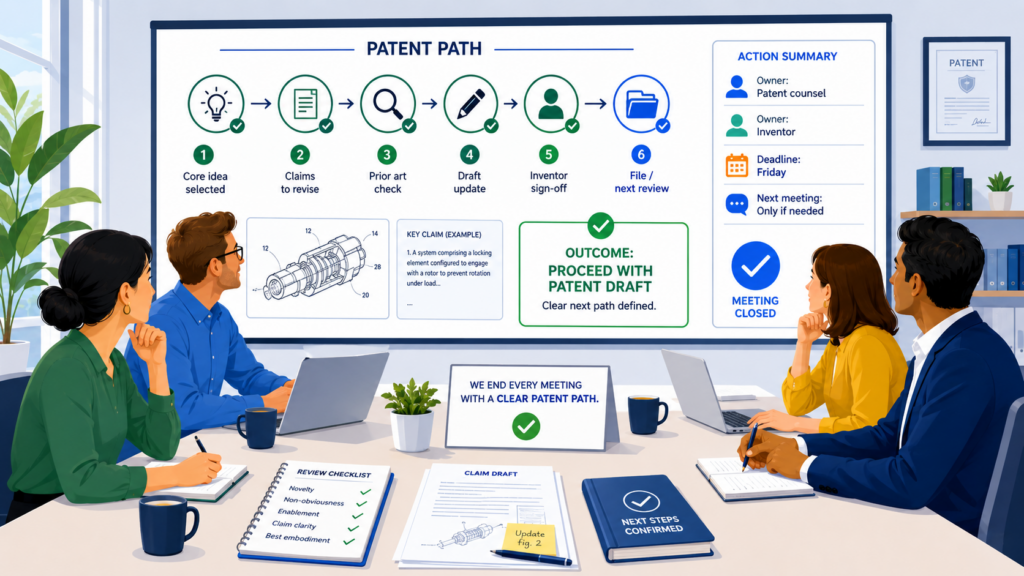
The end of the meeting should not feel like a fade-out. It should feel like a handoff. Everyone should know what was decided, why it was decided, and what happens next.
There are only a few useful endings. The team moves forward with filing. The team gathers specific missing details. The team waits for a technical milestone.
The team splits the idea into separate inventions. The team decides not to pursue it. The team sends it for deeper attorney review. Any of these can be a good outcome if the reason is clear.
The bad outcome is uncertainty.
If people leave saying, “We had a good discussion,” but no one knows the next move, the meeting failed.
The closing decision should be spoken in simple words
At the end, the meeting owner should state the decision out loud. This is not optional. It prevents hidden confusion.
The closing should sound simple. The team is moving forward because the invention is core to the product and the launch is close.
Or the team is not filing yet because the method is still changing and the inventor needs to document the final flow.
Or the team is splitting the idea because there are two separate technical advances. Or the team is dropping the idea because it is not central to the business and is easy to work around.
That plain statement matters.
It gives the team shared memory. It also gives the founder confidence that the meeting produced value.
The decision should include the reason
A decision without a reason is weak. A month later, no one will remember why the choice was made. Then the team may reopen the same debate.
The reason should be captured with the decision.
If the team moves forward, write the business reason and the technical reason. If the team waits, write what must change before review resumes.
If the team drops the idea, write why it is not worth more effort right now. If the team needs more input, write the exact missing facts.
This record saves time later.
It also helps the company build a smarter patent culture. Over time, the team learns what kinds of ideas are worth review, what details matter most, and how to prepare better.
The path should connect directly to execution
A decision is not enough. The next step must be ready to execute.
If the team decides to file, who sends the invention materials to the attorney? Who approves the budget? Who answers technical questions?
What product deadline matters? What version of the invention is being used? If the team needs more detail, who provides it? What exactly do they provide? Where do they put it? Who checks it?
These details may seem small, but they decide whether the patent process moves or stalls.
Patent review meetings often fail in the gap between decision and action. The team agrees on the path, but no one turns that agreement into motion.
The best patent path feels calm and controlled
Founders do not need more chaos. Engineers do not need more random homework. Attorneys do not need scattered facts. Everyone benefits when the path is calm.
That is the value of a better patent system.
PowerPatent helps startups turn invention work into a clearer process, with smart software to organize the input and real attorney oversight to guide the legal side.
It helps founders move faster, avoid avoidable mistakes, and protect important work without turning patents into a drag on the company.
See how PowerPatent helps teams go from invention to filing with less friction here: https://powerpatent.com/how-it-works
Conclusion
Patent review meetings should not feel slow, vague, or painful. They should help your team see the real invention, judge its value, protect founder time, and move to the next step with confidence. The best meetings are short on noise and strong on decisions.
They start with a clear goal, use plain words, focus on what is new and useful, and end with action. When you build this rhythm early, patents stop feeling like a legal burden and start becoming a smart part of your company’s edge. PowerPatent helps make that easier: https://powerpatent.com/how-it-works
Leave a Reply