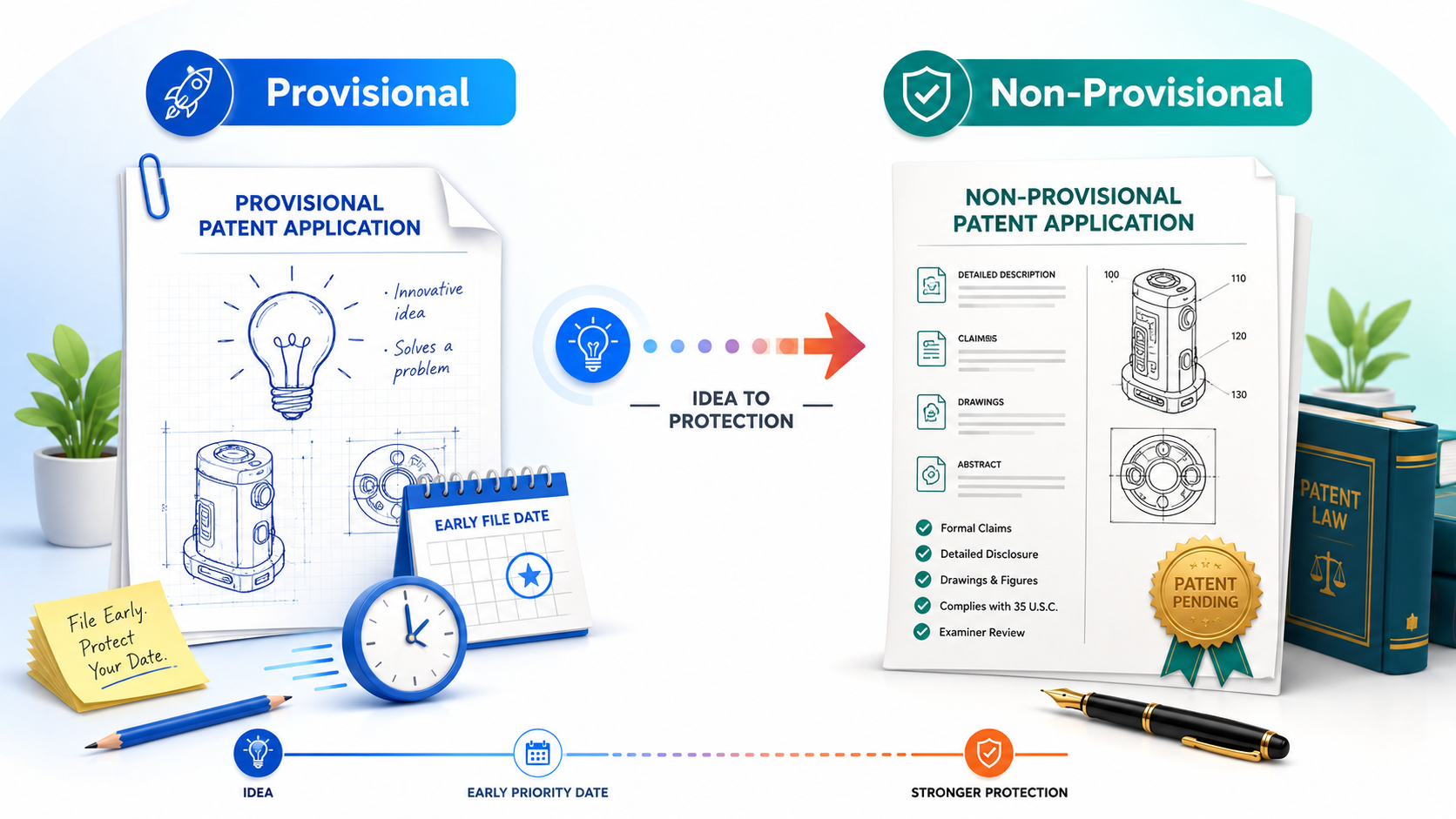
A patent choice can shape your startup’s future. File too late, and someone may beat you to the idea. File too thin, and your patent may not protect what matters. File the wrong type, and you may waste time, money, and leverage.
The Real Difference Between A Provisional And A Non-Provisional Patent Application
A provisional patent application and a non-provisional patent application are not two versions of the same thing.
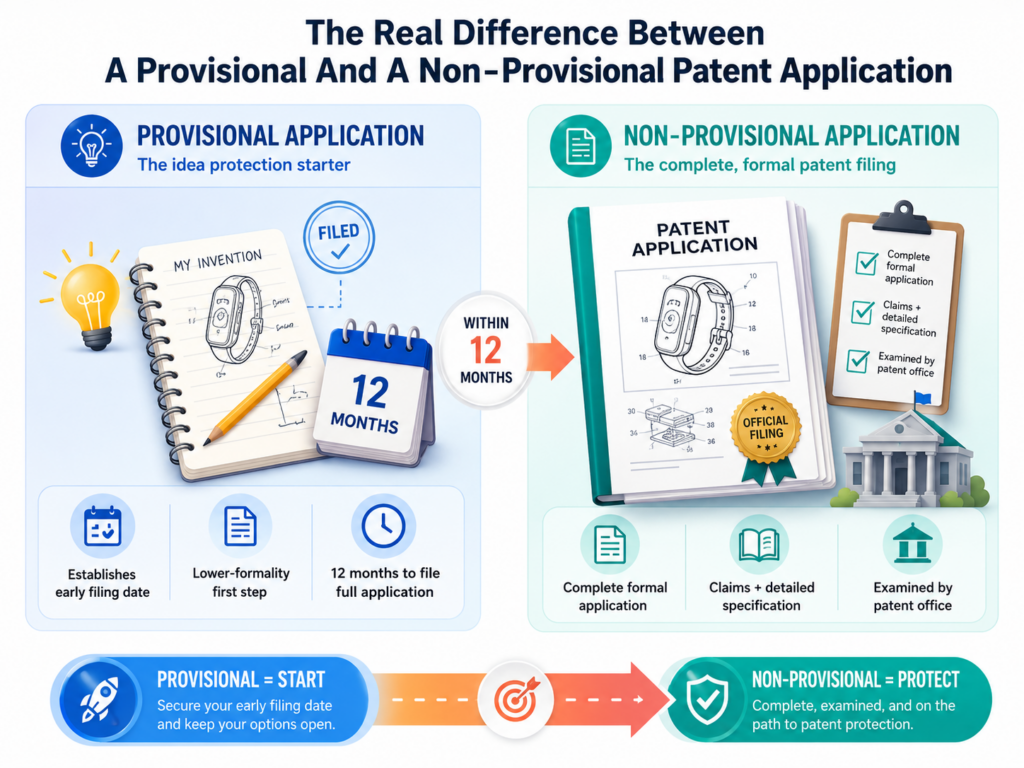
They play different roles. A provisional application is a starting point. A non-provisional application is the formal path toward an actual granted patent.
A provisional application can help you lock in an early filing date while your invention is still taking shape. This can be very useful for founders because startups move fast.
You may be testing the product, changing the model, building new features, talking to users, raising money, or preparing for launch. In that window, you may not want to wait until every detail is final before you protect the core idea.
The United States Patent and Trademark Office says a provisional application lets you file without a formal patent claim, oath, declaration, or prior art statement. It is also not examined.
This means the patent office does not review it and decide whether to grant you a patent from that provisional filing alone. Its main value is that it can support an early effective filing date for a later non-provisional application, when handled the right way.
Think Of A Provisional As A Serious Placeholder
A provisional application is often described as a placeholder, but that word can be dangerous. Some founders hear “placeholder” and think it can be rough, thin, or casual. That is where mistakes happen.
A weak provisional can create a false sense of safety. You may think you protected your invention, but later find that the key details were missing.
If the later non-provisional application adds important material that was not included in the provisional, that new material may not get the earlier filing date.
For a founder, that can be painful, especially if you pitched investors, launched publicly, joined an accelerator demo day, published a paper, posted a video, or talked to customers in the meantime.
So the smarter view is this: a provisional application is not the full race, but it should still be built like it matters.
It should explain the invention with enough depth that a skilled person could understand how it works. It should cover the main version, strong fallback versions, and future versions you are already likely to build.
A Founder Should Never Treat Cheap Filing As The Same Thing As Good Protection
The cheapest filing is often the most expensive filing if it fails when you need it. A rushed provisional that only describes the product at a high level may look fine in a folder, but investors, acquirers, competitors, and patent examiners care about substance.
For example, saying “an AI tool that helps doctors make better decisions” is not enough. That sounds like an idea.
A better filing would explain the data inputs, model steps, training flow, scoring logic, user workflow, feedback loop, deployment setting, edge cases, and ways the system improves over time. It would also explain what makes this system different from normal tools in the field.
That level of detail matters because patent strength often comes from the specific way your invention works, not just the broad goal.
Many founders believe the invention is the outcome. In patents, the invention is often the method, system, structure, or technical path that creates the outcome.
A Non-Provisional Is The Application That Can Become A Patent
A non-provisional application is the formal patent application that enters the examination process. This is the filing that the USPTO can review and, if it meets the rules, allow as a patent.
The USPTO describes a utility patent application as a complex legal document and says it is often best prepared by someone trained to prepare such documents.
That does not mean founders should stay away from the process. It means founders should bring the technical truth, product insight, customer context, and business strategy into the process early.
The best patent filings do not come from legal work alone. They come from a clear bridge between the invention, the product roadmap, the market, and the way a competitor might try to copy the value.
A non-provisional usually includes formal claims. Claims are the part of the patent application that define the legal boundary of the invention. Put simply, the claims say what you are trying to own.
This is one reason the non-provisional takes more care. It is not just a description of what you built. It is a strategic document that should protect the business value behind what you built.
The Non-Provisional Is Where Your Patent Strategy Becomes Concrete
The non-provisional is where vague protection turns into a real patent plan. It should not merely repeat your provisional. It should sharpen it.
By the time you file the non-provisional, you may know much more than you knew at the provisional stage. You may know which feature users love most. You may know which technical step creates the biggest performance gain.
You may know which architecture is hardest for a competitor to work around. You may know which claim angle supports your product, your API, your platform, your data pipeline, your device, or your workflow.
This is where many founders need a better system. They file a provisional, then forget about it until the twelve-month deadline gets close.
That creates pressure. Under pressure, the non-provisional becomes a paperwork task instead of a business weapon.
PowerPatent is built to avoid that trap. It helps founders turn technical notes, product details, diagrams, code concepts, and invention decisions into stronger patent filings with smart software and real attorney oversight. You can see how the process works here: https://powerpatent.com/how-it-works
The Twelve-Month Window Is Useful, But It Is Not A Pause Button
A provisional application gives you a window to file a corresponding non-provisional application if you want to claim the benefit of the provisional filing date.
The USPTO explains that a corresponding non-provisional can be filed within twelve months to receive the benefit of the provisional application filing date. It also states that a provisional application is abandoned after twelve months if no proper next step is taken.
For founders, this twelve-month period should be used on purpose. It is not just time to wait. It is time to learn.
You can use it to test the market, improve the product, gather technical proof, refine the roadmap, prepare investor materials, and decide what is truly worth protecting.
You can also file more provisionals as the invention grows, if new technical ideas emerge. Then, when the non-provisional is prepared, those filings can be reviewed together and turned into a more complete patent family plan.
The Best Founders Use The Provisional Year To Build A Stronger Patent
The provisional year should feel like an active strategy window. During that time, your team should keep track of what changes, what improves, what users ask for, what competitors might copy, and what technical choices become more important.
A simple habit can make a big difference. Each time your team ships a meaningful technical change, write down what changed, why it matters, and how it works. Capture diagrams.
Save examples. Keep notes from engineering reviews. Mark which parts were hard to solve. Record failed paths too, because they can help show why your final approach is not obvious.
This does not have to slow the company down. It just means your invention record should grow as your product grows.
When you later prepare the non-provisional, you will have better raw material. That can lead to stronger claims, richer detail, and fewer missed ideas.
When A Provisional Patent Application Makes The Most Sense For A Founder
A provisional application often makes sense when speed matters and the invention is real enough to describe well.
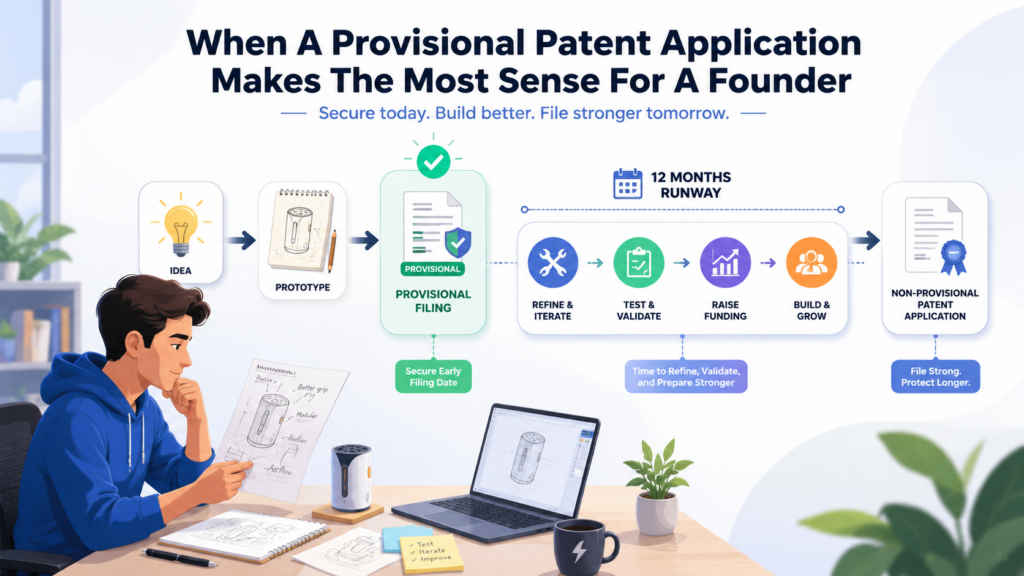
That is the key balance. You do not need a finished product, but you do need enough detail to explain the invention clearly.
Many founders file a provisional before a public launch, investor pitch, customer pilot, research release, conference talk, app store listing, open-source announcement, or demo day.
The goal is to create a filing date before the invention is shown to the world. This can be a smart move because public sharing can create patent problems if not managed carefully.
A provisional can also help when your company is still learning. Maybe the product works, but the market is still being tested. Maybe the model architecture is set, but the workflow may change.
Maybe the device prototype works, but the manufacturing design is still being improved. A provisional can give you a starting point while you keep building.
File A Provisional When The Core Invention Is Clear Enough To Teach
The best time to file is often when your team can explain the core invention in a way that another skilled person could understand and build from. That does not mean you need perfect polish. It means you need real detail.
For a software startup, this may mean you can describe the system flow, data sources, processing steps, model behavior, user actions, outputs, and technical improvement.
For a hardware startup, this may mean you can describe the parts, shape, control logic, materials, sensor placement, and how the device works in use. For a biotech or climate tech startup, this may mean you can describe the process, composition, test setup, operating ranges, and observed results.
The danger is filing too early with only a dream. A patent application does not protect a wish. It protects an invention that is described.
If the filing says almost nothing beyond the problem and the hoped-for result, it may not give you much protection later.
A Strong Provisional Should Capture More Than The Current Product
Your first version may not be the most valuable version. Startups learn fast. A founder who only protects today’s screen, today’s workflow, or today’s prototype may leave the real prize exposed.
A better provisional should cover the current build, the next likely build, and the key alternatives that competitors may use.
It should describe different ways to perform the same function. It should include different system layouts, different inputs, different model types, different user flows, and different ways to deploy the invention.
This is not about stuffing the application with random guesses. It is about mapping the invention like a founder. Ask what part creates the business edge.
Ask what a copycat would keep the same even if they changed the look. Ask which technical step makes the product faster, cheaper, safer, smarter, or more useful.
File Before You Share The Invention In A Way You Cannot Control
Founders talk. They pitch. They sell. They recruit. They post. They test. That is normal. The issue is that public disclosure can affect patent rights. So if you are about to share details outside the company, it is smart to think about filing first.
This is especially important before demo day or investor outreach. Many founders think investor meetings are private by default.
They may not be. Some investors will not sign a confidentiality agreement. Some pitch decks get forwarded. Some demo videos end up online. Some technical claims become public before the founder realizes it.
A provisional filing before these events can give you more confidence. It lets you speak with less fear because you have already taken a step to protect the invention.
That does not mean you should reveal every technical secret. It means you are not walking into the room empty-handed.
The Filing Should Match What You Are About To Reveal
Here is where strategy matters. If your provisional covers one part of the product, but your pitch reveals a different key invention, you may still have a gap.
Before a major public moment, review what you are about to disclose. Compare it to what is in the filing. Make sure the important technical details are included.
This is one of the places where PowerPatent can help founders move faster without flying blind.
The platform is designed to help capture invention details and support attorney-reviewed filings, so founders can protect what they are actually building and showing. Learn more here: https://powerpatent.com/how-it-works
When A Non-Provisional Patent Application Makes More Sense Than Waiting
A non-provisional patent application makes more sense when the invention is stable enough, valuable enough, and important enough that you want to move toward a real patent as soon as you can.
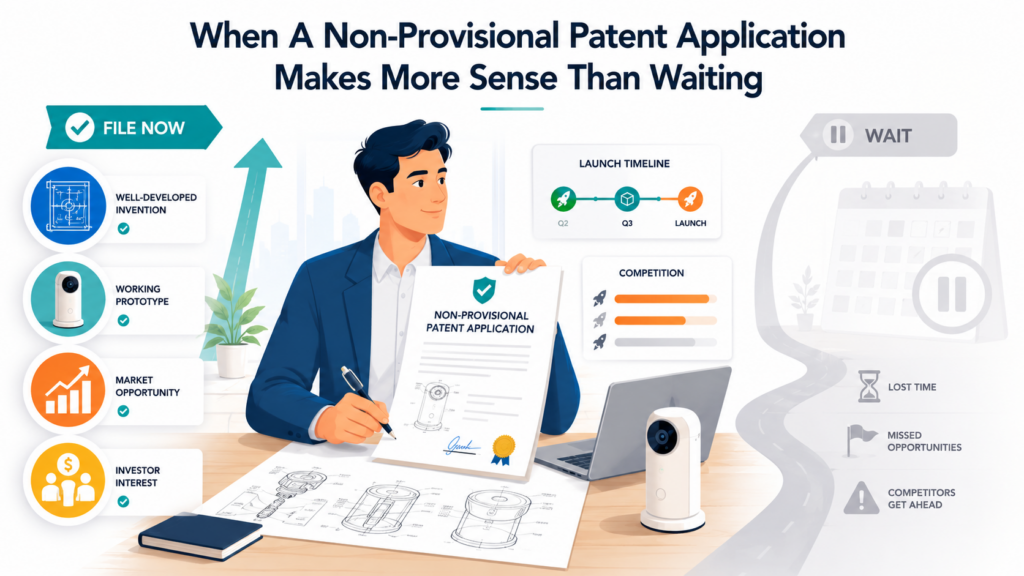
A provisional can be useful, but it does not get examined by the USPTO and does not become a patent by itself.
The non-provisional is the filing that starts the formal review path, and it must include a written description, at least one claim, drawings when needed, an oath or declaration, and the required filing, search, and examination fees.
For founders, this matters because time is not just a legal issue. Time is a business issue.
If your startup is entering a crowded market, raising a serious round, preparing for diligence, selling to large enterprise buyers, or building something that larger companies can copy fast, a non-provisional may send a stronger signal.
It shows you are not only saying “patent pending.” You are taking the actual step toward claims that can mature into a granted patent.
A non-provisional can also make sense when the invention is already central to the company. If the product depends on one technical method, one special data flow, one novel device structure, one model training system, or one automation process, waiting too long can create risk.
A provisional year can be helpful, but it can also become a comfort blanket. Some founders use it to delay hard decisions. That can be costly when the business needs clear IP direction.
The Non-Provisional Is Better When You Know What You Want To Protect
The biggest sign you may be ready for a non-provisional is focus. You do not need to know every future product feature, but you should know the technical center of the invention.
You should be able to say what part creates the edge, why it is hard to copy, and how it helps the user in a way older methods do not.
This is especially true for deep tech startups. If your company is built around a new model pipeline, robotics control loop, chip design, medical device workflow, battery process, security method, or climate system, your patent plan should not stay vague for too long.
The more your company value depends on that invention, the more important it is to move from a temporary filing posture into a serious examination path.
A Founder Should Think In Terms Of Business Leverage, Not Paperwork
The real question is not “Can I file a provisional first?” The better question is “What filing path gives my company the most leverage right now?” If you are raising money, a well-built non-provisional can help show investors that you are serious.
If you are entering partner talks, it can help show that the company is thinking ahead. If you are in a market where big players move quickly, it can help create a stronger story around ownership.
This does not mean a non-provisional is always better. It usually costs more, takes more care, and requires more strategy.
But it can be the smarter move when delay creates more risk than benefit. The founder’s job is to protect the company’s future options while still keeping the team moving.
PowerPatent helps founders make this choice with more clarity. The platform helps capture the technical story behind the invention, then supports attorney-reviewed filings so the application is not just filed, but aimed at what matters. You can see the process here: https://powerpatent.com/how-it-works
Filing A Non-Provisional Can Help You Avoid A Weak Last-Minute Conversion
One of the most common founder mistakes is waiting until the end of the provisional year, then rushing the non-provisional. The twelve-month window sounds long at first.
Then product work, hiring, fundraising, pilots, bugs, and customer calls eat the year. Suddenly the deadline is close, and the team is forced to turn a thin provisional into a full non-provisional under pressure.
That is not the best way to build important IP. A rushed non-provisional can miss key claim angles. It can describe the product too narrowly.
It can fail to capture new versions that emerged during the year. It can also ignore the way competitors might design around the invention.
A non-provisional deserves time because the claims matter. Claims are the lines that define what you are trying to protect. If those lines are too narrow, a competitor may step around them.
If they are too broad without support, they may run into problems during review. The art is to claim the invention in a way that matches the technical truth and the business goal.
Strong Claims Need Strong Raw Material
Founders sometimes think claims are magic words written at the end. They are not. Strong claims come from strong invention detail.
They come from understanding the system, the alternatives, the hard parts, the edge cases, and the business moat.
This is why a founder should prepare for a non-provisional before the deadline is near. Keep track of what changed after the provisional. Save diagrams. Write down why the new architecture is better.
Record the parts that were hard. Keep notes from technical debates. Capture test results when they show a real gain. These details can make the later filing much stronger.
A Non-Provisional May Be The Better First Filing In Some Cases
Some founders assume they must always file a provisional first. That is not true. In some cases, going straight to a non-provisional can be the cleaner path.
This can make sense when the invention is already well developed, when the company has the budget for a stronger filing, when there is no need for a learning window, or when the market is moving so fast that examination should begin sooner.
It can also make sense when the patent story is central to a financing event, a sale process, or a major partnership.
The right choice depends on the state of the invention and the needs of the business. A provisional can buy time. A non-provisional can start the real patent process. The wrong move is treating either one as a generic form.
The Best Filing Path Should Match The Startup Stage
A seed-stage company may need speed, coverage, and room to learn. A Series A company may need a more mature portfolio.
A company entering enterprise sales may need filings that match customer-facing technical claims. A company preparing for diligence may need clean ownership, clear filing dates, and a sensible patent roadmap.
This is where founders should stop thinking about patents as isolated documents. A good patent strategy should move with the company. It should support the next raise, the next product release, the next market, and the next technical breakthrough.
The Biggest Mistake Founders Make With Provisional Applications
The biggest mistake founders make with provisional applications is filing something too thin and believing they are fully protected. A provisional application can be powerful, but only when it describes the invention well.
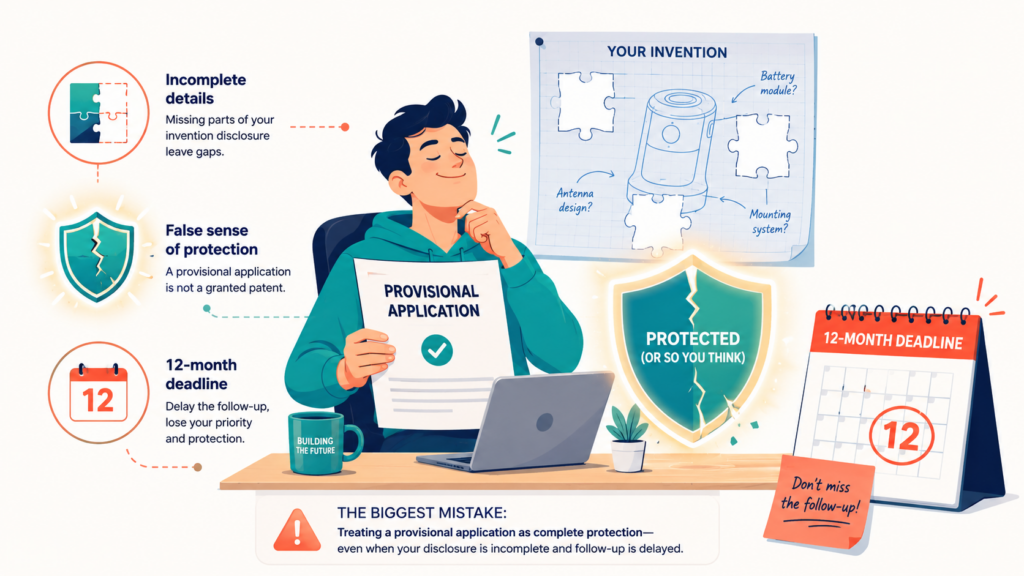
The USPTO allows a provisional application to be filed without formal claims, an oath or declaration, or an information disclosure statement, but that does not mean the invention can be described in a loose or shallow way.
This mistake often starts with good intentions. A founder wants to move fast. A launch is coming. An investor meeting is on the calendar. A conference deadline is close.
So the team files a short document that describes the product in broad terms. It may include a few screenshots, a light summary, and some marketing language. Everyone feels better because the company can now say “patent pending.”
But “patent pending” is not the same as strong protection. The real question is whether the filing supports the invention you later want to claim. If the provisional does not teach the key details, the later non-provisional may not get the full benefit the founder expected.
That gap can be hard to fix after public disclosure, because the missing details may have already been shared, used, sold, or shown.
A Thin Provisional Can Create False Confidence
False confidence is dangerous because it changes behavior. A founder who believes the invention is protected may talk more openly. They may publish technical details.
They may pitch without care. They may send decks widely. They may allow pilots without clear controls. They may delay the real patent work.
This is risky because the value of a provisional depends on what it actually contains. A filing date is useful only for what was properly described. If the strongest part of the invention is missing, the date may not help much for that strongest part.
For example, imagine a startup files a provisional for “a smart logistics platform that uses AI to reduce delivery delays.” That sentence may sound impressive, but it does not teach much.
It does not explain the data flow, the prediction model, the routing engine, the feedback system, the exception handling, the timing rules, or the way the system improves under changing conditions.
If the startup later tries to claim those specific features, the early filing may not support them unless they were included with enough detail.
The Filing Should Teach The Invention Like An Engineer Explaining It To Another Engineer
A strong provisional should feel less like a pitch deck and more like a clear technical guide.
It should explain what the system does, how it does it, what parts are involved, what order the steps happen in, what inputs are used, what outputs are created, and what alternatives can be used.
This does not mean the writing must be hard to read. In fact, simple language is often better. But simple does not mean shallow. A founder should aim for clear, deep, plain-English detail.
The application should also include drawings when they help explain the invention. A drawing does not have to be beautiful to be useful.
A basic flowchart, system diagram, user journey, device layout, data pipeline, or block diagram can make the invention easier to understand. For technical inventions, drawings can help show the structure that words alone may miss.
Marketing Language Is Not Enough
Founders are trained to sell the result. Patents need more than the result. A landing page might say the product is faster, smarter, safer, easier, or more accurate. A patent filing must explain the technical path that makes those benefits happen.
This is where many startup filings become weak. They use words like “AI-powered,” “automated,” “real-time,” “intelligent,” “seamless,” or “personalized” without explaining the actual mechanism.
Those words may help sell the product, but they do not protect the invention by themselves.
A better filing explains the machine behind the magic. It says what is collected, what is compared, what is transformed, what rules or models are used, what decision is made, and how the system reacts.
It also explains what happens when the data is missing, noisy, late, biased, incomplete, or wrong.
The Best Applications Capture The Why Behind The Build
A strong filing should not only explain what the invention does. It should explain why the team built it that way. This can help show the technical problem and the technical solution.
For example, if your model uses a special preprocessing step because raw sensor data is too noisy, say that. If your robotic system changes grip force based on a live confidence score, explain why that matters.
If your cybersecurity tool reduces false positives by grouping signals in a new way, describe that grouping. If your developer tool speeds up testing by creating a special map of code changes, explain how the map is made and used.
These details make the filing more useful because they connect the invention to a real problem. They also help future patent work because they give the attorney more material to build claims around.
The Provisional Should Cover Workarounds
A competitor rarely copies your product exactly. They copy the value. They may change the interface, swap a model, rename a step, move a process to the cloud, change where the data is stored, or perform the same logic in a different order.
A weak provisional protects only the exact version the founder built. A stronger provisional thinks ahead. It describes alternatives. It explains different ways to carry out the same inventive concept.
It includes different system setups, different kinds of inputs, different forms of output, different timing options, and different deployment environments.
This does not mean you should make wild guesses. It means you should protect the invention at the right level. If your edge is a new way to rank risk, do not only describe one dashboard.
If your edge is a new device structure, do not only describe one size. If your edge is a new training method, do not only describe one model.
A Smart Provisional Makes Copying Harder
A smart provisional gives your future non-provisional more room to work. It gives your attorney more paths for claims. It helps the company respond if the product changes. It makes the filing less brittle.
This is why PowerPatent focuses on capturing the real technical story. Founders often have the details in code, diagrams, notebooks, tickets, and team conversations, but those details do not always make it into the patent filing.
PowerPatent helps bring those details forward with smart software and real attorney oversight, so the filing can better match the invention. Start here: https://powerpatent.com/how-it-works
How To Decide Which Filing Path Fits Your Startup
The right filing path depends on your invention, your timeline, your budget, your market, and your next business move. A provisional is often better when you need speed and flexibility.
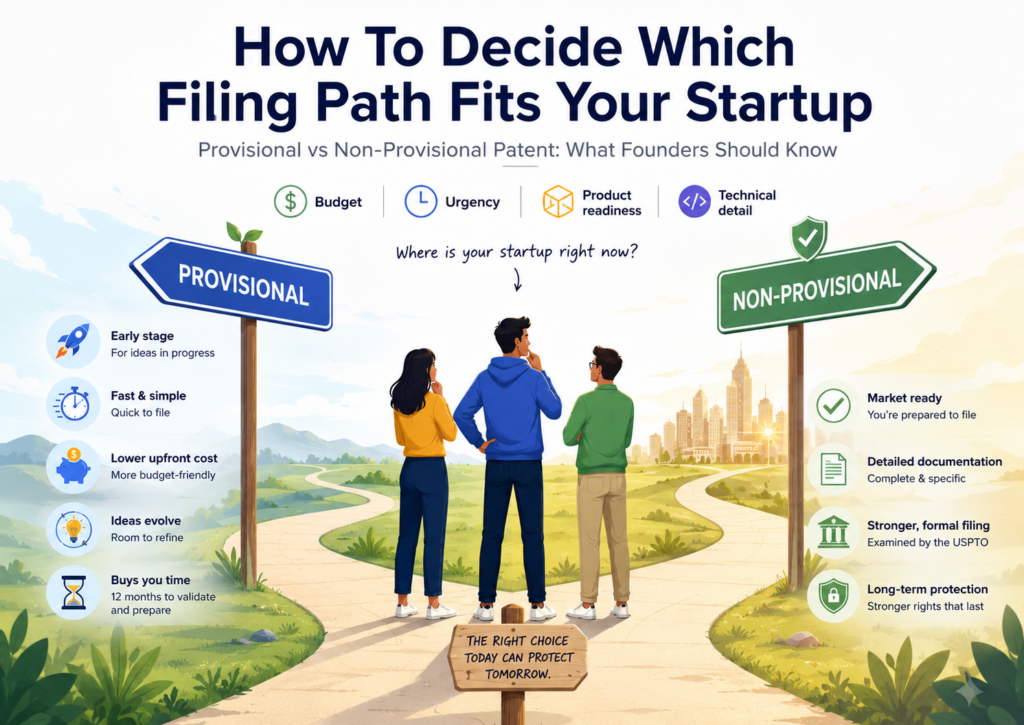
A non-provisional is often better when the invention is ready for a formal patent path. The wrong answer is choosing based only on cost.
Cost matters. Startups have limited money. But patents are not just expenses. They are tools for control. A good filing can support fundraising, hiring, partnerships, enterprise sales, licensing, and exit talks.
A bad filing can create paperwork without leverage. So the better question is not “Which one is cheaper?” It is “Which one protects the company’s next big step?”
Start With The Business Moment
Before choosing a filing type, look at what is about to happen in the business. Are you about to launch publicly? Are you about to pitch investors? Are you about to start a paid pilot? Are you about to publish research? Are you about to open source part of the stack? Are you about to hire people who will see the core system? Are you about to enter talks with a large company that could build a similar tool?
Each of these moments changes the risk. A filing before disclosure may help preserve options. A filing before diligence may help show maturity.
A filing before a partnership may help create boundaries. A filing before launch may help you speak with more confidence.
A provisional often fits when the business needs a fast, smart first step before one of these moments. A non-provisional may fit when the invention is already clear and the company needs to move toward examination.
Your Filing Should Serve The Next Twelve To Twenty-Four Months
A patent filing should not live apart from the startup plan. It should support what the company is likely to do next. If the next year is about learning, testing, and refining, a provisional can give you time while keeping a filing date in place.
If the next year is about scaling a known product and defending a core advantage, a non-provisional may be the better move.
Think about the next funding round. Think about the next customer segment. Think about the next major product release.
Think about the countries where you may sell. Think about the competitors most likely to copy you. Your patent path should make sense in that context.
This is also why founders should not treat patent work as something to do once and forget. Every major product shift can create new invention points. The first filing may protect the core.
Later filings may protect improvements, integrations, workflows, and new technical gains.
Look At How Much The Invention May Change
If the invention is still changing every week, a provisional may be useful. It can capture what you know now while leaving room for more filings as the invention improves.
But if the invention is stable and the team has strong detail, filing a non-provisional may avoid delay.
The hard part is knowing whether the changes are cosmetic or technical. A new button, new color, new onboarding flow, or new pricing page may not change the invention.
But a new data pipeline, model architecture, device structure, control method, or error-handling process may matter a lot.
Founders should learn to spot technical change. When your team solves a hard engineering problem, that may be invention material. When your product performs better because of a new method, that may be invention material.
When a customer’s painful workflow becomes easier because your system handles a technical step in a new way, that may be invention material.
Track New Inventions As They Happen
Do not wait until the patent deadline to remember what changed. Keep a simple invention record. Write down the date, the problem, the old approach, the new approach, why it works, and who helped create it.
Save diagrams and test results. Keep enough detail that someone can understand the change months later.
This habit is simple, but it can create a major advantage. It helps your attorney understand the invention faster. It helps your company avoid losing good ideas.
It helps you decide whether to file another provisional during the year. It also helps with ownership questions because you have a clearer record of who contributed.
PowerPatent is helpful here because founders are already busy. The platform helps turn scattered technical material into a more organized invention story, with attorney oversight so the filing path stays grounded. See how it works here: https://powerpatent.com/how-it-works
Consider The Market And The Copy Risk
Some markets move slowly. Others move very fast. If your product is easy to observe and copy, you may need earlier and stronger protection.
If your invention is hidden in backend systems, trade secret protection may also play a role, but patents can still matter if the method can be reverse engineered, discovered through use, or described during sales.
Copy risk is not only about direct competitors. It can come from large platform companies, suppliers, customers, research groups, offshore teams, or well-funded startups watching the same space. If the idea is valuable and visible, assume someone will try to move near it.
A provisional may help you move quickly before exposure. A non-provisional may help you move toward stronger, more formal rights.
The best path may include both, starting with a strong provisional and then using the year to build a more complete non-provisional.
Protect The Value, Not Just The Feature
Founders often describe inventions as features. A patent strategy should go deeper. The value may be the method behind the feature, the system that supports it, the way data is prepared, the way decisions are made, the way hardware and software work together, or the way errors are handled.
Ask what a competitor would need to copy to steal the value. That answer should guide the filing. If the filing protects only the surface, it may not stop the copycat. If it protects the technical engine, it can be far more useful.
What To Put In A Strong Provisional Patent Application
A strong provisional patent application should describe the invention as if the future of the company may depend on it. That does not mean it has to be written in dense legal language. It means it should be complete, clear, and technical enough to support later claims.
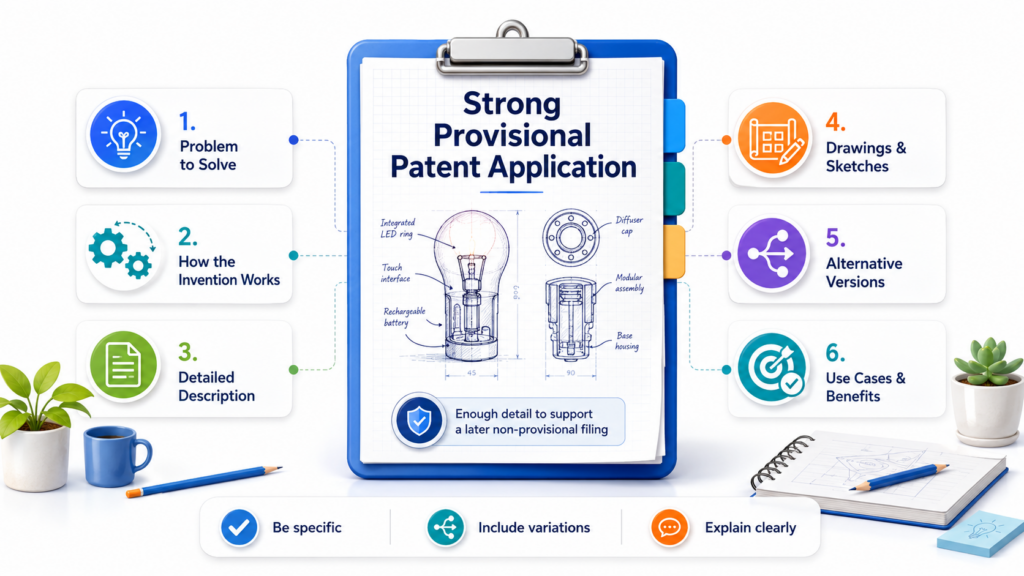
The USPTO notes that a provisional application can be filed with fewer formal parts than a non-provisional, but it still needs a real specification, and drawings should be included when needed to understand the invention.
For founders, the goal is simple. The filing should capture the invention you have now, the important versions you expect to build, and the workarounds a smart competitor might try.
It should not read like a landing page. It should read like a clear explanation of how the invention works and why it matters.
A good provisional gives your later non-provisional more room. It can support broader claim thinking.
It can help preserve the early date for the real substance of the invention. It can also give your team confidence before public sharing, fundraising, pilots, or partnerships.
Start With The Problem In Plain Words
Every strong filing starts with the problem. But the problem should be specific. “Healthcare is inefficient” is too broad. “Existing patient intake systems fail to merge real-time device data with prior visit data before triage decisions” is much better.
“Software testing is slow” is weak. “Existing test tools do not map code changes to likely failure points across services before deployment” is stronger.
The problem matters because it frames why the invention exists. It helps show that the team was not just building a nice feature. The team solved a real technical issue.
After describing the problem, explain why old methods fall short. Keep it fair and simple. Do not overclaim. You do not need to attack every existing system. Just explain the gap your invention addresses.
The Problem Should Lead Directly To The Technical Solution
The best applications make the reader feel the logic. First, here is the problem. Next, here is why it is hard. Then, here is the system or method the team built. That flow is powerful because it makes the invention easier to understand.
For example, if your startup built a better fraud detection system, explain the old issue first. Maybe old tools review transactions one at a time and miss behavior across accounts.
Then explain your technical solution. Maybe your system builds a live relationship graph, updates account risk scores after each event, and triggers different checks based on graph changes.
That kind of detail is useful. It shows more than a goal. It teaches a method.
Explain The System Like It Is Being Built
A strong provisional should explain the parts of the system. For software, this may include the user device, server, database, model, API, rules engine, dashboard, workflow, data source, training process, and output system.
For hardware, this may include sensors, processors, materials, housing, power source, actuators, control logic, and physical layout. For biotech, robotics, energy, and advanced manufacturing, the key parts will depend on the field.
The point is to show how the invention actually works. Describe what enters the system, what happens inside, and what comes out.
Explain the order of steps. Explain what happens when conditions change. Explain what the system does when data is missing or noisy. Explain what alternatives may be used.
This is where founders can add huge value. You know why the team made certain choices. You know what failed. You know what made the final system better. Those details can be very important.
Include Examples That Show The Invention In Use
Examples make a filing stronger because they turn abstract ideas into clear use cases. A founder should include realistic examples of how the invention works in practice.
If the invention is a developer tool, show how it handles a code change. If it is a medical workflow system, show how it handles a patient case.
If it is a climate sensor network, show how it detects and responds to a condition. If it is a robotics system, show how it acts during a task. If it is a fintech system, show how it processes risk.
Examples should not be fluffy. They should show steps, inputs, outputs, and decisions. They should help a reader understand the invention without needing a meeting with your engineering team.
Add Variations Before Someone Else Does
A strong provisional should not only cover the preferred version. It should cover variations. This is important because products change and competitors design around.
Variations may include different data types, model types, sensors, materials, user roles, workflows, hardware layouts, network setups, operating ranges, scoring methods, and deployment environments.
In software, the same invention might run on a server, user device, edge device, or distributed system. In hardware, the same invention might use different materials or shapes. In AI, the system might use different model families or training methods.
The filing should make clear that the invention is not limited to one exact product screen or one narrow prototype unless that narrow detail is truly the invention.
Think Like A Friendly Competitor
A useful exercise is to imagine a smart competitor who likes your idea but wants to avoid your patent. What would they change first? Would they move a step to another server? Would they use a different model? Would they change the input data? Would they alter the order of steps? Would they replace a sensor? Would they split the workflow between two tools?
Now ask whether your provisional describes those alternatives. If it does, your later patent team may have more options. If it does not, you may have left a path open.
This is exactly the kind of strategic thinking founders should bring into patent work. PowerPatent helps teams capture these technical variations and organize them into filings with real attorney review.
To see how founders can move from raw invention notes to a smarter patent process, visit https://powerpatent.com/how-it-works
What To Expect After You File A Provisional Patent Application
After you file a provisional patent application, you can generally use the phrase “patent pending” for the invention described in the filing. That phrase can help in conversations with investors, partners, customers, and potential competitors.
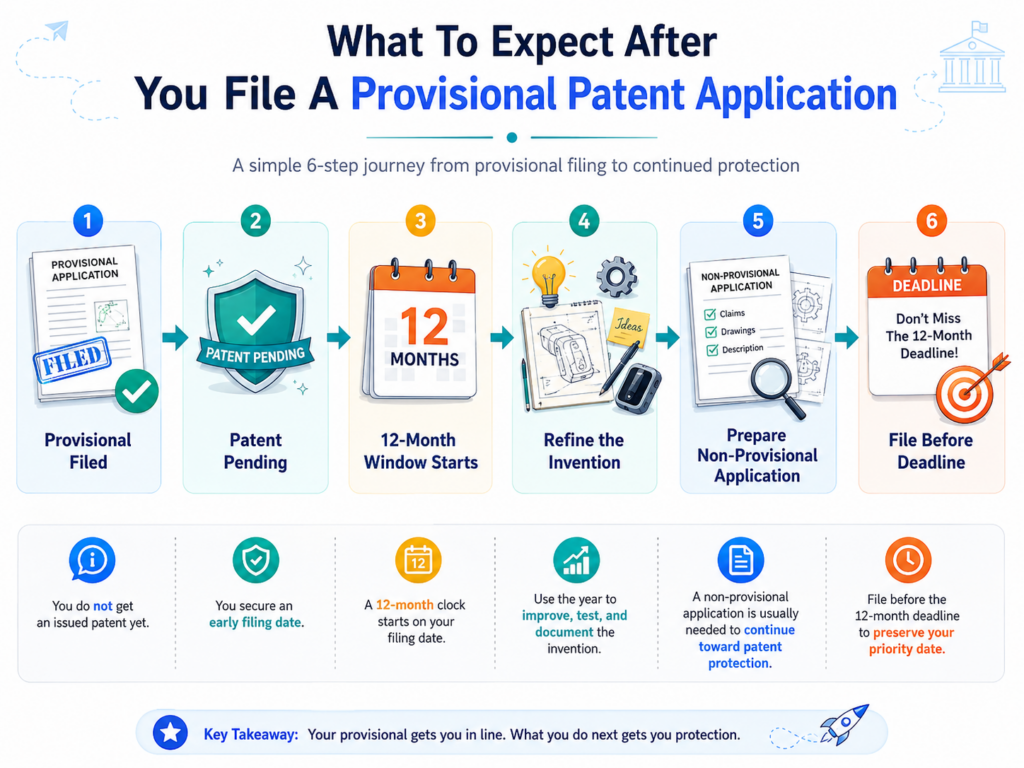
But it is important to understand what has and has not happened. A provisional application does not get examined and does not issue as a patent by itself. A later non-provisional is the filing that may be examined and may become a patent.
This means the filing is not the finish line. It is the start of a timed strategy window. The USPTO explains that a corresponding non-provisional application can be filed within twelve months to receive the benefit of the provisional filing date.
For founders, those twelve months should be used with care. They are a chance to improve the product, test the market, learn what matters, and prepare a stronger non-provisional.
The worst move is to file the provisional and forget it. That turns the filing into a calendar risk. The better move is to treat the provisional year as an active build-and-protect period.
The First Month After Filing Should Be Used To Organize
Once the provisional is filed, save the filing receipt, application number, exact filing date, inventor list, and final copy of what was submitted.
Make sure the company knows where the files live. Make sure the founders and team understand what the filing covers and what it does not cover.
This sounds basic, but many startups are messy at this stage. Files sit in email threads. Drafts get confused with final versions.
Nobody knows which diagrams were filed. The person who handled the filing leaves the company. Then, months later, the team scrambles to reconstruct the record.
A clean filing record is not busywork. It helps later when preparing the non-provisional, raising money, answering diligence questions, and deciding whether to file more applications.
Mark The Twelve-Month Date And Work Backward
The twelve-month deadline should not be treated as a reminder. It should be treated as a planning anchor. If the provisional was filed on March 10, the team should not start thinking about the non-provisional on March 1 of the next year. That is too late for a thoughtful filing.
Work backward. Plan time to review product changes, gather technical updates, identify new invention points, prepare drawings, shape claim strategy, and complete attorney review. A strong non-provisional needs more than a rushed rewrite.
This is one reason a guided system can help. PowerPatent gives founders a clearer way to move from invention capture to attorney-reviewed filings without letting the patent plan fall behind the product. Learn more here: https://powerpatent.com/how-it-works
Use The Year To Learn What The Patent Should Really Protect
The provisional year gives your startup time to learn. That learning should shape the non-provisional.
Maybe you filed the provisional around a broad platform idea, but users care most about one workflow. Maybe the first model architecture worked, but the second one created the real performance gain. Maybe the hardware prototype changed after field testing.
Maybe enterprise customers revealed a compliance need that led to a better technical process. Maybe your team discovered that the most valuable part is not the user-facing feature, but the backend decision system.
These discoveries matter. They can change the patent strategy. They can show which claims are worth pursuing.
They can reveal whether you need another provisional for new subject matter. They can also help avoid wasting effort on parts of the product that are not central to the moat.
Keep A Living Invention File During The Year
A living invention file can be simple. It should capture what changed, when it changed, why it mattered, and how it works. The founder, CTO, product lead, or engineering manager can keep this updated during major product moments.
Do not only record wins. Record failed paths too. If the team tried three methods and only one solved the problem, that story can be useful. It shows the real engineering work behind the invention. It also helps explain why the final approach matters.
This file should include diagrams, examples, test results, product specs, technical notes, and decision records. It should not be a legal essay. It should be a clear record of invention progress.
Decide Whether New Filings Are Needed Before The Year Ends
One provisional may not be enough if the product changes in a meaningful way. If new technical ideas emerge, you may need another filing. This is common in startups because the first version is rarely the final version.
For example, a company may file a provisional for a core AI workflow, then later invent a new training method, a new deployment system, or a new feedback loop.
Those later ideas may not be fully covered by the first filing. Filing another provisional can help capture them before disclosure.
This does not mean every small update needs a new patent filing. The key is whether the change adds a new technical solution that may have business value. A new feature label may not matter. A new way the system works may matter a lot.
The Non-Provisional Can Become A More Complete Story
When the year is used well, the non-provisional can be stronger than the first filing. It can include the original invention, refined versions, better examples, more drawings, sharper claim ideas, and stronger support for future product directions.
This is how smart founders use the provisional path. They do not file and hope. They file, learn, improve, capture, and then convert the best technical story into a serious non-provisional.
What To Expect After You File A Non-Provisional Patent Application
After you file a non-provisional patent application, the formal patent process begins. This is different from a provisional filing. The application enters the USPTO system as an application that may be examined.
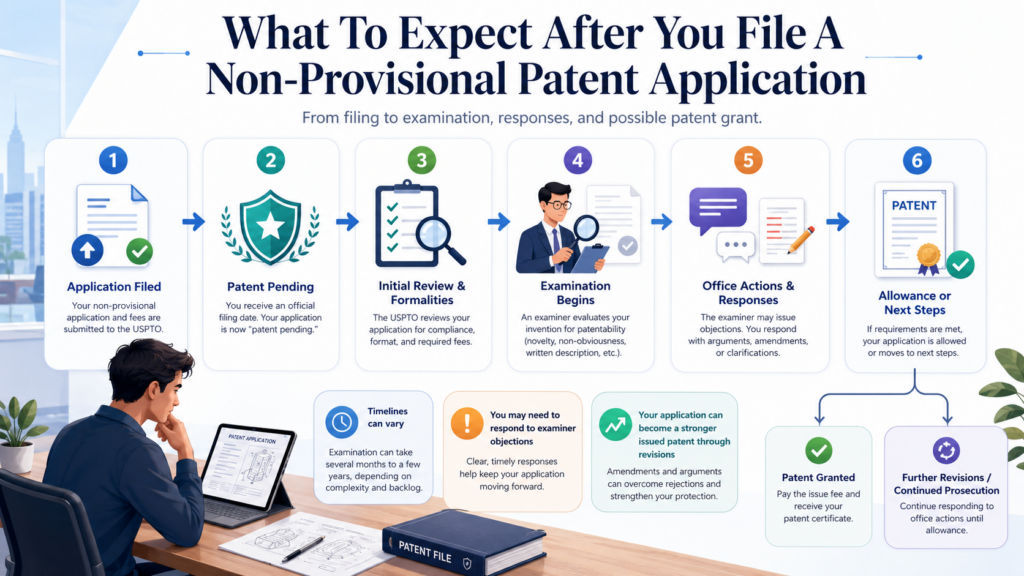
It includes claims, and those claims define the invention you are asking the patent office to allow. The process can take time, and it often includes back-and-forth with the examiner.
Founders should not panic when the first response from the patent office is not an allowance. Many applications receive rejections or objections during examination.
That does not always mean the invention is bad. It often means the claims need to be argued, clarified, changed, or narrowed. Patent examination is a process, not a simple yes-or-no event.
The key is to enter this process with a strong application and a clear business goal. You do not want claims that sound broad but are not supported.
You also do not want claims so narrow that they only cover one tiny version of your product. The best path is to claim the invention in a way that is both defensible and useful.
The Claims Become The Center Of The Conversation
Once the non-provisional is filed, the claims matter most. The written description supports the claims, but the claims define the boundary you are trying to protect.
During examination, the patent office compares the claims to earlier patents, publications, products, and other public information.
This is why the earlier drafting work matters so much. If the application has rich detail, there may be more room to adjust the claims during review.
If the application is thin, your options may be limited. You generally cannot add new invention matter to fix a weak application after filing. That is why the original filing must be strong.
A founder does not need to write the claims alone. But a founder should understand the claim strategy. You should know what business value the claims are trying to protect.
You should know whether the claims cover the product as built, future versions, competitor workarounds, customer-side use, server-side processing, device structure, or system-level behavior.
Claims Should Map To The Business Moat
A claim that does not map to business value may not be worth much. If your company’s edge is a special model training pipeline, a claim focused only on a user dashboard may miss the point.
If your edge is a device configuration, a claim focused only on a general method may be too easy to avoid. If your edge is how data moves across a network, a claim should not only describe the final result.
This is where founders should stay involved. Your attorney can help shape the legal strategy, but you know where the product is going.
You know what competitors will try. You know what customers value. You know which technical part was hardest to build.
PowerPatent is designed for this kind of founder-attorney collaboration. It helps turn technical product knowledge into a filing process with smart software and real attorney oversight. See how it works here: https://powerpatent.com/how-it-works
Publication May Make The Application Public
Most U.S. patent applications are published after eighteen months from the earliest filing date for which benefit is sought, unless an exception applies.
The USPTO explains that many patent applications are published on or after eighteen months from the filing date.
This matters because publication can reveal details of your invention. For many startups, this is fine because the goal is to seek patent protection in exchange for public disclosure.
But founders should still understand the timing. If you are keeping certain details as trade secrets, you should think carefully before putting them into a patent application.
Patents and trade secrets are different tools. A patent can help protect an invention that is disclosed and claimed. A trade secret protects information that is kept secret and has value because it is secret.
Some startups use both. For example, they may patent the core system while keeping certain data, weights, thresholds, recipes, supplier details, or tuning methods secret.
Do Not Put Everything Into A Patent Filing Without A Reason
More detail is good when it supports the invention you want to claim. But that does not mean every company secret belongs in the application.
Founders should be strategic. The filing should teach the invention well enough to support meaningful claims. It should not casually reveal private details that do not help the patent.
This is an important conversation to have before filing. What should be patented? What should stay confidential? What details are needed to support the claims? What details are not needed? What will be visible if the application publishes?
A strong patent process helps answer these questions instead of treating the filing like a document dump.
The Non-Provisional Process Should Feed Your Company Strategy
Once a non-provisional is filed, keep it connected to the business. If the product changes, note whether the application still covers the commercial version. If new features become important, ask whether new filings are needed.
If competitors appear, compare their public products to your claim strategy. If investors ask about IP, be ready to explain what has been filed and why it matters.
The patent process should not sit in a legal folder away from the company. It should support real decisions. It can shape how you talk about your moat.
It can support diligence. It can help guide future filings. It can also help your team understand which technical assets are most valuable.
A Patent Portfolio Is Built One Smart Filing At A Time
Most strong patent portfolios are not built from one giant filing. They are built over time.
A company files around the core invention, then files around improvements, use cases, integrations, and new technical systems. Each filing should have a reason. Each filing should support the company’s direction.
For founders, the lesson is simple. Do not treat the non-provisional as the end. Treat it as the start of a more mature IP path.
The companies that do this well build protection alongside product growth, not after the fact.
How The Twelve-Month Provisional Window Should Be Used
The twelve-month window after a provisional filing is not free time. It is strategy time. A provisional application is automatically abandoned twelve months after filing, and it is not examined.
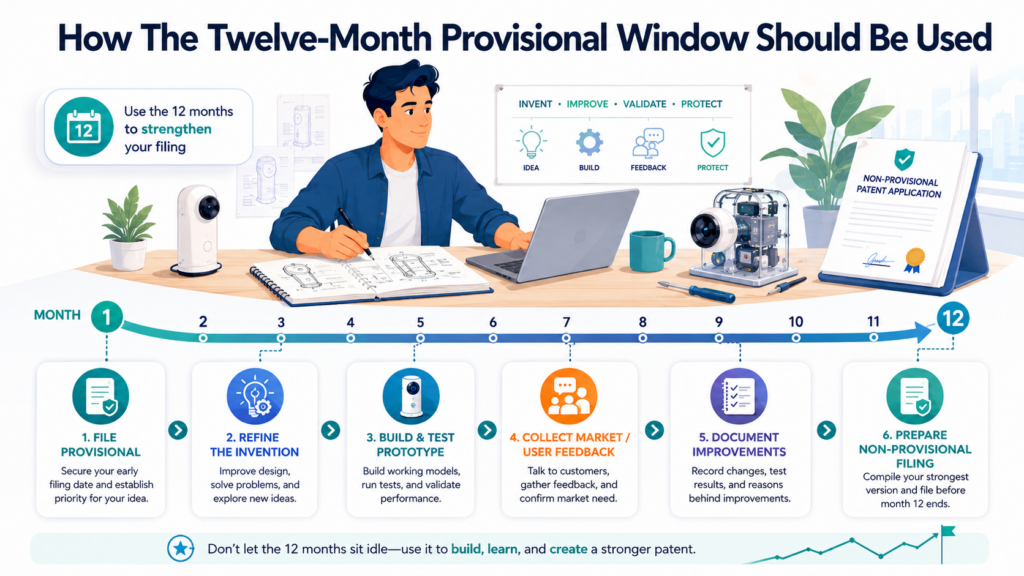
To benefit from the earlier provisional filing date, a founder must file a corresponding non-provisional application during that twelve-month period.
This is where many startups make a quiet but serious mistake. They file the provisional, feel safe, and go back to building.
That feels practical in the moment, but it can turn the final month into a scramble. A patent filing should not be rebuilt from memory when the deadline is near. It should grow along with the product.
The best founders treat the provisional year like a structured learning window. They use it to answer the most important patent question: what part of this invention is truly worth protecting? That answer may not be clear on the filing date.
It often becomes clearer after customers use the product, after the team solves harder problems, and after the company sees which technical pieces create the biggest business edge.
Your First Job Is To Watch What Changes
After filing a provisional, pay close attention to how the product changes. Not every change matters for patents. A new logo, a cleaner screen, or a better onboarding message may help the business, but it may not be a new invention.
A new way the system processes data, trains a model, controls a device, reduces delay, improves accuracy, cuts compute cost, or handles failure may be much more important.
Founders should train themselves to notice technical progress. When your team says, “This finally works,” pause and ask why.
When an engineer says, “The old way was too slow, so we changed the pipeline,” pause and capture that. When a customer asks for something hard and your team builds a new technical path to solve it, write it down.
A provisional filing protects what it describes. It does not automatically cover every later improvement just because the improvement belongs to the same product. That is why the twelve-month window should include active invention capture.
Treat Each Major Product Breakthrough As A Patent Checkpoint
A patent checkpoint does not need to be a long meeting. It can be a short review after a meaningful technical change.
The goal is to ask whether the change adds a new method, system, structure, process, or technical result that may deserve protection.
For example, imagine your startup filed a provisional for a machine learning platform that predicts equipment failure. Three months later, your team creates a new way to clean sensor data before the model reads it. That new data step improves accuracy in harsh field conditions.
That may be a valuable invention point. Six months later, your team builds an edge device workflow that sends only selected events to the cloud, cutting bandwidth cost. That may be another invention point.
If those improvements are not captured before public use or disclosure, the company may lose options. The point is not to file a new application every week. The point is to notice when the invention has grown.
Your Second Job Is To Prepare For The Non-Provisional Early
A non-provisional application deserves more care than a last-minute conversion. It is the filing that can be examined and may become a patent if it meets the requirements.
A non-provisional utility application generally includes a specification with a description and claims, drawings when needed, an oath or declaration, and filing, search, and examination fees.
That means the non-provisional is not just a cleaned-up provisional. It is a strategic document. It should use what the startup learned during the year.
It should include better examples, better drawings, clearer variations, and claims that line up with the business moat.
The founder’s role is not to become a patent attorney. The founder’s role is to bring the raw truth. What did the team build? What changed? What was hard? What do customers care about? What might competitors copy? What product direction matters next?
Strong Non-Provisional Work Starts Months Before The Deadline
The right time to start thinking about the non-provisional is not the final week. It is much earlier, while the product story is still fresh. Waiting too long creates three problems.
First, people forget details. The reason behind a design choice may be obvious today and gone from memory six months later. Second, team members move on.
A key engineer may leave, and the invention story may leave with them. Third, pressure leads to narrow thinking. When the deadline is close, the team may focus only on getting something filed instead of getting the right thing filed.
A better approach is to review the provisional around the middle of the year. Ask what is still true, what has changed, and what now looks more valuable.
Then review again before the final filing work begins. This simple rhythm can make the non-provisional much stronger.
Your Third Job Is To Avoid Public Gaps
The provisional year is often full of public activity. You may pitch investors, launch beta access, speak at conferences, publish technical content, post product demos, recruit engineers, or sell pilots. Each of these moments can reveal parts of the invention.
Before each public moment, compare what you plan to reveal with what has already been filed.
If you are about to reveal a new technical method that was not in the provisional, consider whether another filing is needed first. This is especially important when the new method is the reason the product works better.
Do Not Let The Pitch Deck Outrun The Patent Filing
Pitch decks can create trouble because they often explain the company’s edge in bold, simple terms.
A founder may include diagrams, workflows, architecture slides, model details, customer results, or roadmaps. Investors may ask direct questions. Founders often answer because they want to build trust.
That is normal. But the filing strategy should keep up. If your pitch deck now explains a stronger invention than your provisional covered, you may have a gap. The same is true for demo videos, sales decks, technical blogs, white papers, and customer pilots.
PowerPatent helps founders avoid this “deck ahead of filing” problem by making it easier to turn real technical work into attorney-reviewed filings.
The goal is to protect what you are actually building and sharing, not just what you described months ago. See how PowerPatent works here: https://powerpatent.com/how-it-works
How To Think About Patent Claims Without Getting Lost
Patent claims can feel scary because they sound legal. But the idea is simple. Claims define what you are asking to protect.
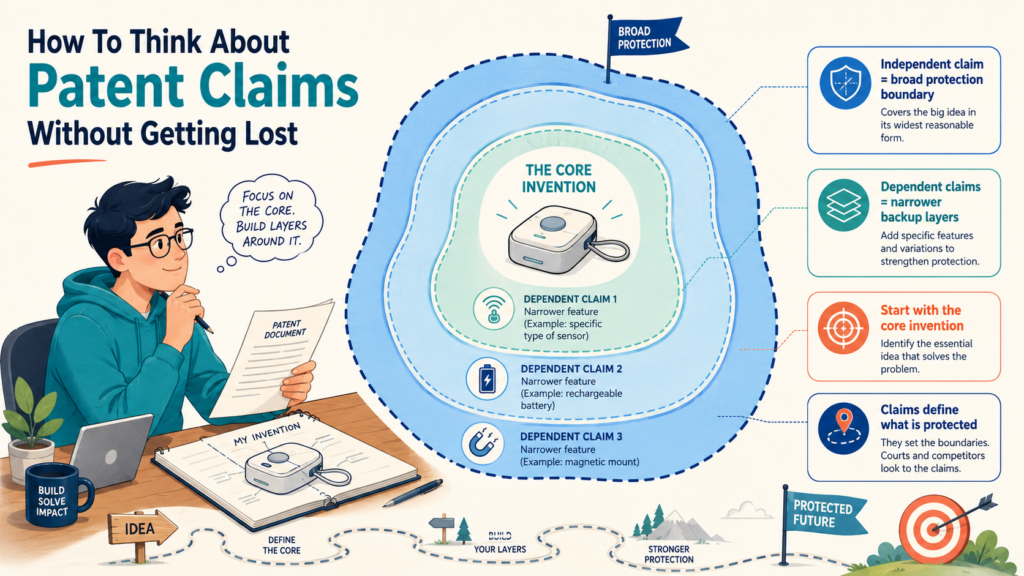
The description explains the invention. The drawings help show it. The claims draw the boundary.
In a non-provisional application, claims are required. A provisional application does not require formal claims, but that does not mean you should ignore claim thinking at the provisional stage.
The USPTO explains that a provisional application does not require claims in the same way a non-provisional does, but it must still include a specification and any drawings needed to understand the invention.
For founders, claim thinking is really moat thinking. What part of the invention should be hard for someone else to copy? What technical path creates the value? What would a competitor need to do to steal the benefit without copying your exact screen or exact code?
Claims Should Protect The Engine, Not Just The Paint
A founder often sees the product the way users see it. The user sees the interface, the report, the robot movement, the dashboard, the alert, the score, or the result. But patent value often sits below the surface. It may be in the engine.
The engine may be a data pipeline. It may be a model training method. It may be a control loop. It may be a device structure.
It may be a way to sync systems. It may be a way to reduce compute load. It may be a new interaction between hardware and software. It may be a way to turn messy input into useful output.
A claim strategy that focuses only on what the user sees may miss the strongest part. A competitor can change the look.
They can change the words. They can move buttons around. They can make the output appear in a different format. But if they need the same technical engine to deliver the same value, that is where your filing should focus.
Ask What Must Stay The Same For The Value To Exist
This is one of the clearest founder questions. If a competitor changed the interface, the brand, the cloud provider, the model type, or the customer workflow, what would they still need to keep in order to get the same benefit?
That answer may reveal the claim target. Maybe the important part is not “showing a risk score.” It may be how the system builds the score from live signals and past events.
Maybe the important part is not “an AI assistant for engineers.” It may be how the tool maps code changes to test actions before a build fails. Maybe the important part is not “a smart wearable.” It may be how the sensors are placed and how the device filters motion noise.
Good claim thinking strips away the surface and finds the technical center.
Claims Should Be Broad Enough To Matter And Specific Enough To Stand
Founders often want the broadest possible patent. That is natural. But broad without support can create problems.
If the claim tries to own too much, it may run into older work or lack enough support in the application. If the claim is too narrow, it may be easy to design around.
The skill is finding the useful middle. A strong claim strategy often has layers. One layer may aim at the broader invention.
Other layers may cover specific versions, technical choices, and fallback paths. This gives the application more ways to survive review while still protecting meaningful business value.
The founder does not need to draft these layers alone. But the founder should help identify what matters.
Which version is live today? Which version is planned next? Which part is hardest to copy? Which alternative would still hurt you if a competitor used it? Which customer use case drives revenue?
Do Not Confuse Broad Words With Strong Protection
Words like platform, artificial intelligence, automation, real time, personalized, intelligent, and optimized can sound broad.
But they are not strong by themselves. A claim that uses big words without a clear technical structure may not protect much.
Strong protection usually comes from clear steps and clear relationships. What receives data? What changes the data? What compares it? What decides? What triggers the next action? What is stored? What is sent? What is adjusted? What technical result improves?
The more clearly the application describes those relationships, the more useful the claims can become. This is why founder input is so important. The legal team can shape the claims, but the founding team knows how the system really works.
Claims Should Match The Way A Competitor Would Copy You
A competitor may not copy the full product. They may copy one valuable part. They may copy the backend method and build a different front end.
They may copy the device shape but use different software. They may copy the workflow and use a different model. They may copy the training method but sell it in a different market.
Patent strategy should account for this. A claim that only covers your exact product may be too narrow.
A better strategy looks at likely copy paths. It asks how others might capture the same value while changing enough details to seem different.
Founder-Led Copycat Thinking Can Improve The Filing
Founders are usually good at this because they know the market. You know which big company could move into your space. You know which open-source project could add a similar feature.
You know which customer might try to build in-house. You know which partner could become a competitor.
Use that knowledge. Before filing, describe the top ways someone might copy the value. Then make sure the application discusses variations that cover those paths where appropriate.
This can help the patent attorney think beyond the current product and draft with the real market in mind.
PowerPatent is built for this kind of practical patent work. It helps founders capture the invention, the product context, and the business edge, then pairs that with attorney oversight so the filing has more strategic depth. Learn more here: https://powerpatent.com/how-it-works
How Provisional And Non-Provisional Filings Affect Fundraising
Patents do not raise money by themselves. Investors still care about the team, market, traction, product, growth, and timing.
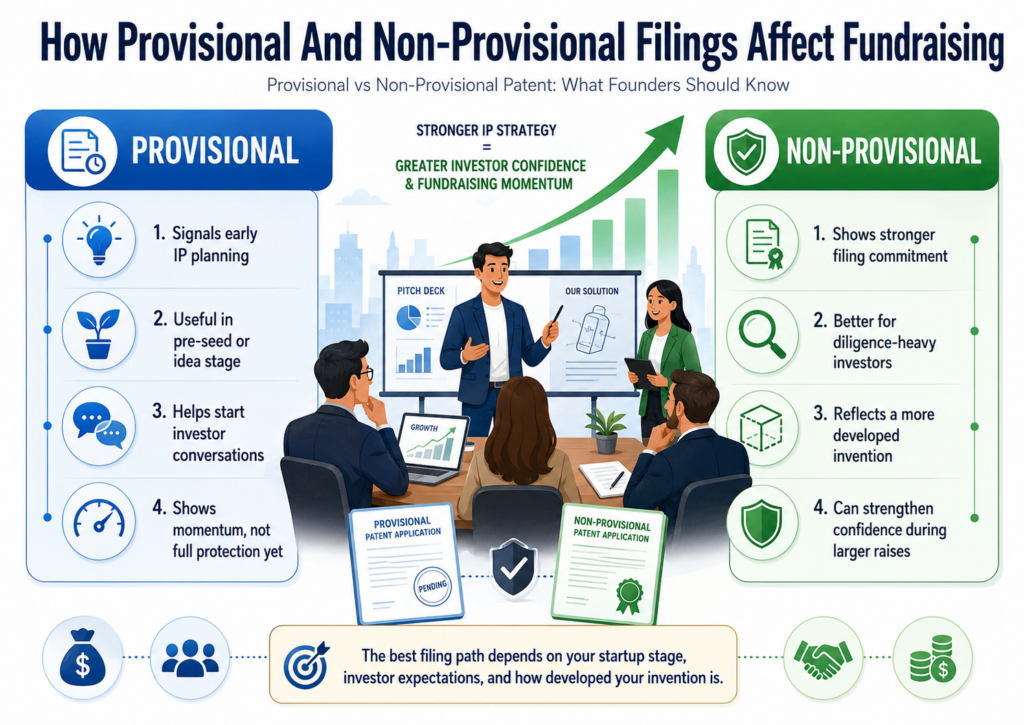
But a smart patent filing can support the story. It can show that the startup has noticed its technical edge and taken action to protect it.
For deep tech startups, patent strategy can be especially important. If your company is built around a hard technical invention, investors may want to know whether that invention can be copied.
They may also want to know whether the company owns the work, whether the filings match the product, and whether the patent plan fits the market.
A provisional can help before an early raise because it gives the company a filing date and lets the founder say the invention is patent pending.
A non-provisional can help in a later raise because it shows the company has moved toward the formal patent path. Neither filing should be treated as a magic badge. The quality and fit matter.
A Provisional Can Help You Pitch Earlier With More Confidence
Early-stage founders often need to pitch before everything is final. That is normal. You may be pre-seed or seed stage. You may have a prototype, early users, or strong technical proof. You may not yet know the final product shape.
A provisional can fit this stage well. It can help you file before broad investor outreach, demo day, or public launch. It can also give you time to learn before the non-provisional is due.
This is useful because investors may ask questions that reveal what really matters. Customer pilots may show which part of the invention has market pull. Product changes may make the later non-provisional stronger.
But the provisional must be real. A weak filing can create a weak story. If investors dig into your IP and see that the filing barely describes the invention, it may not help. A strong provisional should give a clear technical foundation.
Investors Care About The Moat Story More Than The Filing Label
Saying “we filed a provisional” is not enough. A better founder can explain what the filing covers in plain words. Not with legal jargon.
Not with secret details you should not reveal. Just enough to show that the company has protected the core technical path.
For example, instead of saying, “We have a provisional on our AI platform,” a stronger founder might say, “We filed around the way our system turns noisy field sensor data into early failure warnings before standard tools can detect the pattern.” That is clearer. It connects the patent filing to the business value.
A good IP story should be simple. Here is the hard problem. Here is the technical solution. Here is why it matters to customers. Here is how we are protecting it. That is what investors can understand.
A Non-Provisional Can Help During Serious Diligence
As a startup matures, diligence gets deeper. Investors may ask for patent application numbers, filing dates, inventor names, assignments, ownership records, and summaries of what each filing covers.
They may want to know whether the filings cover the product currently being sold. They may also ask whether there are future filings planned.
A non-provisional can be useful here because it is a more formal filing. It includes claims and enters the examination path.
The USPTO says a non-provisional application is examined by a patent examiner and may issue as a patent if patentability requirements are met.
That does not mean every company needs to rush into non-provisionals before fundraising.
It means the filing path should match the fundraising stage. If you are raising a larger round and the core invention is central to valuation, a more mature patent position may help.
Clean Ownership Matters As Much As Filing
A patent application is only useful to the company if the company has the right ownership.
Founders should make sure invention rights are assigned to the company, not left sitting with individual founders, employees, contractors, universities, labs, or prior employers.
This can become a major diligence issue. If a contractor helped build the invention but did not assign rights, investors may worry.
If a founder created part of the invention while still employed elsewhere, there may be questions. If university resources were used, there may be obligations. These issues are best handled early.
PowerPatent helps founders move through the patent process with more structure, including the kind of attorney oversight that can help catch issues before they become expensive. See how it works here: https://powerpatent.com/how-it-works
The Best Fundraising Use Of Patents Is Strategic Clarity
A patent filing should support a clear story. It should not be a vague flex. Strong founders use filings to show that they understand what they are building and why it is hard to copy.
This matters because investors hear many claims about moats. They hear about data moats, network effects, speed, brand, distribution, and AI advantage. Some are real. Some are weak. A thoughtful patent strategy can make the technical moat feel more concrete.
Your Patent Story Should Be Easy To Say In Thirty Seconds
A founder should be able to explain the patent strategy simply. The explanation should cover the invention, the stage, and the plan.
For example, “We filed a provisional before pilots to protect the core workflow. Since then, we have found two new technical improvements from customer use, and we are preparing the non-provisional to cover both the original system and the improved version.” That sounds thoughtful. It shows control.
Another example could be, “We went straight to a non-provisional because the core device design is stable, and our claims are aimed at the sensor placement and control method that make the system work in real-world conditions.” That sounds focused.
Investors do not need a law lecture. They need confidence that the company is protecting what makes it valuable.
How Public Disclosure Can Change The Patent Decision
Public disclosure is one of the biggest reasons founders think about patents early. Startups grow by sharing. They pitch, launch, demo, recruit, publish, sell, and partner. But sharing technical details before filing can create risk.
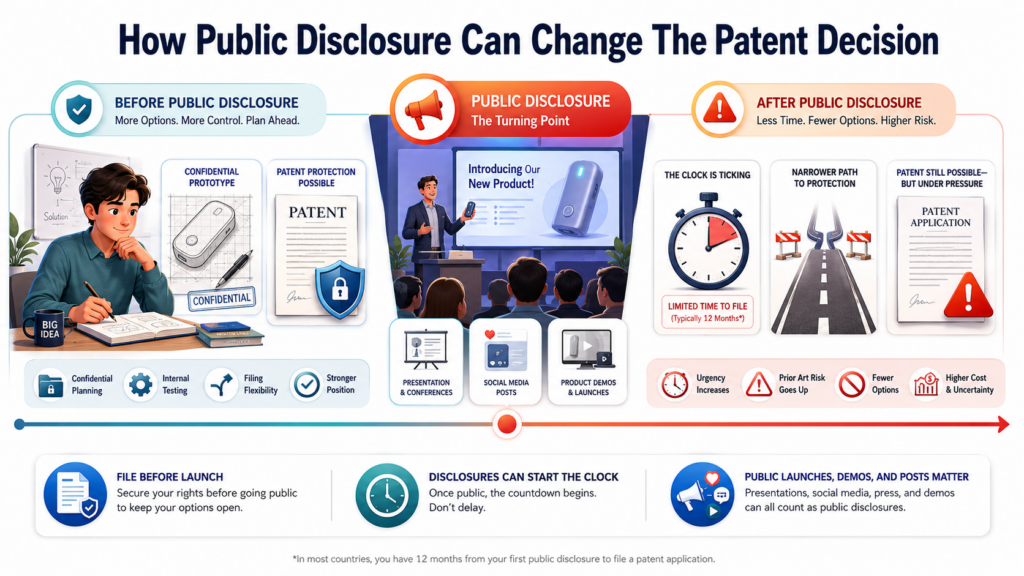
A public disclosure can include more than a formal paper. It may include a website, video, pitch deck, conference talk, product demo, GitHub repo, app listing, sales call without confidentiality, customer pilot, webinar, social post, or public beta. The key question is whether the invention was made available to people outside a controlled setting.
This does not mean founders should stop talking. Startups need motion. It means you should file before revealing the technical core when possible.
A provisional can be especially useful here because it gives a faster way to capture the invention before a public moment. A non-provisional may be better if the invention is ready and the company wants to start the formal path.
File Before The Big Reveal When The Technical Edge Will Be Shown
The safest habit is simple. Before you reveal how the invention works, file something strong enough to support what you are about to disclose.
This is especially true before demo day, a major launch, a technical blog post, a research release, or a widely shared pitch.
Founders often think they are only showing the product, not the invention. But a demo can reveal a lot.
It can show workflow, timing, outputs, system behavior, model responses, device operation, failure handling, or user interaction. A technical audience may be able to infer even more.
If the reveal is high level and does not show the technical core, the risk may be lower. But founders often reveal more than they realize because they are trying to impress people. That is why a filing review before public moments is smart.
Your Public Story Should Match Your Filing Strategy
There should be no gap between what you are about to say publicly and what your patent filing covers.
If your filing covers the first version, but your launch reveals a new version with a better technical method, consider whether the new method needs to be filed first.
This is practical, not theoretical. A founder may file a provisional in January, improve the system in April, then show the improved system publicly in May.
If the April improvement is not in the January filing, the company should not assume it is protected. A new filing may be needed before the May reveal.
The filing strategy should move with the company’s public story. When the story changes, the IP plan should be checked.
Confidential Conversations Still Need Care
Not every outside conversation is public. Some talks happen under confidentiality terms. Some customer pilots or partner talks may have written agreements. But founders should not assume privacy.
Many investors do not sign confidentiality agreements. Some sales calls are not covered. Some accelerator events are public. Some enterprise pilots involve many people across the customer’s company.
Even when confidentiality exists, it should be reviewed. Who is bound? What information is covered? How long does the duty last? Can the recipient share with affiliates, contractors, or advisors? What happens to feedback or improvements?
This is where legal details matter, but the founder lesson is simple. Do not rely on vibes. Know whether the conversation is protected before you disclose the technical core.
Share The Result When You Can And The Mechanism Only When Needed
A smart founder learns to separate the result from the mechanism. You can often explain the customer value without revealing the deepest technical details.
For example, you might say your system reduces false alerts in industrial monitoring. You may not need to explain the exact signal grouping method in a first sales call.
You might say your AI tool helps legal teams find risky clauses faster. You may not need to disclose the exact ranking method, training flow, or data structure in a public webinar.
This does not mean hiding everything. It means being intentional. Reveal enough to move the business forward. Protect the mechanism before sharing it widely.
PowerPatent helps founders prepare for these moments by turning invention details into attorney-reviewed filings before public exposure creates avoidable risk. You can explore the process here: https://powerpatent.com/how-it-works
Public Disclosure Can Affect Foreign Patent Plans
Founders who may sell, raise, manufacture, or compete outside the United States should be even more careful.
Patent rules vary by country, and public disclosure before filing can create serious problems in many places. A U.S.-only mindset can be too narrow for startups with global markets.
If your company may care about Europe, China, Japan, Korea, India, Canada, Australia, or other major markets, discuss filing before public disclosure.
The cost of filing globally can be high, so not every startup should file everywhere. But you should make that decision on purpose, not by accident.
Global Plans Should Be Considered Before Launch
A founder does not need a perfect global patent plan on day one. But before a major public launch, it is smart to ask where protection might matter.
Where will customers be? Where will competitors be? Where will manufacturing happen? Where might an acquirer care? Where might partners operate?
These answers can shape the filing path. A provisional may start the clock. Later, the company may decide whether to file in the United States only, use international filing routes, or focus on specific countries.
The key is to keep the option open until the business has enough information to choose wisely.
Conclusion
Choosing between a provisional and a non-provisional patent application is really about timing, risk, and strategy. A provisional can help you move fast, protect an early filing date, and keep building while your product changes. A non-provisional starts the real path toward a granted patent and should be used when your invention is clear enough to claim with confidence.
The best founders do not file just to say “patent pending.” They file to protect the technical edge that makes the company valuable. PowerPatent helps you do that with smart software and real attorney oversight. Start here: https://powerpatent.com/how-it-works
Leave a Reply