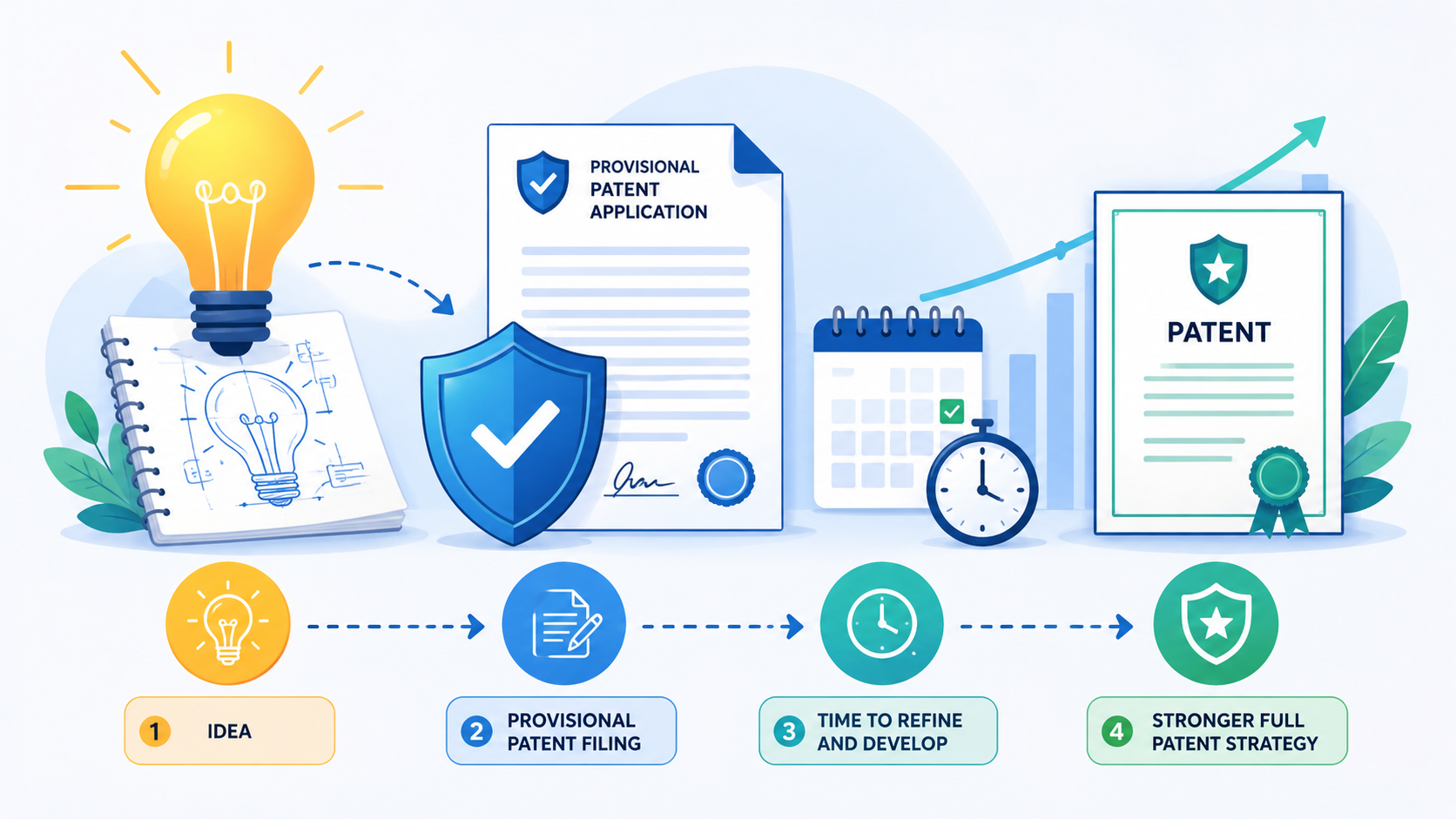
Your idea is fragile when it is new. You may need to show it to a co-founder, investor, customer, engineer, designer, lab partner, or manufacturer before the full product is ready. That is where many founders make a costly mistake. They talk too soon, ship too fast, or file something too thin. Then, later, when the company starts to grow, they learn that the early protection was weak.
Use a Provisional Patent as a Business Tool, Not a Cheap Shortcut
A provisional patent application is often sold as a fast and low-cost way to “protect an idea.” That is partly true, but it is not the full truth.
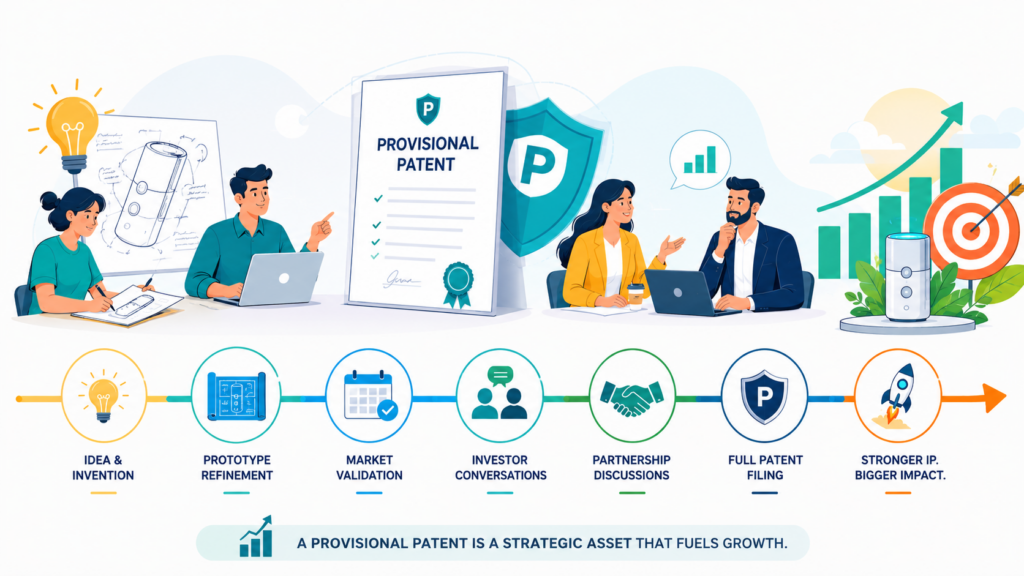
The real value of a provisional is not just that it lets you file early. The real value is that it gives your startup a clear starting line.
That starting line matters. It can help you talk to people with more confidence. It can help you test the market. It can help you raise money.
It can help you build in public without feeling like every demo is a risk. It can also give your future patent attorney a strong base to build on when it is time to file the full non-provisional patent application.
But here is the part founders must understand. A weak provisional can create false comfort. It can make you feel protected when the real invention is not fully explained. That is dangerous.
A rushed filing that only says “an app that uses AI to help doctors” or “a system that improves batteries” may not do much for you later. The document has to teach the invention in enough detail so that the later patent claims can be supported.
The USPTO says a provisional application can help establish an early effective filing date for a later non-provisional application. It also says a provisional does not need formal patent claims, an oath, or an information disclosure statement, and it is not examined.
That sounds simple, but simple does not mean careless. The later application still needs to connect back to what you actually disclosed in the provisional.
The filing date is only useful for what you actually describe
Think of a provisional like a photo of your invention on the day you filed. If the photo is blurry, missing key parts, or only shows the outside, you may not be able to use it later to prove that you had the deeper idea at that time.
This is where many technical teams get into trouble. They file a quick provisional before a pitch, but the document reads like a product brochure. It talks about the outcome. It says what the product does.
It says why the market needs it. But it does not explain how the system works, what the steps are, what the data flow looks like, what parts are required, what parts are optional, what can change, and what makes the invention different from normal engineering.
That gap can hurt later. If your later patent claims focus on a model pipeline, a control loop, a sensor layout, a training method, a hardware structure, or a special workflow, the early provisional needs to describe that material clearly.
It does not need to be perfect, but it should be rich enough that someone skilled in the field can understand how to make and use the invention.
A provisional should capture the invention, not just the product
Your product and your invention are not always the same thing.
A product is what the customer sees. An invention is the technical way you make the result happen. A customer may see a clean dashboard, a faster test result, a better robot motion, or a smoother user flow. But the protectable value may sit behind the screen.
It may be in how you process noisy data, how you choose between models, how you reduce compute cost, how your device handles failure, how your system updates itself, or how your workflow turns a messy human task into a repeatable machine process.
So before you file, ask a simple question: what would a smart competitor copy if they wanted the benefit without copying our brand?
That answer should shape the provisional. Not the pitch deck. Not the landing page. Not the public demo. The filing should protect the engine under the hood.
This is why PowerPatent is built around both smart software and real attorney oversight. Software can help you pull out the invention details fast. Attorney review can help spot thin areas, missing angles, and parts that may matter later.
For founders who want speed without creating a weak paper trail, that combination can be powerful. You can see how it works here: https://powerpatent.com/how-it-works
File early, but do not file empty
There is a smart kind of early filing and a risky kind.
The smart kind happens when you have enough detail to explain at least one working version of the invention. You may still be testing.
You may not have the final UI. You may not know the perfect business model. That is fine. A provisional is often useful before the product is fully polished.
The risky kind happens when you only have a wish. For example, “we want to use AI to find better drug targets” is not yet a strong invention story.
But “we use this data intake process, this filtering step, this model structure, this scoring method, and this validation loop to rank drug targets under these limits” is much stronger. The difference is detail. The difference is the how.
Founders often wait too long because they think a patent filing must come after launch. That can be a mistake. In a first-to-file world, speed matters.
Public disclosure, investor conversations, customer pilots, conference talks, GitHub posts, grant papers, and sales demos can all create pressure. A provisional can give you a cleaner path before those moments.
But speed should not mean dumping rough notes into a filing portal. Your early filing should be built with the future in mind.
It should describe the core version, several backup versions, and the likely paths your product may take over the next year.
The best provisional is written for the company you are becoming
A good provisional does not only describe what exists today. It also covers the natural next versions that your team can already see.
That matters because startups change fast. The model changes. The sensors change. The cloud setup changes. The customer segment changes. The user flow changes. The prototype becomes an API.
The API becomes a platform. The platform becomes a full system with partner tools. If your provisional is too narrow, it may only protect the first rough build, not the stronger commercial version you ship later.
A better strategy is to include the current version, the next version, and the likely alternate versions.
You can explain that the system may use different models, different data sources, different hardware parts, different thresholds, different interfaces, or different deployment modes. You can also explain which pieces are required and which can be swapped.
This does not mean you should stuff the filing with vague language. It means you should map the invention with care.
You want enough detail to support real patent claims later, but enough range to avoid locking yourself into one early prototype.
That is the balance. File early enough to protect the idea before the world sees it. File deeply enough that the document can matter later.
Treat the 12-month clock like a funding and product deadline
A provisional application does not become a patent by itself. The USPTO explains that a provisional is automatically abandoned after 12 months, and a corresponding non-provisional application must be filed during that period if you want to benefit from the earlier provisional filing date.
That 12-month window is not just a legal date. It is a business window.
During that year, your team should learn what matters. You should test the market. You should find out which feature customers care about most. You should see what investors ask about.
You should watch what competitors do. You should learn which technical path is strongest. Then, before the window closes, you should convert the provisional into a more complete non-provisional application that claims the right invention.
This is where many startups lose value. They file a provisional, forget about it, and then rush near the deadline.
By then, the product has changed, the team is busy, and key details are scattered across Slack, GitHub, notebooks, demos, and old pitch decks. The final patent filing becomes a scramble.
A stronger move is to treat the provisional year as an invention-building year. Each major product change should be captured. Each new technical breakthrough should be reviewed.
Sometimes, it may make sense to file another provisional as the invention improves. That way, your patent story grows with your product instead of freezing on day one.
Your provisional strategy should match your startup rhythm
A deep tech startup does not move in a straight line. One week you are tuning a model. The next week you are changing the data layer.
Then a pilot customer asks for a new workflow. Then your team finds a faster method. Then an investor wants to know why your approach is hard to copy.
Your patent strategy should keep up.
For some teams, one strong provisional before a major disclosure is enough. For others, a rolling provisional strategy may work better.
That means filing a first provisional for the core invention, then filing follow-on provisionals as major improvements appear. When the non-provisional deadline comes, the strongest pieces can be combined into a broader filing plan.
This is especially useful for AI, robotics, biotech tools, medical devices, chips, climate tech, advanced manufacturing, and other fields where the first prototype is rarely the final invention.
The main point is simple. Do not treat a provisional as a form. Treat it as a living part of your company’s moat.
PowerPatent helps founders turn technical work into patent-ready material without slowing the team down.
That means your code, diagrams, product notes, and invention details can become a stronger filing path with attorney oversight built in. Learn more here: https://powerpatent.com/how-it-works
File Before You Talk, Demo, Publish, Pitch, Sell, or Share Too Much
A provisional patent strategy starts before the first big public moment. Not after. Not when the product is already on the website. Not after the pitch deck has gone to fifty investors.
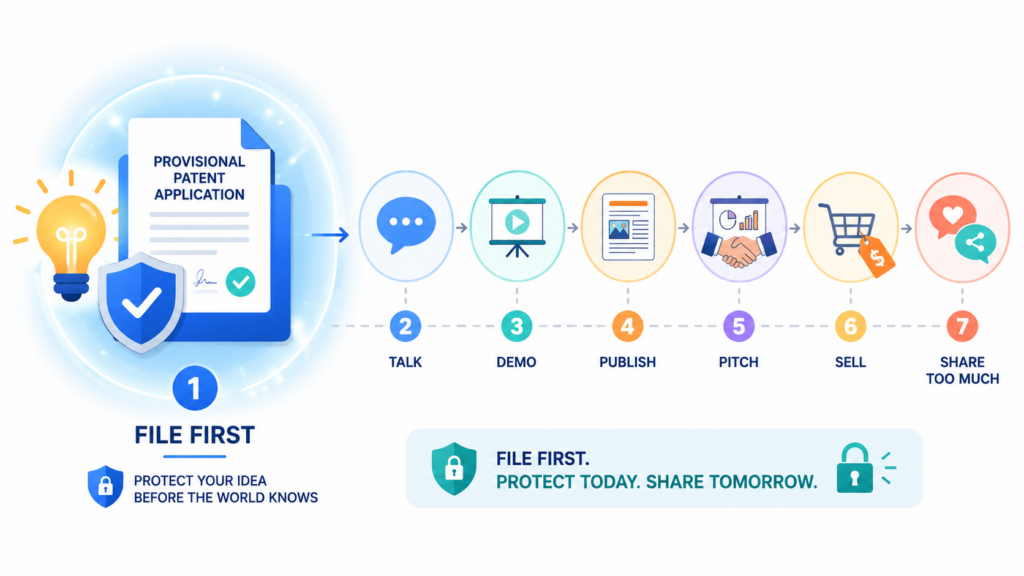
Not after the code is open on GitHub. Not after the beta has been shown at a trade show. The safest time to think about a provisional is before the idea leaves your control.
This does not mean you should hide in a room and never talk to anyone. Startups need feedback. Founders need customers. Engineers need partners. Investors need to understand what makes the company special.
But you should know what you are sharing, who you are sharing it with, and whether your core invention has been captured in a filing before that sharing happens.
A lot of founders think the danger is only someone “stealing the idea.” That can happen, but it is not the only risk. Another risk is that your own public words can hurt your future patent rights.
A blog post, demo video, research paper, public pitch, sales page, webinar, grant summary, app store listing, customer manual, or conference talk may count as a disclosure.
Once the invention is out, the clock can start moving. In some countries, public disclosure before filing can be very harmful. Even in places with grace periods, it is risky to depend on them.
The best time to file is before the first serious disclosure
A serious disclosure is any moment where someone outside your trusted inner circle can learn how the invention works. It may not feel formal. It may feel like a friendly coffee chat, a founder meetup, a pilot call, or a quick investor update.
But if you are sharing the technical heart of the invention, you should pause and ask whether you have protected the idea first.
This is very important for technical founders because the most valuable details often come out during casual talks. A founder may start with a simple pitch, then answer questions, then explain the system, then open a diagram, then walk through the data flow, then describe the edge cases, then reveal the secret part without meaning to. That is how leaks happen. Not always through bad people. Often through normal startup motion.
The smart move is to file before those moments. A well-built provisional gives you a cleaner path. It lets you speak with more confidence because your key invention is already written down and filed.
It also creates a record of what you had at that time. That record can be useful when the company later grows, raises money, signs partners, or faces copycats.
PowerPatent helps founders move fast here because it is built for teams that cannot pause for months.
You can bring in notes, diagrams, product details, and technical material, then use smart software and attorney oversight to shape a stronger filing. See how that process works at https://powerpatent.com/how-it-works
Confidential talks are helpful, but they are not a full strategy
Non-disclosure agreements can help, but they should not be your only line of defense. Some investors will not sign them.
Some big companies will avoid them. Some early customer talks move too fast. Some partners may sign, but still create practical risk if the relationship goes badly.
A provisional patent filing can support your sharing strategy because it does not depend only on trust. You still want good habits. You still want to limit what you share. You still want written agreements when needed. But the filing gives you another layer.
The key is to match the depth of sharing to the stage of protection. If you have not filed yet, keep the talk focused on the problem, the market, and the benefit. Avoid the deep “how it works” layer until the filing is in place.
Once a provisional is filed, you can be more open, but still be careful. Patent pending does not mean “tell everyone everything.” It means you have taken a first step.
Separate the pitch from the invention
Your pitch deck should not be the same as your invention file. The pitch is for belief. The patent filing is for protection. The pitch should show why the company matters. The provisional should explain how the invention works.
Many founders mix these two things. Their provisional sounds like a fundraising deck. It talks about the size of the market, the pain of the customer, the growth of the industry, and the future vision.
That can be useful for business, but it does not protect much by itself. A patent filing needs the working details.
A good provisional should explain the parts of the system, the steps the system performs, the inputs, the outputs, the choices made along the way, and the ways the invention can be used in more than one setting. It should show the technical shape of the idea.
If the invention is software, it should explain the flow of data and decisions. If it is hardware, it should explain the structure and how the parts work together. If it is AI, it should explain more than “we use AI.”
It should describe what data is used, how it is handled, what the model does, and what improves because of the method.
Protect the secret sauce before the sales story grows
The sales story can change every month. The secret sauce should be captured early.
You may start by selling to small clinics, then move to hospitals. You may start with a dashboard, then become an API. You may start with one type of sensor, then support many.
You may start with a manual step, then automate it. If your provisional only covers the early sales story, you may miss the deeper invention that carries across all those versions.
This is why the provisional should not just mirror your current website. It should be written around the engine of the business.
What makes your product work better, faster, cheaper, safer, or more reliably than the normal way? What did your team figure out that others would not want to spend years solving? What part would hurt most if a competitor copied it?
That is the material you should capture before you talk too widely.
Write the Provisional Like a Technical Playbook, Not a Legal Shell
A strong provisional should feel like a clear technical guide. It should teach the invention. It should show the reader what the system does, what parts are involved, how those parts connect, what happens first, what happens next, and what can change without breaking the idea.
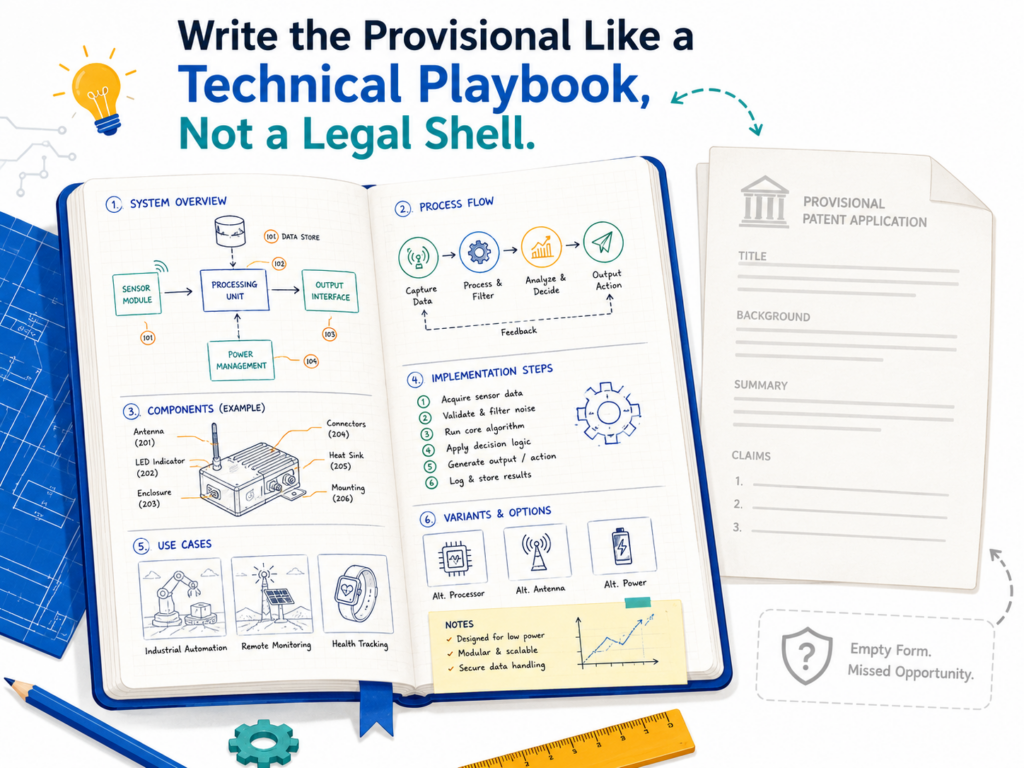
You do not need to write it in a stiff or confusing way. In fact, simple language often works better. The goal is not to sound like a patent lawyer. The goal is to explain the invention so well that the later patent application has a strong base.
This is where many founders can help a lot. You know the invention better than anyone. Your notes, code comments, product docs, diagrams, lab records, and design choices may hold the most useful details.
But those details need to be shaped. A raw brain dump is not enough. A few screenshots are not enough. A pitch deck is not enough.
A thin summary is not enough. The provisional should be organized so the invention is easy to understand and hard to dismiss as a vague idea.
Start with the problem, but move quickly into the solution
A good filing can begin by explaining the problem. But it should not stay there too long. The problem sets the stage. The invention is the main act.
For example, saying “current systems are slow” is not enough. You need to explain why they are slow and how your approach fixes that in a specific way. Maybe your system reduces repeated data calls.
Maybe it changes the order of steps. Maybe it uses a special scoring method. Maybe it filters low-value data before sending it to a model.
Maybe it runs part of the process on the device instead of the cloud. Maybe it predicts failure before the user notices. The useful part is the practical method.
This is especially true for software and AI inventions. Many teams describe the final result, such as “more accurate recommendations” or “faster diagnosis” or “better fraud detection.”
Those outcomes matter, but the filing must go deeper. It should explain the path from input to output. It should describe how the system improves the result. It should include examples that show the invention in use.
A founder should ask, “Could another engineer build a basic version after reading this?” If the answer is no, the filing may be too thin.
The best provisionals describe choices, not just features
A feature is what the user sees. A choice is what the system does to make the feature work.
For example, a feature might be “automatic risk scoring.” A choice might be “the system assigns different weights to data sources based on time, source trust, and conflict level, then updates the score when new events arrive.”
That choice is more useful for a patent filing because it explains how the system behaves.
Good provisional writing brings those choices to the surface. It explains why one path was chosen over another. It explains what happens when data is missing. It explains what happens when two inputs conflict.
It explains how the system handles errors, edge cases, speed limits, cost limits, privacy needs, or device limits.
These details can be gold. They often show where the invention really lives. They also help separate your work from common ideas.
Many people can say they want to automate a task. Fewer can explain a specific, working way to do it.
Include drawings, flows, examples, and variations
A provisional does not need formal patent drawings in the same way a full patent application often does, but good visuals can make the filing stronger. Simple diagrams can show the system.
Flow charts can show steps. Tables can show examples. Screens can show user actions. Hardware sketches can show shape and placement. Model pipeline diagrams can show how data moves.
The drawings do not need to be beautiful. They need to be clear. A clean hand sketch can be better than a glossy marketing graphic if it shows how the invention works.
Examples are also very helpful. A filing should not only say what the system can do in broad terms. It should walk through real use cases. For a medical device, show how a reading is taken, processed, checked, and reported.
For an AI tool, show how data enters, how the model uses it, and how the output changes the user’s next step. For robotics, show how the robot senses, plans, moves, and adjusts. For climate tech, show how the system measures, controls, stores, converts, or reduces waste.
Variations protect you from your own future changes
Your first version will not be your last version. That is why your provisional should describe variations.
A variation is another way the invention can be built or used. It may use a different sensor, a different model, a different material, a different interface, a different rule, a different machine, a different network setup, or a different workflow.
These variations matter because your company may pivot. Your customers may ask for changes. Your team may find a better path. Your later claims may need support for more than one version.
This does not mean adding empty phrases like “many variations are possible” and moving on. That is weak. Strong variation writing names the possible changes and explains how they still fit the invention.
For example, if your system uses a phone camera today, but could later use a fixed camera, drone camera, microscope, or infrared sensor, say that and explain how the image data is still processed.
If your system uses one machine learning model today, but could use several model types, say what types may work and why. If your device uses a certain material today, but other materials could do the same job, describe them.
PowerPatent is useful here because many founders have the details, but not the structure. The platform helps draw out the invention story, while attorney oversight helps make sure the filing is not just a rough note dump. You can explore the workflow here: https://powerpatent.com/how-it-works
Build the Provisional Around the Future Claims You May Need
A provisional patent application does not need formal claims, but it should still be written with future claims in mind. That may sound odd at first.
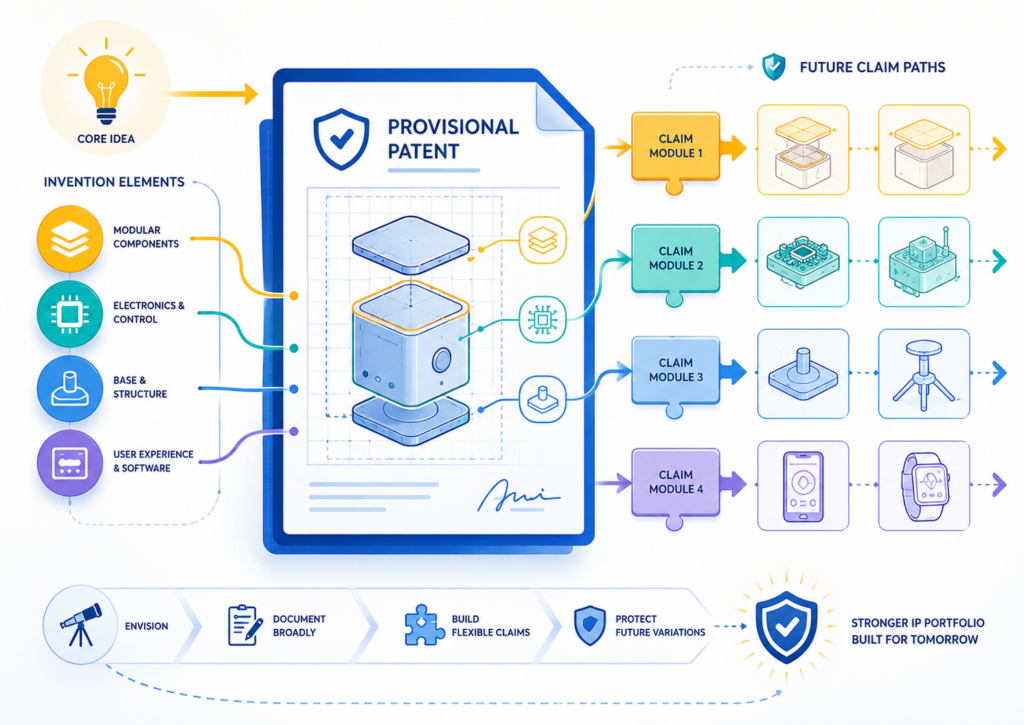
If claims are not required, why think about them? Because the later non-provisional application will need claims, and those claims need support in the earlier filing if you want the early date to matter.
Think of claims as the fence around your invention. The provisional is the land survey. If the survey does not show the land clearly, the fence may be hard to place later.
This is one of the most strategic parts of provisional work. You are not only writing what the product does today. You are creating room for the claims you may want later.
That means you should think about the broad invention, the narrower versions, the fallback positions, and the commercial features that competitors may copy.
Know what you want to stop competitors from doing
A patent strategy should begin with a simple business question: what should a competitor not be able to copy?
The answer may not be the whole product. It may be a single workflow, one data process, a device structure, a training method, a control system, a user interaction, a manufacturing step, or a way of connecting parts.
The more clearly you can name the thing you want to protect, the better your provisional can be.
For example, imagine your startup has a tool that helps factories detect machine failure early. The patentable part may not be the dashboard. It may be the way your system blends vibration data, temperature data, maintenance records, and operator notes into a changing risk score.
Or it may be the way it learns from false alarms. Or it may be the way it sends different warnings to different workers based on role and urgency.
Those are possible claim targets. Your provisional should describe them in detail.
Write for broad coverage and fallback coverage
Good patent strategy does not depend on one perfect sentence. It gives you layers.
Broad coverage tries to protect the main idea at a high level. Fallback coverage protects narrower versions in case the broad version is too close to what already exists.
Both matter. If the filing only describes the invention broadly, it may sound vague. If it only describes one narrow version, a competitor may design around it.
A strong provisional should include the core concept, then several specific ways to carry it out. It should explain the must-have parts and the optional parts.
It should show the simplest version and more advanced versions. It should capture the commercial version, but also other versions that might be used by competitors.
This is where “patent thinking” helps. You are not just asking, “What did we build?” You are asking, “What family of solutions did we create?”
Include the details that make later claims stronger
Later claims often depend on small details. A filing that misses those details may limit your options.
For software, useful details may include how data is received, cleaned, grouped, scored, stored, updated, displayed, or acted on.
For AI, useful details may include training data, model selection, feature extraction, feedback loops, confidence scoring, human review, model updates, and deployment setup.
For hardware, useful details may include shape, placement, connection, movement, materials, tolerances, sensor location, and failure handling.
For biotech tools or lab systems, useful details may include sample handling, measurement steps, reaction conditions, detection methods, and control logic.
The point is not to drown the filing in random detail. The point is to include the details that may later support useful claims.
A practical way to find these details is to review the invention through competitor eyes. If a competitor wanted the same benefit, what would they copy? If they wanted to avoid your patent, what would they change? If they changed that part, would the invention still work? These questions can reveal which parts need broad wording and which parts need specific backup.
The strongest provisional gives your future attorney room to work
Your future patent attorney should not have to rescue a thin filing. They should be able to build from a strong base.
When the non-provisional deadline approaches, the attorney will need to decide what to claim. If your provisional has deep support, the attorney has more room.
They can draft claims to the main system, the method, the device, the software process, the data flow, the user workflow, and the alternate versions. If the filing is thin, the attorney may have fewer options.
This is why a “cheap provisional” can become expensive later. Saving money at the start can cost you claim scope, investor confidence, or enforceable protection later. The goal is not to overpay. The goal is to file smart.
PowerPatent was built for this exact gap. Founders need speed and control, but they also need the judgment that comes from real patent attorney oversight.
The platform helps turn technical invention material into a more complete filing path without making the process feel old, slow, or unclear. Learn more here: https://powerpatent.com/how-it-works
Use a Provisional to Support Fundraising Without Overexposing the Invention
Investors like strong moats. They want to know why your company can win and keep winning.

A provisional patent application can help tell that story. It can show that you are not only building fast, but also protecting what makes the company hard to copy.
But fundraising creates a special problem. You need to explain enough to create belief, but not so much that you give away the whole machine. A provisional can help you manage that line.
Once the filing is in place, you can say the invention is patent pending and speak with more confidence about the protected area. You still need to be careful, but you are no longer walking into every conversation with nothing filed.
A good provisional also helps your own thinking. It forces you to define the invention. That can make your fundraising story sharper.
Instead of saying, “We use AI to improve operations,” you can say, in plain terms, “We built a new way to turn messy real-time plant data into early failure warnings that get better after each maintenance event.” That is clearer, stronger, and more investable.
Investors want to know what is hard to copy
Most investors do not want a long legal lecture. They want to know what makes your company special. They want to know why a big company cannot copy you in six months.
They want to know what you have learned that others do not know. They want to know whether your early lead can become a durable advantage.
Your provisional can help answer those questions, but only if it is tied to the business. The filing should protect the technical edge that supports the company’s growth.
It should not be a random side feature that sounds clever but does not matter to the market.
For example, if your whole company depends on a faster way to run a model on low-power devices, that should be central.
If your main advantage is a new lab workflow that cuts testing time, that should be central. If your key value is a special way to combine human review with machine output, that should be central.
The patent strategy should follow the business strategy.
Patent pending can create trust, but it should not be used as decoration
“Patent pending” can help, but it is not a magic phrase. It should mean that you filed something real and thoughtful. It should give investors comfort that you are taking the moat seriously.
Some founders put “patent pending” on a deck and hope nobody asks questions. Strong investors may ask.
They may want to know what was filed, when it was filed, what it covers, whether it matches the product, whether it supports future filings, and whether the company owns it. If your provisional is thin or off-target, the phrase may not help much.
A better approach is to be ready with a plain-English patent story. You do not need to share the whole filing. You can explain the protected technical area, why it matters, and how it supports the company’s plan.
You can say the company has filed a provisional covering the core method, system, or device behind the product. You can explain that the next step is to convert it into a full application before the deadline.
That sounds mature. It shows control.
Use the filing process to clean up ownership early
Before fundraising, ownership must be clean. If the invention was created by founders, employees, contractors, university labs, advisors, or outside developers, the company needs to know who owns what. A provisional filing is a good time to catch these issues.
This is not just paperwork. It can affect deals. Investors may ask whether every inventor has assigned rights to the company. They may ask whether a university, employer, lab, accelerator, or contractor has any claim.
They may ask whether open-source code creates limits. They may ask whether the invention was created before or after the company formed.
Founders should not wait until diligence to clean this up. The earlier you map invention ownership, the easier it is to fix.
A simple habit helps. When preparing a provisional, identify who contributed to the actual invention, not just who worked at the company.
Then make sure company documents and assignment records are handled properly with counsel. The goal is to avoid surprises when money is on the table.
A clean patent story can speed up diligence
Fundraising is already hard. Do not make it harder by having a messy invention record.
When investors see a clear patent strategy, it can reduce friction. They may not need every detail at the first meeting, but they will notice whether you have thought about protection.
A clear filing date, a clear invention summary, clean ownership, and a plan for conversion can make your company look more prepared.
This is especially important for deep tech, where the product may take years to fully mature. Investors often back the technical edge before revenue is huge. Your provisional can help show that the edge is real and being protected.
PowerPatent helps founders prepare for this kind of moment. It gives teams a more founder-friendly way to capture technical work and move toward stronger filings with real attorney oversight.
Instead of waiting until diligence panic, you can build the patent story as you build the company. Start here: https://powerpatent.com/how-it-works
Avoid the Thin Provisional That Looks Filed but Protects Almost Nothing
The most dangerous provisional is the one that makes you feel safe while leaving the real invention exposed. It has a filing receipt. It may even let you say “patent pending.”
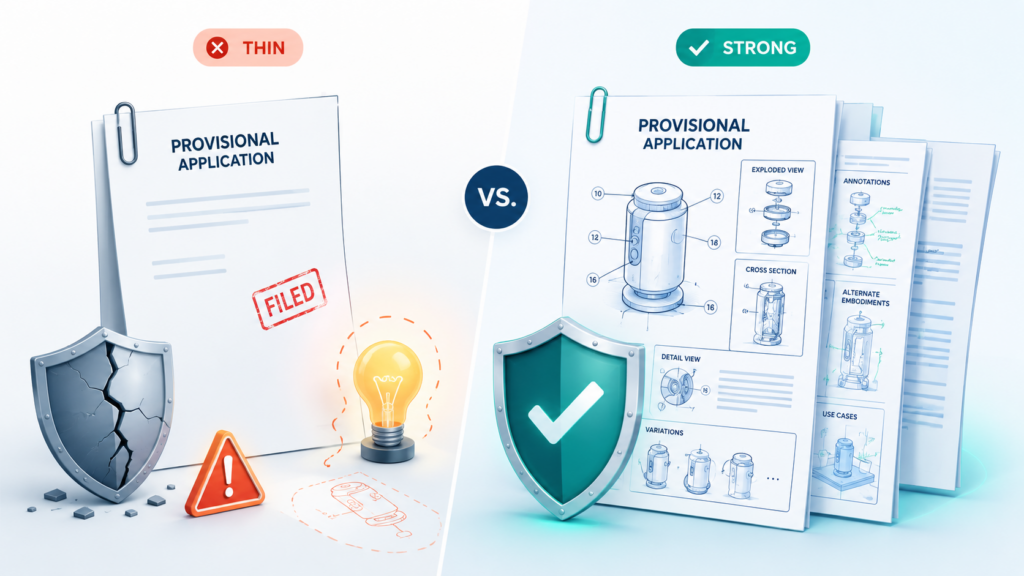
But when it is time to convert, enforce, license, raise money, or answer hard questions, it falls apart because it does not support the invention that matters.
This happens more often than founders think. A team files a few pages in a hurry. The document includes a product name, a short summary, a market problem, and a few broad claims about what the tool can do. It may even include screenshots.
But it does not explain the technical method. It does not show the system flow. It does not describe alternate versions. It does not explain the part that makes the product hard to copy.
That kind of filing may be better than nothing in some narrow cases, but it is not a strong strategy.
A weak provisional often sounds like a landing page
Landing pages are made to sell. Patent filings are made to teach. When those two get mixed up, the result is weak.
A landing page says the product is fast, simple, smart, secure, accurate, scalable, or easy to use.
A patent filing should explain what makes it fast, why it is secure, how it improves accuracy, what makes it scalable, and what steps create the result. The filing should not only claim benefits. It should explain the mechanics.
For example, “our platform uses AI to automate contract review” is not enough. A stronger filing would explain how the system receives the contract, breaks it into sections, identifies clause types, compares language to a rule set or trained model, flags risk, ranks issues, creates edits, learns from user approval, and handles conflicts across document versions. The value is in the process, not the slogan.
The same idea applies to every field. “Better battery management” is too thin. “A control method that changes charging behavior based on cell temperature, use history, predicted load, and safety state” is much more useful.
“Smart robotics” is thin. “A robot motion plan that adjusts grip force based on object softness and slip feedback” is better.
Screenshots are useful, but they cannot carry the whole filing
Screenshots can help show an interface. But screenshots alone often miss the invention.
A screen may show a score, a button, a chart, or a warning. It may not show how the score is made, what data feeds it, what rules change it, what happens after a user clicks, or how the system improves over time.
If the invention is mostly behind the screen, the filing must go behind the screen too.
Founders should treat screenshots as support, not the main protection. Use them to explain how a user interacts with the system. Then explain what the system does in response.
The stronger filing is the one that connects user action to backend logic, data handling, model behavior, device control, or technical effect.
Do not confuse speed with skipping the hard thinking
A provisional can be fast. It should not be careless.
The hard thinking is not legal theater. It is business protection. You need to decide what the invention is, what parts matter, what the broad idea is, what the fallback versions are, what competitors may copy, and what your team may build next. That thinking can happen quickly if the process is well-run, but it still needs to happen.
This is where old patent processes often frustrate founders. They feel slow, expensive, and disconnected from the way technical teams work. But the answer is not to file junk. The answer is to use a better process.
A strong process pulls from the material your team already has. Code notes. Architecture diagrams. Product specs. Slack explanations. Lab results. CAD files. Model cards. Test logs.
User stories. Customer demo scripts. These can all reveal invention detail. The trick is turning them into a clear, attorney-reviewed filing before key disclosure moments.
A strong provisional should survive the conversion meeting
One simple test is to imagine the conversion meeting eleven months later.
Your patent attorney opens the provisional and asks, “What can we claim from this?” If the document has rich detail, clear flows, useful examples, and strong variations, that meeting can be productive.
If the document is vague, the attorney may have to say, “We can claim some things, but not the parts you now care about most.”
That is the moment you are trying to avoid.
The best provisional is not perfect. It does not need to predict every future feature. But it should give your future self room.
It should make the next filing easier, not harder. It should preserve the early date for the real invention, not just a shallow description of the brand.
PowerPatent helps teams avoid thin filings by combining software that moves fast with real attorney oversight that looks for gaps.
That means you can protect early without settling for a weak document that only looks good on the surface. See how PowerPatent works here: https://powerpatent.com/how-it-works
Treat Every Product Change as a Possible New Patent Moment
Startups do not invent once. They invent again and again. The first provisional may protect the first version, but your best invention may appear three months later during a customer pilot, a late-night debug session, a model failure, a manufacturing issue, or a hardware redesign. A strong provisional strategy leaves room for that.
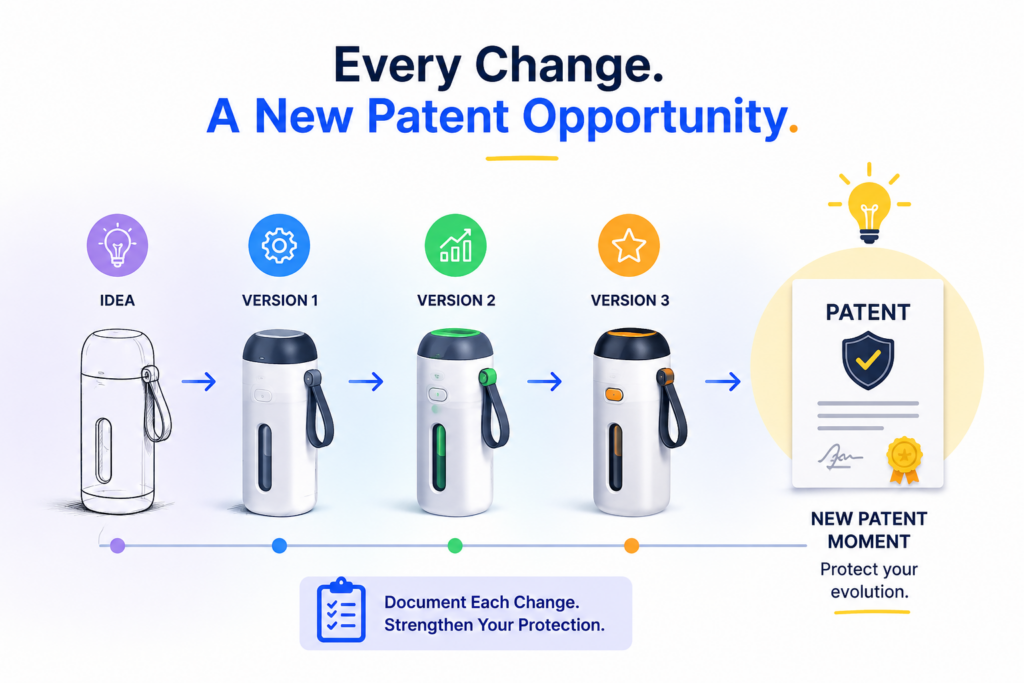
This is one of the biggest missed chances in startup patent work. A team files one provisional, then assumes the job is done for a year. But during that year, the product changes in major ways. The team solves deeper problems. They find a better system design.
They build a new workflow that customers love. They reduce cost. They improve safety. They create a new model loop. They automate a painful step. Yet none of that makes it into a follow-up filing.
Then, near the conversion deadline, everyone realizes the original provisional does not cover the current product well. That is painful because the best protection often comes from capturing each major invention close to the time it is made.
Your patent strategy should move with your build cycle
A startup’s invention record should not live outside the product process. It should move with it.
When your team ships a major change, you should ask whether the change is just normal product work or a new invention. Most changes will not need a new filing. Some will. The key is to notice the difference.
A new invention moment may happen when the team solves a technical problem in a way that is not obvious, creates a process that gives a clear performance gain, makes the system work under tough limits, reduces cost in a special way, improves accuracy through a new method, changes hardware structure, creates a new data loop, or finds a better way to connect human and machine decisions.
These moments should be captured while they are fresh. The people who solved the problem still remember why it was hard.
The diagrams still make sense. The test data is still easy to find. The edge cases are still in mind. Waiting months makes everything harder.
Customer pilots often reveal the most valuable inventions
Real customers break clean assumptions. That is a good thing.
A pilot may show that the model fails on messy data. A nurse may use the device in a way the team did not expect. A factory line may create noise that ruins sensor readings.
A robot may struggle with odd lighting. A finance user may need a different risk path. A climate system may face weather patterns that were not in the lab test.
When your team fixes those problems, you may create something more valuable than the first idea.
The first idea may have been broad. The pilot fix may be the thing that makes the product actually work in the real world. That can be worth protecting.
For example, a startup may begin with “AI inspection for parts.” During pilots, the team may invent a way to handle glare, dust, odd angles, and incomplete images without slowing the line.
That practical method may be the true moat. If it is not captured, a competitor may copy the field-tested solution later.
Use follow-on provisionals to protect major improvements
A follow-on provisional is another provisional filed after the first one. It can capture improvements, new versions, and deeper discoveries. This can be a smart move when the invention keeps changing fast.
The goal is not to file every tiny update. That would waste time and money. The goal is to file when the improvement could become important to the business.
If the change affects the core value, the customer benefit, the technical performance, the cost structure, the safety profile, or the competitive moat, it deserves attention.
Follow-on filings can also help when you are preparing for bigger public moments. Maybe you filed a first provisional before investor talks.
Then, six months later, you are about to announce a pilot, publish results, show a demo, or launch a beta with major improvements. A second filing before that public moment may help protect the new material.
A rolling strategy can give your startup a stronger patent story
A rolling strategy means you keep capturing important inventions over time instead of trying to force everything into one early filing.
This can work very well for deep tech teams. AI systems improve with data. Hardware improves through tests. Medical tools improve through clinical feedback. Robotics improves through real-world failure.
Climate tech improves through field conditions. Advanced manufacturing improves through process tuning. Each improvement may add to the moat.
By the time you file the non-provisional, you may have a fuller story. You may be able to combine the first filing, later improvements, and the current product direction into a stronger application plan. You may also decide which ideas deserve separate filings.
This is where PowerPatent can be a major advantage. Instead of treating patents as a once-a-year panic, founders can build a more natural workflow for capturing inventions as they happen.
Smart software helps collect and shape the details. Real attorney oversight helps decide what matters. That is a better fit for the way startups actually build. Learn more at https://powerpatent.com/how-it-works
Make Your Provisional Match the Real Commercial Moat
A provisional patent strategy should not protect random clever ideas. It should protect what makes the company valuable. This sounds simple, but many startups miss it. They file on the thing that is easiest to explain, not the thing that is hardest to copy.
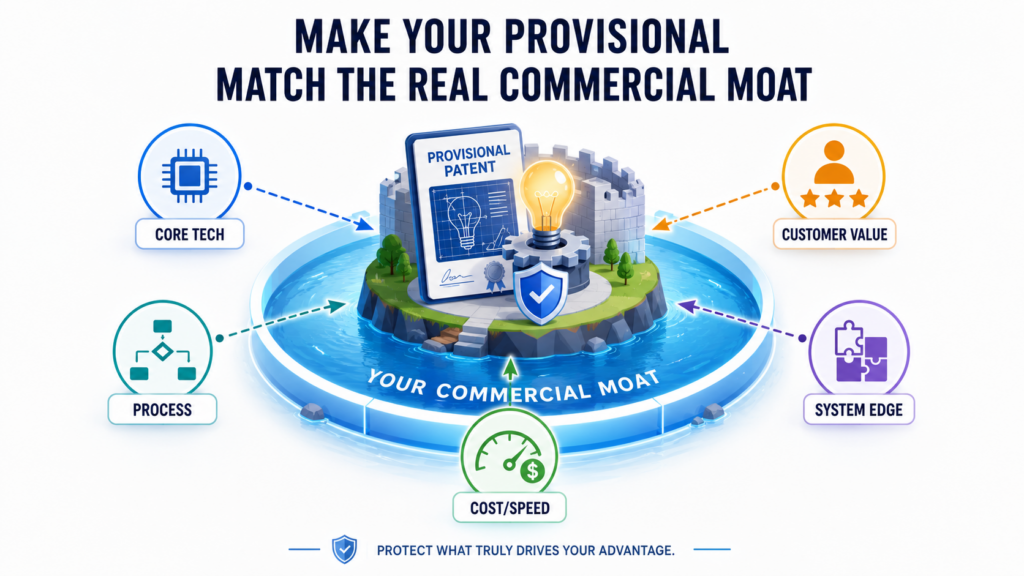
They protect the visible feature, not the hidden system. They protect the early demo, not the business engine. That can lead to a patent file that looks active but does not help the company win.
The commercial moat is the part of your business that keeps competitors from catching up. It may be speed. It may be accuracy. It may be cost. It may be trust.
It may be a special data loop. It may be a hardware design that works under hard conditions. It may be a way to make a process repeatable when others still need manual work. It may be the link between your software, data, device, and workflow.
Your provisional should be built around that moat.
The invention should support the reason customers choose you
Start with the buyer. Why does the customer care? What pain goes away when your product works? What result becomes faster, cheaper, safer, cleaner, or easier? Then move one layer deeper. What technical method makes that result possible?
That deeper answer is often where the patent value lives.
For example, a customer may choose your medical AI tool because it gives faster triage. But the invention may be a way to combine patient history, sensor data, and live symptom inputs while showing uncertainty to a nurse. A customer may choose your robotics system because it reduces labor.
But the invention may be a motion method that lets the robot handle odd-shaped items without constant retraining. A customer may choose your climate tool because it lowers energy cost.
But the invention may be a control process that predicts load and changes system behavior before demand spikes.
The filing should connect the customer value to the technical path. That link is powerful because it makes the provisional useful for both patent strategy and company strategy. It also helps your team explain the moat to investors in plain words.
Do not file on the shiny part if the boring part creates the advantage
Some of the best inventions look boring from the outside. A routing step. A cleaning process. A sync method. A sensor placement. A calibration routine. A data filter.
A retry logic. A safety fallback. A way to handle missing inputs. These details may not make a great sales headline, but they can make the product work.
Founders often underplay these parts because they feel too technical or too small. But competitors copy what works. If the “boring” part is what makes the system faster or more reliable, it may be central to the moat.
A strong provisional should not chase buzzwords. It should capture the practical breakthrough. That may mean writing about how data is checked before a model sees it.
It may mean explaining how a device stays accurate after wear. It may mean showing how the system keeps working when a network connection fails. It may mean describing how users correct results and how those corrections improve the next output.
The value is often in the working detail.
Compare your invention to the normal way of doing the job
A clear provisional should show why your approach is different from the normal way. You do not need to write a long research paper, but you should understand the old path and the new path.
The old path might be manual review, slow lab testing, fixed rules, separate tools, cloud-only processing, one-size-fits-all models, expert-only workflows, or hardware that fails in harsh settings.
The new path is your invention. The more clearly you explain the difference, the easier it becomes to see what should be protected.
This exercise also helps you avoid filing on something too broad or too vague. “Using software to manage tasks” is not a moat. “A system that changes task order based on live machine state, worker skill, predicted downtime, and part availability” may be closer.
“Using AI for diagnosis” is not a moat. “A method that flags low-confidence cases, requests targeted human input, and updates future triage rules based on confirmed outcomes” may be stronger.
The point is not to make the invention sound bigger than it is. The point is to find the true edge.
The moat may sit across several parts working together
Some inventions are not one part. They are a combination.
A single sensor may be common. A single model may be common. A single dashboard may be common.
But the way your system connects sensor data, model output, user action, and feedback may be new and valuable. That combination should be explained as a working whole.
This is common in modern startups. The power is often in the stack. The product may use software, hardware, data, cloud systems, human review, and customer workflow in one loop. A competitor may be able to copy one piece. The hard part is copying the full loop.
Your provisional should describe that loop. It should show how the pieces pass information, how decisions are made, and how the system improves the result.
It should also explain what happens when one part changes. That gives your later patent team more room to claim the invention as a system, a method, a device, or a workflow.
PowerPatent is built for this kind of work because deep tech inventions rarely fit into a simple form.
The platform helps founders capture the full technical story, while real attorney oversight helps align the filing with the business moat. Explore the process here: https://powerpatent.com/how-it-works
Capture AI, Software, and Data Inventions With Extra Care
AI and software startups often move fast, but patent filings in this area need careful thought. A weak provisional that says “use AI to do X” is not enough. Many people are using AI to do many things.

The value is in how your system uses data, models, rules, feedback, user actions, infrastructure, and real-world limits to create a better result.
For AI and software inventions, the filing should explain the flow. What comes in? What happens to it? What decisions are made? What is produced? How is the result used? What changes over time? What makes this method better than a normal tool?
This does not mean you need to reveal every trade secret in painful detail. Patent strategy and trade secret strategy should be balanced. But you do need enough detail to support the patent rights you want later.
If you want to claim a special model workflow, the provisional should describe that workflow. If you want to claim a feedback loop, the filing should explain how feedback is collected and used.
If you want to claim a system that improves accuracy under messy real-world data, the filing should show how that happens.
Do not just name the model; explain the method around it
Saying that your product uses a large language model, neural network, transformer, classifier, recommender, or computer vision model is not usually the strongest point. The model type may be known. The more interesting part may be what you do before and after the model.
For example, the invention may sit in how you prepare inputs, remove noise, split tasks, select tools, route requests, rank outputs, verify results, ask for human review, create confidence scores, handle unsafe outputs, update prompts, choose between models, reduce compute cost, or store learned patterns. These surrounding steps can be very important.
A strong AI provisional should tell the full story. It should not treat the model like a magic box. It should show the steps that make the model useful in a real product.
Training data and feedback loops can be part of the moat
Many AI products get better because of the way they learn from use. That learning process may be worth capturing.
If users correct the system, what happens next? Are corrections stored? Are they grouped by customer, role, industry, task, or risk level? Does the system update a rule, a prompt, a model weight, a retrieval source, a score, or a workflow? Does a human expert approve changes before they are used? Does the system separate private customer data from shared learning? Does it create a safer or more accurate output over time?
These details matter. They can show the real invention behind the product.
For example, an AI drafting tool may not be patentable just because it drafts text.
But a special process that collects user edits, maps them to task type, ranks them by legal or technical risk, and updates future draft suggestions under attorney review may be a more concrete invention story.
The exact strength depends on the facts, but the point is clear: describe the process, not the buzzword.
Software provisionals should show system architecture
Software founders often think diagrams are optional. They should not be treated that way. A simple architecture diagram can explain the invention much faster than pages of abstract text.
The provisional should show the user device, server, database, model layer, API, external data sources, admin system, and other major parts where relevant. It should explain what each part does and how information moves between them.
It should describe the key steps in order. It should also include examples of different deployments, such as cloud, edge, local device, hybrid, or enterprise setup, if those options matter.
This gives the later patent application more support. It also helps avoid a vague filing that sounds like any software product.
Edge cases often show the real invention
Strong software often shines when things go wrong. Bad data. Missing data. Duplicates. Slow networks. Conflicting user inputs.
Privacy limits. High traffic. Low battery. Device failure. Model uncertainty. Permission problems. These edge cases can reveal the invention.
If your team created a special way to handle these problems, include it. Explain what the system detects, what it does in response, and why that improves the result.
A competitor may not copy your homepage, but they may copy the way your product handles the messy parts.
For example, a logistics platform may look simple on the surface. But its value may come from a fallback process that keeps routing decisions accurate when GPS data drops out.
A medical workflow tool may look like a form. But its value may come from a risk path that changes questions based on earlier answers and confidence level. A security tool may look like a dashboard. But its value may come from how it ranks alerts and suppresses false positives.
PowerPatent helps technical teams pull these details out of normal build materials.
Code, diagrams, architecture notes, model flows, and product specs can all become useful patent material when shaped the right way. Learn more here: https://powerpatent.com/how-it-works
Decide What to Patent and What to Keep Secret
Not every valuable idea should go into a patent filing. Some things are better kept as trade secrets. A strong provisional strategy includes this choice. It is not just “file everything.” It is “file what helps create protection, and keep secret what is better protected by staying hidden.”
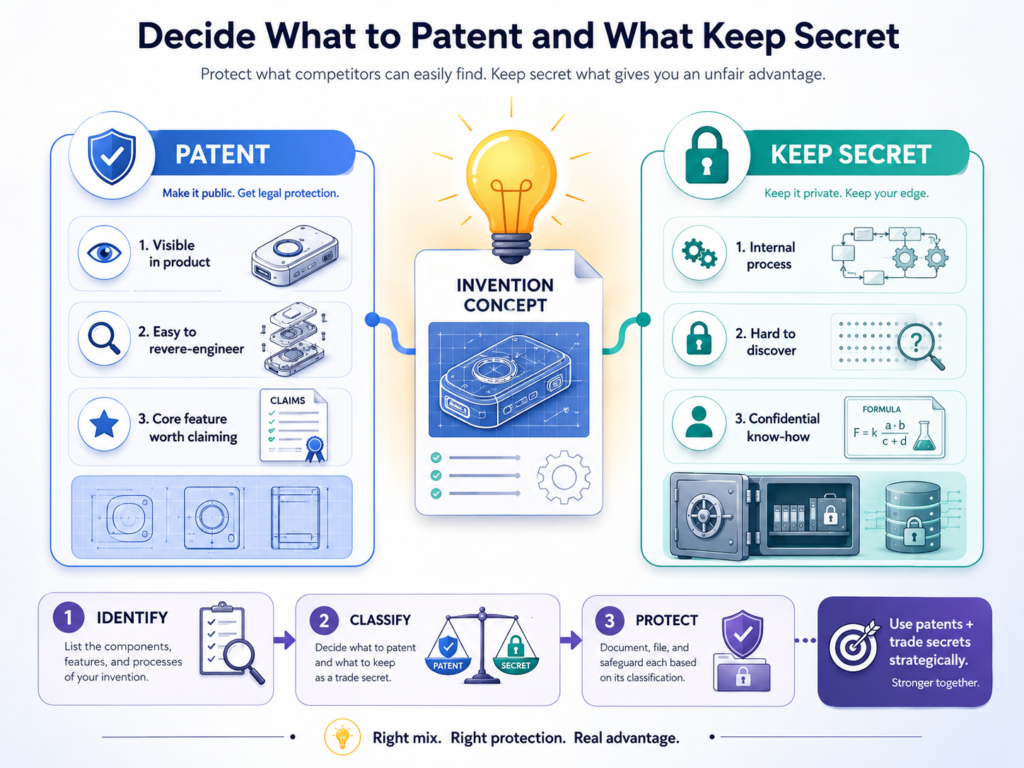
A patent application eventually becomes public if it moves forward in the normal path. That means you should be thoughtful about what you disclose. If the invention can be reverse engineered from the product, a patent may be useful because competitors may figure it out anyway.
If the key method is hidden on your servers and hard to discover, trade secret protection may be worth considering. This is a business and legal decision, and it should be made with counsel.
For startups, the best answer is often a mix. Patent the parts that competitors can see, copy, or independently build once the market is clear.
Keep secret the internal tuning, private data, exact weights, vendor settings, hidden thresholds, or hard-won process tricks that do not need to be public.
Patent the part that defines the category
A patent can be powerful when your invention creates a new way to solve a known problem. If your product shows the market a better path, competitors may rush to follow. That is where a patent filing can help.
For example, if your company creates a new device layout that makes a medical test cheaper and faster, competitors may be able to inspect the device once it is sold.
If your company creates a new robotics grip method that can be seen during use, competitors may learn from demos. If your company creates a user workflow that becomes the new standard, competitors may copy the flow. These may be good patent candidates.
The filing should focus on the part that makes the category shift possible. It should not only protect small UI choices or surface features unless those are truly important. It should aim at the deeper method or system that makes the new approach work.
Keep hidden details hidden when disclosure does not help
Some details may be very valuable but not needed for patent coverage. Exact model weights, private training sets, internal scoring constants, supplier terms, secret recipes, internal scripts, or customer-specific tuning may not need to go into a filing unless they are central to the invention you want to claim.
This is where careful drafting matters. You can often describe the invention in enough detail to support patent rights without handing over every internal knob and dial.
You may explain that the system uses a threshold, a score, a trained model, or a ranking process without exposing every private parameter. The right level of detail depends on the invention.
The danger goes both ways. If you disclose too little, the filing may be weak. If you disclose too much, you may give away secret value. This is why attorney oversight matters. The goal is to make a smart disclosure, not a reckless one.
Use patents and trade secrets as a team
Patents and trade secrets should not be seen as enemies. They can work together.
The patent can cover the broad method, system, device, or workflow. The trade secrets can cover private details that make your version perform better.
This is common in technical businesses. A company may patent the core structure of a manufacturing process while keeping exact settings secret.
A software company may patent a workflow while keeping its data set private. A hardware company may patent a device arrangement while keeping supplier methods or calibration tricks secret.
The provisional should be drafted with this split in mind. Before filing, founders should mark which details are central to the patent story and which details may be better kept out. That conversation should happen before the document is filed, not after.
The wrong split can weaken your moat
If you patent too narrowly and keep the main idea secret, competitors may patent around you or copy visible parts.
If you disclose your best hidden details without needing to, you may lose secret value. If you keep too much out of the filing, your later claims may not have support.
The right split depends on how the product works, how competitors may copy it, what customers can see, what can be reverse engineered, how fast the market moves, and how important the patent will be for fundraising, partnerships, or exit.
This is a strategic call. It is not just a form-filling exercise.
PowerPatent gives founders a better way to navigate this because the process is not only about creating a document.
It is about shaping a filing that fits the company. Smart software helps gather the details. Real attorney oversight helps decide how to use them. See how PowerPatent supports founders here: https://powerpatent.com/how-it-works
Use the Provisional Year to Learn, Improve, and Strengthen the Full Patent
The 12 months after filing a provisional should be active. This is not dead time. It is not a waiting room. It is your chance to learn which parts of the invention matter most before you file the full non-provisional application.
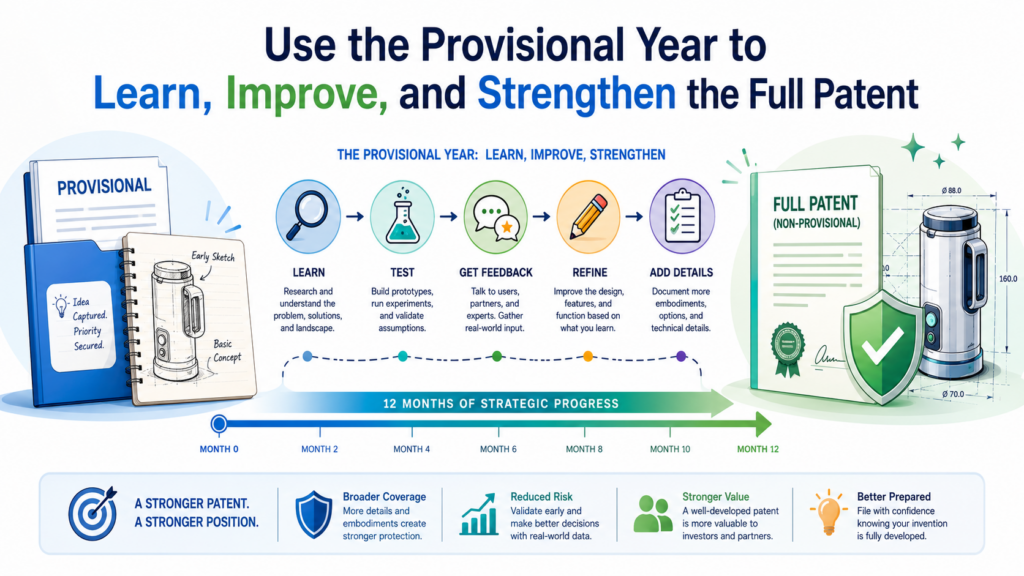
During this year, your product may grow from prototype to pilot. Your customer story may become clearer. Your technical edge may sharpen. Your first idea may split into several inventions.
Your team may learn that one feature is not important, while a smaller backend process is the real gold. If you use the year well, the later filing can be much stronger than the first provisional alone.
A founder should think of the provisional as a first stake in the ground. The non-provisional is where the long-term patent path begins to take shape. The better you use the year between them, the more strategic the final filing can be.
Track what changes after the filing
After the provisional is filed, keep a simple invention record. It does not need to be fancy. It needs to be useful. Capture major technical changes, why they were made, who contributed, what problem they solved, and what result improved.
This is especially important when changes come from customer feedback. If a pilot customer reveals a problem and your team invents a new solution, write that down.
If test data shows a surprising improvement, save it. If a new architecture lowers cost, note the before and after. If a model update reduces errors, capture how it works.
By the time you prepare the non-provisional, this record can help decide what to include, what to claim, and whether more filings are needed.
Do not let key details live only in Slack, GitHub, or memory
Startup knowledge is scattered. Some of it is in Slack. Some is in tickets. Some is in pull requests. Some is in notebooks.
Some is in founder memory. Some is in customer calls. That is normal, but it becomes risky when patent deadlines arrive.
A good patent workflow pulls the important details into one place. You do not want to search through thousands of messages at the last minute. You want the invention story to be available when needed.
This does not mean your engineers need to write patent memos every week. It means the company should create a light habit of capturing breakthroughs.
When something hard gets solved, save the explanation. When a design decision creates a major gain, record it. When a demo reveals a new use case, capture it.
Revisit the provisional before major company moments
The provisional should not sit untouched until the deadline. Revisit it before big events.
A big event may be a fundraising round, public launch, major customer pilot, conference demo, research paper, grant submission, partnership announcement, open-source release, or acquisition talk.
Before these moments, ask whether the filed provisional covers what you are about to reveal. If it does not, you may need another filing.
This is a practical way to reduce risk. It also keeps the patent strategy aligned with the company’s public story. The more public your company becomes, the more important it is to know what is already protected and what is not.
The non-provisional should reflect what you learned
When the time comes to file the non-provisional, do not simply reformat the first provisional and call it done. That may waste the learning from the year.
The non-provisional should be built with the current business in mind. It should include the strongest invention details from the first filing, the improvements made during the year, the variations that now matter, the commercial use cases that proved valuable, and the claim strategy that best supports the company.
This is where a strong early process pays off. If you captured the invention well at the start and tracked improvements during the year, the full application can be more thoughtful. If you waited until the last week, the filing may be rushed and weaker than it should be.
PowerPatent helps founders avoid that last-minute scramble. The platform is designed to turn live invention work into patent-ready material with attorney oversight, so the full filing is not built from scattered memories. You can see the process here: https://powerpatent.com/how-it-works
Build a Founder-Ready Provisional Checklist Without Turning It Into Busywork
A good provisional strategy should be simple enough to use. If the process is too heavy, founders avoid it. If it is too light, the filing becomes weak.
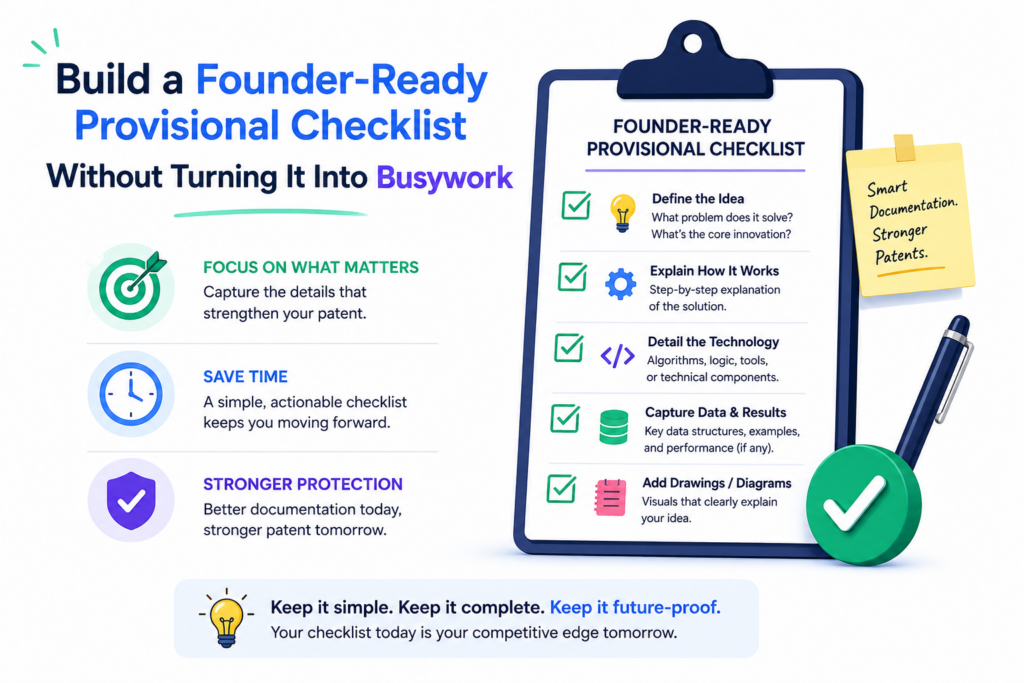
The goal is a practical middle path. You want enough structure to capture the invention clearly, but not so much process that your team stops building.
Think of this as a founder-ready prep system. Before filing, you want to gather the core facts. What is the invention? What problem does it solve? How does it work? What parts are required? What parts can change? What makes it different? What proof do you have? What public disclosures are coming? Who helped invent it? What should stay secret?
You do not need to turn this into a giant legal exercise. But you should be honest and specific.
Start with the plain-English invention story
The first step is to write the invention in plain English. Not legal English. Not investor English. Just clear English.
Say what the system does, who uses it, what problem it solves, and how it solves that problem. Then explain why the solution is better than the normal way. This plain story becomes the base. It helps everyone align before deeper drafting begins.
For example, instead of writing “a machine learning platform for optimization,” write something more direct.
“The system predicts when a warehouse order will be delayed by combining live worker location, item location, order urgency, and equipment status, then changes the pick path before the delay happens.” That is much clearer. It shows the task, the inputs, the action, and the result.
A good plain-English story makes the whole patent process easier.
Then go deeper into the working steps
Once the plain story is clear, break the invention into working steps. What happens first? What happens next? What data is used? What decisions does the system make? What parts talk to each other? What output is created? What does the user or machine do with that output?
This is where the filing starts to become useful. The goal is to make the invention teachable. A reader should be able to follow the path from problem to solution without guessing.
For technical teams, this may feel obvious because you live with the product every day. But the filing cannot rely on what is obvious to you. It must explain the invention clearly enough for someone else to understand.
Gather proof, examples, and variations
Proof helps show that the invention is real. It may include test results, prototype notes, screenshots, diagrams, data samples, before-and-after comparisons, lab results, simulation results, or customer pilot learnings.
You do not always need all of this in the provisional, but gathering it helps the drafting process.
Examples are also powerful. A filing with examples is easier to understand and often more useful later. Examples show the invention in action.
They can cover different users, different settings, different devices, different data types, or different conditions.
Variations are just as important. A filing that only describes one version may be too narrow. A filing that describes realistic alternatives gives your future patent team more room.
Keep the process light, but do not skip ownership
Ownership should be checked early. Who contributed to the invention? Were they employees, contractors, advisors, students, lab partners, or outside vendors? Did they sign the right documents? Was the invention created using company resources, university resources, or another employer’s resources?
This may feel like an admin issue, but it can become a major problem later. Clean ownership matters for fundraising, licensing, partnerships, and exits.
The founder-ready approach is simple: identify contributors early, get assignments handled, and keep records clean. Do not wait until an investor asks.
PowerPatent helps make this easier by giving founders a structured way to capture invention details without drowning in legal process.
You get speed, clarity, and real attorney oversight in one workflow. Learn how it works at https://powerpatent.com/how-it-works
Conclusion
A provisional patent is not just an early filing. It is a smart move that helps you protect the technical heart of your idea before you pitch, launch, demo, publish, or sell. The key is to file early, but file with real detail. Explain how the invention works, what makes it different, what may change, and what competitors would likely copy.
Then use the 12-month window to improve the invention and prepare a stronger full patent filing. PowerPatent helps founders do this faster with smart software and real attorney oversight. See how it works here: https://powerpatent.com/how-it-works
Leave a Reply