
Most founders think patents are about filing more. But sometimes the smartest move is not to file at all. Sometimes the real power move is to publish on purpose. If you are building something new, you need to know when to protect and when to block. You need to know when to own and when to stop others from owning. That is where public disclosures and defensive publications come in. Used the right way, they can protect your startup, save you money, and give you control. In this guide, we are going to break it down in plain English. No legal talk. No confusion. Just clear strategy you can use right now.
When Filing a Patent Is the Wrong Move
Filing a patent can be powerful. But power used at the wrong time can hurt you. Many founders think more patents always mean more safety. That is not true.
In some cases, filing too early, too late, or on the wrong thing can waste money, expose your roadmap, or even block your own growth. Smart founders know that protection is about timing and intent.
Sometimes the best move is to hold back. Sometimes it is to publish. Sometimes it is to wait. Let’s break down when filing is not the right call and what you should do instead.
When Your Product Is Still Changing Fast
If your core tech changes every few weeks, filing too soon can lock you into yesterday’s idea.
In early stages, your system might shift based on user feedback, testing, or new data. If you file during that chaos, your patent may protect a version of your product that no longer exists.
That means you paid to protect something you abandoned. Worse, your competitors can read your filing and see your early thinking.
Instead of rushing, track your changes. Keep clean notes. Save diagrams. Store version history.
When your core system starts to feel stable, when the same structure keeps showing up even as you improve it, that is when filing makes more sense.
If you are unsure whether your idea is stable enough, this is where real guidance matters.
PowerPatent pairs smart software with real patent attorneys who help you decide what is ready and what needs time → https://powerpatent.com/how-it-works
When the Real Value Is in Speed, Not Exclusivity
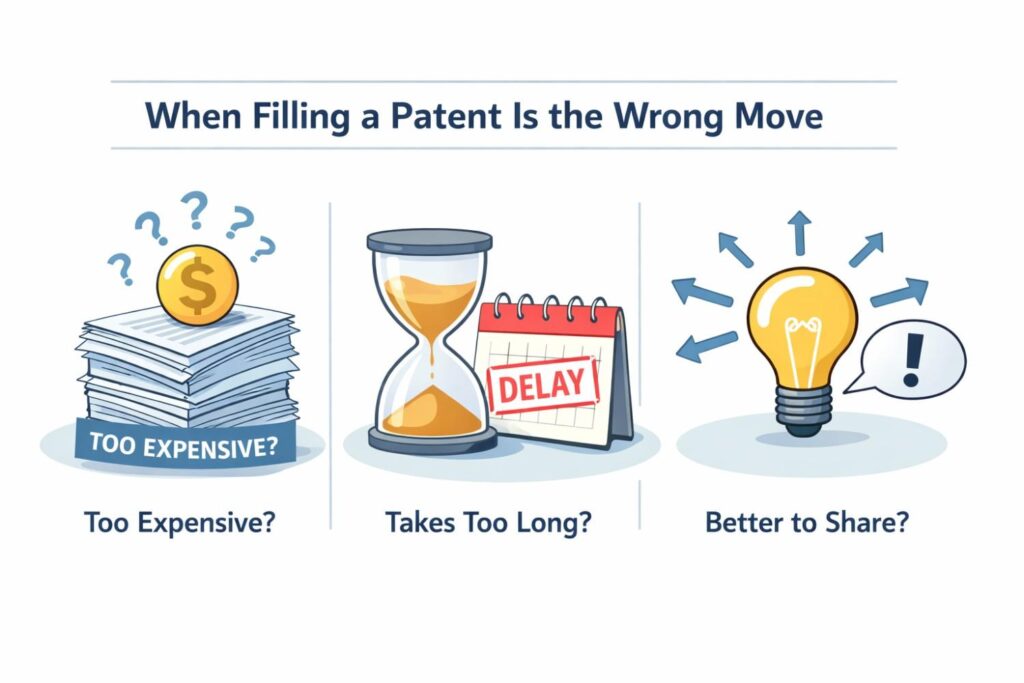
Some markets move so fast that by the time a patent is granted, the wave has passed.
In software, AI tools, consumer apps, and many web platforms, the first mover advantage can matter more than a legal right.
If your edge is execution speed, brand, network effects, or distribution, a patent might not be your strongest weapon.
Ask yourself a simple question: if a competitor copies this exact feature tomorrow, would we still win because of our speed, team, or user base? If the answer is yes, filing may not be urgent.
In that case, you may focus on shipping, scaling, and building a strong user moat. You can always file later on deeper technical layers that truly matter.
The key is being honest about where your advantage lives.
When Disclosure Would Reveal Your Secret Sauce
Every patent becomes public. That means your method, your structure, your system, all of it will be published.
If your advantage depends on something that is hard to reverse engineer, like a training pipeline, a tuning process, or a special internal workflow, filing might expose it. Once published, competitors can study it and design around it.
In these cases, trade secret protection may be stronger. That means tight internal controls, limited access, strong contracts, and careful data security. You keep the method hidden and rely on secrecy rather than publication.
This works best when the process is not visible from the outside and cannot be easily copied by looking at your product.
Before choosing this route, think long term. Can you realistically keep it secret for years? If not, filing might still be smarter.
When You Want to Block, Not Own
Sometimes your goal is not to own a space. It is to stop others from owning it.
If you know an idea is valuable but not core to your business, filing a full patent might not make sense. It takes time and cost. But you may not want a competitor to patent it and later attack you.
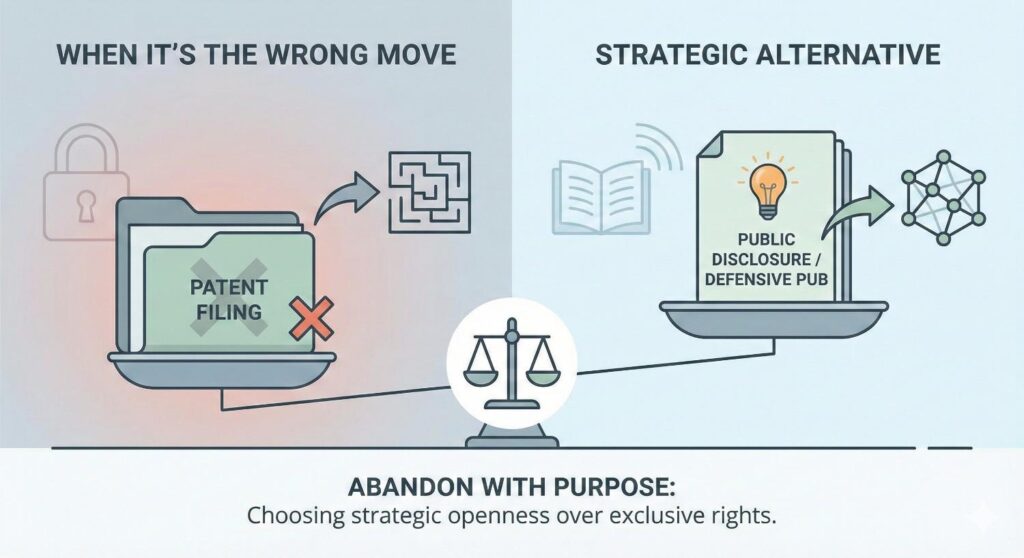
In that case, a public disclosure can create prior art. That means once it is public, no one else can patent the same thing. You gave it away on purpose to protect your freedom.
This move is highly strategic. You are shaping the field. You are making sure no one can close a door later.
The trick is timing. The disclosure must be clear and detailed enough. It must explain how the system works, not just the idea. Vague blog posts do not work. The disclosure needs substance.
When Budget Is Tight and Focus Is Critical
Early startups run on limited capital. Every dollar has a job.
Filing patents across many features can drain your runway. That pressure can hurt hiring, marketing, or product growth. If you try to protect everything, you may protect nothing well.
A smarter move is to choose one or two core innovations that truly matter. Protect those deeply. For everything else, decide if speed, secrecy, or disclosure is better.
This is not about cutting corners. It is about smart allocation.
At PowerPatent, founders often map their tech stack and identify which layer creates real defensibility. Then they protect that layer first → https://powerpatent.com/how-it-works
When You Are Testing Market Fit
Before product-market fit, your biggest risk is not copying. It is building something nobody wants.
Filing patents before you know customers care can be a distraction. It pulls time and focus into legal work instead of learning from users.
If you are still testing your core use case, spend your energy validating demand. Once traction appears and you see real adoption, then shift to protection.
Protection makes more sense when the business model is clear.
When Partnerships Require Openness
Some deals require sharing details. Investors, strategic partners, and enterprise clients may ask how your system works.
If you file a patent, you control that story. But if you file too early, you may reveal details before you understand your own leverage.
In some cases, a staged approach works better. You can file a provisional to secure a date, then refine before filing the full application. Or you can delay filing until the partnership terms are clear.
The mistake is filing without a strategy tied to your growth plan.
When You Do Not Yet Know What to Claim
Patents are not about describing everything. They are about claiming the right boundaries.
If you do not understand what makes your approach different at a deep level, filing too early can lead to weak claims. Weak patents do not help you. They create false confidence.
Spend time mapping your system. What are the exact steps? What is different from existing tools? What technical problem are you solving? What constraint are you removing?
When you can explain your innovation in simple, precise terms, then filing makes sense.
PowerPatent helps founders translate code and architecture into clear patent language without confusion → https://powerpatent.com/how-it-works
When Filing Could Signal the Wrong Message
Sometimes filing can send a signal to competitors or acquirers.
In some markets, a sudden patent filing can alert bigger players that you are entering their space. That may invite early pressure.
On the other hand, in some industries like biotech or hardware, not filing can signal weakness.
Context matters. Study your industry. Look at what funded startups in your space are doing. See when they file. Learn the pattern.
Your patent strategy should match your competitive landscape, not follow generic advice.
Strategic Pause Is Not Weakness
Choosing not to file right now is not the same as giving up. It can be a calculated pause.
The key is intentionality. You are not ignoring protection. You are sequencing it. You are aligning it with growth, funding, and product stability.
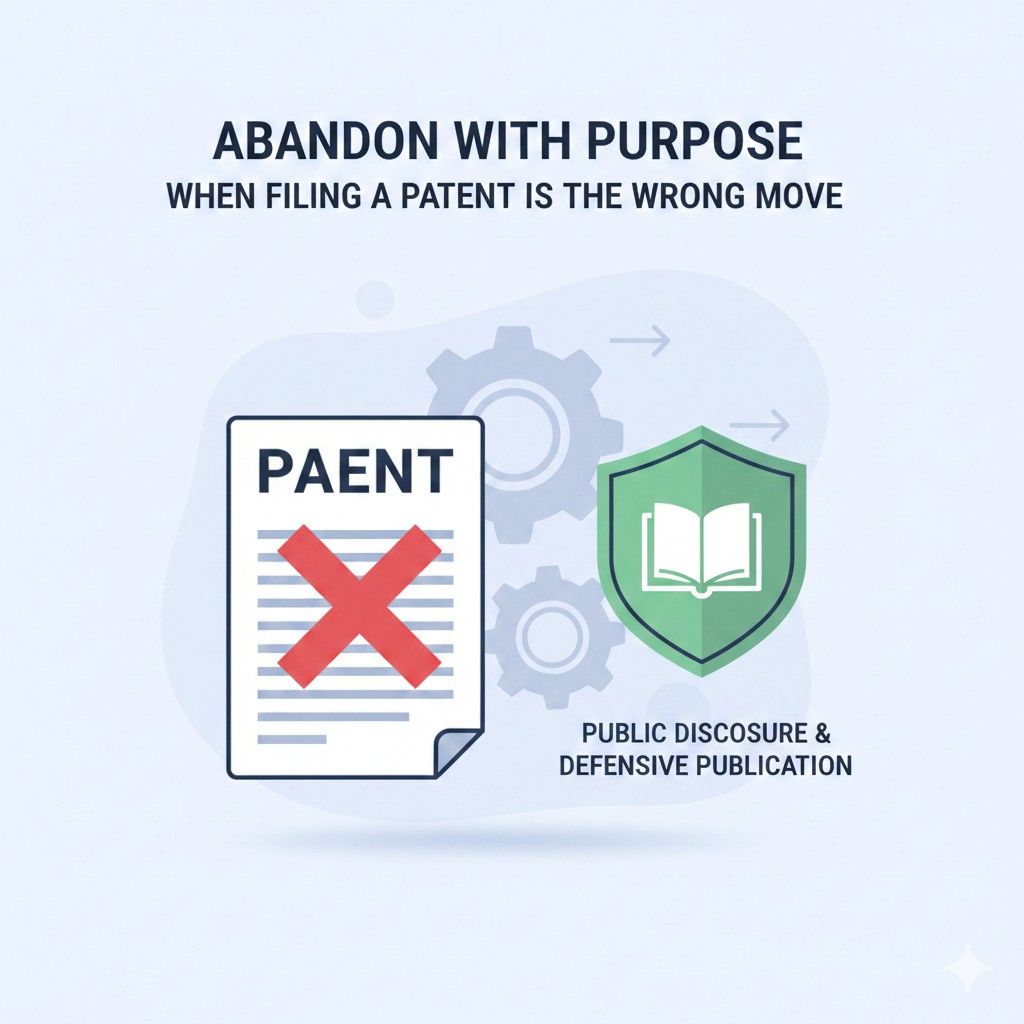
Abandoning a filing plan can be the right move if it creates clarity and focus.
The real danger is not filing. It is filing without purpose.
How Public Disclosures Can Block Your Competitors
Public disclosure sounds scary at first. Most founders are told to stay quiet. Do not share too much. Do not reveal the magic. But in the right moment, publishing can be your strongest move.
A well-timed public disclosure can stop a competitor from ever owning the space you are building in. It can protect your freedom without the cost of a full patent. It can shape the field before others even realize what is happening.
This is not about tweeting your idea. It is about using disclosure as a tool. When done with purpose, it becomes a shield.
The Power of Being First in Public
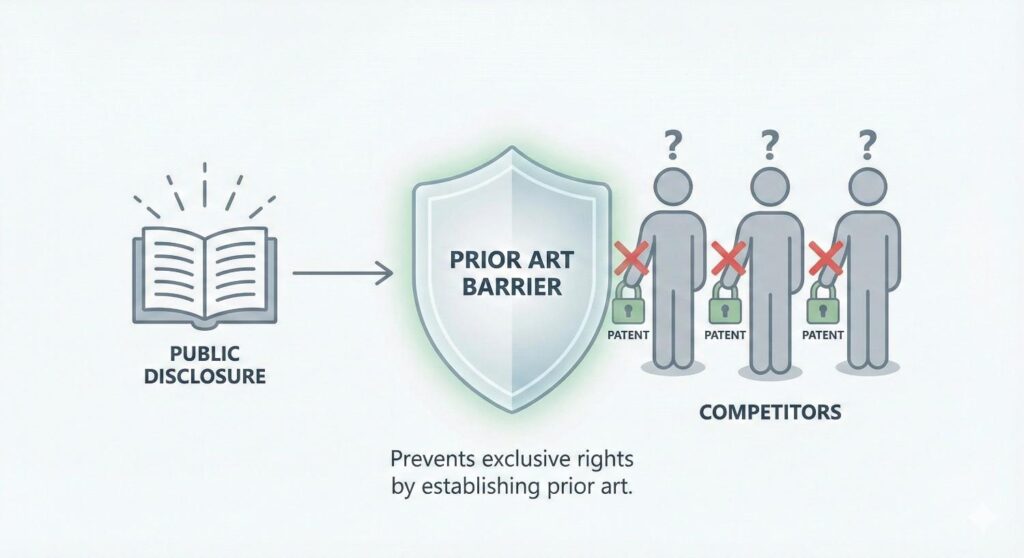
The patent system rewards novelty. If something is already public, it usually cannot be patented by someone else.
That means if you clearly describe a method, system, or process in a public place, you may block others from claiming it as their own later.
Timing is critical. The disclosure must happen before someone else files. If you wait too long, you lose the advantage.
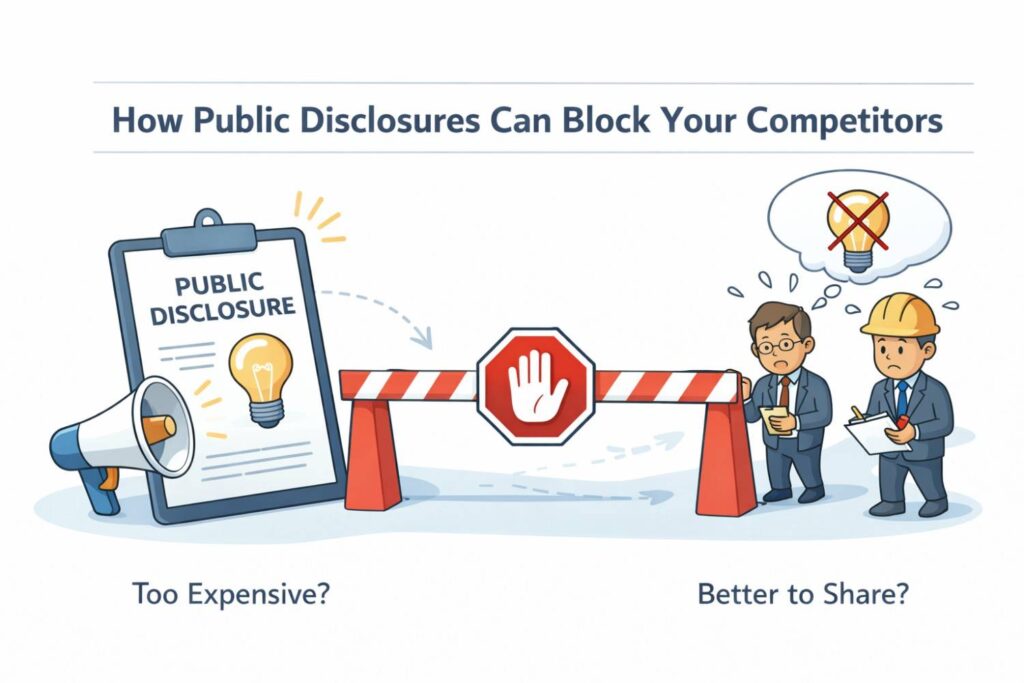
Smart founders watch the market closely. If they see a trend forming and know they will not file patents in that area, they may publish detailed technical content early. This creates a public record.
It is not about being loud. It is about being documented.
What Counts as a Real Public Disclosure
Not all content works.
A vague blog post saying “we use AI to improve routing” will not block anyone. It is too general. It does not explain how the system works.
A strong disclosure clearly describes the steps, the structure, and the logic. It explains the technical details in a way that someone skilled in the field could understand and reproduce.
This does not mean sharing your entire codebase. It means explaining the core idea in a way that is specific.
You can publish in technical blogs, online repositories, academic-style papers, or other public platforms that are date-stamped and accessible.
The key is clarity and proof of timing.
Disclosure as a Competitive Boundary
Think of public disclosure as drawing a line in the sand.
You are telling the world: this concept exists. It is known. No one can lock it up.
This is powerful in crowded markets. If many startups are exploring similar ideas, you can prevent one aggressive player from filing broad patents that box everyone out.
In this way, disclosure protects not only you, but your freedom to operate.
It also sends a quiet signal. It shows that you understand the system. You are not just building. You are thinking ahead.
When You Plan to Pivot
Sometimes you explore an idea deeply, then decide not to pursue it.
Maybe the market is too small. Maybe the margins are weak. Maybe it does not fit your long-term plan.
Instead of leaving that research unused, you can publish it. By doing so, you prevent others from patenting that exact path and later using it against you if you circle back.
This is a clean exit strategy. You abandon with purpose.
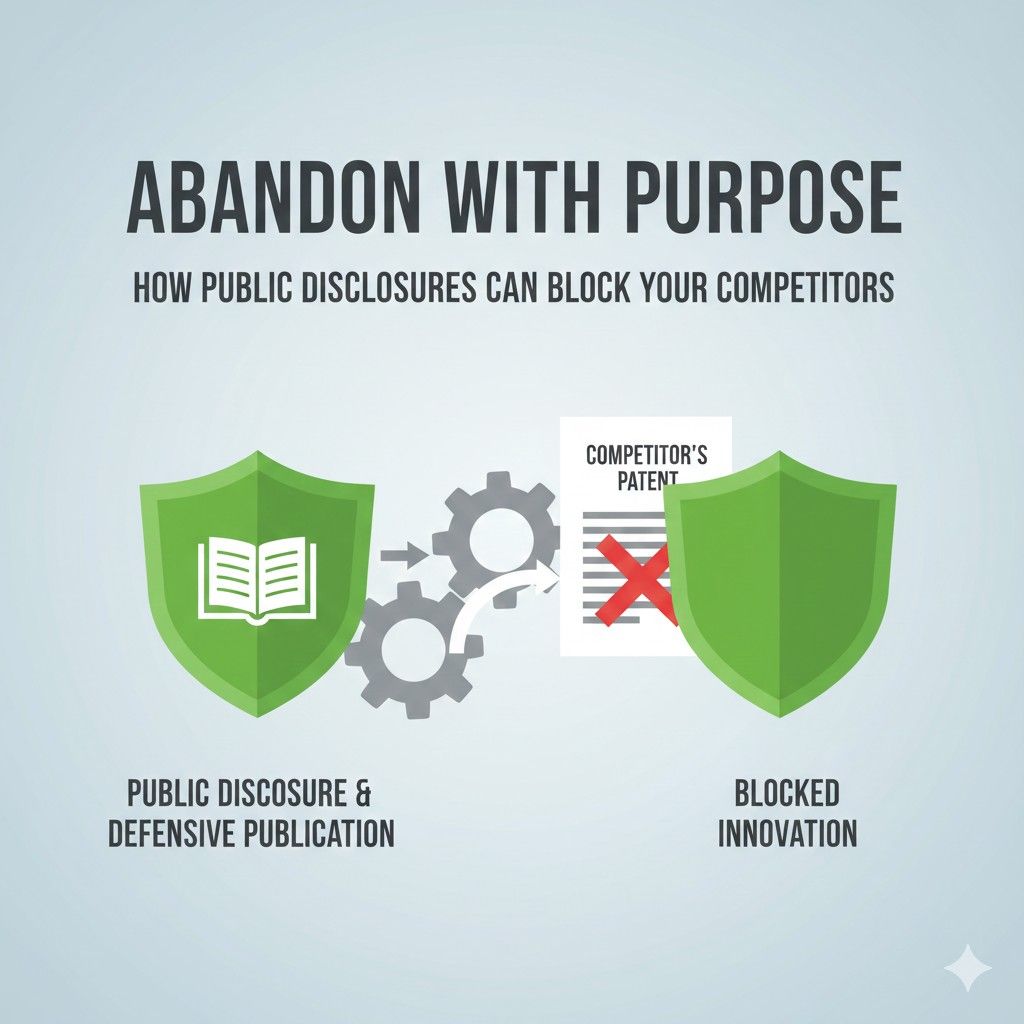
You turn old work into strategic leverage.
Protecting Freedom to Operate
Freedom to operate means you can build and sell without fear of being blocked.
If you suspect that competitors may try to patent obvious extensions of a shared idea, you can preempt that move.
For example, if you develop a certain model architecture but decide not to patent it, you can publish it. That way, no one else can later patent that same architecture and claim you are infringing.
This is especially useful in AI, software infrastructure, and platform tools where improvements are often small but important.
Disclosure becomes a way to clear the road ahead.
Balancing Disclosure and Patent Rights
There is a trade-off.
Once you disclose publicly, you may lose the ability to patent that idea in many countries. In some places, you have a limited time window. In others, you have none.
So before you publish, be sure you do not want to file later.
A common strategy is to divide your system into layers. Protect the core with patents. Publish the outer layers that are useful but not central to your long-term value.
This layered approach requires planning.
At PowerPatent, founders often map their technology into core, edge, and experimental zones. That makes it clear what to patent and what to disclose → https://powerpatent.com/how-it-works
Using Disclosure to Build Reputation
There is another benefit that many overlook.
A detailed technical disclosure can build trust and authority. It shows depth. It shows real engineering strength.
Investors and partners often respect founders who understand both innovation and strategy.
By publishing thoughtful technical work, you create public proof of expertise. That can help with hiring, fundraising, and partnerships.

This is not marketing fluff. It is strategic positioning.
Avoiding Accidental Disclosure
While intentional disclosure can be powerful, accidental disclosure can hurt you.
Conference talks, demo days, GitHub commits, whitepapers, even detailed sales decks can count as public disclosure.
Before sharing technical details, pause and decide your intent. Are you blocking? Are you protecting? Or are you just excited and oversharing?
Make it a habit to review major releases or presentations with a protection mindset.
If something is core and you may want to patent it, file first. Then speak.
Smart sequencing prevents regret.
Making Disclosure Part of Your IP Strategy
Disclosure should not be random. It should be part of your larger plan.
Ask yourself: which areas do we want to own? Which areas do we want to keep open? Which ideas are experiments we may abandon?
When you answer those questions clearly, disclosure becomes a deliberate move.
You are shaping your competitive space instead of reacting to it.
And when you do decide to file, do it with structure and support. Using smart tools combined with real attorneys can save you time and prevent mistakes → https://powerpatent.com/how-it-works
Public disclosure is not weakness. It is strategy.
Defensive Publications: Turning Your Idea Into a Shield
A defensive publication is not surrender. It is a move made with clear eyes.
Instead of filing a patent to own an invention, you publish it in a formal and detailed way so no one else can patent it. You give up exclusive rights on purpose. In return, you gain freedom.
You make sure the idea stays open. You prevent future legal threats built on the same concept.
For the right startup, at the right time, this can be one of the smartest protection strategies available.
What a Defensive Publication Really Is
A defensive publication is a public, technical document that explains an invention clearly enough that it becomes prior art.
That means if someone later tries to file a patent on the same concept, the patent office can point to your publication and say, “This already exists.”
It must be detailed. It must explain how the system works. It must be accessible to the public. And it must have a clear date.
This is not a marketing blog post. It is not a vague product announcement. It is closer to a technical paper.
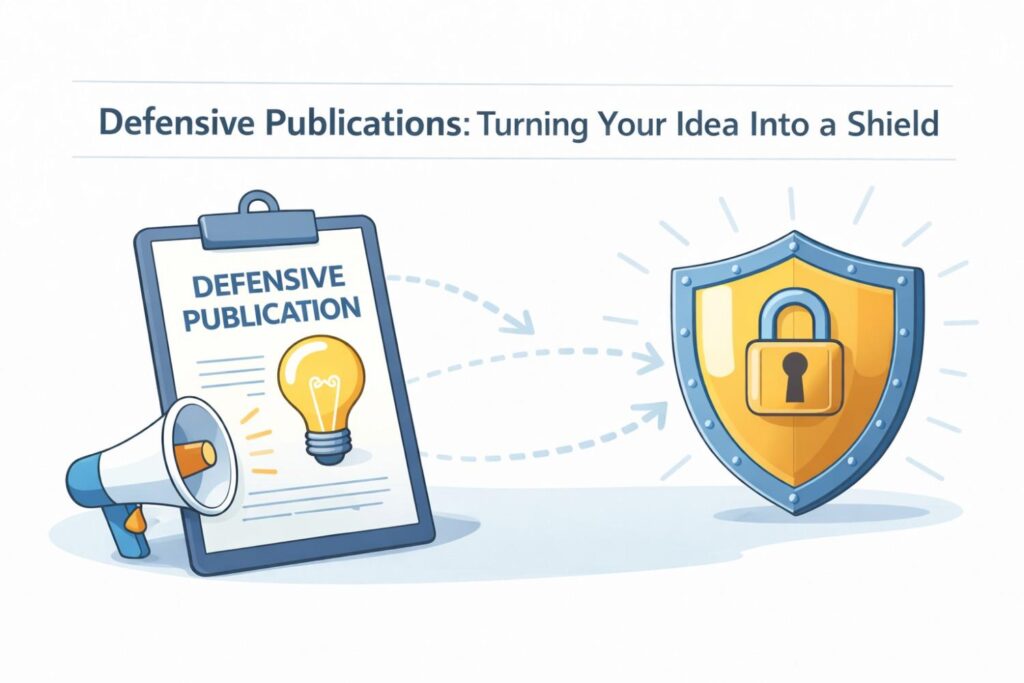
When done right, it acts like a permanent record in the innovation timeline.
Why You Would Choose This Path
You choose a defensive publication when owning the patent is not as valuable as keeping the space open.
Maybe the idea is useful but not core to your business. Maybe it supports your main product but does not define it. Maybe you believe the market will build on this idea in many ways, and you do not want one company to control it.
In these cases, publishing can prevent future problems.
It is also useful when the cost of filing and maintaining patents does not match the expected benefit. If the return is low but the risk of someone else patenting it is real, a defensive publication can be the balanced move.
This is not about being passive. It is about choosing your battles.
Creating a Strong Defensive Publication
If you decide to publish defensively, the quality of the document matters.
The explanation must be clear and specific. It should describe the technical problem and how your system solves it. It should outline the structure, the process flow, and any unique components.
Think about what a patent examiner would need to understand to reject a later patent application. That level of detail is your target.
It helps to include diagrams, example implementations, and clear definitions. The goal is to remove ambiguity.
Many founders underestimate this step. They publish something too general, which leaves gaps. Those gaps allow competitors to file patents around the edges.
A strong defensive publication closes those gaps.
If you are unsure how detailed it needs to be, this is where guidance matters.
PowerPatent helps founders think through what to protect, what to publish, and how to document ideas clearly so nothing important is missed → https://powerpatent.com/how-it-works
Where to Publish for Maximum Impact
The location of your publication matters.
It should be on a platform that is publicly accessible and indexed. Some founders use technical journals. Others use established defensive publication databases.
Some use well-known repositories that are searchable and date-stamped.
The key is that the document must be easy to find and clearly dated.
If it is buried on a hidden web page or behind a login, it may not serve its purpose.

You want it to stand as visible proof that the idea existed at that time.
Timing the Publication Carefully
Timing can change everything.
If you publish too early, you may give up options before fully understanding your roadmap. If you publish too late, someone else may have already filed.
Before publishing, pause and review your pipeline. Ask whether this idea could become core later. If there is even a small chance it becomes central to your competitive edge, consider filing first.
Some startups use a hybrid approach. They file patents on the main architecture, then defensively publish supporting variations they do not plan to claim.
This layered strategy protects the heart of the system while keeping the surrounding space open.
The decision should align with your long-term vision, not short-term convenience.
Defensive Publications in Fast-Moving Fields
In fields like AI, software infrastructure, and data systems, innovation moves quickly.
Broad patents can sometimes create roadblocks that slow the entire ecosystem.
If you see an obvious next step in the technology and do not want one player to monopolize it, publishing first can protect the community and your own future work.
This is especially useful if you are building on open-source foundations. You can contribute improvements publicly, ensuring they remain available to everyone.

That does not mean you avoid patents entirely. It means you choose carefully which pieces to own and which pieces to release.
The goal is strategic balance.
Reducing Litigation Risk
One of the biggest hidden benefits of defensive publications is reducing the chance of future legal fights.
If a competitor files a broad patent that overlaps with your work, and you have a strong prior publication, that document becomes a powerful tool. It can be used to challenge or narrow their claims.
Without that record, you may be forced into expensive disputes.
In simple terms, a defensive publication is like placing a time-stamped marker in the ground. It proves you were there first.
For startups with limited legal budgets, that proof can make a major difference.
Aligning Defensive Strategy With Fundraising
Investors care about defensibility. They want to know how you protect your edge.
Some founders worry that publishing instead of filing looks weak. In reality, a clear explanation of your strategy often builds confidence.
If you can show that you deliberately patented your core innovations and defensively published non-core ideas to block competitors, that signals maturity.
It shows that you understand the rules of the game.
When discussing your IP approach with investors, frame it around control. You are choosing what to own and what to keep open. You are shaping your competitive space instead of leaving it to chance.
And when you do need patents, having a structured and efficient system helps you move fast without chaos. That is exactly what PowerPatent was built to support → https://powerpatent.com/how-it-works
Making It a Habit, Not a Reaction
The strongest IP strategies are proactive.
Instead of waiting until a competitor files something scary, build a regular review process. Look at your roadmap every quarter. Identify ideas that are not core but could be weaponized by others. Decide whether to patent or publish.
Document those decisions. Track what has been filed and what has been disclosed.
This turns defensive publication into a repeatable system, not a last-minute scramble.
Over time, you create a protective layer around your company. Some parts are owned. Some parts are intentionally open. All of it is deliberate.
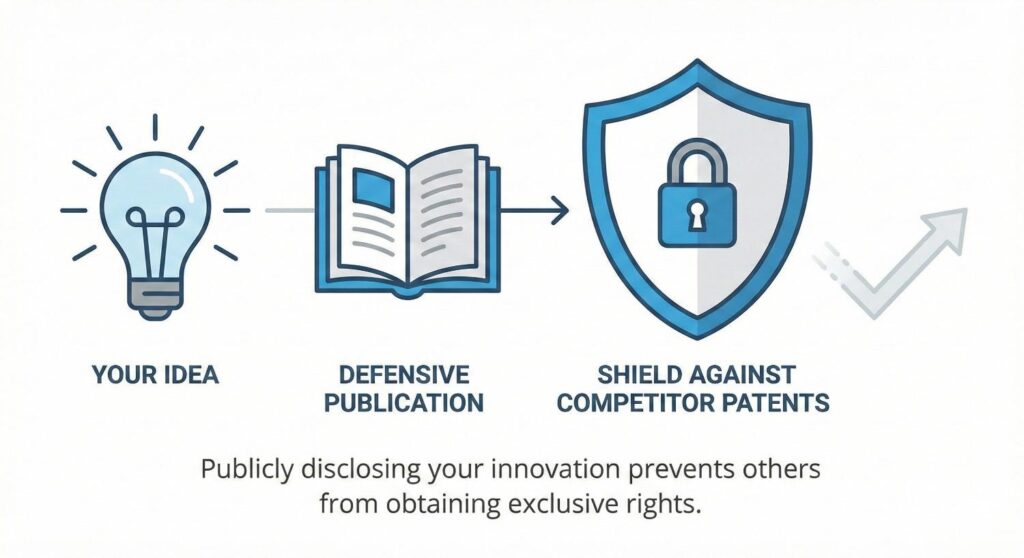
Abandoning a patent filing does not mean giving up. Publishing defensively does not mean losing. When done with purpose, both moves give you clarity, control, and confidence.
You are not just building technology. You are shaping the ground beneath it.
Wrapping It Up
Most founders think the choice is simple. File a patent or do nothing. Protect or expose. Win or lose. But real strategy lives in the gray area. Sometimes you file and go deep. Sometimes you wait. Sometimes you publish on purpose. Sometimes you walk away from an application that no longer fits your roadmap. The power is not in filing more. The power is in choosing with intention.
Leave a Reply