
If you are building serious technology, you are already moving intellectual property across borders, whether you realize it or not.Every time you share source code with a contractor overseas, give a technical walkthrough to a foreign hire, upload models to a global cloud server, or send a patent draft to a co-founder who happens to be abroad, you are making an IP transfer. In the eyes of the government, that transfer can matter just as much as shipping hardware in a box.This is where export controls and sanctions quietly enter the picture.
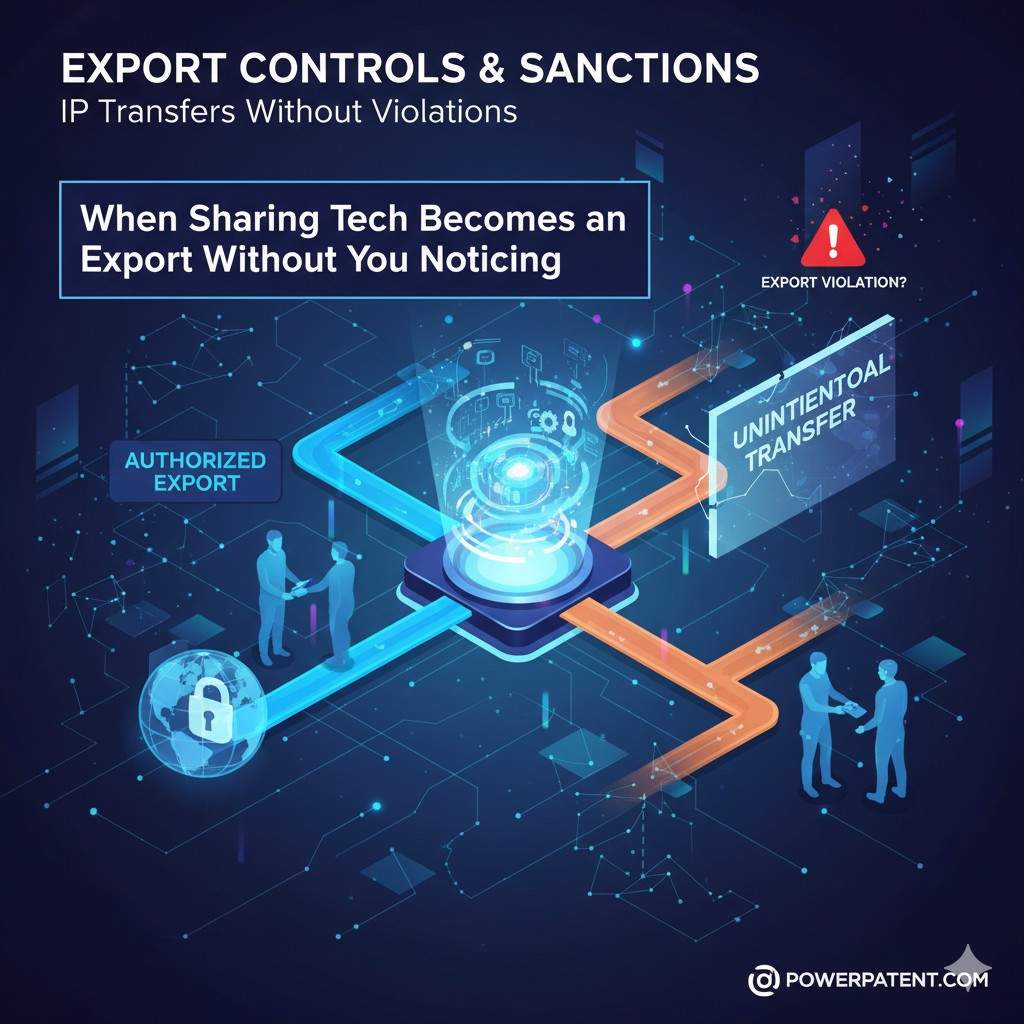
When Sharing Tech Becomes an Export Without You Noticing
Sharing technology feels normal. It feels harmless. It feels like progress. That is exactly why export issues show up when teams least expect them.
This section breaks down how everyday actions quietly turn into regulated exports, and what businesses can do to stay ahead without slowing down.
The Moment an Export Happens Is Earlier Than You Think
Most founders picture exports as physical shipments. A box. A label. A customs form. In reality, exports often happen long before anything physical moves.
An export can happen the instant controlled technical knowledge is made available to someone who is not a U.S. person.
That moment could be a screen share, a shared folder, a pull request, or a technical call. There is no warning pop-up. There is no clear line. The rule triggers at access, not at shipment.
This matters because modern companies are built on access. Tools are open by default. Teams are global by default. Speed depends on sharing. That combination is powerful, but it also means exports happen quietly and often without intent.

The strategic move here is to assume that sharing technical depth is the same as exporting it. Once you internalize that idea, decisions become much clearer and much safer.
Deemed Exports Inside the Office or on Zoom
One of the most misunderstood rules is the deemed export rule. This rule treats the release of certain technical information to a foreign person inside the United States as an export to that person’s home country.
This means location does not protect you. A foreign engineer sitting in your U.S. office can trigger the same rule as if you emailed the same information overseas. The same is true for Zoom calls, whiteboard sessions, and live debugging.
Businesses get caught here when onboarding talent fast. A new hire joins. Access is granted broadly. Technical walk-throughs begin. No one stops to ask whether the technology being shared is controlled.
The fix is not to block talent or slow hiring. The fix is to separate general onboarding from deep technical disclosure.
High-level product context is almost always safe. Detailed implementation, architecture, training data structure, or tuning methods may not be.
Source Code Is Treated Differently Than Most Founders Expect
Source code feels like an internal asset. It feels private. It feels like something export rules would not touch unless it is military-grade. That assumption is risky.
Certain types of source code, especially code tied to encryption, advanced chips, AI training pipelines, robotics control, or signal processing, can fall under export controls.
Even when it does not, sharing it with sanctioned people or places can still be restricted.
What surprises teams is that access counts even if no one downloads anything. Read access can be enough. Viewing code during a screen share can be enough. Letting a foreign contractor browse a repo can be enough.
The practical move is to treat repo access as a regulated action. Before granting access, ask a simple question internally: does this repo reveal how the system actually works, or just how it is used? That one question filters most risk.
Cloud Tools Turn Local Work Into Global Sharing
Cloud platforms are built for speed, not borders. Files sync everywhere. Servers spin up anywhere. Backups live wherever the provider decides is efficient.
From a compliance point of view, that convenience creates blind spots. If controlled technical data is stored or processed on servers outside the U.S., that may count as an export.
If foreign nationals have admin access to those systems, that may also count.
This does not mean you need to abandon the cloud. It means you need to understand where your most sensitive IP lives and who can touch it.
Strategic teams map their IP by sensitivity. General business files live freely. Core technical details live in tighter environments. This is not about paranoia. It is about knowing which doors matter.
Demos and Sales Conversations Can Cross the Line
Founders love demos. Demos close deals. Demos attract partners. Demos also cause accidental exports when they go too deep.
A demo that shows what a product does is usually fine. A demo that explains how it does it can be a problem. The difference is subtle but important.
Trouble starts when demos include architecture diagrams, training flows, performance tuning logic, or unique methods that are not public. If the audience includes foreign persons, that detail may count as an export.
The smart move is to design demos in layers. The first layer shows value. The second layer explains use. The third layer explains internals. Only the first two layers should ever be public or broadly shared.
Collaboration With Overseas Contractors Is a Common Trap
Many startups rely on overseas developers, researchers, and designers. This is normal and often necessary. The risk appears when the work involves core technical insight rather than surface-level execution.
If a contractor needs to understand how your system truly works in order to contribute, that is a transfer of technical knowledge. If that knowledge is controlled, or if the contractor is in a sanctioned country, you may need permission before sharing.
The mistake is assuming that contracts handle this. They do not. NDAs protect ownership. They do not protect compliance.
A better approach is scoping work carefully. Ask what the contractor actually needs to know to do the job. Often, it is less than you think. The less technical depth shared, the lower the risk.
Patent Drafting Creates Early and Deep Disclosure
Patents require disclosure. Good patents require clear disclosure. That disclosure often happens long before filing, while drafts move between inventors, attorneys, and platforms.
If inventors are abroad, or if drafts are shared across borders, the technical detail inside a patent draft can itself be an export. Many founders never consider this because patents feel like a legal process, not a technical transfer.
This is where process matters. Using systems designed to handle patent creation with awareness of cross-border issues reduces risk. Keeping control over who sees what, and when, is critical.
This is one reason PowerPatent is designed around structured, controlled disclosure rather than chaotic document sharing.
It helps teams protect IP without creating new problems while doing so. You can see how that works here: https://powerpatent.com/how-it-works.
Intent Does Not Matter When Violations Are Reviewed
One of the hardest lessons for founders is that good intent does not erase violations. Regulators look at what happened, not why it happened.
Most export violations come from lack of awareness, not bad actors. Emails were sent. Access was granted. Knowledge moved. That is enough.
This is why strategy beats reaction. Training teams lightly but clearly. Designing access thoughtfully. Treating technical depth as something to manage, not spray.
You do not need a compliance department to do this well. You need awareness baked into how you share.
Turning Awareness Into a Competitive Advantage
Companies that understand these rules early move faster later. They onboard partners with confidence. They expand globally without fear. They patent aggressively without rework.
The goal is not to stop sharing. The goal is to share with intention.
When your team knows when sharing becomes exporting, you control the moment instead of being surprised by it later. That control protects your company, your IP, and your future deals.
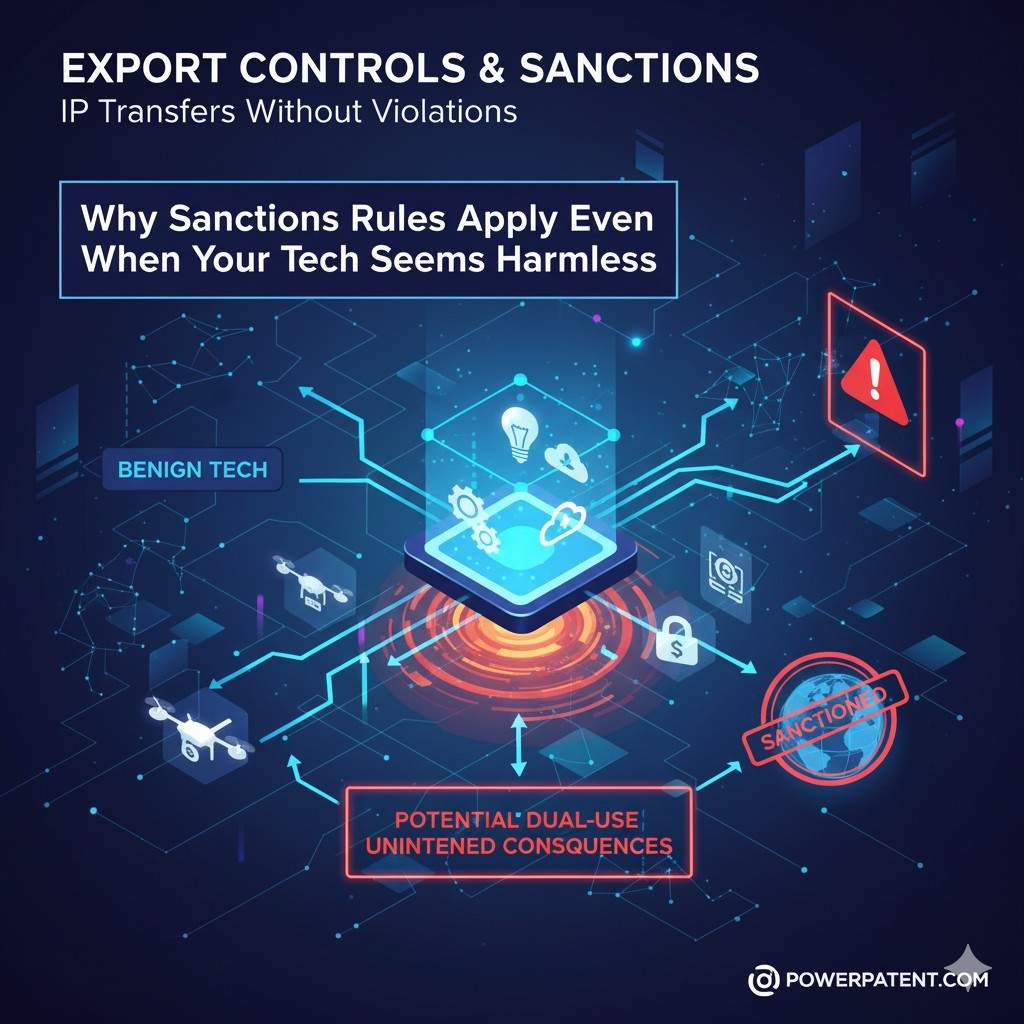
Why Sanctions Rules Apply Even When Your Tech Seems Harmless
Sanctions are often misunderstood because they do not focus on the technology first. They focus on people, places, and relationships. That difference is why many companies violate sanctions rules without ever touching controlled tech.
This section explains how sanctions quietly affect IP sharing, why even basic software access can trigger problems, and how businesses can build habits that keep growth clean and uninterrupted.
Sanctions Are About Who, Not Just What
Most founders assume sanctions only matter if they sell to certain countries. That view is incomplete. Sanctions often apply based on who receives value, not just where they live.
If a person or entity appears on a blocked list, sharing value with them can be prohibited. Value is not limited to money. It includes software access, technical help, updates, support, and even problem-solving time.
This means a single GitHub invite, API key, or shared model can be enough to create an issue if the recipient is restricted. The tech itself might be simple. The relationship is what triggers the rule.

Strategic companies treat identity checks as part of IP protection, not as paperwork. Knowing who is on the other side of access is just as important as knowing what they can see.
Sanctions Can Apply Even to Free or Open Tools
A common myth is that sanctions only apply when money changes hands. That belief creates risk in open-source work, free trials, and early-stage partnerships.
Providing free access to software can still be considered providing a service. Offering technical guidance can still be considered assistance. Helping debug an issue can still be considered support.
This matters when startups offer early access broadly or run pilots with global users. If a restricted party joins quietly, the company may violate rules without ever billing a dollar.
The fix is not to close your product. The fix is to understand where your access gates are and what minimal checks make sense at each one.
IP Transfers Through Support and Training Are Often Overlooked
Support conversations feel informal. Training sessions feel routine. Both can carry deep technical knowledge.
When a team explains system internals to help a user integrate, optimize, or extend a product, they may be transferring IP. If the recipient is restricted, that transfer may be blocked.
This often shows up in enterprise pilots and strategic partnerships. Engineers want the pilot to succeed, so they share more detail. Sales wants momentum, so guardrails are relaxed.
Smart companies draw a clear line between usage guidance and internal design. They empower support teams to help without exposing core methods.
Sanctions Risks Increase as Companies Scale Globally
Early-stage startups often know every user. As companies grow, that visibility fades. Users sign up automatically. Partners appear through resellers. Access expands faster than oversight.
This is where sanctions risk grows quietly. The company does not change intent, but the system changes exposure.
The strategic move is to align growth systems with IP sensitivity. Core systems that expose technical depth should not be fully open. Layers of access protect both IP and compliance.
This does not slow growth. It makes growth sustainable.
Contractors and Advisors Can Create Sanctions Exposure
Advisors, consultants, and short-term contractors are often onboarded quickly. Trust is high. Checks are light.
If any of these people are in sanctioned locations or linked to restricted entities, sharing IP with them can be prohibited. The risk increases when advisors are technical and involved early.
Businesses that manage this well do not rely on memory or assumptions. They build simple intake steps that confirm eligibility before access is granted.
This step protects both sides. It avoids awkward reversals later and keeps relationships clean.
Sanctions Rules Do Not Care About Your Company Size
Many founders believe sanctions enforcement targets large corporations. That belief is dangerous.
Rules apply equally to startups and public companies. In fact, startups can be more exposed because they move faster and document less.
Violations discovered during fundraising, acquisition, or diligence can delay or kill deals. Buyers care deeply about compliance history, even for small companies.
The cost of early awareness is small compared to the cost of fixing issues under pressure.
Designing IP Sharing With Sanctions in Mind
The goal is not to turn founders into sanctions experts. The goal is to design systems that naturally avoid risk.
That starts with understanding where IP flows. It continues with knowing who touches it. It ends with keeping sensitive details in controlled paths.
Companies that do this early gain confidence. They can share when it is safe and pause when it is not, without panic.
PowerPatent is built with this reality in mind. It helps teams capture and protect inventions in a structured way that avoids unnecessary exposure while still moving fast.
If you want to see how that works in practice, you can explore it here: https://powerpatent.com/how-it-works.
Sanctions Awareness Strengthens Trust With Partners
Partners want to know they are working with a company that understands its obligations. Quiet competence builds trust.
When you can explain how you protect IP and respect global rules, partners feel safer sharing with you in return. That trust compounds over time.
This is not about fear. It is about professionalism.
Sanctions awareness, when done right, becomes part of how serious companies operate.
The Hidden Risk Inside Patent Drafts, Code Repos, and Cloud Tools
The most dangerous IP transfers are rarely dramatic. They happen in quiet places where teams feel safe. A draft document. A shared folder. A repo invite. A cloud dashboard.
These tools are built for speed and collaboration, not for export awareness. That mismatch is where risk lives.
This section focuses on the everyday systems founders rely on and explains how they quietly become channels for regulated IP transfers. The goal is not to scare you away from these tools, but to help you use them with control and intent.
Patent Drafts Are Technical Blueprints in Disguise
A patent draft is not just a legal document. It is often the clearest technical description of how your invention works. In many cases, it is more detailed than internal design docs because it has to be precise.
When that draft moves between inventors, attorneys, and platforms, it carries core technical knowledge with it. If any contributor is abroad or not a U.S. person, that sharing can count as an export.
This risk often appears early. A co-founder traveling overseas reviews claims. An engineer based abroad comments on figures. An advisor outside the U.S. gives feedback. None of this feels risky in the moment.
The strategic move is to treat patent drafts as sensitive technical assets from day one. Control who sees full drafts and when. Share high-level summaries when possible. Keep detailed descriptions inside systems designed for controlled access.

This is where modern patent tools matter. When patent creation is scattered across email threads and attachments, control disappears. Structured platforms reduce accidental exposure while keeping work moving.
Invention Disclosure Is an Export Before Filing
Founders often believe export rules only matter once a patent is filed. That is incorrect. Disclosure happens the moment an invention is explained in enough detail to be understood.
Internal invention disclosures, white papers, and early diagrams all count. If those materials are shared across borders, the same issues apply.
The mistake is thinking of these documents as internal brainstorming. Regulators care about content, not labels.
A better approach is to separate ideation from technical execution. Early brainstorming can stay broad. Once ideas turn into methods, access should tighten.
PowerPatent is designed around this transition. It helps teams move from idea to protected invention in a controlled flow, instead of dumping technical detail into uncontrolled documents. You can explore that flow here: https://powerpatent.com/how-it-works.
Code Repositories Expose More Than Just Code
Repos are not just code storage. They often include comments, commit history, test data, configuration files, and internal notes. Together, these pieces tell the full story of how a system works.
Granting access to a repo often reveals far more than intended. Even read-only access can expose algorithms, architecture choices, and performance trade-offs.
This becomes risky when access is granted broadly or automatically. New hires, contractors, or partners may gain visibility into areas they do not need.
Strategic teams design repos with layers. Core logic is separated from interfaces. Sensitive modules are isolated. Access is intentional, not default.
This structure improves security and export compliance at the same time.
Version Control Creates Permanent Disclosure Trails
One overlooked issue is history. Even if current code is safe to share, older commits may not be.
Version control systems preserve past states. A user granted access today can often see yesterday’s design decisions, experiments, and abandoned approaches.
From a compliance view, that history still counts as disclosure. From an IP view, it can reveal how your system evolved.
The fix is not deleting history, which is rarely practical. The fix is being careful about who gets access to which repos and when.
Cloud Dashboards Reveal System Behavior
Cloud platforms often expose metrics, logs, training runs, and deployment settings. These details can reveal how models are trained, how systems scale, and how performance is tuned.
Granting admin or viewer access to these dashboards can be equivalent to sharing internal design docs.
This risk increases when teams rely on shared accounts or broad permissions. Convenience leads to overexposure.
A simple mindset shift helps. Treat dashboards as technical documentation, not just tools. Access should reflect that value.
Collaboration Tools Blur Personal and Corporate Sharing
Slack, Notion, Google Docs, and similar tools make collaboration feel casual. That casual feel hides how much technical detail flows through them.
Design decisions, debugging discussions, and architecture debates often happen in chat. Those conversations are stored, searchable, and shareable.
If participants include foreign persons, those conversations can be exports. If workspaces include external guests, exposure grows.
The strategic move is to decide where deep technical discussions happen. Keeping sensitive discussions in controlled channels reduces risk without hurting collaboration.
Early-Stage Teams Are Most Exposed
Ironically, early-stage startups often face the highest risk. Teams are small. Roles overlap. Access is wide open. Speed is everything.
There are no guardrails yet. That freedom is powerful, but it also means one careless share can create lasting issues.
The advantage of being early is that habits are easy to change. Building simple awareness now prevents painful cleanups later.
Using Process as Protection, Not Friction
The best companies do not rely on memory or fear. They rely on process.
They define what counts as core IP. They decide where it lives. They choose how it moves. Once defined, these rules fade into the background and stop feeling heavy.
This approach protects exports, sanctions, and IP at the same time.
PowerPatent fits into this mindset. It helps founders capture and protect inventions in a way that respects how IP actually moves in modern teams. If you want to see how that reduces risk while increasing speed, take a look here: https://powerpatent.com/how-it-works.
How Founders Can Move Fast, Protect IP, and Stay Compliant at the Same Time
Speed and compliance are often framed as opposites. One is about momentum. The other feels like restraint. In practice, the best companies treat them as the same goal. When IP is shared with intention, teams move faster because they do not stop to fix mistakes later.
This final section focuses on how founders can build simple habits and systems that protect intellectual property, respect export and sanctions rules, and still let the company run at full speed.
The First Step Is Knowing What Actually Matters
Not all information carries the same weight. Companies slow down when they treat everything as sensitive or when they do not know what is sensitive at all.
The strategic move is clarity. Founders should be able to answer one simple question: what information, if shared, would truly expose how our invention works?

That answer usually points to a small set of things. Core algorithms. Training methods. System architecture. Hardware control logic. Unique processes.
Once those are known, the rest becomes easier. Protection focuses where it counts. Everything else flows freely.
Speed Comes From Reducing Rework, Not Skipping Steps
Many export and sanctions problems do not show up until later. During fundraising. During acquisition talks. During customer diligence.
When issues appear at those moments, teams stop. Lawyers get involved. Documents are reviewed. Timelines stretch.
Founders who build clean IP sharing early avoid these pauses. They answer questions with confidence. They show control. Deals move forward.
True speed is not about ignoring rules. It is about designing so rules are not constantly tripped.
Designing Access Around Roles Instead of People
People change roles. They join. They leave. They travel. Systems that rely on individual judgment break under that motion.
Role-based access scales better. Engineers working on core systems see core details. Contractors working on interfaces see interfaces. Advisors see summaries, not internals.
This structure protects IP without constant decision-making. It also reduces accidental exports because access is already aligned with need.
Treating Patents as a Strategic Asset, Not a Filing Task
Patents are often rushed at the last minute. Drafts fly around. Details are added under pressure. Control is lost.
Founders who treat patents as an ongoing strategy behave differently. They capture inventions as they are built. They control disclosure early. They avoid chaotic sharing later.
This approach not only strengthens patents, it reduces export risk because technical detail is introduced in a structured way.
PowerPatent was built for this mindset. It helps founders document inventions clearly while keeping ownership, access, and timing under control. If you want to protect what you are building without slowing down, you can see how it works here: https://powerpatent.com/how-it-works.
Training Teams Without Turning Them Into Lawyers
Your team does not need to know export law. They need to know when to pause and ask.
Simple guidance goes a long way. Share internally that deep technical detail is different from general product info. Explain that access is a decision, not a default.
When teams understand the why, they make better calls on their own.
Using Outside Help at the Right Moments
No startup should try to handle everything alone. The key is knowing when help adds leverage instead of friction.
Export and sanctions questions often arise at clear points. International hiring. Overseas partnerships. Deep technical demos. Patent filing.
Having trusted tools and advisors ready at those moments keeps momentum intact.
Confidence Is the Real Advantage
Founders who understand how IP moves inside their company make better decisions. They share boldly when it is safe. They slow down when it is not. They do not guess.
That confidence shows up in pitches, partnerships, and exits. It signals maturity.
Export controls and sanctions are not obstacles. They are part of the environment serious technology companies operate in.
When you design for them early, they stop being scary. They fade into the background while your company keeps building.
If your goal is to protect your invention, move fast, and avoid painful surprises, PowerPatent was designed to support that journey from day one. You can explore the full process here: https://powerpatent.com/how-it-works.
Wrapping It Up
Export controls and sanctions are not edge cases anymore. They sit quietly inside everyday startup work. They show up in code access, patent drafts, demos, cloud tools, and team collaboration. Most violations do not come from bad intent. They come from moving fast without seeing where IP actually flows.The companies that win are not the ones that slow down. They are the ones that design for awareness early. They know what parts of their technology truly matter. They control how those parts move. They share with purpose instead of habit.
Leave a Reply