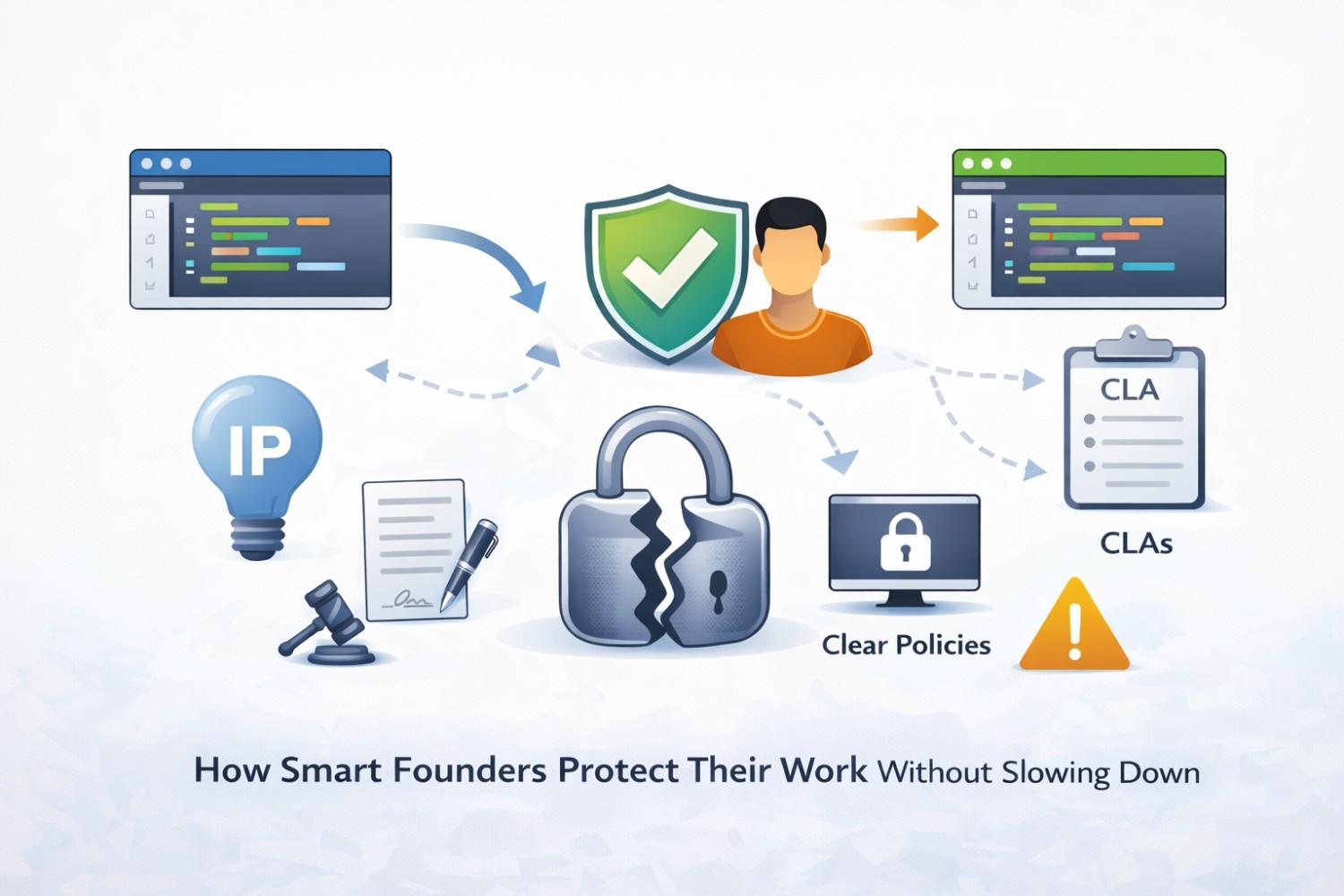
If you are building software, you are dealing with forks and contributions whether you like it or not. The moment someone touches your code, copies it, improves it, or builds on top of it, questions about ownership show up. These questions do not wait until you are ready. They appear early, often quietly, and they can cause real damage later if you ignore them.
This article is about control. Not control in a scary way, but in a smart founder way. It is about knowing what you own, what you do not, and how to avoid giving away the most valuable thing your company has without meaning to. We are going to talk about forks, outside help, open code, and simple assignment basics using plain words and real examples. No legal fog. No filler.
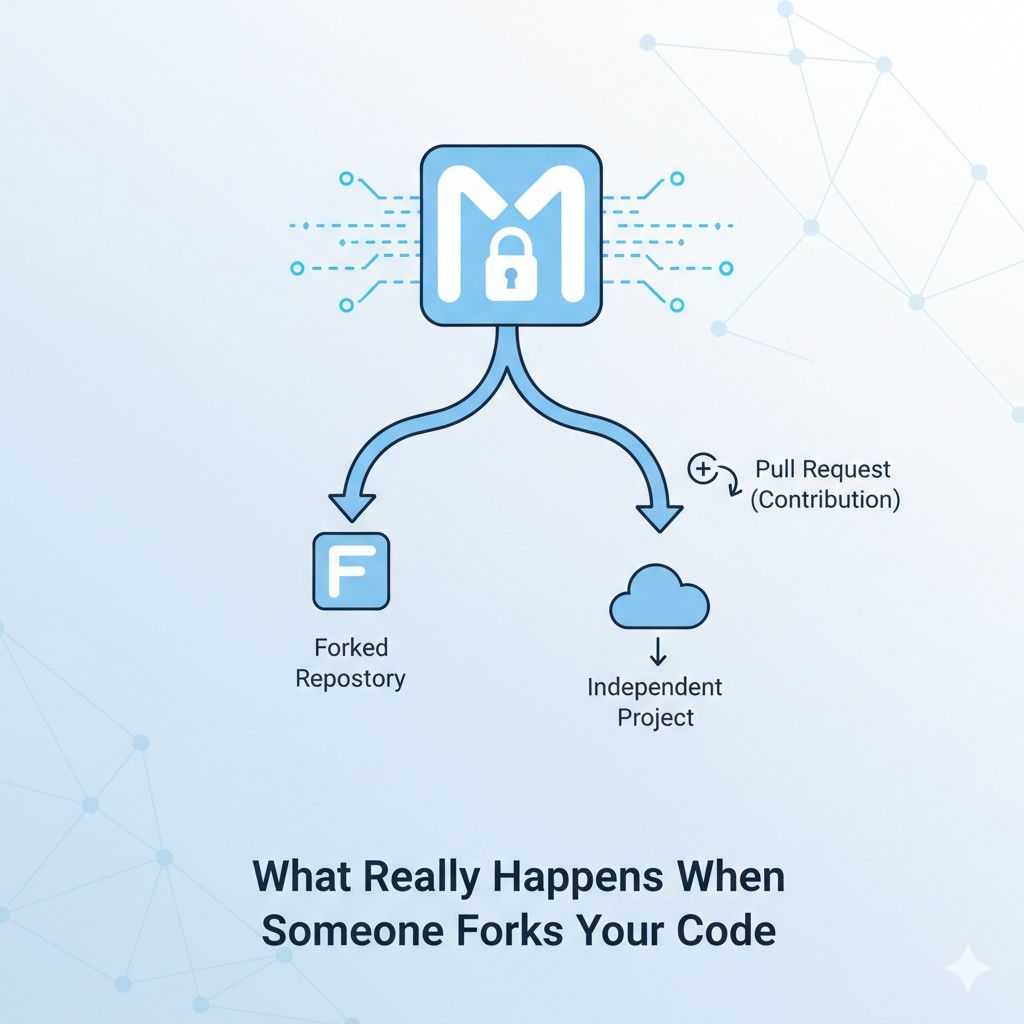
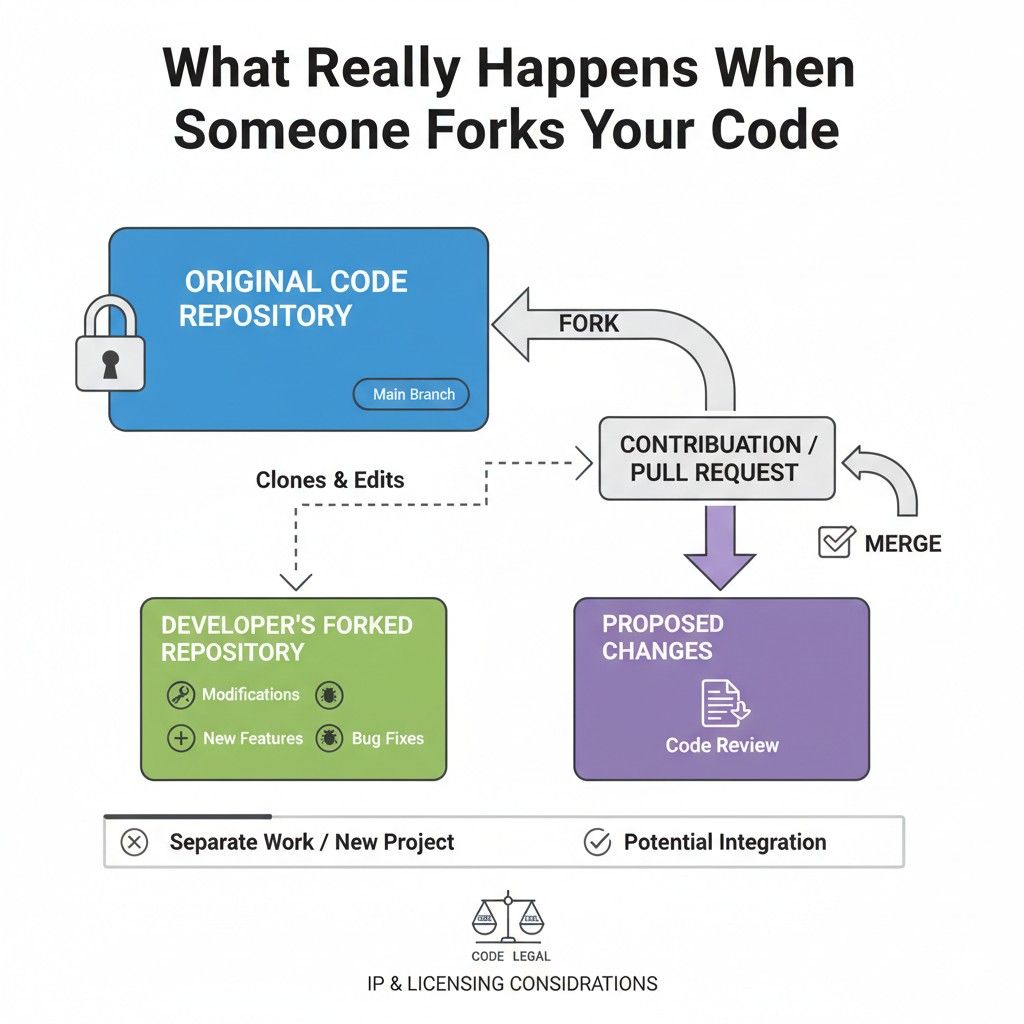
What Really Happens When Someone Forks Your Code
When a founder hears the word fork, the first reaction is often pride. Someone cared enough to copy the work. That feels like progress. But under the surface, a fork is not a compliment or an insult.
It is a legal and business event. The moment a fork happens, control starts to shift unless you planned for it.
This section explains what is actually happening when code is forked and how smart companies stay ahead of it without slowing down.
A fork is not just a copy, it is a new path
A fork creates a new line of development that you do not control. Even if it starts from your code, it can quickly become something else. New features, fixes, and ideas can appear that never come back to you.
From a business point of view, this matters because value does not live in old code. Value lives in progress. If progress moves away from you, so does leverage.
After a fork, the other party is free to make choices that may not help your company. They can target a new market. They can change pricing. They can add features that users love.
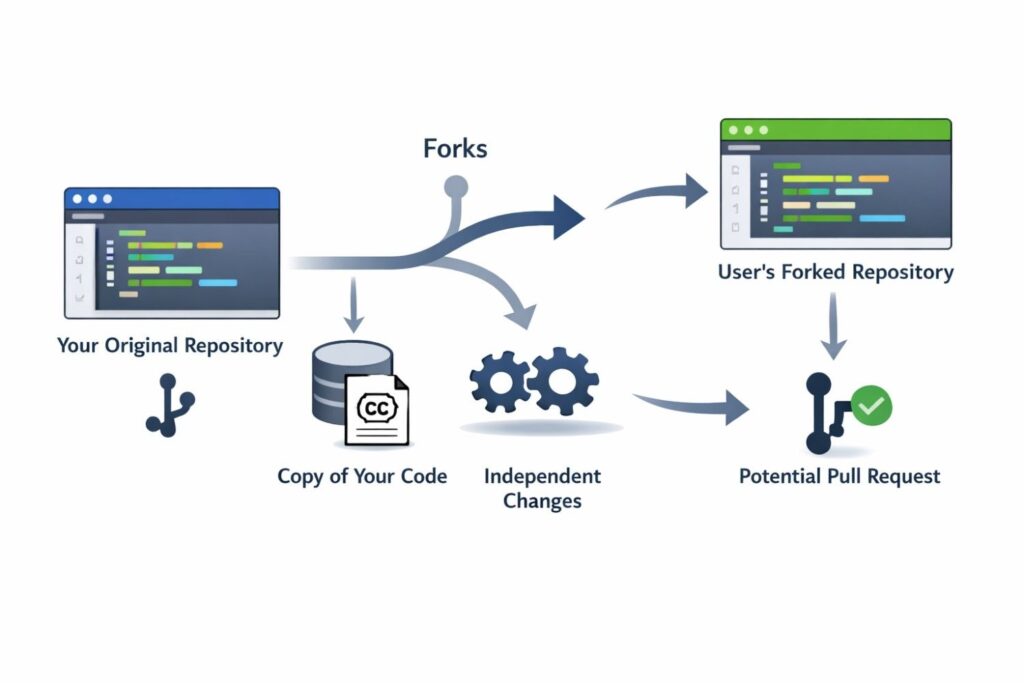
If your setup is weak, you may have no right to pull those ideas back into your product later. That is how founders wake up one day to see a faster version of their own idea competing with them.
Open licenses shape your future more than you think
Many forks happen because code is open. Open code is not bad, but it is precise. Every license sets rules about what others can do and what you can take back.
Some licenses allow almost anything. Others require sharing changes. Some make it hard to protect a future patent.
Founders often choose a license early just to ship faster. They grab one that looks popular and move on. That choice can quietly decide whether your company can ever fully own its core tech.
If a fork builds something valuable and the license blocks you from using it without giving away more of your own work, you lose flexibility at the worst time.
A strong move is to treat license choice like product design. It should support where you want the company to go, not just where you are today. If patents matter to you, the license should not block that path.
If enterprise sales are in your future, your license should not scare buyers. This is a place where founders often guess instead of decide. Guessing is expensive later.
Forks can affect patents before you even file
Here is something many teams miss. A public fork can become public proof. If someone forks your code and adds a new idea, that idea is now visible. If you later try to patent something close to it, timing matters.
Who disclosed first matters. What was public and when matters.
If you plan to patent, forks are not neutral. They change the clock. They change what is considered new. A fork can even create confusion about who invented what if records are messy.
This is why serious teams think about patent timing early and use tools that help them capture inventions while they are still private.
PowerPatent was built exactly for this problem, helping teams file fast while code is still under control. You can see the process at https://powerpatent.com/how-it-works.
Forks can dilute your story to investors
Investors care about defensibility. When they see many forks, they ask quiet questions. Which version is winning. Who owns the best ideas. Can this company stop others from copying the core value.
If you cannot explain how forks fit into your plan, trust drops. Even if your product is strong, messy ownership creates doubt.
Doubt slows deals. A clear story about forks, licenses, and ownership builds confidence. It shows you are not just building, but protecting.
A smart tactic is to document your fork policy early. Decide what you welcome back, what you will never merge, and how you track outside changes.
This is not about blocking the world. It is about showing you are in charge of your own house.
Internal forks are just as risky
Forks do not only come from strangers. They happen inside companies too. A side project by an employee. A prototype built on a weekend. A rewrite done by a contractor on their own repo.
These forks feel safe, but they can be worse because they blur lines.
If that work is not clearly assigned to the company, it may not belong to the company. Even if everyone assumes it does.
Years later, when the company is bigger, that assumption can break deals. Buyers and investors check. They always do.
The fix is boring but powerful. Clear assignment language from day one. Not later. Not when things get serious. Right away.
Every person who touches the code should be aligned. This is easier than most founders think, especially with modern tools that handle it cleanly instead of endless email chains.
Forks change how control feels over time
At first, a fork feels small. One repo. One team. One idea. Over time, forks add up. They pull attention. They pull users. They pull talent. Control slowly weakens without a single dramatic moment.
Strong founders zoom out. They look at how many places their idea lives. They ask who can move fast without them. Then they tighten the core. Not by force, but by structure. Clear ownership. Clear contribution paths. Clear legal ground.
This is where IP strategy stops being a legal topic and becomes a business tool. The goal is not to block forks. The goal is to make sure forks do not block you.
How smart teams stay ahead of forks
The most effective teams plan for forks before they happen. They assume success will attract copies.
They build guardrails that let them stay open without losing control. They align licenses, assignments, and patent plans into one simple system.
They also move fast on protection. Waiting feels easier, but it increases risk. Filing early, even with simple drafts, locks in dates and clarity. This does not require slowing down or spending huge money.
Platforms like PowerPatent exist so founders can protect ideas while building, not after. If this is relevant to you, it is worth understanding how it works at https://powerpatent.com/how-it-works.
Forks are part of modern software. They are not the enemy. But ignoring them is a mistake.
When you understand what really happens when code forks, you can use that knowledge to build stronger products, cleaner ownership, and a company that is ready for scale.
Why Contributions Can Quietly Break Your Ownership
Contributions often feel harmless. Someone fixes a bug. Someone improves performance. Someone adds a small feature and sends a pull request. It feels like help, and it often is.
But from an ownership point of view, every contribution is a fork in disguise. It introduces new authorship, new rights, and new risk if you do not handle it correctly.
This section explains how contributions slowly weaken ownership and what serious companies do to prevent that without killing momentum.
Every contribution creates a new author
The moment someone writes code, they own what they wrote unless they clearly give it to you. This is true even if the contribution is small. Even if it took ten minutes.
Even if it was done with good intent. Ownership does not care about intent. It cares about authorship.
Many founders assume that accepting a pull request means they now own the code. That assumption is wrong. Without a clear agreement, you only have permission to use it under the license rules.
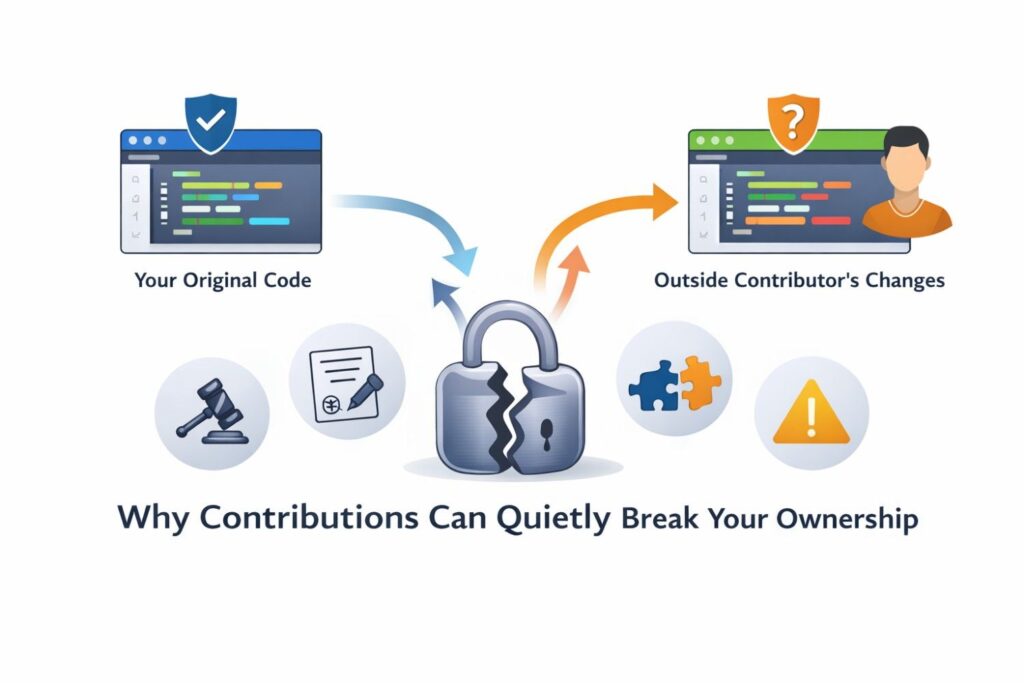
You do not fully own it. That difference may not matter today, but it matters a lot when money shows up.
A clean company knows exactly who authored each part of the system and under what terms it was added. This clarity does not slow teams down. It removes future arguments before they exist.
Good contributors can create bad outcomes
Most contributors are helpful people. They want to support the project, build reputation, or scratch an itch.
None of that protects your company later. If a contributor leaves and later disagrees with how their work is used, unclear ownership becomes leverage against you.
This shows up during fundraising and acquisition. Lawyers ask simple questions. Do you own all of the code. Can anyone claim rights. If the answer is not a clean yes, deals slow or prices drop.
The painful part is that this usually comes from friendly contributions that no one thought twice about. The fix is not to avoid contributors. The fix is to handle them with structure.
Contributor agreements are not paperwork, they are insurance
A contributor agreement is a simple idea. It says that if someone adds code, the company owns it. That is all. It does not need to be scary or complex. It just needs to exist and be used every time.
Companies that wait until later to add contributor agreements often fail. Old contributions remain unassigned.
Tracking people down years later is hard. Some disappear. Some ask for money. Some refuse. This turns a simple fix into a long cleanup.
The smartest move is to treat contributor agreements like version control. Automatic. Expected. Normal. When done early, no one argues. When done late, everyone questions it.
Internal contributions can be even more dangerous
Employees and contractors contribute all the time. Founders often assume employment means ownership.
That is not always true. If agreements are missing or poorly written, parts of the code may belong to the person who wrote them.
This risk increases with contractors, freelancers, and overseas teams. Different laws apply. Assumptions break. A contractor who helped early may still own critical logic years later if assignment was never signed.
The solution is simple but must be consistent. Every person who contributes should have clear assignment terms in place before they write meaningful code. This includes founders. Many founders forget to assign their own work to the company they started.
Contributions can block patents without warning
Patent rights depend on ownership. If someone else owns part of an invention, you may not be able to patent it alone. Or worse, you may patent it and later discover the patent is weak because ownership was split.
Contributions that touch core logic are especially risky. Even a small change can become part of a claimed invention later. If that change came from someone who never assigned rights, the entire patent can be questioned.

This is why strong teams align contribution flow with patent strategy. They capture inventions early. They track who contributed what. They use systems that make this easy instead of relying on memory.
PowerPatent was designed for this exact gap, helping teams document inventions and ownership as they build. You can explore how that works at https://powerpatent.com/how-it-works.
Open source contributions need clear boundaries
Using open source and accepting open contributions are different things. When you accept contributions into your core product, you are blending outside ownership with inside value.
Smart companies draw a line. Some areas are open for contribution. Some are not. Core logic often stays protected.
Extensions and tooling may stay open. This balance lets the community help without owning the heart of the business.
The key is intention. If you do not decide where contributions belong, they will drift into places you later wish they had not.
Documentation protects you when memory fails
Years pass quickly in startups. Early contributors fade from memory. Git history remains, but context is lost. Why a change was made. Who suggested it. Whether there was an agreement.
Documenting contribution terms at the time of contribution solves this. It creates a record that survives people leaving. It gives lawyers clean answers later. It removes guesswork.
This does not require heavy process. It requires discipline. One clear flow, used every time.
Ownership problems rarely show up early
The most dangerous thing about contribution risk is that nothing breaks right away. The product works. Users grow. Revenue grows. Everything feels fine.
The problem appears when stakes are high. When money is on the table. When diligence starts. At that point, fixing ownership is slow and stressful. Preventing it early is calm and cheap.
Founders who think long term handle contributions like they handle security. You do not wait for a breach to care. You build habits early.
Turning contributions into an advantage
When handled well, contributions can strengthen your company. You gain speed. You gain ideas. You gain goodwill. But this only works when ownership is clean.
Clear assignment makes integration safe. Clean records make patents stronger. Strong IP makes fundraising easier. All of this starts with treating contributions as business events, not just code events.

Companies that get this right early move faster later. They spend less time cleaning up and more time building.
The Simple Truth About IP, Ownership, and Assignment
Most founders think IP is something you deal with later. After traction. After revenue. After the product feels real. That belief causes more damage than almost any other early mistake.
IP is not a finish-line task. It is a foundation task. This section explains what ownership really means, how assignment works in plain terms, and how strong teams set this up once so it does not haunt them later.
Ownership is about control, not credit
Ownership does not mean you get your name on something. It means you control how it is used, sold, licensed, or protected. In a company, the goal is simple.
The company should own the core work. Not the founders as individuals. Not employees. Not contractors. The company.
When ownership is split across people, control becomes fragile. Decisions slow. Risk increases. Even if everyone is friendly, unclear ownership creates pressure later when incentives change.
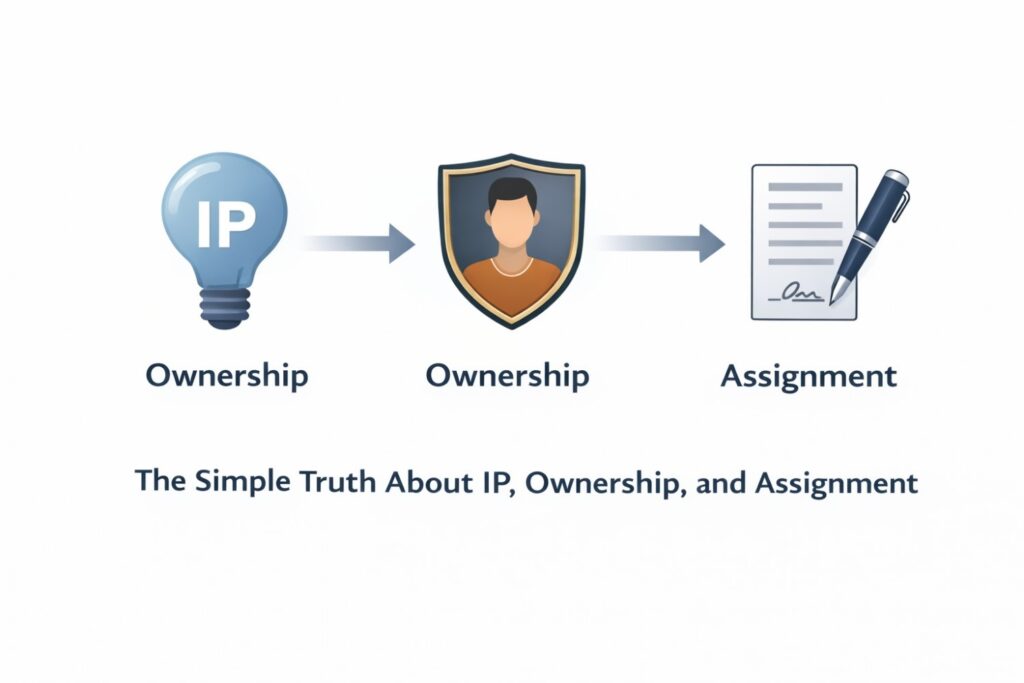
The cleanest companies make one thing very clear. If the work moves the company forward, the company owns it.
Assignment is the bridge between people and the company
Assignment is just a transfer. A person creates something. They assign it to the company. That is it. No tricks. No hidden meaning.
What trips founders up is timing. Assignment must happen before or at the time the work is created. Not years later. Not when a deal appears. Late assignment creates doubt. Early assignment creates certainty.
This applies to everyone. Founders assign their work. Employees assign their work. Contractors assign their work. If someone refuses, that is a signal, not a detail.
Verbal understanding is not enough
Many teams rely on trust. They say things like everyone knows this belongs to the company. That belief does not survive lawyers, investors, or courts.
Only written assignment counts. It does not need to be long. It does not need complex words. It needs to exist and be signed.

Strong founders treat this like source control. If it is not written down, it does not exist.
Founders often forget to assign themselves
This mistake is more common than people admit. Two founders build for months before forming a company. They incorporate later. They assume everything automatically moved over. It did not.
Without founder assignment, the company may not own its own core product. This can block funding and acquisitions instantly.
The fix is simple but must be done intentionally. Founders assign all past and future work to the company as soon as it exists. Waiting creates holes that are painful to explain later.
Contractors require extra care
Contractors are not employees. Laws treat them differently. In many places, contractors own what they create unless there is a clear assignment.
This becomes dangerous when contractors touch core systems. A contractor may hold rights to critical logic without knowing it. Or without caring.
A smart rule is never let a contractor write important code without assignment already signed. Not after the fact. Not in parallel. Before.
IP is bigger than code
IP includes ideas, designs, methods, and systems. Not just files in a repo. If someone helps design how something works, that can be IP. If ownership is unclear, rights are unclear.
This matters for patents. Patents protect ideas, not just code. If someone contributed to an idea and never assigned it, patent rights may be shared or blocked.
Teams that want strong patents think about ownership at the idea stage, not just implementation.
Assignment strengthens patents and valuation
Clean assignment makes patents stronger. It shows clear chain of ownership. Investors and buyers love that. It reduces risk. It speeds deals.
Messy assignment does the opposite. It creates questions. Questions reduce value. Even great technology loses leverage when ownership is unclear.
This is why modern teams combine IP strategy with tooling that keeps assignment clean as they build.
PowerPatent supports this by aligning invention capture, ownership, and patent filing into one flow. You can see how it works at https://powerpatent.com/how-it-works.
Clean ownership reduces future conflict
People leave companies. Relationships change. Clean assignment keeps things calm when that happens. It prevents arguments. It prevents surprise claims. It protects the company without attacking anyone.
This is not about distrust. It is about clarity.
Early setup saves massive time later
Fixing ownership after the fact is slow. Tracking down signatures. Explaining context. Negotiating retroactive terms. All of that steals focus from building.
Setting it up early takes little time. It becomes background noise. One less thing to worry about.

Founders who understand this do not fear IP. They use it as a tool. They move faster because the ground beneath them is solid.
How Smart Founders Protect Their Work Without Slowing Down
Founders often believe protection and speed are opposites. They think if they stop to think about IP, assignments, or patents, momentum will die. The best companies prove the opposite.
They protect early so they never have to stop later. This section shows how experienced founders build simple habits that keep ownership clean while the product keeps moving.
Protection works best when it runs in the background
The smartest founders do not treat IP as a big event. They treat it like infrastructure. Something that runs quietly while the team builds.
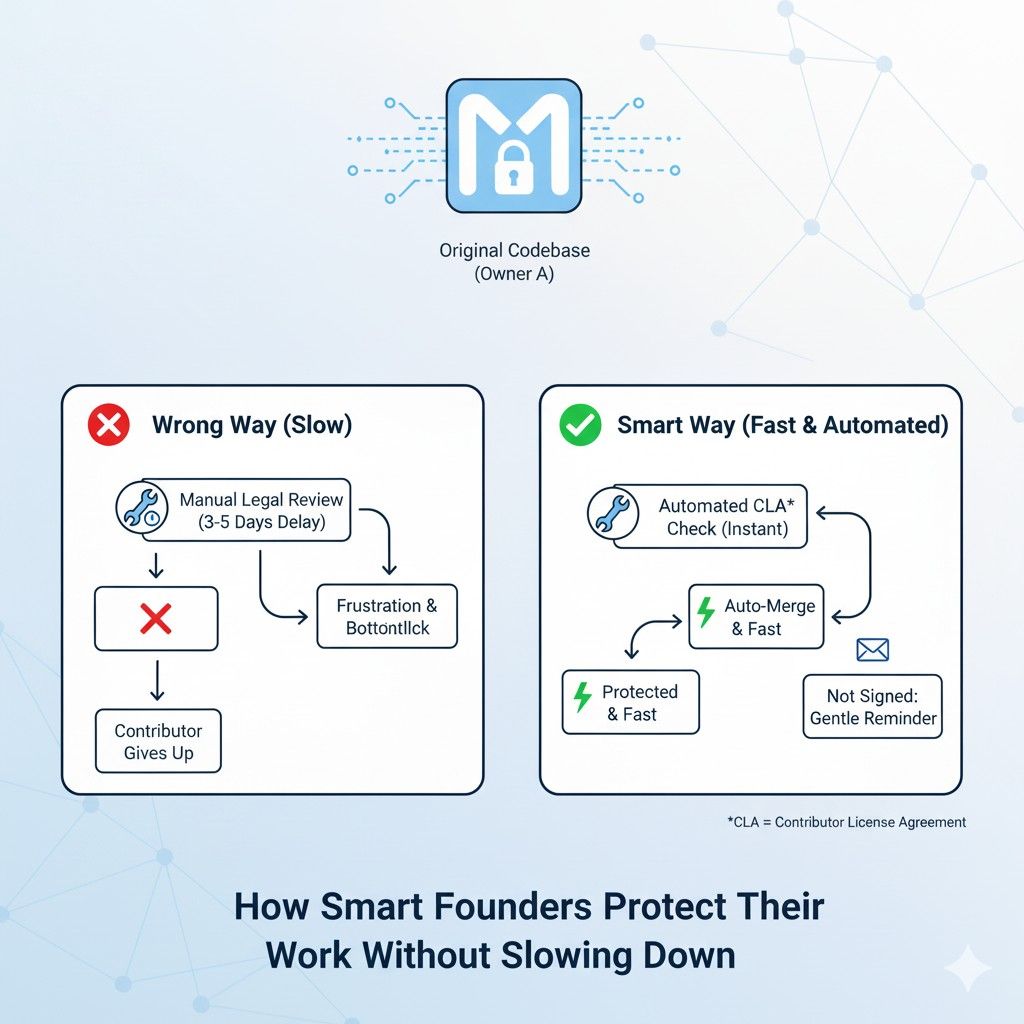
When protection is baked into normal workflows, it stops feeling like work. Contributors sign assignment before writing code.
Founders document ideas as they appear. Invention records happen alongside product notes. Nothing dramatic. Nothing slow.
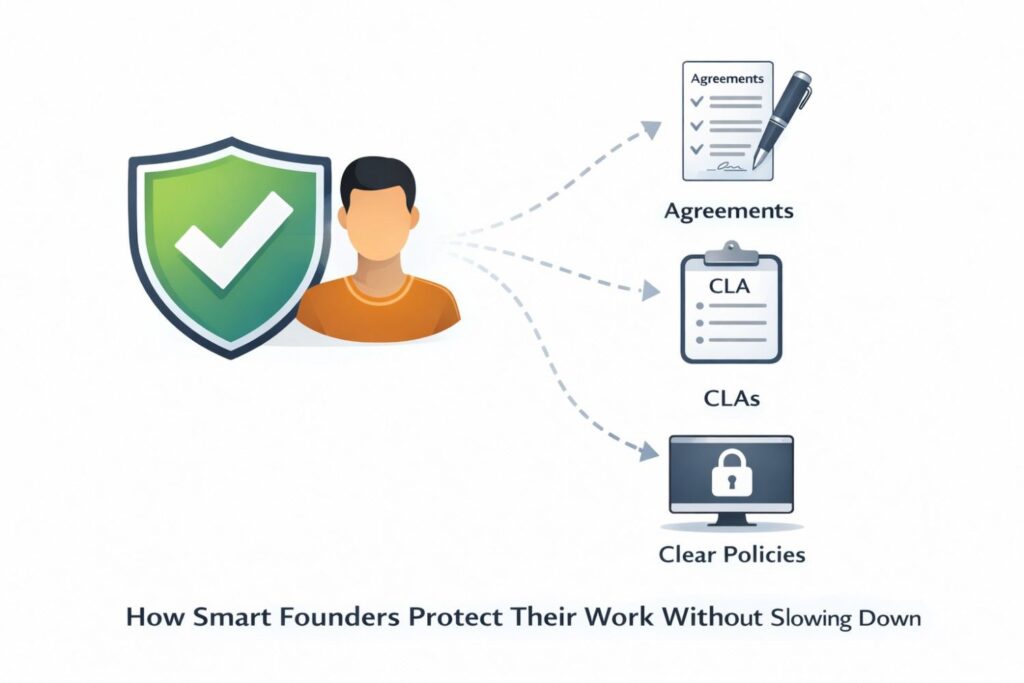
The mistake is waiting until protection feels urgent. By then, it is disruptive. Early setup avoids that.
Speed comes from clarity, not shortcuts
Shortcuts feel fast. Skipping agreements. Delaying filings. Ignoring ownership. These save minutes now and cost months later.
Clarity creates real speed. When everyone knows the rules, decisions are quick. There is no debate about who owns what. No pause to clean up history. No fear of hidden risk during growth.
Strong founders optimize for clarity, not avoidance.
Early invention capture changes everything
Ideas move fast. Teams forget who suggested what. Whiteboards get erased. Slack messages vanish.
Capturing inventions early solves this. It locks in dates. It records contributors. It preserves the story of how something was built. This becomes powerful when filing patents or answering diligence questions.
Modern platforms make this easy. Instead of long meetings or legal emails, teams capture ideas in simple language as they build.
PowerPatent was designed around this reality, helping founders protect ideas without pulling them away from product work. If this matters to you, you can see the flow at https://powerpatent.com/how-it-works.
Filing early does not mean filing perfectly
Many founders delay patents because they think everything must be final. That belief is wrong. Early filings can be rough. They can evolve. What matters is locking in priority while the idea is still yours.
Early filing gives you time. Time to refine. Time to learn. Time to build before others catch up. Waiting gives away that advantage.
Smart founders file early and improve later.
Patents and open work can coexist
Being open does not mean being exposed. The best companies know which parts to share and which parts to protect.
They open tools, integrations, or examples. They protect core systems and methods. This balance builds community without giving away the engine.
Patents make this safer. They let you share without losing leverage. They let you talk without fear.
Investors notice quiet discipline
Investors rarely praise IP early. They just notice when it is missing. Clean ownership, early filings, and clear contribution rules signal maturity.
These signals reduce friction. They speed checks. They build trust. Often without a single meeting about IP.
That is the power of doing this right early.
Protection supports confidence, not fear
The goal of IP is not to threaten others. It is to give your team confidence. Confidence to share. Confidence to hire. Confidence to partner.
When protection is handled well, it disappears from daily stress. It becomes part of the foundation, like servers or payments.
A simple system beats constant cleanup
The best founders build one system and stick to it. One flow for assignments. One place for invention capture. One strategy for filings.
They do not reinvent this every year. They do not patch it during crises. They set it once and move on.
This is why platforms like PowerPatent exist.
To replace messy, manual processes with something founders can trust while staying focused on building. You can explore how that system works at https://powerpatent.com/how-it-works.
Protecting work is part of building the company
Your product is not just what users see. It is the ideas underneath. The methods. The systems. The things that make it hard to copy.
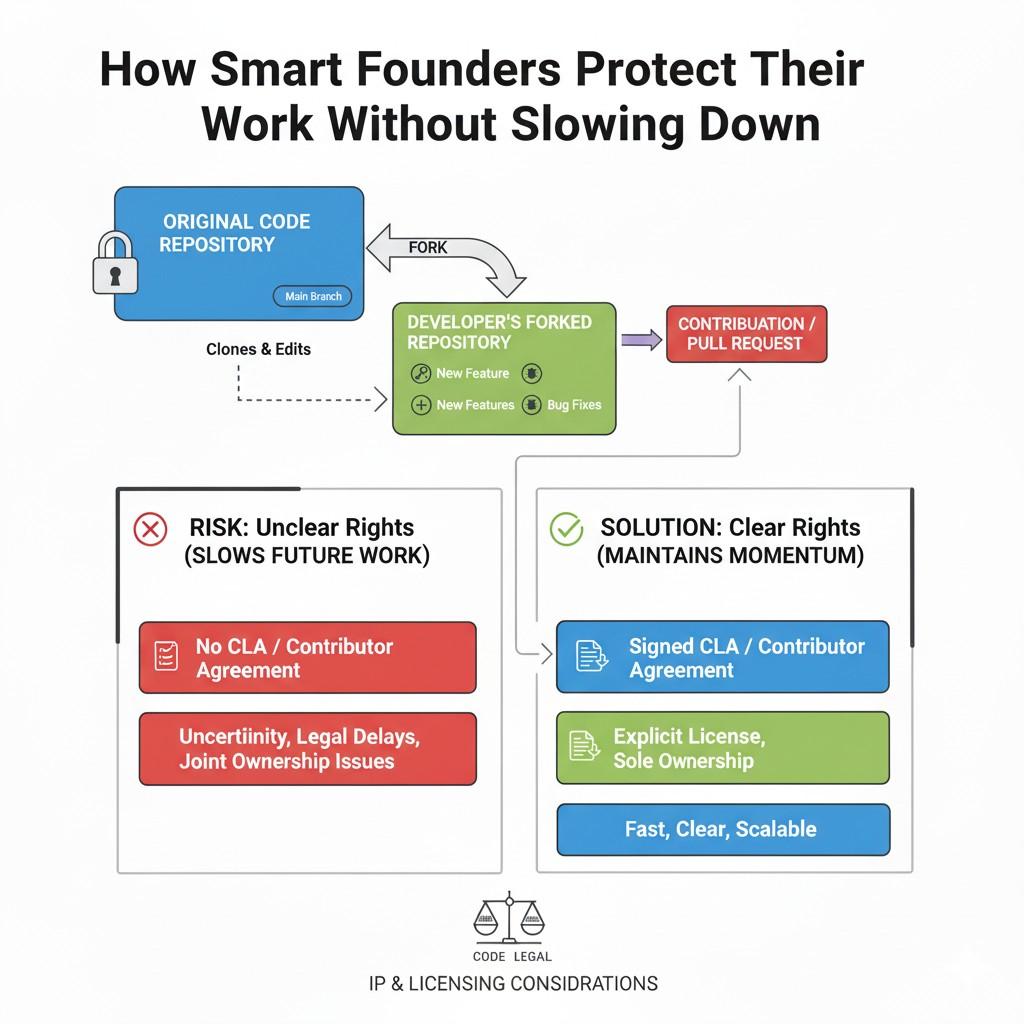
Protecting those things is not a distraction from building. It is part of building.
Wrapping It Up
Forks, contributions, ownership, and assignment are not edge cases. They are everyday realities for modern software companies. Ignoring them does not make them go away. It just delays the moment when they become expensive.
The strongest founders handle these issues early, quietly, and with intention. They assume success will attract forks. They expect contributions. They plan for growth before it happens. By doing this, they keep control without creating friction. They build trust with investors without long explanations. They protect future options without slowing today’s progress.
Leave a Reply